Tuesday, August 10, 2021


Alberta First Nation teams up with tech company to build net-zero power plant

'This announcement demonstrates Indigenous leadership in Canada’s energy transition'

NET Power’s plant in La Porte, Texas, is seen in this photo. The company's test facility started generating power in 2018. (NET Power)

Work is under way to build what officials say will be the first net-zero natural gas-powered electricity plant in Canada.

Frog Lake First Nation, east of Edmonton, has partnered with Kanata Clean Power and Climate Technologies to use NET Power's patented technology to build the plant. 

It will use natural gas and pure oxygen to generate electricity, with the resulting CO2 recycled through a combustor, turbine, heat exchanger and compressor — finally generating power without emissions, according to the companies.  

Chad Gvozdenovic with Kanata Clean Power said he believes the technology is a game changer for both the province and the country.

"This will allow our transition and will support renewables with firm dispatchable 24/7 power, so we will allow renewables to penetrate really deeply in our electricity system," he said.

Frog Lake's NET Power plant will generate 300 megawatts of electricity, and produce water for 15,000 households. The clean water is a waste product of the process. 

Kanata says the project development is underway with construction expected to start in 2023 and power production to start by 2025.

"This announcement demonstrates Indigenous leadership in Canada's energy transition," said Frog Lake Chief Greg Desjarlais in a release. 

"We are now developing net zero infrastructure that will demonstrate our leadership, addressing climate change using technology that will help decarbonize Canada's economy."

A 50-megawatt plant using the same technology is already in operation in La Porte, Texas. Four others in the United States and United Kingdom are also in development.

Great Britain's First Black Olympic Swimmer Is Hopeful Swimming Caps For Black Hair Will Be Approved For The Next Games

“I know a lot of people want to be on the right side of history with this. So I'm very optimistic that there's going to be a positive outcome from it.”

Posted on August 9, 2021

David Davies - Pa Images / PA Images via Getty Images


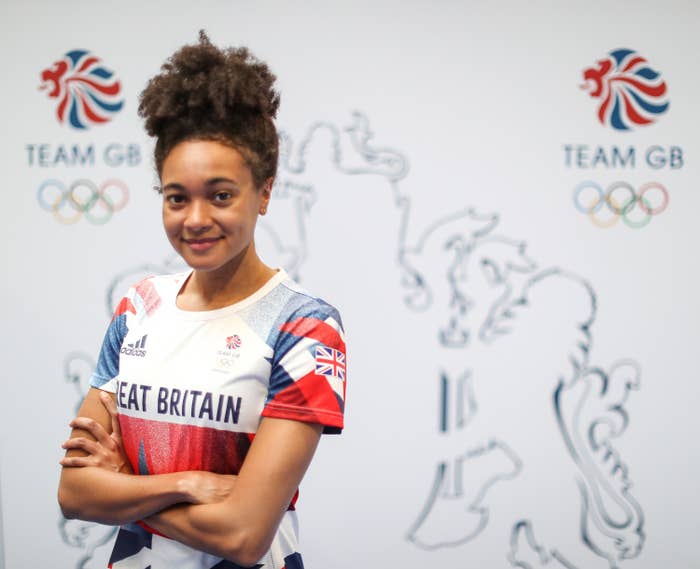
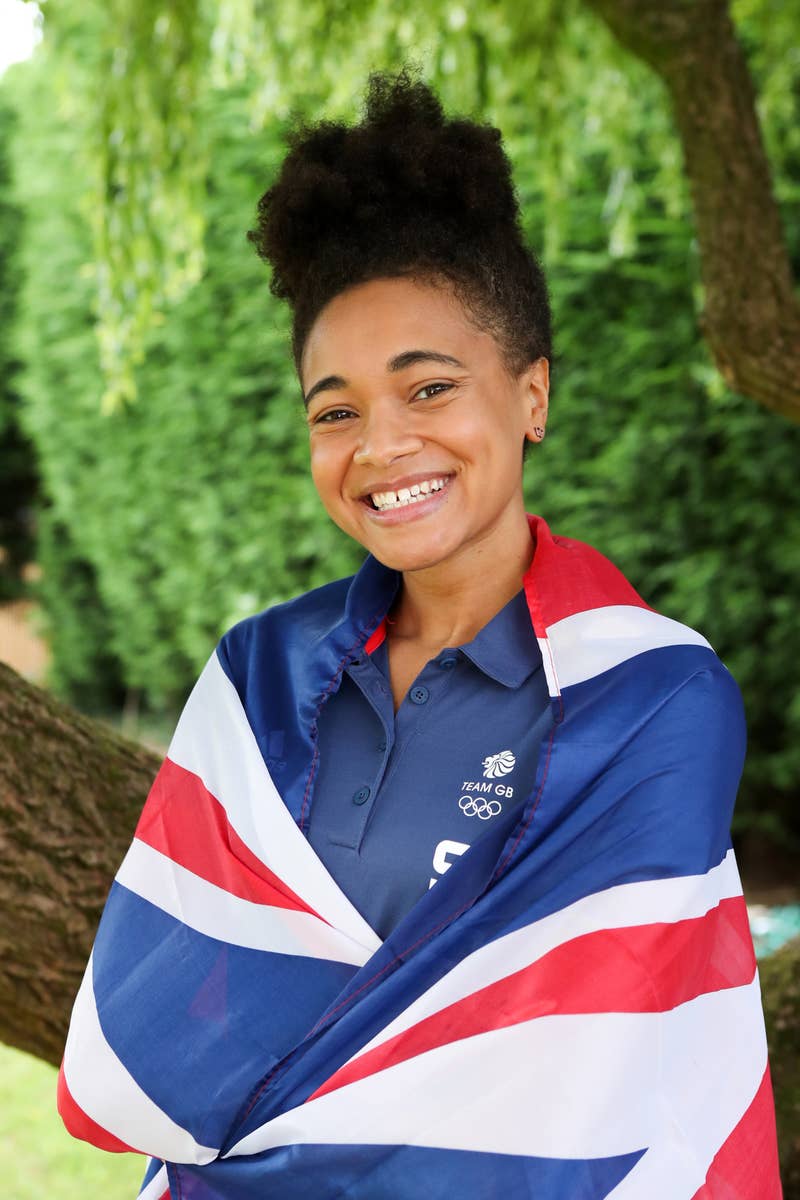
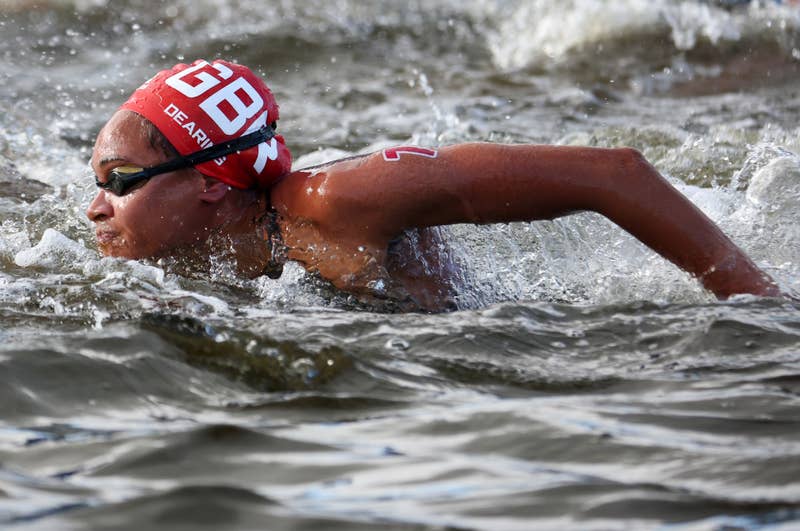
Alice Dearing, the UK’s first Black Olympic swimmer, wants organizers for the next Games to approve swim caps that better accommodate Black hair.

Dearing is one of four Black people who set up the Black Swim Association in the UK, which aims to make swimming more accessible for ethnic minorities, and told the BBC in 2019 that she understands why Black swimmers would quit over their hair.

One of the barriers many Black women face is a way to swim while maintaining the health of their natural hair. Many swim caps are too small for protective styles such as braids and locs.

"It sounds ludicrous, but it can be really damaging to your self-image and confidence as chlorine wrecks hair,” Dearing told the BBC, “but it's even harder for girls with thicker hair, which the majority of Black girls have."

The International Swimming Federation (FINA) rejected an application by Soul Cap, which makes swim caps designed for Black hair, for approval for Olympic athletes to wear their caps in competitions. FINA said the caps are unsuitable because they don't follow "the natural form of the head."

Following widespread coverage and rallying from the public online, FINA reached out to Soul Cap to apologize and offer them help with their application to become approved for international competition, including the next Olympic Games.


Instagram: @soulcapofficial


Dearing told BuzzFeed News that she is hopeful that the Black swim caps will eventually be approved.


“I'm really excited,” she said. “I think this will probably go through and go forward and be usable at international competitions. I really hope so.

“I know a lot of people want to be on the right side of history with this. So I'm very optimistic that there's going to be a positive outcome from it.”

Dearing said that a lot of organizations need to be educated and she is glad that they’re listening.

“It's not just being thrown to the side like as potentially it has been done in the past,” she said. “I'm not insinuating that any organization would do this on purpose, but decades ago this stuff wouldn't have been so mainstream, it wouldn't have been so seen and recognized.”

Dearing said she learned to swim at around 5 years old, getting into competitive swimming at the age of 8 after her mom saw an advertisement for a local swimming club.


Morgan Harlow / Getty Images

Dearing and her brother took swimming lessons together and she said watching competitions was a family activity.

“We would record them, rewatch them, like, it was like a proper family thing with me, my mum and one of my brothers,” she said.

Fast-forward a few years and Dearing herself has swum in those competitions and qualified for the Tokyo Olympics. Although she came in 19th place, her participation is still historic as the first Black swimmer for the Team Great Britain.

Dearing also cofounded the Black Swimming Association, which aims to encourage and diversify the people who swim in the UK. Dearing said she wants to give back to the sport as it has given her so much good in her life.

“I want other people to know those opportunities are available to them, and not kind of be pigeonholed into something because of their race or because society thinks that that's what they should do," Dearing said.

Dearing has also become a role model to many. She said it’s not something she thought she could be and said it is surreal. “It's just kind of like, I'm just the girl from Birmingham, just a girl from the Midlands in England,” she said. “So it's something that's kind of crazy. You never really think you're in that position to help influence or help inspire or change someone's life in such a positive way.”

Although Dearing is one of the few Black swimmers known internationally, she said that In the swimming community she was not always the only non-white swimmer.

As she got older she started to hear whispers of people saying that Black people don’t swim and people appeared to be surprised that she swam.

“We always laughed it off because my mum, my mum's from Ghana originally, she grew up swimming and it was part of her lifestyle,” Dearing said. “This isn't just a joke like this is actually affecting people's lives and affecting the choices that they make on a daily basis. That's why I'm so passionate about that.”

Dearing said that while she isn’t very happy with her Olympic performance, she has been getting messages of support.

“Literally everybody else is just like, well done for getting there in the first place, well done for standing up, and having these conversations being part of something that's bigger than yourself and advocating for change,'' she said.


P&G
Dearing is one of the athletes participating in Procter & Gamble’s Athletes for Good Fund, which gives 52 athletes $10,000 for initiatives for their local communities.

“It's been so overwhelming, like so many strangers messaged me, too many that I can't even reply to,” she said. “But you know, I can really feel that I'm supported and uplifted by all these people. And it's a feeling that I'll never forget, honestly, it's just so powerful. I'm so honored that people have really taken the time out to support me.”

Dearing said she didn’t get a chance to see any of the live competitions when the Olympics were in the UK, but she is excited for the Paris Games as it is so close to home.

“Obviously, I'm just kind of annoyed and I never appreciated that London 2012 whilst it was around, but having kind of, like, a kind of a second chance with Paris ... I'm really excited for, hopefully, that opportunity to compete as an athlete there as well.”


Clive Rose / Getty Images


Ikran Dahir is a reporter for BuzzFeed News and is based in London.
Simone Biles Said Putting Her Mental Health First At The Olympics Will Likely Be One Of Her "Greatest Accomplishments"

"To have mental health be talked about more in sports is really nice because at the end of the day, we are humans before athletes," Biles said.

Stephanie K. BaerBuzzFeed News Reporter
Posted on August 8, 2021

Xavier Laine / Getty Images
Simone Biles smiles at the women's balance beam final in Tokyo on Aug. 3.

Simone Biles said that her decision to withdraw from several events at the Olympics to focus on her mental health will likely go down as one of her "greatest accomplishments."

Biles reflected on her experience in Tokyo during a Zoom call Saturday with President Joe Biden, first lady Jill Biden, and fellow Team USA athletes.

"The Olympics was not how I expected it to go, but putting my mental and my physical health first will probably be one of my greatest accomplishments," Biles said.

Speaking from his home in Delaware, the president congratulated the Olympic athletes for their performance. He also thanked them for representing the US in the Summer Games, saying they made him and the country proud.

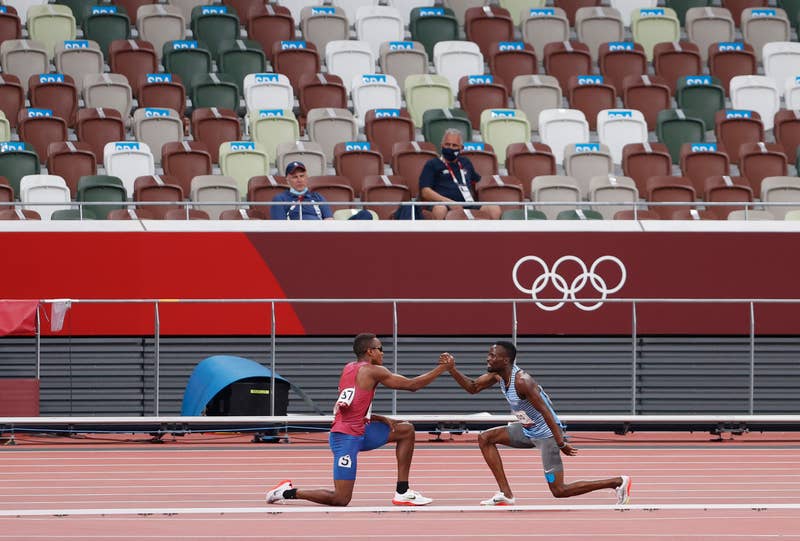
"When you get knocked down by an opponent on track and you stop and go back and pick him up and walk to the finish line with him, c’mon. That’s what America’s supposed to be about," Biden said, referring to the moment US runner Isaiah Jewett and Nijel Amos of Botswana fell during the 800-meter race, then helped each other up and jogged to the finish line together.


Oliver Weiken / Picture Alliance via Getty Images
Isaiah Jewett of the US and Nijel Amos of Botswana

"You represented every single thing that we stand for," Biden added. "You really did."

The president also specifically called out swimmer Katie Ledecky and Biles for the courage they showed while under so much "psychological pressure."

Jewett and Biles then shared their reflections on the difficult moments they faced during the competition.

"At the end of the day, we’re all people and we all go through the same nervousness, and we all go through the same pains, so might as well finish what we started," Jewett said.

Biles, who left in the middle of the gymnastics team final and backed out of the individual all-around competition to focus on her mental health, said that earlier in her career, she would probably have been "too stubborn" to take a step back. The 24-year-old added that she was proud of the way her teammates handled her withdrawal during the team final.

"To have mental health be talked about more in sports is really nice because at the end of the day, we are humans before athletes," she said.

After missing several events, Biles — the most decorated gymnast in the world — returned to the competition Tuesday for the balance beam final and won the bronze medal.

Biden said Biles' choice to prioritize her mental health on the biggest stage in the world set an important example for so many people — not just athletes.

"And guess what? You got back up on that damn beam," the president said before joking about his own athleticism. "I tell you what — doing a flip on a 4-inch beam is my idea of going to purgatory. I'd try most anything else before I’d try that."


MORE ON THIS
Simone Biles Won A Bronze Medal In Her Olympic ReturnIkran Dahir · Aug. 3, 2021
Simone Biles Explained Exactly What Happened During Her "Petrifying" Vault After Previously Saying She Could "Literally Die" If It Went WrongBen Henry · July 30, 2021
What Simone Biles Did At The Olympics Is RevolutionaryElamin Abdelmahmoud · July 28, 2021
Simone Biles Pulled Out Of The Women’s Gymnastics Team Final Due To Mental Health ConcernsAde Onibada · July 27, 2021


Stephanie Baer is a reporter with BuzzFeed News and is based in Los Angeles.


SHE WAS AN ASYLUM SEEKER
A 37-Year-Old Nicaraguan Woman Died In ICE Custody After Testing Positive For COVID-19
FROM ORTEGA'S NICARAGUA
The woman died in a Texas hospital after crossing the border last week.

Hamed AleazizBuzzFeed News Reporter
Posted on August 4, 2021

Chris Carlson / AP
An ICE processing center

A 37-year-old Nicaraguan woman who crossed the border last week and said she was fearful of being transferred to her home country died in ICE custody on Tuesday after testing positive for COVID-19, according to government documents obtained by BuzzFeed News.

The woman was arrested by Border Patrol agents who transferred her to ICE custody. She later tested positive for COVID and was brought to a hospital in Harlingen, Texas. The cause of death had not yet been determined, according to the documents.

ICE officials did not immediately respond to a request for comment.

Several people in ICE detention have died after testing positive for COVID since the beginning of the pandemic. The woman also appears to be the fifth person to have died in ICE custody this fiscal year, which started Oct. 1. In the previous fiscal year, which ended Sept. 30, 21 immigrants died in ICE custody, the highest number since 2005. Late last year, an immigrant in ICE custody in rural Mississippi died of a heart attack after staff did not send him to the hospital for urgent medical care, according to a draft inspector general’s report obtained by BuzzFeed News.

As of this week, it was reported that over 22,000 immigrants in ICE custody had tested positive for COVID-19 since the beginning of the pandemic. The agency is detaining more than 25,000 immigrants across the country.

In September, the House Oversight Committee found that ICE detainees had died after receiving inadequate medical care and that jail workers had “falsified records to cover up” issues. That same month, the House Homeland Security Committee released a report that found people detained by ICE are often given deficient medical care, and that detention centers use segregation as a threat against immigrants.

ICE has publicly insisted that its detention facilities, as well as those that are operated by private, for-profit corporations, provide thorough and adequate medical care to all detainees. Agency officials have repeatedly said that it takes the health and safety of detainees very seriously and that while deaths are “unfortunate and always a cause for concern,” they are “exceedingly rare.”

A senior DHS official told a federal court judge this week that the Department of Homeland Security was "likely to have encountered about 210,000 individuals in July" — the highest monthly number since 2000. "July also likely included a record number of unaccompanied child encounters ... and the second-highest number of family unit encounters,” the official added.
Frida Kahlo: new book highlights lesser-known works

A new, curated compilation of the Mexican artist's 152 paintings — including lost and lesser-known pieces — focuses on Kahlo and the stories behind her works.


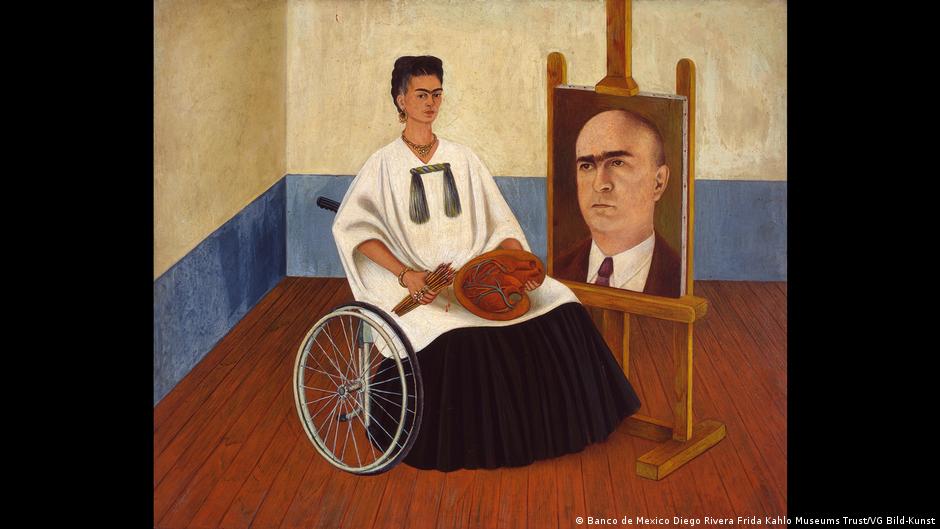
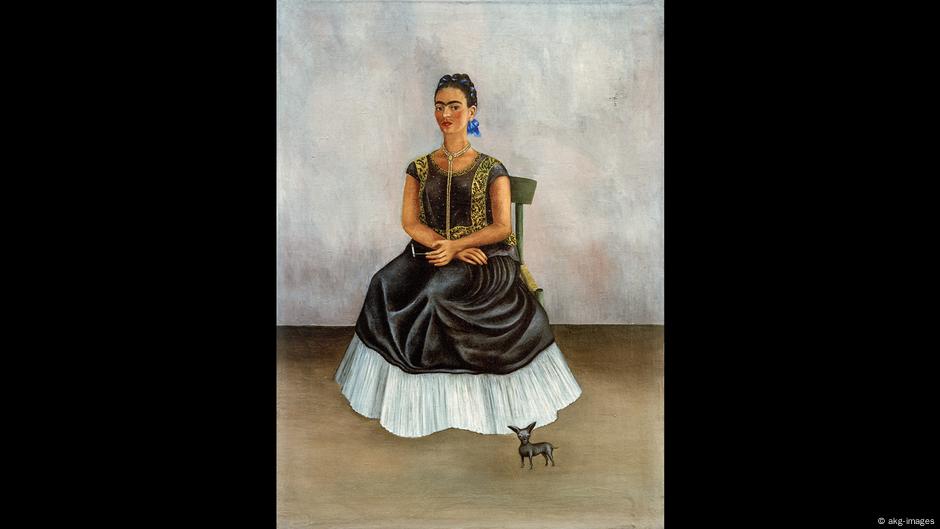
'Self-portrait with Dr Farill' is the last self-portrait to which Kahlo added her signature


In 1951, Mexican artist, Frida Kahlo wrote in her diary: "I've been unwell for a year. Seven operations on my spine. Dr. Farill saved me. He gave me back my joy in life. I'm still in a wheelchair and I don't know how soon I'll be able to walk again… But I do want to live. I've already started the little painting I'm going to give Dr. Farill and am doing it for him with the utmost affection."

That "little painting" is the picture you see above. It would also prove to be the last self-portrait Kahlo painted to which she added her signature.

But who was this Dr Farill? Why is Kahlo dressed the way she is? What has Catholicism got to do with that palette on her lap? Wait, is that a palette or a heart?

Have these questions prompted you to look closer?


A pencil sketch by Kahlo that is a departure from the lush colors typically attributed to her

Shedding light on Frida's lesser-known works

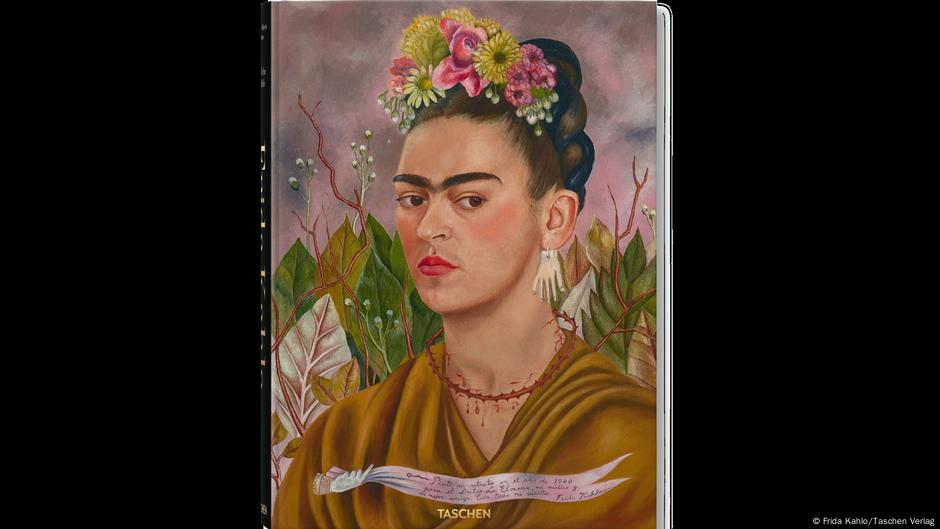
The answers lie in an expansive book on her works titled, Frida Kahlo: The Complete Paintings, published by Taschen.

Triggered by the lack of comprehensive art history on Kahlo's work, Mexican art historian Luis-Martin Lozano and his co-authors Andrea Kettenmann and Marina Vazquez Ramos embarked on this ambitious project to give people a deeper understanding of Kahlo, the artist.

"First of all, who was she as an artist? What did she think of her own work? What did she want to achieve as an artist? And what do these paintings mean by themselves?" Lozano said about the focus of his book in an interview with the BBC.

He added that some of her works have "amazingly" never been written about. "Never, not a single sentence!" Others were either wrongly titled or dated. "It's a mess as far as art history is concerned," Lozano said.

His book is a study of each of Kahlo's 152 paintings done between 1924 and 1954, identified by their origins and exhibition history. Paintings that were destroyed or whose present whereabouts are unknown are identified only by photographs.


Frida Kahlo: The Complete Paintings includes previously unseen or overlooked works by the artist (Credit: Taschen)

Beyond her renowned portraits


Mention Frida Kahlo, and chances are her arresting self-portraits come to mind first: the one in which she stares unflinchingly at the viewer, clad in traditional Mexican garb and eye-catching accessories, braided hair worn up and adorned with flowers, her trademark unibrow and hint of mustache bucking conventional beauty ideals.

Forming a third of her entire works, these self-portraits — sometimes her unibrow alone suffices — have long been money-spinners, adorning assorted paraphernalia from flowerpots to yoga cushions to yes, even face masks, as collectibles for Frida fans.

Much has also been documented about Kahlo's life-altering accident at age 18, which saw her bed-ridden, bored and turning to art for emotional release; her rocky relationship with fellow Mexican artist Diego Rivera, which involved infidelities on both sides and, in her case, with both sexes; her heartbreak at motherhood eluding her; her passion for flora and fauna; and her inimitable style influenced by her Mexican heritage and her fierce individuality.

Labeled and embraced by turns as a style/feminist/LGBTQ/cult icon, Kahlo's storied life ironically tended to divert attention from her journey as an artist and the history behind her art, Lozano feels. People either viewed her paintings through the lens of her publicized private life or are overwhelmingly drawn to her better-known pieces.


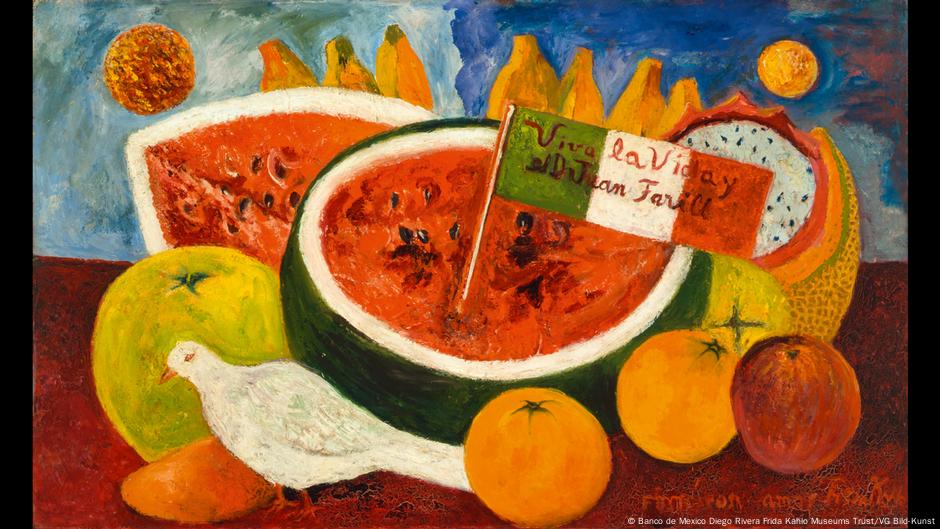
Kahlo dedicated and gave this still life to her surgeon, Dr. Juan Farill whom she highly respected

More than meets the eye


Totaling 624 pages, this tome is an eye-opener not just for fans but also for the uninitiated.


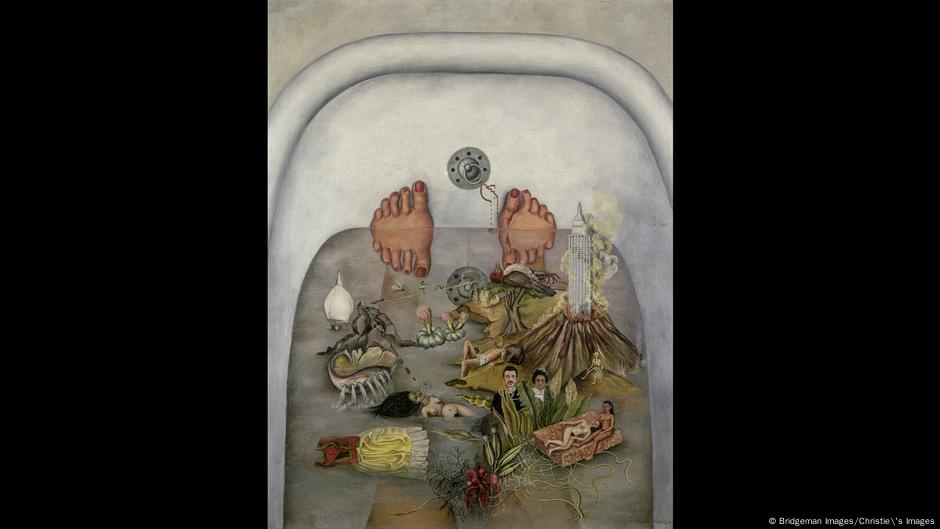
Readers may be surprised by many of her lesser-known or overlooked works "that may not be associated with Kahlo," in Lozano's words. These include pencil sketches such as Showing the Scar (1938), still-life paintings including Long Live Life (1953), surrealist pieces like What the Water Gave Me (1938-39), and early portraits that differ in style and rendition from her renowned later, lusher works.


"What Water Gave Me" suggests self-analysis begins in the womb and is fed by life's memories

However, the heart of this book is the catalog that runs over 100 pages, where Lozano and his colleagues have painstakingly researched the history and context, and sometimes even the timelines of ownership of Kahlo's works.

Accompanying interviews, newspaper articles, photographs, notes, diary pages and personal letters in Kahlo's own handwriting flesh out the stories surrounding her pieces.
Unvarnished stories

What emerges are stories that sometimes reveal the mundane in an artist's life. For instance, that the painting Ixcuhintli Dog with Me (Self-portrait with Xoloitzcuintli Dog) that she painted around 1938, had been painted over a previous picture.

Piecing together other circumstances in her life then, historians speculate that she reused the canvas as money may have been tight and she may have been pressed for time to deliver pieces for an exhibition.

X-ray photograpy of "Ixcuhintli Dog With Me (Self-portrait With Xoloitzcuintli Dog)" reveals an earlier painted-over piece underneath

Consider the other piece that she bequeathed to her beloved orthopedic surgeon, Dr. Juan Farill, titled Still Life (Still Life Dedicated to Dr. Juan Farill). On the little Mexican flag pierced into the watermelon she had written, "Long live life and D Juan Farill."

Older photos of the piece reveal that she had originally written "Juanito" — a more informal way of addressing people in Spanish. However, she might have had second thoughts about being over-familiar with a man she highly respected, and thus painted over it resulting in a slightly smudged dedication.

Furthermore, the wealth of information on religious and cultural symbolism in her choice of colors, clothing, subject positions, fruits, animals, draw attention to the tiniest details, adding further layers to appreciating her art.

In all, the book underscores the journey of an art icon, who at the core was human and who sublimely captured her humanity on canvas.
HINDU NATIONALISM IS MODERN ARYAN FASCISM
India: New temple-mosque conflict brewing in Varanasi

The existence of Gyanvapi mosque in Varanasi has been challenged in court by Hindu nationalists, who argue that it was built after tearing down an iconic Hindu temple.
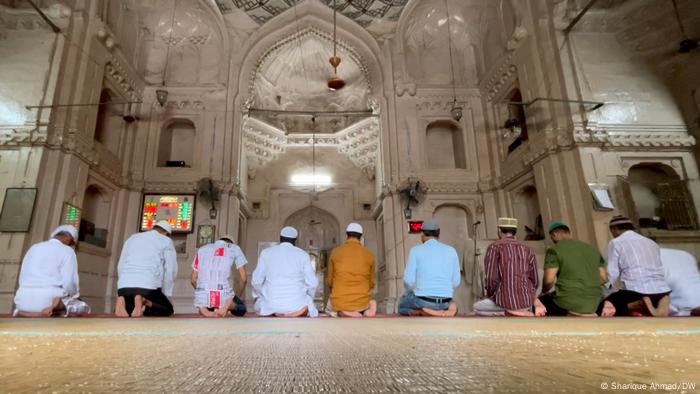


The Gyanvapi mosque is located in the heavily guarded heart of the temple town of Varanasi in the state of Uttar Pradesh

It's the afternoon call to prayer at the Gyanvapi mosque in the northern Indian state of Uttar Pradesh.

The handful of men there, kneeling, are dwarfed by the massive 17th-century structure, their soft words nearly drowned out by the steady hum of the low ceiling fans.

It's a moment of peace and reflection, before the men step back out into an ocean of chaos. They are, after all, in the heavily guarded heart of the temple town of Varanasi, and the heart of a religious dispute that has been brewing for decades.

The existence of Gyanvapi mosque has been challenged in court, over allegations that it was built after tearing down an iconic Hindu temple.

The petitioner wants the land to be restored to the Hindus, so a temple can be built in the place of the mosque.

It is a familiar dispute for many Indians — a similarly controversial mosque once existed just 200 kilometers (125 miles) from this one and became the epicenter of a decadeslong standoff between Hindus and Muslims in the country.

The Babri mosque in the city of Ayodhya was torn down by Hindu mobs in December 1991, catapulting the Hindu nationalist Bhartiya Janata Party (BJP), currently ruling India, into national prominence.

Almost three decades later, the Supreme Court of India awarded the disputed land to the Hindu side.

Watch video03:39 India: Gyanvapi mosque dispute raises concern

'This is not Ayodhya'


SM Yaseen, a member of the Varanasi mosque's board, is undaunted by this verdict. Yaseen runs a woodwork shop but keeps copies of the Indian constitution and earlier Supreme Court judgments at hand to firmly make his point.

"This is not Ayodhya," he says emphatically. He explains that the Muslim side is better organized, better prepared to litigate, and more sizable and affluent in Varanasi, in comparison to the Muslims who lived alongside the Babri mosque.

"We accepted the Ayodhya verdict with heavy hearts, hoping there won't be fresh trouble in the future," says Yaseen. "But if they are insistent on filing cases, we'll fight them. I just hope this does not leave the courts and spill out onto the streets."

The threat of religious violence hangs heavy in the memories of most Indians of Yaseen's generation.

More than 2,000 deaths were recorded in the riots that broke out across the country after the Babri mosque's demolition.

And frequent clashes between Hindus and Muslims have disturbed communal harmony and contributed to mistrust and prejudice between the two biggest religious communities in the country.

But the disputes have also been a rallying cry.

The promise to build a temple to the Hindu god Ram in the Babri mosque's stead featured prominently in the BJP's manifestos in the last two general elections.

The party scored stunning victories in both elections.
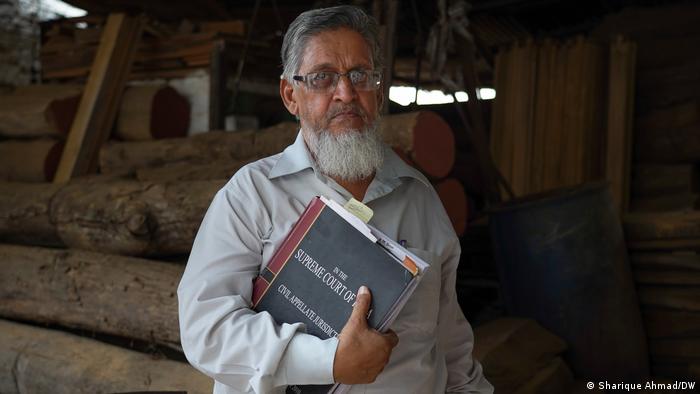

"We accepted the Ayodhya verdict with heavy hearts, hoping there won't be fresh trouble in the future," says Yaseen

BJP in need of a new rallying cry?


"A whole generation of politicized Hindus were mobilized around the Babri issue," says Kapil Komireddi, the author of Malevolent Republic, which chronicles the rise of Hindu nationalism in India. "Now, that cause needs to be kept alive."

Prime Minister Narendra Modi's government has already delivered on another key promise to remove the special constitutional status of Kashmir, India's only Muslim-majority state.

It also introduced a controversial amendment to the nation's citizenship law, which was widely criticized for being anti-Muslim.

These measures, along with the promised Ram temple under construction in Ayodhya, mean that the BJP may need a new rallying point, says Komireddi.

Now, petitions similar to the one in Varanasi have also been filed against mosques in the cities of Mathura and Agra in Uttar Pradesh state.

The Hindu petitioners insist that the sites have been desecrated and must be restored to Hindu worshippers.

"The Muslims destroyed this blessed site and built a mosque on it to establish their own religion," Vijay Shankar Rastogi, the lawyer fighting the case against Varanasi's Gyanvapi Mosque, told DW. "I filed this public interest suit on behalf of all the Hindus of this country, against all the Muslims."

Rastogi, who is representing the temple as a "friend" of the deity, was just 35 years old when he first filed the original petition against the mosque in 1991. Three decades later, he filed a fresh petition asking for an archaeological survey of the site, as he is convinced that a temple's remains will be found under the mosque.
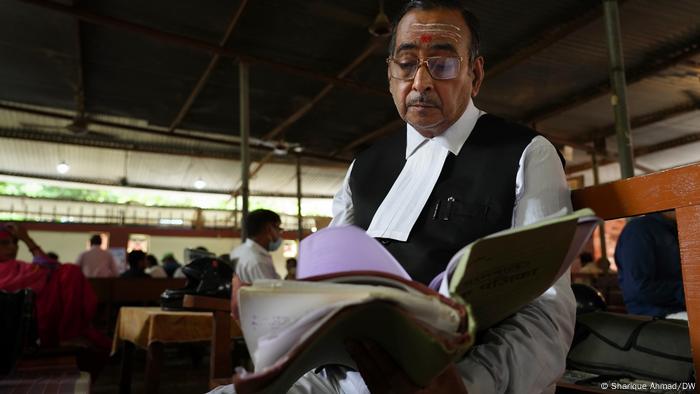
"The Muslims destroyed this blessed site and built a mosque on it to establish their own religion," Rastogi said

India's secular character under threat


Incidentally, it is a 1991 law that is a mainstay of the Muslim side's defense. According to the Places of Worship Act, the "religious character" of a place, as it stood on India's Independence Day in 1947, cannot be challenged.

The law was passed to preserve India's secular character by preventing pre-independence communal conflicts from affecting the country's religious harmony.

In its verdict on the Babri mosque dispute, India's Supreme Court also said that the 1991 law must apply in all other similar cases.

For this reason, the Muslim side contests that the archaeological survey is irrelevant, as there is proof of the mosque's existence in 1947. But now, Hindu nationalist groups are challenging this law in the Supreme Court.

But Rastogi claims the law supports the Hindus' case.

"The archaeological survey will prove that the religious character of the place has always been Hindu," he says. "The physical character, which is Muslim, is of no consequence."

AYODHYA: A RELIGIOUS FLASHPOINT
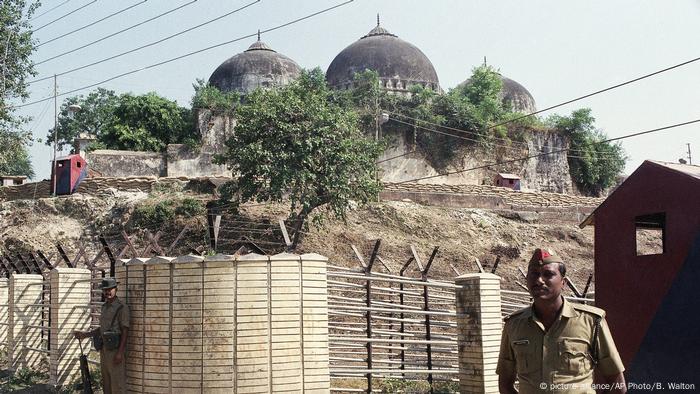
Security mans the site of the Babri masjid in the city of Ayodhya
The Babri Masjid, a 16th century mosque, was an oft-disputed site for Hindu extremists, who considered the city of Ayodhya the birthplace of Ram, a Hindu deity. Hindu extremists claimed that the mosque was originally built by demolishing a Hindu temple  1234


Need to find a common ground

Varanasi is one of Hinduism's holiest cities, hosting millions of pilgrims every year who come here to make offerings to the Hindu god Shiva, and to wash away their sins in River Ganges. However, almost a third of Varanasi's population is Muslim, and opinions on the latest standoff seem to be firmly divided along religious lines.

Sitting at the doorstep of a large clothes shop that his family has run for generations, Yusuf Faizi worries that these issues usually surface in the run-up to elections, referring to the next year's state polls in Uttar Pradesh.

"Tensions will rise in Varanasi over this issue," he told DW.

The mood in the Hindu-majority areas is firmly in favor of the temple.

"People will be happy if the mosque is removed. We will be able to offer prayers more comfortably," said Ravi Seth, a Hindu shopkeeper.

Rajesh Kesari, another shopkeeper, agrees. "This is Lord Shiva's city, and the land should go to him," he asserted.

Author Komireddi believes reckoning with India's past could be a solution to this conflict.

"If you want to defang the Hindu rage, you have to accept that some of their grievances are actually anchored in experience, of being brutalized by foreign invaders," he said. "To prevent the tearing down of mosques, we must accept history as it happened."
Drought alert in ten counties across Kenya

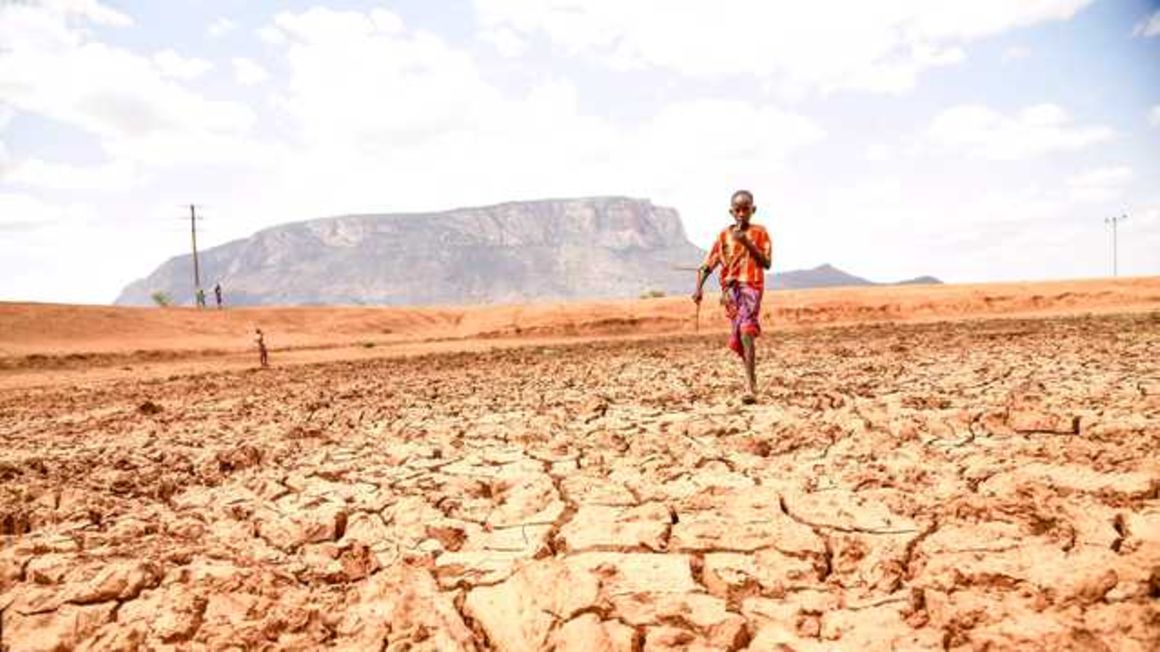
The parched landscape at Lerata, Samburu, one of the counties experiencing drought. PHOTO | FILE
Summary

Kenya is warning of a looming drought in 10 counties that have been battling desert locusts in the past one year.

Devolution Cabinet Secretary Eugene Wamalwa issued a drought alert in Kilifi, Garissa, Isiolo, Mandera, Samburu, Tana River, Wajir, Lamu, Marsabit and Turkana counties.


By LUKE ANAMI
More by this Author

Kenya is warning of a looming drought in 10 counties that have been battling desert locusts in the past one year.

Devolution Cabinet Secretary Eugene Wamalwa issued a drought alert in Kilifi, Garissa, Isiolo, Mandera, Samburu, Tana River, Wajir, Lamu, Marsabit and Turkana counties.

“This calls for anticipatory action will go a long way in building the resilience of the communities in the affected counties,” he said.

“The onset of the long rains was expected from mid to late March in most areas through June in Western, Upper Rift Valley and Coastal regions; but cessation was observed in the other areas by end of May,” said Lawrence Omuhaka, Chief Administrative Secretary in Ministry of Agriculture, Livestock, Fisheries and Cooperatives.

Mr Omuhaka chaired the EAC Sectoral Council on Agriculture in Arusha on behalf of the Agriculture Cabinet Secretary, Peter Munya.

Kenya’s drought response plan requires Ksh9.4 billion for the July-November period, Ksh5.8 billion for food and safety net support and Ksh3.6 billion for non-food interventions.

According to a consolidated regional June 2021 report by the East African Community titled “Food Security Status Report,” food security in the region had remained stable in the past one and-a-half years, despite challenges of volatile food prices, desert locust impacts, and the Covid-19 pandemic.

The long rains crop production forecast for 2021 in Kenya was generally depressed for most areas.

Meanwhile, the UN’s Food and Agriculture Organisation (FAO) is urging continued surveillance to control the desert locusts that are now in Somalia, Ethiopia and Yemen.

“Effective survey and control operations in northern Somalia and eastern Ethiopia are key in reducing breeding that will occur in northeast Ethiopia from now until September,” warns FAO in its July 2021 report on desert locusts.

While Kenya may be off the hook, seasonal rains have commenced in Afar in Tigray areas of Ethiopia and above normal rainfall are expected during the next four weeks that will allow one generation of breeding between now and September.

“The swarms will complete maturation and lay eggs that should begin to hatch in early August, giving rise to hopper bands, which could eventually lead to the formation of new immature swarms from late September onwards,” the report says.
Between the Holocaust and Israel: the Jews jailed on Cyprus


Issued on: 10/08/2021 - 
More than 52,000 Jews were detained in a dozen camps in Cyprus, according to Israel's Holocaust memorial and education centre Christina ASSI AFP

AFTER ALL IT WAS THE BRITISH THAT ORIGINATED  THE CONCENTRATION CAMP DURING THE BOER WAR

Larnaca (Cyprus) (AFP)

After surviving the Holocaust, trekking the Alps in winter and crossing the Mediterranean in an overcrowded boat, Rose Lipszyc clearly remembers her months incarcerated in harsh British camps in Cyprus.

"After all that, we were back behind barbed wire again," 92-year-old Lipszyc said, speaking 75 years after British soldiers began imprisoning Jews on the eastern Mediterranean island, dark events whose legacy resonates today.

Lipszyc's family, from the Polish city of Lublin, were among the six million Jews the Nazis massacred during World War II.

She escaped death using false papers, working as a forced labourer in Germany.

After the war, she walked to Italy. Then, joining an exodus of thousands of traumatised refugees dreaming of a Jewish nation, Lipszyc boarded a rickety boat in Venice bound for British-run Palestine.

"There were 300 of us squeezed into the boat," Lipszyc said. "We were like sardines."

The British wanted the cramped camps to be a "deterrent" aimed at "breaking the power of the 'Hebrew resistance movement' in Palestine" - AFP

But as the shores of Palestine appeared on the horizon, two British warships powered out.

"The English soldiers -- who I would have kissed the feet of for liberating me in Germany -- were leaping into our little boat with batons," she said, her voice trembling.

- 'Traumatic' -


She was taken 250 kilometres (155 miles) northwest to Cyprus, also then under British rule.

Between August 1946 and February 1949, more than 52,000 Jews taken off 39 boats were detained in a dozen camps in Cyprus, according to Yad Vashem, Israel's Holocaust memorial and education centre.

The chief rabbi of Cyprus says the history of the island's detention camps is a 'very important piece of the puzzle' between the Holocaust and Israel's foundation in 1948 Christina ASSI AFP

"The English weren't starving us, and they weren't killing us like the Germans," Lipszyc said. "But it was so traumatic, that the very same people who had freed me just a short time ago now incarcerated me."

The British wanted the cramped camps to be a "deterrent" aimed at "breaking the power of the 'Hebrew resistance movement' in Palestine", Yad Vashem said. More than 400 people died of sickness.

It is a history that Arie Zeev Raskin, chief rabbi of Cyprus, who says several thousand Jews pray at the synagogue each year, wants to "teach to the next generation".

He calls it a "very important piece of the puzzle" between the Holocaust and Israel's foundation in 1948.

When he discovered a farmer using one of the camps' last remaining metal huts as a tractor shed, Raskin made it the centrepiece of the Jewish Museum of Cyprus he is building in the port city of Larnaca.


"The huts were boiling hot in summer, and freezing in winter," Raskin said.

In the camps, some 80 percent were aged between 13 and 35, "among the more spirited and lively survivors of the Holocaust", said Yad Vashem, which added that 2,200 babies were born in the camps.

Tally Barash was one of them. "They called me Bat Aliya, meaning 'daughter of the immigration'," 73-year-old Barash said, recalling descriptions of life in the camps by her parents, Jews from Romania. "It was a very hard time."

- Tunnels and smugglers -

Barash served as an Israeli soldier during the Six-Day War of 1967 in which Israeli forces overran the rest of formerly British-ruled Palestine, beginning an occupation that continues to this day.

Today, decades after she was born in British detention in a military hospital, she runs a print shop in London, and is proud of her past.

Christakis Papavassiliou said his father Prodromos risked his life working with underground Jewish groups Christina ASSI AFP

"The museum will help keep memories alive," she said.

Some Cypriots, also resentful of British rule, worked with Jewish militia forces.

Key among them was Prodromos Papavassiliou, who after fighting fascist forces in North Africa with Britain's Cyprus Regiment, was outraged at the camps, his son Christakis Papavassiliou said.

"He risked his life working with underground Jewish groups," said Papavassiliou, a retired honorary French consul.

Prodromos helped hundreds of Jews, hiding those who tunnelled out in orange groves and caves, until he could organise boats to smuggle them away from coves near the now-popular tourist resort of Ayia Napa.

His exploits were dramatized in the 1960 Hollywood epic "Exodus", starring Paul Newman and Eva Marie Saint, while the Israeli port city of Haifa named "Papa Square" in his honour.

Papavassiliou, president of the Cyprus-Israel Business Association, said that past had "helped forge close ties" between the two countries.

- 'Hate only destroys' -


The history holds another lesson, with "obvious parallels" to the migrant crisis today, said Eliana Hadjisavvas, of Britain's Institute of Historical Research, while acknowledging the "contextual differences" too.

"The history... reminds us that in the face of persecution and suffering, people will endure huge sacrifices in search of safety," said Hadjisavvas, who is writing a book on the camps.

A handout picture released by the Israeli Government Press Office shows European Jews abroad the S.S. Galila arriving in the Israeli port city of Haifa Eldan DAVID GPO/AFP

"As nation states continue to grapple with the political management of migration, draconian measures and detention centres have increasingly become a defining feature of contemporary responses."

Lipszyc finally reached Palestine "just a week or two" before Israel's May 1948 declaration of independence, and war erupted again.

Later, she moved to Canada, where the great-grandmother of four offered her life advice to AFP, speaking from Toronto.

"If you could live through what I lived through, then you would see that hate does not help you in life," she said. "Hate only destroys."

© 2021 AFP

FEMICIDE PATRIARCHY MISOGYNY
UN calls for end to child marriages as Zimbabwe mourns 14-year-old child bride


TUESDAY AUGUST 10 2021

A girl carries water. Zimbabweans have expressed outrage after a 14-year-old child bride died while giving birth. PHOTO | FILE | NMG

Summary

The girl’s death in rural Marange in the eastern parts of the country has brought back into the spotlight the scourge of child marriages in Zimbabwe, especially among indigenous religious sects.

Memory was allegedly forced out of school and into marriage at age 13. She died on July 15 and was secretly buried two hours later by the church.

Her death was only exposed last week because the church was allegedly offering Memory’s nine-year-old sister as a replacement to her “husband.

By KITSEPILE NYATHI
More by this Author

The United Nations has condemned the practice of child marriage in Zimbabwe after a 14-year-old girl died while giving birth at a church shrine.

Zimbabweans have also expressed outrage about the girl’s death online with a petition demanding justice for Memory Machaya garnering nearly 40,000 signatures in a few days.

The girl’s death in rural Marange in the eastern parts of the country has brought back into the spotlight the scourge of child marriages in Zimbabwe, especially among indigenous religious sects.

Memory was allegedly forced out of school and into marriage at age 13. She died on July 15 and was secretly buried two hours later by the church.

Her death was only exposed last week because the church was allegedly offering Memory’s nine-year-old sister as a replacement to her “husband.”

The UN in Zimbabwe said it “notes with deep concern and condemns strongly the circumstances leading to the death of Memory Machaya.”

“Sadly, disturbing reports of the sexual violation of underage girls, including forced child marriages, continue to surface and indeed this is another sad case,” the UN in Zimbabwe, which represents all 25 UN agencies in the country, said in a statement.

It said one in three girls in Zimbabwe is likely to be married before turning 18.

This is despite the fact that Zimbabwe’s Constitutional Court in 2016 banned child marriages after two former child brides challenged the country’s Marriage Act.

The judges struck down a section of the law that allowed girls to marry at 16, but boys at 18.

“A situation where one out of three girls in Zimbabwe will be married before the age of 18 years is also not acceptable,” the UN added.

“The current trend of unresolved cases of violence against women and girls in Zimbabwe, including marriages of minors cannot continue with impunity.

“All forms of violence and early forced marriages severely affect the mental and physical health of girls and is a violation of the Convention on the Rights of the Child, which Zimbabwe is a signatory.”

Dewa Mavhinga, southern Africa director for Human Rights Watch, said millions of girls in Zimbabwe continue to suffer in forced marriages because the government was failing to enforce the Constitutional Court ruling.

“Child marriage is rampant in Zimbabwe, especially among indigenous apostolic churches, an evangelical group that mixes Christian beliefs with traditional cultures and has millions of followers across the country,” Mr Mavhinga said.

“Girls are often sexually abused, beaten by their husbands and in-laws, confined in their homes, forced into pregnancy and labour, exposed to serious reproductive health risks, including risk of death, and denied an education.

“Millions of Zimbabwean girls like Memory Machaya continue to suffer abuse because of the authorities’ inaction.

“The future of millions of girls depends on Zimbabwe’s government ensuring the ban on child marriages is fully enforced.”
CANADIAN POLLING COMPANY
Dominion Voting Sues Newsmax, One America News Network Over 2020 Election Fraud Claims


WASHINGTON (Sputnik) – Lawyers for the Dominion Voting Systems company have filed lawsuits against conservative US news outlets Newsmax and One America News (OAN) Network and businessman Patrick Byrne over unsubstantiated 2020 election fraud claims, the company said in a statement on Tuesday.

"Today, legal representatives for Dominion Voting Systems filed defamation complaints against Newsmax Media Inc. in the Superior Court of Delaware, and against Herring Networks Inc. — owner of One America News (OAN) Network — and Patrick Byrne in the United States District Court for the District of Columbia," the statement read.

Court documents show complaint against the OAN Network also includes names of Herring Networks owners Robert Herring and Charles Herring, as well as One America News Network personalities Chanel Rion and Christina Bobb, the statement added.

Dominion lawyer Stephen Shackelford, in the statement, claimed that the three groups of defendants pushed false claims that the voting apparatus company was behind widespread irregularities in the 2020 presidential vote, which saw Joe Biden edge out Donald Trump to clinch the Oval Office.

"As detailed in our complaints, OAN, Newsmax, and Patrick Byrne have knowingly and continuously sold the false story of election fraud in the 2020 presidential election, with Dominion cast as the villain, severely injuring Dominion in the process," Shackelford said. "Newsmax and OAN both endorsed, repeated, broadcast, and amplified a series of verifiably false lies about Dominion to serve their own commercial purposes."

Shackelford also accused Byrne of bankrolling and promoting a viral disinformation campaign about Dominion.

"We are suing to set the record straight, to vindicate Dominion's rights, to hold the Defendants accountable, and to recover damages for the devastating economic harm done to Dominion's business," he added.

The complaint against OAN noted that the network spread false information about Dominion by broadcasting and promoting interviews with "discredited figures", including Byrne, Trump lawyer Rudy Giuliani, lawyer Sidney Powell and the controversial CEO of the MyPillow company Michael Lindell.


© FLICKR / GAGE SKIDMORE
Trump Reportedly Refuses to Share Election War Chest to Help Giuliani With $1.3 Bln Dominion Lawsuit

"OAN’s coverage of Dominion was dishonest and false. OAN caused tremendous harm to Dominion," the complaint said.

Another complaint accused Newsmax of manufacturing and broadcasting "verifiably false" information about Dominion.
"If Newsmax cared about the truth - if it cared about informing (rather than deceiving) its viewers - it would identify for its viewers each specific lie it broadcast, promoted, and endorsed in November and December 2020, tell its viewers in no uncertain terms that those lies were false, and explain to its viewers all the voluminous evidence debunking those lies," the document said.

Following the 2020 presidential election, former US President Donald Trump declared that his victory was stolen via massive fraud and acts of impropriety. His legal team accused the Smartmatic software company and the Dominion Voting Systems, of participation in a fraudulent scheme to ensure his failure in the election.