Sunday, January 09, 2022

Usborne's 1980s range of childrens' coding books released as free PDFs

A knight fights a dragon on the cover of an Usborne book.
(Image credit: Usborne)

Publishing giant Usborne has been in the computer books business for many, many decades, and its productions were an entry point to the industry for unknowable numbers of coders. As with everything in a technology-led industry these books are very much of their time, but the whole aesthetic of these things is nostalgia catnip for those of a certain age. If you're the type who ever sat down in front of a Spectrum and spent half a day painstakingly copying out code, then the gaudy thrill of the illustrations for Computer Spacegames never fades.

There's a wide range, available for free on its website. It rather charmingly advises that "these programs don't work on modern computers" though the books cover more than coding, and of course if you've got a BBC Micro or Commodore 64 in the attic then it's rock and roll time.

The books are obviously no longer in print, so fair play to the publisher for keeping them available and free. Usborne of course does keep up with the times and, should you want to seed some nostalgia in the next generation, has a contemporary range of books to teach kids some coding skills.

Trinity College Dublin begins €90m project to relocate vulnerable books

The Long Room at Trinity College Dublin. 
Photograph: Paul McErlane/The Guardian

Restoring and moving 750,000 volumes and ancient manuscripts expected to take five years


Lisa O'Carroll in Dublin
@lisaocarroll
Fri 7 Jan 2022 

It is known as Ireland’s “front room”, where esteemed visitors including the Queen, Joe Biden, Emmanuel Macron and the Duke and Duchess of Sussex have been taken to get a sense of the “land of saints and scholars”.

Biden, vice-president at the time, was so moved by the atmospherics in the dimly lit, barrel-vaulted hall when he visited Trinity College Dublin (TCD) in 2016 that he came back a year later to contemplate the history of its old library, known as the Long Room.

A page from the Book of Kells, considered one of Europe’s finest treasures. 
Photograph: Digital Resources & Imaging Services/Trinity College Dublin

But if he were to make a third visit, he may not be so lucky. Three hundred years after the first foundation stone was laid, the 250,000 ancient books and manuscripts – including the ornately decorated ninth-century Book of Kells – printed on vellum, paper or silk are to be moved one by one, along with 500,000 others, to make way for the restoration of the building.

It is a monumental task that will take the best part of five years and cost €90m (£75m).

“Moving 750,000 vulnerable books is quite an undertaking, so we are having to pilot everything to see what is involved,” says TCD’s librarian and archivist Helen Shenton, who is leading the daunting project involving a 50-strong team.

Some of the books in the alcoves that line the 65-metre hall are so delicate they are joined together with fabric ties. The accumulation of exhaust fume particles from the roads surrounding the building can accelerate the deterioration, while human detritus from nearly 1 million annual visitors pre-pandemic, ranging from clothing fibres and human hair, reaches 1cm in parts.

Each book has to be examined, dusted, carefully hoovered and repaired if necessary. In a normal maintenance and preservation cycle “it takes us five years alone to clean all the books”, Shenton explains.

Helen Shenton, librarian and college archivist in the Long Room. Photograph: Paul McErlane/The Guardian

The restoration project is currently in an “enabling” phase that will last two years because of the fragility of the books. It will determine the logistics of the move and the equal challenge of keeping the collection of books open to students and visiting scholars.

The physical preservation of the books is the driving force behind the project. Recent fires at Notre Dame, the national museum in Brazil and the Mackintosh building at the Glasgow School of Art have shown the risks to historic and cultural buildings.

“We do not want to join that litany,” says Shenton. “We need to conserve the building and the collection for its fourth century,” she said.
Vacuuming dust off books.

Even the distinctive smell that Shenton says many visitors remark on when they enter is evidence of deterioration. According to a book on the library by Harry Cory Wright, the sweet scent is “the smell coming from ageing cellulose in paper, similar to the smell of almonds, which contain the same chemical.”

Shenton says: “Books are organic artefacts and what you are smelling is deteriorating leather, deteriorating paper, and the thing we can do to slow that down is to have better environmental conditions. Not only do we need temperature and humidity control, we also need to protect against particle pollution that is coming through the windows.”

The restoration has been on the cards for years, and cataloguing each book was finally finished during the pandemic with a team of 50 working from home, completing what was a 40-year project.
Trinity’s Old Library building. 
Photograph: Paul McErlane/The Guardian

To future-proof the collection for study, Shenton is also creating the first online catalogue of Trinity’s collection. Each book will be fitted with a radio frequency identification (RFID) tag to enable scholars to be able to target their reads from the comfort of their desks.

Once all the books have been removed, the library will close for about three years, during which time the building, under the plans of heneghan peng architects, will undergo a complete makeover.

In what will be a shock to many previous visitors, the ground floor will be returned to the open arcade of the original building, which was designed to protect the books on the first floor against damp.

Estelle Gittins, assistant librarian (manuscripts), looks up some of the material that will need to be moved. 
Photograph: Paul McErlane/The Guardian

At the same time there will be “a completely reimagined exhibition” that will position treasures such as the Book of Kells in an international context, exploring for example “what was happening on the Silk Road at the same time”.

And finally, the male-only series of busts, remarked upon by Meghan, that stand at each of the alcoves in the Long Room is also going.

It was one of the first things Shenton noticed when she took the job and, after a competition, four new busts by four different artists will be commissioned, of the mathematician Ada Lovelace; the Abbey Theatre co-founder, Lady Gregory; the writer Mary Wollstonecraft; and Rosalind Franklin, the biophysicist who made critical contributions to the identification of the double helix structure of DNA and related RNA.
USA
Omicron explosion spurs nationwide breakdown of services

By JENNIFER SINCO KELLEHER and TERRY TANG

1 of 5
Los Angeles County Fire Department vehicles sit at a medical call Friday, Jan. 7, 2022, in Inglewood, Calif. Occasionally, firefighters transport patients to the hospital in fire engines because of short staffing amid an explosion in omicron-fueled coronavirus infections at an ambulance company that the fire department contracts with. 
(AP Photo/Mark J. Terrill)


Ambulances in Kansas speed toward hospitals then suddenly change direction because hospitals are full. Employee shortages in New York City cause delays in trash and subway services and diminish the ranks of firefighters and emergency workers. Airport officials shut down security checkpoints at the biggest terminal in Phoenix and schools across the nation struggle to find teachers for their classrooms.

The current explosion of omicron-fueled coronavirus infections in the U.S. is causing a breakdown in basic functions and services — the latest illustration of how COVID-19 keeps upending life more than two years into the pandemic.

“This really does, I think, remind everyone of when COVID-19 first appeared and there were such major disruptions across every part of our normal life,” said Tom Cotter, director of emergency response and preparedness at the global health nonprofit Project HOPE. “And the unfortunate reality is, there’s no way of predicting what will happen next until we get our vaccination numbers — globally — up.”

First responders, hospitals, schools and government agencies have employed an all-hands-on-deck approach to keep the public safe, but they are worried how much longer they can keep it up.

In Kansas’ Johnson County, paramedics are working 80 hours a week. Ambulances have frequently been forced to alter their course when the hospitals they’re heading to tell them they’re too overwhelmed to help, confusing the patients’ already anxious family members driving behind them. When the ambulances arrive at hospitals, some of their emergency patients end up in waiting rooms because there are no beds.

Dr. Steve Stites, chief medical officer for the University of Kansas Hospital, said when the leader of a rural hospital had no place to send its dialysis patients this week, the hospital’s staff consulted a textbook and “tried to put in some catheters and figure out how to do it.”

Medical facilities have been hit by a “double whammy,” he said. The number of COVID-19 patients at the University of Kansas Hospital rose from 40 on Dec. 1 to 139 on Friday. At the same time, more than 900 employees have been sickened with COVID-19 or are awaiting test results — 7% of the hospital’s 13,500-person workforce.

“What my hope is and what we’re going to cross our fingers around is that as it peaks ... maybe it’ll have the same rapid fall we saw in South Africa,” Stites said, referring to the swiftness with which the number of cases fell in that country. “We don’t know that. That’s just hope.”

The omicron variant spreads even more easily than other coronavirus strains, and has already become dominant in many countries. It also more readily infects those who have been vaccinated or had previously been infected by prior versions of the virus. However, early studies show omicron is less likely to cause severe illness than the previous delta variant, and vaccination and a booster still offer strong protection from serious illness, hospitalization and death.

Still, its easy transmissibility has led to skyrocketing cases in the U.S., which is affecting businesses, government offices and public services alike.

In downtown Boise, Idaho, customers were queued up outside a pharmacy before it opened Friday morning and before long, the line wound throughout the large drugstore. Pharmacies have been slammed by staffing shortages, either because employees are out sick or have left altogether.

Pharmacy technician Anecia Mascorro said that prior to the pandemic, the Sav-On Pharmacy where she works always had prescriptions ready for the next day. Now, it’s taking a lot longer to fill the hundreds of orders that are pouring in.

“The demand is crazy — everybody’s not getting their scripts fast enough so they keep transferring to us,” Mascorro said.

In Los Angeles, more than 800 police and fire personnel were sidelined because of the virus as of Thursday, causing slightly longer ambulance and fire response times.

In New York City, officials have had to delay or scale back trash and subway services because of a virus-fueled staffing hemorrhage. The Metropolitan Transportation Authority said about one-fifth of subway operators and conductors — 1,300 people — have been absent in recent days. Almost one-fourth of the city sanitation department’s workers were out sick Thursday, Sanitation Commissioner Edward Grayson said.

“Everybody’s working ’round the clock, 12-hour shifts,” Grayson said.

The city’s fire department also has adjusted for higher absences. Officials said Thursday that 28% of EMS workers were out sick, compared with about 8% to 10% on a normal day. Twice as many firefighters as usual were also absent.

In contrast, the police department saw its sick rate fall over the past week, officials said.

At Phoenix Sky Harbor International Airport, two checkpoints at the airport’s busiest terminal were shut down because not enough Transportation Security Administration agents showed up for work, according to statements from airport and TSA officials.

Meanwhile, schools from coast to coast tried to maintain in-person instruction despite massive teacher absences. In Chicago, a tense standoff between the school district and teachers union over remote learning and COVID-19 safety protocols led to classes being canceled over the past three days. In San Francisco, nearly 900 educators and aides called in sick Thursday.

In Hawaii, where public schools are under one statewide district, 1,600 teachers and staff were absent Wednesday because of illness or pre-arranged vacation or leave. The state’s teachers union criticized education officials for not better preparing for the ensuing void. Osa Tui Jr., head of the Hawaii State Teachers Association, said counselors and security guards were being pulled to go “babysit a classroom.”

“That is very inappropriate,” Tui said at a news conference. “To have this model where there are so many teachers out and for the department to say, ‘Send your kid’ to a classroom that doesn’t have a teacher, what’s the point of that?”

In New Haven, Connecticut, where hundreds of teachers have been out each day this week, administrators have helped to cover classrooms. Some teachers say they appreciate that, but that it can be confusing for students, adding to the physical and mental stress they’re already feeling because of the pandemic.

“We’ve already been tested so much. How much can the rubber band stretch here?” asked Leslie Blatteau, president of the New Haven Federation of Teachers.

___ Kelleher reported from Honolulu. Tang reported from Phoenix. Associated Press writers Rebecca Boone in Boise, Idaho; Paul Davenport in Phoenix; Heather Hollingsworth in Mission, Kansas; Michelle L. Price, David Porter and Michael R. Sisak in New York; and Michael Melia in Hartford, Connecticut, contributed to this report.
Ethiopian airstrike kills 56 civilians, Tigray fighters say

Tigrayan forces have claimed that dozens of civilians in a camp for internally displaced people were killed in a government airstrike — indicating conflict is still ongoing despite recent reconciliation efforts.


Tigray forces said the strike hit a camp for internally displaced people, like the one pictured here in Dabat

A spokesman for Tigrayan forces said Saturday that an airstrike by the Ethiopian government killed at least 56 civilians in the country's embattled northern region.

Reports of the airstrike at the camp in Dedebit, in northwestern Tigray, came a day after Ethiopian Prime Minister Abiy Ahmed issued a message of reconciliation on Orthodox Christmas.

What we know about the strike


"Another callous drone attack by Abiy Ahmed in an IDP [internally displaced persons] camp in Dedebit has claimed the lives of 56 innocent civilians so far," Getachew Reda, a spokesman for Tigray People's Liberation Front (TPLF), said on Twitter.

The report could not be identified independently as access to Tigray is restricted, and the region remains under a communications blackout.

But Reuters news agency quoted aid workers as saying the strike in the town near the border with Eritrea took place late on Friday night.

A senior official told the AFP news agency that the hospital in the town where victims were taken reported 55 people dead and 126 injured.

There was no immediate comment on the strike from the government. Ethiopia has previously denied targeting civilians in the 14-month conflict with Tigrayan fighters.

Conflict continues after Christmas amnesty

On Friday, the government freed opposition leaders from several ethnic groups — including some TPLF leaders.

But the TPLF has remained skeptical of Abiy's call for national reconciliation.

"His daily routine of denying medication to helpless children and of sending drones targeting civilians flies in the face of his self-righteous claims," TPLF spokesman Getachew said Friday.

The European Union on Saturday welcomed the reconciliatory move but raised concern over the ongoing conflict.

"All parties must seize the moment to swiftly end the conflict and enter into dialogue," the bloc's foreign affairs chief, Josep Borrell, said in a statement.


Amid international pressure for negotiations, Ethiopian lawmakers last month approved a bill to establish a commission for national dialogue. But the commission excludes TPLF leaders.

In late December, the conflict seemed to shift as the TPLF fighters withdrew back into Tigray after approaching the Ethiopian capital, Addis Ababa.

Civilians caught in the conflict


Last month, the UN's humanitarian agency said airstrikes on Tigray between December 19 and 24 caused "mass civilian casualties."

Earlier this week, three Eritrean refugees, including two children, were killed in an airstrike on a camp in Tigray, according to the UN refugee agency.

Tens of thousands of people are believed to have been killed in the conflict that started in November 2020.

The TPLF, which once ruled the country, has accused the government of blocking aid to the Tigray region. The government has denied the allegation.

fb/wd (AFP, AP, Reuters)

Aid agencies suspend work in Tigray area hit by deadly strike: UN

Aid agencies have suspended operations in an area of Ethiopia's stricken Tigray region where a deadly air strike hit a camp for people displaced by the country's 14-month war, the UN said Sunday.

© Amanuel Sileshi
Ethiopian government forces seized a string of strategic towns in December in a new turning point in the war

The raid came only hours after the Ethiopian government had issued a call for "national reconciliation", and sparked renewed calls from an alarmed international community for an end to the brutal conflict.

The UN Office for the Coordination of Humanitarian Affairs (OCHA) said in a statement to AFP that the attack at midnight Friday in the town of Dedebit in northwestern Tigray had "caused scores of civilian casualties including deaths", according to its preliminary information. 
© Aude GENET Tigray is the northernmost region of Ethiopia

"Humanitarian partners suspended activities in the area due to the ongoing threats of drone strikes," it said.

Tigray rebels said Saturday that the attack had killed 56 people, while an official at the region's main hospital in the capital Mekele reported 55 dead and 126 injured.

It was not possible to independently verify the claims because access to the region is restricted and it remains under a communications blackout.

There was no response to requests for comment from Ethiopian government officials.

- Near 'total collapse' of health system -

OCHA said the lack of essential supplies, especially medical supplies and fuel, was "severely disrupting the response to the injured, and (has) led to the nearly total collapse of the health system in Tigray".

"The intensification of air strikes is alarming, and we once again remind all parties to the conflict to respect their obligations under international humanitarian law," it said.

The fighting between forces loyal to Prime Minister Abiy Ahmed and the rebel Tigray People's Liberation Front (TPLF) has killed thousands of people and created a deep humanitarian crisis in the north.

Tigray itself is under what the UN calls a de facto blockade that is preventing life-saving food and medicine from reaching its six million people, including hundreds of thousands in famine-like conditions.

Doctors at the Ayder Referral Hospital earlier this month issued a statement painting a bleak picture of desperation, saying patients including children were needlessly dying because of the blockade.

- 'Unacceptable' -


The Dedebit strike came the same day that the Ethiopian government announced an amnesty for several senior TPLF figures and other high-profile opposition leaders in what it said was a bid to foster national dialogue and "unity".

The amnesty has been welcomed by the international community as a possible way out of the fighting, which has threatened to tear apart Africa's second most populous country.

It followed a dramatic turnaround in fortunes on the battlefield, with the rebels retreating to their Tigray stronghold at the end of December in the face of a military offensive that saw government forces retake a string of strategic towns.

Although there appeared to have been a lull in fighting since, the rebels have accused the government of continuing to conduct deadly drone attacks on Tigray.

OCHA reported last month that dozens of civilians were reportedly killed in the last days of December in a barrage of air raids in Tigray.

And the United Nations reported this week that three Eritrean refugees including two children had been killed in an air strike Wednesday on a refugee camp in Tigray.

The US Bureau of African Affairs has described the attacks as "unacceptable".

"We redouble our call for an immediate end to hostilities, the prompt launch of an inclusive national dialogue, and unhindered access so aid can reach all Ethiopian communities in need," it said on Twitter.

txw/jj
Google honors physicist Stephen Hawking with new Doodle

Google honored late physicist Stephen Hawking on Saturday with a Doodle. Image courtesy of Google

Jan. 8 (UPI) -- Google celebrated what would have been physicist, cosmologist and author Stephen Hawking's 80th birthday Saturday with a new Doodle.

Hawking was born on this day in Oxford, England, in 1942. He died at the age of 76 in 2018.

Google's homepage features an image of Hawking in his trademark wheelchair with a background of a galaxy spinning in space. Clicking on the graphic brings up an animated video depicting scenes from Hawking's life.

Artist Matthew Cruickshank created the Doodle.

"Today's video Doodle celebrates one of history's most influential scientific minds, English cosmologist, author, and theoretical physicist Stephen Hawking," Google said.

"From colliding black holes to the Big Bang, his theories on the origins and mechanics of the universe revolutionized modern physics while his bestselling books made the field widely accessible to millions of readers worldwide."

Hawking was known for his work as a theoretical physicist in which he studied the universe and black holes.

RELATED UPI Archives: Stephen Hawking's nurse ruled unfit to practice

His expertise in astrophysics rose to fame in 1988 with the publication of his book, A Brief History of Time. The book became an international bestseller, selling more than 10 million copies in 35 languages.

Hawking was one of the rare scientists who rose to pop star fame, giving numerous televised interviews and even appearing in The Simpsons, Futurama and The Big Bang Theory.

He also became an advocate for disability issues after being diagnosed with amyotrophic lateral disease -- more commonly known as ALS or Lou Gehrig's disease -- in 1962. The disease gradually paralyzed him over decades and he was dependent upon a wheelchair for mobility and a computer to speak and write.

RELATED  UPI Archives: Stephen Hawking's voice sent into space toward a black hole

Hawking was the subject of the 2014 biopic The Theory of Everything starring Eddie Redmayne as the physicist and Felicity Jones as his former wife, Jane Hawking. Redmayne won the Oscar, Golden Globe, Screen Actors Guild and British Academy Film awards for Best Actor for the role.
Record number of Florida manatees died in 2021


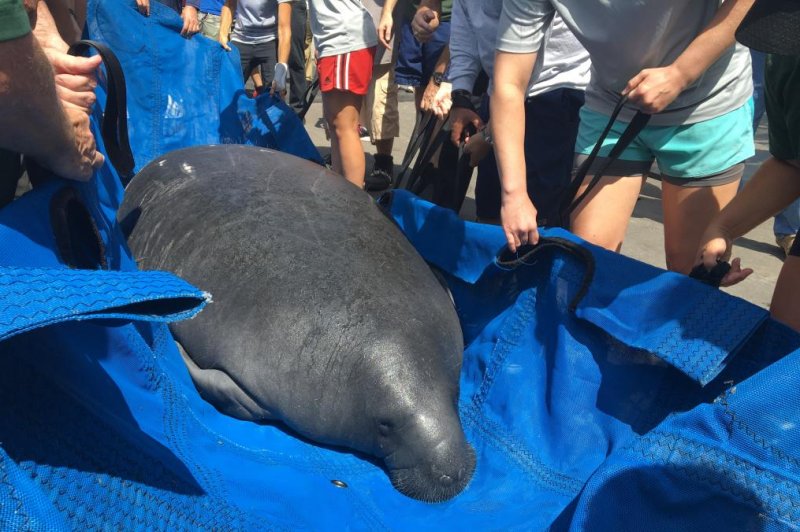
Members of the Florida Fish and Wildlife Conservation Commission prepare to release a rehabilitated manatee back into the wild in Florida. The state announced that 1,101 of the animals died in 2021, the highest total in at least the last 12 years. Photo courtesy Florida Fish and Wildlife Conservation Commission

Jan. 8 (UPI) -- Florida's manatee population saw its highest death toll in at least a dozen years in 2021, the state announced.

The Florida Fish and Wildlife Conservation Commission is reporting a total of 1,101 of the mammals died last year.

That figure is almost double the state's five-year average of 625 deaths.


Last week, a new emergency rule went into effect providing more protection for manatees. It established a temporary no-entry zone, which is supervised by law enforcement and the commission's biologists.

Manatees are a protected species in Florida, which recorded 637 of the animals' deaths in 2020.

The second-highest death toll since 2010 occurred in 2013 when 830 animals died.

A majority of the deaths occurred on the state's east coast, in what the commission calls a manatee mortality event.

Watercraft were listed as the animals' cause of death in 103 cases, which was the second-lowest number for that cause in the last five years.

"The Florida Fish and Wildlife Conservation Commission and the U.S. Fish and Wildlife Service continue to investigate a high level of manatee mortalities and respond to manatee rescues along the Atlantic coast of Florida," says a statement on the commission's website.
US Treasury Department to send $1B in pandemic rental assistance


Janet Yellen, U.S. Treasury secretary, speaks during a House Financial Services Committee hearing in September. The U.S. Treasury Department said Friday it would reallocate $1.1 billion in pandemic rental assistance from places where it went unused to states and cities with a higher need for the aid. 
File Photo by Al Drago/UPI | License Photo

Jan. 8 (UPI) -- The U.S. Treasury Department said Friday it would reallocate $1.1 billion in pandemic rental assistance from places where it went unused to states and cities with a higher need for the aid.

California will receive about $50 million in reallocated funds, the most of any state. New Jersey will receive $43 million; New York will receive $27 million; and the District of Columbia will receive $18 million. The rest will be divided among local governments and Native American tribes nationwide.

This is the first round of payments being made as the Treasury Department works to redistribute funds from the $46.5 billion in emergency rental relief programs created by the U.S. Congress during the COVID-19 pandemic.

More than 75% of the funds were voluntarily given to governments in the same state as the entities to which they had been granted, according to the Treasury Department. It was not immediately clear which, if any, grantees had been forced to give up their funds.

Grantees who received the funds initially faced losing it if they didn't obligate at least 65% or spend 15% of the money by November.

"Any amounts recaptured from a grantee were first prioritized to grantees in the same state that were deemed eligible to receive reallocated funds," the Treasury Department said in a news release.

Funds were then distributed nationally, prioritizing grantees that had substantially completed their spending the $25 billion distributed in the first round of emergency rental assistance. Grantees that made quicker progress in the second round of funding were weighted more heavily.

The Treasury Department noted that the emergency rental assistance programs have been effective in preventing evictions during the pandemic, which have remained 60% below historical levels before the pandemic began despite an end to the eviction moratorium in August.

Rock formation collapses onto boats in Brazil killing at least 6 people


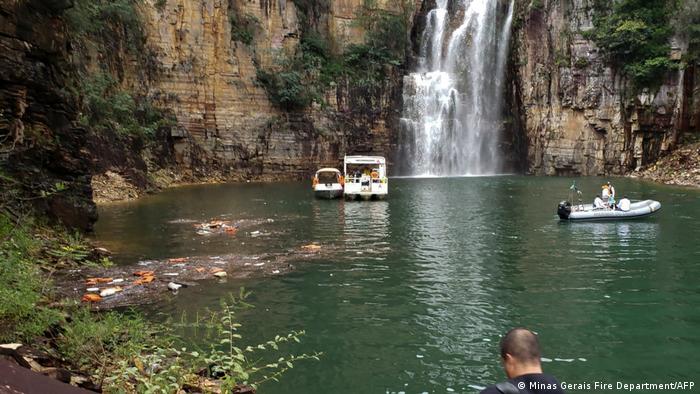
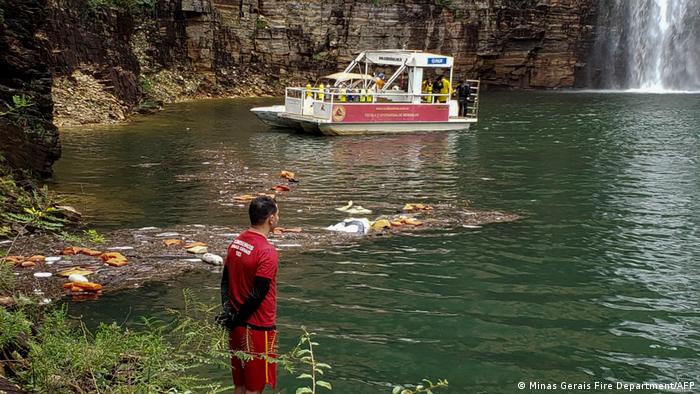
Fire department officials are pictured at Lake Furnas after a rock formation collapsed onto multiple boats traveling on a lake in the Brazilian state of Minas Gerais on Saturday, killing at least six people. 
Photo courtesy Minas Gerias Fire Department/Twitter

A screenshot taken from a video shared by President Jair Bolsonaro 
shows the moment the rock formation collapses onto two boats in Brazil.
 Photo courtesy Jair Bolsonaro/Twitter

Jan. 8 (UPI) -- A rock formation collapsed onto multiple boats traveling on a lake in the Brazilian state of Minas Gerais on Saturday, killing at least six people.

Video posted to social media and confirmed by the fire department in Minas Gerais shows the moment the massive rock formation slammed into the boats on Lake Furnas in the town of Capitólio.

The bodies of six people have been confirmed to have died while divers with rescue teams continue searching for 20 missing people, fire department spokesman Pedro Aihara said.

First responders were able to rescue 24 people from two boats that were directly hit by the falling rock formation, Aihara said. Those survivors were treated for injuries including broken bones.

Dozens of others who were on two nearby boats that suffered an indirect impact were treated for minor injuries, according to officials

"Today, we are suffering the pain of a tragedy in our state, due to heavy rains, which caused the loosening of a wall of stones in Lake Furnas, in Capitólio," Romeu Zema, the governor of the state, said in a statement posted to Twitter.


Search and rescue teams carry a young victim of the rock formation collapse

 in Capitólio, Brazil. Photo courtesy Jair Bolsonaro/Twitter

"Rescue work is still ongoing. I stand in solidarity with the families at this difficult time. We will continue to act to provide the necessary support and support."

President Jair Bolsonaro said in a statement to Twitter that the Brazilian Navy deployed relief teams to help in the region while also providing search and rescue operations for victims of the tragedy.

Brazil: Several dead as cliff collapses on boats

At least six people are reported dead, while 20 others are still missing. Officials suggest that heavy rains were the cause of the accident. 


Parts of a cliff face fell onto boaters on Brazil's Furnas Lake

A slab of rock broke off from a cliff and fell onto boaters at a lake in southeastern Brazil, killing at least six, authorities said on Saturday.

Edgard Estevo, commander of the Minas Gerais State Fire Department, said as many as 20 people were believed to be missing and officials were seeking to identify them.

Officials said at least 32 people had been injured but most had been released from hospitals by Saturday evening.


Divers and helicopters have been deployed to search for the 20 people still missing

Video images showed a group of small boats drifting near a waterfall below a cliff on Furnas Lake when a piece of rock broke off, hitting at least two of the boats.

Another video on social media shows the minute before the incident, with people warning that "many stones are falling" and advising other boats to move away from the rocks.

Where did the accident occur?

Estevo said the incident occurred between the towns of Sao Jose da Barra and Capitolio, located in Brazil's southeastern Minas Gerais state. The boats had left from the town of Capitolio.

Furnas Lake was originally formed along with the creation of a hydroelectric dam and is a major tourist attraction in the area.

Tourists come to see the rock walls, caverns and waterfalls surrounding the Furnas Lake's waters.

Why did the accident happen?

Officials suggested that the rock could have come loose due to recent heavy rains that caused flooding in the state and displaced 17,000 people.

Pedro Aihara, spokesperson for the Minas Gerais State Fire Department, told Brazilian broadcaster GloboNews that the rocks in this area are "more susceptible to the effects of wind and rain" and "show less resistance."

sdi/nm (AP, AFP, Reuters, Lusa

    Galapagos Volcano Home To Endangered Lizard Erupts

    By AFP News
    01/07/22

    Rare Charles Darwin Sketch Is Published In New Book 'Plant: Exploring The Botanical World'

    A volcano on a Galapagos island that is home to a species of critically endangered lizard has erupted for the second time in seven years, national park officials said Friday.

    The Wolf volcano's slopes host the pink iguana, only 211 of which were reported to be left on Isabela, the largest island in the Galapagos archipelago, as of last August.

    "#Galapagos | Wolf Volcano begins eruptive activity on Isabela Island..." the Galapagos National Park (PNG) said on Twitter, citing staff who witnessed the eruption.

    The Wolf Volcano, the highest on the Galapagos Islands, erupted early Friday
     Photo: PARQUE NACIONAL GALAPAGOS via AFP / Wilson CABRERA

    For its part, the Geophysical Institute of Quito said the 1,707-meter (5,600-foot) volcano spewed gas-and-ash clouds as high as 3,800 meters into the air, with lava flows on its southern and southeastern slopes.

    The volcano, the highest of the Galapagos, is some 100 kilometers (62 miles) from the nearest human settlement.

    The PNG did not state whether the iguanas or other animals who live on the island were in imminent danger.

    The Galapagos pink iguana lives exclusively around the slopes of Wolf Volcano on Isabela Island Photo: PARQUE NACIONAL GALAPAGOS via AFP / Freddy Jiménez

    The area also hosts yellow iguanas and the famous Galapagos giant tortoises.

    Located in the Pacific some 1,000 kilometers (600 miles) off the coast of Ecuador, the Galapagos Islands are a protected wildlife area and home to unique species of flora and fauna.

    The archipelago was made famous by British geologist and naturalist Charles Darwin's observations on evolution there.

    The Wolf volcano last erupted in 2015 after 33 years of inactivity, without affecting local wildlife.


    The pink iguanas that inhabit its slopes were identified as a separate species only in 2009, and occupy an area of 25 square kilometers (10 square miles). They are found nowhere else.

    Isabela island also hosts four other active volcanos.
    Too much meat? Spain factory farming debate creates beef

    Debate over the environmental impact of Spain's huge factory farming sector is heating up in the country, Europe's biggest meat consumer, and splitting its ruling coalition.
    © Miguel RIOPA The growth of Spain's livestock sector is fuelled by external demand, especially from China, as well as within Spain

    In an interview published in British daily The Guardian, Consumer Affairs Minister Alberto Garzon lashed out against Spain's "so-called mega-farms", calling them unsustainable.

    "They find a village in a depopulated bit of Spain and put in 4,000, or 5,000, or 10,000 head of cattle," he said.

    "They pollute the soil, they pollute the water and then they export this poor quality meat from these ill-treated animals."

    Garzon is the coordinator of the tiny United Left party, a junior member of the minority coalition government led by Socialist Prime Minister Pedro Sanchez, and his comments angered farmers.

    © OSCAR DEL POZO Debate over the environmental impact of Spain's huge factory farming sector is heating up

    "There are no mistreated animals in Spain, minister," the UPA union, which represents small producers, said in a statement.

    It said Garzon's statements were "based on falsehoods, clumsy, nearsighted and could have harmful effects on Spanish meat exports".

    Pablo Casado, the leader of the conservative main opposition Popular Party (PP) which is strong in some rural areas, also weighed in, calling Garzon's words "an attack against ranchers and farmers and the image of our country".

    Government spokeswoman Isabel Rodriguez said Garzon was speaking in a personal capacity.

    She added that the government "supports the livestock sector, which contributes decisively to our exports"
    .
    © PIERRE-PHILIPPE MARCOU Spanish Consumer Affairs Minister Alberto Garzon's comments have angered farmers

    The debate risks deepening the divide between the Socialists and left-wing coalition partner Podemos ahead of an election in the Castile and Leon region north of Madrid as the PP rides high in the polls.

    - 'Bigger and bigger' -

    Garzon had already come under fire in July for urging Spaniards to reduce their meat consumption, prompting Sanchez to say that for him "there's nothing that beats a well done steak".

    For Salvador Calvet, a University of Valencia professor who studies the sector, the outcry over Garzon's comments is due to the cultural and economic weight of livestock farming, which provides a living for "many families".

    © Josep LAGO Spain is Europe's biggest meat consumer

    It is responsible for some 2.5 million jobs in the country and accounts for nine billion euros ($10 billion) in annual exports, according to the United Nations' Food and Agriculture Organization (FAO).

    And it is booming. Meat production has increased ten-fold in Spain over the past 60 years, a larger increase than in most other European nations, according to a University of Oxford database.

    Although there are fewer farms, their size is getting "bigger and bigger", said Calvet.

    The growth of the sector is fuelled by external demand, especially from China, as well as within Spain, where ham, chorizo sausages and other animal products are a key part of many people's diet.

    Each Spaniard eats an average of 98.8 kilograms (218 pounds) of meat per year, compared to the worldwide average of 42 kilograms, according to FAO figures.

    That makes Spain Europe's biggest meat consumer, ahead of Portugal at 98.7 kilograms and Poland at 88.5 kilograms.

    - 'Legitimate debate' -

    This level of consumption amounts to more than 270 grams per day, "when international scientific recommendations recommend 300 grams of consumption per week", environmental group Greenpeace said in a statement.

    It warned that the consequences of this overconsumption are "devastating".

    Greenpeace was one of several environmental groups which backed Garzon, who has also come under fire for banning adverts for sugary foods aimed at children and a crackdown on the betting industry.

    "There is a legitimate debate" over the environmental impact of livestock breeding but the reality is "complex and nuanced", said Calvet.

    Breeders have "improved" their practices in recent years but they could still do more, he added.

    vab/ds/imm