Friday, April 15, 2022

Biden's biofuel: Cheaper at the pump, but high environmental cost

A biofuel production plant in Iowa
A biofuel production plant in Iowa.

In an effort to ease Americans' pain at the gas pump, President Joe Biden has announced his administration will ease restrictions on the sale of E15—gasoline that includes 15 percent ethanol—and new investments in biofuels as a whole.

But the decision hasn't pleased scientists who study the environmental impact of ethanol.

What is ethanol?

Fuel ethanol is based on the same type of alcohol used in beverages, but with "denaturant" additives that make it unsuitable for drinking.

Blending ethanol with gasoline eases reliance on crude oil.

Most gas now sold in the United States is E10. American ethanol is generally produced by fermenting sugar from . Other countries such as Brazil rely on sugar from sugar cane.

In 2011, the US Environmental Protection Agency approved the use of E15 following research on its pollution impact.

But it is currently offered at just 2,300 gas stations in the country, according to officials.

What has Biden announced?

Speaking at a bioethanol production plant in the Midwestern state of Iowa, Biden said Tuesday that the EPA would lift a restriction prohibiting the sale of E15 between June 1 and September 15—a constraint that was imposed to limit air pollution.

That's because ethanol evaporates more easily and turns more readily into smog, which is particularly problematic in the  and sunlight of summer.

In 2018, then president Donald Trump also wanted to lift this restriction, as a concession to farmers in the midst of a trade war with China.

But a  eventually overturned Trump's decision.

According to the White House, at today's prices, E15 can save an average of 10 cents per gallon of gasoline (4.5 liters).

Environmental consequences

Though biofuels have been touted for their ability to reduce greenhouse gas emissions, assessing the environmental impact of bioethanol requires including greenhouse gas emissions related to the crops needed for its production.

And "the carbon balance of ethanol relative to gasoline isn't as good as it was originally anticipated," Tyler Lark, a scientist at the University of Wisconsin-Madison told AFP.

In 2005, Congress passed a "Renewable Fuel Standard," which required transportation fuel to include a volume of biofuel that increased over time.

The law was further expanded in 2007. As a result, 2.8 million additional hectares of corn were grown between 2008 and 2016, according to a study published in February in the Proceedings of the National Academy of Sciences (PNAS).

Lark. the first author of the PNAS study, said the consequences of converting land to corn cultivation were underestimated at the time.

"When you do that, you plow up other types of land that may have been sequestering carbon and you apply extra nitrogen fertilizer to grow that corn," he said.

In addition, some of the fertilizer used to grow corn emits nitrous oxide (N2O), a very powerful greenhouse gas.

Thus,  related to gasoline or  are ultimately comparable, concludes the study.

There are other harmful consequences, too—including leaching of fertilizers into , and the destruction of wildlife habitats to make way for corn fields.

Health dangers

Once in the tank, bioethanol emits less CO2 per liter than traditional fuels, but there's less energy per volume and so more is needed.

In addition, "it produces acetaldehyde which is a carcinogen, formaldehyde, which is a carcinogen and both of those are two of the five most potent ozone producers in photochemical smog," explained Mark Jacobson, a professor of environmental engineering at Stanford University.

Ground-level ozone represents a major health hazard, causing numerous respiratory problems including asthma. For Jacobson, both gasoline and biofuels are "horrible."

"It's bad for both climate and air pollution, and spending money on it is taking money away from real solutions" such as electric vehicles, he concluded.

At bioenergy crossroads, should corn ethanol be left in the rearview mirror?
Journal information: Proceedings of the National Academy of Science
© 2022 AFP

Why algae can be our next secret weapon to combat plastic pollution

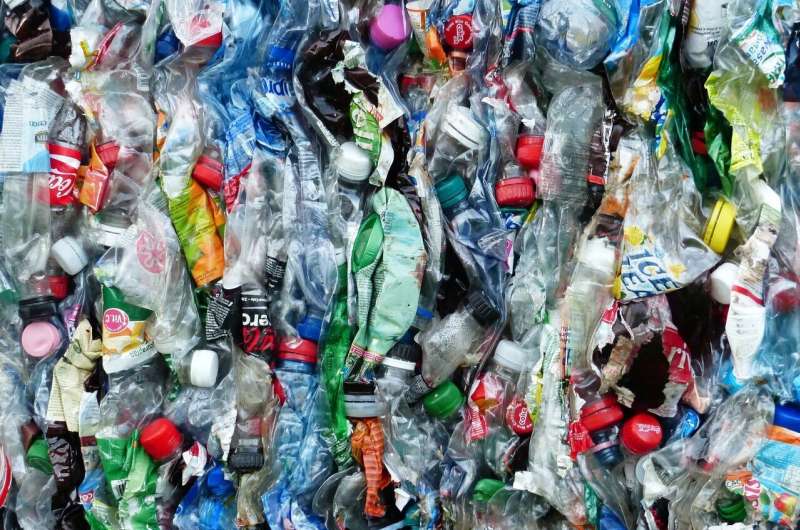
plastic bottles
Credit: CC0 Public Domain

Plastic pollution has become an alarming problem worldwide. A 2015 study published in Science Magazine projected that by 2025, around 100–250 million metric tons of plastic waste could enter our oceans every year.

The problem also triggered the United Nations (UN) to issue a global resolution to end plastic waste, adopted by representatives from 173 countries.

However, even if all drastic measures were put in place to stop plastic production tomorrow, we would still have around 5 billion tons of plastic waste in landfills and the environment.

Research has shown that plastic can disintegrate into microplastic—particles ranging from 1 nanometer (nm) to less than 5 micrometers (mm)—with various shapes, densities, and mechanical and chemical properties.

Due to their small volume and high surface area, microplastics can absorb pollutants, causing chronic toxicity when consumed and accumulated within organisms.

For decades, scientists have been looking to nature for our fight against the plastic problem. Combined with global strategic action to slow down plastic production, we could prevent future plastic disasters.

Microalgae, for instance, are the most promising nature-based candidate capable of destroying microplastics. It is a unicellular species that exists individually or in chains or groups. Depending on the species, their size can range from a few millimeters to hundreds of micrometers.

Cultivating microalgae is simple because it does not require fertile land, large quantities of freshwater, and pesticides compared to other aquaculture crops.

Microalgae are also capable of growing rapidly. Open pond cultivation has been one of the oldest and simplest ways to cultivate microalgae on a large scale. Some people also use photobioreactors—bioreactors used in an enclosed system to increase microalgae cultivation.

How microalgae works

Interaction between microalgae and plastic can significantly change the properties of plastic, including its biodegradation, the alteration of plastic density, and sinking behavior. Moreover, microalgae may take control, gather, and stick to microplastics on their surface, regardless of their size.

There are four stages of plastic biodegradation. First is the attachment of microalgae to plastic surfaces. This starts the biodegradation process and alters surface properties.

The second is biodeterioration. Microalgae will secrete specific enzymes, which are pivotal for plastic biodegradation.

The third is the biofragmentation process. In this stage, the plastic material loses its mechanical stability and becomes fragile.

The last stage is the assimilation process, where microbial filaments and water start to penetrate plastics, which results in the decomposition and utilization of plastic by microorganisms.

Studies have reported success stories of algae-based plastic biodegradation, particularly for polyethylene (commonly used in fibers for clothing or bottle), low-density polyethylene or LDPE (used in plastic bags) and bisphenol A or BPA (chemicals to harden plastic). One of those studies calculated a 58.9% decrease of carbon composition in their LDPE sample.

More action is needed

As the biggest archipelagic country, Indonesia has a maritime area of over 6.4 million square kilometers and extensive freshwater lakes which have immense potential for microalgae cultivation.

Microalgae could be a viable solution to tackle the plastic problem in Indonesia—the world's second-largest ocean plastic polluter, according to a 2015 study.

More research is vital to deepen analyses of microalgae and microplastics' interactions and their effects to support this initiative. So far, studies on  in Indonesia only focus on its potential as a green energy resource or its capacity to become a substitute material for plastic.

To prevent plastic disasters, we also need improvements in plastic recycling and reusing strategies. Regulation and policies should be in line with the 2018–2015 National Action Plan on Marine Debris which highlights Indonesia's waste management, reduction or substitution of plastic usage, redesign of plastic products and packaging, doubling  collection rates, and expansion of waste disposal facilities.


Thai national parks ban single-use plastics
Provided by The Conversation 
This article is republished from The Conversation under a Creative Commons license. Read the original article.The Conversation

Woman with no left temporal lobe developed a language network in the right side of her brain

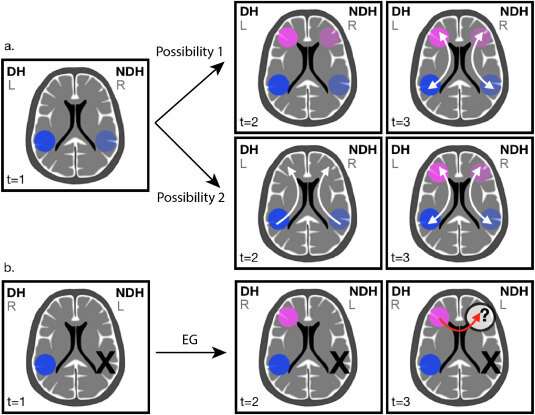
Woman born with no left temporal lobe developed a language network in the right side of her brain
Credit: Neuropsychologia (2022). DOI: 10.1016/j.neuropsychologia.2022.108184

A team of researchers with members affiliated with MIT, Carnegie Mellon University, UCLA and Harvard University has found that a woman without a left temporal lobe developed a language network in the right side of her brain that allowed her to communicate normally. The group published their study of her brain in the journal Neuropsychologia.

In 2016, a woman in her fifties who has chosen to be known only as EG, contacted brain scientists at MIT regarding what she described as her "interesting brain." She had no left temporal lobe. The team at MIT referred her to cognitive neuroscientist, Evelina Fedorenko at Harvard University who welcomed the opportunity to study such an "interesting brain."

EG told Fedorenko and her team that she only came to realize she had an unusual brain by accident—her brain was scanned in 1987 for an unrelated reason. Prior to the scan she had no idea she was different. By all accounts she behaved normally and had even earned an advanced degree. She also excelled in languages—she speaks fluent Russian—which is all the more surprising considering the left temporal lobe is the part of the brain most often associated with language processing.

Eager to learn more about the woman and her brain, the researchers accepted her into a study that involved capturing images of her brain using an fMRI machine while she was engaged in various activities, such as language processing and math. In so doing, they found no evidence of language processing happening in the left part of her brain; it was all happening in the right. They found that it was likely the woman had lost her left temporal lobe as a child, probably due to a . The area where it had been had become filled with . To compensate, her brain had developed a language network in the right side of her brain that allowed her to communicate normally. The researchers also learned that EG had a sister who was missing her right temporal lobe, and who also had no symptoms of brain dysfunction—an indication, the researchers suggest, that there is a genetic component to the stroke and recovery process in the two women.


How (and where) the brain analyzes math and language spoken simultaneously
More information: Greta Tuckute et al, Frontal language areas do not emerge in the absence of temporal language areas: A case study of an individual born without a left temporal lobe, Neuropsychologia (2022). DOI: 10.1016/j.neuropsychologia.2022.108184
Journal information: Neuropsychologia 
© 2022 Science X Network


Scientists discover 'missing link' in a severe form of asthma, paving the way to new therapy

Scientists discover 'missing link' in a severe form of asthma, paving the way to new therapy
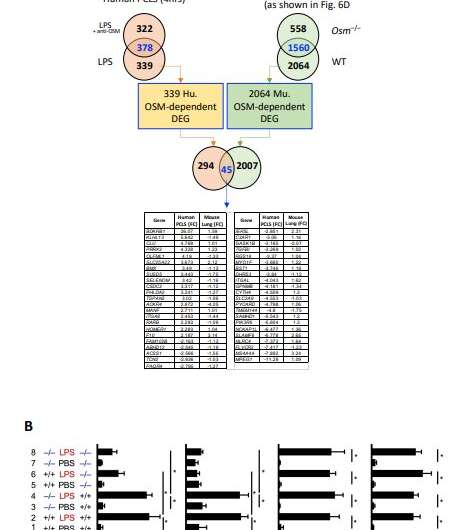
LPS triggers common and distinct responses in human and murine lung tissues 
and drives systemic responses. (A) Common OSM-dependent, LPS-induced 
differentially expressed genes (DEG) are shown in human PCLS after 4 hours 
and mouse lung after 4 hours. (B) Serum cytokines and chemokines were 
measured in recipient C57BL/6 Osm–/– or C57BL/6 WT mice given WT or 
Osm–/– bone marrow-derived macrophages (BMDM) treated with LPS or PBS,
 as indicated. n=5 mice per group with 1 of 2 experiments shown. 
Data are presented as mean ± SEM. Data were analyzed using Mann-Whitney 
tests. *p<0.05. Credit: Science Translational Medicine (2022). 
DOI: 10.1126/scitranslmed.abf8188

Scientists have identified a single molecule that may explain how bacteria can trigger one of the most severe types of asthma, a discovery that for the first time identifies the "missing link" between exposure to bacterial components and extreme inflammation of the lungs' airways.

The new research not only clarifies how a severe form of  affects patients, but further underscores how bacterial dysbiosis—disruptions in beneficial bacteria amid exposure to pathogenic forms—affects vulnerable lungs. Going into the research, scientists already knew that bacterial molecules can trigger inflammatory activity in the lungs' airways because patients with  often have changes in their bacterial populations. Yet the exact mechanisms by which bacteria exacerbate asthma remained unclear.

Seeking answers, Dr. Sarah Headland and colleagues in the immunology division of Genentech in south San Francisco, zeroed in on a form of asthma known as non-type-2 to find out why it is one of the severest forms of inflammatory respiratory disease. She and her team have also begun the arduous task of developing a customized therapy.

Writing in Science Translational Medicine, the team describes the research that allowed a better understanding of this form of asthma and the first steps toward a therapy geared specifically for patients with non-type-2 disease. They began by analyzing the cells and tissues from patients encumbered by severe bacteria-associated asthma and comparing those findings to the cells and tissues of people with mild to moderate forms of asthma as well as to those who don't have asthma at all.

Headland and colleagues studied airway biopsies from 57 patients with severe asthma, 28 patients with mild or moderate asthma, and 16 healthy individuals. The key discovery was abnormally high activity of oncostatin M, a protein associated with inflammation and an aggressive immune response, that was unique among patients with severe asthma. Additionally, exposure to lipopolysacharride—LPS, a component of bacterial cell walls—triggered the activity of oncostatin M.

"Bacterial dysbiosis and opportunistic bacterial infections have been observed in, and may contribute to, more severe asthma," wrote Headland in Science Translational Medicine. "However, the molecular mechanisms driving these exacerbations remain unclear. We show here that bacterial lipopolysaccharide induces oncostatin M and that airway biopsies from patients with severe asthma present with an OSM-driven transcriptional profile.

"This profile correlates with activation of inflammatory and mucus-producing pathways," Headland added, noting that using "primary human lung tissue or human epithelial and mesenchymal cells, we demonstrate that oncostatin M is necessary and sufficient to drive pathophysiological features observed in severe asthma after exposure to LPS."

While the new analysis helped scientists gain a keener understanding of the underlying drivers of severe bacteria-associated asthma, there were also suggestions in their research that a monoclonal antibody may one day block oncostatin M. Both lines of research—discovering the missing link in severe bacteria-associated asthma and pinpointing a potential form of treatment—provide a ray of hope for patients with the form of the disease broadly known as non-type-2.

Asthma was once thought to be a single disorder, but doctors now understand it to be several complex but related conditions with varying underlying triggers. There are two key categories of severe asthma: Type 2 inflammation and non-type 2 inflammation. Each of the two categories is based on the biological mechanisms that drive the disease. Type 2 inflammation, for example, includes allergic asthma and eosinophilic asthma.

The Asthma and Allergy Foundation of America defines allergic asthma as an inflammatory disease caused by an allergen, such as exposure to cockroaches, pollen, dust mites, mold or pet dander, to name a few triggers. The immune system responds by producing an overabundance of the immunoglobulin (antibody) known as Immunoglobulin E, or IgE. Extremely high levels of IgE can cause inflammation of the lungs' airways.

Another form of Type 2 is eosinophilic asthma, which is characterized by high levels of white blood cells known as eosinophils. A hallmark of this type of asthma is generalized swelling throughout the entire respiratory tract, from the nasal region to the tiniest airways in the lungs. People with this form of asthma experience wheezing, shortness of breath, chest tightness and lung-function abnormalities, among other symptoms.

Non-type 2 inflammation in severe asthma has been defined as the absence of eosinophils. However, doctors say there is much more to this form of asthma, which is characterized by a constellation of problems, ranging from an extreme inflammatory condition in the lungs airways to shortness of breath and difficulty controlling the condition. In terms of treatment, medical experts also have long known that non-type 2 inflammation doesn't respond to inhaled corticosteroids, a standard of care that works well in other forms of asthma. Thus, the discovery of a bacterial dysbiosis associated with oncostatin M, opens a new window of understanding into a debilitating form of the disease, Headland and colleagues reported.

Indeed, there is a glaring unmet need for patients with this form of asthma because a specific therapy—something targeted—to address the unique manifestations of this form doesn't exist.

Headland and her collaborators found that oncostatin M drives the core asthma features, such as inflammatory signaling and excessive mucus production, when exposed either to LPS or a common bacterial pathogen, Klebsiella pneumoniae. And because of the unique role played by oncostatin M, the Genentech scientists are developing a potent monoclonal antibody that can block the protein, staving off airway inflammation.

So far, the tests, which appear promising, have been conducted in a mouse model. The hope is to develop a treatment that can be tested in a human clinical trial. "Together, these results provide a scientific rationale supporting the clinical development of therapeutics targeting [oncostatin M] to prevent asthma progression," the authors concluded.Researchers discover new therapeutic target for severe asthma

More information: Sarah E. Headland et al, Oncostatin M expression induced by bacterial triggers drives airway inflammatory and mucus secretion in severe asthma, Science Translational Medicine (2022). DOI: 10.1126/scitranslmed.abf8188

Journal information: Science Translational Medicine 

© 2022 Science X Network

Study suggests Larsen A and B ice shelves collapsed due to atmospheric rivers

Multiapproach study suggests Larsen A and B ice shelves collapsed due to atmospheric rivers
Satellite imagery from an atmospheric river landfall on January 25th, 2008 that triggered 
the disintegration of the land-fast ice in the Larsen A and Larsen B embayments that were
 visible five days later. MODIS-Terra Aqua images were acquired at worldview.earthdata.
nasa.gov. Credit: Jonathan Wille

A team of researchers affiliated with multiple institutions across Europe has found evidence that suggests the collapse of the Larsen A and B ice shelves was due to the arrival of atmospheric rivers. In their paper published in the journal Communications Earth and Environment, the group describes how they tracked the movement of atmospheric rivers during the time period when the ice shelves collapsed and what their work reveals about likely scenarios unfolding in Antarctica as global warming continues.

Ice shelves form when ice from  meet the sea, and instead of breaking, they float on top of the ocean. Prior research has suggested that as  continues, ice shelves have begun to breakup. And while such breakups do not contribute to a rise in ocean levels, their loss does allow the glaciers that spawned them to flow unimpeded into the sea, which does raise sea levels. Prior research has also shown that one of the major reasons for  break up is the flow of warmer water beneath them. In this new effort, the researchers have found that atmospheric rivers are also very likely a contributing factor.

Atmospheric rivers, as their name suggests, are currents of air that have different properties than the air around them. In most cases, they are warmer and thus carry more moisture. To learn more about the possible impact of atmospheric rivers when they flow into the Antarctic region, the researchers used a variety of tools, including a computer algorithm developed specifically to detect atmospheric rivers, and climate models and imagery captured by satellites. By identifying and following the paths of atmospheric rivers as they arrived at Antarctica, they found that one arrived in 1995 just before the collapse of Larsen A, and another arrived in 2002 just before the collapse of Larsen B.

Study suggests Larsen A and B ice shelves collapsed due to atmospheric rivers
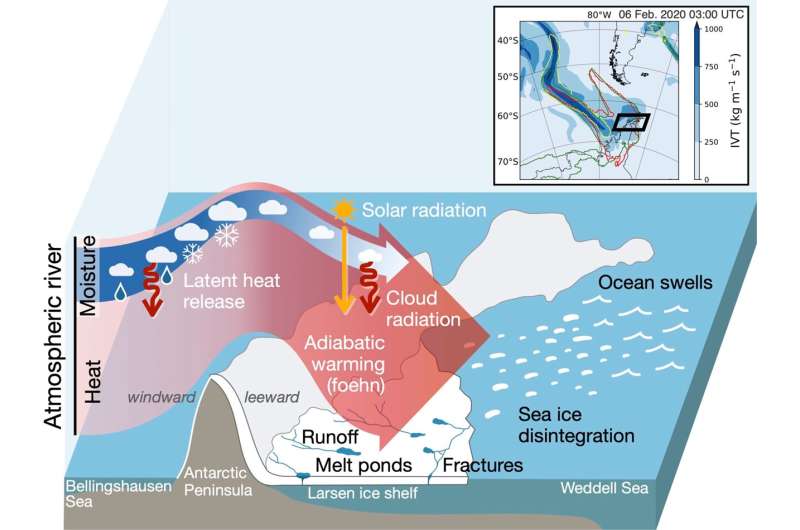
An illustration of a typical intense atmospheric river over the northern Antarctic Peninsula 
and the associated observed meteorological features and impacts consequential to 
ice-shelf stability. Also, an example of a detected AR landfall on Feb. 6th, 2020, with the
 corresponding IVT values. The yellow, red, and green outlines are the shape of the AR as 
determined by the vIVT AR detection scheme, IWV AR detection scheme, and the original 
Antarctic AR detection algorithm, respectively. 
Credit: Communications Earth & Environment (2022).
 DOI: 10.1038/s43247-022-00422-9

Further study of the two events showed that the warm moist air from the atmospheric rivers led to melting of the surface ice, which seeped into cracks and refroze, widening the cracks. That led both of the shelves to be exposed to ocean swells that tore them apart. They also found that atmospheric rivers played a role in triggering 13 of 21  events between 2000 and 2020.Researchers identify biggest threats to Larsen C ice shelf

More information: Jonathan D. Wille et al, Intense atmospheric rivers can weaken ice shelf stability at the Antarctic Peninsula, Communications Earth & Environment (2022). DOI: 10.1038/s43247-022-00422-9

Journal information: Communications Earth & Environment 

© 2022 Science X Network

Researchers realize direct synthesis of isoparaffin-rich gasoline from syngas


Peer-Reviewed Publication

DALIAN INSTITUTE OF CHEMICAL PHYSICS, CHINESE ACADEMY SCIENCES

A research team led by Prof. PAN Xiulian and Prof. BAO Xinhe from the Dalian Institute of Chemical Physics (DICP) of the Chinese Academy of Sciences realized the direct synthesis of isoparaffin-rich gasoline from syngas using ZnAlOx-SAPO-11 oxide-zeolite (OXZEO) catalysts.

They elucidated the active sites of isoparaffin formation, which provided guidance for the one-step synthesis of high-quality gasoline from syngas.

This study was published in ACS Energy Letters on March 23.

Previously, the DICP team proposed a new catalyst concept based on metal OXZEO bi-functional catalysts, and it enabled the direct conversion of syngas to a variety of chemicals and fuels with high selectivity, such as light olefins, ethylene, gasoline, aromatics and oxygenates. The OXZEO concept provided a new technology platform for the highly efficient utilization of coal and other carbon resources.

In this study, they achieved 34% CO conversion and 82% gasoline selectivity by modulating the acid sites distribution of zeolite, in which the iso/n-paraffins ratio was as high as 38. By optimizing the reaction conditions, they increased the ratio of iso/n-paraffins as high as 48, which was the highest value of the iso/n-paraffins ratio reported so far.

Moreover, a 150-hour on stream test of the catalyst indicated rather stable activity in syngas-to-gasoline.

Further studies showed that the external acid sites of the zeolite could be the active sites for the formation of branched, especially the multi-branched isoparaffins.

"This study provided important guidance for the one-step synthesis of high-quality gasoline from syngas and even CO2," said Prof. PAN.

The above work was supported by the Ministry of Science and Technology of China, the National Natural Science Foundation of China, the Dalian High-level Talent Innovation Program, and the Youth Innovation Promotion Association of CAS.

MEDICARE FOR ALL

What drives racial and ethnic gaps in American Medicare’s quality program?

Study points to role of primary care received outside an Accountable Care Organization’s network, and the importance of coordination and access

Peer-Reviewed Publication

MICHIGAN MEDICINE - UNIVERSITY OF MICHIGAN

For the past 10 years, the Medicare system has tried to improve the quality of health care that millions of older Americans receive, while slowing the growth in costs to the federal budget, by encouraging health care providers to join Accountable Care Organizations.

Today, ACOs coordinate the care of 11 million people, most of them with traditional Medicare coverage. The better the ACOs do, the more they’re rewarded.

But the improvements haven’t reached all older Americans equally. ACOs that include a higher percentage of patients who are Black, Hispanic, Native American or Asian have lagged behind those with higher percentage of white patients in providing preventive care and keeping patients out of the hospital.

Now, a new study shows that some of this inequity stems from how an ACO’s patients get their primary care. Even if they see specialist physicians who belong to an ACO, older adults aren’t required to see a primary care provider who belongs to the same ACO.

In the new issue of JAMA Health Forum, a team from the University of Michigan shows that ACOs with higher percentages of members of racial and ethnic minority groups also tended to have higher percentages of out-of-network primary care. That meant the patient’s routine care was delivered by a provider with no connection to the ACO, and therefore no potential financial benefit if they hit the quality benchmarks.

The study used data from nearly 4 million Medicare participants whose providers belong to 538 ACOs in the Shared Savings Program. The percentage of patients who got their primary care outside the ACO was nearly 13% in the ACOs that had the highest percentage of participants from racial or ethnic minorities, compared with about 10% of the patients in the other ACOs.

But even when the researchers left out the ACOs that had the highest percentage of out-of-network primary care, they still saw differences in quality of care. Older adults in ACOs with the highest percentages of minority participants were less likely to get diabetes and cholesterol checks, and those who had been hospitalized were more likely to end up back in the hospital within a month.

On the other hand, in the ACOs that had the lowest percentage of patients who got their primary care out of the ACO network, there were no differences in quality performance between ACOs with different percentages of members from minority groups.

“These findings suggest that efforts by ACOs to encourage use of in-network primary care may reduce health care disparities among racial and ethnic minority patients, which has policy implications for the Shared Savings Program that includes most ACOs,” says John Hollingsworth, M.D., M.S., the U-M physician and health care researcher who led the analysis with Shivani Bakre, a former research associate at U-M.

Hollingsworth and several co-authors are members of the U-M Institute for Healthcare Policy and Innovation; Hollingsworth and his team are part of the Dow Division of Health Services Research in the Department of Urology at Michigan Medicine.

The Centers for Medicare and Medicaid Services, the federal agency that oversees Medicare and the ACO program, recently announced a new kind of ACO that will launch in 2023, called ACO REACH. It specifically focuses on health equity and bringing the benefits of the ACO model to underserved communities.

CITATION: Association Between Organizational Quality and Out-of-Network Primary Care Among Accountable Care Organizations That Care for High vs Low Proportions of Patients of Racial and Ethnic Minority Groups
JAMA Health Forum. 2022;3(4):e220575. doi:10.1001/jamahealthforum.2022.0575

PSYCHOLOGY OF CLASS WAR

University of Cincinnati study: Socioeconomic factors affect response to depression treatment

Cross-college collaboration highlights importance of patients’ home environments

Peer-Reviewed Publication

UNIVERSITY OF CINCINNATI


Mills and Strawn 

IMAGE: JEFFREY MILLS, LEFT, AND JEFFREY STRAWN, RIGHT, HAVE BECOME CLOSE COLLABORATORS TAKING A TRANSDISCIPLINARY APPROACH TO RESEARCH. view more 

CREDIT: PHOTO/UNIVERSITY OF CINCINNATI

Patients seeking treatment for depression who have lower income and education and those who are members of minority populations tend to have worse treatment outcomes even when receiving equal access to treatment, according to new research from the University of Cincinnati. 

Led by Jeffrey Mills, PhD, and Jeffrey Strawn, MD, the UC cross-college collaborative research was recently published in the journal Psychiatric Services.

Strawn, professor in the Department of Psychiatry and Behavioral Neuroscience in UC’s College of Medicine and a UC Health adolescent psychiatrist, said that previous research has concluded that people seeking treatment for depression with lower income and less education have worse outcomes because of a lack of access to quality health care, but it is hard to isolate socioeconomic factors as they are often intertwined. 

The research team analyzed data from a very large clinical trial known as CO-MED that enrolled 665 patients seeking treatment for depression. In the randomized trial, all patients had the same access to treatment without differences due to health insurance or income.

Study results

After controlling for sex, age and treatment type following 12 weeks of antidepressant medication treatment in the study, the team’s analysis found patients who were non-white improved 11.3% less compared to white patients. Those who were unemployed saw 6.6% less improvement compared to employed patients. Compared to patients in the 75th percentile of income distribution, patients having income at the 25th percentile reduced improvement by 4.8%.

Strawn noted the findings are still preliminary, but he was particularly interested to find that patients without a college degree had 9.6% less improvement compared to college graduates.

“We think about these things in terms of access, we think about them in terms of income inequality, and I realize that education does track with those, but just having a college degree while controlling for all of these other factors still had a significant impact,” said Strawn.

The researchers also examined the effect of the combination of socioeconomic factors, since the individual factors are often correlated, Mills said. Patients who were non-white, unemployed with no degree and had income in the 25th percentile had 26% less improvement compared to patients who were white, employed with a college degree and had income in the 75th percentile.

Mills said that the findings do not negate the fact that a lack of access makes an impact on treatment outcomes, but it does show the importance of including a patients’ home environment when analyzing the effectiveness of treatment.

“If you’re going home to a wealthy neighborhood with highly educated parents or spouse, then you’re arguably in a much better environment for the treatment to be effective than if you’re going to a poor neighborhood with other problems,” said Mills, professor of economics in UC’s Carl H. Lindner College of Business.

Strawn said other research suggests patients in resource-poor environments may be affected by greater chronic variable stress, meaning high stress in a pattern that is intermittent and difficult to predict. Other studies suggest chronic variable stress has a worse effect on patients than chronic sustained stress that is more steady, he said.

“So this is, ‘I was able to pay my rent this month, but I’m not sure that I will be able to next month. And I have a job right now, but I don’t know that I will next month,’” Strawn said. “So it’s just the impact of all those things as well as maybe having relatives or kids who have fewer educational resources or other job-related stress, or potentially other health problems, and you’re still running into those same barriers in terms of access and cost and support there.”

Research application

The study findings have the potential to impact clinical trials by designing studies that pay better attention to socioeconomic variables that may have been previously overlooked, Strawn said.

“When we don’t control for these variables, which we often do not in our clinical trials because of differences in populations, we may miss detecting an effective treatment because its effect is obscured,” Strawn said. “So it can potentially jeopardize our treatment development by not accounting for these factors.”

Strawn said those treating patients every day can use the knowledge from the study in a more straightforward approach. While removing barriers of access to treatment is important, he said clinicians must also acknowledge that a patient’s socioeconomic environment may be affecting their ability to get better with treatment when measuring progress and crafting future treatment plans.

Mills said the research also has important implications when crafting and implementing economic policy, such as the recently passed infrastructure bill or ongoing discussions on the minimum wage. The impact of a policy on an individual’s socioeconomic environment, and subsequently their mental health, is not typically considered, he said.

“Someone employed at a higher wage has a chance to improve their socioeconomic status and environment, and so they’re definitely less likely to get mental health problems,” he said. “If people with higher socioeconomic status do get mental health problems, what we’re showing is they’re more likely to improve if they get treatment.” 

Team science

In the past, two researchers with different specialties in different colleges within a university may have never worked together on research like this, but the collaboration shows the benefit of what is called team science, a transdisciplinary approach to research. 

Strawn explained that traditional multidisciplinary research often looks like a psychiatrist, a neurologist and a psychologist all within the College of Medicine working together on a project. While that has its place, team science works across disciplines and involves completely separate sets of expertise, concepts and approaches.

“We think of multidisciplinary as being kind of the fruit salad where you have your grapes and your bananas, but everything is still distinct,” Strawn said. “And then you have your transdisciplinary, where things are really blended and it’s difficult to tell whose contributions are whose. That’s probably more like the fruit smoothie of disciplinary integration. I think that’s hopefully what we’ve achieved.”

Mills said he has previously seen colleagues expected to closely collaborate who never published a paper together because their skill sets were too similar and they did not need each other to move forward. Alternatively, Mills and Strawn have interest in each other’s field and bring varying, complementary skill sets to the research.

“It’s further than just multidisciplinary, because if I get together with my colleagues, we still have had very similar training. We use the same jargon, we have similar ideas,” Mills said. “There’s not the same cross pollination in stepping out of your field and thinking about other topics and giving each other ideas and concepts that you may not have thought about.”

Moving forward, the researchers want to continue the research by combining data from other depression trials to produce more powerful results with a larger dataset.