Thursday, April 28, 2022

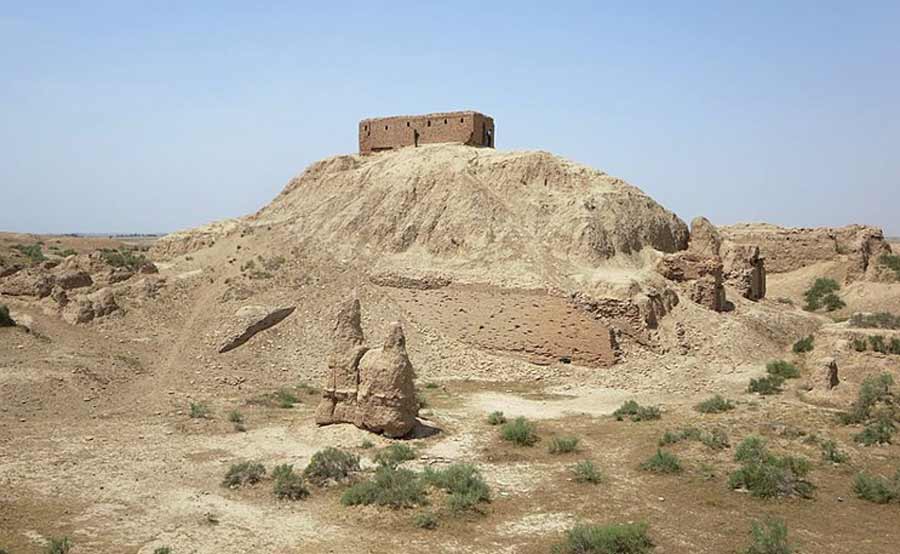
The ruins of the Enlil temple, or the Ekur, in Nippur, which was once the most important pilgrimage destination in Mesopotamia. The brick structure on top was constructed by American archaeologists around 1900.		Source: David Stanley /CC BY 2.0

The ancient city of Nippur is one of the most interesting holy cities in the Middle East. Now only known as a dilapidated, prehistoric town, Nippur was once recognized as an essential religious capital in Mesopotamian culture. Located in southern Iraq between the cities of Baghdad and Basra, Nippur had a very long life compared to surrounding cities, having lasted from nearly 5000 BC until 800 AD.

Nippur was not known at its height as a political capital. In fact, it rarely involved itself in politics at all during its time. Nippur instead was known as a holy city as the home of Enlil, an ancient Mesopotamian god known for his powers over the air, wind, earth, and storms. Because Nippur was considered a holy place, it is believed that this contributed to its longevity – even in war, a respect for holy places and a fear of the gods’ wrath was maintained by both sides, protecting it from major destruction. 

Though Nippur was not specifically a political capital, it still played an important role in Mesopotamian politics because of its status as a holy city and a home for Enlil and other gods. Kings in local cities often sought recognition from Enlil’s temple, called Ekur, in exchange for providing the people of Nippur with land, precious stones, and other goods. They would also provide men to construct and restore temples and other important buildings throughout the city for the gods’ favor. Even after wars, a king’s first move would often be to bring goods waged from war to sacrifice to Enlil and other gods in gratitude for protection. These lavish donations contributed significantly to the wealth and success of Nippur over time.

The culture of Mesopotamia, the story of Enlil, and the ultimate downfall of Nippur are all vital parts of the fascinating story of this ancient holy city. By analyzing the past, we can better understand the steps we must take in the future to respect and preserve this valuable site.
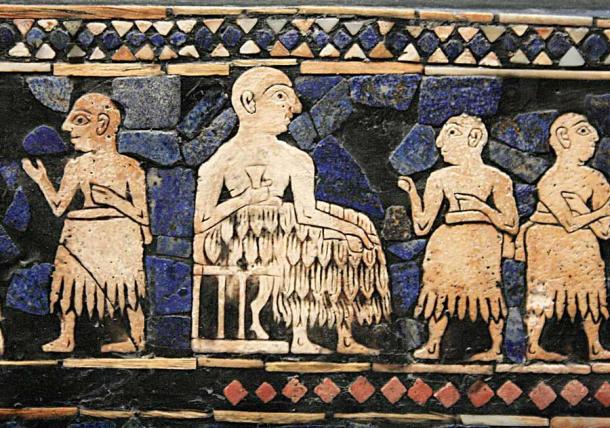
Nippur was one of the places that the ancient Sumerians settled, and it was extremely influential throughout the Mesopotamian region for its religious ideas and practices. Enthroned Sumerian king of Ur, possibly Ur-Pabilsag, with attendants. Standard of Ur, circa 2600 BC. (Michel wal / CC BY-SA 3.0)

Nippur was one of the places that the ancient Sumerians settled, and it was extremely influential throughout the Mesopotamian region for its religious ideas and practices. Enthroned Sumerian king of Ur, possibly Ur-Pabilsag, with attendants. Standard of Ur, circa 2600 BC. (Michel wal / CC BY-SA 3.0 )

The Nippur Sumerians: Religious, Innovative Masterminds

Nippur was one of the homes of ancient Sumerians, people located in southern Mesopotamia. The southern region of Mesopotamia was called Sumer, and consisted of several city-states such as Nippur, each of whom had their own king. The name Sumer actually translates to “land of the civilized kings,” as politics were a significant part of Sumerian culture.

The Sumerians were known for their innovation and their ability to design and build new items or concepts. In particular, they are known for putting a value on days, hours, and minutes by dividing day and night into 12 hours each, an hour into 60 minutes, and a minute into 60 seconds. They also developed some of the first school and government buildings in history, with some of their incredible architecture still existing today. In addition to their innovations, the original narrative of the Biblical flood came from this region. Sumer was a highly advanced civilization, and Nippur was an essential part of it.

Religion was a central aspect of all of Sumerian and Mesopotamian civilization . Religion influenced political decisions, government leaders, school curricula, and all social structure. Sumerians believed that the gods had turned chaos into order to create the Earth, and that to continue living on Earth they must work alongside the gods to maintain that order. While there was a strong focus on individual talents and skills that could be used to help the gods, the Sumerians had a strong sense of community, banding together as a community to serve the gods in exchange for their existence.
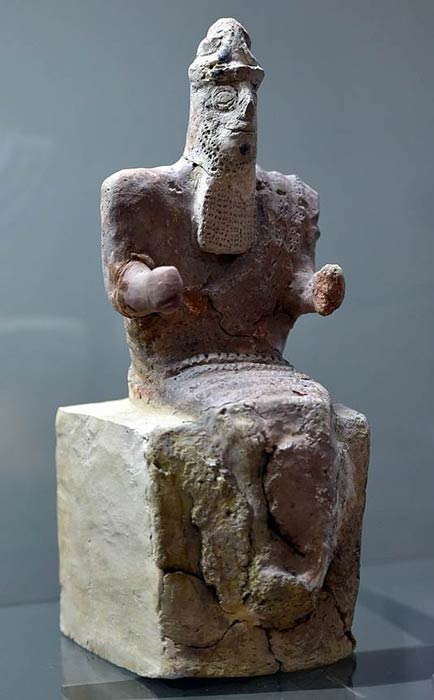
Statuette of Enlil sitting on his throne from the site of Nippur, dated to 1800 – 1600 BC, now on display in the Iraq Museum. (Osama Shukir Muhammed Amin / CC BY-SA 4.0)

Statuette of Enlil sitting on his throne from the site of Nippur, dated to 1800 – 1600 BC, now on display in the Iraq Museum. (Osama Shukir Muhammed Amin / CC BY-SA 4.0 )

A Loving God with a Penchant for Floods

Enlil is the chief deity amongst the Sumerians and primarily worshiped god in the city of Nippur. Enlil is known for his association with air, wind, earth, and storms, as well as his worship place in the middle of Nippur. Those looking to worship Enlil would visit the Ekur temple, which translates to “mountain house.” This temple was known as the assembly of gods in Nippur and was the most sacred and revered building in all of ancient Sumer. It was believed that Enlil had built the temple for himself as a connection between Heaven and Earth.

Ancient Sumerian myths state that Enlil was so holy that even other gods could not look directly upon him. Sumerians who worshiped Enlil also believed he was responsible for the development of the Earth. The first god, Nammu, had created Heaven (An) and Earth (Ki), who mated with each other to create Enlil. Enlil separated his creators, An and Ki (Heaven and Earth) so humans would be able to survive there. Humans were created by the mating of Enlil and Ki (Earth, his mother), as were all other forms of life on Earth.

In other mythology, Enlil is the supposed father of many other gods on Earth. The moon god Nanna , the god of death Nergal, the warrior god Ninazu, and the god of rivers Enbilulu are all believed to be his offspring. In one version of the Sumerian flood story, the god Enki helps a man Ziusudra to survive, and he became the only survivor of the flood. Enlil, impressed by this, gave Ziusudra immortality as a gift for his intelligence and strength. This version of the story was recorded on an ancient Sumerian tablet, but the story is not complete, and the cause of the flood is unclear due to tablet damage over time.

Another myth about the Great Flood states that Enlil himself caused it. It is believed that Enlil had grown tired of the loudness of humans preventing him from sleeping, so he decided to eliminate the humans as they were overpopulated. In this story, the family of a man named Utnapishtim is warned of the impending flood and is told by the god Ea to build a boat to survive. When Enlil discovers that Utnapishtim and his family have survived the flood, he becomes enraged. However, his son Ninurta saves his family by convincing Enlil to let them live as long as the Earth does not become overpopulated again. Enlil compromises by creating predators, famines, and diseases to keep the population at bay and gives Utnapishtim immortality for his loyalty. 

Sumerians focused the entirety of their existence on worshiping the gods and ensuring the gods would be pleased with their work. As part of this worship, they frequently created statues of Enlil as well as other gods, as they believed a statue of a god became a physical embodiment of it. These statues then became regular parts of worship rituals, between which Sumerians would tend to the statues constantly by providing cleaning, food, and other human care for them.

Enlil was often described as a caring, fatherly deity who cares for his people. Kings in nearby city-states used Enlil as a personal influence and sought to rule similarly to how Enlil ruled humanity. In fact, Enlil was thought of so highly that Nippur was the only city-state in Sumer to never have a palace built. They believed that a palace would draw attention away from Enlil and wanted his temple to be considered the most important building in the city.

Even after the Babylonians captured Sumer under the rule of Hammurabi in the 17th century BC, Enlil’s temple was still being used. Though he lost popularity throughout the years, he gained attention on and off, such as around the 7th century BC when ancient Babylonians began to believe that Enlil gave their own god, Marduk, his powers. This worship continued until around the 1st century BC, when the civilization significantly declined and worship of both Enlil and Marduk stopped.
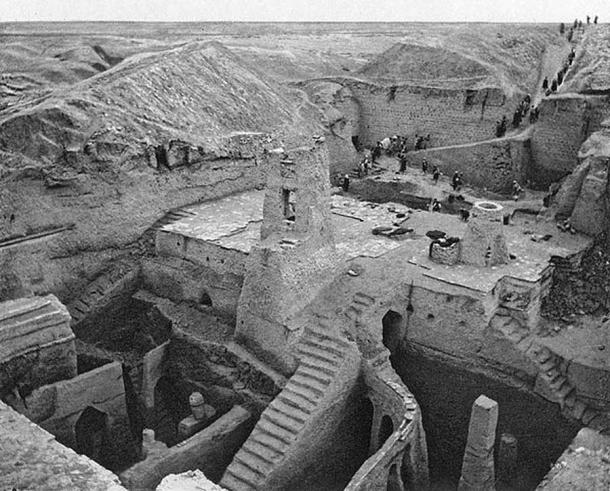
Nippur excavations, 1893. (John Henry Haynes / Public domain)

Nippur excavations, 1893. (John Henry Haynes / Public domain )

From Holy City to Decaying Ruins

Nippur experienced many seasons of both downfall and regeneration. At times, when all hope seemed lost for Nippur, a nearby king might send workers to have parts of the temple rebuilt or for additions to be built onto it. This is evidenced by remaining artifacts and architecture in the region, as some preserved bricks show the symbols of different reigns over time. The dynasty of Ur, under Ur-Nammu, in particularly helped to build Nippur back up by rebuilding city walls, shrines, and even canals.

Under Hammurabi’s rule , Enlil’s temple was left mostly neglected. The Babylonians had made Babylon the new religious center of the region and had attributed Enlil’s stories to Marduk. Around the 7th century BC, Ekur was given more attention, when some Babylonians began worshipping Enlil again and they decided to turn Ekur into a fortress. Giant walls were built around the temple to protect it, and it was well maintained until around 250 AD. At this point, the region was taken over by Sassanids and left to decay.

Nippur was still inhabited for the next few hundred years. Early Muslim geographers made note of the region, though their mentions of Nippur declined sometime after 800 AD, indicating that the city was likely becoming less inhabited at this point. Though it was still used at times for religious purposes, the city was entirely abandoned by the 13th century AD. Even after its abandonment, many local cities still acknowledged the ruins as a sacred site that was once filled with splendor.
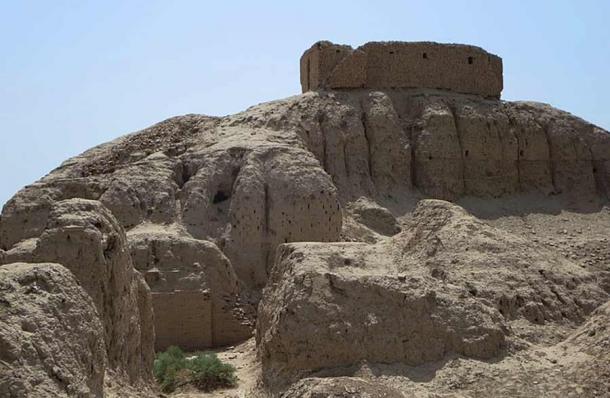
Ruins of Enlil’s Temple, Nippur.  (David Stanley / CC BY 2.0 )

Nippur: Upcoming Glow Up of the Year?

Though Nippur is now a site of ancient ruins, it is still fascinating to see some of the still-standing buildings that exist there. In particular, Enlil’s temple, the Ekur, is still standing and can be seen by those who visit. The site has also been excavated over 19 times by archaeologists since the mid-1900s, which has resulted in many fascinating discoveries.

As of February 2017, Nippur has been placed on the “tentative” list under UNESCO’s World Heritage Sites to join under the “cultural” category. The United Nations Educational, Scientific, and Cultural Organization is a UN agency that strives to protect important historical landmarks from destruction under the categories of cultural, historical, scientific, natural, or mixed. They also strive to educate others about these sites so others can see the significance of these areas in our history and in our world.

If Nippur becomes a UNESCO World Heritage Site, it may be provided resources to help conserve the remaining walls and buildings in the city. It will also prevent further damage to the site by limiting access to animals, people, and governmental negligence. This could be an excellent opportunity to protect Nippur from further destruction and reduce decay of these ancient buildings.

As of right now, further excavations are already planned in Nippur to discover more about Mesopotamian culture, particularly in the areas of medicine and technology . In addition, many archaeologists are working to perform renovations on some of the existing buildings in Nippur to prevent decay even before approval from UNESCO. With a bit of elbow grease, Nippur could be seeing yet another restoration in the future.

Top image: The ruins of the Enlil temple, or the Ekur, in Nippur, which was once the most important pilgrimage destination in Mesopotamia. The brick structure on top was constructed by American archaeologists around 1900. Source: David Stanley / CC BY 2.0

By Lex Leigh

Claims for Early Settling of the Americas Challenged By New Study

When were the Americas settled? When did humans first set foot there? These leading questions continue to baffle scientists and historians alike, as ever emerging new evidence sets the date back, or sometimes pushes it forward. General historical evidence and consensus has pointed to the arrival of the earliest inhabitant hunter-gatherers in the Americas from Asia, across the Bering Strait , around 14,200 years ago, concurred upon by a new study published in the scientific journal PLOS One , whose authors have rejected newer and more recent theories that point to a much earlier arrival.


Map of sites used in the new study trying to understand the settling of the Americas. (Surovell et. al. / PLOS ONE)

Map of sites used in the new study trying to understand the settling of the Americas. 

(Surovell et. al. / PLOS ONE )

Evidence of Early Occupation?

This study, conducted by University of Wyoming (UW) Professor Todd Surovell, and worked upon by fellow colleagues from UW and five other institutions, points to a “misinterpretation of archaeological evidence” at certain sites in North and South America that has allowed for the emergence of contradicting theories. For this most recent study, the researchers primarily looked at three sites in the USA where claims of early human occupation had been made – two in Texas, and one in Idaho.

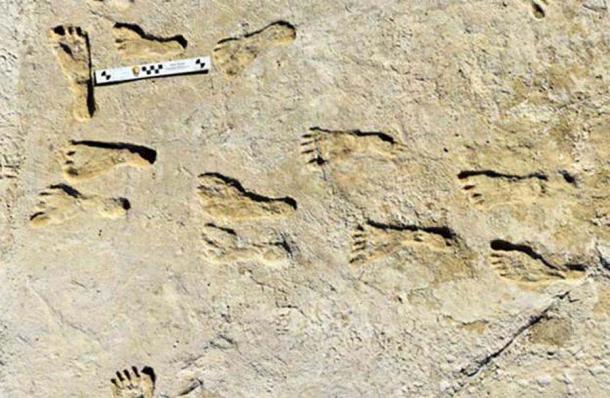
As recently as 2021, a study published in Science alleged that a series of human footprints from the exposed outcrops of Lake Otero in White Sands National Park in New Mexico dated back to 23,000 to 21,000 years ago. This time period has been associated with massive ice sheets that walled off human passage to North America. A plethora of recent discoveries in North and South America point to a site in Monte Verde in Chile as old as 18,500 years ago , and the Gault site in Texas upto 20,000 years ago.

The ancient New Mexico footprints found at White Sands National Park, which could be dated because the footprints were embedded with native plant seeds. (Bennett et al. / Science)

The ancient New Mexico footprints found at White Sands National Park, which could be dated because the footprints were embedded with native plant seeds. (Bennett et al. /  Science)

The Stratigraphic Integrity Index and the Science of Simulation

Surovell and his colleagues have developed a statistic called the Apparent Stratigraphic Integrity Index (ASII), applied to all sites that come before and after 13,000 years ago, north and south of the continental ice sheets. The ASII is a simulation that involves “modelling stratigraphic mixing of multicomponent archaeological sites to identify signatures of stratigraphic integrity in vertical artifact distributions,” the authors write in the study. Depositional and occupational history are held constant in this simulation.

The results point to a high stratigraphic integrity of early archaeological sites in Alaska, with strong evidence of unambiguous human occupation . However, the sites in more southern locations point to possible earlier human occupations which show signs of artifact mixing among multiple time periods, which has formed the basis of this study, and claims to refute the newer claims about earlier occupation.

The aforementioned sites were juxtaposed against the stratigraphic integrity of sites in Alaska, Wyoming and Pennsylvania, and it was found that all three sites revealed signs of stratigraphic mixing, while the new sites did not. “If humans managed to breach the continental ice sheets significantly before 13,000 years ago, there should be clear evidence for it in the form of at least some stratigraphically discrete archaeological components with a relatively high artifact count. So far, no such evidence exists,” they posit in the study.

“(Our) findings support the hypothesis that the first human arrival to the New World occurred by at least 14,200 years ago in Beringia and by approximately 13,000 years ago in the temperate latitudes of North America. Strong evidence for human presence before those dates has yet to be identified in the archaeological record,” write the authors.


The Hell Gap archaeological site in eastern Wyoming was one of the sites included in the study. (Todd Surovell / University of Wyoming)

The Hell Gap archaeological site in eastern Wyoming was one of the sites included in the study. (Todd Surovell / University of Wyoming )

Historically Poor Data Collection

The authors also write that sites claiming to be older than 13,000 years are few and supporting data has been poorly disseminated. They go on to argue that there are no sites in the Americas that lie south of the ice sheets which point to a discrete stratigraphy and cultural occupation, and accompanying volumes of artifacts.

“That they did so in Beringia but failed to do so south of the continental glaciers suggests that either there was something fundamentally different about pre-Clovis human behavior and/or geomorphology south of the ice sheets, or that the evidence indicating the presence of humans south of the ice sheets has been misinterpreted,” the researchers wrote.

“At a minimum, it shows that, when stratigraphically discrete occupations are not present, additional studies must be performed to demonstrate that stratigraphic integrity of association between artifacts and dated strata exist.”

The authors have added an important disclaimer though – by no means do they allege that this ASII is a waterproof mechanism. Therefore, it is possible that humans colonized the Americas earlier, but logically, they were unable to produce stratigraphically discrete occupation surfaces, which would then have had a large number of artifacts. That was not the case when the ASII simulation was run. Future finds and different simulational-computational models which process data in different manners will eventually be able to answer one of history’s perennial mysteries.

Top image: New study refutes idea that the settling of the Americas took place earlier than previously thought. Source: JohanSwanepoel / Adobe Stock

By Sahir Pandey

First Chinese-Built Methanol-Fueled Tanker Begins Sea Trials

sea trials for methanol-fueled tanker built in China
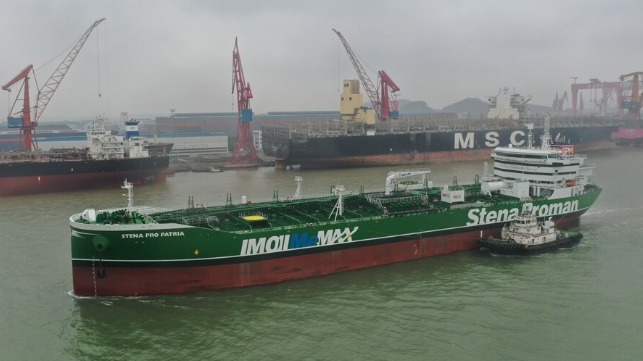
Stena Pro Patria is the first of six methanol-fueled tankers being built by GSI in China (GSI)

PUBLISHED APR 27, 2022 7:53 PM BY THE MARITIME EXECUTIVE


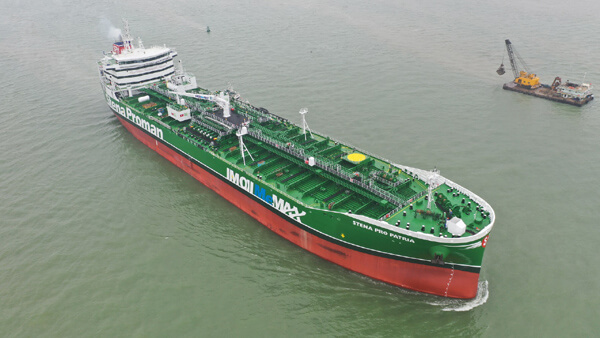
Sea trials recently began for the Stena Pro Patria, the first methanol-powered dual-fuel tanker constructed in China. Built by Guangzhou Shipyard International the vessel is the first of six 49,990 dual-fuel tankers designed to use methanol being built by the shipyard and are being billed as an advancement for methanol-fueled propulsion. Over the next few years, methanol is expected to expand rapidly as Maersk introduces the first large containerships designed to run on the alternative fuel and x-Press Feeders has ordered up to a dozen smaller containerships also operating on methanol.

Proman Stena Bulk, a joint venture between Sweden’s Stena Bulk AB and Switzerland’s Proman became the first of the new generation of shipping companies to order methanol-fueled vessels. Initially, they ordered two vessels and then expanded the order to three, while Proman later independently ordered three additional tankers all using the same design. 

All the vessels are being built by Guangzhou Shipyard International (GSI) with the other two ships for Proman Stena Bulk also currently under construction. The Stena Pro Patria is expected to be delivered shortly, while her sister ships, Stena Pro Marine and Stena Prosperous, are also due to be completed this year. Each of the vessels will be 610 feet long with a 105 foot beam.


First methanol-fueled tanker is currently on sea trials with the first three vessels due to be delivered this year (GSI)


GSI vice president William Zhou hailed the start of sea trials and testing of the propulsion equipment as “a watershed moment” in the development of methanol as an alternative fuel for MR tankers. He said each tanker will significantly slash NOx emissions by using each year around 12,500 tons of methanol as a marine fuel. The vessels are powered by a MAN dual-fuel 6G50ME C9.6 engine, without catalyst conversion.

“We are very proud to see the first ship in this ground-breaking fleet begin sea trials,” said Zhou. “We won the contract under stiff competition from Korea and this ship shows what GSI is truly capable of building on our experience of building 30 dual-fuel vessels. The construction of the Stena Pro Patria is a massive achievement for all parties involved and I would like to thank Proman, Stena, our team, MAN engines as well as the class society DNV for all they are doing to make this bold ship design and fleet a reality.”

Zhou said each tanker uses the latest energy efficiency technology including continually controlled combustion, optimized tuning, redesigned and aerodynamic hull lines, and an energy shaft generator reducing fuel consumption.

“Methanol has the benefit of being widely available already near many ports worldwide having being shipped for decades,” said Zhou. “Moreover, bunkering of methanol, as an ambient temperature liquid fuel, is similar to distillate fuel so can be used in existing bunkering facilities with relatively few upgrades.  He expects that the use of methanol will grow due to properties that make it no more dangerous than diesel and is less hazardous to the environment than diesel or HFO biodegrading rapidly in the event of a spill.

GSI highlighted that it has built, or is building, a total of 32 dual-fuel ships including two LNG propulsion ropax vessels, two LNG propulsion Suez tankers, 14 LNG propulsion LR2 tankers, eight LNG propulsion PCTCs, and six methanol propulsion MR tankers. Their goal is to become one of the world’s greenest shipyards.

China Launches its First Autonomous Container Ship Service

China starts service on first autonomous containership
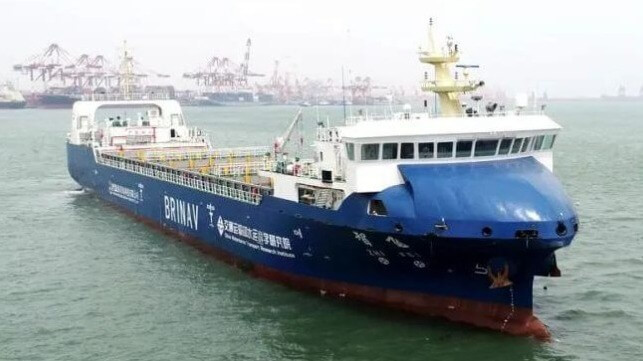
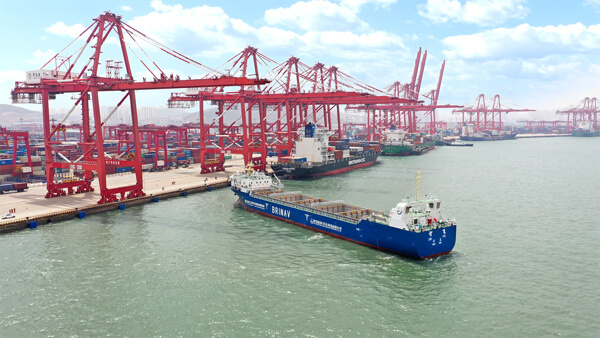
Zhi Fei entered comemrcial services after extensive trials as the first autonomous containership (Bestway)

PUBLISHED APR 25, 2022 5:16 PM BY THE MARITIME EXECUTIVE


Chinese officials are reporting that they have put the world’s first autonomous, electric container feeder ship into commercial service after a period of extensive trials. The vessel, which was developed through a broad collaboration of Chinese institutions is reported to be a demonstration ship that will provide significant learning for the future development of the technology.

The vessel, named Zhi Fei (Chinese for Flying Wisdom) commenced its first regular voyage on April 22. The Zhi Fei is reported to be approximately 8,000 dwt with a capacity of 300 TEU. The vessel is 384 feet long with a beam of 57 feet and a depth of approximately 32 feet. Propulsion is reported to be by a DC electric system that gives the feeder ship a top speed of approximately 12 knots and a normal operating speed of 8 knots. The Zhi Fei was built by the Qingdao Shipyard.

The design for the vessel was led by Bestway in cooperation with Shanghai Jiahao Ship Design Institute and the Dalian Maritime University. The initial construction contract was signed at the end of 2019 with work beginning in May 2020. The vessel was launched in April 2021 with the first sea trials in June and testing on the systems began last September. The technical evaluation was completed in March 2022, and the vessel is now operating between Qingdao Port in Shandong Province and Dongjiakou managed by Navigation Brilliance (BRINAV). 


Zhi Fei began commercial operations on April 22, 2022 (Bestway)


According to the reports, the ship adopts a full-rotation electric propulsion system based on hybrid technology and integrates large-capacity battery packs and generator sets through DC networking to achieve intelligent energy efficiency optimization. The Chinese are saying that it is the first time that a DC power system has been combined with intelligent operations.

The containership is capable of operating in three different modes, manned driving, remote driving, and unmanned driving. The intelligent systems provide independent route planning, intelligent collision avoidance, and remote-control operations. The vessel employs 5G, satellites, and other multi-network systems.

Information developed from this project and the operation of the ship are contributing to efforts to build similar self-propelled containerships with a larger capacity from 500 to 800 TEU.


Ulstein Proposes Molten Salt Reactor Ship to Achieve Zero Emissions

molten salt reactor MSR vessel concept
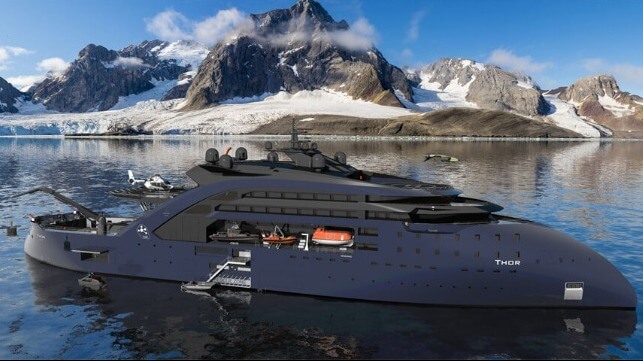
Thor would be powered by a molten salt reactor serving as a replenishment base for the crusie ships (Ulstein)

PUBLISHED APR 27, 2022 8:44 PM BY THE MARITIME EXECUTIVE


Norway’s Ulstein Group presented its unique vision for the future of zero-emission shipping with a design that would become the first ship to use a Thorium Molten Salt Reactor as its power source and would act as a replenishment vessel for expedition cruise ships. The concept of the MSR is drawing interest for multiple potential applications on land and sea as it is viewed as a safe technology that reduces the dangers of traditional nuclear reactors providing the potential for vast amounts of clean, safe electric power.

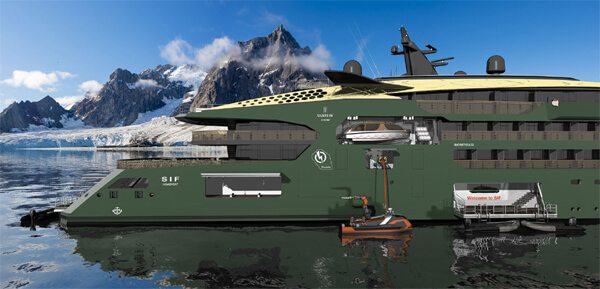
The concept vessel, Ulstein Thor is a 488-foot ship that would be powered by the MSR reactor and server as a “replenishment, research, and rescue” vessel (3R) to support the operation of Ulstein designed expedition cruise ships.
 
Ulstein says that the vessel concept is capable of making the vision of zero-emission cruise operations a reality. They believe that Thor, “may be the missing piece of the zero emissions puzzle for a broad range of maritime and ocean industry applications.” Using the MSR reactor, Thor would never need to refuel. As such, Ulstein says the design is intended to provide a blueprint for entirely self-sufficient vessels of the future.


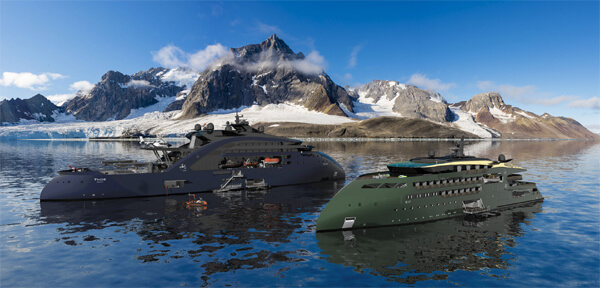
Thor would be the replenishment vessel for the expedition cruise ship Sif (Ulstein)


“We have the goals, ambition, and environmental imperative to switch to zero-emission operations, but, until now, we haven’t had the solution,” said Ulstein CEO Cathrine Kristiseter Marti unveiling the design concept at this week’s Seatrade Cruise conference. “We believe Thor might be the answer we’ve been looking for. Thor is essentially a floating, multi-purpose ‘power station’ that will enable a new battery revolution."

The MSR concept works by dissolving Thorium, an abundant, naturally occurring metal with low radioactivity, in liquid salt. The ensuing chain reaction heats the salt, producing steam to drive a turbine and create electricity. In the advent of a failure in the reactor, the concept is that the Thorium would become encased in the cooled salt preventing the spread of radiation. 

Several concepts have been presented to leverage the capabilities of MSR in the maritime world. South Korean shipbuilder Samsung Heavy Industries said it would undertake a joint research and development project with the Korea Atomic Energy Research Institute for modern nuclear-powered ships. Recently, Samsung and Seaborg also detailed a concept to create floating power barges using MSR to create electricity.

Ulstein developed Thor’s charging capacity scaled to simultaneously satisfy the power needs of four expedition cruise ships. They said the design would enable replenishment of energy and supplies on site, while also boasting the technology to facilitate rescue operations, as well as conducting research tasks.

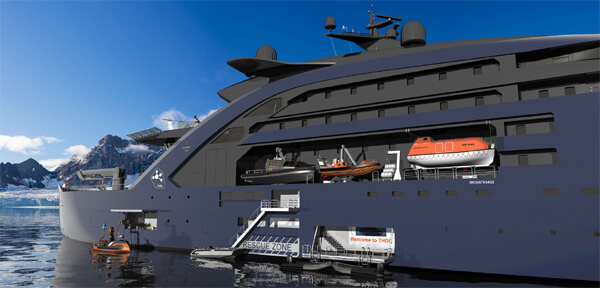
To demonstrate its feasibility, Ulstein also developed the Ulstein Sif concept, a 328-foot, zero-emission expedition cruise ship. The Ice Class 1C vessel would run on next-generation batteries, utilizing Thor to recharge while at sea. The designs for both Thor and Sif feature Ulstein’s X-Bow design, created for greater operability, comfort, operational functionality, and fuel efficiency. Thor also features helicopter pads, firefighting equipment, rescue booms, workboats, autonomous surface vehicles, and airborne drones, cranes, as well as laboratories and a lecture lounge. The expedition cruise vessel Sif would accommodate up to 80 passengers and 80 crew, offering silent, zero-emission expedition cruises to remote areas, including Arctic and Antarctic waters.
 

Closeup of Thor with its autonomous recharging vehicle (Ulstein)


Recharging of Sif's battery using an autonomous recharging vehicle from Thor (Ulstein)


World’s First All Electric Bunker Tanker Enters Service in Japan

first electric bunker vessel enters service
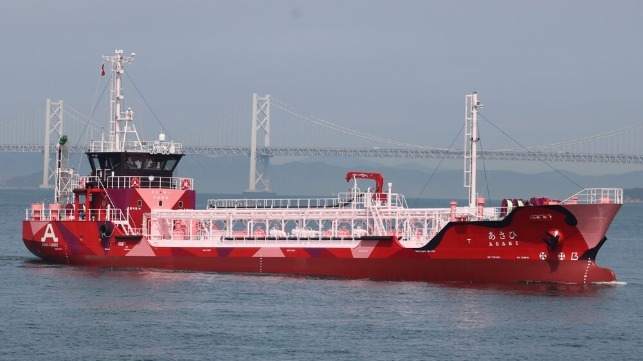
Asahi is the first all electric bunker vessel (Asahi Tankers)

PUBLISHED APR 27, 2022 6:51 PM BY THE MARITIME EXECUTIVE


The world’s first electric-powered bunker tanker went into service yesterday in Japan after several weeks of testing and demonstrations. The 492 ton vessel is powered entirely by large-capacity lithium-ion batteries making it carbon-free in its operations. The vessel, Asahi operated by Asahi Tankers, is in commercial service but also is viewed as a demonstration ship contributing to the development of battery-powered vessels.

Designs for the bunker vessel were developed in cooperation with Japan’s e5 Lab as part of its effort to develop zero-emission ships and through the use of technology to improve the working environment aboard the vessel. It was launched in December 2021 by Japanese shipbuilder Koa Sangyo and delivered to its owners Asahi Tankers on March 30.

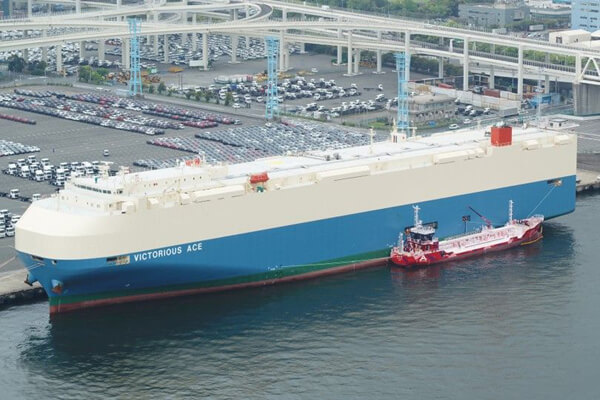
Measuring 203 feet in length and with a 34 foot beam, the tanker has a capacity to transport 1,277 cbm of fuel providing bunkering operations in Tokyo Bay. On April 26, the Asahi fueled the Mitsui O.S.K. Lines-operated car carrier Victorious Ace at the Daikoku Pier C-1 Wharf in Yokohama. According to the companies, this “marked a commemorative moment for the Asahi’s first bunkering operation.”


Tanker completed the bunkering operation for MOL's car carrier on April 26 (MOL)


The power for the vessel is stored in a lithium-ion battery developed by Corvus Energy with the propulsion system built by Kawasaki. They reported that the battery has a capacity of 3,480 kWh providing all the power needed for navigation, berthing, and cargo handling. The ship is propelled by two 300kw azimuth thrusters and also has two 68kw side thrusters. The tanker has an operating speed of about 10 knots and a range of approximately 100 miles. It will require about 10 hours to fully recharge the batteries.

Since the delivery at the end of March, the vessel has undergone power tests first at the shipyard and then at its newly built power plant in Kawasaki City. The specially designed plant recharges the vessel. As part of the design developed by e5 and Kawasaki, the Asahi can also serve as a source of power designed to provide support in emergencies or natural disasters.

The vessel drew large crowds of spectators along with industry officials who inspected her during her previews last week. In addition to the zero-emission operations, Asahi reports that the tanker provides a more comfortable work environment with less noise and vibration than traditional vessels. They also expect that there will be reduced requirements for engine maintenance.

Asahi has contracted for the construction of a second electric-powered bunker tanker. The vessel will be built at Zosen KK shipyard and is due for delivery in March 2023. 


Colombian river plagued

by clouds of toxic foam

STORY: According to the local government, the foam floating on the Balsillas river comes from detergent wastes dumped into the river.

However, Mosquera neighbours complained that the foam was not just soap and that its residues were corrosive, seriously affecting the community.

The local shopkeeper Luis Romero complained about losing clients every time the foam appeared because the unpleasant smell drives customers away.

"Health, that's the problem. This foam affects everything; for example, foam falls on the doors, and everything rots," Romero said.

Resident Claudia Esperanza Garzon told Reuters that her health has declined since the appearance of the foam.

"I have to use an inhaler because my lungs are already bad," said Garzon while sweeping foam from his house.

10 football pitches a minute, that's the rate of tropical rainforest loss in 2021: Study
The loss of tropical primary forests also caused the emissions of 2.5 billion tonnes of carbon dioxide. 

David Fogarty
Climate Change Editor

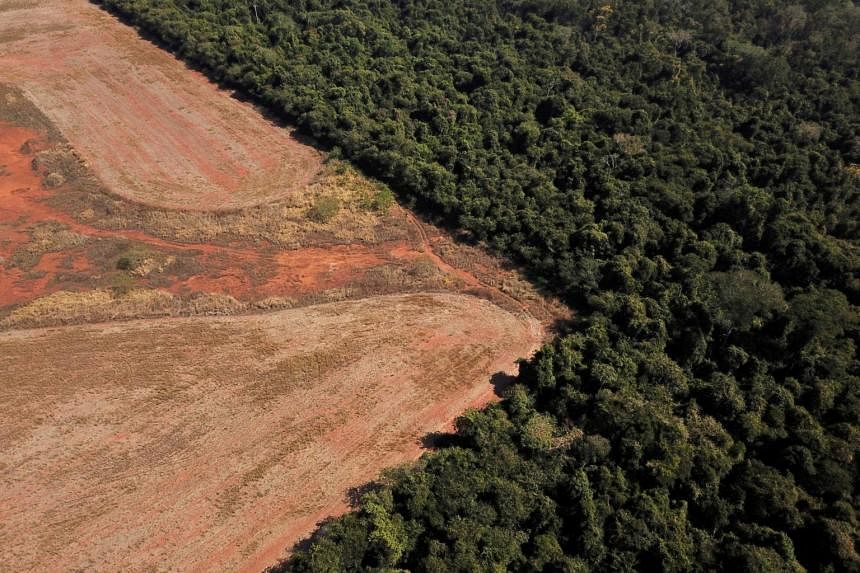
SINGAPORE - The world lost primary rainforests in the tropics at the rate of 10 football pitches a minute in 2021, a stubbornly high level that undermines global pledges to slash deforestation and increases the threat from climate change, a global study released on Thursday (April 28) shows.

The annual Global Forest Watch/World Resources Institute (WRI) forest loss analysis found that the tropics lost 11.1 million hectares of tree cover in 2021. This includes 3.75 million ha of humid tropical primary forests - an area roughly the size of Bhutan.

The loss of tropical primary forests also caused the emissions of 2.5 billion tonnes of carbon dioxide (CO2), equivalent to the annual fossil fuel emissions of India, underscoring the climate threat. CO2 is the main greenhouse gas.

Primary forests are dense, undisturbed areas that contain large amounts of trees, are rich in species and are key to regulating the climate, including rainfall patterns. They also support millions of indigenous people.

But over the past two decades, the tropics have been losing millions of hectares of primary forests and other types of forests.

Large-scale agriculture remains the top cause, mainly oil palm, soy, cattle ranching and wood for fuel. Fires and logging for timber are other key drivers.

To try to address the crisis, 141 heads of state committed during the COP26 climate talks last November to halt and reverse forest loss by 2030.

But the report's findings underscore the challenge of following through on that pledge and that actions by countries really need to step up.

"Those actions are going to have to be dramatic," Ms Frances Seymour, WRI distinguished senior fellow, told a press briefing.

Last year, the tropics lost 11 per cent less primary forest than 2020. But that followed a 12 per cent increase from 2019 to 2020, mostly due to a higher level of fire-related loss, according to the study, a collaboration with the University of Maryland in the United States.

Brazil topped the list with 1.55 million ha lost, followed by the Democratic Republic of Congo with nearly 500,000 ha and Bolivia with 291,391 ha.

In Indonesia, home to the world's third largest expanse of rainforest, the rate of primary forest loss declined for the fifth straight year, falling by 25 per cent in 2021 compared with 2020, helped by a mix of government and private sector efforts as well as better fire management.

Malaysia's forest loss fell 1 per cent, also the fifth consecutive year of decline.

But the overall global rate of loss remains high, leading to large amounts of greenhouse gas emissions and exacerbating the risks from climate change, which is already fuelling hotter and drier conditions that are causing larger and more widespread forest fires.

Forests soak up large amounts of CO2 and help cool the planet. Chop them down and CO2 levels rise further, heating up the planet and triggering hotter conditions for fires that in turn cause more devastating fires such as those in Brazil, Bolivia, northern Russia as well as Indonesia in 2015. Climate change plus forest clearing is creating a vicious circle.

Outside of the tropics, boreal forests in the Northern Hemisphere experienced the highest rates of tree cover loss in 2021, mainly due to fires, the study found. Russia suffered the worst fire season since record-keeping began in 2001, with more than 6.5 million ha of tree cover loss in 2021.

Ms Seymour said climate change itself was making it harder to maintain the world's remaining forests.

She said the data in the new study "reveals how much of the year-to-year variability and tree cover loss is due to fires".

"And this loss of forest resilience is edging us closer and closer to tipping points, such as the wholesale conversion of the Amazon rainforest to a savanna grassland."

"That would release enough carbon into the atmosphere to blow the Paris Agreement goals right out of the water," she said, referring to the goals of limiting global warming to well below 2 deg C and ideally, 1.5 deg C above pre-industrial levels.