CNN investigates the killing of Palestinian-American journalist Shireen Abu Akleh on May 11 and says she was targeted by Israeli sniper positioned 600 feet away from her with a clear line of sight.
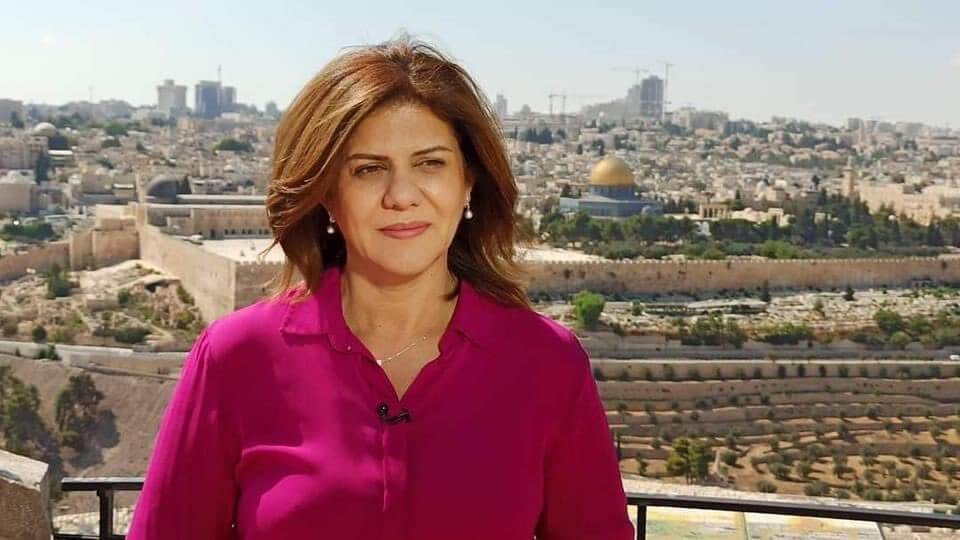
SHIREEN ABU AKLEH (SOCIAL MEDIA)
Today CNN published its own investigation of the killing of Palestinian-American journalist Shireen Abu Akleh on May 11, and it says that new eyewitnesses, videos and ballistic analysis bear out what Abu Akleh’s colleagues said that day: The AlJazeera correspondent was targeted by an Israeli sniper positioned about 600 feet away from her with a clear line of sight.
CNN’s team of six journalists writes:
[A]n investigation by CNN offers new evidence — including two videos of the scene of the shooting — that there was no active combat, nor any Palestinian militants, near Abu Akleh in the moments leading up to her death. Videos obtained by CNN, corroborated by testimony from eight eyewitnesses, an audio forensic analyst and an explosive weapons expert, suggest that Abu Akleh was shot dead in a targeted attack by Israeli forces.
CNN’s devastating report shows the media are not dropping the killing of Shireen Abu Akleh, even if the Israeli government is. Hopefully this will bring added pressure on the U.S. government to investigate the case on its own, as 57 Congresspeople have urged it to do, and demand accountability for the killing.
The new investigation, which follows on similar forensic analyses by Bellingcat and B’Tselem, supports the assertions of journalist eyewitnesses, in the face of Israeli denials.
All of the journalists were wearing protective blue vests that identified them as members of the news media.
“We stood in front of the Israeli military vehicles for about five to ten minutes before we made moves to ensure they saw us. And this is a habit of ours as journalists, we move as a group and we stand in front of them so they know we are journalists, and then we start moving,” [reporter Shatha] Hanaysha told CNN…
CNN points out that an Israeli army spokesperson Ran Kochav described the journalists as “armed with cameras” later that day.
The CNN investigation reviewed a 16-minute video shot by Salim Awad, a 27-year-old Jenin camp resident.
His video captures the moment that shots were fired at the four journalists — Abu Akleh, Hanaysha, another Palestinian journalist, Mujahid al-Saadi, and Al Jazeera producer Ali al-Samoudi, who was injured in the gunfire — as they walked toward the Israeli vehicles. In the footage, Abu Akleh can be seen turning away from the barrage. The footage shows a direct line of sight towards the Israeli convoy.
Awad witnessed the attack.
“We saw around four or five military vehicles on that street with rifles sticking out of them and one of them shot Shireen. We were standing right there, we saw it. When we tried to approach her, they shot at us. I tried to cross the street to help, but I couldn’t,” Awad said.
Another witness reinforced this account:
Jamal Huwail, a professor at the Arab American University in Jenin, who helped drag Abu Akleh’s lifeless body from the road, said he believed the shots were coming from one of the Israeli vehicles, which he described as a “new model which had an opening for snipers,” because of the elevation and direction of the bullets.
“They were shooting directly at the journalists,” Huwail said.
The investigation analyzed videos and photos of the scene with the help of two military experts, to conclude that the shot that hit Abu Akleh was fired by a sniper aiming at a target in a manner that points to Israeli soldiers positioned about 600 feet away.
“The number of strike marks on the tree where Shireen was standing proves this wasn’t a random shot, she was targeted,” [Chris] Cobb-Smith [a weapons expert and British army veteran] told CNN, adding that, in sharp contrast, the majority of gunfire from Palestinians captured on camera that day were “random sprays.”…
At 200 meters, Cobb-Smith said that there was “no chance” that random firing would result in three or four shots hitting in such a tight configuration. “From the strike marks on the tree, it appears that the shots, one of which hit Shireen, came from down the street from the direction of the IDF troops.”
Today CNN published its own investigation of the killing of Palestinian-American journalist Shireen Abu Akleh on May 11, and it says that new eyewitnesses, videos and ballistic analysis bear out what Abu Akleh’s colleagues said that day: The AlJazeera correspondent was targeted by an Israeli sniper positioned about 600 feet away from her with a clear line of sight.
CNN’s team of six journalists writes:
[A]n investigation by CNN offers new evidence — including two videos of the scene of the shooting — that there was no active combat, nor any Palestinian militants, near Abu Akleh in the moments leading up to her death. Videos obtained by CNN, corroborated by testimony from eight eyewitnesses, an audio forensic analyst and an explosive weapons expert, suggest that Abu Akleh was shot dead in a targeted attack by Israeli forces.
CNN’s devastating report shows the media are not dropping the killing of Shireen Abu Akleh, even if the Israeli government is. Hopefully this will bring added pressure on the U.S. government to investigate the case on its own, as 57 Congresspeople have urged it to do, and demand accountability for the killing.
The new investigation, which follows on similar forensic analyses by Bellingcat and B’Tselem, supports the assertions of journalist eyewitnesses, in the face of Israeli denials.
All of the journalists were wearing protective blue vests that identified them as members of the news media.
“We stood in front of the Israeli military vehicles for about five to ten minutes before we made moves to ensure they saw us. And this is a habit of ours as journalists, we move as a group and we stand in front of them so they know we are journalists, and then we start moving,” [reporter Shatha] Hanaysha told CNN…
CNN points out that an Israeli army spokesperson Ran Kochav described the journalists as “armed with cameras” later that day.
The CNN investigation reviewed a 16-minute video shot by Salim Awad, a 27-year-old Jenin camp resident.
His video captures the moment that shots were fired at the four journalists — Abu Akleh, Hanaysha, another Palestinian journalist, Mujahid al-Saadi, and Al Jazeera producer Ali al-Samoudi, who was injured in the gunfire — as they walked toward the Israeli vehicles. In the footage, Abu Akleh can be seen turning away from the barrage. The footage shows a direct line of sight towards the Israeli convoy.
Awad witnessed the attack.
“We saw around four or five military vehicles on that street with rifles sticking out of them and one of them shot Shireen. We were standing right there, we saw it. When we tried to approach her, they shot at us. I tried to cross the street to help, but I couldn’t,” Awad said.
Another witness reinforced this account:
Jamal Huwail, a professor at the Arab American University in Jenin, who helped drag Abu Akleh’s lifeless body from the road, said he believed the shots were coming from one of the Israeli vehicles, which he described as a “new model which had an opening for snipers,” because of the elevation and direction of the bullets.
“They were shooting directly at the journalists,” Huwail said.
The investigation analyzed videos and photos of the scene with the help of two military experts, to conclude that the shot that hit Abu Akleh was fired by a sniper aiming at a target in a manner that points to Israeli soldiers positioned about 600 feet away.
“The number of strike marks on the tree where Shireen was standing proves this wasn’t a random shot, she was targeted,” [Chris] Cobb-Smith [a weapons expert and British army veteran] told CNN, adding that, in sharp contrast, the majority of gunfire from Palestinians captured on camera that day were “random sprays.”…
At 200 meters, Cobb-Smith said that there was “no chance” that random firing would result in three or four shots hitting in such a tight configuration. “From the strike marks on the tree, it appears that the shots, one of which hit Shireen, came from down the street from the direction of the IDF troops.”
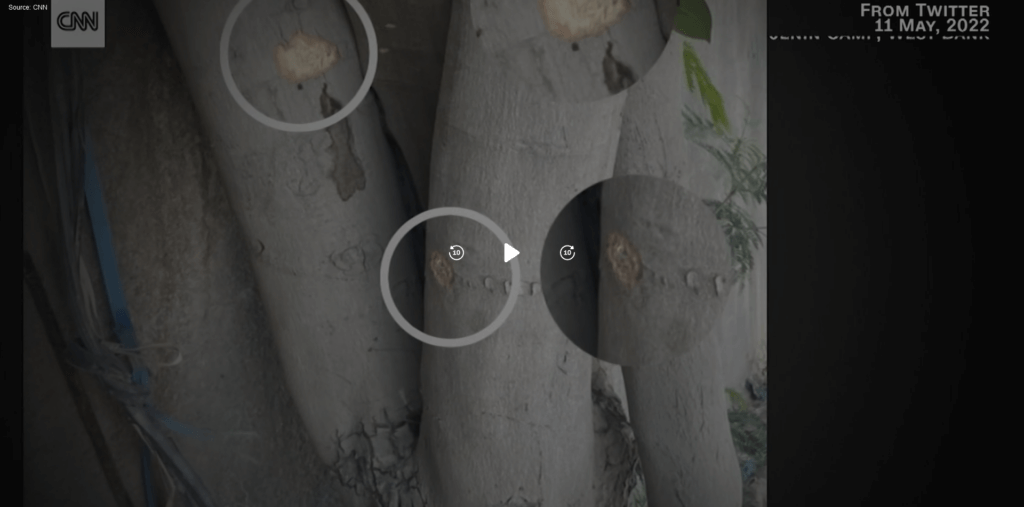
PHOTO OF 3 GROUPED GUNSHOTS ON TREE BESIDE SHIREEN ABU AKLEH SUPPORT THE IDEA THAT SHE WAS TARGETED AND NOT THE VICTIM OF A BURST OF GUNFIRE. FROM THE CNN INVESTIGATION, MAY 24, 2022.
A second expert consulted by CNN was Robert Maher, professor of electrical and computer engineering at Montana State University, who specializes in forensic audio analysis. Maher analyzed the intervals between the sounds of bullets leaving the barrel and the subsequent muzzle explosions recorded on video to assess the distance of the shooter from the camera.
“That would correspond to a distance of something between 177 and 197 meters,” or 580 and 646 feet, he said in an email to CNN, which corresponds almost exactly with the Israeli sniper’s position.
The best thing about the CNN report is that it shows that international media are not going to forget about Shireen Abu Akleh’s killing. We can only hope that more media and free speech organizations become advocates for Abu Akleh in death, as governments try to push the case aside.
A second expert consulted by CNN was Robert Maher, professor of electrical and computer engineering at Montana State University, who specializes in forensic audio analysis. Maher analyzed the intervals between the sounds of bullets leaving the barrel and the subsequent muzzle explosions recorded on video to assess the distance of the shooter from the camera.
“That would correspond to a distance of something between 177 and 197 meters,” or 580 and 646 feet, he said in an email to CNN, which corresponds almost exactly with the Israeli sniper’s position.
The best thing about the CNN report is that it shows that international media are not going to forget about Shireen Abu Akleh’s killing. We can only hope that more media and free speech organizations become advocates for Abu Akleh in death, as governments try to push the case aside.
Shireen Abu Akleh in her own words
In addition to being a courageous journalist, Shireen Abu Akleh also wrote in-depth articles reflecting on the role of the media in the struggle for Palestinian human rights.
BY MUHAMMAD ALI KHALIDI MAY 23, 2022
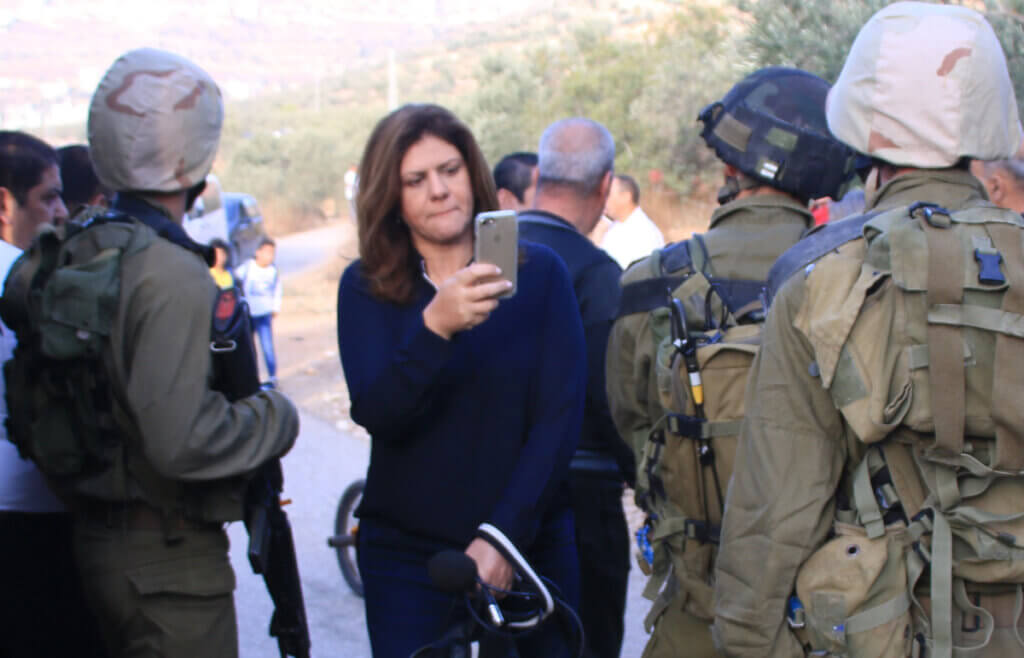
In addition to being a courageous journalist, Shireen Abu Akleh also wrote in-depth articles reflecting on the role of the media in the struggle for Palestinian human rights.
BY MUHAMMAD ALI KHALIDI MAY 23, 2022
(FILE) A PHOTO TAKEN ON OCTOBER 15, 2018. AL JAZEERA JOURNALIST SHIREEN ABU AKLEH TAKES A PHOTO DURING THE COVERAGE OF THE CLOSURE OF LUBBAN AL-SHARQIYA SCHOOL SOUTH OF NABLUS CITY, IN THE WEST BANK. (PHOTO: WAJED NOBANI/APA IMAGES)
As is now widely known, Palestinian-American journalist Shireen Abu Akleh was killed on May 11, 2022, while covering an Israeli military raid on a refugee camp in the occupied Palestinian territories for Al Jazeera. Her TV channel has accused Israel of “assassinating her in cold blood,” and her funeral included thousands of marchers in Jerusalem.
To add injury to injustice, her pallbearers and mourners were attacked by baton-wielding Israeli soldiers, who tried to prevent marchers from waving Palestinian flags.
After initially vigorously denying that she was shot by an Israeli sniper, Israel first said it would investigate the crime, then callously refused to do so. Abu Akleh was the latest victim of the longest military occupation in the contemporary world, and one of an estimated 50 Palestinian journalists killed since 2000, six of them in the past two years, according to the Palestinian Journalists Syndicate.
What is not so well known is that, in addition to being a courageous journalist of great integrity, Abu Akleh also wrote in-depth articles reflecting on the role of the media in the struggle for Palestinian human rights. Tragically, she wrote about a number of issues that are directly relevant to her assassination by the Israeli occupation forces.
An article written in 2016 for the Arabic-language journal of the Institute for Palestine Studies, discussed media coverage of the Palestinian “Popular Rebellion” (al-Habbah al-Sha’biyyah) of late 2015 and early 2016, which was ignited by Israeli raids on the al-Aqsa Mosque compound in Jerusalem.
The article reflects broadly on the complexities of reporting under military occupation. In it, Abu Akleh describes the readiness of the Israeli military to use lethal force against unarmed civilians, she discusses Israeli attacks on the news media, and she analyzes Israeli attempts to deny culpability for crimes committed against Palestinians.
She also comments on the fact that Palestinians killed by the Israeli military are often portrayed as heroes and role models by local Palestinian media, whether or not they want to be seen as such.
In one passage, Abu Akleh observed, with tragic prescience, on the ease with which Israeli soldiers killed unarmed civilians during the “Popular Rebellion” of 2015-2016:
In the most recent rebellion, the media was at least able to undermine the Israeli narrative – if not refute it entirely – when it came to the killing of many young men and women, notably in cases where there were no Israeli casualties. It became clear during the recent rebellion that Israeli soldiers would not hesitate to pull the trigger on Palestinians on the barest suspicion of their intention to carry out an operation.
She also commented on the media’s success in challenging the official Israeli explanation in some civilian deaths, on grounds of self-defense:
The media also succeeded in raising questions about Israel’s killing of suspects, many of whom were minors, when there was no need to do so. Images clearly showed numerous instances in which Palestinians were executed even though they posed no threat to soldiers’ lives.
She was sharply critical of Israeli attacks on Palestinian media outlets that covered violent assaults on civilians and documented the brutality of the Israeli occupation:
It’s not surprising that Israel regards the media as an agitator against the occupation and takes extreme measures against the news media, such as shutting down three radio stations in Hebron and confiscating all their equipment… Dozens of journalists have been injured by Israel with live ammunition and rubber-coated bullets in the course of their reporting. And at least 19 have been arrested in the most recent assault…
Meanwhile, Abu Akleh was attuned to the alienation of Palestinian youth from their political leadership and tried to convey their sense of political impotence:
It’s hard to discuss the recent rebellion without at least mentioning the role of the political leadership and the Palestinian political factions. Or maybe it would be more accurate to say: without mentioning their absence. After years of political impasse and the ongoing division between the two parts of the nation [the West Bank and Gaza Strip], and in light of the inability of the political factions to effect any change on the political scene, a general sense of alienation has arisen between the younger generation and the political leadership.
She also wrote somewhat critically on the Palestinian media’s commemoration of all victims of the Israeli occupation as martyrs and heroes, whether they like it or not:
The local news media generally propagate the image of the martyr as a role model and hero. The families of martyrs are often enlisted to glorify martyrdom, irrespective of their actual feelings. On October 27, 2015, I was covering the funeral of Iyad Jaradat, who was killed in the town of Sa’ir northeast of Hebron, when he was shot with a bullet to the head during confrontations with the Israeli occupation forces. Approaching his mother before the arrival of the body, I wondered what I could possibly ask her. As soon as I asked permission to interview her, relatives who were standing beside her began repeating the stock phrases used in the aftermath of martyrdom. “Tell them that he died for the sake of al-Aqsa mosque, the nation, Palestine, and Jerusalem.” So I asked a different question from the one I had prepared: “Is it any consolation to you that your son died for the sake of al-Aqsa?” She raised a finger to indicate negation and said: “No, nothing can be a consolation.”
That mother’s testimony says it all. Even though Shireen was killed in the line of duty, as she bore witness to the injustice and brutality of military occupation to the world, nothing can be a consolation for her loss.
The entire translated text of the article was published on the Institute of Palestine Studies’ blog, Palestine Square.
As is now widely known, Palestinian-American journalist Shireen Abu Akleh was killed on May 11, 2022, while covering an Israeli military raid on a refugee camp in the occupied Palestinian territories for Al Jazeera. Her TV channel has accused Israel of “assassinating her in cold blood,” and her funeral included thousands of marchers in Jerusalem.
To add injury to injustice, her pallbearers and mourners were attacked by baton-wielding Israeli soldiers, who tried to prevent marchers from waving Palestinian flags.
After initially vigorously denying that she was shot by an Israeli sniper, Israel first said it would investigate the crime, then callously refused to do so. Abu Akleh was the latest victim of the longest military occupation in the contemporary world, and one of an estimated 50 Palestinian journalists killed since 2000, six of them in the past two years, according to the Palestinian Journalists Syndicate.
What is not so well known is that, in addition to being a courageous journalist of great integrity, Abu Akleh also wrote in-depth articles reflecting on the role of the media in the struggle for Palestinian human rights. Tragically, she wrote about a number of issues that are directly relevant to her assassination by the Israeli occupation forces.
An article written in 2016 for the Arabic-language journal of the Institute for Palestine Studies, discussed media coverage of the Palestinian “Popular Rebellion” (al-Habbah al-Sha’biyyah) of late 2015 and early 2016, which was ignited by Israeli raids on the al-Aqsa Mosque compound in Jerusalem.
The article reflects broadly on the complexities of reporting under military occupation. In it, Abu Akleh describes the readiness of the Israeli military to use lethal force against unarmed civilians, she discusses Israeli attacks on the news media, and she analyzes Israeli attempts to deny culpability for crimes committed against Palestinians.
She also comments on the fact that Palestinians killed by the Israeli military are often portrayed as heroes and role models by local Palestinian media, whether or not they want to be seen as such.
In one passage, Abu Akleh observed, with tragic prescience, on the ease with which Israeli soldiers killed unarmed civilians during the “Popular Rebellion” of 2015-2016:
In the most recent rebellion, the media was at least able to undermine the Israeli narrative – if not refute it entirely – when it came to the killing of many young men and women, notably in cases where there were no Israeli casualties. It became clear during the recent rebellion that Israeli soldiers would not hesitate to pull the trigger on Palestinians on the barest suspicion of their intention to carry out an operation.
She also commented on the media’s success in challenging the official Israeli explanation in some civilian deaths, on grounds of self-defense:
The media also succeeded in raising questions about Israel’s killing of suspects, many of whom were minors, when there was no need to do so. Images clearly showed numerous instances in which Palestinians were executed even though they posed no threat to soldiers’ lives.
She was sharply critical of Israeli attacks on Palestinian media outlets that covered violent assaults on civilians and documented the brutality of the Israeli occupation:
It’s not surprising that Israel regards the media as an agitator against the occupation and takes extreme measures against the news media, such as shutting down three radio stations in Hebron and confiscating all their equipment… Dozens of journalists have been injured by Israel with live ammunition and rubber-coated bullets in the course of their reporting. And at least 19 have been arrested in the most recent assault…
Meanwhile, Abu Akleh was attuned to the alienation of Palestinian youth from their political leadership and tried to convey their sense of political impotence:
It’s hard to discuss the recent rebellion without at least mentioning the role of the political leadership and the Palestinian political factions. Or maybe it would be more accurate to say: without mentioning their absence. After years of political impasse and the ongoing division between the two parts of the nation [the West Bank and Gaza Strip], and in light of the inability of the political factions to effect any change on the political scene, a general sense of alienation has arisen between the younger generation and the political leadership.
She also wrote somewhat critically on the Palestinian media’s commemoration of all victims of the Israeli occupation as martyrs and heroes, whether they like it or not:
The local news media generally propagate the image of the martyr as a role model and hero. The families of martyrs are often enlisted to glorify martyrdom, irrespective of their actual feelings. On October 27, 2015, I was covering the funeral of Iyad Jaradat, who was killed in the town of Sa’ir northeast of Hebron, when he was shot with a bullet to the head during confrontations with the Israeli occupation forces. Approaching his mother before the arrival of the body, I wondered what I could possibly ask her. As soon as I asked permission to interview her, relatives who were standing beside her began repeating the stock phrases used in the aftermath of martyrdom. “Tell them that he died for the sake of al-Aqsa mosque, the nation, Palestine, and Jerusalem.” So I asked a different question from the one I had prepared: “Is it any consolation to you that your son died for the sake of al-Aqsa?” She raised a finger to indicate negation and said: “No, nothing can be a consolation.”
That mother’s testimony says it all. Even though Shireen was killed in the line of duty, as she bore witness to the injustice and brutality of military occupation to the world, nothing can be a consolation for her loss.
The entire translated text of the article was published on the Institute of Palestine Studies’ blog, Palestine Square.
Shireen Abu Akleh: Two Assassinations, Four Funerals
The mass outpouring of national unity that followed the martyrdom of Shireen Abu Akleh reflects a historic moment of unified Palestinian struggle and consciousness.
Jerusalem the Capital
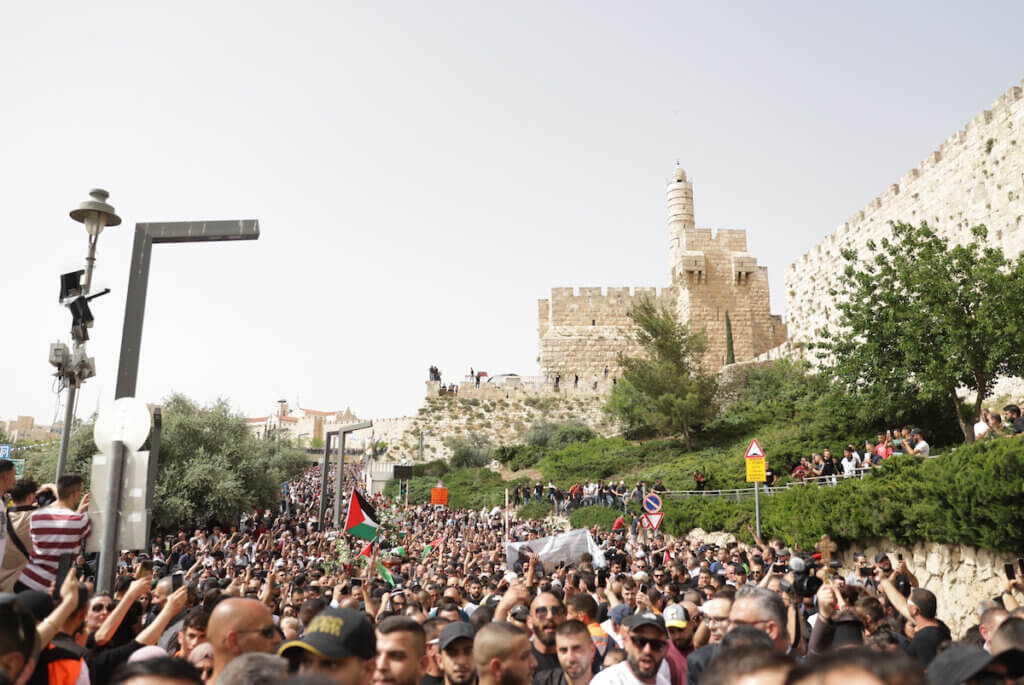
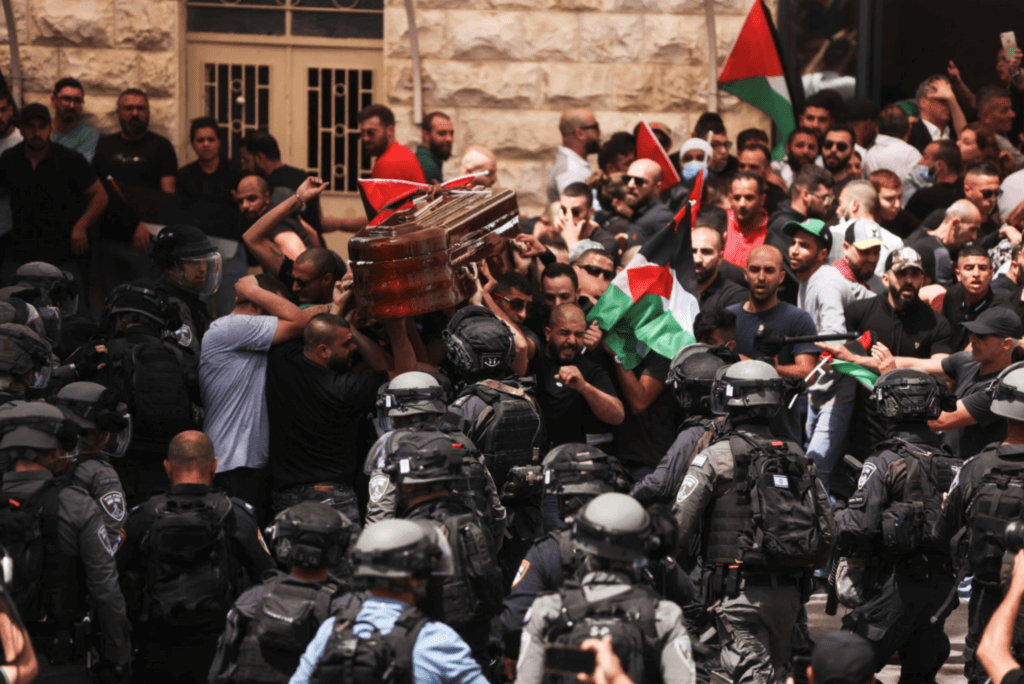
The heroes: Protectors of the funeral and coffin
Let’s imagine for a second the brutality with which young Jerusalemites and non-Jerusalemites who carried Shireen’s coffin on their shoulders were beaten. Let’s imagine the thick batons that the (Israeli) police used to beat them. Let’s imagine the poisonous gasses that polluted the air of the funeral, the filthy wastewater that contaminated the area, on a sanitary level, since it was in the vicinity of a hospital, as well as on an ethical level, since it held the body of a martyr.
These heroes received batons, punches, and severe beatings, and yet held on to the coffin, they endured this much blind loathing and held on to the coffin, raised high on their shoulders, as a martyr from Palestine deserves, as Shireen Abu Akleh deserves.
The hero and heroes who saved Shatha Hanaysha and tried to save Shireen at the outskirts of the camp the moment of the crime
It is not only the brutal image of the occupation and its crimes that would remain engraved in our minds, nor just the pictures of the funeral, nor just the pictures of the young men who climbed the walls of the Old City, but the pictures of the heroes who could not care less about their lives, and insisted on reaching the site of Shireen’s martyrdom, with journalist Shatha Hanaysha, whom they saved from a certain death. They managed to take Shireen to a hospital despite the intensity of the murderers’ bullets at the site. These young men, although not fighters, have turned into heroes in everyone’s eyes. Is there an act higher than the sacrifice they have made?
Walid, Guevara, Sandy, Wissam, Najwan, Samir, Elias and injured Ali Samoudi, as well as other al-Jazeera crew members working in Palestine

The mass outpouring of national unity that followed the martyrdom of Shireen Abu Akleh reflects a historic moment of unified Palestinian struggle and consciousness.
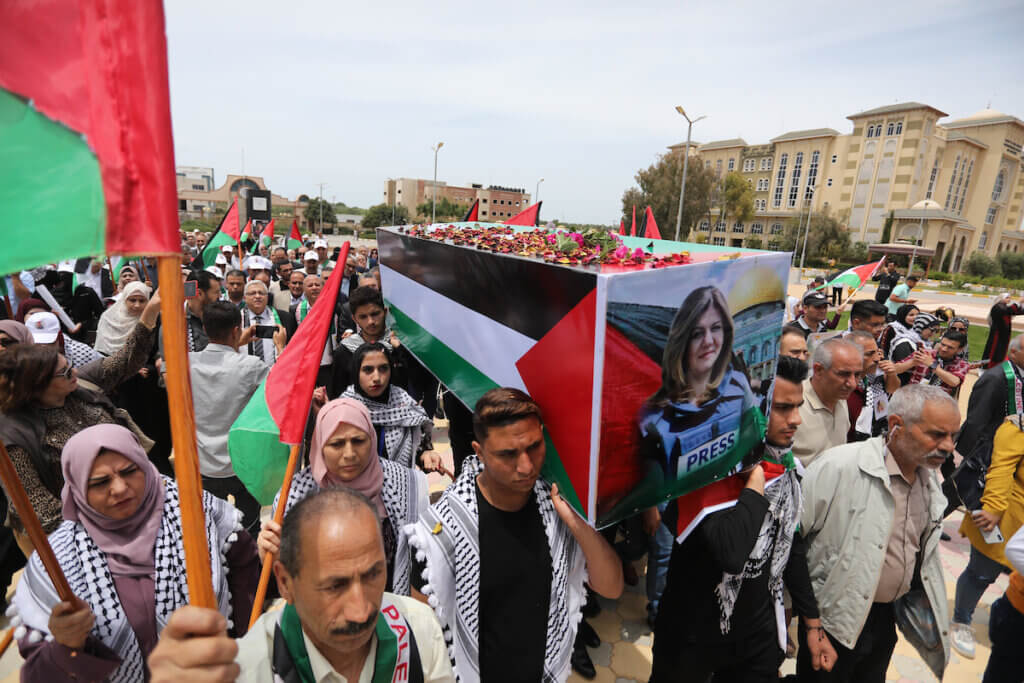
STUDENTS CARRY A MOCK COFFIN AS THEY HOLD A SYMBOLIC FUNERAL FOR SLAIN AL JAZEERA JOURNALIST SHIREEN ABU AKLEH, AT AL-AZHAR UNIVERSITY IN MUGHRAQA, CENTRAL GAZA STRIP, ON MAY 16, 2022. (PHOTO: ASHRAF AMRA/APA IMAGES)
Editor’s Note: This article was first published by the Institute for Palestine Studies on May 17, 2022 and has been translated and republished with their permission.
This is not a lament for Shireen, nor is it a political article. It is not a press report, nor is it a study. It is not a tribute or condolence, because Shireen Abu Akleh deserves more than all of these. These are mere observations and impressions of The Assassination of Shireen, of the deep sadness that has stricken people, all people, not only in Palestine, but across the world. These are impressions of “real funerals” rather than metaphorical, of the sanctity of the casket and coffin, of the raised flags, and those that fell to the ground, of the capital and the conflict over the capital, of the tragic departure of a dear friend, an exceptional human at all levels. I do not write this to praise her virtues, everyone has done so already, although she deserves a lot, and a lot from us.
Shireen Abu Akleh renewed Palestine and the values of the Palestinian people
Shireen was insidiously and aggressively assassinated. With her martyrdom, every Palestinian felt that they had lost their own someone dear. Shireen, who had entered every house through al-Jazeera for a quarter of a century of hard, respectful, and professional journalism, is entering houses this time as a member of every Palestinian family, in the east, west, north, and south. Every Palestinian felt personally touched by her martyrdom, and thus felt subjugated and humiliated. Everyone is asking “how could a well-known journalist be killed in the field dressed in such a way that clearly indicates that she is a journalist: a helmet and a vest with the word ‘PRESS’?” This act targets those who tell the truth, the truth about daily killing in Palestine.
The assassination of Shireen, turning her into news, is an Israeli attempt to hide the truth; and to discipline, intimidate, and deter those who seek to show it. However, the reaction to her murder exceeded all expectations, with hundreds of thousands of people taking to the streets to express their anger, not only in solidarity with Shireen’s small family, but because to most of them Shireen is family.
This large and massive participation in the funeral is but an expression of great anger, and the retrieval of the concept of Palestine, that is still under occupation, thus the retrieval of collective values of people under occupation, the most important of which is the collective sense of the need to be rid of this occupation and end it through resistance. With all its political and religious diversity, including diversity imposed by the Israeli occupation (West Bank, Palestinians of lands occupied in 1948, and the Gaza Strip), the Palestinian people expressed unprecedented national and on-the-ground unity. What made this unity special is that it was not emotional or sentimental, but an extension and an accumulation of what happened in May 2021 during attacks on the Gaza Strip and Sheikh Jarrah, an extension of the great solidarity with the prisoners of the Freedom Tunnel last September. These heroic prisoners, whose heroic and courageous actions reverberated around the whole world, are still being punished by the occupation through the murder of their siblings. Now comes the martyrdom of Shireen Abu Akleh, which served to crown, perpetuate, and define this moment of a great unitary struggle, which will inevitably be understood in the future as a moment of continuity with the events of the past year.
Editor’s Note: This article was first published by the Institute for Palestine Studies on May 17, 2022 and has been translated and republished with their permission.
This is not a lament for Shireen, nor is it a political article. It is not a press report, nor is it a study. It is not a tribute or condolence, because Shireen Abu Akleh deserves more than all of these. These are mere observations and impressions of The Assassination of Shireen, of the deep sadness that has stricken people, all people, not only in Palestine, but across the world. These are impressions of “real funerals” rather than metaphorical, of the sanctity of the casket and coffin, of the raised flags, and those that fell to the ground, of the capital and the conflict over the capital, of the tragic departure of a dear friend, an exceptional human at all levels. I do not write this to praise her virtues, everyone has done so already, although she deserves a lot, and a lot from us.
Shireen Abu Akleh renewed Palestine and the values of the Palestinian people
Shireen was insidiously and aggressively assassinated. With her martyrdom, every Palestinian felt that they had lost their own someone dear. Shireen, who had entered every house through al-Jazeera for a quarter of a century of hard, respectful, and professional journalism, is entering houses this time as a member of every Palestinian family, in the east, west, north, and south. Every Palestinian felt personally touched by her martyrdom, and thus felt subjugated and humiliated. Everyone is asking “how could a well-known journalist be killed in the field dressed in such a way that clearly indicates that she is a journalist: a helmet and a vest with the word ‘PRESS’?” This act targets those who tell the truth, the truth about daily killing in Palestine.
The assassination of Shireen, turning her into news, is an Israeli attempt to hide the truth; and to discipline, intimidate, and deter those who seek to show it. However, the reaction to her murder exceeded all expectations, with hundreds of thousands of people taking to the streets to express their anger, not only in solidarity with Shireen’s small family, but because to most of them Shireen is family.
This large and massive participation in the funeral is but an expression of great anger, and the retrieval of the concept of Palestine, that is still under occupation, thus the retrieval of collective values of people under occupation, the most important of which is the collective sense of the need to be rid of this occupation and end it through resistance. With all its political and religious diversity, including diversity imposed by the Israeli occupation (West Bank, Palestinians of lands occupied in 1948, and the Gaza Strip), the Palestinian people expressed unprecedented national and on-the-ground unity. What made this unity special is that it was not emotional or sentimental, but an extension and an accumulation of what happened in May 2021 during attacks on the Gaza Strip and Sheikh Jarrah, an extension of the great solidarity with the prisoners of the Freedom Tunnel last September. These heroic prisoners, whose heroic and courageous actions reverberated around the whole world, are still being punished by the occupation through the murder of their siblings. Now comes the martyrdom of Shireen Abu Akleh, which served to crown, perpetuate, and define this moment of a great unitary struggle, which will inevitably be understood in the future as a moment of continuity with the events of the past year.
Jerusalem the Capital
MOURNERS CARRY SLAIN AL JAZEERA VETERAN JOURNALIST SHIREEN ABU AKLEH DURING HER FUNERAL PROCESSION IN THE OLD CITY OF JERUSALEM ON MAY 13, 2022. (PHOTO: JERIES BSSIER/APA IMAGES)
“Jerusalem is Arab”; this is not just a slogan that the residents of the West Bank shouted near Israeli checkpoints that surround the city, which they are forbidden from entering, these are the cheers of hundreds of thousands who shouted from the walls of the Old City, and in its alleyways. This simply means that the conflict over the city has been resolved by Palestinian and Arab consciousness, by global popular consciousness and, will of course be introduced and reintroduced, in international forums.
As for the nuclear state, with a smart, powerful, and technologically advanced, “most ethical” army, as it claims, it proceeded for six consecutive hours to confiscate Palestinian flags carried by mourners, who not only raised the Palestinian flag, but also removed Israeli flags off their flagpoles at Jaffa Gate, one of the gates of the Old City of Jerusalem. This means that 74 years on, this “strong” state is still not able to control neighborhoods in its capital or in “the capital”, which says a lot.
This “strong” state attempted to limit the number of mourners participating in Shireen’s funeral, and planned to implement this order, demanding that the funeral be limited to religious rites, and that mourners would not raise Palestinian flags, and thus deployed police forces to the vicinity of the (St. Louis) French Hospital to tighten its control over the funeral.
This “strong” state permitted itself to do what no one in history has done, no matter their religion, and assaulted the casket in a very hideous way that will forever be engraved in people’s memories. With this assault, Israel assassinated Shireen Abu Akleh again, but in doing so, it strengthened the resolve of mourners to participate mightily in the funeral, in a manner deserving of a martyr from Palestine, and instilled in the minds of people in the entire world the most heinous picture of this occupation.
“Jerusalem is Arab”; this is not just a slogan that the residents of the West Bank shouted near Israeli checkpoints that surround the city, which they are forbidden from entering, these are the cheers of hundreds of thousands who shouted from the walls of the Old City, and in its alleyways. This simply means that the conflict over the city has been resolved by Palestinian and Arab consciousness, by global popular consciousness and, will of course be introduced and reintroduced, in international forums.
As for the nuclear state, with a smart, powerful, and technologically advanced, “most ethical” army, as it claims, it proceeded for six consecutive hours to confiscate Palestinian flags carried by mourners, who not only raised the Palestinian flag, but also removed Israeli flags off their flagpoles at Jaffa Gate, one of the gates of the Old City of Jerusalem. This means that 74 years on, this “strong” state is still not able to control neighborhoods in its capital or in “the capital”, which says a lot.
This “strong” state attempted to limit the number of mourners participating in Shireen’s funeral, and planned to implement this order, demanding that the funeral be limited to religious rites, and that mourners would not raise Palestinian flags, and thus deployed police forces to the vicinity of the (St. Louis) French Hospital to tighten its control over the funeral.
This “strong” state permitted itself to do what no one in history has done, no matter their religion, and assaulted the casket in a very hideous way that will forever be engraved in people’s memories. With this assault, Israel assassinated Shireen Abu Akleh again, but in doing so, it strengthened the resolve of mourners to participate mightily in the funeral, in a manner deserving of a martyr from Palestine, and instilled in the minds of people in the entire world the most heinous picture of this occupation.
ISRAELI SECURITY FORCES ATTACK PALLBEARERS CARRYING THE CASKET OF SHIREEN ABU AKLEH OUT OF THE ST LOUIS FRENCH HOSPITAL IN OCCUPIED EAST JERUSALEM’S SHEIKH JARRAH NEIGHBORHOOD. BEFORE BEING TRANSPORTED TO A CHURCH AND THEN HER RESTING PLACE IN JERUSALEM. (PHOTO: AHMAD GHARABLI/AFP)
The heroes: Protectors of the funeral and coffin
Let’s imagine for a second the brutality with which young Jerusalemites and non-Jerusalemites who carried Shireen’s coffin on their shoulders were beaten. Let’s imagine the thick batons that the (Israeli) police used to beat them. Let’s imagine the poisonous gasses that polluted the air of the funeral, the filthy wastewater that contaminated the area, on a sanitary level, since it was in the vicinity of a hospital, as well as on an ethical level, since it held the body of a martyr.
These heroes received batons, punches, and severe beatings, and yet held on to the coffin, they endured this much blind loathing and held on to the coffin, raised high on their shoulders, as a martyr from Palestine deserves, as Shireen Abu Akleh deserves.
The hero and heroes who saved Shatha Hanaysha and tried to save Shireen at the outskirts of the camp the moment of the crime
It is not only the brutal image of the occupation and its crimes that would remain engraved in our minds, nor just the pictures of the funeral, nor just the pictures of the young men who climbed the walls of the Old City, but the pictures of the heroes who could not care less about their lives, and insisted on reaching the site of Shireen’s martyrdom, with journalist Shatha Hanaysha, whom they saved from a certain death. They managed to take Shireen to a hospital despite the intensity of the murderers’ bullets at the site. These young men, although not fighters, have turned into heroes in everyone’s eyes. Is there an act higher than the sacrifice they have made?
Walid, Guevara, Sandy, Wissam, Najwan, Samir, Elias and injured Ali Samoudi, as well as other al-Jazeera crew members working in Palestine
AL JAZEERA JOURNALIST GUEVARA AL-BUDAIRI BIDS FAREWELL TO AL JAZEERA JOURNALIST SHIREEN ABU AKLEH, WHO WAS KILLED DURING AN ISRAELI RAID, IN THE WEST BANK CITY OF RAMALLAH ON MAY 12, 2022. (PHOTO: WAJED NOBANI/APA IMAGES)
About those heartbroken by the death of a friend, colleague, sister and journalist, about their bravery to continue to report, pictures and news, despite their great loss, and about their heavy tears as they covered the news, and about their coherence in the funeral, during the burial procession, and in funeral homes. It was as if they had agreed to postpone their grief until after they finished their duty of covering (the news) in a way that their colleague Shireen deserved. They continued their coverage for five days, covering not only the funeral route and the ceremony, but also the news of Palestine – specifically, the raids against the Jenin refugee camp on the day of the funeral.
Iman, Manal, Wasim, Carol, Jamal, Michael, Nadia, Nay, Marian, Rita, Malak, Faten, Fouad, Haitham, and other close friends
All of these friends concurred that Shireen had honored them with her friendship, and that their loss was great and very painful; to Shireen they were family, and at the same time Shireen was family to them. The impact of her loss was enormous, a great silence ensued, and their eyes reflected the entire sadness of this tragedy. But the determination of Shireen’s colleagues and friends to take part in her farewell from Jenin to Jerusalem, through all the cities and towns, to commemorate her, and the continued talk of her, gave them the strength to cope with the shock of her departure.
Her brother Antoine, his wife Lisa, son Nasri and daughters Lena and Larrain
Antoine, the brother who received the news of his sister Shireen’s injury, and then her martyrdom, via breaking news thousands of miles away from Palestine, for him to begin the risky return journey from Somalia, where he works with the United Nations, which was under complete closure due to general elections, he had to travel most of the distance to the airport on foot and reached it without a ticket or any preparation to travel in the times of Covid-19 and its procedures. On board, he saw everything happening in Palestine, he saw the Israeli police storming his home in Beit Hanina, he had to experience a thousand thoughts all while also experiencing this overwhelming sadness.
Shireen conjured Palestine up with her death, and this may be a consolation for her small family and for all of us.
An only brother loses his only sister, his two daughters and son lost their only aunt, they were deprived of an aunt; Antoine’s wife, Lisa, lost her sister-in-law, her friend and her sister. What brutality is this?
What consoles Antoine, Lisa and their children is that Shireen regained the Arabism of Jerusalem, she united Palestinians, restored the spirit of international solidarity with Palestine, and redirected the compass to its rightful place. Shireen conjured Palestine up with her death, and this may be a consolation for her small family and for all of us.
Finally, the murderer’s narrative
Shireen’s greatest passion was to expose the crimes of the Israeli occupation in Palestine, and through her work as a journalist, she exposed murders, confiscations, Judaization, repression, and racial discrimination. She was always face-to-face with the Zionist narrative, exposing its lies and claims. I do not want to go into the mazes of the investigation, nor the identity of who is behind the murderer, or the justifications they gave to media, let alone their ghastly confusion, their attempt to confuse the world’s public opinion in turn, the ensuing obfuscation, and so on.
There is a known murderer with a name and a commander, the commander has a higher commander, and the higher commander reports to a political official, all of whom decided on the 11th of May, 2022 to continue to shed Palestinian blood. Those behind the crime are the occupation authorities who sent their special forces to practice what they do best: killing Palestinians wherever they are, regardless of profession. Over time, the occupation has killed journalists, lawyers, doctors, children, young men, and women, without being prevented by any taboos. I repeat that there is a known murderer, and when the occupation ceases to carry out daily killings in villages, cities and refugee camps in Palestine, it will lose its raison d’être.
The departure of journalist Shireen Abu Akleh entails a lot of work that the Palestinian Authority and Palestinian and international human rights institutions have to do to expose the practices of this occupation. The forces of political and civil society have a lot of burdens to bear in order to maintain the momentum of solidarity that the departure of martyr Abu Akleh has left, an unprecedented international solidarity that must be preserved, observed, developed, and supported.
Translated by Nina AbuFarha
Khaled Farraj
Khaled Farraj is the Director General of the Institute for Palestine Studies.
About those heartbroken by the death of a friend, colleague, sister and journalist, about their bravery to continue to report, pictures and news, despite their great loss, and about their heavy tears as they covered the news, and about their coherence in the funeral, during the burial procession, and in funeral homes. It was as if they had agreed to postpone their grief until after they finished their duty of covering (the news) in a way that their colleague Shireen deserved. They continued their coverage for five days, covering not only the funeral route and the ceremony, but also the news of Palestine – specifically, the raids against the Jenin refugee camp on the day of the funeral.
Iman, Manal, Wasim, Carol, Jamal, Michael, Nadia, Nay, Marian, Rita, Malak, Faten, Fouad, Haitham, and other close friends
All of these friends concurred that Shireen had honored them with her friendship, and that their loss was great and very painful; to Shireen they were family, and at the same time Shireen was family to them. The impact of her loss was enormous, a great silence ensued, and their eyes reflected the entire sadness of this tragedy. But the determination of Shireen’s colleagues and friends to take part in her farewell from Jenin to Jerusalem, through all the cities and towns, to commemorate her, and the continued talk of her, gave them the strength to cope with the shock of her departure.
Her brother Antoine, his wife Lisa, son Nasri and daughters Lena and Larrain
Antoine, the brother who received the news of his sister Shireen’s injury, and then her martyrdom, via breaking news thousands of miles away from Palestine, for him to begin the risky return journey from Somalia, where he works with the United Nations, which was under complete closure due to general elections, he had to travel most of the distance to the airport on foot and reached it without a ticket or any preparation to travel in the times of Covid-19 and its procedures. On board, he saw everything happening in Palestine, he saw the Israeli police storming his home in Beit Hanina, he had to experience a thousand thoughts all while also experiencing this overwhelming sadness.
Shireen conjured Palestine up with her death, and this may be a consolation for her small family and for all of us.
An only brother loses his only sister, his two daughters and son lost their only aunt, they were deprived of an aunt; Antoine’s wife, Lisa, lost her sister-in-law, her friend and her sister. What brutality is this?
What consoles Antoine, Lisa and their children is that Shireen regained the Arabism of Jerusalem, she united Palestinians, restored the spirit of international solidarity with Palestine, and redirected the compass to its rightful place. Shireen conjured Palestine up with her death, and this may be a consolation for her small family and for all of us.
Finally, the murderer’s narrative
Shireen’s greatest passion was to expose the crimes of the Israeli occupation in Palestine, and through her work as a journalist, she exposed murders, confiscations, Judaization, repression, and racial discrimination. She was always face-to-face with the Zionist narrative, exposing its lies and claims. I do not want to go into the mazes of the investigation, nor the identity of who is behind the murderer, or the justifications they gave to media, let alone their ghastly confusion, their attempt to confuse the world’s public opinion in turn, the ensuing obfuscation, and so on.
There is a known murderer with a name and a commander, the commander has a higher commander, and the higher commander reports to a political official, all of whom decided on the 11th of May, 2022 to continue to shed Palestinian blood. Those behind the crime are the occupation authorities who sent their special forces to practice what they do best: killing Palestinians wherever they are, regardless of profession. Over time, the occupation has killed journalists, lawyers, doctors, children, young men, and women, without being prevented by any taboos. I repeat that there is a known murderer, and when the occupation ceases to carry out daily killings in villages, cities and refugee camps in Palestine, it will lose its raison d’être.
The departure of journalist Shireen Abu Akleh entails a lot of work that the Palestinian Authority and Palestinian and international human rights institutions have to do to expose the practices of this occupation. The forces of political and civil society have a lot of burdens to bear in order to maintain the momentum of solidarity that the departure of martyr Abu Akleh has left, an unprecedented international solidarity that must be preserved, observed, developed, and supported.
Translated by Nina AbuFarha
Khaled Farraj
Khaled Farraj is the Director General of the Institute for Palestine Studies.

.jpg)