Prosecutor: ‘We Build The Wall’ fundraiser cheated donors
NEW YORK (AP) — The organizers of a “We Build The Wall” campaign to raise money for a wall along the U.S. southern border lied to donors by saying all their money would fund the wall when they were actually pocketing hundreds of thousands of dollars, a prosecutor told a jury at the start of a criminal trial Tuesday.
Assistant U.S. Attorney Alison Moe directed the attention of jurors to defendant Timothy Shea, who sat alone facing charges after two other defendants recently pleaded guilty in the case and a fourth defendant, Steve Bannon, was pardoned by President Donald Trump hours before he completed his four-year term last year.
She said Shea, of Castle Rock, Colorado, and his “partners in crime” beginning in December 2018 duped hundreds of thousands of people into believing that they would not pocket any money that was raised because 100% of donations went to building the wall.
The prosecutor tried to narrow the focus of jurors by telling them that the prosecution “is not about whether there should be a wall” or whether money was used to build a wall.
“None of that makes it OK for the defendant to steal money at the same time,” she said.
Moe said Shea used a shell company, Ranch Property Management, to hide the fact that hundreds of thousands of dollars were being siphoned away from donations because Shea and his partners “wanted some of that money for themselves.”
She said it had been agreed that the projects founder, Brian Kolfage, would receive $100,000 along with $20,000 a month even though donors had been told he would receive nothing.
“They were committing fraud, plain and simple,” Moe said.
Kolfage, an Air Force veteran who lost both legs in a mortar attack in Iraq, and codefendant financier Andrew Badolato, each pleaded guilty in April to charges. They await sentencing.
Shea’s attorney, John Meringolo, told jurors that the prosecution’s case fails because Ranch Property Management was not a shell company and his client never said he didn’t want to be paid for working out real estate issues related to the wall along a southern border “where it’s very dangerous.”
Meringolo told jurors that if he does his job, by the end of the case “on the train going home, you’ll say: ‘That’s not nice what they did to Tim Shea. When you work, you get paid.’”
The lawyer said the fundraising effort resulted in the construction of two stretches of wall, including one that was completed in a matter of weeks at a cost of $7 million even though the Army Corps of Engineers had predicted it would cost $31 million and take two years to build.
Shea, the owner of an energy drink company, Winning Energy, whose cans have featured a cartoon superhero image of Trump and claim to contain “12 oz. of liberal tears,” was described by Meringolo as someone with experience in real estate whose expertise came in handy along the border, where most properties are ranches.
He warned jurors not to let their political views cloud their judgment.
“We’re New Yorkers. Maybe we don’t like the wall,” he said. “There’s nothing wrong with us all having different views. That’s what makes this country great.”
Wednesday, May 25, 2022

Replacement theory and NIMBYism have the same racist roots
Robert David Sullivan
The fear of new neighbors is one reason for the current housing crisis, more specifically the shortage of affordable housing, in the United States. Daniel Parolek, an author and architect, coined the term “missing middle housing” to describe the type of buildings whose scale is between downtown high-rises and suburban single-family homes—the rowhouses, duplexes, triple-deckers and five- or six-story apartment buildings that have traditionally accommodated working-class families and many immigrants.
As the urbanist website Planetizen explains, “These types of residential buildings are described as ‘missing’ because for many decades, this kind of housing has been illegal to build in almost every corner of almost every U.S. city…. The preference for single-family homes and the sequestering of large multi-family residential buildings to a few small corners of large regions have been reinforced by the long-term adoption of exclusionary zoning codes, described as ‘exclusionary’ exactly for this effect of banishing all kinds of residential development other than the prototypical American home.”
Zoning codes are not the only ways to keep new people out of a community. There are also restrictions on particular living arrangements (like bans on how many non-family members can live together). Another tactic is tax breaks for longtime homeowners. Most notoriously, Proposition 13 in California limits property tax increases for residents, not the properties themselves, and so encourages homeowners to stay put and watch the values of their homes skyrocket. The U.S. Supreme Court upheld Proposition 13 with language that would gladden any proponent of the great replacement theory, saying that the law promotes “...local neighborhood preservation, continuity, and stability.”
There is also the “nuclear option” of neighborhoods attempting to secede from cities where newcomers (i.e., non-whites) have become politically powerful. This is not necessary in older areas like Boston, where a geographically small central city is hemmed in by suburbs that have used home rule to resist new housing and to oppose regional solutions to the affordable housing shortage. In other words, deep-blue communities like Brookline, Mass., have no moral grounds to ridicule people in Texas who want to secede from the United States so that liberals elsewhere can’t tell them what to do.
“It’s about people being stewards of what they love and care about,” said Susan Kirsch, the founder of Livable California, which has organized opposition to new housing in the suburbs of that state. That sounds nice, but the language of “stewardship” can be hijacked by xenophobes and immigration restrictionists like the University of Pennsylvania law professor Amy Wax, who has written that a “large influx of immigrants, especially from nations that do not share our cultural values and understandings, will undermine citizen morale, unity, and solidarity as well as the integrity of our institutions.”
Your neighborhood group of town council may have good reasons for curbing development in your community. But if people start turning away from facts and instead focus on maintaining “character,” it may be time to stop posting outraged comments about Mr. Carlson on social media and instead engage in some self-examination.

Robert David Sullivan is a senior editor at America magazine.
AMERICA A JESUIT PUBLICATION
Robert David Sullivan
May 24, 2022
 Photo by Zac Gudakov on Unsplash
The man suspected of killing 10 people in a mostly Black neighborhood in Buffalo on May 18 believes in it. Tucker Carlson has made it a central theme of his nightly program on Fox News, even if he avoids using the exact phrase. It is the “great replacement” theory, the idea that there is an effort underway to change the demographics of the United States so that white people become a politically impotent minority. Focusing on immigration to the United States, Mr. Carlson has said that the Democratic Party is trying to build political power by bringing in “more obedient voters from the third world.”
The great replacement theory and its undisguised racism have horrified all but the most right-wing political leaders, as well as anyone who follows Catholic social teaching and recognizes the right of all people to find a safe home. But it is not new. The United States has frequently been gripped by fears of “those people” moving next door, whether they are Catholic immigrants in big cities in the 19th century, Black families heading to Northern states in the 20th century or Latinos now making up much of the population growth in states like Florida and Texas.
These demographic changes, both at the national and state levels, have really been examples of addition rather than replacement, but that distinction can be erased in a country that has always been uneasy with population growth and suspicious of big cities. Variants of the great replacement theory have been present on a smaller scale in towns and in neighborhoods all over the United States, including in deep-blue Democratic areas. You can find it wherever people say that new housing, inseparable from the new people it would attract, would ruin the “character” of their community. Or when environmentalists adopt the zero-sum logic of the great replacement theory to argue that any population growth in an area represents harm to the people already living there.
The United States has frequently been gripped by fears of “those people” moving next door.
 Photo by Zac Gudakov on Unsplash
The man suspected of killing 10 people in a mostly Black neighborhood in Buffalo on May 18 believes in it. Tucker Carlson has made it a central theme of his nightly program on Fox News, even if he avoids using the exact phrase. It is the “great replacement” theory, the idea that there is an effort underway to change the demographics of the United States so that white people become a politically impotent minority. Focusing on immigration to the United States, Mr. Carlson has said that the Democratic Party is trying to build political power by bringing in “more obedient voters from the third world.”
The great replacement theory and its undisguised racism have horrified all but the most right-wing political leaders, as well as anyone who follows Catholic social teaching and recognizes the right of all people to find a safe home. But it is not new. The United States has frequently been gripped by fears of “those people” moving next door, whether they are Catholic immigrants in big cities in the 19th century, Black families heading to Northern states in the 20th century or Latinos now making up much of the population growth in states like Florida and Texas.
These demographic changes, both at the national and state levels, have really been examples of addition rather than replacement, but that distinction can be erased in a country that has always been uneasy with population growth and suspicious of big cities. Variants of the great replacement theory have been present on a smaller scale in towns and in neighborhoods all over the United States, including in deep-blue Democratic areas. You can find it wherever people say that new housing, inseparable from the new people it would attract, would ruin the “character” of their community. Or when environmentalists adopt the zero-sum logic of the great replacement theory to argue that any population growth in an area represents harm to the people already living there.
The United States has frequently been gripped by fears of “those people” moving next door.
The similarity may be strongest when people say that they moved into a neighborhood with a certain character (single-family homes, no renters, no traffic) and can reasonably expect that character to be the same until they move out or die. This is no different from expecting the United States to remain mostly white, mostly Christian or supportive of the values epitomized by John Wayne.
The fear of new neighbors is one reason for the current housing crisis, more specifically the shortage of affordable housing, in the United States. Daniel Parolek, an author and architect, coined the term “missing middle housing” to describe the type of buildings whose scale is between downtown high-rises and suburban single-family homes—the rowhouses, duplexes, triple-deckers and five- or six-story apartment buildings that have traditionally accommodated working-class families and many immigrants.
As the urbanist website Planetizen explains, “These types of residential buildings are described as ‘missing’ because for many decades, this kind of housing has been illegal to build in almost every corner of almost every U.S. city…. The preference for single-family homes and the sequestering of large multi-family residential buildings to a few small corners of large regions have been reinforced by the long-term adoption of exclusionary zoning codes, described as ‘exclusionary’ exactly for this effect of banishing all kinds of residential development other than the prototypical American home.”
Zoning codes are not the only ways to keep new people out of a community.
Zoning codes are not the only ways to keep new people out of a community. There are also restrictions on particular living arrangements (like bans on how many non-family members can live together). Another tactic is tax breaks for longtime homeowners. Most notoriously, Proposition 13 in California limits property tax increases for residents, not the properties themselves, and so encourages homeowners to stay put and watch the values of their homes skyrocket. The U.S. Supreme Court upheld Proposition 13 with language that would gladden any proponent of the great replacement theory, saying that the law promotes “...local neighborhood preservation, continuity, and stability.”
There is also the “nuclear option” of neighborhoods attempting to secede from cities where newcomers (i.e., non-whites) have become politically powerful. This is not necessary in older areas like Boston, where a geographically small central city is hemmed in by suburbs that have used home rule to resist new housing and to oppose regional solutions to the affordable housing shortage. In other words, deep-blue communities like Brookline, Mass., have no moral grounds to ridicule people in Texas who want to secede from the United States so that liberals elsewhere can’t tell them what to do.
“It’s about people being stewards of what they love and care about,” said Susan Kirsch, the founder of Livable California, which has organized opposition to new housing in the suburbs of that state. That sounds nice, but the language of “stewardship” can be hijacked by xenophobes and immigration restrictionists like the University of Pennsylvania law professor Amy Wax, who has written that a “large influx of immigrants, especially from nations that do not share our cultural values and understandings, will undermine citizen morale, unity, and solidarity as well as the integrity of our institutions.”
Your neighborhood group of town council may have good reasons for curbing development in your community. But if people start turning away from facts and instead focus on maintaining “character,” it may be time to stop posting outraged comments about Mr. Carlson on social media and instead engage in some self-examination.
Robert David Sullivan is a senior editor at America magazine.
AMERICA A JESUIT PUBLICATION
Judge Arrested For Cattle Rustling And In Case You're Wondering, Yes, It's 2022.
Buckle up, buckaroos!
By JOE PATRICE
May 24, 2022

Someone’s in trouble at the reunion.
Susan Hays, an election lawyer who has clashed with Jones, told NBC News she could not believe he would “risk real trouble” by allegedly stealing cattle.
“It’s a pain in the ass to round up cattle and take them to market,” Hays said.
Exactly! The maturity of the agriculture market in the country and the meticulous tracking required by regulators should prevent people from selling stolen cattle on the black market, shouldn’t it? It should at least make it difficult enough that it’s not worth the effort.
Jones faces up to 50 years in prison if convicted.
Tiny Texas community shaken by arrest of official over cattle rustling [The Guardian]
Buckle up, buckaroos!
By JOE PATRICE
May 24, 2022
Cattle rustling is one of those problems that Hopalong Cassidy has to deal with, not something afflicting the country in 2022. But everything old is new again — from fashion to losing bodily autonomy — so of course cattle rustling would be back in the news.
But it’s back in Texas and authorities have arrested 71-year-old Skeet Jones on three counts of theft of livestock and one count of organized criminal activity. The only snag with his arraignment is that… Skeet Jones is the only judge in the county [it turns out the county itself has an Acting District Judge for this stuff and Skeet’s “County Judge” role is more political than judicial… like the Supreme Court, eh?]
The Connected Legal Playbook empowers in-house legal teams to optimize productivity, optimize engagement, be proactive, and have a greater impact on the business.From LAWVU
As another person pointed out, Loving County is the least populous county in the contiguous United States, and the arrest of Judge Jones and his three alleged accomplices mean 6 percent of the county just got arrested.
These arrests come after a year-long investigation by special rangers trying to get to the bottom of cattle theft in the tiny county. Not clear why it took a whole year since the county population is basically the size of a parlor gathering in an Agatha Christie novel, but here we are.
From The Guardian:
His cousin Brandon Jones is a constable, an elected law enforcement officer, for the county.
“He’s had free rein for the entire time since he’s been the judge,” Brandon Jones told NBC News. “That’s given him a sense of power and impunity that he can do whatever he wants whenever he wants. Even the feeling of self-righteousness. That he can do no wrong.”
But it’s back in Texas and authorities have arrested 71-year-old Skeet Jones on three counts of theft of livestock and one count of organized criminal activity. The only snag with his arraignment is that… Skeet Jones is the only judge in the county [it turns out the county itself has an Acting District Judge for this stuff and Skeet’s “County Judge” role is more political than judicial… like the Supreme Court, eh?]
The Connected Legal Playbook empowers in-house legal teams to optimize productivity, optimize engagement, be proactive, and have a greater impact on the business.From LAWVU
As another person pointed out, Loving County is the least populous county in the contiguous United States, and the arrest of Judge Jones and his three alleged accomplices mean 6 percent of the county just got arrested.
These arrests come after a year-long investigation by special rangers trying to get to the bottom of cattle theft in the tiny county. Not clear why it took a whole year since the county population is basically the size of a parlor gathering in an Agatha Christie novel, but here we are.
From The Guardian:
His cousin Brandon Jones is a constable, an elected law enforcement officer, for the county.
“He’s had free rein for the entire time since he’s been the judge,” Brandon Jones told NBC News. “That’s given him a sense of power and impunity that he can do whatever he wants whenever he wants. Even the feeling of self-righteousness. That he can do no wrong.”
Someone’s in trouble at the reunion.
Susan Hays, an election lawyer who has clashed with Jones, told NBC News she could not believe he would “risk real trouble” by allegedly stealing cattle.
“It’s a pain in the ass to round up cattle and take them to market,” Hays said.
Exactly! The maturity of the agriculture market in the country and the meticulous tracking required by regulators should prevent people from selling stolen cattle on the black market, shouldn’t it? It should at least make it difficult enough that it’s not worth the effort.
Jones faces up to 50 years in prison if convicted.
Tiny Texas community shaken by arrest of official over cattle rustling [The Guardian]
FOR PROFIT HEALTHCARE
Americans avoid visits to the doctor even after pandemic

By: Scripps National
Posted May 24, 2022
Treatment for common health issues during the pandemic dropped off significantly and hasn't recovered.
New research found treatment for heart attacks dropped about 30% during the pandemic.
Treatment is needed within the first 90 minutes of symptoms of a heart attack, experts say. Additional research found the less money people made, the longer they stayed in the hospital following a heart attack. They also had a higher chance of dying.
Another study out that race and substance use history can lead to further bias and treatment for some heart attacks.
“Black patients with a history of cocaine use who presented with a heart attack were about 25% less likely to receive the capitalization and about 40% less likely to receive revascularization compared to white patients,” said Dr. Michael Dangl, a physician with the University of Miami Jackson Memorial Hospital.
A national sample of black patients with a history of cocaine use found that they were less likely than white patients to get critical treatments. That is despite black patients being more likely to have insurance and being less likely to abuse other stimulants that can cause heart attacks.
How willing someone is to take necessary medications after a heart attack and heart attack treatment is one thing that doctors have to consider before procedures are ordered.
The doctor who initiated this research said there needs to be more objective ways to measure.
“Rather than just looking at someone and saying, oh, they have this history of cocaine use is not likely to be compliant,” Dangl said. “Looking at more objective measures of compliance. See if there's, you know, if they're on any other medications, How regular have they been with those medications that really like refill history?”
He also suggested more diversity in the cardiology field. Racial and implicit bias training could improve health equity and treatment for heart attacks.
Heart disease is the leading cause of death in the United States.
Americans avoid visits to the doctor even after pandemic
By: Scripps National
Posted May 24, 2022
Treatment for common health issues during the pandemic dropped off significantly and hasn't recovered.
New research found treatment for heart attacks dropped about 30% during the pandemic.
Treatment is needed within the first 90 minutes of symptoms of a heart attack, experts say. Additional research found the less money people made, the longer they stayed in the hospital following a heart attack. They also had a higher chance of dying.
Another study out that race and substance use history can lead to further bias and treatment for some heart attacks.
“Black patients with a history of cocaine use who presented with a heart attack were about 25% less likely to receive the capitalization and about 40% less likely to receive revascularization compared to white patients,” said Dr. Michael Dangl, a physician with the University of Miami Jackson Memorial Hospital.
A national sample of black patients with a history of cocaine use found that they were less likely than white patients to get critical treatments. That is despite black patients being more likely to have insurance and being less likely to abuse other stimulants that can cause heart attacks.
How willing someone is to take necessary medications after a heart attack and heart attack treatment is one thing that doctors have to consider before procedures are ordered.
The doctor who initiated this research said there needs to be more objective ways to measure.
“Rather than just looking at someone and saying, oh, they have this history of cocaine use is not likely to be compliant,” Dangl said. “Looking at more objective measures of compliance. See if there's, you know, if they're on any other medications, How regular have they been with those medications that really like refill history?”
He also suggested more diversity in the cardiology field. Racial and implicit bias training could improve health equity and treatment for heart attacks.
Heart disease is the leading cause of death in the United States.
USA
How the Child Welfare System Is Silently Destroying Black Families
A single call from an anonymous tipster is all it takes for the government to take children from their families
DOROTHY ROBERTS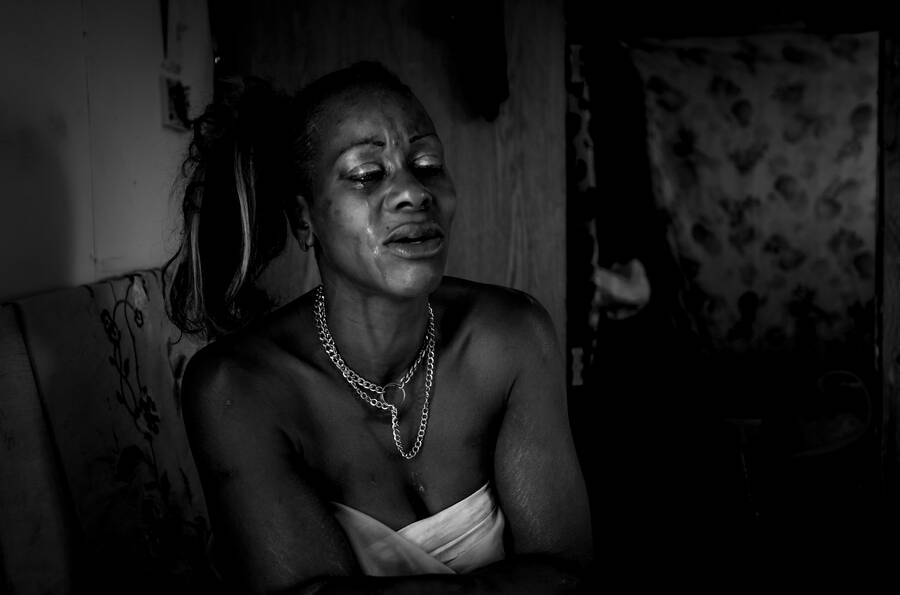
The sun had just begun to rise over Manhattan on an August morning in 2013. Angeline Montauban was whispering into the phone as she crouched in the bathroom of her apartment. As her partner and their 3‑year-old son slept, Montauban had tiptoed to the bathroom to call Safe Horizon, a domestic abuse hotline she had seen advertised in subway stations. She had decided it was time to stop the violence she was experiencing at the hands of her partner, and she hoped Safe Horizon could provide counseling or help her relocate with her son.
At first, the social worker who answered her call listened sympathetically to Montauban’s story. But once Montauban mentioned the couple had a little boy, the voice on the other end turned harsh and began collecting information about the family’s whereabouts.
That very afternoon, a caseworker with the city’s Administration for Children’s Services (ACS) arrived at Montauban’s apartment, explaining she was there to investigate a report of child maltreatment. At first Montauban was confused; she and her partner took excellent care of their son and had never abused him. Then she realized the social worker at Safe Horizon had contacted child protection authorities based on Montauban’s call for help.
“The minute she knocked on my door, she was building a case against me,” Montauban would recall about the ACS worker. The caseworker inspected her son’s body, as well as the entire apartment, finding no evidence of harm to the boy, yet she told Montauban that her family was under ACS supervision for the next 60 days. Twice a month, a caseworker would make an unannounced visit to inspect their home, looking for evidence that might warrant removing her son and putting him in foster care. Within a few weeks, Montauban obtained an order of protection for herself against her partner, and he moved out of their apartment. But the visits and order didn’t satisfy ACS.
Protesters rally in Brooklyn, N.Y., on June 20, 2020, holding signs that say “Black Families Matter.” The march decried the Administration for Children’s Services, dubbed “the family police,” which disproportionately separates Black families.
In a family court hearing, ACS insisted Montauban file for an order of protection for her son against his father as well. Montauban disagreed, explaining to the judge that she wanted her son to maintain a relationship with his father, who had never hurt him.
A few days later, Montauban’s partner took their son to family court for an appointment. ACS instructed him to leave the boy at a daycare center on the first floor of the court building. It was a setup: ACS had filed a petition to apprehend Montauban’s son on the grounds that he was neglected because Montauban allegedly had allowed him to witness domestic violence and declined to file an order of protection against his father. That evening, the caseworker called Montauban to inform her that ACS had snatched her son from the family court daycare center. Her toddler was in foster care — in the custody of strangers in the Bronx.
Instead of working toward reunifying Montauban with her son, ACS moved him to several foster homes, promised the foster caretakers he would be free for adoption, and retaliated against Montauban when she expressed concerns by suspending her visits with him. When Montauban faced termination of her parental rights, it was her son’s insistence on being reunited with her that preserved their legal bond. It took Montauban five years to retrieve her son from what she calls the “labyrinth” of family policing.
A longstanding narrative has convinced the public that the child welfare system is a flawed but benevolent social service program that strengthens families and rescues children from abusive homes. Most people think of the child welfare system and the criminal punishment system as distinct parts of government. Child welfare is supposed to be based on civil law and therefore not entail the surveillance and condemnation that characterize criminal justice. Whereas police investigate crimes to arrest lawbreakers, child protection workers investigate allegations of maltreatment to keep children safe. Whereas accused defendants stand trial to determine criminal culpability and are punished if convicted, family courts determine what’s in the best interests of the child and order services for their parents.
Or so goes the official story.
In reality, the child welfare system operates surprisingly like its criminal counterpart. It is a $30 billion apparatus that monitors, controls and punishes families in the same Black communities systematically subjugated by police and prisons. It is more accurate to call it a family policing system. State-level child protective services agencies investigate the families of 3.5 million children every year, with one in three children nationwide subject to investigation by the time they reach age 18. Most Black children (53%) experience an investigation from child protective services (CPS) at some point while growing up. A 2021 study of large U.S. counties revealed that Black children had consistently high rates of investigation, reaching 63.3% of Black children in Maricopa County, Ariz.
Identifying children as at risk of maltreatment gives caseworkers the authority to probe into and regulate every aspect of a family’s life. All it takes is a phone call from an anonymous tipster to a hotline operator about a vague suspicion to launch a life-altering government investigation. Based on vague child neglect laws, investigators can interpret being poor — lack of food, insecure housing, inadequate medical care — as evidence of parental unfitness. Caseworkers search homes, subject family members to humiliating interrogation and inspect children’s bodies for evidence, sometimes strip-searching them. Caseworkers can make multiple unannounced home visits at any time of day or night and request personal information from teachers, hospitals, therapists and other service providers. In some cities, caseworkers force parents to sign blanket release forms to obtain confidential records about them and their children
These investigations not only traumatize families, but can lead to intense family regulation and years of separation between parents and children, and ultimately can result in permanent dissolution of families. Every year, CPS removes about 500,000 children from their homes — half through judicial proceedings and half through informal “safety plans.” The racial disparities seen in CPS investigations are mirrored in the national foster care population, with Black children grossly overrepresented. Although Black children were only 14% of children in the United States in 2019, for example, they made up 23% of children in foster care. More than one in 10 Black and Native children in America will be forcibly separated from their parents and placed in foster care by their 18th birthday
Recent foster care rates for U.S. children, at 576 per 100,000, are about the same as incarceration rates for U.S. adults, at 582 per 100,000. Black and Native children are also more than twice as likely as white children to experience the termination of both parents’ rights
Child welfare investigations are essentially stop-and-frisk family surveillance, without the safeguards of law and public scrutiny that are present in the criminal context. Because child welfare is classified as part of the civil legal system, CPS workers are not classified as law enforcement officers. The Fourth Amendment protection against unreasonable government searches still theoretically applies, but agencies and courts have created a child welfare exception—arguing that if the rights of family members pose a risk to children, then those Fourth Amendment protections can be waived.
The tentacles of CPS surveillance have reached across U.S. society, far beyond the walls of child welfare agencies. Family policing relies on an expansive network of information sharing that spans the school, healthcare, public assistance and law enforcement systems. By federal edict, every state must identify people who work in professions that put them in contact with children — such as teachers, healthcare providers, social services staff and daycare workers — and require them to report suspected child abuse and neglect to government authorities. These deputized agents are known as “mandated reporters.” Since states began enacting these reporting laws in the 1960s, the categories of enlisted professionals have expanded, and some states have passed “universal” reporting legislation that requires all residents, with few exceptions, to convey suspicions to the state.
As mandated reporters, providers of social services direct state surveillance against poor and low-income families — especially Black families. And using social services, receiving welfare benefits and living in public housing subject families to an extra layer of contact with these mandated reporters. Public workers are far more likely to report suspicions about their clients (essentially, because they are poor) than their counterparts in the private sector (who work with a more affluent, paying clientele). Regardless of income, healthcare professionals, for example, are more suspicious of Black families than other groups who bring their injured children to the hospital.
What’s more, mandated reporting drives parents away from the very service providers most likely to support them. Many parents are deterred from fully engaging with healthcare, educational and social service systems because mere suspicion from a service provider could lead to family separation.
Mandated reporting, then, thwarts the potential for schools, healthcare clinics and social programs to be caring hubs of community engagement that non-coercively help families meet their material needs. It also wastes millions and millions of dollars investigating baseless allegations — money that could have provided concrete assistance to children and their family caregivers. These funds would bear far better fruit for children if given directly to their parents as cash allowances or used to provide material resources that meet children’s needs.
Instead, these professionals divert struggling families into a system with the potential to destroy them.
The extensive, multisystem network of CPS informants, combined with their power to pry into a family’s personal life and space, gives CPS access to massive amounts of information ordinarily beyond the government’s reach. In recent years, CPS agencies have begun adopting novel technological tools that are expanding the scope of family surveillance even further. Governments are increasingly considering hiring technology and consulting firms — including IBM, SAS and Deloitte — to employ big databases and artificial intelligence to monitor families and automate decisions about interventions. Some of the nation’s largest child welfare departments — in California, Florida, Illinois, Pennsylvania and Texas — are using computerized risk assessment technologies to police families. The contracts (lucrative for private enterprises) not only magnify government surveillance but eat up budgets that could be used to provide material resources that families need.
For families that are screened into the family policing system, the next phase of surveillance entails their forced compliance with mandated services requested by CPS agencies and rubber-stamped by judges. These “service plans” usually have nothing to do with providing the tangible things families need, but instead consist of a list of requirements family caregivers must fulfill — or else they lose their children to foster care. Rarely are parents asked what services they would find helpful; instead, parents are asked to focus on fixing their perceived parenting deficits with skills classes and psychological counseling.
All it takes is a phone call from an anonymous tipster to a hotline operator about a vague suspicion to launch a life-altering government investigation.
Service plans are akin to the probation orders and restrictions imposed on people convicted of crimes. In the criminal context, the violation of a single provision lands the offender in prison. In the child welfare system, parents who fail to fulfill some provision on their list in time risk having their parental rights terminated and their ties to their children irreparably disrupted.
The public accepts this extraordinary infringement on freedoms and family relationships because it masquerades as benevolence — and because it disrupts the most marginalized communities. Precisely because it seems to operate outside criminal law enforcement, the family policing system has become an extremely useful arm of the carceral state. CPS has the power to intensively monitor entire communities, all the while escaping public scrutiny and bypassing legal protections by claiming to protect children.
It’s time to tear off this veneer. The child welfare system oppresses poor communities and especially Black communities by policing families. Revealing the truth about the CPS system should force the public to question its purpose, design and impact — and to see the need to replace it with a radically reimagined approach that can actually serve families and keep children safe.
Reader donations, many as small as just $1, have kept In These Times publishing for 45 years. Once you've finished reading, please consider making a tax-deductible donation to support this work.
How the Child Welfare System Is Silently Destroying Black Families
A single call from an anonymous tipster is all it takes for the government to take children from their families
DOROTHY ROBERTS
MAY 24, 2022
Diamond Haynes tearfully discusses her seven children, all in foster care, on Feb. 13, 2018. Haynes, in her late 30s at the time, lived in a trailer outside Los Angeles before moving to South L.A. to work as a retail clerk.
LUIS SINCO/LOS ANGELES TIMES VIA GETTY IMAGES

IN THESE TIMES
The sun had just begun to rise over Manhattan on an August morning in 2013. Angeline Montauban was whispering into the phone as she crouched in the bathroom of her apartment. As her partner and their 3‑year-old son slept, Montauban had tiptoed to the bathroom to call Safe Horizon, a domestic abuse hotline she had seen advertised in subway stations. She had decided it was time to stop the violence she was experiencing at the hands of her partner, and she hoped Safe Horizon could provide counseling or help her relocate with her son.
At first, the social worker who answered her call listened sympathetically to Montauban’s story. But once Montauban mentioned the couple had a little boy, the voice on the other end turned harsh and began collecting information about the family’s whereabouts.
That very afternoon, a caseworker with the city’s Administration for Children’s Services (ACS) arrived at Montauban’s apartment, explaining she was there to investigate a report of child maltreatment. At first Montauban was confused; she and her partner took excellent care of their son and had never abused him. Then she realized the social worker at Safe Horizon had contacted child protection authorities based on Montauban’s call for help.
“The minute she knocked on my door, she was building a case against me,” Montauban would recall about the ACS worker. The caseworker inspected her son’s body, as well as the entire apartment, finding no evidence of harm to the boy, yet she told Montauban that her family was under ACS supervision for the next 60 days. Twice a month, a caseworker would make an unannounced visit to inspect their home, looking for evidence that might warrant removing her son and putting him in foster care. Within a few weeks, Montauban obtained an order of protection for herself against her partner, and he moved out of their apartment. But the visits and order didn’t satisfy ACS.
Protesters rally in Brooklyn, N.Y., on June 20, 2020, holding signs that say “Black Families Matter.” The march decried the Administration for Children’s Services, dubbed “the family police,” which disproportionately separates Black families.
ERIK MCGREGOR/LIGHTROCKET VIA GETTY IMAGES
In a family court hearing, ACS insisted Montauban file for an order of protection for her son against his father as well. Montauban disagreed, explaining to the judge that she wanted her son to maintain a relationship with his father, who had never hurt him.
A few days later, Montauban’s partner took their son to family court for an appointment. ACS instructed him to leave the boy at a daycare center on the first floor of the court building. It was a setup: ACS had filed a petition to apprehend Montauban’s son on the grounds that he was neglected because Montauban allegedly had allowed him to witness domestic violence and declined to file an order of protection against his father. That evening, the caseworker called Montauban to inform her that ACS had snatched her son from the family court daycare center. Her toddler was in foster care — in the custody of strangers in the Bronx.
Instead of working toward reunifying Montauban with her son, ACS moved him to several foster homes, promised the foster caretakers he would be free for adoption, and retaliated against Montauban when she expressed concerns by suspending her visits with him. When Montauban faced termination of her parental rights, it was her son’s insistence on being reunited with her that preserved their legal bond. It took Montauban five years to retrieve her son from what she calls the “labyrinth” of family policing.
A longstanding narrative has convinced the public that the child welfare system is a flawed but benevolent social service program that strengthens families and rescues children from abusive homes. Most people think of the child welfare system and the criminal punishment system as distinct parts of government. Child welfare is supposed to be based on civil law and therefore not entail the surveillance and condemnation that characterize criminal justice. Whereas police investigate crimes to arrest lawbreakers, child protection workers investigate allegations of maltreatment to keep children safe. Whereas accused defendants stand trial to determine criminal culpability and are punished if convicted, family courts determine what’s in the best interests of the child and order services for their parents.
Or so goes the official story.
In reality, the child welfare system operates surprisingly like its criminal counterpart. It is a $30 billion apparatus that monitors, controls and punishes families in the same Black communities systematically subjugated by police and prisons. It is more accurate to call it a family policing system. State-level child protective services agencies investigate the families of 3.5 million children every year, with one in three children nationwide subject to investigation by the time they reach age 18. Most Black children (53%) experience an investigation from child protective services (CPS) at some point while growing up. A 2021 study of large U.S. counties revealed that Black children had consistently high rates of investigation, reaching 63.3% of Black children in Maricopa County, Ariz.
Identifying children as at risk of maltreatment gives caseworkers the authority to probe into and regulate every aspect of a family’s life. All it takes is a phone call from an anonymous tipster to a hotline operator about a vague suspicion to launch a life-altering government investigation. Based on vague child neglect laws, investigators can interpret being poor — lack of food, insecure housing, inadequate medical care — as evidence of parental unfitness. Caseworkers search homes, subject family members to humiliating interrogation and inspect children’s bodies for evidence, sometimes strip-searching them. Caseworkers can make multiple unannounced home visits at any time of day or night and request personal information from teachers, hospitals, therapists and other service providers. In some cities, caseworkers force parents to sign blanket release forms to obtain confidential records about them and their children
These investigations not only traumatize families, but can lead to intense family regulation and years of separation between parents and children, and ultimately can result in permanent dissolution of families. Every year, CPS removes about 500,000 children from their homes — half through judicial proceedings and half through informal “safety plans.” The racial disparities seen in CPS investigations are mirrored in the national foster care population, with Black children grossly overrepresented. Although Black children were only 14% of children in the United States in 2019, for example, they made up 23% of children in foster care. More than one in 10 Black and Native children in America will be forcibly separated from their parents and placed in foster care by their 18th birthday
Recent foster care rates for U.S. children, at 576 per 100,000, are about the same as incarceration rates for U.S. adults, at 582 per 100,000. Black and Native children are also more than twice as likely as white children to experience the termination of both parents’ rights
Child welfare investigations are essentially stop-and-frisk family surveillance, without the safeguards of law and public scrutiny that are present in the criminal context. Because child welfare is classified as part of the civil legal system, CPS workers are not classified as law enforcement officers. The Fourth Amendment protection against unreasonable government searches still theoretically applies, but agencies and courts have created a child welfare exception—arguing that if the rights of family members pose a risk to children, then those Fourth Amendment protections can be waived.
The tentacles of CPS surveillance have reached across U.S. society, far beyond the walls of child welfare agencies. Family policing relies on an expansive network of information sharing that spans the school, healthcare, public assistance and law enforcement systems. By federal edict, every state must identify people who work in professions that put them in contact with children — such as teachers, healthcare providers, social services staff and daycare workers — and require them to report suspected child abuse and neglect to government authorities. These deputized agents are known as “mandated reporters.” Since states began enacting these reporting laws in the 1960s, the categories of enlisted professionals have expanded, and some states have passed “universal” reporting legislation that requires all residents, with few exceptions, to convey suspicions to the state.
As mandated reporters, providers of social services direct state surveillance against poor and low-income families — especially Black families. And using social services, receiving welfare benefits and living in public housing subject families to an extra layer of contact with these mandated reporters. Public workers are far more likely to report suspicions about their clients (essentially, because they are poor) than their counterparts in the private sector (who work with a more affluent, paying clientele). Regardless of income, healthcare professionals, for example, are more suspicious of Black families than other groups who bring their injured children to the hospital.
What’s more, mandated reporting drives parents away from the very service providers most likely to support them. Many parents are deterred from fully engaging with healthcare, educational and social service systems because mere suspicion from a service provider could lead to family separation.
Mandated reporting, then, thwarts the potential for schools, healthcare clinics and social programs to be caring hubs of community engagement that non-coercively help families meet their material needs. It also wastes millions and millions of dollars investigating baseless allegations — money that could have provided concrete assistance to children and their family caregivers. These funds would bear far better fruit for children if given directly to their parents as cash allowances or used to provide material resources that meet children’s needs.
Instead, these professionals divert struggling families into a system with the potential to destroy them.
The extensive, multisystem network of CPS informants, combined with their power to pry into a family’s personal life and space, gives CPS access to massive amounts of information ordinarily beyond the government’s reach. In recent years, CPS agencies have begun adopting novel technological tools that are expanding the scope of family surveillance even further. Governments are increasingly considering hiring technology and consulting firms — including IBM, SAS and Deloitte — to employ big databases and artificial intelligence to monitor families and automate decisions about interventions. Some of the nation’s largest child welfare departments — in California, Florida, Illinois, Pennsylvania and Texas — are using computerized risk assessment technologies to police families. The contracts (lucrative for private enterprises) not only magnify government surveillance but eat up budgets that could be used to provide material resources that families need.
For families that are screened into the family policing system, the next phase of surveillance entails their forced compliance with mandated services requested by CPS agencies and rubber-stamped by judges. These “service plans” usually have nothing to do with providing the tangible things families need, but instead consist of a list of requirements family caregivers must fulfill — or else they lose their children to foster care. Rarely are parents asked what services they would find helpful; instead, parents are asked to focus on fixing their perceived parenting deficits with skills classes and psychological counseling.
All it takes is a phone call from an anonymous tipster to a hotline operator about a vague suspicion to launch a life-altering government investigation.
Service plans are akin to the probation orders and restrictions imposed on people convicted of crimes. In the criminal context, the violation of a single provision lands the offender in prison. In the child welfare system, parents who fail to fulfill some provision on their list in time risk having their parental rights terminated and their ties to their children irreparably disrupted.
The public accepts this extraordinary infringement on freedoms and family relationships because it masquerades as benevolence — and because it disrupts the most marginalized communities. Precisely because it seems to operate outside criminal law enforcement, the family policing system has become an extremely useful arm of the carceral state. CPS has the power to intensively monitor entire communities, all the while escaping public scrutiny and bypassing legal protections by claiming to protect children.
It’s time to tear off this veneer. The child welfare system oppresses poor communities and especially Black communities by policing families. Revealing the truth about the CPS system should force the public to question its purpose, design and impact — and to see the need to replace it with a radically reimagined approach that can actually serve families and keep children safe.
Reader donations, many as small as just $1, have kept In These Times publishing for 45 years. Once you've finished reading, please consider making a tax-deductible donation to support this work.
USA
Foreign-Educated Nurses Across the Country Fill a Critical RoleBy Kenneth Moritsugu
May 24, 2022
Foreign-educated nurses are an integral component of our nation’s health care delivery system, often adding a much-needed layer of support to hospitals, clinics, and long-term care facilities, many of which have faced ongoing nursing shortages for nearly 40 years. These staffing challenges were exacerbated during the COVID-19 pandemic as the number of patients surged, and nearly 1 in 5 health care workers left their jobs often citing physical, mental, or emotional stress.
During this unprecedented time, nurses were on the front lines providing critical care to patients across the United States. And as the pandemic rolled through different regions of the country, the flexibility provided by foreign-educated nurses helped alleviate shortages in communities from coast to coast.
Specific to filling those shortages were health care staffing firms that often stood in the gap by providing well-trained care professionals where there was the most acute need. For example, Cincinnati-based Health Carousel, one of the largest certified ethical recruitment and staffing firms, worked during the pandemic to provide hospital administrators with easier, faster access to a nationwide network of qualified health care workers.
Many of the foreign-educated nurses in the U.S. largely come from the Philippines, Europe, India, and Africa. This is a mutually beneficial relationship as many of these nurses come to the U.S. with their immediate families to experience and gain the benefits of living in the U.S., while also earning enough money to send to relatives back in their home country. In places like the Philippines, these remittances can account for nearly 9 percent of the nation’s GDP, with revenue sent from the U.S. making up more than 40 percent of that amount.
Some critics of foreign-educated nurses argue that the U.S. shouldn’t poach the talent of poorer countries. But many of these nurses dedicated years of service to their countries, and eventually decided it was time to do what was best for them and their families. That’s why one nurse from the Philippines told PBS that it was a thirteen-year dream for her to work in the U.S., where foreign-educated nurses are often provided with incentive packages including compensation for relocation, good pay, and benefits.
Nurse staffing agencies give health care facilities access to more qualified nurses, often with specialties not readily available in their community. Foreign-educated nurses are able to help in some of the most challenging assignments, giving relief to staff nurses. In addition, foreign-educated nurses help reduce overtime costs, allowing staff nurses to achieve a work-life balance and experience a supportive workplace culture, while also helping to moderate health care costs.
Now with, what we hope, is the worst of the pandemic behind us, there are still staffing needs due to nurses who left the profession because of pandemic burnout, seasonal changes, and sudden increases in hospital activity. In states like Florida, Mississippi, and New Hampshire with the largest demand, foreign-educated nurses have been able to fill the void when hospitals experience staffing shortages. And as the baby boomer generation comes of retirement age, the need for nursing specialists will continue to rise.
Foreign-educated nurses provide important access to quality care at a reasonable cost to communities and individuals that otherwise go lacking. Policymakers and the health care industry should continue to support the nursing profession and provide opportunities and support to nurses and health care specialists who sacrifice so much to provide the care that patients across the country need.
Rear Admiral Kenneth Moritsugu, M.D., was the Deputy Surgeon General of the United States and has served as Acting Surgeon General.
Robert Reich: Bombardment By The Billionaires
May 24, 2022
By Robert Reich
The richest person in America tweeted last week that Democrats have “become the party of division & hate, so I can no longer support them and will vote Republican.”
Advertisement
Hello? Democrats are the party of division and hate? What planet has Elon been living on?
Meanwhile, the second-richest person in America (Jeff Bezos) tweeted that the Democrats’ proposed tax hikes on the rich will not tame inflation and their proposed spending would worsen it (he’s wrong, and I’ll explain why in another post).
In addition to last week’s billionaire tweetstorm, it was reported that Oracle’s Larry Ellison (#7 on Forbes’ list of richest Americans) in November 2020 joined Sean Hannity, Lindsay Graham, and Trump’s attorney to discuss strategies for contesting the presidential election results.
Oh, and Ellison has dumped some $25 million into a Super PAC supporting South Carolina Republican senator Tim Scott, a Trump endorsee.
As I noted last week, another billionaire, Peter Thiel, has donated at least as much to Trump-endorsed Republicans in senate primaries.
Advertisement
Not to mention Trump-diehards Charles Koch (#16 on the Forbes list), Rupert Murdoch (#31), and Carl Icahn (#43).
This is the same crew, not incidentally, that’s been fighting unions and flooding Congress and statehouses with cash to support Trump election deniers, prevent tax hikes on themselves, and kill off Biden’s and the Democrats’ agenda (more on this in a moment).
This billionaire bombardment gives Biden and the Democrats an opportunity to tell America whose side they’re on and whose side they’re not on — in effect, to declare class war on the class warriors.
Will they take it?
Not in over a century has so much of the nation’s wealth been concentrated at the very top — in the richest one-tenth of one percent of the richest one-tenth of one percent. Not in seventy years have corporations been as flush with cash, notwithstanding the stock market’s recent selloff. Not since the 1890s have CEOs raked in as much pay relative to average workers. Not since the creation of the income tax have the super-rich paid as low a rate as they do now relative to tax rate paid by most other Americans.
Isn’t it time for Biden and the Democrats to tell this to America?
Wealth isn’t a zero-sum game in which more at the top necessarily means less below, but wealth is tied to power — and power is a zero-sum game.
Many of America’s wealthiest and most powerful are now gathering for their annual gabfest in Davos, Switzerland, just as the annual get-together of America’s right (CPAC) is coming to a close in Budapest, Hungary. The two conferences are beginning to converge. Although the CEOs and hedge fund managers at Davos profess to worry about America’s record inequality and tout “corporate social responsibility,” their own corporate political action committees are doing everything possible to squelch tax increases on them, and to prevent additional spending on health care, child care, and other needs of average working people.
Meanwhile, not even the Republicans’ billionaire backers can disguise the total absence of a Republican agenda to help average working people.
The reason Democrats haven’t been able to get their agenda through the Senate and raise taxes on billionaires or on big corporations to pay for it — or even repeal the Trump tax cuts that went mostly to the top — is because Democrats have only 48 senate votes (all fifty Senate Republicans are against these measures, and the other two senate Democrats are major beneficiaries of campaign donations from corporations and the rich).
Isn’t it time for Biden and the Democrats tell this to the American people, and offer them a clear choice in the upcoming midterms and beyond?
Billionaires are mounting a class war. Republican lawmakers are mounting a culture war to deflect attention from it.
On October 31, 1936, in New York’s Madison Square Garden, Franklin D. Roosevelt, facing a bruising re-election bid, defined the stakes much as they are today. He explained that America was in a struggle against “business and financial monopoly, speculation, reckless banking, class antagonism, sectionalism, war profiteering” and that a wealthy elite “had begun to consider the Government of the United States as a mere appendage to their own affairs.”
He continued: “We know now that Government by organized money is just as dangerous as Government by organized mob.”
Then FDR said, in words similar to what Joe Biden and Democrats should be using against the billionaires and bigots who are now arrayed against them:
Isn’t it time Biden and the Democrats came out clearly against the billionaires abusing their wealth and power by suppressing the wages of average working people and flooding our democracy with their money? And against the culture warriors who are covering up for them? Isn’t it time for Biden and the Democrats to explain why they haven’t been able to get their agenda through Congress?
Biden and the Democrats should tell Americans which side they are on — and ask America to choose sides.

Robert B. Reich is Chancellor's Professor of Public Policy at the University of California at Berkeley and Senior Fellow at the Blum Center for Developing Economies, and writes at robertreich.substack.com. Reich served as Secretary of Labor in the Clinton administration, for which Time Magazine named him one of the ten most effective cabinet secretaries of the twentieth century. He has written fifteen books, including the best sellers "Aftershock", "The Work of Nations," and"Beyond Outrage," and, his most recent, "The Common Good," which is available in bookstores now. He is also a founding editor of the American Prospect magazine, chairman of Common Cause, a member of the American Academy of Arts and Sciences, and co-creator of the award-winning documentary, "Inequality For All." He's co-creator of the Netflix original documentary "Saving Capitalism," which is streaming now.
May 24, 2022
By Robert Reich
The richest person in America tweeted last week that Democrats have “become the party of division & hate, so I can no longer support them and will vote Republican.”
Advertisement
Hello? Democrats are the party of division and hate? What planet has Elon been living on?
Meanwhile, the second-richest person in America (Jeff Bezos) tweeted that the Democrats’ proposed tax hikes on the rich will not tame inflation and their proposed spending would worsen it (he’s wrong, and I’ll explain why in another post).

In addition to last week’s billionaire tweetstorm, it was reported that Oracle’s Larry Ellison (#7 on Forbes’ list of richest Americans) in November 2020 joined Sean Hannity, Lindsay Graham, and Trump’s attorney to discuss strategies for contesting the presidential election results.
Oh, and Ellison has dumped some $25 million into a Super PAC supporting South Carolina Republican senator Tim Scott, a Trump endorsee.
As I noted last week, another billionaire, Peter Thiel, has donated at least as much to Trump-endorsed Republicans in senate primaries.
Advertisement
Not to mention Trump-diehards Charles Koch (#16 on the Forbes list), Rupert Murdoch (#31), and Carl Icahn (#43).
This is the same crew, not incidentally, that’s been fighting unions and flooding Congress and statehouses with cash to support Trump election deniers, prevent tax hikes on themselves, and kill off Biden’s and the Democrats’ agenda (more on this in a moment).
This billionaire bombardment gives Biden and the Democrats an opportunity to tell America whose side they’re on and whose side they’re not on — in effect, to declare class war on the class warriors.
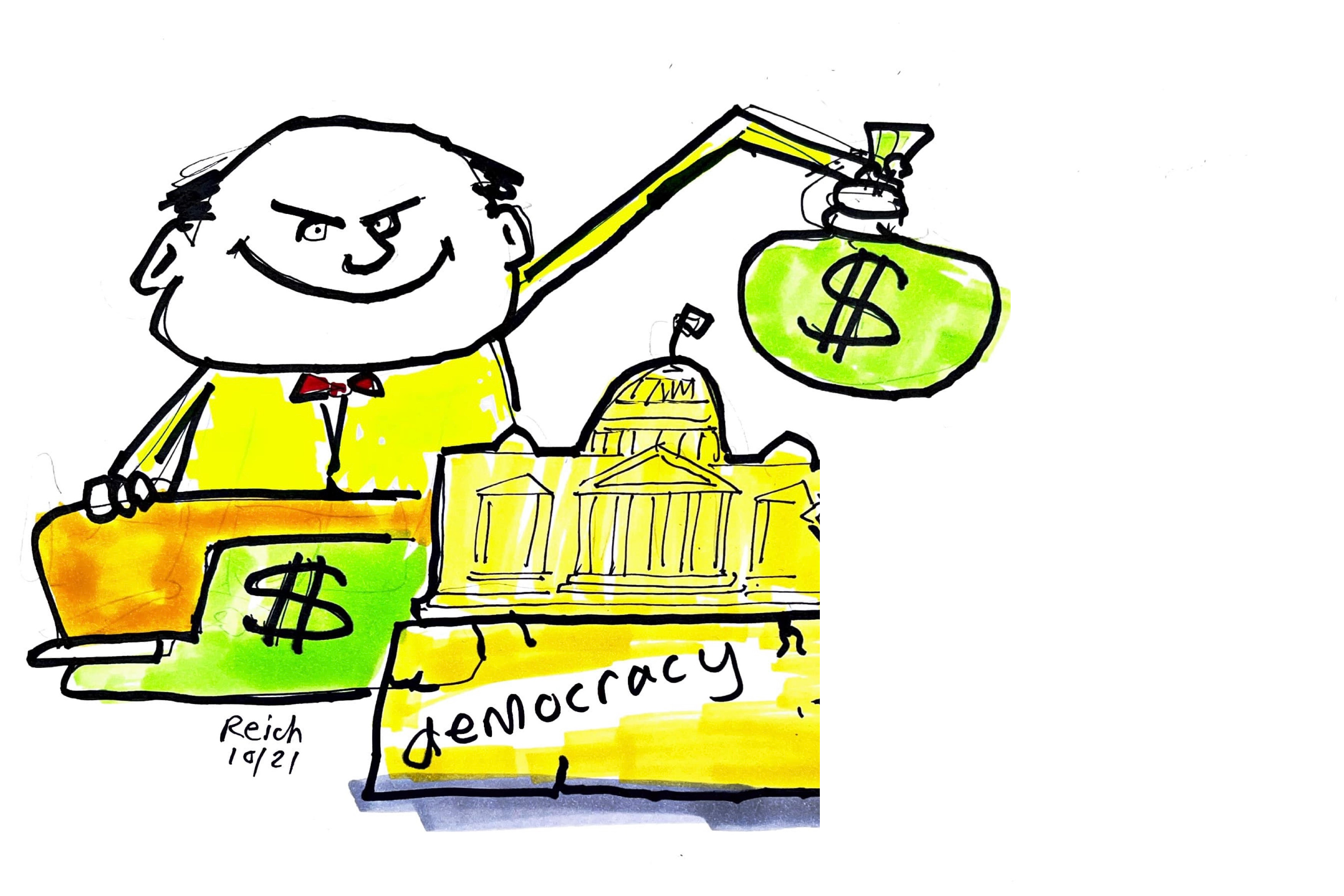
Will they take it?
Not in over a century has so much of the nation’s wealth been concentrated at the very top — in the richest one-tenth of one percent of the richest one-tenth of one percent. Not in seventy years have corporations been as flush with cash, notwithstanding the stock market’s recent selloff. Not since the 1890s have CEOs raked in as much pay relative to average workers. Not since the creation of the income tax have the super-rich paid as low a rate as they do now relative to tax rate paid by most other Americans.
Isn’t it time for Biden and the Democrats to tell this to America?
Wealth isn’t a zero-sum game in which more at the top necessarily means less below, but wealth is tied to power — and power is a zero-sum game.
Many of America’s wealthiest and most powerful are now gathering for their annual gabfest in Davos, Switzerland, just as the annual get-together of America’s right (CPAC) is coming to a close in Budapest, Hungary. The two conferences are beginning to converge. Although the CEOs and hedge fund managers at Davos profess to worry about America’s record inequality and tout “corporate social responsibility,” their own corporate political action committees are doing everything possible to squelch tax increases on them, and to prevent additional spending on health care, child care, and other needs of average working people.
Meanwhile, not even the Republicans’ billionaire backers can disguise the total absence of a Republican agenda to help average working people.
The reason Democrats haven’t been able to get their agenda through the Senate and raise taxes on billionaires or on big corporations to pay for it — or even repeal the Trump tax cuts that went mostly to the top — is because Democrats have only 48 senate votes (all fifty Senate Republicans are against these measures, and the other two senate Democrats are major beneficiaries of campaign donations from corporations and the rich).
Isn’t it time for Biden and the Democrats tell this to the American people, and offer them a clear choice in the upcoming midterms and beyond?
Billionaires are mounting a class war. Republican lawmakers are mounting a culture war to deflect attention from it.
On October 31, 1936, in New York’s Madison Square Garden, Franklin D. Roosevelt, facing a bruising re-election bid, defined the stakes much as they are today. He explained that America was in a struggle against “business and financial monopoly, speculation, reckless banking, class antagonism, sectionalism, war profiteering” and that a wealthy elite “had begun to consider the Government of the United States as a mere appendage to their own affairs.”
He continued: “We know now that Government by organized money is just as dangerous as Government by organized mob.”
Then FDR said, in words similar to what Joe Biden and Democrats should be using against the billionaires and bigots who are now arrayed against them:
Never before in all our history have these forces been so united against one candidate as they stand today. They are unanimous in their hate for me — and I welcome their hatred.
Isn’t it time Biden and the Democrats came out clearly against the billionaires abusing their wealth and power by suppressing the wages of average working people and flooding our democracy with their money? And against the culture warriors who are covering up for them? Isn’t it time for Biden and the Democrats to explain why they haven’t been able to get their agenda through Congress?
Biden and the Democrats should tell Americans which side they are on — and ask America to choose sides.
Robert B. Reich is Chancellor's Professor of Public Policy at the University of California at Berkeley and Senior Fellow at the Blum Center for Developing Economies, and writes at robertreich.substack.com. Reich served as Secretary of Labor in the Clinton administration, for which Time Magazine named him one of the ten most effective cabinet secretaries of the twentieth century. He has written fifteen books, including the best sellers "Aftershock", "The Work of Nations," and"Beyond Outrage," and, his most recent, "The Common Good," which is available in bookstores now. He is also a founding editor of the American Prospect magazine, chairman of Common Cause, a member of the American Academy of Arts and Sciences, and co-creator of the award-winning documentary, "Inequality For All." He's co-creator of the Netflix original documentary "Saving Capitalism," which is streaming now.
Beto O’Rourke disrupts GOP news conference on shooting
By ACACIA CORONADO

1 of 5
1 of 5
Democrat Beto O'Rourke, who is running against Greg Abbott for governor in 2022, interrupts a news conference headed by Texas Gov. Greg Abbott in Uvalde, Texas Wednesday, May 25, 2022. (AP Photo/Dario Lopez-Mills)
UVALDE, Texas (AP) — Beto O’Rourke interrupted a press conference Wednesday about the school shooting in Uvalde, Texas, calling the tragedy “totally predictable when you choose not to do anything.”
O’Rourke was escorted out while members of the crowd yelled at him, with one man shouting profanities at O’Rourke. The Democrat is challenging Gov. Greg Abbott in this year’s election.
Republican Lt. Gov. Dan Patrick said to O’Rourke: “You’re out of line and an embarrassment.”
O’Rourke, as he was being escorted out, turned around, faced the stage, pointed his finger and said: “This is on you until you choose to do something different. This will continue to happen. Somebody needs to stand up for the children of this state or they will continue to be killed just like they were killed in Uvalde yesterday.”
Abbott says the gunman who killed 19 children and two teachers at an elementary school warned on social media minutes before the attack that he was going to shoot up a school. He says the shooter, 18-year-old Salvador Ramos, used an AR-15 in the attack Tuesday at Robb Elementary School in Uvalde.
The news conference was attended by several elected Republican officials
UVALDE, Texas (AP) — Beto O’Rourke interrupted a press conference Wednesday about the school shooting in Uvalde, Texas, calling the tragedy “totally predictable when you choose not to do anything.”
O’Rourke was escorted out while members of the crowd yelled at him, with one man shouting profanities at O’Rourke. The Democrat is challenging Gov. Greg Abbott in this year’s election.
Republican Lt. Gov. Dan Patrick said to O’Rourke: “You’re out of line and an embarrassment.”
O’Rourke, as he was being escorted out, turned around, faced the stage, pointed his finger and said: “This is on you until you choose to do something different. This will continue to happen. Somebody needs to stand up for the children of this state or they will continue to be killed just like they were killed in Uvalde yesterday.”
Abbott says the gunman who killed 19 children and two teachers at an elementary school warned on social media minutes before the attack that he was going to shoot up a school. He says the shooter, 18-year-old Salvador Ramos, used an AR-15 in the attack Tuesday at Robb Elementary School in Uvalde.
The news conference was attended by several elected Republican officials
CRIMINAL CAPITALI$M
Nursing home owner loses US funding after Ida evacuationsBATON ROUGE, La. (AP) — A nursing home owner in Louisiana who lost the state licenses for his seven facilities after moving hundreds of residents to a poorly equipped warehouse as Hurricane Ida approached has now been barred from federal health care programs.
State officials found residents from Bob Dean’s homes in “inhumane and squalid contitions,” the Department of Health and Human Services noted in a news release Monday. As a result, the department’s Office of Inspector General has excluded Dean’s nursing homes from federal health programs, which include Medicaid and Medicare.
“Inspectors noted residents sleeping on floor mattresses less than a foot apart near standing water, some were partially undressed or completely naked, and others were calling for help or left alone with full diapers,” Monday’s release said. “The building smelled of urine while trash and dirty linens were piling up.”
In the days after Ida hit, last Aug. 29, the state reported the deaths of seven people who had been evacuated to the warehouse in the town of Independence. Five were classified as storm-related.
Dean’s attorney, John McLindon, told The Times-Picayune/The New Orleans Advocate on Monday that Dean is appealing the state license revocations and will be reinstated for the federal programs if the appeals are successful.
The nursing homes were River Palms Nursing and Rehab and Maison Orleans Healthcare Center in New Orleans; South Lafourche Nursing and Rehab in Lafourche Parish; Park Place Healthcare Nursing Home, West Jefferson Health Care Center and Maison DeVille Nursing home of Harvey, in Jefferson Parish; and Maison DeVille Nursing Home in Terrebonne Parish.
IN-DEPTH
DARPA
US military-led insect project feared to be weaponized and risks global food security, especially in ‘rival countries’ near its bio-labs

Photo: VCG
The conflict between Russia and Ukraine has led to a global food crisis, at a time of climate change, pollution, and other threats to the food supply. In the predictable future, food problems will be a permanent fixture in the world, while conflicts arising from "wars on crops" will also become an international issue of great concern.
Since 2016, the advanced military research institute in the US proposed a defense program, known as the "Insect Allies," which it said was to confront potential food supply risks. However, the Pentagon uses insects to deliver a "genetically engineered virus" that could affect crop growth by altering which genes the plants express, media reported.
After being announced, the plan has received wide criticism from scientists and experts around the world, warning that the Insect Allies might open an easily weaponized technological "Pandora's box."
The intentions of the Pentagon are also in question - is it really to save humanity from starvation, or will it, on the contrary, deliberately cause a humanitarian crisis in order to serve some "military aims."
Experts reached by the Global Times said the Insect Allies is turning this concern into a real potential danger. "Why do they use insects as carriers? Why does the US build bio-labs near other countries like Russia? When the Pandora's Box is opened, a series of disasters will follow," said an expert.
However, this is just a tip of the iceberg as a project with a potential biological weapons threat. In addition to the Insect Allies program, the US has conducted biological experiments around the world in said notorious "bio-labs" disregarding human safety and natural ethics while blatantly violating the "Biological Weapons Convention."

Photo: VCG
Insects become 'bioweapons'
The Defense Advanced Research Projects Agency (DARPA) is a research and development agency in the United States Department of Defense responsible for developing high-tech military applications.
Ever since DARPA announced the Insect Allies in the name of preventing disaster and increasing productivity, controversies surrounding the proposal have never stopped swirling.
According to the DARPA website, the program is pursuing "scalable, readily deployable, and generalizable countermeasures" against "potential natural and engineered threats" to food supply with the goals of preserving the US crop system.
It states that the program, "by applying targeted therapies," seeks to mitigate the impact of incursions, including naturally occurring threats to the crop system and "threats introduced by state or non-state actors," which can quickly jeopardize national security.
The Insect Allies program aims to transfer modified genes to plants through insect vectors along with the plant viruses they transmit, which involves three technical areas - viral manipulation, insect vector optimization, and selective gene therapy in mature plants, according to DARPA.
To achieve this goal, the $45 million project has founded at least four research institutes, the media reported previously.
It is reported that one of Insect Allies' experiments in 2017 involved maize and tomato plants and dispersal insect species including leafhoppers, whiteflies, and aphids.
However, DARPA's concept and the intention behind it have hardly convinced scientists. As early as in April 2018, an article on Science warned that the crop-protecting insects from Insect Allies "could be turned into bioweapons."
"If successful, the technique could be used by malicious actors to help spread diseases to almost any crop species and devastate harvests, they say. The research may be a breach of the Biological Weapons Convention," read the Science article, quoting European scientists.
"The program may be widely perceived as an effort to develop biological agents for hostile purposes and their means of delivery," the critics noted.
Germany's Max Planck Institute also indicated that the Insect Allies "could easily be misused for developing biological weapons."
In a critical review published in January 2022 on Society of Environmental Toxicology and Chemistry, scientists noted that "the combination of a virus-induced genetic modification of crop plants in the field using genetically modified insect vectors poses a greater risk than the hitherto existing use of genetically modified organisms."
In 2019, Forbes listed Insect Allies on the list of "Tech Ethics Issues We Should All Be Thinking About." "Is this a biological weapon? Will it motivate other countries to develop the technology in defense? " Forbes asked.
Zhang Jie, an expert from the Institute of Plant Protection under the Chinese Academy of Agricultural Sciences (CAAS), told the Global Times that the possibility of using insects as vectors for harmful bacteria and viruses to attack crops and cause a food crisis not only exists, but also has a lot of room for expansion.
He said that three main crops - rice, wheat and corn - all have deadly viruses, bacteria, or fungi. In reality, targeted pests, such as rice planthoppers and wheat aphids, can carry different viruses to infect the crops, causing huge losses.
"It would be deadly to transform an insect into a bioweapon, because until now, viruses in crops have been very difficult to control. Once an infected crop develops symptoms, it is almost impossible to save. And the virus keeps variating, creating even more difficulties in prevention," Zhang said.
Zhou Huanbin, Zhang's colleague who studies genome editing, told the Global Times that in the gene editing of crops, some principles must be followed, one of which is to minimize the risk of uncontrolled spread of gene-edited crops.
Also concerning the controllability of the project, Gregory Kaebnick, an ethicist at the Hastings Center bioethics research institute in New York, was quoted by AP as saying that once they are introduced into the fields, insects and microbes "might be impossible to remove." He warned that the Insect Allies technology could "end up being destructive."
Biological Weapons Convention violations
The Insect Allies plan has been labeled as a "biological weapon" by Western scholars since the day it was announced, triggering a big discussion in Western academic circles and the media about whether the plan violates the United Nations' Biological Weapons Convention (BWC).
"Because of the broad ban of the Biological Weapons Convention, any biological research of concern must be plausibly justified as serving peaceful purposes. The Insect Allies program could be seen to violate the Biological Weapons Convention, if the motivations presented by DARPA are not plausible," the Max Planck Institute article noted.
As the cornerstone of international biological arms control, the BWC was ready for signing in 1972 and went into effect in 1975, with more than 180 state parties.
However, the US first pushed for the striking down of the BWC, but later became the only country to oppose the establishment of a multilateral verification mechanism for the convention.
"To use insects as a vector to spread diseases is a classical bioweapon," Silja Voeneky, a professor of international law at the University of Freiburg in Germany, told The Washington Post.
According to Voeneky, in this program, using insects as a key feature is "particularly alarming, because insects could be deployed cheaply and surreptitiously by malevolent actors."
Her worry is echoed by Chinese military expert Song Zhongping, who also called the Insect Allies technology a "typical form of biological weapons."
"It could reduce crop yields in targeted countries and artificially create food crises there. Then it loses its independence in the food sector and might become dependent on US food exports, including genetically modified food, which is part of biological warfare," Song said.
Song believes that the US really needs to explain why insects are to be used as vectors in this research, especially as insects could quietly disseminate viruses into crops in other countries.
"It is not difficult to understand why the US will set up biological laboratories around rival nations, because only in these places can the labs ensure the localization of the species they use in experiments," he said. "For instance, it would be problematic if they bring American insects to a lab in Ukraine and release them in Russia."
Long history of insect vector use
The Insect Allies program is just one of many instances in which the US' research was accused of causing dire consequences around the world especially through the use of biological laboratories.
The US openly admitted that it runs 336 biological laboratories in 30 countries around the world, including 26 in Ukraine. However, the contracts suggest that the US has signed contracts with 49 countries, way more than it had admitted to.
The Pentagon has a long history of using insects as disease vectors. According to a partially declassified 1981 US Army report, US biological warfare scientists conducted multiple experiments on insects.
In the 1980s, the United States Army Medical Research Institute of Infectious Diseases came up with experiments to see "if sand flies and mosquitoes could be vectors of Rift Valley Virus, Dengue, Chikungunya, and Eastern Equine Encephalitis." The US Army researched their potential as bio-weapons, according to Bulgarian investigative journalist Dilyana Gaytandzhieva.
Under a US Army operation codenamed May Day in the same decade, Aedes Aegupti mosquitoes were dispersed through ground based methods in Georgia state of the US. The mosquitoes are alleged to be the vectors of dengue, chikungunya and the Zika virus.
Gaytandzhieva also revealed that the Pentagon has allegedly performed entomological warfare tests in countries such as Georgia and Russia.
In 2014, the US-built Lugar Center near Tbilisi, capital of Georgia was equipped with an insect facility and launched a project called "Raising Awareness about Barcoding of Sand Flies in Georgia and Caucasus." Two other programs were also undertaken at the center in the following years.
As a result, Tbilisi has been infested with biting flies since 2015, which have developed non-typical behavior from what they have previously exhibited, such as the newly emerged flies surviving indoors year-round, and being also highly resistant to cold.
The biting flies were also found in nearby Dagestan region of Russia.
Moreover, while conducting research into deadly viruses and bacteria, the US was unable to ensure the security of its biological laboratories. The Pentagon admitted in 2015 that since 2003, live samples of anthrax were mistakenly sent from the Dugway Proving Ground military base near Salt Lake City, Utah, to all 50 states as well as nine countries, including the UK, South Korea, and Germany.
Pandora’s Box
By Shan Jie and Fan Wei
By Shan Jie and Fan Wei
GLOBAL TIMES
Published: May 24, 2022
Photo: VCG
The conflict between Russia and Ukraine has led to a global food crisis, at a time of climate change, pollution, and other threats to the food supply. In the predictable future, food problems will be a permanent fixture in the world, while conflicts arising from "wars on crops" will also become an international issue of great concern.
Since 2016, the advanced military research institute in the US proposed a defense program, known as the "Insect Allies," which it said was to confront potential food supply risks. However, the Pentagon uses insects to deliver a "genetically engineered virus" that could affect crop growth by altering which genes the plants express, media reported.
After being announced, the plan has received wide criticism from scientists and experts around the world, warning that the Insect Allies might open an easily weaponized technological "Pandora's box."
The intentions of the Pentagon are also in question - is it really to save humanity from starvation, or will it, on the contrary, deliberately cause a humanitarian crisis in order to serve some "military aims."
Experts reached by the Global Times said the Insect Allies is turning this concern into a real potential danger. "Why do they use insects as carriers? Why does the US build bio-labs near other countries like Russia? When the Pandora's Box is opened, a series of disasters will follow," said an expert.
However, this is just a tip of the iceberg as a project with a potential biological weapons threat. In addition to the Insect Allies program, the US has conducted biological experiments around the world in said notorious "bio-labs" disregarding human safety and natural ethics while blatantly violating the "Biological Weapons Convention."
Photo: VCG
Insects become 'bioweapons'
The Defense Advanced Research Projects Agency (DARPA) is a research and development agency in the United States Department of Defense responsible for developing high-tech military applications.
Ever since DARPA announced the Insect Allies in the name of preventing disaster and increasing productivity, controversies surrounding the proposal have never stopped swirling.
According to the DARPA website, the program is pursuing "scalable, readily deployable, and generalizable countermeasures" against "potential natural and engineered threats" to food supply with the goals of preserving the US crop system.
It states that the program, "by applying targeted therapies," seeks to mitigate the impact of incursions, including naturally occurring threats to the crop system and "threats introduced by state or non-state actors," which can quickly jeopardize national security.
The Insect Allies program aims to transfer modified genes to plants through insect vectors along with the plant viruses they transmit, which involves three technical areas - viral manipulation, insect vector optimization, and selective gene therapy in mature plants, according to DARPA.
To achieve this goal, the $45 million project has founded at least four research institutes, the media reported previously.
It is reported that one of Insect Allies' experiments in 2017 involved maize and tomato plants and dispersal insect species including leafhoppers, whiteflies, and aphids.
However, DARPA's concept and the intention behind it have hardly convinced scientists. As early as in April 2018, an article on Science warned that the crop-protecting insects from Insect Allies "could be turned into bioweapons."
"If successful, the technique could be used by malicious actors to help spread diseases to almost any crop species and devastate harvests, they say. The research may be a breach of the Biological Weapons Convention," read the Science article, quoting European scientists.
"The program may be widely perceived as an effort to develop biological agents for hostile purposes and their means of delivery," the critics noted.
Germany's Max Planck Institute also indicated that the Insect Allies "could easily be misused for developing biological weapons."
In a critical review published in January 2022 on Society of Environmental Toxicology and Chemistry, scientists noted that "the combination of a virus-induced genetic modification of crop plants in the field using genetically modified insect vectors poses a greater risk than the hitherto existing use of genetically modified organisms."
In 2019, Forbes listed Insect Allies on the list of "Tech Ethics Issues We Should All Be Thinking About." "Is this a biological weapon? Will it motivate other countries to develop the technology in defense? " Forbes asked.
Zhang Jie, an expert from the Institute of Plant Protection under the Chinese Academy of Agricultural Sciences (CAAS), told the Global Times that the possibility of using insects as vectors for harmful bacteria and viruses to attack crops and cause a food crisis not only exists, but also has a lot of room for expansion.
He said that three main crops - rice, wheat and corn - all have deadly viruses, bacteria, or fungi. In reality, targeted pests, such as rice planthoppers and wheat aphids, can carry different viruses to infect the crops, causing huge losses.
"It would be deadly to transform an insect into a bioweapon, because until now, viruses in crops have been very difficult to control. Once an infected crop develops symptoms, it is almost impossible to save. And the virus keeps variating, creating even more difficulties in prevention," Zhang said.
Zhou Huanbin, Zhang's colleague who studies genome editing, told the Global Times that in the gene editing of crops, some principles must be followed, one of which is to minimize the risk of uncontrolled spread of gene-edited crops.
Also concerning the controllability of the project, Gregory Kaebnick, an ethicist at the Hastings Center bioethics research institute in New York, was quoted by AP as saying that once they are introduced into the fields, insects and microbes "might be impossible to remove." He warned that the Insect Allies technology could "end up being destructive."
Biological Weapons Convention violations
The Insect Allies plan has been labeled as a "biological weapon" by Western scholars since the day it was announced, triggering a big discussion in Western academic circles and the media about whether the plan violates the United Nations' Biological Weapons Convention (BWC).
"Because of the broad ban of the Biological Weapons Convention, any biological research of concern must be plausibly justified as serving peaceful purposes. The Insect Allies program could be seen to violate the Biological Weapons Convention, if the motivations presented by DARPA are not plausible," the Max Planck Institute article noted.
As the cornerstone of international biological arms control, the BWC was ready for signing in 1972 and went into effect in 1975, with more than 180 state parties.
However, the US first pushed for the striking down of the BWC, but later became the only country to oppose the establishment of a multilateral verification mechanism for the convention.
"To use insects as a vector to spread diseases is a classical bioweapon," Silja Voeneky, a professor of international law at the University of Freiburg in Germany, told The Washington Post.
According to Voeneky, in this program, using insects as a key feature is "particularly alarming, because insects could be deployed cheaply and surreptitiously by malevolent actors."
Her worry is echoed by Chinese military expert Song Zhongping, who also called the Insect Allies technology a "typical form of biological weapons."
"It could reduce crop yields in targeted countries and artificially create food crises there. Then it loses its independence in the food sector and might become dependent on US food exports, including genetically modified food, which is part of biological warfare," Song said.
Song believes that the US really needs to explain why insects are to be used as vectors in this research, especially as insects could quietly disseminate viruses into crops in other countries.
"It is not difficult to understand why the US will set up biological laboratories around rival nations, because only in these places can the labs ensure the localization of the species they use in experiments," he said. "For instance, it would be problematic if they bring American insects to a lab in Ukraine and release them in Russia."
Long history of insect vector use
The Insect Allies program is just one of many instances in which the US' research was accused of causing dire consequences around the world especially through the use of biological laboratories.
The US openly admitted that it runs 336 biological laboratories in 30 countries around the world, including 26 in Ukraine. However, the contracts suggest that the US has signed contracts with 49 countries, way more than it had admitted to.
The Pentagon has a long history of using insects as disease vectors. According to a partially declassified 1981 US Army report, US biological warfare scientists conducted multiple experiments on insects.
In the 1980s, the United States Army Medical Research Institute of Infectious Diseases came up with experiments to see "if sand flies and mosquitoes could be vectors of Rift Valley Virus, Dengue, Chikungunya, and Eastern Equine Encephalitis." The US Army researched their potential as bio-weapons, according to Bulgarian investigative journalist Dilyana Gaytandzhieva.
Under a US Army operation codenamed May Day in the same decade, Aedes Aegupti mosquitoes were dispersed through ground based methods in Georgia state of the US. The mosquitoes are alleged to be the vectors of dengue, chikungunya and the Zika virus.
Gaytandzhieva also revealed that the Pentagon has allegedly performed entomological warfare tests in countries such as Georgia and Russia.
In 2014, the US-built Lugar Center near Tbilisi, capital of Georgia was equipped with an insect facility and launched a project called "Raising Awareness about Barcoding of Sand Flies in Georgia and Caucasus." Two other programs were also undertaken at the center in the following years.
As a result, Tbilisi has been infested with biting flies since 2015, which have developed non-typical behavior from what they have previously exhibited, such as the newly emerged flies surviving indoors year-round, and being also highly resistant to cold.
The biting flies were also found in nearby Dagestan region of Russia.
Moreover, while conducting research into deadly viruses and bacteria, the US was unable to ensure the security of its biological laboratories. The Pentagon admitted in 2015 that since 2003, live samples of anthrax were mistakenly sent from the Dugway Proving Ground military base near Salt Lake City, Utah, to all 50 states as well as nine countries, including the UK, South Korea, and Germany.
Subscribe to:
Comments (Atom)