It’s possible that I shall make an ass of myself. But in that case one can always get out of it with a little dialectic. I have, of course, so worded my proposition as to be right either way (K.Marx, Letter to F.Engels on the Indian Mutiny)
Wednesday, July 13, 2022
IT'S NOT ABOUT GAS IT'S ABOUT COAL
German official: Nuclear would do little to solve gas issue
BERLIN (AP) — Germany's vice chancellor on Tuesday defended the government's commitment to ending the use of nuclear power at the end of this year, arguing that keeping its few remaining reactors running would be complex and do little to address the problems caused by a possible natural gas shortfall.
Germany's main opposition party has called repeatedly for the country's last three nuclear reactors to be kept online after the end of December amid fears that Russia may halt natural gas supplies entirely. There's some sympathy for that position in the ranks of the pro-business Free Democrats, the smallest party in Chancellor Olaf Scholz's governing coalition.
“Nuclear power doesn't help us there at all,” Vice Chancellor Robert Habeck, who is also the economy and climate minister and is responsible for energy, said at a news conference in Vienna. “We have a heating problem or an industry problem, but not an electricity problem — at least not generally throughout the country.”
Germany shut down three nuclear reactors in December and the remaining three are due to cease production at the end of this year as part of a long-running plan to phase out conventional power plants in favor of renewable energy.
In this year's first quarter, nuclear energy accounted for 6% of Germany's electricity generation and natural gas for 13%, both significantly lower than a year earlier. Germany has been getting about 35% of its gas from Russia.
Habeck said the legal certification for the remaining reactors expires at the end of the year and they would have to be treated thereafter as effectively new nuclear plants, complete with safety considerations, and the likely “very small advantage” in terms of saving gas wouldn't outweigh the complications.
Fuel for the reactors also would have to be procured, and Scholz has said that the fuel rods are generally imported from Russia.
Opposition politicians have argued that Habeck's environmentalist Green party, which has long strongly supported the nuclear phaseout, is opposing keeping reactors online for ideological reasons.
The Associated Press
Sask. cattle producers call for meat pricing investigation, transparency
There is a disconnect between what producers are receiving for their animals and the high prices consumers are paying for beef products, according to the Saskatchewan Stock Growers Association. (Paul Daly/CBC - image credit)
Cattle producers in Saskatchewan want more transparency about who is profiting from beef sales.
They say meat packers and retailers are limiting supply to drive up prices.
"We know what retail prices are and we know what our farm gate prices are," said Garner Deobald, who farms near Hodgeville, Sask. "There's a lot of money that's staying in the supply chain, but not coming back down to the grassroots."
Deobald is also president of the Saskatchewan Stock Growers Association (SSGA), a cattle industry lobbying organization.
The association wants the federal and provincial governments to follow the money and investigate.
"Let's have a look at see if we can identity where the profits are being made, and if there is a way or a strategy that we can come up with to share in this a little more this equitably."
From calf to consumer
Kathy Larson said on Monday that the package of sirloin steaks in her fridge cost about $12 per pound, or about $9 per steak.
"A lot of times when you see that in the grocery store, you think oh well the cow-calf producers, the cattle producers, they must be so rich."
But Larson said that assumption is incorrect.
The beef supply chain begins with the cattle producers and newborn calves, explained Larson, a research associate with the department of agricultural and resource economics at the University of Saskatchewan and a former beef economist with the Western Beef Development Centre.
Producers raise the calves born in springtime until they're weaned from their mothers and weigh about 550 lbs, Larson said. Then the animals then moved to a backgrounder lot for "usually around two dollars a pound."
Once the steers and heifers reach about 1,000 lbs, they are transitioned to a feedlot. The steers and heifers will be fed barley and corn grain and silage until they weigh around 1300 to 1500 lbs. Once they reach this weight, they are sold off to the packer.
Larson said Alberta and Saskatchewan have about 170 feedlots. Currently, feedlots are selling the animals to facilities run by giant companies Cargill and JBS for about $1.75 per pound. She noted she saw ground beef at the store on Sunday priced at $6.40 per pound.
The majority of beef is processed at federally inspected plants to meet export requirements. She said Cargill and JBS account for about 65 per cent of all federally-inspected Canadian slaughter capacity.
"They control a lot. We go from 12,000 cow-calf [operations in Saskatchewan] to less than 200 feedlots and then two main packers controlling almost two-thirds of the federally inspected slaughter," she said. There are more than 30,000 cow-calf operations in Western Canada.
She said the request for transparency on where the retail dollar is going makes sense. She noted there are similar issues in the United States.
The Associated Press reported last week that Sysco, a massive food distributor, joined multiple other businesses in accusing the country's four largest meat processors, including Cargill and JBS, of working together to inflate beef prices.
Access to local beef at risk
SSGA says packers and retailers are limiting supply to drive up prices, since "packers and retailers know there's no one else to take their place or profits."
"Industry members are questioning packers' strategy, which seems to be limiting the amount of product available at the retail level ― keeping boxed beef prices high while allowing fed cattle supplies to build in the countryside, which keeps cattle prices low," said the SSGA in its call for an investigation.
Cargill declined to comment, directing CBC to the Canadian Meat Council — which did not respond to request for comment. CBC did not receive a response from JBS.
Ryan Remiorz/The Canadian Press
Deobald said producers are frustrated that consumers are paying more while producers, who are selling the cattle that will eventually become beef, risk going under.
He said this frustration is amplified at a time when producers are already grappling with the harsh impact of drought, "astronomical" feed costs, and rising costs of fuel and fertilizer. People are having to downsize or sell off herds, convert grassland into cultivated crops and sell land.
Deobald said there's only so much people can take before they throw up their hands, saying "enough is enough."
"We enjoy what we do, we are willing to work long hard hours, but if there's no reward at the end and you're losing money at the end it just can't continue."
Canadians are at risk of losing access to Saskatchewan-raised beef if producers continue running losses, Deobald said.
In a written statement, a spokesperson for the provincial Ministry of Agriculture said "we also share industry pricing concerns; however, it would be best for the SSGA to discuss their investigation request with Competition Bureau Canada."
Deobald said SSGA will consider seeking action through the Canada Competition Bureau, which investigates alleged price-fixing and other anticompetitive conduct, if their calls for action go unanswered.
A spokesperson for the Canada Competition Bureau said they couldn't comment on specific behaviour in the marketplace, but encouraged anyone who believes to have evidence of price-fixing to report it.
Trudeau announces deal to build $1.5B electric vehicle battery plant in Ontario
Prime Minister Justin Trudeau speaks during an electric battery announcement at Queen’s University in Kingston, Ont., on Wednesday July 13, 2022. (Lars Hagberg/Canadian Press - image credit)
Prime Minister Justin Trudeau announced Wednesday that Ottawa and Ontario have signed a deal with Umicore, a global metals refiner, to build a new battery materials facility in the province's Loyalist Township.
Speaking at Queen's University in Kingston, Ont., the prime minister said the facility will supply materials for one million electric vehicles a year.
Umicore, a multinational corporation based in Belgium, will transform metals such as nickel, cobalt and lithium into cathode active battery materials (CAM) at the new eastern Ontario site — materials that are critical to producing lithium-ion batteries for electric vehicles.
Trudeau said the new plant will create 1,000 jobs while it is being built and hundreds of long-term positions once it is up and running.
He said the government and industry investments are part of a "big bet" that Canada can be a key international player in electric-vehicle supply chains.
WATCH: Trudeau announces deal with Umicore to build EV battery plant in Ontario
"Today's announcement is about creating jobs, cutting pollution and building a stronger, cleaner economy for Canadians. Umicore's intention to establish its new facility in Loyalist Township is another major step forward as we make Canada a global leader in producing electric vehicles, from minerals to manufacturing," Trudeau said.
Ontario's Economic Development Minister Vic Fedeli said the $1.5-billion investment will build the first industrial-scale manufacturing plant of its kind in North America.
"With recent success attracting major investments to the province, our government is staking Ontario's claim to developing and building the batteries that will power vehicles of the future," Fedeli said.
Federal Industry Minister Francois-Philippe Champagne said the plant will fill a gap in the Canadian electric-vehicle system by shoring up a key part of the battery-making process.
"The auto sector is spreading across the country now," Champagne said. "It's not just concentrated, but now Kingston is going to be part of the auto sector in Canada."
The plant will be built with some financial support from both levels of government but a dollar figure wasn't immediately available.
Ottawa and the province have plowed hundreds of millions of dollars in public money into similar projects in recent months.
In a statement, Ontario Premier Doug Ford, who was not at Wednesday's announcement, said these multi-billion dollar investments are paying off, helping the province to "strengthen its position as a North American auto manufacturing powerhouse."
Umicore said it has signed a memorandum of understanding with Ottawa, which will allow it to tap funds from the federal Strategic Innovation Fund to help offset some of the construction costs associated with building a plant of this size.
The company already has penned an agreement with Loyalist Township for a 140-hectare parcel of land that eventually will house the plant.
The company will start on construction in 2023, with the site expected to be fully operational by the end of 2025 — pumping out the materials that will help drive the global transition from cars and trucks powered by internal combustion engines to electric vehicles.
"We are most grateful to the Canadian and Ontario governments for their support and for their readiness to co-fund this planned project. The facility will help Canada and Umicore in their shared objective of achieving a carbon-neutral battery supply chain," said Mathias Miedreich, CEO of Umicore.
Carmakers General Motors, Honda and Stellantis, the company that makes Jeep and Chrysler vehicles, have also promised recently to spend billions of dollars in the coming years to build battery and electric vehicle manufacturing facilities in Ontario — investments that have breathed new life into Canada's long-stagnant auto sector.
According to government data, Canada's auto sector supports nearly 500,000 workers, contributes $16 billion annually to the country's gross domestic product and is one of the largest export industries.
Gap in crisis mode after CEO becomes latest exec to depart struggling retailer
CEO of Gap Inc. Sonia Syngal speaks during a roundtable discussion with industry executives and US President Donald Trump on reopening the country, in the State Dining Room of the White House in Washington, DC on May 29, 2020. (Photo by MANDEL NGAN / AFP) (Photo by MANDEL NGAN/AFP via Getty Images)
Struggling retailer Gap (GPS) is in crisis mode ahead of the crucial selling periods of back to school and the holidays, with the stock down nearly 6% in pre-market trading after it revealed the departure of its CEO.
Gap surprised a few on the Street Monday evening after the market close by announcing CEO Sonia Syngal would be stepping down as CEO after a "brief" transition period. In her place, executive chairman Bob Martin will assume the role as interim CEO.
Syngal was seen as a potential savior for Gap when she took over as CEO in March 2020 from interim CEO Robert Fisher, who in turn, had stepped in for ousted chief executive Art Peck.
The former CEO of Old Navy, Syngal was credited with reviving that important division, and moved quickly in her early days as Gap's leader to inject a fashion sense back into the company. That included signing design king and rap star Kanye West to a pricey, long-term clothing design deal.
Syngal also worked to improve the company's supply chain and shutter under-performing stores.
Unfortunately for Syngal, her time at Gap will be remembered for more promise than delivery — a byproduct in part of Gap letting customers down on size and style for decades. West's collection never made the splash it was expected to, nor did it drive meaningful sales.
The onset of the COVID-19 pandemic and its assorted challenges did nothing to help Syngal's turnaround cause, concluding in a disastrous first quarter.
Gap said in late May first quarter sales at Old Navy and Gap plunged 19% and 11%, respectively, from the same quarter last year.
For the year, Gap saw earnings per share of $0.30 to $0.60 compared to Street estimates for $1.30.
On Tuesday, Gap declined to update its full-year profit outlook. But similar to other retailers, it warned of a challenging end to the second quarter. Gap said it expects sales to decline in the high-single digit percentage range. Operating margins are pegged to be "zero" to slightly negative.
"Although the company announced some management changes (CEO leaving; new Pres/CEO for Old Navy hired), the equally important news is what they said about 2Q. While management indicated that 2Q sales will be down high-single digit percentage (approximately in line with their plan), promos were higher than expected, leading to lower gross margin/operating margin. We already knew Gap had too much inventory coming out of 1Q and that they would be promotional through 2Q. But that they had to increase promos even more than expected (they didn’t specify which brands were the culprits) is another negative indicator for the apparel sector and GPS," said Citi analyst Paul Lejuez in a note to clients.
Gap's shares were down 21% under Syngal's CEO tenure compared to a 43% rise in the S&P 500.
No permanent CEO at the Gap yet. Likely inventory bulge exiting the lackluster second quarter of sales. A stock price trading at less than $9 a share on Monday. Hardly a fashionable scenario for anyone interviewing to take over before year end.
Winslow Homer: Crosscurrents—Exhibition of the great 19th century American painter at the Metropolitan Museum
American painter Winslow Homer (1836–1910) has long been known for his dramatic seascapes of the rocky Maine coast, as well as his paintings of Civil War scenes. His oil paintings and watercolors such as Breezing Up(A Fair Wind) (1876) of boys setting out to sea in a small sloop or children playing Snap the Whip (1872) communicate something of the optimism of the post-Civil War period when America was a rising power and there was a general sense of progress, of growth, and hopes that the democratic promise of the Civil War would be realized.
The Gulf Stream, 1899
Organized around The Gulf Stream (1899), Homer’s powerful painting of a lone black man adrift on a stormy sea beset with sharks, the aptly titled exhibition Crosscurrents at the Metropolitan Museum in New York underscores the centrality of racial and class relations during and in the aftermath of the Civil War in Homer’s work.
Likewise the impact of developing industrial capitalism on rural and maritime life is evident when his images of American rural life in the 1870s-80s are carefully examined. His stunning watercolors of the West Indies indicate not just natural beauty, but the exploitation of this tropical “paradise” first by European colonial masters and then by US imperialism. Finally, his most persistent theme, the human struggle with the forces of nature, is at once existential but also grounded in a particular time and place.
The Sharpshooter, 1863
To the extent that direct observation of the everyday was the basis of his work, Homer’s images seem straightforward. “Barbarously simple,” to the mind of contemporary and fellow Bostonian, writer Henry James. “He (Homer) has chosen the least pictorial features of the least pictorial range of scenery and civilization as if they were every inch as good as Capri or Tangier; and, to reward his audacity, he has incontestably succeeded.”
But Homer’s images, whether “pictorial” by James’ standards or not, were carefully composed to suggest narratives that are more ambiguous than they first appear; and though largely self-taught, he was not an unsophisticated provincial. Through his associations with fellow artists in New York City, where he lived and maintained a studio from the early 1860s till he relocated to the coast of Maine in the 1880s, and particularly his travel on two significant occasions—the first to Paris, France, in 1867 and the second to the English coastal village of Cullercoats for two years (1881–1882)—his work was deeply informed by that of the best European painters, such as his forerunner in dramatic seascapes, English Romantic painter J.M.W. Turner (1775-1851) and the Realist Gustave Courbet (1819-1877), with whom his unvarnished pictures of rural labor share a particular affinity.
Prisoners from the Front, 1866
The organization of the exhibition draws connections between what otherwise might seem like discrete bodies of Homer’s work, centering it in the historic developments of the Civil War and post-war Reconstruction period. It opens with The Sharpshooter (1863), a small canvas showing a single Union soldier perched up in a tree. At first it is hard to even distinguish the soldier from the tree branches, were it not for the telling detail of the red badge on his cap and the highlight on his ear and visor. Once noticed, however, the imminently bloody consequences of his focus are chilling. At a later time, Homer described his experience—and made a sketch of—looking through one such sharp-shooter’s scope as the closest thing he could imagine to murder.
In Defiance, Inviting a Shot before Petersburg (1864), a larger painting which effectively serves as a counterpart, we see what the soldier might have been aiming at—a Confederate soldier dances atop a trench before a decimated field inviting Union fire with a doomed bravado. A supporter of the Union and the abolition of slavery, Homer nonetheless saw the war as an internecine conflict that left deep scars on both sides. On at least two occasions he sketched behind Confederate lines, and the aforementioned scene in Petersburg might have been witnessed on one such.
The Cotton Pickers, 1876
Homer’s direct experience of the war came through his assignment by Harper’s Weekly to sketch camp life of Union troops under Major General George B. McClellan in 1861. At the age of 25, he already made his living producing wood-block illustrations for the popular press. The second son in a Boston mercantile family of fluctuating means, Homer had been apprenticed as a teenager to John Henry Bufford, a prominent Boston printer in whose shop he mastered the relatively new and labor-intensive process of lithography.
Introduced to the United States by Louis Prang in 1825, lithography, literally stone (litho) drawing (graphy), was a means of reproducing images in print media. Many political cartoons, like those of French satirist Honoré Daumier (1808-1890) were lithographs. But much of the work at Bufford’s was the more mundane production of handbills and advertisements. Homer left the sweatshop-like conditions of the litho shop by his early 20s in favor of work in wood-engraving for Harper’s. While never a cartoonist of the stature of Daumier, Homer’s illustrations often carry a pointed, if understated irony. And his strength as a draftsman, as well as his narrative compositions owed an enduring debt to this training. Even after becoming established as an artist, he would continue to earn a part of his living as an illustrator well into his career.
Painted upon his return to his New York studio, likely from sketches made on the scene, Prisoners from the Front (1866) established Homer’s artistic reputation as a painter, not a mere illustrator. Featured at the annual exhibition of New York’s National Academy of Design, it was shown to further critical acclaim at the 1867 Exposition Universelle in Paris, which Homer visited on his trip of that year.
The Life Line, 1884
The painting captures both the commonality—all of the figures are the same height and occupy the same picture plane—as well as the divide between the North and South. The capturing Union officer, Brigadier General Francis Channing Barlow on the right may be the victor, but the cocky Confederate officer is the center of the composition. The other prisoners, one aged and the others in ragged clothes that hardly count as uniforms, clearly indicate the social divisions between the Southern planter class and the farmers and woodsmen of the hill country that made up the bulk of the Confederate troops. All of them look poor in comparison to Barlow with his glossy boots and sword; even the Confederate officer, for all his swagger, has buttons missing from his jacket and breeches.
Through such seemingly minor details, Homer’s pictures invite the viewer to ask questions, but only suggest answers. In The Veteran in a New Field and The Brush Harrow (both 1865) In the tradition of countless paintings of agricultural life from Breughel down to Millet, the images suggest humanity’s place in the earth’s seasonal cycles. But on further examination, the human toll of the recent conflict is encapsulated in the images of a solitary man harvesting with a scythe suggestive of the Grim Reaper and two children at work with a primitive tool in fields without adult assistance.
Homer was one of the few visual artists of his time to observantly and sympathetically portray formerly enslaved African Americans in paintings that pose questions about the newly established social relations immediately after the Civil War. In Near Andersonville (1865-66) and A Visit from the Old Mistress (1876), these questions are posed sharply. Two other stunningly beautiful paintings, The Cotton Pickers (1876) and Dressing for the Carnival (1877) depict aspects of African-American life as it was being established during the period of Reconstruction (1867-1877).
Old Mill (The Morning Bell), 1871
Also in the 1870s, Homer began to spend summers in Gloucester, Massachusetts, a New England fishing community where everyone, including children, was involved in hauling their daily livelihood from the sea. It was there he first began painting in watercolors, a medium that did not then have the stature of oil, being associated with amateurs, mostly women. But it was perfectly suited to capturing the crystalline light of Cape Ann, and Homer’s mastery of the medium gave it tremendous expressive power. More rapidly produced than oil paintings, Homer was also able to earn a better living, consigning more than a hundred watercolors to his gallery for sale one season.
Even here however, the picturesque in Homer is grounded in specific events. Waiting for Dad (Longing) (1873), for example, might seem to be a sentimental image, till one learns that a particularly devastating Nor-easter had drowned a good portion of the male population at sea that year, leaving many households without fathers, and families without their main breadwinners.
The power of the sea, and our relation to it, would become an increasingly dominant theme of Homer’s work by the 1880s. In 1881, he made his second trip to Europe, this time staying almost two years in Cullercoats, a northern English coastal village with a fishing economy much like Gloucester. There he painted primarily the fishwives he observed—their husbands being likely at work out at sea—standing tenaciously against the forces of nature in Perils of the Sea (1881) Inside the Bar (1883), and The Gale (1883-1893).
A Garden in Nassau, 1885
He also witnessed, and painted, several extraordinary rescues from sinking vessels. The Life Line (1884) in particular is exceptional not only for the power of its composition—the nearly drowned woman and her rescuer hang suspended in the center of the composition of crashing waves—but it demonstrated the use of a new technology, the breech buoy, which made such hazardous rescues possible. The importance of technology in mastering the forces of nature is also apparent in Eight Bells (1886) as two fishermen use a sextant and chronometer to determine their ship’s position in rough seas.
Homer examined the same fundamental relationships between human labor and the forces of the sea in the very different environment of the tropics in the watercolors he painted on his two stays in the Caribbean in 1885 and in 1898. Partly commissioned by The Century Magazine to advertise the natural beauty of the islands as tourist destinations for well-to-do Northerners, Homer’s dazzling watercolors again show a social as much as a natural environment. Here young black fishermen haul turtle and sponges from the iridescent waves, instead of herring and halibut, but the hazards of earning a living in such a way were much the same, though different in critical respects.
The watercolors Rest and A Garden in Nassau (both 1885) are powerful images of exclusion and inequality. A young black woman resting her burden of fruits and a black child respectively stand outside high stucco walls behind which all that we, like they, can see are verdant palms and vibrant flowers suggesting that a tropical “paradise” for some was based on the distinctly un-paradisiacal disenfranchisement and exploitation of the labor of others.
Driftwood 1909
Homer’s characteristically blunt depiction of a carefully observed social reality is implicitly critical. His approach had much in common with, and was likely informed, by that of Courbet, a generation older than Homer, whose Realist manifesto proclaimed:
'To be able to translate the customs, ideas, the appearances of my epoch according to my own appreciation of it [to be not only a painter but a man,] in a word to create living art, that is my goal.' (“On Realism,” 1855.)
There are similarities between the two painters, not only in approach but in their attention to class relations and rural labor in a period of social and political transition. Each lived through titanic events—Courbet, the 1848 revolution and the Paris Commune of 1871; Homer, the Civil War and the rise of American industrial society. Each adopted an uncompromising realism. It is difficult not to see the influence of Courbet and others in a work like Homer’s Prisoners from the Front.
At the same time, there are considerable dissimilarities, rooted, above all, in differing social conditions. The social struggle in France in the mid-19th century was at a considerably more advanced state. French workers revolted in 1830 and rose up as independent force in June 1848, at a time when the American Civil War, which would usher in a period of explosive economic development and growth of the working class, was only being prepared.
The differences find expression, for example, in the depiction of rural labor in Courbet’s The Stone Breakers (1849), as opposed to Homer’s Old Mill (The Morning Bell) (1871). Nor did the explosive struggles of the working class in America of the 1880s and later ever become Homer’s subject. He had matured and found his social-artistic orientation in a different era in a different context.
Nevertheless, Homer’s final paintings of the surf pounding the rocks in Prout’s Neck, Maine, such as Northeaster (1895) or Driftwood (1909), for all that they convey the restless movement of water, are surprisingly rooted in concrete actuality. With Homer’s characteristically keen powers of observation, they are informed by his understanding that human beings, through their labor, are inexorably engaged in unrelenting struggle with this tumult and clash of elements.
(Winslow Homer: American Passage by William R. Cross, published 2022, has served as a reference for this review.)
The Ukrainian military said it destroyed a Russian ammunition depot in the occupied Kherson region.
The war has caused a spike in demand for traditional defense equipment.
Credit...Tyler Hicks/The New York Times The arms race
With Russia making slow but steady gains in the east, Ukraine has increasingly appealed for faster deliveries of sophisticated weapons from the West to hold off its better-armed foe.
The U.S. and many European countries have promised more weaponry, but they are wary of sending too much before Ukrainian troops can receive proper training. The Pentagon is also concerned about potentially depleting its own stockpiles.
To get a sense of how the two sides are trying to replenish their military stocks, I spoke to Alexandra Marksteiner, a researcher at the Stockholm International Peace Research Institute who tracks the global arms industry. Our conversation has been lightly edited and condensed.
Ukraine has been using more Javelin missiles each week than are produced in a year.
Credit...Doug Mills/The New York Times Will the arms industry be able to keep up with demand?
Alexandra: Right now it does seem like Ukraine is going through these stockpiles faster than can be replenished. Lockheed Martin produces about 2,100 Javelin missiles a year and Ukraine uses about 500 a day. Lockheed has promised to double production to 4,000, but that’s not going to be much of a dent.
Having the industrial capacity to replenish these stocks is going to be essential. This industrial capacity is what gave the Allies a leg up against the Axis powers during World War II. So it’s incredibly important. It’s an aspect of this war that’s not talked about enough.
The arms industry, even before the invasion, dealt with things that all other industries are dealing with at the moment — rising prices of inputs, labor shortages, supply chain issues. So there were already structural issues that were affecting it and now you have this massive increase in demand.
So the question is, who can sustain what level of production for longer — Russia, or Ukraine plus the U.S. and Europe? Right now, the cards are definitely stacked against the Russian industry.
Replenishing weapons stocks is essential for both Ukraine and Russia.
Credit...Brendan Hoffman for The New York Times
What is the situation in the West?
In Europe and the U.S., obviously if you take all those arms industries together, it’s going to be much larger than the arms industrial capacity of Russia. But you also have to consider that there are orders that were logged many years ago. It’s sometimes very hard to shift gears quickly.
And there are other parts of the world that these countries have been focused on. For example, the strategic rivalry with China is taking up a lot of not just capacity, but mental head space in U.S. defense planning. So you can’t say that the entire arms industry is going to be devoted to making the systems that are needed by Ukraine.
It’s also a matter of how quickly production capacities can be shifted. In the past couple of years, you had this idea that the future of war was going to be hybrid, it was going to be low intensity, more unconventional. So there was a focus on all these high tech, next generation technologies, artificial intelligence, hypersonic missiles.
And then the Ukraine war kind of shot that impression completely. There is now renewed focus on traditional defense equipment: tanks, artillery, ammunition.
The focus has shifted and that means that production capacities are also going to have to shift in an industry that was already kind of struggling.
Russia has gone through massive amounts of equipment.
Credit...Mauricio Lima for The New York Times What about the situation in Russia?
The Russian arms industry is quite large. There are indications that it actually shrank a bit over the past couple of years, but it’s still definitely a force to be reckoned with. And, of course, the Russian arms industry is now going to be fully committed to this war.
But an interesting thing about the Russian arms industry is that it was actually instructed over the past couple of years to shift more focus to civilian products.
We think it was because there was a massive military modernization program in Russia during the 2010s. It was a 10-year program, it was very expensive. It gave a lot of contracts to the Russian arms industry. But then the Kremlin was not so sure how many physical resources it had to give to military modernization over the next decade, so in order to keep the arms industry alive, they said, “OK, please focus more on civilian products and survive until we need you again.”
Now the industry has to shift again. And it has to replenish those stockpiles that Russia is losing every single day.
I am very heartened by the international aid and attention given to Ukrainian refugees, with many countries opening their borders to them and welcoming them in. At the same time, countless refugees fleeing the Middle East have been met with barbed-wire fences. At best, they are treated with indifference. At worst, they are abused, beaten, detained in inhumane conditions and even killed. While we continue to help Ukrainians, it is imperative that we adopt the same attitude toward all refugees and victims of war, because nobody chooses war, it is forced upon them. — Jiang Wanyan, Singapore
Russia Says US ‘Hype’ Not Helping Arrested WNBA Player Griner
by Staff Writer AFP 07/07/22 Brittney Griner has been detained in Russia on drug charges. File photo: Kirill Kudryavtsev/AFP
Moscow said Thursday that US “hype” over women’s basketball star Brittney Griner, held in Russia on drug smuggling charges, will not help her case after President Joe Biden spoke out against her detention.
“The hype and working on the public, with all the love for this genre among modern politicians, currently only disturbs (the court process),” Deputy Foreign Minister Sergei Ryabkov said, according to Russian news agencies.
“It does not just distract from the case but creates interference in the core sense of the word. Silence is needed here.”
His comments came a day after Biden spoke to Griner’s wife Cherelle Griner, saying the star was “wrongfully detained under intolerable circumstances” and vowed to make bringing her home a “priority.”
The US leader also said he had written to the WBNA star, after she had sent him a hand-written letter presented to the White House on July 4, US Independence Day.
“I realize you are dealing with so much, but please don’t forget about me and the other American Detainees,” Griner wrote.
“Please do all you can to bring us home.”
But Ryabkov said letters between the two would not help the star’s fate.
“It is not correspondence of this kind that can help, but a serious perception by the American side of the signals they received from Moscow, through specialized channels,” he said. Detained days before Ukraine conflict
The 31-year-old basketball star was detained in the days before Russia sent troops to Ukraine, after which the United States and its allies imposed unprecedented economic sanctions on Moscow.
Her case has become one of many sticking points in relations between the United States and Russia, with Washington putting its special envoy in charge of hostages on the case.
She came to Russia in February to play club basketball during the US off-season — a common path for American stars seeking additional income.
She was detained at a Moscow airport after she was found carrying vape cartridges with cannabis oil in her luggage.
US authorities initially kept a low profile on the case, which was not made known to the general public until March 5 but has since upped the ante.
Russian law is strict in such cases and other foreigners have recently been handed heavy sentences on drug-related charges.
Last month, a Moscow court sentenced a former US diplomat, Marc Fogel, to 14 years in prison for “large-scale” cannabis smuggling.
Russia and the United States regularly clash over the detention of each other’s citizens and sometimes exchange them in scenes reminiscent of the Cold War.
Many Rwandans have been convicted for acts related to the 1994 genocide by domestic courts, international ones or those in Western countries.
A French court on Tuesday jailed for 20 years Laurent Bucyibaruta, the highest-ranking Rwandan official, to have faced trial in France over the 1994 massacres in which an estimated 800,000 Tutsis and moderate Hutus died in 100 days of mass killings.
AFP takes a look back at previous convictions. International Criminal Tribunal for Rwanda
In September 1998 it became the first international tribunal to hand down a conviction for genocide. The court issued dozens of rulings, from life sentences to acquittals, before closing in late 2015.
Its work was taken over by the Mechanism for International Criminal Tribunals (MICT) office in Arusha, where the overall MICT chief prosecutor, Serge Brammertz, is based.
Felicien Kabuga, an alleged financier of the genocide, is due to be tried “as soon as possible” at The Hague after a UN court ruled in June that he was fit to stand.
Kabuga, arrested near Paris in 2020 after 25 years on the run, is accused of helping to create the Interahamwe Hutu militia, the main armed group involved in the massacres, according to the UN. Rwandan justice
Rwanda started trying genocide suspects in 1996 and on a single day in April 1998 had 22 executed by firing squad.
It abolished the death penalty in 2007, lifting the main obstacle for the ICTR to transfer genocide suspects to the Rwandan judiciary for trial.
Since 2017, three defendants who have returned to Kigali have received life sentences.
Between 2005 and 2012, more than 12,000 “gacaca” grassroots courts put nearly two million people on trial and convicted 65 percent, sending most to prison. Western courts
In 2001 a Brussels court sentenced four Rwandans, including two Catholic nuns, to 12-20 years in prison for “serious violations of international humanitarian rights” for providing the means for the killings or failing to intervene.
In 2005 two Rwandan businessmen were sentenced to 10-12 years in jail for war crimes and murder.
In 2007 a former Rwandan army major was convicted of “premeditated homicide” for his role in several killings, including of 10 Belgian peacekeepers who were protecting the prime minister.
In 2009 a Brussels court sentenced a Rwandan ex-bank director, dubbed the “genocide banker”, to 30 years in prison for murders and rapes during the bloodbath.
In 2019 former senior Rwandan government official Fabien Neretse was sentenced to 25 years in prison in the first conviction in Belgium that used the crime of “genocide”.
In France the first trial took place in 2014, two decades after the genocide. An ex-presidential guard member was sentenced to 25 years in prison.
To date three men have been definitively sentenced. A fourth, a former Franco-Rwandan hotel driver accused of having transported militiamen, appealed his conviction in 2021 to 14 years in prison.
In 2016 a Paris court sentenced two former Rwandan village mayors to life in prison for taking part in the genocide. The sentence was confirmed on appeal.
Since 2009, a dozen or so convictions have been handed down — most of them life imprisonment — in Sweden, Finland, Norway, Germany, the Netherlands, the US and Canada.
US Justice Department announces Reproductive Rights Task Force
By Hannah Rabinowitz and Shawna Mizelle, CNN Tue July 12, 2022 US Associate Attorney General Vanita Gupta delivers remarks at the Department of Justice Robert F. Kennedy Building on May 20, 2022, in Washington, DC.
(CNN)The Justice Department on Tuesday announced a task force aimed at identifying ways to protect reproductive rights in the wake of the Supreme Court decision that struck down the federal right to abortion.
Called the Reproductive Rights Task Force and chaired by Associate Attorney General Vanita Gupta, the group will "monitor and evaluate" state and local legislation and enforcement that might infringe on a person's ability to seek reproductive care, ban abortion-inducing drugs or impose criminal or civil consequences on federal employees who provide reproductive health services that are legal under federal law.
"The Court abandoned 50 years of precedent and took away the constitutional right to abortion, preventing women all over the country from being able to make critical decisions about our bodies, our health, and our futures. The Justice Department is committed to protecting access to reproductive services," Gupta said in a statement.
The announcement comes after Biden signed an executive order Friday aimed at protecting abortion rights and called on the the Justice Department, "much like they did in the civil rights era, to do something, to do everything in their power to protect these women seeking to invoke their rights." The DOJ announcement formalizes existing efforts by the department to support access to reproductive health care.
The Biden administration has worked across multiple federal agencies to respond to the Roe v. Wade reversal -- the Department of Health and Human Services, for example, issued guidance Monday clarifying a health care provider's duty and protections when providing abortion care for life/health-saving measures. But the White House has so far dismissed several progressive ideas to protect abortion access, including using federal lands for abortion services and expanding the Supreme Court.
Biden's executive order attempts to safeguard access to medication abortion and emergency contraception, protect patient privacy, launch public education efforts as well as bolster the security of and the legal options available to those seeking and providing abortion services.
Still, there is no action the President can take to restore the nationwide right to an abortion in the wake of the high court's ruling, and Biden has acknowledged publicly his options to expand abortion access remain limited.
As Democrats and advocates pressure the White House to take a stronger stance to codify abortion access, Biden recently said he would support making an exception to the filibuster -- the 60-vote threshold in the Senate needed to pass most legislation -- in order to codify abortion rights, a position he had previously been reluctant to support.
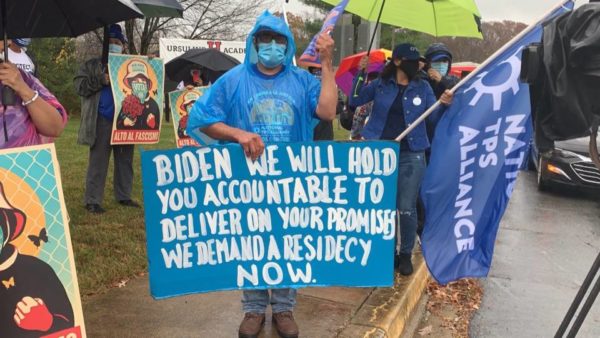
Biden Extends TPS for Venezuelans, Keeps Blocking Asylum Seekers at US Border
HAVANA TIMES – In immigration news, the Biden administration has extended temporary protected status, TPS, for Venezuelans for another 18 months. This designation only protects Venezuelans who’ve been in the United States since March 2021; Venezuelan asylum seekers who’ve come to the U.S. after March 8, 2021, are not eligible for the temporary humanitarian relief and face deportation. Tens of thousands of Venezuelans have fled due to rising shortages of food and medicine, and other conditions that have been largely exacerbated by harsh U.S. sanctions on Venezuela. This comes as the Biden administration also continues to mass expel thousands of asylum seekers from Haiti, Central America and other regions arriving at the U.S.-Mexico border under the Trump-era pandemic policy Title 42.