Thursday, August 18, 2022

CRIMINAL CAPITALI$M
Investment Bank Behind 32,000% IPO Probed by Hong Kong Regulator

Cathy Chan and Kiuyan Wong
Wed, August 17, 2022

LONG READ


(Bloomberg) -- The Hong Kong financial group behind an initial public offering that stunned Wall Street by soaring more than 32,000% following its debut has drawn regulatory scrutiny over deals it arranged in the Asian financial hub.

The previously unreported probe by Hong Kong’s securities watchdog into AMTD Group Co., which is run by former UBS Group AG banker Calvin Choi, predates the US listing of its unit AMTD Digital Inc. Despite reporting just $25 million of revenue in the year ending in April 2021, AMTD Digital’s market capitalization briefly surged above $400 billion in early August -- surpassing giants including Goldman Sachs Group Inc. and JPMorgan Chase & Co. The stock has since tumbled more than 90%.

Hong Kong’s Securities and Futures Commission searched AMTD Group’s office and Choi’s home in February 2021, according to people familiar with the matter, who asked not to be named discussing private information. Investigators were looking into its underwriting arrangements as recently as November, one of the people said. The full scope of the inquiry and its current status are unclear. Some SFC probes never result in charges and those that do can often take years to become public.

The regulator’s scrutiny adds to a string of controversies in recent years involving Choi, who is appealing a separate SFC decision to ban him from the securities industry for two years over what the regulator said were conflicts of interest from his time as a UBS dealmaker. A unit of China Minsheng Investment Group, which bought a major stake in AMTD Group in 2015, publicly accused Choi of financial fraud, even putting up posters with his face on the streets of Hong Kong, according to a 2020 Caixin report. It’s unclear whether CMIG took any further legal steps.

Choi, who didn’t respond to repeated phone calls and text messages, has appealed the SFC ruling and a tribunal will hear the case in December. In September 2020 he told newspaper Tai Kung Pao that the allegations from CMIG were untrue and he had never had any authority over CMIG funds.

An SFC spokesman declined to comment. An official at CMIG declined to comment. AMTD Digital didn’t immediately respond to requests for comment.

The financier’s firm is one of at least seven from Hong Kong or mainland China to see wild price swings after listing in the US this year. US Securities and Exchange Commission Chair Gary Gensler has repeatedly warned about the risks of investing in Chinese companies and last week said the regulator pays close attention to wild market moves, without specifically mentioning any firms.

The SFC probe has focused at least partly on small-cap IPOs that were underwritten by a unit of AMTD Group, the same one that arranged the US listing of AMTD Digital, people familiar with the matter said. Deals scrutinized by the SFC include IPOs of IntelliCentrics Global Holdings Ltd. and China Bright Culture Group, the people said.

Investment Avenues


The Hong Kong stock exchange in June 2021 sanctioned two executives at IntelliCentrics Global after the company used more than 90% of the proceeds from its 2019 IPO to buy offshore promissory notes via AMTD. The bourse noted that the company has said its purchase “was a temporary and interim measure” to manage IPO proceeds. Even so, the exchange found that the firm and two executive directors had breached its rules.

China Bright Culture Group, a television producer, invested $70.8 million -- or 60% of the amount raised selling shares in Hong Kong -- in a promissory note issued by L.R. Capital Property Investment Ltd., according to its 2021 annual report. The full amount was later redeemed.

L.R. Capital Property shares the same Cayman Islands address -- and company secretary -- as L.R. Capital Management Co., in which Choi’s father held a stake until December 2021, according to filings with corporate registries in the British territory and Hong Kong. The latter company, a former majority owner of AMTD Group, played a part in the decision by the SFC to ban Choi, according to a ruling by the Securities and Future Appeals Tribunal in Hong Kong.

According to people with knowledge of how AMTD arranged deals, the firm worked with select investors to cover shortfalls in demand for IPOs. After the IPO, the newly listed company would invest similar amounts into wealth products managed by firms linked to AMTD, the people said.

If shares of the newly listed company rose after the IPO, the investors would sell and share the profit with the listed company, the people said. The IPO issuer would then redeem its investments in AMTD-linked wealth products, the people said. The issuer also agreed to cover any potential losses suffered by the select investors in the IPO, the people added.

Documents seen by Bloomberg News show close ties between some of the investors. Three companies that invested in one recent IPO underwritten by AMTD, for example, shared the same company secretary and two of them are registered on the same Hong Kong address, the documents show.

“Any kind of manipulation that is obscuring the nature of the cash flow or the nature of the company is a form of market manipulation that regulators are, or should be, watching out for,” said Veronique Lafon-Vinais, associate professor of business education at Hong Kong University of Science and Technology, speaking in general.

Without prior consent from regulators, listing rules in Hong Kong prohibit underwriters from allocating IPO shares to “connected clients,” or nominee companies unless the name of the ultimate beneficiary is disclosed, according to the placing guidelines.

AMTD Group has helped arrange at least 62 IPOs in Hong Kong and the US, including those of Ebang International Holdings Inc. and Molecular Data Inc., which together raised close to $200 million in New York in 2020.

In an April 2021 report, short seller Hindenburg Research alleged that both firms had diverted a majority of the funds raised into bonds issued by companies linked to AMTD.

In a statement last year, Ebang said that as part of its treasury management it had invested proceeds in bonds in “arm’s length transactions facilitated by AMTD,” and has redeemed the investment in full. Molecular Data invested $58.4 million in wealth management products issued by L.R. Capital Property, according to a company filing. The firm served notice for full redemption of the note at the end of 2021.

Intellicentrics, China Bright Future, Ebang and Molecular Data didn’t respond to emails seeking comment.

Connected Companies

Hong Kong’s market has long been plagued by allegations of transactions between closely connected companies. In 2018, the SFC’s enforcement chief accused a “nefarious network” of listed companies, brokers, money lenders and advisers of enriching themselves off unsuspecting investors. The regulator has since clamped down on the small-cap market, known as GEM, to root out the extreme price swings caused by so-called “ramp-and-dump” schemes that inflated the value of thinly traded companies.

Similarly extreme gyrations are now confounding US investors. AMTD Digital shares surged at one point to as high as $2,555.30 from its $7.80 IPO price, before falling to $186.93 on Wednesday. Another affiliate, AMTD Idea Group, climbed as much as 536% in New York. A little know financial services company, Magic Empire Global Ltd. -- unaffiliated with AMTD -- jumped as much as 2,825% following its debut on Aug. 6 before tumbling again. Other Chinese or Hong Kong-based firms have also seen big swings after listing in New York.

AMTD Group was founded in 2003 by Commonwealth Bank of Australia and billionaire Li Ka-shing’s CK Hutchison Holdings Ltd. Morgan Stanley’s private equity unit is also an investor, though it has pared back in recent years.

Choi took the helm after leaving UBS in 2015 with the backing of China Minsheng, which then held an effective 25% stake in AMTD Group. Choi’s mandate was to diversify away from insurance brokering to investment banking, asset management and financial technology. The US-listed AMTD Idea calls itself Asia’s largest independent investment bank and has boasted of “unparalleled access” to capital from Hong Kong tycoons and a “SpiderNet” of business contacts.

Choi is now the sole owner of a vehicle that controls 32.5% of AMTD Group, according to a filing. L.R. Capital, which Choi was linked to in the SFC probe, was a majority owner but sold its shares in 2021. AMTD Group owns 50.6% of AMTD Idea, which on Aug. 16 said it would inject $500 million in assets into AMTD Digital to bring its ownership to 87.64%.

A Hong Kong native and Canadian citizen, Choi has been a fixture at annual financial technology events in Singapore in recent years. In 2019, he joined former Hong Kong Chief Executive Carrie Lam on a foreign trip to Thailand and Malaysia, but a bid last year to join the 1,500-person electorate that picks the city’s leader was rejected by a vetting committee.

In the ban on Choi issued in January, the SFC said he failed to disclose his connection to L.R. Capital, which was an integral part of deals he was working on at UBS in 2014 and 2015.

In a statement last year, the financier hit back at critics, without mentioning any specifics. “There are those who envy and [are] jealous, and those who are cold-eyed and mockers, and malicious, there are slanderers,” he said. “However, entrepreneurs must insist that development is the last word.”

Some of AMTD’s most high-profile backers are now distancing themselves from the firm. Li’s CK Group plans to sell its remaining stake in AMTD Group, it said earlier this month. CK Group said it held less than 4% of AMTD Group and isn’t invested directly in AMTD Digital.

Morgan Stanley’s private equity unit, which bought a stake in AMTD Group in 2014, later sold most of its holding. It has no involvement in daily operations and is looking to exit the remaining 1.7% it still holds, a person familiar with the matter said.

Media representatives at Morgan Stanley and CK Group declined to comment.
China Is Ramping Up Swiss Gold Imports, Signaling Better Demand
TICKLING THE GNOMES OF ZURICH'S BEARDS

Eddie Spence and Ranjeetha Pakiam
Thu, August 18, 2022 


(Bloomberg) -- China’s gold imports from the major refining hub of Switzerland jumped to the highest in more than five years, signaling demand improved as the Asian nation relaxed strict Covid measures.

One of the world’s top bullion buyers, China shipped in more than 80 tons from Switzerland in July, according to Swiss Federal Customs Administration. That’s more than double the previous month and eight times more than in May.

The data indicates that Chinese gold demand is picking up, after being hurt by lockdowns to control Covid outbreaks in several major cities. While the country’s purchases rarely have the power to drive prices higher, they can provide a floor when Western investors sell.

“China has gone from a situation where everything was closed to things are back to semi-normality,” said Nikos Kavalis, a managing director at consultancy Metals Focus Ltd. “The market’s still not great, but it’s definitely a lot better than it was in April.”

Gold prices remain down for the year, after nearing a record high in March as Russia’s invasion of Ukraine stoked demand for a haven. Prices have been supported between about $1,700 and $1,800 an ounce, even as the Federal Reserve embarks on aggressive interest-rate hikes that normally reduce the metal’s appeal.

Gold in China has also fetched a premium of about $7 to international prices, a relative high level that will have spurred local banks to import bullion, according to Kavalis. Only lenders with state-issued licenses are permitted to bring gold into China.
Flotilla of Diesel Ships Heads to Europe Amid Energy Crisis

Elizabeth Low
Thu, August 18, 2022


(Bloomberg) -- A fleet of ships carrying diesel, one of the world’s most important fuels, is heading for European markets facing energy-security threats from high temperatures, soaring gas prices, and Russian disruption.

Five ships transporting close to 3 million barrels are poised to move from Asia to Europe so far in August, preliminary data from Vortexa show. That’s the most in five months on a barrel-per-day basis. Shipments from the Middle East to Europe are also set to expand.

The rising flows of diesel -- used in industries, transport and for power -- toward Europe are a result of market dislocations caused by higher prices at the hub of Amsterdam, Rotterdam and Antwerp (ARA) relative to Asia, said traders. China’s sputtering economy and a seasonal demand lull in India also contributed to Asia’s oversupply, they added.

Europe has been struggling with a historic drought that’s causing a plunge in water levels on the Rhine River. The waterway that links oil tanks in the ARA hub to consumers in inland Europe is currently impassable to most barges, creating a supply bottleneck that could prompt draw-downs in their stockpiles that will need to be replenished ahead of winter.

Countries including Sweden and Germany have warned of rising oil consumption in a bid to replace pricey gas, while the region has been purchasing more coal from across the world. It’s still unclear, however, just how strongly Europe’s demand will rebound this year-end due to a slowdown in the region’s economy.

East-to-West Arbitrage

Diesel that will load from India and North Asia in August takes close to a month to reach Europe, arriving at its destination just as summer comes to an end. Some of the vessels on the so-called arbitrage route to Europe include larger vessels such as Suezmaxes that can carry up to 1 million barrels of oil.

“Traders are taking opportunity of the economies of scale to make the East-West arbitrage workable by loading their cargoes onto these larger tankers,” said Serena Huang, lead Asia analyst for Vortexa.

Gas-to-oil switching is forecast to surge this year, with the International Energy Agency boosting its forecast for global oil demand growth by 380,000 barrels daily on the expectation that industry and power generators will switch fuels. The extra demand that prompted the revision is “overwhelmingly concentrated” in the Middle East and Europe, the agency said. Its bullish view was echoed by Goldman Sachs Group Inc.

Additionally, the risk of Russian gas-supply disruptions and concerns over energy security are set to encourage more diesel stockpiling. Europe’s benchmark for gas has nearly tripled this year, soaring way beyond the 18% climb in oil prices during the same period.

Meanwhile, Asian refineries are expected to churn out 215,000 barrels a day more diesel than the region requires, while supplies from the Middle East also rise, according to JY Lim, an analyst at S&P Global Commodity Insights.

New refinery capacity in the Middle East “mean a change in the east of Suez gasoil supply/demand balance, meaning that the structural arbitrage may be open more often and for longer,” said Kevin Wright, an analyst at Kpler. Diesel flows from Asia to Europe are likely to rise during the rest of the third quarter, he said.
Omers Posts 0.4% Loss as Equity Markets Sap PE Gains

Layan Odeh
Thu, August 18, 2022 


(Bloomberg) -- The Ontario Municipal Employees Retirement System posted a 0.4% loss for the first six months of 2022 as a decline in public stocks exceeded the pension fund’s private equity gains.


“The geopolitical environment was incredibly, not only unpredictable, but tragic in so many ways,” Omers Chief Executive Officer Blake Hutcheson said in an interview Thursday. “We have inflation that’s today higher than it’s been in 40 years. Central banks are raising rates quicker than they have since any time since 1994.”

The fund’s public stock holdings dropped 13.2% and the bond portfolio slid 2.5%, it said in a statement, while private equity investments gained 7.7%.


Omers is a net-seller so far this year as the firm realized investments in private equity, infrastructure and real estate -- including selling its interests in GNL Quintero SA, a liquid natural gas terminal in Chile, and in Sony Center in Berlin. The Toronto-based pension plan has also agreed to sell its interest in the holding company that controls Michigan-based Midland Cogeneration Venture.

“Over the last year, we were actually expecting some downturns and making sure we were armed for the next wave of investment opportunities,” Hutcheson said.

Fear of a recession has weighed on deal-making and initial public offerings, crunching valuations and restricting the ability of private equity firms to exit investments. Omers has a strong war chest available to purchase high quality assets, according to Hutcheson. “We will be able to continue to buy in this cycle but very selectively -- very high quality assets, very much on target with strategy.”

The pension fund’s net assets decreased to C$119.5 billion ($92.3 billion).

Montreal-based Caisse de Depot et Placement du Quebec reported a 7.9% loss in the first six months of the year, while Canada Pension Plan Investment Board, the country’s largest pension fund, posted a negative 4.2% return in its fiscal first quarter. Ontario Teachers’ Pension Plan said this week it had a 1.2% net return in the first six months of the year.
Oil companies work around Jones Act to supply U.S. fuel markets


 Oil tankers are docked at the port of Tuxpan


By Laura Sanicola
Wed, August 17, 2022

(Reuters) - U.S. oil companies are working around a century-old shipping law to supply fuel to the U.S. East Coast, according to data from Refinitiv and oil trading sources, as high demand for gasoline and global disruptions in fuel markets sent prices higher.

Traders are increasingly sending unfinished gasoline components from the Gulf Coast to Buckeye Partners LP’s terminal in the Bahamas, also known as Borco, where they are blended into finished gasoline to be sent to the U.S. East Coast. The uncommon trade is a sign of heavy demand for products up and down the coast, home of some of the nation's largest consumer markets.

The trade represents a legal workaround to the Jones Act, which requires goods moved between U.S. ports to be carried by ships built domestically and staffed by U.S. crew.

There is a limited quantity of those vessels, which raises the cost of those shipments.

Since March, at least eight vessels have transported gasoline components from the Gulf Coast to the Borco terminal in the Bahamas, and then delivered finished gasoline from there to ports along the Atlantic, according to shipping data.

The majority of the vessels were chartered by BP Plc. BP declined to comment.

Normally, Gulf Coast sellers make bigger profits either by exporting products, or by sending gasoline or diesel to the East Coast by way of the Houston-to-New Jersey Colonial Pipeline, which carries roughly 2.5 million barrels per day of gasoline and other fuels.

That line is jammed right now as U.S. East Coast refineries struggle to meet demand. Those refiners are running at more than 98% capacity, according to the U.S. Energy Information Administration.

Shippers submit requests to Colonial to move refined products on Colonial, but right now those requests exceed the line's overall capacity. Space on the line is more expensive than in years, traders said, making it suddenly profitable to transport goods with the Bahamas stop.

This trade does not run afoul of the Jones Act, but it was uncommon before Russia's invasion of Ukraine, and did not occur in 2021, according to available shipping data.

In 2021, the United States exported 146,000 barrels of gasoline components in total to the Bahamas, according to the EIA. In May 2022 alone, the most recent data available, that figure was 498,000 barrels.

Last year, the United States imported 699,000 barrels of finished gasoline from the Bahamas, or 1.8% of all imports of that product for the year. So far in 2022, the United States has already imported 1.2 million barrels of gasoline from the Bahamas.

In March, the Agean Star and Gulf Rastaq loaded fuel components in Houston, discharged at Borco and later supplied finished gasoline to Savannah, Georgia, and Jacksonville, Florida, according to shipping data.

The Nave Luminocity and Navig8 Success vessels loaded gasoline components in the Gulf, discharged at Borco and then transported finished gasoline to New Jersey and New York, shipping data showed. Several more ships made similar voyages through the summer.

(Reporting by Laura Sanicola in New York; Editing by Matthew Lewis)
Starbucks Must Offer to Rehire Fired Activists, Judge Rules

Josh Eidelson
Thu, August 18, 2022 


(Bloomberg) -- Starbucks Corp. has to offer reinstatement to seven fired pro-union employees in Memphis, Tennessee, and must not retaliate against employees who support union organizing, a federal judge ruled.

The firings appear to be illegal in light of evidence the company acted in a discriminatory manner, US District Judge Sheryl Lipman said in an order Thursday.

The decision is a victory for the US National Labor Relations Board, which has been confronting an alleged crackdown by Starbucks on a nationwide unionization push by its workers.

The union Starbucks Workers United has prevailed in elections this year at over 200 of the chain’s roughly 9,000 corporate-run US stores, which were all union-free until the labor group’s first victory last December. NLRB regional directors around the country have issued more than 20 pending complaints against the company.

Starbucks, which has denied wrongdoing, said it planned to appeal and would ask that the ruling be put on hold in the meantime. “Interest in a union does not exempt partners from following policies that are in place to protect partners, our customers and the communities we serve,” the company said in a statement.

The company has said that the Memphis employees weren’t punished for their involvement with the union or for talking to the media, but rather because they let off-duty staff and non-employees, including journalists, into their store when it was closed, and violated numerous safety rules.

The fired employees, who call themselves the “Memphis Seven,” are the most prominent among dozens of workers across the country who the union argues were fired for organizing. Since being terminated, the Memphis employees have taken part in protests in Tennessee and in Starbucks’ Seattle hometown, spoken at the South by Southwest festival, met with lawmakers, and worked to organize fellow baristas.

Read More: Howard Schultz Returns to an Unstoppable Union Wave at Starbucks

“We’re beyond thankful the federal court ruled in our favor, and this just goes to show that Starbucks will do everything in their power to silence us,” Nabretta Hardin, one of the fired pro-union employees in Memphis.

US labor law prohibits companies from retaliating against workers for taking collective action to improve their working conditions, including union organizing.

But the labor board, which prosecutes alleged violations of that law, has no authority to make companies pay punitive damages. Disputes over alleged retaliatory firings can drag on for years, hampering organizing efforts even if the employee eventually prevails.

NLRB regional offices investigate claims. If they find merit in the claims and can’t reach a settlement, the offices issue complaints which are then considered by agency judges.

The judges’ rulings can be appealed to NLRB members in Washington and from there to federal court. The NLRB’s top prosecutor, Joe Biden appointee Jennifer Abruzzo, has said she plans to “aggressively” seek federal court injunctions to get wrongly fired employees back to work more quickly.

Abruzzo, the agency’s general counsel, called Thursday’s ruling a “crucial step” in protecting employee rights.

“Starbucks, and other employers, should take note that the NLRB will continue to vigorously protect workers’ right to organize without interference from their employer,” she said in an emailed statement.

In a June filing, Starbucks argued there was no need for an injunction because the evidence showed the firings had not actually hurt the union organizing efforts. Instead, the company wrote, “the discharges emboldened union organizing activities in Memphis and throughout the nation.”

Starbucks Illegally Threatened Seattle Workers, Labor Board Claims

Josh Eidelson
Wed, August 17, 2022 


(Bloomberg) -- Starbucks Corp. illegally threatened employees in cities including its Seattle hometown, US labor-board prosecutors alleged in a Tuesday complaint.

A National Labor Relations Board regional director claims that letters issued by the company to staff at 10 stores in Washington state and Oregon violated federal law. Employees were told that when workers unionize, “negotiations can often take more than a year -- if a contract is reached at all,” and that in the meantime “benefits and wages will essentially be frozen,” according to the complaint.

By issuing that message, the company “has been interfering with, restraining, and coercing employees in the exercise of the rights” guaranteed by labor law, the regional director wrote.

Starbucks denied wrongdoing. “We want our partners to be informed and have all the facts when making their decision and have followed NLRB rules to ensure they have what they need to make the best decision for themselves,” spokesperson Reggie Borges said in an email. “Claims of anti-union activity are categorically false.”

NLRB regional directors around the country have issued more than 20 complaints against Starbucks on behalf of the agency’s general counsel. In another Tuesday filing, the labor board’s Chicago regional director accused the company of violating the law by prohibiting pro-union face masks and T-shirts, interrogating staff, telling employees unionization would be futile, and threatening them with the loss of raises and benefits if they organized.

Potential Appeals

Absent a settlement, such complaints are heard by agency judges, whose rulings can be appealed to labor-board members in Washington, D.C., and from there into federal court. The agency has the authority to order changes to company policies, but not to make employers pay punitive damages for violations.

“The NLRB may have issued this complaint in Seattle, but workers across the country have been getting similar letters from Starbucks,” Arizona Starbucks employee Michelle Hejduk said in an emailed statement from the union, Starbucks Workers United. “This complaint just scratches the surface of the threats Starbucks has made to workers in their anti-union leaflets nationwide.”

Freezing benefits during contract talks has been a flashpoint in the nationwide struggle between the company and the union, which has prevailed this year in elections at over 200 of the chain’s roughly 9,000 corporate-run US cafes.

In May, Starbucks announced a suite of new raises and benefits taking effect this month, but said those improvements wouldn’t apply to sites that unionized. The union has argued that withholding the new perks is an intimidation tactic.

On its website, the company says, “The law is clear: once a store unionizes, no changes to benefits are allowed without good faith collective bargaining.”

ANTI-UNION REORGANIZATION
Starbucks COO to Depart, Role to Be Eliminated in Overhaul

Daniela Sirtori-Cortina
Thu, 18 August 2022 


(Bloomberg) -- Starbucks Corp. Chief Operating Officer John Culver will leave the company as the coffee chain undergoes a broader leadership overhaul.

Culver will step down from his current role on Oct. 3 and serve as an executive adviser before departing the company at the end of 2022. Starbucks will eliminate the COO role, with day-to-day business operations now reporting to the chief executive officer. Frank Britt, chief strategy and transformation officer, will oversee some additional functions.

“Our reinvention requires us to rethink our leadership structure to create every opportunity for our new CEO and, most importantly, to accelerate delivery of modernized and elevated experiences,” CEO Howard Schultz said in a letter to employees about Culver’s departure.

In a separate letter, Culver said that George Dowdie, Starbucks’s global supply-chain chief, also plans to leave the company.

Schultz returned to Starbucks as interim CEO this year after the departure of predecessor Kevin Johnson in April. He has moved quickly to put his stamp on the company in his third stint at the helm, even as Starbucks seeks a new permanent CEO whom it plans to name in the fall. He dismissed former General Counsel Rachel Gonzalez and blasted past management for “false promises” in an April message to employees.

CNBC earlier reported the COO news.
China's Geely Auto grows EV ambition as fossil fuel vehicle demand sinks

Wed, August 17, 2022 

The Geely Automobile Holdings logo is pictured at the Auto China 2016 auto show in Beijing

SHANGHAI (Reuters) -China's Geely Automobile Holdings Ltd aims to increase the proportion of electric vehicles (EVs) in its total sales to 50% in 2023, as it accelerates a transition to electric power amid weakening demand for petrol-driven cars.

Sales of pure electric and plug-in hybrids will already account for more than 30% of Geely's monthly sales in the second half of this year, Chief Executive Jerry Gan told reporters in an online event on Thursday.

One out of five vehicles Geely sold in the first half were full electric or hybrid, sales of which increased nearly four fold, compared with a 20% slump in sales of vehicles with combustion engines, according to the company.

Hangzhou-based Geely, China's highest-profile automaker globally due to the group's investments in Volvo Cars and Mercedes-Benz, posted a 35% fall in first-half net profit.

The company said its vehicle sales, which fell 9% in the first half in China, were below management expectations, citing COVID-19 curbs and shortages of semiconductors.

Those challenges along with intensifying competition and rising raw material and battery costs would put pressure on sales through the end of 2022, it said.

China's auto sector has been hit hard by government efforts to combat COVID-19, with many areas including the commercial hub of Shanghai under lockdowns of varying lengths.

Authorities have tried incentives to revive demand, and the central government has halved purchase tax to 5% for cars priced at less than 300,000 yuan ($45,000) and with engines no larger than 2.0 litres.

Geely posted a 29% rise in six-month revenue though June to 58.18 billion yuan, thanks to better product pricing and product mix which offset the sales declines.

Geely is also seeking to expand further into Southeast Asia and Europe. Its exports increased 64% in the first half and accounted for 18% of total sales.

Geely said previously its total annual vehicle sales including EV brands Zeekr and Geometry would hit 3.65 million units by 2025, with more than 30% of them electrified.

($1 = 6.7883 Chinese yuan renminbi)

(Reporting by Zhang Yan and Brenda Goh; Editing by Stephen Coates and David Holmes)

Electric car boom stresses public charging infrastructure, J.D. Power study finds

EV owners rank Level 2 and DC Fast Charger networks

Automakers are cranking out new EV models at lightning speed, but a recent J.D. Power study shows that the public charging infrastructure has a long way to go to catch up. The organization found that EV owners in high-volume areas struggle with finding a working charger and noted that overall satisfaction with EV purchases depends on where the buyer lives. The organization polled 11,554 owners for the 2022 study between January and June 2022.

J.D. Power points out that there are more Level 2 charging stations in operation than ever, but people are less satisfied with them. The study used a 1,000-point scale to judge satisfaction and found that sentiment around Level 2 chargers dropped 10 points to 633 in 2022.  Satisfaction with DC fast chargers has not changed since last year, remaining steady at 674 points.

Read more: What do Level 1, Level 2 and DC fast charging (Level 3) mean?

Most people are fine with the ease of charging. J.D. Power scored satisfaction with the ease of charging at 699 for Level 2 chargers and 745 for DC fast chargers. As the organization notes, this shows that most people understand how to use EV chargers and can use them without significant difficulty. On the flip side of the satisfaction coin, ratings for the cost of charging are much lower, at 446 for Level 2 and 473 for DC fast charging.

Unsurprisingly, maintenance and operability play significant roles in EV owners’ satisfaction. Being able to use a charger is just as important as there being a charger in the first place. The study found that 20% of owners did not charge during recent visits to a station, and notes that of those people, 72% indicated that it was because the charger wasn’t working correctly. In terms of charging station companies, Tesla Destination chargers led the way with a score of 680. Volta came in second and ChargePoint third. 

Read more: EV charging guide | What to know when buying an electric car

Owners also tend to have different experiences depending on where they live. States like California and others in the Pacific region offer more extensive infrastructure, so the ownership experience is better than in a state like Montana, where there are far fewer chargers. Interestingly, owner satisfaction was highest in the west-north-central area, which includes Iowa, Kansas, Minnesota, Missouri, and others. 

J.D. Power measures satisfaction with Level 2 and DC fast charging stations across 10 areas: 

Ease of charging
Speed of charging
Ease of payment
Ease of finding this location
Convenience of this location
Things to do while charging
How safe you feel at this location
Availability of chargers
Physical condition of charging station


Discovery of 12 Inuvialuit gravesites in Edmonton brings closure for families marked by TB epidemic

Liny Lamberink - 18h ago

A woman from Inuvik, N.W.T., says finding and marking the grave of her long lost brother, who died as a baby during the tuberculosis epidemic, feels like closure to her.


© Submitted by Peggy Day
Peggy Day said her brother, Ricky Don Kayotuk, became sick and was sent from Reindeer Station to Inuvik, and then to Charles Camsell Hospital in Edmonton where he died at 10 months old in 1961. He is one of 12 Inuvialuit beneficiaries whose burial site was found recently by the Nanilavut Iniative.

Peggy Day said Ricky Don Kayotuk would have been an older brother to her if he hadn't passed away at 10 months old at Charles Camsell Hospital in Edmonton, where he'd been sent after becoming sick.

His grave is one of 12 recently found in the Edmonton area by the Nanilavut Initiative, which searches for Inuit who were separated from their families and who died during the epidemic from the 1940s to the 1960s.

"All I can think of is my mother, and how empty her arms must have felt," said Day, talking about what little she knows of her brother's short life. Her mother, who has since died, told her he became sick when he was just nine months old, in 1961.

Day said he was sent from Reindeer Station, N.W.T., to Inuvik for treatment, and then eventually on to Charles Camsell Hospital. She said he died of pneumonia and her family never knew where he was buried.

Until now.

Triggered by a separate investigation of unmarked graves at the hospital, Day's family contacted the Nanilavut Initiative last year in search of her brother's burial site. No unmarked graves were found at Charles Camsell, but this spring Day got the news from Beverly Lennie, who is leading the Nanilavut Initiative in the Inuvialuit Settlement Region, that her brother had been found at a cemetery in St. Albert.

"She gave me his death certificate, and I was like 'no way, no way."

That moment brought up more emotion for Day than she expected, and she recalled telling her husband she hadn't expected to cry so much for a brother she never met. Day is among family members who are now in the Edmonton area to commemorate the 12 Inuvialuit beneficiaries the initiative says it has found so far.
 
The Nanilavut Initiative

The Nanilavut Initiative — a collaboration between the federal government, the Inuvialuit Regional Corporation (IRC) and Inuit Tapiriit Kanatami — is working in five different regions in Canada to find Inuit who died during the tuberculosis epidemic.

Tuberculosis is a contagious and potentially deadly lung disease that is preventable and curable now — but in the past, reached epidemic proportions. It peaked among Inuit between the 1940s and 1960s, and the Government of Canada says one third of Inuit were infected with it in the 1950s.

Many of those Inuit were sent away from their home communities to medical facilities for treatment. Although some returned home, others did not. Their bodies were buried near the facilities, and their loved ones were never informed of their fate.

The IRC is hosting a grave marking commemoration ceremony Thursday in Fort Edmonton Park at 1 p.m. The corporation is also planning a remembrance journey the following morning that will travel to, and lay wreaths at, each of the five burial sites in the Edmonton area.


In a statement from the Nanilavut Initiative, Duane Smith, IRC's CEO and chair, said the corporation's goal is to give each Inuvialuit family closure and to pay respect to their lost loved ones.

"Too much time has passed without proper answers or commemoration," he said.

A place to go remember

One of the graves belongs to James Harry's brother, Philip.

The 50-year-old man from Sachs Harbour, N.W.T., said his sibling died somewhere in Edmonton at about two years old. His mother, unlike Day's, now has the chance to say goodbye to her lost son.

"She's a mother, she's probably been carrying it around her whole life that her son passed away," said Harry. "At least now we have a place where … we can go."

Harry said his mom and brother both travelled to Edmonton for the commemorative events.

"We're feeling it mostly for our mom because we didn't meet our brother. All we did was hear about him and then, you know, feelings come along with it when mom tells us."
As the biggest airlines return to profits, unions demand ending stock buybacks

Unions representing thousands of airline employees called on the executives of the major carriers to hold off on reimplementing stock buybacks until operations have improved and labor contracts have been ratified.


By Holden Wilen – Staff Writer, Dallas Business Journal
Aug 18, 2022 

A group of labor unions representing airline workers has launched a campaign demanding the big four carriers improve their operations and agree to new collective bargaining agreements before reimplementing stock buybacks and dividends.

The airline industry received $54 billion in federal Covid-19 pandemic aid across three funding rounds to help cover labor costs. As a condition for receiving the funding, Congress prohibited the carriers — including Fort Worth-based American Airlines Group Inc. and Dallas-based Southwest Airlines Co. — from distributing dividends or buying back stock. Those restrictions will end on Sept. 30.

All four of the major airlines have returned to profitability. Delta Air Lines (NYSE: DAL) has been profitable for the last 12 months. American (NASDAQ: AAL) and Southwest (NYSE: LUV) both reported record revenue in the second quarter, in addition to quarterly profits. United Airlines (NASDAQ: UAL) also swung to a profit while posting its highest revenue in at least a decade.

Despite the positive financial numbers, the airline industry has struggled with a high number of cancellations as travel demand has recovered at a higher and quicker level than anticipated. U.S. airlines have already canceled more flights in the first half of 2022 than they did all of last year, according to the unions. The airlines and many of the unions are also engaged in negotiations that have at times become tense.

The airlines should focus on stabilization and people before putting money into the pockets of Wall Street investors, union executives said. Unions participating in the campaign include the Association of Flight Attendants-CWA, the Air Line Pilots Association, the Association of Professional Flight Attendants, Communications Workers of America, the International Association of Machinists and Aerospace Workers, the International Brotherhood of Teamsters, the Transport Workers Union of America and the Service Employees International Union.

APFA President Julie Hedrick called the current time a "critical moment" in the airline industry's recovery and said stock buybacks would "add insult to injury" for employees. APFA represents more than 28,000 American Airlines flight attendants.

"Our airlines are returning to profitability, and there is potential to keep growing in that direction," Hedrick said in a statement. "But growth will not happen without proper investment...When we invest in ways that make our passengers excited to return to the sky, stock prices will follow."

United, Southwest, American, and Delta spent more than $39 billion combined on stock buybacks from 2014 to 2019, according to the unions. The companies should not be allowed to restart stock buybacks until they end "operational chaos" by better aligning staffing and scheduling to meet demand and conclude labor contract negotiations.

"We paused the greed in aviation for a little while with legislative constraints tied to Covid relief,” Sara Nelson, president of the Association of Flight Attendants-CWA, said in a statement. "But the greed that ran rampant before Covid created a system that was already stretched thin with minimum staffing and high overtime hours. We can’t allow executives to send one dime to Wall Street before they fix operational issues and conclude contract negotiations that will ensure pay and benefits keep and attract people to aviation jobs."

United Airlines responded to the campaign, saying in a statement it remains focused on making financial investments to improve the company.

"Our highest financial priorities right now are restoring our balance sheet and investing in our employees and customers – most importantly by executing on our United Next plan which includes taking delivery of nearly 300 new aircraft over the next several years.“

Matt Miller, a spokesman for American, said the company has no plans for share repurchases as it looks to use capital to pay down debt.

"Our goal is to use any excess liquidity to pay off debt, as evidenced by our $15 billion debt reduction commitment, of which $5.2 billion has been actioned over the past 12 months," Miller said.

A spokesperson for Delta said the company plans to reinvest $6 billion in the business. The company increased base pay for its employees by 4% and provided profit-sharing payouts last year.

"Delta’s top financial priority is restoring its financial foundation by generating sustained and meaningful profitability and cash flow to support debt reduction and reinvestment in the business," spokesman Morgan Durrant said.

Southwest could not immediately be reached.

Southwest CEO Bob Jordan said at the company's annual meeting of shareholders in May that the company hopes to bring back dividends in 2023.

John Samuelson, president of the TWU, said any airline that chooses to buy back stock instead of investing in its workforce would be "not only irresponsible but untrustworthy."

"Airline CEOs need to know that the public is watching and that we won’t stand for their greed," he said.
ZIONIST FASCISM
Israel to provide information to U.S. on basis for NGO closures -State Dept

Reuters


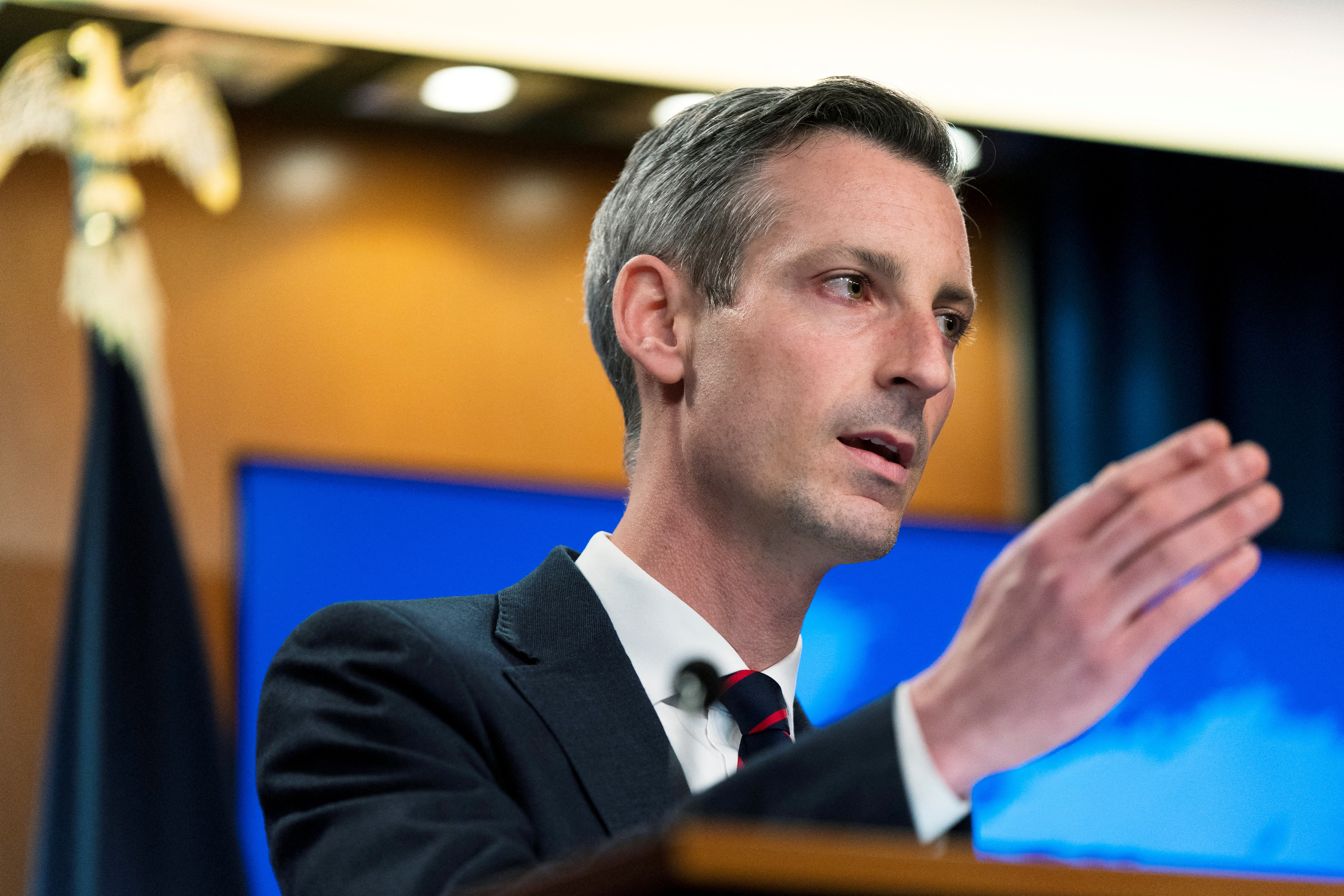
U.S. State Department spokesperson Ned Price speaks during a news conference in Washington, U.S.  Manuel Balce Ceneta/Pool via REUTERS

WASHINGTON, Aug 18 (Reuters) - Israel has said it will provide additional information to the United States on the basis for the closure of Palestinian nongovernmental organizations on Thursday, U.S. State Department spokesperson Ned Price said while expressing concern over the closures of civil society groups.

Washington contacted Israeli officials, including at high levels, for more information, Price said at a regular news briefing, after security forces raided the offices of seven groups in the Israeli-occupied West Bank it accuses of channeling aid to militant groups. read more

"We will review what is provided to us and come to our own conclusion," Price said.

The United Nations condemned the closures and said there was no credible evidence to support the Israeli accusations.

"Despite offers to do so, Israeli authorities have not presented to the United Nations any credible evidence to justify these declarations," the U.N. Human Rights Office said in a statement. "As such, the closures appear totally arbitrary."

The United Nations identified the groups as the Addameer Prisoner Support and Human Rights Association; Al Haq; Bisan Center for Research and Development; Defense for Children International – Palestine; Health Work Committees (HWC); Union of Agricultural Work Committees (UAWC); the Union of Palestinian Women's Committees (UPWC).

Nine European Union countries have said they will continue working with the groups, citing a lack of evidence for the Israeli accusation. read more