Thursday, August 18, 2022

Reversing oil and gas rules threatens the health of Permian families


Kayley Shoup
Thu, August 18, 2022 a

New Mexico’s groundbreaking rules to improve air quality by limiting air pollution from the oil and gas industry just took effect this month and already the Independent Petroleum Association of New Mexico (IPANM) has launched a legal attack against them.

Make no mistake – this legal wrangling and foot dragging from IPANM is not only bad for our air, it also wastes time and money that producers should be using to cut pollution. It is also a direct threat to the health of families in the Permian Basin because it could allow oil and gas operators to walk away from their responsibility to clean up after themselves and reduce the impacts on their workers, neighboring communities and all New Mexicans.

When the American Lung Association’s 2021 State of the Air Report gave failing grades for ozone pollution to New Mexico’s Eddy, Lea and San Juan Counties, it was a wake-up call about the need for strong state regulations to tackle air pollution from the oil and gas industry. With the leadership of Governor Lujan Grisham, the state Environment Department responded by developing nation-leading ozone precursor rules with the input of the oil and gas industry and New Mexicans from across the state. Major operators, including Occidental Petroleum support the state’s approach, again highlighting how far out of the mainstream IPANM is on this issue.

Air pollution is especially concerning in a state like New Mexico with high rates of respiratory illness. Ozone acts like a sunburn to the lungs, and can cause breathing issues, asthma attacks, respiratory and cardiovascular attacks.

Oil and gas operations are a significant source of ozone-forming VOCs as well as methane emissions from venting, flaring and leaks. Well site toxins can worsen respiratory diseases and trigger asthma attacks, and smog can also worsen emphysema and impact the cardiovascular system. Methane is one of the key drivers of climate change – a powerful greenhouse gas that is 84 times more potent than carbon dioxide in the short term.


Eddy County is one of only two rural counties among the top 25 most polluted for ozone in the nation, underscoring the critical need for strong oil and gas rules. New Mexico took an important step forward last year to hold the oil and gas industry accountable for its waste and pollution when the state instituted a ban on routine venting and flaring, and then followed up that action by requiring all operators to find and fix leaks – without exceptions.

Governor Lujan Grisham understood the public health imperative of reducing oil and gas emissions when she committed to enacting air and methane pollution rules. The final rules allow no exemptions to leak detection and repair requirements and protect those living closest to development with requirements for more frequent inspections to find and fix leaks. IPANM’s lawsuit attempts to reverse those protections and would impact air quality and the health of New Mexicans.

More than 130,000 New Mexicans live within a half-mile of oil and gas development, including communities of color that face disproportionate impacts from climate change and pollution. Across the state rural communities, tribal communities, children and the elderly are especially at risk for adverse health impacts of oil and gas pollution.

IPANM’s legal maneuvers show an insulting disregard for communities like ours that are closest to oil and gas well sites where families experience the greatest impacts of operations. New Mexicans should not accept failing grades when it comes to protecting the state’s air, and the courts should reject this blatant attempt by the industry to dodge accountability for its waste and pollution.

This article originally appeared on Carlsbad Current-Argus: Reversing oil and gas rules threatens the health of Permian families
DON'T BLAME US
OPEC chief says blame policymakers, lawmakers for oil price rises


A sticker reads crude oil on the side of a storage tank in the Permian Basin

Thu, August 18, 2022 
By Rowena Edwards, Maha El Dahan and Alex Lawler

LONDON (Reuters) -Policymakers, lawmakers and insufficient oil and gas sector investments are to blame for high energy prices, not OPEC, the producer group's new Secretary General Haitham Al Ghais told Reuters on Thursday.

A lack of investment in the oil and gas sector following a price slump sparked by COVID-19 has significantly reduced OPEC's spare production capacity and limited the group's ability to respond quickly to further potential supply disruption.

The price of Brent crude came close to an all-time high of $147 a barrel in March, after Russia's ordering of troops into Ukraine exacerbated supply concerns. While prices have since declined, they are still painfully high for consumers and businesses globally.

"Don't blame OPEC, blame your own policymakers and lawmakers, because OPEC and the producing countries have been pushing time and time against for investing in oil (and gas)," Al Ghais, who took office on Aug. 1, said in an online interview.

Oil and gas investment is up 10% from last year but remains well below 2019 levels, the International Energy Agency said last month, adding that some of the immediate shortfalls in Russian exports needed to be met by production elsewhere.

The OPEC official also pointed the finger at a lack of investment in the downstream sector, adding that OPEC members had increased refining capacity to balance the decline in Europe and the United States.

"We are not saying that the world will live on fossil fuels forever ... but by saying we're not going to invest in fossil fuels ... you have to move from point A to point B overnight," Al Ghais said.

OPEC exists to ensure the world gets enough oil, but "it's going to be very challenging and very difficult if there is no buy-in into the importance of investing," he said, adding that he hopes "investors, financial institutions, policymakers as well globally seriously take this matter (to) heart and take it into their plans for the future."

RELATIVELY OPTIMISTIC


Oil has tumbled since March and Brent hit a six-month low below $92 a barrel this week.

The slide reflects fears of economic slowdown and masks physical market fundamentals, Al Ghais said as he took a relatively optimistic view on the outlook for 2023 as the world tackles rising inflation.

"There is a lot of fear," he said. "There is a lot of speculation and anxiety, and that's what's predominantly driving the drop in prices."

"Whereas in the physical market we see things much differently. Demand is still robust. We still feel very bullish on demand and very optimistic on demand for the rest of this year."

"The fears about China are really taken out of proportion in my view," said Al Ghais, who worked in China for four years earlier in his career. "China is a phenomenal place of economic growth still."

The Organization of the Petroleum Exporting Countries, plus Russia and other allies, known as OPEC+, has unwound record oil-output cuts made in 2020 at the height of the pandemic and in September is raising output by 100,000 barrels per day.

Ahead of the next meeting which OPEC+ holds on Sept. 5, Al Ghais said it was premature to say what it will decide, although he was positive about the outlook for next year.

"I want to be very clear about it - we could cut production if necessary, we could add production if necessary."

"It all depends on how things unfold. But we are still optimistic, as I said. We do see a slowdown in 2023 in demand growth, but it should not be worse than what we've had historically."

"Yes, I am relatively optimistic," he added of the 2023 outlook. "I think the world is dealing with the economic pressures of inflation in a very good way."

OPEC+ began to restrain supply in 2017 to tackle a supply glut that built up in 2014-2016, and OPEC is keen to ensure Russia remains part of the OPEC+ oil production deal after 2022, Al Ghais said.

"We would love to extend the deal with Russia and the other non-OPEC producers," he said.

"This is a long-term relationship that encompasses broader and more comprehensive forms of communication and cooperation between 23 countries. It's not just in terms of production adjustment."

(Reporting by Rowena Edwards, Alex Lawler, Dmitry Zhdannikov, Maha El Dahan and Olesya Astakhova; Editing by David Evans and David Holmes)
US Scientists say new climate law is likely to reduce warming


 Employees of NY State Solar, a residential and commercial photovoltaic systems company, install an array of solar panels on a roof, Aug. 11, 2022, in the Long Island hamlet of Massapequa, N.Y. Massive incentives for clean energy in the U.S. law signed Tuesday, Aug. 16, by President Joe Biden should reduce future global warming “not a lot, but not insignificantly either,” according to a climate scientist who led an independent analysis of the climate package. (AP Photo/John Minchillo, File)

SETH BORENSTEIN
Tue, August 16, 2022 

WASHINGTON (AP) — Massive incentives for clean energy in the U.S. law signed Tuesday by President Joe Biden should reduce future global warming “not a lot, but not insignificantly either,” according to a climate scientist who led an independent analysis of the package.

Even with nearly $375 billion in tax credits and other financial enticements for renewable energy in the law, the United States still isn’t doing its share to help the world stay within another few tenths of a degree of warming, a new analysis by Climate Action Tracker says. The group of scientists examines and rates each country’s climate goals and actions. It still rates American action as “insufficient" but hailed some progress.

“This is the biggest thing to happen to the U.S. on climate policy,” said Bill Hare, the Australia-based director of Climate Analytics which puts out the tracker. “When you think back over the last decades, you know, not wanting to be impolite, there’s a lot of talk, but not much action.”

This is action, he said. Not as much as Europe, and Americans still spew twice as much heat-trapping gases per person as Europeans, Hare said. The U.S. has also put more heat-trapping gas into the air over time than any other nation.

Before the law, Climate Action Tracker calculated that if every other nation made efforts similar to those of the U.S., it would lead to a world with catastrophic warming — 5.4 to 7.2 degrees (3 to 4 degrees Celsius) above pre-industrial times. Now in the best case scenario, which Hare said is reasonable and likely, U.S. actions, if mimicked, would lead to only 3.6 degrees (2 degrees Celsius) of warming. If things don’t work quite as optimistically as Hare thinks, it would be 5.4 degrees (3 degrees Celsius) of warming, the analysis said.

Even that best case scenario falls short of the overarching internationally accepted goal of limiting warming to 2.7 degrees warming (1.5 degrees Celsius) since pre-industrial times. And the world has already warmed 2 degrees (1.1 degrees Celsius) since the mid-19th century.

Other nations “who we know have been holding back on coming forward with more ambitious policies and targets” are now more likely to take action in a “significant spillover effect globally,” Hare said. He said officials from Chile and a few Southeast Asian countries, which he would not name, told him this summer that they were waiting for U.S. action first.

And China “won’t say this out loud, but I think will see the U.S. move as something they need to match,” Hare said.

Scientists at the Climate Action Tracker calculated that without any other new climate policies, U.S. carbon dioxide emissions in 2030 will shrink to 26% to 42% below 2005 levels, which is still short of the country’s goal of cutting emissions in half. Analysts at the think tank Rhodium Group calculated pollution cuts of 31% to 44% from the new law.

Other analysts and scientists said the Climate Action Tracker numbers makes sense.

“The contributions from the U.S. to greenhouse gas emissions are huge,” said Princeton University climate scientist Gabriel Vecchi. “So reducing that is definitely going to have a global impact.”

Samantha Gross, director of climate and energy at the Brookings Institution, called the new law a down payment on U.S. emission reductions.

“Now that this is done, the U.S. can celebrate a little, then focus on implementation and what needs to happen next,” Gross said.


The Inflation Reduction Act is a start, but carbon emissions need to be cut far more

Susan Nugent
Wed, August 17, 2022 

When a pipe breaks in the bathroom, do I spend a lot of time figuring out if I can afford to pay for the repair? The longer I wait, the more damage there is to floors, cupboards and closet doors, for starters.

Our global climate pipes have been broken a long, long time. We’ve spent decades deciding if the damage is bad enough to bother repairing the pipes. The damage to the planet has increased through all those years.

Our seas are rising, wildfires are spreading, heat records are breaking and droughts are destroying crops. The U.S. has spent over $50 billion on flood disasters, NPR News recently reported. The Kentucky floods destroyed homes and killed dozens in a matter of days.

Mud covers most all the roads Aug. 4 in the small Eastern Kentucky town of Neon. Mayor Susan Polis has called the area home for 65 years and says she's never seen flooding to this level.

Recently, Congress took action to call a plumber. At this point, scientists don’t know how much the plumber can save.

The Intergovernmental Panel on Climate Change called for a 50% reduction in fossil fuel use by 2030. But that goal will unlikely be met. The Inflation Reduction Act, recently signed into law by President Joe Biden, instead aims to lower carbon emissions only 40% by 2030.

A Sun article recently stated that the fossil fuel industry is “blamed” for increased carbon in the atmosphere. Beyond merely placing blame, scientists present data proving the fossil fuel industry’s responsibility for the increase in carbon dioxide in our atmosphere.

If we don’t bring fossil fuel use to a halt, the problems caused by increased atmospheric carbon dioxide continue. Heat, drought, floods, wildfires and hurricanes will not be slowed until the industry stops emitting carbon dioxide. Even then, ridding our air of excess emissions will require time.

More from Susan Nugent:

Prepare for a huge migration to Alachua County, other impacts of climate change

Take control of our future by transitioning to clean energy

Climate change produces positive and negative images in Florida, around the world

The Inflation Reduction Act tries to reduce emissions by providing incentives for us to buy electric vehicles and to make our homes more energy efficient. Given that transportation accounts for 27% of our greenhouse gases, tackling the reduction of emissions from cars and pickups starts to address the carbon dioxide source.

Another way to look at the potential reductions is to look at a household’s carbon footprint. Most households contribute over 60% of their greenhouse gases in transportation and housing. The Inflation Reduction Act attempts to reduce greenhouse gases by making the switch to clean energy attractive.

The act gives responsibility to the consumer for reducing greenhouse gases rather than addressing the fossil fuel industry’s responsibility. Negotiations with Sen. Joe Manchin resulted in many concessions that benefit the fossil fuel industry. Large areas of land, including much in Alaska, will open for purchase and drilling, when we need to decrease both.


An oil transit pipeline runs across the tundra to a flow station at the Prudhoe Bay oil field on Alaska’s North Slope.

Consumers have seen the switch of responsibility in other areas related to greenhouse gases. For example, instead of requiring a reduction in production of plastics in the industry, the consumer is urged not to buy plastic.

Passing the burden of blame to the consumer does not prompt industry to create or to provide alternatives. They continue to sell plastic goods without viable options for consumers. But even though they won’t accept responsibility, we must act.

Placing the burden on the consumer to change a lifestyle often leaves the consumer wondering what difference one purchase will really make. If I cover my food with plastic wrap rather than find an appropriately sized container with a top, will that really make a difference? Requiring reduction of fossil fuel use would be a much quicker and more efficient method of cleaning our air.

Until the United States can face the fact that we do have a climate crisis and our government realizes it must stop pussyfooting around the fossil fuel industry, then consumers must change long-held habits. Only by refusing to support the industry’s petroleum-based products will we make change happen.

A friend recently shared his Gainesville Regional Utilities bill with me. It had finally reached the point his bill was higher than he wanted to pay. He immediately started to call solar companies. The difference in cost between increased bills and solar panels will quickly be actualized.

My own estimated time for reaching the point where I receive my solar energy “for free” was seven years. But with fuel costs doubling, my time will halve.

So we, consumers, remain ultimately responsible despite the easier alternative. With a commitment to moving away from fossil fuels, and with determination not to support the fossil fuel industry, we can make a difference.

The Inflation Reduction Act aims for 40% reduction by 2030. That goal must be the minimum goal for all of us. Let’s help the plumber and make full use of the act’s incentives.


Susan Nugent

Susan Nugent is a Climate Reality Project leader from Gainesville.
Join the conversation

This article originally appeared on The Gainesville Sun: Susan Nugent: Inflation Reduction Act just start of cutting emissions


WASTE OF FOOD
Ethanol could get boost from carbon capture credits in Biden climate law


 Ethanol biodiesel fuel is shown being pumped into a vehicle at a gas station in Nevada, Iowa


By Leah Douglas

WASHINGTON (Reuters) - A major expansion in tax credits for companies that capture and store carbon emissions under U.S. President Joe Biden's new climate law could be a boon to the ethanol industry as it seeks to meet its mid-century climate goals.

The Inflation Reduction Act (IRA) Biden signed on Tuesday significantly expands tax credits for industrial projects that capture emissions of carbon dioxide, the main gas blamed for climate change, and either store it underground or use it as a building block for other products.

The industry hopes to use carbon capture and storage (CCS) technology, aided by a network of carbon transport pipelines across the Midwest, to reach a goal of net zero emissions by 2050. The technology could help ethanol makers position their product as a green fuel against the backdrop of transit electrification.

Geoff Cooper, president and CEO of ethanol trade group the Renewable Fuels Association, said the IRA is “the most significant federal commitment to low-carbon biofuels since the Renewable Fuel Standard was expanded 15 years ago.”

The IRA allows companies that own and operate CCS equipment to collect as much as $85 per ton, up from $50, of captured carbon that is stored underground, and $60 per ton, up from $35, of captured carbon that is used in other manufacturing processes or for oil recovery.

One set of projects that could benefit from the expanded credits are a network of pipelines proposed in the Midwest to capture and transport ethanol plant emissions.

Three companies - Summit Carbon Solutions, a subsidiary of Iowa-based Summit Agricultural Group; Wolf Carbon Solutions, an affiliate of Alberta-based Wolf Midstream; and Navigator CO2 Ventures, a subsidiary of Texas-based Navigator Energy Services - hope to run more than 3,600 miles (5,800 km) of pipeline from ethanol plants across six states to underground storage sites.

The projects could capture as much as 39 million tons of carbon annually, according to the company websites, potentially making them eligible for more than $3.3 billion in tax credits.

In statements to Reuters, the three companies cheered the IRA and its inclusion of the expanded credits.

The pipelines are in varying stages of the permitting process in each state. Widespread dissent among landowners along the proposed pipeline routes could present an obstacle to the projects as they proceed.

Ethanol production lends itself well to carbon capture projects because the manufacturing process emits a pure stream of carbon dioxide, said Jessie Stolark, public policy and member relations manager at the Carbon Capture Coalition.

“They have been the first mover in a lot of ways,” Stolark said.

(Reporting by Leah Douglas in Washington; Editing by Timothy Gardner and Matthew Lewis)

Zaporizhzhia Nuclear Power Plant 

urges world to prevent nuclear disaster

that will make Chornobyl pale in 

comparison

KATERYNA TYSHCHENKO – THURSDAY, 18 AUGUST 2022, 

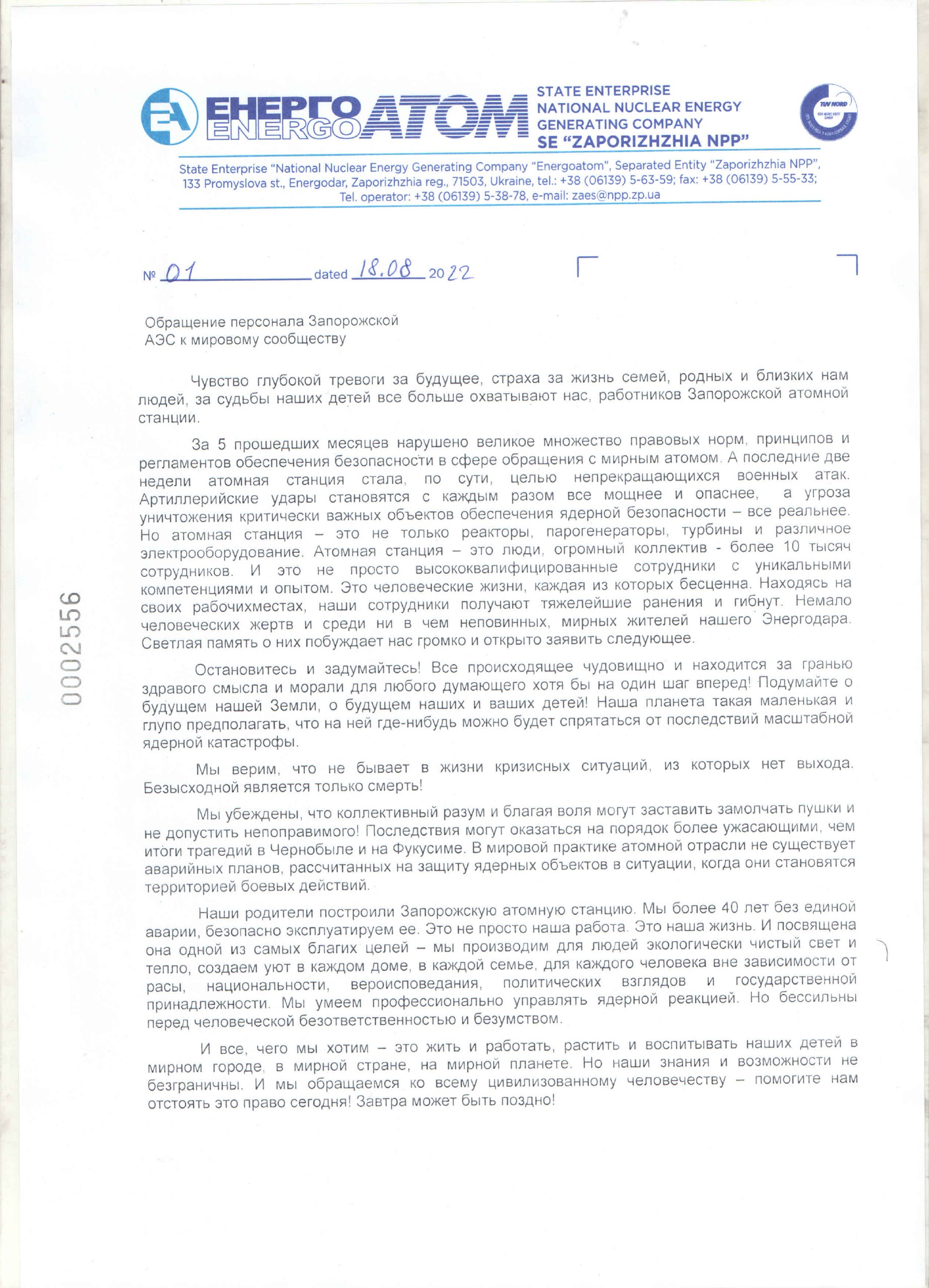
The Zaporizhzhia Nuclear Power Plant (ZNPP) staff are urging the world to prevent a nuclear disaster at the plant. The consequences of it might be worse than those of the Chornobyl disaster or the one at the Fukushima power plant in Japan.

SourceStatement by the Zaporizhzhia Nuclear Power Plant staff

Quote: "We believe that collective intelligence and good will can make the cannons go quiet and prevent an irreversible disaster from occurring. The consequences of such a disaster can be far worse than those of the Chornobyl and Fukushima tragedies.

The world’s nuclear sector has no emergency plans for ensuring the security of nuclear facilities when they become the grounds for military actions."

Details: The ZNPP staff note that over the past five months, "countless legal norms, principles and safety regulations have been violated" in the realm of "peaceful use of atomic energy". They stress that the Zaporizhzhia NPP has essentially become "the target of relentless military attacks" in the past two weeks.


"Our planet is too small to believe that there will be a place where one could hide in the aftermath of a large-scale nuclear disaster," the statement signed by the ZNPP staff reads.

However, the statement does not outline any concrete steps that the world community could take. Moreover, it does not name the aggressor country, Russia, responsible for the possible nuclear disaster.

Background:

  • On 18 August, Russian military command threatened to stop the operation of Europe’s largest Zaporizhzhia Nuclear Power Plant.

  • In addition, the Russian Defence Ministry announced a large-scale provocation could occur at the ZNPP during the visit of UN Secretary-General António Guterres to Ukraine on 19 August.

  • Russian forces captured the Chornobyl Nuclear Power Plant in the beginning of Russia’s full-scale invasion in Ukraine. They captured the Zaporizhzhia NPP on 4 March, creating the threat of nuclear disaster. In mid-March, the Russians detonated munition at the ZNPP. In recent weeks, Russia has ramped up its attacks on the ZNPP.

  • At a meeting of the United Nations Security Council, the United States indicated that for the security of the ZNPP, it is necessary to withdraw Russian troops from there, create a demilitarised zone and provide access to IAEA [International Atomic Energy Agency] experts. Vasiliy Nebenzia, Russia's Permanent Representative to the United Nations, did not support the offer to create a demilitarised zone around the ZNPP.

  • On 13 August, Russian occupying forces placed several artillery systems on the territory of the ZNPP. They used these systems to fire on the power plant, while making it seem as though the shells come from Nikopol.


Invaders announced online broadcast from Zaporizhzhia Nuclear Power Plant "for its people"


Ukrayinska Pravda

KATERYNA TYSHCHENKO — THURSDAY, 18 AUGUST 2022, 16:23

The so-called "occupation authorities'' of Zaporizhzhia Oblast announced that drones will broadcast online the situation at the Zaporizhia Nuclear Power Plant (ZNPP) on Friday.

Source: Russian propaganda agency RIA Novosti, on Telegram, citing the so-called "member of the main council of the military-civil administration of Zaporizhzhia Oblast" Vladimir Rogov in the interview with "Solovyov.Live".

Quote: "Zaporizhzhia Oblast administration promises that there will be constant filming of situation around the Zaporizhzhia NPP, made by drones, where – according to the Russian Defense Ministry – Ukrainian troops are preparing a provocation."

Updated: Later the Russian agency noted that the filming will be conducted "for the security forces" of the invaders.

Quote from Rogov: "The probability that tomorrow a provocation will be carried out against the nuclear power plant is not just much higher than average, but it is close to almost 100%.

Just yesterday, I specifically handed over drones to our guys at the nuclear power plant, so that constant filming would be conducted around the perimeter for Rosgvardiya (National Guard of the Russian Federation) and our security forces, so that later any arrival and moment could be recorded online."

Background: The Ministry of Defense of the Russian Federation declared that on 19 August, a "large-scale provocation of the Kyiv regime" may occur at the Zaporizhzhia NPP during the visit of UN Secretary-General Antonio Guterres to Ukraine.

In Russia, they claim that on August 19, the Ukrainian Armed Forces will launch artillery strikes on the territory of the Zaporizhzhia NPP from Nikopol, and then demonstrate the elimination of the consequences of the accident at the nuclear power plant.

Earlier, according to the media, the invaders placed artillery units at the Zaporizhzhia NPP firing on the plant and simulating strikes from Nikopol.

Background:

On 18 August, Russian military command threatened to stop the operations of Europe’s largest Zaporizhzhia NPP.


Energoatom notes that the Zaporizhzhia NPP shutdown, by the invaders, brings the script of a radiation disaster closer.


Journalists fight on their own frontline. Support Ukrainska Pravda!


Russia calls U.N. idea to demilitarise Ukraine's Zaporizhzhia nuclear plant unacceptable


An overview of the Zaporizhzhia Nuclear Power Plant, in Ukraine

Thu, August 18, 2022 

MOSCOW (Reuters) -Russia's foreign ministry on Thursday rejected a proposal by U.N. Secretary General Antonio Guterres to demilitarise the area around the Russian-controlled Zaporizhzhia nuclear power plant in Ukraine, saying it would make the facility "more vulnerable".

The plant, Europe's largest of its kind, was captured by Russia in March, shortly after President Vladimir Putin ordered tens of thousands of troops into Ukraine in what he called a "special military operation".

Fears have grown in recent weeks over its safety and the risks of a possible Fukushima-style nuclear accident after Ukraine and Russia accused each other of shelling it.

Guterres, who is currently on a visit to Ukraine, earlier this month called for the withdrawal of military personnel and equipment from the power station and for "a safe perimeter of demilitarization."

Ivan Nechayev, a spokesman for the Russian foreign ministry, told a briefing on Thursday that the proposal was unacceptable to Moscow.

He accused Kyiv of organising what he called provocations and of being unable to control nationalist armed groups.

"That is the very reason that the proposals (on demilitarisation) are unacceptable," said Nechayev.

"Implementing them would make the power station even more vulnerable."

Russia says it keeps some troops at the plant to ensure its smooth running and security.

Kyiv accuses Russia of using the plant as a shield from which it shells Ukrainian targets. It also says Russia has shelled the plant; Moscow says Ukraine is the one shelling the facility.

Nechayev said a visit to the plant by the International Atomic Energy Agency (IAEA) could take place in the very near future and that experts could determine for themselves who had been shelling it.

Russia, which says it has no heavy weapons at the plant, earlier on Thursday accused Kyiv and the West of planning a "provocation" there on Friday. Kyiv dismissed the accusation as cynical and untrue.

(Reporting by Reuters;Editing by Andrew Osborn)


BLAH, BLAH, BLAH
Putin slams US lawmakers' visits to Taiwan, blames US for Russia’s continued invasion of Ukraine
PUTIN AIN'T CHOMSKY


Ryan General
Wed, August 17, 2022

Russian President Vladimir Putin blamed the United States for the continued fighting in Ukraine during an international security summit on Tuesday.

Speaking to an audience attended by military officials from Africa, Asia and Latin America, the Russian leader accused “Western globalist elites” of shifting the blame “for their own failures to Russia and China.”

Putin reiterated his previous claim that the Russian military invaded Ukraine to stop the U.S. government’s attempt of turning the country against Russia.

“They need conflicts to retain their hegemony,” Putin was quoted as saying. “That’s why they have turned the Ukrainian people into cannon fodder. The situation in Ukraine shows that the United States is trying to drag the conflict out, and it acts in exactly the same way trying to fuel conflicts in Asia, Africa and Latin America.

Putin’s condemnation of Western powers comes amid a series of sanctions imposed by the U.S., Canada, the United Kingdom and other countries. The sanctions, imposed after Russia’s invasion of Ukraine, targeted the country’s banks, oil refineries and military exports, among others.


Putin also referenced U.S. House Speaker Nancy Pelosi’s trip to Taiwan to accuse Washington of promoting instability around the world.

“The American adventure in Taiwan wasn’t just a trip by an irresponsible politician,” Putin said. “It was part of a deliberate and conscious U.S. strategy intended to destabilize the situation and create chaos in the region and the entire world, a blatant demonstration of disrespect for another country's sovereignty and its own international obligations.”

Putin said that attempts by so-called “Western elites” to cling to the “current globalist model” are already doomed. “The era of the unipolar world order is nearing its end,” he added.

Russian Defense Minister Sergei Shoigu, who also spoke during the conference, further alleged that in addition to the weapons that Western governments supply to Ukraine, they also aid the Ukrainian military with detailed intelligence information and instructors to teach them how to operate their weapons systems.

Shoigu denied both claims that Russia could potentially use nuclear or chemical weapons in the ongoing conflict.

While Putin’s fight against the West has earned him an ally in Chinese President Xi Jinping, a recent report suggesting that China has been stealing sensitive data from Russian defense might put their friendship to the test.

A report by Russian cybersecurity company Kaspersky Labs claimed that China's government-connected hacking group TA428 conducted numerous attacks on Russia's military-industrial complex.

"The attack targeted industrial plants, design bureaus and research institutes, government agencies, ministries and departments in several East European countries (Belarus, Russia, and Ukraine), as well as Afghanistan,” the report noted.


Noam Chomsky - Foundations of World Order: the UN, World Bank, IMF & Decl. Human Rights 
MIT Dec 6, 2018

Scientists warn of dire effects as Mediterranean heats up


 While vacationers might enjoy the Mediterranean sea’s summer warmth, climate scientists are warning of dire consequences for its marine life as it burns up in a series of severe heat waves. 
(AP Photo/Amr Nabil, File)


CIARÁN GILES and ILAN BEN ZION
Wed, August 17, 2022 

MADRID (AP) — While vacationers might enjoy the Mediterranean Sea's summer warmth, climate scientists are warning of dire consequences for its marine life as it burns up in a series of severe heat waves.

From Barcelona to Tel Aviv, scientists say they are witnessing exceptional temperature hikes ranging from 3 degrees Celsius (5.4 Fahrenheit) to 5 degrees Celsius (9 Fahrenheit) above the norm for this time of year. Water temperatures have regularly exceeded 30 C (86 F) on some days.

Extreme heat in Europe and other countries around the Mediterranean has grabbed headlines this summer, but the rising sea temperature is largely out of sight and out of mind.

Marine heat waves are caused by ocean currents building up areas of warm water. Weather systems and heat in the atmosphere can also pile on degrees to the water's temperature. And just like their on-land counterparts, marine heat waves are longer, more frequent and more intense because of human-induced climate change.

The situation is “very worrying,” says Joaquim Garrabou, a researcher at the Institute of Marine Sciences in Barcelona. “We are pushing the system too far. We have to take action on the climate issues as soon as possible.”

Garrabou is part of a team that recently published the report on heat waves in the Mediterranean Sea between 2015 and 2019. The report says these phenomena have led to “massive mortality” of marine species.

About 50 species, including corals, sponges and seaweed, were affected along thousands of kilometers of Mediterranean coasts, according to the study, which was published in the Global Change Biology journal.

The situation in the eastern Mediterranean basin is particularly dire.

The waters off Israel, Cyprus, Lebanon and Syria are “the hottest hot spot in the Mediterranean, for sure,” said Gil Rilov, a marine biologist at Israel’s Oceanographic and Limnological Research institute, and one of the paper’s co-authors. Average sea temperatures in the summer are now consistently over 31 C (88 F).

These warming seas are driving many native species to the brink, “because every summer their optimum temperature is being exceeded,” he said.

What he and his colleagues are witnessing in terms of biodiversity loss is what is projected to happen further west in the Mediterranean toward Greece, Italy and Spain in the coming years.

Garrabou points out that seas have been serving the planet by absorbing 90% of the earth’s excess heat and 30% of carbon dioxide emitted into the atmosphere by coal, oil and gas production. This carbon-sink effect shields the planet from even harsher climate effects.

This was possible because oceans and seas were in a healthy condition, Garrabou said.

“But now we have driven the ocean to an unhealthy and dysfunctional state," he said.

While the earth's greenhouse gas emissions will have to be drastically reduced if sea warming is to be curtailed, ocean scientists are specifically looking for authorities to guarantee that 30% of sea areas are protected from human activities such as fishing, which would give species a chance to recover and thrive.

About 8% of the Mediterranean Sea area is currently protected.

Garrabou and Rilov said that policymakers are largely unaware of the warming Mediterranean and its impact.

“It’s our job as scientists to bring this to their attention so they can think about it,” Rilov said.

Heat waves occur when especially hot weather continues over a set number of days, with no rain or little wind. Land heat waves help cause marine heat waves and the two tend to feed each other in a vicious, warming circle.

Land heat waves have become commonplace in many countries around the Mediterranean, with dramatic side effects like wildfires, droughts, crop losses and excruciatingly high temperatures.

But marine heat waves could also have serious consequences for the countries bordering the Mediterranean and the more than 500 million people who live there if it's not dealt with soon, scientists say. Fish stocks will be depleted and tourism will be adversely affected, as destructive storms could become more common on land.

Despite representing less than 1% of the global ocean surface area, the Mediterranean is one of the main reservoirs of marine biodiversity, containing between 4% and 18% of the world’s known marine species.

Some of the most affected species are key to maintaining the functioning and diversity of the sea's habitats. Species like the Posidonia oceanica seagrass meadows, which can absorb vast amounts of carbon dioxide and shelters marine life, or coral reefs, which are also home to wildlife, would be at risk.

Garrabou says the mortality impacts on species were observed between the surface and 45 meters (around 150 feet) deep, where the recorded marine heat waves were exceptional. Heat waves affected more than 90% of the Mediterranean Sea’s surface.

According to the most recent scientific papers, the sea surface temperature in the Mediterranean has increased by 0.4 C (0.72 F) each decade between 1982 and 2018. On a yearly basis, it has been rising by some 0.05 C (0.09 F) over the past decade without any sign of letting up.

Even fractions of degrees can have disastrous effects on ocean health, experts say.

The affected areas have also grown since the 1980s and now covers most of the Mediterranean, the study suggests.

“The question is not about the survival of nature, because biodiversity will find way to a survive on the planet,” Garrabou said. “The question is if we keep going in this direction maybe our society, humans, will not have a place to live.”

____

Ilan Ben Zion reported from Jerusalem.

____

Follow all AP stories on climate change issues at https://apnews.com/hub/climate-and-environment

___

Associated Press climate and environmental coverage receives support from several private foundations. See more about AP’s climate initiative here. The AP is solely responsible for all content.

Stimulus checks helped ‘democratize investing’ among Black and Hispanic Americans, study finds


·Personal finance writer

Federal stimulus checks helped millions of Americans stay financially afloat during the worst of the pandemic. For some, the payments also allowed them to finally invest.

A new study revealed that two in five stimulus check recipients used the funds for more than one purpose. Most notably, 47% of Black and Hispanic Americans used the payments in more ways than one, compared with 32% of white adults, according to the 2021 Financial Capability Study from FINRA Investor Education Foundation, a nonprofit dedicated to financial education and empowerment.

The analysis conducted from June to October 2021, surveyed over 26,000 stimulus recipients in the U.S. and found that Black and Hispanic American adults between the ages of 18 and 40 were more likely to invest some of the funds in the stock market than white respondents in the same age group.

“Many stimulus recipients reported spending the money in multiple ways — particularly Black/ African-American and Hispanic adults,” Gerri Walsh, president of the FINRA Investor Education Foundation, told Yahoo Money. “In fact, while Black and Hispanic young adults were more likely to invest than whites, they were also more likely to use the money to make purchases and pay bills.”

The IRS sent the third and last round of Economic Impact Payments to eligible individuals in March 2021. Most Americans received up to $1,400 in stimulus checks, and an additional $1,400 for each qualifying dependent. (Credit: Getty Creative)

Stimulus checks kept household finances stable

Stimulus checks helped bolster household finances, according to FINRA’s study, and contributed to some of the financial resilience documented in 2021.

More than 169 million payments were delivered by the IRS in the third and final round of stimulus checks to households across the country last year, with $1,400 reaching most households. According to FINRA’s financial capability study, Americans used the funds for its intended purpose.

Among those surveyed, more than 78% reported that they received at least one pandemic-related stimulus payment. Some 59% of respondents used the money to make purchases or pay bills, consistent with the goals of the American Rescue Plan, the analysis found. Another 38% added the money to their savings, while 33% used it to pay down debt.

During the pandemic, stimulus checks helped Americans stay afloat as many experienced an unexpected drop in income. According to FINRA, stimulus payments and enhanced unemployment benefits were responsible for most of the financial resilience documented in 2021. (Credit: Getty Creative)

Additionally, some respondents said they donated some funds to individuals or organizations or invested in the stock market (7% and 6%, respectively).

“Nearly 6 in 10 respondents reported having made purchases or paid bills with the stimulus money they received, suggesting that a majority used the stimulus as intended,” Walsh said. “Of course, we need to keep in mind that many used stimulus funds for more than one purpose.”

The stimulus funds reshaped how Americans thought about money, which may have contributed to a boost in their understanding of personal finances, Walsh said.

“Given that more households had emergency savings in 2021 than 2018, despite pandemic-related economic turmoil, stimulus payments may have at least partly contributed to a rise in some financial capability measures we saw from 2018 to 2021,” Walsh said. “However, more work is needed to understand the relationship between stimulus payments and financial capability.”

Young adults between the ages of 18 and 40 were more likely to invest some of their stimulus funds in the stock market, FINRA found. Those most likely to invest were Black and Hispanic American men. (Credit: Getty Creative).

Younger adults were more likely to invest stimulus funds

Some stimulus checks ended up in the stock market, and those most likely to invest were younger adults of color with college degrees, and folks with higher incomes.

Compared to all other age groups, those between the ages of 18-40 were found to have spent some of their stimulus in the stock market.

Among 18- to 40-year olds, Black Americans were 6.27% more likely to invest their stimulus funds than whites. According to FINRA, this was followed by Hispanic respondents who were 2.5% more likely to report using the stimulus payments for investing versus white respondents.

According to Walsh, the financial cushion of the stimulus checks provided “lower barriers to investing” for Black and Hispanic young adults.

“Including ease of access and the ability to invest with smaller amounts of money has in several ways democratized investing,” she said.

“It could be that when both the opportunity and the means to invest are presented, demographic groups that are typically underrepresented in the investor ranks might consider investing,” Walsh said. “Since investing is one avenue to decrease the wealth gap in America, this is in many ways an encouraging finding.”

Gabriella is a personal finance reporter at Yahoo Money. Follow her on Twitter @__gabriellacruz.

Canadian Solar (CSIQ) Surpasses Q2 Earnings and Revenue Estimates

Zacks Equity Research
Thu, August 18, 2022 


Canadian Solar (CSIQ) came out with quarterly earnings of $1.07 per share, beating the Zacks Consensus Estimate of $0.70 per share. This compares to earnings of $0.18 per share a year ago. These figures are adjusted for non-recurring items.

This quarterly report represents an earnings surprise of 52.86%. A quarter ago, it was expected that this solar wafers manufacturer would post a loss of $0.05 per share when it actually produced earnings of $0.14, delivering a surprise of 380%.

Over the last four quarters, the company has surpassed consensus EPS estimates three times.

Canadian Solar , which belongs to the Zacks Solar industry, posted revenues of $2.31 billion for the quarter ended June 2022, surpassing the Zacks Consensus Estimate by 3.71%. This compares to year-ago revenues of $1.43 billion. The company has topped consensus revenue estimates just once over the last four quarters.

The sustainability of the stock's immediate price movement based on the recently-released numbers and future earnings expectations will mostly depend on management's commentary on the earnings call.

Canadian Solar shares have added about 25.4% since the beginning of the year versus the S&P 500's decline of -10.3%.

What's Next for Canadian Solar?

While Canadian Solar has outperformed the market so far this year, the question that comes to investors' minds is: what's next for the stock?

There are no easy answers to this key question, but one reliable measure that can help investors address this is the company's earnings outlook. Not only does this include current consensus earnings expectations for the coming quarter(s), but also how these expectations have changed lately.

Empirical research shows a strong correlation between near-term stock movements and trends in earnings estimate revisions. Investors can track such revisions by themselves or rely on a tried-and-tested rating tool like the Zacks Rank, which has an impressive track record of harnessing the power of earnings estimate revisions.

Ahead of this earnings release, the estimate revisions trend for Canadian Solar: favorable. While the magnitude and direction of estimate revisions could change following the company's just-released earnings report, the current status translates into a Zacks Rank #2 (Buy) for the stock. So, the shares are expected to outperform the market in the near future. You can see the complete list of today's Zacks #1 Rank (Strong Buy) stocks here.

It will be interesting to see how estimates for the coming quarters and current fiscal year change in the days ahead. The current consensus EPS estimate is $0.92 on $1.97 billion in revenues for the coming quarter and $3.06 on $7.45 billion in revenues for the current fiscal year.

Investors should be mindful of the fact that the outlook for the industry can have a material impact on the performance of the stock as well. In terms of the Zacks Industry Rank, Solar is currently in the top 24% of the 250 plus Zacks industries. Our research shows that the top 50% of the Zacks-ranked industries outperform the bottom 50% by a factor of more than 2 to 1.

One other stock from the same industry, Azure Power (AZRE), is yet to report results for the quarter ended June 2022.

This solar power producer is expected to post quarterly earnings of $0.22 per share in its upcoming report, which represents a year-over-year change of +15.8%. The consensus EPS estimate for the quarter has remained unchanged over the last 30 days.

Azure Power's revenues are expected to be $78.8 million, up 32% from the year-ago quarter.
The BlackRock Trust: Crypto Legitimacy or the Beginning of the End for Bitcoin?

Zac Colbert
Thu, August 18, 2022 

After BlackRock, the largest asset manager in the world, announced on Aug. 11 that it will launch a private bitcoin trust for its clients, some crypto enthusiasts said the move could legitimize the digital asset in the eyes of more traditional investors.

BlackRock’s new private trust will make bitcoin available to its institutional clients, tracking bitcoin’s performance, offering direct exposure to the price of the cryptocurrency and of course, trading options.

This article is excerpted from The Node, CoinDesk's daily roundup of the most pivotal stories in blockchain and crypto news. You can subscribe to get the full newsletter here.

“Despite the steep downturn in the digital asset market, we are still seeing substantial interest from some institutional clients in how to efficiently and cost-effectively access these assets using our technology and product capabilities,” BlackRock said in its press release.

The news comes shortly after the firm announced a partnership with Coinbase to provide clients of its Aladdin platform access to cryptocurrency trading and custody services. These developments highlight how traditional investors and institutions from banks to hedge funds are moving into the crypto market, indicating that digital assets are here for the long haul.

These fresh endorsements lend crypto ever-stronger legitimacy, bringing digital assets into the more traditional financial industry and therefore making them more accessible to both new and old investors.

But does advocacy from a multinational investment-management firm go against everything Bitcoin originally stood for? Especially when, just five years prior, BlackRock CEO Larry Fink called bitcoin an “index of money laundering.”

Bitcoin’s anarchic beginnings in 2009 heralded the potential democratization of finance. Blockchain technology promised a more open and secure approach to currency for everyone. So with bitcoin now trending in mainstream Wall Street investment portfolios, has the leading cryptocurrency betrayed its revolutionary roots?

See also: What Jack Dorsey's Beef With 'Web 3' Is Really About | David Z. Morris

At the end of June, Coinbase’s stock was at its all-time low of $47.02. But the announcement of BlackRock and Coinbase’s partnership may be partly responsible for the recent upward trajectory of the crypto exchange’s share price.

But Coinbase shares are still down 75% from their peak, and online skeptics feel BlackRock’s partnership with the once top-of-its-game Coinbase is nothing more than a power grab by a centralized financial institution.

And with the added possibility of new regulations from U.S. Congress, the news further fuels fears that the current crypto winter is not fleeting, but the beginning of the end for Bitcoin.

As is always the case with the market, only time will tell.
Dan Price resigns as CEO of payments firm after misconduct allegations

Edward Helmore
Thu, August 18, 2022 


Dan Price, the chief executive of a Seattle-based credit card processing company who made headlines when he implemented a $70,000 minimum wage, has abruptly resigned after accusations of misconduct and misdemeanor criminal charges that he assaulted a woman after a dinner meeting.

Price, who started Gravity Payments in 2004 at age 19, wrote in an email he was stepping away from the company because “my presence has become a distraction here.

“I also need to step aside from these duties to focus full time on fighting false accusations made against me,” he added. “I’m not going anywhere.”

According to the Seattle Times, Price started the company in 2004 in his dorm at Seattle Pacific University using money from his older brother. He got the idea for the payments system while playing in a rock band at a coffee shop.

Eleven years later, he shocked the business community by announcing that he would cut his $1m salary to accommodate pay rises for all 120 employees, from sales to administration. Price told the New York Times that workers would be getting raises over three years, bringing the minimum salary of every employee to $70,000. The company called the program “The Gravity of $70k”.

“Is anyone else freaking out right now?” Price told employees at the time. “I’m kind of freaking out.”

Price later credited a 2010 academic paper titled “High income improves evaluation of life but not emotional well-being” for the idea and noted the growing disparities between executives and line workers, which was then at around 354-1 but has now grown to 670-1, according to the Institute for Policy Studies. Slightly less than half of the company’s 70 employees saw their pay double.

“The market rate for me as a CEO compared to a regular person is ridiculous. It’s absurd,” Price said at the time. “As much as I’m a capitalist, there is nothing in the market that is making me do it.”

The move established Price as a progressive CEO, and his company marketed itself as being for “the little gal or guy who believes in the American dream and is willing to work to chase it”.

But Price ran into legal trouble. He was sued by his brother, who claimed he was overpaying himself. The lawsuit failed. Then Bloomberg reported on a 2015 Tedx Talk given by Price’s wife, Kristie Colon, in which she described being waterboarded and beaten by her ex. Colon did not name Price, who told the outlet that the events “never happened”.

Mysterious flyers appeared near Gravity’s headquarters asking, “Have you been abused by Dan Price? We hear you. We believe you. We support you.”

Then, in February this year, Price was charged with misdemeanor assault and reckless driving. According to court documents, reported by the Seattle Times, a 26-year-old woman called Seattle police to report that she had met Price at a restaurant to discuss “professional matters”.

In his Tesla sedan after the dinner, prosecutors said, Price had attempted to kiss the woman, grabbed her throat when she refused, and then performed “doughnuts” with the car in a parking lot. Price has pleaded not guilty to the charges.

“Mr Price respects the legal process and is confident that he will be vindicated in court,” Price’s defense attorney, Mark Middaugh, wrote in an email to the Seattle paper.

After resigning on Wednesday, Price posted a statement on Twitter listing his accomplishments in workers’ pay, overall employee satisfaction, time off, parental leave and retention. “I’m proud of what we’ve done,” he said.