Wednesday, September 21, 2022

UN
Bolivia and Peru express concern over the situation of the Palestinian people and the war in Ukraine

The President of Bolivia, Luis Arce, and the President of Peru, Pedro Castillo, expressed their concern about the situation of the Palestinian people and the Russian invasion of Ukraine during a meeting at the United Nations Assembly on Tuesday, while calling for a ceasefire in the country.


The President of Bolivia, Luis Arce, and the President of Peru, Pedro Castillo
 - MARIANA BAZO / ZUMA PRESS / CONTACTOPHOTO

"Let the United Nations work tirelessly for a ceasefire between Russia and Ukraine. For the historical rights of the Palestinian state and people to be respected and for NATO to stop thinking about its expansionist plans," Arce stressed.

For his part, Castillo has remarked before the UN General Assembly that "strategic balances" have been modified, resulting in the deterioration of peace. "(Peru) reiterates the illegitimacy of the Russian Federation's intervention in Ukraine, just as it reproves Israel's persistent occupation of Palestinian and Arab territories since 1967," he said.

In this way, he called for a cease-fire in Ukraine so that economic sanctions do not "affect food security" in a "convulsed" context in which these "unilateral" reprisals, different from those approved by the Security Council, are contrary to international law.

"It is indispensable that the international community assumes once and for all its responsibilities and propitiates peace negotiations to find a solution based on the recognition of the two states", explained Castillo, adding that it is necessary "a viable Palestine" and an "Israel with secure borders".

For this reason, the Peruvian president announced before the United Nations General Assembly on Tuesday that the Peruvian government will open a diplomatic representation in Palestinian territory with the aim of promoting this "lasting peace".

"THE "LITHIUM TRIANGLE" AND THE LAW OF THE SEA

 During his speech, Arce asked the United Nations to ensure the non-interference of states over strategic natural resources in the so-called "lithium triangle", formed by Bolivia, Argentina and Chile, which is "in the crosshairs" of the United States. "We are not pieces on a chessboard," he said, adding that they have "every right to decide" about their own resources.

Bolivia has gone through several potholes throughout their shared history, among them the Altiplano's lawsuit before the International Court of the Hague, brought by then President Evo Morales, in which Chile was forced to negotiate a sovereign outlet to the Pacific Ocean.

In view of these disputes, Arce explained that the sea "is a right of the peoples" and that "Bolivia was born with the sea". "However, at present, it is a cloistered country, forced by the circumstances of the past to face multiple barriers for transportation, communication and trade".

The Bolivian president has also put the focus on the fight against drug trafficking. "We must change the approach", he explained, adding that "militarization" is a point that needs to be worked on, since "it has affected the peasants in the south", leaving the large criminal groups in "impunity".

"The international war on drugs criminalizes and generates unilateral sanctions against countries of the south, but shields the laundering of assets, facilitates drug trafficking and other related crimes in other countries of the north," he said, adding that it is necessary to bet on a social and less militarized approach.

THE SAHARA AND THE MALVINAS 

For his part, Castillo recalled that Peru has re-established diplomatic relations with the Saharawi republic. "It firmly supports their right to self-determination", he said, adding that they support the efforts of the UN for a "cease-fire" in Western Sahara and a "negotiated and peaceful solution".

"In the same conviction, Peru fully recognizes the sovereignty rights of the Argentine Republic in the Malvinas Islands and we demand that the parties begin consultations and negotiations to achieve this imperative objective," he concluded.
Fernandez assures UN that the attack on Cristina Fernandez sought to alter democracy

The President of Argentina, Alberto Fernandez, has assured this Tuesday before the UN General Assembly that the assassination attempt against Vice-President Cristina Fernandez de Kirchner sought to "alter democracy".


The President of Argentina, Alberto Fernandez - 

"In Argentina, the attempt to assassinate the vice president not only affected public tranquility. It also sought to alter a virtuous collective construction that next year will celebrate four decades of life," he said, thanking "the solidarity" that the country has received "from the whole world" after the attack, as reported by 'La Nación'.

Speaking in New York before the United Nations General Assembly, in what was his first intervention before the world forum, Fernandez said that "many times in history, assassinations have been prologues of great tragedies" and "entire peoples succumbed behind those prophets of hatred".

"I am sure that the fascist violence that disguises itself as republicanism will not succeed in changing this broad consensus to which the vast majority of Argentine society adheres," she added, as reported by the Télam agency.

In this sense, he warned that extremist and violent discourses have found "fertile ground to sow anti-political sentiment", and he scorned that "those who seek to weaken" democracies "have specific interests that lead them to promote extreme polarization".

"Let us not accept this situation with resignation. Let us generate an energetic global rejection of those who promote division in our communities," said Fernandez.

ARGENTINA ASKS THE UNITED KINGDOM FOR A DIALOGUE ON THE MALVINAS 

On the other hand, Fernandez has taken advantage of the UN General Assembly to ask the United Kingdom to resume dialogues to address the sovereignty of the Malvinas Islands.

According to Télam, the Argentine president reaffirmed the country's "legitimate and imprescriptible sovereignty rights" over the Malvinas Islands, South Georgia, South Sandwich Islands and the surrounding maritime areas.

He also denounced that the United Kingdom "aggravated the controversy" with an "unjustified and excessive military presence in the islands" and with "calls for the illegal exploitation of resources". However, it has expressed its willingness to resume "negotiations" with London.

"We request the Secretary General to renew his efforts in the fulfillment of that mandate and that the United Kingdom agrees to abide by the call of the international community and put an end to this anachronistic colonial situation", emphasized Fernandez, reiterating to the British Government to comply with UN resolution 31/49, which calls for the decolonization of the Malvinas Islands.
Sahara – Morocco defends before the UN its autonomy plan for the Sahara as «the only solution».

The head of the Moroccan government, Aziz Ajanuch, defended Tuesday before the UN General Assembly the Moroccan autonomy proposal for the Sahara, which he described as "a realistic and fair solution to the problem", claiming once again the Moroccan ownership of the former Spanish colony.


Morocco's Prime Minister Aziz Ajanuch, leader of the 
National Rally of Independents (RNI) 
- CHADI / XINHUA NEWS / CONTACTOPHOTO

In his speech, he reiterated Morocco's commitment to a "definitive political solution" to what he called an "artificial regional conflict" over the Sahara, but made it clear that this solution must be based on "the Moroccan autonomy initiative, the only solution to this dispute", and be framed within "the territorial integrity and national sovereignty of the kingdom".

According to the Moroccan Prime Minister, this "serious and realistic" initiative presented by Morocco in 2007 already enjoys the support of more than 90 countries. About thirty countries, mainly African, have in recent years opened consulates in the former Spanish colony after recognizing Moroccan sovereignty over these territories.

Moreover, he maintained that "the Southern Provinces", as the Sahara is called in Morocco, "live at the pace of an irreversible development dynamic, within the framework of the new development model" launched by King Mohammed VI in 2015 and its population participates in it through its democratically elected representatives in the councils of the two regions into which this territory is divided.

MESSAGE TO ALGERIA 

In another development, according to le360.ma portal, Ajanuch said Morocco supports the efforts of the UN envoy for the Sahara, Staffan de Mistura, to relaunch the process of round tables with the participation of Morocco, the Polisario Front, Mauritania and Algeria with a view to reaching a realistic and lasting political solution in accordance with the resolutions of the Security Council.

"The participation of Algeria, with seriousness and good faith, in the process of round tables (...) is a sine qua non to achieve a definitive settlement to this question", the Moroccan Prime Minister stressed, after accusing Algiers of being responsible for "the creation and maintenance of this artificial dispute".

On another matter, the Moroccan Prime Minister stressed his country's "firm" position in support of the Palestinian cause and a "two-state solution", although, nevertheless, he stressed that he will continue to defend "the special status of Jerusalem".

Nevertheless, Ajanuch maintained that "the world is now witnessing profound and multidimensional crises and challenges, and the African continent is the most affected by the difficult global economic conditions, which undermine its efforts in the field of sustainable development".

In addition, he called for strengthening international cooperation to launch "major initiatives" for development that will enable Africa to "withstand many international shocks," pointing specifically to climate change.

DIPLOMATIC EFFORT 

Morocco has recently been engaged in a major diplomatic effort to attract more countries to support its thesis of the Moroccanness of the Sahara. After then U.S. President Donald Trump recognized Rabat's sovereignty over the former Spanish colony in December 2020, the Moroccan government has worked and lobbied for other countries to follow in its footsteps.

In the case of Spain, the Prime Minister, Pedro Sanchez, recognized last March in a letter to Mohamed VI that the Moroccan autonomy plan is "the most serious, solid and credible basis" for a solution, while other countries such as France and Germany have recognized that it could be one of the bases for resolving the conflict.

The Moroccan Foreign Minister, Naser Burita, is also in New York these days, where he is having a busy schedule of meetings with his counterparts from several countries with the aim of continuing to promote Morocco's theses.

On Tuesday, the head of Moroccan diplomacy held a total of eleven bilateral meetings, nine of them with ministers of European countries - Luxembourg, Finland, Belgium, Cyprus, Hungary, Slovenia, Czech Republic, Netherlands and Portugal. A meeting with the Spanish Foreign Minister, José Manuel Albares, is scheduled for Wednesday.
Belgian proposal to bless same-sex unions goes against Holy See norm, Vatican says


The proposal to bless homosexual couples put forward by the Flemish bishops "was not presented to the Vatican beforehand" and is contrary to a directive of the Holy See, according to the Vatican's official newspaper, Vatican News.

"With this measure, the Flemish bishops, among them Cardinal Jozef de Kesel, oppose a directive of the Holy See," reads the article, which lists the liturgy published by the Catholic bishops of Flanders that can be used for the ecclesiastical blessing of homosexual couples.

In February 2021, the Vatican banned any ecclesiastical blessing of homosexual couples, as well as any rite comparable to marriage between a man and a woman. "God does not bless sin," the Congregation for the Doctrine of the Faith noted in a document at the time.

The Flemish bishops are the first in the Church to explicitly give the green light to the ecclesiastical blessing of homosexual couples, with a document that, according to the Vatican, is in open opposition to the one published by the Holy See's Dicastery for the Doctrine of the Faith.

The official Vatican media cites the information published on the official website of the Belgian Bishops' Conference, where the blessing of the union of same-sex couples is contemplated and it is established that, in each diocese, there will be a person dedicated to the pastoral care of homosexual persons. However, the Belgian prelates specify that this blessing will be clearly differentiated from sacramental marriage.

"During pastoral meetings, people often ask for a moment of prayer to ask God to bless and perpetuate this commitment of love and fidelity," the Belgian Episcopal Conference points out in the document entitled 'Homosexual persons are pastorally close. For a hospitable Church, which excludes no one'.

However, they point out that this moment of prayer can be simple and that "the difference with what the Church understands as sacramental marriage must be clear". The Flemish bishops will travel to Rome next week for the usual 'ad limina' visit, which includes private meetings with the Pope.
Two dead and 25 injured in Iran's Kermanshah following protests

By REUTERS - 

Two people died on Tuesday following protests in the western Iranian city of Kermanshah, the city's prosecutor was quoted as saying on Wednesday by the semi-official Fars news agency.


(OFFICIAL KHAMENEI WEBSITE/HANDOUT VIA REUTERS)

"Unfortunately, two people were murdered in yesterday's riots in Kermanshah. We are certain this was done by anti-revolutionary elements because the victims were killed by weapons not used by the security apparatus," Shahram Karami said.

The prosecutor added 25 people, including protesters, security forces and bystanders, were injured during the protests.

Related video: People killed in violent Iran protests
Duration 1:04  View on Watch


Fifteen protesters were arrested in Shiraz on Tuesday, according to an official quoted by IRNA.
Internet may be disrupted in Iran for 'security reasons'

Access to the internet in Iran may be disrupted due to "security reasons", the minister of communications was quoted as saying on Wednesday by the semi-official ISNA news agency, amid widespread protests following the death of a young woman in police custody.

"Due to security issues and the debates going on currently in the country, restrictions to the internet may be decided and applied by the security apparatus, but overall we have not had any bandwidth reduction," Issa Zarepour said.

Police officer dies in protests over death of woman arrested for improperly wearing veil

Authorities in Iran on Wednesday denounced the death of a policeman in the context of protests in recent days in the country over the death of a woman after she was arrested for improperly wearing the veil.


Archive - Police in Iran - ROUZBEH FOULADI / ZUMA PRESS / CONTACTOPHOTO

The governor of Shiraz, Lorfollah Shibani, said that the officer died in an incident on Tuesday and added that four other officers were also injured, while 15 people were arrested, according to the Iranian news agency IRNA.

As part of the demonstrations, an officer was injured in the city of Mashhad (northeast) after attackers set him on fire, although other demonstrators came to his rescue with a fire extinguisher, as reported by the Tasnim news agency.

The protests in Iran following the death of Mahsa Amini have so far resulted in five deaths and dozens of injuries, according to authorities. The demonstrations have had their epicenter in the Kurdish-majority areas of the northwest of the country, although they have spread to numerous cities, including the capital, Tehran.

Amini, 22, a member of Iran's Kurdish minority, was arrested on September 13 in Tehran for improper dress and died three days later after falling into a coma after fainting in a detention center amid allegations of torture and ill-treatment.

The Tehran Police on Monday came out in the wake of the controversy and assured that Amini's death was an "unfortunate incident", while Iranian President Ebrahim Raisi spoke to the family by phone on Sunday and promised a thorough investigation to shed light on what happened.

What is different about the most recent protests in Iran? - analysis

By SETH J. FRANTZMAN - TODAY - 
The Jerusalem Post

A police motorcycle burns during a protest over the death of Mahsa Amini, a woman who died after being arrested by the Islamic republic
© (photo credit: WANA (WEST ASIA NEWS AGENCY) VIA REUTERS)

Iran has seen protests in cities and towns over the past four days in the wake of the police killing of a young woman.

The protests began in western Iran in the Kurdistan region of the country but they have spread to Tehran, Mashhad and other cities in the last two nights. The protesters have generally been seen clashing with police and plainclothes security and also gathering in large numbers at night. In many cases, women have been at the forefront of the protests.

These protests are different from the large-scale protests in 2019, in which Iran’s security forces have been accused of killing around 1,500 people; and in 2009 when there were massive demonstrations across Iran.

The 2009 protests were a response to election fraud during the election of far-right Mahmoud Ahmadinejad. In 2017, protests erupted driven by economic anger.

These protests are different this time because they were driven by anger over the regime’s treatment of women, particularly the police detaining and then killing a woman named Mahsa Amini.


A police motorcycle burns during a protest over the death of Mahsa Amini, a woman who died after being arrested by the Islamic republic's ''morality police'', in Tehran, Iran September 19, 2022. 
(credit: WANA (WEST ASIA NEWS AGENCY) VIA REUTERS)

KURDISTAN

Amini is a Kurdish woman and she was detained while on a trip to Tehran, accused by police of not covering her hair in the manner the theocratic regime desired. She was then beaten and fell into a coma and died last week. The regime has tried to calm crowds, claiming the death was an accident and that she died of heart failure or pre-existing conditions. But what caused her death was the police detention.

The protests began in the Kurdistan region of Iran where minority Kurds have faced oppression for decades. This gives the protests two overlapping causes; the suppression of women and the suppression of minorities. The protests reveal the degree to which people despise the regime and are willing to take to the streets to show their anger. A number of videos posted online reveal the depth of this anger.

In one video, young men confront police on the streets and women are heard cheering them on from balconies. In another crowds chant “death to the dictator.” On Keshavarz boulevard in Tehran, a man says that many of the intersections in the city are full of demonstrators. He also shouts pro-Kurdish slogans. For Kurds, the two issues are entwined. A strike in the Kurdish region and videos of security forces shooting and beating people have shown the degree to which the regime faces major challenges controlling parts of the country.

Nevertheless, the regime will likely put down the protests as it has in the past. But the brief freedom people have enjoyed in the streets, particularly at night, is a freedom they won’t forget. Images and videos posted online have shown women dancing and in one widely shared video, a woman is seen cutting her hair as men cheer. These are attempts to carve out temporary freedom in the streets usually controlled by the regime. This is a regime that sentences women to prison and beatings for not covering their hair or for dancing. The things that westerners take for granted are revolutionary acts in Iran.

On what other issues do Iranians go out and protest?

Over the last decade, Iranians have taken to the streets to confront the state over a variety of issues, from elections to the economy, to police brutality and suppression of minorities. When one adds up the long list of issues it is clear that the regime has only a tenuous grip on the country. At every corner, it is confronted by the fact that large numbers of people dislike the leadership and only brute force and time keep the regime in control.

The regime generally benefits from the fact that other authoritarian countries are on its side and don’t want to see their own rulers challenged; and the fact that there isn’t much outside support for Iranians.

For instance, other countries in the Middle East are hesitant to support protests in Iran, fearing their own citizens might rise up. Iran has hijacked Iraqi politics; is an ally of Syria and has Hezbollah loyalists in Lebanon. The Gulf countries don’t want to see chaos in Iran spill over. This means that the people of Iran are largely alone. They have received some recognition abroad, in the US and Europe; but even there they face an uphill struggle because the Iranian regime is attending the UN, while the people rise up.

The key question facing the protesters is whether these demonstrations will grow outside of the Kurdish region and Tehran. For now, it is unclear if that is possible. On Tuesday night, more cities appeared to join the protests, but that may only be temporary.
Uganda confirms death of patient admitted as suspected Ebola case after new outbreak declared

Daniel Stewart - 

Ugandan authorities on Wednesday confirmed the death of a patient who was being monitored as a suspected Ebola case following Tuesday's outbreak, bringing to two the number of deaths from the virus.


Colored scanning electron micrograph of Ebola virus particles (green) budding and adhering to the surface of cells. - 
NATIONAL INSTITUTE OF ALLERGY AND INFECTIOUS DISEA© Provided by News 360

The spokesman of the Ugandan Ministry of Health, Emmanuel Ainebyoona, has detailed that the deceased is a child and added that the authorities "are waiting" for the results of the laboratory test to confirm that the cause of death is Ebola.

"At the moment it is a suspicious death," he said, before adding that the child was part of a group of fourteen people admitted to a hospital in Mubende with symptoms compatible with Ebola, as reported by the Ugandan newspaper 'New Vision'.

The director of the Mubende Regional Hospital, Rosemary Byabashaija, has indicated that fourteen identified contacts of the first deceased patient are in the hospital. "Since we registered the first case, we have sent a monitoring team to sensitize the population," she explained.

For their part, the Rwandan authorities have raised the health alert level in response to the Ebola outbreak in Uganda. The director general of the Rwanda Biomedical Center (RBC), Claude Mambo Muvunyi, said that the authorities are "closely monitoring" the epidemiological situation in Uganda and in the Democratic Republic of Congo (DRC), where a case was reported last month in the province of North Kivu (east).

"We believe that the outbreak in Uganda will be contained, as it is a family," he said, before detailing that the strain is also not the same as the one detected in DRC, as reported by the Rwandan newspaper 'The New Times'. "We are well prepared. We have equipment to handle Ebola cases, but we have asked for more," he said.

The World Health Organization (WHO) said Tuesday that the confirmation of the first case followed an investigation by the national rapid response team after six "suspicious deaths" in the district over the past month.

"This is the first time in more than a decade that Uganda has recorded a case of the Sudanese strain of Ebola. We are working closely with national health authorities to investigate the source of this outbreak while supporting efforts to put effective control measures in place," said WHO Director for Africa, Matshidiso Moeti.

"Uganda is no stranger to effective Ebola control. Thanks to its experience, measures have been put in place to detect the virus quickly and we can depend on this knowledge to stop the spread of infections," she concluded. Uganda reported its last case of this strain in 2012, while in 2019 it declared an outbreak by the Zaire strain, imported from Democratic Republic of Congo (DRC).
Rashida Tlaib: You can't hold progressive values, back Israel's apartheid gov't

By ZVIKA KLEIN -


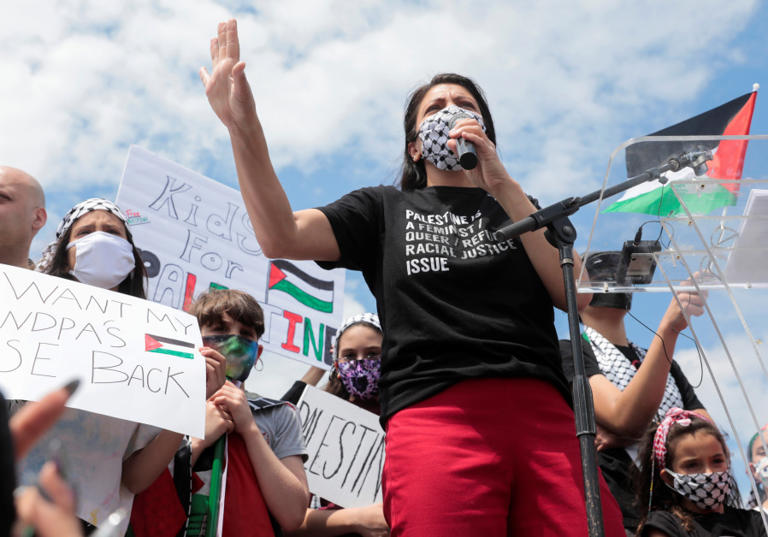
Palestinian-American congresswoman Rashida Tlaib attends a pro-Palestinian protest in Dearborn, Michigan, US, May 16, 2021.© (photo credit: REUTERS/REBECCA COOK)

“I want you all to know that among progressives, it has become clear that you cannot claim to hold progressive values, yet back Israel’s apartheid government,” said Rashida Tlaib, US representative for Michigan’s 13th congressional district, during an online advocacy seminar held on Tuesday by Americans for Justice in Palestine Action (AJP Action), and co-sponsored by American Muslims for Palestine (AMP).

“We will continue to push back and not accept this idea that you are progressive, except for ‘Philistine,’ any longer.”

She spoke of “victories” that the anti-Israel movement has achieved “due to the work of all of you, and so many others that continue to speak truth to power. When we center our beliefs and our actions on the truth that all human life is precious, that every person deserves to live free of fear and have the opportunity to achieve their full potential.

“The need to oppose Israel’s government’s apartheid rule is obvious. The path to freedom for Palestine is long and daunting, we must see through to its end. We owe it to not only Palestinians, [but] oppressed people all over the world who understand that our struggles are linked to one another.”

"The path to freedom for Palestine is long and daunting, we must see through to its end."Rashida Tlaib

European spyware investigators criticize Israel and Poland


WARSAW, Poland (AP) — European Parliament members investigating the use of surveillance spyware by European Union governments sharply criticized Israel on Wednesday for a lack of transparency in allowing the sale of powerful Israeli spyware to European governments that have used it against critics.


The European lawmakers also condemned the Polish government for refusing to meet with them during a fact-finding visit to Warsaw that ended Wednesday.

“It is regrettable and we condemn the fact that the Polish authorities did not want to cooperate with our investigation committee,” Jeroen Lenaers, the head of the delegation, said at a news conference in Warsaw.

“We think it also is a telling sign of the complete lack of importance this government attaches to checks and balances, to democratic scrutiny and to dialog with elected representatives.”

The committee is investigating the use by governments of Israel's Pegasus spyware and other invasive surveillance tools, viewing such technology as a threat to democracy in the 27-nation bloc.

Pegasus was developed by Israel's NSO Group and is designed to breach mobile phones and extract vast amounts of information from them, including text messages, passwords, locations and microphone and camera recordings. The company markets the technology as a tool to target criminals but many cases have been discovered worldwide of governments using it against dissidents, journalists and political opponents.

In Europe, cybersleuths have found traces of Pegasus or other spyware in Poland, Hungary, Spain and Greece.

Sophie in ’t Veld, the raporteur of the inquiry, said the committee has learned that the NSO group has sold spyware to 14 EU governments, using export licenses issued by the Israeli government. It learned that NSO stopped selling to two of those, but won't say which ones. They are widely believed to be Poland and Hungary due to their democratic backsliding.

“Why can we not say with certainty that Poland was one of the two countries of which the contract has been terminated?" she said. "Why is it that NSO is allowed to operate in the European Union, conduct its finances through Luxembourg, sell its products to now 12 member states, products that have been used to violate the rights of European citizens and to attack democracy of the European Union?”

Israel, an ally, should “cooperate with us in the protection of our citizens,” she said.

In 't Veld also she would expect most EU countries to use spyware in rare cases, and with oversight, but that others including Poland have used it "against citizens,” making it “a tool for an authoritarian political agenda.”

Greece has been rocked by revelations that Nikos Androulakis, a European Parliament member and head of Greece’s third-largest political party, was put under surveillance last year with Predator spyware when he was running for his PASOK party’s leadership. A financial journalist also was under surveillance.

That follows revelations of spyware use against government critics in Poland and Hungary and against Catalan separatists in Spain.

During their visit, which began Monday, the 10-member delegation met with Poles targeted by the spyware, including a prosecutor and a senator, and other officials including members in the opposition-controlled Senate investigating Pegasus use.

They will publish a report on their findings and recommendations on Nov. 8.

Vanessa Gera, The Associated Press
Tech sector says more job cuts to come as Elevate conference gets underway

TORONTO — The Elevate technology conference made its return to Toronto this week with a buzzy spectacle — shutting down several blocks of the Esplanade neighbourhood for a block party with performances from artists like rapper Haviah Mighty and scheduling more than 350 speakers, including tennis star Venus Williams, to grace its three venues by the time it wraps Thursday evening.

But the annual festival's reappearance after a two-year, pandemic hiatus is coming at a less than grand time for the industry. A slew of startups and tech giants as prominent as Netflix, Shopify and Wealthsimple have slashed their workforces as the sector grapples with fading investor exuberance and a potential recession.

That meant how to navigate the economic headwinds — and predictions about how long they will last — were hot topics on the Elevate stages.

“I don’t think we’ve hit close to the bottom yet,” said “Dragons’ Den” star Michele Romanow in a Wednesday mainstage session called “leading through uncertainty."

“Tech has seen the first kind of bump in this road and it could get a whole lot worse.”

Her e-commerce investing company Clearco has not been immune to the industry’s troubles. It laid off 60 employees last month as it handed off its international business, a month after cutting 25 per cent of its workforce.

The company anticipated a lot of international growth that no longer made sense in the current economy and it eventually cut “experimental” projects, which Romanow said was “devastating."

She’s since been outlining a new business plan for employees and reminding them that she cannot promise it will go perfectly according to that plan.

“Being an entrepreneur is an extremely hard job. It is largely masochistic, even when the sun is shining and so when it starts raining, and we go into cloudier economic conditions, this is a very difficult thing,” she said.

Abdullah Snobar, executive director of the DMZ tech hub in Toronto, agreed more cuts from more companies lie ahead.

“This is just the beginning,” he said, as Elevate kicked off on Tuesday. “Not to create this over the top scare … narrative, but I think for sure they're going to see a lot more layoffs.”

Labour data aggregator Layoffs.fyi counts 630 startups worldwide which have let go of 80,902 employees this year alone. About 1,193 startups have laid off 176,874 workers since the pandemic began.

Workers watching these cuts unfold and being affected by them are now getting acquainted with the fact that “the world won't be the way it was,” when companies were hiring “ridiculous” numbers of staff members in a short period of time, Snobar said.

But these workers are still needed.

A 2019 report from the Information and Communications Technology Council, a not-for-profit organization offering labour policy advice, predicted demand for digitally-skilled talent in Canada would reach 193,000 by 2022 and more than 305,000 by 2023.

A 2020 addendum accounting for COVID-19 forecast that demand would be reduced by nearly 24 per cent and said under new baseline scenarios, the digital economy is expected to experience demand for 147,000 workers by 2022, with total employment reaching nearly two million.

Banks, insurance companies and even retailers are embarking on hiring sprees as they delve deeper into artificial intelligence, apps and other software to advance their operations and cope with labour shortages.

“I don't think you'll be looking at a Gotham story, like the clouds have come in and we have got to be very careful and everybody's hiding for a bit,” said Snobar. “We're going to get over this thing.”

Lisa Zarzeczny, Elevate’s chief executive and co-founder, agrees. It’s part of why she was intentional about booking speakers who were willing to talk about the harsh realities facing tech and share tips on how to move forward.

“We don't want to gloss over it,” she said. “We think there's an opportunity to learn, and so across all of our stages, we're asking some hard questions.”

On top of Romanow’s session, Elevate had scheduled Wealthsimple founder Michael Katchen and Properly CEO Anshul Ruparell to explore how to grow a business amid headwinds and Rangle.io CEO Nick Van Weerdenburg leading a talk called “Hedgehogging and outfoxing: The psychology of leveraging uncertainty.”

Thirteen per cent of the workforce at financial services company Wealthsimple were laid off in June.

"There's no question that this year has been way more challenging of an environment than the last several and in tech, we know this because you feel it in valuations, you feel it in fundraising," Katchen said.

Wealthsimple has an even more on-the-ground view of the environment because its clients are investors, and they are hurting when the markets are down, he added.

But Katchen sees the current downturn as a natural part of doing business.

"There's the old adage that the best companies get built in environments like this and if you try and want to build a company of consequence, you're going to face many moments like this in the story of your business."

This report by The Canadian Press was first published Sept. 21, 2022.

Tara Deschamps, The Canadian Press
U of A pilot project uses artificial intelligence to identify distracted drivers in Edmonton

Artificial intelligence could soon help catch distracted drivers in Edmonton.


U of A pilot project that tracks distracted drivers through its technology 
seen along Argyll Road in Edmonton, Alta. on September 13, 2022.

Lisa MacGregor - Sept 13 - Global News 

The University of Alberta is testing a new system that's similar to photo radar, but catches drivers on their phone.

The large device looks like a power generator or light tower used on a construction site. It was switched on Tuesday and will track data along Argyll Road in south Edmonton and in two other locations for the next three weeks.

'It uses sensors to capture high-resolution images through windshields," said Karim El-Basyouny, the urban traffic safety research chair at the University of Alberta.

"The artificial intelligence is trained to detect phone use from large datasets, allowing the system to pick up on multiple cues that may indicate distracted driving."

He said the pilot project is for testing only and won't result in traffic enforcement for now.

“What we're trying to do here is see if there is a better understanding on how big of an issue it is," El-Basyouny said.

“The work is going to help us better understand what policies need to be in place in the future.

"Enforcement can potentially be one of the tools that we can use.”

The University of Alberta teamed up with Edmonton Police Service to bring the automated technology, created by Acusensus, to Canada through a grant.

Tony Parrino, the general manager of Acusensus in North America, said it's a radar-based system that will not put your privacy or personal information at risk and the images are reviewed in the final step by trained humans, to avoid any false positives.

“We're looking at four different distinct angles down into the windscreen windshield of the vehicle behind the dash. We've got a shallow camera that looks at the phone-to-ear event and then we have a colour context camera and then a plate camera to identify those vehicles," Parrino said.


Even driver Jack Shultz is on board — and he actually hates photo radar so much he created a Facebook group called Edmonton Cash Cows.

Video: Alberta photo radar review finds it’s a cash cow

“I'm against photo or automated traffic enforcement but I am in agreeance with trying to curb the situation and get a roads back to being safe," Shultz said.

“It makes me think about 2017, when me and my family were T-boned by a gentleman using a cell phone — we were T-boned and hospitalized. My common-law wife had to have reconstructive surgery.”

That's a fate this project hopes others will avoid, thanks to technology.

The U of A also states the findings from this project will also inform future decisions on the use of such technology in improving safety and contributing to the city’s goal of ‘Vision Zero’ – which is to have zero traffic-related serious injuries and fatalities