Thursday, September 22, 2022

 UCP leadership race power rankings: It’s all over but the groveling

Never underestimate a politician's ability to grovel. 

Now that Danielle Smith has the UCP leadership race all but locked up, conciliatory trial balloons are being floated, emails are being exchanged between former rivals and phone calls are being made to friendly columnists.

This Don Braid column is a very effective bit of propaganda for the UCP and for Danielle Smith. It goes into some detail of what a Danielle Smith premiership would look like that and the conciliatory moves she’s already making. 

Braid very kindly decided to run a quote from an anonymous MLA that sums it all up. 

“There is no one in this caucus, not one person, who thinks a Rachel Notley-led government is better than a Danielle Smith-led government. The feeling is, let’s get our arrows pointed in the same direction.”

A man begging for his wife's forgiveness inside Chicago divorce court. 1948. 

It’s also entirely believable that all the UCP MLAs and leadership candidates who said they’d never vote for the Alberta Sovereignty Act would turn around and immediately cave and vote for an Alberta Sovereignty Act. Nothing unites a fractured political project like losing your job or status. There’s all the perks, pay and power that come with a cabinet post (an extra $60K a year) or even just your ability to run as an MLA again since the leader of the party signs your nomination papers.

I expect we’ll all see a very rapid change of tune on how bad the Alberta Sovereignty Act is, not just from UCP MLAs but also Postmedia columnists and talking heads shortly after October 6. 

This Rick Bell column imagines a sniveling UCP insider character that Bell creates dialogue for instead of Braid’s tactic of quoting them anonymously. But it’s the same message: Smith is going to win and the groveling has begun. While Bell mocks his made up insider character, don't think for a second that the coterie of government relations hacks and conservative insiders who surround this government like a noxious gas cloud will vanish if Smith wins. Smith has been around conservative politics for a long time and knows how things get done. 

Kenney may decry Smith’s latest stunts—he would prefer his chosen heir Travis Toews win the leadership instead—but once you get past the Alberta Sovereignty Act theatrics there’s no big policy disagreement between the two. Smith will continue gutting the healthcare system, killing people en masse for “freedom”, handing over public assets to private interests for pennies on the dollar and the rest of the odious conservative political project with just as much verve as Kenney. Our only blessing is that she’ll only be premier for a few months before an election. 

But it’s pretty funny that the UCP just skipped through the actual leadership race and are moving on to post-leadership race jockeying. 

Some journalists have tried to ask the UCP candidates about policy. Michelle Bellefontaine of the CBC asked the candidates about healthcare, no one cared. Alanna Smith of Globe and Mail asked about the drug poisoning crisis that continues to kill so many. Crickets. What are the UCP leadership candidates going to do about this inflation crisis? Maybe fiddle with the small business tax.

This column was originally going to be about policy but the battle of ideas in the UCP leadership race lasted less than a week. There’s no significant policy disagreement between any of the leadership candidates, although Leela Aheer might want the UCP to be a bit more polite if she was leader.   

So instead of doing a power ranking of the policies of the UCP leadership candidates I’m going to rank their wordmarks.  

7. Travis Toews

Boring dark blue, reverse text and a weird superfluous outline of Alberta next to the word Alberta mean this wordmark ends up last. The font is also a pricey one, Ysans Std Extra Bold. That goes for $80. For that money he probably could have gotten two bottles of Jameson’s for his Sky Palace dining experience. 

6. Todd Loewen

Maybe I’m just biased against reverse text but Todd Loewen’s wordmark just isn’t doing it for me. I also don’t like the design choice to put the logo above the name and to have the slogan be skinny all caps. The font looks to be Marat Sans Bold Small Caps which goes for a cool $60.69 (nice.) There’s been a bit of custom design work here as well as the T and the L have been made larger though it just doesn’t jibe once you look at it for more than a second. This guy actually participated in the convoy in Ottawa and is now set to become a cabinet minister.

5. Rebecca Schulz

Another stale blue colour choice. Boring super common bold sans serif font that according to myfonts.com and my eye looks like Hamburg Serial Heavy. The little pop of light blue from the slogan doesn’t add much to a design that’s so focused on the big blocky name. Also she refused to sign the childcare deal with the feds until after a federal election making thousands of parents pay extra money for childcare unnecessarily. 

4. Brian Jean

We all love mountains and honestly it’s the visual element that brings this one all the way up four. I also like the font used used for the name even though I can’t figure out which one it is when I plug it into myfonts. The blue is tedious but standard. He’s also a politician who uses an “aw shucks” image to hide the fact that he’s a man living off the fortune his mom made when Fort McMurray became a boomtown. 

3. Leela Aheer

I don’t quite know what that design element to the left of her name is but I kind of like it and it has some colour which is welcome. And the bold mix of the serif and sans serif fonts is a refreshing change from a sea of sans serifs. Shame about the blue. 

2. Rajan Sawnhey

She deindexed AISH and presided over an entirely unnecessary change to giving out AISH money that resulted in thousands of disabled folks being stuck with NSF charge but I do like the little pop of yellow and the font on the word Forward. 

1. Danielle Smith

I’m a sucker for wheat and the two blues used in the name with the two blues in the outline of Alberta work quite well. Design wise it’s solid. It’s just a shame she wants to immediately cause a constitutional crisis and start feuding with Ottawa instead of actually making people’s lives better while our healthcare system crumbles to dust and the price of everything goes up. 

Duncan Kinney
http://www.progressalberta.ca/

PS. You can find the online version of this piece here.


'Hitler's Girl' explores British ties with the Nazis

A new book discusses how close Britain's aristocracy was to the Nazi regime and what the situation in those times tells us about the dangers to democracy today

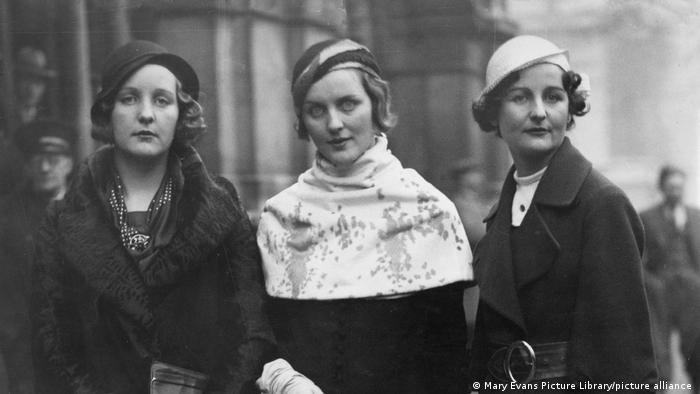
'Hitler's Girl': Unity Mitford (left) with her sisters Diana (center) and Nancy (right)

Anyone trying to dive deep into the history of British far-right and fascist movements in the 1930s is bound to come across the names of Unity Mitford and Oswald Mosley.

Rumored to have been Hitler's girlfriend, Unity Mitford's personality and ideas have been discussed in books such as David Pryce-Jones' "Unity Mitford: An Enquiry into Her Life and the Frivolity of Evil" (1977) and David Litchfield's "Hitler's Valkyrie: The Uncensored Biography of Unity Mitford" (2014).

Oswald Mosley, the leader of the British Union of Fascists (BUF) from 1932 to 1940, and his movement have similarly been analyzed in several books, including "Hurrah for the Blackshirts" (2005), Graham Macklin's "Failed Führers: A History of Britain's Extreme Right" (2020) and Richard C. Thurlow's "Fascism in Britain: From Oswald Mosley's Blackshirts to the National Front" (1998).  

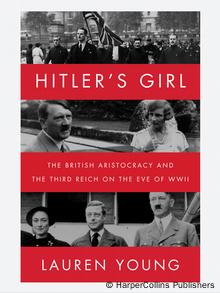
Now a new book on the topic, "Hitler's Girl: The British Aristocracy and the Third Reich on the Eve of WWII," has been published. The author, Yale lecturer Lauren Young, has used newly unclassified material for the work.

By revealing the complicity of British aristocrats with Hitler's Germany and the possible threat to British democracy at the time, Young aims to demonstrate how Western liberal democracies face the same challenges today as in the 1930s.

"We are inundated with information about the Second World War, Hitler and the Nazis. This book argues that today's challenges to democracy are similar to those of the 1930s," Young tells DW. The author and lecturer has previously taught at the London School of Economics and served as a political adviser in many international forums, including the UN.


HOW HITLER AND THE NAZIS DEFAMED ART
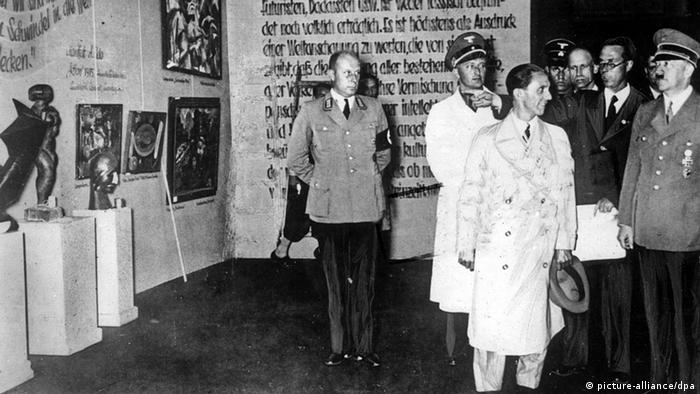
Degenerate art
Modern artworks whose style, artist or subject did not meet with the approval of Adolf Hitler and the National Socialists were labeled "degenerate art." From 1937, the Nazis confiscated such works from German museums. In a traveling exhibition, "degenerate art" was held up for public ridicule. Here we see Reich Propaganda Minister Joseph Goebbels and Hitler at the original exhibition in Munich.
12345678910


Britain in the 1930s

The book first establishes the historical background by chronicling how Germany's crushing defeat in World War I and the severe terms of the Treaty of Versailles led to financial and social crises in the country, setting the stage for Hitler's rise to power.

Young then looks into how the British aristocracy started flirting with fascism as early as the 1920s, when members of the upper class, including the Duke of Westminster, the Duke of Buccleuch and politician Harold Nicolson traveled to Italy to observe the fascist movement for themselves.

Winston Churchill, who later became Britain's prime minister, had also visited Italy during this period, leaving the country with a favorable impression of the fascists as an "antidote to the Russian poison," according to the book.

Young also examines the emergence of the British Union of Fascists, led by Oswald Mosley, and discusses how many members of the aristocracy, including Unity Mitford's family, were connected with it.

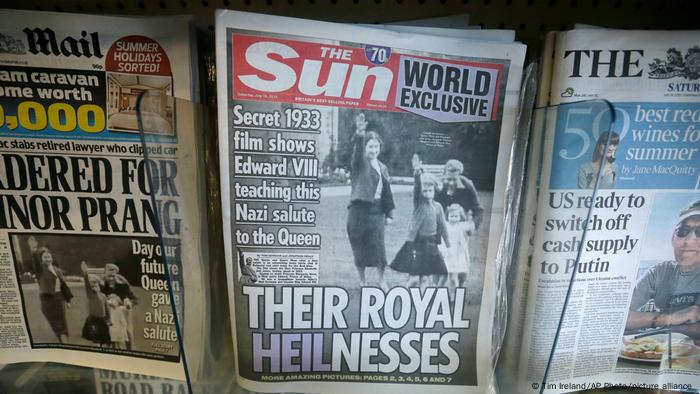
The author points out that pro-Nazi views were also found among the royal family. She mentions a 1933 video of the late Queen Elizabeth II, who was seven years old at the time, giving the Nazi salute along with her mother and her younger sister, Margaret, as instructed by their uncle, future King Edward VIII. The publication of the picture in 2015 in British tabloid The Sun caused a furor and a dismissive response by the royal family.

The Queen's Nazi salute caused a stir in the UK in 2015

The book also mentions aristocrats like the Duke of Connaught and the Earl of Kincardine showing interest in visiting a concentration camp in Germany to understand how the Nazis were implementing "race purity and fitness."

It also discusses how the cornerstone of Neville Chamberlain's foreign policy was to avoid war at all costs, and this included an unspoken rule to refuse German and Austrian Jewish refugees entry into what was then British-mandated Palestine. Chamberlain, who had preceded Churchill, was British Prime Minister from 1937 to 1940.

Even the Kindertransport to Britain could have been more robust and saved more Jewish children, had the British government been less eager to please Hitler, the author argues.

'Hitler's Girl'

The title of the book, "Hitler's Girl," was inspired by a headline from the British press in the 1930s about Unity Mitford, explains Young. As the title suggests, Mitford is a central figure in the book.

Born as one of seven children in the aristocratic Redesdale family, Mitford was — almost prophetically — conceived in the town of Swastika, Ontario, Canada and christened Unity Valkyrie. Over the years, she and her sisters, Nancy and Diana, would grow up to become "Bright Young Things," which was the nickname given by the tabloid press to describe young aristocrats and socialites in 1920s London, and flirted with the far right in Britain.

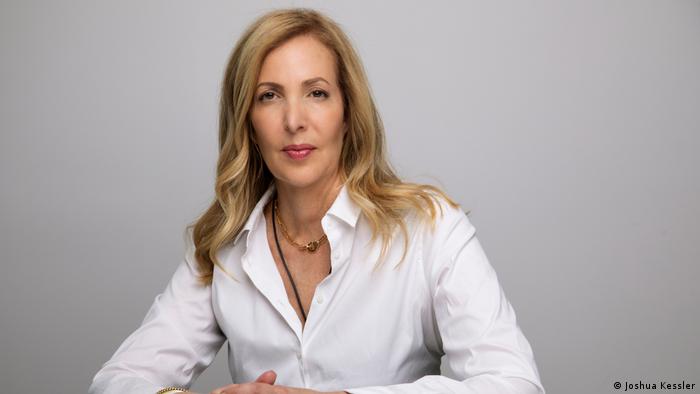
Yale lecturer and author Lauren Young

Unity's sister, Diana, famously married BUF leader Oswald Mosley. Unity herself was a fierce antisemite, completely taken in by Hitler and his personality. She even joined a finishing school in southern Germany to be able to personally meet the Führer. Altogether, she met him over 160 times.

According to Young, "everybody knew what Unity Mitford was doing. It was gossip. It was intriguing. Yet nobody thought that it was worth using her as an intelligent asset, a way to learn more about their adversary, Hitler, or even as evidence to imprison her for treason when she was repatriated to England."

The book ends with Unity Mitford coming back to England in 1939 after reportedly trying to kill herself. Despite Britain being at war with Germany, she was not tried for high treason, a subject that has been much discussed in political circles and the media at the time. She was also rumored to have had a child — possibly Hitler's child, whose birth was not recorded because the mother was not married.

The future of democracy

"Hitler's Girl" is not an attempt to find proof for what might have been, but it's about complacency and the lack of public outcry on important issues.

During the period described in the book, Chamberlain's policy of appeasement was beneficial in many respects, and there was also a groundswell of support for Hitler among the British ruling classes as well as a resurgence of right-wing movements.

Book cover Hitler's Girl: The British Aristocracy and the Third Reich on the Eve of WWII

'Hitler's Girl' was released this year on August 22

The author argues that there are many implicit parallels in today's world: "If we look at democratic erosion, for example, in America today, we have important warning signals like voter suppression legislation that has been enacted in 19 states just in this past year. Are we doing enough to protect our basic democratic right to vote," Young asks, citing examples like the recent landmark judgement by the Supreme Court overturning the constitutional right to abortion.

Ultimately, through this book, Young aims to raise awareness that "democracy is not our birth right."   

"In many cases, complacency is tantamount to complicity in the erosion of our democracy, our democratic rights, and potentially to the future as liberal democracies," she says.

Edited by: Elizabeth Grenier

Muslim women are taking off their headscarves and cutting their hair on TikTok to protest Iran's hijab rules following the death of 22-year-old Mahsa Amini

Charissa Cheong
Wed, September 21, 2022

Mahsa Amini died in a Tehran hospital on Friday.Screenshots from TikTok
  • 22-year-old Mahsa Amini died on Friday after being arrested by Iran's Islamic morality police.

  • Police detained Amini on suspicion of breaking hijab-wearing rules, reports say.

  • Muslim women are now cutting their hair and hijabs on TikTok in protest.

Women in Iran are taking off their headscarves and cutting their hair to protest the death of 22-year-old Mahsa Amini.

Amini died in a Tehran hospital on Friday after being arrested by Iran's Islamic morality police on Tuesday on suspicion of not correctly wearing a hijab — a head covering traditionally worn by Muslim women and is mandatory in Iran — according to reports.

Tehran police said Amini was arrested for the purpose of "justification and education" about the hijab, and told her family she died of a "sudden" heart attack. Her family say she had no known heart conditions, and witnesses said they saw police beating her up inside a van, according to BBC News.

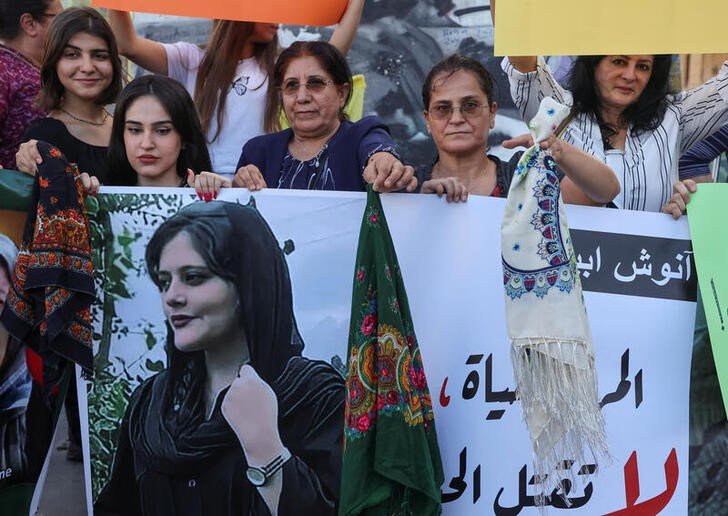
On September 18, the day of Amini's funeral, protests erupted in Iran, with women removing their headscarves and waving them in the air to protest the hijab-wearing rules that led to the arrest of the 22-year-old.

Now, Muslim and Iranian women based all over the world are joining the protests by taking off their headscarves and cutting their hair in protest on TikTok and Instagram.

@persianziba Today exactly two years ago I started wearing hijab, today I cut my hair for #mahsaamini , who was an Iranian woman that got unal!ved in Iran because of the mandatory hijab law. I cannot show the video of me cutting my hair out of religious reasons (On my story there is a censored version of the video) so as a symbol of solidarity I made a video cutting my scarf as well in order to spread the message. I am wearing one of our traditional Persian scarfs around me to represent my people as an Iranian woman. I cannot go into detail for my own safety, so please do the research and spread our message. #fy #fyp #foryou #foryoupage #freedom #help #helpus #iran ♬ original sound - em🤍

In one video with 930,000 views, a woman can be seen cutting up her black headscarf with a pair of scissors. The caption under the video read, "Today exactly two years ago I started wearing hijab, today I cut my hair for #mahsaamini." The user wrote that she did not want to cut her hair on camera for "religious reasons," but filmed herself cutting the headscarf "to spread the message."

"My heart goes out to all my female friends fighting for their basic human rights in Iran," wrote one TikToker under a video with 430,000 views, where she could be seen snipping her long hair into a shoulder-length bob.

@mayamahyari For #Mahsa Amini. My heart goes out to all my female friends fighting for their basic human rights in Iran. #mahsa_amini #mahsaamini #no_to_islamic_republic_of_iran #humanrights #womenpower #griving #Iran #iranianwomenlivesmatter #iranianwomen ♬ original sound - em🤍

Some women who don't identify as Muslim have also been posting tributes to Amini on TikTok, saying they want to "stand with Iranian women." One TikToker took part in the hair-cutting trend and showed herself standing in front of a mirror with a newly-shaved head after a caption appeared on the clip saying, "Candian women stand with you."

Many of these TikTok videos used audio from "Another Love," a pop song by English singer Tom Odell. The song is also being used on TikTok to share clips filmed at protests in Iran following Amini's death, according to captions under the videos.

Amnesty International and Human Rights Watch have both called for criminal investigations into Amini's death. Iranian state-run news agency IRNA reported that President Ebrahim Raisi has asked Iran's interior ministry to "investigate the cause of the incident with urgency and special attention.


Iran restricts access to WhatsApp and Instagram in response to Mahsa Amini protests


Mohamed Azakir / reuters


·Weekend Editor

Iran has blocked access to Instagram and WhatsApp as its government attempts to subdue protests that began last week following the death of a woman at the hands of local authorities. As of Wednesday, demonstrations across the country had been ongoing for four consecutive days. The protests began over the weekend after 22-year-old Mahsa Amini died in the custody of Iran’s morality police on September 16th. She was arrested for allegedly violating the country’s strict dress code for women.

According to internet watchdog NetBlocks (via Reuters), the Iranian government has gradually restricted web access across much of the country in recent days. The blackout began in Tehran and other parts of Iran when protests first broke out on Friday. On the evening of September 19th, the government extended restrictions to parts of the western Kurdistan province. As of Wednesday, accessing WhatsApp and Instagram through any of the country’s major internet providers was impossible. According to NetBlocks, the current restrictions are the most severe since 2019, when Iran shut down all internet access in response to fuel protests.

Meta did not immediately respond to Engadget’s request for comment. NetBlocks suggests the disruptions are likely to significantly limit the ability of the Iranian people to communicate freely. In theory, Iran’s government may believe that restricting internet access will reduce the likelihood of protestors organizing and allow it to better control the narrative of Amini's death.

US condemns death of Iranian woman in religious police custody while demonstrations erupt in Tehran
John Bowden
Wed, September 21, 2022

The US State Department has condemned the killing of an Iranian woman in police custody after she was detained for not wearing a head covering.

Outrage over the death of Mahsa Amini is growing both domestically inside Iran, according to reports from opposition groups, as well as around the world.

The 22-year-old’s death last Friday has sparked a new wave of resistance against Iran’s religious police and morality rules, including from some prominent left-leaning members of the country’s parliament. Protests have broken out in dozens of cities across the country, according to anti-government sources.

“Mahsa Amini’s death after injuries sustained while in police custody for wearing an ‘improper’ hijab is an appalling and egregious affront to human rights,” a spokesperson for Joe Biden’s National Security Council told reporters. “Our thoughts are with Mahsa’s family and loved ones.”

“Women in Iran should have the right to wear what they want, free from violence or harassment. Iran must end its use of violence against women for exercising their fundamental freedoms,” they continued. “There must be accountability for Mahsa’s death.”

In the US, protests continued with new fervour outside the United Nations’s headquarters as well as a nearby hotel where Ebrahim Raisi, Iran’s president, is staying as he attends a meeting of the General Assembly. Thousands of protesters gathered in the streets on Wednesday, demanding justice.
Anti-Raisi protesters in the streets of New York City (OIAC)

“No one can nor should remain silent regarding the barbaric murders of the young 22-year-old Mahsa Amini by this brutal regime,” said Dr Ramesh Sepehrrad, advisory chair of the Organization of Iranian-American Communities.

Maryam Rajavi, president-elect of the National Council of Resistance of Iran, added that Ms Amini’s death “ignited the powder keg in our rebellious cities”.

“Indeed, the moment this murderer enters the building that is supposed to serve the nations of the world is a moment of shame and disgrace for those who appease the ruling religious fascism, a moment that scars the conscience of humanity,” Ms Rajavi added of Mr Raisi’s upcoming speech to the General Assembly.

At least some in the body appear to agree, as the UN’s High Commissioner for Human Rights has called for an investigation into Ms Amini’s death and alleged torture.

The Biden administration remains engaged in negotiations with Iran’s leadership regarding a possible resumption of the 2015 nuclear deal signed between the Obama administration, Tehran, and a handful of European countries.

Senators on the Foreign Relations committee told The Independent on Tuesday that they had no updates about the status of those negotiations, which are opposed entirely by more hawkish members of Congress.

Wave of protests in Iran reflects seething anger over how its regime treats women

Dan De Luce and Yasmine Salam and Hyder Abbasi and Bianca Britton

Wed, September 21, 2022

She traveled to Tehran to visit relatives, a dark-haired 22-year-old woman from Iran’s Kurdistan region. But outside a subway station, the “morality police” arrested Mahsa Amini for allegedly failing to fully cover her hair, and pulled her into a police van.

Three days later, she was dead.

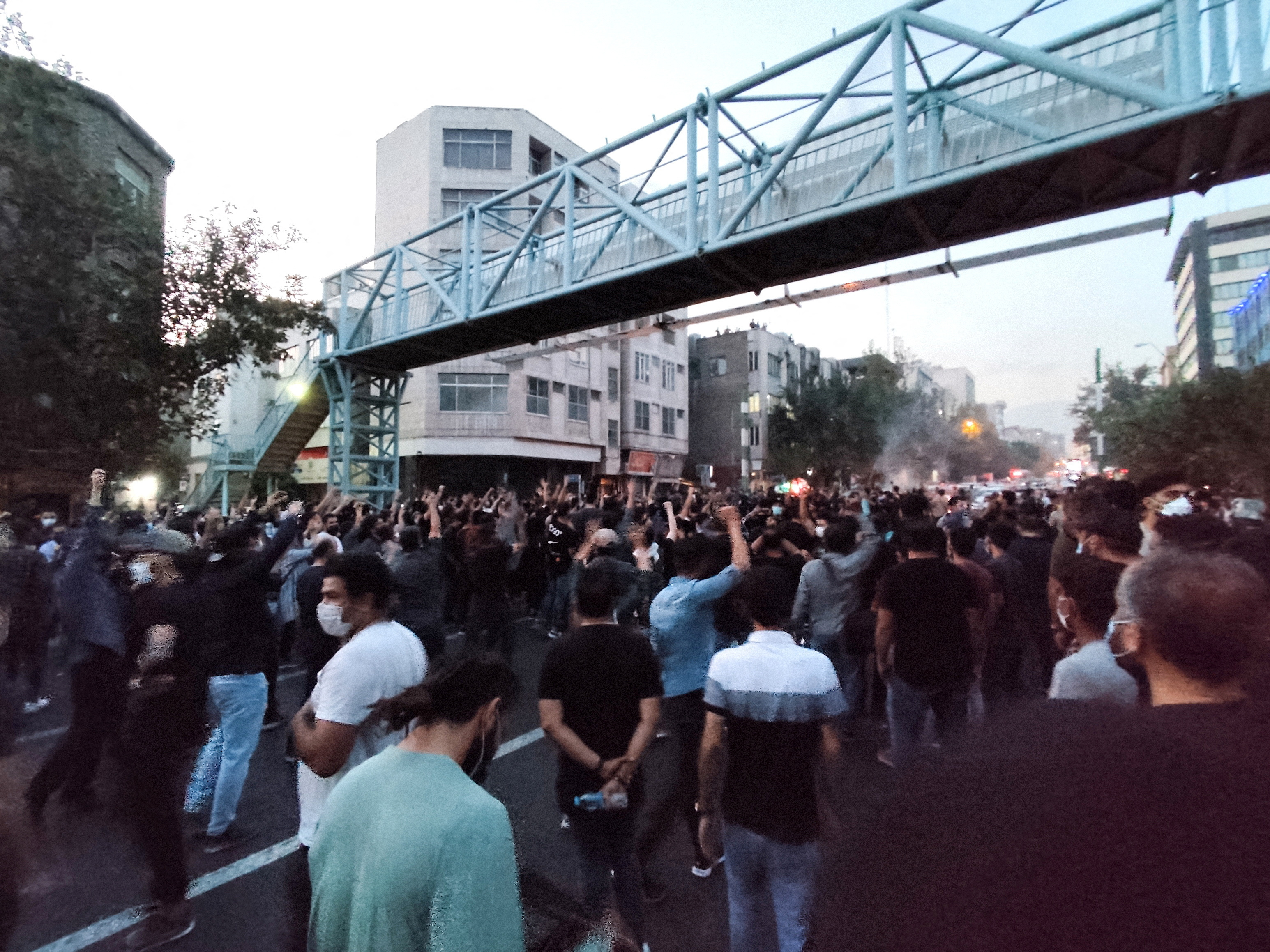
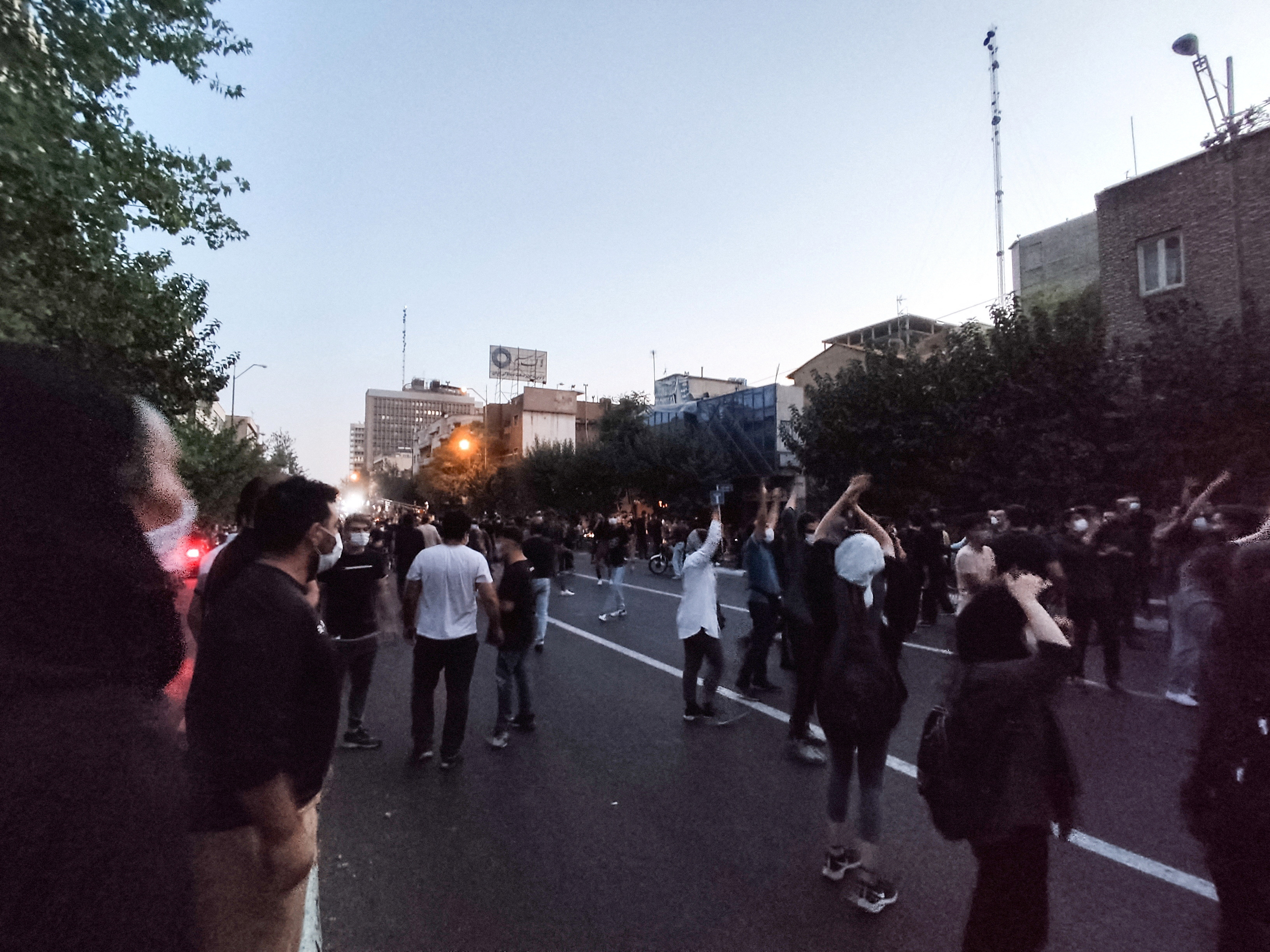
Amini’s death in the capital has ignited a wave of protests across the country, exposing a raw anger among Iranian women about their treatment by the regime and an unprecedented willingness to defy the government.

"Many people are pointing out that this could be my daughter, my sister, my wife," said Hadi Ghaemi, the executive director of the New York-based Center for Human Rights in Iran. "This has shaken people, that every time a woman leaves home, she might not come back.”

As Iran’s hard-line President Ebrahim Raisi met world leaders in New York for the United Nations General Assembly this week, extraordinary scenes have unfolded in his country, with women removing their headscarves and even burning them in front of cheering crowds, according to videos posted online.

The combination of viral videos and pent-up anger represent a potential “George Floyd” moment for Iran, Ghaemi said, with the regime now “forced into a corner given how innocent this woman was and there was no grounds for having treated her so violently.”

Iran’s U.N. mission did not respond to a request for comment.

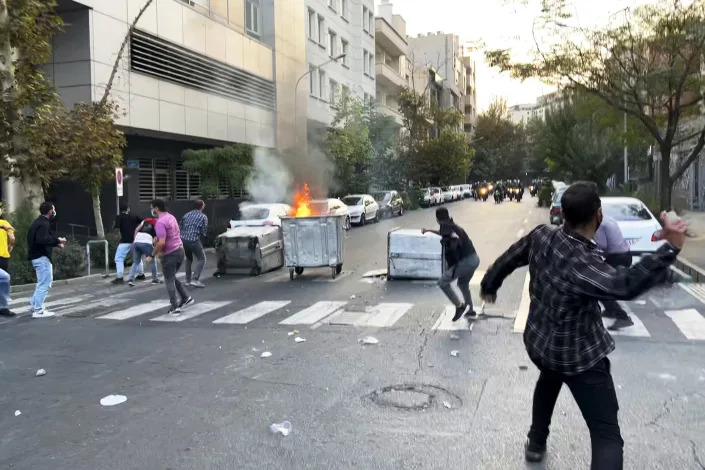
Protesters in Tehran throw stones at police during demonstrations Tuesday over the death of a young woman who had been detained for violating the country's conservative dress code. (AP)

Raisi has ordered an investigation into Amini’s death and expressed condolences to her father in a phone call, according to Iranian state media.

“I learned about this incident during my trip to Uzbekistan, and I immediately ordered my colleagues to investigate the matter specially," Raisi said on the call, according to his official website. "I assure you that I will demand this issue from the responsible institutions so that its dimensions are clarified."

The president emphasized that he considers all Iranian girls as his own children. "Your daughter is like my own daughter, and I feel that this incident happened to one of my loved ones. Please accept my condolences," he added.

Eyewitnesses — who were also in the van — told Amini’s father that she was beaten up in the police vehicle on the way to the detention center, human rights groups say. Iranian authorities, however, said she died from a heart attack and called the incident “unfortunate.”

“They said Mahsa had heart disease and epilepsy but as the father who raised her for 22 years, I say loudly that Mahsa did not have any illness. She was in perfect health,” Amini’s father told an Iranian news outlet.

Women’s rights advocates have battled the theocracy from its earliest days after the 1979 Islamic Revolution, protesting the mandatory veil or hijab, along with an array of laws that critics and U.N. rights monitors say render women second-class citizens.

But human rights groups say the women’s movement has gained new strength from social media in recent years and a younger generation more willing to confront the regime.

Since 2017, Iranian women increasingly have taken their opposition to the hijab law online, posting videos of themselves removing the headscarf accompanied by declarations that the government has no right to tell a woman how to dress.

Since Raisi was elected in June, the government has deployed more morality police units, who patrol the streets to ensure women adhere to the regime’s strict female dress code, said Raha Bahreini, Amnesty International’s Iran researcher based in London.

"One very distressing trend in recent months has been the persecution of females who defy compulsory veiling laws. The level of violence that women are facing in the street is really horrific," she said.

"And because there is now more vocal opposition, and campaigning against compulsory veiling laws in Iran, the Iranian authorities are also escalating their attacks on women in the streets," Bahreini said.

But phone cameras and hashtags have become a weapon for activists to push back, mobilize civil disobedience and expose what they allege is a surge in police repression against women.

The digital campaign has been cheered along by Masih Alinejad, an Iranian women rights activist who immigrated to the United States and has become a thorn in the side of the regime.

She invites Iranian women to post their protest videos on social media under her #WhiteWednesdays hashtag campaign. As a result, she has amassed millions of followers online and the FBI alleges she was the target of a recent kidnapping plot by the regime.

For the Iranian government, "the compulsory hijab is not just a small piece of cloth. It is like the main pillar of the Islamic Republic," Alinejad told NBC News.

"When mullahs took power in Iran, what was the first thing they did? They forced women to wear the hijab. Why? Because they use our bodies, like a political platform. So they write their own ideology on our bodies."

The regime likely fears that giving ground on the mandatory hijab rule could open the door to the whole theocratic system unraveling, said Mahsa Alimardani, a researcher at Article 19, a nongovernmental organization that promotes freedom of expression.

"They do not want to concede on this one point in fear that they would have to concede on a lot of other restrictions that help keep the regime in place," she said.

On July 12, when the Iranian government organized an annual “chastity” day to promote the mandatory hijab law, opponents organized counterprotests, posting videos of themselves removing their headscarves in public. Some of the protesters were identified and arrested, but a subsequent online protest on social media under the #No2Hijab hashtag attracted hundreds of thousands of supporters.

"The consequence of this campaign in Iran was to enrage government authorities, clergy and imams,” said Atena Daemi, an Iranian human rights activist who was imprisoned for seven years for protesting the death penalty and undertook three hunger strikes.

Government officials and clerics called for harsher penalties against women protesting the law, she said.

"Women, on the other hand, grew more motivated to continue their fight against the mandatory hijab because with each new action, they discover they are so many, they find each other, and unify and organize for the next movement,” Daemi added.

Human rights experts and activists say Iran has never wavered from its hard-line restrictions on women since the revolution, even when more pragmatic reformists have been in power.

According to Iran’s interpretation of Sharia law, women cannot travel abroad without the permission of a father or husband, are banned from singing or riding bicycles, are denied custody of their children if they remarry, can seek a divorce only under limited circumstances, can be legally married at age 13 and even younger if a court approves and can only inherit an eighth of their husband’s estate. Iran ranked 143 out of 146 countries surveyed in a recent World Economic Forum report on gender pay gaps around the world.

Image: Tehran protests (AP)

When faced with major street protests in the past, the Iranian government has responded with overwhelming force, including opening fire on unarmed protesters, according to human rights groups and Western governments. At least four people have been killed so far by police in this week’s protests, according to Iranian-focused human rights organizations.

NBC News has not verified the claims.

State media alleged that foreign agents and seditionist elements were behind the street protests.

It’s unclear if the protests will snowball further, or if the authorities will find a way to stifle the momentum of public anger.

Whatever the outcome of the current protests, Amini’s death has meant the regime is “definitely losing the battle for legitimacy,” Alimardani said.

Every prison sentence and arrest meted out by the regime has only radicalized Iranian women and served as a catalyst for more protests, Alinejad and other activists said.

“We have so many Rosa Parks in Iran. To me, I don’t see Iranian women like victims. They are like warriors,” Alinejad said, referring to the U.S. civil rights pioneer.

Daemi, one of the most prominent women’s rights advocates in Iran, said she has no plans to abandon her struggle despite the threat it poses to her health and her family.

“I am confident that humanity will win,” she said. “One day, the sun will break through the gloom.”

This article was originally published on NBCNews.com

Iran's Revolutionary Guards issue warning as protests over woman's death spread


1/6

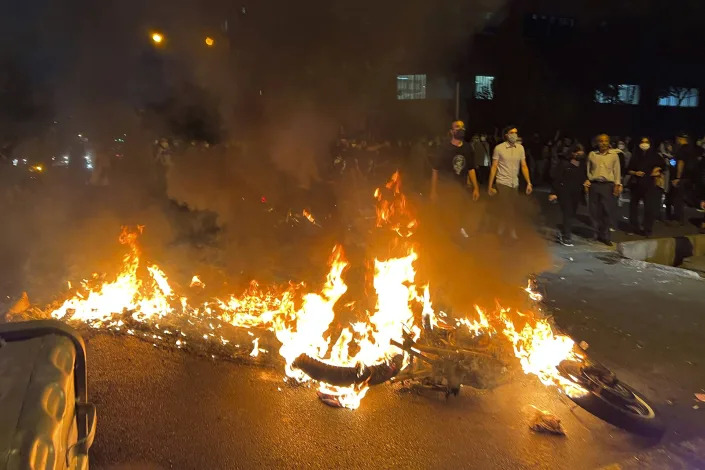
People attend a protest over the death of Mahsa Amini, a woman who died after being arrested by the Islamic republic's "morality police", in Tehran, Iran September 21, 2022. 
WANA (West Asia News Agency) via REUTERS

Revolutionary Guards issue warning over unrest

Reports of security forces coming under attack

Kurdish woman died after detention by morality police

Iranian government has pledged inquiry into her death

DUBAI, Sept 22 (Reuters) - Iran's powerful Revolutionary Guards called on the judiciary on Thursday to prosecute "those who spread false news and rumours", in an apparent bid to take the steam out of nationwide protests over the death of a young woman in police custody.

The warning was a clear indication that the elite force is prepared to step up its crackdown on demonstrations.

Protesters in Tehran and other Iranian cities torched police stations and vehicles earlier on Thursday as public outrage over the death showed no signs of abating, with reports of security forces coming under attack.

Mahsa Amini, 22, died last week after being arrested in Tehran for wearing "unsuitable attire". She fell into a coma while in detention. The authorities have said they would launch an investigation into the cause of her death.

In a statement, the Guards expressed sympathy with the family and relatives of Amini.

"We have requested the judiciary to identify those who spread false news and rumours on social media as well as on the street and who endanger the psychological safety of society and to deal with them decisively," the Guards, who have cracked down on protests in the past, said.

Women have played a prominent role in the protests, waving and burning their veils, with some cutting their hair in public.

Pro-government protests are planned for Friday and some marchers have already taken to the streets, Iranian media said.

Judiciary chief Gholamhossein Mohseni Ejei has ordered speedy action in the case of the rioters to "maintain the security and peace of the citizens", Tasnim news reported.

The United States on Thursday imposed sanctions on Iran's morality police, accusing them of abuse and violence against Iranian women and of violating the rights of peaceful Iranian protesters, the U.S. Treasury said.

The protests over Amini's death are the biggest in the Islamic Republic since 2019. Most have been concentrated in Iran's Kurdish-populated northwest but have spread to the capital and at least 50 cities and towns nationwide, with police using force to disperse protesters. Amini was from the province of Kurdistan.

A new mobile internet disruption was registered in the country, internet monitoring group Netblocks wrote on Twitter, in a possible sign that the authorities fear the protests will intensify.

On Twitter, WhatsApp said it is working to keep Iranian users connected, adding that it is not blocking Iranian numbers.

A member of an Iranian pro-government paramilitary organisation, the Basij, was stabbed to death in the northeastern city of Mashhad on Wednesday, two semi-official Iranian news agencies reported on Thursday.

There was no official confirmation of the death.

Tasnim also said another member of the Basij was killed on Wednesday in the city of Qazvin from a gunshot wound inflicted by "rioters and gangs".

Nour news, a media outlet affiliated with a top security body, shared a video of an army officer confirming the death of a soldier in the unrest, bringing the total reported number of security force members killed in the unrest to five.

An official from Mazandaran said 76 members of the security forces were injured in the province during the unrest while the police commander of Kurdistan said more than 100 security forces were wounded.

In the northeast, protesters shouted "We will die, we will die but we'll get Iran back" near a police station which was set on fire, a video posted on Twitter account 1500tasvir showed. The account focuses on protests in Iran and has around 100,000 followers.

Reuters could not verify the footage.

PERSONAL FREEDOMS

Amini's death has reignited anger over issues including restrictions on personal freedoms in Iran - including strict dress codes for women - and an economy reeling from sanctions.

Iran's clerical rulers fear a revival of the 2019 protests that erupted over gasoline price rises, the bloodiest in the Islamic Republic's history. Reuters reported 1,500 were killed.

Protesters this week also expressed anger at Supreme Leader Ayatollah Ali Khamenei. "Mojtaba, may you die and not become Supreme Leader," a crowd was seen chanting in Tehran, referring to Khamenei's son, who some believe could succeed his father at the top of Iran's political establishment.

Reuters could not verify the video.

Reports by Kurdish rights group Hengaw, which Reuters could not verify, said the death toll in Kurdish areas had climbed to 15 and the number of injured rose to 733. Iranian officials have denied that security forces have killed protesters, suggesting they may have been shot by armed dissidents.

In northern Iran, crowds armed with batons and rocks attacked two members of the security forces on a motorbike as a crowd cheered, according to footage which Reuters was unable to verify.