Thursday, November 03, 2022

THEY USED TO BE 'RUSSIAN'
Most UFOs are 'Chinese surveillance' drones and 'airborne clutter,' Pentagon officials reveal

Intelligence agencies in the U.S. have spent the last few years analyzing footage of hundreds of recent UFO encounters, and they want the American people to know: It's still not aliens.


Government officials are beginning to explain several recent UFO encounters
 Bettmann/Getty Images

According to several U.S. Department of Defense (DoD) officials who spoke anonymously to The New York Times last week, many recent sightings of UFOs — or unidentified aerial phenomena (UAPs), as the government prefers to call them — are likely just observations of foreign surveillance operations or airborne clutter, such as weather balloons.

Several UAP incidents have been officially identified as "relatively ordinary" Chinese surveillance drones, the anonymous officials said. China has previously stolen plans for advanced U.S. fighter planes, and is interested in how the U.S. trains its pilots, the DoD officials added.

Other UAP sightings recorded by military aircraft, which appear to show airborne objects moving in seemingly physics-defying ways, are likely the results of optical illusions. This includes the infamous video known as "GOFAST," which was recorded by a U.S. Navy aircraft and leaked to the media in 2018. (The video, along with two other leaked films of military encounters with UAPs, was eventually declassified by the government.)

While the object in the GOFAST video appears to be zooming over the water at incomprehensible speeds, this is just an optical illusion created by the angle of the recording relative to the water, the DoD officials told The Times. In reality, the object is moving at no more than 30 mph (48 km/h), the officials added.

A classified UAP report delivered to Congress this week by the DoD's intelligence agencies likely includes the findings reported by The Times. The new report adds new details to cases described in a document that officials publicly released in June 2021, describing 144 alleged UAP incidents reported by U.S. government personnel between 2004 and 2021.

The 2021 report acknowledged that, due to a lack of high-quality data, most alleged UAP encounters could not be conclusively explained. However, the report offered several blanket explanations for UAP in general, including "technologies deployed by China, Russia, another nation, or a non-governmental entity," as well as "airborne clutter" such as birds and weather balloons.

Nowhere in the report were aliens or extraterrestrials mentioned — however, that did not stop alien conspiracy theories from arising, due in part to the government's general lack of transparency about UAP incidents.

Sue Gough, a DoD spokesperson, told The Times that the government was committed to sharing whatever UAP information it could without putting national security at risk. Government officials also tend to refrain from discussing UAP incidents publicly because there is simply not enough data to conclusively explain them, Gough added.

"In many cases, observed phenomena are classified as 'unidentified' simply because sensors were not able to collect enough information to make a positive attribution," Gough told The Times. "We are working to mitigate these shortfalls for the future and to ensure we have sufficient data for our analysis."

As the DoD continues its investigation into UAP sightings, NASA has also launched an independent UAP study team, which will operate from October 2022 to mid-2023. According to NASA, the team will focus on collecting and analyzing as much UAP data as possible, in order to develop new methods for identifying the unidentifiable objects in America's skies.

Prepare for alien encounter now before it's too late, warn scientists

Sarah Knapton - Yesterday - The Telegraph

Aliens could get in touch tomorrow and we must know what to say to them, scientists have warned, as they launched a new research hub to prepare humanity for first contact.

The University of St Andrews has joined forces with the UK SETI (Search for Extraterrestrial Intelligence) Research Network to establish protocols and procedures if aliens are found.

The team warn that although there are measures in place for dealing with threats posed by asteroid impacts, there is no agreed response if a radio signal were picked up from another intelligent lifeform.

The Seti Post-Detection Hub will bring together experts from around the world to decide how to decipher methods, enact space law and anticipate societal impacts.

Dr John Elliott, honorary research fellow in the School of Computer Science at St Andrews and coordinator of the Hub, said: “Will we ever get a message from ET? We don’t know. We also don’t know when this is going to happen.

“But we do know that we cannot afford to be ill prepared – scientifically, socially, and politically rudderless – for an event that could turn into reality as early as tomorrow and which we cannot afford to mismanage.

“We need to coordinate our expert knowledge not only for assessing the evidence but also for considering the human social response, as our understanding progresses and what we know and what we don’t know is communicated. And the time to do this is now.”

Truth is out there

The potential for problems in communicating with alien life was explored in the fourth instalment of the Star Trek film franchise, The Voyage Home.

In depicts an alien probe sending out a message that inadvertently plays havoc with human technology with the crisis only resolved when Kirk and his crew realise it is trying to communicate with the planet's whales.

Many scientists now think that intelligent life elsewhere in the universe is a real possibility, and Nasa recently launched an eight-month inquiry to investigate hundreds of unexplained UFO sightings.

The investigation into "unidentified aerial phenomena" is being led by Dr Thomas Zurbuchen, of Nasa’s Science Mission Directorate, and is due to report back next summer.

Last year, the Pentagon's Unidentified Aerial Phenomena Task Force released a report into 144 UFO incidents between 2004 and 2021, many of which were spotted by military pilots.

Although investigators concluded that there was no evidence the objects had come from outer space, or a foreign adversary, they said that most could not be explained.

Protocols need updating

Currently, the only existing agreed "contact" protocols for encountering alien life were drawn up by the SETI community itself in 1989, and have not been revised since 2010. But they focus entirely on scientific conduct.

The Royal Society held a Scientific Discussion Meeting on "The detection of extra-terrestrial life and the consequences for science and society" in 2010 but there has been no global agreement on how to handle contact.

Learning how to decipher an alien language or method of communication is likely to be one of the major hurdles that experts will need to consider.

In a recent BBC documentary First Contact: An Alien Encounter, scientists admitted it may never be possible to understand what aliens are trying to tell us.

Dr Alexander Rehding, professor of music at Harvard University, said humans had still not learned how to translate animal communication.

“Whales are a really good study, and they are in some ways the closest thing that we have to aliens here on Earth,” he said.

“Whales are highly intelligent, and their environment is entirely different from ours. The patterns that we hear are purely patterns that we recognise as music, repeated patterns.

“It is a form of vocalising but we don't really know what it's for. Is it music, is it a language? What does it mean? It can give us a sense of how difficult the task at hand is.”


Mr Spock and whale

Dr Elliott admitted that deciphering an alien language would be tricky without some kind of extraterrestrial Rosetta Stone.

“Nevertheless, much can be gleaned, without this. Language for intelligent species has a structured system that is multi-layered and has internal structure," he said.

“By identifying any patterns within the signal and calculating how these patterns interact, we will then be able to know if it passes this initial surface structure test for displaying evidence of being language-like.

“If so, we will then be able to move on to identifying internal structures displayed by all known intelligent species. Once this is done, we can then move onto deeper levels of ‘syntax’ to ultimately where it ‘meets’ semantics.”

William Borucki, a former Nasa space scientist, added: “When I look at how Hollywood portrays contact, one of the things that I think is unreal, is that people that can readily communicate and have similar ambitions, similar responses.

“But when I think about intelligent life, and the variety of it on Earth, we've got dogs, we've got apes, we've got octopi that have their intelligence in their arms, not in their head.

“We can't talk to most of the creatures on Earth in an intelligent way. How are we going to talk to intelligent civilisations? I'm not sure we'll ever understand.”


Black Women Share The Unseen Suffering Of Sickle Cell Disease

Sometimes the chronic pain that Precious Gaza experiences is so severe that she has to be hospitalised. While she cries in agony and screams in pain, nurses tending to her sometimes question the severity of her sickle cell anemia symptoms.


“It’s hard to get people to understand the pain sufferers like me go through. I’m not visibly ill, so people often assume I’m healthy and well, and because I look fine my pain is downplayed,” Precious explains. “People sometimes think we are lazy or are just exaggerating about the pain.”

Those suffering from invisible health conditions like sickle cell disease are accustomed to this pernicious scepticism. Yet the stark reality is that this denial is further intensified for Black women and other women of colour.

Black Equity Organisation commissioned a study that revealed how a significant number of Black people living in the UK face discrimination by healthcare professionals. Over 65% said that they had experienced prejudice from doctors and other staff in healthcare settings. And this figure increased among Black people aged 18 to 34 to 75%.

Systemic racism is so deeply entrenched in our healthcare systems that it is leading to deadly consequences. Cue: the Black Maternity Scandal last year. Rochelle Humes went undercover with UK broadcaster Channel 4 Dispatches to discover that Black women in the UK are four times more likely to die in pregnancy and childbirth than white women.

Reflecting on these shocking statistics, Precious urges: “healthcare racism needs to be taken more seriously and formally addressed. It’s endangering lives and causing complications for people like me who just want to get better.”

Precious is just one of approximately 15,000 people suffering from sickle cell disease, an inherited blood disease prevalent in the Black community. At least 25% of West Africans and 10% of Afro-Caribbeans are affected, while it is uncommon amongst white Europeans. Those originating from the Mediterranean, Asia, and the Middle East are also more susceptible to the condition.

As the fastest-growing genetic condition in the UK, the demand for blood donors in the Black community has increased significantly. Just recently, the UK’s national health service (NHS) made an urgent call for blood donations from Black donors to help sickle cell patients. Often those from the same ethnic background are more likely to have the same blood groups. And for blood transfusions to work, you need well-matched blood groups.

To address this demand, the NHS Blood and Transplant recently launched a new campaign titled ‘Not Family, But Blood’ to recruit more donors of Black heritage.

Red blood cell transfusion treatments are essential for sickle cell sufferers to help treat and prevent their condition. These treatments decrease the concentration of sickle haemoglobin in a patient’s bloodstream, helping them to avoid any further health complications.


Growing up, the fear of having an unexpected episode affected Precious’ ability to live an active social life. “As a child, I always had to shield myself to avoid risks to my health. I could never travel on my own and I couldn’t go anywhere without a chaperone. Whether that’s through making friends or being unable to attend regular social events like birthday parties or sleepovers, she is always in fear of having an episode.”

When dating, she would worry about disclosing her health condition and being seen as a burden when a relationship would get serious. A crucial factor for people with sickle cell trait is that in case they may want children, they need to be aware of their partner’s genotype so they can ensure a healthy pregnancy. This is something she has had to always consider when getting into a serious relationship.

Before she met her current partner, guys would assume that they’d have to become her primary caretaker. “A lot of people worry about the responsibilities and sacrifices they might have to make, so they back away. I’m lucky that I have finally found someone who truly loved me for me.”

Many suffering from health conditions like sickle cell also struggles to work typical 9-5 hours while handling chronic pain. It’s clear workplaces are failing those with chronic illnesses by not making the necessary arrangements to support them or, in most cases, just not hiring them. Out of fear of being seen as a liability, many like Previous suffer in silence. “For someone that has sickle cell, working 8 hours long every single day is not sustainable. I kept getting pushed out of jobs because I would have endless episodes, and this had a huge impact on me financially.”

This left her with no choice but to build her own business and become self-employed. Her previous employers have been unwilling to adjust working practices and she often found herself dismissed on the basis that her condition was too ‘unpredictable.’

Even when onboarding for a new role, Precious would go for medical examinations, and as soon as her sickle cell condition was identified, she’d be eliminated from an application round. “Sometimes they would make up an excuse or say that they don’t have the financial capacity to hire me.”

Frustratingly, sickle cell awareness is low and often overlooked, unlike the more prominently known illnesses and diseases, like cancer and leukaemia. Concerted efforts have been made to change this, but they don’t go deep enough to create a true impact. September is recognised by many organisations, including the WHO (World Health Organisation) as Sickle Cell Awareness Month, but this month does little to give the condition visibility.

“Sickle cell awareness often goes unseen. We need a bigger platform to raise funding, research, and a spotlight for people to tell their stories,” says Precious. “There needs to be reorientation for healthcare workers. Partner with sickle cell charities and get sickle cell advocates to train and educate. There’s so much more to be done.”

Growing up awareness of sickle cell was virtually non-existent, so it is a relief for Precious to see that some strides are being made to change this. She has created a social media community where she calls herself and her peers ‘sickle cell warriors,’ sharing infographics, videos, and posts educating users on the condition.

“I’m always making sure to be active in raising awareness among my friends and family,” she continues. “I create content on social media as much as possible to create as much awareness. Every opportunity that comes my way to bring awareness, I jump on it.”

Precious has hope that one day that she will be cured of sickle cell and finally be able to live pain-free. She is currently fundraising for a bone marrow transplant which could provide her with healthy cells and replace her damaged blood. Such procedures are costly and invasive, but it is the opportunity that could finally give Precious the life she dreams of.

Meanwhile, the online community of sickle cell warriors has been a powerful source of strength and comfort for her. “Sometimes we meet in person, or we catch up via zoom to share our daily struggles, be vulnerable and encourage each other to keep going.”

“When it comes to sickle cell and sickle pain, no one else understands, except another person who also suffers from sickle cell. We use this understanding to be there for each other, and this experience truly makes us feel finally seen.”

This article was originally published on Unbothered UK
STILL A DEATH SENTENCE
Man jailed 30 years for crime he didn't commit dies soon after release

Postmedia News -


A Tennessee man who spent 30 years in jail for a crime he didn’t do died not long after finally being released from jail, according to reports.

Claude Garrett, 66, died in his sleep after just six months of freedom, earlier this week.

He had been released from Riverbend Maximum Security Institution in May, according to his friend Liliana Segura, as reported by the Daily Star .

“Since then, and over the past 5 months, Claude relished his freedom. He enjoyed every moment with his daughter, Deana, and especially his grandson, who he absolutely adored,” Segura wrote.

Garrett had been convicted of the 1992 murder of his girlfriend Lorie Lance, who died in a fire in their home after they had gone to a bar.

Garrett said he’d fallen asleep and tried to save Lance, who he said he woke up and tried to take to the front door. Instead, he said, she went to the back door and he went out the front and called firefighters.

As firefighters tried to get the fire under control, Claude kept telling them “I don’t understand why, I don’t understand why she didn’t follow me out the door,” according to the report.

After the fire was eventually extinguished, firefighters later found Lorie’s body in a utility room. She had died from smoke inhalation.

On Aug. 20,1993, after two and a half days of deliberations, the jury found Claude Garrett guilty of first-degree murder. He was sentenced to life in prison because of alleged signs of arson.

Earlier this year, after years of appeals, Criminal Court Judge Monte Watkins wrote that Claude had shown “actual innocence”.

The forensic finding that suggested arson was dismissed as “junk science.”
The US federal government wants to stop your boss from spying on you

jzinkula@insider.com (Jacob Zinkula) - 

ljubaphoto/Getty Images© Provided by Business Insider

Companies are using surveillance technologies to keep tabs on remote workers.

But a top government labor lawyer says some employers have gone too far.

Under current law, some level of employee surveillance is generally allowed.


With more of their employees working from home, many companies are taking steps to keep tabs on them. But the federal government says some of this surveillance has gone too far.


In a memo released Monday, the top lawyer for the National Labor Relations Board, a federal government agency dedicated to protecting worker rights, said she will work to protect US employees from "intrusive or abusive electronic monitoring and automated management practices."

This "omnipresent surveillance" is happening almost everywhere, wrote the NLRB's General Counsel Jennifer Abruzzo, as employers "closely monitor and manage employees."

In warehouses, some employers "record workers' conversations and track their movements," she said. On the road, some drivers are subjected to "GPS tracking devices and cameras." In the office, some companies are monitoring employees with "keyloggers" that track what a worker types into their computer and software that "takes screenshots, webcam photos, or audio recordings" over the course of the work day. And even at home, many companies continue to monitor workers with "employer-issued phones or wearable devices."

But Abruzzo says each of these practices deserves scrutiny.

"An employer's right to oversee and manage its operations with new technologies is not unlimited," she said.

As remote work has emerged, companies ranging from Amazon to Microsoft to JP Morgan have expressed concerns that workers are slacking off when they're not in the office. In a September Microsoft survey of 20,000 people across 11 countries, 85% of managers said it was difficult to tell whether remote workers were being productive. Some experts have called this "productivity paranoia" a sentiment that's led some companies to expand the use of various surveillance technologies. But worker advocates like Abruzzo are concerned that this practice has gone too far.

Along with infringing upon workers' privacy, the General Counsel said this surveillance could also be used to disrupt union organizing — something Amazon has been accused of in the past — and collect vast amounts of data on workers.

"Some employers use that data to manage employee productivity, including disciplining employees who fall short of quotas, penalizing employees for taking leave, and providing individualized directives throughout the workday," she said.

These are among the reasons Abruzzo's memo called on the NLRB to review companies' surveillance technologies and assess whether they restrict workers' rights. In the meantime, she recommended that employers be required to disclose the technologies they are using to their employees, as well as the reasons they are doing so.

While the emergence of remote work has brought this surveillance into the spotlight in recent years, the legal landscape remains murky.

In October, a Florida-based company was forced to pay $73,000 to a Dutch worker who was fired for refusing to turn on his webcam during a virtual training program.

But while the Dutch court sided with the worker, legal experts told Insider a US worker would have likely faced a different outcome. That's because most Americans work in states with at-will employment, meaning either they or their employer can end their employment agreement at any time and for almost any reason.

Though there are some reasons for which firing an employee can be illegal, "the scope for what's illegal is narrow," Cody Yorke, an associate at employment law firm Outten & Golden's New York office, previously told Insider. Therefore, it's "probably not" illegal, Yorke said, to make a US employee leave their camera on all day, adding that federal laws around employee privacy are "kind of outdated."

The Monday memo suggests that the National Labor Relations Board is working to get up to speed. Going forward, the agency is expected to utilize laws already in place to protect workers, as well as push for more comprehensive legislation if necessary.
Prison watchdog raises concerns again about conditions at Edmonton Institution

Madeleine Cummings - CBC


Correctional Investigator Ivan Zinger has once again singled out the Edmonton Institution in his office's annual report, describing "oppressive" confinement conditions and staff shortages observed by his staff last year.


Correctional Investigator Ivan Zinger wrote about problems at Edmonton Institution in his annual report.© Nathan Gross/CBC

The federal maximum security prison was the only one in the country to have its own section in the annual report, which is dated June 30 but was released publicly last week.

As CBC News reported in January, staff from Zinger's office visited the prison over three days about a year ago and spoke with prisoners, staff and managers.

The investigators found the prison was overpopulated and understaffed, with no programs or meaningful work opportunities for inmates. More than 250 prisoners shared a single computer visitation station and the wait for accessing mental care was a year long.

Zinger said Correctional Service of Canada Commissioner Anne Kelly responded to his concerns on Dec. 8 and assured him that corrective measures were underway.

These measures included reinstating population management and citizen advisory committee meetings, establishing an inmate welfare committee, installing more video visitation consoles and addressing staff recruitment and retention problems.

"Though the situation at Edmonton Institution is still far from ideal and the systemic problems brought forward are far from resolved, the collaboration and responsiveness of the commissioner in trying to address office findings and concerns is encouraging," Zinger wrote in his annual report.

He said his office will continue to closely monitor the prison and intervene as necessary.

Edmonton Institution was also mentioned in a section of the report about discrimination and differential treatment.

One individual, who had spent time at the Edmonton prison, reported intentional and pervasive discrimination and racism toward Black prisoners and staff.

In a response to the report, Kelly wrote that she would continue to try to improve correctional environments. She suggested CSC create an action plan addressing the relationship between use-of-force and systemic racism against Indigenous and Black individuals and expand staff diversity training that is "oriented to practical and lived experiences of Black people."

In a statement on Tuesday, Public Safety Minister Marco Mendicino said he looked forward to seeing CSC "step up efforts to support the mental wellness of inmates" and that he would ensure progress is made on the issues mentioned in the report.

Union sees problems persist in Edmonton

James Bloomfield, prairies regional president for the Union of Canadian Correctional Officers, said conditions for staff at Edmonton Institution have declined since June.

He said there has been a lack of stability in management and officers are demoralized. Between 20 and 30 per cent of them are on leave due to mental and physical injuries sustained at work, he added.

He called the correctional investigator's report "just the tip of the iceberg," and said the investigators would have heard a fuller story had they spoken with the union.

The union is asking the commissioner to train managers and improve communication between management and staff.

"We'd like to see some tangible actions at that site that prove that they are making it better for their staff," he said.

Consider rehabilitation goals: advocate

Chris Hay, executive director of the John Howard Society of Alberta, said further punishing inmates goes against the goal of helping them become law-abiding citizens.

"If you treat someone like an animal, they will behave like an animal," he told CBC News on Wednesday.

He said inmates need social and community supports to succeed once out of prison so limiting video call opportunities doesn't make sense.

He said it would be unrealistic to expect that people locked up in cells for 21 hours a day, with no access to programs, could successfully reintegrate into society upon their release.

"I am not condoning their behaviour," he said. "I'm just saying, put on your logical thinking cap and think about the outcomes you want to achieve."

Hay said he was happy to see CSC has announced some changes and hopes the correctional investigator follows up to see if conditions improve.

Can anyone block Ontario legislation designed to impose a contract on education workers?

Isaac Callan and Colin D'Mello -

Ontario Premier Doug Ford and members of province's legislature pay tribute to Queen Elizabeth in Toronto on Wednesday September 14, 2022.

Tensions flare over Ontario’s plan to use notwithstanding clause to quash education strike

The Canadian Civil Liberties Association is calling Bill 28 a “catastrophe” for Canadian rights and freedoms and vows to fight the legislation in court.

The Doug Ford government's decision to invoke the rarely used notwithstanding clause to impose a contract on education workers in Ontario has raised eyebrows and ire from as far away as the federal government.

Canada's justice minister and prime minister both condemned the move, and an emergency debate was demanded on Parliament Hill.

But it remains unclear if anyone can — or will — block the province's new anti-strike legislation.

Read more:

As unionized education workers across Ontario prepare to strike from Friday "until further notice" over broken contract negotiations, the province is rushing through legislation that will outlaw the strike and impose a contract on them.

The proposed bill — Keeping Students in Class Act — relies on the notwithstanding clause to block challenges from courts and tribunals.

The notwithstanding clause, or Section 33 of the Charter of Rights and Freedoms, gives provincial legislatures or Parliament the ability, through the passage of a law, to override certain portions of the Charter for a five-year term.

In the Ford government's new legislation, the clause is used to protect the bill from potential legal challenges — explicitly overriding Canadian human rights laws.

"The Act is declared to operate notwithstanding sections 2, 7 and 15 of the Canadian Charter of Rights and Freedoms and the Act will apply despite the Human Rights Code," the bill's explanatory note says.

Read more:

In government talking points obtained by Global News, Ontario's minister of education is instructed to say that the province does "not take this step lightly."

"We believe the Act, if passed, is justified and would not violate the Charter or Human Rights Code," one bullet point reads, despite the wording of the proposed law.

The talking points argue that the province's hand "has been forced."

"What (Doug Ford) is doing — I think everybody would agree — is something he can do," Andrew McDougall, an assistant professor with the University of Toronto Scarborough, told Global News.

He noted the notwithstanding clause was generally used in "the most extreme situations."

"A lot of people would, I think, say that this particular situation falls short of that and it's an inappropriate use of it even though he might technically be allowed to use it."

Read more:

Canada's justice minister is among those who say a standoff with CUPE does not meet the threshold the clause was designed for.

David Lametti indicated on Tuesday the federal government has the option to challenge Ontario in court but has yet to make a decision on next steps.

“The use of the notwithstanding clause is very serious. It de facto means that people’s rights are being infringed and it’s being justified,” Lametti said.

Canadian Prime Minister Justin Trudeau called its use "wrong."


However, the Ministry of Justice would not explain or elaborate on the potential to intervene — either if it would act or how that might work.

In response to questions from Global News, a spokesperson for the Ministry of Justice condemned Ontario's use of the clause and said the province "must explain" its actions but did not lay out any steps Ottawa might take.

"I will be waiting with great interest to find out if (the minister) comes up with any particular legal argument in the next couple of days," McDougall said.

One option that is theoretically available to the government is the disallowance clause of the constitution. It allows the federal government to overrule and throw out a provincial law within two years of its creation.

Carissima Mathen, a professor with the University of Ottawa's law program, said the clause is not a realistic option for the government.

"It would probably lead to a serious rupture in federal-provincial relations that would be destabilizing for the entire country," she said.

"It is understandable that people would be looking to unorthodox methods to stem a disturbing trend of treating the Charter of Rights as an inconvenience rather than one of Canada’s defining features. Unfortunately, there is not much that the federal government, acting alone, can do about that."

The Prime Minister's Office said Wednesday night that Trudeau and Doug Ford had spoken about Ontario's use of the notwithstanding clause.

A statement said Trudeau "was clear that the preemptive use of the Canadian Charter of Rights and Freedoms’ notwithstanding clause is wrong and inappropriate."

Mathen said the federal government could refer the question of limits to the notwithstanding clause to the Supreme Court of Canada for an advisory opinion or even pass its own legislation "that imposes limits on use of the clause at the federal level, and urge provinces to do the same."

The Canadian Civil Liberties Association — which acknowledges that little can be done to force the Ford government to change course — also indicated Ottawa should consider reopening the constitution to remove the availability of the clause.

Read more:

In Ottawa on Wednesday, the NDP sought and was denied an emergency debate on events at Queen's Park.

“There is a clear interest for this parliament to debate the trampling of constitutional rights and the implication it will have for everyone in Ontario and across the country," stated a letter to the Speaker, signed by NDP MP Matthew Green.

The NDP also introduced an unsuccessful unanimous consent motion Wednesday asking the House of Commons to “reject any intervention aimed at restricting the collective rights of workers to freely negotiate their working conditions.”


Ontario's proposed bill also sets out to limit the ability of tribunals and arbitrators to step in.

It says that an arbitrator, mediator-arbitrator, arbitration board or any administrative tribunal will not be able to make any decisions around the provisions within the proposed law or determine if it flies in the face of the Human Rights Code.

The same parties will not be able to decide if the actions of the government or its ministers are "constitutional or ... in conflict with the Human Rights Code."

The Ontario Human Rights Commission — the province's human rights watchdog — told Global News it had "no comments."

— with files from Global News' Rachel Gilmore

'Dangerous' and 'draconian': Labour experts pan Ontario's notwithstanding clause use

TORONTO — Ontario's pre-emptive use of the notwithstanding clause in legislation intended to prevent a strike by education workers is a dangerous and draconian move that could have implications for labour negotiations across the country, experts say.


The Progressive Conservative government passed legislation Thursday that imposes a contract on education workers with the Canadian Union of Public Employees and bans them from striking. The legislation says the government intends to invoke the notwithstanding clause to keep the eventual law in force despite any constitutional challenges.

It's the first time in Ontario's history, and just the second time in Canadian history, that the controversial clause -- which allows the legislature to override parts of the Canadian Charter of Rights and Freedoms for a five-year term --has been used in back-to-work legislation.

"This intervention is incredibly dangerous because it is basically the government saying, we know we are violating these workers' constitutional rights, and we're going to do it anyways," said Stephanie Ross, the director of McMaster University's school of labour studies.

The use of the notwithstanding clause has roiled unions and shocked observers across the country, who fear it could embolden other governments to quash one of the most powerful pieces of leverage a union has in negotiations, without constitutional recourse.

The move not only has significant implications for other major education unions currently negotiating with the province, but for unions across the country, Ross said.

"I don't think any worker in Ontario or Canada should rest easy with the recourse to the notwithstanding clause to override workers' rights," she said.

While the Saskatchewan government invoked the notwithstanding clause in 1986 in strike-ending legislation, Ontario has taken the unprecedented step to include the clause in legislation before workers hit the picket line.

Education Minister Stephen Lecce has defended the use of the clause, saying it is to prevent disruptions to classroom learning because of strikes or litigation.

Despite the legislation, CUPE has said its 55,000 education workers, including custodians and education assistants, will strike Friday and "until further notice," risking fines imposed in the legislation of up to $4,000 per employee and $500,000 for the union per day.

Mediation between CUPE and the government concluded Thursday with no deal ahead.

Lecce had said he wouldn't negotiate further unless the union cancelled its strike.

In negotiations, the union had asked for annual salary increases of 11.7 per cent for its workers, who it says make on average $39,000 and are among the lowest paid in schools. The government has said the new, imposed four-year deal would give 2.5 per cent annual raises to workers making less than $43,000 and 1.5 per cent raises to all others, though the union has argued those figures are inflated.

The use of back-to-work legislation has been increasingly common since the 1980s, said Charles Smith, co-author of "Unions in Court," a history of the labour movement's engagement with the Charter. He said it eventually led the Supreme Court in 2015 to declare the right to strike as constitutionally protected.

Smith noted a union still must follow several steps before it can legally picket, including negotiations, a strike vote and a strike notice.

He called Ontario's move "extremely heavy-handed" and "draconian."

"The union played by the rules and the government is essentially rewriting those rules in its favour," said Smith, associate professor at St. Thomas More College at the University of Saskatchewan.

The Ontario Liberal government's 2012 back-to-work legislation imposing contracts on striking education workers and teachers was eventually found to have violated bargaining rights, with the government paying millions of dollars in compensation to the unions.

This time around, the government's use of the notwithstanding clause could be seen as a way to avoid those financial costs, said Alison Braley-Rattai, associate professor of labour studies at Brock University.

"It is hard not to read it any other way than wanting to dictate contract terms then not having to pay out the other end for a violation of their Charter rights," she said.

While the union has limited legal routes to contest the law, Braley-Rattai said the move could spark momentum for a larger political response.

"It takes the ability to organize quickly and comprehensively to capitalize upon that spark," she said.

Unions across the country have voiced solidarity with the CUPE education workers, calling on members to support an Ontario-wide protest on Friday and in some cases vowing to walk out themselves.

Canadian Labour Congress president Bea Bruske said in her 30 years in the labour movement, she does not "remember a time when there was this much immediate response to something that egregious."

She said along with joining picket lines, the congress has discussed possible work-to-rule measures.

"With this government, we have no choice but to look at every option possible as a fight back," she said.

"If other provinces adopt this kind of tactic, that's hugely problematic. But what I'm worried about is that it will also embolden employers to use a bully method, rather than coming to the bargaining table to actually be proactive."

Ross, the McMaster professor, said other support measures could include donations to CUPE or partial student and teacher walkouts. There is also the possibility of wildcat strikes -- informal, illegal actions where unionized workers strike without following the formal legal process.

But she said the first test of broader labour movement solidarity in this dispute will come Friday, if scheduled job action goes forward.

"We'll be watching to see not just how mobilized the union itself is but whether or not the broader labour movement comes out in support and in what numbers," Ross said.

This report by The Canadian Press was first published Nov. 3, 2022.

Jordan Omstead, The Canadian Press


Trudeau tells Ford use of notwithstanding clause is 'wrong and inappropriate' in call

Yesterday 

OTTAWA — Prime Minister Justin Trudeau told Ontario Premier Doug Ford on Wednesday that his pre-emptive use of the notwithstanding clause in legislation intended to keep education workers from striking is "wrong and inappropriate."


NDP MP calls for emergency debate on Ford's use of notwithstanding clause© Provided by The Canadian Press

"The Prime Minister emphasized the critical importance of standing up for Canadians’ rights and freedoms, including workers’ rights," Trudeau told Ford, according to a readout of the call provided by the Prime Minister's Office.

"He was clear that the pre-emptive use of the Canadian Charter of Rights and Freedoms' notwithstanding clause is wrong and inappropriate, and should only ever be used in the most exceptional of circumstances."

Ford's office, meanwhile, said the premier told the prime minister that allowing education workers to strike would have an "unacceptable" effect on students after two years of disruptions due to the pandemic.

"He also reiterated that Ontario is determined, if necessary, to pass legislation to keep classrooms open and ensure certainty and stability for parents and students now and in the future," the readout provided by the province said.

The union representing the 55,000 affected education workers in Ontario said it still plans to hold a strike starting Friday and it will continue indefinitely, despite the looming legislation expected to pass Thursday that would make that illegal.

The legislation says the government intends to invoke the notwithstanding clause -- which allows the legislature to override parts of the Canadian Charter of Rights and Freedoms for a five-year term -- to keep the eventual law in force despite any potential constitutional challenges.

The Liberals have been critical of the Ford government this week, with Trudeau previously describing the legislation as outright "wrong."

Earlier Wednesday, Trudeau said his government was looking at its options to respond to Ford's use of the notwithstanding clause.

He made the brief comment in French outside the House of Commons moments after NDP Leader Jagmeet Singh called for more action from the federal government.

Related video: Interim NDP leader Peter Tabuns among 16 MPPs kicked out of Ontario legislature    Duration 2:55    View on Watch

"We’re seeing right now a clear attack on workers, on vulnerable workers and on workers’ rights. There has to be a response," Singh told reporters Wednesday afternoon.

"We're open to any solution to be put on the table and to evaluate if it will work or not and if it will help workers' rights."

Federal Justice Minister David Lametti didn't bite on a question earlier Wednesday about what options might be on the table.

"I'm not going to discuss options here," he said before a Liberal caucus meeting, though there are "a number of different things one might do."

Lametti said the pre-emptive use of the clause is "very serious" and "anti-democratic."

"It guts Canadian democracy," he said. "It means the Charter doesn't exist."

An NDP MP, Matthew Green, called on the House to hold an emergency debate on the issue Wednesday afternoon.

He called Ford's government "authoritarian" and accused the premier of being a "liar" who is misleading Ontarians about the impacts of the choice to use the notwithstanding clause.

"This particular case could present a precedent for provincial governments across the country that might seek to use this to further undermine the collective agreement rights of workers," Green told reporters earlier in the day.

The House deputy Speaker denied the request, saying the conditions for an emergency debate weren't met.

Green also called on the House to unanimously condemn the Ford legislation on Wednesday afternoon, but some Conservative MPs voted down his motion.

Trudeau and others have called on federal Conservatives to respond, but MPs on their way into a Conservative caucus meeting Wednesday morning declined to comment.

The Canadian Union of Public Employees, which is representing the workers, presented a counter-offer late Tuesday night in response to the imposed contract terms in the legislation but has not yet provided details about the proposal.

Ontario's education minister has suggested that there won't be much movement at the bargaining table this week and insisted that any new offer from the union must include cancelling the strike.

This report by The Canadian Press was first published Nov. 2, 2022.

Marie-Danielle Smith, The Canadian Press


GENERAL STRIKE!

Unions express solidarity with education workers planning strike, OPSEU plans walkout

TORONTO — Union members across Ontario are expected to join picket lines in solidarity with education workers planning a strike Friday, with one union saying its workers will also be walking off the job for the day in an expression of support.

Education workers with The Canadian Union of Public Employees are set to begin an indefinite strike that will shut many schools around the province after the government passed legislation Thursday imposing a contract on them. The bill also bans a strike and threatens fines for those who don't comply.

The government's legislation has drawn the ire of several unions, including the Ontario Public Service Employees Union, which said its 8,000 education workers, will stage a walkout Friday in solidarity with CUPE.

OPSEU president JP Hornick said the province's legislation was undemocratic.

"I think that the Ford government picked a fight with a group of workers, primarily women, primarily the lowest paid people in the education sector and thought that he and Lecce would be able to just force them down," she said, referring to Premier Doug Ford and Education Minister Stephen Lecce.


"And what he did was light a spark. And he can't control where that goes."

OPSEU's education workers include education assistants and early childhood educators.

Most of the boards where those members work already planned to close schools on Friday, saying they couldn't operate safely without CUPE members that include custodians, librarians and educational assistants. But at least two boards, in Sudbury and Simcoe County, announced Thursday they would also close schools as a result of OPSEU's planned walkout.


OPSEU's solidarity walkout could escalate tensions in its own negotiations with the government, scheduled to begin later this month.

"(Members) know that the way this legislation is written that it sets a new norm, and it sets the tone for what they can expect in their bargaining," Hornick said.

Meanwhile, the Elementary Teachers' Federation and the Ontario Secondary School Teachers' Federation, who are both in negotiations with the government, said they had no similar solidarity walkout plans but were encouraging members to join CUPE picket lines before and after work.

ETFO's president said the union was lobbying legislators and contacting parents and community groups to rally support for CUPE.

"This is such a flagrant attack on democracy and our democratic rights at this particular time," said Karen Brown.

Related video: Frontline education staff poised to walk off job tomorrowt Time 0:03
Duration 2:51
View on Watch

"We are working... to examine what are some options, what is available, and how we can continue to support and put pressure on this government."

Other unions have also spoken out in support of CUPE, notably the Labourers' International Union of North America, which endorsed Ford's Progressive Conservatives in the June election.

In response to the planned strike, daycamps have cropped up across Ontario, including some run by operators expressing support for the education workers.

Kristen Dennis, owner of the Leslieville school of dance and music, said she was prepared to hold daycamps for the extent of the strike after Friday's registration filled up in less than 24 hours.

She said she "absolutely" stands with education workers and working parents.

"I kind of felt like a little bit conflicted. I should be out there picketing with the education workers, but instead, we're running this programming," she said.

"We would much rather cancel the program and see some sort of an agreement be reached between the two sides."

Elizabeth Snell, owner of dance and circus arts studio Artists' Play in Toronto, said she cut fees for a daycamp running on Friday and opened more spots than usual for the program that typically runs on school PA days.

"I'm just trying to make it so that it's more affordable and accessible for people that need it. But still fun and engaging for the children," she said, adding she was prepared to hold daycamps for the extent of a strike.

"I support the education workers. I just hope that there can be a clear discussion and that they can come to some sort of agreements," said Snell, who has three school-aged children and whose husband is a teacher.

"It's putting everybody in a bad situation, but I don't think we can be upset at the people wanting to stand their ground."

Education Minister Stephen Lecce said the government had no choice but to proceed with its legislation, which includes the notwithstanding clause that allows the legislature to override parts of the Canadian Charter of Rights and Freedoms for a five-year term.

"For the sake of Ontario's two million students, to keep classrooms open, CUPE has left us with no choice but to pass the Keeping Kids in Class Act," he said.

The government originally offered raises of two per cent a year for workers making less than $40,000 and 1.25 per cent for all others, but says the new, imposed four-year deal would give 2.5 per cent annual raises to workers making less than $43,000 and 1.5 per cent raises for all others.

CUPE has said that framing is not accurate because the raises actually depend on hourly wages and pay scales, so the majority of workers who earn less than $43,000 in a year wouldn't get 2.5 per cent.

CUPE has said its workers, which make on average $39,000 a year, are generally the lowest paid in schools and have been seeking annual salary increases of 11.7 per cent.

- With files from Allison Jones

This report by The Canadian Press was first published Nov. 3, 2022.

Jordan Omstead, The Canadian Press
Ottawa orders Chinese companies to exit three Canadian lithium miners

Naimul Karim -
Financial Post

Industry Minister François-Philippe Champagne said that following a “multi-step national security review process,” the government has asked Sinomine Rare Metals Resources Co., Chengze Lithium International Ltd. and Zangge Mining Investment Co. to divest from Canada’s Power Metals Corp., Lithium Chile Inc. and Ultra Lithium Inc.

Ottawa has ordered three Chinese companies to divest their investments in three Canadian junior lithium miners as it looks to strengthen its hold on this country’s critical minerals projects amid rising demand for the commodities.

Industry Minister François-Philippe Champagne said that following a “multi-step national security review process,” the government has asked Sinomine Rare Metals Resources Co., Chengze Lithium International Ltd. and Zangge Mining Investment Co. to divest from Canada’s Power Metals Corp., Lithium Chile Inc. and Ultra Lithium Inc., respectively.

These steps were taken under section 25.4(1) of the Investment Canada Act (ICA), which gives the government the power to require non-Canadians “to divest themselves of control of” a Canadian business if it believes the investment could be injurious to national security.

“In accordance with the ICA, foreign investments are subject to review for national security concerns, and certain types of investment — such as those in the critical minerals sectors — receive enhanced scrutiny,” Champagne said in a statement. “Therefore, we reviewed a number of investments in Canadian companies engaged in the critical minerals sector, including lithium.”

Calgary-based Lithium Chile said “it was reviewing the options and potential outcomes of the order with Chengze.”

It added that the investment made by Chengze has given Lithium Chile a “significant cash position,” but the government’s order “does not affect” the company’s assets or lithium resources.

“The assets operated by (Lithium Chile) are owned through its South American subsidiaries in Chile and Argentina. The assets operated by the company are not Canadian assets, nor the company’s significant lithium resource,” Lithium Chile said in a statement. “The investment into the company by Chengze, does not equate to a control position, nor does it give Chengze special rights in respect to the outcome or decisions made by the company.”

Lithium Chile said the investments by Chengze in 2022 followed ICA policies and were approved by the TSX Venture Exchange.

The company added that it values the experience and expertise of Chengze and its ability to “efficiently develop its assets.”

Jonathan More, chief executive of Power Metals, said the company was reviewing the matter with legal counsel.

“While we are surprised by Canada’s stance towards Chinese investment into Canada’s critical minerals industry, it clearly shows that they see the opportunity and assets of Power Metals as too valuable for such foreign investment,” he said in a statement.

Patricia Mohr, an economist and former vice-president at the Bank of Nova Scotia, said the government has a tricky situation on its hands since Canada needs to attract foreign investment to its critical mineral industry, but there can be questions about the net benefits for the country when state-owned or controlled enterprises are involved.

“China dominates world supplies of many critical materials … there is some need to prevent supply chain vulnerabilities from affecting industry in Canada and the West, particularly as the electric-vehicle and renewable-energy industries develop,” she said.

Pierre Gratton, chief executive of the Mining Association of Canada, said the industry is very sensitive to both the geopolitical context and the difficult choices the government and its allies are facing.

“Access to capital and markets is essential to allowing Canada to provide responsibly sourced critical minerals required for global decarbonization,” he said.

The government’s orders come days after Canada raised the bar that foreigners must clear to join the country’s critical minerals industry. Any attempt by a state-owned enterprise to purchase assets in the sector can now trigger Part IV.1 of the ICA, which could require an extended review on the grounds that it could be “injurious” to national security.

“These new and strengthened efforts will improve the administration of Canada’s investment review regime. To ensure transparency, we will continue to announce outcomes of such orders going forward,” Champagne said in a statement.

He added that the government’s decisions were based on the advice of “critical minerals subject matter experts, Canada’s security and intelligence community, and other government partners”

The policy shift comes after a parliamentary committee in March said Canada should launch a full security review for every investment by a company influenced by an “authoritarian state,” since that meets the ICA’s threshold of potentially being “injurious to national security.”

Champagne’s decision to opt not to do so in January when Chinese miner Zijin Mining Group Co. Ltd. acquired Neo Lithium Corp., a mining company formerly listed in Canada that owned a lithium project in Argentina, led to controversy.

Former Conservative leader Erin O’Toole criticized the federal government for allowing Zijin Mining to acquire Neo Lithium since the demand for critical minerals such as lithium needed for electric batteries was rising. He said the government had not done a proper security review.

Champagne at the time said the deal was thoroughly reviewed . He also said Neo Lithium’s project would not be mining for lithium hydroxide but lithium carbonate, which Canada would not be relying on to produce electric batteries.


China dominates the electric-vehicle (EV) supply chain through its refining and processing industries, even though most of the metals required by EVs, such as lithium, nickel and cobalt, are mined outside the country.

Democratic countries in North America and Europe have been banding together to offset China’s dominance of the EV supply chain.

For example, Washington’s recently passed Inflation Reduction Act offers a US$7,500 subsidy to encourage the production of EVs in North America, while Minister of Finance Chrystia Freeland has repeatedly stressed the need for “ friendshoring ,” an idea that democratic allies would build supply chains through each other’s economies and tackle the influence of authoritarian regimes in the energy sector.

Zhao Lijian, a spokesperson for China’s foreign ministry, urged Canada to stop suppressing Chinese companies.

“The Canadian side has overstretched the concept of national security and placed arbitrary curbs on normal trade and investment cooperation between China and Canadian companies,” he said at a press conference on Nov. 3. “This is against the principle of market economy and international economic and trading rules the Canadian side has been talking about. It does no good to the development of the target sectors, and hurts the stability of global industrial and supply chains.”


Forced sale of strategic mineral interests important step to boost security: experts


TORONTO — The move by the federal government to force Chinese companies to sell their investments in three critical mineral companies is being called a meaningful and necessary escalation of Canada's defensive posturing on strategic assets.

The order Wednesday from Innovation Minister François-Philippe Champagne, which followed an announcement last week that he would be limiting foreign state-owned companies in the industry, shows the government is responding to a changing world, said Aaron Shull, managing director at the Centre for International Governance Innovation.

"They're on their front foot now," said Shull.

The decision to force Chinese divestment of critical mineral companies Ultra Lithium Inc., Lithium Chile Inc. and Power Metals Corp. comes in sharp contrast to the government allowing a Chinese state-owned investor to take over Neo Lithium Corp. in January without an in-depth security review.

The shift comes as hostile states use every tool short of armed conflict, whether diplomatic, informational, or economic, to advance their interests that are often not aligned with Canada's, said Shull.

"The world is fundamentally different," he said. "Adversarial states are leveraging every aspect of state power that they possibly can."

The timing of the move comes weeks after Deputy Prime Minister Chrystia Freeland gave a speech at the Brookings Institute in Washington, D.C., expanding on the 'friend-shoring' strategy she and U.S. Treasury Secretary Janet Yellen have been speaking about for months, which focuses on the need to close ranks on trade issues with countries whose interests are aligned.

It also comes after the U.S. moved in early October to restrict the exports of microchips and chipmaking equipment to China, as well as restrictions on U.S. citizens working for Chinese chipmakers, as economic actions gain momentum.

"This is all connected. I don't think there's a coincidence here," said Shull.

Canada has taken actions against Chinese state-owned investors in the past, including blocking efforts to take over TMAC Resources Inc. in 2020 and Aecon Group Inc. in 2018, and orders for China Mobile to divest its Canadian affiliate CMLink in late 2021, but this latest move comes as Canada increasingly recognizes mineral production as a security issue.

In announcing the latest decision, Champagne said in a written statement that the government will act decisively when investments threaten national security or critical minerals supply chains.

Critical minerals and metals, such as lithium, cadmium, nickel and cobalt, are essential components of everything from wind turbines and electric cars to laptops, solar panels and rechargeable batteries.

China is the dominant player in critical minerals refining and processing, as well as in the manufacturing supply chain of battery cell components. But China does not produce a lot of the minerals itself, and has instead invested heavily in overseas mines to acquire the raw materials it needs.

This hunger for raw minerals has meant significant investments in Canada's mining sector and helped allow for increased production.

Pierre Gratton, chief executive of the Mining Association of Canada, hinted at the tension between security and economic considerations in an emailed statement, saying that while the industry is very sensitive to the geopolitical context and difficult choices of government, access to capital and markets is also essential to increase production.

Lithium Chile said in a statement that the investments by Chengze Lithium, completed in January and May this year, gave the company a significant cash position, but that the government order doesn't affect the company's operations.

The company says it has already had several companies reach out with interest in acquiring Chengze's block of ownership.

Funding from state-owned firms means influence from the Chinese Communist Party, so Canada has had to move forward with that in full view, said Lawrence Herman, international trade counsel at Herman & Associates.

"You can't run after Chinese money and think it's going to be a panacea for all kinds of financial issues," said Herman, who is also a senior fellow at the C.D. Howe Institute.

The divestment order is an important first step, said Herman, though he thinks more should be done including wider strategic reviews in areas such as technology and cybersecurity.

"This is an important step and it shows, finally, that the federal government is waking up to the threat posed by China."

This report by The Canadian Press was first published Nov. 3, 2022.

Ian Bickis, The Canadian Press

Fiscal Update 2022: 
Canada's Fall Budget: Measures for Homeowners, Students, Low-Income Canadians

Investing.com - 

Canadian Finance Minister Chrystia Freeland presented the fall budget today, tabled in the House of Commons. The budget posted a $30.64 billion deficit earmarked for spending. The number was lower than the $52.8 billion projected last spring, revised lower due to soaring inflation, higher corporate profits and reduced spending.

Canada's Fall Budget: Measures for Homeowners, Students, Low-Income Canadians© Reuters

The budget also included new measures to aid students, low-income Canadians and homeowners struggling to keep pace with the cost of living.

“We are providing targeted inflation relief because that is the right thing to do, but we cannot support every single Canadian in the way we did with emergency measures at the height of the pandemic,” Freeland noted in the foreword to the document.

“To do so would force the Bank of Canada to raise interest rates even higher. It would make life more expensive, for everyone, for longer.”

Today’s update comes amidst a time of sharply rising interest rates, and decades high inflation.

The relatively conservative measures were a far cry from highly liberal pandemic-era spending measures by Trudeau’s liberals. Economists estimate that measures this year have required a further 25 bps of tightening by the Canadian central bank.

Of the $30 billion in new spending spread over six years, $2.7 billion will go towards the Canada Student Loans and Canada Apprentice Loans, making the loans permanently interest free. The money will be earmarked for the next five years

The budget update also earmarked $4 billion over six years to automatically issue advance payments of the Canada Workers Benefit for those who qualified in the previous year. The benefit is intended to support working, low-income individuals and families.

The government also plans to introduce legislation to launch a Tax-Free First Home Savings Account. The measure is expected to help first-time homebuyers save up to $40,000 tax-free, doubling the First-Time Home Buyers’ Tax Credit.

The budget update also proposes a refundable tax credit for investments in green energy, in line with the Liberal’s target for emissions reduction. It is expected to cost $6.7 billion over five year.

The credit covers electricity generation systems, stationary electricity storage systems that do not require the use of fossil fuels, low-carbon heat equipment and industrial zero-emission vehicles.

The federal government will also launch a Canada Growth Fund that promises to pull in billions in new investments to reduce carbon emissions, and put in place a new tax on share buybacks by public corporations. The measure is expected to boost federal revenues by $2.1 billion over five years.

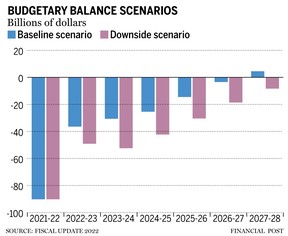
In terms of what’s next for the Canadian economy, the budget presented two outlooks: a baseline scenario on which the government has based its fiscal planning, and a downside scenario that sees the country enter a moderate recession early next year (in line with economist forecasts, and one which - notably - the government has not based its fiscal planning on.

Ottawa aims to balance fiscal restraint with targeted support amid darkening economic outlook

Fall economic statement slashes growth forecasts but predicts budget surplus by 2027

Author of the article: Stephanie Hughes
Publishing date: Nov 03, 2022 
 
Canada's Deputy Prime Minister and Minister of Finance Chrystia Freeland released the fall economic statement in Ottawa Thursday. 
PHOTO BY REUTERS/BLAIR GABLE

The federal government is aiming to strike a balance with targeted new supports and fiscal discipline as it charts a course for Ottawa’s finances over the next few years in the face of soaring inflation and a looming economic downturn.

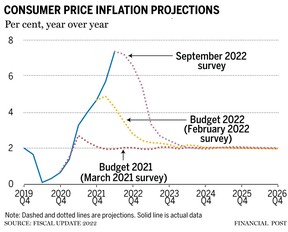
Ottawa acknowledged in its Fall economic statement Thursday that inflation has risen much higher than projected in the Spring Budget, with the latest CPI reading sitting at 6.9 per cent in September. Interest rates around the world have risen sharply this year to combat these price pressures, prompting a global economic slowdown and expectations that Canada would see its own growth stall next year.


The fiscal update slashes growth forecasts for this year and next from its Spring projections. Real gross domestic product is seen slowing to 0.7 per cent in 2023 from the originally forecast 3.1 per cent. GDP this year is expected to grow 3.2 per cent, down from an earlier forecast of 3.9 per cent.

Against this gloomier economic backdrop, the update stressed that fiscal prudence would be important to mitigate the impact of inflation and ensure the government had the capacity to provide targeted support to Canadians.

The government is now expecting the deficit to shrink to $36.4 billion in fiscal 2022-2023 and to reach a $4.5 billion surplus by fiscal 2027-2028.

However, Thursday’s statement also warned of a downside scenario that would see the budgetary balance deteriorating by an average of around $16 billion per year and adding 3.3 percentage points to the federal debt-to-GDP ratio by 2027-2028 if tax revenues fell, program costs were higher than expected, and if public debt charges rose dramatically.


“I am confident that we have the right approach… in this Fall economic statement,” said Deputy Prime Minister Chrystia Freeland during a press conference. “And what we’re announcing today – what we’ve been doing throughout – is to strike a balance between necessary, compassionate support for Canadians and fiscal responsibility.”

A key part of the update was “new support for Canadians who need it most”, or targeted aid for lower-income Canadians to help them cope with the coming downturn and possible recession.

The government said it would automatically advance Canada Workers Benefit payments for Canadians who qualified for the measure last year — a move that is expected to cost $4 billion over six years beginning in 2022/2023. This measure could provide $714 for single workers and $1,231 for a family split between three advance payments to help cope with rapidly rising costs of living.

It also plans to double the goods and services tax credit payment for an estimated 11 million low- and moderate-income Canadians over the next six months in a move expected to provide $2.5 billion in additional support. Single Canadians without children are expected to receive an extra $234, families can get up to an extra $467 and seniors may receive an extra $225 on average.

The government also plans to move ahead on the Canada Dental Benefit it established in partnership with the New Democratic Party to provide payments of up to $1,300 per child under the age of 12 for families without dental coverage making less than $90,000 a year. The legislation was first introduced in September and the government anticipates this will provide support for 500,000 Canadian children as the government develops a national dental care program by 2025.

An investment of $250 million over five years into employment training starting in fiscal 2023-2024 to prepare Canadian workers for a shifting global economy under its Employment and Social Development Canada program.

The government also plans to lower credit card transaction fees for small businesses by negotiating with payment card network and other financial institutions to lower fees. As of Nov. 3, the government is publishing a draft legislative amendment to the Payment Card Networks Act to make this happen. If the industry fails to come up with an agreement over the next few months, the government will push this legislation forward in the new year to regulate credit card transaction fees.

The government earmarked about $1.16 billion for fiscal 2022-2023 for its top-up to the Canada Housing Benefit previously announced on Sept. 13 this year. The government expects this tax-free $500 payment will aid 1.8 million low-income renters, families with an adjusted net income below $35,000 and single Canadians making less than $20,000.

Following the economic statement, the government plans to table legislation to create the new Tax-Free First Home Savings Account, granting would-be first-time homebuyers a new tax-free tool to save up to $40,000, and double the First-Time Home Buyers’ Tax Credit that aims to provide $1,500 in direct support to home buyers.

Once Canada comes out the other side of the anticipated global slowdown next year, Freeland remains optimistic of the country’s economic prospects.

“So far this year, our economic growth has been the strongest in the G7,” Freeland said. “And when we get through the coming global slowdown with the COVID recession behind us, there is no country in the world better-placed than Canada to thrive.”