The new premier is trying to mute her reputation for entertaining extreme views. But is she really changing? Not likely
Author of the article: Don Braid • Calgary Herald
Publishing date:Nov 18, 2022 •
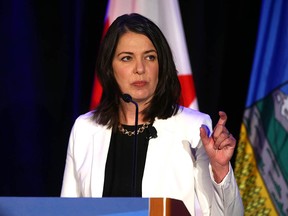
Premier Danielle Smith speaks to the Calgary Chamber of Commerce at the Westin Hotel on Friday. Jim Wells/Postmedia
Dr. John Cowell, the new administrator of AHS, had an interesting response when I asked for his views on vaccination and masking mandates.
Cowell said that’s a question for either Health Minister Jason Copping or the new chief medical officer of health, Dr. Mark Joffe.
“My focus is not on public health. It’s laser focused on availability and robustness of the care system.”
Good health-care delivery would seem to be about public health, but never mind that.
The point is that everybody in government is dancing around Premier Danielle Smith’s views on these issues.
It’s pretty certain that Cowell and Joffe, both veterans of AHS and Alberta health care, are in line with traditional views on the benefits of mask use and widespread public vaccination.
Smith appointed them both, and they’re good choices. They also make her seem more moderate than many people expected.
It’s part of an effort to appease Albertans spooked by her record of challenging expert advice in many areas, especially health care.
But intellectual oddity is part of Smith’s political DNA. People who worked with her earlier in her elected career still describe how they’d spend hours trying to talk her out of the latest weird theory.
Right now, she has the whole government stuck on an absurd point.
She will not recommend mask use. Therefore, nobody else can, either.
RECOMMENDED FROM EDITORIAL
Dr. John Cowell, the new administrator of AHS, had an interesting response when I asked for his views on vaccination and masking mandates.
Cowell said that’s a question for either Health Minister Jason Copping or the new chief medical officer of health, Dr. Mark Joffe.
“My focus is not on public health. It’s laser focused on availability and robustness of the care system.”
Good health-care delivery would seem to be about public health, but never mind that.
The point is that everybody in government is dancing around Premier Danielle Smith’s views on these issues.
It’s pretty certain that Cowell and Joffe, both veterans of AHS and Alberta health care, are in line with traditional views on the benefits of mask use and widespread public vaccination.
Smith appointed them both, and they’re good choices. They also make her seem more moderate than many people expected.
It’s part of an effort to appease Albertans spooked by her record of challenging expert advice in many areas, especially health care.
But intellectual oddity is part of Smith’s political DNA. People who worked with her earlier in her elected career still describe how they’d spend hours trying to talk her out of the latest weird theory.
Right now, she has the whole government stuck on an absurd point.
She will not recommend mask use. Therefore, nobody else can, either.
RECOMMENDED FROM EDITORIAL
Braid: New AHS overseer says he has full power to act fast on big problems

Braid: Hinshaw's out, Smith names mainstream AHS doctor as CMOH

Parents file formal complaint against CBE for poor ventilation as respiratory illnesses, absences spike
Political people have a group mind for words from the top. They hear, and comply as efficiently as an ant colony.
The premier says people should wear a mask if they’re so inclined. But every time she’s asked if she actually recommends masking, she won’t say the words.
She simply returns to the same point — wear one if you like — as if she’s advising on a hat for the day.
But it’s one thing to say she won’t force people to wear masks and quite another to refuse to say they should, especially in the face of a multi-virus wave that’s challenging hospitals right now.
Smith has been premier for only five weeks. She may not yet fully realize how much power her words carry. Many Albertans actually listen to the messages from a premier and take them seriously.
Her refusal to recommend masks very likely diminishes their use and results in some school kids getting sick. Masks really do help prevent spread of illness, as people like Cowell and Joffe have surely known for their entire medical careers.
But in Smith’s UCP there’s a small but powerful core of people who think masks are part of a communist plot to subject us all. To them, the sight of a masked person signals cowardice and stupidity.
Smith is playing to them, while at the same time presenting herself as moderate in health care.
On the economic front, her Friday speech certainly pleased a friendly audience at the Calgary Chamber of Commerce.

remier Danielle Smith and Deborah Yedlin, Chamber president and CEO, during a lunch hour address on Friday. Jim Wells/Postmedia
But her government still seems determined to bring in reforms that most Albertans simply don’t want.
There’s little desire for an Alberta Pension Plan — in fact, any effort to actually create one could panic people close to pension age.
The UCP is also pressing for an Alberta revenue agency to collect personal provincial income tax. That means filling out two returns.
Did that in Quebec years ago, don’t care to again.
Rural municipalities and politicians are also solidly opposed to the drive for an Alberta police force to replace the RCMP.
Big-city dwellers would still have their local forces and might not care much. But this is one expensive, complex project. Serous reform of the RCMP is much more sensible.
Then there’s the contentious Sovereignty Act, coming in less than two weeks
At tis early point we see a premier who’s very astute about managing the effect of her attitudes and ideas. She is a very good speaker and a genuinely friendly, likable person.
But after five weeks of her premiership, Albertans are fully entitled to ask a question. What will happen if she wins a four-year majority next spring?
Don Braid’s column appears regularly in the Herald
Twitter: @DonBraid
But her government still seems determined to bring in reforms that most Albertans simply don’t want.
There’s little desire for an Alberta Pension Plan — in fact, any effort to actually create one could panic people close to pension age.
The UCP is also pressing for an Alberta revenue agency to collect personal provincial income tax. That means filling out two returns.
Did that in Quebec years ago, don’t care to again.
Rural municipalities and politicians are also solidly opposed to the drive for an Alberta police force to replace the RCMP.
Big-city dwellers would still have their local forces and might not care much. But this is one expensive, complex project. Serous reform of the RCMP is much more sensible.
Then there’s the contentious Sovereignty Act, coming in less than two weeks
At tis early point we see a premier who’s very astute about managing the effect of her attitudes and ideas. She is a very good speaker and a genuinely friendly, likable person.
But after five weeks of her premiership, Albertans are fully entitled to ask a question. What will happen if she wins a four-year majority next spring?
Don Braid’s column appears regularly in the Herald
Twitter: @DonBraid
TORY Varcoe: Smith prepared to unleash sovereignty act on Ottawa's oilpatch emissions cap
In a speech to the Calgary Chamber of Commerce, the new premier tried to stake out ground as a fiscal conservative who is prepared to invest
Author of the article:Chris Varcoe • Calgary Herald
Publishing date:Nov 18, 2022 • 9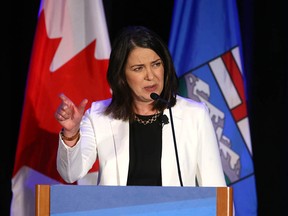
Article content
Premier Danielle Smith says she is prepared to use the Alberta sovereignty act to fight Ottawa over its attempt to cap emissions in the Canadian oil and gas sector — or require farmers to cut emissions when they use nitrogen-based fertilizers.
And while she will look to implement more spending to help Albertans who are facing soaring bills, Smith suggested she’s not about to open the spending taps in next year’s budget, even as the province expects to record a mammoth $13.2-billion surplus this year.
In her first speech to the Calgary Chamber of Commerce on Friday, the new UCP leader tried to stake out ground as a fiscal conservative who is prepared to invest in new infrastructure, while also demonstrating she’s willing to fight with the federal government.
The promised legislation that dominated the UCP leadership race this summer — to be called the Alberta Sovereignty Within a United Canada Act — could be quickly used on two fronts: Ottawa’s attempts to curb emissions from the energy and agriculture sectors.
“They cannot take unilateral action to phase out our industry. We have exclusive jurisdiction,” Smith told a crowd of several hundred business leaders.
“This will be the first use of the Alberta Sovereignty Within a United Canada Act. One (case) will be, no we are not going to reduce fertilizer use arbitrarily by 30 per cent . . . And, no, we are not going to allow you to put an arbitrary restriction on our oil and natural gas industry that will force them to reduce emissions 42 per cent in eight years — we’re not going to do that.”
The speech and ensuing fireside chat with Calgary chamber CEO Deborah Yedlin touched on a number of issues that are being closely watched by the business community, including the need to attract investment and workers, and the ongoing federal-provincial tussle over the climate file.
Earlier this year, the federal government released a new emissions reduction blueprint for the country as Canada seeks to reach a net-zero target by 2050. It’s also moving ahead with plans to cap emissions from the oil and gas sector.
Ottawa projects total emissions from the industry will drop by 42 per cent (from 2019 levels) by 2030, although details on how that will happen are still being developed.
However, it has raised the ire of the industry, including members of the Pathways Alliance, a group of large oilsands producers who have committed to reaching net-zero emissions by 2050 but who believe the interim target is unfeasible.
The Liberal government is seeking feedback on two ways it could get there: through a cap-and-trade system that establishes a hard limit on industry emissions, or by setting an industry-specific carbon price that could be raised (above the national levy) to push producers to lower emissions.
Ottawa has also raised the prospect of setting a 30 per cent reduction on nitrogen-based fertilizer emissions as a goal, although officials said it wouldn’t be a mandatory federal target.
In an interview, Smith said she would first want to seek a solution that would use diplomacy before turning to the sovereignty act.
“If we can get to some kind of agreement that we all want to reduce emissions but we’re going to do it in our own way in Alberta, then we won’t have to use it,” she added.
“But I’ve just heard way too much feedback from the business community about how devastating it would be to share value and the ability to attract investment if Ottawa proceeded unilaterally on that. So we’ve got to protect our industry.”
RECOMMENDED FROM EDITORIAL
Braid: Winding up for Sovereignty Act, Smith echoes long history of Alberta government protests

Proposed emissions cap on oil and gas sector 'overly ambitious': CNRL

Braid: Premier Smith promises quick relief for health care ills and inflation
The act aims to authorize the province to refuse to enforce any federal law or policy “that attacks Alberta’s interests or our provincial rights.“
While provinces have jurisdiction under the Constitution over natural resource development, the Supreme Court of Canada ruled in 2021 that the national carbon price is constitutional.
On Friday, the chiefs of Treaties 6, 7, and 8 came out in opposition to the sovereignty act, calling it unconstitutional and illegal.
However, the message of battling Ottawa over energy policy will resonate in some corners.
Adam Legge, president of the Business Council of Alberta, said if the province completes its due diligence before activating the legislation, he thinks it’s defensible to use the act over the oilpatch emissions cap.
“With the oil and gas emissions cap, the two proposals both are terrible. Both will not work. Both will crush the industry . . . and so we would love to see that as an opportunity to exercise the rights of Alberta industry and the Alberta government,” Legge said after the speech.
“It’d be a great first test of constitutionality.”
Yedlin said the cap “is not something that is good either for the province or for the country” because it would require shutting in one million barrels per day of production from the oilsands alone.
In a speech to the Calgary Chamber of Commerce, the new premier tried to stake out ground as a fiscal conservative who is prepared to invest
Author of the article:Chris Varcoe • Calgary Herald
Publishing date:Nov 18, 2022 • 9
Premier Danielle Smith speaks at the Calgary Chamber of Commerce luncheon on Friday.
Jim Wells/Postmedia
Article content
Premier Danielle Smith says she is prepared to use the Alberta sovereignty act to fight Ottawa over its attempt to cap emissions in the Canadian oil and gas sector — or require farmers to cut emissions when they use nitrogen-based fertilizers.
And while she will look to implement more spending to help Albertans who are facing soaring bills, Smith suggested she’s not about to open the spending taps in next year’s budget, even as the province expects to record a mammoth $13.2-billion surplus this year.
In her first speech to the Calgary Chamber of Commerce on Friday, the new UCP leader tried to stake out ground as a fiscal conservative who is prepared to invest in new infrastructure, while also demonstrating she’s willing to fight with the federal government.
The promised legislation that dominated the UCP leadership race this summer — to be called the Alberta Sovereignty Within a United Canada Act — could be quickly used on two fronts: Ottawa’s attempts to curb emissions from the energy and agriculture sectors.
“They cannot take unilateral action to phase out our industry. We have exclusive jurisdiction,” Smith told a crowd of several hundred business leaders.
“This will be the first use of the Alberta Sovereignty Within a United Canada Act. One (case) will be, no we are not going to reduce fertilizer use arbitrarily by 30 per cent . . . And, no, we are not going to allow you to put an arbitrary restriction on our oil and natural gas industry that will force them to reduce emissions 42 per cent in eight years — we’re not going to do that.”
The speech and ensuing fireside chat with Calgary chamber CEO Deborah Yedlin touched on a number of issues that are being closely watched by the business community, including the need to attract investment and workers, and the ongoing federal-provincial tussle over the climate file.
Earlier this year, the federal government released a new emissions reduction blueprint for the country as Canada seeks to reach a net-zero target by 2050. It’s also moving ahead with plans to cap emissions from the oil and gas sector.
Ottawa projects total emissions from the industry will drop by 42 per cent (from 2019 levels) by 2030, although details on how that will happen are still being developed.
However, it has raised the ire of the industry, including members of the Pathways Alliance, a group of large oilsands producers who have committed to reaching net-zero emissions by 2050 but who believe the interim target is unfeasible.
The Liberal government is seeking feedback on two ways it could get there: through a cap-and-trade system that establishes a hard limit on industry emissions, or by setting an industry-specific carbon price that could be raised (above the national levy) to push producers to lower emissions.
Ottawa has also raised the prospect of setting a 30 per cent reduction on nitrogen-based fertilizer emissions as a goal, although officials said it wouldn’t be a mandatory federal target.
In an interview, Smith said she would first want to seek a solution that would use diplomacy before turning to the sovereignty act.
“If we can get to some kind of agreement that we all want to reduce emissions but we’re going to do it in our own way in Alberta, then we won’t have to use it,” she added.
“But I’ve just heard way too much feedback from the business community about how devastating it would be to share value and the ability to attract investment if Ottawa proceeded unilaterally on that. So we’ve got to protect our industry.”
RECOMMENDED FROM EDITORIAL
Braid: Winding up for Sovereignty Act, Smith echoes long history of Alberta government protests
Proposed emissions cap on oil and gas sector 'overly ambitious': CNRL
Braid: Premier Smith promises quick relief for health care ills and inflation
The act aims to authorize the province to refuse to enforce any federal law or policy “that attacks Alberta’s interests or our provincial rights.“
While provinces have jurisdiction under the Constitution over natural resource development, the Supreme Court of Canada ruled in 2021 that the national carbon price is constitutional.
On Friday, the chiefs of Treaties 6, 7, and 8 came out in opposition to the sovereignty act, calling it unconstitutional and illegal.
However, the message of battling Ottawa over energy policy will resonate in some corners.
Adam Legge, president of the Business Council of Alberta, said if the province completes its due diligence before activating the legislation, he thinks it’s defensible to use the act over the oilpatch emissions cap.
“With the oil and gas emissions cap, the two proposals both are terrible. Both will not work. Both will crush the industry . . . and so we would love to see that as an opportunity to exercise the rights of Alberta industry and the Alberta government,” Legge said after the speech.
“It’d be a great first test of constitutionality.”
Yedlin said the cap “is not something that is good either for the province or for the country” because it would require shutting in one million barrels per day of production from the oilsands alone.
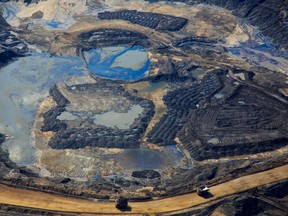
A view of Canadian Natural Resources’ oilsands mining operation near Fort McKay.
Postmedia file photo
Smith also spoke Friday about the economic outlook and warnings about “stormy skies ahead,” with rising inflation, supply chain disruptions, higher interest rates and concerns of a global recession.
The government will have to deal with affordability issues that are hitting Alberta consumers, particularly through higher utility costs.
The premier also ruled out implementing a provincial sales tax, said she’d like to see a long-term debt repayment strategy put in place, and will make sure the government doesn’t significantly ramp up operating spending.
She pegged the province’s annual structural deficit at between $8 billion and $10 billion.
“We also have to make sure that just because we happen to be in this era of higher amounts of revenue, that we do not lose control over year-over-year spending growth,” she said.
“We are not out of the woods yet. We have been bailed out by oil and natural gas revenues. And I am grateful for that.”
Chris Varcoe is a Calgary Herald columnist.
cvarcoe@postmedia.com
Smith also spoke Friday about the economic outlook and warnings about “stormy skies ahead,” with rising inflation, supply chain disruptions, higher interest rates and concerns of a global recession.
The government will have to deal with affordability issues that are hitting Alberta consumers, particularly through higher utility costs.
The premier also ruled out implementing a provincial sales tax, said she’d like to see a long-term debt repayment strategy put in place, and will make sure the government doesn’t significantly ramp up operating spending.
She pegged the province’s annual structural deficit at between $8 billion and $10 billion.
“We also have to make sure that just because we happen to be in this era of higher amounts of revenue, that we do not lose control over year-over-year spending growth,” she said.
“We are not out of the woods yet. We have been bailed out by oil and natural gas revenues. And I am grateful for that.”
Chris Varcoe is a Calgary Herald columnist.
cvarcoe@postmedia.com



/cdn.vox-cdn.com/uploads/chorus_image/image/71647842/Screen_Shot_2022_07_23_at_6.26.39_PM.0.png)

Comments