It’s possible that I shall make an ass of myself. But in that case one can always get out of it with a little dialectic. I have, of course, so worded my proposition as to be right either way (K.Marx, Letter to F.Engels on the Indian Mutiny)
Sunday, March 26, 2023
Who owns the moon? A space lawyer answers
Frans von der Dunk, Professor of Space Law, University of Nebraska-Lincoln
THE CONVERSATION Sun, March 26, 2023 Edwin E. 'Buzz' Aldrin Jr. poses for a photograph beside the U.S. flag deployed on the moon during the Apollo 11 mission on July 20, 1969.Neil A. Armstrong/NASA/AP Photo
Most likely, this is the best-known picture of a flag ever taken: Buzz Aldrin standing next to the first U.S. flag planted on the Moon. For those who knew their world history, it also rang some alarm bells. Only less than a century ago, back on Earth, planting a national flag in another part of the world still amounted to claiming that territory for the fatherland. Did the Stars and Stripes on the moon signify the establishment of an American colony?
When people hear for the first time that I am a lawyer practicing and teaching something called “space law,” the question they ask most frequently, often with a big smile or a twinkle in the eye, is: “So tell me, who owns the moon?”
Of course, claiming new national territories had been very much a European habit, applied to non-European parts of the world. In particular the Portuguese, the Spanish, the Dutch, the French and the English created huge colonial empires. But while their attitude was very Europe-centric, the legal notion that planting a flag was an act of establishing sovereignty quickly stuck and became accepted worldwide as part and parcel of the law of nations.
Obviously, the astronauts had more important things on their mind than contemplating the legal meaning and consequences of that planted flag, but luckily the issue had been taken care of prior to the mission. Since the beginning of the space race the United States knew that for many people around the world the sight of a U.S. flag on the Moon would raise major political issues. Any suggestion that the moon might become, legally speaking, part of U.S. backwaters might fuel such concerns, and possibly give rise to international disputes harmful to both the U.S. space program and U.S. interests as a whole.
By 1969, decolonization may have destroyed any notion that non-European parts of the world, though populated, were not civilized and thus justifiably made subject to European sovereignty – however, there was not a single person living on the moon; even life itself was absent.
Still, the simple answer to the question of whether Armstrong and Aldrin by way of their small ceremony did transform the moon, or at least a major part thereof, into U.S. territory turns out to be “no.” They, nor NASA, nor the U.S. government intended the U.S. flag to have that effect. The first outer space treaty
Most importantly, that answer was enshrined in the 1967 Outer Space Treaty, to which both the United States and the Soviet Union as well as all other space-faring nations, had become a party. Both superpowers agreed that “colonization” on Earth had been responsible for tremendous human suffering and many armed conflicts that had raged over the last centuries. They were determined not to repeat that mistake of the old European colonial powers when it came to decide on the legal status of the moon; at least the possibility of a “land grab” in outer space giving rise to another world war was to be avoided. By that token, the moon became something of a “global commons” legally accessible to all countries – two years prior to the first actual manned moon landing.
So, the U.S. flag was not a manifestation of claiming sovereignty, but of honoring the U.S. taxpayers and engineers who made Armstrong, Aldrin, and third astronaut Michael Collins’ mission possible. The two men carried a plaque that they “came in peace for all mankind,” and of course Neil’s famous words echoed the same sentiment: his “small step for man” was not a “giant leap” for the United States, but “for mankind.” Furthermore, the United States and NASA lived up to their commitment by sharing the moon rocks and other samples of soil from the lunar surface with the rest of the world, whether by giving them away to foreign governments or by allowing scientists from all over the globe to access them for scientific analysis and discussion. In the midst of the Cold War, this even included scientists from the Soviet Union.
Case closed, no need for space lawyers anymore then? No need for me to prepare University of Nebraska-Lincoln’s space law students for further discussions and disputes on the lunar law, right? No space lawyers needed?
Not so fast. While the legal status of the Moon as a “global commons” accessible to all countries on peaceful missions did not meet any substantial resistance or challenge, the Outer Space Treaty left further details unsettled. Contrary to the very optimistic assumptions made at the time, so far humankind has not returned to the moon since 1972, making lunar land rights largely theoretical. This 1964 file photo from the World’s Fair in the borough of Queens in New York shows a views of a moon colony in the Futurama 2 ride put together by General Motors. AP Photo
That is, until a few years ago when several new plans were hatched to go back to the moon. In addition at least two U.S. companies, Planetary Resources and Deep Space Industries, which have serious financial backing, have started targeting asteroids for the purpose of mining their mineral resources. Geek note: Under the aforementioned Outer Space Treaty, the moon and other celestial bodies such as asteroids, legally speaking, belong in the same basket. None of them can become the “territory” of one sovereign state or another.
The very fundamental prohibition under the Outer Space Treaty to acquire new state territory, by planting a flag or by any other means, failed to address the commercial exploitation of natural resources on the moon and other celestial bodies. This is a major debate currently raging in the international community, with no unequivocally accepted solution in sight yet. Roughly, there are two general interpretations possible. So you want to mine an asteroid?
Countries such as the United States and Luxembourg (as the gateway to the European Union) agree that the moon and asteroids are “global commons,” which means that each country allows its private entrepreneurs, as long as duly licensed and in compliance with other relevant rules of space law, to go out there and extract what they can, to try and make money with it. It’s a bit like the law of the high seas, which are not under the control of an individual country, but completely open to duly licensed law-abiding fishing operations from any country’s citizens and companies. Then, once the fish is in their nets, it is legally theirs to sell.
OSIRIS-REx will travel to a near-Earth asteroid called Bennu and bring a small sample back to Earth for study. The mission launched Sept. 8, 2016, from Cape Canaveral Air Force Station. As planned, the spacecraft will reach Bennu in 2018 and return a sample to Earth in 2023.
On the other hand, countries such as Russia and somewhat less explicitly Brazil and Belgium hold that the moon and asteroids belong to humanity as a whole. And therefore the potential benefits from commercial exploitation should somehow accrue for humanity as a whole – or at least should be subjected to a presumably rigorous international regime to guarantee humanity-wide benefits. It’s a bit like the regime originally established for harvesting mineral resources from the deep seabed. Here, an international licensing regime was created as well as an international enterprise, which was to mine those resources and generally share the benefits among all countries.
While in my view the former position certainly would make more sense, both legally and practically, the legal battle by no means is over. Meanwhile, the interest in the moon has been renewed as well – at least China, India and Japan have serious plans to go back there, raising the stakes even higher. Therefore, at the University of Nebraska-Lincoln we will need to teach our students about these issues for many years to come. While ultimately it is up to the community of states to determine whether common agreement can be reached on either of the two positions or maybe somewhere in between, it is of crucial importance that agreement can be reached one way or another. Such activities developing without any law that is generally applicable and accepted would be a worst-case scenario. While not a matter of colonization anymore, it may have all the same harmful results. This article is republished from The Conversation, a nonprofit news site dedicated to sharing ideas from academic experts.
2 megamouth sharks caught on video for the 1st time ever
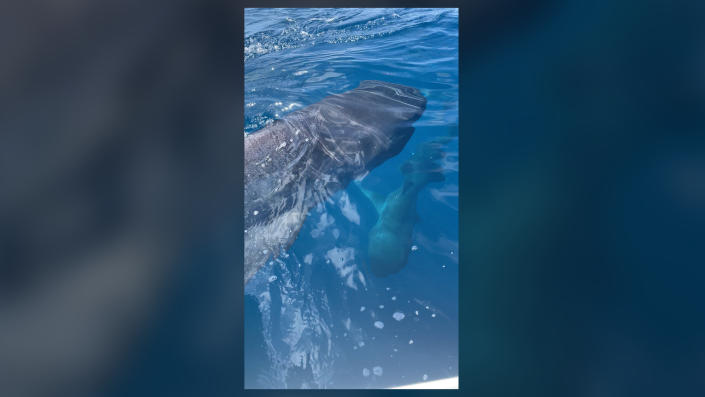
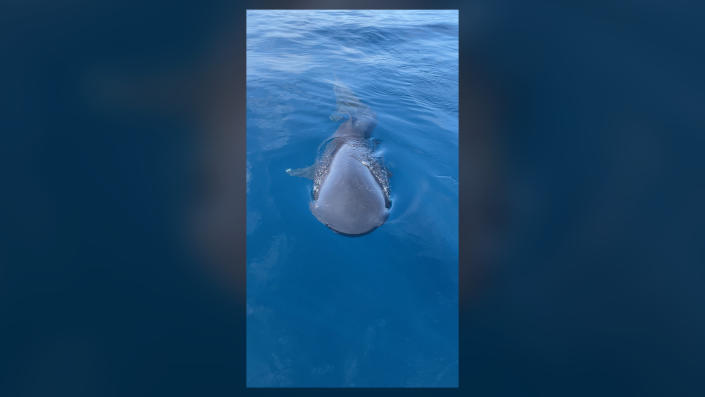
Joshua A. Krisch Fri, March 24, 2023 Stunning new footage shows a pair of extremely elusive megamouth sharks(Megachasma pelagios) swimming together off the coast of San Diego.
The video, captured by fishers in early September 2022, may show the deep-dwelling beasts in a courtship ritual and is one of just a handful of sightings of the creatures alive. In the 50 years since the species was discovered, there have been just 273 sightings, most involving sharks caught in fishing gear. Only five megamouth sharks have been spotted swimming freely in the wild. Never before had two been seen swimming together.
Now, a new study analyzing the footage suggests that the two sharks were engaging in courtship or mating behaviors.
"The curiosity of these fishermen benefited the field as a whole," study lead author Zachary Skelton, a graduate student at the University of California, San Diego, told Live Science. "The 10 minutes the fishermen had with the sharks contains the only knowledge we have on megamouth shark sociality."
The elusive megamouth shark can grow to be 18 feet (5.5 meters) in length and weigh up to 2,679 pounds (1,215 kilograms). These bulbous-headed creatures are filter feeders that sift food from the water captured in their enormous mouths. Yet, despite their size and distinctive features, megamouth sharks evaded detection until 1976.
"It's pretty darn rare to see one, let alone two at a time swimming at the surface during the day," Christopher G. Lowe, director of the Shark Lab at California State University Long Beach, who was not involved in the study, told Live Science in an email. To better understand megamouth shark behavior, Skelton and colleagues analyzed the footage in light of whatever they could find in the literature on the social behaviors of other filter-feeder sharks, such as basking sharks (Cetorhinus maximus) and whale sharks (Rhincodon typus). "Because the encounter was so brief, we had to heavily rely on other studies and species to try and make sense of why the sharks were at the surface, why they were together, and why at that specific place," Skelton said.
Visible male sex organs known as claspers suggested the smaller of the two sharks was male. And although the team could not confirm the sex of the other shark, they determined that it was probably female, based on a lack of obvious claspers and a series of scars on its back similar to the mating scars found on female sharks from other species.
Given that the male was closely following the putative female shark and that neither shark was seen attempting to feed, the researchers concluded that the footage likely reflects a courtship display. The results were published March 13 in the journal Environmental Biology of Fishes.
"This anecdotal observation has all the hallmarks of precopulatory mating behavior," Carl Meyer, an associate researcher at the Shark Research Lab at the Hawaii Institute of Marine Biology who was not involved in the study, told Live Science in an email. "We still know comparatively little about the biology and ecology of megamouth sharks so this observation is an interesting addition to our understanding of this species."
Neil Hammerschlag, director of the Shark Research & Conservation Program at the University of Miami, who was not involved in the study, was similarly impressed. "The paper does a good job of speculating what could be occurring," he told Live Science in an email. "The social behavior of [megamouth] sharks is still a bit of a black box to scientists, and observations like these are exciting, generating a bunch of questions and theories that can be further studied."
2,000 mummified ram heads left in honor of Egypt's most powerful pharaoh are found inside an ancient temple
Bethany Dawson Sun, March 26, 2023
In this article: Ramesses II Third pharaoh of the Nineteenth Dynasty of Egypt Some of the 2,000 ram heads discovered in Egypt.Egyptian Ministry of Tourism and Antiquities
More than 2,000 mummified ram heads have been discovered in Egypt.
Archaeologists at the King Ramses II Temple of Abydos found the mummified remains.
They also discovered mummified dogs, wild goats, cows, deer and an ostrich.
More than 2,000 mummified ram heads and a palatial Old Kingdom structure have been uncovered by archaeologists at the King Ramses II Temple of Abydos.
The finds, located roughly 270 miles south of Cairo, come from a period of over 1,000 years, from the Sixth Dynasty to the Heroic Age, making some of the discoveries over 4,300 years old.
One of the ancient ram heads discoveredEgyptian Ministry of Tourism and Antiquities
In addition to the ancient ram's head, archaeologists from the University of New York also discovered a group of mummified dogs, wild goats, cows, deer and an ostrich.- ADVERTISEMENT -
The mummified remains are believed to have been left at the site to honor Ramses II about 1,000 years after his death, the Egyptian Ministry for Tourism and Antiquities said.
It is thought that the rams and other animals would have been used as offerings during worship of the rams in Abydus during the Bipidus period, Dr Sameh Iskandar, head of the mission added in a statement. View of a new area uncovered by a team from New York University- Institute for the Study of the Ancient World (ISAW) at the temple of Ramesses II in Abydos, Sohag Governorate, Egypt, in this handout image released on March 25, 2023.The Egyptian Ministry of Antiquities/Handout via REUTERS
In addition to the wealth of animal remains, the archaeological team also uncovered a "huge building" with walls roughly five meters thick from the Old Kingdom's sixth dynasty.
The structure contained a number of statues, tree remains, leather shoes, clothing, and papyri.
The discovery could help "reestablish the sense of the ancient landscape of Abydos before the construction of the Ramses II temple," Iskandar said, per Reuters.
Ancient zodiac paintings on Egyptian temple see the light of day after 2,200 years
Owen Jarus Thu, March 23, 2023 This zodiac sign depicts Sagittarius. While the zodiac signs at Esna were known before cleaning was done the work allows them to be seen more clearly. Here we see a centaur with a scorpion's tail aiming a bow and arrow.
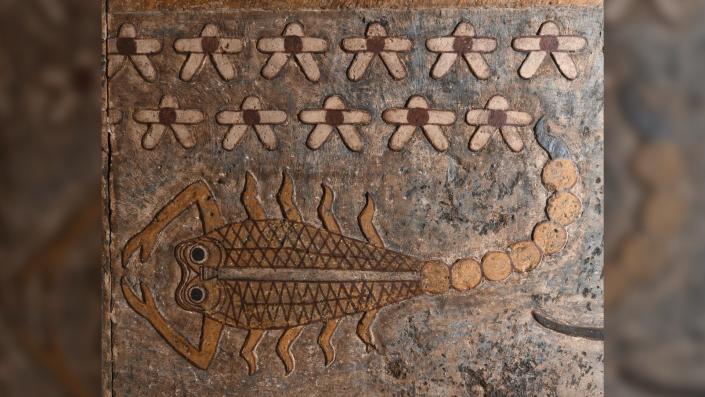
Gorgeous zodiac paintings decorating the roof and walls of the 2,200-year-old Temple of Esna in southern Egypt have been revealed during a restoration project that's clearing away two millennia's worth of grime, soot and bird poop, researchers announced March 20.
Restorers painstakingly cleaned the zodiac artworks, many of which were painted onto the temple's ceiling. Other restored images include depictions of the planets Jupiter, Saturn and Mars, as well as images of stars and constellations used by the ancient Egyptians to help measure time, researchers said in a statement. The team also conserved ancient images of snakes, crocodiles and hybrid creatures, such as a snake with a ram's head.
While the existence of the zodiac and some of the other images at the temple were already known to researchers, the cleaning and conservation have allowed the artwork to be seen in more detail. The restoration work also revealed previously unknown inscriptions, team co-leader Christian Leitz, an Egyptology professor at the University of Tübingen in Germany, told Live Science in an email.
This zodiac sign depicts Scorpio. With the cleaning and restoration the colors of the signs are more visible.. Here we see a scorpion with claws at the front, eight legs, and a sharp stinger at the end of it's tail. Ancient zodiac
"The zodiac itself is part of Babylonian astronomy and does not appear in Egypt until Ptolemaic times," Leitz said in the statement. The Ptolemies were a dynasty of rulers descended from one of Alexander the Great's generals, who ruled Egypt between 304 B.C. and 30 B.C, Leitz said. It may have been the ancient Greeks who introduced the zodiac to Egypt.
After its introduction, the zodiac became popular in ancient Egypt. "The zodiac was used to decorate private tombs and sarcophagi and was of great importance in astrological texts, such as horoscopes found inscribed on pottery sherds," Daniel von Recklinghausen, a researcher at the University of Tübingen, said in the statement. While few ancient Egyptian temples had zodiacs depicted on them, a well-known example is a temple at Dendera, which has the zodiac along with images of five of the planets, Leitz told Live Science. Images of hybrid animals were revealed in better detail during the cleaning and restoration work. Here we see a bird-like creature with four wings, a dog-like head, and a snake for a tail. There are also two winged serpents flying about and one snake-like creature at the bottom.
The zodiac used at Esna is similar to the zodiac used today, Leitz told Live Science. "There is no difference apart from some depictions of the signs," he noted.
From the photos the team released, it is clear that the images are much more visible than before the restoration, Juan Antonio Belmonte Avilés, an astronomer at the Institute of Astrophysics of the Canary Islands (IAC) in Spain who has conducted extensive research on astronomy in ancient Egypt, told Live Science in an email. We will have to wait until more is published until we can tell exactly how much new information the cleaning has provided, said Avilés, who was not involved in the restoration.
The team is in the process of analyzing the new inscriptions, Leitz said. The Temple of Esna is located 37 miles (60 kilometers) south of Luxor (ancient Thebes), the statement notes. Hisham El-Leithy, an archaeologist with at the Egyptian Ministry of Tourism and Antiquities, is a co-leader of the team, while Ahmed Emam, a conservation expert at the ministry, led the restoration work.
Previously, archaeologists working on the Temple of Esna restoration project unveiled 46 depictions of goddesses from ancient Egypt. The temple is dedicated to the Egyptian deity Khnum, who is associated with fertility and water.
Chad nationalizes assets by oil giant Exxon, says government
SAM MEDNICK Fri, March 24, 2023
DAKAR, Senegal (AP) — Chad is nationalizing all assets from multinational oil giant Exxon Mobil, including its hydrocarbon and exploration permits, said the government.
″The finance and budget minister must make sure the said decree is implemented from the date of its publishing," said Haliki Choua Mahamat the government's general secretary on state media.
The nationalization of a private company means that all assets are now owned by the government. While this used to happen in the 1960s and 1970s, it hasn't happened recently and doesn't conform to usual legal frameworks in the sector, say energy experts.
Chad began producing oil in 2003 and Exxon has been operating in the country for several decades. It was running the Doba oil project in Chad.
The move could scare away investors from West Africa at a time of growing global energy demand and a decline in foreign investments in the region, said Olufola Wusu, a partner and head of the oil and gas desk at Megathos Law Practice based in Nigeria.
“Expropriation of any sort without compensation is not a step in the right direction, because it is going to erode investor confidence in that particular country and once investors are jittery, they pull back their investment, so regulators and leaders in Africa need to play by the rules,” he said.
The government’s decision came after a long dispute between Exxon and Chad, which rejected the sale of the company’s operations last year.
Tensions have risen in the West African nation in recent months with unprecedented protests mounting against the government of President Mahamat Idriss Deby.
Deby was declared the head of state after his father’s death in April 2021. The son's succession did not follow Chad's constitutional line of succession. Opposition political parties at the time called the handover a coup d’etat, but later agreed to accept Deby as interim leader for 18 months.
———-
Associated Press reporter Chinedu Asadu in Abjua Nigeria contributed
Apache Stronghold Fights for Entire Way of Life in Oak Flats Case
Darren Thompson Fri, March 24, 2023 Wendsler Nosie (Via Facebook)
On Tuesday, a federal appeals court heard arguments from Apache leaders who are opposing a federal land swap they say will destroy their entire way of life.
The Apache Stronghold — a non-profit organization of San Carlos Apache Tribal citizens — filed suit on January 21, 2021 against a federally approved land deal between the U.S. Forest Service and Resolution Copper, a joint venture of mining giants Rio Tinto and BHP. The land deal, which was included in federal legislation that passed in 2014, swapped the 2,422 acres of federal land above a copper deposit for 5,459 acres of Arizona land owned by Resolution Copper.
Resolution Copper hopes to build a copper mine near a place the Apache and other tribes consider sacred, a ceremonial ground called Chí’chil Biłdagoteel, or “Oak Flat.”- ADVERTISEMENT -
Oak Flat is in the Tonto National Forest, which is the land the federal government is willing to exchange, and is on the National Register of Historic Places. It has been protected from mining by Congress for more than 60 years.
If completed, the mine would be nearly 2 miles wide and almost 1,100-feet deep. According to Resolution Copper, the mine would become the largest copper mine in North America and would supply up to a quarter of domestic copper demand per year. The company estimates it will produce as much as 40 billion pounds of copper over 40 years.
The 9th Circuit Court decided in early 2022 that Resolution Copper could proceed with operations while the lawsuit is pending in court. Last November, the court announced that it would rehear Apache Stronghold v. United States “en banc”—meaning in front of a full panel of 11 judges. The en banc hearing was requested by the court, to rehear the case, and is extremely rare, Apache Stronghold’s legal counsel Becket Law told Native News Online last fall. A call to rehear a case happens in less than 0.5 percent of cases the court hears.
In the lawsuit, the Apache Stronghold states,“the Apaches view Oak Flat as a ‘direct corridor’ to the Creator's spirit.” They also argued that the land exchange violates their First Amendment rights and the Religious Freedom Restoration Act, where “government should not substantially burden religious exercise without compelling justification.”
At Tuesday’s hearing, the court’s 11 judges questioned both sides about whether the government can do what it wants with federal land, even if it prevents some citizens from fully exercising their religious rights.
"Oak Flat is where my people have come to connect with our Creator for millennia, and we have the right to continue that sacred tradition,” Apache Stronghold Executive Director Wendsler Nosie Sr. said in a statement after the hearing. "Today we stood up in court for that right, determined to stop those who think that our place of worship can be treated differently simply because it lacks four walls and a steeple.”
The hearing in Pasadena brought Apache Stronghold with elders and allies from other Tribes to a ceremony outside the courthouse. Peter Roybal, executive counsel for Chiricahua Apache Nation, lives in Pasadena and traveled to Arizona to transport elders to attend the ceremony.
“We are here to support Oak Flat and the Apache Stronghold,” Roybal, told Native News Online. “We pray the panel of judges have strength, wisdom and good judgment. This is a decades old battle and it has been fought on many fronts, but regardless of today’s outcome, we have seen many people come together with kindness and support.”
The 9th U.S. Circuit Court of Appeals is expected to issue a decision in the next few months.
About the Author: "Darren Thompson (Lac du Flambeau Ojibwe) is a staff reporter for Native News Online who is based in the Twin Cities of Minnesota. Thompson has reported on political unrest, tribal sovereignty, and Indigenous issues for the Aboriginal Peoples Television Network, Indian Country Today, Native News Online, Powwows.com and Unicorn Riot. He has contributed to the New York Times, the Washington Post, and Voice of America on various Indigenous issues in international conversation. He has a bachelor\u2019s degree in Criminology & Law Studies from Marquette University in Milwaukee, Wisconsin. "
Contact: dthompson@nativenewsonline.net
NASA investigates veteran Mars orbiter to solve a missing fuel mystery
Robert Lea Fri, March 24, 2023 An illustration of the Mars Odyssey Orbiter as it circles Mars
Engineers at NASA and Lockheed Martin Space have performed the difficult task of measuring the fuel supply of the oldest Mars orbiting spacecraft without the use of a fuel gauge, after calculations indicated the probe may be close to running on empty.
Estimates from 2021 and 2022 indicated the Mars Odyssey orbiter has exhausted its propellant much faster than expected, prompting the investigation of the craft's "missing fuel." Eventually, the scientists concluded that the missing fuel was never missing at all! That means Odyssey should have enough propellant to keep going until the end of 2025.
The Mars Odyssey orbiter has been in space for 22 years. During this time, the mission has completed over 94,000 orbits of Mars and delivered a wealth of impressive discoveries such as the detection of water ice under the planet's surface that could be used by future astronauts.
During its mission, Odyssey has traveled the equivalent of 1.37 billion miles (2.21 billion kilometers) around Mars, which has required careful fuel management. The problem is that the spacecraft, launched in 2001, isn't fitted with a fuel gauge.
That means NASA operators have to rely on mathematics and ingenious tests to calculate how much of the 500 pounds (225.3 kilograms) of hydrazine propellant the craft lifted off from Earth with is left.
The remaining fuel supplies are measured by applying heat to Odyssey's two propellant tanks to see how quickly they reach a set temperature, which indicates how full of fuel they are. Just like an empty teapot which heats up faster than a full one, an empty fuel tank should hit a target temperature more rapidly than a full one, NASA said in a statement.
In 2021, the test indicated that Odyssey had just 11 pounds (5 kg) of propellant left, which is less than mathematical modeling of the probe's fuel consumption predicted. In January 2022, the NASA team used the method again, and again came up with a lower than expected amount of remaining fuel: just 6 pounds (2.8 kg) of hydrazine. If the results are correct, Odyssey would be running on empty in less than a year.
The engineers didn't know how to explain the discrepancy between the test results and the expectations and set out to conduct a deeper investigation, which revealed hitherto unknown details about how the craft's complex fuel system has aged while in flight. So where did Odyssey's "missing fuel" go?
Following the calculations that indicated the Mars Odyssey Orbiter may be running low on fuel, NASA Jet Propulsion Laboratory (JPL) scientists drafted in Lockheed Martin Space engineers, who not only built Odyssey, but also maintain its mission operations and provide engineering support for the craft.
"First, we had to verify the spacecraft was OK," Odyssey's project manager at JPL, Joseph Hunt, said in the statement. "After ruling out the possibility of a leak or that we were burning more fuel than estimated, we started looking at our measuring process."
The combined JPL/Lockheed Martin Space team decided that they needed "fresh eyes" to assess the Odyssey issue. These fresh eyes came in the form of spacecraft propellant estimation consultant, Boris Yendler.
Yendler connected the missing fuel to the fact that, like all spacecraft, Odyssey uses some fuel to keep its systems at optimal operating temperatures and protect them from the cold of space. The consultant wondered if some source on Odyssey was adding heat to its fuel. This would have the effect of causing temperatures to rise faster during the fuel tank heating test, thus giving inaccurate fuel measurements.
The painstaking investigation led to the discovery that heaters along an Odyssey fuel line were warming connected propellant tanks, making them appear emptier than they actually are. Accounting for this in their method of measurement and factoring in more complex fluid dynamics, the team was able to determine that Odyssey has about 9 pounds (4 kg) of hydrazine left.
Mars Odyssey doesn't actually burn through much fuel each day, as solar panels on the craft supply the energy needed to power its systems. Additionally, the probe uses reaction wheels to stay pointed toward Mars during science investigations. These wheels spin inside the spacecraft's body, generating torque that allows Odyssey to maintain its attitude without propellant.
Where the hydrazine actually comes in is when Odyssey completes a full orbit and needs to offload increasing momentum in its reaction wheels. The spacecraft does this by releasing tiny precisely measured bursts of propellant via its thrusters.
Thanks to such limited use Odyssey has enough fuel left to last a few more years at least. The team, however, acknowledges that the remaining fuel quantity they calculated may change as they refine their calculations and improve measurement accuracy. Nevertheless, the team is certain that they now understand the craft better than they did previously.
"It's a little like our process for scientific discovery," Odyssey's mission manager at NASA JPL, Jared Call, said in the statement. "You explore an engineering system not knowing what you'll find. And the longer you look, the more you find what you didn't expect."
How to watch Ceres, a dwarf planet 14 times smaller than Pluto, photobomb a spiral galaxy this weekend
Jamie Carter Sat, March 25, 2023 at 8:00 AM MDT·2 min read A preview of the dwarf planet Ceres "meeting" spiral galaxy Messier 100 in the night sky
This weekend, you can watch live as the first asteroid ever discovered passes across one of the night sky's most beautiful spiral galaxies.
The Rome-based Virtual Telescope Project will host a livestream starting at 11 p.m. EDT on Sunday, March 26 (03:00 UTC on Monday, March 27), when Ceres will be visible in front of Messier 100 (M100), a stunning example of a grand-design spiral galaxy, according to NASA.
Ceres is the largest object in the asteroid belt between Mars and Jupiter, according to NASA, and accounts for nearly a third of the asteroid belt's mass. Initially labeled an asteroid upon its discovery more than 200 years ago, it's been classed as a dwarf planet since 2006, the same year that Pluto was demoted from a planet to a dwarf planet. Ceres is about 14 times smaller than Pluto and is the only dwarf planet in the inner solar system.
This weekend, Ceres will appear to "meet" the distant spiral galaxy M100 in the night sky, according to the Virtual Telescope Project, though the two objects will actually be trillions of miles apart.
At the time of the line-of-sight view, Ceres will be about 150 million miles (240 million kilometers) from Earth while M100 is at about 55 million light-years away.
The meeting will take place in the constellation Coma Berenices just a few days after Ceres' opposition, which is when Earth passes between it and the sun. That's great news for skywatchers because Ceres only appears 100% illuminated from Earth when close to opposition. It will shine at magnitude 7, which is just out of view of the naked eye. A pair of stargazing binoculars should reveal Ceres, while a good small telescope will also show M100, according to the Virtual Telescope Project.
Ceres was discovered by astronomer Giuseppe Piazzi in 1801. Its average distance from Earth is comparable to that of Mars, and its closeness has inspired some researchers to suggest that in the future it could be a target for human habitats. NASA's Dawn spacecraft visited Ceres from 2015 to 2016, taking some stunning images.
M100's spectacular spiral arms host several small black holes, including the youngest one ever observed in our cosmic neighborhood, according to NASA. M100 was discovered by French astronomer Pierre Méchain in 1781.
Artificial intelligence could help hunt for life on Mars and other alien worlds
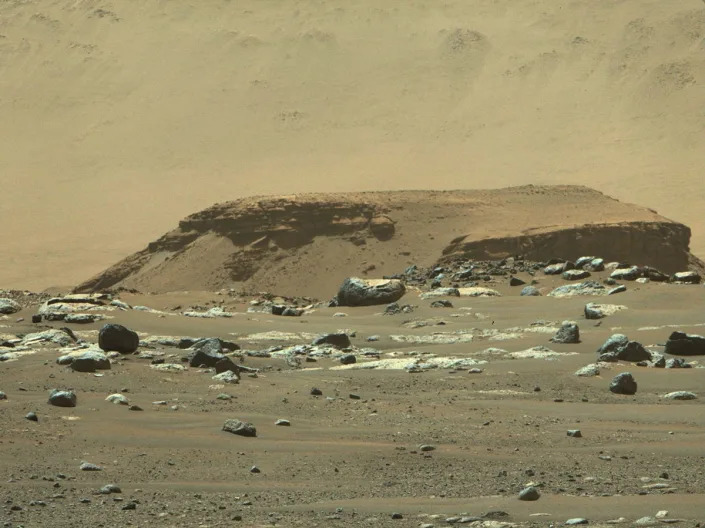
Robert Lea Sat, March 25, 2023 a section of the Martian surface covered in rocks
A newly developed machine-learning tool could help scientists search for signs of life on Mars and other alien worlds.
With the ability to collect samples from other planets severely limited, scientists currently have to rely on remote sensing methods to hunt for signs of alien life. That means any method that could help direct or refine this search would be incredibly useful.
With this in mind, a multidisciplinary team of scientists led by Kim Warren-Rhodes of the SETI (Search for Extraterrestrial Intelligence) Institute in California mapped the sparse lifeforms that dwell in salt domes, rocks and crystals in the Salar de Pajonales, a salt flat on the boundary of the Chilean Atacama Desert and Altiplano, or high plateau.
Biosignature probability maps from convolutional neural network models and statistical ecology data. The colors in a) indicate the probability of biosignature detection. In b) is a visible image of a gypsum dome geologic feature (left) with biosignature probability maps for various microhabitats (e.g., sand versus alabaster) within it.
Warren-Rhodes then teamed up with Michael Phillips from the Johns Hopkins University Applied Physics Laboratory and University of Oxford researcher Freddie Kalaitzis to train a machine learning model to recognize the patterns and rules associated with the distribution of life across the harsh region. Such training taught the model to spot the same patterns and rules for a wide range of landscapes — including those that may lie on other planets.
The team discovered that their system could, by combining statistical ecology with AI, locate and detect biosignatures up to 87.5% of the time. This is in comparison to no more than a 10% success rate achieved by random searches. Additionally, the program could decrease the area needed for a search by as much as 97%, thus helping scientists significantly hone in their hunt for potential chemical traces of life, or biosignatures.
"Our framework allows us to combine the power of statistical ecology with machine learning to discover and predict the patterns and rules by which nature survives and distributes itself in the harshest landscapes on Earth," Warren-Rhodes said in a statement. "We hope other astrobiology teams adapt our approach to mapping other habitable environments and biosignatures."
Such machine learning tools, the researchers say, could be applied to robotic planetary missions like that of NASA's Perseverance rover, which is currently hunting for traces of life on the floor of Mars' Jezero Crater.
"With these models, we can design tailor-made roadmaps and algorithms to guide rovers to places with the highest probability of harboring past or present life — no matter how hidden or rare," Warren-Rhodes explained.
Picking an analog for Mars on Earth
The team chose Salar de Pajonales as a testing stage from their machine learning model because it is a suitable analog for the dry and arid landscape of modern-day Mars. The region is a high-altitude dry salt lakebed that is blasted with a high degree of ultraviolet radiation. Despite being considered highly inhospitable to life, however, Salar de Pajonales still harbors some living things.
The team collected almost 8,000 images and over 1,000 samples from Salar de Pajonales to detect photosynthetic microbes living within the region's salt domes, rocks and alabaster crystals. The pigments that these microbes secrete represent a possible biosignature on NASA's "ladder of life detection," which is designed to guide scientists to look for life beyond Earth within the practical constraints of robotic space missions.
The team also examined Salar de Pajonales using drone imagery that is analogous to images of Martian terrain captured by the High-Resolution Imaging Experiment (HIRISE) camera aboard NASA's Mars Reconnaissance Orbiter. This data allowed them to determine that microbial life at Salar de Pajonales is not randomly distributed but rather is concentrated in biological hotspots that are strongly linked to the availability of water.
Warren-Rhodes' team then trained convolutional neural networks (CNNs) to recognize and predict large geologic features at Salar de Pajonales. Some of these features, such as patterned ground or polygonal networks, are also found on Mars. The CNN was also trained to spot and predict smaller microhabitats most likely to contain biosignatures.
For the time being, the researchers will continue to train their AI at Salar de Pajonales, next aiming to test the CNN's ability to predict the location and distribution of ancient stromatolite fossils and salt-tolerant microbiomes. This should help it to learn if the rules it uses in this search could also apply to the hunt for biosignatures in other similar natural systems.
After this, the team aims to begin mapping hot springs, frozen permafrost-covered soils and the rocks in dry valleys, hopefully teaching the AI to hone in on potential habitats in other extreme environments here on Earth before potentially exploring those of other planets.
The team's research was published this month in the journal Nature Astronomy.
SPACE JUNK POLLUTING DARK SKIES Indian rocket launches final 36 satellites for OneWeb's broadband constellation
Mike Wall Sat, March 25, 2023 An Indian LVM3 rocket launches the final 36 satellites for OneWeb's first-generation broadband constellation from Satish Dhawan Space Centre on March 25, 2023.
India's most powerful rocket launched the final 36 satellites for OneWeb's first-generation internet constellation on Saturday night (March 25).
A Launch Vehicle Mark-3 (LVM3) rocket lifted off from India's Satish Dhawan Space Centre Saturday at 11:30 p.m. EDT (0330 GMT and 9 a.m. India Standard Time on March 26), carrying 36 OneWeb broadband satellites toward low Earth orbit (LEO).
About 90 minutes later, the Indian Space Research Organisation (ISRO) announced that all 36 spacecraft had been deployed successfully into the intended orbit, a circular path about 280 miles (450 kilometers) above Earth. The satellites will raise their own orbits over the coming days and weeks, finally settling in at an altitude of about 745 miles (1,200 km).
Saturday's launch was a huge one for OneWeb. It was the 18th and final mission devoted to building out OneWeb's first-generation broadband constellation in LEO, which before Saturday consisted of 582 satellites.
"This launch will be one of the most significant milestones in OneWeb's history so far, with the launch adding an additional 36 satellites to the OneWeb fleet, the first-ever completed global LEO constellation," OneWeb representatives said in a prelaunch statement.
"By completing the constellation, OneWeb is taking a pivotal step forward in delivering global coverage," they added.
Most of the 17 previous OneWeb launches were conducted by Russian-built Soyuz rockets operated by the French company Arianespace. But Russia's invasion of Ukraine in February 2022 sundered that partnership, impelling OneWeb to find new rocket rides for its satellites.
The London-based company soon did just that, inking deals with both SpaceX and NewSpace India Limited (NSIL), ISRO's commercial branch. SpaceX Falcon 9 rockets launched three missions for OneWeb, which is interesting, given that Elon Musk's company is building its own broadband constellation in LEO, called Starlink.
Saturday's liftoff was the second under the NSIL contract. The first, in October 2022, was also flown by an LVM3, which is also known as the GSLV MK III. ("GSLV" stands for "Geosynchronous Satellite Launch Vehicle.")
The 143-foot-tall (43.5 meters) LVM3 is India's brawniest rocket. It's capable of delivering 17,600 pounds (8,000 kilograms) of payload to LEO, according to its ISRO specifications page.
The 36 OneWeb satellites that went up Saturday weigh a total of 12,798 pounds (5,805 kg), ISRO wrote in a mission description, which you can find here.
Editor's note: This story was updated at 1:20 a.m. ET on March 26 with news of successful launch and satellite deployment.
Mike Wall is the author of "Out There" (Grand Central Publishing, 2018; illustrated by Karl Tate), a book about the search for alien life. Follow him on Twitter @michaeldwall. Follow us on Twitter @Spacedotcom or on Facebook.
OneWeb launch completes space internet project
Jonathan Amos - BBC Science Correspondent Sun, March 26, 2023
London-based company OneWeb has launched the final set of satellites it needs to deliver a broadband internet connection anywhere on Earth.
The 36 spacecraft went up on an Indian LVM3 rocket from the Sriharikota spaceport in Andhra Pradesh. Their deployment 450km above the planet takes OneWeb's total in-orbit constellation to 618.
It's less than three years ago that the UK government took the decision to buy OneWeb out of bankruptcy.
At the time, it was seen as controversial; arguments raged about whether it was a sound use of taxpayer money.
But since the purchase, OneWeb has managed to attract significant additional investment, and is even now planning a next generation of satellites.
"This is the most significant milestone in the history of OneWeb, as we reach the satellites needed for global coverage. Over several years we have remained focused on our commitment to deliver a network that will provide connectivity for our customers and communities that need it most," said OneWeb CEO, Neil Masterson.
It will take some months for the Sunday's batch of satellites to be tested and to get into the right part of the sky (at an altitude of 1,200km), but when they are in position OneWeb will have the facility to deliver a global communications service.
Only one other organisation in the world is flying more satellites in space today - and that's OneWeb's chief competitor: the Starlink system operated by Elon Musk.
Unlike the US entrepreneur's network, OneWeb is not selling broadband connections direct to the individual user. Its clients, principally, are the telecoms companies that provide this internet service. They might also be employing the connectivity to supplement, or expand, the infrastructure in their mobile phone networks.
Each satellite weighs about 150kg. The next generation will be bigger and more powerful
The OneWeb system will require the necessary ground infrastructure to command and control all the satellites and link them to the internet, but this too should be fully up and running come the end of 2023.
The satellite enterprise has been a decade in gestation. Projected as a $6bn project, it ran into money woes in early 2020 and sought the protection of US bankruptcy laws until a buyer could be found. At the time, it had lofted just 74 satellites.
With its debts wiped out, OneWeb then moved quickly to build out the network and secure wider investment. It's currently working through a merger plan with Paris-based Eutelsat, best known for distributing thousands of TV channels around the world.
UK Secretary of State for Science, Innovation and Technology, Michelle Donelan, said: "The completion of the low-Earth orbit constellation is hugely significant both for OneWeb and the UK's wider sector.
"We invested in OneWeb's vision to bridge the global digital divide, and our burgeoning space sector is transforming the UK into the perfect base for likeminded companies to realise their stratospheric potential." The system will fly 49 satellites in 12 planes - with spares ready to jump in
OneWeb has made the UK a major space player.
The number of satellites in the constellation has demanded a big commitment from the UK's Civil Aviation Authority, which is Britain's licensing agency for space activity.
All ground infrastructure should be in place come the year's end
"We undertake a significant oversight role, to make sure that their satellites are all healthy, and they they're operating within the limits that OneWeb have set out and that we agreed to," explained Colin Macleod, the authority's head of space regulation.
"Our team has regular meetings at OneWeb's White City headquarters. All their engineers sit in a room where they present what they're doing, and if they have any risks or issues - they will talk us through the solutions so that our engineers will be comfortable with their actions," he told BBC News.
Safety is paramount. The region in the sky where OneWeb spacecraft are moving - from 450km in altitude up to 1,200km - is becoming ever more congested, and the CAA wants assurance that the constellation is being flown in a responsible manner.
Much of the operation necessarily has to be automated, and the command and control software has had to scale rapidly over the past three years.
Flat antennas electronically steer to connect with the satellites in the sky
Sunday's launch took the number of satellites in space from 582 to 618.
In May, another 15 will go up to act as in-orbit spares. These will be joined by a demonstration spacecraft that will trial future technologies.
OneWeb plans to expand its network in the coming years to include bigger, more powerful spacecraft. But contrary to earlier suggestions, the constellation will probably now be kept under 1,000 individual satellites.
The next generation will, though, provide ancillary services, such as signals that allow users to fix their position on the surface of the Earth or know the precise time (a service akin to those currently provided by satellite-navigation systems like GPS and Galileo).
OneWeb is intent on merging its operations with Paris-based Eutelsat
The core business will remain connectivity.
OneWeb has a series of flat-panel antennas coming on to the market for its customers very soon.
In contrast to traditional steerable dishes, these units electronically track satellites across the sky to maintain the data links.
One of these antennas, produced by Kymeta, was trialled recently on Mount Snowdon in Wales to provide mountain rescue teams with stable broadband communications where previously there was no network availability.
Starlink Rival OneWeb Poised for Global Coverage After Weekend Launch
Passant Rabie Fri, March 24, 2023 India launched 36 OneWeb satellites in October 2022.
British satellite company OneWeb is gearing up for the launch of its final batch of internet satellites, completing a constellation in low Earth orbit despite some hiccups along the way.
India’s heaviest launch vehicle LVM-3 will carry 36 OneWeb satellites, with liftoff slated for Sunday at 11:30 p.m. ET, according to OneWeb. The launch will take place at the Satish Dhawan Space Centre in Sriharikota, India, marking OneWeb’s second deployment from India. You can watch the launch at the livestream below.
Launch of LVM3-M3/OneWeb India-2 Mission from Satish Dhawan Space Centre (SDSC) SHAR, Sriharikota
OneWeb has been building an internet constellation in low Earth orbit since 2020, and it currently consists of 579 functioning satellites, according to statistics kept by Harvard-Smithsonian astrophysicist Jonathan McDowell. The addition of 36 new units will raise the population of the constellation to 615, completing the first orbital shell. The company had originally planned on building a 648-unit constellation, but it says this final launch will cap it off and allow for global coverage.
The company ran into some difficulties last year when it was forced to halt the launch of its satellites after terminating its contract with Russia’s space agency Roscosmos.
After relying on Russia’s Soyuz rocket to launch its satellites, OneWeb’s relationship with Roscosmos quickly deteriorated following the Russian invasion of Ukraine. In retaliation against the Western sanctions imposed against Russia, Roscosmos refused to launch OneWeb’s satellites unless the company agreed to a list of demands. OneWeb declined, prompting Russia to keep OneWeb’s 36 satellites at a storage facility in Baiknour, Kazakhstan.
The company was left scrambling to find alternative rides for its satellites. As a result, OneWeb signed contracts with its internet constellation rival SpaceX, as well as ISRO, for the six remaining launches required for its first generation satellites.
Sunday’s launch will complete OneWeb’s constellation, enabling it to initiate global coverage this year, according to the company. Hopefully the company will be able to recover from last year’s setback, and move on from those 36 satellites still being held hostage by Russia.
For more spaceflight in your life, follow us on Twitter and bookmark Gizmodo’s dedicated Spaceflight page.
Berlin vote could turbocharge German capital's climate plans
FRANK JORDANS Sat, March 25, 2023
BERLIN (AP) — Voters in Berlin go to the polls this weekend to decide on a proposal that would force the city government to drastically ramp up the German capital’s climate goals.
Sunday's referendum, which has attracted considerable financial support from U.S.-based philanthropists, calls for Berlin to become climate neutral by 2030, meaning that within less than eight years the city would not be allowed to contribute further to global warming. An existing law sets the deadline for achieving that goal at 2045, which is also Germany's national target.
The center-right Christian Democratic Union, which won a recent local election in the capital and is likely to lead its new government, opposes the earlier target but would be bound to implement it if the referendum passes.
Jessamine Davis, a spokesperson for the grassroots group that initiated the vote, said Berlin's current target isn't in line with the 2015 Paris climate accord, which aims to cap global warming at 1.5 degrees Celsius (2.7 Fahrenheit) compared with the pre-industrial average.
“This is a very ambitious target, we're clear about that. And it won't be easy,” she said of the plan to cut almost all emissions by 2030. “But the climate crisis is an even bigger challenge.”
Davis pointed to the flood disaster in western Germany two years ago that killed more than 180 people and caused tens of billions of euros (dollars) in economic damage. Scientists say such disasters could become more likely as the planet warms. By contrast, redesigning Berlin's city-wide heating network so it becomes carbon neutral is estimated to cost 4 billion euros, she said.
Polls show Berliners are narrowly in favor of the proposal, but the law also requires that it win the support of at least 25% of the city’s 2.4 million eligible voters to pass — something that could be harder to achieve on a day when no elections or other votes are taking place.
To draw attention to the referendum, Davis' group has conducted a large-scale advertising campaign, helped by donations of almost 1.2 million euros ($1.3 million). While about 150,000 euros came from crowdfunding, most of the money was provided by philanthropic organizations and individuals.
The biggest chunk — over 400,000 euros — came from German-American investors Albert Wenger and Susan Danziger.
In emails to The Associated Press, Wenger said the U.S.-based couple had “a long history of supporting climate movements and making investments in innovative solutions to the climate crisis.”
“The Berlin ballot initiative demonstrates that citizens in a democratic process are demanding faster and stronger climate action,” he said. “This is a replicable model for the rest of the world and could result in achieving climate neutrality by 2030 before major tipping points are crossed.”
Stefan Evers, a senior lawmaker for the Christian Democrats, said his party acknowledges the “historic challenge” of climate change and the impacts it is already having on Berlin and its 3.7 million inhabitants.
The party has proposed increasing the budget for climate-related measures by 5 to 10 billion euros, but Evers said the investments required if the referendum passes would break the bank.
“Everybody who votes ‘yes’ on Sunday needs to ask themselves: Do we want to make drastic savings on kindergartens, schools, public sports facilities, homeless aid and social housing because of this referendum, or not,'” he told fellow lawmakers Thursday.
Evers warned that if estimates of a 100 billion-euro price tag for the measures are accurate, “then in a few years Berlin won't be climate-neutral but bankrupt.”
Strong criticism of the plan has also come from newspapers owned by German media giant Axel Springer. Its biggest shareholder is American investment firm KKR, which has sizeable financial interests in the fossil fuel industry.
In a statement, Axel Springer dismissed as “absurd” any suggestion that its publications could be influenced by the interests of its owners. “Economic interests or those of third parties don't play a role in the coverage by our media,” it said.
Davis said she's optimistic about the referendum's chances, “but what really counts now is that everybody goes to the polls." Days before the referendum her group complained that many voters who requested postal ballots had not received them.
The Berlin TV Tower stands out in the center of the German capital Berlin, Friday, March 24, 2023. Voters in Berlin go to the polls this weekend to decide on a proposal that would force the city government to drastically ramp up the German capital’s climate goals. Sunday's referendum, which has attracted considerable financial support from U.S.-based philanthropists, calls for Berlin to become climate neutral by 2030, meaning that within less than eight years the city would not be allowed to contribute further to global warming. (AP Photo/Markus Schreiber)