Sunday, March 26, 2023

Emmanuel Macron removes luxury watch during pensions interview

Henry Samuel
Fri, March 24, 2023


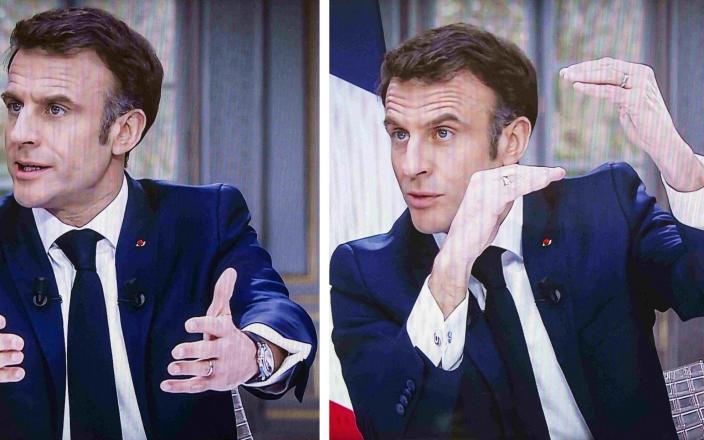
Emmanuel Macron subtly removed a luxury watch from his wrist during a key television interview on his unpopular pension reform, in what critics say is further  proof he is “president of the rich”.

During the half-hour prime-time interview on his decision to raise the retirement age 
from 62 to 64, Mr Macron can be seen starting the broadcast with a large watch with a blue face and black strap on his left arm.

Social media commentators pointed out that he then surreptitiously removed the 
timepiece 11 minutes into the conversation, placing his left arm under the table while calmly continuing to answer a question. When he brought it back, the watch was   nowhere to be seen.


Many online commentators claimed the timepiece was made by F.P Journe and cost €80,000 (£70,000). $118,752.00 Canadian Dollars

In fact, the watch cost far less than some claimed. According to France Info, it is a BRV 1-92 model of French company Bell&Ross valued at €2,400 (£2,110) and carries the colours of the president’s security unit, GSPR. He has been wearing the same watch for the past year and a half. It was already spotted at the football World Cup in Qatar.

“€2,400 is expensive  
$3,312.84 CAD    but it’s 40 times less than prices circulating on the internet,” wrote France Info. 

The Elysée insisted that Mr Macron had removed it because it was “clinking on the table”. Indeed, he removed it just after it could be heard touching the desk while he mentioned “blockages”.

Regardless, the Leftist opposition instantly pounced on the images as the latest proof that the president had no idea what it was like to be on the breadline in France. They argue that the reform will above all affect low-paid workers.

“Just as he is talking about ‘minimum wage workers’ who have never had such high purchasing power, he discreetly removes his pretty luxury watch,” wrote Clémence Guetté, an MP from the France Unbowed party of Jean-Luc Mélenchon.

paris - AP Photo/Laurent Cipriani

The French president likes to be known as “the master of the clocks”, meaning he decides to speak and act at a time of his choosing.

However, for his detractors who are dead set against raising the retirement age, he is an out-of-touch ex-banker incapable of understanding the concerns of the average modest French worker.

Critics also claimed Mr Macron was wearing a €5,000 (£4,000) Hermes suit. Here again, fact-checkers on French media said it was a far less costly model by Parisian tailor Jonas & Cie valued at around €450 (£395).
Michigan 1st state in decades to repeal 'right-to-work' law


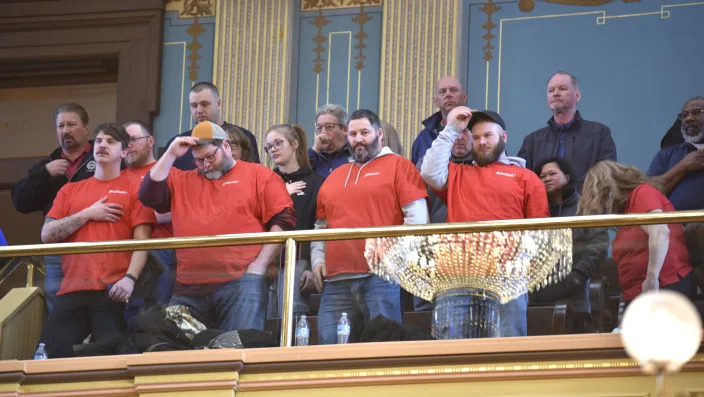
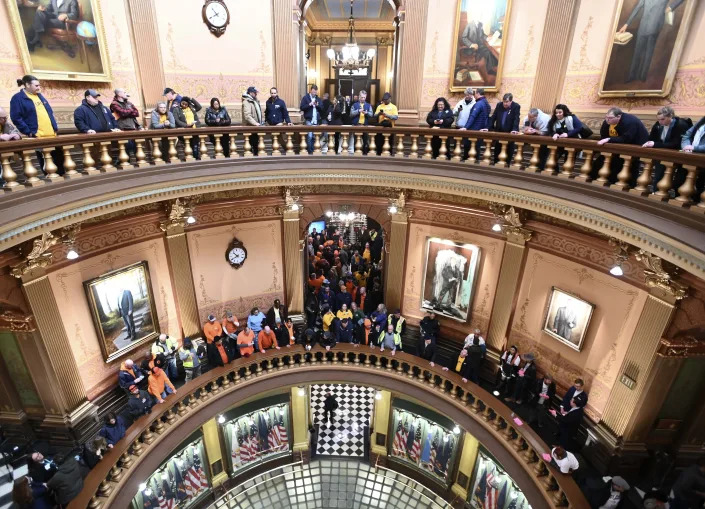
- Union members and supporters chant in the Capitol rotunda, Tuesday morning, March 14, 2023, as they wait for a Right To Work bill to be voted on. Michigan, long known as a mainstay of organized labor, became the first state in decades to repeal a union-restricting law known as “right-to-work” that was passed over a decade ago by a Republican-controlled Legislature. 
(Todd McInturf/Detroit News via AP)


JOEY CAPPELLETTI
Fri, March 24, 2023


LANSING, Mich. (AP) — Michigan, long known as a mainstay of organized labor, on Friday became the first state in decades to repeal a union-restricting law known as “right-to-work” that was passed over a decade ago by a Republican-controlled Legislature.

The state's “right-to-work” law had allowed those in unionized workplaces to opt out of paying union dues and fees. Its repeal is seen as a major victory for organized labor with union membership reaching an all-time low last year.

"Today, we are coming together to restore workers’ rights, protect Michiganders on the job, and grow Michigan’s middle class,” Democratic Gov. Gretchen Whitmer said in a statement Friday after signing the legislation.

The second-term governor also signed legislation restoring a prevailing wage law that had been repealed by Republicans in 2018. It requires contractors hired for state projects to pay union-level wages.

Repealing the “right-to-work” law, enacted in 2012, had long been listed as a top priority for Democrats, who took control of the full state government this year for the first time in 40 years.

Supporters of the repeal poured into the state Capitol in Lansing earlier this month as the House and Senate took up the legislation before approving it along party lines after limited deliberations.

“It’s a new day here in Lansing,” Senate Majority Leader Winnie Brinks said prior to the vote. ”It’s time to once again make Michigan known as a place where workers want to come."

Democrats had argued that the law allowed for “free riders” that received union representation without having to pay fees or dues. Without it, unions can now require all workers in a unionized workplace to pay fees for the cost of representation in bargaining.

Michigan had the nation’s seventh-highest percentage of unionized workers when the “right-to-work” law was enacted in 2012, but that dropped to 11th in 2022. Over the past decade, union membership in Michigan has fallen by 2.6 percentage points as overall U.S. union membership has been falling steadily for decades, reaching an all-time low last year of 10.1%.

Michigan becomes the first state in 58 years to repeal a “right-to-work” law, with Indiana repealing its in 1965 before Republicans there restored it in 2012. In 2017, Missouri's Republican Legislature approved a “right-to-work” law, but it was blocked from going into effect before voter's overwhelmingly rejected it the next year.

In total, 26 states now have “right-to-work” laws in place. There were massive protests in Indiana and Wisconsin in recent years after those legislatures voted to curb union rights.

In Michigan, thousands of union supporters descended on the state Capitol to protest in 2012 when the Republican-controlled Statehouse pushed the “right-to-work” legislation through without hearings.

Neighbored by state's with “right-to-work” laws, Republicans say the repeal will lead to Michigan becoming less attractive to businesses and will lead to forced union membership. House Republican leader Matt Hall said in statement following Whitmer's signing that “businesses will find more competitive states for their manufacturing plants and research and development facilities.”

Small Business Association of Michigan President Brian Calley, who was lieutenant governor when the law was passed in 2012, said the repeal “eliminates the right of workers to decide for themselves if they wish to join a union.”

The legislation Whitmer signed also includes $1 million in appropriations, which Republicans say is to ensure they are “referendum-proof.” The Michigan Constitution states that bills with appropriations attached to them are not subject to a public referendum in which voters could reject the law.

Whitmer promised in her 2019 State of the State speech to “veto bills designed to cut out the public’s right of referendum.”

The Democratic governor on Friday also signed legislation repealing a third-grade reading law that required students to repeat the grade if they test more than one grade level behind in reading and writing.
Strong signal, pending action: Putin’s warrant shows limits of international law


Laura Kelly
Sun, March 26, 2023 

Russian President Vladimir Putin is a wanted man, but his chance of avoiding judgment is high.

It’s a sad realization for many who are looking to hold the Russian leader accountable for launching a full-scale invasion against Ukraine and face responsibility for unimaginable horrors allegedly carried out by Russian forces.

Still, global justice advocates say the International Criminal Court’s (ICC) arrest warrant against Putin for war crimes, served last week, sends a powerful message of deterrence and animates a debate over enforcement.

An arrest warrant was also served for Maria Lvova-Belova, Russia’s Presidential Commissioner for Children’s Rights. Both were charged with the unlawful deportation of Ukrainian children to Russia.

But there’s frustration over how the ICC, based in The Hague, Netherlands, can execute the arrest warrant.

Russia has rejected the ICC’s authority out-of-hand. Moscow is not a signatory to the Rome Statute that enshrined the court’s jurisdiction.

The forcible transfer of a population by an occupying power, in particular children, is a war crime under the Rome Statute.

Ukraine’s Prosecutor General Andriy Kostin said that they have succeeded in bringing back 308 Ukrainian children who were abducted by Russia, but estimates that Moscow holds more than 16,000 of these children.

In a program reportedly overseen by Lvova-Belova, these children are submitted for “reeducation” that in effect denies their Ukrainian identity and are handed over for adoption by Russian families.

Acting on an ICC warrant


The 123 members of the ICC are generally compelled to act on an arrest warrant if any of the alleged perpetrators travels to their countries. Still, they can refuse to act by citing domestic law, in particular if a country respects that a head of state enjoys unique protections and immunity from arrest.

Member-states South Africa and Hungary have already raised concerns over their commitments to the ICC.

“We can refer to the Hungarian law and based on that we cannot arrest the Russian President … as the ICC’s statute has not been promulgated in Hungary,” said Gergely Gulyas, chief of staff to Hungarian Prime Minister Viktor Orban, Reuters reported.

And South Africa’s international relations minister, Naledi Pandor, reportedly said Friday that the government is seeking legal advice over their obligations to the ICC if Putin arrives in Durban in August to attend the BRICS summit, the grouping of Brazil, Russia, India, China and South Africa.

Pandor said South Africa wants to “be in a position where we could continue to engage with both countries to persuade them towards peace.”

Mary Glantz, senior adviser for the Russia and Europe Center at the U.S. Institute of Peace, said South Africa’s response to the ICC warrant sends an important signal of the power of the court.

“I think the initial mood in the Global South was business as usual. The fact that they’re even investigating what legal obligations they have and that they’re thinking about this, I think is a positive step,” she said, referring to South Africa.

“It’s a step in the right direction that maybe we’re moving the needle a little on global public opinion about what’s going on in Ukraine.”

It’s an unusual move by the ICC to make public its arrest warrants, Gantz said, and is likely a signal of the court’s confidence in the evidence it has for its case, and that it may have other secret warrants for members of Putin’s inner circle.

“They could show up somewhere and that country, as a state party, could get the information that ‘nope, there’s an arrest warrant’ and they could be picked up,” Gantz said.

“It leaves a pall of uncertainty around everybody in [Putin’s] inner circle when it comes to international travel.”

America’s relationship with ICC

The war crimes warrant has also brought up uncomfortable questions for the U.S., which walks a fine line between voicing support for international justice and clashing intensely with the ICC over its pursuit of war crimes investigations allegedly by U.S. soldiers in Iraq and Afghanistan.

The Biden administration has eased friction with the ICC by removing sanctions imposed on its chief prosecutor by the former Trump administration. The ICC, in turn, set aside investigations into alleged crimes committed by American forces in Afghanistan.

The U.S., which is not a member state of the ICC, has said the court’s most important function is to carry out justice in countries where the home courts are compromised, and that the strength of the American justice system should shield it from efforts to make it a target of the international court. Still, Congress has recognized the U.S. can do more and took recent action to amend U.S. law to better position itself to assist the ICC and apprehend alleged war criminals.

This includes the Justice for Victims of War Crimes Act, signed into law in January, which allows for America’s courts to carry out trials against alleged war criminals who are found to be in the U.S., even if they never targeted Americans or committed crimes in the U.S. The law is unlikely to be used to go after Putin, given the far-fetched scenario he’d travel to the U.S.

Another important piece of legislation, included in the 2023 funding bill, lifted a prohibition on the U.S. working with the ICC, but narrowly defined it to focus specifically on war crimes investigations surrounding Russia’s war in Ukraine.

“And so they changed it to say, ‘OK, for this very, very specific situation, there’s a certain amount of help we can give,’” said Celeste Kmiotek, staff lawyer with the Strategic Litigation Project at the Atlantic Council, which focuses in part on accountability for atrocity crimes and human rights violations.

“This is a very good opportunity for U.S. lawmakers to really consider, potentially being more open to the ICC.”

A delicate debate on U.S. involvement with the ICC is playing out behind closed doors between the Pentagon and the White House, the New York Times reported earlier this month, saying the Department of Defense is blocking the State Department from transferring war crimes evidence to the ICC.

The evidence reportedly includes material about decisions by Russian officials to deliberately target civilian infrastructure and related to the ICC’s case against Putin and Lvova-Belova.

On Friday, a bipartisan group of senators sent a letter urging President Biden to share U.S.-collected evidence with the ICC: “Knowing of your support for the important cause of accountability in Ukraine, we urge you to move forward expeditiously with support to the ICC’s work so that Putin and others around him know in no uncertain terms that accountability and justice for their crimes are forthcoming.”

A State Department spokesperson said that the administration has “worked hard” over the past two years to improve U.S. relations with the ICC, pointing to the lifting of sanctions and “a return to engagement,” but did not specifically address whether it is directly providing evidence to the international court.

Child relocation charges just the start?

The war crimes allegations over the forced relocation of children is significant, international law experts have argued, because it could lay the groundwork for more war crimes charges, including genocide and crimes against humanity.

There’s some optimism to believe Putin and his most senior officials will face justice.

Of the 18 heads of state or heads of major military forces wanted by international justice, 83 percent have faced accountability, Thomas Warrick, a nonresident senior fellow for the Atlantic Council wrote in an analysis.

Putin has few friends left in the world. Still, support he receives from Chinese President Xi Jinping, and the comments from Hungary and South Africa highlight that the Russian leader is not entirely isolated.

But a larger rap sheet, possibly including genocide and other heinous war crimes, could help pressure action from countries who have stayed on the sidelines.

“You got to wonder, how many states really want to be seen standing side-by-side with an accused war criminal,” Gantz said, “somebody who is accused of kidnapping children, at this point, and could potentially be accused of genocide, which I think could be even more poisonous, even more toxic to people standing next to him.”

For the latest news, weather, sports, and streaming video, head to The Hill.

Former rebel leader is named Congo's new Defense Minister


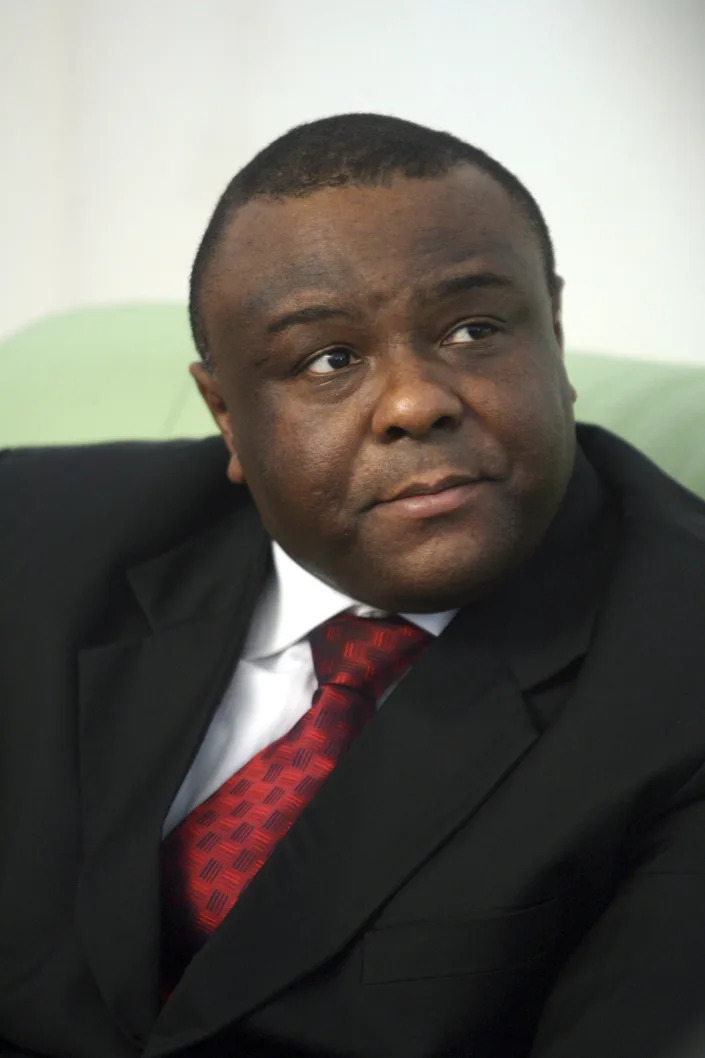
Former militia leader Jean Pierre Bemba holds a press conference in the Congoleses capital Kinshasa Oct. 26, 2006. Bemba was appointed as Congo's defense minister Thursday March 23, 2023, amid a cabinet reshuffle.
 (AP Photo/Jerome Delay, file)

JEAN-YVES KAMALE
Fri, March 24, 2023 

KINSHASA, Congo (AP) — Congo's former rebel leader jailed by the International Criminal Court, Jean-Pierre Bemba, has been appointed Congo's Defense Minister and Deputy Prime Minister in a Cabinet reshuffle.

Bemba's appointment to the key positions was announced Thursday evening on state television by President Felix Tshisekedi's spokeswoman. Bemba's promotion and other Cabinet appointments come less than a year ahead of Congo's presidential elections.

Congo's former vice president between 2003 and 2006, Bemba was later imprisoned by the ICC for more than a decade, accused of murders, rapes and pillaging committed by his Movement for the Liberation of Congo forces in the neighboring country of Central African Republic. In a surprising ruling, he was acquitted by the ICC in 2018. Bemba has always maintained his innocence.

Bemba's return to prominent government positions comes nine months ahead of Congo's presidential elections scheduled for December. Bemba's political comeback was likely decided to help Tshisekedi win votes in Congo's war-torn northeast, where Bemba's rebel group was popular in the 1990s and 2000s, say analysts.

“This is clearly a pre-election reshuffle and Jean-Pierre Bemba has been appointed to bring his supporters in line to rally behind the president ahead of the race,” said Benjamin Hunter, Africa analyst for Verisk Maplecroft, a risk assessment firm.

“Despite Bemba’s previous imprisonment by the ICC, he is a political heavyweight with the patronage networks and contact book to help Tshisekedi’s election campaign,” he said.

Conflict in eastern Congo has been simmering for decades with more than 120 armed groups fighting for power, land, resources and some to defend their communities. Tshisekedi came to office in 2019 promising to stem Congo's instability and violence, but it's only increased.

Other new government postings in the Cabinet reshuffle include Tshisekedi’s former chief of staff, Vital Kamerhe, who was named the minister of the economy. Kamerhe was sentenced to 20 years in prison but acquitted last year. Antipas Mbusa Nyamwisi, a former warlord in Ituri province was appointed minister of state for national integration.
A SYMBIOTE IS A PARASITE
Apple enjoys 'symbiotic' relationship with China, Cook says


AFP
Sat, March 25, 2023 


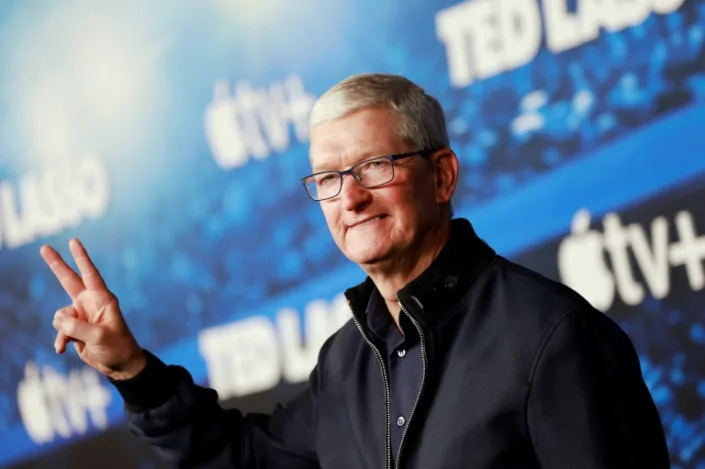
Apple enjoys a "symbiotic" relationship with China, CEO Tim Cook said on Saturday, as the iPhone giant looks to move production out of the country.

Cook, who is in China to attend the high-profile China Development Forum, said "Apple and China grew together," during an interview on the role of technology in education.

"This has been a symbiotic kind of relationship that I think we both enjoyed," he said at the state-run event attended by top government officials and corporate leaders.

Cook's visit comes as Apple, the world's biggest company by market value, is trying to move production out of China.


Last year, Apple sales were hit by curtailed production at factories as a result of China's zero-Covid policy.

US export controls on high-tech components are also threatening the company's supply chain.

Cook did not address supply chain issues during his discussion.

Instead, he focused on the need to bridge the education gap between urban and rural schools and encouraged young people to learn programming and critical thinking skills.

He also pledged to increase Apple's spending on its rural education program in China to 100 million yuan ($15 million).

Cook visited an Apple Store in downtown Beijing on Friday, and a photo of him posing for a selfie with singer Huang Ling has gone viral on Chinese social media.

Apple CEO praises China's innovation, long history of cooperation on Beijing visit


Reuters
Fri, March 24, 2023 

SHANGHAI (Reuters) - Apple CEO Tim Cook on Saturday used his first public remarks on his visit to China to praise the country for its rapid innovation and its long ties with the U.S. iPhone maker, according to local media reports.

Apple CEO Tim Cook on Saturday used his first public remarks in China in recent years to praise the country for its rapid innovation and its long ties with the U.S. iPhone maker, according to local media reports.

Cook is in Beijing to attend the China Development Forum, a government-organised event being held again in full force after the country ended its COVID controls late last year.

Besides Cook, the event is being attended by senior government officials as well as CEOs of firms such as Pfizer and BHP.

"Innovation is developing rapidly in China and I believe it will further accelerate," Cook was quoted by The Paper news outlet as saying.

His visit comes at a time of rising tensions between Beijing and Washington and as Apple has been looking to reduce its supply chain reliance on China and moving production to new up and coming centres such as India.

Last year, production at the world’s largest iPhone factory run by Apple supplier Foxconn was heavily disrupted after China's zero-COVID policies fuelled worker unrest.

Cook also visited an Apple Store in Beijing on Friday, pictures of which went viral on Chinese social media.

During his speech, Cook also discussed education and the need for young people to learn programming critical thinking skills, announcing that Apple plans to increase spending on its rural education programme to 100 million yuan, the local media reports said.

(Reporting by Brenda Goh)
From Boston to Detroit — why Atlanta's 'Cop City' protests are galvanizing communities around the U.S.

Protests against a plan to build a new training center for police and firefighters in Atlanta have spread to cities across the country. The center's critics are wary that, if successful, it could create a precedent for others to follow.


Marquise Francis
·National Reporter
Sat, March 25, 2023 

Protests against a plan to build a new police and firefighter training center in Atlanta have spread to cities including New York, Detroit and Miami. 


Protests over the construction of a new 85-acre training center for police and firefighters in Atlanta have spread well beyond the city’s limits, and are gaining momentum across the country.

For more than two years, the proposed training center, dubbed “Cop City” by its opponents, has been the subject of criticism from environmentalists and social justice advocates alike, who argue that its construction would harm the local ecosystem and accelerate the militarization of the police. But in recent months the issue has garnered increased national attention, especially after the fatal police shooting in January of Manuel Terán, a 26-year-old environmental activist who was protesting the facility’s construction.

In the immediate aftermath of Terán’s death, vigils in his honor were held across the country, from Tallahassee to Los Angeles. Since then, what began as a local issue has continued to spark demonstrations in a variety of other cities, where activists have felt inspired to stand in solidarity with Atlanta while warning against the construction of similar facilities in their own backyards.

In late February, dozens of protesters took to the streets of downtown Detroit, stopping midday traffic while chanting, “Stop Cop City!” Less than two weeks later, similar chants were shouted by more than 50 students and community members on the campus of Harvard University. Then last weekend, in Providence, R.I., dozens gathered outside a Home Depot with signs that read, “Defund and Reimagine.”

A makeshift memorial for environmental activist Manuel Terán, who was killed by law enforcement during a raid to clear the construction site of "Cop City." 
(Cheney Orr/AFP via Getty Images)

Students at Harvard said they rallied because of their own concerns about systemic police violence.

“Believe it or not, the same concerns in Atlanta are also in Massachusetts, whether we have our own Cop City to prove it,” Karen Choi, a sophomore at the school and one of the event’s organizers, told Yahoo News. “The issue of violence is systemic, rooted in a history of police brutality that has long been safeguarded by a numbers game that prioritizes profit.”

Maggie House, a student at the Harvard Graduate School of Design, said she chose to demonstrate because she believes police brutality, forest devastation and climate change are “national and global issues which unite our generation.”

“Allowing Cop City to move forward not only increases the risk for militarized police force[s] to be used against all Americans, it has the potential to carve a pathway for private investors to partner with police foundations nationally to create similar projects with equally devastating effects,” House told Yahoo News.

Detroit activists offered similar explanations for rallying against the Atlanta training center.

“Those same tools of militarized police impact us here in Detroit, just as they do in Atlanta,” Antonio Cosme, an education coordinator with the National Wildlife Federation, told Bridge Detroit last month. “I see Detroit and Atlanta as being deeply, deeply interwoven in their cultural fabric.”


Environmental activists rally on March 4 in the South River Forest near Atlanta, where the training center is scheduled to be built.
 (Andrew Lichtenstein/Corbis via Getty Images)

Tiffany Roberts, a public policy director for the Southern Center for Human Rights, an Atlanta-based public interest law firm dedicated to prison reform, has been an outspoken critic of the center. She told Yahoo News that she’s encouraged by the wide range of demonstrations taking place in cities across the country.

“The courageous organizing by these young people has really been a source of pride for me,” Roberts said, adding that she thinks the intersectionality of issues on display in the Cop City debate makes it resonate more widely. “They can talk about police militarization and they can talk about the environment and they can talk about environmental racism.”

In an interview with the Intercept earlier this year, Casey Sharp, a Georgia-based archaeologist who has helped facilitate communications between activists and local leaders in Atlanta, predicted that the Cop City protests “will become another Standing Rock,” referring to demonstrations beginning in 2016 over the planned construction of a 1,200-mile-long oil pipeline through the Standing Rock Sioux Reservation in North Dakota that drew national attention.

The debate over Cop City

The Atlanta Public Safety Training Center, which is set to include a shooting range, fire training towers and a mock city featuring homes and streets, was approved by the Atlanta City Council in 2021 with the backing of the Atlanta Police Foundation (APF), a nonprofit largely funded by corporate donors. Amid a flurry of lawsuits attempting to halt the project altogether, a spokesperson for the city said “construction is ongoing” but offered no specifics on the current status of the center.

The training center is estimated to cost around $90 million, a third of which is expected to be paid by taxpayers. The rest will come from private donations raised by the APF.

Proponents of the center say it is needed to help boost law enforcement recruitment, retention and morale in the wake of severe staffing shortages in the city.

The site of the planned police training facility near Atlanta.
 (Cheney Orr/AFP via Getty Images)

Atlanta City Council member Michael Julian Bond, who voted in favor of the plan two years ago, told Yahoo News in January that the center represents a necessary investment in public safety that’s been decades in the making.

“The city desperately needs new training facilities,” Bond said, citing an increase in 911 calls in the last three years after the police killings of George Floyd in Minneapolis and Rayshard Brooks in Atlanta. “There is a continuingly demonstrated need for police, fire and emergency services.”

But critics believe that besides harming the region’s environment, the facility will further strain relations between police and the community, particularly the Atlanta area’s majority Black population.

In an interview with the New York Times earlier this month, Arthur Rizer, a former Washington state police officer and policing expert, said, “I do share the concern of the citizens of Atlanta that the apparent focus is going to be a paramilitary-type training, urban assault tactics, which quite frankly have not been effective at reducing crime.”
Activists fear Atlanta’s Cop City could set a precedent

In recent months, the growing backlash against Cop City in Atlanta has raised concerns for activists in other parts of the country that their cities could be next.

“Cop City, if built, will set a new precedent for police militarization, not just in Atlanta, not just in the Southeast, not just in the country, but in the world,“ Jonah Sylvester, an organizer with the Weelaunee Defense Society of Pittsburgh, told the Pittsburgh City Paper earlier this month.

In 2020, the city of Pittsburgh acquired a former hospital from the federal government, at no cost, in order to build a regional policing and first responder training center, similar to the one proposed in Atlanta. Though no concrete plans have been put in motion, city officials have said the project would cost about $120 million.

In New Jersey, Gov. Phil Murphy, a Democrat, included in his latest budget a new $120 million state police training center to replace the 100-year-old facility currently shared by the State Police Academy, the National Guard, the New Jersey Department of Corrections and the Juvenile Justice Commission.

The recent push for new police training centers in Atlanta and elsewhere is a direct response to the 2020 protests following the murder of Floyd and other high-profile police killings.


Firefighters on the scene after a police car was set on fire during a protest against Cop City in Atlanta, Jan. 21.
 (Benjamin Hendren/Anadolu Agency via Getty Images)

Atlanta officials like Mayor Andre Dickens, a Democrat, have touted the police training center as exactly the kind of reform that community members demanded in 2020.

“Good community policing depends on high-quality training,” Bryan Thomas, a spokesperson for Dickens’s office, told Yahoo News.

But critics are wary of any type of massive investment in policing, arguing that the focus on training misses the point of what the 2020 protests sought to accomplish.

“It wasn’t training that people asked for in 2020,” Roberts said. “What people asked for in 2020 was for police to stop killing [Black] people.”
Environmental concerns over the center

Environmental activists also object to the plans for the center, which is slated to be built on the site of a former prison farm in the South River Forest, a sprawling 3,500-acre green space just outside the city’s limits.

The land was designated as part of a 2017 proposal to create green space and recreation options for underserved parts of Atlanta. But the City Council scrapped those plans just four years later, agreeing instead to lease the land to APF to build the training center.


Law enforcement vehicles block the entrance to the site of the training facility. 
(Cheney Orr/AFP via Getty Images)

Many community activists argue that preserving the park’s greenery will help combat climate change, as trees absorb carbon dioxide and produce oxygen, while making the area less susceptible to flooding.

Terán, who was killed following a clash with police in the South River Forest in January, was among those who objected to the training facility for environmental reasons.

His death, which is being investigated by the Georgia Bureau of Investigation (GBI), has prompted widespread outrage, exacerbating long-simmering tensions between protesters and law enforcement throughout Atlanta.

While police initially claimed that Terán was shot after he opened fire on a state trooper, evidence has since come to light that casts doubt on that narrative, including body camera footage from one of the responding officers at the scene as well as the findings of an independent autopsy commissioned by Terán’s family.

The Atlanta Police Department declined Yahoo News’ request for comment on the shooting, and the GBI pointed to its previous statements about the case.

“The GBI cannot and will not attempt to sway public opinion in this case but will continue to be led by the facts and truth,” the bureau said in a statement on March 10. “We understand the extreme emotion that this has caused Terán’s family and will continue to investigate as comprehensively as possible.”


An image of environmental activist Manuel Terán. 
(Cheney Orr/AFP via Getty Images)

Peaceful vigils held throughout Atlanta in the wake of the shooting have turned violent in recent weeks. At one particular demonstration earlier this month, three dozen people, many of them from out of state, were arrested and charged with domestic terrorism after, police said, they hurled bricks and fireworks at officers.

According to Atlanta police, a group of violent agitators had used “the cover of a peaceful protest” to “destroy property and attack officers.” But Defend the Atlanta Forest, a local activist group, insists that those arrested, including one person from Canada and another from France, weren’t actually among the agitators, but were simply concertgoers attending a nearby music festival.

City Council member Bond, whose father, Julian Bond, was a prominent leader in Georgia’s civil rights movement, condemned those who have responded to Terán’s death with violence.

“I regret that someone has lost his life in pursuing his ideals as an activist,” Bond said. “I also regret that a peaceful demonstration about his death was co-opted by a few who embedded themselves to commit acts of violence.”

“Martin Luther King never set a police car on fire,” he continued. “And he changed the world.”

Cover thumbnail photo illustration: Yahoo News; photos: Spencer Platt/Getty Images, Cheney Orr/AFP via Getty Images, Andrew Lichtenstein/Corbis via Getty Images
Myanmar lawyer accused of helping army slain by guerrillas


FILE - A supporter shows a portrait of former leader Aung San Suu Kyi during a protest marking the two-year anniversary of the military takeover that ousted her government outside the Myanmar Embassy in Bangkok, Thailand, on Feb. 1, 2023. Lawyers for Myanmar’s ousted leader Aung San Suu Kyi, who is serving a 33-year prison sentence on charges widely considered contrived by the military who overthrew her elected government, have been denied meetings with her even though they are in the process of making several appeals.
(AP Photo/Sakchai Lalit) (ASSOCIATED PRESS)More


GRANT PECK
Sat, March 25, 2023

BANGKOK (AP) — A veteran corporate lawyer has been shot dead in Myanmar’s biggest city by self-proclaimed urban guerrillas, highlighting the bloody struggle between the military government and its foes in the country’s cities as well as the remote countryside.

Min Tayza Nyunt Tin was shot multiple times while driving his car in Yangon on Friday, according to a business colleague, media reports and a statement from the guerrilla group.

The group, calling itself Urban Owls, accused him of being a business associate of the country’s military leaders who seized power two years ago, and claimed he helped them launder money in order to buy real estate and business assets abroad in deals totaling hundreds of millions of dollars.

Its claims could not be independently verified, and a colleague of Min Tayza denied the guerrillas’ allegations. The victim was the founder and CEO of BIZ Law Consult Myanmar, a law firm specializing in intellectual property and trademark law.

Media outlets sympathetic to the military reported on the Telegram messaging app that the 56-year-old was shot by members of the People’s Defense Force.

It's a loosely organized armed wing of the pro-democracy National Unity Government, which opposes the military government that was established when the army seized power in February 2021 from the elected government of Aung San Suu Kyi. Many of the opposition forces operate autonomously of the National Unity Government.

The army takeover triggered widespread peaceful protests that were quashed with lethal force, triggering armed resistance that U.N. experts now characterize as civil war.

Urban guerrillas have carried out targeted killings, arson and small bombings since 2021. Victims included officials and members of the military as well as people believed to be informers or military collaborators. In November 2021, a former navy officer who was the chief finance officer of Myanmar’s military-linked telecommunications company was fatally shot on a Yangon street.

The army has clamped down harshly on opponents in the cities, arresting thousands and using deadly force even against nonviolent demonstrators. According to a detailed list by the Assistance Association for Political Prisoners, a rights monitoring organization, at least 3,160 civilians have been killed by security forces since the army seized power.

The statement issued by the Urban Owls guerrillas cited what it claimed were social media postings by Min Tayza, including one that expressed gratitude to former air force commander Myat Hein for helping him make his fortune.

The guerrillas’ statement also claimed Min Tayza “has publicly announced on Facebook that he shall ‘only provide services to reliable friends and supporters of the military’ shortly after the 2021 coup took place.”

The citations could not be verified, because the Facebook account where the comments allegedly were posted is marked as a private one.

The guerrillas' statement said the shooting is “yet another warning to all business tycoons and associates” of the country's military.

“We are among many guerrilla groups in Yangon who are aware of your money laundering schemes and blood money deals, and shall spare no one standing against the Spring Revolution of Myanmar,” it said.

A member of BIZ Law Consult Myanmar company confirmed Min Tayza’s death to The Associated Press on Friday night but denied the allegation of his military links. The person spoke on condition of anonymity for fear of arrest by the military and attacks by urban guerrillas.

“I want to say that none of the allegations are correct. We only give services for intellectual property for business firms. We are not associated with them (the military),” the person said.

The firm’s Facebook page also promotes opening bank accounts, buying property and getting retirement visas in neighboring Thailand, where the company has an office. Well-to-do Myanmar residents, not just supporters of the military, have sought to transfer assets to Thailand, which they consider a safe haven.

Myanmar’s economy has been in shambles due to civil disobedience, mismanagement by the military and economic sanctions imposed by Western nations as a consequence of the army’s seizure of power and human rights abuses.

On Friday, the U.S. government announced a new set of sanctions against two individuals and six companies meant to stem the supply of jet fuel to Myanmar. Activists say blocking the supply of jet fuel can hinder Myanmar’s military from carrying out air strikes in the countryside, which often cause civilian casualties.
CRIMINAL CAPITALI$M SMUGGLING
Bolsonaro's legal woes deepen with undeclared diamond gifts


Lawyer Paulo Cunha, left, accompanied by adviser Osmar Crivelatti, arrives to return weapons received by Brazil's former President Jair Bolsonaro at the Federal Police headquarters in Brasilia, Brazil, Friday, March 24, 2023. Representatives of Bolsonaro on Friday returned weapons he received from the United Arab Emirates and a set of jewels from Saudi Arabia, both of which he received during his presidency, as he was ordered to do by a Brazilian government watchdog. 
(AP Photo/Eraldo Peres)

ELÉONORE HUGHES and MAURICIO SAVARESE
Fri, March 24, 2023 

RIO DE JANEIRO (AP) — Undeclared diamond jewelry brought into Brazil from Saudi Arabia has deepened the legal jeopardy of former Brazilian President Jair Bolsonaro. An investigation into two sets of jewels reportedly worth millions is only the latest scandal threatening the far-right politician. But an extensive paper trail and even videos could make the case particularly daunting for Bolsonaro.

WHAT HAPPENED WITH THE DIAMONDS?


Federal police and prosecutors are investigating whether Bolsonaro tried to sneak two sets of expensive diamond jewelry into Brazil without paying taxes — and whether he improperly sought to prevent the items from being incorporated into the presidency’s public collection. Authorities are also looking into whether he enlisted public officials to try to bypass customs.

The first set of jewels, composed of earrings, a necklace, a ring and a watch by Swiss brand Chopard, arrived in Brazil in October 2021 through Sao Paulo’s international airport with an adviser to the then minister for mines and energy, Bento Albuquerque, according to the newspaper O Estado de S.Paulo, which first reported the case in early March.

Customs authorities seized the jewels, which are reportedly worth $3 million. A video released by television network Globo shows Albuquerque at customs later the same day stating that the jewels were for Bolsonaro’s wife, Michelle.

A second set of jewels, also made by Chopard and including a watch, a pen, a ring, cuff links and a piece resembling a rosary, slipped past authorities and ended up in Bolsonaro’s possession. The watch is worth about $150,000, the newspaper Folha de S.Paulo reported.

A government watchdog on March 22 ordered Bolsonaro to turn the jewelry over to the state-owned Caixa Economica Federal bank, as well as firearms he received as a gift from authorities in the United Arab Emirates. Bolsonaro's representatives did so on Friday.

Brazil requires its citizens arriving by plane from abroad to declare goods worth more than $1,000 and, for any amount above that exemption, pay a tax equal to 50% of their value. The two sets of jewelry would have been exempt from tax had they been a gift from the state of Saudi Arabia to the nation of Brazil, but would not have been Bolsonaro's to keep.

Bruno Dantas, a member of Brazil’s government watchdog, said a president could receive a gift for personal use without paying taxes as long as it was of low value, such as a T-shirt of a country’s national football team. Expensive jewelry does not meet the criteria, he said.

The watchdog said it will audit all gifts received by Brazil’s presidency during Bolsonaro’s term.

WHAT DID BOLSONARO DO ABOUT THE CONFISCATED JEWELS?


Documents and video footage appear to show Bolsonaro making multiple unsuccessful attempts to retrieve the seized jewelry.

A letter from the presidential office was sent to Albuquerque requesting that the jewels be released, O Estado de S.Paulo reported. The ministries of foreign affairs and mines and energy also sent letters pressuring customs authorities. Then Bolsonaro sent a personal letter to customs, O Estado de S.Paulo said.

A last attempt came in the closing days of Bolsonaro's presidency. According to a document viewed by O Estado de S.Paulo, on Bolsonaro's orders a sergeant took a military plane to Sao Paulo’s airport in a failed effort to force the release. Globo released a video of the sergeant speaking with custom authorities.

WHAT LEGAL ISSUES HAS THE CASE RAISED?


The Senate’s transparency commission is investigating whether the sale of a refinery by Brazil's state-controlled oil giant Petrobras to the United Arab Emirates’ Mubadala Capital was related to the jewels. Mubadala didn't respond to a request for comment sent Friday.

Petrobras completed the sale for $1.65 billion one month after the first set of jewels was seized in Sao Paulo. The price was “way below” fair market value, an oil workers’ union said in a recent statement.

Rodrigo Sánchez Rios, a law professor at Pontifical Catholic University in the city of Curitiba, said Bolsonaro could potentially face trial on several counts, including influence peddling, embezzlement, money laundering and corruption.

“This is potentially the crime with the most evidence currently implicating Bolsonaro,” said legal expert Wallace Corbo from the Getulio Vargas Foundation, a think tank and university.

WHAT HAS BOLSONARO SAID ABOUT THE JEWELRY?


“There was no intention on our part to disappear with this material,” Bolsonaro told television network Record on Wednesday during an event in Florida. He previously told CNN Brasil that he neither asked for nor received the confiscated jewelry.

Bolsonaro’s attorney Frederick Wassef said in a statement on March 7 that the former president “officially declared personal property received on trips,” and is the target of political persecution.

WHAT ARE BOLSONARO’S OTHER LEGAL PROBLEMS?

The former president has denied any wrongdoing in all of the various cases under investigation, most recently whether he incited the Jan. 8 riots in which his supporters ransacked the Supreme Court, the presidential palace and Congress one week after leftist Luiz Inácio Lula da Silva was inaugurated as president.

Bolsonaro is the subject of a dozen investigations by Brazil’s electoral court into his actions during the presidential election campaign, particularly related to his unsubstantiated claims that Brazil’s electronic voting system is susceptible to fraud. If Bolsonaro were found guilty in any of those cases, he would lose his political rights and be unable to run for office in the next election.

Separately, Bolsonaro and his allies are also under investigation in a sprawling Supreme Court-led investigation on the spread of alleged falsehoods and disinformation in Brazil.

Federal police are also investigating Bolsonaro and his administration for alleged genocide of the Indigenous Yanomami people in the Amazon rainforest by encouraging illegal miners to invade their territory and thereby endangering their lives. He has called the accusation a “hoax from the left.”

——-

Savarese reported from Sao Paulo.
Opinion: From Mexico to Brazil, Latin America's democracies face a common threat from within


Will Freeman and Beatriz Rey
Sun, March 26, 2023 

Then-Brazilian President Jair Bolsonaro posing with soldiers during annual military exercises. 
(Eraldo Peres / Associated Press)

Thirty years ago, Latin America’s nascent democracies did what had once seemed impossible: They confined the militaries that had regularly overthrown them to their barracks.

But now presidents from Mexico to Brazil are coaxing the generals back out — and undermining their democracies in the process. By invitation of elected leaders, militaries across the region are reemerging as a political force: resolving election disputes, putting down protests and taking top government jobs.

In contrast to the region’s Cold War-era militaries, modern Latin American armed forces aren’t governing directly. Often, they’re reluctantly heeding civilian leaders’ calls to wade into politics and governance. But their resurgence nevertheless threatens democracies already beset by election deniers, economic hardship and civil unrest.

Less than a half-century ago, military rule was the norm in Latin America. From Brazil’s 1964 military coup until the fall of the Berlin Wall, generals habitually ousted elected presidents and formed authoritarian juntas, often with U.S. support and in the name of fighting communism. By 1977, repressive military regimes ruled all but four countries in the region.

But by the 1990s, with the lone exception of Cuba, Latin America had embraced democracy. Coup attempts dwindled as military officers accepted civilian rule. In Argentina, junta leaders faced trial. In Chile and Guatemala, where militaries clung to control of some government agencies and offices, elected leaders slowly but surely reformed them. It was a rare and remarkable story of democratic progress in a region with a long history of uncertain rule of law.

But once militaries are firmly under civilian control, it’s up to civilians to manage them responsibly. Most of Latin America’s elected leaders failed that test.

Driven by a combination of pragmatism and opportunism, politicians leveraged military forces to bolster their governments as de facto police forces, state bureaucracies and electoral tribunals. This trend started slowly but quickly gained steam.

Facing governance challenges ranging from rising crime to climate-accelerated natural disasters, elected governments leaned on their armed forces to perform tasks that weaker state institutions couldn’t. Militaries’ competence, loyalty and public trust across the region — second only to the church’s — made them useful to political leaders.

During the 2000s, Latin American leaders used professional soldiers in place of ill-equipped local police forces, putting armies in charge of fighting crime.

In the 2010s, as the region’s economies slowed to a crawl, democracies got messier. Protests and election disputes proliferated, and elected leaders frequently called in the military for backup. The presidents of Chile and Ecuador used troops to enforce curfews and restore order after uprisings in 2019. In Venezuela, Honduras, Nicaragua and, most recently, Peru, troops cracked down on protesters with lethal force.

Since the onset of the pandemic, Latin American governments have dispatched militaries to produce masks in Argentina, enforce stay-at-home orders in Chile and cajole people into quarantine centers in El Salvador.

The region’s politicians have also increasingly enlisted militaries as unofficial political referees. Honduras’ military, at the urging of its Congress, forced then-President Manuel Zelaya into exile in 2009. Bolivia’s military successfully “suggested” President Evo Morales leave office as antigovernment protests raged in 2019. And El Salvador’s populist president, Nayib Bukele, pushed his 2020 agenda through the legislature by filling its halls with gun-toting troops.

Political opportunism has been another driving factor. As the region’s traditional political parties broke down, power-hungry presidents turned to the military in their stead. The late Venezuelan autocrat Hugo Chávez, a former military officer, took the tactic furthest, filling the government with generals.

Former Brazilian President Jair Bolsonaro, himself a former army captain, and Mexican President Andrés Manuel López Obrador have both taken pages from his playbook. Bolsonaro, who staffed a third of his Cabinet with military figures, roped top brass into a fruitless hunt for evidence of fraud in last year’s election. López Obrador, who once promised to rein in the military, has instead given its officers roles in security, infrastructure and tourism while creating a new, military-staffed National Guard.

While the risk to Latin American democracy once came from from generals disobeying orders, it now comes from their tendency to follow them. Today’s generals don’t want to replace civilian governments. They’re more focused on safeguarding privileges, budgets and authority.

That doesn’t mean these democracies are safe. Although it’s unlikely that other militaries in the region will go as far as Venezuela’s by fusing with an autocratic ruling party, the militarization of governance and politics is already taking a toll on democracies’ health in a few ways.

First, militarization stifles critical voices in civil society even when it’s not undermining election integrity. Militaries’ capacity for secrecy and intimidation serve them well on the battlefield but don’t mix with healthy democratic politics. Mexican journalists recently revealed that military officials had accessed a reporter’s private messages by infecting his phone with spyware, the latest in a string of similar cases exposed since 2017. After the Peruvian armed forces killed 10 protesters and injured scores more in December, demonstrations began to decline.

Militarizing aspects of governance that are properly left to civilians can also lead to mismanagement, corruption and waste. After the military took over Venezuela’s state-run oil company, its output nosedived. Military officials made costly mistakes as they rolled out Brazil’s pandemic response, sending some 78,000 vaccine doses to the wrong state; they did no better as an ad hoc police force tasked with halting the destruction of the Amazon. And in Mexico, López Obrador’s decision to put the military in charge of building and operating infrastructure shields government contracts from scrutiny.

Finally, militaries sometimes protect their own from accountability. While Colombia convicted 800 soldiers and put 16 generals under investigation for extrajudicial executions between 2002 and 2008, Mexico’s Supreme Court appears to have put all major rulings affecting the military on hold since López Obrador took office. Under a 2017 law, Brazil allows officers accused of abusing civilians to face trial in special military courts.

Brazil’s recently elected president, Luiz Inácio Lula da Silva, offers hope for rolling back militaries' role in government. Since his inauguration in January, he has replaced military figures with civilians in more than 100 government posts. A general who vocally opposes an activist military, Tomás Paiva, became the army’s top commander.

At the same time, Lula is carefully building bridges to avoid alienating the generals. Ten years ago, that might not have been necessary. Today it’s a must — and a testament to how much ground Latin America’s democracies have lost.

Will Freeman is a fellow for Latin America studies at the Council on Foreign Relations. Beatriz Rey is a senior researcher at the State University of Rio de Janeiro.

This story originally appeared in Los Angeles Times.
Gandhi says disqualification 'politically motivated'

BBC
Sat, March 25, 2023 

Rahul Gandhi speaks to the media in Delhi on Saturday, a day after being disqualified from parliament

The leader of Indian's opposition Congress party Rahul Gandhi has said his disqualification by parliament was politically motivated.

On Friday, India's parliament stripped Mr Gandhi of his MP status a day after he was sentenced to two years in prison in a defamation case.

He was convicted by the court for 2019 comments about PM Narendra Modi's surname at an election rally.

The governing BJP says his expulsion conformed with parliamentary rules.

A 2013 Supreme Court order says that a lawmaker convicted in a crime and sentenced to two or more years in jail stands disqualified from the parliament with immediate effect.

Speaking at a news briefing on Saturday, Mr Gandhi said: "It makes me no difference if I'm disqualified... Disqualify me for life.... I will keep going, I will not stop."

Although India's opposition parties don't always agree on political issues, many of them have supported Mr Gandhi over his disqualification. On Friday, 14 parties approached the Supreme Court, alleging that the federal government was misusing investigative agencies to target BJP's opponents.

Congress president Mallikarjun Kharge alleged that the action against Mr Gandhi was a consequence of his demand for a parliamentary investigation to probe allegations against the Adani Group.

The huge conglomerate was accused of decades of "brazen" stock manipulation and accounting fraud by US-based short-seller Hindenburg Research earlier this year. The Adani Group has denied allegations of financial fraud.

"My job as I see it is to defend the democratic nature of this country," Mr Gandhi said after his disqualification.

"That means defending the institutions of this country, that means defending the voice of the poor people of this country, that means telling the people of this country the truth about people like Mr Adani, who are basically exploiting the relationship they have with the prime minister," he said.

"I was disqualified because Prime Minister Narendra Modi is scared of my next speech on Adani... I can see it in his eyes."

Mr Gandhi's supporters say his disqualification is a sign that India's democratic system is weakening, and more protests against the government are planned in the coming days.

He will not be allowed to take part in national elections due next year, unless his sentence is suspended or he is acquitted in the case.

The ruling Bharatiya Janata Party (BJP), however, said the decision to disqualify Mr Gandhi was in accordance with parliamentary laws, and criticised his party for questioning the verdict.

Federal Labour Minister Bhupender Yadav said Mr Gandhi had insulted members of the caste grouping known as Other Backward Classes (OBC) under which the name "Modi" falls.

"Insulting any surname is not freedom of speech," he said.

But some experts have questioned the severity of Mr Gandhi's sentence.

Joyojeet Pal, an associate professor of information at the University of Michigan, said that it was "highly unusual" for a first-time offender like Mr Gandhi to be given the maximum possible punishment of two years' imprisonment.

"Both low-level politicians and parliamentarians in India are known to engage in extreme speech on social media and in their public meetings. A conviction of this scale, with the consequence of removing the primary challenger to Modi, is practically unheard of," Prof Pal added.

India's Rahul Gandhi says he won't stop asking Modi questions


Rahul Gandhi, a senior leader of India's main opposition Congress party, arrives at the New Delhi airport

Sat, March 25, 2023 
By YP Rajesh

NEW DELHI (Reuters) -Indian opposition leader Rahul Gandhi said on Saturday he had been disqualified from parliament because he has been asking Prime Minister Narendra Modi tough questions about his relationship with Gautam Adani, founder of the Adani conglomerate.

Modi's Hindu nationalist Bharatiya Janata Party responded saying Gandhi had been punished under the law for a defamatory comment he made in 2019 and it had nothing to do with the Adani issue.

Gandhi, a former president of India’s main opposition Congress party who is still its main leader, lost his parliamentary seat on Friday, a day after a court in the western state of Gujarat convicted him in a defamation case and sentenced him to two years in jail.

The court granted him bail and suspended his jail sentence for 30 days, allowing him to appeal.

The defamation case was filed in connection with comments Gandhi made in a speech that many deemed insulting to Modi. Gandhi's party and its allies have criticised the court ruling as politically motivated.

"I have been disqualified because the prime minister is scared of my next speech, he is scared of the next speech that is going to come on Adani,” Gandhi told a news conference at the Congress party headquarters in New Delhi.

"They don’t want that speech to be in parliament, that’s the issue,” Gandhi said in his first public comments since the conviction and disqualification.

Gandhi, 52, the scion of a dynasty that has given India three prime ministers, did not elaborate on why Modi might not like his next speech.

Gandhi's once-dominant Congress controls less than 10% of the elected seats in parliament's lower house and has been decimated by the BJP in two successive general elections, most recently in 2019.

India's next general election is due by mid-2024 and Gandhi has recently been trying to revive the party's fortunes.

"I am not scared of this disqualification ... I will continue to ask the question, 'what is the prime minister’s relationship with Mr Adani?’,” Gandhi said on Saturday.


OPPOSITION QUESTIONS


Modi's rivals say the prime minister and the BJP have longstanding ties with the Adani group, going back nearly two decades when Modi was chief minister of the western state of Gujarat. Gautam Adani is also from Gujarat.

The Congress party has questioned investments made by state-run firms in Adani companies and the handover of the management of six airports to the group in recent years, even though it had no experience in the sector.

The Adani group has denied receiving any special favours from the government and government ministers have dismissed such opposition suggestions as “wild allegations”, saying regulators would look into any wrongdoing.

Congress, and its opposition allies have called for a parliamentary investigation.

"The life of Indian Prime Minister Narendra Modi is an open book of honesty," BJP leader Ravi Shankar Prasad told a news conference called in response to Gandhi's statements on Saturday.

"We don’t have to defend Adani, BJP never defends Adani, but BJP doesn’t target anyone either," Prasad said, accusing Gandhi of habitually lying.

A former federal minister, Prasad listed international business deals the Adani group had signed when a Congress-led coalition government ruled India from 2004 to 2014 and its investments in Indian states ruled by Congress.

"So how is Adani group investing 650 billion rupees ($7.89 billion) in a state ruled by your party," Prasad asked, referring to an announcement by the conglomerate in October that it would invest in the solar power, cement and airport sectors in the western state of Rajasthan, which is ruled by Congress.

Adani's group is trying to rebuild investor confidence after U.S. short-seller Hindenburg Research accused it of stock manipulation and improper use of tax havens - charges the company has denied.

Hindenburg's Jan. 24 report eroded more than $100 billion in the value of the company's shares.

($1 = 82.3340 Indian rupees)

(Reporting by YP RajeshEditing by Robert Birsel and Frances Kerry)