Sunday, March 26, 2023

Industrial users eye small reactors for power supplies

23 March 2023


US micro reactor developer Last Energy has announced power purchase agreements for 34 units of its plants with four industrial partners across Poland and the UK. Meanwhile, Finland's Fortum is collaborating with Outokumpu to explore the use of small modular reactors (SMRs) to power its steel manufacturing operations.

A power plant based on Last Energy's micro reactor technology (Image: Last Energy)

Last Energy said the agreements represent "the largest pipeline of new nuclear power plants under development in the world", with 10 plants planned for the Katowicka Special Economic Zone (KSSE) in Poland and a further 24 plants in the UK. In total, the deals represent power purchase agreements for more than USD18.9 billion in electricity sales, it said.

In Poland, Last Energy is targeting the commissioning of the first of 10 of its 20 MWe micro nuclear power plants at the KSSE in 2026. It said the agreement represents more than USD4.3 billion in electricity sales over the lifetime of the contract and USD1 billion in inward energy and infrastructure investment in the zone. The KSSE special economic zone - located in the southwest of Poland - is home to 540 companies and 90,000 industrial jobs.

"The KSSE is at the forefront of Poland's energy transition, and this partnership is a key part of securing our regional and national competitiveness," said Janusz Michałek, President of the Management Board of KSSE. "Industrial investors are looking for a secure supply of carbon-free power to power their operations today, and seamlessly scale as their power requirements increase. This project would provide the type of security and certainty in energy supply and price that our industrial partners need to make long-term investments in our area."

In the UK, Last Energy announced three new partnerships, with power purchase agreements for 24 plants. It said the partners represent a "diversity of UK industries, including a life sciences campus, sustainable fuels manufacturer, and a developer of hyperscale data centers".

In total, the power purchase agreements represent over USD14 billion in electricity sales, with the first UK plant targeted for commissioning in 2026. Total inward investment is expected to be USD2.4 billion.

"The specific partnerships and details of each project will be announced over the coming months, as project teams on both sides finalise arrangements for site selection and engagement with appropriate stakeholders," Last Energy noted.

"The demand for zero-carbon, baseload energy solutions is huge, and micro nuclear is an ideal solution for distributed energy users," said Last Energy UK CEO Mike Reynolds. "Our private-sector led approach to delivering new nuclear power supports the wider government efforts to promote growth and investment in the green industries of the future."

Last Energy is a spin-off of the Energy Impact Center, a research institute devoted to accelerating the clean energy transition through innovation. Its SMR technology is based on a pressurised water reactor with a capacity of 20 MWe or 60 MWt. Power plant modules would be built off-site and assembled in modules. Thanks to the use of ready-made modular components, a reactor is expected to be assembled within 24 months of the final investment decision. The assumed lifetime of the power plant is 42 years.

In July last year, Last Energy signed a Letter of Intent with the Legnica Special Economic Zone (LSEZ) - also in south-western Poland - and DB Energy on the construction of a power plant consisting of ten SMRs with a combined capacity of 200 MWe. The agreement also included a power purchase agreement with a minimum length of 24 years by LSEZ and its tenants.

Finnish study


Finnish utility Fortum announced it has signed a memorandum of understanding (MoU) to explore the decarbonisation of Outokumpu's steel manufacturing operations with emerging nuclear technologies, such as SMRs.

"The agreement initiates a long-term process with the aim to assess potential construction of SMRs in Finland," Fortum said. "One possible option for the location would be the Tornio region of Finland, where Outokumpu's largest mill is situated. In the first phase, the goal is to identify potential business models and technical solutions for further development".


Outokumpu's Tornio steel mill (Image: Outokumpu)

"Decarbonising heavy industries is a prerequisite for reaching carbon-neutrality in Europe and this requires significant amounts of clean energy," said Fortum President and CEO Markus Rauramo. "The Nordic market is extremely competitive when it comes to clean and affordable power, and Fortum is one of the very few European companies that can deliver it reliably, when needed and at scale to our customers already today.

"In the future, however, more will be needed. So, we are pleased to start collaboration with a steel industry forerunner like Outokumpu to explore the future potential of new nuclear power in the Nordics."

Outokumpu President and CEO Heikki Malinen added: "Looking into emerging technologies in our energy supply is a natural step in our ambition to reduce CO2 emissions. In addition to wind, solar, and hydropower, energy intensive industries and the whole society needs stable and CO2-free electricity generation. Today, nuclear power is the only alternative for this. Therefore, we are excited to explore the possibilities offered by small modular reactors together with Fortum, as part of our sustainability journey."

The MoU is part of Fortum's nuclear feasibility study launched in November 2022. During the two-year programme, Fortum will explore commercial, technological and societal, including political, legal, and regulatory conditions, both for SMRs and conventional large reactors in Finland and Sweden. The study also investigates new partnerships and business models. In addition to Outokumpu, Fortum has signed cooperation agreements with Rolls-Royce SMR of the UK, EDF of France, Kärnfull Next of Sweden and Helen of Finland.

Researched and written by World Nuclear News

Canadian, Polish, US companies in 'unprecedented' SMR collaboration

24 March 2023


GE Hitachi Nuclear Energy (GEH), Tennessee Valley Authority (TVA), Ontario Power Generation (OPG) and Synthos Green Energy (SGE) have agreed to work together to advance the global deployment of the GEH BWRX-300 small modular reactor (SMR) through collaboration on development of a standard design.

(L-R) Wileman, Lyash, Hartwick and Kasprów signed the agreement (Image: @TVANews)

The CEOs of the companies signed a technical collaboration agreement at an event in Washington DC, attended by representatives of the governments of all three countries. TVA, OPG and SGE will invest in the development of the BWRX-300 standard design and detailed design for key components, including reactor pressure vessel and internals. Each contributor has agreed to fund a portion of the overall cost of development of a standard design, which GEH anticipates will require a total investment of around USD400 million.

The collaborators will collectively form a Design Center Working Group with the purpose of ensuring the standard design is deployable in multiple jurisdictions, with a long-term goal for the BWRX-300 design to be licensed and deployed in Canada, the USA, Poland and beyond.

All three companies have already announced plans for GEH's SMR: OPG has begun site preparation at the Darlington New Nuclear Project site in Ontario for a BWRX-300 plant which will be the first grid-scale SMR in North America; TVA is preparing a construction permit application for a BWRX-300 at the Clinch River Site near Oak Ridge, Tennessee; and ORLEN Synthos Green Energy (OSGE), a joint venture between SGE and PKN Orlen, has started the pre-licensing process in Poland for the reactor as well as beginning a site selection process for its first unit.

"Getting this right is critical," GEH President and CEO Jay Wileman said. "We all know nuclear has to be part of the equation, if you want to achieve net-zero by 2050," but to "earn" its seat at that table "we've got to be on schedule, on budget, and it's got to be at competitive cost. That is one of the foremost purposes of our design-to-cost [approach], in our common design, where you design it once, and you build it multiple times."

Each of the companies will benefit from the "unprecedented" collaboration, which will further strengthen the cost competitiveness of the BWRX-300, he added.

"Working together, we are taking intentional steps to advance new nuclear in the US and around the world," TVA President and CEO Jeff Lyash said.

"Nuclear power will play a key role in meeting increasing clean electricity needs in Ontario and beyond, which is why OPG is constructing North America's first grid-scale SMR at the Darlington New Nuclear Project site," said OPG President and CEO Ken Hartwick. The collaboration agreement "will help advance necessary work to develop this next generation of nuclear power efficiently, benefiting electricity-users in all our jurisdictions."

"For the first time ever, a private Polish company is investing in a design for nuclear power plants," Rafał Kasprów, CEO of SGE, said, adding that GEH's modular technology is "simply ideal" for decarbonising energy and heat production in Poland, and also for the company's other zero-emission projects in the UK and throughout Central Europe.

Deploy, deploy, deploy


Addressing the event in Washington, US Assistant Secretary for Nuclear Energy Kathryn Huff said the partnership was a model for "precisely the kind of first-mover visionary private investment-driven effort" needed to drive deployment at scale. "It takes a lot of dollars to make real change happen, and the federal government can't provide all of those dollars. Our one dollar needs to turn into trillions of dollars on the private side, and this group of individuals is doing just that," she said.

Earlier this week the US Department of Energy (DOE) published the first of its Commercial Liftoff reports, to support dialogue with the private sector on the pathways to "commercial lift-off" for a range of technologies including advanced nuclear.

"This partnership is precisely what will result in commercial lift-off for small modular reactors which DOE is really excited about as a technology," Huff said. The department partnered with GE on boiling water reactor technology "for decades" and is currently partnering with GEH on advanced construction technologies aiming to make nuclear construction faster and cheaper, including a technology called steel bricks - modular steel-concrete composite structures, much like high-tech LEGO pieces - she added. These may go on to be demonstrated at Clinch River

"These companies know how to deploy real technology," she said.

"You are part of the model that DOE would love to see - we love a public-private partnership but a private-private-private-private partnership is even better - so I encourage you all to congratulate them on joining us in what DOE is calling implementation season because it's time to deploy, deploy, deploy."

Listen: GE Hitachi Nuclear's Jay Wileman on his hopes for greater regulatory harmonisation in February's World Nuclear News podcast. Click below to listen (from 25 minutes in) or via podcast platforms.

Researched and written by World Nuclear News

Alberta grows links with SMR sector

24 March 2023


ARC Clean Technology Canada, Inc has signed a Memorandum of Understanding (MoU) with the Government of Alberta's Invest Alberta Corporation to jointly pursue activities to support commercialisation of ARC's ARC-100 small modular reactor (SMR) technology in the province.

ARC announced the signature of the MoU on 23 March (Image: @arc_cleantech)

Alberta is one of four Canadian provinces - the others are New Brunswick, Ontario and Saskatchewan - that have agreed to a joint strategic plan outlining their strong support for the path forward on SMRs.

Under the terms of the MoU, ARC will begin the process to expand its operations in Alberta with the objective of developing a fleet of ARC-100 reactors, with support from Invest Alberta for engagement and partnership activities with industry and stakeholders. ARC will also develop the associated supply chains and manufacturing, operating and support services necessary for the construction and operation of multiple ARC-100 units.

The ARC-100 is a 100 MWe sodium-cooled fast reactor based on proven technology developed at the Experimental Breeder Reactor-II reactor, which operated successfully at the US government's Argonne National Laboratory for 30 years. It has also been selected for deployment in New Brunswick, with a fully operational unit at the Point Lepreau nuclear site by 2029.

Invest Alberta CEO Rick Christiaanse said meaningful partnerships with leading cleantech innovators like ARC bring "impactful net-zero solutions" to the province. "Momentum is building in Alberta around SMR technology, with Invest Alberta signing MOUs with several companies that are on the path to launching proven sustainable energy supplies in the province," he said.

William Labbe, president and CEO of ARC Clean Technology Canada, said early deployment of the company's SMR technology would bring high quality jobs, significant investment, and economic benefits. "With Alberta being Canada's energy and heavy industry leader, it is a natural market for ARC's industrial applications and will be a key stepping stone for the global deployment of Canadian SMR technology," he said.

Invest Alberta - a Crown corporation of the Government of Alberta - in January signed an MoU with  X-Energy Canada to develop economic opportunities supporting the potential deployment of the Xe-100 SMR. It has also supported SMR developer Terrestrial Energy in its efforts to expand its operations into Alberta: earlier this month the company opened an office in Calgary to support the commercial development of its Integral Molten Salt Reactor plant for industrial cogeneration in western Canada.

Researched and written by World Nuclear News

AUKUS-focused university collaboration agreed

24 March 2023


South Australia's Flinders University has signed agreements with universities in the USA and UK that will enable the Australian university to begin developing the specialist skills needed to underpin the future construction of nuclear submarines under the Australia-United Kingdom-United States (AUKUS) security partnership.

Premier Peter Malinauskas (standing) watches as Flinders University Vice-Chancellor Colin Stirling (left) and Clint Sharrad, interim director of the Dalton Nuclear Institute at the University of Manchester, sign the partnership agreement. (Image: Flinders University)
The separate agreements with the University of Manchester in the UK and the University of Rhode Island in the USA will enable Flinders University to offer undergraduate and postgraduate studies to South Australian students, the university said.

The University of Manchester is the lead university in the UK's Nuclear Technology Education Consortium and has partnered with Flinders University for the Australian delivery of its nuclear masters programmes and doctoral level research training. The partnership agreement with the University of Rhode Island, which has strong ties to the submarine manufacturing industry, will foster collaborative research, explore cooperative educational opportunities and internships, and promote jointly hosted seminars and events.

"These historic new partnerships will bring the world's best nuclear education and research programmes to Adelaide, equipping Flinders graduates with the high-tech skills required to build the SSN-AUKUS submarines," Flinders University President and Vice-Chancellor Colin Stirling said.

Prime Minister Anthony Albanese of Australia, Prime Minister Rishi Sunak of the UK and President Joe Biden of the USA earlier this month announced the start of the next phase of the project that will ultimately see a new fleet of submarines - known as SSN-AUKUS - built by the UK and Australia. The Australian-built subs will be built in South Australia, with some components made in the UK, and Australia has said it will work over the next decade to build up its submarine industrial base. The first Australian-built submarines are expected to be delivered in the 2040s.

Some 5,500 direct jobs will be created to build the SSN-AUKUS submarines in South Australia when the programme reaches its peak in 20 to 30 years' time, South Australian Premier Peter Malinauskas said.

"We've seen in the UK the massive depth and breadth of skills that are going to be required to build the most complex machines in history," he said. "There's no time to waste. We've already agreed to partner with the Commonwealth to deliver a Skills Academy, and an additional 800 university places over the next four years.

"The partnerships between Flinders, Manchester and Rhode Island universities will see hundreds of South Australians beginning to learn the skills required to operate nuclear-powered submarines."

Researched and written by World Nuclear News

 'Loyal Opposition?': Video of U.S. President Joe Biden meeting Conservative Leader Pierre Poilievre goes viral

Biden's comment may have been a joke, but doesn't reflect positively on the U.S. president, some viewers say


U.S. President Joe Biden meets with Conservative Leader Pierre Poilievre at the House of Commons on Friday. (Twitter/Greg Price)

Abhya Adlakha
·Editor, Yahoo News Canada
Fri, March 24, 2023 

video of U.S. President sharing a pointed remark while meeting Conservative Leader Pierre Poilievre at the House of Commons has gone viral.

Earlier today, Biden was escorted by Trudeau into the House of Commons where he briefly greeted dignitaries, senators, other party leaders, and Poilievre.

The clip, uploaded by SFC Network Communications Director Greg Price, shows Biden shaking hands with Poilievre while the two introduce themselves to each other formally.

Poilievre introduces himself to Biden as the "leader of His Majesty's Loyal Opposition". Biden, after momentary confusion asks, "Loyal Opposition?" to which Poilievre responds, "We believe that opposition is an act of loyalty in our system."


Biden laughs while grabbing Poilievre's arm and remarks, "We do too, unfortunately"
before moving on to meet the next person.

The video, uploaded only three hours ago, has already garnered more than 70,000 views.

This is the first non-summit overnight visit by a U.S. president in almost two decades. The trip is a chance for Biden and Trudeau to continue their efforts to renew the bilateral relationship, which was marked by some tension in recent years.

As part of the trip, Biden visited Parliament Hill today for an official address followed by a gala dinner at the city's Aviation Museum.
'Not a good response by our president': Twitter reacts to Biden's remarks, compliments Poilievre

Hong Kongers hold first protest in years under strict rules


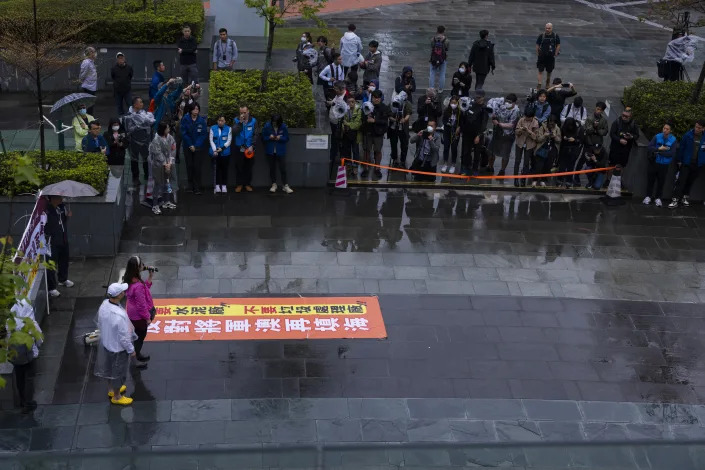
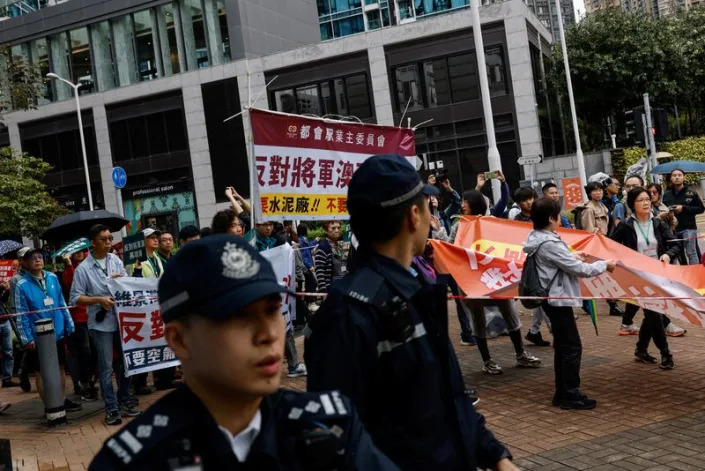
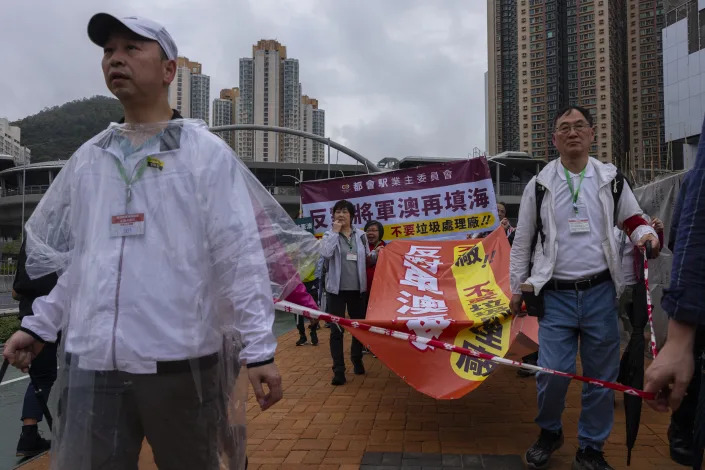
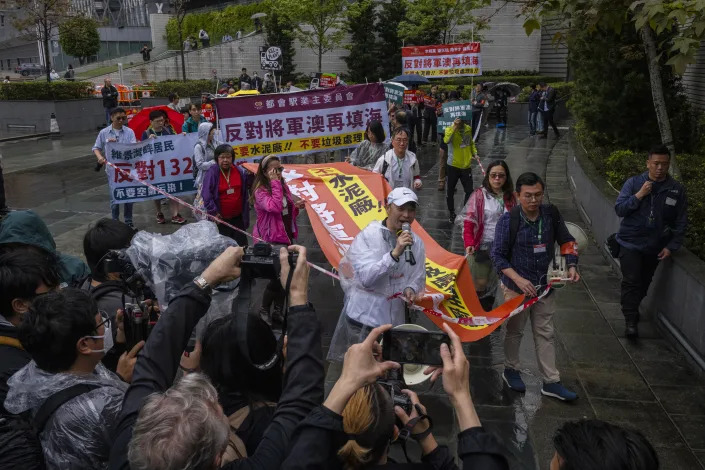
Protesters, left, stage a rally as member of the press, right, stand in a cordoned area in Hong Kong, Sunday, March 26, 2023. Dozens of people on Sunday joined Hong Kong's first authorized demonstration against the government since the lifting of major COVID-19 restrictions under unprecedentedly strict rules, including wearing a numbered badge around their necks.
 (AP Photo/Louise Delmotte)

KANIS LEUNG
Sun, March 26, 2023

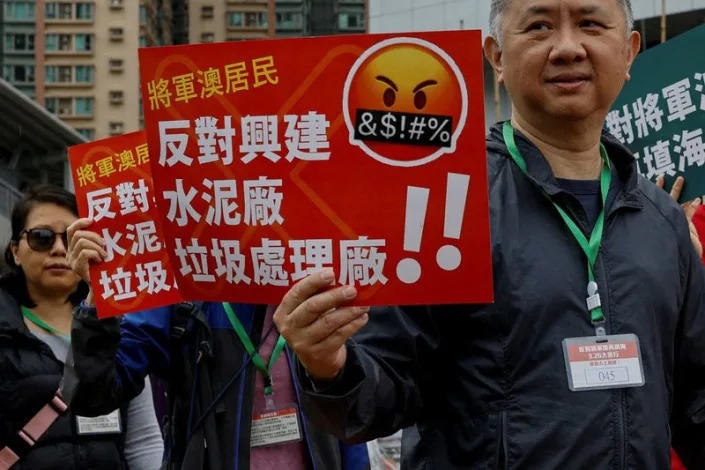
HONG KONG (AP) — Dozens of people on Sunday joined Hong Kong's first authorized protest since the lifting of major COVID-19 restrictions under unprecedentedly strict rules, including wearing a numbered badge around their necks.

The rules set out by the police, who cited security reasons, came as the financial hub was promoting its return to normalcy after years of anti-virus controls and political turmoil.

During the pandemic, protests were rare due to COVID-19 restrictions. In addition, many activists have been silenced or jailed after Beijing imposed a national security law following massive protests in 2019. Critics say the city's freedom of assembly that was promised Hong Kong when it returned to China from Britain in 1997 has been eroded.

Sunday’s demonstration against the proposed reclamation and construction of rubbish-processing facilities was the first police-approved march of its kind after the city scrapped its mask mandate and social distancing limits.

But organizers had to comply with police requirements such as taking measures to ensure the number of participants would not exceed the expected turnout of 100 people and asking for proof of a “reasonable excuse” from protesters who wore masks during the event. At the height of the 2019 anti-government movement, Hong Kong’s government invoked emergency powers to ban masks from public gatherings so it can identify protesters who officials accused of illegal acts.

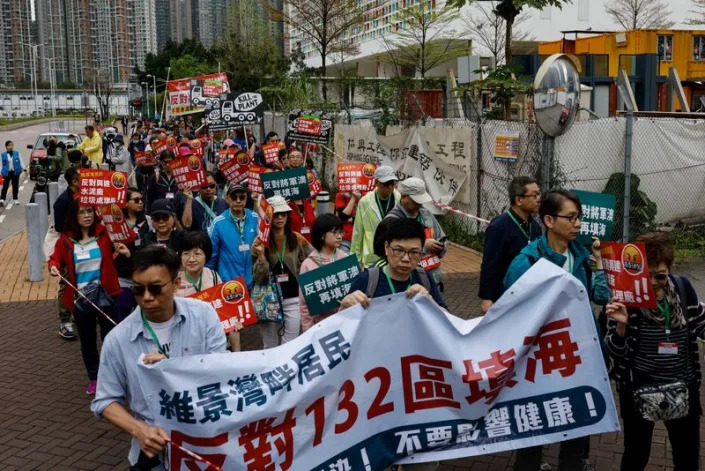
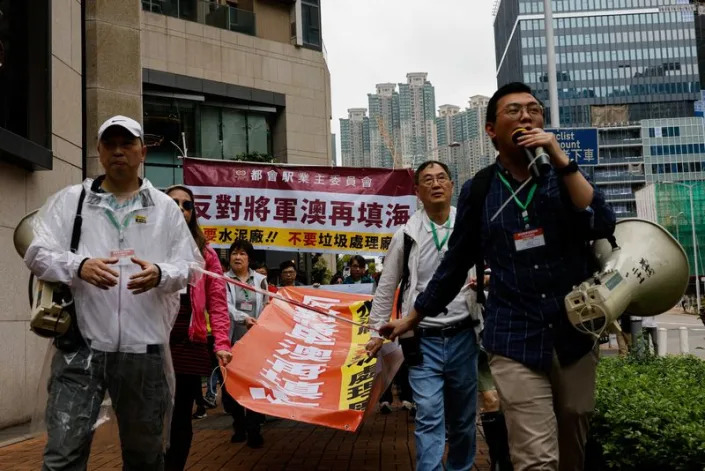
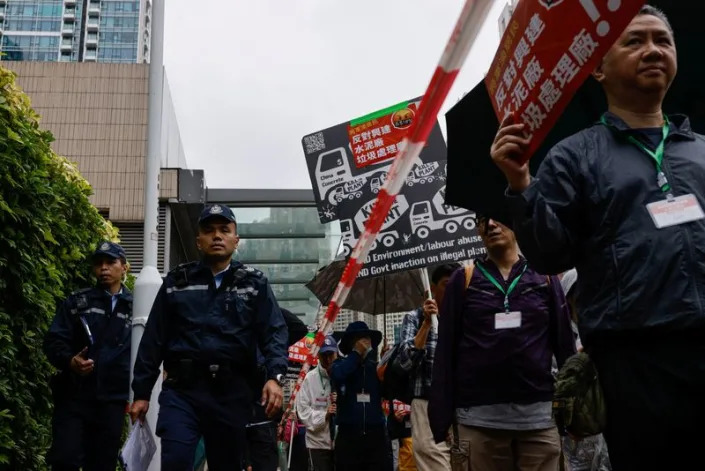
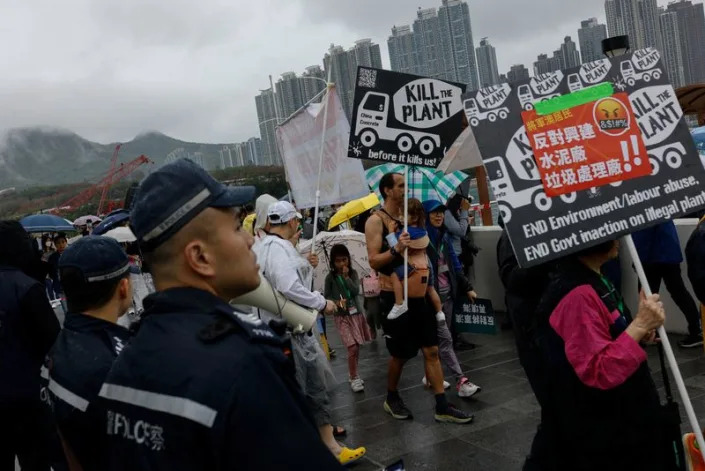
On Sunday, about 80 people expressed their opposition to the plans in Tseung Kwan O, a residential and industrial area, the organizer said. They had to walk in a cordoned-off moving line in the rain amid heavy police presence.

Theresa Wang described the new restrictions as “a bit weird” but said they were still acceptable because the city was adjusting to “the new Hong Kong.”

“I’m not happy but we have to accept it. We have to accept what is deemed legal now,” the 70-year-old retiree said, adding that she hoped the protest would be a sign the government is more open to discussion.

Protester Jack Wong said he would prefer not to wear the badge printed with a number. Police said earlier the requirement aims to prevent lawbreakers from joining the march.

“But if it is a requirement, what can I say? I prefer not to comment further. You know what I mean,” he said.

In granting its approval, police also requested that organizers ensure there would not be any acts that might endanger national security, including displaying anything seditious.

Cyrus Chan, one of the march organizers, said demonstrators had communicated with police on their promotional materials and slogans. Officers earlier had told him that participants should not wear all-black outfits, he said. Protesters commonly wore black during the 2019 protests.

“It's definitely strict,” Chan said. “We hope this is just an individual case. We hope to show them that Hong Kong society has the ability to have peaceful marches and they do not need to set that many conditions to restrict us."

Earlier this month, the Hong Kong Women Workers’ Association planned a march to call for labor and women’s rights but canceled it at the last moment without specifying why.

Days later, the association said on its Facebook page that police had invited it for further meetings after granting it the approval and that it had tried its best to amend the agreement. But it still could not launch the protest as it had wished, it wrote at that time.

A pro-democracy group separately said national security police had warned four of its members not to participate in the association’s march.

_____

Associated Press photographer Louise Delmotte contributed to this report.


Hong Kong police keep tight tabs on first authorised protest in years


Protest against a land reclamation and waste transfer station project, in Hong Kong


Sat, March 25, 2023
By Jessie Pang

HONG KONG (Reuters) -Hong Kong police on Sunday permitted a small protest march under tight restrictions in one of the first demonstrations to be approved since the enactment of a sweeping national security law in 2020.

Several dozen demonstrators were required to wear numbered lanyards and were barred from wearing masks, as police monitored their march against a proposed land reclamation and rubbish processing project.

Participants chanted slogans against the reclamation project as they marched in the rain with banners in the eastern district of Tseung Kwan O, where the project is slated to be built.

Some also criticised the restrictions on their protest, which included a maximum of 100 participants, according to a seven-page letter from police to organisers, seen by Reuters.

"We need to have a more free-spirited protest culture," said James Ockenden, 49, who was marching with his three children.

"But this is all pre-arranged and numbered and it just destroys the culture and will put people off from coming for sure."

Responding to the protest, the city's Development Bureau said the project was intended to "support the daily needs of the community".

It said it would "respect the right to freedom of expression" and would study the possibility reducing the scale of the land reclamation.

Police granted the organisers a "no objection" letter on condition they ensured the protest would not violate national security laws, including seditious displays or speech.

"Some lawbreakers may mix into the public meeting and procession to disrupt public order or even engage in illegal violence," the police warned in their letter.

Organisers said up to 50 people took part in the first protest to be authorised by the city's police for several years. They later told media that around 80 people joined Sunday's protest.

Applications for other protests, including a candlelight vigil on June 4 to commemorate the victims of China's Tiananmen Square crackdown in 1989, have been denied on grounds related to COVID social-distancing.

The last of Hong Kong's COVID restrictions was scrapped this year, following China's decision to end its "zero-COVID" policies.

Hong Kong's mini-constitution, the Basic Law, guarantees the right to public assembly.

Since the China-imposed national security law, enacted in June 2020 in response to protracted pro-democracy protests in 2019, authorities have clamped down on freedoms and arrested scores of opposition politicians and activists.

Some Western governments have criticised the law as a tool of repression but Chinese authorities say it has restored stability to the financial hub.

One protester surnamed Chiu, 50, said she appreciated the chance to protest "in difficult times", and said she saw the lanyards more as a means to facilitate crowd management.

"It doesn't mean putting a leash on us to restrict our expression. I think it's acceptable," she told Reuters.

Political observers and some Western diplomats are watching to see if authorities will allow a resumption of major demonstrations in Hong Kong, namely on June 4 and July 1, that had been a mainstay of the city's once vibrant civil society scene and attracted thousands of people.

(Additional reporting by Xie Yu, Writing by James Pomfret; Editing by Robert Birsel and Louise Heavens)

Police monitor first Hong Kong protest since 2020

BBC
Sun, March 26, 2023

Police gave permission for 100 people to attend the rally.

The first protest in two years has taken place in Hong Kong under close monitoring by police.

The small rally was the first since China imposed sweeping restrictions on the rights and freedoms of people living in the territory.

Only 100 people were allowed to attend. They were also required to wear number tags and their banners were examined in advance.

Sunday's march was against a land reclamation plan in the city's east.

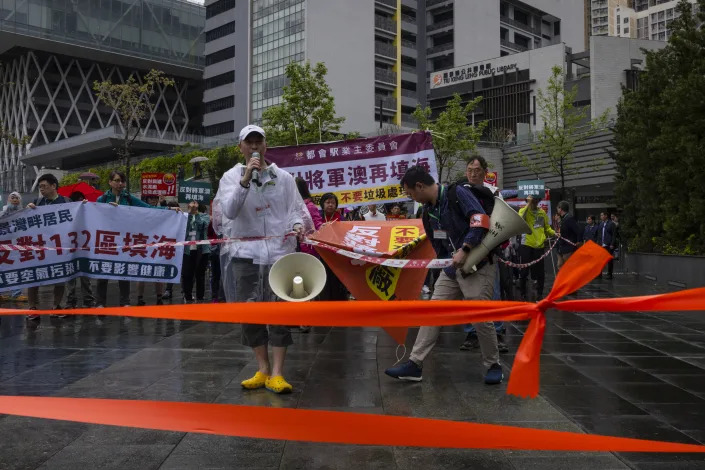
Police required organisers to follow stringent conditions and surrounded the marchers with a cordon that kept media and protesters separated.

The participants were allowed to chant slogans against the project.

An anonymous attendee told AFP that the arrangements were "ridiculous": "I am here to join a march, not a shame parade," he said.

Another commented that the measures under which they were allowed to hold the march amounted to "intimidation".

Hong Kong is a Special Administrative Region of China. Under its "one country, two systems" principle, residents are supposed to enjoy certain freedoms unavailable on the mainland - and Hong Kong's mini-constitution, the Basic Law, guarantees the right to public assembly.

But these rights have been eroded since 2020, when Beijing imposed a national security law in response to the months-long Hong Kong protests against Beijing's control in 2019.

Beijing said the law was needed to bring stability to the city - but critics said it was designed to squash dissent, and weaken Hong Kong's autonomy.


Protesters had to wear numbered lanyards to the march.
SERIOUSLY?!
UK
Laughing gas to be banned under Government plans to crack down on anti-social behaviour
REACTIONARY REJECTION OF DRUG DECRIMINALIZATION

Amy Gibbons
Sun, March 26, 2023 

Communities Secretary Michael Gove said the inappropriate sale and use of the substance will be forbidden to stop public areas becoming drug-taking 'arenas' - Jeff Overs/BBC/PA

Laughing gas will be banned against expert advice under Government plans to crack down on anti-social behaviour, a Cabinet minister has confirmed.

Communities Secretary Michael Gove said the inappropriate sale and use of the substance will be forbidden to stop public areas becoming drug-taking “arenas”.

Ministers have decided to press ahead with the move against the recommendation of the independent Advisory Council on the Misuse of Drugs (ACMD).

Asked whether nitrous oxide would be banned, Mr Gove told Sky News’ Sophy Ridge On Sunday programme: “Yes.”


He said: “I think any of us who have had the opportunity to walk through our parks in our major cities will have seen these little canisters, these silver canisters which are examples of people not only despoiling public spaces but also people taking a drug which can have a psychological and neurological affect and one that contributes to anti-social behaviour overall.”

Labour backed the decision, with shadow culture secretary Lucy Powell telling Ridge: “I think we want to see it banned as well because I think it does cause a huge amount of littering, of disruption and of anti-social behaviour challenges as well.”

Mr Gove said ministers had not yet decided which drug classification level would apply to the substance.

“We want to make sure the sale and use can be restricted for its appropriate purpose,” he said.

'Drug-taking arenas'


“We can’t have a situation, we mustn’t have a situation where our parks, our public spaces become drug-taking arenas. And that is why we need to crack down on new manifestations of drug taking and these laughing gas canisters are an increasing scourge and one that has been reported to me as a constituency MP.”

He accepted that ministers had been advised not to ban the drug, but said the Government had taken a different view - opting to make it illegal under the Misuse of Drugs Act 1971.

“It is the case that we need to be clear that there are types of activity, particular types of activity that cause distress to others in public which are unacceptable,” he said.

“Of course it is absolutely right that we uphold the law in this case.

“Yes, the advisory committee offered their advice, but ultimately it is ministers who are responsible.

'Vital that we deal with this scourge'


“And we believe collectively that it is absolutely vital that we deal with this scourge and in the same way.”

Following a Government-commissioned review, the ACMD said the substance “should not be subjected to control under the Misuse of Drugs Act 1971”.

It concluded that the sanctions for offences under the act would be disproportionate with the level of harm associated with the drug, and that such control could create “significant burdens” for its legitimate uses - such as for anaesthetic purposes and as a gas for whipped cream in cooking.

The non-legitimate sale of nitrous oxide is currently controlled under the Psychoactive Substances Act 2016, which the council said “remains the appropriate legislation”.

This means the production, supply and importation of the drug for its psychoactive effects is illegal, but not possession.

Mr Gove - who has previously admitted taking cocaine - said he had learned through his own experience that it was a “mistake” to “regard drug taking as somehow acceptable”.

Asked whether some might view ministers’ stance on laughing gas as “hypocritical” if they had confessed to taking illegal substances in the past, he told Ridge: “No, I think it is because I have learned... that it is a mistake - worse than a mistake - to regard drug taking as somehow acceptable.”


A MORE EXPERIENCED ENGLISHMAN WROTE 
 

KICK A JUNKIE TO THE CURB LAW
Rishi Sunak pledges to end ‘scourge of anti-social behaviour’ with new action plan

Josh Salisbury
Sat, March 25, 2023

(PA)

Offenders blighting their communities will be put to work in jumpsuits or hi-viz jackets to clean up their crimes within 48 hours of being handed punishments, Rishi Sunak will pledge.

The Prime Minister said his plan, due to be announced on Monday, would “crack down" on anti-social behaviour “once and for all".

A key plank of the measures will be making justice "immediate" and ensuring that communities can visibly see efforts to clean up vandalism and graffiti.

Other punishments could include picking up litter, washing police cars or doing unpaid work in shops, according to Downing Street.

Officials said the UK Government's anti-social action plan was about establishing a “zero-tolerance approach where offenders know they will face the full consequences of their actions".

Speaking ahead of the plan's publication, the Prime Minister said: “For too long, people have put up with the scourge of anti-social behaviour in their neighbourhoods.

“These are not minor crimes. They disrupt people's daily lives, hold businesses back and erode the sense of safety and community that brings people together.

“That's why I'm bringing forward a new plan to crack down on this behaviour once and for all - so that everyone can feel proud of where they live."

Mr Sunak will announce an approach known as immediate justice to be piloted in 10 areas before a rollout across England and Wales next year.

The plan is set to include new funding for police and crime commissioners (PCCs) to ensure those responsible for offences that blight communities are punished as soon as possible.

The Prime Minister has set the target of having offenders who are slapped with community orders starting reparation work within 48 hours of being handed the punishment.

Mr Sunak dedicated a portion of his new year speech, setting out his five pledges ahead of the next election, on his ambitions to tackle anti-social behaviour.

He said that low-level offences made "life miserable for so many" and argued the destructive form of behaviour could "be a gateway to more extreme crimes".

According to officials, Mr Sunak's plan will see offenders having to wear jumpsuits or hi-vis jackets and work under supervision as part of efforts to give the public confidence that justice is being done.

Where possible, low-level criminals will be tasked with cleaning up the mess they created.

If their anti-social activity has already been removed or repaired, they will instead be assigned projects to assist their community in other ways.

Ministers have pledged that victims and affected communities will get a say in deciding what type of punishment or consequences offenders should face.

The immediate justice pilots come in addition to an expansion of the so-called community payback scheme for more serious criminals.

Currently, offenders are sentenced by courts to do unpaid work that directly benefits their local communities, such as cleaning up public places and removing graffiti.

Under Mr Sunak's pilots idea, teams of offenders will be rapidly deployed to clean up more urgent incidents of anti-social behaviour, with the Probation Service delivering the work alongside selected councils.

According to Government figures, last year saw 1,500 offenders spend almost 10,000 hours on 300 community clean-up projects, with plans to double that this year.

https://www.theguardian.com/books/2014/feb/01/william-burroughs-junky-will-self

Feb 1, 2014 ... Burroughs wrote Junky on the very brink of a transformation in western culture. His junkies were creatures of the depression, many of whose ...


Date
2020-08
Author
 West-Israel, Beatrice J.
William Burroughs’ novel Junky is humorous and meticulously detailed in portraying its protagonist’s spiral to rock bottom. However, within the otherwise dispassionate narrative, readers encounter an undercurrent of pure need, with characters and narrator/protagonist Bill Lee at once repelled and empowered by the powers of destruction that junk has over their lives. The book is structured as a descending spiral, ever-inward and downward, as Lee wanders from New York to Mexico: one instance of the text’s overarching depiction of a journey from stability to destruction and back again. Burroughs portrays human need as the propellant of this cycle, a catalyst that causes individuals to move because of their own suffering. In attempting to keep himself stable and well, for instance, Lee must always have more junk: his need for junk is what drives him to the very ends of his resources, and propels him out of the phase of stability. When he runs out of junk, withdrawal sickness sets in, signifying the death of his addict self and rebirth into a new life. Just as quickly, his addiction may be reborn in subsequent chapters. In exploring this text, I document both the forms and functions of this cycle. The protagonist’s environment, for example, is analogous to his mindset, moving him from an iconic image of stability (suburban Midwestern U.S.) to a jewel of chaos, Mexico. Bill Lee equates his childhood home in the Midwest with atrophy, and to end the stagnation he engages in violent lifestyles that, like pruning a plant, initiate growth through destruction. Lee finally escapes to Mexico, fleeing a court case: agents of stability and law in the U.S. After he reaches Mexico, he begins to atrophy again, with “nothing to do" and “no place to go,” since his life is no longer driven by his junk habit (117). Soon after this, driven by a need for junk imposed on him by his environment, Lee is back in the cycle of destruction. “Junk” serves as a signifier for destruction in Junky, a metaphor for human needs which propel the larger cycles in which the text operates. According to Burroughs, kicking junk is a violent process that causes the death of junk-dependent cells. As the text suggests, the entropy that follows is a kind of rotting away as part of a natural cycle of matter. The junk always runs out, and the body goes through the violence of junksickness before renewing itself, which is a "suffering of the cells alone” (Junky 3). The effect of this suffering appears on the face of Lee associate Jack, who exhibits a “conscious ego that look[s] out of the glazed, alert-calm hoodlum eyes—would have nothing to do with the suffering of his rejected other-self” (3). Junk-sickness creates an undercurrent of violence at the cell level, and all the while Jack is helping Bill Lee to sell a “Tommy gun” (1), invoking a violence beyond the cellular. In a similar manner, the violence that morphine-sickness brings to another Lee associate, Roy, is positioned in the narrative directly after Jack’s homicide story, in which he admits to bashing someone’s head with a pipe. Violence, signifying death, is positioned before Roy’s junk-sickness, signifying rot. The circumstances of Lee’s narrative follow natural cycles of death, renewal, and life, implying that the spirals of suffering Lee transcends are analogies for the universal suffering and rebirth which transforms all of existence.
Citation
West-Israel, B. J. (2020). In defense of destruction: How addiction propels natural cycles of death and renewal in William S. Burroughs' Junky (Unpublished thesis). Texas State University, San Marcos, Texas.
PDF DOWNLOAD


Analysis-Coinbase, SEC on collision course for 'existential' clash over crypto industry

Chris Prentice and Hannah Lang
Fri, March 24, 202


 The logo for Coinbase Global Inc is displayed on the Nasdaq MarketSite
 jumbotron and others at Times Square in New York

NEW YORK/WASHINGTON (Reuters) -Coinbase debuted on the U.S. stock market on April 14, 2021 - the same day U.S. senators confirmed Gary Gensler to lead the Securities and Exchange Commission (SEC), the country's top markets regulator.

Gensler, who has called the crypto sector a "Wild West" riddled with fraud, is now embroiled in a battle with the world's largest publicly-traded crypto firm over a core debate: whether digital assets are investment contracts akin to stocks or bonds that should be regulated by the SEC.

Friction between crypto proponents and the regulator have been brewing under Gensler's leadership, with both sides growing increasingly loud in their criticisms.

The escalating tension exploded into public view on Wednesday when Coinbase CEO Brian Armstrong and the company's chief legal officer Paul Grewal posted online that the firm had been told that SEC staff intend to recommend enforcement action, adding that Coinbase was willing to fight it in court.

Coinbase shares have tumbled 12% since Wednesday's disclosure.

SEC and Coinbase spokespeople declined to comment. For months, the two have been in discussions over regulation and the agency's investigation into Coinbase, according to two sources.

In July, the firm disclosed an SEC probe into its asset listing processes, staking programs and yield-generating products.

Discussions between the SEC and Coinbase broke down in recent weeks, with one source saying the two sides had moved "further apart." The SEC appears to be going after Coinbase's entire business as operating outside of U.S. laws, the source said.

The crypto industry believes it operates in a regulatory gray area not governed by existing U.S. securities laws - and that new legislation is needed to regulate the industry.

"We continue to think rulemaking and legislation are better tools for defining the law for our industry than enforcement actions," Coinbase's Grewal said on Wednesday. "But if necessary, we welcome the opportunity for Coinbase and the broader crypto community to get clarity in court."

Prior to Gensler's arrival, the SEC engaged in targeted enforcement, but the Democratic chair has ratcheted up focus on crypto platforms themselves. The SEC's crackdown on crypto gathered pace after November's collapse of Sam Bankman-Fried's FTX exchange.

Gensler has raised questions over whether crypto firms rely on a business model that is fundamentally non-compliant with the law, adding that crypto intermediaries provide a range of functions, such as operating as an exchange, broker-dealer, clearing agent and custodian, that should be regulated by the SEC.

"This is probably existential for Coinbase," said Joshua White, a finance professor at Vanderbilt University. "It’s perhaps existential for the industry, at least in the U.S."

The SEC on Thursday issued an investor alert warning that firms offering crypto asset securities may not be complying with U.S. laws.

Kristin Smith, the CEO of the Blockchain Association, voiced the crypto industry association's support for Coinbase, noting: "The SEC doesn't make the law – it only makes allegations, which ultimately must be tested in the courts."

The SEC has gone to court against many crypto firms, including a case against San Francisco-based crypto and cross-border payments company Ripple Labs Inc that some say could offer clarity on when a digital asset is considered a security.

But the SEC and Coinbase debate over an "unspecified portion" of its listed digital assets sets the stage for a more expansive and potentially defining courtroom battle. Coinbase's website lists over 150 crypto assets for trading.

Coinbase flagged potential regulatory risks when it filed to go public in 2021, and noted on Wednesday that its staking and exchange services are "largely unchanged" since then.

"There couldn't be a more significant development for crypto markets and crypto investors," said Philip Moustakis, former SEC enforcement lawyer and partner with Seward & Kissel LLP in New York.

(Reporting by Chris Prentice and Hannah Lang; editing by David Gaffen and Nick Zieminski)

IMF chief warns risks to financial stability have increased


AFP
Sun, March 26, 2023 


International Monetary Fund chief Kristalina Georgieva warned on Sunday that risks to financial stability had increased and stressed "the need for vigilance" following the recent turmoil in the banking sector.

Speaking at a forum in Beijing, the IMF managing director said she expected 2023 "to be another challenging year", with global growth slowing to below 3.0 percent due the war in Ukraine, monetary tightening and "scarring" from the pandemic.

"Uncertainties are exceptionally high," with the outlook for the global economy likely to remain weak over the medium term, she told the China Development Forum.

"It is also clear that risks to financial stability have increased," she added.

"At a time of higher debt levels, the rapid transition from a prolonged period of low interest rates to much higher rates -- necessary to fight inflation -- inevitably generates stresses and vulnerabilities, as evidenced by recent developments in the banking sector in some advanced economies."

Her comments came after the financial sector was shaken by the collapse of Silicon Valley Bank and the enforced takeover of Swiss bank Credit Suisse by rival UBS, leading to fears of contagion.

Bank shares tumbled on Friday as fears about the health of the financial sector resurfaced, with German Chancellor Olaf Scholz forced to give reassurances about Deutsche Bank after the long-troubled lender became a focus of investor concerns.

Georgieva said policymakers had acted decisively in response to financial stability risks.

"These actions have eased market stress to some extent, but uncertainty is high which underscores the need for vigilance," she said.

The IMF chief, however, pointed to China's rebound as a bright spot for the world economy.

The IMF forecasts China's economy to grow 5.2 percent this year, driven by a rebound in private consumption as the country reopens after its pandemic isolation.

"The robust rebound means China is set to account for around one third of global growth in 2023 -- giving a welcome lift to the world economy," she said.

"A 1.0 percentage point increase in GDP growth in China leads to 0.3 percentage point increase in growth in other Asian economies, on average -- a welcome boost."

Georgieva urged China's policymakers to seek to raise productivity and rebalance the economy away from investment and towards more durable consumption-driven growth.

"Market-oriented reforms to level the playing field between the private sector and state-owned enterprises, together with investments in education, would significantly lift the economy's productive capacity," she said.

ehl-mtp/smw