Thursday, April 27, 2023

Philippines Prepares for Offloading of Stranded Chinese Bulker

offloading grounded Chinese bulker
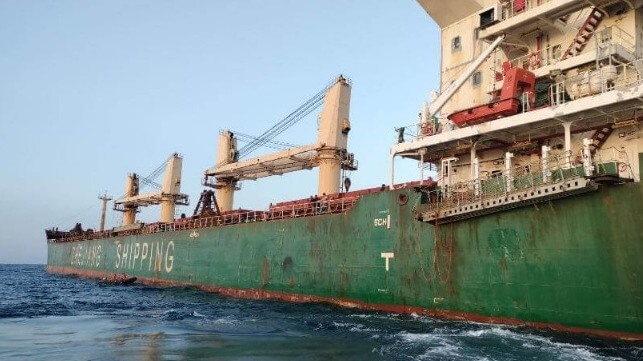
CHinese bulker will be offloaded to free if after grounding in the eastern Philippines (Philippine Coast Guard)

PUBLISHED APR 27, 2023 6:04 PM BY THE MARITIME EXECUTIVE


Ten days after a Chinese bulker first went aground in the eastern central region, the Philippines is preparing for the next phase of the salvage operation. The Philippine Coast Guard reported that it has given clearance for the salvage operation to begin after a survey confirmed that there has been no leakage or damage inside the vessel to this point.

The incident began on April 18 with reports of the bulker, Zhe Hai 168, grounding approximately 2.7 nautical miles off Eastern Samar province in the Philippine Sea. The 12-year old vessel is 57,000 dwt and was reported to be carrying a cargo of nickel ore loaded at Homonhon Island, Eastern Samar. The ship was sailing to Caofeidian, China where it was due to arrive on April 25.

A visual inspection was carried out on April 19 by the Coast Guard, Marine Environment Protection Unit, and the vessel’s local agent. The MEPU also conducted a surface assessment for possible traces of oil and reports the tests have been negative.

The vessel, which is 623 feet in length, however, remains firmly stuck and has been unable to refloat using the available resources. The PCG reports the decision has been made to begin offloading the vessel before further attempts will be made to pull it free from the reef. 

A salvage team from Singapore was due to reach the bulker today and will be placing a barge alongside. They will then temporarily transfer the cargo to the barge to lighten the ship so it can be floated off the reef. The ship was 20 crewmembers aboard who are reported to be in good health waiting for the salvage operation.

The Coast Guard is requiring that the salvage team install oil spill booms before beginning its work. The Coast Guard continues to monitor the situation and reports that it began a marine casualty investigation on April 22.

Once the vessel has been refloated, the Philippine Coast Guard will require another hull assessment. Divers will also evaluate the condition of the coral to determine potential damage claims.

New facility streamlines isotope production at US lab

25 April 2023


Brookhaven National Laboratory (BNL) has announced the shipment of the first actinium-225 (Ac-255) to be produced in a newly refurbished hot cell laboratory at the US Department of Energy's (DOE) lab. The new facilities will streamline production and shipment of the rare radioisotope for the development of new cancer treatments.

The new hot cells in use at BNL's MIRP (Image: BNL)

Ac-225 is an extremely rare alpha-emitting radioisotope that can be used in targeted alpha therapy. Scientists from BNL's Medical Isotope Research and Production (MIRP) programme have been working since 2014 as part of a DOE effort across three national laboratories to produce Ac-225, as well as Ac-225/Bi-213 generators to produce the bismuth-213 isotope, for use in clinical trials. This involves irradiating thorium-232 targets using proton accelerators at the Brookhaven and Los Alamos national laboratories, then shipping irradiated targets to Oak Ridge National Laboratory (ORNL) to extract and purify the isotope.

The effort has established reliable, routine Ac-225 production, and demonstrated that the process is scalable. But the availability of space in the specialised "hot cell" laboratory needed for processing radioactive materials has limited the amount of Ac-225 that could be made.

A metallurgical laboratory at Brookhaven, unused since the 1990s, has now been refurbished to enhance isotope processing capabilities at BNL, through a USD8.5 million investment from the DOE Science Laboratories Infrastructure programme. This has involved retrofitting the obsolete hot cell facility and labs to create a new All-Purpose (AP) Hot Cell facility.

The hot cells at the new facility were completed in March and have doubled the number of Ac-225 processing sites for DOE's Isotope Program, BNL said, and the expanded processing capacity provides redundancy so Brookhaven and ORNL can serve as backups for each other. Having both target irradiation and hot cells for processing at one laboratory also provides a more efficient way of producing larger batches of Ac-225 by removing some of the logistical challenges.

"This upgrade will streamline the overall production and distribution of Ac-225 to research centres by eliminating the need to ship material off site for final processing," said MIRP Director Cathy Cutler said. "Now we can irradiate the targets and process them right here at Brookhaven so that Ac-225 can be shipped directly to research centres."

BNL announced on 19 April that the first shipment of Ac-225 from the new facility took place in mid-March.

Researched and written by World Nuclear News

UK launches Nuclear Waste Services strategy

25 April 2023


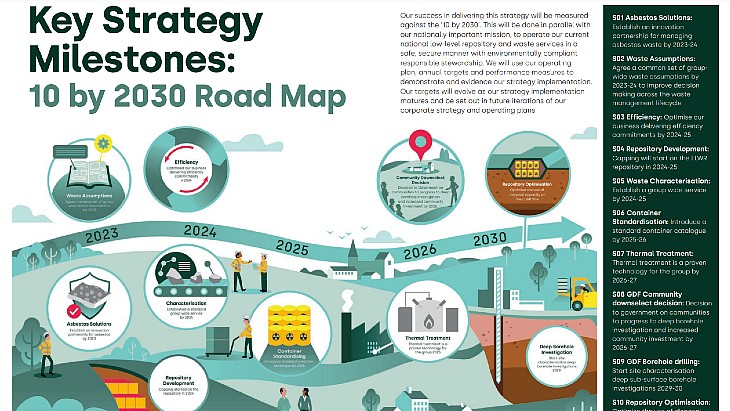
The Nuclear Waste Services strategy for the UK aims to "make nuclear waste permanently safe, sooner".

The strategy is focused on goals to hit by 2030 (Image: NWS corporate strategy report 2023)

The strategy sets out key dates, such as capping starting on the Low Level Waste Repository in 2024-25, thermal treatment technologies developed as a proven technology by 2026-27 and decisions taken in 2026 on which communities will progress to detailed testing as part of the Geological Disposal Facility programme.

NWS Chair Adrienne Kelbie and NWS CEO Corhyn Parr said, in a joint statement: "This strategy sets our direction, objectives, key milestones and the transformation needed to succeed by 2030."

Reducing waste is a key theme of the strategy, which says: "The volumes of this waste going to disposal in the UK have been driven down greatly over the years through more effective application of the waste hierarchy to identify ways to avoid creating waste, to better characterise materials, identify new opportunities to re-use or recycle materials and physically reduce the volume of the remaining waste. Between 2009 and 2021 this saw a remarkable shift from 95% of waste arising in 2009 going straight to disposal at the Low Level Waste Repository, to only 2% of waste arising in 2021 going to disposal. The rest has been successfully diverted."

On decommissioning, it says the "landscape is constantly evolving due to the generation of more and different types of waste and the increased need to recycle as much waste as possible from decommissioning. We need to reduce secondary wastes, achieving final end states for the nuclear estate and minimising impacts on future generations. This includes the aspiration to recycle 50% of waste from decommissioning and reduce secondary wastes by around 70% by 2030".

The strategy also says that thermal treatment technologies could have a big impact, by applying "high temperatures to waste to pacify reactive materials, reduce volumes and produce a stable waste form for final disposal". NWS is working with Sellafield Ltd, "who are leading the trials programme to understand waste applicability and technology maturity in order to develop Thermal Treatment into a proven technology solution (S07 Thermal Treatment)".

Listen: NWS's Corhyn Parr interview on World Nuclear News podcast (from 18 minutes, 30 seconds)


Nuclear Waste Services was created in 2022 as the single UK waste business for the Nuclear Decommissioning Authority (NDA), integrating Radioactive Waste Management, Low Level Waste Repository  and the NDA Integrated Waste Management Programme.

It says "our aspiration is to promote a circular economy mindset by treating nuclear waste as a valuable asset whilst developing skills and national infrastructure. Then as a country we can become self-sufficient in the full lifecycle management of nuclear waste, which will support future clean energy security for UK prosperity".

Nuclear Decommissioning Authority CEO David Peattie said that a year after the launch of NWS as a single waste-focused organisation in the UK "the strategy shows how the team is developing its thinking and providing safe, sustainable and cost-effective solutions to help achieve our nationally important work".

Researched and written by World Nuclear News

Expansion of US-Korean cooperation on SMRs

26 April 2023


Agreements to cooperate on small modular reactors (SMRs) have been signed between South Korean and US companies during a visit by Korean President Yoon Suk-yeol to the USA. Doosan Enerbility and the Export-Import Bank of Korea (KEXIM) signed a memorandum of understanding (MoU) to cooperate with NuScale Power, while SK and Korea Hydro & Nuclear Power (KHNP) have agreed to collaborate with TerraPower.

(Image: NuScale)

The MoU between NuScale, Doosan and KEXIM aims to "strengthen collaboration among the three parties and support NuScale's small modular reactor deployment".

"This announcement leverages and bolsters an existing relationship between NuScale and Doosan, and it highlights the domestic and global manufacturing opportunities to build SMRs around the world," NuScale said.

The MoU outlines areas of cooperation, such as marketing, technical support and further development of a global supply chain, while Doosan and NuScale commit to strengthening their cooperation to deploy NuScale VOYGR plants globally. Specifically, Doosan committed to helping establish a US-based supply chain for NuScale Power Module production through capacity expansion and manufacturing technology advancement.

Doosan Enerbility - under its former name of Doosan Heavy Industries & Construction - in 2019 signed a business collaboration agreement with NuScale for the supply of NuScale Power Modules and other equipment and, together with Korean financial investors, has made an equity investment of nearly USD104 million in the Portland, Oregon-based SMR company. The Korean company completed a manufacturability review in January 2021 and Doosan is now working on component prototype development.

At the end of 2022, NuScale placed the first upper reactor pressure vessel long lead material production order with Doosan.

Last month, KEXIM - the official export credit agency of South Korea - and NuScale signed an MoU in which they agreed to financial cooperation in support of deploying NuScale VOYGR plants. The organisation continues to explore potential opportunities to provide credit facilities to NuScale and facilitate overseas business of Doosan in collaboration with NuScale.

"With KEXIM's assistance, Doosan and NuScale will be able to deploy NuScale VOYGR plants worldwide and utilise a Korean supply chain when deploying NuScale plants in the Asian market," NuScale said.

"Today's news underscores how our SMRs fill a unique global need: providing flexible, reliable and carbon-free energy while driving economic activity in manufacturing and supply chain development. With our Korean partners and their technical expertise, we are well-positioned to meet this ambitious goal," said NuScale President and CEO John Hopkins. "The momentum towards creating a domestic and global supply chain to deploy our SMR technology is accelerating."

The NuScale Power Module is a pressurised water reactor with all the components for steam generation and heat exchange incorporated into a single unit, generating 77 MWe, which in September 2020 became the first SMR design to receive approval from the US Nuclear Regulatory Commission. NuScale offers the units as VOYGR plants: a VOYGR-12 power plant comprising 12 modules is capable of generating 924 MWe. The company also offers four-module and six-module plants and other configurations based on customer needs.

Cambridge, Ontario-based ATS Corporation's Industrial Automation business has been awarded a contract by NuScale to build and test a prototype for the Module Assembly Equipment-Bolting (MAE-B) system, a critical part of the NuScale VOYGR power plant.

The MAE-B system includes prototyping the automation technology to be used on the Reactor Flange and Containment Flange tools. Extensive testing will be performed on the system to provide confidence that the technology will operate as intended for the NuScale Power Module. The prototype, which will serve as a proof-of-concept system, will be assembled and tested at an ATS facility in Wixom, Michigan.

KHNP joins TerraPower effort


TerraPower announced it has signed a collaboration agreement with SK and KHNP supporting the demonstration and commercialisation of the Natrium reactor and integrated energy system.


(Image: TerraPower)

SK Inc and SK Innovation - both affiliates of SK Group, Korea's second-largest conglomerate - invested USD250 million in TerraPower in August last year during an equity raise of USD830 million, the largest private raise among advanced nuclear companies to date.

"The addition of KHNP, a globally recognised nuclear developer, further strengthens the team collaborating to bring the Natrium reactor to market," TerraPower said.

"These partnerships are critical for the first Natrium reactor and the many additional facilities we plan to construct in the US and globally," said TerraPower President Chris Levesque. "We already have a strong partner in SK and look forward to adding the recognised global expertise of KHNP as a long-term partner to help realise the benefits of advanced nuclear energy".

He added: "Today's collaboration announcement, supported by government and corporate leaders, further exemplifies the important role the public and private sector have in bringing new technologies to market."

TerraPower has been selected by the US Department of Energy to receive cost-shared funding through the Advanced Reactor Demonstration Program to test, license and build an advanced reactor within the next seven years. The company has selected Kemmerer in Wyoming as the preferred site for the Natrium nuclear power plant demonstration project, which will feature a 345 MWe sodium-cooled fast reactor with a molten salt-based energy storage system. The storage technology can temporarily boost the system's output to 500 MWe when needed, enabling the plant to follow daily electric load changes and integrate seamlessly with fluctuating renewable resources.

Researched and written by World Nuclear News

Kansai seeks to extend lifetime for Takahama units

26 April 2023


Kansai Electric Power has asked Japan's Nuclear Regulation Authority (NRA) for permission to extend the lifespan of units 3 and 4 at its Takahama nuclear power plant by 20 years.

Takahama (Image: Kansai)

Under regulations which came into force in July 2013, Japanese reactors have a nominal operating period of 40 years. One extension to this - limited to a maximum of 20 years - may be granted, requiring amongst other things, a special inspection to verify the integrity of reactor pressure vessels and containment vessels after 35 years of operation.

Kansai said it had carried out special inspections and evaluations of the two units, and not found any issues likely to cause problems if the operating period was to be extended to 60 years, saying that it had put together a facility management programme for the extended operation including the replacement of the steam generators. It added: "We will continue to strive to improve the safety and reliability of nuclear power plants and with the understanding of the local community and others we will utilise nuclear power generation as an important power source."

The Takahama plant, in Fukui prefecture, is home to four reactors. Takahama 1 and 2 - both 780 MWe (net) pressurised water reactors (PWRs) - entered commercial operation in 1974 and 1975 respectively, while units 3 and 4 - both 830 MWe PWRs - both began commercial operation in 1985. Takahama 1 and 2 became the first Japanese units to be granted a licence extension beyond 40 years under revised regulations, but are currently out of service pending the completion of a bunkered back-up control centre, as required by the regulator. Kansai has previously said it plans to restart units 1 and 2 in mid-2023.

Researched and written by World Nuclear News

NRC approves use of Framatome codes in advanced nuclear fuel development

26 April 2023


Framatome received approval from the US Nuclear Regulatory Commission (NRC) to apply the company's suite of Advanced Codes and Methods to operating conditions with uranium-235 enrichments above the industry standard of 5%.

(Image: Framatome)

"This approval is a critical step toward the company's goal of reload readiness by 2027 for implementing nuclear fuel with higher uranium enrichments and burnups in the current light water reactor fleet," Framatome said. "The NRC decision is an important milestone for the company's advanced fuel development efforts targeting improved fuel utilisation for nuclear plant operators and systematic improvements for safety and plant economics."

Fuel vendors and power reactor licensees are exploring the possibility of increasing the maximum enrichment of fuel up to 10%, but NRC regulations currently limit uranium-235 enrichment levels in power reactor fuel to no more than 5% by weight. In June 2021, the NRC accepted for review a topical report to apply Framatome's suite of Advanced Codes and Methods to operating conditions with U-235 enrichments above 5%.

Framatome said its Advanced Codes and Methods provide significant operational margin gains. "These margins provide nuclear plant operators with the flexibility to extend their reactor performance when coupled with the company's nuclear fuel technology and its higher enrichment and burnup characteristics."

The company said the NRC approval also demonstrates that Framatome can "effectively model reactor behaviour in the evaluation of neutronic, thermal hydraulic, small- and large-break loss-of-coolant-accident (LOCA), non-LOCA safety analysis, and thermal mechanical performance with fuel enriched above current limits".

In February 2022, the NRC approved a licence amendment allowing Framatome's shipping containers to transport fresh nuclear fuel assemblies in the US having U-235 enrichments up to 8%. The NRC also approved the methodology used to demonstrate that Framatome's fuel fabrication facility will retain current safety margins when higher enriched material is received and processed into fuel.

"Based on this approval, major equipment orders have been placed to support the system upgrades needed to process higher enrichments," Framatome said.

The advanced fuel technology is being developed at Framatome facilities worldwide and will be built at the Richland, Washington, nuclear fuel manufacturing facility, which in 2009 received the first 40-year fuel fabrication operating licence approval, extending its licence to 2049.

The Richland facility produces uranium oxide powder, pellets and fuel rod components as well as fuel assemblies for both pressurised water reactors and boiling water reactors. It is currently licensed to possess and process uranium enriched to a maximum of 5% U-235.

Researched and written by World Nuclear News

Licence application milestone for PLS

27 April 2023

Fission Uranium Corp has filed its application to the Canadian Nuclear Safety Commission (CNSC) for a licence to construct a uranium mine and mill facility at the Patterson Lake South (PLS) high-grade uranium project in Saskatchewan and begun front-end engineering design for the project.

Winter exploration work at PLS (Image: Fission Uranium)

PLS is on the southwest margin of the Athabasca Basin and incorporates the Triple R deposit, which is both high grade and shallow - mineralisation starts just 50 metres below the surface. The deposit has indicated mineral resources of 114.9 million pounds U3O8 (44,196 tU) at an average grade of 1.94% U3O8, inferred resources of 15.4 million pounds at an average grade of 1.10% and probable reserves of 93.7 million pounds at an average 1.41% U3O8, all reported at a cut-off grade of 0.25%.

The company earlier this year filed a NI 43-101 technical report summarising the feasibility study for the project, including a construction timeline of 3 years with an estimated initial capital cost of CAD1.155 billion (USD848 million) for a ten-year life-of-mine with total production of 90.9 million lbs U3O8, and an average unit operating cost of CAD13.02 per pound U3O8.

The company has now said the environmental assessment of the project is continuing on schedule with community engagement, baseline assessment reporting and data compilation.

Fission President and CEO Ross McElroy said: "I am very pleased to confirm that the construction licence application for the PLS project has been submitted. Additionally, we have successfully completed our winter field program, and the Front End Engineering Design work is well under way. Our development path to production is progressing on schedule and, at the same time, the fundamentals for uranium continue to strengthen in line with the global reactor construction boom."

The CNSC is responsible for regulating and licensing all existing and future uranium mining and milling operations in Canada.

Researched and written by World Nuclear News

Dutch government allocates funding for nuclear programme

27 April 2023


In its draft Climate Fund for 2024, the Dutch government has budgeted funds totalling EUR320 million (USD352 million) for the development of nuclear energy. The funds will be used for the preparation of the operational extension of the existing Borssele nuclear power plant, the construction of two new large reactors, the development of small modular reactors (SMRs) and for nuclear skills development in the Netherlands.

The existing Borssele plant (Image: ANVS)

In December 2021, the Netherlands' new coalition government placed nuclear power at the heart of its climate and energy policy. Based on preliminary plans, two new reactors will be completed around 2035 and each will have a capacity of 1000-1650 MWe. The two reactors would provide 9-13% of the Netherlands' electricity production in 2035. The cabinet announced in December 2022 that it currently sees Borssele as the most suitable location for the construction of the new reactors.

In a 26 April letter informing the House of Representatives about taking additional climate measures, Minister for Climate and Energy Policy Rob Jetten said: "The cabinet is sharpening the ambition for the electricity sector: the aim is to have CO2-free electricity production, which is affordable and reliable, in the Netherlands as early as 2035."

He said the construction of new nuclear power plants around 2035 "will play an important role in the CO2-free electricity system. If two additional power stations are operational around that time, the share of nuclear energy will grow to more than 10% of the electricity mix. We are also accelerating the development of SMRs that are close to the market in their design phase."

The draft climate budget includes EUR10 million over the period 2023-2025 for extending the operation of the Borssele plant. The funds - which are subject to the approval of the European Commission - are intended for additional studies regarding aging, shareholder structure and business economic feasibility of the extension. The 485 MWe (net) pressurised water reactor currently provides about 3% of the Netherlands' electricity. The plant has been in operation since 1973 and is scheduled to close in 2033.

A further EUR117 million has been budgeted for additional studies on the construction of two new nuclear power plants. "These are specifically about financing models, the tender process, feasibility studies of vendors, a participation plan, a social impact report on new construction, a programme management organisation of the Special Purpose Vehicle which will arrange the tendering, construction and operation of the nuclear power plants to be built," the ministry said.

Speaking at the World Nuclear Fuel Cycle 2023 conference which took place earlier this month in The Hague, EPZ Fuel Cycle Manager Tom Keij, said: "We will continue to operate our nuclear power plants for more than 60 years and we have two more new ones. It's not sufficient to close the gap between [the Netherlands'] electricity consumption and the needed production capacity in 2050. But at least it's a start."

In addition, EUR65 million has been budgeted for building the country's "knowledge infrastructure". The resources are for education and research, "so that the Dutch nuclear knowledge and research infrastructure can be strengthened".

The government has also allocated funds of EUR62 million "in the form of a working budget for the province of Zeeland and the municipality of Borssele for the ambitions around the extension of Borssele's operating life and the new construction process".

Funding for SMRs


Support for the development of SMRs also receives funds of EUR65 million in the draft budget. "This completes the transition phase from design to realisation, accelerated by establishing a practical link between Dutch manufacturing industry and the developers of SMRs. This applies to SMRs based on conventional nuclear concepts that are close to the transition to realisation." It added, "The goal is to build knowledge in the production chain, control and supervision. The experience gained is also relevant for the construction of two new nuclear power plants."

In August 2022, the UK's Rolls-Royce SMR signed an exclusive agreement with ULC-Energy to collaborate on the deployment of Rolls-Royce SMR power plants in the Netherlands. ULC-Energy - established in 2021 and based in Amsterdam - aims to accelerate decarbonisation in the Netherlands by developing nuclear energy projects that efficiently integrate with residential and industrial energy networks in the country.

The formal planning phase is to start this year, and ULC's timeline sees site selection and contract negotiations taking place in 2024, with a formal licensing application the following year and construction of a first SMR unit beginning in 2027 with a start-up date in the 2030s.

The Dutch regulator must make a final decision on a licence within six months of receiving an application, and ULC is already undertaking pre-licensing work as well as starting EPC negotiations with Rolls-Royce. "Right now we're very much aligned in our messaging," ULC-Energy Executive Director Bas Suijs said at WNFC 2023. "At some point, we're going to be sitting on the opposite side of the table because we have to negotiate with them a contract for a reactor."

Decarbonising the Dutch economy by 2050 will be a "huge challenge", Suijs said. Many of the industries that make up the Netherlands' industrial clusters rely heavily on fossil fuel - predominantly natural gas. "And that has to change," he said. "Not just because of the energy crisis that we're facing, but we're running out of gas. And that, we've known for the last decade."

Production from the Groningen gas field - one of the largest in the world - is to cease in October due to a rising number of earthquakes and this accelerates the need for the development of a scalable, clean baseload solution to support the electrification and hydrogen that will be necessary to achieve industrial decarbonisation, Suijs said. Added to this, Dutch regional grids are struggling to cope with a significant increase in renewable supply, with several regions currently unable to connect new businesses to the grid, is making a "perfect storm", he added.

Researched and written by World Nuclear News

Jacobs to design remotely-operated tools for ITER

26 April 2023


Jacobs has been awarded a contract to design and engineer maintenance systems for the International Thermonuclear Experimental Reactor (ITER) fusion project.
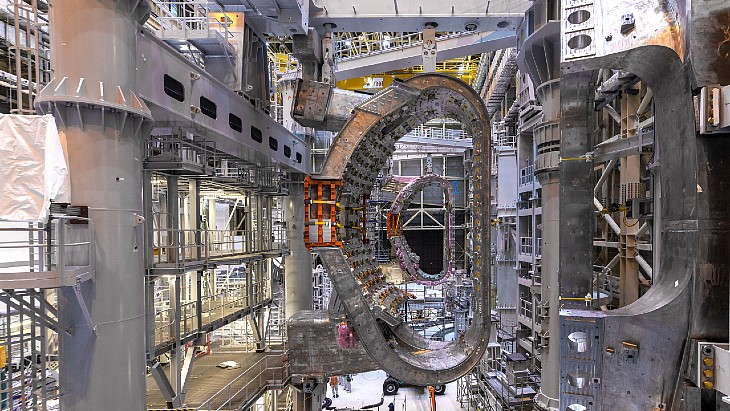
(Image: ITER)

The contract covers work on up to 25 diagnostic ports and systems in the multinational ITER fusion reactor being built in southern France. It is for four years with a possible two-year extension, Jacobs said, with the company designing and engineering remotely-operated tools.

Karen Wiemelt, Jacobs Energy, Security and Technology senior vice president, said: "Our support of the maintenance of these diagnostics systems not only delivers on Jacobs' commitment to climate response but also our purpose of creating a more connected, sustainable world ... through our team in Aix-en-Provence, combined with the full strength of Jacobs' global capability, we will work with ITER to channel our technology-enabled knowledge and experience toward benefiting people and the planet."

ITER is a major international project to build a tokamak fusion device in Cadarache, France, designed to prove the feasibility of fusion as a large-scale and carbon-free source of energy. The goal of ITER is to operate at 500 MW (for at least 400 seconds continuously) with 50 MW of plasma heating power input. It appears that an additional 300 MWe of electricity input may be required in operation. No electricity will be generated at ITER.

Thirty-five nations are collaborating to build ITER - the European Union is contributing almost half of the cost of its construction, while the other six members (China, India, Japan, South Korea, Russia and the USA) are contributing equally to the rest. Construction began in 2010 and the original 2018 first plasma target date was put back to 2025 by the ITER council in 2016. That timeline for first plasma is currently in the process of being revised, following the COVID-19 pandemic and the discovery of defects in the thermal shields and vacuum vessel sector.

Researched and written by World Nuclear News


Chinese and German milestones in fusion research

13 April 2023


A Chinese tokamak device has set a new world record for a steady-state high-constraint mode plasma operation and German researchers have discovered a way to build smaller and cheaper fusion reactors. Meanwhile a US Government Accountability Office report on achieving commercial fusion cautions that several challenges must still be overcome.

The EAST tokamak (Image: Hefei Institutes of Physical Science)

On 12 April, China's experimental advanced superconducting tokamak (EAST), known as the 'artificial sun', set a new world record and successfully achieved a steady-state high-constraint mode plasma operation for 403 seconds. The previous record was 101 seconds, set by EAST in 2017.

The breakthrough was achieved after more than 120,000 shots in EAST, located at the Institute of Plasma Physics under the Chinese Academy of Sciences (ASIPP) in Hefei, Anhui Province.

The temperature and density of particles have been greatly increased during high confinement plasma operation, which will lay a solid foundation for improving the power generation efficiency of future fusion power plants and reducing costs, ASIPP Director Song Yuntao told the Xinhua news agency.

Since starting operation in 2006, EAST has been an open test platform for Chinese and international scientists to conduct fusion-related experiments and research. Currently, the engineering design of the future China Fusion Engineering Test Reactor (CFETR) - which is seen as the next-generation 'artificial sun' - has been completed, aiming at being the world's first fusion demonstration reactor.

Smaller and cheaper devices


Meanwhile, researchers at Germany's Max Planck Institute for Plasma Physics (IPP) have found a way to significantly reduce the distance needed between the hot plasmas in nuclear fusion devices and the vessel wall.

The ASDEX Upgrade tokamak experiment at IPP in Garching near Munich serves as a blueprint for International Thermonuclear Experimental Reactor (ITER) and later fusion power plants. Important elements for ITER were developed there. Plasma operating conditions and components for later power plants are already being tested.

A central element of ASDEX Upgrade and all modern magnetic fusion facilities is the divertor. This is a part of the vessel wall that is particularly heat-resistant and requires an elaborate design. In order to handle the high temperatures, the divertor tiles of ASDEX Upgrade and also of ITER are made of tungsten, the chemical element with the highest melting temperature (3422°C).

Without countermeasures, 20% of the fusion power of the plasma would reach the divertor surfaces. For this reason, small amounts of impurities (often nitrogen) are added to the plasma. These extract most of its thermal energy by converting it into ultraviolet light. Nevertheless, the plasma edge (the separatrix) must be kept at a distance from the divertor to protect it. In ASDEX Upgrade until now, this has been at least 25 centimetres (measured from the lower plasma tip - the X-point - to the edges of the divertor).

Researchers at IPP have now succeeded in reducing this distance to less than 5 centimetres without damaging the wall.

"We accidentally moved the plasma edge much closer to the divertor than we had intended," IPP physicist Tilmann Lunt said. "We were very surprised that ASDEX Upgrade coped with this without any problems."

"Because the plasma moves closer to the divertor, the vacuum vessel volume can be better utilised," IPP said. "Initial calculations show that if the vessel were optimally shaped, it would be possible to almost double the plasma volume while maintaining the same dimensions. This would also increase the achievable fusion power."

"We are dealing with a significant discovery in fusion research," said IPP Division Director Ulrich Stroth. "The X-point radiator opens up completely new possibilities for us in the development of a power plant. We will further investigate the theory behind it and try to understand it better by new experiments at ASDEX Upgrade."

Challenges still remain


The two announcements came as the US Government Accountability Office (GAO) released a report concluding fusion technology faces many challenges before it can produce commercial electricity.

"Several challenges must be overcome to achieve commercial fusion, and stakeholders' projections of this timeline range from 10 years to several decades," GAO said. "One key scientific challenge is in the physics of plasmas, the state of matter needed for fusion."

Researchers have made advancements in understanding the behaviour of burning plasmas but lack sufficient experimental data to validate their simulations, the report says. One key engineering challenge is the development of materials that can withstand fusion conditions for decades, such as extreme heat and neutron damage, and no facility exists where materials can be fully tested. "More generally, the task of extracting energy from fusion to provide an economical source of electric power presents several complex systems engineering problems that have yet to be solved."

The report noted that public and private sector misalignments, regulatory uncertainty, and other factors also present challenges to fusion energy development. One area of misalignment is research priorities. Public sector efforts prioritise basic science, but fusion energy development requires an additional emphasis on technology and engineering research. Another factor is regulatory uncertainty, which could slow development of fusion energy, although developing appropriate regulations to ensure safety without constraining development is difficult.

GAO developed four policy options that could help address these challenges or enhance the benefits of fusion energy. They identify possible actions by policymakers, which include legislative bodies, government agencies, academia, industry and other groups.

Researched and written by World Nuclear News
Emergency-use robot trialled at Sellafield

25 April 2023

A remotely-operated rescue robot capable of withstanding hazardous environments has been evaluated at the UK's Sellafield nuclear site. Designed and manufactured by British engineering firm Forth, the Rescue Robot will make emergency jobs across UK nuclear plants "significantly safer and more cost effective".

The Rescue Robot (Image: Forth)

The Rescue Robot has been built on a 1.6-tonne JCB compactor excavator platform and fitted with high-tech robotics systems and wireless technology, in addition to specialist, robust cameras and lights which will not be destroyed in hazardous conditions.

Functions of the robot include: a specialist 700-bar rescue tool fitted to cut through any hazards in its way; a grapple hook to move any obstruction; an ability to tow a trailer with a fitted hopper to disperse a bund of sand to contain spillages; an affixative spraying system to contain a radioactive spillage.

The robot is also tetherless and can be controlled from a safe space in the control centre up to 150 metres away.

The robot has been successfully trialled at the Sellafield site and Cumbria-based Forth is now looking to roll it out at other plants across the UK.

"The Rescue Robot is a pioneering development which has already been successfully tested in hazardous environments, and it has been manufactured to offer a safe, remotely-operated alternative to sending humans into disaster zones," said Forth Managing Director Mark Telford. "By working with Sellafield Ltd, we were able to prove the machine is able to withstand some particularly dangerous conditions, and its various adaptations and capabilities mean that this will be a real asset to the UK's nuclear industry.

"There are endless amounts of modifications and end effectors which can be included on the robot, and we are excited to be able to provide a product which will make working in nuclear plants across the country much safer, while also saving industry a substantial amount of money."

A Rescue Robot is now permanently situated at Sellafield and is on standby to safely carry out any emergency work in the most hazardous zones of the site.

"The introduction of the Rescue Robot provides huge benefits in helping to keep humans out of harm's way if we ever need to respond to an emergency situation," said Sellafield Ltd Security and Resilience Operations Manager Gus Harding. "The Sellafield site is the perfect testing ground for this sort of innovative technology and having a machine like this so readily available gives everybody peace of mind."

Researched and written by World Nuclear News