Thursday, April 27, 2023

Woman who set Emmett Till lynching in motion dies at 88: 'Justice was never done — now it's over'
Travis Gettys
April 27, 2023

Emmett Till

The white woman whose accusations led to the brutal murder of Emmett Till has died at age 88.

Carolyn Bryant Donham, who claimed the Black teenager had wolf-whistled at her as she worked in a store in Mississippi in August 1955, had been suffering from cancer and was receiving end-of-life hospice care, reported Mississippi Today.

“[Some people] have been clinging to hope that she could be prosecuted," said Devery Anderson, the author of Emmett Till: The Murder That Shocked the World and Propelled the Civil Rights Movement. "She was the last remaining person who had any involvement. Now that can’t happen.”

"It’s going to be a wound, because justice was never done,” he added. “Some others were clinging to hope she might still talk or tell the truth. … Now it’s over.”

Till had just turned 14 years old when he was taken from his relatives' home, where he was staying while visiting from Chicago, by Donham’s then-husband Roy Bryant and his half-brother J.W. Milam, who later admitted to beating and shooting the boy to death after they were acquitted by an all-white jury.

A majority-Black grand jury declined to indict Donham in 2007 following an intensive FBI investigation, and another grand jury did the same last year.

Donham wrote a 109-page memoir that remains sealed in the Southern Historical Collection at the University of North Carolina at Chapel Hill until 2036, but reporters have obtained a copy and found that her recollection contradicts her original statement to her husband's defense lawyer.

She originally had said Till was scared but unharmed when her husband asked her whether he was the Black man who had insulted her, but Donham wrote that the teen defiantly admitted to whistling at her, which matches a highly inaccurate magazine report about the case from the 1950s.

“His death was tragic and uncalled for beyond all doubt,” she wrote. “For that, I am truly sorry. If it had been within my power to change his fate, I would have done so.”
Deadly invader devastating Venezuelan coral reefs

Agence France-Presse
April 27, 2023

The coral was initially classified as a member of the broad Xeniidae family before it was finally categorized in 2021 as Unomia stolonifera © Yuri CORTEZ / AFP

An ominous shadow in the turquoise Caribbean waters off Venezuela comes from a deadly intruder -- a soft coral that experts say has caused one of the most destructive habitat invasions on record anywhere.

The Unomia stolonifera, native to Indonesia and the Indo-Pacific, is a pinkish type of pulse coral so called for its dance-like movements in the ocean currents.

It is a popular aquarium ornament -- pretty to look at and hardy -- with a single polyp fetching as much as $80 to $120.

But it is also a killer -- settling on native hard corals, rocks and even seagrass which it suffocates and replaces, ultimately destroying entire ecosystems.

Off Venezuela's north coast, Unomia dominates the ocean floor landscape after being introduced through the illegal aquarium trade around 20 years ago.

"This is an ecological catastrophe," said marine biologist Juan Pedro Ruiz-Allais, director of Project Unomia, named after the invader he has spent years investigating.

Fish stocks are drastically decreasing in the waters off Venezuela as native reefs, which serve as nurseries and feeding grounds, die off, he told AFP.

"When the reef dies, when it is covered by the Unomia stolonifera, a disruption of the food chain occurs," said the biologist.

"It is a social, food security, and economic problem because the livelihood of fishermen is compromised."

'Nobody knew'

When Ruiz-Allais first came across the invader in 2007, it was an unknown species in the Caribbean and even the Atlantic, he recalled. "Nobody knew what it was."

It was first spotted in the Mochima National Park, a gorgeous archipelago covering more than 94,000 hectares, and has since been found to have colonized most of those islands.

The first scientific report was published in 2014, and the coral was initially classified as a member of the broad Xeniidae family before it was finally categorized in 2021 as Unomia stolonifera.

The coral was initially classified as a member of the broad Xeniidae family before it was finally categorized in 2021 as Unomia stolonifera © Yuri CORTEZ / AFP

From Mochima, it has spread west and east in the Caribbean Sea.

Off the northern state of Anzoategui, it has taken over the equivalent of 300 football stadiums.

The coral is spread by fishing nets, anchors, and ship ballast water.

"It is a great colonizer," Gustavo Carrasquel, director of the Azul Ambientalistas, an environmental NGO, told AFP.

- 'Unprecedented' -

The threat extends beyond Venezuela's borders: officials say Unomia traces have been found near the islands of Aruba and Curacao, and in waters off Colombia and Brazil -- where it became attached to an oil rig but was controlled.

"It is a problem that will affect the rest of the Caribbean," said Ruiz-Allais.

But nowhere has it been more destructive than in Venezuela.

"It is an unprecedented case," said Project Unomia coordinator Mariano Onoro.

Fishermen and tour operators, concerned about the invasive coral's rapid propagation, have resorted to manual extraction.

But experts say this is not advised, because broken-off fragments are transported by the tides, settling to create yet more colonies.

The privately funded Project Unomia has developed an extraction machine with a group of engineers that is awaiting government approval for testing.

Venezuela's Institute for Scientific Research and the ministry of eco-socialism have launched an investigation into the coral's rapid spread but have yet to come up with a solution.

Fishermen and tour operators concerned about the invasive coral's rapid propagation, have resorted to manual extraction © Yuri CORTEZ / AFP

For now, the magnitude of the problem is such that the invader's elimination appears impossible.

"What we can do is recover some areas and control it," said Onoro.

© 2023 AFP
Climate change behind 'devastating drought' in Horn of Africa, report says
Agence France-Presse
April 27, 2023

Young boys pull containers of water as they return to their huts from a well in the village of Ntabasi village amid a drought in Samburu East, Kenya, on Friday, Oct, 14, 2022. 
© Brian Inganga, AP

A devastating drought that has struck the Horn of Africa could not have occurred without global warming, according to a new report released Thursday from an international team of climate scientists

"Human-caused climate change has made agricultural drought in the Horn of Africa about 100 times more likely," said a summary of the report by the World Weather Attribution (WWA) group.

"The ongoing devastating drought would not have happened at all without the effect of greenhouse gas emissions," it added.

Since late 2020, countries on the Horn of Africa -- Djibouti, Ethiopia, Eritrea, Kenya, Somalia, South Sudan and Sudan -- have been suffering the worst drought in 40 years. The extended drought has led to the deaths of millions of heads of cattle and wiped out crops.

The WWA study concentrated on the three areas worst hit by the drought: southern Ethiopia, Somalia and eastern Kenya.


While climate change had little effect on total annual rainfall in the region, "higher temperatures have significantly increased evaporation from soil and plants, which has made dry soils much more likely", according to the 19 scientists who contributed to the WWA report.

"Without this effect, the region would not have experienced agricultural drought -- when crops and pastures are affected by dry conditions -- over the last two years," the summary added.

"Instead, widespread crop failures and livestock deaths have left more than 20 million people at risk of acute food insecurity."

The WWA said that, for its rapid analysis, "scientists looked at changes in rainfall in 2021 and 2022 in the affected region, covering southern Ethiopia, southern Somalia and eastern Kenya".

"They found that climate change is affecting the rainfall periods in opposite ways. The long rains are becoming drier, with low rainfall now about twice as likely, while the short rains are becoming wetter due to climate change," it added.

"This wettening trend in the short rains has been masked recently by the La Nina weather pattern, which reduces rainfall in the short rains."

Joyce Kimutai, a Kenyan climatologist who contributed to the report, told AFP: "It is time we act and engage differently. Central to this process is to transform and enhance resilience of our systems.

"We need to innovate across and throughout food systems, improve collaboration, involve vulnerable groups, make the best use of data and information, as well as incorporating new technologies and traditional knowledge."

The WWA network, set up by leading climate scientists, has built a reputation in recent years for its capacity to evaluate the extent to which climate change has contributed to extreme weather events.

Its results are published as a matter of urgency, without passing through the long peer-review process required by scientific journals, but employ approved methodological approaches.


‘Got polio?’ messaging underscores a vaccine campaign’s success but creates false sense of security as memories of the disease fade in U.S.

The Conversation
April 27, 2023

Little Girl with Polio (Boston Children's Hospital Archive)

Got Polio? Me neither. Thanks, Science.

Messages like this are used in memes, posters, T-shirts and even some billboards to promote routine vaccinations. As this catchy statement reminds people of once-feared diseases of the past, it – perhaps unintentionally – conveys the message that polio has been relegated to the history books.


This pro-science message uses a popular ‘cheers’ meme format.

Phrasing that aims to encourage immunizations by highlighting their accomplishments implies that some diseases are no longer a threat.

Few people today know much about polio. In 2022, only one-third of surveyed adults in the U.S. were aware that polio has no cure. Moreover, a 2020 poll had found that 84% of adults viewed vaccinating children as important, a 10% decline from 2001. The COVID-19 pandemic amplified anti-vaccination messaging, while also delaying routine immunization.

Vaccine-preventable diseases are far from eradicated. Measles outbreaks in unvaccinated or under-vaccinated American communities have begun resurfacing in the past few years, despite a 2000 declaration that the virus had been eliminated in the U.S. Pertussis cases have been on the rise, with more than 18,000 cases reported in 2019. And in July 2022, polio reappeared in an unvaccinated New York man – the first U.S. diagnosis since 1979. This case helped return attention to polio, causing at least some young adults to wonder about their own vaccination status.
ADVERTISEMENT


A shift in focus to immunization in developing countries has further lulled Americans into a false sense of security. While global approaches have been effective and are certainly needed, as the author of “Constructing the Outbreak: Epidemics in Media and Collective Memory,” I suggest that the celebratory messaging is no longer as effective as it once was and runs the risk of making it seem as if polio only lives in history books.


Polio patients at Baltimore’s Children’s Hospital watched television from inside the iron lungs that breathed for them. Bettmann via Getty Images

Campaigning against a devastating disease

Before vaccines, polio – called infantile paralysis or poliomyelitis – was the most feared childhood disease in the U.S. Frequently affecting elementary school kids, the disease sometimes presented like a cold or flu – fever, sore throat and headache. In other cases, limb or spinal pain and numbness first indicated that something was wrong. Paralysis of legs, arms, neck, diaphragm or a combination could occur and, depending on the area affected, render patients unable to walk, lift their arms, or breathe outside of an iron lung.


Full page ads like this one from 1953 solicited funds to help polio patients. March of Dimes

Only time could reveal whether the paralysis was permanent or would recede, sometimes to return decades later as Post-Polio Syndrome. Enough people were infected in outbreaks in the 1930s, 1940s and early 1950s that the effects of paralytic polio were quite visible in everyday life in the form of braces, crutches, slings and other mobility devices.

Thanks to the National Foundation for Infantile Paralysis, beating polio became a national priority. The NFIP grew out of President Franklin Delano Roosevelt’s Warm Springs Foundation. Roosevelt himself had been partially paralyzed by polio, and the NFIP provided funds for public education, research and survivors’ rehabilitation.


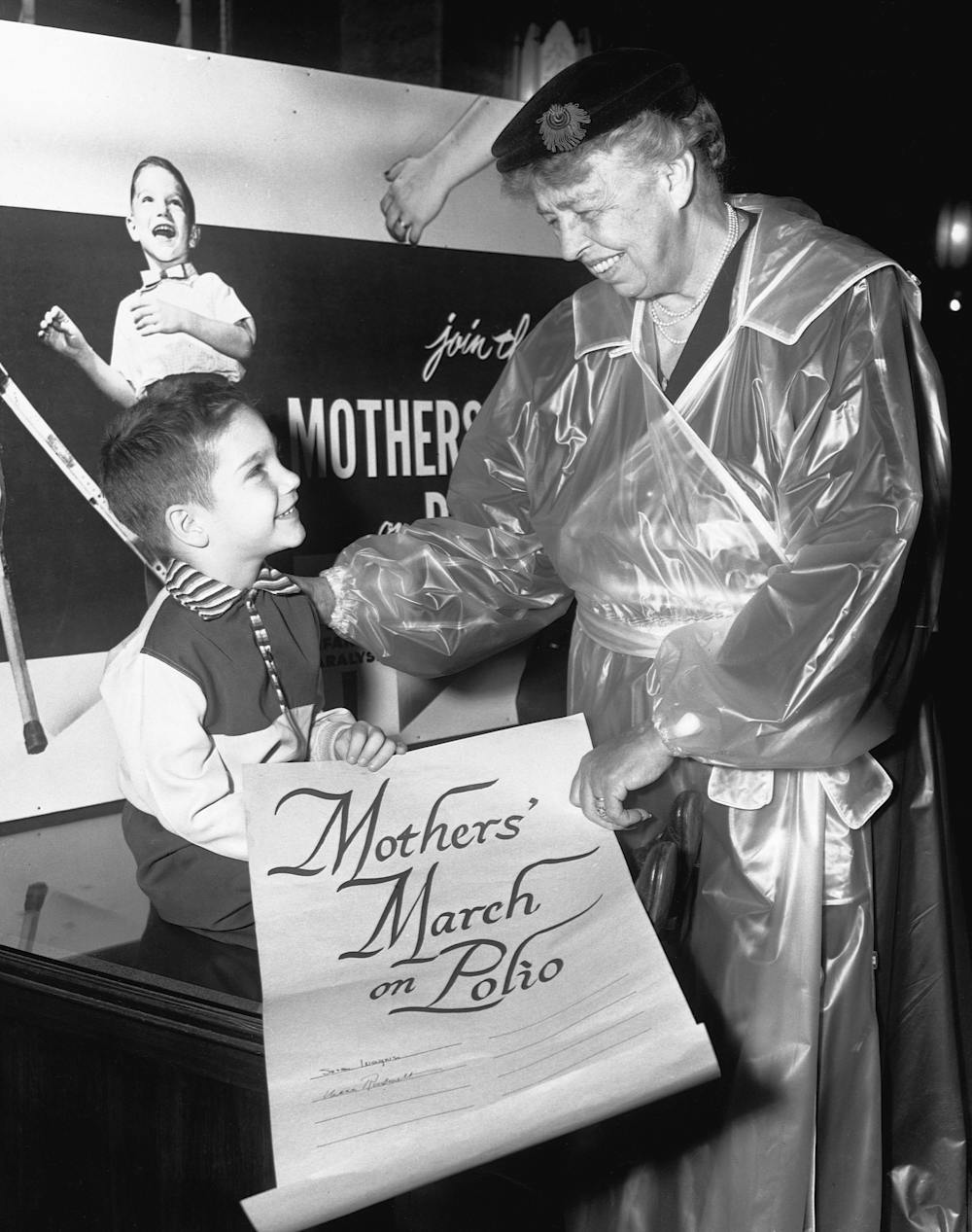
Eleanor Roosevelt helped inaugurate the Mothers’ March on Polio to raise money to fight the disease. Bettmann/CORBIS via Getty Images

Its campaigns were prolific and diverse, combining interpersonal and mass communication strategies.


From FDR “Birthday Ball” celebrations to parades and elementary school fundraising competitions, various groups raised money. High schoolers performed polio-themed plays, putting the disease itself on trial in “The People vs. Polio.” People passed around collection boxes at movie theaters and other public gatherings.


An ad placed in Vogue in 1952 laid out the ‘Polio Pledge.’ National Foundation for Infantile Paralysis


Campaigns used every medium. Brochures and short films raised awareness of the threat of polio, emphasizing the need for funding to support patient rehabilitation and scientific research. The National Foundation for Infantile Paralysis generated scores of radio scripts and hired Frank Sinatra, Elvis Presley and other famous voices to read them. Judy Garland, Mickey Rooney, Lucille Ball and other Hollywood stars also joined the fight. Comic strips and cartoons featuring Mickey Mouse and Donald Duck rallied for March of Dimes funds to help polio patients.

Starting in 1946, the NFIP featured children with crutches and braces who had survived polio as “poster children” asking for funds to help them walk again. News stories covered outbreaks and polio epidemics, detailing the devastation of the disease on individuals, families and communities, while advising families how to reduce risk through the “Polio Pledge for Parents,” which provided a list of do’s and don'ts during summer months.
From public enemy No. 1 to success story


The work of the National Foundation for Infantile Paralysis yielded unprecedented and continuous success, providing hospitals with equipment during epidemics and supporting the development of vaccines. Following the largest vaccine trial in history, on April 12, 1955, the Poliomyelitis Vaccine Evaluation Center announced that Jonas Salk’s vaccine was 80%-90% effective against paralytic polio and officially ready for general use.


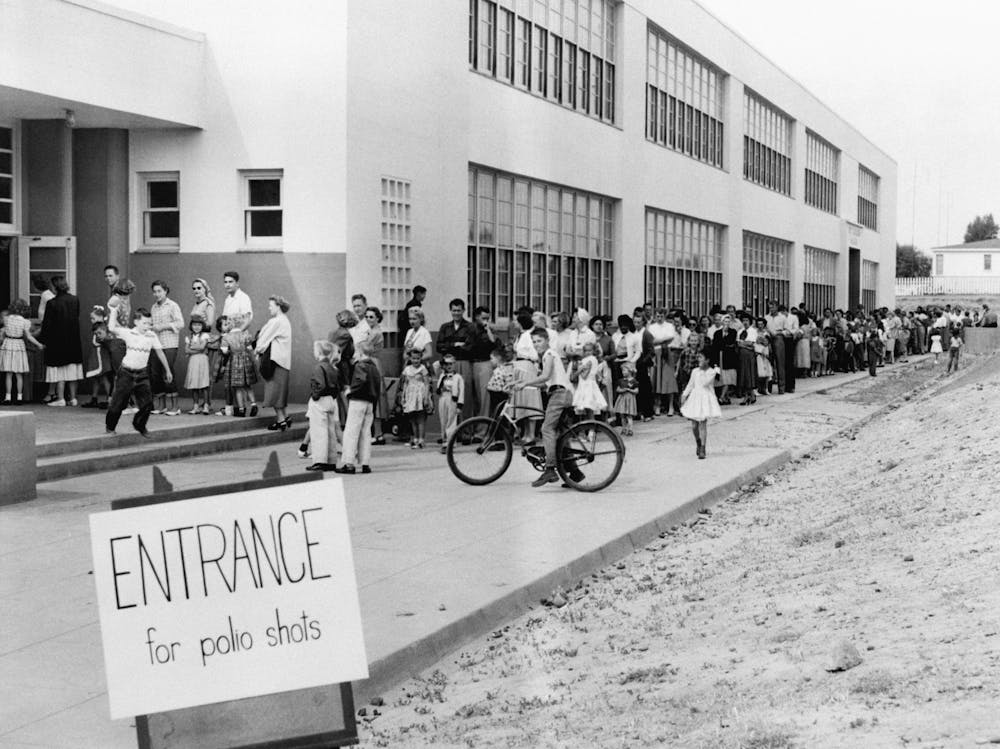
Once a vaccine was available, people lined up to protect themselves and their families from the virus. Bettmann via Getty Images


Over the next decade, the NFIP shifted its focus to widespread immunization, again using both mass media and local campaigns. With Salk’s vaccine, and then Albert Sabin’s, polio cases fell quickly, from the peak of 57,879 cases in 1952 to only 72 cases in 1965, with the last naturally occurring U.S. case in 1979.

The repeated declaration of what polio vaccines could and were accomplishing was strategically effective in persuading more people to get their shots. The American public of the 1960s and 1970s had lived through repeated polio epidemics and knew both the fear of contracting the disease and its visible aftereffects. As of 2021, 92.7% of Americans were fully protected by the vaccine, though these rates have been in decline since 2010 and fluctuate by region.

Public health rhetoric that focused on this vaccine success story worked around the world in the late 1980s and 1990s. Gradually, though, the perceived threat in the U.S. of polio and other vaccine-preventable diseases dissipated over generations as vaccinations largely eliminated the risk. Most people in developed countries lack firsthand experiences of just how terrifying these diseases are, having never experienced polio, diphtheria, measles or pertussis, or lost family members to them.


At the same time that polio has been largely forgotten in the U.S., anti-vaccination messages have been spreading disinformation that distorts the risk of vaccines, ignoring the realities of the diseases they immunize against.

Rhetoric from polio vaccine campaigns in the 1950s and 1960s emphasized the risks of not getting immunized – acute illness, life-changing pain and paralysis or even death. In the 21st century U.S., immunization campaigns no longer emphasize these risks, and it’s easy to forget the potentially deadly repercussions of skipping vaccines.

I believe pervasive public health messaging can counter anti-vaccination disinformation. A reminder for the American public about this still dangerous disease can help ensure that “Got Polio?” does not become a serious question.

Katherine A. Foss, Professor of Media Studies, Middle Tennessee State University

This article is republished from The Conversation under a Creative Commons license. Read the original article.
Editorial: New Yorker til the end: Thanks and farewell to Harry Belafonte
2023/04/27

BOTH CALLED COMMUNISTS BY RIGHT WINGERS
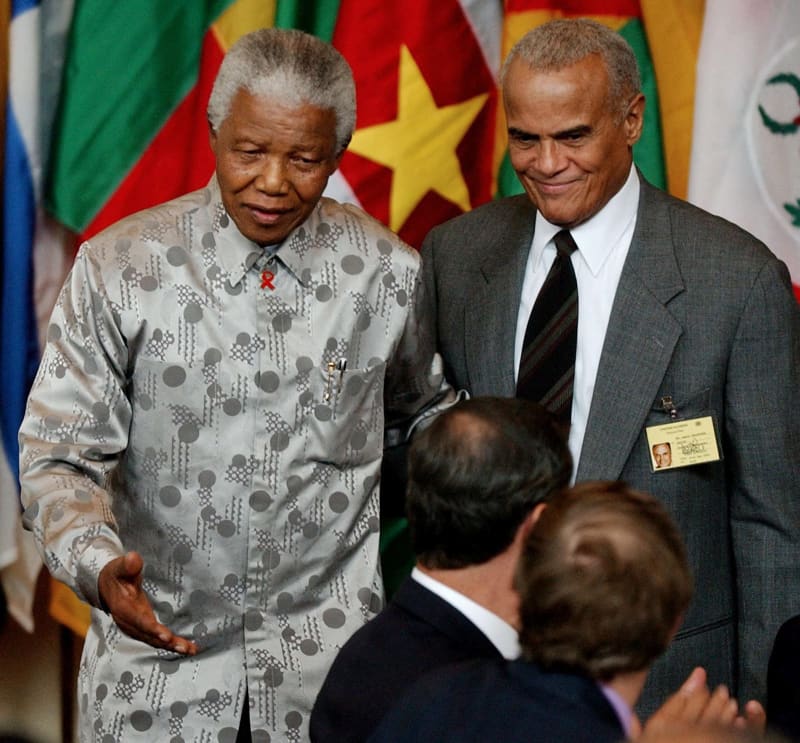
Former South African President Nelson Mandela is assisted by US singer Harry Belafonte on May 9, 2002, at a luncheon in honor of heads of state and government at United Nations headquarters in New York. 
- Stan Honda/AFP/Getty Images North America/TNS

His name would have been recognized with admiration and gratitude anywhere around the world, but Harry Belafonte was born and always made his home right here in New York City, up until this week, when the celebrated singer, actor and civil rights icon passed away at age 96 in his Upper West Side home.

Belafonte dropped out of George Washington High School to join the Navy during WWII, and began his musical career playing storied clubs like the Royal Roost and the Village Vanguard, polishing up his folk-music sound as he ascended.

Then, it was in a Harlem church basement that the Harlem native first met close friend Dr. Martin Luther King Jr., whom he would go on to march with. Among the stops he arranged many years later for newly-freed South African civil rights legend Nelson Mandela was a packed speech at Yankee Stadium. He was of New York and made New York better in turn.

Belafonte’s early and runaway success — being, by age 30, the first artist to ever sell more than a million full-length records via his third album, “Calypso,” not to mention a flourishing career in films — would have enabled him to live in perpetual comfort and uncontroversial celebrity for the rest of his life, but that was not enough for him. Belafonte constantly risked, and sometimes lost, professional opportunities to his uncompromising nature, for perceived transgressions as small as sharing a stage with a white woman.

For decades, as he kept singing and bringing the musical styles of his parents’ native Jamaica to broader audiences, Belafonte preoccupied himself with social causes, advocacy and action. Sometimes, these interests and talents came together, as with 1985′s “We are the World,” the single that raised tens of millions of dollars for famine relief in Ethiopia. In all cases, the famed singer of the “Banana Boat Song” asked himself how he could be part of a greater cause than himself.

“I wasn’t an artist who became an activist,” he said, “I was an activist who became an artist.”

___

© New York Daily News

Sam Bankman-Fried dined with Jared Kushner and Saudi crown prince in bid for funds: report
David McAfee
April 27, 2023

Sam Bankman-Fried, the disgraced former FTX CEO, reportedly went to a dinner with Saudi Crown Prince Mohammed bin Salman and Jared Kushner, as he sought funding to save his company.

Bankman-Fried asked his new friend, former Trump admin official Anthony Scaramucci, to arrange a trip to Saudi Arabia to try to raise capital for FTX, according to Puck. Bankman-Fried was slapped with another indictment in March, alleging a bribe to a Chinese official.

During that trip with Scaramucci, there was a dinner at which Kushner was present.

"The Mooch had a relatioship with Mohammed bin Salman, who invited the two for dinner at his palace," Puck reported.

“Sam wanted to go in a T-shirt and shorts,” Scaramucci told Puck, “so we had to have a conversation about that."

"The Mooch, whose sister is a personal shopper at Bloomingdale’s, bought S.B.F. a suit to wear to dinner at the palace," the outlet reported

As the story goes, there was a choice spread of food, and the event itself was swimming in big names.

"It was quite a dinner. There was tons of food—lamb, meat, fruit, pita bread and hummus—and polite conversation. Steve Schwarzman and Ray Dalio were there, as were Steve Mnuchin and Jared Kushner," according to Puck's piece. "Dalio spoke about his vision for China. Kushner said nothing. It was more or less a social occasion, not a place for business chatter. The Mooch and S.B.F. had already made their pitch, earlier that afternoon, to both the Saudi sovereign wealth fund and the Saudi venture capital fund, and they had received an indication that the Saudis were willing to invest some $250 million in the new FTX funding round, subject to due diligence, which they had agreed to do in the Bahamas at the end of November."

The Mercury News also picked up the story, noting that Bankman-Fried, "the mop-haired entrepreneur," was "desperately trying to raise $1 billion from some of the region's most ruthless but wealthy leaders."

"From Scaramucci’s description, it doesn’t sound as though Bankman-Fried had any concerns about immersing himself in a morally dubious situation involving Mohammed, Kushner and Saudi government money," the outlet said. "The crown prince is known as an autocratic ruler, held responsible by the CIA for ordering the murder of Washington Post columnist Jamal Khashoggi."
Pentagon leaks suspect wanted to 'kill a ton of people' because it would be 'culling the weak minded': prosecutors

Agence France-Presse
April 27, 2023

The US National Guard Bureau said Jack Teixeira enlisted in September 2019 and is an IT and communications specialist. (Stefani REYNOLDS/AFP)

A US national guardsman accused of leaking top secret documents had a history of making "violent" statements and owned numerous weapons, federal prosecutors alleged ahead of his detention hearing Thursday.

The Justice Department also said that 21-year-old Jack Teixeira might still have access to classified documents and that "hostile" nations could aid his escape if he is released from prison.

The prosecution argued that Teixeira poses "an ongoing risk" to America's national security and he should remain in jail until his trial.

The IT specialist with the US Air National Guard, is accused of orchestrating the most damaging leak of US classified documents in a decade.
The video player is currently playing an ad.

WAIT,WHAT?
RELATED: Military leak suspect got top security clearance despite being denied gun license: prosecutors

The documents posted online unveiled US concern over Ukraine's military capacity against invading Russian forces, and showed Washington had apparently spied on allies Israel and South Korea.

Teixeira was arrested earlier this month following a week-long probe and charged with two counts that carry maximum prison sentences of 10 years and five years.

He wrote on social media in November that he wanted to "kill a ton of people" because it would be "culling the weak minded," according to the document filed late Wednesday.

Prosecutors also claim that the airman sought advice from another user about what type of rifle would be easy to operate from the back of an SUV and that he searched mass shootings online.

They added that Teixeira owned "a virtual arsenal of weapons, including bolt-action rifles, rifles, AR and AK-style weapons, and a bazooka," with some "just feet from his bed."

The document says that Teixeira was suspended from school in March 2018 after a classmate "overheard him make remarks about weapons, including Molotov cocktails, guns at the school, and racial threats."

Teixeira poses "a serious flight risk," the prosecutors argue.

"He accessed and may still have access to a trove of classified information that would be of tremendous value to hostile nation states that could offer him safe harbor and attempt to facilitate his escape from the United States," the filing said.

Teixeira, who has not yet entered a plea, is accused of the "unauthorized retention and transmission of national defense information" and the "unauthorized removal and retention of classified documents or material."

Document leak suspect destroyed evidence and researched mass shootings: prosecutors
Reuters
April 26, 2023

Jack Teixeira, an Air National Guardsman, in a photo his mother posted on social media.


By Sarah N. Lynch, Idrees Ali and Phil Stewart

(Reuters) -A U.S. Air National Guardsman accused of leaking classified military documents has a history of making violent threats, used his government computer to research mass shootings, and tried to destroy evidence of his crimes, federal prosecutors said on Wednesday.

In a 48-page filing, the Justice Department said 21-year-old Jack Teixeira should be detained pending trial, saying his violent rhetoric coupled with his apparent efforts to destroy evidence "compound his risk of flight and dangerousness."

Prosecutors will present their arguments in favor of detention to a U.S. magistrate judge in Worcester, Massachusetts, on Thursday afternoon.

Teixeira's lawyers have not commented on the case, and are expected to argue at Thursday's hearing that he should not be detained pre-trial.

The filing, which also contained photos of the suspect's bedroom from the FBI's search of his home, said that in July of 2022 he used his government computer to look up famous mass shootings using search terms such as "Uvalde," "Ruby Ridge" and "Las Vegas shooting."

During the search at his home, the FBI found a smashed tablet computer, a laptop and a gaming console inside a dumpster. In addition, prosecutors said they had unearthed evidence that Teixeira instructed other online users to "delete all messages."

Teixeira was charged earlier this month with one count of violating the Espionage Act related to the unlawful copying and transmitting of sensitive defense material, and a second charge related to the unlawful removal of defense material to an unauthorized location.

If convicted, prosecutors said he faces up to 25 years in prison.

The leaked documents at the heart of the investigation are believed to be the most serious U.S. security breach since more than 700,000 documents, videos and diplomatic cables appeared on the WikiLeaks website in 2010. The Pentagon has called the leak a "deliberate, criminal act."

Prosecutors said in their detention memo that Teixeira in February 2022 began accessing hundreds of classified documents not relevant to his job, and started posting some of the classified information on social media around December 2022.

"The damage the defendant has already caused to the U.S. national security is immense. The damage the defendant is still capable of causing is extraordinary," the memo says.

The classified documents provided a wide variety of highly classified information on allies and adversaries, with details ranging from Ukraine's air defenses to Israel's Mossad spy agency.

VIOLENT COMMENTS

Apart from the evidence that Teixeira tried to obstruct evidence and influence witnesses in the case, prosecutors said he has a troubled history dating back to his teenage years.

When he was 18, they said, his firearms identification card application was denied due to remarks he made while still in high school related to "weapons, including Molotov cocktails, guns at the school, and racial threats."

He also made violent comments about murder on social media, including one post in November 2022 saying that if he could, he would "kill a [expletive] ton of people" because it would be "culling the weak minded."

On Feb. 10, 2023, Teixeira sought advice from a user about what type of rifle would be easy to operate from the back of a parked SUV against a "target on a sidewalk or porch," according to the filing.

Prosecutors said they also found evidence that Teixeira admitted to others online that the information he was posting was classified.

In an exchange of chatroom messages included in the filing, Teixeira was asked whether the information he was posting was classified.

He responded: "Everything that ive been telling u guys up to this point has been."

In Wednesday's filing, prosecutors said: "There is no condition of release that can be set that will reasonably assure his future appearance at court proceedings or the safety of the community ... He should be detained."

(Reporting by Sarah N. Lynch, Idrees Ali, Phillip Stewart, Eric Beech and Dan Whitcomb; Editing by Muralikumar Anantharaman, Heather Timmons and Edmund Klamann)
California poised to ban diesel truck sales in 2036: ‘This is a first-of-its-kind requirement’
2023/04/27

PepsiCo, one of the first companies to have a commercial fleet featuring the Tesla Semi electric truck, hosts an event at its Sacramento facility for the arrival 18 new trucks on Tuesday, April 11, 2023. - Hector Amezcua/The Sacramento Bee/TNS

California’s leading air quality regulator will soon vote on whether to ban the sale of new diesel big rigs by 2036 and switch all trucks in the state to zero-emission by 2042, unprecedented rules that would transform California’s trucking industry.

Trucking companies and local governments warn the California Air Resources Board that the mandates would be unachievable as environmental justice advocates laud the ambitious regulation they helped shape. After a final public hearing on Thursday, a vote is expected Friday.

“This is a first-of-its-kind requirement that will ensure industry has the certainty as to where California is going, which is zero,” said Sydney Vergis, CARB chief of transportation pollution. “It will help ensure that private infrastructure providers have certainty that should they decide to invest in California, there will be a market for them.”

By mandating the purchase of electric or hydrogen-powered trucks over time, the proposal aims to drastically reduce greenhouse gas pollution and harmful diesel exhaust generated by the 1.8 million medium- and heavy-duty trucks on California roadways.

The Advanced Clean Fleets rule builds on a 2020 rule to mandate electric truck production, and is considered a linchpin in California’s efforts to combat climate change by improving air quality and transitioning to a carbon neutral economy powered with clean energy by 2045.

Adding millions of pollution-free trucks to the road over the next decades would also improve public health, proponents argue. But industry critics say many zero-emission trucks rely on new and expensive technology, not to mention a high-capacity charging network that doesn’t yet exist.

Shifting gears to zero

Despite making up just 7% of the vehicles on California roads, big rigs are the single largest source of vehicle air pollution. Freight trucks moved 8.3 million tons of goods in 2022 worth $1.2 billion, Department of Transportation data show, in an industry that could reach $7 billion in revenue by 2025.

The engines of those trucks emit about 70% of smog-forming nitrogen oxides and 80% of carcinogenic diesel soot, according to the air board. Much of that industrial pollution is felt most acutely in communities that live closest to ports and warehouses, including the southern Central Valley, Los Angeles County and the Inland Empire.

In a bold move that leaves no room for combustion engine truck sales just over a decade from now, CARB’s new rule would forbid truck manufacturers from selling any non-zero emission vehicle starting in 2036.

The rule would first kick in for drayage trucks, which move cargo between ports and warehouses up and down the state. Existing diesel vehicles can operate for several more years, but any new vehicles must be zero emission beginning 2024 and all must be converted to electric by 2035.

A requirement to switch existing trucks to zero emissions by 2042 would also apply to groups of 50 or more owned and operated by companies with more than $50 million in annual revenue, called “high-priority fleets,” as well as federally owned trucks.

That includes both heavy duty big rigs weighing 8,500 pounds or more as well as lighter vehicles that include package delivery vans operated by the U.S. Postal Service, UPS and Amazon.

Requirements for public agencies such as fire departments and water agencies would also approach rapidly. Truck-owning agencies must make half of their truck purchases zero emission by 2024, ramping up to 100% by 2027, but emergency vehicles are exempt.

Air board officials expect the rule could put some 510,000 zero-emission vehicles on the road by 2035, reaching 1.7 million in 2050. CARB estimates the change would generate $26.5 billion in health benefits, from reduced rates of asthma attacks and emergency room visits for example, and $48 billion in savings for truck owners on lower operation and maintenance costs.

Some exemptions apply if entities can show a lack of available models. The agency will track implementation by requiring fleet owners to register trucks in an online system.
‘Impossible’ to comply?

Both trucking companies and local governments have emerged as key critics of the regulation.

They argue timelines are difficult to meet given a limited availability of zero-emission trucks and a dearth of adequate charging infrastructure. Air board leaders have said they expect private and public investment in charging infrastructure to grow over time.

Members of the trucking industry say the regulation could create serious problems in California’s already strained supply chain. Increased prices and less availability of certain commodities are likely ahead, said Chris Shimoda, senior vice president of the California Trucking Association.

© The Sacramento Bee

Feinstein resignation calls grow after Manchin sides with GOP on pollution rule
Jessica Corbett, Common Dreams
April 27, 2023, 2:03 PM ET

Senator Dianne Feinstein during an event in 2020. (Senate Democrats/Flickr)

U.S. Sen. Dianne Feinstein is facing fresh calls to resign after her extended absence—and Sen. Joe Manchin's inclination to partner with Republicans—led to the Wednesday passage of a resolution to roll back Biden administration emissions standards for heavy-duty trucks.

In a 50-49 vote, Manchin (D-W.Va.)—a fossil fuel industry beneficiary known for obstructing his own party's priorities, particularly on climate policy—joined all Senate Republicans to narrowly pass the Congressional Review Act resolution, which the White House has said President Joe Biden will veto if it is also approved by the GOP-controlled House of Representatives.

Feinstein (D-Calif.), an 89-year-old who plans to retire when her term expires in January 2025, has been away from Capitol Hill since late February recovering from shingles. She has already faced pressure to step down because without her vote on the Senate Judiciary Committee, the GOP can block Biden's judicial nominees—and Republicans have prevented Democrats from temporarily replacing her on the panel

"Because Sen. Feinstein was absent, the Senate overturned a Biden rule that would cut pollution from heavy-duty trucks and causes harm to people's lungs. We are putting decorum over democracy and our values. It's time for Sen. Feinstein to step down gracefully," Rep. Ro Khanna (D-Calif.) said Thursday morning.

Khanna—who is supporting Congresswoman Barbara Lee, one of three California Democrats running to fill Feinstein's Senate seat next year—is one of a handful of House Democrats who have previously called for the veteran lawmaker to step down.

Democratic strategist and communications consultant Sawyer Hackett similarly said Wednesday night that "Feinstein's refusal to resign negates the expanded Senate majority Democrats overcame tremendous odds to achieve."

"Republican measures are passing in a Democratic Senate," Hackett stressed. "Step down."

Also emphasizing the Senate GOP's power under current conditions, San Francisco-based immigration attorney Jeremy Rosenberg tweeted: "Unconscionable. Yet completely avoidable. It's past time for Sen. Feinstein to step down."

Rosenberg further noted that if Feinstein were to acquiesce to resignations demands, Democratic California Gov. Gavin Newsom would be responsible for selecting her replacement.

While calls for Feinstein to exit the Senate mounted, Manchin came under fire as "a one-man pollution machine" for what one reporter described as his "warpath against his own party."

Echoing Senate Republicans, Manchin claimed Wednesday that "the Biden administration wants to burden the trucking industry with oppressive regulations that will increase prices by thousands of dollars and push truck drivers and small trucking companies out of business," and warned against enabling the U.S. Environmental Protection Agency (EPA) to "continue to seize unrestrained power."

As Roll Calldetailed Wednesday:
The EPA's nitrogen oxide (NOx) rule, finalized in December, requires heavy- and medium-duty vehicles starting in model year 2027 to meet the "most stringent" emissions reduction option first proposed by the agency a year ago.

Nitrogen oxides are produced from fuel burning and mix with other pollutants in the atmosphere to create smog and acid rain. High levels of smog have been linked to respiratory diseases and asthma. The EPA estimates that the rule will reduce NOx emissions from the heavy-duty truck fleet by 48 percent by 2045.

If the most ambitious goals outlined in the rule are met by 2045, the EPA projects that early onset asthma cases among children will decline by 18,000 per year and premature deaths will go down by 2,900 annually.

Evergreen Action highlighted in a series of tweets that "heavy-duty vehicles are a MAJOR source of NOx pollution that contributes to negative health impacts like lung and heart diseases—and are especially harmful to low-income, Black, and Brown communities that live near major roads and ports."

"Meanwhile, many automakers have already committed to transitioning to zero-emissions vehicles, and the cost of electrifying heavy-duty vehicles is getting cheaper every year," the group added. "The Biden administration has also already committed to vetoing the resolution if it passes the House, but it is still shameful to see Republicans trying to undermine the right of every American to breathe clean air."

Kansas senator’s message to non-Christian constituents: ‘I would be happy to try and convert you’

Rachel Mipro, Kansas Reflector
April 27, 2023

Sen. Mark Steffen, a Hutchinson Republican, denied telling a Muslim woman to convert if she wanted to be represented by him. Kansas Reflector verified the comment by listening to audio from the conversation. (Sherman Smith/Kansas Reflector)


TOPEKA — A Republican senator told a Muslim woman that he would be happy to convert her to Christianity when she asked him how he planned to fairly represent all his constituents, not just those who shared his religion.

Hutchinson Republican Sen. Mark Steffen was meeting with a group of young Kansans from Wichita and Hutchinson in his office when he made the statement March 16.

Rija Nazir, a 22-year-old recent Wichita State University graduate and campaign organizer with Loud Light, said she wanted to give Steffen a chance to explain his perspective when she asked the question, after seeing a large Bible on his desk and knowing his strong religious views.

“I obviously knew a little bit of background about him, but I didn’t want to just write him off just yet,” Nazir said. “I wanted to have a chance to let him speak for himself.”

Nazir told Steffen she was Muslim and asked him how he approached non-Christian constituents.

“I would be happy to try and convert you,” Steffen said in response, while laughing.

Nazir said she was worried that his immediate response to her question was to dismiss her religion.

“I already know that a lot of senators think that way,” Nazir said. “But it was still jarring to hear him say it without any hesitation. Usually I’m able to kind of lay off the situation and kind of be a little bit like, ‘OK, yeah,’ but in that situation, I was just kind of speechless.”

Kansas Reflector verified the conversation by listening to an audio recording from the meeting, but Steffen denied making the comment.

“That is not true,” Steffen said in an April 26 interview. “That is a false statement, 100%. That’s all I got to say.”

Rija Nazir participates in a March 6, 2023, rally for bodily autonomy at the Statehouse in Topeka. (Sherman Smith/Kansas Reflector)

Nazir said she had experienced Islamophobia and bigotry before, but she felt Steffen’s reaction was inappropriate, especially as a lawmaker.

“It still got to me, even though it’s not something that’s very new to me,” Nazir said. “Just to see someone spew that kind of hatred and not even backtrack or try to cover themselves up was very scary to see.”

Other meeting participants said Steffen didn’t retract his statement when informed that other people of different religions were also present, including Jewish and atheist attendees.

Jenna Dozier, a 22-year-old Jewish person and political science major at Wichita State, said she was concerned by Steffen’s comment.

“Being promised equal representation at the convenience of religious conversion to Christianity is extremely inappropriate for a state senator,” Dozier said. “In Kansas we believe in the first amendment that allows us to practice our religion of choice. Sen. Mark Steffen should be ashamed for his remarks said to Rija and I.”

After discussions with their families and faith leaders, Nazir and Dozier decided to come forward to ask Steffen to issue an apology and commit to respecting all faiths in an open letter to be published and released by Loud Light this week. In the letter, the two also ask Senate President Ty Masterson, an Andover Republican, to denounce Steffen’s statement.

A spokesman for Masterson’s office didn’t respond to inquiries from Kansas Reflector for this story.

Rabbi Moti Rieber, executive director of Kansas Interfaith Action, said lawmakers needed to represent everyone fairly, regardless of religion.

“The idea that everyone is represented in our government — without regard to race or religion — is a core principle of our representative democracy,” Rieber said. “A senator serves everyone, not just those who share his religion. Sen. Steffen’s clear indication to these two young people that he respects non-Christian Kansans less is a repudiation of this basic civic concept, and requires (at least) an apology and a pledge to do better in the future.”

Steffen is known for his conservative Christian views. He mentioned his desire for “Godly” legislative results in a Wednesday Facebook post, at the start of the veto override session.

“The Kansas Senate is back in session. It’s time to override our wildly liberal governor. The well-being of our society is in the balance. Pray for wisdom and Godly results,” Steffen said.

Kansas Reflector is part of States Newsroom, a network of news bureaus supported by grants and a coalition of donors as a 501c(3) public charity. Kansas Reflector maintains editorial independence. Contact Editor Sherman Smith for questions: info@kansasreflector.com. Follow Kansas Reflector on Facebook and Twitter.


STUPID IS AS STUPID DOES
'Greedy, selfish, self-serving': GOP senator blasted for 'taking comfort' in global warming

Alex Henderson, AlterNet
April 27, 2023,

Senator Ron Johnson of Wisconsin speaking at CPAC 2011 in Washington, D.C. (Gage Skidmore/Flickr)

The late talk radio host Rush Limbaugh was a major climate change denier, repeatedly claiming that global warming was a "hoax." And he also argued that if climate change were a reality, it would be a good thing because it would mean more agriculture in Scandinavian countries like Sweden and Norway. Limbaugh neglected to mention, however, that if sea levels rise considerably because of climate change, a long list of coastal cities — from Miami to New York City to Malaga, Spain — will, according to scientists, be in trouble.

Limbaugh, who also denied that cigarette smoking was harmful, died of lung cancer in February 2021. But his argument that climate change could have a beneficial side hasn't gone away. And far-right Sen. Ron Johnson (R-Wisconsin) made some pro-climate change arguments during a Senate Budget Committee hearing on Wednesday, April 26, claiming that apart from areas of Africa, "global warming" would be "beneficial."

Johnson told Dr. Michael Gladstone — a University of Chicago economics professor who testified during the hearing — "In terms of excess deaths, a warming globe is actually beneficial.... In my own state, we'd have a reduction mortality…. Why wouldn't we take comfort in that?"

Gladstone replied, "The effects of climate change are going to be very unequal… There's large swaths of the country where the damages will be much larger."

But Johnson tried to spin a Lancet study to show that climate change would do much more good than harm, citing "deaths caused by cold" rather than heat.

Johnston told Gladstone, "You're concerned if you're in the really hot region of Africa, but in terms of the United States and most of Europe, we're in pretty good shape."

The Wisconsin senator is being slammed on Twitter in response to those comments

Twitter user Gary Koepnick, @GaryKoepnick, posted, "Is he really that stupid? How the hell does he think the planet is going to compensate for the rising temperature? Problem is he doesn't care that flooding will be devastating for Midwest farmland 50 from now because his greedy selfish self serving a** will be dead."

@Electricboyo argued, "Hey Ron: What if the weather gets so bad that it kills 1/2 of us? I suppose that's OK with you if it doesn't kill your supporters?"

@18TruckaMan wrote, "So @SenRonJohnson, according to your 3rd-grade analysis of climate change, you'd be ok with our Southern & Atlantic states slowly consumed by the Atlantic & CA by the Pacific? So long as the dairy cows of Wisconsin don't get their cloven hoofs wet, do I have that right?"

Scientific analysis of massive Twitter datasets links preferred pronouns in bios to left-wing politics

2023/04/26


More and more users have been including preferred gender pronouns in their Twitter bios over time, according to new research published in the Journal of Quantitative Description: Digital Media. The research also provides evidence that words and phrases related to left-wing politics are more likely to be used alongside pronoun lists.

Preferred pronouns refer to the pronouns (such as “she” and “her”) that an individual chooses to use for themselves, as opposed to the pronouns that are traditionally associated with their sex or gender.

The use of preferred pronouns has become increasingly common in recent years, with more people sharing their pronoun preferences on social media, in email signatures, and in other settings. This trend is seen as particularly beneficial for nonbinary and transgender individuals, and is encouraged by LGBT+ activists.

“In the years before I conducted this research, I began encountering cisgender people putting pronoun lists in email signatures and Zoom rooms in an attempt to make it easier for transgender or nonbinary individuals to do so,” said study author Liam Tucker, an undergraduate researcher at The University of Alabama.

“I was interested in better understanding what characterizes the people who shared their preferred pronouns. Social media sites offer data related to personal identity at a scale, which made it an excellent choice for this sort of study.”

The researchers analyzed Twitter profile biographies to measure expressions of personal identity over time, focusing on the prevalence of pronouns listed in U.S.-located Twitter accounts. They used Twitter’s API to construct massive cross-sectional datasets and examined five pronoun lists: she/her, he/him, they/them, she/they, and he/they. The datasets were generated for every year from 2015 to 2022. Each annual dataset included roughly 5 million to 11 million Twitter accounts.

The study found that Twitter users who included preferred pronouns in their bio were generally more active on Twitter than those who did not. Additionally, users with preferred pronouns in their Twitter profile were more likely to follow and be followed by others who also had pronouns listed in their profiles.

Those with a pronoun list in their bio were also more likely to mention left-wing politics and gender or sexual identity in their tweets, and less likely to mention finance, sports, religion, patriotism, or right-wing politics.

Polling has shown that those who support publicly sharing preferred pronouns tend to be younger, more liberal, and less religious. The study’s findings align with these results.

“We observed that certain linguistic tokens systematically co-occurred with pronoun lists,” Tucker told PsyPost. “Specifically, tokens associated with left-wing politics, gender or sexual identity, and social media argot co-occurred disproportionately often alongside pronoun lists, while tokens associated with right-wing politics, religion, sports, and finance co-occurred infrequently.”

The prevalence of pronoun lists was very low until 2018, after which it grew substantially until 2021 and then plateaued. For example, the prevalence of she/her in bios increased by nearly 1,100% between 2017 and 2022.

The researchers also found that people who had joined Twitter in its early years were more likely to include pronouns in their bios compared to people who joined the platform later.

“We found that Twitter users who created their accounts from 2006-2008 were disproportionately likely to include a pronoun list in their Twitter bio,” Tucker told PsyPost. “This slightly surprised me, because Twitter users with an account by 2008 are nearly all 30 years or older and we predicted that people under 30 years of age are disproportionately likely to publicly post their pronouns.”

“We theorize that early Twitter adopters were disproportionately young, urban, cosmopolitan, and aware of new social trends — characteristics that also describe the first people to share preferred pronouns.”

The study found that Twitter users who had “she/her” or “he/him” pronouns in their profile bios were just as likely to have a verified badge as users who didn’t have a pronoun list. However, users with other pronouns (such as they/them) were much less likely to have a verified badge.

However, the ownership of Twitter changed in October 2022, which might have impacted these dynamics.

“Our work was conducted from data gathered from February 2015-June 2022, before Elon Musk purchased Twitter,” Tucker explained. “Our conclusions are about active U.S.-based Twitter users and are not necessarily accurate descriptions of the current cohort of active Twitter users. A future study could replicate this work to identify changes in characteristics of Twitter users with pronoun lists.”

“This project is an example of ipseology, which is the study of human identity using large datasets and computational methods,” he added. “This field of study is just getting started, and it offers the unique opportunity to compare how people describe themselves over time and cross-culturally.”

The study, “Pronoun Lists in Profile Bios Display Increased Prevalence, Systematic Co-Presence with Other Keywords and Network Tie Clustering among US Twitter Users 2015-2022“, was authored by Liam Tucker and Jason J. Jones.

© PsyPost