Friday, June 23, 2023

Opinion: The Canadian wildfires should be a wake-up call to us all

Abby Drey/adrey@centredaily.com  PENNSYLVANIA

Lydia Shen
Fri, June 23, 2023

Like many other Centre County residents, I stepped out of my house a couple weeks ago to find my neighborhood engulfed in a pale gray haze and a strange, smoky smell.

But there was no mistaking this scene for someone’s backyard cookout gone wrong. I was standing amid smoke caused by Canadian wildfires hundreds of miles to the north, drifting into central Pennsylvania and creating such dire air pollution that state officials issued a rare Code Red alert — meaning that the air quality was unhealthy for the general public.

Mother Nature is sending us an unequivocal message, and we must heed her warning: If we fail to mitigate climate change, we will continue to grapple with its consequences in the years to come. These recent wildfires are just one example. Rising temperatures cause droughts, dry air and more frequent lightning strikes, creating the perfect conditions for an entire forest to ignite. These events put both humans and wildlife alike in harm’s way — experts believe that spending 24 hours outside in some of Canada’s recent air quality conditions can cause the equivalent lung damage of smoking up to nearly 11 cigarettes. This year’s wildfire season alone has displaced more than 20,000 Canadians, a number that will only rise from here on out.

The ongoing growth in global temperatures, if left unchecked, will come with a host of other concerns besides wildfires. Coastal damage due to ice cap melting and sea level rise. Intense hurricanes and tropical storms wreaking havoc on vulnerable communities. Heat waves worse than the ones that swept across the U.S. last year, and ecosystems completely upended as natural habitats are destroyed. And living through all of this, forced to bear the consequences of our current inaction, will be each of us — regardless of where you live or what you believe in.

My generation is watching. We are watching as biospheres are damaged for pure economic benefit, as the scope of the Clean Water Act is drastically limited and precious natural resources are sacrificed in the name of profit. We are alarmed, and we are certainly not impressed. On an individual level, it may be easy to write off the environmental consequences of your own actions. But when many people do so, across towns, counties and nations, the effects will be felt. By continuing to dispel greenhouse gasses into the atmosphere at the present rate, we only enable and encourage more wildfires, more hurricanes, and more heat waves.

Climate change is here, and it’s here now. It will only get worse if we don’t set our priorities straight. My personal mantra is think globally, act locally. Look at the big picture, and take the extra step to sort your recyclables, compost in your garden, or buy from the local farmers market. Turn off that light switch, visit the thrift shop down the street, and consider investing in an electric car. The average U.S. citizen has an annual carbon footprint of 16 tons, and by making just one of these simple changes, you can reduce that amount by up to 1.95 tons. In doing so, you’ll be shaping a better future for the next generation to live in.

These are not the first wildfires we’ve encountered, and they certainly won’t be the last. But let them be a warning sign, a reality check. There is no plan B — no planet B. This is the only earth we have been given, and we must do everything we can to protect it.

Lydia Shen is a senior at State College Area High School, where she is co-president of the Environmental Club and president of Ocean Bowl.
Church of England to disinvest from fossil fuels this year

A Church of England logo is seen during the Candlemas Festival Eucharist service at Ripon Cathedral in Ripon

Reuters
Thu, June 22, 2023 

LONDON (Reuters) - The Church of England Pensions Board said it had decided to divest its holding in Shell over what it said were insufficient plans to align its strategy to the goal of limiting global warming to 1.5 degrees Celsius.

The Board, which up to 2022 led engagement with Shell on behalf of the CA100+ climate-focussed investor group, has around 1.35 million pounds ($1.72 million) invested in Shell of its total 3.2 billion pounds in investments.

The Church of England's separate 10.3 billion pound Church Commissioners fund will also divest from all remaining oil and gas companies in its portfolio, including Shell, BP, Equinor and TotalEnergies, it said on Thursday.

"The Church will follow not just the science, but our faith – both of which call us to work for climate justice," Justin Welby, the Archbishop of Canterbury, said in a statement.

The Pensions Board said in its statement it would no longer prioritise engagement with the oil and gas sector on climate change and would instead refocus its efforts on reshaping the demand for oil and gas from sectors such as the auto industry.

Shell aims to reduce carbon emissions to net zero by 2050 and has set several short and medium-term emission intensity targets, but has so far rejected calls to set 2030 goals to reduce absolute emissions.

Scientists say the world needs to cut greenhouse gas emissions by about 43% from 2019 levels by 2030 to meet the Paris Agreement's goal of keeping warming to less than 2 degrees Celsius (3.6 Fahrenheit) above pre-industrial levels.

A Shell spokesperson said the Church funds' decisions were "disappointing, but not surprising", adding Shell believed it was Paris-aligned.

"At the same time, we are clearly focused on capital discipline, enhanced performance and delivering shareholder value," the Shell spokesperson said.

This year, the Board voted against Shell's chair and directors over climate concerns and in favour of an activist shareholder resolution asking Shell to set Paris-aligned emissions targets for 2030, which received 20% support.

($1 = 0.7839 pounds)

(Reporting by Shadia Nasrall and Muvija M; Editing by Jan Harvey)


Church of England dumps all oil and gas investments

Phil HAZLEWOOD
Thu, June 22, 2023 

Archbishop of Canterbury Justin Welby said oil and giants had made some progress in energy transition 'but not nearly enough' (JUSTIN TALLIS)

Campaigners on Thursday hailed a move by the Church of England to exclude all oil and gas majors from its investment portfolio because of climate concerns.

The body that manages the Church's £10.3-billion ($13.1-billion) endowment fund excluded 20 companies from its list of financial assets two years ago.

It has now extended the ban to 11 more, including BP, ExxonMobil, Shell and TotalEnergies, after assessing that none was meeting the goals of the 2015 UN climate accord to tackle global warming.

"With the 2021 exclusions and those announced today, the Church Commissioners (for England) will have excluded all oil and gas majors," it said.


"The broader exclusion of all oil and gas exploration, production and refining companies will follow by the end of 2023."

The Church of England Pensions Board announced separately that it, too, would disinvest from fossil fuels.

Archbishop of Canterbury Justin Welby, a former oil company executive who leads the worldwide Anglican Communion of affiliated churches, said Christians had "a duty to protect God's creation".

"Energy companies have a special responsibility to help us achieve the just transition to the low-carbon economy we need," he added.

"Some progress has been made, but not nearly enough. The Church will follow not just the science, but our faith –- both of which call us to work for climate justice."

First Church Estates Commissioner Alan Smith said the decision to divest "was not taken lightly" but energy majors had been too slow to act.

- Campaign -

The announcement came as the Church's national assembly, the General Synod, comprising hundreds of lay members and clergy, prepares to convene in early July.

In 2018, the body set a five-year strategy to invest in climate solutions, engage with high carbon-emitting companies, and disinvest from fossil fuel firms not aligned with the Paris accord.

The agreement saw countries agree to cap global warming at "well below" 2.0 Celsius above average levels measured between 1850 and 1900 -- and 1.5C if possible.

The Church's National Investing Bodies are due to report back to the upcoming synod in York, northern England, on progress meeting the plan.

Last week, more than 200 clergy, including 10 bishops, sent an open letter to the commissioners and the pensions body calling for "fossil-free" pensions.

The 42 Church of England dioceses have their own investments but according to Operation Noah, a Christian climate charity, more than half have pledged to exclude those linked to fossil fuels.

Operation Noah chair Darrell Hannah said Thursday's announcement "should send shockwaves around the world".

Hannah said it should show that oil and gas majors "are not operating in good faith and not preparing for the global transition to renewable energy".

"We trust that today's announcement... will encourage many others to divest from fossil fuels and invest in climate solutions," he added.

- 'Lost faith' -

Oil and gas majors have been frequent targets for climate activists for not doing enough to move from polluting fossil fuels towards cleaner alternatives such as renewables.

Energy giants have been accused of stalling on their commitments because of strong demand for fossil fuels, which has given them bumper profits.

The Church of England Pensions Board in May joined other minority shareholders in voting against Shell's "green" transition plan, and called for more ambitious carbon-cutting targets.

Friends of the Earth's divestment campaigner Rianna Gargiulo said she hoped Thursday's announcement could spur institutional investors such as local councils, pension funds and universities to follow suit.

Greenpeace called it a "moment of moral reckoning" for other investors and the government.

"After years of trying to change these companies from within, the Church of England has clearly lost faith in Shell and other oil giants' ability to redeem themselves," it added.

phz/rfj/lth

Rules allow transgender woman at Wyoming chapter, and a court can't interfere, sorority says


Two people walk on the University of Wyoming campus in Laramie, Wyo. Sorority rules allow a transgender woman to belong to its University of Wyoming chapter and a court can't interfere with that, a sorority being sued over the matter says in seeking the lawsuit’s dismissal. The Kappa Kappa Gamma motion to dismiss, filed Tuesday, June 20, 2023. in U.S. District Court in Cheyenne, is the sorority's first substantive response to the lawsuit, other than a March statement by its executive director, Kari Kittrell Poole, that the complaint contains “numerous false allegations.” 
(Shannon Broderick/Laramie Boomerang via AP, FIle) 

MEAD GRUVER
Wed, June 21, 2023 

CHEYENNE, Wyo. (AP) — A national sorority has defended allowing a transgender woman into its University of Wyoming chapter, saying in a new court motion that the chapter followed sorority rules despite a lawsuit from seven women in the organization who argued the opposite.

Seven members of Kappa Kappa Gamma at Wyoming's only four-year state university sued in March, saying the sorority violated its own rules by admitting Artemis Langford last year. Six of the women refiled the lawsuit in May after a judge twice barred them from suing anonymously.

The Kappa Kappa Gamma motion to dismiss, filed Tuesday in U.S. District Court in Cheyenne, is the sorority's first substantive response to the lawsuit, other than a March statement by its executive director, Kari Kittrell Poole, that the complaint contains “numerous false allegations.”

“The central issue in this case is simple: do the plaintiffs have a legal right to be in a sorority that excludes transgender women? They do not,” the motion to dismiss reads.


The policy of Kappa Kappa Gamma since 2015 has been to allow the sorority's more than 145 chapters to accept transgender women. The policy mirrors those of the 25 other sororities in the National Panhellenic Conference, the umbrella organization for sororities in the U.S. and Canada, according to the Kappa Kappa Gamma filing.

The sorority sisters opposed to Langford's induction could presumably change the policy if most sorority members shared their view, or they could resign if “a position of inclusion is too offensive to their personal values,” the sorority's motion to dismiss says.

“What they cannot do is have this court define their membership for them,” the motion asserts, adding that “private organizations have a right to interpret their own governing documents.”

Even if they didn't, the motion to dismiss says, the lawsuit fails to show how the sorority violated or unreasonably interpreted Kappa Kappa Gamma bylaws.

The sorority sisters' lawsuit asks U.S. District Court Judge Alan Johnson to declare Langford’s sorority membership void and to award unspecified damages.

The lawsuit claims Langford's presence in the Kappa Kappa Gamma house made some sorority members uncomfortable. Langford would sit on a couch for hours while “staring at them without talking,” the lawsuit alleges.

The lawsuit also names the national Kappa Kappa Gamma sorority council president, Mary Pat Rooney, and Langford as defendants. The court lacks jurisdiction over Rooney, who lives in Illinois and hasn't been involved in Langford's admission, according to the sorority's motion to dismiss.

The lawsuit fails to state any claim of wrongdoing by Langford and seeks no relief from her, an attorney for Langford wrote in a separate filing Tuesday in support of the sorority's motion to dismiss the case.

Instead, the women suing “fling dehumanizing mud” throughout the lawsuit “to bully Ms. Langford on the national stage,” Langford's filing says.

“This, alone, merits dismissal,” the Langford document adds.

One of the seven Kappa Kappa Gamma members at the University of Wyoming who sued dropped out of the case when Johnson ruled they couldn't proceed anonymously. The six remaining plaintiffs are Jaylyn Westenbroek, Hannah Holtmeier, Allison Coghan, Grace Choate, Madeline Ramar and Megan Kosar.
TRANSPHOBIC BANNER
Premier David Eby calls banners over B.C. highway 'hateful' and 'reprehensible'
Story by The Canadian Press • Yesterday 6:04 p.m.

David Eby

RICHMOND, B.C. — British Columbia Premier David Eby says "hateful" banners aimed at transgender people that have hung for months over one of the province's highways are "reprehensible" and he wishes the protesters involved would "go home."

The premier's comments come more than a month after a B.C. Supreme Court judge granted the government an injunction banning signs or gatherings in the area around the Mountain Highway Overpass over Highway 1 in North Vancouver.

The signs have included messages saying "gender ideology = child sex grooming" and "no child is ever born in the wrong body."

Eby said he had concerns about safety as well as the nature of the protest.

"The content of the protest, obviously, it's quite hateful. It's really, in my opinion, seeking to divide British Columbia and to foment division and hatred in our province," Eby said at an unrelated news conference on Thursday.

"I find it reprehensible and while I recognize the free speech rights of people to be out and to demonstrate, the content of the d
emonstration I find quite awful and I wish those people would certainly go home."

RCMP said Wednesday they were seeking clarity from the Ministry of Transportation related to whether enforcing the injunction, granted on safety grounds, would mean infringing on protesters' rights under the Charter of Rights and Freedoms.

Related video: Controversial North Vancouver highway protests continue despite injunction (Global News)   Duration 1:59   View on Watch

“If we enforce the injunction, we have to make sure that doing so will not infringe on the Charter rights of any individual,” Insp. Jayson Lucash, officer in charge of the North Vancouver RCMP, said in a statement.

“It is a complex assessment, but it’s ultimately aimed at upholding the integrity of judicial process, and maintaining public confidence in the criminal justice system.”

The Mounties said the sentiments behind the protests "do not align with the RCMP’s core values, and are contrary to the RCMP’s commitment to inclusivity in supporting our diverse community."

In a statement issued Thursday, the Ministry of Transportation said the court order gave police the ability to arrest and remove anyone they think is contravening or has contravened the injunction.

The ministry said hanging banners from highway overpasses is not allowed under the Transportation Act.

"We continue to ask police to act on the injunction to provide for the safety of the travelling public," the statement said.

Eby said the government went to court seeking the injunction because the location of the protest raised safety concerns for drivers along the highway and that a sign has fallen on at least one occasion.

"If nothing else, we need to ensure that the public is safe and that the demonstration doesn't compromise public safety," he said.

Banners at the same location have declared COVID-19 a "fraud" and carried abusive messages about Prime Minister Justin Trudeau.

This report by The Canadian Press was first published June 22, 2023

The Canadian Press


As LBGTQ community girds for battle, advocates say time and the law are on their side

Story by The Canadian Press


WASHINGTON — Harleigh Walker is just an ordinary American high school kid, but with one important difference: how she's spending her summer vacation.

The self-described "very happy" straight-A student, debate-team veteran and unabashed Taylor Swift fan enjoys listening to records in her bedroom and going to concerts with friends in her Alabama town of Auburn.

Oh, and she loves to travel. Which is good, because she's fast becoming one of the most prominent and eloquent advocates for transgender rights in the United States.

That's what she was doing again Wednesday, the first day of summer, in front of one of the most powerful Senate committees on Capitol Hill — just one of many U.S. forums where the country's social divisions are on regular display.

"I'm just trying to be in a teenager in America, same as any other teen," Walker said, her grey plaid pantsuit and poise under pressure making her seem older and wiser than her 16 years.

"But I keep having to jump through hoops that other people don't have to. I keep having to spend Spring Break lobbying for my right to exist while my friends are on vacation."

This, in a nutshell, is the United States in 2023: riven by seemingly insurmountable cultural and social divisions that serve as rocket fuel for social media's echo-chamber dynamics and provide fertile ground for political gain.

And with the 2024 presidential election cycle in full swing, the question of LGBTQ rights promises to be a popular talking point with Republicans, particularly in the dozens of U.S. states considering legislation that targets them.

"We're kind of living in two different Americas right now," said Andrew Flores, an assistant professor at American University's School of Public Affairs in Washington, D.C., who specializes in LBGTQ politics and policy.

"Some trans people have a whole lot more protections because of where they live, and some trans people have a whole lot fewer protections just because of where they live."

At least 20 states have already enacted laws that limit or entirely outlaw gender-affirming medical care for transgender minors — just one component of a wide array of restrictions being imposed by Republican-led state legislatures.

Others include limits on self-expression like drag shows and literature, access to facilities like public washrooms, marriage bans, rollbacks of protections against discrimination and the ability to obtain gender-friendly IDs.

But it's been schools and their students that have become the hottest flashpoint, in large part because of their political heft and the ability of opponents to frame the issue as one of student safety, parental rights and fairness.

Also at Wednesday's hearing was Riley Gaines, a former all-American competitive swimmer from Tennessee who has become an outspoken critic of allowing transgender women to compete against biological females.

"It's not transphobic to say that you can't change your sex — sex is down to a chromosomal level, and that's not something that can be changed," Gaines said.

She described, often fighting tears, the climate in the locker room at last year's NCAA Championships when she and others found themselves changing in the company of transgender competitor Lia Thomas.


Some of their rivals were so unnerved they opted to change clothes in a janitor's closet instead, she testified.

"Sports is the one area where your sexual chromosomes matter," Gaines said. "The overwhelming majority of people regarding this issue of fairness and women's sports agree that having men in women's sports is wrong, and that it's unfair."

That's what makes it such a powerful political tool, said Flores, who also serves as a visiting scholar with the Williams Institute, a think tank at UCLA focused on the intersection between jurisprudence and gender identity issues.

"At least for now, people are viewing the sports question from a fundamentally moral perspective — it's, 'I'm right or you're wrong,'" he said.

Finding a middle ground on which to build policy is difficult when an issue is so complex and misunderstood, he added.

"Eventually, there's going to be a greater appreciation of what that complexity is, but it will take time, in part just because the American public is finally learning more about what the term transgender actually means."

Despite the political and cultural climate, LGBTQ activists nonetheless feel they are on the cusp of a breakthrough akin to the advent of gay rights in the 1970s and 1980s, culminating in the legalization of same-sex marriage in 2015.

"I think we are in a moment in history right now where there is absolute division and there is absolute regress — but I actually think that it's not nearly as bad as the media wants to make it," said Todd Sears, a New York financial adviser.

In 2010, Sears founded Out Leadership, a growing alliance of corporate leaders actively promoting LGBTQ inclusion and advancement in some of America's most prominent boardrooms and C-suites.

"I have so many titans of business that have supported me and continue to support this movement that it's almost like the death knell — (criticism is) the loudest right before it's over. I think this is the dying gasp.

"It's bad, and I don't want to underplay that. But it just shows how much progress we've made, how much farther we've come, just by the vitriol and the hatred and the intensity of the fear."

Out Leadership released an index last month cataloguing how LGBTQ-friendly all 50 states are, with an eye toward promoting the time-honoured principle that diversity and equality are simply good business.

New York, Connecticut and New Jersey topped their list, while Louisiana, South Carolina and Arkansas rounded out the bottom.

The prevalence of anti-LGBTQ bills across the U.S. prompted congressional Democrats to reintroduce the Equality Act, a proposed federal law designed to protect LGBTQ people from discrimination.

"This is an insult to our ideals. It is a continuing stain upon our pride as a country," New Jersey Sen. Cory Booker told a news conference Wednesday.

"This is not a cause just for the LGBTQ. It is the call of all Americans who believe in our ideals."

For Flores, the case law to date surrounding LGBTQ issues is simply too robust to imagine higher courts overturning it, even with the conservative tilt of the current U.S. Supreme Court.

"The law as it relates to sex and gender is actually far more developed than even the law around sexual orientation, and what your rights are under that category," he said.

He cited the examples of two well-known U.S. cases that ran afoul of the U.S. Constitution: a state effort to establish a higher legal drinking age for men and a military institute in Virginia that wanted to exclude women.

Both cases were predicated on similar outdated stereotypes about women, he said: that they were less likely to drive while intoxicated, and unlikely to withstand the rigours of a military curriculum aimed at male soldiers.

"If there are stereotypes involved, that's clearly going to be something that could be questionable," Flores said.

"There's more legal grounding to say, 'What are your motivations to make certain broad-based claims, and are those motivations based upon a stereotype about what you think about men and women?'"

This report by The Canadian Press was first published June 23, 2023.

James McCarten, The Canadian Press


Uptick in anti-LGBTQ+ bills has left workers concerned for their safety and benefits: 'I worry that we're moving backwards'

Story by Rebecca Picciotto • CNBC - Yesterday 


Woman's hand working in office with LGBT decor and accessories.
 Cultura LGBTQIA© Provided by CNBC

So far this year, 491 anti-LGBTQ+ policies have been proposed to the U.S. legislature, according to the American Civil Liberties Union. That's well over double the total of last year.

This legislative trend has led to growing concerns for LGBTQ+ employees about their professional security, access to benefits and safety at work. For example, workers say they are worried that they may lose gender-affirming health care for themselves or their children.

"A year ago, if you were to tell me, 'How do you feel in the workplace as an LGBT person?' I would say, 'Yeah, there's challenges but I'm confident and excited to see us progress,'" says Radissen Ramoutar, an advertising manager at Indeed. "This year, if you asked me that question, I would say … 'I don't know if we're moving forward anymore. I worry that we're moving backwards.'"

Glassdoor report that polled over 6,000 employees in May found that 55% of LGBTQ+ workers say they have either experienced or witnessed their coworkers making anti-LGBTQ+ comments, a 53% increase from 2019. An Indeed survey of over 700 LGBTQ+ workers discovered that 65% are worried about the impact that anti-LGBTQ+ legislation will have on their employment opportunities.

Abby, an office manager at Indeed who is based in Texas, says, "I do not feel as comfortable showing up in the workplace being a very visibly queer person that uses they/them pronouns without knowing exactly who I'm speaking to anymore. Especially living in a state affected by this legislation."

Abby asked that their last name be omitted due to safety concerns related to sharing their identity with a public audience.

Now, employees are getting more selective about where and at which companies they work. According to the Indeed report, more than three-quarters of LGBTQ+ workers would hesitate to apply to a job based in a state with anti-LGBTQ+ legislation. In today's tight labor market, that's an especially significant result.

"It matters in hiring … you are literally doing away with 15 million people the moment you don't support the LGBTQ+ community," says LaFawn Davis, senior vice president of environmental, social and governance policies at Indeed. "Companies that are more inclusive make more revenue."

How to tell where a company stands, beyond rainbow logos

It might seem a safe bet to assume that any company that rolls out a rainbow rebrand on June 1 would have an LGBTQ+-friendly work environment. That is not always the case, according to Davis.

"Employees know that once a year there's a rainbow that goes on their company logo, but there's not much action within the community," she says.

Distinguishins authentic corporate activism from performative allyship requires really getting to know a company. Here are some questions you can use to better understand a company's LGBTQ+ culture, according to Indeed:

Does the company have LGBTQ+ employee resource groups? Employee resource groups, or ERGs, aim to create voluntary, worker-led spaces for those of similar identities to share their collective experiences at work. Indeed's survey found that 80% of LGBTQ+ workers reported better well-being at work when they were able to participate in an ERG. However, it has not yet become a standard feature of every company — just about a third of LGBTQ+ workers say that their company has an ERG.

Does the company have openly out LGBTQ+ leaders? A February survey found that 75% of LGBTQ+ startup founders hide their identity to avoid discrimination from investors. Nearly 70% of Indeed's surveyed workers say they are not aware of any out executives or leaders at their companies. If LGBTQ+ executives do not feel comfortable sharing their identity at a given organization, an employee might wonder whether that culture would translate to their level too.

Does the company have inclusive office policies? Davis says that at some companies, there are still "antiquated dress codes" that do not allow employees to feel comfortable with their identities at the office. Other companies may not have systems in place to update company records with pronouns or new names. Some office buildings may not have gender-inclusive bathrooms. These features, while seemingly simple, can make a difference in a company's ability to cultivate a "culture of psychological safety," as Davis puts it.

Does the company openly and consistently support LGBTQ+ community milestones? A company's public behavior around LGBTQ+ issues can be a helpful indicator of their internal culture. For example, companies like Disney have been openly supportive of LGBTQ+ communities and policies, going beyond Pride Month niceties.

DON'T MISS: Want to be smarter and more successful with your money, work & life? Sign up for our new newsletter!

Check out:

For some LGBTQ employees, remote work is a 'game changer' for inclusion

The 10 highest-rated companies for LGBTQ+ workers, according to Glassdoor

How to tell if a company is LGBTQ+ friendly during a job search, according to an expert


GLOBALIZATION HIGHEST FORM OF CAPITALI$M
Exclusive-Fast-fashion giant Shein plans new Mexico warehouse in Latin America push


A Shein logo is pictured at the company's office in the central business district of Singapore

Thu, June 22, 2023 
By Daina Beth Solomon

MEXICO CITY (Reuters) - Fast-fashion giant Shein is seeking more warehouse space in Mexico as it expands e-commerce operations in the country, part of the company's budding plans to gain a bigger foothold in Latin America, said three people familiar with the project.

The Singapore-based retailer that was founded in China is also expanding its manufacturing network in Brazil, and Reuters reported last month it plans to open a factory in Mexico.

Shein's growing presence in Mexico comes as the company faces opposition in the United States, where some lawmakers are planning to introduce a bill to eliminate a tariff exemption used by e-commerce companies that ship low-cost goods from China directly to buyers.

Reuters could not establish whether Shein's warehouse plans for Mexico would potentially play a role in its U.S. operations.

Shein has been scouting for at least 35,000 square meters (around 377,000 square feet) of warehouse space in a key industrial corridor north of Mexico City, two sources told Reuters, in an effort to take a bigger slice of the growing Mexican e-commerce market.

One person said the company is considering partnering with a logistics provider in a space double that size, which would come close to the sizes of large Amazon and MercadoLibre warehouses in the same area.

Shein already runs two smaller distribution centers outside Mexico City, said a third source. The new warehouse is intended for shipments inside Mexico as the company partners with more local sellers.

When asked about the plans, Shein said it aims to grow in Latin America and sees Mexico as a key market.

"We continue to explore nearshoring options and the expansion of our SHEIN Marketplace model in Mexico," a spokesperson said in a statement, adding the company seeks quick delivery times and wide product variety.

Shein Latin America Chairman Marcelo Claure recently told Forbes that Shein is also looking at making Mexico a production hub for other countries, including potentially the United States.

Within Mexico, the company is poised to attract middle-class shoppers due its low prices and lack of formidable competitors, noted retail analyst Dave Marcotte, a senior vice president at Kantar.

"It's easier for them to stand out," he said.

(Reporting by Daina Beth Solomon; Editing by Aurora Ellis)


Shein Pushes Into Europe to Boost Supply Chain Beyond China

Bloomberg News
Thu, June 22, 2023


(Bloomberg) -- Fast-fashion giant Shein will strengthen its presence in Europe and Mexico, including selling more locally made products, in a bid to diversify its China-centric supply chain.

The company will launch an online marketplace in Mexico this month, where products from third-party sellers can be bought alongside Shein’s own brand of $10 dresses and $12 jeans. That’ll be followed by roll outs in Germany, Spain, France and Italy, in the third quarter.

The move builds on existing offerings in Brazil and the US and “reinforces the entire localization strategy worldwide,” Leonard Lin, global head of public affairs, said in an interview at the company’s headquarters in Singapore. “We’ll be prepared to grow the diversification and work with manufacturing suppliers in other countries as well.”

Shein’s pivot to selling products other than its own, including Skechers shoes and Lansinoh mother-care items, brings it closer to what rival Temu offers. The bargain shopping app backed by China e-commerce heavyweight PDD Holdings Inc. has surged in popularity in the US and saw sales top Shein’s in May, with its wide array of items from clothing to socket wrenches.

Lin said Shein’s expansion isn’t a reflection of what competitors are doing and the firm will continue to focus on what it can offer to the young female shoppers that are its core clientele. There’s been a huge increase in demand from customers for more product variety, he said.

China Reliance

Despite its diversification push, the company remains heavily reliant on a vast network of contract manufacturers in China that churn out new designs in about 10 days to meet the fast-changing whims of Western consumers.

While the system has underpinned Shein’s rapid ascent — it far surpasses Zara and H&M in the US fast-fashion market — it’s also left the company mired in the middle of US-China tensions that are rippling across a raft of sectors. The firm has also long faced criticisms that run the entire gamut of its operations from accusations about stealing designs, to links to forced labor and its contribution to overconsumption that’s harming the environment.

The company has spent millions to address those concerns, including upgrading factories and launching a program that showcases independent designers’ work and gives artists a cut of the profits.

Lin said Shein takes copyright infringement seriously and uses automated and manual checks to review products from suppliers and third-party sellers before offering them for sale. The company also monitors geopolitical developments and is committed to complying with local laws and regulations, he said.

“We take visibility across our entire supply chain seriously and we’re committed to respecting human rights and adhering to local laws in each market we operate in,” Lin said. “We have zero tolerance toward forced labor.”

Supply Shifts

Efforts to shift further away from China are also likely to remove one of its biggest disadvantages: long delivery times. The company already has distribution centers in the US Midwest and California to get items to customers quicker, has opened a warehouse in Toronto and has a facility in Poland.

Local production is being considered in India under a partnership with Mukesh Ambani’s Reliance Industries Ltd. and there are about 1,000 manufacturers of Shein-branded items across Turkey and Brazil. The company wants the South American country, the first to get a Shein marketplace, to have 85% of sales from local producers and merchants by 2026, Lin said.

Shein is already rolling out the red carpet to entice businesses. It will offer training and incentives, like waiving commission for certain periods of time, to potential top vendors. It wants 100,000 sellers across all marketplaces to achieve annual sales of $100,000, with another 10,000 hitting $1 million in three years, according to Lin. Some of the company’s current sellers have managed monthly sales that top $1 million within three months of joining the platform.

Most Read from Bloomberg Businessweek


AUSTERITY
Major Cuts to Social Security Are Back on the Table — What’s Being Proposed Now?

Vance Cariaga
Thu, June 22, 2023 

Shutterstock / Shutterstock

A group of Republican lawmakers aims to balance the federal budget and slash government spending by targeting programs like Social Security — and some seniors could see a major reduction in lifetime benefits if the plan makes it into law.

The proposal was unveiled June 14 by U.S. House conservatives, Bloomberg reported. One of its main features is to raise the full retirement age (FRA) at which seniors are entitled to the full benefits they are due.

The 176-member House Republican Study Committee (RSC) approved a fiscal blueprint that would gradually increase the FRA to 69 years old for seniors who turn 62 in 2033. The current full retirement age is 66 or 67, depending on your birth year. For all Americans born in 1960 or later, the FRA is 67.

As Bloomberg noted, workers expecting an earlier retirement benefit will see lifetime payouts reduced if the full retirement age is raised. Those payouts could be drastically reduced for seniors who claim benefits at age 62, when you are first eligible.

Lawmakers on both sides of the political aisle have been working to come up with a fix for Social Security before the program’s Old Age and Survivors Insurance (OASI) Trust Fund runs out of money. That could happen within the next decade or so. When it does, Social Security will be solely reliant on payroll taxes for funding — and those taxes only cover about 77% of current benefits.

While most Democrats want to boost Social Security through higher payroll taxes or reductions to benefits for wealthy Americans, the GOP has largely focused on paring down or privatizing the program.

As previously reported by GOBankingRates, House Speaker Kevin McCarthy (R-Calif.) recently told Fox News that this month’s debt limit bill was only “the first step” in a broader Republican agenda that includes further cuts.

“This isn’t the end,” McCarthy said. “This doesn’t solve all the problems. We only got to look at 11% of the budget to find these cuts. We have to look at the entire budget. … The majority driver of the budget is mandatory spending. It’s Medicare, Social Security, interest on the debt.”

As Bloomberg noted, Republicans argue that failing to change Social Security could lead to a 23% benefit cut once the trust fund is depleted. Raising the retirement age is a way to soften the immediate impact. The RSC said its proposal would balance the federal budget in seven years by cutting some $16 trillion in spending and $5 trillion in taxes.

“The RSC budget would implement common-sense policies to prevent the impending debt disaster, tame inflation, grow the economy, protect our national security, and defund [President Joe] Biden’s woke priorities,” U.S. Rep. Ben Cline (R-Va.), chairman of the group’s Budget and Spending Task Force, told Roll Call.

Democrats were quick to push back against the proposal.

“Budget Committee Democrats will make sure every American family knows that House Republicans want to force Americans to work longer for less, raise families’ costs, weaken our nation, and shrink our economy — all while wasting billions of dollars on more favors to special interests and handouts to the ultra-wealthy,” U.S. Rep. Brendan Boyle, (D-Pa.), the Budget Committee’s top Democrat, said in a statement.

Social Security: No Matter Your Age, Do Not Claim Benefits Until You Reach This Milestone

Retirement Savings: Here’s How Much Cash Baby Boomers Need To Retire in the Next 5 Years

Meanwhile, White House Press Secretary Karine Jean-Pierre issued a statement saying the RSC budget “amounts to a devastating attack on Medicare, Social Security, and Americans’ access to health coverage and prescription drugs.”

Although the proposal might make it through the GOP-led House, it’s unlikely to become law – at least while Biden is still president. Even if a bill somehow got approved by the Democrat-controlled Senate, Biden would almost certainly veto it.

UK
Mortgage crisis to wipe out savings of 1.2m households as repayments set to surge


Eir Nolsoe
Thu, June 22, 2023 

Chancellor Jeremy Hunt has so far resisted calls for a financial package to support homeowners hit by rising rates - Lucy North/PA Wire

The mortgage crisis will wipe out the savings of 1.2m families this year and push many into insolvency, economists have warned.

Households having to remortgage face their bills rising by nearly 50pc, according to the National Institute of Economic and Social Research (NIESR).

This will push the total number of families with no savings to 7.8 million, equivalent to 28pc of all households.

The warning comes after the Bank of England on Thursday took analysts by surprise when it raised its base rate by 0.5 percentage points to 5pc.

The increase was twice as large as expected and cemented market predictions that Threadneedle Street will take borrowing costs to highs of 6pc.

Fixed-rate monthly repayments will on average rise from £700 to £1,000 for two million families when their deals end, NIESR said.

Meanwhile, mortgage holders on variable rates will on average see costs rise from £450 to £700.

Max Mosley from NIESR said: “The rise in interest rates to 5pc will push millions of households with mortgages towards the brink of insolvency.”

Mr Mosley warned that the rate shock awaiting households amid spiralling borrowing costs would be greater than lenders would have accounted for in stress tests.

Regulation up until recently required banks to ensure that new borrowers could withstand a three percentage point increase in the interest rate on their mortgage.

But many households who took out home loans with interest rates of only one to two percent are now facing jumps of as much as four percentage points.

Mr Mosley said: “No lender would expect a household to withstand a shock of this magnitude, so the Government shouldn’t either. Some investment should be done in forbearance agreements, giving households and lenders the ability to create payment plans that work for each other.”

Jeremy Hunt tomorrow will meet bank bosses after resisting calls to give financial help to households struggling to withstand rate rises. The Chancellor is expected to urge banks to work with customers to provide tailored support following a similar conversation last December.

The interest rate on the average two-year fixed mortgage rose to 6.19pc on Thursday morning, while a five-year fixed deal reached 5.82pc.

These figures are expected to keep rising as lenders bring back products on the market with higher prices after many rushed to pull deals over the past week.
UCP ALBERTA

AHS agreed to hire Dr. Hinshaw, then removed her, prompting prestigious Indigenous doctor to resign


Story by Saif Kaisar • June 22, 2023

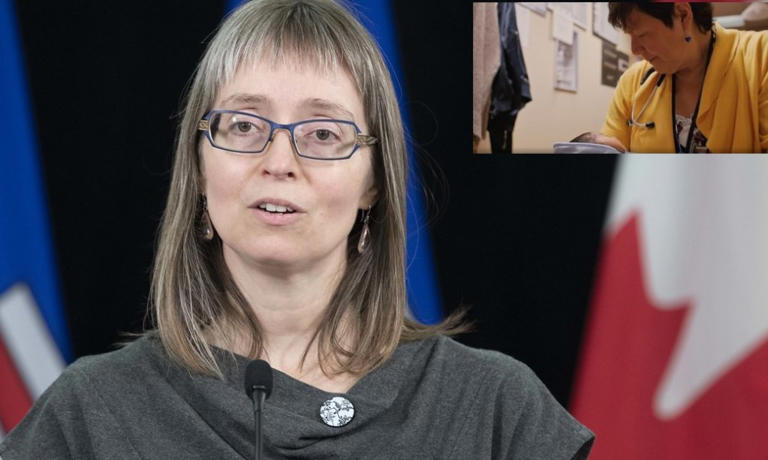
Dr. Deena Hinshaw and Dr. Esther Tailfeathers.© THE CANADIAN PRESS/HO-NFB

Dr. Deena Hinshaw, Alberta's former Chief Medical Officer of Health, was set to begin working with the Indigenous Wellness Core (IWC) — a part of Alberta Health Services — and now she isn't, and one of her would-be colleagues has resigned in protest.

"I went from believing I was a leader to recognizing I was a token," Dr. Esther Tailfeathers told Global News.

She is the senior medical director of the IWC.

"My realization is that with all the experience and the work that I've done in Indigenous health, it didn't mean anything."

Tailfeathers is upset after learning her team's decision to hire Hinshaw was reversed after being initially approved.

She says there was an extensive and competitive process before picking Hinshaw to fill a role in the IWC as Public Health and Preventive Medicine Lead.

Video: Alberta replaces chief medical officer of health Deena Hinshaw with Mark Joffe

Hinshaw was offered the job in May.

On June 1, a memo went out internally, welcoming Hinshaw to the team.

It led to backlash, mostly from those unhappy with how Hinshaw handled the pandemic.

AHS issued a statement shortly after: "Dr. Hinshaw is not employed by AHS."

Video: Alberta’s former top doctor joins B.C.’s public health leadership team


"Who rescinded it? I don't know, and I think there are questions to be asked about why the job was rescinded, and somebody should ask about 'did anybody think about the impact this will make to Indigenous lives in the province?'"

She's concerned the decision to send her team back to restart the hiring process could cost Indigenous lives.

"It breaks my heart to know that we worked very hard to start lifting the strategy but it was completely ignored and for some irrational reason, Deena's offer was rescinded," Tailfeathers said in a Zoom interview.

Video: Dr. Deena Hinshaw out as Alberta’s chief medical officer of health

Global News asked AHS why the decision was made and by whom.

The health authority responded it would not comment on the matter.

"AHS doesn’t speak to personnel matters," the statement read.

"AHS remains firmly committed to working with Indigenous communities and will continue to work to provide culturally safe healthcare for all First Nations, Metis, and Inuit peoples throughout the province. "

Lorian Hardcastle, an associate professor at the faculty of law and Cumming School of Medicine at the University of Calgary, questions why this happened.

"The team supported Dr. Hinshaw's hiring, she is qualified to fill this position despite being a controversial figure, so it isn't clear what other than politics may have driven this," she said.

The Premier's Office dismissed that thought.

"AHS is responsible for hiring decisions and the government of Alberta does not comment on AHS personnel decisions," a spokesperson for the premier said in full.

Hardcastle says if the decision to rescind Hinshaw's job offer wasn't political, both Tailfeathers' team and the public deserve to know what did cause it.

She says AHS' decision has led to two major losses to Indigenous health.

As for Tailfeathers, she says this move may deter talented physicians and health-care workers from coming to Alberta.

"This scares all physicians because nobody is guaranteed a job," Tailfeathers warned.

"Even if they go through protocol with proper search and selection, they meet all the criteria, they're offered a job, and the next day they find out their job has been rescinded."

Video: Alberta’s former top doctor joins B.C.’s public health leadership team
Unifor kicks off grocery talks with 100 per cent strike vote by 'fed up' workers

Story by The Canadian Press • Yesterday

Unifor national president Lana Payne.

TORONTO — Unifor says grocery workers have more resolve than ever to achieve higher wages and better working conditions as it heads into a two-year stretch of bargaining for more than a dozen collective agreements.

The work will begin with negotiations next week for a contract covering 3,700 Metro workers across the Greater Toronto Area, who — in an unusual move — have already voted 100 per cent in favour of a strike if a deal can't be reached.

The strike vote ahead of bargaining and 100 per cent support for a strike are both rare, said Stephanie Ross, an associate professor in the school of labour studies at McMaster University.

"I think that tells you something about the sense of urgency," said Ross. "People are falling behind every day."

The strike vote sends a strong signal not just to Metro, but to all three grocery giants that their workers are fed up, said Unifor national president Lana Payne.

"We need to send a signal and a very serious message to the supermarket barons that workers deserve a piece of these profits, and they deserve to have better pay, better working conditions and more full-time jobs," she said.

"We want to make important gains in this round of bargaining. We feel we're in a good place to do that."

Unifor represents more than 11,000 grocery store workers at major grocers across Ontario, Newfoundland and Labrador, Nova Scotia and Quebec, the union said. Payne said the next collective agreement up for bargaining will be for Loblaw workers in Newfoundland and Labrador this fall.

Workers have seen the quality of their jobs erode over time, with inflation eating into their wages even as the grocers post healthy profits, Payne said.

The pandemic underscored just how essential grocery store workers are, Payne said, noting that many of them received so-called 'hero pay' early on only to have it taken away — something that GTA Metro worker Courtney Cook said "felt like a slap in the face."

"This is our first bargaining since the pandemic," Cook said. "A lot of things changed during the pandemic, and we were deemed essential workers. So I think everyone's just frustrated that our pay doesn't reflect that kind of status."

Unifor held a national strategy session in May to determine its priorities for grocery sector bargaining, said Payne, as the union is hoping to establish a pattern and gain momentum with the first round at Metro. Those priorities include significant pay improvements, greater access to better health benefits, eliminating pay disparities, more full-time work and job protections for workers affected by technological changes, she said.

Metro spokeswoman Stephanie Bonk said in an email that the grocer is committed to working with the union to reach an agreement that meets employees' needs while also giving the company flexibility to meet and exceed customers' expectations.

The major grocers have come under public scrutiny as inflation surged across Canada last year, hitting more than eight per cent last June as the cost of basic necessities rose. Executives from the grocers spoke earlier this year in front of a parliamentary committee studying grocery prices, denying accusations that food price inflation was being driven by profit-mongering.

But accusations of profiteering aside, the grocers have been posting profits. On Thursday, Empire Company Ltd. reported it earned $182.9 million in its latest quarter compared with $178.5 million a year ago. Loblaw in its latest earnings report reported a profit of $418 million in its first quarter, down from $437 million last year when the company saw a one-time gain from a court ruling. And Metro in its second quarter reported earnings of $218.8 million, up from $198.1 million a year earlier.

Unifor is determined to get a bigger slice of that pie for workers, Payne said.

"It's really just hard that we're putting in everything we have for this company. And we're not getting back what we feel we deserve," said Cook.

Between the pandemic and the briefness of hero pay, ongoing inflation and grocers' profits, the grocery sector is in the midst of a "perfect storm," said Ross, leading to more labour militancy — and not just in the grocery sector.

"People are much more willing to hit the bricks than they perhaps have been … in a long time."

Ross said this first round with GTA Metro workers is all-important to set a benchmark for the pattern bargaining approach that Unifor is taking, where it tries to set a standard for one collective agreement and then replicate it across the sector.

In addition to better pay, Cook said she wants to see jobs at Metro become more stable, giving workers more predictable hours so they can better prioritize their families and their lives outside of work.

She said the 100-per-cent strike vote shows workers are ready to do whatever it takes to get what they deserve, and she thinks grocery store workers across the country will be approaching the bargaining table with the same kind of resolve.

Payne thinks the pandemic has also made Canadians more aware of grocery workers and what they face, and that this will translate into public support and sympathy as the workers bargain with grocers.

"They risked their health and safety every single day, to go to work for a job that in many cases was not paying them a decent wage," she said.

"Enough is enough here. We have to make good improvements in this collective agreement, and the resolve of our members is very strong. And I think this strike vote clearly shows they're prepared to fight if they need to."

Ross said recent major strikes have seen record levels of public support for workers in the wake of the pandemic and high inflation.

"There's a much more positive climate of potential public support for the union than there maybe has been in decades," she said.

"But … it all comes down to strategy, how the union and the employer frames their messages and how those messages land with the public."

This report by The Canadian Press was first published June 22, 2023.

Companies in this story: (TSX:MRU)

Rosa Saba, The Canadian Press