Friday, June 23, 2023

FDIC accidentally reveals details about Silicon Valley Bank’s biggest customers

Matt Egan
Fri, June 23, 2023

Celal Gunes/Anadolu Agency/Getty Images

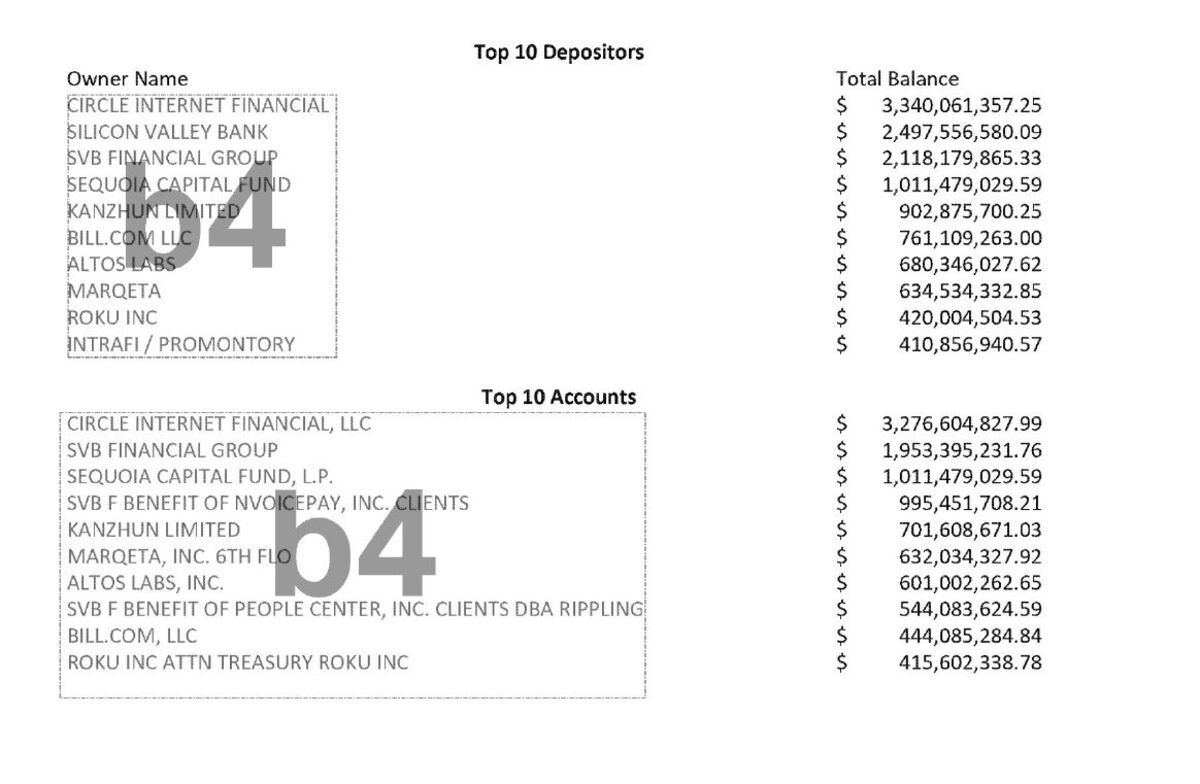
The FDIC mistakenly revealed to Bloomberg News details on the biggest customers at Silicon Valley Bank, the failed bank whose depositors were rescued through emergency action by regulators.

An FDIC document posted online by Bloomberg News on Friday offers new insights into who benefited from that controversial rescue in March when SVB became the second biggest bank failure in US history. According to Bloomberg, that document was accidentally released unredacted by the FDIC in response to a Freedom of Information Act request.

After SVB suddenly collapsed, the FDIC and other federal regulators decided to make all of the bank’s customers whole, including those with more funds than the $250,000 insurance limit.

That emergency move saved not only fledgling tech startups — some of which could have been wiped out by the SVB implosion — but some heavy hitters in the tech industry, too.

For instance, leading venture capital firm Sequoia Capital, held just more than $1 billion at SVB, according to the FDIC document. Sequoia, famous for its prescient investments in PayPal, Google, Apple and other tech firms, was SVB’s fourth-biggest depositor, according to the document.

Sequoia did not respond to a request for comment.

Another major SVB customer was Kanzhun, a Beijing tech firm that runs BOSS Zhipin, China’s largest online recruitment platform. The FDIC document indicates the Chinese firm held about $903 million at SVB.

The FDIC, charged with insuring deposits at banks, apparently did not intend to release the details on SVB’s biggest customers.

According to Bloomberg, the FDIC asked the media outlet to destroy and not share the depositor list, saying it meant to “partially” withhold some details from the document “because it included confidential commercial or financial information.”

The FDIC declined to comment to CNN.

Dennis Kelleher, CEO of financial reform nonprofit Better Markets, pushed back on the notion that the details should be hidden from public view.

“This is not, as regulators claim, ‘confidential commercial or financial information.’ It might be embarrassing information, but the American people have a right to know so there can be some oversight and accountability for regulators’ actions,” Kelleher told CNN in an email.

SVB’s biggest depositor was Circle Internet Financial, the stablecoin firm behind USD Coin. The FDIC document shows that Circle held $3.3 billion at SVB, a figure that the stablecoin company previously disclosed

The streaming platform Roku held $420 million at SVB, according to the FDIC document. Hours after SVB failed, Roku warned investors it held about $487 million — roughly a quarter of its total cash — with the bank and did not know if it would be able to recover the funds.

US officials have defended the rescue of SVB depositors as the necessary step to prevent panic from spreading and imperiling the broader financial system.

But critics of the US response to the bank failures have argued the SVB rescue amounted to a bailout, one that would help foreign companies.

“Americans will also be paying to guarantee the deposits of many Chinese companies that were SVB customers,” former Vice President Mike Pence wrote in an op-ed. “We have to stop the insanity of bailout out failing businesses.”

The FDIC estimates the SVB failure will cost its deposit insurance fund $16.1 billion. The agency plans to recoup those losses by assessing fees on banks.

“The American people are going to pay the $16 billion bill to prevent the collapse of Silicon Valley Bank,” Kelleher, the Better Markets CEO, said. “Those banks are not going to cut their executives’ bonuses…They are going to recover those costs in higher fees and rates for everyday banking services and products for Main Street Americans.”

For more CNN news and newsletters create an account at CNN.com
CRIMINAL CAPITALI$M
Swiss National Bank calls for new measures after Credit Suisse crash


Noele Illien
Wed, June 21, 2023 

Swiss National Bank building in Zurich

ZURICH (Reuters) -The Swiss National Bank (SNB) on Thursday said it was crucial to draw lessons from the Credit Suisse crisis that led to the bank's downfall and forced rescue by rival UBS and consider measures that would prevent such events in the future.

"These measures need to strengthen banks’ resilience in order to prevent a loss of confidence wherever possible, and ensure a broad range of effective options to stabilise, recover or wind down a systemically important bank in the event of a crisis," the central bank said in its 2023 financial stability report.

Among the measures, the SNB called for banks to be required in the future to prepare a minimum amount of assets that could be pledged for central banks, a step designed to help banks access emergency liquidity if worried customers rapidly withdrew cash.

Switzerland's largest bank recently grew even bigger, following its rescue of embattled Credit Suisse in a takeover engineered by Swiss authorities in March and formalised by UBS on June 12.

Politicians and economists have raised concerns whether Switzerland can effectively oversee a bank that now has a balance sheet of $1.6 trillion and 120,000 employees worldwide, and risks associated with that.

The SNB said it was not yet able to judge how resilient the newly merged bank would be.

"The currently available data are not sufficient for a comprehensive assessment of the combined bank’s resilience in such a forward-looking analysis," the report said.

Still, lessons needed to be learned "in view of the higher systemic importance of the combined bank and the associated risks for Switzerland," the SNB said.

The central bank said there were, however, three key observations to come from the crisis, including that compliance with capital requirements is necessary but not sufficient to ensure confidence in a bank.

Capital instruments designed to absorb early losses were not effective, the SNB said.

"AT1 capital instruments absorbed losses only as the point of non-viability was imminent and state intervention became necessary," the report said.

The SNB also said that the scale and pace of deposit outflows at Credit Suisse that resulted from the loss of confidence were unprecedented and more severe than assumed under the liquidity regulations.

In a statement published the day the biggest banking deal since the 2008 financial crisis officially closed, Swiss regulator, FINMA, said one of the most pressing goals for the new merged bank was to quickly reduce the risk of the former Credit Suisse investment bank, but was confident this could be achieved.

(Reporting by Noele Illien and John Revill Editing by Tomasz Janowski)


Three former Credit Suisse CEOs blamed for excessive risk-taking in bondholder suit
Reuters
Thu, June 22, 2023


ZURICH (Reuters) -A group of Credit Suisse AT1 bondholders has filed a class action suit accusing former executives at the Swiss bank, including three past CEOs, of being responsible for the bank's downfall.

A lawsuit filed in a New York court on Tuesday accused former bosses Thomas Gottstein, Tidjane Thiam and Brady Dougan, and several other executives of doing excessively risky trades to achieve high short-term returns and bonuses.

"Credit Suisse’s directors and senior executives, and the rotten culture they instilled and fostered, destroyed trust in the bank, which led to its collapse," the lawsuit said.

The lawsuit also accused executives of "creating and perpetuating a culture at Credit Suisse that placed profits, excessive risk-taking, and self-dealing over sound risk management and compliance with the law."

It did not specify the amount of compensatory damages the plaintiffs were seeking.

UBS, which earlier this month became Credit Suisse's new owner following a government-engineered rescue in March, said it would not comment on the court case.

Representatives of Exos Financial, a financial firm founded and led by Dougan, did not immediately respond to an e-mail seeking comment, while the two other former chief executives could not be immediately reached for comment.

As a part of Credit Suisse's rescue, Switzerland's regulator decided to render around $18 billion of Credit Suisse's Additional Tier 1 (AT1) debt worthless, which stunned markets and alerted litigators.

The deal upended a long-established practice of giving bondholders priority over shareholders in a debt recovery, triggering hundreds of lawsuits.

Last month, Switzerland’s Federal Administrative Court said it has received 230 claims against the country’s financial regulator FINMA after it wrote off the value of Credit Suisse’s AT1 bonds.

(Reporting by Noele IllienEditing by Tomasz Janowski)
CRIMINAL CAPITALI$M
Deloitte Quits as Byju’s Auditor Piling Pressure on Tech Startup


Alex Gabriel Simon and Anto Antony
Thu, June 22, 2023 


(Bloomberg) -- The auditor for Indian tech firm Byju’s quit, the latest setback for the once high-flying startup that’s had its offices searched by anti-money laundering officials and is embroiled in a tussle with creditors over a $1.2 billion loan

Deloitte Haskins & Sells resigned as auditors to Think & Learn Pvt., better known as Byju’s, citing a delay in submitting financial statements, according to a letter seen by Bloomberg and confirmed by officials who declined to be identified.

Deloitte hasn’t been able to start an audit due to the delays and that will have a “significant impact” on its ability to “plan, design, perform and complete” the audit as per standards, it said in the letter sent to India’s Registrar of Companies.

The resignation compounds troubles at the Indian ed-tech company started by former teacher Byju Raveendran, which once touched a valuation of $22 billion as a prime example of India’s fledgling internet economy.

Business boomed during the pandemic, with the number of users of its flagship app topping 100 million. The startup spent heavily on marketing, such as sponsorship of India’s national cricket team and the FIFA World Cup.

But demand for online tutoring dropped off after schools reopened, and Byju’s has for months been in talks with lenders of its $1.2 billion debt after it breached investor protections by missing a deadline to disclose annual financial results.

There is no earnings statement for Byju’s for 2022 in the public domain. The most recent available shows expenditure more than doubled in the year to March 31, 2021, while revenue fell.

Byju’s said in a statement on Thursday it appointed MSKA & Associates, a member of international accounting network BDO, as statutory auditors. A spokesperson for Deloitte wasn’t available for comment.

The Economic Times newspaper also said several board members of the company, including early backer G.V. Ravishankar, had tendered their resignations, a report which Byju’s called “entirely speculative.”

Legal Action


India’s anti-money laundering investigation agency conducted searches at offices of Byju’s in April as part of a probe. Then the standoff over the loan taken out in 2021 with a due date of 2026 heated up in May, when an agent for the lenders sued Byju’s in the US state of Delaware.

In a court hearing that month, lenders accused the tech company of hiding $500 million. Byju’s was trying to protect the money from predatory lenders, Joe Cicero, a lawyer for the Indian firm, said during the hearing. Delaware Chancery Court Judge Morgan Zurn didn’t make any ruling about whether moving the money was appropriate.

On June 6, Byju’s said it “elected” to halt making any payments on the $1.2 billion term loan and skipped a $40 million interest payment due that day.

It also filed a lawsuit in New York, alleging a group of investors manufactured a fake debt crisis to extort money from it. The lenders’ group has called the lawsuit meritless.

The loan is being quoted at 63.8 cents on the dollar, Bloomberg-compiled data show. A level below 70 is generally considered distressed.

--With assistance from P R Sanjai and Advait Palepu.
Rare Earth Metals Production By Country: Top 10 Countries

Sana Ijaz
INSIDER MONKEY
Thu, June 22, 2023

In this in-depth article, we'll list the top countries producing rare earth metals to see how they are impacting this market. If you want to skip the detailed knowledge of rare earth metals' use, market trends, and mining developments.

China leads the pack with regard to rare earth metals production by country and will stay ahead of others in the foreseeable future. Other leading producers of rare earth metals are the United States, Australia, Myanmar, and Thailand, among others. Where China accounts for 70% of the global production of rare earth metals, the United States, Australia, and Myanmar collectively make up 24% of the world's total throughput of rare earth metals.

Rare earth metals comprise a group of 17 chemically similar metallic elements, including the 15 lanthanides, along with scandium and yttrium. REEs are used in consumer electronics, renewable energy systems, and military equipment. Moreover, certain REEs like neodymium and dysprosium are used to manufacture permanent magnets used in wind turbines and electric vehicles.

High heat resistance, electrochemical and magnetic characteristics, and specific luminescent properties of rare earth metals make them useful in an array of advanced technological fields. For instance, REEs are integral to the production of high-strength magnets used in wind turbines and electric vehicles, thereby playing a crucial role in green energy solutions. Their magnetic properties also serve a vital role in miniaturizing components in digital technology, like hard drives, smartphones, and other electronic devices.

Which Country Is The Largest Producer Of Rare Earth Metals?

China is the largest global producer of rare earth metals. China generated approximately 0.21 million metric tons of these elements in 2022. Further, China possesses 44 million metric tons of reserves of rare earth elements, which are yet to be exploited. So doubtlessly, China is the largest producer of rare earth metals, owing to its diverse mining sector and geological treasure.

Where Are Rare Earth Metals Found In The World?

The primary global source of REEs is China, which accounts for approximately 70% of the global REEs mining output. China's dominance in rare earth metal production by country comes largely from the Bayan Obo Mining District in Inner Mongolia, the world's largest known REEs deposit.

Outside of China, the Mountain Pass Mine, situated in southeastern California, is the primary rare earth metal deposit in the United States. Moreover, the Mount Weld Mine in Australia represents a significant source of REEs in the country.

Exploration efforts have also identified substantial REEs deposits in Canada (8.3 million metric ton reserves), South Africa (0.79 million metric ton reserves), Tanzania (0.89 million metric ton reserves), and Greenland (1.5 million metric ton reserves of REEs), among others. However, these countries are not actively mining REEs because of the complexity of extraction and separation processes, alongside environmental considerations and cost-prohibitiveness.

What Is The Main Issue With Rare Earth Extraction?


Irrespective of their name, rare earths are relatively abundant within the Earth's crust. However, they're often found dispersed in low concentrations. Therefore, their extraction and processing are economically challenging and environmentally detrimental. As the widespread distribution necessitates large-scale and invasive mining operations to obtain economically viable quantities, it results in high extraction costs. Further, the scatter and consequent low concentration make rare earth deposits less commercially viable to mine compared to other minerals, as more extensive energy and resources are required for extraction and subsequent refinement.

Another chief issue in rare earth extraction is the extensive environmental degradation and public health risks it poses. Most extraction methods consist of significant physical disruption of landscapes through open-pit mining and create large quantities of waste material.

Rare earths refinement is an energy-intensive and chemically complex process involving hazardous substances like concentrated acids. Accidental leaks or inappropriate disposal of these substances can lead to devastating ecological impacts and human health hazards. One infamous example is the Bayan Obo mining district in China which has witnessed severe groundwater contamination and associated health risks.
The Financial Side of Rare Earth Metals

The rare earth metals industry was valued at $7 billion in 2021. Moreover, forecasts predict this market will reach $15 billion by 2030, advancing at a solid CAGR of 9.1%, indicating rapidly increasing demand. Such growth stems from the role these metals play in advanced technology applications like renewable energy, electronics, and defense technologies, among others.

Furthermore, the world trade value for rare earth metals was reported to be approximately $2.71 billion in 2021. Burma (Myanmar), despite its complex socio-political landscape, surfaced as the top exporter of rare earth metals in 2021, with net exports valued at around $803 million. Since the country has abundant rare earth reserves and is possibly aided by foreign investment, it's a leading exporter of REEs.

Conversely, China, despite being the largest producer of rare earth metals, was the largest importer of these resources in 2021, as its net imports were valued at an identical figure to the global trade value of $2.71 billion. Such intense imports of rare earth elements might appear paradoxical at first, but it can be rationalized by analyzing China's domestic and international strategic policies.

Major Rare Earth Mining Companies and Stocks

Energy Fuels Inc (NYSE:UUUU) is a leading US uranium company with a current current market cap of $1.01 billion that works in the uranium supply line for nuclear facilities. And since uranium is also present as a by-product in rare earth metals, Energy Fuels Inc (NYSE:UUUU) is expanding its REE (rare earth element) capabilities. In 2021, Energy Fuels Inc (NYSE:UUUU) sold its three wholly owned subsidiaries to enCore Energy for $120 million. Energy Fuels Inc (NYSE American:UUUU) aims to utilize this cash to expand its REE, uranium, vanadium, and medical isotope business plans for the next two to three years.

Moreover, Mp Materials Corp (NYSE:MP) is the biggest producer of rare earth metals outside China. The company focuses on high-purity separated neodymium and praseodymium (NdPr) oxide. The market cap of Mp Materials Corp (NYSE:MP), as of the writing of this article, is $4.044 billion, which is substantial given the curtailed market footprint of REEs. Mp Materials Corp (NYSE:MP) operates Mountain Pass, which is the only integrated rare earth mining and processing site in North America.

Another REE stock to look out for is Tronox Holdings plc (NYSE:TROX), a manufacturer of virtually integrated titanium dioxide (TiO2), that is used in paints, plastics, and coatings. The current market cap of Tronox Holdings plc (NYSE:TROX) is $2.017 billion, owing to its expansive operations in the US, UK, Africa, and Australia. As rare earth metals are expected to stay in demand, Tronox Holdings plc (NYSE:TROX) is smart to invest in.


Rare Earth Metals Production By Country: Top 10 Countries

Our Methodology

We referred to the 2022 USGS Mineral Commodity Summaries published in 2023 to rank rare earth metals production by country. This document provided credible data on rare earth metals, as USGS is a leading authority in the mining and mineral industry. The 2023 edition provided a country-by-country breakdown of rare earth metals production so we could precisely map global production trends. Our sources for financial data and forecasts about rare earth metals included OECD and MarketWatch, among others.

Based on the USGS data, here is rare earth metals production by country:

10. Brazil

Rare Earth Metal Mine Production in 2022: 80 metric tons

Brazil's rare earth metal production in 2022 was 80 metric tons, making it the 10th largest rare earth metal producing country. This mine yield came down from 500 metric tons and 600 metric tons in 2021 and 2020, respectively. However, this contraction does not reflect a depletion of resources as Brazil has expansive reserves, estimated at approximately 21 million metric tons of rare earth metals.

9. Madagascar

Rare Earth Metal Mine Production in 2022: 960 metric tons

The island nation of Madagascar registered 960 metric tons of rare earth metal production. While considerable, this output decreased from 3,200 metric tons reported in 2021. This drastic drop in production represents a decrease of over 70% and suggests a consequential shift in Madagascar's mining industry, with potential implications for the global supply chain of these critical components.

8. Russia

Rare Earth Metal Mine Production in 2022: 2,600 metric tons

When it comes to rare earth metals production by country, Russia ranks eighth on our list. Russia contributed notably to the global supply of rare earth metals by producing 2,600 metric tons in 2022. Notably, this is just a fraction of the country's potential output, owing to its significant reserves. As of recent estimates, Russia harbors 21 million metric ton reserves of these invaluable elements, which will impact the global mining sector in the foreseeable future.

7. India

Rare Earth Metal Mine Production in 2022: 2,900 metric tons

India is amongst the leading rare earth metals producing countries, owing to its 2,900 metric tons yield in 2022. India's efforts towards locating rare earth elements have resulted in the identification of a considerable reserve of these metals. As per current estimations, India has a stockpile of 6.9 million metric tons of rare earth metals. Given these generous reserves that are yet to be exploited, India is surely a key player in meeting the global demand for rare earth metals. Future trajectories in this field will also significantly influence the global supply chain, given the expanding demand for these vital resources.

6. Vietnam

Rare Earth Metal Mine Production in 2022: 4300 metric tons

Vietnam's mine throughput for rare earth metals was 4,300 metric tons in 2022, up from a humble mine yield of 400 metric tons in 2021. This achievement shows the country's growing expertise and commitment to rare earth extraction. Concurrently, the country holds substantial potential with an estimated reserve base of 22 million metric tons of these crucial elements, asserting itself as a potential powerhouse in rare earth resources.

5. Thailand

Rare Earth Metal Mine Production in 2022: 7,100 metric tons

When it comes to rare earth metals production by country, Thailand is among the top five. Its reported production volume of rare earth metals was 7,100 metric tons in 2022. Notably, Thailand’s rare earth metals output reached 8,200 metric tons in 2021, more than double the production in 2020, which stood at 3,600 metric tons. However, following this unprecedented increase, the production experienced a decrease, sliding to 7,100 metric tons in 2022. Such a shift might be indicative of a level of volatility in Thailand’s rare earth metals production over the observed period.


4. Burma / Myanmar

Rare Earth Metal Mine Production in 2022: 12,000 metric tons

Burma’s mine output of rare earth metals was recorded to be 12,000 metric tons in 2022. The country’s production volumes primarily consist of dysprosium and terbium, with minor outputs of scandium and yttrium. Burma’s production yield indicates its potential to offer diversified supply sources, mitigating the risks associated with the concentration of these critical resources. Moreover, Burma is amongst the largest exporters of rare earth metals worldwide. Its export of REEs reached $803 million in 2021, despite the country’s complex socio-political landscape and developing mining infrastructure.

3. Australia


Rare Earth Metal Mine Production in 2022: 18,000 metric tons

Australia is the third-largest producer of rare earth metals, only behind the US and China. The country mined 18,000 metric tons of rare earth metals in 2022, which is a slight drop from the country’s yield of 24,000 metric tons in 2021. This generous rare earth metals output indicates the country’s immense rare earth potential, as its reserves are estimated to be 4.2 million metric tons. Australia’s most prominent rare earth metals mine is the Mount Weld Mine, which has state-of-the-art infrastructure to extract REEs from other minerals. Also, despite having the world’s sixth largest reserves of rare earth metals, Australia’s mining efforts in this sector remain relatively curtailed.

2. United States


Rare Earth Metal Mine Production in 2022: 43,000 metric tons

The United States saw mine production of 43,000 metric tons of rare earth metals in 2022. Also, the current estimates suggest that the country holds approximately 2.3 million metric tons of reserves of rare earth metals. This substantial reserve capacity indicates the potential for continued and amplified domestic production in the future. Currently, the largest rare earth metals mine in the US is the Mountain Pass Mine in southeastern California, which is an open-pit mine with substantial mining capacity.

1. China

Rare Earth Metal Mine Production in 2022: 0.21 million metric tons

China is the largest rare earth metals producing country that accounts for over 70% of of rare earth metals’ global production. The country’s mine yield of rare earth metals was recorded at 0.21 metric tons in 2022. China also has the largest deposits of rare earth metals, amounting to 44 million metric tons. The main REEs deposit in China is the Bayan Obo Mining District in Inner Mongolia, which is also the world’s largest known REEs deposit.
FRACKQUAKES
Dutch government to end gas extraction in northern province after 60 years and many damaging quakes


THE HAGUE, Netherlands (AP) — Extraction from one of the world's largest natural gas fields will end in October, the Dutch government announced Friday, turning off a lucrative source of revenue that also sparked unrest by causing a string of earthquakes.

“The gas tap will be turned off on Oct. 1. That means an end to extraction after 60 years," Prime Minister Mark Rutte said.

However, he said it remains possible gas could still be pumped from the Groningen field after that date if there is a “perfect storm” of an extremely cold winter this year and a problem with storage of gas from other sources amid ongoing concerns about gas deliveries caused by Russia's war in Ukraine.

Faced with mounting anger from residents whose homes were repeatedly rattled by the shallow tremors, the government had already wound down extraction from the field which held 2,800 billion cubic meters of gas. Only enough is now being pumped to keep gas installations in the region operational.

Thousands of households are still waiting for their homes to be strengthened after years of shaking that damaged buildings. Thousands more are awaiting compensation.

Groninger Bodem Beweging, an organization that represents residents in the region, called the announcement “a step in the right direction,” but added its members would not be celebrating yet and will continue to push for a definitive end this year with no possibility of more extraction.

Gas was extracted in Groningen for decades by a consortium including energy giants Shell and ExxonMobil before the government decided in 2018 to gradually stop pumping the energy source that warms most Dutch homes.

A damning parliamentary report issued in February into the government's handling of the extraction calculated that the Dutch state earned 363 billion euros from Groningen gas. The report said the government put profits before people, prompting an apology from Prime Minister Mark Rutte.

“The interests of the people of Groningen have been structurally ignored in natural gas extraction in Groningen, with disastrous consequences,” a parliamentary commission said in a statement in February.

“We can’t take away the suffering of the past,” Rutte said Friday, but he said authorities are working hard on repairs and strengthening. The government has pledged to spend at least 22 billion euros on repairs to homes and infrastructure and to “invest in the long-term economic perspective” of the region.

Johan Atema, director of NAM, the company set up in 1947 to extract gas from Dutch fields, called the closure announcement an important decision.

“Many Groningen residents are still experiencing a huge impact from the earthquakes and we therefore fully support the final closure of the gas field,” he said in a statement.

“Looking back, this gas field has simultaneously provided the Netherlands and surrounding countries with reliable energy for decades, and with its yields it has made a major contribution to prosperity in our country,” he added.

Mike Corder, The Associated Press
Scientists discover troubling explanation behind recent whale death: ‘It’s heartbreaking to see this kind of destruction’


Hayleigh Evans
Fri, June 23, 2023

A dead sperm whale washed ashore in Hawaii on Jan. 27, and scientists suspect they have found the culprit: plastic.

What happened?


Scientists believe the whale, which beached in Kauai, died from ingesting fishing traps and nets, plastic bags, and other marine debris. The 56-foot, 120,000-pound marine mammal had foreign objects at the opening of its intestinal tract that prevented it from digesting its food.

“This is the first sperm whale in Hawaiian waters where we have seen this kind of ingestion of discarded fishing gear and nets,” Kristi West, the director of the University of Hawaii’s Health and Stranding Lab, said in a press release. “It’s heartbreaking to see this kind of destruction in an individual animal.”

After examining the whale’s stomach, scientists found six hagfish traps, seven varieties of fishing nets, two kinds of plastic bags, and multiple fishing lines. The whale’s stomach was so big that researchers were unable to study its entirety and believe there were more items they could not recover.

Why is this whale death concerning?


The whale death is a jarring reminder of how dangerous plastic pollution is to marine life. Even creatures as large as sperm whales can fall victim to plastic debris in the ocean.

Researchers estimate there are 5.25 trillion pieces of plastic waste in the ocean. Roughly 269,000 tons of this waste floats on the ocean surface, and about four billion plastic microfibers per square kilometer pollute the deep sea.

Not only does this pose a risk to marine life that mistake these items for food, but it can also contaminate human food. Toxins from plastic pollution contaminate fish, and humans are exposed to these toxins when eating seafood.

What can I do to help protect marine life?

Plastic waste is endangering marine species, and it is our responsibility to reduce ocean pollution. Luckily, there are a variety of solutions everyone can participate in.

The simplest way to fight plastic pollution is to reduce our reliance on single-use plastics. There are many reusable products that you can introduce to your daily life to replace these items.

When you go shopping, bring reusable grocery bags, and instead of using plastic water bottles, try carrying around a reusable one.

Participating in beach or river cleanups or donating to organizations that conduct them, like 4ocean or The Ocean Cleanup, is the most direct way to prevent ocean plastic pollution. Clearing trash from coastlines not only saves the ocean from plastic debris, but you may also save a life.

Join our free newsletter for cool news and cool tips that make it easy to help yourself while helping the planet.

Get a clue, says panel about buzzy AI tech: It's being 'deployed as surveillance'


Image Credits: PATRICIA DE MELO MOREIRA/AFP / Getty Images

Connie Loizos
Thu, June 22, 2023 

Earlier today at a Bloomberg conference in San Francisco, some of the biggest names in AI turned up, including, briefly, Sam Altman of OpenAI, who just ended his two-month world tour, and Stability AI founder Emad Mostaque. Still, one of the most compelling conversations happened later in the afternoon, in a panel discussion about AI ethics.

Featuring Meredith Whittaker (pictured above), the president of the secure messaging app Signal; Credo AI co-founder and CEO Navrina Singh; and Alex Hanna, the director of Research at the Distributed AI Research Institute, the three had a unified message for the audience, which was: Don't get so distracted by the promise and threats associated with the future of AI. It is not magic, it's not fully automated and -- per Whittaker -- it's already intrusive beyond anything that most Americans seemingly comprehend.

Hanna, for example, pointed to the many people around the world who are helping to train today's large language models, suggesting that these individuals are getting short shrift in some of the breathless coverage about generative AI in part because the work is unglamorous and partly because it doesn't fit the current narrative about AI.

Said Hanna: "We know from reporting . . .that there is an army of workers who are doing annotation behind the scenes to even make this stuff work to any degree -- workers who work with Amazon Mechanical Turk, people who work with [the training data company] Sama -- in Venezuela, Kenya, the U.S., actually all over the world . . .They are actually doing the labeling, whereas Sam [Altman] and Emad [Mostaque] and all these other people who are going to say these things are magic -- no. There's humans. . . .These things need to appear as autonomous and it has this veneer, but there's so much human labor underneath it."

The comments made separately by Whittaker -- who previously worked at Google, co-founded NYU’s AI Now Institute and was an adviser to the Federal Trade Commission -- were even more pointed (and also impactful based on the audience's enthusiastic reaction to them). Her message was that, enchanted as the world may be now by chatbots like ChatGPT and Bard, the technology underpinning them is dangerous, especially as power grows more concentrated by those at the top of the advanced AI pyramid.

Said Whittaker, "I would say maybe some of the people in this audience are the users of AI, but the majority of the population is the subject of AI . . .This is not a matter of individual choice. Most of the ways that AI interpolates our life makes determinations that shape our access to resources to opportunity are made behind the scenes in ways we probably don't even know."

Announcing the Security Stage agenda at TechCrunch Disrupt

Whittaker gave an example of someone who walks into a bank and asks for a loan. That person can be denied and have "no idea that there's a system in [the] back probably powered by some Microsoft API that determined, based on scraped social media, that I wasn't creditworthy. I'm never going to know [because] there's no mechanism for me to know this." There are ways to change this, she continued, but overcoming the current power hierarchy in order to do so is next to impossible, she suggested. "I've been at the table for like, 15 years, 20 years. I've been at the table. Being at the table with no power is nothing."

Certainly, a lot of powerless people might agree with Whittaker, including current and former OpenAI and Google employees who've reportedly been leery at times of their companies' approach to launching AI products.

Indeed, Bloomberg moderator Sarah Frier asked the panel how concerned employees can speak up without fear of losing their jobs, to which Singh -- whose startup helps companies with AI governance -- answered: "I think a lot of that depends upon the leadership and the company values, to be honest. . . . We've seen instance after instance in the past year of responsible AI teams being let go."

In the meantime, there's much more that everyday people don't understand about what's happening, Whittaker suggested, calling AI "a surveillance technology." Facing the crowd, she elaborated, noting that AI "requires surveillance in the form of these massive datasets that entrench and expand the need for more and more data, and more and more intimate collection. The solution to everything is more data, more knowledge pooled in the hands of these companies. But these systems are also deployed as surveillance devices. And I think it's really important to recognize that it doesn't matter whether an output from an AI system is produced through some probabilistic statistical guesstimate, or whether it's data from a cell tower that's triangulating my location. That data becomes data about me. It doesn't need to be correct. It doesn't need to be reflective of who I am or where I am. But it has power over my life that is significant, and that power is being put in the hands of these companies."

Added Whittaker, the "Venn diagram of AI concerns and privacy concerns is a circle."

Whittaker obviously has her own agenda up to a point. As she said herself at the event, "there is a world where Signal and other legitimate privacy preserving technologies persevere" because people grow less and less comfortable with this concentration of power.

But also, if there isn't enough pushback and soon -- as progress in AI accelerates, the societal impacts also accelerate -- we'll continue heading down a "hype-filled road toward AI," she said, "where that power is entrenched and naturalized under the guise of intelligence and we are surveilled to the point [of having] very, very little agency over our individual and collective lives."

This "concern is existential, and it's much bigger than the AI framing that is often given."

We found the discussion captivating; if you'd like to see the whole thing, Bloomberg has since posted it here.


After jobs warning, Germany's Axel Springer says AI can liberate journalists

Reuters
Thu, June 22, 2023

FILE PHOTO: Illustration shows Artificial Intelligence words


BERLIN (Reuters) - A senior executive at German media giant Axel Springer on Thursday said artificial intelligence would free journalists to devote more time to core reporting, days after an internal email warned the technology would lead to significant job losses.

"For newsrooms, AI opens up new paths and freedoms. Journalists can outsource tedious work to AI and devote more time and energy to their core tasks," Chief Information Officer Samir Fadlallah told Reuters on the sidelines of a media conference in Berlin.

The company will address challenges around the technology "constructively," he said.

In an email seen by Reuters earlier this week, the publisher outlined a "digital only" roadmap for its mass-circulation Bild tabloid to be implemented by the beginning of 2024, saying that its "AI offensive" meant that many jobs would become redundant.

"The functions of editorial managers, page editors, proofreaders, secretaries and photo editors will no longer exist as they do today," the editorial leadership team wrote to Bild staff.

While Springer did not comment on the number of jobs at risk, company sources told Reuters a low three-digit number of employees would ultimately have to leave.

Fadlallah said his focus was on regulatory challenges and the opportunities the technology opens up for consumers.

"We see great potential in Generative AI to provide our readers and users with even more attractive and individually tailored products," he said, adding that it offers users "completely new opportunities for interaction."

"The focus is certainly on topics such as necessary regulation, remuneration for the use of our content as training material for large language models, and data protection," he said.

The company has said it aims to improve earnings at its flagship Bild and Welt publications by 100 million euros ($109.14 million) by 2025 through revenue increases and cost savings, and intends to fully stop producing print edition newspapers in the medium term.

Axel Springer is active in more than 40 countries and employs more than 18,000 people worldwide. Alongside its German titles, the firm owns English-language news website Politico, U.S. media company Insider and classified portals StepStone and AVIV.

($1 = 0.9163 euros)

(Reporting by Klaus Lauer, Writing by Anna Mackenzie)


OpenAI CEO Sam Altman Says AI Is ‘Most Important Step Yet’ For Humans and Tech

Priya Anand and Emily Chang
Thu, June 22, 2023 

OpenAI CEO Sam Altman

(Bloomberg) -- Sam Altman, chief executive officer of artificial intelligence startup OpenAI Inc., said there are many ways that rapidly progressing AI technology “could go wrong.” But he argued that the benefits outweigh the costs, “We work with dangerous technology that could be used in dangerous ways very frequently.”

Altman addressed growing concern about the rapid progress of AI in an interview onstage at the Bloomberg Technology Summit in San Francisco. Altman has also publicly pushed for increased regulation of artificial intelligence in recent months, speaking frequently with officials around the world about responsible stewardship of AI.

Despite the potential dangers of what he called an exponential technological shift, Altman spoke about several areas where AI could be beneficial, including medicine, science and education.

“I think it’d be good to end poverty,” he said. “But we’re going to have to manage the risk to get there.”

OpenAI has been valued at more than $27 billion, putting it at the forefront of the booming field of venture-backed AI companies. Addressing whether he would financially benefit from OpenAI’s success, Altman said, “I have enough money,” and stressed that his motivations were not financial. “This concept of having enough money is not something that is easy to get across to other people,” he said, adding that it’s human nature to want to be useful and work on “something that matters.”

“I think this will be the most important step yet that humanity has to get through with technology,” Altman said. “And I really care about that.”

Elon Musk, who helped Altman start OpenAI, has subsequently been critical of the organization and its potential to do harm. Altman said that Musk “really cares about AI safety a lot,” and that his criticism was “coming from a good place.” Asked about the theoretical “cage match” between Musk and his fellow billionaire Mark Zuckerberg, Altman joked: “I would go watch if he and Zuck actually did that.”

OpenAI’s products — including the chatbot ChatGPT and image generator Dall-E — have dazzled audiences. They’ve also helped spark a multilbillion-dollar frenzy among venture capital investors and entrepreneurs who are vying to help lay the foundation of a new era of technology.

To generate revenue, OpenAI is giving companies access to the application programming interfaces needed to create their own software that makes use of its AI models. The company is also selling access to a premium version of its chatbot, called ChatGPT Plus. OpenAI doesn’t release information about total sales.


Microsoft Corp. has invested a total of $13 billion in the company, people familiar with the matter have said. Much of that will be used to pay Microsoft back for using its Azure cloud network to train and run OpenAI’s models.

The speed and power of the fast-growing AI industry has spurred governments and regulators to try to set guardrails around its development. Altman was among the artificial intelligence experts who met with President Joe Biden this week in San Francisco. The CEO has been traveling widely and speaking about AI, including in Washington, where he told US senators that, “if this technology goes wrong, it can go quite wrong.”

Major AI companies, including Microsoft and Alphabet Inc.’s Google, have committed to participating in an independent public evaluation of their systems. But the US is also seeking a broader regulatory push. The Commerce Department said earlier this year that it was considering rules that could require AI models to go through a certification process before being released.

Read more: Regulate AI? Here’s What That Might Mean in the US: QuickTake

Last month, Altman signed onto a brief statement that included support from more than 350 executives and researchers saying “mitigating the risk of extinction from AI should be a global priority alongside other societal-scale risks, such as pandemics and nuclear war.”

Despite dire warnings from technology leaders, some AI researchers contend that artificial intelligence isn’t advanced enough to justify fears that it will destroy humanity, and that focusing on doomsday scenarios is only a distraction from issues like algorithmic bias, racism and the risk of rampant disinformation.

OpenAI’s ChatGPT and Dall-E, both released last year, have inspired startups to incorporate AI into a vast array of fields, including financial services, consumer goods, health care and entertainment. Bloomberg Intelligence analyst Mandeep Singh estimates the generative AI market could grow by 42% to reach $1.3 trillion by 2032.

--With assistance from Dina Bass.


Amazon Is Spending $100 Million to Teach Cloud Customers About AI
Dina Bass
Thu, June 22, 2023 


AWS Chief Executive Officer Adam Selipsky 

(Bloomberg) -- Amazon.com Inc.’s cloud unit is building a program to help customers develop and deploy new kinds of artificial intelligence products as the biggest seller of cloud services tries to match Microsoft and Google in the market for so-called generative AI.

Amazon Web Services is investing $100 million to set up the AWS Generative AI Innovation Center, which will link customers with company experts in AI and machine learning. They’ll help a range of clients in health care, financial services and manufacturing build customized applications using the new technology. Highspot, Twilio, Ryanair and Lonely Planet will be early users of the innovation center, Amazon said.

The goal is to help sell more cloud services, convincing clients to turn to AWS as they build new generative AI applications rather than Microsoft Corp.’s Azure, which has seized an early lead owing to its partnership with ChatGPT maker OpenAI, or Alphabet Inc.’s Google, which pioneered much of the early technology underpinning this new frontier.

“We will bring our internal AWS experts free-of-charge to a whole bunch of AWS customers, focusing on folks with significant AWS presence, and go help them turbocharge their efforts to get real with generative AI, get beyond the talk,” AWS Chief Executive Officer Adam Selipsky said Thursday at Bloomberg’s technology conference in San Francisco.

Amazon unveiled its own generative AI tools earlier this year, but longtime employees and customers deemed the announcement uncharacteristically vague, Bloomberg reported in May. One customer who tested the tools awarded the technology an “incomplete” grade, while people familiar with AWS product launches wondered if Amazon released the AI tools to counter perceptions it has fallen behind Microsoft and Google.

Amazon has denied its generative AI tools were rushed or incomplete and said the technology is ready for customers to test and provide feedback. Asked about Amazon’s position in the AI race, Selipsky said: “Are we really going to have a conversation about three steps into a 10k race? Amazon has always taken a much more long-term view of the world than any other company.”

With the viral releases of OpenAI’s Dall-E image-generation software and the ChatGPT chatbot over the past year, companies are rushing to incorporate the technology into their products and services, and the cloud giants are positioning themselves to cash in. Bloomberg Intelligence analyst Mandeep Singh estimates the market for generative AI, in which AI models analyze volumes of data and use it to generate new images, texts, audio and video, could grow by 42% to reach $1.3 trillion by 2032.


--With assistance from Brad Stone and Natalie Lung.

(Updated with customers with early access to the innovation center.)


The 'Black effect': Overcoming the challenge of making AI more inclusive to tap new consumers

Damon Embling
Fri, 23 June 2023


Marketers and advertisers have gathered on the French Riviera for this year’s Cannes Lions Festival of Creativity to hear how to be more authentic and inclusive in an increasingly tech-driven marketplace.

Bombarded with advertising messages online every day, consumers are becoming increasingly savvy when it comes to deciding what kind of content and brands to engage with.

Going beyond prices and offers, many are scrutinising companies not only for their sustainability credentials, but their commitment to diversity and inclusion too.

Will AI re-write creativity? Here's what to expect from Cannes Lions 2023

'Untapped' Black consumers

At Cannes Lions, creative minds have been told to wake up to the "untapped" potential of the Black consumer market, during a session titled 'Harness the Black Effect: Diversity as a Game Changer for Brands'.

The audience heard that Black consumers represent more than €1.6 trillion in annual buying power in the US alone. Yet Black audiences make up less than two per cent of American advertising and marketing spend

When you talk about AI and some of these new-age kind of approaches, we want to make sure that AI is being mindful of how it’s implementing across diverse consumers.

"In 2023, investment is still really low towards dedicated Black-facing campaigns and there's quite a bit of an opportunity that’s left on the table thereby," Brianne Boles-Marshall, Diverse Media Strategy and Investment Lead at American automaker General Motors (GM) told Euronews Next in Cannes.

"It's just like anything else, if you're not speaking directly with an audience, they may feel like your message is not for them. So, if you want to change the game of your brands, if you want to let [the consumer] know that yes, our products are for you, you speak with them, not at them".

Boles-Marshall added that research has shown that the "Black Effect," the impact of Black consumers, influences mainstream consumer behaviours to a greater degree.
Making AI inclusive

Advertisers, marketers, and the media are tackling inclusivity in an increasingly tech-driven environment, with the rise of things like generative AI (artificial intelligence) creating content.

It’s an extra challenge for businesses as they strive to be more diverse and representative.

"We have to evolve with the technology, and we have to make sure the technology, as it evolves, is inclusive," said Boles-Marshall. “When you talk about AI and some of these new-age kind of approaches, we want to make sure that AI is being mindful of how it’s implementing across diverse consumers".

She continued: "We’re not trying to usurp Black consumers; we’re trying to leverage the power they already have. So as long as tech obeys that rule too, I think we’ll be in good shape".

Changemakers: Leo Burnett’s Chaka Sobhani on why workplace diversity really matters

Being in tune with consumers

Younger people, in the 18-25 age group, are taking greater notice of inclusive advertising when making purchase decisions, according to consumer research carried out by Deloitte in 2021.

But the consulting firm highlights that it is not enough to just market inclusiveness or diversity, stressing its data shows 57 per cent of consumers are more loyal to brands who commit to addressing social inequities in their actions.

Deloitte also points out that getting future customers onboard involves brands demonstrating a range of equitable outcomes, including in recruitment and retention, as well as marketing products for users of differing abilities.

“Words alone don’t cut it. If you don't pass the smell test, it's actually going to cost you more money to better your reputation in the marketplace than if you had just followed through with what you had said in the first place,” Boles-Marshall, from GM, told Euronews Next.

“Consumers are savvy, they are investigating things and they're sharing what they've investigated with other consumers. It's wildfire".

Cannes Lions: How the metaverse and gamification has become a gamechanger for the skin care industry

Electrifying inclusivity

GM is going through a transformation of its own right now, setting itself a goal of electrifying most of the vehicles it manufactures by 2035. The company also wants to be carbon neutral five years later. A journey it says will be fully inclusive.

“At General Motors, we have dedicated media budgets towards Black consumers. We've targeted Black-owned media in consumer segments, but we have also taken note of how we're delivering against all diverse segments,” said Boles-Marshall.

“For us, it's all about everybody in, we want to make sure that everybody sees themselves in our products and everybody's locking arms to drive our products into the all-electric future".

For more from this interview at the 2023 Cannes Lions Festival of Creativity, watch the video in the media player 


Mexican president pushes new Labor Minister to resolve Grupo Mexico conflict


Thu, June 22, 2023 
By Daina Beth Solomon

MEXICO CITY (Reuters) - Mexican President Andres Manuel Lopez Obrador on Thursday said he will ask incoming Labor Minister Marath Bolanos to meet with mining company Grupo Mexico and a top union leader to attempt to resolve labor disputes stretching back more than a decade.

Grupo Mexico, a conglomerate controlled by one of Mexico's wealthiest people German Larrea, recently clashed with Lopez Obrador over a railway concession and has several mines where production has stalled, at times for years, amid conflicts with workers.

The San Martin lead, copper, zinc and silver mine in the central state of Zacatecas, where work stopped from 2007 to 2018 due to a strike, came under U.S. scrutiny last week for potential violations of a regional trade pact after a union known as The Miners argued that the strike is legally still in place.

The underground Taxco mines in the central state of Guerrero, which principally produce lead and zinc, have been shut down due to a strike since 2007. A strike also interrupted work at the Buenavista open-pit copper mine in the Cananea mining district of the northern state of Sonora from 2007 to 2010.

Lopez Obrador said he would ask Bolanos to meet with Grupo Mexico CEO Larrea as well as Napoleon Gomez Urrutia, the longtime leader of The Miners union that represents workers throughout the sector. He is also a senator in Lopez Obrador's MORENA party.

"We have to seek conciliation, truly thinking of the workers, not the interests of the business leaders or the union leaders," Lopez Obrador told his daily news conference.

He tapped Bolanos earlier this week to become labor minister in place of Luisa Maria Alcalde, who will become interior minister amid a Cabinet reshuffle as some officials vie to become MORENA's presidential candidate.

Lopez Obrador noted that Alcalde did not have a good relationship with Gomez Urrutia, and said he hoped her successor could spur discussions.

"Now that Marath is in the Labor Ministry, we can come to an agreement," the president said.

(Reporting by Daina Beth Solomon; editing by Jonathan Oatis)

Trafigura Mexico Oil Head Eschenbach Leaves as AMLO Roils Firms


Lucia Kassai and Amy Stillman
Thu, June 22, 2023 

(Bloomberg) -- Trafigura Group Mexico Oil and Gas Director Katia Eschenbach has left the company as the nationalist energy policy in Latin America’s second-largest economy poses challenges for trading firms.

Eschenbach had led the firm’s operations in Mexico for 12 years, with a goal of profiting from the country’s energy market revamp under the previous administration, according to people with knowledge of the matter. Eschenbach didn’t return messages seeking comment, and Trafigura said in a statement that it doesn’t comment on personnel matters.

Trafigura, one of the world’s largest commodity trading houses, is among a number of foreign firms that have faced difficulties operating in Mexico under President Andres Manuel Lopez Obrador’s nationalist energy policies, which have included canceling permits for fuel imports and terminal projects.

AMLO, as the president is known, suspended Trafigura’s fuel-import contracts in 2021, claiming that the company was transporting contraband fuel. Trafigura denied the accusation and resumed normal operations in Mexico last year. The firm also was banned from trading oil with Petroleos Mexicanos’ PMI unit amid allegations of corruption about two years ago.

Read More: Trafigura Resumes Business in Mexico After Smuggling Accusations

Most Read from Bloomberg Businessweek
Home Depot to pay $72.5 million to settle California wage class action

A Home Depot employee is seen outside a store in Los Angeles

Fri, June 23, 2023
By Jonathan Stempel

(Reuters) - Home Depot has agreed to pay $72.5 million to end a long-running class-action lawsuit alleging the largest U.S. home improvement retailer underpaid workers in California.

The preliminary settlement was filed late Thursday in a San Francisco federal court, and requires a judge's approval.

Half of the settlement, after taking out legal fees and costs, goes to hourly employees who worked closing shifts and were required to wait off-the-clock after stores were locked.

Another 41% goes to employees who were not paid for time needed to collect and put on aprons, and 9% goes to employees who lost pay because Home Depot rounded their clock-in and clock-out times to the nearest quarter hour.

The settlement covers more than 272,000 people employed by Home Depot in California since March 8, 2012 and is "fair, reasonable and adequate," the plaintiffs' lawyers said.

Home Depot denied wrongdoing, but settled to avoid the burden, cost and uncertainty of litigation, court papers show.

The Atlanta-based retailer said on Friday that it was glad to settle, so it could focus on serving employees and customers.

Lawyers for the plaintiffs did not immediately respond to requests for comment.

The lawsuit began in March 2016, and a trial had been scheduled for this year.

Lawyers for the plaintiffs plan to seek up to $24.2 million, or one-third of the settlement amount, for legal fees, plus up to $3.5 million for expenses.

The case is Utne v Home Depot USA Inc, U.S. District Court, Northern District of California, No. 16-01854.

(Reporting by Jonathan Stempel in New York; Editing by Alexander Smith)


Workers: Local battery maker lays off most of its employees


Andy Knight, The Herald Bulletin, Anderson, Ind.
Wed, June 21, 2023 

June 21—ANDERSON — A locally based lithium-ion battery manufacturer laid off nearly all of its employees this week, including an undetermined number at its 73rd Street headquarters.

According to social media posts from several employees, EnerDel Inc. informed affected workers of the layoffs Monday, and a member of the company's leadership team confirmed the decision later in the day.

"Unfortunately, all my team members are laid off today," Bob Hong, who led the company's engineering department, wrote on LinkedIn. "They are very great battery engineers in different functions and they have to look for a new job. If you are hiring or you know someone is hiring, please reach out to me."

It was unclear Wednesday how many employees at the Anderson location were affected, but various media accounts placed the total number of U.S. EnerDel workers from 60 to 152.

Local business leaders expressed surprise and disappointment in the news, noting that the layoffs come as competition for government subsidies to assist in manufacturing batteries and other renewable energy sources is intensifying. Electric vehicle makers and battery producers increasingly are bringing overseas production back stateside.

"It's really disheartening to see a layoff of this scale in the community, but particularly in the green energy space," said Clayton Whitson, president and CEO of the Madison County Chamber of Commerce. "This is an industry that will continue to grow, and to see a green company facing challenges like this ... it's hard."

Early last year, EnerDel announced it was moving its headquarters to Anderson from Indianapolis following its acquisition by a board member. In July 2022, the company announced the opening of an advanced engineering technology center in Irvine, California, to be staffed by an additional 25 workers.

The company apparently has faced financial headwinds in recent months. According to the Indianapolis Business Journal, EnerDel CEO Steve Heir sent an email in May notifying employees that two potential significant investors in the business had backed out.

Whitson said the chamber and local economic development officials would be proactive in looking for ways to help the company restart its operations, at least in Anderson.

"It's hard for me to speculate without knowing the root causes of the situation they're in," Whitson said. "Certainly with green renewable energies and battery operations, things are competitive right now. Until we are more ready to embrace green energy, there are limited contracts to be had."

A message requesting additional information and comments left at the company's headquarters Wednesday was not returned.

Follow Andy Knight on Twitter @Andrew_J_Knight, or call 765-640-4809.