Saturday, June 24, 2023

U$A
Students outraged after discovering eyebrow-raising investments made by universities: ‘A total contradiction’


Erin Feiger
Fri, June 23, 2023

Several major universities are in the hot seat as the topic of climate change heats up on campus.

A CBS News investigation recently uncovered that many universities touting the fact that they are working to fight climate change are accepting donations from the same dirty energy companies that drive global warming.

What’s happening?

Students and experts alike are understandably upset that many major universities are profiting from climate change while they claim to be fighting it.

A new study by Data for Progress found that from 2010 to 2020, six dirty energy companies — or companies that make money off of oil, coal, and gas — funneled more than $700 million in research funding to 27 universities in the U.S.


Some of the particularly egregious top schools on the list are those that champion climate research, including Stanford University. June Choi, who chose to get her Ph.D. from Stanford’s Doerr School of Sustainability, was dismayed to learn that the school accepted funding from the dirty energy industry, calling it “a total contradiction.”
Why is it concerning that dirty energy companies are funding education?

Dirty energy use is the largest source of harmful, planet-overheating carbon pollution in the world, so when universities accept donations from oil, gas, or coal companies for climate change research, it threatens to put a positive spin on the very industry causing the problem.

As Bella Kumar, lead author of the Data for Progress report, pointed out, “These research projects have real-life implications — for example a lot of the fossil fuel-funded research has re-centered natural gas in the conversation about renewables.”

Universities that claim to be doing more to fight climate change than they actually are is an example of corporate greenwashing, which has become increasingly prevalent and problematic.

Greenwashing is when a company or establishment makes false or misleading claims about the environmental benefits of a product or practice. Dirty energy companies have been doing it for years, and these relationships with universities are just another example.

Michael Mann, a climatologist at the University of Pennsylvania, said “[Dirty energy companies] are purchasing the name Stanford University, and that is worth a lot to [an] industry that’s trying to purchase credibility. ‘Hey look, we’re trying to solve the problem and we’re working with the greatest universities around to do so.’”
What’s being done to hold universities accountable?

Since the news came out, students have formed oversight committees and are starting to demand transparency from their universities.

Further, due to pressure on universities to divest from stock in dirty energy companies, 50 universities or university systems have exited those investments.

Join our free newsletter for cool news and actionable info that makes it easy to help yourself while helping the planet.
Renewables Revolution: US Green Energy Poised for 'Staggering' Growth, According To BloombergNEF Report

Jeannine Mancini
BENZINGA
Fri, June 23, 2023 


The U.S. clean energy sector is set to deliver a record-breaking 600 gigawatts (GW) of solar, wind and energy storage capacity by the end of the decade, according to BloombergNEF’s latest Clean Energy Market Outlook. The report notes that the White House’s Inflation Reduction Act has played a key role in propelling the country toward “staggering” renewable energy growth.

The forecast predicts that 358 GW of new solar capacity will be deployed between 2023 and 2030, almost tripling the current installed capacity. Meanwhile, wind power capacity is expected to increase by 137 GW, nearly doubling total capacity compared to 2022 levels. The report also expects 111 GW of new battery storage capacity to be deployed by 2030, marking a nine-fold increase in current capacity.

As the U.S. clean energy market gears up for a massive surge in battery storage capacity, innovative companies like Airthium and other startups will play a critical role in driving down costs and unleashing the full potential of sustainable power. Sustainable power solutions will become a vital part of the growing renewable energy sector.

The report also highlights the need for significant regulatory and permitting reforms to overcome structural constraints and meet net-zero targets. The $83 billion allocated toward grid investment through 2030 falls short of the $255 billion investment required to align with these targets.

Against this backdrop, more than 40 clean energy organizations, environmental groups and developers have called on Congress to fund high-capacity transmission deployment and research through the U.S. Department of Energy’s budget. The coalition emphasizes the need for additional electric transmission infrastructure to support clean energy deployment, private investment, job creation and emissions reduction.

The urgency of this issue is further highlighted by Google’s announcement of a new partnership with EDP Renewables North America to deliver over 80 distributed solar photovoltaic projects, totaling 500 megawatts of new capacity. The deal is said to be the largest corporate sponsorship of distributed solar development in the U.S., according to data from S&P Global and BloombergNEF.
Surging Green Energy Stocks

Green energy has been getting considerable support from the U.S. government and Biden administration. The Biden Administration passed the Inflation Reduction Act was a $1.2 trillion bill and has since allocated hundreds of millions more to the space. This is causing certain companies like First Solar Inc. (NASDAQ:FSLR) to rally over 215% in the past ten months. The company is up over 24% today after an announcement to acquire another solar company. While currently on the decline, Enphase Energy Inc. (NASDAQ:ENPH) is still up over 3,000% in the last five years, largely due to increased government subsidies in the space. Famous electric car maker Tesla Inc.‘s early success is largely attributed to government subsidies on electric vehicles.
Malawi Establishes Agency to Oversee Trade, Marketing of Carbon Credits


Frank Jomo and Antony Sguazzin
Fri, June 23, 2023

(Bloomberg) -- Malawi has created an agency to oversee its trade and marketing of carbon emission offsets, President Lazarus Chakwera said.

“Using the prevailing global market prices, the potential value of Malawi’s carbon credits is estimated at 19.9 million metric tons of carbon per annum, valued at over $600 million,” Chakwera said at the inauguration of the Carbon Marketing Initiative on Friday.

Malawi’s announcement is the latest attempt by an African government to profit from the growing trade in offsets. Zimbabwe this year decreed that the state will get half the proceeds of any carbon credit programs while Kenya is putting in place regulation to oversee the trade.

One carbon credit represents a ton of planet-warming carbon dioxide or carbon dioxide equivalent either removed from the atmosphere or prevented from entering it in the first place. The offsets are bought by emitters to mitigate the effects of their activities.

Malawi’s agency will collate an inventory to establish a national carbon registry, said Macdonald Mafuta Mwale, secretary to the Treasury. It will also will seek to find carbon credit opportunities as well as marketing and trading the securities. It has hired Switzerland’s Klik Foundation to help it assess carbon opportunities and issue internationally tradable credits.

The country signed a memorandum of understanding at the event with a Kenya-based company, Koko Networks, which sells carbon credits as part of its business of selling clean-burning bio-ethanol cook-stoves. The stoves displace the use of charcoal and wood for cooking, reducing greenhouse gas emissions.

Koko is “exploring the potential to build a bioethanol utility in Malawi,” Greg Murray, a co-founder of Koko and the company’s chief executive officer, said in a response to queries.

“We are encouraged by the creation of a national carbon strategy and policy in Malawi,” he said. “This is one of the areas that governments need to get right to unlock international private climate finance.”


Poland was not hub for Nord Stream sabotage, prosecutors say


Gas leak at Nord Stream 2 as seen from the Danish F-16 interceptor on Bornholm

Thu, June 22, 2023 

WARSAW (Reuters) - There is no evidence to suggest that Poland was used as a hub for the sabotage of the Nord Stream pipeline, Polish prosecutors said on Thursday, rejecting a report that a team that blew up the pipelines may have used Poland as an operating base.

It also said that there was no direct evidence to suggest that the "Andromeda", a 50-foot (15-metre) yacht suspected of being involved in explosions at the site, took part in the sabotage.

The Wall Street Journal newspaper reported this month that German investigators are examining evidence suggesting a sabotage team used Poland as its base to damage the Nord Stream pipelines in the Baltic Sea in September.

"The statement that 'Poland was a logistics hub for the operation of blowing up Nord Stream' is completely untrue and is not supported by the evidence of the investigation," the Polish National Prosecutor's Office said in a statement.

It added there was no evidence to suggest that Polish citizens participated in blowing up of the pipelines.

According to the newspaper, German investigators have reconstructed the two-week voyage of the Andromeda. Citing people familiar with the voyage, it said the sabotage crew placed deep-sea explosives on Nord Stream 1 before they setting the vessel on a course towards Poland.

Polish prosecutors said that the Andromeda had sailed to Poland from the German island of Ruegen and spent 12 hours in a Polish port.

"The findings of the investigation show that during the stay of the yacht in a Polish port, no items were loaded onto its deck, and the crew of the yacht was inspected by the Polish border guard," the prosecutor's office said.

Polish daily Rzeczpospolita cited the prosecutors office as saying that there were 6 people on board the yacht and that they had Bulgarian passports.

(Reporting by Alan Charlish and Pawel Florkiewicz)
Canada authorities charge Indian man for immigration fraud targeting students


The main entrance to the Canadian Border Services Agency border crossing in Lansdowne

Reuters
Fri, June 23, 2023 

OTTAWA (Reuters) - Canadian authorities on Friday charged an Indian man for issuing fraudulent university letters of acceptance to Indian students and other immigration-related criminal offences.

Brijesh Mishra, a citizen of India, is facing five charges under the Immigration and Refugee Protection Act, the Canada Border Services Agency (CBSA) said in a statement.

CBSA said it had launched an investigation after receiving information about Mishra's status in Canada and his alleged involvement in activities related to "counseling misrepresentation."

Canada is a popular destination for international students since it is relatively easy to obtain a work permit. Official data show there were more than 800,000 foreign students with active visas in Canada in 2022, including some 320,000 from India.

Earlier this year, the Canadian Broadcasting Corporation (CBC) reported that several students from India had been served deportation papers for using forged documents to enter Canada in an alleged immigration scheme.

The acceptance letters appeared to have been written by universities but the Canada Border Services Agency informed the students the documents were fake and warned them that they could face deportation, according to the CBC report.

"Our government is taking action against those who are responsible for fraud, while protecting those who've come here to pursue their studies," Public Safety Minister Marco Mendicino said in a statement on Friday.

Last week, Immigration Minister Sean Fraser announced a freeze on the planned deportation of dozens of students who entered the country using fraudulent university letters.

(Reporting by Ismail Shakil; Editing by Sandra Maler)
Why Women Are Especially Vulnerable During India's Deadly Heat Waves

Astha Rajvanshi
TIME
Fri, June 23, 2023


Women covering their face with dupatta during a hot summer day at Kargil Chowk, in Patna, India, on June 4. Credit - Santosh Kumar—Hindustan Times/Getty Images

Bhanu ben Jadav has been earning her daily wage for the past 18 years by threading beads into intricate necklaces in her slum settlement of Vasant Nagar in the western Indian city of Ahmedabad. She earns around 2,500 rupees, or $30 a month, to feed her family, but the work requires patience, concentration, and cool weather—which has, of late, become near-impossible with the mercury reaching 46°C (114.8°F) this week. In recent days, at least 96 people have died from the sweltering heat in two of India’s most populous states.

“I get headaches, nausea, and vomiting, and my capacity to work shrinks,” 44-year-old Jadav tells TIME over the phone. “I lose so much in this extreme heat.”

Women like Jadav make up 65% of the world’s home-based workforce, which consists of informal workers who produce goods or services in or near their homes for local, domestic, or global markets. There are some 42 million workers like this in India alone. Now they are bearing the brunt of deadly heat waves across South Asia, which experts say could halt or even reverse India’s progress in reducing poverty, food and income security, and gender equality.

Read More: Western Architecture is Making India’s Heat Waves Worse

Last year, India’s meteorological department stated that the country experienced the hottest March since 1901, when it first began recording temperatures. A recent study by Cambridge University estimates that since April 2022, 90% of the country has been at increased risk from hunger, loss of income, or premature death during the record-breaking heat waves, which are becoming more common due to climate change.

Although April, May, and June are generally India’s hottest months, extreme heat has been arriving early in recent years. In March, over 60% of India recorded above-normal maximum temperatures.

As the frequency and intensity of heat waves increase, so does their impact. “Long-term projections indicate that Indian heat waves could cross the survivability limit for a healthy human resting in the shade by 2050,” the Cambridge study said.

Resident Nandini Chohan, 16, paints the roof of the home she shares with her family with reflective paint following an assessment by the Mahila Housing Trust in Chandpole on June 14 in Jodhpur, India. The Mahila Housing Trust trains women to work in their communities to assess and implement measures to mitigate the impact and effects of climate change and rising temperatures, including how to keep their homes cool.
Rebecca Conway—Getty 

Jadav is usually on her feet from 6 a.m. When she isn’t sitting in the communal courtyard outside her home making necklaces, she says she travels from home-to-home as a volunteer for the Mahila Housing Trust, a local nonprofit that aims to improve women’s living and working conditions. But she says that task is made more difficult by heat exhaustion and nausea—just some of the symptoms caused by heat waves.

No group is more impacted than women. A report by HomeNet South Asia, a regional network of home-based workers, found that 43% of women surveyed had reported a loss in income and an increase in caregiving as a result of extreme heat. Another 2014 study concluded that more women died during a heat wave in Ahmedabad in 2010 when temperatures reached 47.8°C (118°F) and heat-related hospital admissions of newborns increased by 43%.

Read More: What Extreme Heat Does to the Human Body

Ronita Bardhan, an associate professor who co-authored the 2023 Cambridge study, says that while people of all genders are equally unable to cope beyond a certain temperature, women are less likely to take protective measures from the heat. “Women will not do any sort of intervention unless the temperature crosses around 32°C [89.6°F] whereas men will start to access any sort of cooling intervention as soon as it crosses around 28 or 29°C [82 or 84°F],” Bardhan says.

During long days spent inside to avoid the heat, many women suffer from dehydration. Lots of research, including the study on Ahmedabad’s 2010 deadly heatwave by the U.S. think tank Rand Corporation, has pointed to the lack of access to toilets, which leads women to drink less water to avoid relieving themselves outdoors.

Despite these factors, Jadav says that most women she knows feel too embarrassed to discuss these issues, leading to a culture of silence. “We call it the norm of a good housewife,” Bardhan says. “This cultural notion doesn’t provide women with the agency to cool themselves down; it dictates they not undertake a lot of interventions when required.”


People suffering from heat related ailments crowd the district hospital in Ballia, Uttar Pradesh, India, on June 20. A scorching heat wave in two of India’s most populous states has overwhelmed hospitals, filled a morgue to capacity and disrupted power supply, forcing staff to use books to cool patients as officials investigate the climbing death toll.
Rajesh Kumar Singh—AP

The most obvious prevention method is investing in electricity and indoor toilets, Bardhan says. But even drinking water can be “life-changing.”

Findings by the U.N.’s Intergovernmental Panel on Climate Change say that the total duration of heat waves has increased by about three days in the last 30 years, and is expected to go up 12 to 18 days more by 2060.

This has pushed the Indian government, including local authorities, to develop better prevention strategies. In 2013, Ahmedabad became the first city to implement a Heat Action Plan (HAP), a guide for emergency responses to heat waves. The city has subsequently reduced the number of heat-related deaths by more than 1,000 each year.

HAP was seen as a pioneering strategy to shield people and adopted by several cities, but challenges persist. When India’s Centre for Policy Research analyzed 37 HAPs in nine cities and 13 districts across 18 states, it found that most plans weren’t built for the local context, oversimplified hazards, and poorly identified and targeted vulnerable groups. In many cases, the plans were underfunded and insufficiently transparent. On a national level, the India Cooling Action Plan, which outlines cooling measures to deal with rising heat over the next two decades, has also suffered from a lack of funding.

Workers like Jadav have turned to more informal mechanisms. She painted her roof with solar-reflective white paint, which research says is one of the quickest and easiest methods of passive cooling. (In Ahmedabad, more than 7,000 roofs belonging to low-income people have been painted.)

More recently, “parametric insurance” has emerged as a new solution to help protect women’s incomes and health. Under this initiative, workers can receive payouts on days of extreme heat, so that they don’t have to work under dangerous conditions.

In Ahmedabad, several local collectives like the Self Employed Women’s Association and Jadav’s Mahila Housing Trust, are trialing “parametric insurance.” The Mahila Housing Trust partnered with London-based Global Parametrics to design an initiative where different heat levels result in different payments. It is expected to be rolled out in three different cities by next year, says Wendy Smith, impact and ESG manager at Global Parametrics.

Jadav recently attended an information session about the program. Although she’s nervous about paying for insurance she isn’t sure will reap dividends, she says she has no other way to protect her income—or her safety.

“I need to work so my family can eat, but some days it’s just too hot,” she says. “I can’t afford an air conditioner, but if I can pay for this insurance and get something in return, it’s worth trying.”

Friday, June 23, 2023

Modi’s visit focuses attention on caste discrimination in US


Atul Dev
Thu, June 22, 2023 

Photograph: Will Oliver/EPA

Maya K came to the US in 2002. She was born in Hyderabad in India, in a family considered to be untouchable by the upper-caste Hindus.

Castes are the hereditary classes of Indian society, each with its role and status defined in the scriptures of Hinduism. At the top of the ladder are the Brahmins, who claim an exclusive right to perform religious rituals; at the bottom are the Dalits, who were denied the right to education and consigned to the jobs that required hard labour, or were considered impure.

Related: Why California is taking on caste-based discrimination

Caste discrimination was outlawed in India at the time of the country’s independence, but in recent years Hindu mobs have lynched Dalits who try to assert their identity with pride. Earlier this month, in the most recent such killing, a 22-year-old was beaten and stabbed to death in Maharashtra, a state co-ruled by the Hindu nationalist Bharatiya Janata party of the prime minister, Narendra Modi, for celebrating the birth anniversary of BR Ambedkar, the Dalit economist and lawyer who wrote India’s constitution.

Modi, who is currently on a state visit to the US, has faced criticism during his tenure for the persecution of minorities, the collapse of constitutional institutions, and the imprisonment of government critics in India. His party, critics allege, aims to make India a Hindu nation, where Dalits, Muslims and other minorities are treated as second-class citizens. For some in the US, the repercussions continue abroad, making the pomp and circumstance of a Modi state visit feel personal.

“As Indians have come to this country,” Maya (not her real name), who lives in Washington DC, said, “they have brought this discriminatory mindset with them.”

Maya had heard snide comments about her caste and faced discrimination while pursuing her undergraduate studies in India, but she did not imagine that would continue in the US. “When I started working, I had an Indian American manager,” she told me. “As soon as he found out my caste, he started ignoring me completely, it got to a point when he would just pretend to not have heard what I said in a meeting,” she said.

In 2008, Maya founded Ambedkar Association of North America, named after BR Ambedkar. The group now has about 700 members spread across the US and Canada with the goal of helping the underprivileged communities back in India with financial support, and fighting against caste discrimination in the US. According to a Carnegie Endowment for International Peace survey about half of all Hindu Americans identify with a caste group.

“Caste is still not a protected category of discrimination in most of the Unites States,” she said.

Modi talks about eliminating caste in his public speeches – he recently said that “Indianness” is the only caste in India – but members of his own party support and protect upper-caste Hindu vigilantes. While hatred against minorities has been a frequent feature of India’s history, Hindu vigilantes have been emboldened by the ascent of Modi, whose political career was launched in 2002 amid a massacre of Muslims in Gujarat. Ever since, Modi has been one of the most divisive politicians in India, and those divisions are also beginning to animate the Indian diaspora in the US.

In July 2020, government regulators in California sued Cisco Systems, a tech conglomerate based in San Jose, accusing it of discriminating against an Indian American employee and allowing him to be harassed by two managers because he was from a lower caste. In May 2021, federal law enforcement agents raided a Hindu temple in New Jersey after hundreds of lower-caste workers accused a Hindu sect with close ties to India’s ruling party of luring them from India and forcing them to do unpaid labour. In August 2022, in a parade to mark the occasion of India’s Independence Day in Edison, New Jersey, the upper-caste Hindu organisers deployed a bulldozer tacked with the picture of Yogi Adityanath, a hardliner of Modi’s party and chief minister of the country’s most populous state, Uttar Pradesh, where a number of Muslim homes have been razed by bulldozers on his orders. That same month, at another parade in Anaheim, California, Indian Americans charged at protesters who were holding signs that read, “Abolish caste” and “Protect India’s Muslim lives”.


Califiornia state senator Aisha Wahab, center, with Thenmozhi Soundararajan, right, promote a bill which adds caste as a protected category in the state’s anti-discrimination laws, in Sacramento in March. Photograph: José Luis Villegas/AP

Maya has been involved with the gathering movement to ban caste discrimination in the US. In 2019, Brandeis University in Massachusetts added caste to its nondiscrimination policy. Since then, the California State University system; the University of California, Davis; Brown University in Rhode Island; and Colby College in Maine have followed suit. In 2021, Harvard’s graduate student union forced the university to add measures to prevent caste discrimination in their contracts.

Beyond the campuses, in February this year, Seattle added caste to the city’s anti-discrimination laws, becoming the first in the US to do so. Kshama Sawant, the Indian American member of the Seattle city council who wrote, presented and fought for the legislation in the council meetings told the press she had received thousands of emails in support of the bill.

Sawant herself grew up in an upper-caste family in western India, “listening to the pejorative things that are said about the lower castes”, she told me. Fighting caste, she said, was not just about correcting individual behaviour. “It is a societal system of oppression, which needs to be taken up at an institutional level,” she said. “Hence the need to make laws about it.”

Her campaign to outlaw caste discrimination in Seattle, Sawant said, faced widespread backlash from Hindu nationalist organisations in the US, such as the Hindu American Foundation and the Coalition of Hindus of North America. She credited the victory in the city council to the alliance of lower-caste and Muslim activists that supported her – a socialist. “Without that alliance, it wasn’t going to happen,” she said.

Rasheed Ahmed, the executive director of Indian American Muslim Council, told me that he sees an alliance of India’s persecuted minorities forming among Indian Americans. “Our Hindu nationalist opponents have financial backing and diplomatic support, they are probably larger in number and greater in influence, but we are standing together to counter them,” he told me. “Religious fundamentalism in India is something we all have to fight together; it is not the problem of one community.”

“Ambedkarite women have been working on this stuff for years,” Maya said, pointing out that Equality Labs, an organisation run by Thenmozhi Soundararajan, had conducted a quantitative survey in 2017 about caste discrimination in the US, which formed the basis of a 2019 congressional briefing on caste in Washington DC.

In March this year, Aisha Wahab, a member of the California state senate and the first Afghan American woman to be elected to a public office in the US, introduced SB 403, a bill that aims to ban caste-based discrimination in America’s most populous state.

“We will have to make alliances not just with socialists but Democrats and even Republicans, and we are prepared to do that,” Maya said. “Our goal,” she said, “is to outlaw caste discrimination in the entire United States – then we will be able to use our real names in public.”


Reddit’s Chief Says He Wants It to ‘Grow Up.’ Will Its Community Let It?

Mike Isaac
Fri, June 23, 2023 

A Reddit logo statue in the social media company’s office in New York on May 23, 2023. 
(Amy Lombard for the New York Times)

SAN FRANCISCO — For the past 11 years, Bucky has put time and effort into stewarding and guiding dozens of communities on Reddit, the sprawling internet message board.

As a “moderator” of roughly 80 different topic-based forums, Bucky — who goes by “BuckRowdy” on Reddit and who asked that his full name not be used to prevent online harassment — and others like him are essential to growing and maintaining the social media site, which is one of the internet’s biggest destinations for online discussion.

Until two weeks ago, when Bucky revolted.

Reddit had just introduced changes that sharply increased its fees for independent developers who build apps using the company’s data. Steve Huffman, Reddit’s chief executive, positioned the move partly as a way to shore up the company’s finances as it heads toward a long-awaited initial public offering.

But the changes made it so expensive for some third-party developers that a handful who build tools for Reddit’s moderators had to shut down or significantly alter their apps. In protest, Bucky and other moderators closed down hundreds of forums on the site, effectively making Reddit unusable for many of its 57 million daily visitors. At one point, the site went offline entirely.

“It is really demoralizing,” Bucky said. Being a Reddit moderator and dealing with users is already difficult, he said. “‘I take all this abuse for you, and keep your website clean, and this is how you repay us?’”

Reddit, an 18-year-old site that was part of an early wave of social networking, has been trying to “grow up,” Huffman has said in interviews. What is unclear is whether Reddit’s community will let it.

Reddit, which is based in San Francisco, has in recent years tried to turn from a rough-and-tumble internet message board into a full-fledged social media business by adding executives and strengthening its advertising capabilities. The 2,000-person company — which has repeatedly been mentioned as an IPO candidate — has raised more than $1.3 billion and is valued at more than $10 billion, according to Crunchbase and Reddit’s public statements.

Other social media companies also made similar changes as they grew up. In 2012, Twitter tweaked its rules for how developers could use its data before it went public, outraging users and strangling some popular third-party apps. Facebook has similarly made platform changes that have irked developers and caused backlashes.

But this month’s uprising at Reddit stands out because it shows the outsize power of the site’s community. The day after moderators closed down hundreds of Reddit forums, users spent 16% less time on the site, according to estimates from Similarweb, an analytics company.

“Reddit is basically entirely community led,” said Adrian Horning, a Reddit user and data scientist who built a bot that “scrapes” the site’s data as a response to the fee changes. “The power regular users have is just inherent in the platform.”

In an interview Wednesday, Huffman said his goal had been to make Reddit better for newcomers and veteran users and to build a lasting business. He said he regretted that developers were surprised by the company’s pricing changes and wished he had been more upfront about how the changes would affect them. He added that there was general anxiety over Reddit’s changes as part of a natural “maturation process.”

“We have the same love for Reddit, and the same fear of losing Reddit, that many of our users do,” he said.

Huffman and Alexis Ohanian founded Reddit in 2005 as a site with a countercultural attitude toward the internet and its advertising-based economy. Reddit espoused free speech at any cost, zero ads and an insular culture that laid a foundation for Web 2.0’s meme culture.

Its community has long been rambunctious, getting Reddit into hot water many times. In 2013, it was the site where internet sleuths searched for — and misidentified — the Boston Marathon bombing suspect. A year later, it became a dumping ground for nude photos that were hacked from celebrities’ cellphones.

But as the site grew and venture investment poured in, its leaders saw the potential for Reddit to build a business. The company had several chief executives, including the former venture capitalist Ellen Pao, before Huffman — who had left the company for six years — was brought back in 2015.

Huffman eventually embraced the idea that Reddit could make money from advertising, a model he once loathed. He accepted and expanded upon rule changes instituted by Pao to contain some of the toxic content that people posted to the site. By 2021, he had confidentially filed paperwork to take Reddit public.

But when interest rates soared and the stock market wobbled last year, Huffman put Reddit’s IPO plans on hiatus. Since then, he has systematically worked to improve the site, grow the number of users and bolster the company’s bottom line.

In April, Huffman announced that he planned to restrict access to Reddit’s “application programming interface,” which is known in industry parlance as API. The API is the main gateway for outsiders to use the company’s data for different purposes.

In an interview at the time, Huffman said he wanted to charge big companies such as Google, Microsoft and Facebook for access to Reddit data, which has been used to train so-called large language models that are at the heart of artificially intelligent systems.

But Huffman did not detail how the pricing for the API access would change and who would be affected. Then in May, Reddit began telling developers its much higher pricing plans for such access. Early this month, one developer of a popular app, Apollo, announced that he was closing down the app because Reddit’s changes would cost him more than $20 million in annual fees to operate it.

Many Redditors were deeply upset that Huffman had appeared to kill off a beloved app in service of building its business. Old-timers were also angry that the heady days of Reddit’s anti-capitalist roots seemed to be officially over.

Huffman defended the decision, noting that it costs Reddit millions of dollars to support apps such as Apollo, which send no money back to the company and do not display ads from Reddit’s advertising partners.

To express their unhappiness, dozens of “super mods” soon restricted access to hundreds of Reddit’s most popular communities. To kill advertising across those communities, which are known as subreddits, moderators posted pornography and other explicit material to force the forums to be labeled “18+” forums, which are generally not advertiser friendly. Other forms of protest included a move by one subreddit, r/pics, to allow only photos of John Oliver to be shared in the forum. (Oliver embraced the Reddit protest, eventually sharing photos of himself as well.)

Huffman said he did not plan to change course. He said Reddit was enforcing its code of moderator conduct, which prohibits moderators from closing their subreddits and posting pornography and depictions of violence in their forums (unless the forums are designated for such topics of discussion). Reddit also said it would replace moderators who did not abide by the rules after being warned.

Bucky said the protests, which have simmered down this week, have now evolved into more general frustrations that have built up over time.

“Any time we see this kind of blowup, there’s a simmering rage underneath the surface that comes back up,” he said.

For now, subreddits seem to be returning online slowly, though there are still efforts to resist the changes. Bucky said he was active in the “Save3rdPartyApps” subreddit, which was formed to organize protests on the site that are allowed under Reddit’s rules.

Reddit is now further away from a public offering than it was last year, Huffman said, but will continue building its business. He added that the community revolt was a part of what made Reddit Reddit and said he and his team planned to continue engaging with top moderators who were upset with the changes.

“For better or for worse, this is a very uniquely Reddit moment,” he said. “This could only happen on Reddit.”

c.2023 The New York Times Company
From Titanic search to fallout: Who will pay for the attempted sub rescue?


James Cheng-Morris
·Freelance news writer, Yahoo UK
Fri, June 23, 2023 

A US airplane flies over a French research vessel, L'Atalante, during the search for the 21-foot submersible on Wednesday. (Getty Images)

On Thursday, after a massive search operation, the US Coast Guard confirmed the worst news: the five people on board the Titan submersible had died after debris was found near the wreck of the Titanic. The vessel had suffered a “catastrophic implosion”.

On Friday, the fallout commenced.

It has emerged the US Navy had detected a sound consistent with an implosion when communications were lost with the Titan, an hour and 45 minutes into its two-hour descent to the wreckage, on Sunday.

The Navy analysed its acoustic data and found an anomaly that was “consistent with an implosion or explosion in the general vicinity of where the Titan submersible was operating when communications were lost”, a senior official, speaking on condition of anonymity, told the Associated Press on Thursday.

According to reports, the information was shared with the US Coast Guard, which decided to continue the search operation and “make every effort to save the lives on board”.

Meanwhile, James Cameron, director of the Titanic movie and a submersible expert who has visited the wreck 33 times, said he had predicted Titan’s fate days before the news was confirmed.

“I felt in my bones what had happened,” Cameron told the BBC.

“For the sub’s electronics to fail and its communication system to fail, and its tracking transponder to fail simultaneously… sub’s gone.

”[It] felt like a prolonged and nightmarish charade where people are running around talking about banging noises and talking about oxygen and all this other stuff.”

A number of vessels, aircraft and other pieces of specialist equipment were deployed by the US and Canada as part of the search.

Rear Admiral John Mauger said at a press conference on Thursday that “we were able to mobilise an immense amount of gear to the site in just a really remarkable amount of time”.

But all this will have cost a lot of money.

Chris Boyer, the executive director of the National Association for Search and Rescue, told the New York Times: “These people paid a lot of money [£200,000] to do something extraordinarily risky [visit the Titanic wreck, which is at a depth of 3,800m] and hard to recover from”.

He said the search operation would “probably cost millions”.


The search area. (PA)

OceanGate is the controversial company which ran the expedition. It has emerged the company’s CEO, Stockton Rush - who was one of the five on board the Titan vessel - said two years ago that the vessel's design had "broken some rules".

He told a YouTube channel in August 2021: "I've broken some rules to make this. I think I've broken them with logic and good engineering behind me. Carbon fibre and titanium? There's a rule you don't do that. Well, I did."

But, according to Paul Zukunft, a former leader of the US Coast Guard, the company won't have to reimburse the government.

He told the Washington Post this is a basic principle of maritime safety: "It’s no different than if a private citizen goes out and his boat sinks. We go out and recover him. We don’t stick them with the bill after the fact.”


A Royal Air Force plane arrives at St John's International Airport in Newfoundland, Canada, after it received a request for assistance in the hunt for the missing Titan submersible. (PA)

Other countries, including the UK, provided assistance.

Two Royal Air Force planes were used to transfer equipment and personnel to St John’s in Canada to assist with the hunt for the submersible. The C-17 Globemaster and A400 Atlas aircraft departed RAF Lossiemouth in north-east Scotland on Thursday.

Earlier that day, the UK also embedded a Royal Navy submariner at the request of the US Coast Guard.

Yahoo News UK has asked the Ministry of Defence if the UK taxpayer will foot the bill for these deployments.

Assessing the disaster, it was James Cameron who said: “We now have another wreck that is based on unfortunately the same principles of not heeding warnings.”

But Guillermo Sohnlein, co-founder of OceanGate Expeditions, defended the firm from critics.

Read more: All Titanic wreckage trips should be cancelled, says scientist

Sohnlein defended the safety of the submersible, saying he and his co-founder Rush were committed to safety during expeditions.

He told Times Radio on Friday: “He was extremely committed to safety. He was also extremely diligent about managing risks, and was very keenly aware of the dangers of operating in a deep ocean environment.

“So that’s one of the main reasons I agreed to go into business with him in 2009.”

Sohnlein, who no longer works for the company, continued: “I know from first-hand experience that we were extremely committed to safety and safety and risk mitigation was a key part of the company culture.”

He added on BBC Radio 4’s Today programme: “Anyone who operates in that depth of the ocean, whether it is human-rated submersibles or robotic submersibles, knows the risks of operating under such pressure and that at any given moment, on any mission, with any vessel, you run the risk of this kind of implosion.”

How much did Titan search cost? US Coast Guard's bill alone will be in the millions, experts say


DAVID SHARP
Fri, June 23, 2023

PORTLAND, Maine (AP) — The cost of the unprecedented search for the missing Titan submersible will easily stretch into the millions of dollars, experts said Friday.

The massive international effort by aircraft, surface ships and deep-sea robots began Sunday when the Titan was reported missing. Searchers raced against a 96-hour clock in the desperate hope to find and rescue the vessel's occupants before their oxygen supply ran out.

But all hope was extinguished Thursday when officials announced the submersible had suffered a catastrophic implosionkilling all five aboard.

A scaled-back search remained in place Friday as the robots — remotely operated vehicles, known as ROVs — continued to scan the sea floor for evidence that might shed light on what occurred in the deep waters of the North Atlantic.

The search area spanned thousands of miles — twice the size of Connecticut and in waters 2 1/2 miles (4 kilometers) deep — with agencies such as the U.S. Coast Guard, the Canadian Coast Guard, U.S. Navy and other agencies and private entities.

There’s no other comparable ocean search, especially with so many countries and even commercial enterprises being involved in recent times, said Norman Polmar, a naval historian, analyst and author based in Virginia.

The aircraft, alone, are expensive to operate, and the Government Accountability Office has put the hourly cost at tens of thousands of dollars. Turboprop P-3 Orion and jet-powered P-8 Poseidon sub hunters, along with C-130 Hercules, were all utilized in the search.

Some agencies can seek reimbursements. But the U.S. Coast Guard — whose bill alone will hit the millions of dollars — is generally prohibited by federal law from collecting reimbursement pertaining to any search or rescue service, said Stephen Koerting, an attorney in Maine who specializes in maritime law.

“The Coast Guard, as a matter of both law and policy, does not seek to recover the costs associated with search and rescue from the recipients of those services,” the Coast Guard said Friday in a statement.

The first priority in search and rescue is always saving a life, and search and rescue agencies budget for such expenses, said Mikki Hastings, president and CEO of the National Association for Search and Rescue.

“In the end, these people were in distress. We know what the ultimate result was. But during the search operation, there are people who are in distress,” she said of the Titan submersible.

Rescue agencies don’t want people in distress to be thinking about the cost of a helicopter or other resources when a life is in danger.

“Every person who is missing – they deserve to be found. That’s the mission regardless of who they are,” she said.


A boat with the OceanGate logo is parked on a lot near the OceanGate offices Thursday, June 22, 2023, in Everett, Wash. The U.S. Coast Guard said Thursday that the missing submersible Titan imploded near the Titanic shipwreck site, killing everyone on board. (AP Photo/Lindsey Wasson)


Titanic sub: John Cusack sparks debate after saying 'no one cares' when refugees capsize

The actor compared the way people responded to the missing Titanic submersible and refugees capsizing


Julia Hunt
·Contributor
Thu, June 22, 2023 

John Cusack has tweeted about the search for the Titanic submersible. (REUTERS)

John Cusack has sparked debate after suggesting that “no one cares” when refugee boats capsize but that things are very different when it comes to the lost Titanic submersible.

The sub went missing in the Atlantic on an underwater journey to the wreck of the Titanic, with five people on board.

A large search is under way, with experts predicting that the vessel will soon run out of oxygen.

Read more: Channel 5 under fire for 'distasteful' show on missing Titanic submersible

Commenting on the search on Twitter, Cusack appeared to reference the migrant boat that recently sank off Greece, leaving 78 dead and hundreds missing.

“All I can think is refugees capsize no one cares - some billionaires on joy rides go missing - it seems like multiple navy’s are instantly searching,” the 56-year-old posted.


Many people chimed in to agree with the actor, who is known for films such as Sixteen Candles and Being John Malkovich.

One person tweeted that it was “infuriating” and another said: “It's really, really sad when it's right in front you. Money people mean more than anyone else.”

“I just got done saying the same thing...” said one fan.

“Five billionaires get lost in a s****** submersible on a $250k per person trip to see the Titanic, and half the US Coast Guard gets mobilised to find them.


The tourist submarine went missing in the Atlantic. (Ocean Gate/Handout/Anadolu Agency via Getty Images)

“Innocent refugees get lost at sea trying to make their way to safety and a better life, and no one can be bothered to give a crap.”

However, another said: “I agree that society is very one-sided but in my mind they're still people.”

“We have to watch the way we refer to people with money,” said someone else.

“It is not fair to think they are less than just because they are rich.”

One fan suggested people have been gripped by the story because “we can see ourselves in a tourist junket that goes awry”.


Several people agreed with the actor. (REUTERS)

“Plausible something like that could happen to us,” they said.

Read more: John Cusack defends speaking out about politics: 'I haven’t really been hot for a long time'

“We don’t really see ourselves in a boat full of other refugees.

"I think people are by and large only empathetic to those with whom they can identify.”


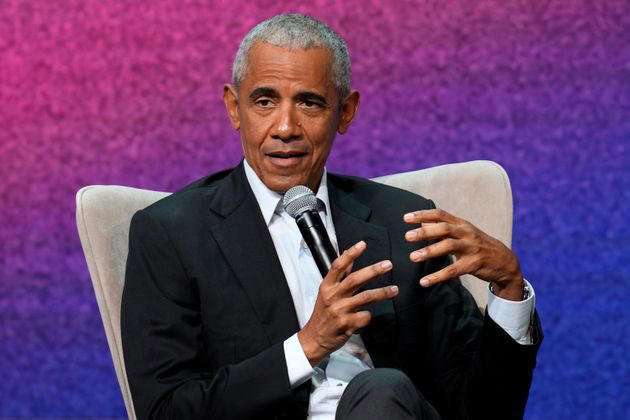
Barack Obama Just Said The Quiet Part Out Loud About The Titan Sub

Story by Kate Nicholson • Yesterday


Former US president Barack Obama spoke about the Titan sub this week in Athens, Greece.© Provided by HuffPost UKFormer US president Barack Obama spoke about the Titan sub this week in Athens, Greece.


Barack Obama hit the nail on the head when he spoke about the “untenable” way the Titan submersible tragedy received more attention than the recent deaths of hundreds of refugees near Greece.

The former US president was speaking during a conference held by the Stavros Niarchos Foundation in Athens on Thursday, when he discussed the struggles which asylum seekers face around the world.

Obama called for people to think about the “circumstances which lead desperate people to come here”.

He said: “We can’t ignore it.

“You think about what’s happening this week. There is a potential tragedy unfolding with the submarine that is getting, you know, minute-to-minute, coverage, all around the world.

“And you know it’s understandable, because we all want and pray that those folks are rescued.

“But the fact that that’s got so much more attention than 700 people who sank,” the crowd began to applaud at this, realising where Obama was going with his sentence.

He added: “That’s an untenable situation.”

He was referring to the fishing trawler which sank off the coast of Greece, with 700 asylum seekers on board on June 14.

The International Organisation for Migration called it “the worst sea tragedies in the last decade in Greece”.

However, it received just a fraction of the coverage the submarine crisis did. There were five people on the the tourist submersible, named the Titan, when it went missing while en route to see the Titanic shipwreck.

Regularly news alerts and live blogs were set up in an effort to track the search and rescue mission for the five passengers, stretching on between Sunday and Thursday.

Obama’s comments came hours before the US Coast Guard confirmed that the five people who were on board the Titan died in a “catastrophic implosion”.


In an exclusive interview with CNN, Obama repeated his sentiment – and, this time, emphasised how it reflects a larger problem with inequality.

He said: “Our democracy is not going to be healthy with the levels of inequality that we’ve seen, generated from globalisation, automation, the decline in unions, obscene inequality.”

He referenced the “news of the day” had focused on how “the submersible, that tragically is right now lost at the bottom of the sea.”

Obama continued: “At the same time, right here, in just off the coast of Greece, we had 700 people that – 700 migrants who were apparently being smuggled into here, and we’ve made news, but it’s not dominating in the same way.

“And in some ways, it’s indicative of the degree to which people’s life chances have grown so disparate.”

Related...