Saturday, June 24, 2023

Facebook and Instagram block news over payment to publishers law

Gareth Corfield
Fri, 23 June 2023

Facebook co-founder, Chairman and CEO Mark Zuckerberg

Facebook and Instagram have blocked news from being shared in Canada after a new law was passed forcing Big Tech companies to pay publishers for using their content.

Canada’s new Online News Act means social media and search giants such as Facebook parent Meta, Google, TikTok and others will have to pay publishers for reproducing news stories or snippets from them.


The law, which received royal assent on Thursday, is the latest move by countries which believe Big Tech’s near-monopoly on online advertising harms news publishers and starves the public of important information.

Justin Trudeau said earlier this month that Meta’s promised ban on news content being shared across Facebook and Instagram was “a real problem”.

Meta, the owner of Instagram and Facebook, said it would carry out a threatened ban on news stories being shared on its platforms, in response to the law’s passage.

Its Canadian press office issued a statement, saying: “We have repeatedly shared that in order to comply with Bill C-18, passed today in Parliament, content from news outlets, including news publishers and broadcasters, will no longer be available to people accessing our platforms in Canada.

Pablo Rodriguez, Canada’s heritage minister, said the new law “levels the playing field by putting the power of Big Tech in check and ensuring that even our smallest news business can benefit through this regime and receive fair compensation for their work”.

News publishers worldwide have long accused the likes of Google and Meta of unfairly profiting from their content by displaying it on their websites while keeping the lion’s share of advertising revenues to themselves.

Google recorded sales of $258bn (£202bn) during 2022, while Meta made revenues of $117bn over the same period.

Mr Trudeau, the Canadian Prime Minister, said earlier this month: “The fact that these internet giants would rather cut off Canadians’ access to local news than pay their fair share is a real problem”, predicting: “It’s not going to work.”

Australia passed similar laws in 2021 aimed at forcing Big Tech to negotiate fair compensation rates with local news publishers.

An initial ban on news sharing by Facebook in Australia crumbled after the Australian government made key concessions.

Ministers promised not to enforce a legal bargaining code if Facebook voluntarily signed content licensing deals with a large enough number of publishers.

Rod Sims, the architect of Australia’s News Media Bargaining Code, has said the resulting cash-for-content deals were worth more than A$200m (£105m) to the country’s A$2.5bn newspaper industry.
Independent blames Facebook for drop in audience numbers amid falling profits

James Warrington
Fri, 23 June 2023 

Lord Lebedev part-owns The Independent - JUSTIN TALLIS / AFP

The Independent has blamed changes to Facebook’s news feed for a drop in readership as it reported a sharp fall in profits.

The Left-leaning title, which is part-owned by Lord Lebedev, suffered a 6pc fall in global page views last year.

In its latest accounts, the Independent said Facebook’s decision last summer to de-prioritise posts from publishers had a “detrimental impact on article views”.

It also blamed the declining audience on a slower US news cycle after attracting more readers the previous year thanks to coverage of Donald Trump, the US election, the Capital riots and Black Lives Matter.

In the UK, monthly article views dropped by 4.4pc owing to declining interest in topics such as Covid, Brexit and Boris Johnson. This was partially offset by the Russia-Ukraine war, Queen Elizabeth II’s Jubilee and her death.

The Independent shut down its print edition in 2016 and shifted to an online and app-only model. Its pre-tax profits tumbled by two thirds from £5.5m to just £1.9m in the year to October 2022.

Bosses blamed this on higher investment in its international expansion, as well as its reporting and documentary production from Ukraine.

However, revenues rose 12pc to a record £46.3m, marking the sixth year of profitable growth since the newspaper went digital-only.

Despite the fall in page views, the digital title also hit the milestone of five million registered readers.

The Independent, which appointed former Daily Mail editor Geordie Greig as its editor-in-chief in January, is pursuing an aggressive international expansion plan, particularly in the US.

It is also looking to expand in areas such as TV, radio and e-commerce in an effort to diversify its revenues.

John Paton, chairman of Independent Digital News Media, said:

“We regard Facebook as an important distribution channel for our journalism, but we also see the importance on diversifying our revenue streams.

“This is the sixth consecutive year of profit, and we have achieved record revenue with 12pc growth as a result of our focus on investing deeper in the areas of international expansion, eCommerce and TV.”

The title has faced a tougher time since the end of its financial year as the digital advertising market went into decline.

While its editorial team in the US has expanded, the company cut around 30 roles in the UK at the end of last year.

The Independent was sold to the Lebedev family in 2010, initially owned by Russian billionaire Alexander Lebedev before ownership was transferred to his son, Lord Lebedev.

The newspaper has also faced scrutiny over its links to Saudi Arabia after it sold a 30pc stake to offshore companies fronted by a Saudi businessman in 2018.

Justin Byam Shaw, a British media entrepreneur, also holds a significant stake in the business, with the remainder made up by minor shareholders.
American TikTok user data stored in China, video app admits

Gareth Corfield
Fri, 23 June 2023 

TikTok China

TikTok has admitted that some of its US users’ data is stored in China, despite previously suggesting it was all on servers within America.

The Chinese-owned company, which is one of the world’s fastest-growing social media apps, admitted in a letter on Thursday that “certain creator data” is stored in China.

The revelation comes after intense public scrutiny of TikTok on both sides of the Atlantic amid national security fears over its ownership by China’s ByteDance.


TikTok said in a letter that it defined creators as users “who enter into a commercial relationship” with it such as influencers who make paid content for the video streaming app.

Those people’s contracts and “related documents” are held outside the US, the company said in a letter to two US senators.

Information on creators such as tax forms and social security numbers are stored in China, Forbes magazine reported on Thursday, citing internal sources.

A company spokesman said: “TikTok has not been asked for this data by the Chinese government or the [Chinese Communist Party]. TikTok has not provided such data to the Chinese government or CCP, nor would TikTok do so.”

Fears over Chinese government access to data have arisen because of the country’s national security laws, which allow any Chinese company to be forced to spy on its customers at the request of local authorities.

US senators Marsha Blackburn and Richard Blumenthal said in a statement: “We are extremely concerned that TikTok is storing Americans’ personal, private data within the reach of the Chinese government.

“TikTok’s response makes it crystal clear that Americans’ data is still exposed to Beijing’s draconian and pervasive spying regimes – despite the claims of TikTok’s misleading public relations campaign.”

Western governments fear that data gathered by TikTok from their citizens’ devices can be sifted through at will by Chinese agents looking for valuable targets to spy on.

Earlier this year, TikTok was banned from British government officials’ devices, with former Conservative Party leader Sir Iain Duncan Smith calling the app a “Chinese government data harvester”.

Similarly, foreign affairs committee chairman Alicia Kearns, who is subject to Chinese sanctions for speaking out about the country’s human rights abuses, has warned that TikTok could let Beijing “capitalise on our vulnerabilities”.

TikTok has repeatedly insisted it is not working with Beijing.

A lawsuit was launched by TikTok in May to stop the US state of Montana banning anyone from installing the app on their personal phones.

The unprecedented ban, which is currently set to come into force next year, breaches Americans’ rights to freedom of speech, according to TikTok’s legal filings. TikTok said recent bans were based on “misguided and based on fundamental misconceptions”.

Five influencers have also sued, saying Governor Greg Gianforte’s prohibition on TikTok is an unlawful “prior restraint on expression that violates the First Amendment” of the US constitution.
UK
Hunt to unveil pension reforms next month


Adam Mawardi
Fri, 23 June 2023

The Chancellor is expected to outline the highly anticipated pension reforms at the annual Mansion House speech in the City of London next month

Jeremy Hunt is poised to reveal broad plans to overhaul the UK’s pensions regime to unlock billions of pounds of investment into high growth British companies.

The Chancellor is expected to outline the highly anticipated pension reforms at the annual Mansion House speech in the City of London next month, the Financial Times reported.

The proposals include new rules to encourage UK pension schemes to invest in lucrative, but potentially riskier British assets, such as equities, early stage companies and infrastructure.

The announcement is also expected to contain proposals to consolidate the fragmented UK pensions regime, following the likes of Australia and Canada.


Mr Hunt is said to be “closely examining” calls from the Tony Blair Institute to merge thousands of defined benefit pension schemes to create super funds able to invest hundreds of billions.

The final version of his plans will be set out in his Autumn Statement later this year.

It comes as Mr Hunt faces mounting pressure to overhaul the pensions industry amid criticism over-cautious funds are costing retirees ­thousands of pounds by not taking enough risk.

The Chancellor also hopes that investment from Britain’s £4.6 trillion retirement industry will help accelerate economic growth as the country faces soaring inflation.

While his reforms are designed to give savers more choices over their investments, the Chancellor is not proposing to control what investments pension funds make.

The Treasury said: “We have the opportunity to boost returns for British pensioners by increasing investment in the UK’s highest growth sectors. This will also unlock billions for our most cutting-edge businesses and ensure they can access the finance they need to scale up and list in the UK.”
UK
STARMER'S LABOUR ARE RED TORIES
Starmer indicates he will not raise income tax for top earners


PA Political Staff
Fri, 23 June 2023

Sir Keir Starmer has said he wants “to lower taxes” as he indicated income tax for top earners will not be raised under a Labour government.

The Labour leader also vowed to keep Bank of England governor Andrew Bailey, who drew some criticism after a shock interest rate hike, in post until 2028.

The party has backed away from tax rises since Sir Keir pledged to increase income tax for the top 5% of earners during his 2020 leadership bid.


Asked about that promise, Sir Keir told the Telegraph: “Obviously, in principle, I want to lower taxes, so that’s the driving principle.

“As for the exact numbers, obviously we may have to wait until closer to the election. There are two, possibly three fiscal events until the next election, and we need to see what the [Office for National Statistics] numbers make of the financial situation.

“But in principle, I want lower taxation. We’re not looking to the lever of taxation, we’re looking to the lever of growth.”

Sir Keir has stated his ambition to secure the highest sustained growth in the G7 group of advanced economies if his party gains power at the next election, expected next year.

He also promised to respect the “really fundamental” independence of the Bank of England.

Bank of England governor Andrew Bailey started his term in 2020 (Jordan Pettitt/PA)

Asked whether he wanted to see Mr Bailey’s eight-year-term end early, he said: “No, no, no. We respect the independence.”

He also told the newspaper that a Labour government would “codify” in law the convention that MPs must approve military interventions, meaning all future military action would need to be approved in the House of Commons.

“Obviously there are going to be urgent situations where that might not be possible [and] I don’t know what we need, whether we need legislation is another matter. But the codification of the practice I think is important,” he said.

Meanwhile, the Labour leader was said to have had a brush with the law while selling ice-creams as part of a student summer holiday business venture that proved not to be legal.

Sir Keir, a former director of public prosecutions, had his “ice-creams confiscated” by police while touting for trade on beaches in the French Riviera during his university years, according to a friend.

John Murray, a university friend of Sir Keir, said the pair, along with other acquaintances, travelled to the south of France as students after seeing an advertisement claiming they could earn hundreds of pounds per day selling cold refreshments on the French Riviera.

Mr Murray told Politico’s Westminster Insider podcast their experience did not live up to the billing, spending their time “almost as beach bums” and making about “four francs a day” from their small business.

During their stay in the picturesque region, he said the friends discovered the trade was “not legal”, meaning they were forced to dodge French authorities while selling their cold wares.

Mr Murray said: “The place was overrun with other beach sellers, because they’d all been suckered into thinking they’d earn hundreds of pounds a day.

“Then we found out it was actually not legal, so we spent our time kind of avoiding being arrested.

“To be honest, I did get arrested. But all that happened was you had your ice creams confiscated, got a receipt, then had to walk back to the beach without your flip flops.”

When asked if Sir Keir had also been detained, Mr Murray said: “I can’t say… I think he probably had his ice-creams confiscated.”

A Labour spokeswoman said: “We are happy to make clear that no arrests were made, or even names taken, and that the only loss of liberty occurred to some cut-price ice-creams.”
Activists call on central banks to limit investments in new fossil fuel projects


Rebecca Speare-Cole, PA sustainability reporter
Fri, 23 June 2023 

Protesters are calling on central banks to limit the flow of money going into new fossil fuel projects.

Frontline activists and climate groups from around the world are staging a coordinated action in the lead up to the Bank of International Settlement’s (BIS) annual general meeting in Basel, Switzerland, on Sunday.

At least 400 protesters, including Greta Thunberg, are expected to march through the Swiss city on Saturday, ahead of the meeting which will be attended by Bank of England Governor Andrew Bailey.


Activists gather for the Peoples’ Forum for Climate Justice and Financial Regulation (Klima-Allianz Schweiz)


Meanwhile, artistic works will be on show in the city as a tribute to 20 environment defenders from around the world who have been killed over their work to protect nature, including British journalist Dom Phillips.

Tim Ratcliffe, 42, from Stoke-on-Trent – who has joined the action with the UK Climate Bailout protest group, told the PA news agency: “The broad message is ‘End fossil finance’.

“It’s within the responsibility of the central banks and financial regulation to ensure financial stability.

Activists gather for the Peoples’ Forum for Climate Justice and Financial Regulation (Klima-Allianz Schweiz)

“But there’s no financial stability in a world that’s suffering from climate emergency and climate breakdown.

“So we’re calling on them to stop the flows of finance to new fossil fuel projects and stop the expansion of the fossil fuel industry.”

Mr Ratcliffe said there is “not enough capacity or movement strength” to fight every new fossil fuel project.

“That is why it comes down to lobbying more systematically, looking at what levers can be pulled and what’s the role of the supervisors, the regulators, the central banks and the core institutions … in the financial sector,” he added.

Around 200 of the climate campaigners have also been gathering for plenary sessions and discussions in Basel this week as part the “Peoples’ Forum for Climate Justice and Financial Regulation”.

They include grassroots activists, policy workers in NGOs and community representatives who are resisting oil and gas projects on the ground in their home countries like Colombia, Argentina, Senegal and Mozambique.

Climate activists Fernanda Herrera, from Argentina, speaks at the Peoples’ Forum for Climate Justice and Financial Regulation (Klima-Allianz Schweiz)

Among them is Aryanne de Campo, 25, from the Centre for Energy, Ecology and Development in the Philippines, who is campaigning to protect the Verde Island Passage – a marine corridor in the country teeming with biodiversity.

It comes after a tanker carrying 800,000 litres of industrial oil capsized close to the strait earlier this year.

Fears of further spills and disruption to local fishing have been prompted by Shell’s plans to build a liquid natural gas import terminal in nearby Batangas City, which is being financed by HSBC, Barclays and Standard Chartered.

Ms de Campo told PA: “Communities have lived and flourished on the Verde Island Passage for centuries but the actions of oil and gas companies, and the banks that finance them, have undermined their livelihood, harmed their health and polluted the precious habitats that exist there.

Artists prepare works in tribute to environmental defenders who have been killed over their work (Klima-Allianz Schweiz)

“I am coming to Basel to tell the banks and the world that some things are too precious to be bought.”

A spokesperson for the BIS said representatives met with the People’s Forum for Climate Justice and Financial Regulation on Tuesday and acknowledged their concerns.

They said: “While direct policy action to address climate change is a matter for legislators and governments and the BIS has no direct role to influence climate change, its members are taking a range of actions within their mandates to mitigate financial stability risks and raise awareness of the need to manage the transition in an orderly way.”

They added that BIS decisions on setting standards have “no legal force but members are expected to implement them”, and that it works to “mitigate risks to the global banking system, including from climate change, to ensure financial stability”.
Expanding gay sex pardons to women won't help most prosecuted lesbians


Caroline Derry, Senior Lecturer in Law, The Open University
THE CONVERSATION
Fri, 23 June 2023 

Stephm2506/Shutterstock

More than a decade after launching a scheme to disregard and pardon convictions for historic “gay sex” offences, the government has now announced the scheme will apply to women. But a look at the history of lesbians and bisexual women convicted for same-sex activity shows that this will do very little to right historic wrongs.

When the scheme was created in 2012, it was limited to cautions and convictions for buggery (anal intercourse) or gross indecency between men. Neither offence applied to sex between women. Anyone convicted of other offences on the basis of same-sex activity could not obtain a pardon or disregard. A disregard means that the offence is deleted from official records and is not disclosed during criminal record checks. Since 2017, a pardon has automatically been granted at the same time.

The new scheme includes any offence which has been abolished or repealed, where the “criminal” conduct was same-sex sexual activity. However, it does not do much to help women, because sex between women has never been a specific offence. (The exception is armed forces veterans convicted under military laws, which were interpreted as prohibiting homosexual acts.)

Instead, prosecutors were inventive in their use of non-sexual offences, many of which remain in force today. I’ve detailed many of these cases in my book on lesbianism and criminal law.

Before same-sex marriage became legally recognised in 2013, some couples’ attempts to marry ended in court. They were charged with perjury, for making false statements to obtain a marriage certificate. A couple who attempted to marry in 1954 were convicted of this offence. The bridegroom was in fact a trans man, but the magistrates’ court considered the couple as lesbians and condemned their “unnatural passions”. Since perjury is still an offence today, they would not be entitled to a pardon.

Read more: Pardons for historic homosexual offences are welcome - but we still need to address the legacy of criminalisation

Less serious offences were rarely reported in the press, so there have probably been many more cases than we are aware of. In particular, minor displays of public same-sex affection have come before the courts as breaches of public order.

Breach of the peace has been used for centuries and as recently as 1980, a lesbian couple who kissed goodbye at a railway station were detained by police. They were later released without charge, but if they had been prosecuted, they would not be entitled to a pardon.

Breach of the peace has not been abolished, and is technically not a conviction since a person is not punished, but is “bound over to be of good behaviour” – meaning they agree to behave for a set period, and will be punished if they do not.

An alternative is conviction under public order offences, whose broad definitions have been used to criminalise same-sex affection. In 1986, two men were convicted of “nuisances in thoroughfares” under the Metropolitan Police Act 1839 after kissing at a bus stop. This has been partially repealed, but similar offences under the Public Order Act 1986 are still in force so pardons would not be available.

One sexual offence which was used to convict women has been repealed: indecent assault. The Sexual Offences Act 2003 replaced it with sexual assault offences. However, a woman would only be convicted of “indecent assault of a female” if the other person was under 16 or did not consent. Rightly, such behaviour remains criminal today.


Before 2004, lesbians’ attempts to marry often ended in court. 
Pressmaster/Shutterstock

This exclusion of women is not just an unfortunate oversight. It is part of a long history of silencing the possibility of sex between women as a way of repressing it. In other words, legislators did not just forget to make it a crime or decide to tolerate it. They were vehemently opposed to it, but feared that if women heard about it then their own wives and daughters might try it.

For example, in a 1921 debate on criminalising “gross indecency between females”, Lieutenant Colonel Moore Brabazon MP insisted that rather than execute or imprison lesbians (both “very satisfactory”), it was better “to leave them entirely alone, not notice them, not advertise them. That is the method that has been adopted in England for many hundred years.” Parliament has arguably continued “not noticing” women in the newly expanded disregard and pardon scheme.
A flawed scheme

The lack of consideration of women’s legal position is not the only problem with this scheme. Despite thousands of eligible convictions, there have been only 208 successful applications by men.

The strict eligibility criteria poses many barriers for applicants, and as a result, two out of three applications have been rejected. To benefit from the scheme, applicants must provide documents and share details of often traumatic events. A caseworker then considers the case records and makes a decision.

But establishing the circumstances of a conviction can be difficult decades after the original events. Records may be missing or incomplete. T

hey might omit details confirming that the activity would not be criminal today (for example, whether the other party was over 16 and consented). As the guidance to caseworkers makes clear, applications can be rejected because of that missing information.

Access to a disregard and pardon is important in practice since criminal convictions can blight people’s lives. It is important in principle because it acknowledges the injustice of convictions based upon legal discrimination.

However, the scheme does not adequately meet these needs – and for women in particular, the recent reforms will not change that.

This article is republished from The Conversation under a Creative Commons license. Read the original article.


The Conversation


The Observer
LGBTQ+ rights

Life inside the wild London club where lesbians were free to be themselves

A new documentary takes viewers back down the rickety stairs to the trailblazing Gateways in Chelsea


Beryl Reid (as Oliver Hardy) during the filming of The Killing of Sister George. 
Photograph: David Newell Smith/The Observer


Ginny Dougary
Sat 18 Jun 2022 
This article is 1 year old


The Gateways is back. The longest-running lesbian club of all-time – the one whose actual clientele appeared in the 1968 film The Killing of Sister George; the one where Mick Jagger tried to talk the owner into letting him crash in a frock; the one that was a sanctuary to every class and sort of woman, from well-known figures such as the writer Patricia Highsmith and the artist Maggi Hambling (then an art student) to swimming-pool attendants at the Tooting Bec lido – has been given a new lease of life in the first full-length documentary film to celebrate its history, and ensure that it is not erased.

Behind a dull green door on the corner of King’s Road and Bramerton Street in Chelsea, down some rickety steps to the basement lay the dive, a former strip club. The lease had been won in a bet at a broadcast boxing event at the Dorchester hotel by course bookie Ted Ware in 1943, and initially he offered it as a hang-out to a group of his lesbian pals who had been kicked out of their old Soho haunt the Bag O’ Nails pub after new owners took over and banned them.

Ted married an Italian actress, Gina Cerrato, in 1953 (they had a daughter, also named Gina, a year later) and the couple ran the club with Gina’s right-hand woman, Smithy, a former member of the US Air Force from California. They turned it into a women-only venue in 1967. After Ted’s death in 1979, Gina kept the club running but its last night was in 1985. She died in 2001.

I first met Gina Jnr (as she was never called) in Bristol in 1975 when she stood out as someone striking in a wide-striped black-and-gold form-fitting men’s suit with a Louise Brooks bob. Growing up, she says she had no idea of what sort of club her parents ran.

Family home life in the leafy mock-Tudor suburbia of Isleworth, West London, was unusual … but not to her. As well as her parents, Smithy had been invited to move in by Ted shortly after his daughter’s fourth birthday. He explained to Gina that it was in recognition of the kindness shown to him in New York as an illegal immigrant when he had been offered safe harbour by a black woman, and then a Jewish family.

There was no flamboyant atmosphere of bohemian chaos. The decor was monochrome: “My mother was never into chintz.” Bedtimes were strict; meals were served at the same hour every day; homework was not to be shirked; a neighbour would take her to church every Sunday. But Gina was aware that her family was more fun than her friends’ families, and if most of the people who visited were pairs of women friends, this seemed perfectly normal.

“When I went to other people’s houses I would find them extraordinarily suffocating and conventional. There’d be this ghastly father who was a boring old fart and a mother who was terribly uptight,” she recalls. “I was glad to go home to the laughter and fun. There was a lot more conversation, and I had a lot more access to my parents than my friends did to theirs. I could say what I wanted as well.”

Even as small children, she and her friends helped with jobs for the club: counting threepenny bits and sixpences from the till for the cigarette and fruit machines, and wiping down bottles of tonic water that were stored in the garage.
The Gateways around 1953.

She was 13 when she discovered for the first time about the club’s clientele and purpose. “It was Sunday lunchtime and my mother and I were washing up after lunch. She said: ‘I want to talk to you about something because you’re going to hear about this at school. You do know what the club is, don’t you?’ I said: ‘What do you mean?It’s a club,’ and she said: ‘It’s a lesbian club, Gina.’

“I said: ‘What?’ And she said: ‘Lesbians! You know, women with women.’ So I was, like: ‘Really? Really?’”

“I think I then said: ‘Does Dad know?’ And she said: ‘He started it! It’s his club!’”

Neatly, it was a story in this newspaper about The Killing of Sister George and the club that persuaded Gina’s mother to explain.

In her mother’s final three weeks, there were a few astonishing revelations. The two Ginas were watching television together when Mick Jagger appeared and Gina Snr asked for the remote to turn the volume up, saying: “Oh, it’s Mick – such a lovely boy.”

He lived in Cheyne Walk, and would pass by the Gateways to get to the King’s Road. “And my mum would be outside, taking deliveries, doing the laundry or whatever, and she said that he used to stop and talk quite often.

“And I was, like: ‘You mean, you knew Mick Jagger?’ And she said: ‘Oh yes, and he was always so kind and respectful. He wanted to come into the club but I wouldn’t let him. He said: ‘Gina, please let me – I’ll wear a dress’, and I said: ‘Darling, I can’t – it’s women-only.’”


There was always speculation about the relationship between her mother and Smithy. On her death bed, her daughter finally asked her about it. “I said: ‘People always ask me, Mum, and I hate to ask you but were you and Smithy lovers?’ And she said: ‘Everybody always assumed that Smithy was madly in love with me and that I was playing her along. But no we weren’t, and the reason for that was that Smithy didn’t want it.’

“That was my first inkling that my mother must have been bisexual.”

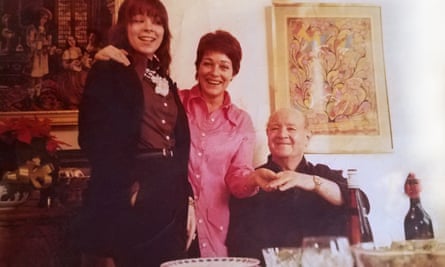
The two Ginas and Ted Ware in the 1970s.

Regardless of their lack of intimate relations, Smithy and Gina Snr loved each other deeply. As did Gina and Ted, who was 25 years older than his wife. “Despite their age difference, they had fun together, and there was an intellectual bond because they both had very fast, sharp minds and were clever, charismatic people.

“We lived as a family. Smithy and my mother were both with my father when he died – all holding hands and taking care of him.”

When the club closed, Gina was very sad but knew that she couldn’t take it over by herself. The documentary Gateways Grind is a way of restoring its history, which is enmeshed with her own, and to see her parents again.

It is presented by Sandi Toksvig, who recalls her own visits to the club, and has interviews with former members. It is sharp, snappy, sassy and sexy – oh, and of course, very sapphic, too. The Gateways Grind, we learn, was a particularly popular dance there where tightly meshed groin action became literally orgasmic.

Gina says she feels “immensely proud and impressed by the work and the commitment [behind the documentary] and still astonished by the interest and love that people have for the Gateways and how they remember it.


“Because we didn’t always have that. There was a time when we were out of favour because we weren’t ‘the right sort of lesbians’.” The club was subjected to demonstrations by the likes of the Gay Liberation Front who disapproved of the secrecy of the club, at a time when women could lose their children for being gay. The indomitable Gina Snr’s response was to call the police on them.

“Gateways wasn’t about being political. Being lesbian was its default position. People coming who were ‘terribly lesbian’ and ‘terribly activist’ were shocked by the fact they weren’t considered special,” says Gina.


Lesbian nightclub the Gateways is celebrated in new show


In January 2020, an application was made to English Heritage for a blue plaque next to what was the dull green door in Chelsea. It is supported by many prominent lesbians but the outcome is still pending.

Gina’s reaction? “It is very emotional for me in the sense that I loved all those people dearly. I know what they went through. It wasn’t all fun and games. There was a lot of sorrow, a lot of harshness, life was not a bed of roses for them.

“So, yes, it’s important to have that blue plaque because it’s a location that means an awful lot to people and something genuinely happened there.”

Gateways Grind will be on BBC4 on 21 June, and screened at the Barbican cinema on Sunday 3 July along with a ScreenTalk with director Jacquie Lawrence and actors Victoria Broom and Lu Corfield


TRAILER


CANADA
‘The books of a country reflect the health of a democracy’: Q&A with author Annahid Dashtgard


Hamid Jafari
Local Journalism Initiative
Fri, June 23, 2023

In her book ‘Bones of Belonging: Finding Wholesomeness in a White World’, author Annahid Dashtgard dives into the complex and multifaceted nature of belonging, racial justice, and the intricate messiness of human existence.

Dashtgard, an Iranian-Canadian woman who fled her homeland, Iran, after the 1979 Revolution, unravels the complexities and nuances of navigating multiple cultural and societal spheres. Her book, which features a collection of poignant essays, explores the impact of systemic inequities and calls for a collective effort to dismantle oppressive systems.


Her efforts for raising these discussions has not been limited to this book. With a master’s degree in education and an undergraduate degree in psychology, Annahid is also the CEO and co-founder of Anima Leadership — a Toronto-based diversity and inclusion consulting company. Her previous book, ‘Breaking the Ocean’, addresses the long-term impacts of immigration, discrimination and racial trauma.

“I’m using story as a way of making accessible the experience of racism,” Dashtgard said. “The books of a country reflect the health of a democracy, and there’s a big gap between the health of the democracy that a lot of people believe we have and what is really the case.”

New Canadian Media caught up with Dashtgard to learn more about her process and experiences.

Note: The following Q&A interview has been edited and condensed for clarity and brevity.

What motivated you to write “Bones of Belonging” and explore the experiences of racialized immigrant women in Canada?

Well, I wanted to write the book that I did not see growing up, and I think book worlds are how we make meaning of our lives and experiences. I always did [that] through reading books by white authors, which was OK, but it didn’t help me make sense of parts of my life. I wanted to write from a perspective that I think is missing. I jokingly sometimes say that it’s the Brown version of ‘Eat, Pray, Love,’ the book that became famous by Elizabeth Gilbert.

Canada is a multicultural country, and Canadians like to talk a lot about how we’re so multicultural and accepting of our differences, except when you go to your local bookstore or library. You look at the voices that are getting published, and they’re still mostly by white people born in Canada. I think that’s a problem because our stories are reflective of who is visible in a nation, and who is visible means who’s opinion or who’s realities we take into account when we make decisions and pass laws and policies.

The books of a country reflect the health of a democracy, and there’s a big gap between the health of the democracy that a lot of people believe we have and what is really the case. So, I think it’s essential we have more stories reflective of the realities of many communities in Canada that are still not being represented.

How did your personal experiences shape the content and direction of the book?

When I moved to Canada as a child, I was nine. I grew up with the myth that everything that was available to white Canadians born in Canada would be available to me, and that certainly wasn’t true. But I believed it because I had to, and there was always a struggle between what I believed and what was true.

I grew up thinking that I must be the problem and, as a lot of immigrants do, work[ed] harder and harder trying to simulate and change aspects of who I was, like my physical body. I’m proud to say I’m one of the few Persian women I know that did not have a nose job, which I’m so glad about as an adult. But I think it’s one of the things that, especially a lot of Persian women do because they think if they do, it’ll make them more acceptable and attractive.

I’m conscious of the code-switching thing of going into white environments where I lower my voice. I’m more polite, and I’m not as opinionated. I dropped a number of those things as an adult, but I can still feel the pressure of them.

It wasn’t until adulthood where I started to realize it’s not about me being the problem. The problem is that we still have a single version of what it means to be Canadian, a single version of what it means to be successful. The version of those stories is still written from the perspective of a white male, upper-class person. It has taken a lot of work throughout my adult life, from age 21 to now that I’m 50, to unlearn what I learned… from the perspective of feminism, anti-racism, and anti-oppression and to understand there are other stories. The impact of that story has harmed me, and I have harmed myself because I’ve been trying to live up to that. That unlearning has been the fuel to write my own story and stories.

A lot of the stories in this book are really about what it means to exist in the in-between. I exist in the in-between of being born in a foreign country but also being Canadian in so many ways. I’m Persian by birth but my father is Persian and my mother is British so there’s also cultural in-between. There is the reality of exile but also feeling home.

How can storytelling provide insight into the challenges of belonging in a society grappling with issues of race and whiteness?

Stories are the universal access point. As humans, our brains are wired to understand the world through stories in a way that statistics and facts and research do not provide. I see this every day in my work as a consultant and educator, teaching people about inclusion and anti-racism. I can go through a PowerPoint and go on and on about facts and the most up-to-date statistics, and I see people’s eyes start to glaze.

I tell one story from my own life or from what I’ve witnessed or experienced or seen in my work, and I watch people’s eyes light up, and the story reaches way deeper than anything else I might say in a two-hour session. It’s also how I learn, I can remember what happened in the book ten years later, whereas I barely remember what I learned in that webinar that I went through 10 years ago. It’s what sticks!

We’re in a time when this conversation about difference, especially racial difference, has become so polarized, and I think that’s a real problem. [It] is the first step towards increasing violence, and that’s what’s happening: verbal violence in the workplace, people stonewalling, passive-aggressively ignoring, and being violent to each other. Most folks living their lives are not going to pick up an academic book on anti-racism and educate themselves… but I think they will pick up a book like “Bones of Belonging.”

I’ve had a lot of feedback on this book already by people going, “I picked this book up, and it was really relatable.” So, I wrote a book that I hope is accessible, and I hope it acts as a bridge.

How do you envision the book impacting its readers, particularly those who may have had similar experiences or identities?

Oh, I love that question because the one thing I wanted more than anything else is for people to go, “I’m so glad you wrote this because I see myself in these stories.” There’s been a lot of messages like that. We people in these identities who are non-white, who are immigrants, who share identities that I talk about, have a hunger to be visible and see ourselves represented in the stories.

I’m just one voice. I think we need many more, and they’re starting to come, but it’s a very slow trickle. I think there’s a real hunger for people to see themselves represented, and that was my biggest hope and the biggest reception, which I’m grateful for.

Were there any challenges you faced while writing the book? How did you overcome them?

I see the biggest challenges at the beginning. I had an agent and I had feedback that the book didn’t fit neatly into one genre. The feedback I got was [that] it’s sort of a blend of nonfiction and also political analysis. I understood that the elements of race and immigration that I talked about are termed political. But for people that are in these identities, this is “everyday life.” What we term political is very much dependent on who is calling that out.

So I had to do a lot of fighting and advocating and educating in the early stages for why this book is needed, who it would reach, and why it’s important. I ended up firing my agent. I chose one of the few publishers that is a black man. When I reached out to him, he immediately sent me an email within five minutes saying [he would] publish this without even reading the whole thing because [he] had read my first book and said [he knew] that this will be important. His name is Kwame Scott Fraser, and he’s an amazing guy that’s done a lot at Dundurn Press in Toronto.

Could you elaborate on the term “Bones of Belonging” and its significance within the context of the book?

I would say that the truest stories are the ones that live in the bone, and when we speak those stories, they resonate. That’s the version that other people relate to and resonate with because they can feel its truth, but it’s the hardest one to dig for.

In one of the stories in the book, I talk about my own experience of making an assumption.I really wanted to expose different elements of what felt true. People can start to excavate their own skeletons.

The structure of the book came very early on, and I envisioned it as a human skeleton-like body. The larger essays are bigger bones in the body that form the bigger skeleton, and then the little in-between vignettes are like the smaller bones. I envision the book in a way that you could just read one limb, or you could read the whole thing and put it all together.

Have there been any surprising or particularly impactful reactions to the book?

We’re not at a time where a book like this is going to get a major plunk of money by Penguin Random House because it’s too “political.” It’s gone out for a Goodreads campaign and has been sent out to a group of influencers in the US, and the response has been wonderful.

What has surprised me is having conversations with people in the literary world, like festival organizers and independent booksellers, who I don’t think have a lot of vision, they tend to just go with the flow, and I’ve been surprised that a number of them have not heard of the book. That seems quite lazy and disappointing to me. In the Canadian publishing world, there’s a lot of talk about diversity, but I don’t think there’s as much action happening, and that’s been disappointing but not surprising. I’m now on the board of the Writers Union of Canada — I just joined — so I am going to put my efforts [into] what I’m talking about.

I was really proud of what the book became. It was listed on a Canadian bestseller list in its first week, and there’s been pieces published in Shadow Lane and the Walrus magazine and CBC books. So that has been wonderful. The disappointing element is when I walk into my local bookstore and they don’t have any copies available and I have to think, ‘What does it take, then, for a book to get noticed by you?’

Hamid Jafari, Local Journalism Initiative Reporter, New Canadian Media
UK
Glastonbury couple seal marriage during intimate handfasting ceremony


Sarah Ping
Fri, 23 June 2023 a

Stuart Beauchamp and Anna Stevens took part in a handfasting ceremony at Glastonbury to ‘seal their marriage’ (Tom Leese/PA) (Tom Leese/PA)

A couple from Birmingham, who have been to every Glastonbury for the last nine years and met through music, say they have “finally sealed our marriage” in a hand-tying ceremony at the festival, calling it the “icing on the cake” to their marriage.

Stuart Beauchamp, 49, a finance director, and his wife, Anna Stevens, 44, have been married for four weeks but decided to seal their marriage at a handfasting ceremony, which is an ancient practice that sees couples tie their wrists together with cloth to declare their commitment to each other.

The couple, who have known each other for more than 25 years, said they felt “blessed” to be able to “put our own stamp” on their married life together.

“It was really good. I didn’t know what to expect, but it was amazing,” Ms Stevens told the PA news agency.

Mr Beauchamp added: “It’s sealed our marriage because we’ve only been married for four weeks, so this is officially our honeymoon. It was a great opportunity to do something different and just make us put our own stamp on it.”

Ms Stevens said she felt “quite emotional” after the ceremony.

“We’ve been together for nearly 25 years and we try and come to Glastonbury every year, so this is the icing on the cake,” she said.

The couple, who first met in a Birmingham nightclub in 1998 for the memorial night for DJ Tony De Vit, who died in the same year, have attended the world-famous festival every year over the last decade, which they dub “the best festival of all time”.

“It’s a place to be free and just do what you want… no-one bats an eyelid,” Mr Beauchamp said.

The pair carried out the ceremony in style, fitted in clothing suited for the Day of the Dead festival held in Mexico every year to remember loved ones who have passed away.

Mr Beauchamp was dressed in a black suit with white details, an oversized bowtie and a large, black sombrero, while Ms Stevens donned a black corset with a red skirt, a flower headpiece and a black veil.

“We dressed as Day of the Dead a couple of years back at Glastonbury so we thought it (would) be fitting to do bride and groom Day of the Dead,” Mr Beauchamp said.

The couple were advised by the celebrant to keep the cloth tied around their wrists for as long as possible, but when asked how long they might wear it, Mr Beauchamp joked: “Until she needs a wee.”

The celebrant, Glenda Procter from the Forest of Dean, Gloucestershire, has been doing handfasting at Glastonbury for more than a decade to offer a personalised and “very intimate” ceremony for couples.

“I think couples truly experience something very intimate, and very personal. And for them this ceremony is all about love,” the 71-year-old told PA.

“Having a hand tie, for many couples, that’s all they need because, actually, nobody can marry them except themselves.

“I say in the ceremony when they sit here that the union is made in their hearts and it’s a union of body, mind and soul.”

Ms Procter began handfasting after becoming a marriage registrar and felt there was “something lacking in a registration ceremony”.

Now, she hosts proposals, ceremonies and creates a space for couples to declare their commitment where many become overwhelmed with emotions.

“All sorts of things happen at Glastonbury and it’s a very special place for couples,” she said.

“My first ceremony here was a couple that had been married five days, so for them, this was what meant the most to them.”

Ms Procter also spoke of a “remarkable” and intimate ceremony between a couple in their 70s who completed their handfasting ceremony with “no guests, no witnesses, just the two of them”.

“They said their vows and their pledges and for them that was all they needed to have that surety that they would not be abandoned, that they were together forever,” she said.
Russia is 'training combat dolphins' in Crimea: UK


AFP
Fri, 23 June 2023 

The Soviet Union previously used dolphins in the military (Vyacheslav Oseledko)

British military spies on Friday said Russia appears to be training combat dolphins in the annexed Crimean peninsula to counter Ukrainian forces.

In its latest update on the conflict, UK Defence Intelligence said the Russian Navy had invested heavily in security at the Black Sea Fleet's main base at Sevastopol since last year.

"This includes at least four layers of nets and booms across the harbour entrance. In recent weeks, these defences have highly likely also been augmented by an increased number of trained marine mammals," it added.

"Imagery shows a near doubling of floating mammal pens in the harbour which highly likely contain bottle-nosed dolphins."

The animals were "likely intended to counter enemy divers", it added.

The Russian Navy has used Beluga whales and seals for a range of missions in Arctic waters, the update said.

A harness-wearing whale that turned up in Norway in 2019, sparking speculation it was being used for surveillance, reappeared off Sweden's coast last month.

Norwegians nicknamed it "Hvaldimir" -- a pun on the word "whale" in Norwegian (hval) and a nod to its alleged association with Russia.

Hvaldimir's harness had a mount suitable for housing an action camera, and the words "Equipment St. Petersburg" printed on the plastic clasps.

In 2016, Russia's defence ministry sought to buy five dolphins as part of attempts to revive its Soviet-era use of the highly intelligent cetaceans for military tasks.

Both the Soviet Union and the United States used dolphins during the Cold War, training them to detect submarines, mines and spot suspicious objects or individuals near harbours and ships.

A retired Soviet colonel told AFP at the time that Moscow even trained dolphins to plant explosive devices on enemy vessels.

They knew how to detect abandoned torpedoes and sunken ships in the Black Sea, said Viktor Baranets, who witnessed military dolphin training in the Soviet and post-Soviet eras.

The US Navy used sea lions deployed to Bahrain in 2003 to support Operation Enduring Freedom after the 9/11 attacks in New York and Washington.

phz/jit/ach