Wednesday, July 26, 2023

Opinion
70 years have passed since Korean cease-fire. It's time to end American's longest war.


Christine Ahn
Mon, July 24, 202

As a daughter of South Korean immigrants, I was raised to be apolitical.

My parents, like many of their generation who lived through Japanese occupation and the devastating Korean War, came to the conclusion that in order to survive, it was best to stay silent. As a result, I knew almost nothing about my birth country or the forces that shaped it.

It wasn’t until graduate school at Georgetown University in Washington, D.C.,that I started learning about the Korean Peninsula and the U.S. legacy in the region. I was stunned to learn that the United States proposed (and the Soviet Union agreed) to divide the peninsula at the end of World War II – circumstances that led to war between North Korea (backed by China) and South Korea (supported by the United States and the United Nations), leading to the Korean War.

Though an armistice halted active fighting in 1953, a peace agreement was never signed. This state of unended war – which marks 70 years on July 27 – has irrevocably shaped not only the lives of those living on the Korean Peninsula but all of us in the United States.


Christine Ahn, the future founder of Women Cross DMZ, with her father, Suk Kyun Ahn, in Seoul, South Korea, in 1974.

It's time to sign a peace agreement with North Korea

After decades of failed U.S. policy, the only pathway to resolve the impasse is for the United States to sign a peace agreement with North Korea. An accord would reduce the risk of renewed conflict between North Korea and the United States and build trust in order to better negotiate on North Korea’s nuclear weapons program.

The threat is real: Our nuclear weapons are much more powerful than Oppenheimer's atomic bomb

Women, in particular, have a crucial role to play in building lasting peace. Not only is there a rich history of women organizing for peace in Korea, but research shows that the involvement of women in peace processes leads to better outcomes.

Yet thus far, few women have been involved in the Korea peace process.

In 2015, Women Cross DMZ crossed the Demilitarized Zone from South Korea to North Korea. In front from left, Vana Kim, Una Kim, feminist icon Gloria Steinem, group leader Christine Ahn, Hyun-Kyung Chung, Nobel Peace laureates Leymah Gbowee and Mairead Maguire, and Medea Benjamin.

That’s why in 2015 I organized a women’s peace walk from North Korea to South Korea – across the Demilitarized Zone – with American feminist icon Gloria Steinem and Nobel Peace laureates Leymah Gbowee and Mairead Maguire. We walked with thousands of Korean women on both sides of the DMZ to show that women are united in their desire for peace in Korea. We continue to advocate for ending the Korean War, reuniting Korean families and including women in the peace process.

Our journey is documented in the film "Crossings," which is now airing on public television.
The 'Forgotten War' is America's longest-running war

While much public attention is paid to North Korea’s nuclear weapons development, we rarely consider how the continued U.S. military presence on the Korean Peninsula helps fuel tensions: 28,500 U.S. troops are stationed in South Korea, and the United States and South Korea routinely hold joint military exercises to rehearse war with North Korea.

The United States also maintains operational control of South Korea’s military during wartime.

North Korea routinely cites this context as justification for its nuclear weapons program – key to self-defense against a potential attack from the United States.

Ukraine shouldn't use cluster bombs: Biden is wrong to send cluster bombs to Ukraine. 50 years later, they're still killing in Laos.

Because the United States and North Korea have never replaced the armistice with a peace agreement, any accidental or intentional escalation could rapidly devolve into renewed fighting. Such a war could involve nuclear weapons, which would likely result in the deaths of millions.

Yet pointing out these facts has led me to be labeled naive at best and, at worst, a North Korean apologist.


Christine Ahn celebrates her graduate school commencement ceremony at Georgetown University in 2001 with her mother, Byong Ok Ahn.

Thankfully, more and more people are now speaking out in favor of peace with North Korea. Many of them are Korean Americans who come from divided families and long to return to their hometowns. Some, like me, have considered the human costs of this war and can remain silent no longer.

Other supporters include Harvard neurosurgeon Dr. Kee Park, who has witnessed the impact of sanctions on health care in North Korea; Dan Leaf, a retired U.S. Air Force lieutenant general who believes that the risk of nuclear war is highest in Korea; and Siegfried Hecker, a nuclear scientist who emphasizes the need for peace as a foundation for denuclearization.

Opinion alerts: Get columns from your favorite columnists + expert analysis on top issues, delivered straight to your device through the USA TODAY app. Don't have the app? Download it for free from your app store.

The risks and costs of the Korean War might be hidden from view, but Americans and Koreans alike can only gain from finally resolving America’s longest standing war.

Christine Ahn is the founder and executive director of Women Cross DMZ, an organization of women mobilizing for peace in Korea.

There is a path forward, should our lawmakers be brave enough to take it. Passing the Peace on the Korean Peninsula Act, which calls for diplomacy in pursuit of a binding peace agreement to formally end the war, would go a long way toward resuscitating this issue from the murky depths of history.

While the Korean War is often referred to as America’s “Forgotten War,” Koreans and Korean Americans have not forgotten. Americans of every background must come together to demand an end to our nation’s longest-running war.

Christine Ahn is the founder and executive director of Women Cross DMZ, an organization of women mobilizing for peace in Korea.

You can read diverse opinions from our Board of Contributors and other writers on the Opinion front page, on Twitter @usatodayopinion and in our daily Opinion newsletter. To respond to a column, submit a comment to letters@usatoday.com.

This article originally appeared on USA TODAY: Korean Armistice Agreement isn't enough. Let's end our 'Forgotten War'
Texas is using disaster declarations to install buoys and razor wire on the US-Mexico border


2/ 20
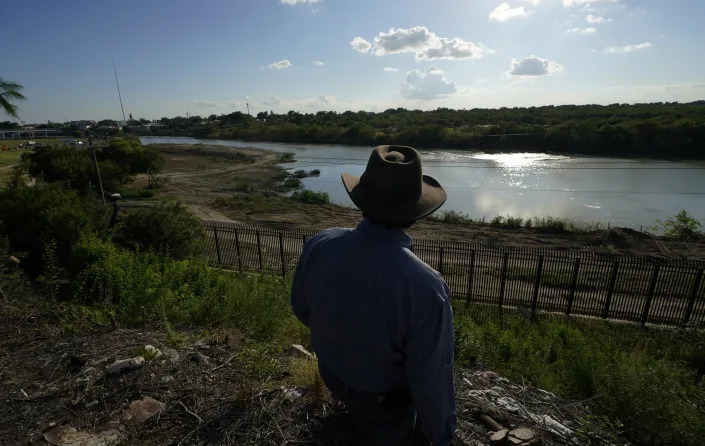
Kayak outfitter Jessie Fuentes stands above the Rio Grande in Eagle Pass , Texas, Thursday, July 6, 2023, where concertina wire lines the banks of the river that has been recently bulldozed. Texas Republican Gov. Greg Abbott has escalated measures to keep migrants from entering the U.S. He's pushing legal boundaries along the border with Mexico to install razor wire, deploy massive buoys on the Rio Grande and bulldozing border islands in the river. (AP Photo/Eric Gay)

VALERIE GONZALEZ and ACACIA CORONADO
Sun, July 23, 2023 

EAGLE PASS, Texas (AP) — Wrecking ball-sized buoys on the Rio Grande. Razor wire strung across private property without permission. Bulldozers changing the very terrain of America's southern border.

For more than two years, Texas Republican Gov. Greg Abbott has escalated measures to keep migrants from entering the U.S., pushing legal boundaries with a go-it-alone bravado along the state's 1,200-mile (1,930-kilometer) border with Mexico. Now blowback over the tactics is widening, including from within Texas.

A state trooper's account of officers denying migrants water in 100-degree Fahrenheit (37.7 Celsius) temperatures and razor wire leaving asylum-seekers bloodied has prompted renewed criticism. The Mexican government, the Biden administration and some residents are pushing back.

Abbott, who cruised to a third term in November while promising tougher border crackdowns, has used disaster declarations as the legal bedrock for some measures.

Critics call that a warped view.


“There are so many ways that what Texas is doing right now is just flagrantly illegal,” said David Donatti, an attorney for the Texas American Civil Liberties Union.

Abbott did not respond to requests for comment. He has repeatedly attacked President Joe Biden's border policies, tweeting Friday that they "encourage migrants to risk their lives crossing illegally through the Rio Grande, instead of safely and legally over a bridge.”

The Biden administration said illegal border crossings have declined significantly since new immigration rules took effect in May.

ALTERED BORDER

Under the international bridge connecting Eagle Pass, Texas, with Piedras Negras, Mexico, protesters gathered at Shelby Park this month, chanting “save the river" and blowing a conch shell in a ceremony. A few yards away, crews unloaded neon-orange buoys from trailers parked by a boat ramp off the Rio Grande.

Jessie Fuentes stood with the environmental advocates, watching as state troopers restricted access to the water where he holds an annual kayak race. Shipping containers and layers of concertina wire lined the riverbank.

The experienced kayaker often took clients and race participants into the water through a shallow channel formed by a border island covered in verdant brush. That has been replaced by a bulldozed stretch of barren land connected to the mainland and fortified with razor wire.

“The river is a federally protected river by so many federal agencies, and I just don’t know how it happened,” Fuentes told the Eagle Pass City Council the night before.

Neither did the city council.

“I feel like the state government has kind of bypassed local government in a lot of different ways. And so I felt powerless at times,” council member Elias Diaz told The Associated Press.

The International Boundary of Water Commission says it was not notified when Texas modified several islands or deployed the massive buoys to create a barrier covering 1,000 feet (305 meters) of the middle of the Rio Grande, with anchors in the riverbed.

The Justice Department has warned Texas that the buoy wall is unlawful and the Biden administration will sue if the state doesn't remove the wall. Abbott tweeted Friday that the state “has the sovereign authority to defend our border."

The floating barrier also provoked tension with Mexico, which says it violates treaties. Mexico's secretary of foreign relations asked the U.S. government to remove the buoys and razor wire in a June letter.

Fuentes sued over the buoys, arguing that border crossings are not covered by the Texas Disaster Act.

As for the river islands, the Texas General Land Office gave the state Department of Public Safety access starting in April “to curb the ongoing border crisis."

“Additionally, the General Land Office will also permit vegetation management, provided compliance with all applicable state and federal regulations is upheld,” said a letter from the office's commissioner, Dawn Buckingham.

The Texas Military Department cleared out carrizo cane, which Buckingham's office called an “invasive plant” in its response to questions from the AP, and changed the landscape, affecting the river's flow.

Environmental experts are concerned.

“As far as I know, if there’s flooding in the river, it’s much more severe in Piedras Negras than it is in Eagle Pass because that’s the lower side of the river. And so next time the river really gets up, it’s going to push a lot of water over on the Mexican side, it looks like to me,” said Tom Vaughan, a retired professor and co-founder of the Rio Grande International Study Center.

Fuentes recently sought special permission from the city and DPS to navigate through his familiar kayaking route.

“Since they rerouted the water on the island, the water is flowing differently,” Fuentes said. “I can feel it.”

The state declined to release any records that might detail the environmental impacts of the buoys or changes to the landscape.

Victor Escalon, a DPS regional director overseeing Del Rio down to Brownsville, pointed to the governor's emergency disaster declaration. “We do everything we can to prevent crime, period. And that’s the job,” he added.


Workers assemble large buoys to be used as a border barrier along the banks of the Rio Grande in Eagle Pass, Texas, Tuesday, July 11, 2023. Texas Republican Gov. Greg Abbott has escalated measures to keep migrants from entering the U.S. He's pushing legal boundaries along the border with Mexico to install razor wire, deploy massive buoys on the Rio Grande and bulldozing border islands in the river. 
(AP Photo/Eric Gay)


TRESPASSING TO STOP TRESPASSERS


For one property owner, the DPS mission cut him out of his land.

In 2021, as Eagle Pass became the preferred route by migrants crossing into the U.S., Magali and Hugo Urbina bought a pecan orchard by the river that they called Heavenly Farms.

Hugo Urbina worked with DPS when the agency built a fence on his property and arrested migrants for trespassing. But the relationship turned acrimonious a year later after DPS asked to put up concertina wire on riverfront property that the Urbinas were leasing to the U.S. Border Patrol to process immigrants.

Hugo Urbina wanted DPS to sign a lease releasing him from liability if the wire caused injuries. DPS declined but still installed concertina wire, moved vehicles onto the property and shut the Urbinas' gates. That cut off the Border Patrol's access to the river, though it still leases land from Urbina.

“They do whatever it is that they want,” Urbina said this month.

The farmer, a Republican, calls it “poison politics.” Critics call it déjà vu.

“I also really see a very strong correlation to the Trump and post-Trump era in which most of the Trump administration’s immigration policy was aggressive and extreme and very violative of people’s rights, and very focused on making the political point,” said Aron Thorn, an attorney with the Texas Civil Rights Project.

“The design of this is the optics and the amount of things that they sacrifice for those optics now is quite extraordinary,” Thorn said.

DPS works with 300 landowners, according to Escalon. He said it is unusual for the department to take over a property without the landowner’s consent, but the agency says the Disaster Act provides the authority.

Urbina said he supports the governor’s efforts, “but not in this way."

"You don’t go out there and start breaking the law and start making your citizens feel like they’re second-hand citizens,” he added.
Jade McGlynn: Russians cannot perpetuate their myth of Russia if they lose control over Ukraine


CIUS
Sun, July 23, 2023 

Editor's Note: The Kyiv Independent is exclusively re-publishing an interview with Yuliya Kovaliv prepared by Forum for Ukrainian Studies, a research publication for experts, practitioners, and academics. This platform is run by the Canadian Institute of Ukrainian Studies (CIUS) of the University of Alberta (Edmonton, Canada).

Jade McGlynn is a Leverhulme EC Researcher in the War Studies department at King’s College London.

CIUS: Your book is titled Russia’s War — not Putin’s War, as many frame it in the West. You examine the role of ordinary Russians in the aggression against Ukraine. What is the main message you are trying to convey in your book by exploring this dimension?

Jade McGlynn: I would like to emphasize two points when answering this question. One is that the aggression against Ukraine is not Putin’s venture only. And if we—we being the West—believe that the catastrophic genocidal war will be easily solved if we get rid of one person, then we are going to fall victim to misconceptions and design wrong policies. The second point is that we need to understand what kind of war the Russians are watching; we need to look at the propaganda. I do not like the argument that people back the war because they are zombified. It does not make any sense. There are 60 million daily users of Telegram [social media] who have access to all forms of channels, including oppositional, and yet of the top 30 political channels an overwhelming majority of 24 are very pro-war.


In my book I wanted to make the argument that the Kremlin’s propaganda functions not only because it has a platform. Of course the situation in the media is rigged, to put it mildly, in favour of advocating the war effort, but such narratives also need resonance. Above all, the narratives are about meaning-making. They need to make sense and resonate with how people view their lives, the world, themselves as Russians, Russia’s history, Russia’s international role, and, of course, Ukraine and the West. And that is why the propaganda works.

CIUS: You write about Russia’s liberal opposition and the reaction of some of its representatives to the aggression. What are your main conclusions about their stance on Russia’s war against Ukraine?

McGlynn: One of the first things to say is that typifying the Russian liberal opposition is a difficult task because they are really incoherent. There is, for example, the feminist anti-war resistance, who I think are incredible. The work they do is incredible. They seem to “get” the calamity behind the war, to put it bluntly. But others—in particular, certain members of the Alexei Navalny team—are less supportive. They remove Ukraine from the narrative almost entirely. That was something else that came out of my research.

If you look for references to Ukraine on the Navalny Telegram channel there were very few, much less than is the average for other Russian Telegram channels, during the first three months of the invasion. They removed Ukraine from communication or tried to insert themselves into the war.

In March 2022 there was a moment when the opposition used the negotiations around Ukraine to try to ask Western governments to include releasing Navalny from prison as one of the Kremlin’s concessions. As much as I would like to see him released—someone who should have not been imprisoned in the first place—Navalny’s case cannot be inserted into such discussions on Ukraine.

Such actions by some of the Russian democratic opposition replicates the Kremlin’s denial of Ukrainian agency, demonstrating Ukrainophobia, solipsism, and a kind of self-obsession. They invariably present themselves as friends of Ukraine but that isn’t always the case. Moreover, it is incredibly offensive to see some aggressively rejecting criticism from Ukrainians using arguments like “Oh, well, you must be Putin bots, because you are fighting us and we are anti-Putin.” But Ukrainians are literally fighting.

Having said all that, I do not want to condemn the Russian opposition. They are not a monolith and many have made incredible sacrifices to undermine Putin’s regime. I do not think I would have the bravery to protest in Putin’s Russia. I would not also have a smidgen of the bravery that Ukrainians have shown. This is more about some of the Russian opposition getting a sense of perspective. Their struggles—as awful as they may be—are not comparable to the struggles that Ukrainians are enduring.

CIUS: You have been following Russia’s media narratives about Ukraine since the beginning of the full-scale invasion. Is it true that the media outlets outside the capital are practically silent about the war? How can you explain this?

McGlynn: The relative silence of the regional media about the war is not really my finding. I have mostly looked at the federal broadcast channels and Telegram. The regional media is something that Paul Goode at Carleton University examined. And what he found was that the war—obviously, they call it a “special military operation”—did not come up very much in the local news; they obviously tried to avoid it.

I just finished a small research project, looking at what media and news outlets wrote about and what kind of information Russians consume from television. I have observed—and it is very interesting—that since October 2022 a major shift has happened from political discussion programs to a variety of series [serialy] and films. I have observed a lot of escapism on the television, but news and real-time events are no longer in the focus.

I think that the war has not gone how the Russians wanted it to. Clearly, there is an awful lot of cognitive dissonance about the fact that the Ukrainians did not meet the Russians as liberators, to put it mildly. There also seems to be a large element of avoidance. Because if you have to start facing questions about the poor progress of the invasion in Ukraine, you need then to find the answers to why. And to be fair, for the majority of ordinary Russians there is not really any benefit in facing those questions. They would have to do something with that information afterwards. Finding answers and accepting them are not pleasant prospects for Russians.

Read the rest of the interview here.
CONSTITUTIONAL TYRANNY
Assimi Goïta: President gets sweeping powers in new Mali constitution

BBC
Sun, July 23, 2023

Col Assimi Goïta now has the power to dictate government policy and dissolve parliament

The military government in Mali has adopted a new constitution that enhances the powers of the president and the armed forces.

It also creates a senate and demotes French from an official to a working language.

Mali has been ruled by a junta since 2020.

The opposition movement has denounced the reforms, which the electoral commission says were backed by 97% of votes cast in last month's referendum.

The official body said turnout was 38%.


Critics fear these changes make it easier for generals to break their promise of handing power back to civilian leaders after a presidential election in February 2024.

The new constitution means Interim President Col Assimi Goïta can now dictate government policy and has the power to dissolve parliament.

A legal case to have the referendum results annulled, because the vote was not held in all parts of Mali, was rejected by the constitutional court.

"Numerous irregularities" and "violations of the law" also meant the referendum result should be thrown out, according to Mali's opposition movement - made up of political parties and civil society organisations.

It has been labelled "a plot on democracy" by Ismaël Sacko - the leader of the Social Democratic Party which was last month dissolved by the junta. He told Mali's judiciary "to get its act together", AFP reports.

There was huge popular support for the military junta when it seized power after mass protests against then-President Ibrahim Boubacar Keïta three years ago. People were fed up with economic uncertainty, a disputed election and chronic insecurity.

Since then, data suggests Mali's military government has made little progress in its fightback against Islamists who control parts of the country.

But the government says the new constitution will stop the spread of the 11-year jihadist insurgency.

Mali recently decided to kick out all 12,000 UN peacekeepers in the country and is thought to employ 1,000 Russian mercenaries from the Wagner group for security back-up.

France's soldiers were ordered to leave last year and there has been rising resentment of the former colonial power and its present-day relationship with Mali, and West Africa more broadly.
CRIMINAL CAPITALI$M
Top Arkansas psychiatrist accused of falsely imprisoning patients and Medicaid fraud
FOR PROFIT MEDICINE


Laura Strickler and Stephanie Gosk
Updated Sun, July 23, 2023 at 6:34 PM MDT·9 min read

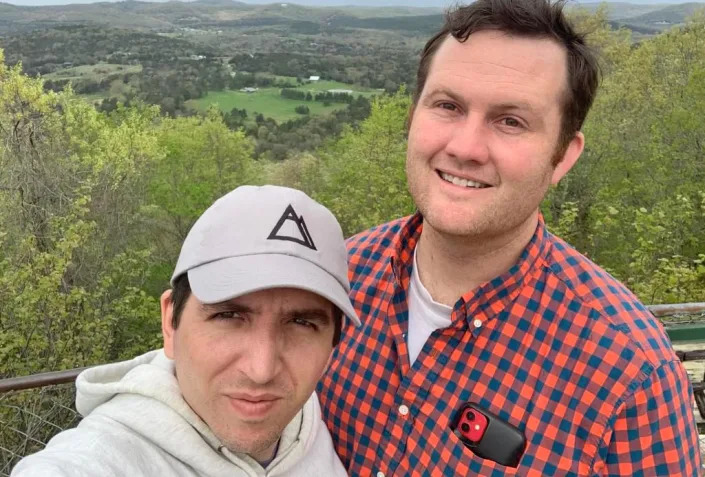
William VanWhy says he was feeling emotionally overwhelmed when he checked himself into the mental health unit at Northwest Medical Center in Arkansas last year. Four days later, he was still in the locked unit but desperate to leave.

“I was not receiving any medical care at all,” VanWhy, 32, said.

Mental health patients in Arkansas can be held against their will for 72 hours if they are deemed a danger to themselves or to others. But to keep them any longer than that, a medical provider must file a court petition and get the consent of a judge.

No petition was filed in VanWhy’s case, and his partner, with the help of a lawyer, ultimately succeeded in getting a court order for his release.


A few hours later, a sheriff’s deputy walked into the hospital with the order in his hand and VanWhy’s husband at his side. In the elevator, they bumped into a nurse from his unit.

“I’m glad he’s getting out,” the nurse said, according to body camera footage obtained by NBC News. “Don’t repeat that.”

VanWhy was released about 20 minutes later. “Oh my gosh. You saved my life,” he told the deputy, the bodycam footage shows.


William VanWhy, left, and his husband, Cameron Tryon. (William VanWhy)

The man who led the unit at the time, Dr. Brian Hyatt, was one of the most prominent psychiatrists in Arkansas and the chairman of the board that disciplines physicians. But he’s now under investigation by state and federal authorities who are probing allegations ranging from Medicaid fraud to false imprisonment.

VanWhy’s release marked the second time in two months that a patient was released from Hyatt’s unit only after a sheriff’s deputy showed up with a court order, according to court records.

“I think that they were running a scheme to hold people as long as possible, to bill their insurance as long as possible before kicking them out the door, and then filling the bed with someone else,” said Aaron Cash, a lawyer who represents VanWhy.

VanWhy and at least 25 other former patients have sued Hyatt, alleging that they were held against their will in his unit for days and sometimes weeks. And Arkansas Attorney General Tim Griffin’s office has accused Hyatt of running an insurance scam, claiming to treat patients he rarely saw and then billing Medicaid at “the highest severity code on every patient,” according to a search warrant affidavit.

Dr. Brian Hyatt describes the additional access safety door in one of the medical psychiatric rooms at Northwest Medical Center-Springdale in 2018. (Arkansas Democrat-Gazette)

As the lawsuits piled up, Hyatt remained chairman of the Arkansas State Medical Board. But he resigned from the board in late May after Drug Enforcement Administration agents executed a search warrant at his private practice.

“I am not resigning because of any wrongdoing on my part but so that the Board may continue its important work without delay or distraction,” he wrote in a letter. “I will continue to defend myself in the proper forum against the false allegations being made against me.”

Northwest Medical Center in Springdale “abruptly terminated” Hyatt’s contract in May 2022, according to the attorney general’s search warrant affidavit.

In April, the hospital agreed to pay $1.1 million in a settlement with the Arkansas Attorney General’s Office. Northwest Medical Center could not provide sufficient documentation that justified the hospitalization of 246 patients who were held in Hyatt’s unit, according to the attorney general’s office.

As part of the settlement, the hospital denied any wrongdoing.

“We believe hospital personnel complied in all respects with Arkansas law, which heavily relies on the treating physician’s assessment of the patient, including in decisions related to involuntary commitment,” Aimee Morrell, a Northwest Health spokeswoman, said in a statement.

“While it is not our practice to comment on pending litigation matters, I can share that last spring, we undertook a number of actions to ensure our patients’ safety, including hiring new providers responsible for the clinical care of our behavioral health patients in early May 2022,” Morrell added.

Hyatt, 50, has not been charged with a crime. Neither he nor his lawyer has responded to multiple requests for comment.

But his legal team provided a statement to Arkansas Business last month.

“Dr. Hyatt continues to maintain his innocence and denies the allegations made against him,” the statement said in part. “Despite his career as an outstanding clinician, Dr. Hyatt has become the target of a vicious, orchestrated attack on his character and service. He looks forward to defending himself in court.”


Dr. Brian Hyatt. (KNWA)

Arkansas Attorney General Tim Griffin declined to comment. “We have no additional details to provide at this time,” he said.

Charlie Robbins, a spokesman for the U.S. Attorney’s Office for the Western District of Arkansas, said the execution of a search warrant is “an important step in any lengthy, ongoing investigation.

“In light of the fact that this investigation is still ongoing, we will not be making any additional comments,” he said.
Massive Medicaid payouts

A graduate of the University of Arkansas for Medical Sciences, Hyatt was named the medical director of Northwest Medical Center’s behavioral health unit in January 2018.

The number of beds expanded from 25 to 75, and the claims to Medicaid and Medicare, as well as to private insurance, surged, according to the Arkansas attorney general’s search warrant affidavit.

Hyatt was getting paid $1,367 per day, according to a report prepared by the Arkansas attorney general’s office. And at the same time he was also running his own private practice, Pinnacle Premier Psychiatry, in the town of Rogers, about 25 miles away, according to the attorney general’s office.

The claims he submitted indicated that he conducted daily face-to-face evaluations with patients at the hospital.

But a former staff member came forward in April 2022 and told state investigators that Hyatt was only on the floor with patients “a few minutes each day and that Dr. Hyatt had no contact with patients,” the affidavit says.

Investigators reviewed 45 days of surveillance footage from the facility and concluded that Hyatt entered a patient’s room or interacted with a patient only 17 times — for less than 10 minutes in total, according to the report prepared by the attorney general.

“Dr. Hyatt never had even a single conversation with the vast majority of patients under his care,” the affidavit says.

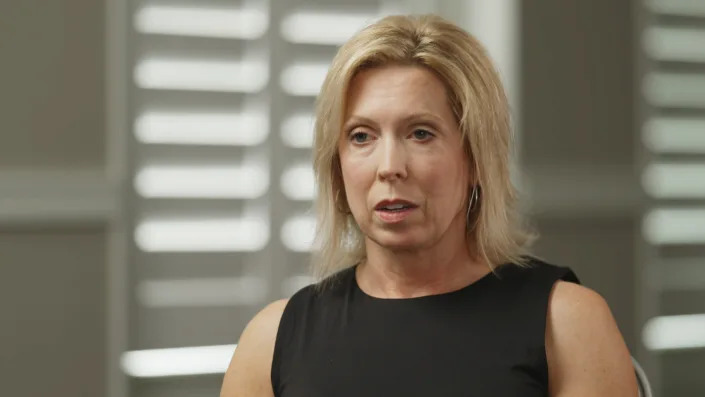
Shannon Williams, 52, says she was one such patient.

Williams, a nurse from Harrison, was grappling with the death of her grandmother when she learned that her brother had died from Covid while overseas. The news pushed Williams, who herself worked in a Covid unit, into what she described as “crisis mode.”

She ended up in the emergency room of a hospital about 90 minutes away from Springdale in February 2021. The next morning, she was transferred to Hyatt’s unit after a physician determined that she was a danger to herself, according to medical records (Williams maintains that she was not suicidal).


Nurse Shannon Williams. (NBC News)

Upon arriving at the unit, Williams said she was stripped down and injected with a sedative against her will.

“I was terrified,” Williams said.

She was held for five days, according to her medical records, despite, she says, her requests to leave.

“It was as if I was in a prison,” Williams, a mother of three, said. “It was like a nightmare. If I cried, then I was again threatened with more time.”

According to the search warrant affidavit, Hyatt’s Medicaid claims dwarfed those of other psychiatrists in Arkansas.

From January 2019 to June 2022, Medicaid paid out more than $800,000 to Hyatt’s facility.

“Dr. Hyatt is a clear outlier, and his claims are so high they skew the averages on certain codes for the entire Medicaid program in Arkansas,” the affidavit says.

Medicaid uses a coding system to determine how much to pay providers — with the highest codes billing at the highest rates because those patients require more care.

It’s common for a newly admitted patient to come in at the highest severity code, which suggests the person is unstable and dealing with a serious issue, and then progress to a lower code before being released.

But 99.95% of Hyatt’s Medicaid claims came in at the most expensive code, the affidavit says.

“According to the claims submitted by Dr. Hyatt and the non-physician providers working under his supervision, no patient being treated in the behavioral unit located at Northwest Medical Center ever got better, at least not before the day of the patient’s release,” the affidavit says.
Mocking emails

Before he came to represent VanWhy, Cash had a bizarre interaction with Hyatt over a different patient.

In January 2022, Cash sent the hospital a fax demanding the immediate release of his client, a patient named Karla Adrian-Caceres.

Adrian-Caceres had arrived at the unit the day before and was clamoring to leave, according to a lawsuit she filed in January 2023.

Adrian-Caceres’ mother went to the hospital to pick her up but was told her daughter would not be released, the lawsuit says. The following morning Hyatt responded by email to Cash, saying he would neither confirm nor deny that Adrian-Caceres was in his unit.

“Our facility is in receipt of your silly demands and libelous commentary regarding someone you claim to represent who is purportedly within our facility,” Hyatt said in the email, which was included in Adrian-Caceres’ court filing.

Hyatt said he would only check to see if she was there if Cash got his client to sign a “release of information form.”

Cash responded four hours later with a court order demanding Adrian-Caceres’ release.

Cash gave the court order to Adrian-Caceres’ mother, and she brought it to the hospital, but the hospital still refused to release her daughter.

So Cash got a second court order, and the judge ordered the sheriff’s office to enforce it, according to her lawsuit.

A deputy went to the facility with Adrian-Caceres’ mother and secured her release, according to documentation from the sheriff’s office obtained by NBC News.

The next morning, Hyatt emailed Cash, mocking the colleges he attended.

“I guess this is what they teach at Poteau Junior College…sorry…Carl Albert State and Northeastern State University,” Hyatt said in the email.

He directed Cash to contact his attorney. “You won’t find him in your “college’s” yearbook,” he wrote.

When Cash heard from VanWhy’s husband two months later, he didn’t bother trying to get the patient released on his own.

“I went straight to the sheriff this time,” Cash said.

Cash said the patients he spoke to were adamant that they received virtually no care while they were being held in Hyatt’s unit. These were people who were vulnerable and oftentimes in need of serious support or therapy, he said.

“Some of them did need help,” Cash said. “And what they got was hurt.”

This article was originally published on NBCNews.com
China property developers' shares, bonds dive as sector worries deepen

STATE CAPITALI$M IS STILL CAPITALI$M


 Workers walk past a construction site of residential buildings by property developer Country Garden in Kunming, Yunnan
1
Updated Mon, July 24, 2023 
By Jason Xue and Tom Westbrook

SHANGHAI/SYDNEY (Reuters) -Stocks and bonds in China's real estate industry fell to around eight-month lows on Monday as repayment concerns at two of the country's biggest developers deepened a crisis of confidence in the sector.

Cash shortages at giants Country Garden and Dalian Wanda show funding issues have reached what many hoped were the largest and safest players in a business that once contributed a quarter of China's gross domestic product and is all but frozen.

Doubts are growing any official support will be forthcoming, and investors do not expect any aid to be aimed at shareholders.


Country Garden shares fell by 8.7% to HK$1.26, an eight-month low and shares in its services arm tumbled 17.9% to HK$7.4. Country Garden dollar bonds fell to less than a fifth of their face value.

Shares at rival Longfor dropped 8.5%, while an asset sale at Wanda failed to revive bond prices as investors waited on whether the cash actually reaches bondholders' pockets.

"As market sales continue to weaken and policy expectations continue to fall short, it will be difficult for real estate developers to repay bonds by their own operations," said Yao Yu, founder of credit analysis firm Ratingdog.

"Investors must become more and more pessimistic."

Property development has ground to a halt in China as a government crackdown on debts and crumbling public confidence have left builders unable to sell apartments or refinance their dues.

Guidelines promoting urban redevelopment published late on Friday were seen as small scale, leaving investors hoping for more from a Politburo meeting expected this week. That big names were struggling, however, highlighted the depth of the problems.

An index of mainland developers fell 6.4% on Monday and recorded its worst session of 2023.

"Everything is falling," said a Hong Kong debt fund manager, who spoke on condition of anonymity.

"The major thing that we see now is onshore-traded Country Garden bonds going down," he said. "That is the largest one. People get scared if that one cannot survive."

DOWNGRADES AND DEFAULTS


Country Garden is a giant with thousands of projects in nearly 300 Chinese cities. Its move to refinance a 2019 loan facility surprised and unnerved investors, and follows ratings downgrades and new defaults elsewhere.

Li Changjiang, the president of Country Garden Services, sold 3.2 million shares of the company last week, reducing his stake to 0.11% from 0.21%.

"Although this is not his first time selling shares of the company, the number of shares sold was one of the largest," said J.P.Morgan analysts in a note.

J.P.Morgan downgraded Country Garden Holdings from neutral to underweight, and cut its price target to HK$0.9 from HK$2.3. The bank also reduced the price target of Country Garden Services Holdings to HK$6.7 from HK$22.

Country Garden's onshore-traded bonds dropped to less than half of their face value on Monday and dollar bonds due in 2025 and 2031 fell below 20 cents on the dollar.

Wanda, China's largest commercial developer, was also seeking cash for one of its subsidiaries to make an already-late coupon payment due before the end of a grace period on July 30.

It sold part of another subsidiary to streaming company China Ruyi for $320 million, which a source familiar with the matter said would help it to repay a separate $400 million bond.

State-backed developer Greenland Holdings has missed repayments this month, while Sino-Ocean Group proposed extended terms for a 2 billion yuan ($278 million) bond due on Aug. 2.

The new problems have squashed a nascent rally after China lifted COVID-19 controls and opened its borders ending years of movement restrictions.

Restructuring plans at Evergrande, which was the poster-child of the sector's 2021 plunge into funding stress, are before the courts in Hong Kong and the Cayman Islands, while property sales are in a new slowdown.

"Distressed Chinese property developers’ bond restructurings can buy them some room," Fitch Ratings said in a report on Monday. "But most will continue to face repayment difficulties if home sales do not recover for a sustained period."

($1 = 7.1972 Chinese yuan renminbi)

(Reporting by Jason Xue in Shanghai and Tom Westbrook in Sydney; Additional reporting by Clare Jim, Xie Yu and Georgina Lee in Hong Kong. Editing by Kim Coghill, Jamie Freed and Barbara Lewis)

China Addresses Investor Concerns in Meeting With Global Funds

Bloomberg News
Sat, July 22, 2023 


(Bloomberg) -- Chinese regulators met with global investors on Friday, according to people familiar with the matter, stepping up the government’s bid to boost market confidence as the country’s economic recovery loses steam.

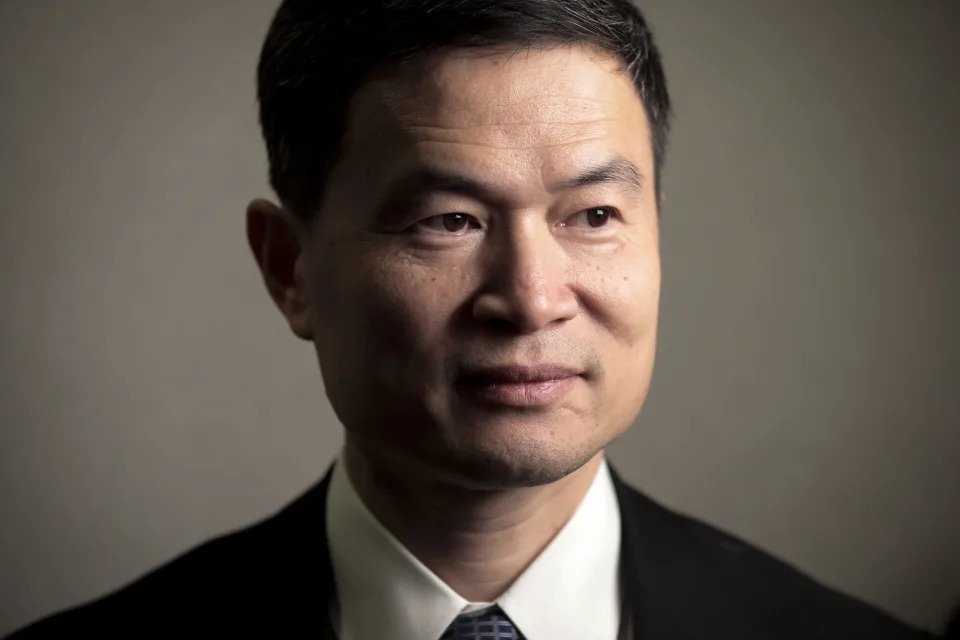
China Securities Regulatory Commission Vice Chairman Fang Xinghai met with some global venture capital and private equity firms to hear their concerns about investment in the country, the people familiar said, requesting not to be named because the matter is private. Among those present were Neil Shen, founding partner of HongShan — formerly known as Sequoia Capital China — and representatives from GIC Pte. and Warburg Pincus. Temasek Holdings Ltd.’s China head Wu Yibing also joined.

Fang was accompanied by regulators from the securities watchdog and the Asset Management Association of China, the people said. Neither agency responded to questions about the meeting outside of business hours, nor did HongShan or GIC. Temasek couldn’t immediately provide a comment while Warburg Pincus representative declined to when contacted by text message.

The rare meeting with global funds comes after Chinese President Xi Jinping’s administration voiced its strongest support in recent years for the country’s private tech enterprises just days earlier. The government’s efforts, however, have been met with skepticism, as investors call for more concrete measures and stronger stimulus to revive growth.

Topics discussed at Friday’s meeting included steps that can be taken to ensure global funds can continue to invest in China, the people said. Regulators were urged to expedite procedures for overseas initial public offering registrations, accelerate listings in mainland China and relax merger-and-acquisition rules, one of the people said.

Escalating Tensions

Escalating tensions between China and the US, Beijing’s multi-year crackdown on its private sector and the country’s weakening economy are dampening investor interest. Private equity and venture capital firms have been struggling to attract institutional money from US endowments and pensions because of these long-term concerns.

This week, a US congressional committee said it was investigating four venture capital firms for their investment in Chinese technology companies, the latest sign of Washington’s increasing scrutiny of American funds suspected of helping develop sensitive industries in China. The entities under investigation are GGV Capital, GSR Ventures, Walden International and Qualcomm Ventures.

The US Department of State also recommended in June that Americans reconsider traveling to mainland China because of arbitrary enforcement of local laws and the risk of wrongful detentions, which spooked the business community.

Concerns about regulatory crackdowns in China have also weighed on the investment community. This month the Communist Party and the government issued a rare joint statement with 31 measures to improve conditions for businesses, including pledges to treat private firms the same as state-owned enterprises.

While that move won the backing of Chinese entrepreneurs including Tencent Holdings Ltd.’s billionaire co-founder Pony Ma, foreign companies are looking for more than rhetoric after two years of crackdowns and pandemic controls. The European Union Chamber of Commerce in China said its companies have been accustomed to “sweeping pro-business statements being made with little concrete action being taken.”

The government showed support for private equity and venture capital earlier this month when Premier Li Qiang approved the final rules on the 20 trillion yuan ($2.8 trillion) private fund market almost six years after a draft was released. While penalties on irregularities were toughened significantly, the new rule sets out a special chapter for venture capital, with looser requirements. It also exempted parent funds from some restrictions, benefiting private equity’s secondary market.

China’s sputtering economic recovery has sent a chill through global markets. Beijing has opted for targeted steps — instead of a broad stimulus — pushing for lower interest rates, easier access to credit and a series of measures to kickstart the moribund housing market.

Businesses are still waiting for signals from Xi’s new economic team that the policy environment will be more transparent and predictable. The president has repeatedly insisted that economic development is the Communist Party’s top priority, even as his government makes protecting national security a central focus.

--With assistance from Amanda Wang and David Ramli.


CHINA
Electric planes get big boost as leading battery maker unveils aviation division

Anthony Cuthbertson
Mon, 24 July 2023 

Contemporary Amperex Technology (CATL) unveiled a condensed battery for electric aircraft on 19 April, 2023 (CATL)

China’s largest battery maker for electric vehicles has launched an aviation division in preparation to begin mass production of electric planes, according to reports.

Contemporary Amperex Technology (CATL), which supplies batteries for Tesla, claims to have achieved the “holy grail” energy density required for commercial electric aircraft of 500 Watt-hours per kilogram (Wh/kg).

The company announced the feat at the Auto Shanghai trade fair earlier this year, with chief scientist Wu Kai claiming that it was poised to begin production of a commercially viable battery for electric aircraft.


“With an energy density of up to 500Wh/kg, it can achieve a high energy density and a high level of safety at the same time in a creative manner, opening up a brand-new electrification scenario of passenger aircrafts,” the company said in a statement at the time.

“CATL can achieve mass production of condensed battery for electric vehicles in a short period of time.”

CATL has now launched a joint venture with state-owned plane manufacturer Commercial Aircraft Corporation of China (COMAC), Yicai Global reported, following four years of research into the technology.

The advent of electric aircraft has become a realistic prospect in recent years following several major battery breakthroughs that have the potential to overcome cost and capacity limitations.

Israel-based startup Eviation completed the first flight of an electric commuter plane last year, taking off from an airport in Washington before touching down eight minutes later.

The Alice aircraft is capable of transporting nine passengers and their luggage, or a tonne of cargo, and has been hailed as the first battery-powered plane viable for short-haul commercial journeys of up to 645km (400 miles).

Regional airlines and logistics firms in the US have already ordered more than 200 Alice planes, with Eviation aiming to fulfil the orders by 2026.

The Independent has contacted CATL for a production timeframe of its electric plane batteries.
China's economy is in trouble - and its youth unemployment crisis is at the heart of the problem

Jennifer Sor
Sun, July 23, 2023 

A woman shops at a supermarket in Beijing, China, October 15, 2015.REUTERS/Kim Kyung-Hoon

China's youth unemployment problem is the root of its economic woes, according to economist Nancy Qian.


Unemployment among workers aged 16-24 hit a record 21% last quarter.


That's largely due to a shortage of high-skill, high-paying jobs, which will weigh on its economy.


China's economy is in crisis – and the nation's youth unemployment problem could be at the root of its current troubles, according to Northwestern University economist Nancy Qian.

"To stem the reversal of its economic fortunes, China must address the root of the problem: the lack of high-paying, high-skilled jobs," Qian said in an op-ed for Project Syndicate this week. "If the economy is going to grow (or at least avoid a contraction) in the long run, the government must create the conditions for job creation in high-productivity sectors, and for greater investment in higher education."

Qian pointed to rampant unemployment among China's younger generation, with a record 21% of workers aged 16-24 out of a job in the second quarter, according to China's National Bureau of Statistics.

That's largely been driven by the lack of high-skill and high-paying jobs in China's employment market, which have left many college graduates unable to find work.

It's also been exacerbated by a number of initiatives China has undertaken in the recent years. In 2021, the government banned online tutoring to reduce pressure on schoolchildren, but that's had the effect of reducing the number of available jobs in the tech industry, Qian said.

The government has also pushed to increase China's fertility rate, which has made employers hesitant to hire younger women.

"Young women's darkening employment outlook is just one of the many signs that the Chinese economy is headed in the wrong direction," Qian warned, noting that China is now diverging from patterns typically seen in advanced economies.

Advanced nations typically see higher education rates, smaller family sizes, and growing labor-force participation among women – trends that are now being reversed in China's socioeconomic fabric, especially as the lack of high-paying jobs in the nation lowers the cultural emphasis on education.

Meanwhile, China's economy has been slowing, with the nation seeing a disappointing economic revival since dialing back its zero-COVID policies at the start of this year. Real estate and factory activity have slowed, and the nation now risks deflation as demand fails to pick up. GDP growth has already started to decline, and accelerated just 6.3% the past quarter, well-below economists' estimates of 7.1%.

"The slowdown from 10% annual GDP growth was inevitable. But current patterns raise profound concerns for China's economic outlook, especially considering that the government's policies for addressing them have not worked," Qian said.

Other experts have said China's future could be grim if its economy doesn't pick up soon. China may be headed for a lost decade, according to one former International Monetary Fund official, and its weakening economy could end up impacting US firms that are heavily exposed to nation, experts say.


India Blocks $1 Billion Bid By China’s BYD to Set Up EV Factory

Ragini Saxena and Ruchi Bhatia
Mon, July 24, 2023 


(Bloomberg) -- India rejected Chinese carmaker BYD Co.’s proposal to build a $1 billion electric-vehicle plant in partnership with a local company, according to people with knowledge of the matter.

The Indian government dismissed the plan from BYD and Hyderabad-based Megha Engineering and Infrastructures Ltd. on national security concerns, the people said, asking not to be identified as the decision is not yet public. The use of Chinese homegrown technology is a concern, one of the people said.

Foreign direct investment in India’s automobile sector doesn’t typically require approval. Investment proposals from countries that share a border with India, however, need political and security clearance from the ministries of external and home affairs.

BYD declined to comment. Representatives for Megha, which was established in 1989 and has infrastructure projects in sectors from power to transport, didn’t return phone calls or an email seeking comment.

Spokespeople for the Finance Ministry, the Heavy Industries Ministry and the Ministry of Home Affairs, which were all assessing BYD’s proposal and vet investment coming into the country, didn’t respond to requests for comment.

New Restrictions

India is restricting Chinese investment following a number of deadly clashes along the disputed border between the two nations, which have strained relations. Great Wall Motor Co. failed in an attempt to buy a mothballed General Motors Co. plant after it couldn’t get approval to close the deal.

The Economic Times reported the Indian government’s rejection of BYD’s investment plan on Saturday.

The government was probing SAIC Motor Corp.’s local unit MG Motor India Pvt over alleged financial irregularities, Bloomberg News reported last year. MG Motor has since announced plans to dilute its 100% share of the business, and aims to have it majority-owned by an Indian firm in two to four years.

Read More: China’s BYD Plans Aggressive Expansion Into India EV Market

The latest rejection deals a blow to BYD’s ambitious plans for India. The company, which entered the South Asian nation in 2007, sought to capture 40% of the domestic EV market by 2030, Sanjay Gopalakrishnan, senior vice president of its local operations, told Bloomberg in January. It’s aiming to sell 15,000 electric vehicles in India this year.

Investment from elsewhere doesn’t seem to be at risk. After meeting with Indian Prime Minister Narendra Modi in the US last month, Elon Musk said Tesla Inc. is likely to make a significant investment in the country.
Harley-Davidson, Triumph in first gear of challenge to Royal Enfield's India reign


A handout image of Scrambler 400 X bike

Sun, July 23, 2023 
By Indranil Sarkar and Aby Jose Koilparambil

BENGALURU (Reuters) -U.S. big-bike maker Harley-Davidson and British rival Triumph have revved up India's premium motorcycle market with aggressively priced models that analysts said could dent the over half-century dominance of local champion Royal Enfield.

The duo surprised the industry this month by unveiling their cheapest models globally in the largest motorbike market by sales, where their expensive imports have long struggled for market share. This time, they are making the bikes in India with domestic partners to bring prices below 233,000 rupees ($2,841).

"These are aspirational brands," said Kotak Securities auto analyst Rishi Vora. "For people who were thinking of buying a Harley or Triumph earlier, the price points weren't accessible. Now, they are."

The similar, near-simultaneous change in approach by two of the industry's most storied brands represents one of the biggest challenges to Royal Enfield's virtual monopoly in high-end motorcycles, coming at a time of rising spending in India in premium segments across categories as varied as mobile phones and cars.

Such is the threat, the back-to-back launches pushed Royal Enfield maker Eicher Motors' stock price down as much as 12.5% and prompted brokerages to flag earnings risk for at least two years - even though Harley-Davidson and Triumph sales currently pale in comparison to those of Royal Enfield.

The pricing and brand cachet of the Harley-Davidson X440 and Triumph Speed 400 could cut Royal Enfield's share of India's 250 cc-plus segment to 75% from over 90%, Kotak said. Royal Enfield's nearest model is the Classic 350 starting at 193,000 rupees.

Eicher declined to comment ahead of its quarterly earnings announcement. Harley-Davidson did not respond to a request for comment. Triumph said it would significantly increase its dealer network to around 100 dealers over the next 12 months.

ROYAL CHALLENGE

The new models mark a return to India for Harley-Davidson and a huge step up for Triumph, but they are up against Royal Enfield's large number of showrooms, strong after-sales service network and entrenched fan base for a 100-plus-year-old brand.

"Is there going to be a challenge to Royal Enfield? Yes. Is it going to be a major one? It can't be immediately," said Shubhabrata Marmar, co-founder of automotive content platform MotorInc.

"Royal Enfield built the community, and have been iterating their showrooms to be ever classier places that have the feel of an international, retro, cool, chic brand."

Rival heritage brands have made little inroads against Royal Enfield, such as Mahindra & Mahindra's Yezdi and Jawa or BMW's eponymous brand that the German automaker manufactures with local partner TVS Motor.

"Once you buy the vehicle, everything else disappears. The pricing and the showroom disappear. It's you, your motorcycle and those trips to the service centre," said Varun Painter, editor of motorcycle content at PowerDrift.

Harley-Davidson spent a decade importing its ultra-premium motorcycles before exiting the market and shuttering most of its dealer network in 2020. It sold fewer than 30,000 motorcycles - less than the number of bikes Royal Enfield sells each month.

It then partnered Hero MotoCorp, the world's largest motorcycle maker, to develop and sell a range of Harley-Davidson branded bikes in India, starting with the X440.

Triumph was selling about 1,200 motorcycles annually in India when, also in 2020, it tied up with Bajaj Auto to build mid-capacity bikes, with Bajaj handling distribution.

Triumph said it has received orders for over 14,000 Speed 400 bikes, exceeding its total India sales of the past decade.

ALONG FOR THE RIDE

The premium segment accounts for under 10% of sales in a country where most people opt for cheaper means of transport to navigate heavy traffic and skirt rising fuel prices. Still, the frenzy over the new models is reflected in the surge in Google searches about Harley-Davidson and Triumph in India.

"The reviews and the stunning price pushed me to make an instant decision to book the Triumph," said Sathish Rao, a software professional and member of a motorcycle club.

Improved financing options is also encouraging lower-income buyers to consider premium bikes, said HDFC Securities analyst Aniket Mhatre.

"Our starter bikes are usually like a 100 cc to 200 cc max. I think that's going to change now. I feel like people are going to go straight to a 400 cc," said motorcycle content creator Priyanka Kochhar, who has ridden both the new bikes.

($1 = 82.0073 Indian rupees)

(Reporting by Indranil Sarkar and Aby Jose Koilparambil in Bengaluru; Additional reporting by Nandan Mandayam, Saumya Singh, Navamya Ganesh Acharya and Varun Hebbalalu; Editing by Dhanya Skariachan, Euan Rocha and Christopher Cushing)