Sunday, July 30, 2023

Here's the story not told in Nolan's Oppenheimer about those forced off their land in New Mexico

32 Hispanos families given just 48 hours to vacate: relatives and ex-lab employee

This black and white photos shows homes and cars in a desert environment.
The town of Los Alamos, N.M., is seen in an undated photograph. In 1942, the U.S. army gave 32 Hispanos families on the Pajarito Plateau 48 hours to leave their homes and land, in some cases at gunpoint, so that a lab that would create the world's first atomic bombs could be built, according to relatives of those removed and a former lab employee. (U.S. Department of Energy/Reuters)

In the movie Oppenheimer, the eponymous character played by Cillian Murphy says the proposed site for a secret atomic weapons lab in northern New Mexico has only a boys' school and Native Americans performing burial rites.

But there were homesteaders living on that land.

In 1942, the U.S. army gave 32 Hispanos families on the Pajarito Plateau 48 hours to leave their homes and land, in some cases at gunpoint, to build the lab that would create the world's first atomic bombs, according to relatives of those removed and a former lab employee.

Homes were bulldozed, livestock shot or let loose, and families given little or no compensation, according to Loyda Martinez, 67, who worked as a computer scientist for 32 years at Los Alamos National Laboratory and cited accounts from evicted ranching and farming families who are her neighbours in the Espanola Valley.

A National Nuclear Security Administration spokesperson said Hispanic farmers were compensated at a significantly lower rate than white property owners, but the agency was not aware of homes being destroyed and animals killed or abandoned. The agency did not address whether homesteaders were forcefully removed.

A man wearing a suit, tie and hat walks down a dusty street.
Cillian Murphy stars as J. Robert Oppenheimer in a scene from Christopher Nolan's Oppenheimer. In the film, Murphy's Oppenheimer says the proposed site for a secret atomic weapons lab in northern New Mexico has only a boys' school and Native Americans performing burial rites. (Universal Pictures/The Associated Press)

Martinez has spent decades campaigning for the evicted homesteaders and the rights of Hispano, Native, women and other lab employees, and has won two class-action lawsuits relating to equal pay and treatment for them.

"These were Hispanic American homesteaders, which perhaps explains why this dark episode in American history is so ignored," she said.

Christopher Nolan's blockbuster movie Oppenheimer has stirred up northern New Mexico's conflicted relationship with "the lab," which today has more than 14,000 workers and is the region's largest employer.

For many local Hispanos — descendants of Spanish colonial settlers — its high wages have paid for homes, higher education and a chance to hang onto multigenerational property in this land-rich, cash-poor area.

The headquarter for the U.S. Atomic Energy Security Service is seen in Los Alamos in September 1947. (The Associated Press)

Marcel Torres, whose family has lived in the Penasco area since the 1700s, worked in the lab's most secret sectors for 35 years as a machinist helping build nuclear weapons — to, he said, "try and prevent a world war."

"We were so valuable to them that they didn't care who we were in race," Torres, 78, said, adding he earned about three times as much at the lab as he would have elsewhere in the area.

'Taking land for Los Alamos was not an aberration'

For others, the lab carries a legacy of death and dispossession.

Martinez lobbied the U.S. Congress for compensation for employees like her father, a lab worker who died after working with toxic chemical element beryllium.

In 2000, Congress acknowledged that radiation and other toxins had contributed to the deaths or illnesses of thousands of nuclear weapons workers.

An atomic bomb of the type that was dropped by the U.S. over Hiroshima, Japan, during the Second World War is seen in this undated photo released by the Los Alamos Scientific Laboratory. (Los Alamos National Laboratory)

The Department of Labour set up a compensation fund for those affected, but it took years for families to be paid, said Martinez, who served on New Mexico's state human rights commission in the early 2000s.

Myrriah Gomez, an assistant professor at the University of New Mexico, said her great-grandparents were evicted from their 25-hectare ranch to build the lab, and her grandfather died of colon cancer after working on the Manhattan Project.

J. Robert Oppenheimer "had no qualms about displacing people from their homelands," said Gomez, who wrote Nuclear Nuevo Mexico about the setting up of the lab.

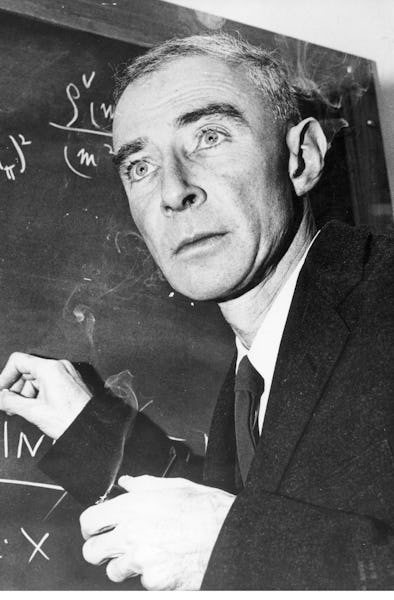
J. Robert Oppenheimer, atomic physicist and head of the Manhattan Project, poses for a photo in 1944. (U.S. Department of Energy/Reuters)

Author Alisa Valdes, who has written a screenplay on Loyda Martinez, said scenes in Oppenheimer shot near Abiquiu, N.M., depicting the lab in an empty landscape echoed the U.S. government's line that the area was uninhabited.

Publicists for the movie did not immediately respond to a request for comment.

The lab was built on lands sacred to local Tewa people that were granted to Hispano settlers under Spanish colonial rule, then allotted to both Hispano and white homesteaders after the United States occupied the area following the 1846-48 Mexican-American War.

Cars are seen at a toll booth in this black and white photo.
The main gate to the Los Alamos National Laboratory in February 1955 in New Mexico. (The Associated Press)

"Taking land for Los Alamos was not an aberration, it's what the United States had been doing since 1848," said State Historian of New Mexico Rob Martinez, whose great-uncle worked at the lab.

In 2004, homesteader families won a $10 million US compensation fund from the U.S. government.

Today Los Alamos County, where the lab is based, is one of the richest and best-educated in the U.S. Neighbouring Rio Arriba County, which is 91 per cent Hispanic and Native American, is among the country's poorest, with the lowest academic scores.

Researchers, some in lab coats, work inside a laboratory in this black and white photo.
Researchers work inside the Los Alamos National Laboratory in 1974. (U.S. Atomic Energy Commission)

"There's no economic development in our areas because it's all focused in Los Alamos," said Cristian Madrid-Estrada, director of the regional homeless shelter in Espanola, Rio Arriba's largest town.

The lab said that more than 61 per cent of employees hired since 2018 were from New Mexico, with most of its workforce living outside Los Alamos County.

"We are dedicated to the success of this region we all call home," a spokesperson said in a statement.

How Oppenheimer Proved Einstein Wrong About Black Holes

In addition to the Manhattan Project, J. Robert Oppenheimer also worked on many other areas of physics.

WRITTEN BY JON KELVEY
ullstein bild Dtl./ullstein bild/Getty Images

J. Robert Oppenheimer is largely known to history for his work on the Manhattan Project, the US government’s secret wartime nuclear bomb development project. That project would result in the bombs dropped on Japan at the end of World War II, and they ushered in the Atomic Age, the Cold War, and endless iteration of post-apocalyptic fiction. There is no Mad Max without Oppenheimer.

But the Manhattan Project has largely eclipsed Oppenheimer’s previous work on a force even more powerful than nuclear bombs — black holes.

“Everyone knows his name in connection with the Manhattan Project, and that's certainly how I first learned of his name, because I grew up in Oak Ridge, one of the Manhattan Project sites.” Loyola University astrophysicist Robert McNees tells Inverse. But Oppenheimer wasn’t such a specialist in his time before his work on the bomb, working on nuclear and particle physics.

In a 1939 paper, Oppenheimer, then a particle physicist, declared that black holes were the inevitable result of the Albert Einstein’s theory of general relativity, contrary to the hopes of that scientist. Oppenheimer declared, like a few others before him,that black holes weren’t just a quirk of the mathematics, but likely real astrophysical objects — that a star massive enough is destined to implode, creating a trap from which what goes in cannot come back out.

“Mathematically, the work of Oppenheimer and his colleagues was really important to put these on firm theoretical footing,” Sheperd Doeleman, an astrophysicist at the Harvard & Smithsonian Center for Astrophysics and director of the Event Horizon Telescope, tells Inverse.


A black hole feeding on a star.
 
IN THE SHADOW OF THE BOMB


While Oppenheimer may have worked on black holes and atomic chain reactions, McNees says he was a bit of an intellectual nomad.

“He strikes me as one of those scientists who kind of like went from topic to topic and just had very good taste in what he worked on,” McNees says. “He would jump into an area and pinpoint an interesting problem and contribute something, and then maybe end up going on to something else.”

For example, Oppenheimer early work helped establish the concept of the positron, the antimatter equivalent of the electron. He also defined the nuclear process — the Oppenheimer-Phillipis process — involved in the transmutation of isotopes, like Carbon-12 transmuting to Carbon-13.

And then in the late 1930s, Oppenheimer stepped in to tell Einstein he was both right and wrong about the universe.

“In 1915, Einstein posits his equations of general relativity, his magnum opus. A masterpiece that elevates space-time from a stage to a participant in the drama,” University of Waterloo astrophysicist Avery Broderick tells Inverse. The Einstein field equations explained how the mass of matter curved the fabric of space-time, and how space-time in turn told matter how to move.

A year later in 1916, German Physicist Karl Schwarzschild came up with the first solution to the Einstein field equations, “which was pretty impressive, because they're difficult equations to solve,” Broderick says.

But the Schwartzchild solution implies something weird: That you could have a large mass in a single point, a singularity, which would so warp space-time that anything that came within a certain radius of that point would never be able to get out again.

“Everyone kind of chortled and said, ‘Oh, ho-ho, isn't that mathematically curious! But it will never happen,’” Doeleman says. Schwartzchild’s calculations showed that “theoretically, you could have a region of space time that was like a knot that you couldn't untie. And Einstein rebelled against that.”

Despite his crafting the theory of general relativity, Einstein, like many other physicists at the time, assumed singularities were either a mathematical phantom of Schwartchild’s solution, or, at the least, were a condition that nature could never actually enter into in practice.


“Einstein's approach or response to this was very natural, very experienced. He was like,Ah!, this can't happen. Nature will stop this, we just don't know how,” Broderick says. “You know, the universe intercedes.”

But in a 1939 paper entitled “On Continued Gravitational Contraction,” Oppenheimer and his co-author Hartland Snyder showed that a sufficiently massive star, when it exhausts its nuclear fuel, will necessarily contract forever, forming what we now know as a black hole.

“A lot of the things that kind of show up as descriptors and popular accounts of black holes, at least as far as I'm aware, originate in this paper,” McNees says.

For instance: If I were to watch you fly into a black hole from a safe distance, and you were holding up a clock I could see through a telescope, your clock would seem to slow down more and more as you approached the point of no return, known as the event horizon.

“It’s just kind of frozen,” McNees says, such that your falling into the black hole seems to take infinite time, from my perspective.

And even if you did fall in, it would be hard to see, because your light gets stretched out to longer and longer wavelengths — redshifted – to the point of obscurity.

But your experience is different. An observer falling past the event horizon doesn’t notice anything change, McNees says. Their clock runs as normal, and “for them, it happens in a finite amount of time.”

This is an effect of time dilation, which Christopher Nolan incidentally depicted in his early film, Interstellar, when a crew of astronauts spend time much closer to a black hole than their colleagues.


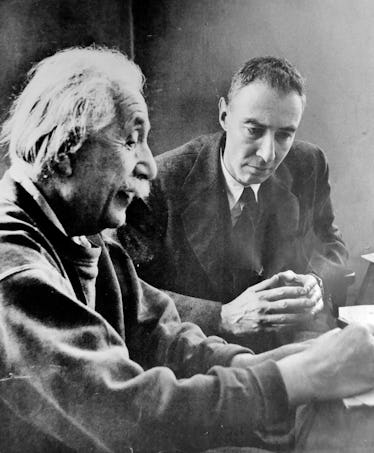
Einstein and Oppenheimer sit down together in 1947.UNIVERSAL HISTORY ARCHIVE/UNIVERSAL IMAGES GROUP/GETTY IMAGES

REDISCOVERING THE BLACK HOLE


These weird findings wound up getting buried for years, thanks to the advent of World War II and the subsequent Manhattan Project, which closed out Oppenheimer’s work in astrophysics.. It would take the work of John Wheeler in the 1950s, and then Roger Penrose and Stephen Hawking in the 1960s and 70s, to pick back up on the work Oppenheimer started and fill in the understanding of black holes we have today.

“It was the 60s and 70s, where people began to see cosmic objects that looked like they might be black holes, and that started a huge observational push to see these things,” Doeleman says.

X-ray and other observations would continue to find evidence gesturing at black holes, but it wasn’t until 2019, when the Event Horizon Telescope (EHT) collaboration released the first image of a black hole, the supermassive black hole at the heart of the Messier 87 galaxy, that we could actually image the event horizon.

The next step in the EHT project is to move from still images to movies, getting a dynamic picture of how matter swirls into the maw of supermassive black holes, and looking for clues that might give to what lies behind the event horizon, according to Doeleman. It could help solve the biggest mystery in physics, how Einstein’s theory of gravity and quantum mechanics, the rules that govern the other forces of the universe, fit together.

“At the center of the black hole at the singularity, that is where quantum physics and gravitational physics, which have never been shown to be consistent with each other, they have to combine,” Doeleman says. “We know that they have to merge. And we have no idea how that happens.”
LEGACIES

All of that research and the discoveries yet to be uncovered comes to us in part because of the work Oppenheimer did, and for which he is barely known.

Doeleman questions how Oppenheimer himself would see his legacy today, knowing what became of his work on both nuclear weapons and black holes.

”Would he have thought the Manhattan Project was the most important thing? Or maybe he would think, ‘this black hole stuff is pretty amazing. And I'm glad to have been a part of something that went far beyond the Earth, was less terrestrial and more cosmic,” Doeleman says. “We won’t know that, but we can wonder.”

Saturday, July 29, 2023

U$A
DEMOCRATS ARE SOCIALISTA
Election disinformation campaigns targeted voters of color in 2020. Experts expect 2024 to be worse

As the 2024 election approaches, community organizations are preparing for what they expect to be a worsening onslaught of disinformation.


In this image provided by Sarah Shah, the advocacy group Indian American Impact, which runs the fact-checking site Desifacts.org, passes out Parle-G cookies with voting plan stickers at a Diwali even in Doylestown, Pa., on Oct. 23, 2022. Community organizations are gearing up for what they expect will be a worsening onslaught of disinformation targeting voters of color as the 2024 election approaches. (Sarah Shah via AP) | AP


By ASSOCIATED PRESS
07/29/2023 

CHICAGO — Leading up to the 2020 election, Facebook ads targeting Latino and Asian American voters described Joe Biden as a communist. A local station claimed a Black Lives Matter co-founder practiced witchcraft. Doctored images showed dogs urinating on Donald Trump campaign posters.

None of these claims was true, but they scorched through social media sites that advocates say have fueled election misinformation in communities of color.

As the 2024 election approaches, community organizations are preparing for what they expect to be a worsening onslaught of disinformation targeting communities of color and immigrant communities. They say the tailored campaigns challenge assumptions of what kinds of voters are susceptible to election conspiracies and distrust in voting systems.

“They’re getting more complex, more sophisticated and spreading like wildfire,” said Sarah Shah, director of policy and community engagement at the advocacy group Indian American Impact, which runs the fact-checking site Desifacts.org. “ What we saw in 2020, unfortunately, will probably be fairly mild in comparison to what we will see in the months leading up to 2024.”

A growing subset of communities of color, especially immigrants for whom English is not their first language, are questioning the integrity of U.S. voting processes and subscribing to Trump’s lies of a stolen 2020 election, said Jenny Liu, mis/disinformation policy manager at the nonprofit Asian Americans Advancing Justice. Still, she said these communities are largely left out of conversations about misinformation.

“When you think of the typical consumer of a conspiracy theory, you think of someone who’s older, maybe from a rural area, maybe a white man,” she said. “You don’t think of Chinese Americans scrolling through WeChat. That’s why this narrative glosses over and erases a lot of the disinformation harms that many communities of colors face.”

Tailoring disinformation

In addition to general misinformation themes about voting machines and mail-in voting, groups are catering their messaging to communities of color, experts say.

For example, immigrants from authoritarian regimes in countries like Venezuela or who have lived through the Chinese Cultural Revolution may be “more vulnerable to misinformation claiming politicians are wanting to turn the U.S. into a Socialist state,” said Inga Trauthig, head of research for the Propaganda Research Lab at the Center for Media Engagement at the University of Texas at Austin. People from countries that have not recently had free and fair elections may have a preexisting distrust of elections and authority that may make them vulnerable to misinformation as well, Trauthig said.

Disinformation efforts often hinge on topics most important to each community, whether that is public safety, immigration, abortion, education, inflation or alleged extramarital affairs, said Laura Zommer, co-founder of the Spanish-language fact-checking group Factchequeado.

“It takes advantage of their very real fear and trauma from their experiences in their home countries,” Zommer said.

Other vulnerabilities include language barriers and a lack of knowledge of the U.S. media landscape and how to find credible U.S. news sources, several misinformation experts told The Associated Press. Many immigrants rely on translated content for voting information, leaving space for bad actors to inject misinformation.

“These tactics exploit information vacuums when there’s a lot of uncertainty around how these processes work, especially because a lot of election materials may not be translated in the languages our communities speak or be available in forms they are likely to access,” said Clara Jiménez Cruz, another co-founder of Factchequeado.

Misinformation can also arise from mistranslations. The Brookings Institute, a nonprofit think tank, found examples of mistranslations in Colombian, Cuban and Venezuelan WhatsApp groups, where “progressive” was translated to “progresista,” which carries “far-left connotations that are closer to the Spanish words ‘socialista’ and ‘comunista.’”

Disinformation, often in languages like Spanish, Mandarin or Hindi, flows onto social media apps like WhatsApp and WeChat heavily used by communities of color.

Minority communities that believe their views and perspectives aren’t represented by the mainstream are likely to “retreat into more private spaces” found on messaging apps or groups on social media sites like Facebook, Trauthig said.

“But disinformation also targets them on these platforms, even though it may feel to them to be that safer space,” she said.

Messages on WhatsApp are also encrypted and can’t be easily seen or traced by moderators or fact-checkers.

“As a result, messages on apps like WhatsApp often fly under the radar and are allowed to spread and spread, largely unchecked,” said Randy Abreu, policy counsel for the National Hispanic Media Coalition, which leads the Spanish Language Disinformation Coalition.

Abreu also raised concerns about Spanish YouTube channels and radio shows that are growing in popularity. He said the coalition is tracking more and more YouTube and radio personalities who are spreading misinformation in Spanish.

A 2022 report by the left-leaning watchdog group Media Matters tracked 40 Spanish-language YouTube videos spreading misinformation about U.S. elections. Many of these videos remained on the platform, despite violating YouTube election misinformation policy, the report said.

Disinformation and disenfranchising communities of color Amid changes in voting policies at state and local levels, advocates are sounding the alarm on how disinformation about voting in 2024 may target communities of color. Many of these efforts have surged as Asian American, Black and Latino communities have grown in political power, said María Teresa Kumar, founding president of the nonprofit advocacy group Voto Latino.

“Disinformation is, at its core, meant to be a sort of voter suppression tactic for communities of color,” she said. “It targets communities of color in a way that feeds into their already justifiable concerns that the system is stacked against them.”

The tactics also feed into a history “as old as the Jim Crow era of attempting to disenfranchise people of color, going back to voter intimidation and suppression efforts after the Civil Rights Act of 1866,” said Atiba Ellis, a professor of law at Case Western Reserve University School of Law.

While many of the same recycled claims around alleged fraud in the 2020 and 2022 elections are expected to resurface, experts say disinformation campaigns will likely be more sophisticated and granular in attempts to target specific groups of voters of color.

Trauthig also raised concerns about how layoffs and instability at social media platforms like Twitter may leave them less prepared to tackle misinformation in 2024. It also remains to be seen how new social media platforms like Threads will approach the threat of misinformation.

Changes in policies like WhatsApp launching a “Communities” function connecting multiple groups and expanding group chat sizes may also “have big implications for how quickly misinformation will spread on the platform,” she said.

In response to the mounting threat of misinformation, Indian American Impact is ramping up its fact-checking efforts through what the organization says is the first fact-checking website specifically for South Asian Americans.

Shah said the group is drawing inspiration from 2022 projects, including a voting toolkit using memes with Bollywood characters and passing out Parle-G crackers with voting information stickers at Indian grocery stores.

Cruz of Factchequeado is paying close attention to misinformation in swing states with significant Latino populations like Nevada and Arizona. And Liu of Asian Americans Advancing Justice is reviewing misinformation trends from previous elections to strategize about how to inoculate Asian American voters against them.

Still, they say there is more work to be done. Critics are urging social media companies to invest in content moderation and fact-checking in languages other than English.

Government and election officials should also make voting information more accessible to non-English speakers, organize media literacy trainings in community spaces and identify “trusted messengers” in communities of color to help approach trends in misinformation narratives, experts said.

“These are not monolithic groups,” Cruz said. “This disinformation is very specifically tailored to each of these communities and their fears. So we also need to be partnering with grassroots organizations in each of these communities to tailor our approaches. If we don’t take the time to do this work, our democracy is at stake.”

THE WEIRDEST POLITICAL CONSPIRACY THEORIES IN 19TH CENTURY AMERICA

THE GRUNGE

Though it may seem like a modern plague, conspiracies have been with us for quite a long time. Generations of humans have been worrying about mysterious cabals and shadowy yet powerful figures for ages. In fact, strange conspiracy theories have been bubbling in the human consciousness for millennia, stretching back to ancient Romans fretting over who started the fire that burned much of their capital city in A.D. 64 (via Memory Studies). And, as Lapham's Quarterly notes, Jewish people in medieval Europe could be killed by mobs fueled by false rumors of a well-poisoning conspiracy, all supposedly put in place to eliminate the Gentiles. Around the same time, many also fretted about the specter of a secret yet immensely powerful network commanded by the Knights Templar, while others were constantly on the lookout for an as-yet-unrevealed Antichrist whose appearance had been prophesied in the Bible (per USC News).

When it comes to American history, conspiracies had a serious heyday in the 19th century. It makes sense given the nation was rocked by political parties constantly jockeying for power and increasingly dire tensions over the issue of slavery. Even after the nation had begun its recovery from the Civil War, conspiracies still lingered, pointing to hidden actors in the nation's political system. As so often happens with unfettered speculation over time, things could get pretty strange. These are some of the weirdest conspiracy theories in 19th-century American politics.

19TH CENTURY POLITICAL CONSPIRACIES DIDN'T COME OUT OF NOWHERE


American politics have nearly always been mired in some sort of conspiracy theory. Less than a decade after the American Revolution drew to a close in 1783, political parties were already volleying claims of backroom deals at one another.

The trouble began in the last decade of the 18th century. According to TIME, Massachusetts minister Jedidiah Morse seemed to be the source of the trouble, at least on American soil. In his sermons, Morse began to claim that the "Bavarian Illuminati" had infiltrated American society with the aim to upend both the newly-formed government and Christianity itself. He pointed to the revolution that was at the time tearing France apart, taking particular note of the atheistic Jacobins who were busy closing French churches and promoting a secular way of life. The Illuminati, he claimed, was also ready to promote a lurid way of life that laughed at notions of fidelity, chastity, and social order.

Morse went even further to tie in the future president Thomas Jefferson and his Democratic-Republican party. Morse was a devoted Federalist, counting himself among the political opponents of the Democratic-Republicans. Soon enough, others fell in line with Morse's alarmist thinking, including the president of Yale. As the new century dawned, the conspiracy fell out of favor but never fully went away. Even today, some Americans still fear that the mysterious Illuminati are running things toward evil, despite a considerable lack of evidence.

CATHOLICISM BECAME LINKED TO POLITICAL CONSPIRACY


In the early decades of the 19th century, American nativists were fighting for their rights against the invaders. Only these nativists were not American Indians indigenous to North America. Instead, as Smithsonian Magazine reports, they were members of a quasi-secret society who purported to be of "pure" Anglo-Saxon heritage. And the invaders? Well, Catholics, of course.

The society in question would eventually come to be known as the "Know Nothing" party, so called for its members' habit of feigning ignorance of the group when questioned. Though the political party would grow in power, its main fears centered on the notion that immigrants from majority Catholic nations, such as Ireland, were undermining the fabric of American society.

The United States in the 1840s was indeed accepting a wave of Irish Catholic immigrants, as Politico reports. According to this conspiracy theory, these Catholics were not true Americans, instead holding allegiance only to the Pope, who was set on destroying Protestant America. To that end, Catholic representatives were said to be guilty of lurid misdeeds, such as murdering infants and kidnapping young women. Never mind that no evidence of such crimes was ever uncovered. In response to the accusations, the Know Nothings and other nativist political groups helped pass laws that limited alcohol consumption and restricted immigration. This made it all the more difficult for new arrivals to participate in civic life or even find employment in their new home.


THE KNOW NOTHING PARTY THRIVED ON CONSPIRACY

The Know Nothing party first took shape as a secret society, originally called the Order of United Americans, then the Order of the Star Spangled Banner. According to Smithsonian Magazine, the order eventually became an organization of powerful players, established its own political party, and reached its apex of influence in the 1850s. Know Nothings became governors and legislators throughout the nation, briefly becoming a serious force in American politics. They were elected largely because of their conspiratorial view toward immigrants, who they argued were intentionally destroying the American way of life. It wasn't just Irish Catholics who loomed unnaturally large in the political imagination. The Know Nothings positioned German immigrants and women's rights suffragists as equally nefarious groups. People became so riled up by these opportunistic political conspiracies that they burned churches and formed violent gangs.

The Know Nothings rose to prominence by playing on the fear and rage of their fellow Americans. But this was not a strong enough foundation and the group soon crumbled. As time wore on, it became more and more difficult for the party to ignore the issue of slavery, which it had tried to avoid. Furthermore, devotees of the party may have also realized that its vision of a United States peopled only by "pure" white Protestants was ridiculously unattainable.

ANTEBELLUM SLAVEHOLDERS FEARED A BLACK REPUBLICAN CONSPIRACY


In the lead-up to the American Civil War, political conspiracies became widespread and widely believed, according to "Plots, Designs, and Schemes." They also became more and more focused on what was surely the most divisive issue at that point in American history: slavery.

In the South, slave owners became convinced that agents from the North were infiltrating their communities and wreaking havoc to undermine their way of life. During the 1830s, one of the prevailing theories was that abolitionists were actually being directed by the British, who were intent on destroying rebellious American democracy (and economic competition). Others argued that the call was coming from inside the house and that bigwigs in the Republican Party were engaged in a conspiracy to outlaw slavery. They became known as "Black Republicans."

Some kernels of truth inflamed these conspiracies further. As The Guardian reports, Abraham Lincoln (himself a Republican), referred to the "ultimate extinction" of slavery in 1858. Although the party did work to limit the expansion of slavery, pre-Civil War Republicans did little to actually stop the practice or roll back the institution of slavery as it had been entrenched in the South. For some Southern leaders, those details didn't matter. William Harris, who advocated for the secession of Mississippi, wrote that his state "will never submit to the principles and policy of this black Republican administration." Though it wasn't true, the conspiracy clearly had some very real effects.


ABOLITIONISTS HELD THEIR OWN CONSPIRACY THEORIES

While Southern slave owners were becoming alarmed at the idea of outsiders actively working to disassemble their culture and economy, anti-slavery abolitionists had their own suspicions. The "slave power" conspiracy alleged that slave owners had already infiltrated all levels of the government and were working to make their way of life the norm for all (via "Plots, Designs, and Schemes").

Though abolitionists on their own may not have been able to make it all the way to the Emancipation Proclamation, "Plots, Designs, and Schemes" notes that they were given a boost by the "slave power" conspiracies and similar suspicions. Northerners who were previously indifferent to slavery or who even held some seriously racist beliefs began to believe that maybe, just maybe, the Southerners really were worming their way into too much power. Some even alleged that it went all the way to the top, with the president himself either one of them or too weak to resist the "slave power" conspirators.

Though there was no evidence ever uncovered to support this — in fact, that would have been diametrically opposed to the conspiracies popular in the South — the "slave power" suspicions seem to have united many disparate groups in the buildup to the Civil War. Scholars even argue that, strange as it may have sounded to some, this particular conspiracy led to the rise of the Republican Party in the 19th century.

SOME STATES SECEDED BECAUSE OF CONSPIRACY

While some American political conspiracies may have seemed laughable in the first decades of the 19th century, they became harder to ignore as time went on. Tensions over the issue of slavery grew, as did fights over just how states were supposed to handle the issue. Eventually, things reached a breaking point. On December 20, 1860, South Carolina became the first state to secede from the Union. According to the National Park Service, this and the following secessions were touched off by the 1860 election of Republican Abraham Lincoln. Yet a closer look at secession declarations shows that conspiracies played their role in the breakup, too.

In its declaration of secession, Texas was convinced the North had sent emissaries to wreak havoc in its territory. This didn't just involve undermining the culture of the South or spreading fear and doubt in the minds of Southerners. The purported misdeed also included more obvious crimes, including such nefarious acts as poisoning the water supply of communities and committing arson in towns throughout the state. According to The Atlantic, other states made similar claims, arguing that Lincoln and his allies wanted not only to upend their way of life but to simply kill Southerners. Given Lincoln's recorded intent to reconcile with the South after the Civil War ended — to the point where even his allies thought he was being too soft on the rebels (via History) — this seems all the more unbelievable.

REAL SLAVE REBELLIONS WERE WARPED INTO FEAR-MONGERING CONSPIRACIES

In the 19th century, American slave owners thought the threat of a slave rebellion loomed largely. Could enslaved people have grown so tired of their inhumane treatment that they were planning a large-scale revolt? The idea makes sense. According to Britannica, the Haitian Revolution concluded in 1804 after a rebellion ousted the French and established the first country to be run by former slaves. Was it such a stretch to imagine that a similar thing might happen on U.S. soil?

As The Atlantic points out, slave rebellion did occur in the U.S. So too did conspiracy theories abound of organized slaves on the threshold of revolution, perhaps helped along by the abolitionists. It didn't help that John Brown actually did attempt to encourage an armed uprising amongst slaves in 1859 Virginia. Never mind that his attack fizzled and Brown himself was executed later that year. For some, this was enough evidence to confirm a widespread slave rebellion plot, with a few indulging in fantastical tales of vicious, well-organized people who wanted nothing more than bloody revenge. It was only a short step from that to believe that emancipation would be nothing less than the end of all white people. However, as the rest of United States history after the 1863 Emancipation Proclamation has made clear, no such thing ever happened.

NEWSPAPERS TIED LINCOLN ASSASSINS TO A LARGER PLOT


On April 14, 1865, President Abraham Lincoln's outing at Ford's Theater ended in his assassination by actor John Wilkes Booth. According to History, Booth had assembled a small group of conspirators to first kidnap Lincoln. When that plan failed, they decided instead to murder the president.

But was the assassination really the work of only a few people? As Ford's Theatre reports, some thought that the plot was beyond the abilities of some second-rate actor and his friends. Almost immediately after Lincoln's death, newspapers began hinting that the president's demise was the work of a larger, more organized group of Southern rebels.

The roster of potential masterminds behind the supposed plot included Confederate President Jefferson Davis and Confederate Secretary of State Judah P. Benjamin. Old religious prejudices came into play, with some arguing that Benjamin (who was Jewish) was influenced by a larger network of anti-Lincoln European bankers. Or was it the Catholics? After all, weren't some of the Booth conspirators devout followers of the Pope? Could Irish-Americans, who had largely opposed the war and rioted against a Union draft, be behind it? Heck, the murder might even have been ordered by Union officials who weren't keen on Lincoln's soft approach to the former Confederacy. However, Ford's Theatre points out that none of these conspiracies were ever proven true. Instead, the consensus remains that the assassination was in fact the work of Booth and a few of his associates.


SOME CONSPIRACISTS LIED TO THE PRESIDENT HIMSELF

When it comes to conspiracies, one of their reliable throughlines is that they're usually bunk. For many, most conspiracy theories are utterly ridiculous, like the idea that we are ruled by lizards or that the Earth is flat. Yet, every once in a while, conspiracy theories turn out to be true, like when the Iran-Contra affair really was a conspiracy to sell weapons and fun a Nicaraguan rebellion, as reported by NewScientist.

In the 19th century, one conspiracy theory fooled even the president. But those involved believed they were doing it for a good reason, given that the president was dying. According to The Washington Post, it all began with an assassination attempt. On July 2, 1881, Charles Guiteau — himself the victim of a conspiratorial thought that had him believing he was a political force and not a mentally ill nobody — shot President James Garfield at a train station. Garfield's doctor attempted to find the bullet lodged in his body by digging around in the wound with unsterilized equipment and hands. The president lingered for weeks before dying of a massive infection on September 19. Before that, his doctors issued cheerful reports to the newspapers, saying that he was "sleeping sweetly" or that "his eyes have regained their old-time sparkle." This was apparently an attempt to bolster the confidence of both the American public and Garfield himself, though eventually even the doctors had to admit their lie when the president finally died.


THE CHINESE EXCLUSION ACT WAS BASED ON CONSPIRATORIAL THINKING


By now, it's probably painfully clear to everyone that, wild as they may be, conspiracy theories can have some very serious consequences in the real world. They've been used as excuses to start wars, gain power, and sell newspapers. Even when a conspiracy isn't quite poised to tear a nation to pieces, it can be used to alienate an entire group of people for no reason other than the fact that they are "different."

In the post-Civil War world of American politics, that concept may have reached its zenith with the Chinese Exclusion Act of 1882, which seriously restricted immigrants based on Chinese racial background. According to History, the act didn't come out of nowhere. It followed years of increasing worries that Chinese workers, who entered the country to work in the mining and construction booms of the mid-19th century, were going to bring society and the economy down. Real economic downturns, increasing labor competition, and concerns about "racial purity" led to the passage of the act.

Proponents of the act, such as San Francisco mayor James D. Phelan, alleged that Chinese immigrants weren't just somehow simultaneously barbaric and "cunning", but part of a larger force that would devastate America through disease and erosion of the much-beloved, vaguely-defined American way of life. This anti-Chinese sentiment, tinged with hints of conspiracy, sadly came to light again in the U.S. with the rise of the COVID-19 pandemic .

BY SARAH CROCKER
OCT. 4, 2022 

FOR PICTURES  & GRAPHICS


SEE


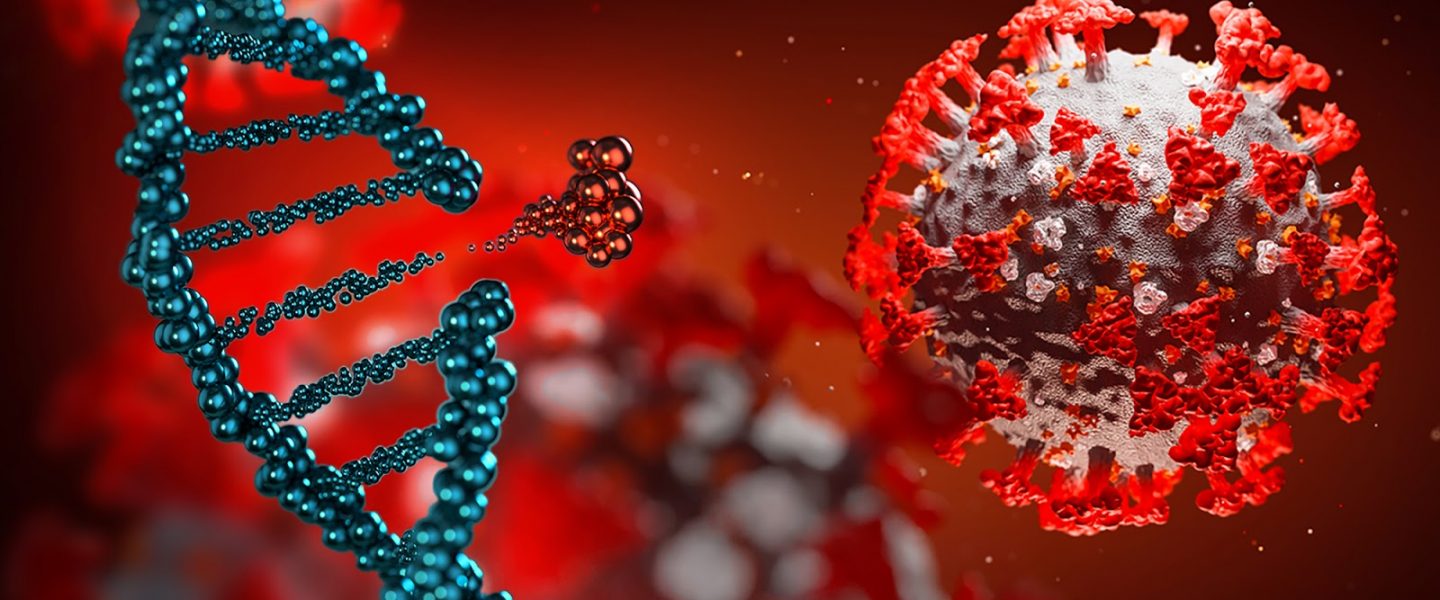
COVID-19, research, CRISPR

While the intelligence community remains torn on the issue, Americans feel strongly that the COVID-19 pandemic began in a Chinese lab.

Scientists and the US intelligence community remain split on whether the virus that triggered the COVID-19 pandemic developed naturally or came from a lab. For example, a recently declassified intelligence report said that both theories remain plausible. The American people are feeling a lot less ambivalent, according to a new poll. A solid majority of them believes that the virus originated in a Chinese lab.

Nearly one-third of respondents thought it was “definitely true” that the virus came from a lab while another 29 percent felt it was “probably true,” the poll, which was conducted by The Economist and YouGov, found.

That viewpoint was especially prevalent among voters of former President Donald Trump. A whopping 87 percent of them believe that the virus definitively or probably came from a lab.

But even Democrats are more likely to think that the “lab leak theory” is true than not. Only a quarter of them are of the opinion that it is false as opposed to 44 percent who believe it is true.

Perhaps the most striking finding of the poll is the low number of Americans who think that the lab leak theory is “definitively false.” Overall, only 5 percent of them feel that way as opposed to more than six times as many who think it is “definitively true.”

The poll also included several other interesting findings. For example, a quarter of Trump voters denied that there even was a COVID-19 pandemic. It doesn’t really make sense that 87 percent of them believe the pandemic started in a lab but 25 percent think it didn’t happen.

Republicans were more likely to say that they had tested positive for COVID-19. A total of 39 percent of them said they had personally tested positive as opposed to 31 percent of Democrats. That is probably not surprising as conservatives were more likely to resist lockdown and social distancing measures early on in the pandemic.

The poll also showed that about one-quarter of Americans have not been vaccinated at all. Predictably, that number is highest among Republicans, 32 percent of whom did not receive any COVID-19 shots. What stands out is that 30 percent of independents also said they had not been vaccinated.

Two-thirds of Americans have received two or more shots, and this is a figure that is consistent among all age groups and most demographics.

About the same number of poll respondents said that they believe that the pandemic is now over, while only about a quarter of Americans think it is ongoing. Once again, the starkest contrast is between voters for President Biden and former President Trump.

Nearly 40 percent of Biden voters expressed their belief that there is currently a COVID-19 pandemic. Only 9 percent of Trump voters shared that view.

Finally, 30 percent of Americans said they either had a family member or a close friend who experienced ongoing symptoms referred to as “long COVID.”


Donald Trump, Supporters, January 6

Will Trump supporters stage another insurrection if Joe Biden wins reelection? One-third of Americans think so.

Just about one-third of Americans believe that Republicans will stage another violent insurrection at the US Capitol if President Joe Biden wins reelection next year, according to a new poll.

That is a staggeringly high number for a country that, until Donald Trump, prided itself on a peaceful transfer of power every four (or eight) years for more than 200 years.

However, large numbers of Americans across the ideological spectrum apparently feel that this is now a thing of the past.

While this opinion was most prevalent among Democrats, more than a quarter of Republicans also believed that it is either somewhat or very likely that “there will be a violent attempt at taking over the Capitol” to stop Congress from certifying the election.

Obviously, seeing how he is the runaway favorite to win the GOP nomination next year, the result could be a reflection of the belief of Americans that Trump, specifically, would incite violence again.

It is interesting that people who voted for the former president in 2020 were least likely to say that another insurrection was upcoming if Biden won.

Among all of the demographics that were quizzed in this poll, conducted by The Economist and YouGov, young people felt most strongly that more violence was on the horizon if the Republican candidate lost.

Nearly half (46 percent) of Americans from the ages of 18 to 29 anticipate another attack on the Capitol.

The poll also found that 18 percent of people believe that Democrats would stage their own insurrection if Biden lost.

With another indictment related to the events of January 6, 2021, looming, a plurality of Americans felt that Trump should be charged with a crime. However, the country is almost evenly split on the issue.

Things are a bit clearer when it comes to whether Trump bears responsibility for what happened. Less than one-third of Americans believe that the former president is completely blameless for what happened. That number would be significantly lower if 62 percent of his own voters hadn’t expressed that they felt that way.

Nearly half of all Americans (and independents) said Trump urged his supporters to engage in violence on that day.

Overall, the country does not approve of what happened on January 6. Three out of four Americans said they disapproved of the takeover of the Capitol. This is also a position held by 60 percent of Republicans.

Finally, Americans are split on whether the congressional investigation into the January 6 insurrection and Trump’s role in it was a serious attempt to get to the bottom of what happened or an attempt to embarrass the former president.

Thirty-six percent of respondents said the probe was a good-faith effort while 32 percent believe it was politically motivated. Another 20 percent felt that it was a bit of both.

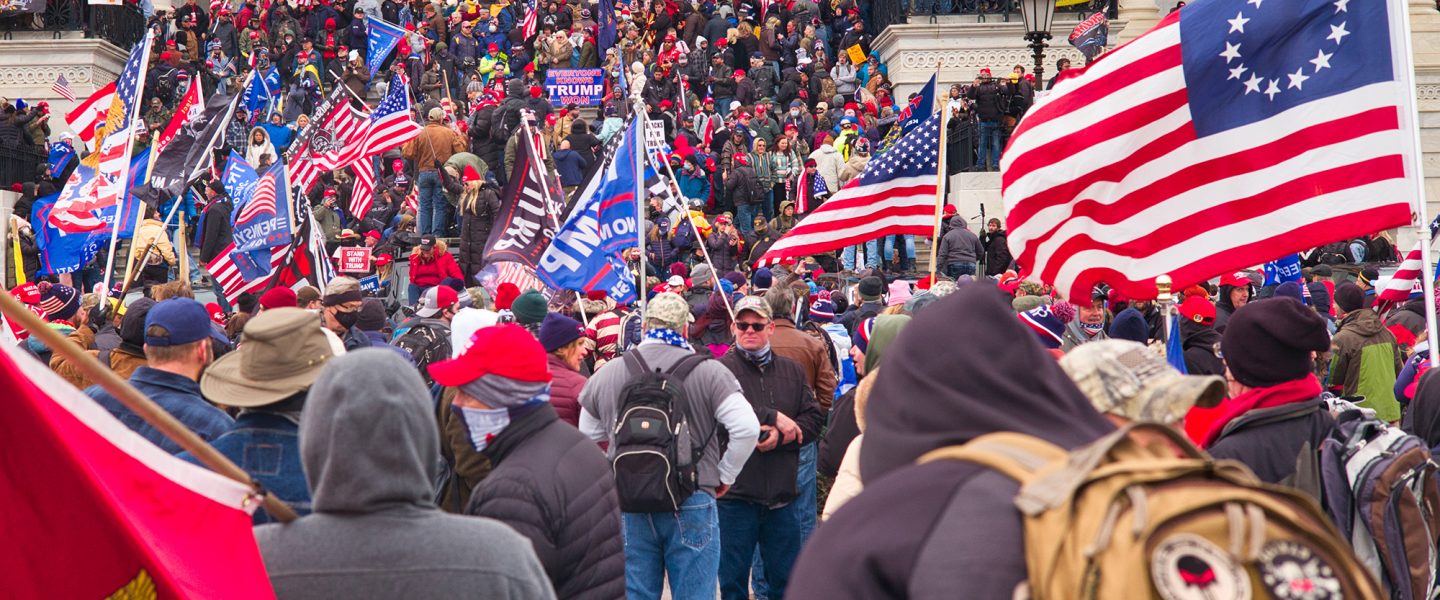
Supporters of Donald Trump breaching the US Capitol on January 6, 2021. Photo credit: Brett Davis / Flickr (CC BY-NC 2.0)

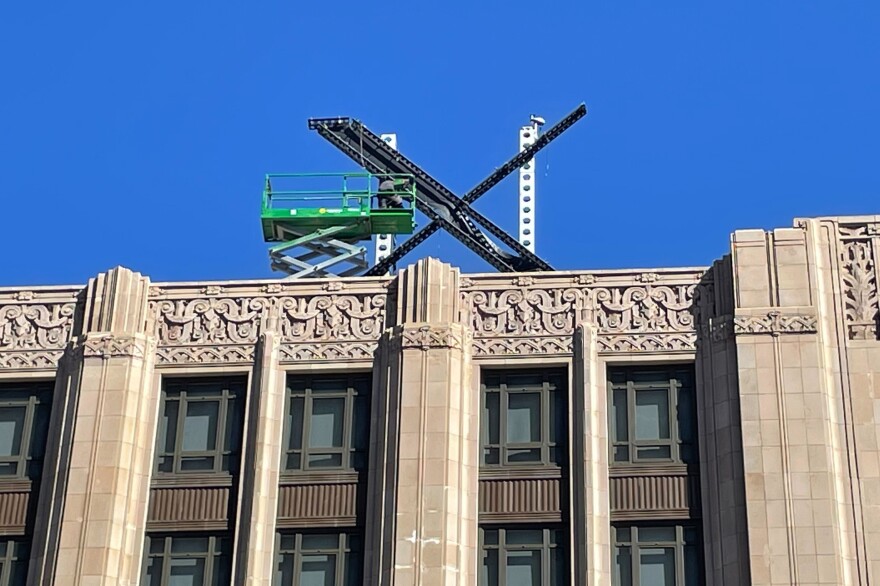
'X' logo installed atop Twitter building, spurring San Francisco to investigate

By The Associated Press
Published July 28, 2023 

Haven Daley
APA large metal "X" sign is seen on Friday on top of the downtown San Francisco building that housed what was once Twitter.


SAN FRANCISCO — The city of San Francisco has opened a complaint and launched an investigation into a giant "X" sign that was installed Friday on top of the downtown building formerly known as Twitter headquarters as owner Elon Musk continues his rebrand of the social media platform.

City officials say replacing letters or symbols on buildings, or erecting a sign on top of one, requires a permit for design and safety reasons.

The X appeared after San Francisco police stopped workers on Monday from removing the brand's iconic bird and logo from the side of the building, saying they hadn't taped off the sidewalk to keep pedestrians safe if anything fell.

Any replacement letters or symbols would require a permit to ensure "consistency with the historic nature of the building" and to make sure additions are safely attached to the sign, Patrick Hannan, spokesperson for the Department of Building Inspection said earlier this week.

Erecting a sign on top of a building also requires a permit, Hannan said Friday.

"Planning review and approval is also necessary for the installation of this sign. The city is opening a complaint and initiating an investigation," he said in an email.

Musk unveiled a new "X" logo to replace Twitter's famous blue bird as he remakes the social media platform he bought for $44 billion last year. The X started appearing at the top of the desktop version of Twitter on Monday.

Musk, who is also CEO of Tesla, has long been fascinated with the letter X and had already renamed Twitter's corporate name to X Corp. after he bought it in October. One of his children is called "X." The child's actual name is a collection of letters and symbols.

On Friday afternoon, a worker on a lift machine made adjustments to the sign and then left.
How many transgender and intersex people live in the US? Anti-LGBTQ+ laws will impact millions

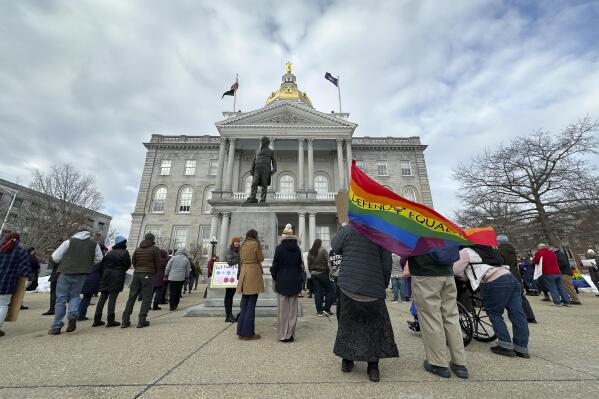
People gather in support of transgender youth during a rally at the Utah State Capitol Tuesday, Jan. 24, 2023, in Salt Lake City. New laws targeting LGBTQ+ people are proliferating in GOP-led states, but often absent from policy decisions is a clear understanding of how many people will be directly affected. 
(AP Photo/Rick Bowmer,File)

A protester outside the Kansas Statehouse holds a sign after a rally for transgender rights on the Transgender Day of Visibility, Friday, March 31, 2023, in Topeka, Kan. New laws targeting LGBTQ+ people are proliferating in GOP-led states, but often absent from policy decisions is a clear understanding of how many people will be directly affected
 (AP Photo/John Hanna, File)

BY REBECCA BOONE AND JEFF MCMILLAN
July 27, 2023

New laws targeting LGBTQ+ people are proliferating in GOP-led states, but often absent from policy decisions is a clear understanding of how many people will be directly affected.

There has been relatively scant data collected on the number of LGBTQ+ residents in the U.S., particularly intersex people — those born with physical traits that don’t fit typical definitions for male or female categories. That means lawmakers are often writing laws without the same kind of baseline information they might have for other demographic groups.

“We can’t study the impact without knowing the population,” said Christy Mallory, legal director of the Williams Institute at the UCLA School of Law. The Williams Institute is a think tank that researches sexual orientation and gender identity demographics to inform laws and public policy decisions.

RELATED STORIES

Many transgender health bills came from a handful of far-right interest groups, AP finds

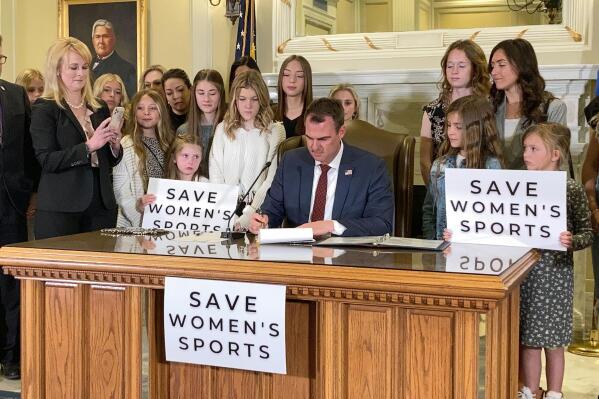
Oklahoma, Arizona governors sign transgender sports bans

Kansas lawmakers botched the drafting of a new anti-trans law, agency attorney says

Here’s a look at what we know and what we don’t know about the number of people in the U.S. who are LGBTQ+ or intersex.
___


WHY DOES IT MATTER?

Legislative decisions to ban transgender women and girls from playing school sports often fail to consider the impact on intersex students.

A new Kansas law defines a person’s sex as male or female, based on what it calls the “biological reproductive system” identified at birth, leaving no room for intersex people, and ignoring the existence of transgender and nonbinary Kansans.

Meanwhile, conversations about gender-affirming care bans were at times clouded by a discredited 2018 study that claimed kids might experience gender dysphoria because of peer influence. This led to erroneous suggestions that the number of trans people was inflated.

Arguments based on the discredited study helped gender-affirming care bans pass in Georgia, Idaho and elsewhere.

“Social media and social pressures that are put on our youth, and I do think that could play into this a little bit,” said Idaho Republican Sen. Doug Ricks during a statehouse debate earlier this year. “It’s difficult. And the conflicting testimony about the studies — there’s good arguments that validate those, and others that disvalidate that.”

While most states’ bans on gender-affirming care have attempted to carve out exceptions for people who are born intersex, they could still make it harder for intersex people to receive medical care, said Erika Lorshbough, executive director of InterACT, an advocacy group that works to advance the rights of children born with intersex traits. Physicians and other medical practitioners who treat intersex people might be confused by the laws or unsure about their potential liability, especially if an intersex patient also identifies as LGBTQ+, Lorshbough said.
___

HOW MANY PEOPLE ARE INTERSEX?

Most advocacy groups estimate that 1.7% percent of people are born intersex — the equivalent of about 5.6 million U.S. residents. That estimate is based on a review published in the American Journal of Human Biology that looked at four decades of medical literature from 1955 to 1998. The estimate includes people with extra or missing sex-linked chromosomes, and those born with other physical variations that don’t fit into categories of “male” or “female.”

Intersex people are born with at least one of about 40 naturally occurring variations relating to their genitalia, internal reproductive organs, chromosome patterns or hormones.

Not all intersex people are identified as such at birth, and those who are may still be listed as either “male” or “female” on their birth certificate. That’s because only about 16 states currently allow a gender marker designation other than “male” or “female” on birth certificates, and not all hospitals have intersex-affirming policies.

Some intersex characteristics might not be evident until puberty or later — in fact, sometimes people don’t know they are intersex until they seek treatment for infertility or undergo other unrelated medical procedures. Others might only find out if they run across medical records from their childhood, because many intersex infants and children are subjected to surgeries and treatments without their consent to make their bodies conform to categories of male or female, according to the American Academy of Family Physicians. Since 2018, the AAFP has opposed medically unnecessary genital surgeries performed on intersex children.

“Some people never know they’re intersex if they have what we think of as a milder variation,” said Lorshbough. “And there are plenty of folks with variations in sex characteristics who don’t identify as intersex, and these issues impact them equally. It’s all about consent and autonomy.”

Hospitals aren’t required to track information about how many babies are born with intersex characteristics, and there has never been a nationwide survey on intersex status done by the U.S. Census Bureau, the National Institutes of Health or another government agency that normally collect demographic data, said Lorshbough.

That means there isn’t enough data to calculate a definitive population number.
___

HOW MANY PEOPLE ARE LGBTQ+?

There are more than 13 million people who are lesbian, gay, bisexual or transgender in the U.S. ages 13 and older, including about 300,000 young people and 1.3 million adults who identify as transgender, according to the Williams Institute. Nearly half of them live in states without protections from discrimination at work, in school, in housing, public accommodations and credit.

Polling by KFF and The Washington Post shows that there are nearly 2 million people nationwide who identify as transgender or trans, representing less than 1% of all adults. The poll found that most trans adults are younger than 35 years old, and the vast majority — nearly 8 in 10 — say that transitioning made them more satisfied with their life. Two-thirds of trans adults say they realized they were trans in childhood, and about one-third say they began to understand when they were 10 years old or younger.

The Census Bureau did not add questions about sexual orientation and gender identity until 2021, though it did begin collecting data about households led by same-sex couples in the 2010 census. The 2021 U.S. Census Household Pulse Survey found that 0.6% of responding adults described themselves as transgender and 1.7% described themselves as neither male, female nor trans.

The same census survey found that 4.4% of adult respondents thought of themselves as bisexual, 3.3% said they were gay or lesbian, and 88.3% said they were straight. Around 2% said they were “something else” or that they didn’t know.
___

ARE MORE PEOPLE IDENTIFYING AS LGBTQ+ NOW?

It’s difficult to tell. Efforts to quantify the number of LGBTQ+ people, including intersex people, in the U.S. were scarce until the last few decades, and stigma likely prevented some from disclosing their identities. There is some overlap between the groups; intersex people are included in the plus sign in LGBTQ+, and some intersex people also identify as gay, lesbian, bisexual, transgender or queer.

From their demographic studies in 2017 and 2022, The Williams Institute noted a slight increase in the number of young people identifying as transgender, but Mallory said additional research will give a more accurate picture.

“This kind of data collection on transgender status is very new for youth,” and some of the increase could be because more states are asking about transgender status during surveys of high school students, Mallory said. “But you know, some of it is probably youth feeling more comfortable identifying as trans.”