It’s possible that I shall make an ass of myself. But in that case one can always get out of it with a little dialectic. I have, of course, so worded my proposition as to be right either way (K.Marx, Letter to F.Engels on the Indian Mutiny)
Friday, September 08, 2023
SO MUCH FOR P3'S
UK's Marquee Offshore Wind Auction Attracts Zero Bids as Costs Soar
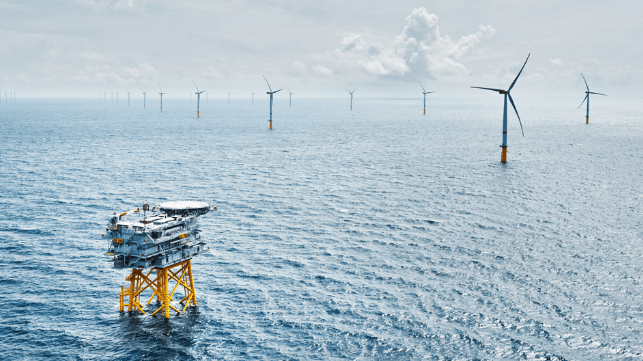
Vattenfall's Norfolk offshore wind project. Work on the Norfolk Boreas segment was recently suspended due to cost increases (Vattenfall)
In what environmental campaigners called a "monumental failure" for the UK's renewable energy goals, the country's latest auction for offshore wind price contracts failed to attract any bids at all. It is the latest and most serious sign of profound economic change in the offshore wind industry, which has to contend with much higher supply chain and lending costs than it did just a few years ago.
The UK provides price stability to renewable-energy developers through its Contracts for Difference (CfD) auction system. Wind developers who bid successfully for a CfD contract receive a guaranteeed sale price for their electricity production for 15 years. Historically, the system has worked well - well enough to power about 40 percent of the UK electrical grid with offshore wind.
But this year, for the sixth CfD auction round, offshore wind developers say that the terms of the CfD pricing mechanism are no longer enough to offset soaring costs for steel, labor, components and interest payments.
According to developers, costs for a new wind farm are up by as much as 40 percent since the last CfD auction. Those costs are beginning to bite: last month, developer Vattenfall took the rare decision to halt work on the giant Norfolk Boreas wind farm because of high inflation and higher capital costs. CEO Anna Borg told media that "it simply doesn't make sense to continue this project" in the current cost environment. Vattenfall is said to be in early conversations about selling the project.
Despite these warning signs, the government's price floor for the latest CfD auction has increased little from the last round, according to industry groups. Under the circumstances, most developers were expected to sit out the auction; when the sealed bid results were unveiled, it became clear that all had walked away.
The UK's Department for Energy Security noted that other nations have had similarly disappointing results in recent auctions. "While offshore and floating offshore wind do not feature in this year’s allocation, this is in line with similar results in countries including Germany and Spain, as a result of the global rise in inflation and the impact on supply chains which presented challenges for projects participating in this round," the department said in a statement.
However, Welsh nationalist party Plaid Cymru noted that Ireland had adapted its auction terms to the current market and attracted investment in four new offshore wind farms. "Wales is losing to Ireland due to the UK government’s poor planning," asserted Plaid Cymru environment spokesperson Ben Lake.
Climate campaigners put the auction's results in starker terms. "This monumental failure is the biggest disaster for clean energy in almost a decade. Thanks to cost pressures and inept government policy, this auction round has completely flopped - denying bill payers access to cheap, clean energy," said Greenpeace UK policy director Doug Parr. "It leaves the UK more dependent on expensive, imported fossil gas."
Other elements of the renewables auction were successful, attracting strong bids for solar and tidal power development. In this round, tidal had its own set-aside, and seven small-scale projects totaling 53 MW were approved.
Green Energy: Wind and Solar Drive Growth in the Breakbulk Sector
(Article originally published in July/Aug 2023 edition.)
With a global push to develop various types of green energy and major construction projects on the books across North America, the competition to attract business in the marine sectors of heavy lift, breakbulk and project cargoes is creating its own energy.
The port of San Diego recently strengthened its position in these areas by adding some major lift capacity.
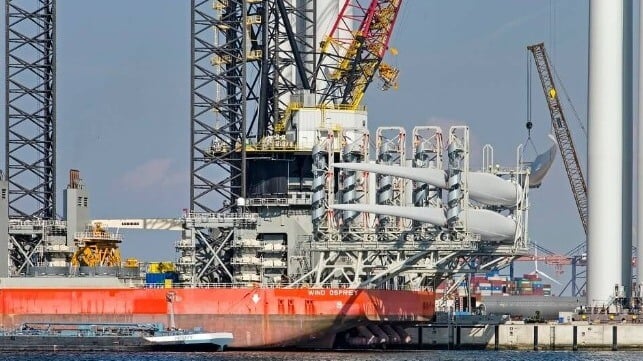
It purchased two all-electric Gottwald Generation 6 Mobile Harbor Cranes from Konecranes that will replace the diesel-powered crane at the Tenth Avenue Marine Terminal (TAMT). These all-electric cranes will be the first in use in North America and will support the port’s strategy of healthy air for all.
The cranes are expected to be operational later this year. The port invested approximately $14 million in the cranes and spent an additional $8.9 million to make the required electrical infrastructure improvements.
Greg Borossay, the port’s Principal for Maritime Business Development, says the motivation to buy the cranes was threefold: To be on the cutting edge of the electrification of heavy lift equipment; from an environmental standpoint, to get rid of the old diesel-powered crane, and to develop more capacity to develop business in heavy lift and breakbulk areas.
San Diego now has the heaviest lift capacity on the West Coast from Vancouver, Canada to the Panama Canal, he says: “This puts us in a good spot for project cargo, especially pieces that are over 200 metric tons. With the two new cranes working in tandem, there will be a lift capability of 400 metric tons.” There will be eight positions for the cranes to work on the dock and four away from the docks because the cranes can be used for rail moves as well.
Heavy lift, project and breakbulk cargoes make up 12 to 15 percent of San Diego’s total tonnage. On its Saga Welco service, it handles steel pipe, coils, H-beams, steel plates and fabrication for electrification projects in the U.S. Southwest plus project cargo out of South Korea and Taiwan.
Other project cargo from northern Europe, like transformers and heavy lift equipment, is primarily destined for Arizona, New Mexico and Nevada where there are several electrification projects underway. On its U.S. Ocean service, the port handles heavy lift and breakbulk plus military equipment and special project cargo going to South Korea and Japan.
Cargo Diversity
Port Tampa Bay is Florida’s largest port for handling steel products serving the construction, manufacturing and mining industries, says Wade Elliott, Senior Vice President of Marketing & Business Development.
“Throughout the port and the Tampa Bay region, there are many companies that specialize in the processing, distribution, fabrication and manufacturing of steel products,” he explains. “We also handle lumber for the home improvement and construction sectors.”
Elliott adds that “Steel and other products for the solar industry have been one of our fastest growing breakbulk segments. High-and-heavy construction equipment pieces, many of which come from the region’s large industrial equipment auctions, are imported and exported through the port using our foreign trade zone.”
Port Tampa Bay has 500,000 square feet of transit shed space, over 5,000 linear feet of berth and over 100 acres of laydown area for breakbulk and project cargo. “We’re currently expanding laydown area at our new Eastport facility and are planning to construct up to 500,000 square feet of additional on-dock, transload warehouse capacity at our primary terminals on Hookers’ Point,” says Elliott.
Within the past year, logistics provider Glovis launched a new ro-ro service delivering automobiles manufactured in Mexico. And Ultrabulk provides regular breakbulk service delivering lumber from Northern Europe.
“While Port Tampa Bay is well known as Florida’s largest port, what really sets us apart is the diversity of our multiple lines of business,” notes Paul Anderson, President & CEO of Port Tampa Bay. “Breakbulk is a critical component of this diversification and an area we remain committed to expanding thanks to our abundant real estate holdings.”
Infrastructure Upgrades
For the fiscal year-to-date through May, the Georgia Ports Authority (GPA) has handled 2.8 million tons of breakbulk cargo or eight percent of GPA’s 37.2 million tons of cargo handled during that time. Most breakbulk cargo for GPA falls under ro-ro, forest products and rubber.
Heavy-lift cargo is handled at the port of Brunswick, arriving by ro-ro vessel at the Colonel’s Island Terminal and loaded on rail or multi-axle, over-the-road chasses. To handle the heavy cargoes and accommodate heavy-lift cranes, GPA is improving the paving adjacent to its near-dock rail.
Additional infrastructure upgrades at Brunswick include replacing a 50,000-square-foot cargo shed at the Mayor’s Point Terminal with a new, 100,000-square-foot warehouse with up-to-date life safety improvements and flooring upgrades to handle heavier loads. The project will be completed in mid-September. The new warehouse will handle rubber imports.
In addition to rubber, GPA’s breakbulk cargoes include forest products and heavy equipment for farming and construction. The deepwater port of Brunswick is considered an ideal gateway for the import-export of breakbulk cargo, especially in light of the port’s easy connectivity to road and rail.
“GPA’s ability to handle breakbulk cargo is important for the authority and its customers because it adds options for logistics operators, delivering flexibility on routing, schedules and transportation costs,” says GPA Executive Director Griff Lynch.
To accommodate more ro-ro cargo carried by Wallenius Wilhelmsen, GPA is making improvements to the Colonel’s Island Terminal. Construction has started on 350,000 square feet of near-dock warehousing that will serve auto processing as well as on three additional buildings and 85 acres of auto storage space on the south side of the island. The improvements will grow annual capacity at Colonel’s Island from 1.2 million to 1.4 million units.
Epicenter of Offshore Wind
South Jersey Ports, which operates four marine terminals in three cities in southern New Jersey – two in Camden and one each in Paulsboro and Salem – specializes in bulk, breakbulk and project cargo and handles over four million tons of cargo annually. Main cargoes include wood products, cement, cocoa beans and steel.
Like other ports, South Jersey is also seeing the benefits of wind energy development. South Jersey Ports has been working with its partners to develop the infrastructure to become the epicenter of the offshore wind industry.
Paulsboro Marine Terminal will handle the monopiles for Ørsted’s Ocean Wind 1 offshore wind project. The project will require 98 monopiles, each weighing approximately 1,500 tons and standing almost 500 feet tall.
“The EEW Group is one of the world's premier manufacturers of monopiles, which are the foundations upon which the towers and wind turbines will sit,” explains Brendan Dugan, the port’s Assistant Executive Director & Chief Commercial Officer. “EEW is from Germany and has established an American affiliate (EEW AOS) at our Paulsboro Marine Terminal. They’ve already built Phase 1 of their manufacturing plant – a weld building and a coating building.”
He says that Phase 2, when complete, “will mean the entire manufacturing process from the importing of raw material and rolling the steel will all be done at EEW's manufacturing plant at our Paulsboro Marine Terminal.”
The port of Galveston is also a benefactor of the global push for green energy. The port has long been a major U.S. importer of wind turbine pieces. With the extension and increase in federal tax credits for wind energy projects, the port is once again seeing higher tonnages for this heavy-lift cargo. That trend is expected to continue.
“This is all good news for Galveston labor unions because breakbulk and ro-ro are hands-on cargoes requiring skilled labor,” says Executive Deputy Port Director Brett Milutin. “The port’s labor unions have years of experience in moving these specialized cargoes by crane from ships to trucks and rail.”
Galveston has also seen significant growth in ro-ro and breakbulk imports in the first half of 2023. Compared to last year, new vehicle tonnage is up 113 percent and ro-ro cargo has increased 10 percent.
Insuring Cargoes
While ports globally are developing strategies to insure clean air, shippers and cargo owners are looking for insurance of a slightly different nature – the kind that covers the value of their products against a multitude of scenarios that could cause harm during transit. So insuring cargoes is as vital as San Diego’s new cranes.
The upcoming Houston Marine & Energy Insurance Conference (Sept. 24-26) offers a venue to research insurance programs. The conference has attracted top talent in the marine, energy, insurance and admiralty law industries and has become the preeminent meeting place for the global marine and energy insurance business.
Steven Weiss, President of Steven P. Weiss Consulting Inc., has a vast background in ocean and inland marine insurance including over 32 years of experience as a marine surveyor, loss adjuster, direct insurance and reinsurance underwriter.
He offers a few tips when shopping for cargo insurance.
“Don’t just focus on cost,” he advises. “Your freight forwarder may tell you you’re covered under his liability policy, but that’s very limited coverage and you’re better off purchasing all-risk coverage though specific exclusions will probably apply. Don’t lie on the application. That’s not only insurance fraud but can make your policy canceled back to inception if it’s relevant to the loss. List all cargoes you expect to move, how much per year, how much per shipment. Do you need stock coverage? Expect to pay more than last year for catastrophic exposure coverage.”
He says different cargoes have different susceptibilities, and most cargo damage is due to inadequate packing. So it’s important to choose quality packers and freight forwarders: “Review their processes and procedures. Review and be a certificate holder on their liability insurance. Ship your cargo by the most appropriate method of transportation – truck, rail, barge, ship, airplane or the best combination. Use marine surveyors to assist in developing packing guidelines or how to improve in the event you’re having consistent losses.”
Sound words from an expert!
Ports columnist Tom Peters writes from Halifax.
Australian Icebreaker Transits 4,000 NM for Antarctic Medevac Case
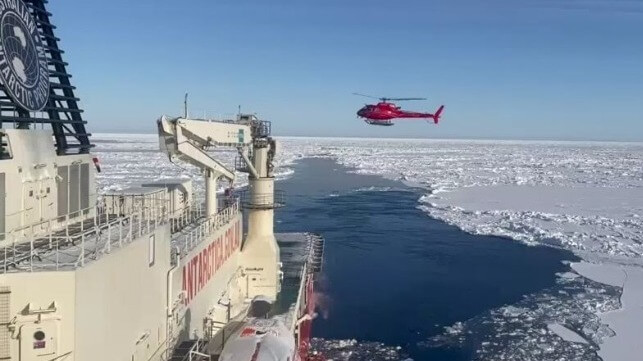
One of Nuyina's two helicopters returns from the successful medevac flight (AAD)
The Australian icebreaker Nuyina is undertaking an ultra-long-distance rescue mission to medevac one person from the Casey Antarctic research station, which lies about 1,900 nautical miles away from the vessel's home base in Tasmania.
According to the Australian Antarctic Division (AAD), a researcher at the remote base was suffering from an unspecified medical condition and needed advanced care. The base's airstrip is closed in the southern hemisphere's winter, given the snowdrifts and harsh weather, leaving medevac by ship as the only available option. Other Antarctic research programs did not have assets available to help, according to the division.
Nuyina left Hobart, Tasmania on August 24 (GMT) and got under way for Casey station, making about 14 knots. She had three medical personnel aboard to tend to the patient while under way, including a specialist from Royal Hobart Hospital, the AAD told Australian media.
By September 1, she had made the crossing and maneuvered through drifting ice to a position within 80 nm of the station. This was within helicopter range, and Nuyina's crew dispatched two helicopters (a primary and a backup) to retrieve the patient. The crew benefited from a favorable weather window, and the helicopters successfully retrieved the individual and returned to the ship. Nuyina got under way once more on September 3, headed northeast towards Tasmania.
"It's the earliest we've ever gone to an Antarctic station — just a day or two after the official end of winter," Australian Antarctic Division operations manager Robb Clifton told ABC Australia. "We were really only able to attempt it because of the fantastic capabilities the Nuyina gives us in terms of icebreaking and aircraft capability."
Nuyina will have transited about one-quarter of her maximum range by the time she returns. If she wishes to refuel, she will have to make a second trip several hundred miles around Tasmania. The ship is too large to pass under Hobart's Tasman Bridge, so she cannot reach her local fuel pier - even though it is just two miles away from her berth at the AAD base.
SERIOUSLY
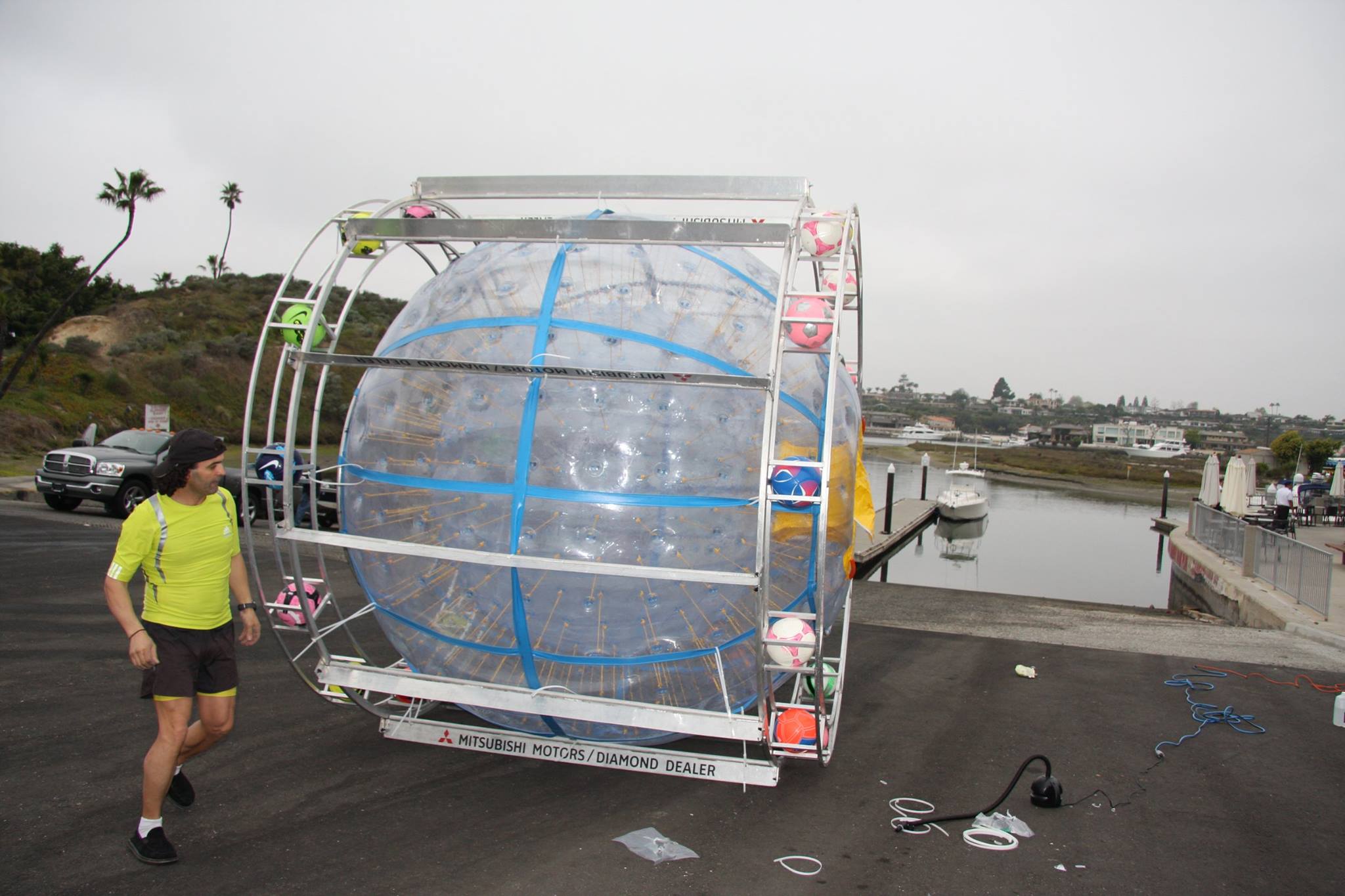
Florida Man Arrested After Fourth Attempt at "Hamster Wheel" Voyage
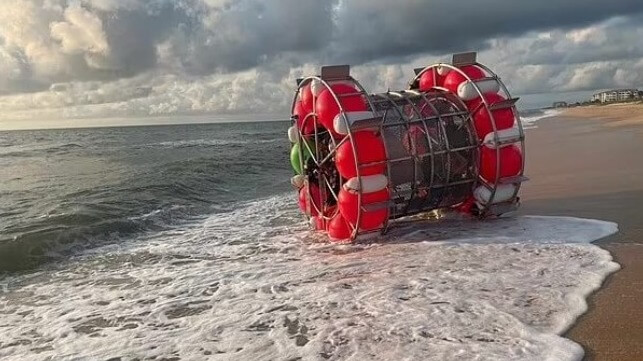
Baluchi's latest version of the device after an aborted transit in 2021 (Flagler County Sheriff's Office)
Once again, the U.S. Coast Guard has intercepted and detained a former professional athlete for an ill-advised attempt to cross the Atlantic in a drum-like paddle wheel device of his own design.
Reza Baluchi, 51, was on his fourth attempt to make a human-powered ocean voyage with an improvised craft. His vessel of choice is a human-powered cylinder, which has been compared to a hamster wheel; by running inside of it, the operator causes it to rotate, potentially propelling it forwards.
Baluchi's previous attempts have not fared well. In his first, he allegedly signaled for help and was rescued by the Coast Guard. After this incident, the Coast Guard warned him that he would have to conduct any future voyages in this device with a support vessel alongside, or not at all. Baluchi has repeatedly breached that order. In 2021, he explained to the Times that he had put everything he had into the device, and a support vessel would be prohibitively expensive.
A previous iteration of the device (Reza Baluchi)
The latest attempt, like the previous three, ended shortly after it began. The U.S. Coast Guard cutter Valiant intercepted Baluchi at a position about 70 miles off Tybee Island. This time, Baluchi told the officers that he was under way for London, and he resisted a boarding. Baluchi allegedly told the Coast Guard that he would take his own life if anyone tried to detain him. He later upgraded the threat by claiming that there was a bomb on board, and that he would detonate it if needed to prevent arrest.
The crew of the Valiant took the threat seriously, and they consulted with a U.S. Navy EOD team to determine the potential blast radius of any possible bomb on board. They were joined soon after by the cutter Campbell, which launched its small boat to deliver Baluchi food and water. The officers informed him of the approach of Hurricane Idalia and again ordered him off the vessel.
After a two-day standoff, Baluchi admitted that there was no bomb on the improvised craft. One more day later, he was disembarked from the craft and taken into Coast Guard custody. The crew delivered him safely to Miami Beach on September 1.
Baluchi has been charged with obstructing a boarding and violating a captain of the port order. "Based on the condition of the vessel – which was afloat as a result of wiring and buoys – USCG officers determined Baluchi was conducting a manifestly unsafe voyage," the arresting officer said in a charging document.
Before his venture into improvised craft, Baluchi was a professional cyclist and long-distance runner, known for his charity fund-raising runs. He has said that proceeds from charitable giving connected to his ocean crossing attempts would be donated to the U.S. Coast Guard, among other recipients.
Amazon Adds Methanol Bunkering to Eco-Transport Deal with Maersk
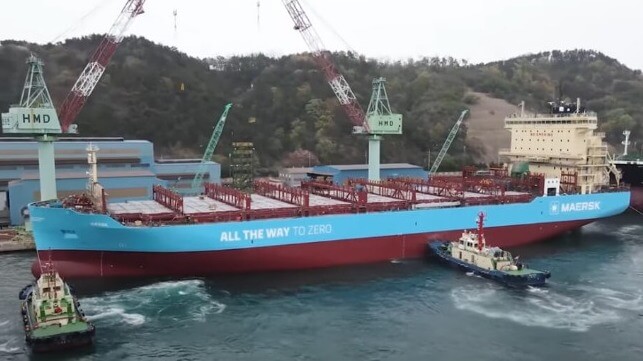
Maersk's first green methanol-powered container feeder, July 2023 (Maersk)
Amazon and Maersk have closed on a contract agreement for moving about 40,000 TEU worth of cargo using green biofuel. The partners have reached similar agreements for the past four years, but this is the first time that the mix will be supplemented by green methanol as a second alternative fuel.
Amazon will have containers on Maersk's first-ever methanol-fueled feeder vessel, and will continue to benefit from green biofuel transport. According to Maersk, the agreement will lead to an emissions reduction of 45,000 tonnes of CO2 over the course of the year when compared to standard bunker fuel.
Maersk's audited ECO Delivery service monitors fuel consumption under way in order to calculate emissions savings, and takes greenhouse gases other than CO2 into consideration in the algorithm. ECO Delivery accounts for about two percent of the shipping giant's cargo volume.
The firm said that the new agreement with Amazon will provide price stability, and it is de-linked from fossil fuel prices.
"We share a common goal with Amazon to reduce our total GHG emissions to net zero by 2040. . . . Decarbonizing shipping is one significant step that is to be combined with many others to protect our future," said Narin Phol, the president of North America at AP Moller-Maersk.
Maersk is the operator of the world’s first dual-fuel methanol containership, delivered by Hyundai Mipo in July. The company has led the way in ordering methanol-fueled tonnage, and it is also building a supply chain for the green methanol to fuel it. This will be a key factor going forward: the limited supply of the green fuel will be the primary bottleneck for adoption, according to analysts and insiders.
Fortescue’s Global Head of Shipping and Marine Projects, Andrew Hoare, warned earlier this month that the methanol supply chain (outside of Maersk's private portfolio) will not support the growing dual-fuel methanol fleet. "We know that there isn't enough methanol on the planet to supply those ships," he said, speaking at DNV’s Singapore Energy Transition 2023 Conference. “What is going to happen is they're just going to sell engines which are able to burn methanol and fuel oil, and they will only burn fuel oil.”
NO CONFINED SPACE SAFETY TRAINING
Three Crewmembers Died of Asphyxia on Chinese Bulker off Taiwan
Taiwan's National Airborne Service responded to an emergency call from a Chinese-owned bulker (National Airborne Service)
Taiwan is reporting that its National Airborne Service responded to an emergency call to evacuate three crewmembers from a Chinese-owned bulker off the eastern coast of the island on September 6. The rescue was complicated by winds, a sea chop, and the size of the bulker.
According to the report, the bulker MSXT Echo called for emergency assistance around 20:00 yesterday reporting that three crewmembers had been found passed out and unresponsive. The 85,000 dwt bulker is a new vessel having only entered service in 2022 after being built by CSSC Chengxi and delivered at the end of 2021. The 754-foot vessel is registered in Liberia and operates with a crew of approximately 20.
The ship is coming from Richards Bay, South Africa after loading coal. At the beginning of July, it was in Singapore and proceeded to Thailand and then South Africa. It was laying off the eastern Taiwan port of Hualien this week awaiting its berth. Media reports are saying due to its size it was being held offshore until a berth was due to become available this weekend.
The Coast Guard responded to the call for assistance but reported that they were unable to get alongside due to the wind and sea conditions. The difference in size between the Coast Guard vessel and the bulker made it impossible for them to board the bulker.
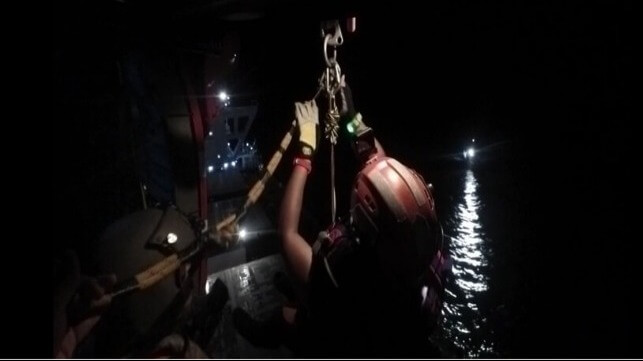
The airborne service was notified and a BlackHawk helicopter team reached the vessel around 21:50 about 10 miles offshore. They conducted a high and low-altitude reconnaissance and then proceeded to the rescue.
The three crewmembers were reported to have been working possibly in the vessel’s hold. The first was hoisted at 22:08 and transferred to shore. The second at 22:18 and also taken to shore before the third hoist at 22:38. All three men ages 27, 33, and 54 were not breathing and had no heartbeat. The hospital attempted to resuscitate them but pronounced them deceased. Permission has been granted to perform autopsies to confirm the cause of death.
The Taiwan Coast Guard was planning to board the ship in daylight to seal the area where the men had been discovered and begin an investigation.
China and South Korea Compete to Deliver First Large Ammonia-Fueled Ships
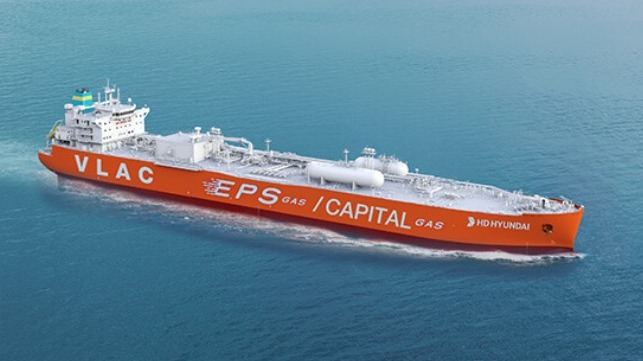
Hyunadai received orders for four ammonia-fueled gas carreirs that will be larger than vessels currently in service (HD KSOE)
The competition is on between Chinese and South Korean shipbuilders to introduce the first and largest ammonia-fueled large gas carriers as a result of Easter Pacific Shipping’s effort to lead the industry into the adoption of alternative fuels. After announcing the broad industry effort to accelerate the development and deployment of the first ammonia-fueled engines from MAN, additional details came out on the full scope of EPS’s aggressive ship orders placed this week.
Hyundai’s HD Korea Shipbuilding & Offshore Engineering reported two orders for a total of four very large ammonia carriers (VLACS) valued at a total of $463 million to be built at the shipyard in Ulsan, South Korea. Two of the vessels will be delivered directly to EPS while the other two are being built for Greece’s Capital Management and will be operated by EPS. They anticipate the deliveries will begin in the second half of 2027 and each contract includes an option for one additional vessel.
The South Korean shipbuilder is highlighting the vessels as the largest ammonia carriers compared to the current in-service fleet. The four ships will each have a capacity of 88,000 cubic meters of ammonia. The design anticipates converting the ships to ammonia propulsion while Hyundai notes that they are also working with EPS and MAN to develop the ammonia-fueled engines.
If the specifications are modified as planned, KSOE says these vessels will become the world’s first ammonia-powered carriers. They are also highlighting that with these orders they have received 19 of the 27 orders placed this year for large liquified petroleum gas/ammonia carriers. Also, with these orders, the shipyard has now exceeded 101 percent of its target for 2023 orders.
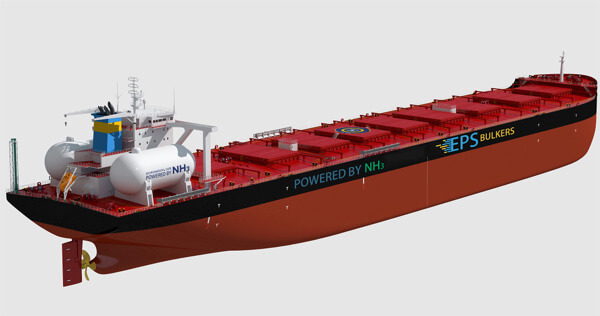
EPS also ordered three 210,000 ton ammonia-fueled bulkers to be built in China (CSSC)
Chinese’s Jiangnan Shipyard is reporting that it also signed contracts with EPS calling for the construction of two liquid ammonia carriers that it anticipates will have a capacity of 93,000 cbm. These vessels are based on an independent design developed by the shipyard adapting its current Panda 93 class, of which EPS already ordered four vessels in May 2023. The ships are a fourth-generation design and will be versatile and able to transport LPG such as propane and butane in addition to ammonia.
China State Shipbuilding Corporation’s Qingdao Beihai Shipbuilding Co. reports that it is also part of the ammonia-propulsion orders. They signed a contract for three 210,000-ton ammonia dual-fuel or dual-fuel ready bulkers with an option for three additional vessels all for EPS. The design places two, 3,000 cbm fuel tanks aft on either side of the deckhouse to fuel the ships. These ships are scheduled for delivery in 2026 and 2027.
Both shipbuilding companies will be joining EPS in the efforts with MAN to complete the design of the first ammonia-fueled marine engines. MAN has said it anticipates the designs will be completed by 2024 and that they would shortly thereafter be available to be incorporated into the ships. EPS has said it is taking an “act-now” approach to decarbonization looking to help lead the maritime industry in the transition.
Divers Discover Two Lost WWI Destroyers off Orkney
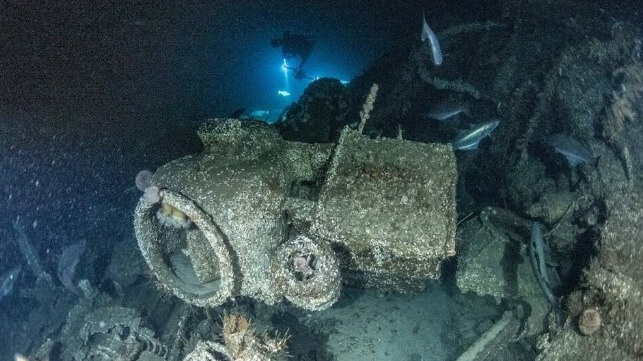
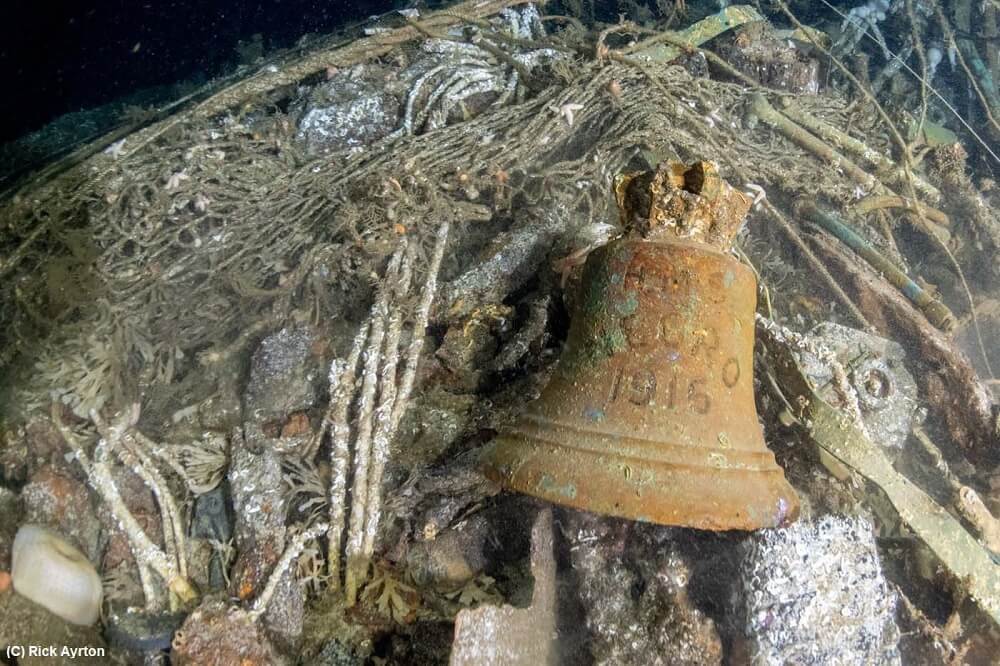
The wrecks of two WW1 Royal Navy destroyers – plus a merchant ship accidentally sunk when rammed by a British warship – have been identified by divers in Orkney.
HMS Hoste and Negro sank within hours of each other after colliding in December 1916 as they returned to the Fleet’s base in Scapa Flow, taking 55 souls with them.
And all aboard the small cargo steamer SS Express died when she was accidentally rammed and sunk by destroyer HMS Granville.
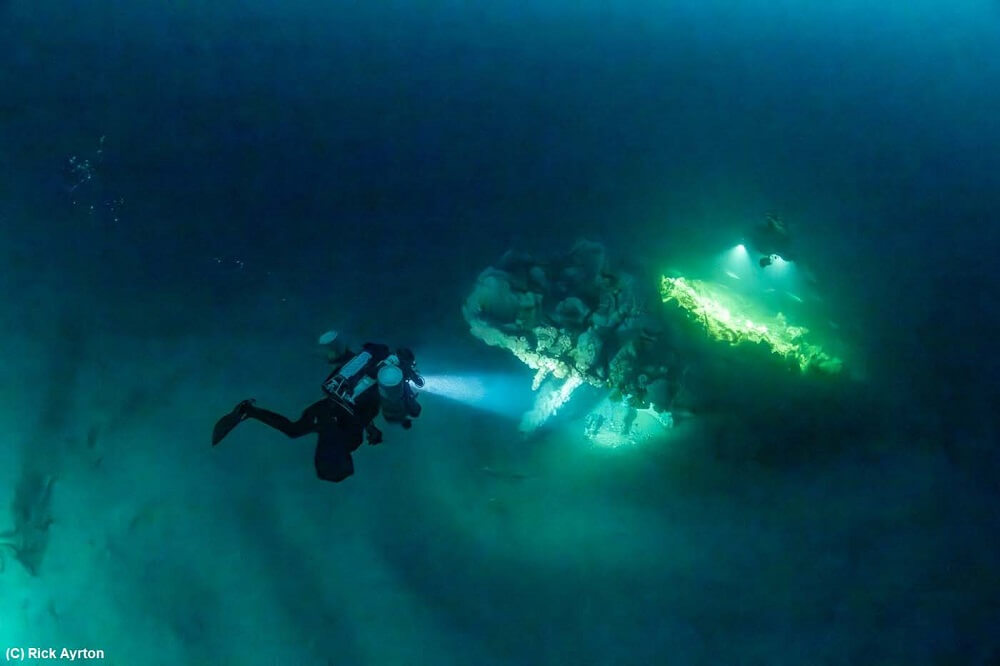
All three wrecks – plus a fourth, as-yet unidentified vessel – were found between Orkney and Fair Isle by the Lost in Waters Deep Expedition, a team of civilian divers determined to give peace of mind to families of seafarers by formally identifying lost vessels and their crew in Scottish waters.
Last year the divers discovered torpedo gunboat HMS Jason, sunk by a mine in the Inner Hebrides in 1917. This year, after extensive research in the archives and consultation of contemporary records and surviving ship’s logs by researcher Kevin Heath, the divers embarked diving support vessel MV Clasina in Orkney – and found the three wrecks they set out to discover.
“The dive team is delighted that we were able to prove Lost In Waters Deep remarkable research and help to honor the memories of everyone who died,” said expedition leader Will Schwarz.
Joining him in the cool Orkney waters was Lieutenant Commander Jen Smith, serving at Northwood, who’s also a keen amateur diver and wreck explorer.
Neither wreck was touched or disturbed by the divers, but they were extensively photographed and filmed. Their findings will be passed on to authorities and a detailed account of the expedition given at the Guz.tech diving conference in Plymouth in November.
“The fact that these wrecks have finally been found and identified is solely due to the commitment of a small group of civilians, who dedicate huge amounts of their own time and resource to this endeavor,” Lt Cdr Smith added.
“If it wasn’t for the efforts of the Lost in Waters Deep team, the final resting place of our lost sailors may never have been found. We are most grateful for the work they do and that the relatives and decedents of those lost now know the final resting place of their loved ones.”
Both warships lie around 100 meters (330ft) down. Hoste had been in service a month when the two ships sailed from Scapa Flow, the Royal Navy’s key base in both world wars, for exercises just six days before Christmas in 1916.
In the small hours of December 20, 1916, HMS Hoste suffered steering problems and was ordered to return to base, escorted by Negro. The two ships collided when Hoste was unable to maneuver due to a steering gear defect, and her escort was unable to avoid her.
Not only did HMS Negro smash into Hoste’s stern, but the collision also caused the release of depth charges which detonated and crippled Negro, and she sank fairly rapidly. Hoste was initially able to slowly proceed under her own steam, but a few hours later the worsening sea state caused the ship to break in two and she was also lost.
All but four of the 138 sailors aboard Hoste were rescued, but Negro lost 51 officers and men.
Separately, two Royal Marines gunners were among all 13 hands killed when the small steamer SS Express was struck by destroyer HMS Grenville in darkness in February 1918. The SS Express had an important role during the war as a supply vessel for the Orkney Islands, and has a special connection with Orcadians with almost all of her crew local men.
Nuclear Torpedo Drones and Their Legality in War
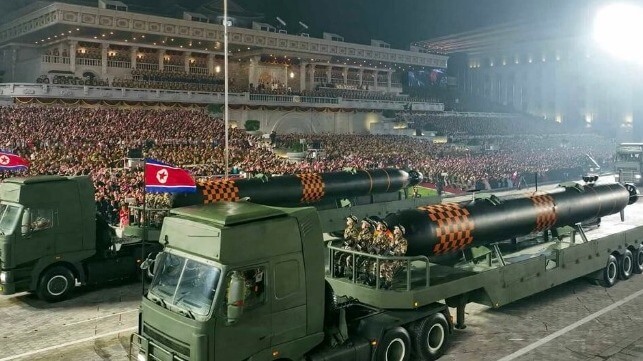
Pyongyang, July 27, 2023 – Haeil-class nuclear torpedo drones feature in a North Korean military parade. (Photo via North Korean state media)
Russia and North Korea are both fielding a novel type of naval weapon – nuclear-armed torpedo drones. These new weapons introduce a variety of strategic and operational challenges that further complicate a worsening threat environment. They also pose critical legal questions about whether their intended concepts of operation are lawful. These weapons have a fearsome potential to weaponize the maritime environment, and precise questions of their legality should be resolved in order to dissuade their proliferation.
North Korea and Russia’s Doomsday Torpedoes
On July 28, North Korea displayed a new nuclear-armed drone torpedo at the 2023 Victory Day Parade in Pyongyang. Although its official classification is unknown, the new weapon is likely a Haeil-class drone torpedo. The nuclear torpedo drone is approximately 52 feet long and 5 feet in diameter, has an estimated range of about 540 nautical miles, and can be fitted with a conventional or nuclear warhead. It could therefore be used against targets in both South Korea and Japan. The torpedo drone appears to have three air filters over the propulsion space for snorkeling, is likely powered by a diesel-electric (battery) propulsion system, has an average speed of 4.6 knots, and can operate at depths between 260-300 feet. Given the size of the drone, North Korea does not have a submarine large enough to launch it, which suggests that the new weapon system will need to be launched from shore, a floating platform, or a modified surface vessel.
The nuclear-armed underwater drone can be used to attack coastal naval installations or cities with little or no warning, providing North Korea with a strategic nuclear weapons delivery option that is difficult to detect and defend against. Thus, the Haeil-class drone provides North Korea with an additional strike option, increasing the resilience of its nuclear forces and making them less vulnerable to preemption or counterattack.
The Haeil-class drone torpedo is similar to (but smaller than) the Russian Poseidon, an intercontinental, nuclear-powered, nuclear-armed autonomous torpedo that was first revealed by the Russian Navy in 2015. The Poseidon (also known as Kanyon or Status 6) can reportedly operate at speeds of around 70-100 knots and at depths of around 3,300 feet, which means it can outrun and out dive any conventional torpedo. The weapon is also equipped with “acoustic tracking devices and other traps” that make it difficult to detect. Moreover, the drone is equipped with its own power source—a nuclear reactor—which gives the torpedo unlimited range. Once launched, the drone is designed to be controlled by both remote communications and onboard automation. In January 2023, TASS reported that Russia had produced the first batch of Poseidon torpedoes for “use by the [K-329] Belgorod special-purpose nuclear submarine.” The Belgorod submarine can carry up to six Poseidon torpedoes, and will deploy to the Pacific Fleet area of responsibility as early as late 2024 or early 2025.
These drone torpedoes can be armed with up to a 100-megaton nuclear warhead, but their primary method of destruction is less about directly impacting targets. Instead, they focus on weaponizing the immediate aftereffects of nuclear detonations in the maritime environment. These nuclear torpedo drones are designed to trigger a radioactive tsunami-like ocean swell that destroys coastal cities and renders them uninhabitable, potentially resulting in large-scale displacement and millions of deaths. The legality of this concept of operations deserves closer scrutiny.
Legal Means and Methods of Warfare
Generally, the legal right of the belligerents to adopt means or methods of warfare during an international armed conflict is not unlimited (AP I, art. 35; HR, art. 22; Newport Manual, § 6.1). Specifically, a belligerent does not have the unlimited right to inflict superfluous injury or unnecessary suffering on the opposing belligerent (HR, art. 23; Newport Manual, § 6.1). Weapons law “regulates which weapons and means can lawfully be used during an armed conflict,” and is comprised on both customary international law and treaties (St. Petersburg Declaration; Newport Manual, § 6.2). The customary international law principle of distinction and the prohibition of unnecessary suffering regulate the legality of the means of warfare (Newport Manual, § 6.2). Weapons law is also codified in treaties, such as the Environmental Modification (ENMOD) Convention and Additional Protocol I (AP I) to the 1949 Geneva Conventions.
Damage to the environment is a concern. AP I places restrictions on weapons that “are intended or may be expected to cause widespread, long-term, and severe damage to the natural environment (AP I, art. 35(3); Newport Manual, § 6.3).” AP I further provides that the belligerent shall take care “in warfare to protect the natural environment against widespread, long-term and severe damage,” which includes a prohibition of the “use of methods or means of warfare which are intended or may be expected to cause such damage to the natural environment…” that prejudices the health or survival of the civilian population (AP I, art. 55(1); Newport Manual, § 6.3). The International Committee of the Red Cross interprets “long-term” to include damage over a period of decades (ICRC Commentary to AP I, ¶ 1453(c)).
The ENMOD convention prohibits States’ parties from engaging “in military or any other hostile use of environmental modification techniques having widespread, long-lasting or severe effects as the means of destruction, damage or injury to any other State Party (ENMOD Convention, art. I; Newport Manual, § 6.3.1).” For the purposes of the Convention, the terms “widespread,” “long lasting,” and “severe” have been interpreted by the convention’s Consultative Committee of Experts. “Widespread” means “encompassing an area on the scale of several hundred square kilometres.” “Long-lasting” means “lasting for a period of months, or approximately a season.” Finally, “severe” means “involving serious or significant disruption or harm to human life, natural and economic resources or other assets.” (See ENMOD, Understanding Relating to Article I). “Environmental modification techniques” are defined in article II as “any technique for changing—through the deliberate manipulation of natural processes—the dynamics, composition or structure of the earth, including its biota, lithosphere, hydrosphere and atmosphere.” Thus, the convention prohibits the use of “modification techniques that result in the environment itself being characterized as a weapon, rather than prohibiting certain military activities that cause damage to the environment (Newport Manual, § 6.3.1).”
The prohibitions in AP I and the ENMOD Convention are, therefore, not duplicative (ICRC Commentary to AP I, ¶ 1450). AP I protects the natural environment against damage which could be inflicted on it by any weapon, whereas the ENMOD Convention prevents the use of environmental modification techniques as a weapon. Additionally, AP I only applies during an international armed conflict, whereas the ENMOD Convention has a wider application—it applies to the use of environmental modification techniques for hostile purposes, even in cases where there is no international armed conflict.
On the one hand, the ENMOD Convention prohibits the deliberate manipulation of natural processes to change “the dynamics, composition or structure of the Earth, including its biota, lithosphere, hydrosphere and atmosphere, or of outer space, with the intention of damaging the armed forces of another State…, its civilian population, towns, industries, agriculture, transportation and communication networks, or its natural resources and wealth (ICRC Commentary to AP I, ¶ 1451).” Therefore, the convention does not prohibit environmental modifications that cause widespread, long-lasting, or severe damage as such, but only if they are used to cause damage to another State (ICRC Commentary to AP I, ¶ 1452).
AP I, on the other hand, “prohibits damaging the natural environment by any means whatsoever, whether direct or indirect, as opposed to effects on the human environment,” that is, “to external conditions and influences which affect the life, development and the survival of the civilian population and living organisms.” (ICRC Commentary to AP I, ¶ 1451). AP I therefore prohibits the use of any means that cause widespread, long-term, and severe damage to the natural environment (ICRC Commentary to AP I, ¶ 1452).
Taken together, AP I and the convention prohibit: (a) “any direct action on natural phenomena of which the effects would last more than three months or a season…;” (b) any direct action on natural phenomena of which the effects would be widespread or severe… regardless of the duration…” or (c) “any method of conventional or unconventional warfare which, by collateral effects, would cause widespread and severe damage to the natural environment as such, whenever this may occur over a period of decades (ICRC Commentary to AP I, ¶ 1453).”
Conclusion
Armed with multi-megaton nuclear warheads, these torpedo drones will be detonated along an adversary’s coast to create a powerful radioactive tsunami to destroy coastal cities and naval bases. Given that the concept of operations for these new weapons might unlawfully modify and weaponize the natural environment, both the North Korean Haeil and Russian Poseidon torpedo drones are likely unlawful weapons per se under the law of armed conflict.
The unleashing of environmental forces in such a manner is contrary to the law of war and likely violates the ENMOD Convention, which prohibits any method of warfare for changing—through the deliberate manipulation of natural processes—the dynamics, composition, or structure of the Earth (DoD Law of War Manual, §§ 6.10.1-6.10.2; FM 6-27, ¶¶ 2-139, 2-140). Examples of environmental effects likely to be widespread (encompassing an area of several hundred square kilometers), long-lasting (for a period of months or a season), or severe (serious or significant disruption or harm to human life, natural and economic resources, or other assets) likely include the inducement of a radioactive tsunami. Unlike a conventional or nuclear weapon designed to destroy enemy forces, the Haeil and Poseidon torpedoes weaponize the natural environment to inflict destruction and ignore the distinction between the enemy’s armed forces and the civilian population. (Newport Manual, § 6.3.1). As parties to AP I and the ENMOD Convention, both North Korea and Russia have legal obligations not to use environmental techniques that are prohibited by the Convention, or to employ means or methods of warfare that can cause widespread, long-term, and severe damage to the natural environment.
Professor Raul (Pete) Pedrozo, Captain, USN, Ret., is the Howard S. Levie Professor on the Law of Armed Conflict, U.S. Naval War College, Stockton Center for International Law. Prior to his retirement from active duty after 34 years of service, he served in numerous positions advising senior military and civilian Defense officials, including as the senior legal advisor to Commander, U.S. Pacific Command. He also served as the Director of the Navy’s International and Operational Law Department in the Pentagon.
The views expresses are those of the author and do not necessarily reflect the views of the Department of Defense or the U.S. Naval War College.
This article appears courtesy of CIMSEC and may be found in its original form here.