Monday, October 02, 2023

Metro Vancouver workers poised to strike as soon as Monday, union says


CBC
Sun, October 1, 2023 

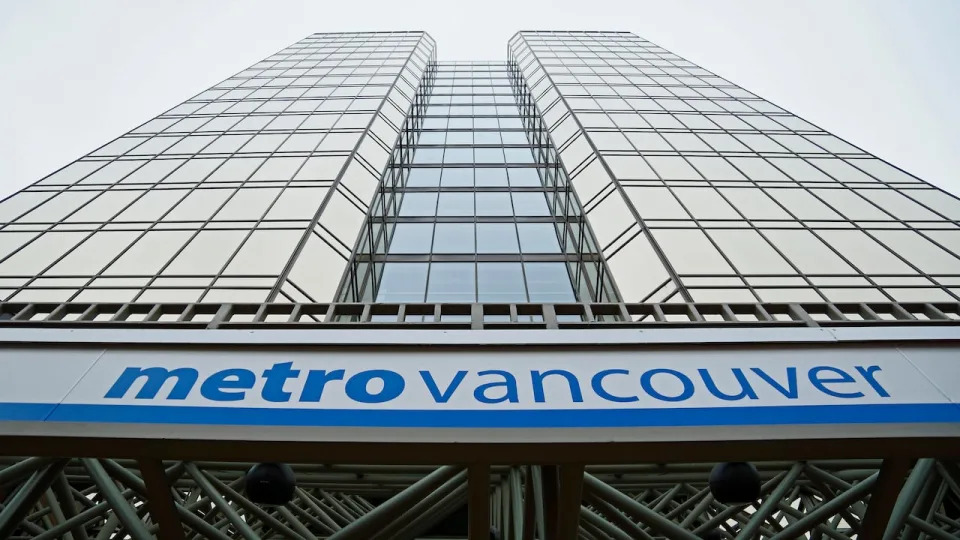
Members of the Greater Vancouver Regional District Employees' Union have issued a strike notice and can legally start job action beginning the afternoon of Oct. 2. (Peter Scobie/CBC - image credit)

Hundreds of workers at Metro Vancouver are poised to strike as soon as Monday afternoon, after their union says it issued a 72-hour strike to the regional district on Friday.

The Greater Vancouver Regional District Employees' Union (GVRDEU) says the union is asking for higher wages and protections for workers as the cost of living rises in the region.

According to its website, the GVRDEU serves "the outside employees of Metro Vancouver" with over 600 members helping maintain services such as water treatment, wastewater collection, infrastructure construction, housing, air quality monitoring, and more.

Metro Vancouver is the regional government that provides and coordinates services for 21 municipalities across the Lower Mainlaind.

Linnar Lee, secretary for the GVRDEU, says the union has been negotiating with Metro Vancouver for since before its last contract expired on Dec. 31, 2021.

"The employer wants concessions during this hard economic time where most of us are struggling … This livable region is not livable anymore economically for us," said Lee, who works as a housing dispatcher for Metro Vancouver.

Beginning Monday afternoon, the union says it will be in a legal position to start job action.

Lee says union members are making fair requests in line with other municipalities, such as wages that will allow workers to continue living in the region.

"We want to be able to tuck our kids in at night to go to sleep, instead of increasing our work hours," she said.

In a statement, the Metro Vancouver regional district said it has offered an 11.5 per cent wage increase over three years and is "committed to reaching a fair and reasonable collective agreement that recognizes how much [the value of its] staff and is affordable to the local taxpayers who must pay for it."

"The potential job action is unfortunate, however, there will be no disruption to the essential services that we provide to nearly 2.8 million residents every day," reads the statement.

Calls for wage increases and protection

On Aug. 23, union members voted 97.2 per cent in favour of a strike.

Lee says bargaining with the region hasn't gone well, due to Metro Vancouver's requests for concessions, such as cutting back on fair wage clauses and expanding working hours.

She adds one provision, known as a "me too clause," allows GVRDEU members and unionized workers from the City of Vancouver and neighbouring municipalities to receive similar wage increases as one another.

The clause ensures "that our union can settle knowing that we have some kind of wage protection if the City of Vancouver comes to an agreement with a certain wage … The employer wants to take that away from us," she said.

"They also want to amend the hours so that it opens it up that workers work longer hours, [which] contradicts work-life balance."

In a statement, the Metro Vancouver region said it is requesting "a series of cost and procedural efficiencies" that could benefit the region and its employees.

"We believe our wage offer of an 11.5 per cent increase over three years and a one-time lump sum of $2,350, plus other improvements to allowances and benefits, is fair and reasonable and aligned with other negotiated settlements in the region," reads the statement.

Essential services are established

While job action may take place, Lee says essential workers for water treatment and other services will still be staffed to ensure public safety.

But with many other staff striking, she says it would be up to management to decide whether to close or alter non-essential services, like parks.

She says the union doesn't take striking lightly, but feels it is necessary.

"For us to say, 'Hey come on, this isn't fair. We need to take strike action.' It's going to hit our pocketbooks, we know that," said Lee. "But the employer has pushed us to this point."
'What do you see?' NASA shares photos of 'ravioli'-shaped Saturn moon, sparking comparisons


Eric Lagatta, USA TODAY
Mon, October 2, 2023 at 8:24 a.m. MDT·3 min read


It's been six years since the closest images of Saturn's innermost moon were captured, but last week may have been the first time that many saw photos of the oddly shaped celestial body when NASA shared them on Instagram.

And many couldn't help but notice the resemblance between the moon known as Pan and some well-known food dishes.

"Ravioli, pierogi, empanada... What do you see?" NASA said on its Instagram page in a post accompanied by two images depicting different angles of the moon. "No wrong answers.⁣"

Many commenters agreed that Pan does indeed resemble one of those three foods, but others were more creative in their interpretation.

"It's a Koopa shell," one user said, referencing the turtle-like race of characters from the Super Mario franchise.

"A macaron with the cream squishing out," commented another.

The photos were taken in 2017 during the Cassini spacecraft's closest encounter yet with Pan, NASA said on Instagram, "improving the level of detail seen on the little moon from previous observations."
Closest images captured in 2017 after Pan discovered in 1990

The two images that NASA shared show how Cassini's perspective changed as it passed within 15,300 miles of Pan on March 7, 2017.

The views show the northern and southern hemispheres of Pan on its trailing side, which is the side opposite the moon’s direction of motion as it orbits Saturn.

The distinct-looking moon was first imaged in 1981 by Voyager 2, but it wasn't until 1990 that Mark R. Showalter, a senior research scientist at the SETI Institute, analyzed the old probe photos and officially discovered the celestial object, according to NASA.


This raw, unprocessed image released by NASA shows Saturn's tiny moon, Pan, in 2017, and was taken by NASA's Cassini spacecraft.

How do scientists explain Pan's unique shape?

Pan, like Saturn's other moon Atlas, has a prominent ridge along its equator that gives it a distinctive flying saucer shape that others have also compared to a walnut.

The thin ridge around Pan’s equator is thought to have come after the moon formed.

Cassini imaging scientists think that Pan formed within Saturn’s rings, with ring material accreting onto it and forming the rounded shape of its central mass. Scientists believe that Pan has a core of icy material that is denser than the softer mantle around it.

Because of Pan’s weak gravity, the ring material simply settled onto it and continued building up rather than flattening as it would on larger bodies, according to NASA.

NASA UFO report: How NASA hopes to shift UFO talks 'from sensationalism to science'
How did Pan get its name?

Moons of Saturn were originally named for Greco-Roman Titans and descendants of the Titans.

But because Saturn has 146 moons, scientists eventually had to begin selecting names from more mythologies. The Greek god of nature and the forest known as Pan is a satyr, which is a a creature resembling a man with the hind legs and hooves of a goat.


‘Strange noise’ heard across coast after whale calf is trapped in net in Australia

Mitchell Willetts
Sun, October 1, 2023 

Screengrab from video by Damian Coulter.

A “strange noise” could recently be heard echoing across a stretch of Australia’s Sunshine Coast, cries from a distressed humpback whale, according to witnesses.

A whale calf was caught in a net and its mother stayed by its side, calling out in anguish or, some say, for help.

“If you heard a strange noise this morning at dawn and wondered what it was..this is your answer,” drone photographer Damian Coulter said in an Oct. 1 social media post, sharing video of the whales. “The distress calls of this mother whale crying for help to release her calf from the shark nets.”

Others reported hearing the whale’s calls.

“We all could hear the mother cry for help which was not a very pleasant sound,” photographer Glenn Reeves said in an Instagram post.

“First thing in the morning my wife was saying I can hear this big noise,” Reeves told the Australian Broadcasting Corporation. “You could hear it, it’s like a didgeridoo echoing through the whole headland.”

The whale’s cries didn’t go unanswered, as a vessel sailed out to the trapped whale and freed it, photos show.

Both mother and baby swam away together,” Reeves said in the post.

The rescuers were sent by Fisheries Queensland, the government agency charged with managing Queensland’s waters, ABC reported.

Though many were happy to hear the whales were rescued, they said it shouldn’t have been necessary to begin with.

“Was such a horrible sound,” a commenter said. “Shark nets need to go.”

“The outcome was positive, but another showcase of the negative effects these nets have,” said another.

Shark nets are intended to act as a barrier to keep sharks away from beaches and therefore people, reducing the odds of an attack. The nets have been effective in this endeavor, according to the government of New South Wales.

However, environmentalists and others have criticized the practice, saying the nets are unnecessary, outdated and put sealife — such as whales — in danger, The Guardian reported.


James Webb telescope makes 'JuMBO' discovery of planet-like objects in Orion


Jonathan Amos - Science correspondent
Mon, October 2, 2023 

At just 1,400 light-years from Earth, the Orion Nebula, M42, is visible to the naked eye as a faint smudge

Jupiter-sized "planets" free-floating in space, unconnected to any star, have been spotted by the James Webb Space Telescope (JWST).

What's intriguing about the discovery is that these objects appear to be moving in pairs. Astronomers are currently struggling to explain them.

The telescope observed about 40 pairs in a fabulously detailed new survey of the famous Orion Nebula.

They've been nicknamed Jupiter Mass Binary Objects, or "JuMBOs" for short.

One possibility is that these objects grew out of regions in the nebula where the density of material was insufficient to make fully fledged stars.

Another possibility is that they were made around stars and were then kicked out into interstellar space through various interactions.

"The ejection hypothesis is the favoured one at the moment," said Prof Mark McCaughrean.

"Gas physics suggests you shouldn't be able to make objects with the mass of Jupiter on their own, and we know single planets can get kicked out from star systems. But how do you kick out pairs of these things together? Right now, we don't have an answer. It's one for the theoreticians," the European Space Agency's (Esa) senior science adviser told BBC News.


JuMBO pull graphic

Prof McCaughrean led the team that produced the new Orion survey.

Using JWST's remarkable resolution and infrared sensitivity, the astronomers have added substantially to the information already mined by older telescopes, including Webb's direct predecessor, the Hubble Space Telescope.

The Orion Nebula, also known by its sky catalogue name of M42, is the nearest, large star-forming region to Earth.

Along with the quartet of bright suns at its centre called the Trapezium, this region of space is visible to the naked eye as a smudge on the sky.

If you don't know it, it can be found low down in the constellation of Orion, which is named after a mythical Greek hunter. The nebula forms part of the hunter's "sword", hanging from his "belt".

Planetary discs: Newborn stars in the nebula are busy making the next generation of planets

The new JWST image is actually a mosaic of 700 views acquired by Webb's NIRCam instrument over a week of observations.

To give a sense of scale, it would take a spaceship travelling at light speed a little over four years to traverse the entire scene. The nebula itself is about 1,400 light-years from Earth.

Tucked away in this vista are thousands of young stars, spanning a range of masses from 40 down to less than 0.1 times the mass of our Sun.

Many of these stars are surrounded by dense discs of gas and dust which may be forming planets, although in some cases, these discs are being destroyed by the intense ultraviolet radiation and strong winds from the most massive stars in the region, in particular from the Trapezium.

The slider tool on this page shows the same nebula scene at shorter and at longer wavelengths. Using different filters in this way emphasises items of interest.

Look at the longer wavelength version to examine the sculpted green clouds of gas that contain polycyclic aromatic hydrocarbons. PAHs are ubiquitous compounds in space produced by stars.

Look also at the many-fingered red feature that dominates the background.

Known as the Orion Molecular Cloud 1 outflow, this is a mass of molecular hydrogen that has been shocked by the the immense energy streaming away from the site of a cataclysmic collision of two giant stars. The speed of the outflow at more than 100km/s indicates the star merger occurred just a few hundred years previously.

Notice the fingertips are tinged with green - a marker for gaseous iron.

Orion Molecular Cloud 1 outflow: The "fingertips" are tinged with iron

There is so much to peruse and probe in the full-sized survey image which is 21,000 by 14,500 pixels. But it is the JuMBOs that have caught the immediate attention of astronomers.

"My reactions ranged from: 'Whaaat?!?' to 'Are you sure?" to 'That's just so weird!' to 'How could binaries be ejected together?'" recalled Dr Heidi Hammel who was not on the survey team.

She said there were no models of planetary system formation that predicted the ejection of binary pairs of planets.

"But... maybe all star formation regions host these double-Jupiters (and maybe even double-Neptunes and double Earths!), and we just haven't had a telescope powerful enough to see them before," the multidisciplinary scientist on JWST told BBC News.

Esa will be posting the full image of M42 on its EsaSky portal which allows anyone to explore publicly available astronomical data. Initial papers describing the survey and the JuMBO discovery will be posted on the arXiv pre-print server on Tuesday.

The Webb survey covers a tighter region of space than a major Hubble effort in 2006

JWST is a joint venture between the US, European and Canadian space agencies.
Third grizzly killed in self-defense in one month outside Yellowstone, officials say

Brooke Baitinger
Fri, September 29, 2023 

Photo by Felicia Montenegro via Unsplash


A hunter shot and killed a charging grizzly bear that was defending its kill just outside Yellowstone National Park, officials said.

The hunter shot the bear at close range in the Tuesday, Sept. 27 encounter in Beattie Gulch north of Gardiner, Montana Fish, Wildlife & Parks said in a news release.

The bear charged the hunter when they got close to an animal carcass the grizzly had stashed to feed on, spokesman Morgan Jacobsen said. It was the third grizzly killed in self-defense in Montana in just one month.

The hunter was not injured, officials said. Bear specialists with the wildlife agency and game wardens determined the bear was defending its food source.

In a similar incident on Aug. 30, a pair of fishermen were walking through thick vegetation along a creek in the nearby Tom Miner Basin when they stumbled into a male grizzly’s path and the bear charged, McClatchy News previously reported. One of the anglers shot and killed the bear.

Only four days prior and about 250 miles northwest, two hunters surprised a mama grizzly bear and her cub while they were out scouting for the upcoming hunting season in a dense section of the Flathead National Forest, McClatchy News reported.

They came within 15 feet of the mom and cub, and shot and killed the adult bear when she charged them.

“Montana is bear country,” officials said in the release. “Grizzly bear populations continue to become denser and more widespread in Montana, increasing the likelihood that residents and recreationists will encounter them in more places each year.”

Bears are more active in late summer and autumn as they eat as much as they can to prepare for their winter hibernation — which also overlaps with hunting season and other fall recreation activities, officials said.

Two killed in bear attack at Banff National Park, grizzly euthanized: Parks Canada


The Canadian Press
Sat, September 30, 2023 


A bear attack in Alberta's Banff National Park has left two people dead, Parks Canada announced late Saturday.

Natalie Fay, external relations manager for Parks Canada's Banff field unit, said the agency received an alert from a GPS device originating from the Red Deer River Valley at approximately 8 p.m. on Friday, indicating a bear attack.

In a statement, Fay said a team specially trained in wildlife attacks was immediately mobilized, but weather hindered their response time.

"Weather conditions at the time did not allow for helicopter use, and the response team travelled through the night to the location by the ground," she said.

"The response team arrived on-site at 1 a.m. and discovered two deceased individuals."

While in the area, the response team encountered a grizzly bear displaying aggressive behaviour, Fay said, leading Parks Canada staff to euthanize it on-site for public safety.

RCMP arrived at 5 a.m. to transport the victims to Sundre, Alta., she said.

"This is a tragic incident and Parks Canada wishes to express its sincere condolences to the families and friends of the victims," the statement read.

A closure is in place around the attack area — including the Red Deer and Panther valleys, from Snow Creek Summit east to the National Park boundary, and north to Shale Pass — until further notice as a safety precaution.

This report by The Canadian Press was first published Sept. 30, 2023.

The Canadian Press
CANADA
Ukrainians reckoning with 'complexity of history' after Hunka affair

CBC
Sun, October 1, 2023 
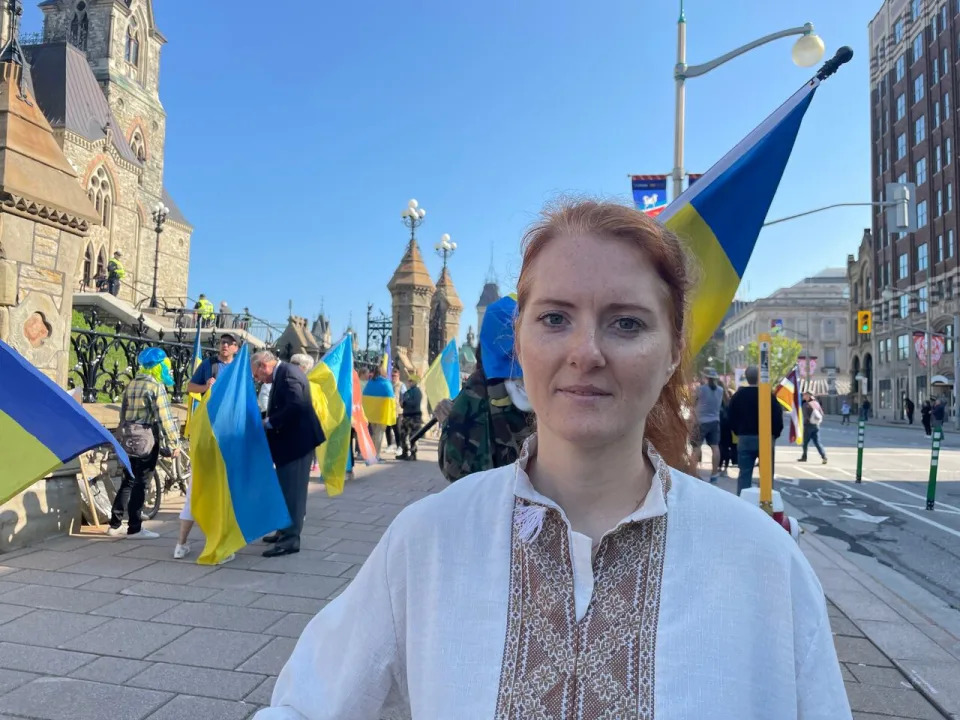
Juliia Baranova stands on Parliament Hill the day of Ukrainian President Volodymyr Zelenskyy's visit last week. Baranova says the warm welcome given to a Ukrainian veteran who fought for the Nazis has opened her eyes to the complicated history of many eastern European nations. (Avanthika Anand/CBC - image credit)

Some members of the local Ukrainian community say there's "broken trust" after a former Ukrainian solder who fought in a Nazi division was honoured in Parliament during President Volodymyr Zelenskyy's visit to Ottawa — and want an apology of their own.

"This is just so, so disappointing," said Jane Kolbe, an active member of the community in Ottawa.

Now-former House of Commons Speaker Anthony Rota invited veteran Yaroslav Hunka, one of his constituents from North Bay, Ont., to sit in the gallery during Zelenskyy's address on Sept. 22.

Hunka received a standing ovation from MPs, the prime minister and Zelenskyy himself.

Days later, it was revealed that Hunka was part of the First Ukrainian Division, also known as the Waffen-SS Galicia Division or the SS 14th Waffen Division — a voluntary unit under the command of the Nazis during the Second World War.

Members of Canada's Jewish community have called it a "humiliating debacle."

Rota resigned as Speaker last week, and Prime Minister Justin Trudeau publicly apologized to the Jewish community for what he called a "deeply embarrassing" moment in Canadian history.
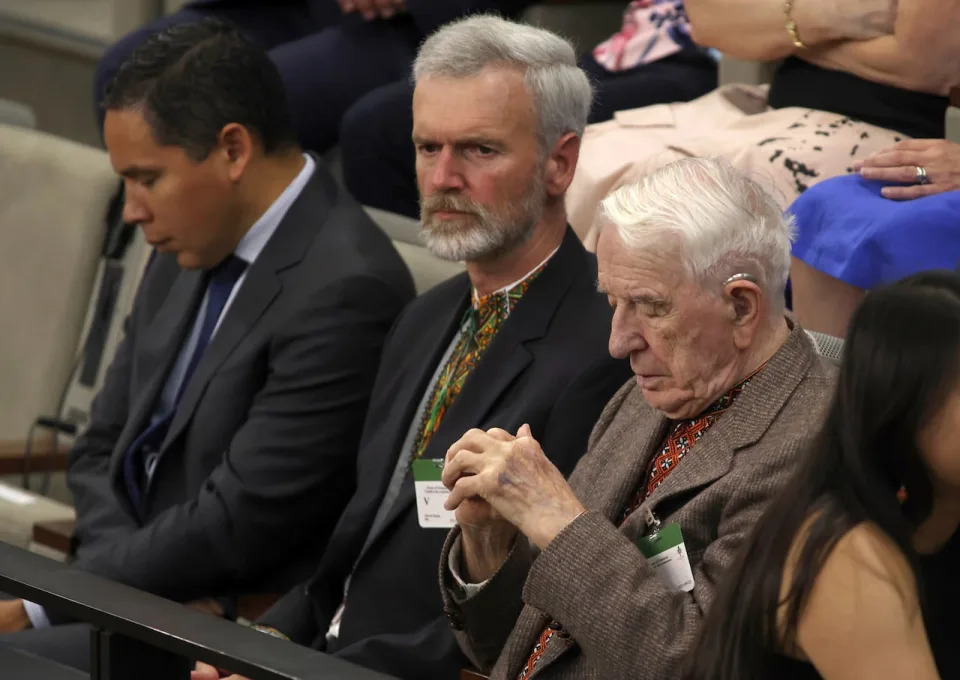

Yaroslav Hunka, right, waits for the arrival of Ukrainian President Volodymyr Zelenskyy in the House of Commons in Ottawa, Onatario, Friday, Sept. 22, 2023. Canadian Prime Minister Justin Trudeau apologized Wednesday, Sept. 27, for Parliament’s recognition of Hunka, who fought alongside the Nazis during last week’s address by Ukraine President Zelenskyy. “All of us who were in the House on Friday regret deeply having stood and clapped, even though we did so unaware of the context,” Trudeau said before entering the House of Commons.
 (Patrick Doyle/The Canadian Press via AP, File)

Ukrainian-Canadian Yaroslav Hunka, 98, was a former soldier fought who fought alongside the Nazis. He was invited by former Speaker Anthony Rota to the House of Commons last week and received a standing ovation during Zelenskyy's visit. (Patrick Doyle/The Canadian Press)

As the incident made international headlines, some members of the Ottawa region's Ukrainian community said it's been "difficult" to watch it overshadow Zelenskyy's important visit.

Many are "still trying to absorb and understand" what happened, Kolbe said.

"It is baffling because [in] the diaspora, there's so many heroes to recognize," she said. "But this really wasn't the time to recognize heroes. This was the time to honour and reflect on President Zelenskyy's speech."

Kolbe said it was important that Trudeau apologized to the Jewish community, and believes the resulting "broken trust" with the Ukrainian diaspora in Canada means they deserve one, too.
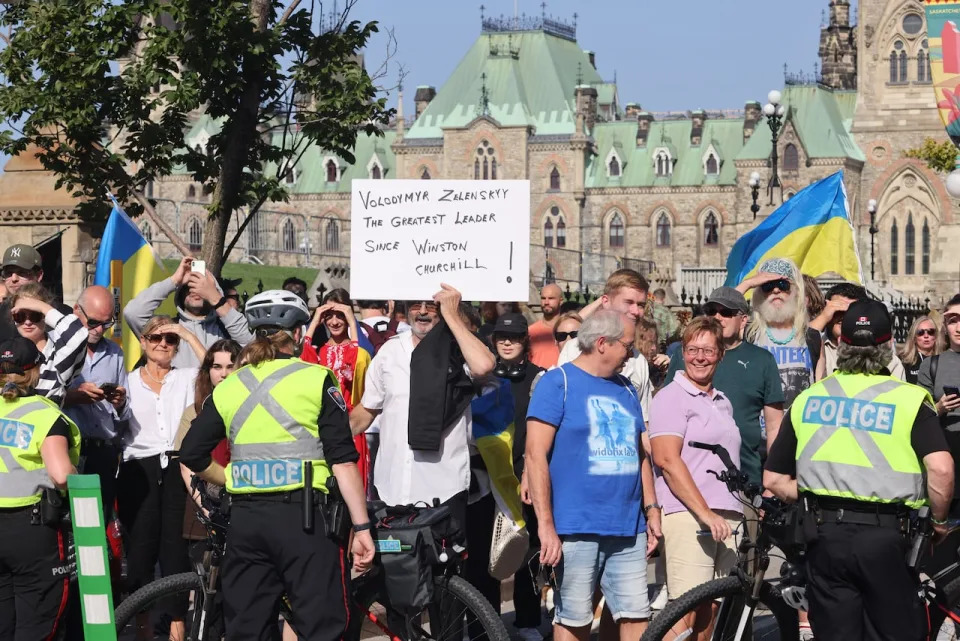

Supporters of the Ukraine stand in front of Parliament Hill as Ukrainian President Volodymyr Zelenskyy and Prime Minister Justin Trudeau attend a joint press conference in Ottawa on Friday, Sept. 22, 2023.

Supporters of the Ukraine stand in front of Parliament Hill during Zelenskyy's visit. (Patrick Doyle/The Canadian Press)

'History has a lot of complexity'

Juliia Baranova was among the hundreds of Ukrainians on Parliament Hill the day of Zelenskyy's visit and said she was "very concerned" about the Hunka incident.

"For me personally, it also shows that history lessons are not learned," Baranova said. "And eastern European countries' history has a lot of complexity."

Reports suggest as many as 2,000 Ukrainian members of Adolf Hitler's Waffen-SS were admitted to Canada after the war.

Historians have documented how soldiers like Hunka were trained at SS facilities in Germany, swore an oath to Hitler and received an education in Nazi doctrine.

But many young Ukrainian soldiers at that time were fighting not for Germany, but to expel the Russians occupying their country, said Dominique Arel, chair of Ukrainian Studies at the University of Ottawa.

The incident in the House of Commons has been made even worse, Arel added, by false Russian claims that the current invasion of Ukraine is a war against Nazism.

"No matter how you try to explain the complexity of history, the symbol is awful. It's shocking," he said.
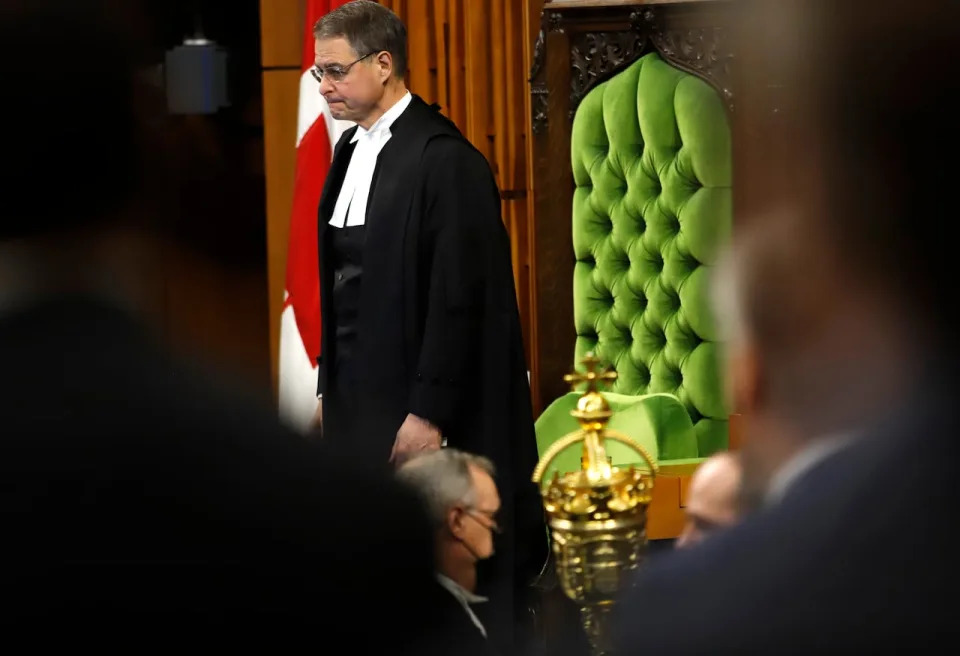

Speaker of the House of Commons Anthony Rota rises to speak in a December 2022 file photo. Rota invited Yaroslav Hunka, a 98-year-old Ukrainian-Canadian who now lives in North Bay, Ont., to witness Ukrainian President Zelenskyy's address to Parliament on Friday.

Rota resigned from his position as speaker last week following the incident. (Patrick Doyle/The Canadian Press)

Baranova, who was unaware of this history before last week, said despite its complexity, "we have to learn it."

Marina Lavow, who lives in Gatineau, Que., and moved to Canada from Ukraine nearly 30 years ago, called it a "really sad and unfortunate event" but noted that not everyone in the diaspora agrees.

"The community is not homogeneous," she said.

"There are different ways [of thinking], different generations. And to some people it means one thing, while to other people who have less knowledge of what happened, why that division was created, it means less."


Rota debacle renews calls to examine history, including war crime records
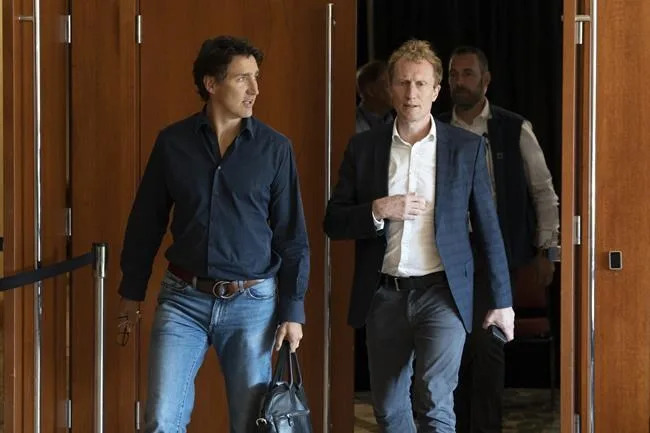


OTTAWA — Canada could revisit calls to declassify documents about the presence of Nazi war criminals in the country, Immigration Minister Marc Miller said Wednesday, as the fallout continued over Parliament's recognition last week of a man who fought for the Nazis.

"Canada has a really dark history with Nazis in Canada," Miller said, heading into the weekly Liberal caucus meeting.

"There was a point in our history where it was easier to get (into Canada) as a Nazi than it was as a Jewish person. I think that's a history we have to reconcile."

Many Jewish organizations in Canada say doing that requires a public airing of information, and that means all the records Canada has about the presence of war criminals must be opened up.

"I think part of the problem here is that the records are closed," said B'nai Brith senior lawyer David Matas in an interview.

"You can't remember the past unless you know the past, and you can't know the past unless you get the records."

B'nai Brith Canada and the Friends of Simon Wiesenthal Center both reiterated their long-standing calls this week for the government to make public all records about the admittance of former Nazi soldiers.

That includes the entirety of a 1986 report from a public commission on war criminals, which is often referred to as the Deschênes Commission for the judge who led it.

The report has never been fully released, including an appendix with the names of 240 alleged Nazi war criminals who might be living in Canada that the report recommended Canada investigate.

"It's now time for Ottawa to not only release the unredacted files related to the Deschênes Commission, but to also address the stark reality that there are still former Nazis with blood on their hands living in Canada," said Friends of Simon Wiesenthal Center President Michael Levitt.

Matas noted that in June, a House of Commons committee studying Canada's access-to-information system recommended all historical documents be released in full after 25 years.

He said implementing that recommendation would fulfil the desire to see Canada's war criminal records.

Currently, records can be released 20 years after someone's death. But Matas said that rule doesn't apply in this case, because information about people who died can't be accessed unless their names are available.

He said it's not that every person named in the records is guilty, but that a justice system relies on openness, and you can't have justice without transparency, whether you're guilty or innocent.

There is also little to no information publicly available about what follow-up was done to investigate alleged war criminals named in the Deschênes report, or bring any of them to justice.

All of this comes after what some have called the most embarrassing international debacle in Canadian history.

On Friday, during an official visit by Ukraine President Volodymyr Zelenskyy, the House of Commons Speaker pointed to a guest in the gallery he identified as a war hero.

Parliamentarians and dignitaries who were present gave two standing ovations to a 98-year-old Ukrainian Canadian war veteran without knowing or understanding that the unit he fought with was formed by Nazi Germany to fight against the Soviet Union.

Speaker Anthony Rota, who said he did not know about Yaroslav Hunka's background, apologized for making an egregious mistake inviting him to Parliament. He announced Tuesday that he would resign from the role.

On Wednesday, Prime Minister Justin Trudeau issued an apology on behalf of Canada and all parliamentarians for the debacle.

University of Alberta professor John-Paul Himka pointed out that nobody seemed to immediately understand how Hunka's military history implied he would have fought with the Germans.

That's because of a great lack of understanding of history, even among elected MPs, he said.

"I mean, this man was introduced as somebody who fought the Russians during World War II. Who was fighting the Russians during World War II? It was the Germans," he said.

Matas concurred.

"I mean if Rota didn't know about this whole issue and he was the Speaker of the House of Commons, you can imagine how widespread the ignorance is," he said.

Still, said Matas, the uproar has rejuvenated the discussion about exposing that history, including all the records.

"This is on the radar, now, I think," he said. "They're paying attention to it."

Miller said he has read the Deschênes report twice since this all happened, and encouraged all Canadians to do so.

He also said he knows there are many people demanding the release of the records, and it is something the government "could possibly examine again."

But he said because he doesn't know exactly what is contained in the documents, he doesn't yet want to say if he backs their full release.

"But again, in a country like Canada that has not only a difficult history with Nazis in Canada, but also one of the most important diaspora of Jewish people, including some of the largest proportions of Holocaust survivors, impunity is absolutely not an option," he said.

Mental Health Minister Ya'ara Saks, whose York Centre riding in Toronto has about one-fifth of its population identifying as Jewish, said Canada should look at what it can do to help provide answers and closure to Jewish Canadians.

She said opening the records is something to be looked at.

This report by The Canadian Press was first published Sept. 27, 2023.

Mia Rabson, The Canadian Press
Ontario city home to Nazi soldier that visited Parliament shares mixed emotions

The Canadian Press
Sat, September 30, 2023


NORTH BAY, Ont. — Allan Hirsh sits on a lawn chair on a cool fall evening in North Bay, Ont., pondering the mixed emotions he's been feeling since his community made international headlines.

The northeastern Ontario city is the current home to a man who was honoured with a standing ovation in the House of Commons during a visit from Ukrainian President Volodymyr Zelenskyy, but whose presence in Parliament later caused global outrage and embarrassment when details emerged about his past as a Nazi soldier during the second World War.

Hirsh says he can understand the pain many are feeling after Yaroslav Hunka's reception in the House, noting his own ancestors fled persecution by the Russian Empire for practising Judaism in the early 20th century and many of his loved ones lost relatives and friends during the Holocaust.

But Hirsh and other city residents say they are shocked to hear their long-time Member of Parliament Anthony Rota resigned as House Speaker over his choice to invite and recognize Hunka, questioning why he has faced sole blame for the debacle.

"I always think about that history and the Holocaust and everything that happened there always makes me emotional," the 75-year-old retired psychotherapist said in an interview.

"But ... am I angry at Anthony Rota? No. This is not something that he did intentionally. ...Oddly enough, it's Anthony that I'm feeling for."

Hirsh says Rota is well-known in his community after spending 16 years as MP for the Nipissing-Timiskaming riding where North Bay is located.

He was first elected in 2004 and has served ever since except for a four-year break when he lost his seat in 2011, and Hirsh has been among those that voted for him.

Rota became House Speaker in 2019 and cemented a reputation for fairness and integrity across party lines.

But on Sept. 22, shortly after Zelenskyy's address to Parliament, Rota introduced Hunka as a Ukrainian Second World War veteran who lives in his riding.

Rota described the 98-year-old as both a Ukrainian and Canadian hero, prompting a standing ovation from members of all parties. It later emerged that Hunka had fought the Soviet Union in Ukraine with the Waffen-SS Galicia Division, a voluntary unit created by the Nazis that Jewish groups say "was responsible for the mass murder of innocent civilians with a level of brutality and malice that is unimaginable."

Calls for Rota's resignation as House Speaker poured in from all sides, including some senior Liberal cabinet ministers, and Rota stepped down from the role effective Wednesday.

Hirsh and other residents feel their MP was "thrown under the bus."

"We were so proud of his career when he became a speaker. He's done, I thought, a good job. He serves his constituents. He apologized for that mistake. To see this happen to him, it's really, really sad," Hirsh said.

Since then, the Conservatives have brought a motion to the government operations committee to summon the RCMP, parliamentary security and officials from the Prime Minister's Office to study how Hunka made his way from North Bay to Ottawa.

Hirsh isn't the only one processing complex feelings dredged up by the week's events.

Karrie Emms, a local business owner, says she has been thinking a lot about when and how the city she has been living in for 35 years welcomed someone like Hunka.

"We know that we never know a true or full story for somebody so I would be interested in finding out what (Hunka's) story actually is," she said.

"I want to know more but not necessarily to hold them accountable … Mr. Rota is very well known and everyone knows he is from North Bay so it's going to be a bit of an issue to overcome."

She, too, questions why Rota has borne sole responsibility for the scandal.

"I know they've apologized but nobody else has lost their jobs over it that I know of," she said, referencing the apology Prime Minister Justin Trudeau delivered on Wednesday. "I find that a little disheartening."

Emms, who works with youth, says there is one silver lining — Canadians of all stripes, including young people in North Bay, are now taking time to educate themselves on eastern European history.

Fellow city resident George Maroosis says he was shocked to learn that Hunka lives in North Bay.

"It's very unfortunate," he said while working at his downtown North Bay business.

"My big question is if the Jewish community knew who this guy was and what his background was, where was our so-called intelligence agency that could have warned as to what the situation was with this particular individual."

After inquiring about Hunka at an assisted living home in North Bay, a Canadian Press reporter was asked to leave the property immediately, and one employee said they were prepared to call the police.

Another employee later said Hunka had lived at the home, but has since moved in with his family.

Hirsh says as political parties try to determine more details of Hunka's visit to Parliament, he hopes the discourse remains respectful.

"(We need to look into) the nuances of everything that happened," he said.

"It's messy. There's nothing black and white."

This report by The Canadian Press was first published Sept. 30, 2023.

Fakiha Baig, The Canadian Press


B.C. Conservative leader under fire for likening teaching of sexuality, gender to residential schools

CBC
Sun, October 1, 2023 

B.C. Conservative Leader John Rustad is facing criticism for a social media comment he posted on the National Day for Truth and Reconciliation on Saturday. (Dirk Meissner/The Canadian Press - image credit)

The leader of the Conservative Party of British Columbia is under fire for a social media post that critics say appeared to compare teaching students about sexual orientation and gender identity to the genocide of Indigenous children in residential schools.

John Rustad, MLA for Nechako Lakes, acknowledged the National Day for Truth and Reconciliation in a Sept. 30 post on X, formerly known as Twitter.

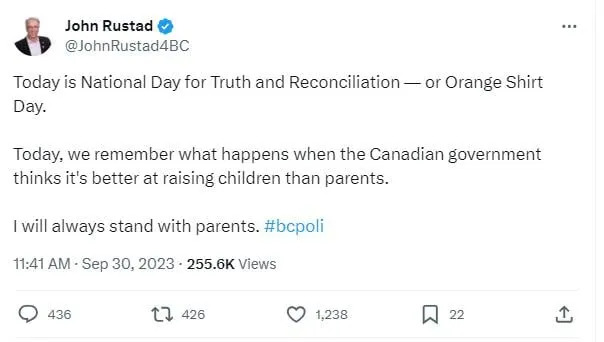
"Today we remember what happens when the Canadian government thinks it's better at raising children than parents," read Rustad's Saturday post, which was also shared on his party's official Facebook page.

"I will always stand with parents."

Rustad's post quickly drew criticism from residential school survivors and fellow MLAs, who said it was politicizing the deaths of children at residential schools in order to support the parental rights movement — which supports a ban on teaching B.C. students about sexual orientation and gender identity (SOGI) in schools.

John Rustad, leader of the Conservative Party of B.C., is facing criticism for a tweet some survivors say weaponizes residential schools to support people advocating to end teaching sexual orientation and gender identity in schools under the banner of parental rights.

This screengrab shows a social media post from John Rustad, leader of the Conservative Party of B.C., that has drawn criticism. (X)

Those who support parental rights say parents need more information and input about what their children are learning in school, a position Rustad previously backed in a Sept. 20 statement.

The catch-all term "parental rights" has also been used across Canada and the United States to lobby for legislation to require parental consent for children and teens who want to use different names or pronouns at schools — measures that some LGBTQ advocates say harm transgender youth.

Critics of the term say it's a dog-whistle for anti-trans policies and is a misnomer, as it excludes LGBTQ parents and suggests parents' rights supersede those of their children.

CBC News reached out to Rustad for comment. In a phone call on Sunday, his office said he would not be available for an interview before publication.

Leader's comment called 'shameful'

Residential school survivor Celeste George, a member of the Nak'azdli Whut'en, a First Nation near Fort St. James, B.C., said seeing Rustad's post on the National Day for Truth and Reconciliation, a day meant to honour victims and survivors of residential schools, was "enraging."

"It's not even the comparison, [it's] the actual idea that he can blatantly use the day for his own hatred, for his own agenda," said George, who is also a former anti-racism educator.

"That was really horrific to me, knowing that hatred has taken so much from us."


Hundreds of people attended a walk for the National Day for Truth and Reconciliation in the First Nations community of Aq'am on Saturday, Sept. 30, 2023.

Hundreds of people take part in a walk on the National Day for Truth and Reconciliation in the First Nations community of Aq'am, B.C., on Saturday. (Corey Bullock/CBC)

She said Rustad's post will fuel anti-Indigenous racism and anti-trans sentiments, a concern echoed by Florence Ashley, a transfeminine associate professor of law at the University of Alberta in Edmonton.

"It's absolutely vile for a politician to compare a deeply marginalized group asking for rights with cultural genocide," Ashley wrote on X on Sunday.

B.C. New Democrat MLA Ravi Parmar called the social media post a "disgraceful comparison."

"It's shameful to co-opt this day to spread fear and attack the rights of queer kids," he wrote on X.

Harsha Walia, a human rights advocate and former executive director of the B.C. Civil Liberties Association, wrote that "weaponizing [the National Day for Truth and Reconciliation] like this is horrific."

"Despicable," Walia said in a post on X. "A party leader & sitting MLA compares genocide of residential schools to anti-trans dog whistle of 'parent rights.'"

Conservative Party newly recognized

Rustad was first elected in 2005 and previously served as minister of Aboriginal relations and reconciliation under the B.C. Liberal — now B.C. United — government.

He previously backtracked after making comments questioning why Indigenous members of his community were receiving COVID-19 vaccines ahead of older members of the population in 2021.

In August 2022, he was ousted from the B.C. United caucus for sharing an online post casting doubt on the science behind climate change.

Rustad sat as an independent until February, when he joined the B.C. Conservative Party. A month later, he was acclaimed as party leader.

Another B.C. United MLA, Bruce Banman, crossed the floor to join Rustad in September, and the two-MLA party was officially recognized in the legislature two weeks ago.

Rustad has previously supported parental rights and said he wants to end the teaching of SOGI in schools.

"Parents raise children — not government, and we have laws in British Columbia to protect children who are unsafe at home," he said in the Sept. 20 statement.

A national Indian Residential School Crisis Line is available to provide support for survivors and those affected. People can access emotional and crisis referral services by calling the 24-hour service at 1-866-925-4419.

Mental health counselling and crisis support is also available 24 hours a day, seven days a week through the Hope for Wellness hotline at 1-855-242-3310 or by online chat.
Top Indian diplomat blocked from Glasgow gurdwara visit

BBC
Sun, October 1, 2023 

The diplomat was approached by Sikh activists outside a Glasgow Gurdwara

India has complained to the Foreign Office after a top diplomat was confronted by protesters at a gurdwara in Glasgow.

The High Commission of India said Vikram Doraiswami had been invited to the place of worship to discuss community and consular issues.

But he left after he was confronted by a small number of activists on Friday.

A Sikh youth group later claimed there was a longstanding ban on Indian officials visiting gurdwaras.

The confrontation follows an international row over suggestions Indian agents may be linked to the murder of a Sikh separatist in Canada.

Trudeau repeats allegation against India amid row

India has strongly rejected the claim by Canadian prime minister Justin Trudeau that there is "credible evidence" of Indian involvement in the shooting of Hardeep Singh Nijjar in British Columbia in June.


Footage posted on social media shows three people approaching the diplomat's car

The incident in Glasgow came during a series of engagements in Scotland by Mr Doraiswami, who is India's High Commissioner to the UK.

Footage posted on social media shows him being approached by three people after his car pulled up outside the gurdwara in Glasgow's Albert Drive.

He remains seated in the back of the car while one of the demonstrators appears to make an attempt to open the door.

Another protester can be heard saying: "I think it's best if you go."

The diplomat was then driven away.

A statement issued later by National Sikh Youth Federation on behalf of "major Sikh bodies" said the three activists had upheld "a long standing ban on Indian officials visiting gurdwaras in their official capacity".

It went on to include an account of the incident, said to have been issued by the activists themselves, which said: "We went to prevent their entry and ask them questions, they left rapidly from the car park."

They denied carrying out any kind of assault.
'Disgraceful incident'

The High Commission of India said the diplomat had been invited to the building by the Gurdwara committee, and that the organisers included community leaders and an MSP.

"They were threatened and abused by these elements. In an effort to prevent any potential altercation the HC [High Commissioner] and CG [Consul General] decided to leave the premises on their arrival," it said in a statement.

The High Commission said it had reported the "disgraceful incident" to the Foreign Office and the police.

It said the three activists were not from Scotland.

Foreign Office minister Anne-Marie Trevleyan posted on X, formerly Twitter, that she was "concerned" by the incident.

"The safety and security of foreign diplomats is of utmost importance and our places of worship in the UK must be open to all," she posted.

The Glasgow gurdwara said it strongly condemned the "disorderly behaviour" which caused Mr Doraiswami to abandon his planned visit.

"The Gurdwara is open to people from all communities and backgrounds, and we welcome everyone openly as per our principles of faith," it said.

Police Scotland confirmed that it had been called to reports of a disturbance at the gurdwara at 13:05 on Friday.

"There were no reports of any injuries and enquiries are ongoing to establish the full circumstances," a spokesperson said.
Here’s a look at the resolution for a foreign force in Haiti. The U.N. will vote Monday

Jacqueline Charles
Sun, October 1, 2023 

Nearly a year after Haiti’s caretaker government requested the immediate deployment of an outside armed force to help the country’s ill-equipped and outgunned police take on deadly gangs, the United Nations Security Council is preparing to authorize on Monday sending a multinational force into the troubled Caribbean nation.

A draft resolution, authored by the United States and obtained by the Miami Herald, says the deployment would be reviewed nine months after the adoption of the resolution, and the cost of the temporary operation would be borne through voluntary contributions by U.N. member countries.

The resolution is scheduled for a vote by the 15-member U.N. Security Council at 4 p.m. Monday.

Two possible obstacles to approval: China and Russia. They’re among the five permanent members of the council, along with the U.S., the United Kingdom and France, any of which have veto power over any resolution.

The two countries have expressed concerns about the draft, which was co-authored by Ecuador with input from Kenya, the East African nation that has volunteered to lead the intervention but requested a Security Council resolution before moving ahead.

China and Russia’s concerns include questions about the size of the Multinational Security Support mission, as it is being officially called, and details on its rules of engagement. The draft doesn’t mention the size of the force. It authorizes the mission to “adopt urgent temporary measures on an exceptional basis” to prevent the loss of life and help the Haiti police maintain basic law and order and public safety, as necessary.

The draft resolution also says the rules of engagement — the directives on how and when to use force — are to be developed in consultation with Haiti, the leadership of the mission and the countries contributing to the force. The wording says the Security Council would be informed about the rules of engagement, mission goals and an end date before the mission’s full deployment.

Similar questions raised by China and Russia were asked last month of U.S. officials after a meeting on Haiti’s security was held on the sidelines of the U.N. General Assembly to seek support for both the resolution and the deployment. Victoria Nuland, the acting U.S. deputy secretary of state, said at the time that such questions “are generally fleshed out after a Security Council resolution. There is no precedent for that level of detail in a resolution itself.”

Another issue, particularly for China, is the illicit trafficking of arms and ammunition in Haiti. Despite a U.S. arms embargo on Haiti, gangs are not only well-armed but they have access to high-powered long-range rifles that can penetrate walls. The weapons have been used to carry out deadly massacres and empty out entire neighborhoods in Port-au-Prince, the capital, and regional provinces.

National Police patrol during an anti-gang operation in the Tabare neighborhood of Port-au-Prince, Haiti, Tuesday, July 25, 2023.

The resolution affirms that the arms embargo “is one of the three pillars” of a sanctions protocol the council adopted last October and it “strongly urges Member States to without delay prohibit the supply, sale, or transfer of small arms, light weapons, and ammunition to non-State actors engaged in or supporting gang violence, criminal activities, or human rights abuses in Haiti, as well as to take all appropriate steps to prevent their illicit trafficking and diversion.”

Two diplomatic sources said there were high hopes that the resolution would pass when the draft first circulated among U.N. members on Friday. But that night, China sent out a note with edits. A U.S. diplomatic source said China’s request for changes to the resolution’s arms embargo language was adopted in a deal with Washington on Saturday, although negotiations with China continued Sunday.

Critics of the U.S. policy on Haiti have called for more to be done to stop the trafficking of weapons into Haiti, most of which leave ports in Florida, though some also make their way into the country via its porous 220-mile border with the neighboring Dominican Republic.

Since Haiti appealed for international intervention a year ago on Oct. 6, the security situation has only gotten worse, with close to 2,800 killings, nearly 1,500 reported kidnappings for ransom and tens of thousands of Haitians forced out of their homes due to the expanding gang attacks. A recent report by the Center for Analysis and and Research in Human Rights in Port-au-Prince documented at least 45 makeshift camps camps in the metropolitan Port-au-Prince area, more than half of them at schools, where an estimated 30,000 to 35,000 people are currently seeking refuge after being forced out of their homes in the past two months.

Gédéon Jean, who runs the human rights group, said “it is extremely important” that the Security Council approve the resolution.

“The United Nations has an obligation to protect a population that is in danger,” he said. “With what is unfolding in Haiti at this moment, only a multinational force can accompany the police and help them.

“It’s a catastrophe, what we are living here today where the gangs are not only killing people, raping them and burning homes, they are burning police stations and taking their vehicles.”

Jean said that given the critical situation Haitians are living on a daily basis, he hopes that China and Russia either vote for the deployment or abstain from voting.


The United Nations Security Council.

Washington has said several countries are willing to deploy police or military to Haiti and are just waiting on the blessing of the Security Council. The U.S. has so far declined to name the countries besides The Bahamas, Jamaica and Antigua and Barbuda, which had previously announced their intent to take part in the mission. The Miami Herald has learned the others are Italy, Spain, Mongolia, Senegal, Belize, Suriname, Guatemala and Peru.

In an interview with the BBC, Kenya Foreign Minister Alfred Mutua said if the resolution is adopted, his country will have boots on the ground in Haiti by the first of January, “if not before.”

He said his country, which announced in late July that it was “positively considering” leading the force and deploying 1,000 of its officers to take part, initially thought it would be leading a so-called “static” mission — in which its forces would provide protection to key government installations such as the airport and seaports, but not engage directly with the gangs.

But a Kenyan assessment team that visited Haiti in August heard concerns from the police and Prime Minister Ariel Henry that just protecting key infrastructure would not be enough. Haitians also reacted strongly against the idea after the Herald published a story about Kenya’s proposed static mission.

“This is going to be an intervention force,” Mutua said. “This is a force that will need to go and disarm the thugs and the gangs. This is the one that we’ll need to go and free kidnapped people and free the women being raped.”

The Multinational Security Support mission, according to the resolution, will provide operational support to the Haitian national police, “including building its capacity through the planning and conduct of joint security support operations, as it works to counter gangs and improve security conditions in Haiti.”

The force would also help secure “critical infrastructure sites and transit locations such as the airport, ports, and key intersections.”

The force would also assist the Haiti National Police to provide “unhindered and safe access to humanitarian aid for the population receiving assistance.”

The resolution urges Haitian gangs and their supporters to cease their criminal acts, and condemns in the “strongest terms the increasing violence, criminal activities, and human rights abuses and violations which undermine the peace, stability, and security of Haiti and the region.”

The resolution also strongly condemns and expresses “deep concern over the gravity and numbers of violations and abuses committed against children in Haiti,” and notes gangs’ abuse against them, “including those involving killing and maiming, recruitment and use, rape and other forms of sexual and gender-based violence, particularly against girls, attacks on schools and hospitals, abduction, and denial of humanitarian access.”

U.N. member countries are also asked to deploy people with expertise in anti-gang operations, community-oriented policing, and the protection of women and children. Before any forces are deployed they would be to undergo training on human rights, child protection, and sexual and gender-based violence.

The last a foreign intervention force was sent into Haiti was in 2004. The U.N. stabilization peacekeeping mission lasted until 2017. Despite its success with taking on gangs, the mission was scarred by allegations of sexual abuse involving peacekeepers and the introduction of waterborne cholera by forces from Nepal.

The resolution includes language on wastewater treatment and to curb sexual abuse. It tells member countries participating in the security mission “take necessary action to ensure appropriate conduct and discipline and to prevent sexual exploitation and abuse, including vetting of all personnel.” The resolution also calls for timely investigations of all allegations of misconduct, to hold perpetrators accountable, and to repatriate units when there is credible evidence of misconduct.

While the resolution welcomes Kenya’s willingness to lead the mission, critics have raised questions about the East African nation’s ability to do so and its forces’ record on human-rights abuses. There are also cultural and language differences to overcome — Kenyans speak English and the official languages of Haiti are French and Haitian-Creole.

Another complicating factor: Haiti’s difficult, and sometimes labyrinthine terrain. Many of the gangs and their leaders live in maze-like slums where concrete shacks are separated by very narrow corridors.

In 2021, an ill-fated operation by specialized Haitian police officers in one particularly notorious slum resulted in the deaths of several police officers during an ambush. Their bodies were never recovered.

Mutua, the Kenyan foreign minister, said that Kenya doesn’t “think there’s going to be a lot of violence,” and believes the gangs will retreat once forces arrive because up until now, they haven’t had “anybody who can match them.”

He acknowledged, however, that the gangs know the terrain better than the Kenyan forces will. But the Kenyan forces, he insisted, will be prepared to take them on.

The gangs “don’t have the support of the people,” he said. “For the last few months, nearly 300 gang members have had their heads chopped off by members of the public. There is an uprising currently going on in Haiti. People are saying enough is enough”

Mutua said a recent poll shows 80% of Haitians “want Kenya to come and lead the force.” The Kenya assessment team conducted the poll to make sure its presence in Haiti would be welcome.

“People are tired. They just need a team to be on the ground,” he said.

“People are right to be skeptical because other emissions have failed before,” Mutua added. “But those are U.N. peacekeeping missions. This is a different mission. This is a mission that is going to go there with the mandate of making sure that the gangs are repelled, and that there’s a sense of peace, security and control in Haiti.”


McClatchy Senior White House and National Security Correspondent Michael Wilner contributed to this report.