Wednesday, October 04, 2023

'It's a new party': How Conservatives try to rebuild trust among Muslim communities
ITS NOT NEW POLIEVERE JUST REMOVED HIS GLASSES


© Provided by The Canadian Press

OTTAWA — When Pierre Poilievre pitches the Conservative party to Muslim Canadians, he talks about "faith, family and freedom."

For months he has been pointing out what he sees as their overlapping values during visits to mosques, at community celebrations, with businesses and in conversations with ethnic media outlets.

It's part of an effort to grow the party's presence, particularly in larger cities that are home to many racialized Canadians whose support for the Conservatives plummeted during the final months of Stephen Harper's government and his divisive 2015 campaign. 

Poilievre has also fine-tuned his message to appeal to growing concerns from some parents, echoed by several prominent Muslim organizations, about what their children are learning about LGBTQ+ issues in schools. 

He is gaining some traction with his acknowledgment of such worries, but whether he will take action through party policy remains unclear

Some also wonder what he would do to address the Islamophobia that many feel his party exacerbated the last time it was in power. "This is where we have that sort of cautious optimism," said Nawaz Tahir, a lawyer who chairs Hikma, an advocacy group for Muslims in southwestern Ontario. Tahir met Poilievre with other community leaders this summer. 

"While it might be resonating in the short term, there are long-term questions about whether or not people will continue to listen, or latch on, in the absence of some concrete policy proposals."

Poilievre has chosen to walk a careful path on the issue of "parental rights." The term, which speaks to the desire by parents to make decisions regarding their children, has been popularized by people with wide-ranging concerns about efforts to make schools more inclusive for LGBTQ+ students, such as by raising Pride flags or including discussion of sexual orientation and gender identity in the curriculum.

New Brunswick and Saskatchewan now require parental permission for transgender and nonbinary students to use different names or pronouns at school. Court challenges have ensued, with teachers' unions and provincial child advocates saying the policies put vulnerable students at risk. 

The Conservative leader has said that Prime Minister Justin Trudeau should "butt out" of the issue and "let parents raise kids," but otherwise Poilievre has stayed mum on how he might respond.

At last month's policy convention in Quebec City, Conservative party members voted overwhelmingly in favour of a policy change to prohibit minors experiencing gender dysphoria from receiving "life-altering" pharmaceutical or surgical treatment.

A video posted online shows that Poilievre said during a Punjabi media event in Surrey, B.C., several days later that he was "taking some time to study that policy to come to the right solution."

He said the party would have to consider "jurisdictions," in the sense of "which level of government is responsible for it" — but ultimately, "I will be making my position clear."

Poilievre's office did not respond to a question about whether he has come to any conclusions.

His office was also silent in July when a photo circulated online that showed Conservative finance critic and Calgary MP Jasraj Singh Hallan with two men who wore T-shirts that read "leave our kids alone." The shirts featured an image of stylized figures beneath an umbrella shielding them from the rainbow of colours associated with LGBTQ+ Pride flags. 

One of the men in the photo, Mahmoud Mourra, a Muslim father of five, has for months been protesting school policies and activities that acknowledge students' sexual orientation and gender identity.

As he and thousands of others took to the streets in recent countrywide demonstrations against "gender ideology" in schools on Sept. 20, Trudeau posted on X, the platform previously known as Twitter, that "transphobia, homophobia, and biphobia have no place in this country."

Poilievre's office, meanwhile, instructed MPs to keep quiet.

Two days later, Poilievre also posted on X, accusing Trudeau of "demonizing concerned parents" with his statement about the protests.

The Muslim Association of Canada also condemned Trudeau's remarks, saying Muslim parents who participated in protests showed up "to be heard, not to sow division." The organization said it feared Muslim kids would face "increased bullying and harassment" at school —a statement Poilievre and many of his MPs shared online.

Dalia Mohamed, who leads public affairs at the Canadian chapter of the Islamic Society of North America, said her organization has heard from parents who worry their children face pushback when opting out of certain lessons or activities related to LGBTQ+ issues.

"What they're seeing more and more is that their kids are facing repercussions," she said.

An audio recording surfaced online in June alleged to be an Edmonton school teacher chastising a Muslim student about missing class to avoid Pride events. The unidentified teacher says respect for differences "goes two ways," adding that if the student thinks same-sex marriage should not be legal, then he "can't be Canadian" and does not "belong here."

The National Council of Canadian Muslims called it "deeply Islamophobic, inappropriate and harassing behaviour." The school board said it was dealing with the issue.

Tahir, with Hikma, said it comes down to respecting religious freedom, adding that it is "not part of our faith teaching" to hate the LGBTQ+ community. "We condemn that," he said.

Tahir said he and other community leaders told Poilievre the Conservatives have an opportunity to regain the support of Muslim Canadians. 

He argued that the "vast majority" of Muslims voted for Brian Mulroney's Progressive Conservatives in the 1980s and early '90s.

"There was a lot of alignment on a number of issues. And that seems to have gone by the wayside," he said.

Still, while there is frustration that the governing Liberals have failed to take enough action against Islamophobia,including within its own government agencies, Poilievre faces an uphill battle against long memories.

"He was around the table during the Harper years when there were some things that happened that were not well received by the Muslim community," said Tahir.

In 2011, then-immigration minister Jason Kenney brought in a rule requiring Muslim women to remove face coverings, such as niqabs, when swearing the oath during citizenship ceremonies. During the 2015 federal election campaign, the Conservatives asked the Supreme Court to hear a request to appeal a court decision to overturn that policy, and Harper mused about extending it to all public servants. The Conservatives also promised to create a tip line to enforce a law against "barbaric cultural practices," which they said at the time included forced marriages.

Eight years later, Conservatives are still apologizing. 

"Mistakes were made. No doubt about that," Conservative MP Garnett Genuis said in August of the 2015 campaign at a Greater Toronto Area breakfast meeting with members of the Pakistani community.

"There's rebuilding of trust," he said in a video shared online. "And I understand people saying, 'Well, we're not sure yet because of some of the things that happened in the past.'" 

He described a "deep fundamental connection" between the Conservative party and the wider Muslim community. He said a "renaissance" of that relationship is underway.

"We're trying to reach out to the community and tell them, 'It's a new party, that was eight years ago,'" Conservative Sen. Salma Ataullahjan said at the same event. Her office did not respond to a request for comment. 

In a written statement, Genuis said the party's message around lower prices, affordable housing and safer communities is "resonating with Canadians of all walks of life.

So is its defence of "faith, family and freedom," he added.

Poilievre addressed the criticism of the Conservatives' unsuccessful 2015 campaign during last year's leadership race. Rival candidate Patrick Brown, who at the time was counting on heavy support from Muslim communities, accused Poilievre of having never "publicly stood against" the divisive policies, such as a "niqab ban." Poilievre pushed back by noting the policy was limited to swearing the citizenship oath.

Since winning the leadership, Poilievre has travelled extensively to meet with immigrant and racialized communities that Conservatives had long ago credited with delivering them a majority victory in 2011.

Historically, the party has believed that many in these groups tend to be more religiously conservative, that they will prioritize public safety and that they are looking for policies, such as lower taxes, that can help them gain an economic foothold in Canada.

Tahir said Poilievre was told during his meeting this summer that if he comes back with concrete plans to address Islamophobia, there would be "a strong willingness" from the community to vote Conservative.

In 2017, Poilievre voted alongside other Conservative MPs against a motion from a Liberal MP to condemn Islamophobia, citing concerns it could infringe on free speech. 

During Ramadan this spring, Poilievre said in an interview with Canada One TV that he believes the country must "combat bad speech with good speech, not with censorship, but with good speech."

He also spoke of bolstering a security fund for mosques and talked about combating Islamophobia through a stronger criminal justice response, part of a broader push by the Conservatives for tough-on-crime policies. 

Earlier this year, Poilievre addressed long-standing allegations that the Canada Revenue Agency is discriminating against Muslim charities.

The agency "has been abusing our Muslim charities and the immigration system has been discriminating against our Muslim immigrants," he said in a video shared by the Muslim Association of Canada.

The National Security and Intelligence Review Agency announced in March it would be investigating allegations of bias and Islamophobia at the CRA.

Saleha Khan said she believes Poilievre is using the debate around LGBTQ+ issues in schools to his advantage. She also worries the surrounding rhetoric could ultimately bring more harm to the community.

The London, Ont., woman and nearly 700 other people, many of whom are members of the Muslim Canadian community,have asked in an open letter that their leaders "help separate fact from fiction" by speaking out about misinformation they see fuelling a lot of the discourse, placing both Muslim and LGBTQ+ students at risk, as well as those who identify as both.

She said the debate is "gut-wrenching" and risks making life even more dangerous for average Muslim families and their children, who already experience Islamophobia and live their life under high alert. 

"We will become the poster children for transphobia and homophobia when we are not the poster children for homophobia and transphobia."

In the Ramadan interview with Canada One TV, Poilievre acknowledged that his party has done a lousy job of fostering better ties. 

He pledged to be different. 

"I'm coming here with my hand extended in a spirit of friendship," he said. "It's not the duty of the Muslim community to come to us. It's our duty to come to you." 

This report by The Canadian Press was first published Oct. 4, 2023.

Stephanie Taylor, The Canadian Press


Halifax waives property taxes owed by residents of historically Black community


HALIFAX — The Halifax region has waived back taxes owed by three property owners in North Preston, a predominantly African Nova Scotian community where Black settlers weren't given clear title to their land, until recently.

In the 1800s, Nova Scotia granted land to both white and Black Loyalists, but only white settlers were given clear land titles, leading to persistent confusion for the descendants of Black settlers.

The double standard limited their ability to obtain mortgages, access housing grants or sell their homes.

In September 2017, the provincial government committed $2.7 million over two years to help residents obtain legal title to land in five of the province's historically Black communities.

Since then, the province has been working through hundreds of claims from residents in North Preston, East Preston, Cherry Brook/Lake Loon, Lincolnville and Sunnyville.

On Tuesday, Halifax regional council discharged a total of $57,000 in property taxes owed by three property owners in North Preston, which is about 20 kilometres northeast of Halifax.

This report by The Canadian Press was first published Oct. 4, 2023.

The Canadian Press

Wab Kinew makes history as Manitoba NDP projected to form majority government


Story by Sam Thompson • GLOBAL NEWS


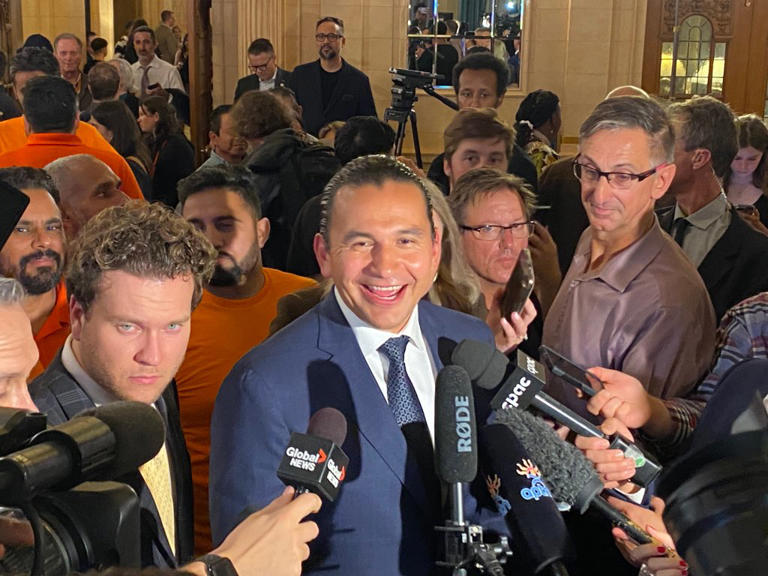
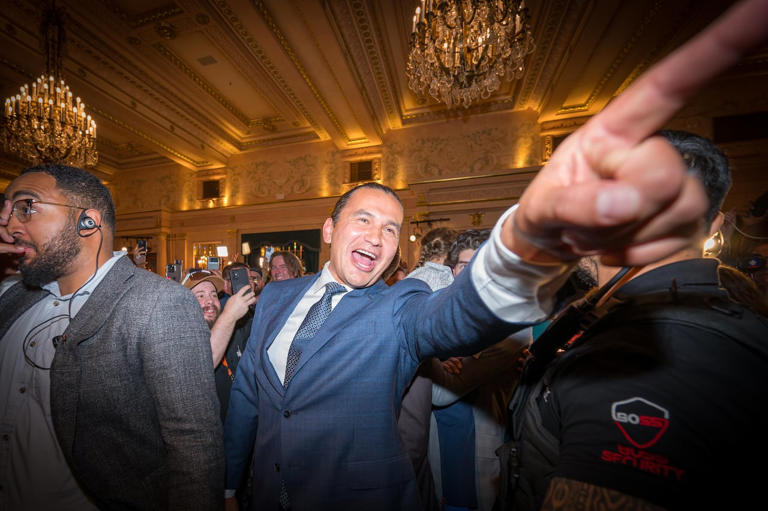
Premier-designate Wab Kinew speaks to media after Tuesday night's election
© Thandi Vera / Global News

Manitoba voters made history Tuesday night.

After seven years of Progressive Conservative governments under premiers Brian Pallister and Heather Stefanson, Global News projects the Manitoba NDP will be back at the helm of a majority government.

Leader Wab Kinew, who is projected to be re-elected in his own riding of Fort Rouge, is set to become the first premier of First Nations descent in a Canadian province. He called the result a victory for all Manitobans.

A musician, broadcast journalist, and university administrator prior to his entry into politics, Kinew moved to Winnipeg as a child from Onigaming First Nation in Ontario.

Kinew was first elected as an MLA in 2016, and became NDP leader in 2017. His party's result Tuesday night is a significant improvement over his first provincial election as leader, a dominant performance by his PC opposition that saw the NDP with only 25 per cent of seats in the legislature.

"My dear sweet Manitoba, look at what we have done here tonight," Kinew said in his victory speech Tuesday.

"A lot of people in the big cities, they look down on us here in Manitoba. 'Fly-over country', they said. 'Winterpeg, Man-it's-cold-out,' they said... but look at what little old Manitoba did tonight.

"Manitoba did something more progressive than any of those big cities ever did. We elected a strong team of New Democrats to fix healthcare and make your life more affordable."

Video: Manitoba Election: NDP aims to succeed where PCs failed, MLA says

With Tuesday's result, the premier-designate makes history, but so did his predecessor — Stefanson was the first woman to serve as premier in Manitoba.Stefanson, who replaced former premier Brian Pallister after his resignation 2021, has held the Tuxedo riding for more than two decades. Results in that race are still coming in, but Stefanson announced she will be stepping down as PC leader.

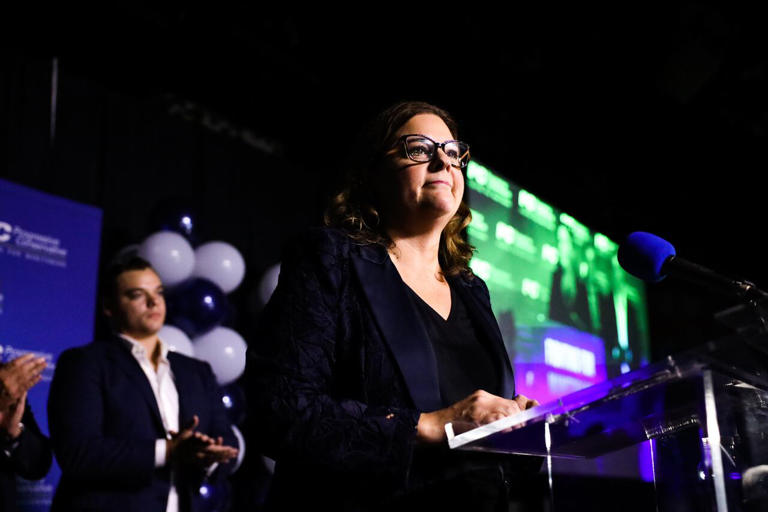
When she spoke to supporters Tuesday night, Stefanson congratulated Kinew on his historic victory, and said it was an honour to serve as premier.

"I have been a candidate for seven elections and I respect the will of the voters... and today the voters have spoken," she said.

"Mr. Kinew and I don't always agree on everything, but like me I know that he loves this province and he loves the people of Manitoba and I wish him all the best and will make every effort in a smooth transition in the premiership."

Video: Manitoba Election: Heather Stefanson concedes to Wab Kinew sealing historic victory

In an emotional speech as results continued to roll in Tuesday night, Manitoba Liberal Leader Dougald Lamont announced that he will be stepping down as leader of his party. Lamont, who had represented the St. Boniface riding, was defeated by the NDP's Robert Loiselle.

"Ultimately the people have decided, and sometimes you get caught in a wave and doesn't seem to matter what you do," Lamont said, calling the campaign one of the hardest he's ever taken part in, but also one of the best.

"I always knew this (result) was a possibility, but we had to hope beyond hope and keep working and do everything we could to run the best possible campaign."

The Green Party of Manitoba, which has yet to win a seat in a provincial election, continued that track record Tuesday, with Leader Janine Gibson falling short of her bid for the Wolseley riding, which is projected to be retained by incumbent Lisa Naylor of the NDP.

Winnipeg mayor Scott Gillingham congratulated Kinew and the NDP on their victory in a release just after Stefanson conceded defeat. Gillingham said he's eager to work with the new provincial government, and acknowledged Stefanson for her partnership on a number of projects over the past year.

Video: Manitoba Election: Dougald Lamont steps down as Liberal leader in emotional speech

The first person from among any of the three Indigenous groups in Canada to become a provincial premier was John Norquay, who was Métis, and who led Manitoba from 1878 to 1887.


 Solid NDP win cements Kinew as 1st First Nations premier in Manitoba history

Story by Bryce Hoye •CBC

The NDP sailed to victory Tuesday night with a solid win that cements leader Wab Kinew as Manitoba's first First Nations premier and also nets the party enough seats to form a majority government.

NDP Leader Wab Kinew led his party with a projected win in Fort Rouge, and while results continue to come in, the New Democrats will come away with at least the 29 seats needed to form a majority government.

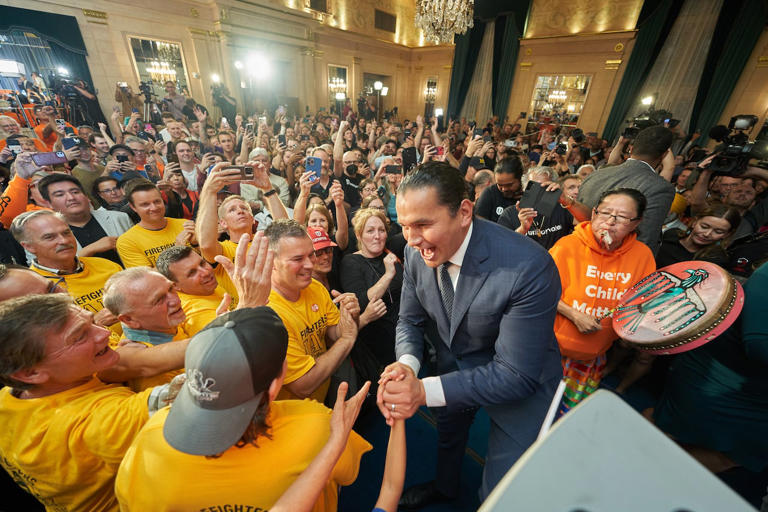
"This is a great victory for all of us in Manitoba," Kinew said to thunderous applause at NDP campaign headquarters Tuesday night. "We can do amazing things when we stand together as one province."

Kinew's win makes Manitoba the first Canadian province to elect a First Nations premier.

He thanked Heather Stefanson for her service as premier.

The PC leader will step down as party leader, she said as she conceded her party's defeat to the NDP. 

Stefanson became Manitoba's first woman premier when she took the job after Brian Pallister stepped down in fall 2021.

"Mr. Kinew and I don't always agree on everything, but like me, I know that he loves this province and he loves the people of Manitoba," Stefanson said. 

"Wab, I hope that your win tonight inspires a future generation of Indigenous youth to get involved in our democratic process — not just here in Manitoba but right across the country."

As of 2 a.m. CT Wednesday, Stefanson led in her Tuxedo riding, with 25 of 26 polls reporting.

After the Kirkfield Park byelection last year, the PCs held 36 seats to the NDP's 18, and the Liberals had three — one seat short of official party status.

On Tuesday, CBC projected the NDP won 30 seats, the PCs won 19 and the Liberals were down to one, with seven races still too tight to call as of 2 a.m. CT.

In the December 2022 Kirkfield Park byelection, former city councillor Kevin Klein came out on top for the PCs — but on Tuesday night, NDP opponent Logan Oxenham wrested Kirkfield Park away from Klein, who was a cabinet minister.

The PCs managed to hang on to a chunk of conservative strongholds outside of Winnipeg on Tuesday, including Ron Schuler's win in Springfield-Ritchot and Kelvin Goertzen's in Steinbach.

But the party suffered a severe blow when PC cabinet ministers Audrey Gordon (Southdale), Rochelle Squires (Riel), Janice Morley-Lecomte (Seine River) and James Teitsma (Radisson) lost their seats to NDP rivals.

Manitoba Liberal Leader Dougald Lamont also conceded defeat to NDP candidate Robert Loiselle in St. Boniface.

"Ultimately the people have decided, and sometimes you get caught in a wave, and sometimes it doesn't matter what you do," Lamont said. "I know we changed hearts and minds in this election, but I also know that's not always enough."

Lamont stepped down as leader as the party was "basically wiped out," he said, reduced from three seats to one, which went to Cindy Lamoureux in Tyndall Park. 

Longtime Liberal MLA for River Heights Jon Gerrard was taken down by the NDP's Mike Moroz. Gerrard was first elected in 1999.

ent Mark Wasyliw his seat for the NDP in Fort Garry, which was the first projection of the night.

"This feels really great.… All the indications we were getting from people were positive," Wasyliw said. "I think we need to heal Manitoba … think health care has become a symbol of that."


Kinew greets supporters at his campaign headquarters in Winnipeg on Tuesday. (David Lipnowski/The Canadian Press)© Provided by cbc.ca

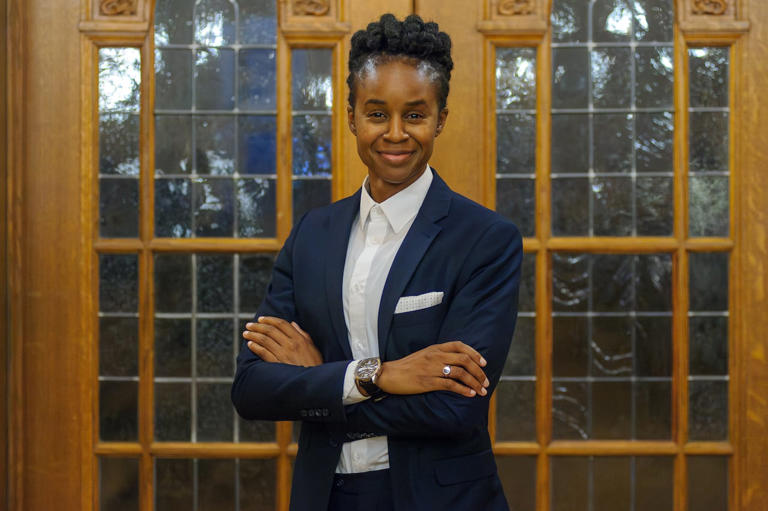
A number of MLAs who held critic files while the NDP were the Official Opposition were re-elected, including Adrien Sala (St. James), Lisa Naylor (Wolseley), Nahanni Fontaine (St. Johns), Nello Altomare (Transcona), Matt Wiebe (Concordia), Bernadette Smith (Point Douglas) and Uzoma Asagwara (Union Station).

But new faces also helped vault the party ahead, like Winnipeg school board trustee Jennifer Chen, who seized Fort Richmond from the PCs. Rachelle Schott (Kildonan-River East) and Oxenham, who lost to Klein the first time they faced off in the Kirkfield Park byelection last year, are two other rookies who propelled the NDP to a win.

Outside Winnipeg, Tom Lindsey (Flin Flon), Eric Redhead (Thompson), Ian Bushie (Keewatinook) and Amanda Lathlin (The Pas-Kameesak) pocketed four northern seats for the NDP, while Glen Simard picked up Brandon East.


Uzoma Azagwara, NDP candidate for Union Station, waits for election results on Tuesday night. (James Turner/CBC)© Provided by cbc.ca


A record 200,790 Manitobans — nearly a quarter of all eligible voters — cast ballots in advance polls, Elections Manitoba said.

In 2019, about 112,814 advance votes were cast — the next-highest number on record. That election saw a 55 per cent turnout.

The PCs rose to power in 2016 under then-premier Brian Pallister.

Stefanson won a hotly contested PC leadership campaign against rival Shelly Glover in fall 2021 after Pallister resigned. She announced Tuesday she would step down as party leader, but didn't say when.

In the two weeks ahead of election day, two polls — one by Angus Reid and another by Probe Research — put the NDP ahead with a six- and then 11-point percentage lead, respectively.

The New Democrats emerged victorious after a weeks-long barrage of attack ads from the PCs.

The PCs ratcheted up their ads in the past few weeks in what some political scientists speculated was a sign of desperation in the waning days of the campaign. 


Manitoba PC Leader Heather Stefanson announces she is stepping down as leader after the NDP won enough seats Tuesday night to form a majority government.
 (Prabhjot Singh Lotey/CBC)© Provided by cbc.ca

Kinew and his team largely stuck to health-care pledges — including a promise to reopen three Winnipeg emergency rooms shuttered during Brian Pallister's time as PC leader. The first to be restored will be Victoria Hospital, followed by Seven Oaks General Hospital and Concordia.

Kinew also pledged to build a new ER in Eriksdale, Man.

It'll take two terms, or up to eight years, for the NDP to fully restore ERs, the party said.

Among other things, Kinew committed to temporarily pausing the provincial gas tax, freezing Manitoba Hydro rates for a year and adding more social and affordable housing

He criticized the PCs for campaigning on their decision not to search a landfill for the remains of two First Nations women police allege were killed by a serial killer

Upon winning Tuesday, Kinew called the PC campaign one with a "divisive message." He thanked voters for showing the rest of the world that the "people of Manitoba are good people."

"I want to express our tremendous gratitude for this awesome responsibility that you have bestowed upon us," he said.

Kinew ended his address to supporters by introducing his mother on stage and leading the crowd in singing her happy birthday.


Incoming Manitoba premier Wab Kinew says focus turns to fixing health care


Provided by The Canadian Press


WINNIPEG — Incoming Manitoba premier Wab Kinew says the hard work begins now as his New Democrats work to fulfil their campaign promise to fix health care in the province.

Kinew says that work includes adding front-line health staff while building new emergency rooms and a cancer care facility.

Kinew is set to become Canada’s first First Nations provincial premier.

His party defeated the Progressive Conservatives on Tuesday to form a majority government.

The result led to the resignation of the other two main party leaders, including PC Premier Heather Stefanson.

Stefanson announced she would step down after leading the Tories for nearly two years. 

As of Wednesday morning, Stefanson was narrowly holding onto her seat in the Winnipeg riding of Tuxedo.

Liberal Leader Dougald Lamont resigned after he lost his Winnipeg riding and his party was reduced to one seat from the previous three.

Kinew told reporters Wednesday that he's pleased voters rejected the politics of division and embraced his party’s message of unity.

“It's my intention to move the ball forward so that the future generation can do even more powerful things than we can imagine today,” said Kinew

“(Becoming premier) is the most difficult thing that I've ever done in my life, and the real work hasn't even begun yet,” he added.

“I'm going to treat this job with the utmost of reverence and the humility that I believe will be necessary to serve you, the people of Manitoba, and of course I hope to make a positive contribution for all Canadians.”

This report by The Canadian Press was first published Oct. 4, 2023. 

The Canadian Press


Wab Kinew to become first First Nations premier of province after Manitoba election win 

 Manitoba New Democrats have won a majority government with leader Wan Kinew becoming the first First Nations premier of a province.

 Progressive Conservative leader Heather Stefanson announced she would step down after leading the Tories for nearly two years.
 (Oct. 4, 2023)


 Historic: NDP & First Nations Leader Wab Kinew Defeat Hate In Manitoba 

 The Rational National 48 minutes ago 

The province of Manitoba has elected its first First Nations premier along with an incredible majority government for the Manitoba NDP.

 
 Manitoba Premier-elect Wab Kinew expresses "extraordinary gratitude" after election win 
| FULL
 Global News
 Streamed 2 hours ago 
 #GlobalNews #Manelection #Manitobaelection

 Premier-designate Wab Kinew addressed Manitobans following Tuesday night's historic election win on Wednesday morning to discuss his party's promises on health care, affordability, and conducting a landfill search.


 MANITOBA ELECTION | 

Watch Wab Kinew's victory speech: 'Seek your vision' 

 CTV News Man. NDP Leader Wab Kinew's speech in Manitoba after defeating Heather Stefanson and winning the provincial election.


 Manitoba NDP Leader Wab Kinew speaks with reporters after historic election win

 October 4, 2023 


 Streamed live 2 hours ago 

Wab Kinew, the leader of the New Democratic Party of Manitoba, holds a news conference in Winnipeg to discuss the results of the October 3 provincial general election.

 His party is expected to form government after winning a majority of seats in the provincial legislature, defeating Heather Stefanson’s Progressive Conservatives.

 Kinew, who has led the Manitoba NDP since 2017, will become the first First Nations provincial premier in Canadian history

Liberal MP Greg Fergus becomes first Black Canadian Speaker

Liberal MP Greg Fergus was elected to be the new House of Commons Speaker. He is the first Black Canadian to hold that position, and earned raucous applause from all sides of the chamber, along with congratulations from party leaders. (Oct. 3, 2023)


MP Greg Fergus salutes Viola Desmond in the House

CBC News
Dec 8, 2016
Quebec Liberal MP Greg Fergus tells the House of Commons what Viola Desmond on the $10 bill means to him.
 To read more: http://cbc.ca/1.3885844

 Pilots Hold the Most Professional Protest  Occurred on September 29, 2023 / Toronto, Ontario, Canada

"Taken at Toronto Pearson International Airport. Air Canada pilots protest demanding better pay and benefits for pilots." 


Avatars to help tailor glioblastoma therapies


Peer-Reviewed Publication

MAX DELBRÜCK CENTER FOR MOLECULAR MEDICINE IN THE HELMHOLTZ ASSOCIATION

Brain region of a zebrafish avatar bearing a human glioblastoma tumor 

IMAGE: 

PATIENT-DERIVED TUMOR CELLS (GREEN) GROWING IN A ZEBRAFISH EMBRYO WITH ITS VASCULAR NETWORK LABELED IN YELLOW, AND ITS MACROPHAGES, A TYPE OF IMMUNE CELL, IN RED. 

view more 

CREDIT: LISE FINOTTO, VIB – KU LEUVEN


Scientists have created a new zebrafish xenograft platform to screen for novel treatments for an aggressive brain tumor called glioblastoma, according to a new study by the Gerhardt and De Smet labs published in EMBO Molecular Medicine.

Joint press release – Max Delbrück Center, VIB, and KU Leuven

Glioblastoma is an aggressive and difficult-to-treat brain tumor in adults. On average, patients survive for only 1.5 years. The standard of care treatment for this disease, which includes surgery followed by radiation and chemotherapy, has not changed in 18 years. That’s partly because the cancer is highly variable with many differences across the patient population. Secondly, these cancer cells also deceive the body in insidious ways: they even recruit immune cells called macrophages to help them. And thirdly, they are out of reach for most anti-cancer drugs, which have only a limited capacity to penetrate brain tissues. Besides the standard of care treatment, oncologists try out drugs on glioblastoma patients without any guarantee they’ll work, often involving adverse side effects. 

“These patients really are in need of new therapies,” says Professor Holger Gerhardt, the senior author of the study and vice-Scientific Director of the Max Delbrück Center in Berlin. “It is very important to identify the patients who do respond to a specific treatment, and the ones who do not.”

Lise Finotto, the lead author and a cancer researcher at the VIB-KU Leuven Center for Cancer Biology in Belgium and formerly at the Max Delbrück Center, and her senior collaborators Gerhardt and Professor Frederik De Smet at KU Leuven, have created a screening platform that could be refined to find novel targets for drugs against glioblastoma. It could also be used to check if a particular patient will respond to a therapy. The study was published in “EMBO Molecular Medicine.”

To understand how macrophages can interact with glioblastoma cells of different patients, the researchers created zebrafish “avatars.” Gerhardt’s lab works extensively with zebrafish. These three-centimeter-long fish are considered good model organisms as their embryos are translucent, making it possible to monitor what’s happening inside. 

An unexpected survival

Finotto investigated glioblastoma stem cells from seven patients collected by scientists at the De Smet lab, which is establishing a living tissue bank of glioblastoma samples. She injected them into zebrafish embryos, creating xenograft models – an avatar for each specific patient. When she live-imaged the embryos, it appeared that the glioblastoma cells had adapted well to their new environment. She saw the zebrafish’s immune system sending macrophages as part of an immune response to control the tumor. But as is typical in glioblastoma, the macrophages were suppressed. The tumors have several mechanisms to reprogram the macrophages so they help them grow.

"We wanted to learn how to revert the macrophages to a tumor-attacking state,” Finotto says. And a clue surfaced when they noticed that the tumor of one patient did not suppress the normal macrophage response.

“Upon closer investigation of the medical details, we discovered that this patient was what we call a 'long-term survivor’,” says De Smet at KU Leuven. “It’s a term used for glioblastoma patients with a survival of more than five years, which is exceptionally rare in this brain cancer.”

Testing platform

Their curiosity about the patient became the driving force behind the project, Finotto says. When they cultured the tumor cells and macrophages together and did single-cell RNA sequencing, they learned that one gene, LGALS1, was downregulated in the tumor of the long-term survivor compared to the others. Earlier studies have also shown that silencing of LGALS1 in glioblastoma cells can result in longer survival. 

The scientists confirmed their results by knocking out the gene in another patient’s sample and observed in the zebrafish models that the tumor became less invasive.

This platform could be used to identify promising targets other than LGALS1 for the treatment of glioblastoma, Finotto says. And with some refinement, zebrafish avatars could be used to identify which treatments will work. Researchers could investigate whether the tumor cells from particular patients grafted into zebrafish respond when treated with various drugs to find the ones that lead to tumor regression, Gerhardt says.

“Armed with this information, we could inform oncologist and help them to make more supported treatment decisions for the patient,” De Smet says. 


Time-lapse video of a zebrafis [VIDEO] | 

By imaging the brain of a zebrafish embryo over time, scientists can follow the dynamic interaction of patient-derived glioblastoma tumor cells (green) and macrophages (red). The brain’s vascular network is labeled in yellow. In this case, the scientists imaged the avatar for more than 15 hours. 

CREDIT

Lise Finotto, VIB-KU Leuven


Further information

Gerhardt Lab at the Max Delbrück Center

Laboratory for Precision Cancer Medicine at KU Leuven

Leuven Living Tissue Lab

VIB-KU Leuven Center for Cancer Biology

Literature

Lise Finotto et al. (2023): “Single-cell profiling and zebrafish avatars reveal LGALS1 as immunomodulating target in glioblastoma.” EMBO Molecular Medicine, DOI: 10.15252/emmm.202318144

Max Delbrück Center

The Max Delbrück Center for Molecular Medicine in the Helmholtz Association (Max Delbrück Center) is one of the world’s leading biomedical research institutions. Max Delbrück, a Berlin native, was a Nobel laureate and one of the founders of molecular biology. At the locations in Berlin-Buch and Mitte, researchers from some 70 countries study human biology – investigating the foundations of life from its most elementary building blocks to systems-wide mechanisms. By understanding what regulates or disrupts the dynamic equilibrium of a cell, an organ, or the entire body, we can prevent diseases, diagnose them earlier, and stop their progression with tailored therapies. Patients should benefit as soon as possible from basic research discoveries. The Max Delbrück Center therefore supports spin-off creation and participates in collaborative networks. It works in close partnership with Charité – Universitätsmedizin Berlin in the jointly run Experimental and Clinical Research Center (ECRC), the Berlin Institute of Health (BIH) at Charité, and the German Center for Cardiovascular Research (DZHK). Founded in 1992, the Max Delbrück Center today employs 1,800 people and is funded 90 percent by the German federal government and 10 percent by the State of Berlin. www.mdc-berlin.de

VIB

VIB’s core mission is to generate disruptive insights in the molecular underpinning of life and to translate these actively into impactful innovations for patients and society. VIB is an independent research institute where some 1,800 top scientists from Belgium and abroad conduct pioneering basic research. As such, they are pushing the boundaries of what we know about molecular mechanisms and how they rule living organisms such as human beings, animals, plants, and microorganisms. Based on a close partnership with five Flemish universities – Ghent University, KU Leuven, University of Antwerp, Vrije Universiteit Brussel, and Hasselt University – and supported by a solid funding program, VIB unites the expertise of all its collaborators and research groups in a single institute. VIB’s technology transfer activities translate research results into concrete benefits for society such as new diagnostics and therapies and agricultural innovations. These applications are often developed by young start-ups from VIB or through collaborations with other companies. This also leads to additional employment and bridges the gap between scientific research and entrepreneurship. VIB also engages actively in the public debate on biotechnology by developing and disseminating a wide range of science-based information.  More info can be found on www.vib.be.

KU LEUVEN

KU Leuven is Europe’s most innovative university (Reuters) and ranks 42nd in the Times Higher Education World University rankings. As Belgium's largest university, KU Leuven welcomes 65,000 students from over 140 countries. Its 8,000 researchers are active in a comprehensive range of disciplines. KU Leuven is a founding member of the League of European Research Universities (LERU) and has a strong European and international orientation. University Hospitals Leuven, its network of research hospitals, provides high-quality healthcare and develops new therapeutic and diagnostic insights with an emphasis on translational research.