75,000 Health care workers picket outside US hospitals in multiple states, kicking off 3-day strike
STEFANIE DAZIO and DAMIAN DOVARGANES
Updated Wed, October 4, 2023
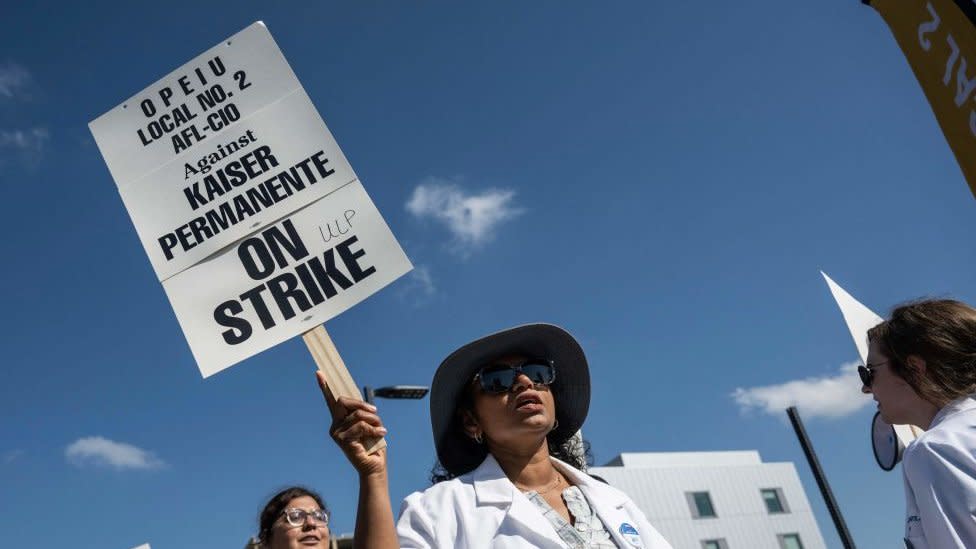
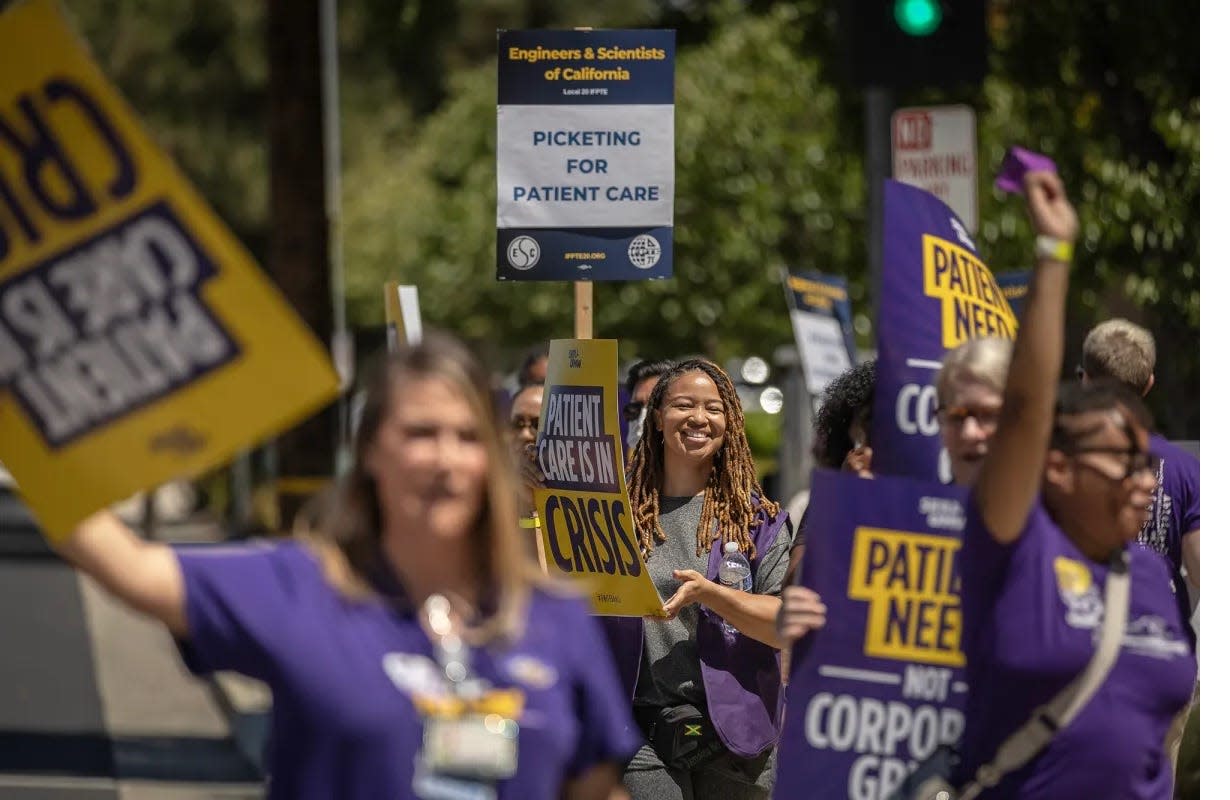
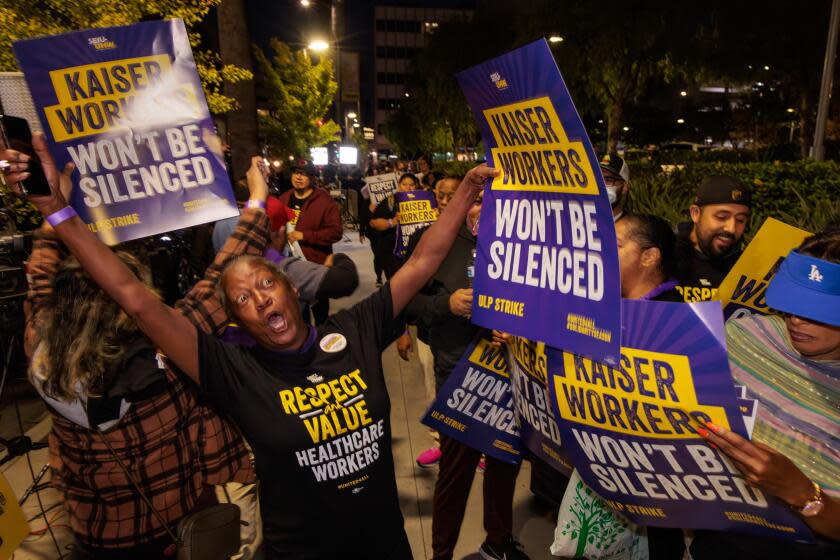
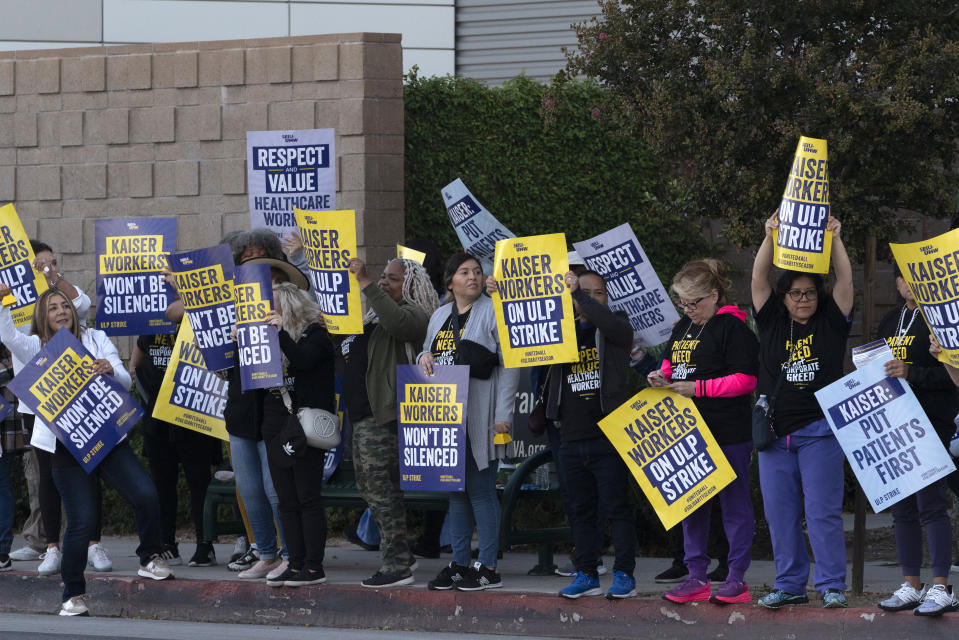
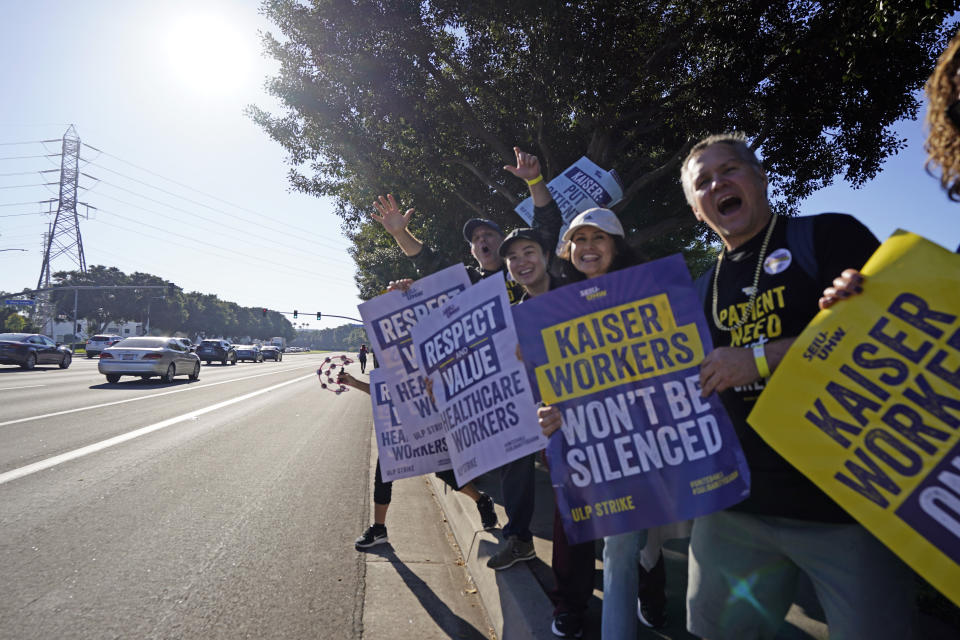
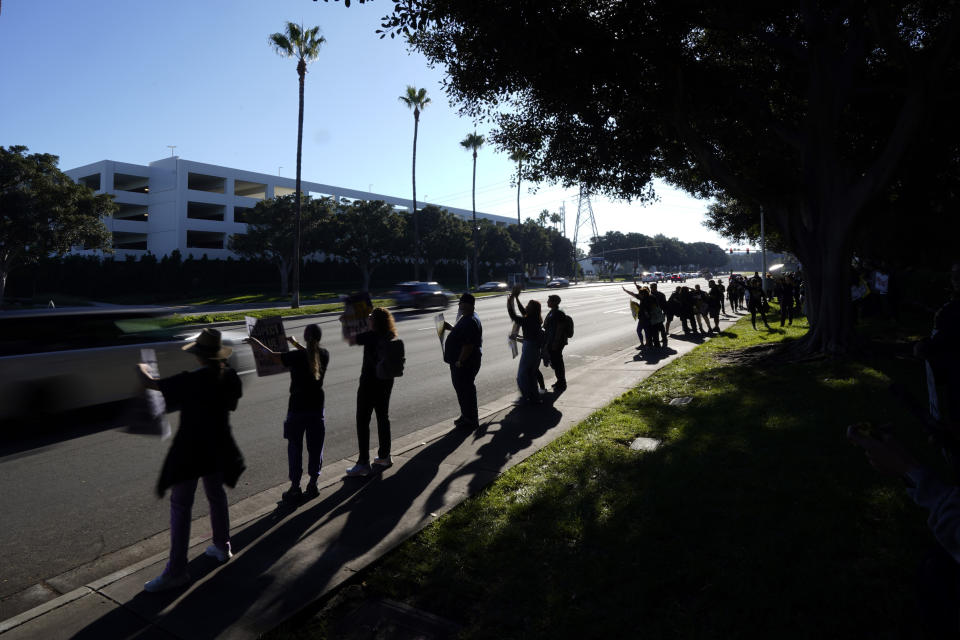
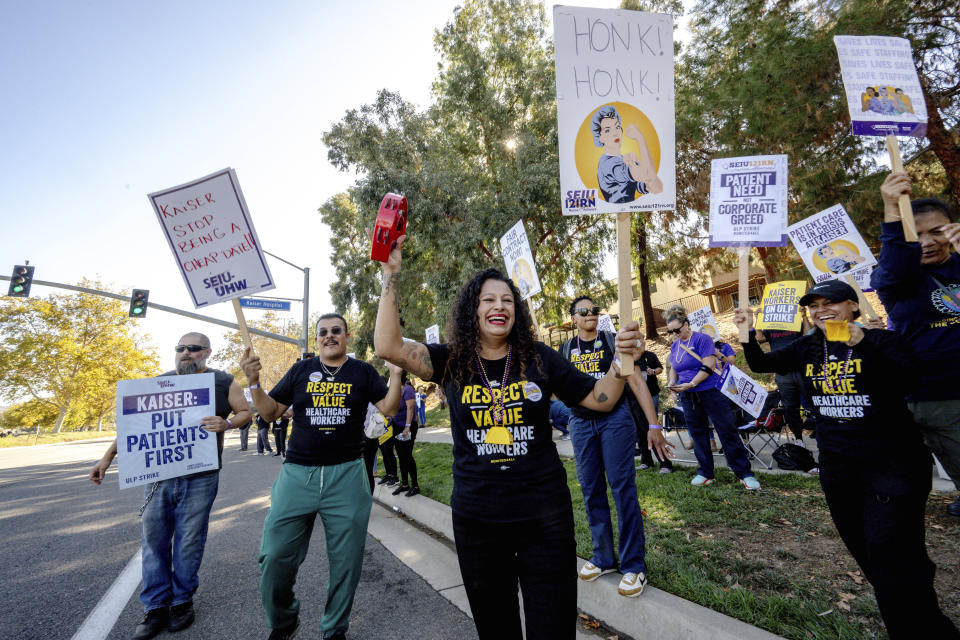
LOS ANGELES (AP) — Tens of thousands of Kaiser Permanente workers took to picket lines in multiple states on Wednesday, launching a massive strike that the company warned could cause delays at its hospitals and clinics that serve nearly 13 million Americans.
The Coalition of Kaiser Permanente Unions, representing about 85,000 of the health system’s employees nationally, approved a strike for three days in California, Colorado, Oregon and Washington, and for one day in Virginia and Washington, D.C. Some 75,000 people were expected to participate in the pickets.
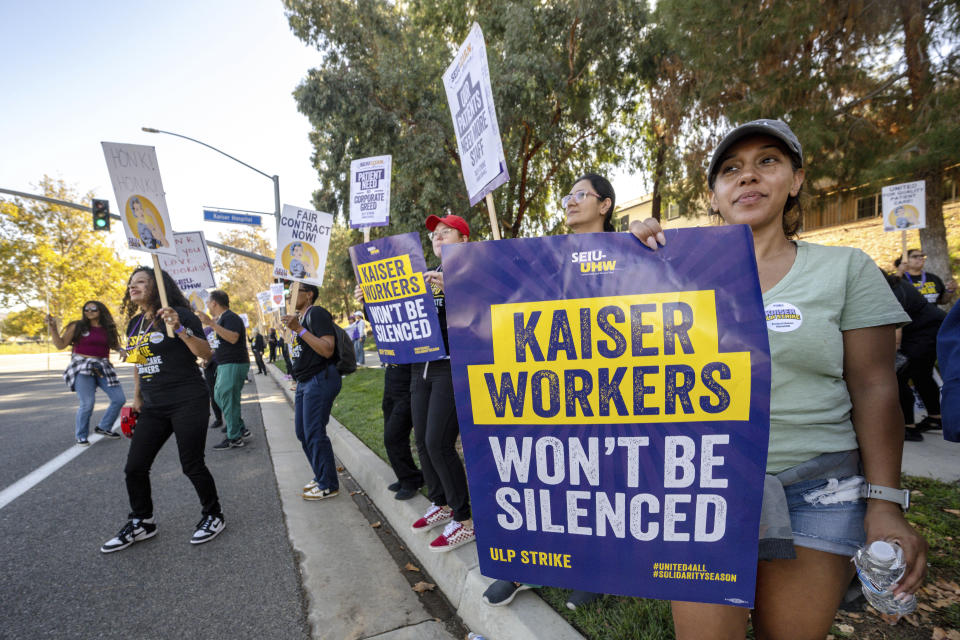
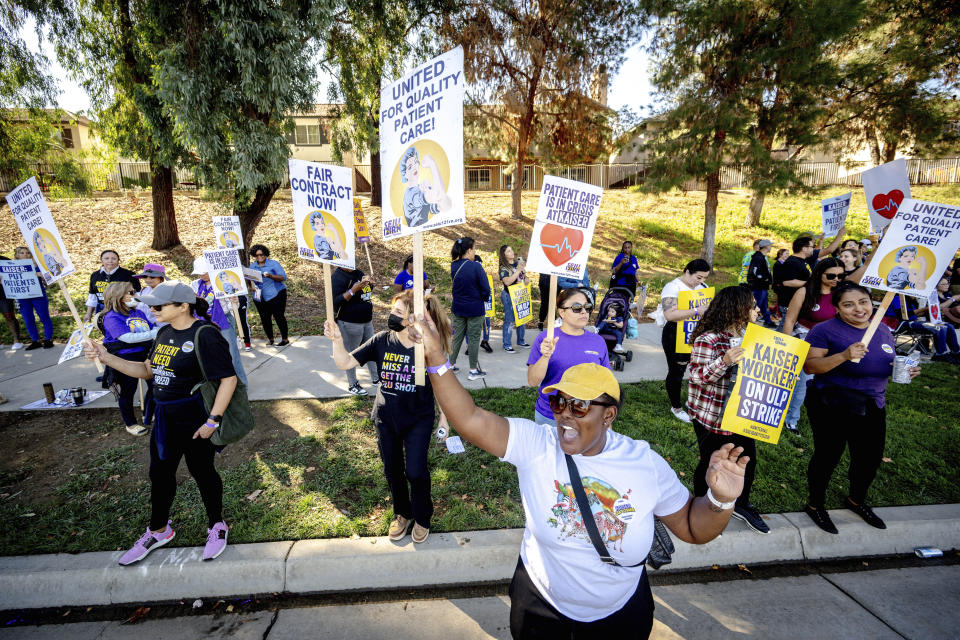
“Kaiser has not been bargaining with us in good faith and so it’s pushing us to come out here and strike,” said Jacquelyn Duley, a radiologic technologist among the hundreds of picketers at Kaiser Permanente Orange County - Irvine Medical Center. “We want to be inside just taking care of our patients.”
The Oakland, California-based nonprofit company said its 39 hospitals, including emergency rooms, will remain open. Doctors are not participating, and Kaiser said it was bringing in thousands of temporary workers to fill the gaps. Still, appointments and non-urgent procedures could be pushed back.
Early Wednesday, workers at Kaiser Permanente Los Angeles Medical Center cheered as the strike deadline arrived. The strikers include licensed vocational nurses, home health aides and ultrasound sonographers, as well as technicians in the radiology, X-ray, surgical, pharmacy and emergency departments.
Brittany Everidge, a ward clerk transcriber in the medical center’s maternal child health department, was among those on the picket line. She said that because of staffing shortages, pregnant people in active labor can be stuck waiting for hours to be checked in. Other times, too few transcribers can lead to delays in creating and updating charts for new babies.
“We don’t ever want to be in a situation where the nurses have to do our job,” she said.
Across Virginia and Washington, D.C., only 180 workers were eligible to strike, according to Local 2 Secretary-Treasurer Sarah Levesque. The picketers had to travel miles across the region to meet up, so rather than commuting long distances for three days, they instead chose to participate in a one-day strike and converged in Springfield, Va., on Wednesday.
Patients like Carlos Herrera, 65, walked by picketers in Los Angeles.
Herrera, who was there for a kidney test, said there were few people inside urgent care and his 10:40 a.m. appointment was on time. He said he supports the strikers because they need more people to combat staffing shortages to treat patients like him.
The strike comes in a year when there have been work stoppages within multiple industries, including, transportation, entertainment and hospitality.
At least 453,000 workers have participated in 312 strikes in the U.S. this year, according to Johnnie Kallas, a Ph.D. candidate and the project director of Cornell University’s Labor Action Tracker. That figure includes Kaiser workers.
He said the strike will likely hurt Kaiser’s reputation and its narrative of patient care more than its bottom line.
“I do think there’s a deep connection between what health care workers had to go through on the front lines of a global pandemic,” he said, adding the feeling now is “they really deserve a lot more in terms of pay, staffing, workplace health and safety.”
The health care industry alone has been hit by several strikes this year as it confronts burnout from heavy workloads — problems that were exacerbated greatly by the COVID-19 pandemic.
Unions representing Kaiser workers in August asked for a $25 hourly minimum wage, as well as increases of 7% each year in the first two years and 6.25% each year in the two years afterward.
Union members say understaffing is boosting the hospital system’s profits but hurting patients, and executives have been bargaining in bad faith during negotiations.
Tonya Harris, who was on the picket line in Irvine, about 40 miles (64 kilometers) south of Los Angeles in Orange County, said medical assistants like her are often asked to double up with doctors –- each of whom has up to 20 patients –- instead of working one-to-one.
“You’re running around and you’re trying to basically keep up with the flow,” she said, wearing her strike captain vest over her scrubs.
The single mother with two kids going into college said she also can’t afford to live in Orange County on her current pay.
Kaiser has proposed minimum hourly wages of between $21 and $23 next year depending on the location.
Since 2022, the hospital system has hired 51,000 workers and has plans to add 10,000 more people by the end of the month.
Kaiser Permanente’s operating revenue climbed 7% in this year’s second quarter to more than $25 billion. The health care giant said in August that strong investment income helped it turn a $2.1 billion profit for the quarter, swinging from a $1.3 billion loss a year earlier. However, the company said it was still contending with inflation and labor shortages.
Kaiser executive Michelle Gaskill-Hames said the company’s practices, compensation and retention are better than its competitors, even as the entire sector faces the same challenges.
“Our focus, for the dollars that we bring in, are to keep them invested in value-based care,” said Gaskill-Hames, president of Kaiser Foundation Health Plan and Hospitals of Southern California and Hawaii.
She added that Kaiser only faces 7% turnover compared to the industry standard of 21%, despite the effects of the pandemic.
“I think coming out of the pandemic, health care workers have been completely burned out,” she said. “The trauma that was felt caring for so many COVID patients, and patients that died, was just difficult.”
The workers’ last contract was negotiated in 2019, before the pandemic.
Hospitals generally have struggled in recent years with high labor costs, staffing shortages and rising levels of uncompensated care, according to Rick Gundling, a senior vice president with the Healthcare Financial Management Association, a nonprofit that works with health care finance executives.
Most of their revenue is fixed, coming from government-funded programs such as Medicare and Medicaid, Gundling noted. He said that means revenue growth is “only possible by increasing volumes, which is difficult even under the best of circumstances.”
___
Associated Press Writers Eugene Garcia in Irvine, California, and Tom Murphy in Indianapolis contributed to this report.
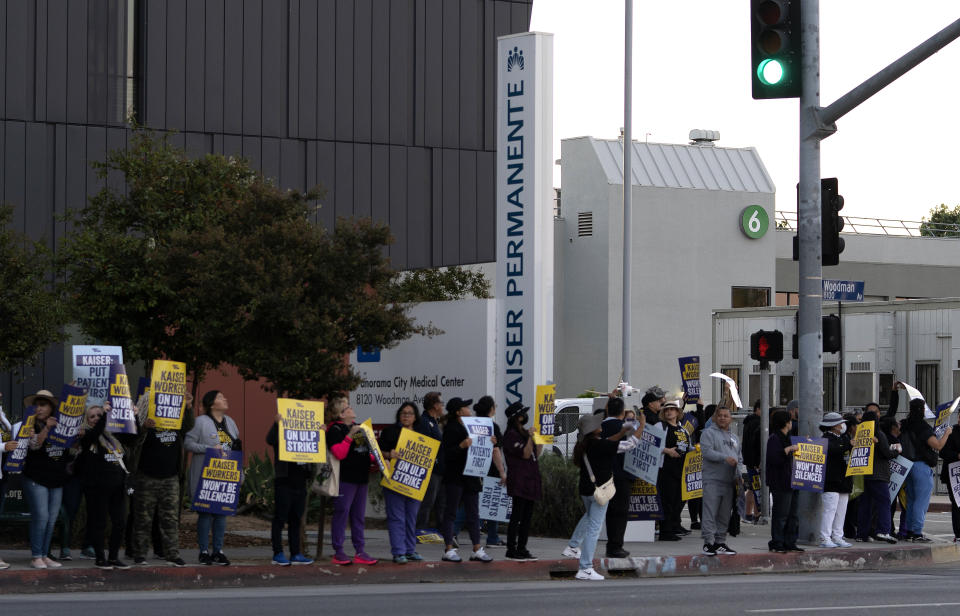
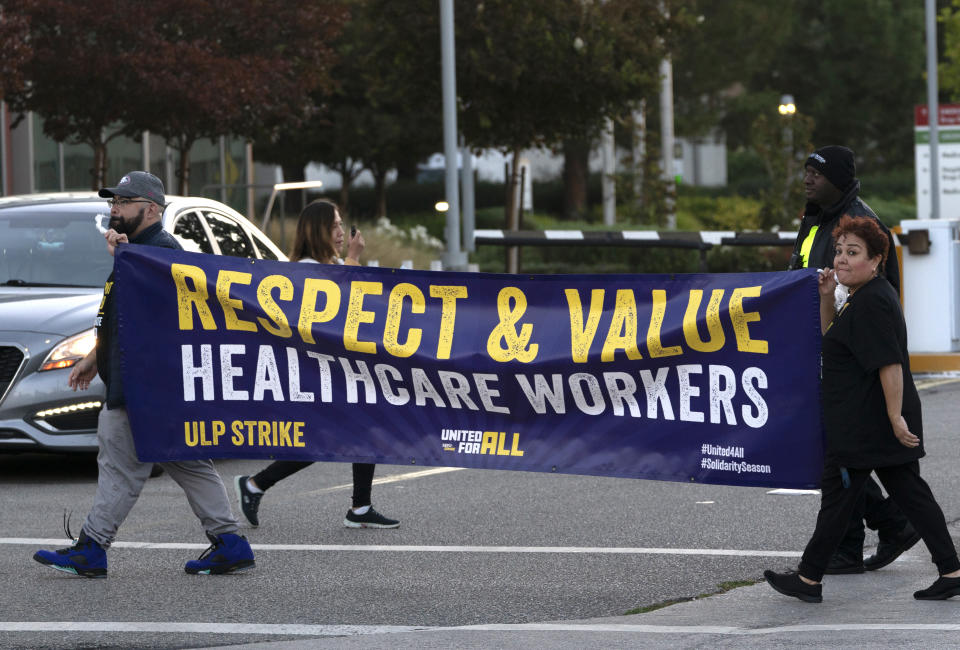
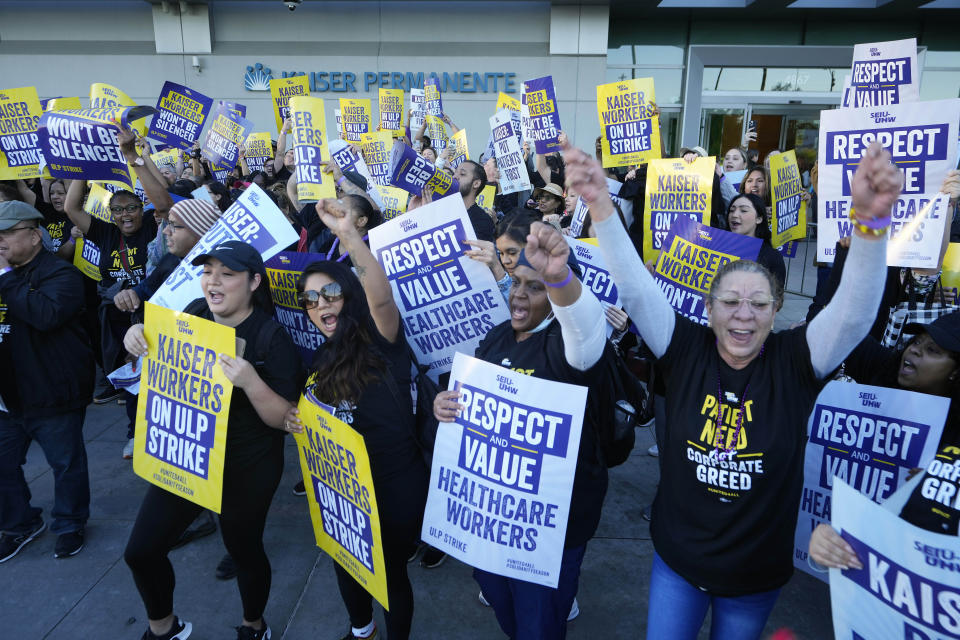
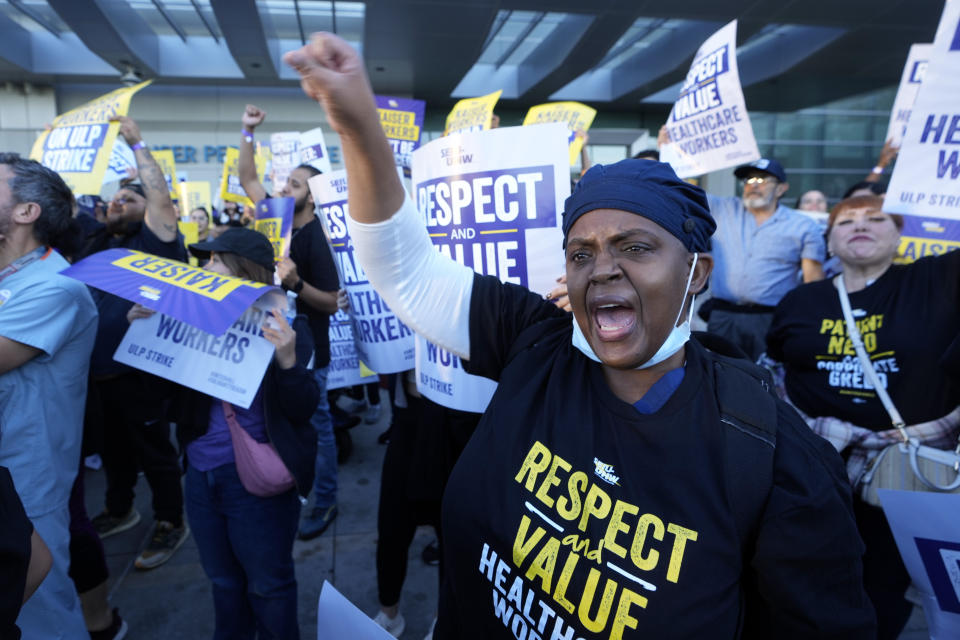
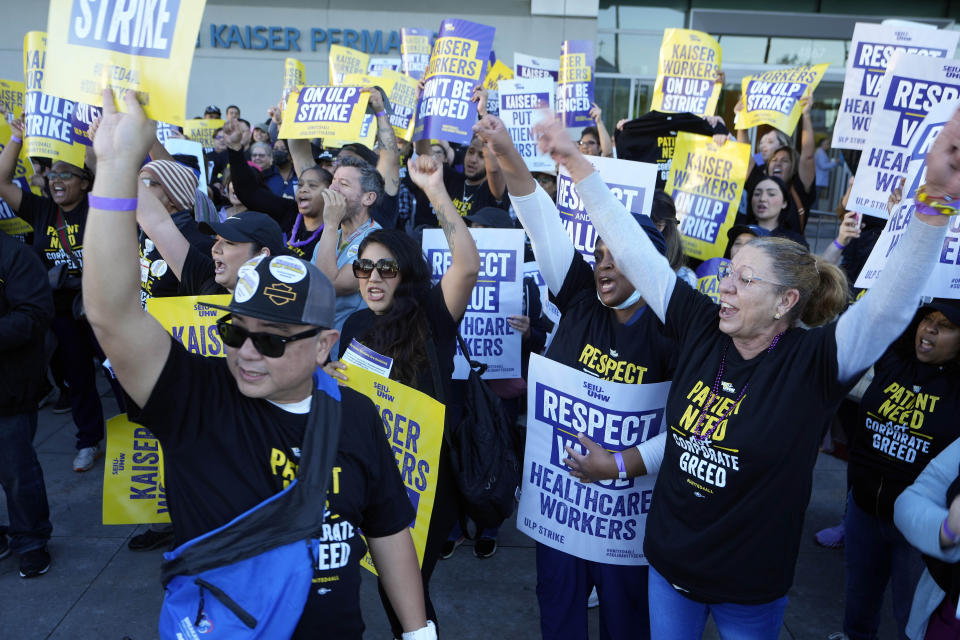
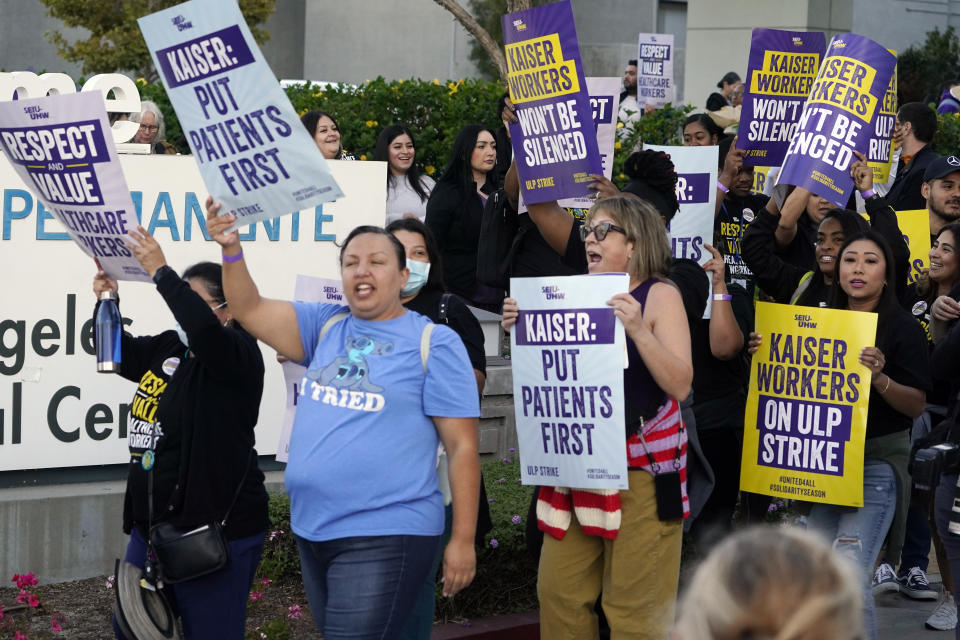
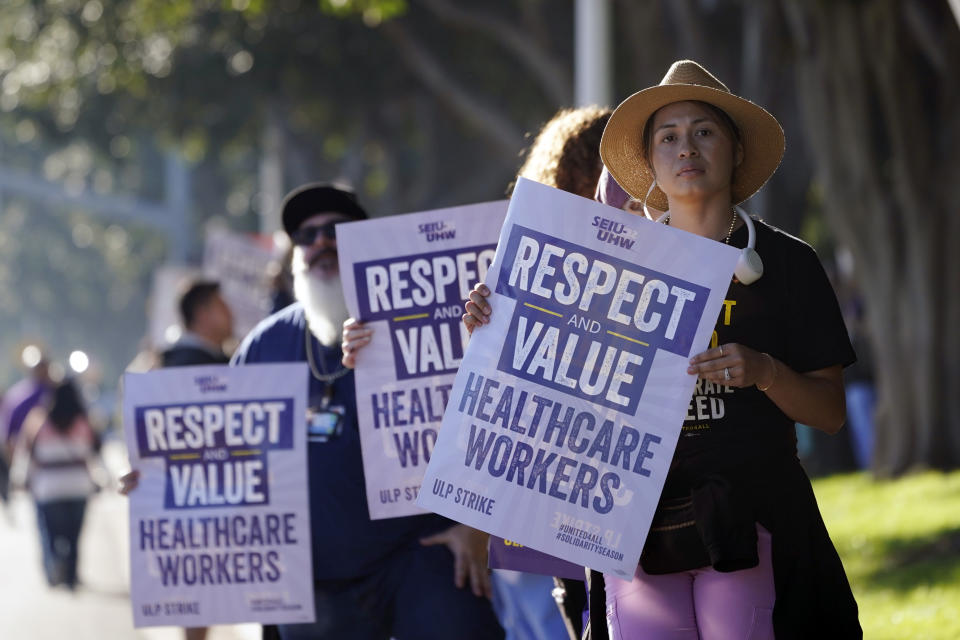
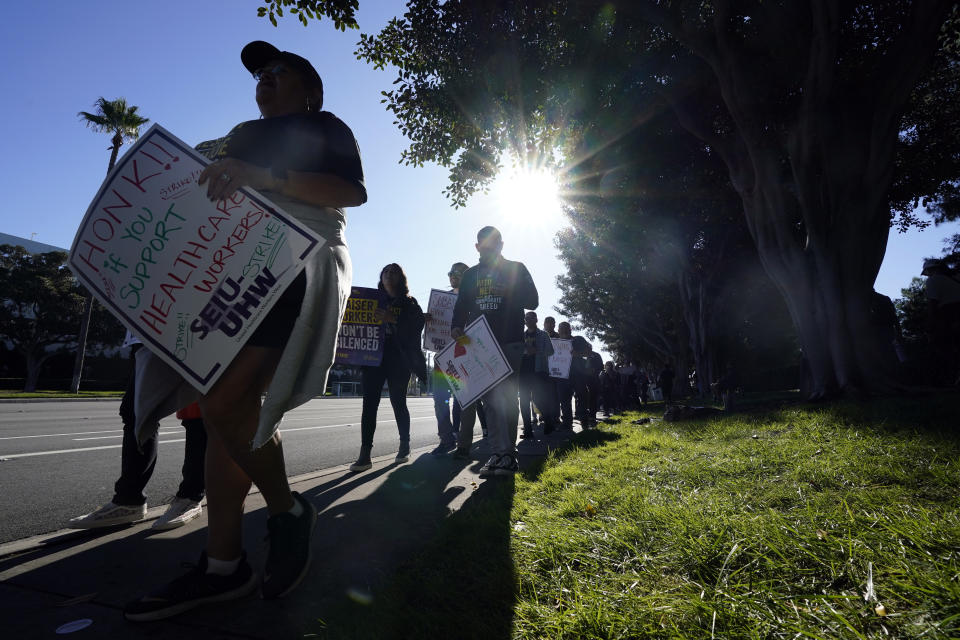
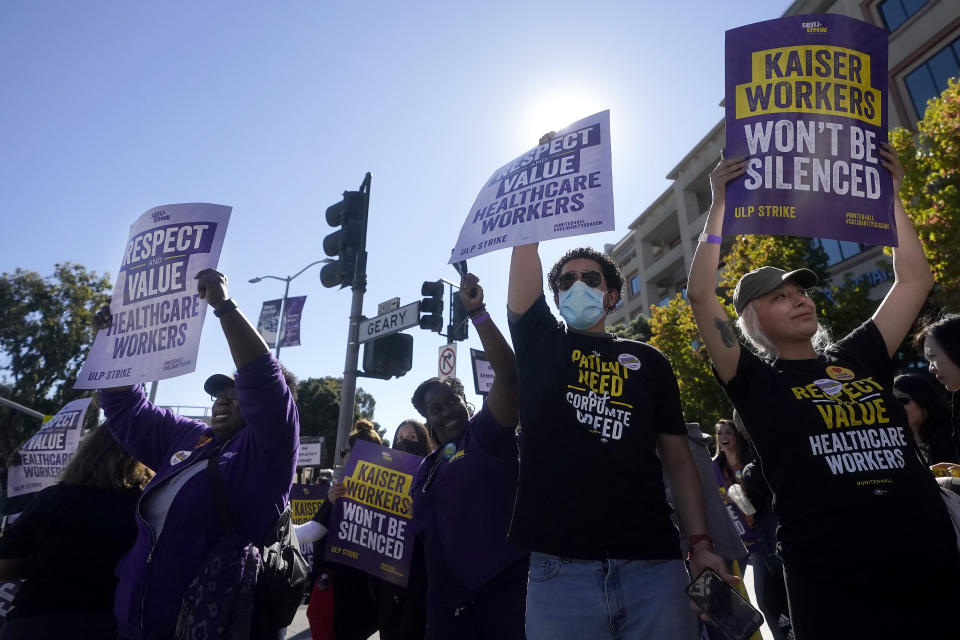
Medical workers and supporters hold signs as they protest outside of a Kaiser Permanente facility in San Francisco, Wednesday, Oct. 4, 2023. Some 75,000 Kaiser Permanente hospital employees who say understaffing is hurting patient care walked off the job Wednesday in five states and the District of Columbia, kicking off a major health care worker strike. (AP Photo/Jeff Chiu)
Updated Wed, October 4, 2023
LOS ANGELES (AP) — Tens of thousands of Kaiser Permanente workers took to picket lines in multiple states on Wednesday, launching a massive strike that the company warned could cause delays at its hospitals and clinics that serve nearly 13 million Americans.
The Coalition of Kaiser Permanente Unions, representing about 85,000 of the health system’s employees nationally, approved a strike for three days in California, Colorado, Oregon and Washington, and for one day in Virginia and Washington, D.C. Some 75,000 people were expected to participate in the pickets.
“Kaiser has not been bargaining with us in good faith and so it’s pushing us to come out here and strike,” said Jacquelyn Duley, a radiologic technologist among the hundreds of picketers at Kaiser Permanente Orange County - Irvine Medical Center. “We want to be inside just taking care of our patients.”
The Oakland, California-based nonprofit company said its 39 hospitals, including emergency rooms, will remain open. Doctors are not participating, and Kaiser said it was bringing in thousands of temporary workers to fill the gaps. Still, appointments and non-urgent procedures could be pushed back.
Early Wednesday, workers at Kaiser Permanente Los Angeles Medical Center cheered as the strike deadline arrived. The strikers include licensed vocational nurses, home health aides and ultrasound sonographers, as well as technicians in the radiology, X-ray, surgical, pharmacy and emergency departments.
Brittany Everidge, a ward clerk transcriber in the medical center’s maternal child health department, was among those on the picket line. She said that because of staffing shortages, pregnant people in active labor can be stuck waiting for hours to be checked in. Other times, too few transcribers can lead to delays in creating and updating charts for new babies.
“We don’t ever want to be in a situation where the nurses have to do our job,” she said.
Across Virginia and Washington, D.C., only 180 workers were eligible to strike, according to Local 2 Secretary-Treasurer Sarah Levesque. The picketers had to travel miles across the region to meet up, so rather than commuting long distances for three days, they instead chose to participate in a one-day strike and converged in Springfield, Va., on Wednesday.
Patients like Carlos Herrera, 65, walked by picketers in Los Angeles.
Herrera, who was there for a kidney test, said there were few people inside urgent care and his 10:40 a.m. appointment was on time. He said he supports the strikers because they need more people to combat staffing shortages to treat patients like him.
The strike comes in a year when there have been work stoppages within multiple industries, including, transportation, entertainment and hospitality.
At least 453,000 workers have participated in 312 strikes in the U.S. this year, according to Johnnie Kallas, a Ph.D. candidate and the project director of Cornell University’s Labor Action Tracker. That figure includes Kaiser workers.
He said the strike will likely hurt Kaiser’s reputation and its narrative of patient care more than its bottom line.
“I do think there’s a deep connection between what health care workers had to go through on the front lines of a global pandemic,” he said, adding the feeling now is “they really deserve a lot more in terms of pay, staffing, workplace health and safety.”
The health care industry alone has been hit by several strikes this year as it confronts burnout from heavy workloads — problems that were exacerbated greatly by the COVID-19 pandemic.
Unions representing Kaiser workers in August asked for a $25 hourly minimum wage, as well as increases of 7% each year in the first two years and 6.25% each year in the two years afterward.
Union members say understaffing is boosting the hospital system’s profits but hurting patients, and executives have been bargaining in bad faith during negotiations.
Tonya Harris, who was on the picket line in Irvine, about 40 miles (64 kilometers) south of Los Angeles in Orange County, said medical assistants like her are often asked to double up with doctors –- each of whom has up to 20 patients –- instead of working one-to-one.
“You’re running around and you’re trying to basically keep up with the flow,” she said, wearing her strike captain vest over her scrubs.
The single mother with two kids going into college said she also can’t afford to live in Orange County on her current pay.
Kaiser has proposed minimum hourly wages of between $21 and $23 next year depending on the location.
Since 2022, the hospital system has hired 51,000 workers and has plans to add 10,000 more people by the end of the month.
Kaiser Permanente’s operating revenue climbed 7% in this year’s second quarter to more than $25 billion. The health care giant said in August that strong investment income helped it turn a $2.1 billion profit for the quarter, swinging from a $1.3 billion loss a year earlier. However, the company said it was still contending with inflation and labor shortages.
Kaiser executive Michelle Gaskill-Hames said the company’s practices, compensation and retention are better than its competitors, even as the entire sector faces the same challenges.
“Our focus, for the dollars that we bring in, are to keep them invested in value-based care,” said Gaskill-Hames, president of Kaiser Foundation Health Plan and Hospitals of Southern California and Hawaii.
She added that Kaiser only faces 7% turnover compared to the industry standard of 21%, despite the effects of the pandemic.
“I think coming out of the pandemic, health care workers have been completely burned out,” she said. “The trauma that was felt caring for so many COVID patients, and patients that died, was just difficult.”
The workers’ last contract was negotiated in 2019, before the pandemic.
Hospitals generally have struggled in recent years with high labor costs, staffing shortages and rising levels of uncompensated care, according to Rick Gundling, a senior vice president with the Healthcare Financial Management Association, a nonprofit that works with health care finance executives.
Most of their revenue is fixed, coming from government-funded programs such as Medicare and Medicaid, Gundling noted. He said that means revenue growth is “only possible by increasing volumes, which is difficult even under the best of circumstances.”
___
Associated Press Writers Eugene Garcia in Irvine, California, and Tom Murphy in Indianapolis contributed to this report.
Medical workers and supporters hold signs as they protest outside of a Kaiser Permanente facility in San Francisco, Wednesday, Oct. 4, 2023. Some 75,000 Kaiser Permanente hospital employees who say understaffing is hurting patient care walked off the job Wednesday in five states and the District of Columbia, kicking off a major health care worker strike. (AP Photo/Jeff Chiu)
Kaiser Permanente: Over 75,000 US healthcare workers go on strike
Bernd Debusmann Jr - BBC News, Washington
Wed, October 4, 2023 at 1:17 PM MDT·2 min read
Nearly 13 million patients could be impacted by the three day strike by Kaiser Permanente workers
Over 75,000 union workers at healthcare provider Kaiser Permanente have gone on strike, beginning the largest walkout by health workers in US history.
The three-day work stoppage involves nurses, pharmacists and lab technicians in five US states and Washington DC.
Nearly 13 million patients could impacted by the strike, which follows stalled contract negotiations between the unions and Kaiser Permanente.
Hospitals and emergency facilities will remain open throughout the strike.
A previous labour agreement between the eight unions in the coalition and the company expired on 30 September,
Through the strike, the Coalition of Kaiser Permanente Unions hopes to pressure the California-based company to address staffing shortages that began during the Covid-19 pandemic in 2020, as well as better wages.
In a statement on Wednesday, Kaiser Permanente said that it had made "a lot of progress" in discussions with the unions overnight and "remained committed to reaching a new agreement".
The strike's greatest impact will be felt in California, Oregon, Colorado and Washington state, where hundreds of medical support staff will strike for three-days.
While Kaiser Permanente has said that hospitals and emergency departments will continue to function - partly staffed by "contingent workers" - non-essential services such as routine check-ups or elective procedures may have to be rescheduled.
In Virginia and Washington DC, a smaller total of approximately 400 pharmacists and optometrists, planned to stop work for a day. Kaiser Permanente has expanded its network of pharmacies to ensure access to medicines if outpatient pharmacies close during the strike action.
The unions have repeatedly pointed to Kaiser Permanente's profits - which reached about $3bn (£2.47bn) in the first half of this year - as a sign that contracts should be renegotiated. In a July statement, the coalition also claimed that the firm's CEO makes $16m (£13.18m) a year, with 49 executives earning over $1m (£820,000).
Michael Ramey, an ultrasound technician at a Kaiser Permanente facility in San Diego, told the BBC's US partner CBS that his job had become "heartbreaking" and "stressful" as a result of chronic staffing issues.
"You don't have the ability to care for patients in the manner they deserve," said Mr Ramey, the head of his local union.
"We are willing to do whatever it takes to ensure we have a contract in place that allows us to be staffed at the levels where we need to be".
The Kaiser Permanente strike is one of several high-profile labour actions that have taken swept across the US this year, including ongoing strikes by the United Auto Workers and the Screen Actors Guild-American Federation of Television and Radio Artists.
US Bureau of Labour statistics show that more than 309,000 workers went on strike through August this year alone.
5 things to know about the Kaiser Permanente strike
Tobias Burns
The Hill
Wed, October 4, 2023
Labor unrest following high inflation and an increased cost of living hit a new high point Wednesday, as more than 75,000 health care workers with hospital chain Kaiser Permanente went on strike in multiple U.S. states.
Unions said it’s the biggest health care strike in U.S. history, but they also expect it to last just three days.
Workers with a coalition of striking unions say Kaiser is deliberately understaffing its facilities, and they are accusing the company of “bad faith bargaining.”
“Kaiser executives are refusing to listen to us and are bargaining in bad faith over the solutions we need to end the Kaiser short-staffing crisis,” Jessica Cruz, a nurse at Kaiser Los Angeles Medical Center, said in a statement provided to The Hill.
“We’re burning ourselves out trying to do the jobs of two or three people, and our patients suffer when they can’t get the care they need due to Kaiser’s short-staffing,” she said.
Business analysts say that the strike, while short, will likely affect both the operational capacity and revenues of the major U.S. healthcare chain.
“Kaiser will respond by keeping critical infrastructure open, but absent plans to backfill striking team members with temporary help, the strike will very likely result in canceled procedures, reduced volumes, and a brief but sharp decline on provider revenues this week,” Kevin Holloran, a senior director with Fitch Ratings, said in a statement sent to The Hill.
What do Kaiser workers want?
Kaiser workers are most vocal about the low staffing levels that they say are burning them out and helping boost the company’s profits.
But they’re also fighting for higher pay, an increased minimum wage and a reformed bonus structure.
“Is Kaiser going to fix the perverse, broken PSP program that rewarded managers and executives for financial losses and gave frontline caregivers the shaft?” United Healthcare Workers West, one of the unions participating in the strike, wrote in a statement Monday.
Workers are also calling for a diminished role for vendors and third-party contractors employed by the company. Contractors can perform technical, administrative or direct care functions that would otherwise be performed by Kaiser employees.
A representative for the company said negotiations are ongoing.
“Both Kaiser Permanente management and Coalition union representatives are still at the bargaining table,” the representative said. “There has been a lot of progress, with agreements reached on several specific proposals late Tuesday.”
Kaiser Permanente enjoys a complex legal status, consisting of both not-for-profit and for-profit entities.
How many workers are striking?
There are 75,000 Kaiser workers striking, represented by a collection of different unions, including the Service Employees International Union and the United Healthcare Workers West (SEIU-UHW).
But there is at least one other strike underway at Kaiser, by UFCW Local 555, affecting pharmacy workers in the Pacific Northwest.
“Pharmacy workers represented by UFCW Local 555 at Kaiser Permanente will walk off the job [on] October 1 at 6:00am to begin a 21-day Unfair Labor Practice (ULP) strike,” the union announced on Sept. 30.
“Kaiser has committed numerous Unfair Labor Practices (ULPs), including failing to provide information regarding bargaining and grievances, attempting to directly deal with our members, and attempting to dictate to the Union who may serve as its representative,” the group said.
What percentage of Kaiser’s workforce is on strike?
Kaiser employs around 305,000 people, according to the company’s website.
With at least 75,000 employees now on strike, a quarter of the company’s workforce is now off-duty.
“Bargaining started almost 6 months ago, but unfortunately it wasn’t until we gave management a ten-day strike notice that they finally got focused and responsive on a broad range of issues,” the SEIU-UHW said in a Sept. 23 statement.
“They seem to now realize that saying no or just not responding on an issue isn’t going to make it go away,” the union said.
What’s the precedent for this kind of strike?
The Kaiser strike comes as auto workers with the United Auto Workers union are engaging in their own precedent-breaking strike, stopping work at all three of the big U.S. automakers at once.
That strike comes on the heels of a coordinated strike in the entertainment industry that saw writers in the Writers Guild of America union and actors in the SAG-AFTRA union stop work simultaneously for the first time since 1960.
The writers’ strike has since concluded, with writers bragging of big gains, while the actors’ strike is continuing.
“Significant increases in the cost of living have often triggered protests. In some cases, these led to progress in the organization of labour, production, and society in general,” international economists with the United Nations noted in a trade and development report released this week.
During the economic recovery from the pandemic, gains have gone disproportionately to owners of big businesses while the labor share of economic output has greatly declined, following a longer-term trend.
“Income distribution has continued to shift further in favour of capital-owners during the COVID-19 pandemic years, with the profits of the largest 2,000 firms worldwide accounting for the bulk of this gain. This mirrored the continued decline of the labour income share globally,” U.N. economists noted.
Where are strikes happening?
Strikes are occurring at Kaiser Permanente hospitals in different states.
These include Washington, Oregon, California, Colorado, Virginia and Washington, D.C.
In California, there are 11 strikes happening in the Los Angeles metropolitan area, 14 in the San Francisco Bay area, five around San Diego, three in the central valley and four around the capital of Sacramento.
Four different strikes have been organized in southwest Washington and Oregon.
Kaiser strike begins as 68,000 employees stage walkout at California hospitals
Kristen Hwang
The Desert Sun
Wed, October 4, 2023
More than 75,000 Kaiser Permanente employees walked off the job this morning, initiating the largest health care worker strike in U.S. history, union officials said.
Kaiser and the Coalition of Kaiser Permanente Unions were unable to reach a deal during a marathon bargaining session in San Francisco Tuesday. The coalition represents eight unions in five states and the District of Columbia. More than 90% of its members work in California facilities where the health care giant serves more than 9 million patients.
Those who walked out include nursing assistants, house keepers, X-ray technicians, phlebotomists, pharmacists, optometrists and other support staff. The strike is expected to last through Saturday morning. Doctors and most nurses are not part of the strike.
“Healthcare workers are taking the work action to protest Kaiser executives’ bad faith bargaining, which is getting in the way of finding solutions to solve the Kaiser short-staffing crisis,” according to a statement from Service Employees International Union-United Healthcare Workers West, the largest of the coalition’s unions.
Workers’ contracts expired over the weekend. Other impacted states include Colorado, Washington, Oregon, Virginia and Washington, D.C.
Health care workers are required by federal law to give employers 10-days advance notice of a strike. Kaiser executives said facilities are prepared to continue operating during the strike.
Contract talks continue
In a statement, Kaiser said it made agreements with the union coalition on several proposals Tuesday but did not specify on which issues. Both parties remain at the bargaining table, according to the statement.
“We remain committed to reaching a new agreement that continues to provide our employees with market-leading wages, excellent benefits, generous retirement income plans, and valuable professional development opportunities,” the statement said.
The union coalition began bargaining six months ago, advocating for a $25-per-hour minimum wage for all workers and a 24.5% raise over four years for employees in all of Kaiser’s labor markets. The coalition also said facilities are dangerously understaffed and has accused Kaiser of unfair labor practices for failing to share information needed for bargaining, such as staffing numbers.
Kaiser maintains its employees have the best salaries and benefits among competitors in each state that it operates in and that the strike is unjustified. It has offered raises of 12.5% to 16% over four years depending on state and a $21 minimum wage, although California workers have been offered a $23 minimum wage.
Some services delayed during Kaiser strike
Although Kaiser hospitals and emergency departments will remain open, non-urgent appointments and procedures may be delayed, Kaiser said in a statement to patients. Kaiser recommends that patients check whether their local facilities are affected by the strike. Some pharmacies might close temporarily or reduce hours during the walkout.
Kaiser, the largest private insurer in the state, operates three dozen hospitals and more than 500 medical offices in California. Last year, Kaiser’s mental health workers in Northern California striked for 10 weeks over caseloads and long wait times. The strike coincided with a state investigation into whether the health insurer was providing members timely and adequate access to appointments. That investigation is ongoing, a spokesperson for the Department of Managed Health Care told CalMatters.
Supported by the California Health Care Foundation (CHCF), which works to ensure that people have access to the care they need, when they need it, at a price they can afford. Visit www.chcf.org to learn more.
This article originally appeared on Palm Springs Desert Sun: Kaiser strike begins; 68,000 employees walk out at California hospitals
Bernd Debusmann Jr - BBC News, Washington
Wed, October 4, 2023 at 1:17 PM MDT·2 min read
Nearly 13 million patients could be impacted by the three day strike by Kaiser Permanente workers
Over 75,000 union workers at healthcare provider Kaiser Permanente have gone on strike, beginning the largest walkout by health workers in US history.
The three-day work stoppage involves nurses, pharmacists and lab technicians in five US states and Washington DC.
Nearly 13 million patients could impacted by the strike, which follows stalled contract negotiations between the unions and Kaiser Permanente.
Hospitals and emergency facilities will remain open throughout the strike.
A previous labour agreement between the eight unions in the coalition and the company expired on 30 September,
Through the strike, the Coalition of Kaiser Permanente Unions hopes to pressure the California-based company to address staffing shortages that began during the Covid-19 pandemic in 2020, as well as better wages.
In a statement on Wednesday, Kaiser Permanente said that it had made "a lot of progress" in discussions with the unions overnight and "remained committed to reaching a new agreement".
The strike's greatest impact will be felt in California, Oregon, Colorado and Washington state, where hundreds of medical support staff will strike for three-days.
While Kaiser Permanente has said that hospitals and emergency departments will continue to function - partly staffed by "contingent workers" - non-essential services such as routine check-ups or elective procedures may have to be rescheduled.
In Virginia and Washington DC, a smaller total of approximately 400 pharmacists and optometrists, planned to stop work for a day. Kaiser Permanente has expanded its network of pharmacies to ensure access to medicines if outpatient pharmacies close during the strike action.
The unions have repeatedly pointed to Kaiser Permanente's profits - which reached about $3bn (£2.47bn) in the first half of this year - as a sign that contracts should be renegotiated. In a July statement, the coalition also claimed that the firm's CEO makes $16m (£13.18m) a year, with 49 executives earning over $1m (£820,000).
Michael Ramey, an ultrasound technician at a Kaiser Permanente facility in San Diego, told the BBC's US partner CBS that his job had become "heartbreaking" and "stressful" as a result of chronic staffing issues.
"You don't have the ability to care for patients in the manner they deserve," said Mr Ramey, the head of his local union.
"We are willing to do whatever it takes to ensure we have a contract in place that allows us to be staffed at the levels where we need to be".
The Kaiser Permanente strike is one of several high-profile labour actions that have taken swept across the US this year, including ongoing strikes by the United Auto Workers and the Screen Actors Guild-American Federation of Television and Radio Artists.
US Bureau of Labour statistics show that more than 309,000 workers went on strike through August this year alone.
5 things to know about the Kaiser Permanente strike
Tobias Burns
The Hill
Wed, October 4, 2023
Labor unrest following high inflation and an increased cost of living hit a new high point Wednesday, as more than 75,000 health care workers with hospital chain Kaiser Permanente went on strike in multiple U.S. states.
Unions said it’s the biggest health care strike in U.S. history, but they also expect it to last just three days.
Workers with a coalition of striking unions say Kaiser is deliberately understaffing its facilities, and they are accusing the company of “bad faith bargaining.”
“Kaiser executives are refusing to listen to us and are bargaining in bad faith over the solutions we need to end the Kaiser short-staffing crisis,” Jessica Cruz, a nurse at Kaiser Los Angeles Medical Center, said in a statement provided to The Hill.
“We’re burning ourselves out trying to do the jobs of two or three people, and our patients suffer when they can’t get the care they need due to Kaiser’s short-staffing,” she said.
Business analysts say that the strike, while short, will likely affect both the operational capacity and revenues of the major U.S. healthcare chain.
“Kaiser will respond by keeping critical infrastructure open, but absent plans to backfill striking team members with temporary help, the strike will very likely result in canceled procedures, reduced volumes, and a brief but sharp decline on provider revenues this week,” Kevin Holloran, a senior director with Fitch Ratings, said in a statement sent to The Hill.
What do Kaiser workers want?
Kaiser workers are most vocal about the low staffing levels that they say are burning them out and helping boost the company’s profits.
But they’re also fighting for higher pay, an increased minimum wage and a reformed bonus structure.
“Is Kaiser going to fix the perverse, broken PSP program that rewarded managers and executives for financial losses and gave frontline caregivers the shaft?” United Healthcare Workers West, one of the unions participating in the strike, wrote in a statement Monday.
Workers are also calling for a diminished role for vendors and third-party contractors employed by the company. Contractors can perform technical, administrative or direct care functions that would otherwise be performed by Kaiser employees.
A representative for the company said negotiations are ongoing.
“Both Kaiser Permanente management and Coalition union representatives are still at the bargaining table,” the representative said. “There has been a lot of progress, with agreements reached on several specific proposals late Tuesday.”
Kaiser Permanente enjoys a complex legal status, consisting of both not-for-profit and for-profit entities.
How many workers are striking?
There are 75,000 Kaiser workers striking, represented by a collection of different unions, including the Service Employees International Union and the United Healthcare Workers West (SEIU-UHW).
But there is at least one other strike underway at Kaiser, by UFCW Local 555, affecting pharmacy workers in the Pacific Northwest.
“Pharmacy workers represented by UFCW Local 555 at Kaiser Permanente will walk off the job [on] October 1 at 6:00am to begin a 21-day Unfair Labor Practice (ULP) strike,” the union announced on Sept. 30.
“Kaiser has committed numerous Unfair Labor Practices (ULPs), including failing to provide information regarding bargaining and grievances, attempting to directly deal with our members, and attempting to dictate to the Union who may serve as its representative,” the group said.
What percentage of Kaiser’s workforce is on strike?
Kaiser employs around 305,000 people, according to the company’s website.
With at least 75,000 employees now on strike, a quarter of the company’s workforce is now off-duty.
“Bargaining started almost 6 months ago, but unfortunately it wasn’t until we gave management a ten-day strike notice that they finally got focused and responsive on a broad range of issues,” the SEIU-UHW said in a Sept. 23 statement.
“They seem to now realize that saying no or just not responding on an issue isn’t going to make it go away,” the union said.
What’s the precedent for this kind of strike?
The Kaiser strike comes as auto workers with the United Auto Workers union are engaging in their own precedent-breaking strike, stopping work at all three of the big U.S. automakers at once.
That strike comes on the heels of a coordinated strike in the entertainment industry that saw writers in the Writers Guild of America union and actors in the SAG-AFTRA union stop work simultaneously for the first time since 1960.
The writers’ strike has since concluded, with writers bragging of big gains, while the actors’ strike is continuing.
“Significant increases in the cost of living have often triggered protests. In some cases, these led to progress in the organization of labour, production, and society in general,” international economists with the United Nations noted in a trade and development report released this week.
During the economic recovery from the pandemic, gains have gone disproportionately to owners of big businesses while the labor share of economic output has greatly declined, following a longer-term trend.
“Income distribution has continued to shift further in favour of capital-owners during the COVID-19 pandemic years, with the profits of the largest 2,000 firms worldwide accounting for the bulk of this gain. This mirrored the continued decline of the labour income share globally,” U.N. economists noted.
Where are strikes happening?
Strikes are occurring at Kaiser Permanente hospitals in different states.
These include Washington, Oregon, California, Colorado, Virginia and Washington, D.C.
In California, there are 11 strikes happening in the Los Angeles metropolitan area, 14 in the San Francisco Bay area, five around San Diego, three in the central valley and four around the capital of Sacramento.
Four different strikes have been organized in southwest Washington and Oregon.
Kaiser strike begins as 68,000 employees stage walkout at California hospitals
Kristen Hwang
The Desert Sun
Wed, October 4, 2023
More than 75,000 Kaiser Permanente employees walked off the job this morning, initiating the largest health care worker strike in U.S. history, union officials said.
Kaiser and the Coalition of Kaiser Permanente Unions were unable to reach a deal during a marathon bargaining session in San Francisco Tuesday. The coalition represents eight unions in five states and the District of Columbia. More than 90% of its members work in California facilities where the health care giant serves more than 9 million patients.
Those who walked out include nursing assistants, house keepers, X-ray technicians, phlebotomists, pharmacists, optometrists and other support staff. The strike is expected to last through Saturday morning. Doctors and most nurses are not part of the strike.
“Healthcare workers are taking the work action to protest Kaiser executives’ bad faith bargaining, which is getting in the way of finding solutions to solve the Kaiser short-staffing crisis,” according to a statement from Service Employees International Union-United Healthcare Workers West, the largest of the coalition’s unions.
Workers’ contracts expired over the weekend. Other impacted states include Colorado, Washington, Oregon, Virginia and Washington, D.C.
Health care workers are required by federal law to give employers 10-days advance notice of a strike. Kaiser executives said facilities are prepared to continue operating during the strike.
Contract talks continue
In a statement, Kaiser said it made agreements with the union coalition on several proposals Tuesday but did not specify on which issues. Both parties remain at the bargaining table, according to the statement.
“We remain committed to reaching a new agreement that continues to provide our employees with market-leading wages, excellent benefits, generous retirement income plans, and valuable professional development opportunities,” the statement said.
The union coalition began bargaining six months ago, advocating for a $25-per-hour minimum wage for all workers and a 24.5% raise over four years for employees in all of Kaiser’s labor markets. The coalition also said facilities are dangerously understaffed and has accused Kaiser of unfair labor practices for failing to share information needed for bargaining, such as staffing numbers.
Kaiser maintains its employees have the best salaries and benefits among competitors in each state that it operates in and that the strike is unjustified. It has offered raises of 12.5% to 16% over four years depending on state and a $21 minimum wage, although California workers have been offered a $23 minimum wage.
Some services delayed during Kaiser strike
Although Kaiser hospitals and emergency departments will remain open, non-urgent appointments and procedures may be delayed, Kaiser said in a statement to patients. Kaiser recommends that patients check whether their local facilities are affected by the strike. Some pharmacies might close temporarily or reduce hours during the walkout.
Kaiser, the largest private insurer in the state, operates three dozen hospitals and more than 500 medical offices in California. Last year, Kaiser’s mental health workers in Northern California striked for 10 weeks over caseloads and long wait times. The strike coincided with a state investigation into whether the health insurer was providing members timely and adequate access to appointments. That investigation is ongoing, a spokesperson for the Department of Managed Health Care told CalMatters.
Supported by the California Health Care Foundation (CHCF), which works to ensure that people have access to the care they need, when they need it, at a price they can afford. Visit www.chcf.org to learn more.
This article originally appeared on Palm Springs Desert Sun: Kaiser strike begins; 68,000 employees walk out at California hospitals