It’s possible that I shall make an ass of myself. But in that case one can always get out of it with a little dialectic. I have, of course, so worded my proposition as to be right either way (K.Marx, Letter to F.Engels on the Indian Mutiny)
Thursday, December 07, 2023
Fortescue Unveils Ammonia-Fueled Ship Calling for Regulations to Catch-Up
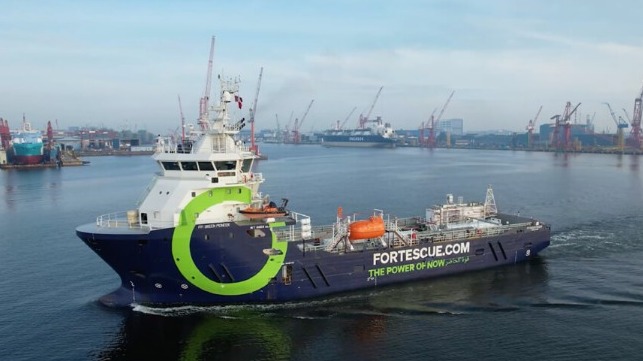
FFI Green Pioneer is being prepared to operate on a mix of ammonia and diesel fuel (Forestcue)
Fortescue, an Australian mining company that is working to become a green technology company, reports it completed the retrofit to create the world’s first ocean-going ammonia-fueled ship. The company’s flamboyant founder and chairman Andrew Forrest arrived in Dubai last week for the COP28 conference aboard a vessel the company has named FFI Green Pioneer.
The converted PSV however made the three-and-a-half-week trip from Singapore on diesel fuel. Forrest explained, “At the moment, the regulatory landscape does not allow for ammonia ships to operate.” He told reporters that they made the trip from Singapore as a symbol to the world of the technology solutions and regulatory changes needed to decarbonize shipping.
He is calling on regulators and ports to license green ammonia loading to facilitate pollution-free shipping. Forrest says that now that green ammonia is emerging as a bulk marine fuel, it is time for the ports to become capable of handling the fuel. However, he contends that no port would permit him to operate today on ammonia.
“This is seriously limiting the progress of the decarbonization of shipping. I look to the leadership of the world’s ports to make clear that running the world’s global shipping on dirty bunker fuel has to stop, as we have a pollution-free alternative.”
Fortescue Future Industries acquired the 13-year-old supply ship MMA Leveque early in 2022 from Australia-based MMA Offshore. Built in 2010 in Indonesia, the 3,100 dwt vessel was originally outfitted with four diesel-electric Cummins main engines.
The company says it spent the past 18 months developing the systems, process, and technology needed to run the Green Pioneer as an ammonia dual-fuel ship. They used similar technology to a four-stroke engine the company retrofitted and demonstrated at its facility in Perth, Australia earlier this year. The engine runs on a blend of ammonia and diesel.
A gas fuel delivery system was installed on the supply ship while two of its four engines were converted to operate as dual-fuel on a mix of ammonia and diesel. Forrest says that regulations meant the vessel was not able to carry ammonia or demonstrate its technology to use ammonia while in Dubai. However, when the vessel returns to Singapore after the conference, Fortescue says it will complete commissioning to enable the first ammonia transfer and reach flag and class approval.
The company says it does not plan to stop with this first demonstration. It is also working on its broader plan for a world-first fuel transfer and marine vessel with approval to use ammonia as a fuel. Forrest told reporters in Dubai that the company is committed to launching a 300-meter (984 foot) 270,00 ton ammonia-fueled iron ore bulker by the end of this decade.
Wärtsilä Expands Methanol Engine Offering to Accelerate Sustainability
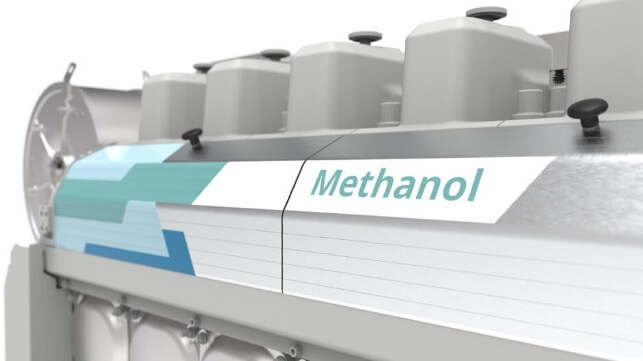
Wärtsilä is expanding its methanol offering to offer the broadest line of engines (Wärtsilä)
Wärtsilä is looking to offer shipowners the broadest portfolio of methanol-fueled engines to help them meet the regulatory challenges to support the move to lower carbon emissions and increase sustainability for shipping. A global leader in power and propulsion for the marine market, Wärtsilä Marine Power seeks to continue to lead the market today by introducing four additional methanol-fueled engines to its portfolio.
“We recognize that it is vital for ship owners to have maximum flexibility and to keep options open as the industry navigates the uncertain pathway to net zero, and we are working hard to deliver this operational flexibility,” said Stefan Nysjö, Vice President of Power Supply, Wärtsilä Marine Power. “Our track record is already very solid, and this expanded engine portfolio adds to both our accomplishments and our long-term commitment to the maritime industry.”
The move to expand the methanol portfolio comes as the industry continues to move toward methanol as the emerging best alternative currently available to achieve the goals for decarbonization. Martin Wold, a consultant at DNV highlighted yesterday that four more methanol-fueled ships were ordered in November pushing the orderbook to over 200 vessels due in the next five years. While there were only a few orders overall in November, it was equally split between LNG and methanol-fueled propulsion and methanol has quickly risen to the second most ordered option while other alternatives such as ammonia remain theoretical with many challenges still to be addressed.
With today’s announcement, Wärtsilä reports it will add the Wärtsilä 20, Wärtsilä 31, Wärtsilä 46F, and Wärtsilä 46TS to its portfolio of engines capable of operating with methanol fuel. The Wärtsilä 32 was launched last year as a methanol engine and has already received type approval certificates from several classification societies. The Wärtsilä 20 engine family can be ordered with methanol combustion capabilities. The four new methanol engines will be available for deliveries at different points from 2025 onwards.
Further, throughout the Wärtsilä diesel engine portfolio, covering both new engines, and those currently in operation, Wärtsilä is developing the corresponding methanol retrofit capabilities. Methanol upgrades are either available or under development for the Wärtsilä 31, Wärtsilä 32, Wärtsilä 46F, Wärtsilä 46TS and Wärtsilä ZA40S engines.
“Decarbonisation is front and center to our strategy going forward, and the development of engines capable of running on future fuels is crucial to that,” said Roger Holm, President of Wärtsilä’s Marine Power business.
The company also highlights that it is backing its extensive experience with strong investments in developing new fuel-flexible technologies and products. Wärtsilä is one of the few marine engine builders with extensive experience in methanol engines, having converted the first of four engines on the ferry Stena Germanica in 2015. Last year, the Wärtsilä 32 Methanol engine and MethanolPac storage and supply system were launched, becoming one of the first commercially available solutions for using methanol as a fuel in the maritime industry.
CSSC Designs Containership Using Molten Salt Nuclear Reactor
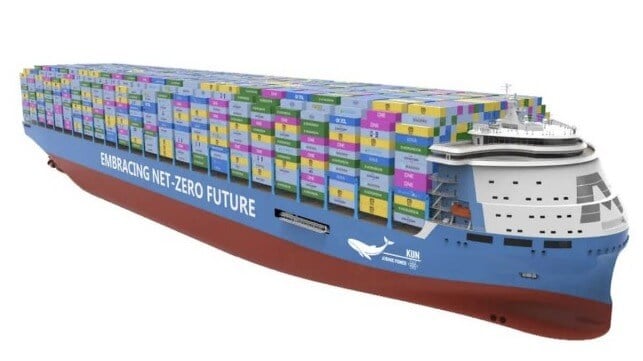
Concept for the first nuclear-powered containership (CSSC/Weibo)
Designs were unveiled in China today, December 5, for the world’s first large containership using the new nuclear power concept known as Molten Salt reactors. The design was developed by Jiangnan Shipbuilding, a division of the Chinese state-owned China State Shipbuilding Corporation (CSSC) and as if to prove that it is more than a theory, they reported that DNV issued an Approval in Principle (AiP) certificate for the design.
Few details were provided for the design with reports highlighting that China has classified the details of its efforts with thorium-based reactors because of the potential military applications. China however highlights that it has an abundant and less expensive supply of thorium meaning that it could be a cost-effective and zero-emission alternative for shipping and other industries. The thorium would be used as a safer alternative to uranium-based reactors.
CSSC writes in a statement posted to Weibo, “This type of ship has high safety as the reactor operates at high temperatures and low pressure, meaning it can avoid in principle core melting.” They highlight that the thorium reactor would not require high-pressure containers and pipelines as the reactor does not use large amounts of water for cooling. In the event of an accident, the core solidifies at ambient temperature, and in addition to normal shutdown methods, CSSC writes that the salt fuel can also be quickly discharged from the reactor to prevent spreading.
The concept design is for a 24,000 TEU containership, which they are calling the world’s largest nuclear-powered containership. Other safety features they reported include the location of the reactor, which was not explained. CSSC highlights that the concept adopts a “double-sided redundant design.”
Reporting on the presentation at a conference in China, the South China Morning Post says China got the first thorium-based molten salt reactor running earlier this year during a test in the Gobi Desert. The paper contends most countries including the United States have abandoned efforts to develop the reactors because of the complexity of the technology.
Several projects are looking at the concept of the Molten Salt reactor to provide mobile power but this appears to be the most advanced design. In the United States, the American Bureau of Shipping was contracted to lead a study into nuclear propulsion and its applications to commercial shipping nearly 80 years after the U.S. demonstrated the first commercial nuclear propulsion ship, the now long-ago retired ns Savannah. Russia continues to operate a nuclear-powered commercial ship while several projects are exploring Molten Salt reactors placed on barges or ships that could be positioned to provide power in remote areas or for emergency recovery operations.
Car Carrier Boom: CSSC Books Order for 12, DNV Approves Largest Design
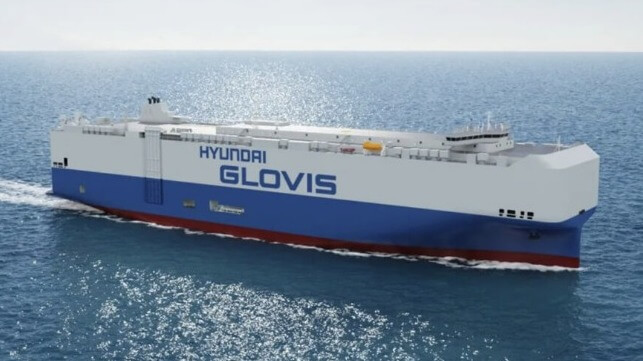
Hyundai Glovis will operate on charter between 12 and 20 of the largest car carriers with 10,000 units (CSSC)
The vehicle transport sector is continuing its rapid growth with a new generation of the world’s largest Pure Car and Truck Carrier (PCTC) set to emerge from the Chinese shipyards. China State Shipbuilding Corporation (CSSC) celebrated the largest order for the largest yet-built car carriers while at the same time, China Merchants rolled out the design for an even larger ship. This comes as the sector is capacity-constrained and now has as many as 100 new vessels on order.
During this week’s China International Maritime Exhibition CSSC signed a multitude of orders but the company was highlighting what it said was the largest single PCTC order in shipbuilding history. It is for a new class of the vessel which they also highlighted as the largest and most advanced in the sector.
The new ships will have a total of 14 car decks with five of them being lift or movable decks for a total capacity of 10,800 units. The vessels will have the capability to load ultra-high and ultra-heavy ro-ro cargo as well as a range of vehicle types. Special consideration is given to transporting hydrogen, compressed natural gas, liquified petroleum, and other new technologies for powering vehicles including electric vehicles, which they expect will drive the industry’s growth. The ships will also be able to transport dangerous cargo and refrigerated containers.
The design and range of capabilities will improve the vessel’s density and flexibility of cargo loading. CSSC highlights that while the vessel’s capacity will be 16 to 20 percent larger than the current biggest vessels with a 9,000-unit capacity, transport costs will be eight percent lower per unit.
The ships will also be environmentally sensitive. They are designed to operate on LNG while also being ready for either ammonia or methanol.
Two of CSSC’s subsidiaries booked a combined order for a minimum of 12 of the vessels and possibly as many as 20 if the options are exercised. As was announced earlier in the week, six of the vessels will be built at Shanghai Waigaoqiao Shipbuilding for Seaspan. It marks the first time the containership company has expanded into the car carrier segment. They also have an option for up to four more vessels.
In a second surprise development, South Korea’s HMM, another primarily container carrier, also ordered six of the vessels to be built at Guangzhou Shipyard. They also have an option for up to four more ships. It is part of HMM’s previously announced strategy designed to expand the company and diversify into other segments to balance with the performance of the containerships.
Delivery is set to begin in 2026 for all the vessels. They will also be operating under long-term charters to Hyundai Glovis, which is one of the world’s largest operators of PCTCs. The company reported last month that its board had approved the plan to build the new class of next-generation vessels.
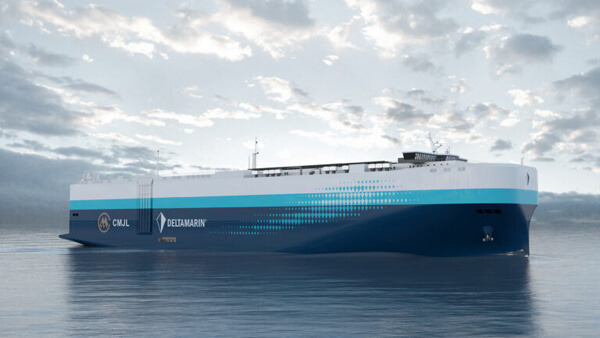
Deltamarin's rendering of the design for the largest PCTC designed with China Merchants
The title of the largest vessels in the category may however be short-lived. During the same trade fair, China Merchants Jinling Shipyard received design approval (AiP) from DNV for a new even larger car carrier. The concept calls for a vessel able to transport 11,000 units. It would also have 14 decks and be 767 feet (234 meters) in length with a 131-foot (40-meter) beam. China Merchants emphasizes like CSSC that the size would increase efficiency and reduce transport cost per vehicle.
The vessels were designed in partnership with Deltamarin and would feature an optimized hull and a stern flow device to improve operating efficiency. They will also use air lubrication for the hull to reduce drag. Powered by LNG, the new class of car carriers would be equipped with a 4,200 cbm LNG tank to maximize range.
China Merchants reports it is already in discussions with an unnamed potential customer for the vessel.
Hijacked Car Carrier's Crew Treated "As Well As Can Be Expected"
A Houthi naval forces commander welcomes the crew of the seized car carrier Galaxy Leader (Houthi Military Media)
The crew of the hijacked car carrier Galaxy Leader are being allowed to have a limited amount of contact with their families, and the information that they've passed on suggests that they are being reasonably well-treated by the Houthi rebels who captured the ship, according to the shipowner.
In a statement, owner Galaxy Maritime Ltd. called on the crew's nations of origin to redouble their efforts to free the seafarers. "The 25 crew members being held have no connection whatsoever with the current situation in the region," Galaxy Maritime said Monday. "Nothing can be achieved by their further detention."
17 members of the Galaxy Leader's crew are Filipino, and the remaining eight are Bulgarian, Romanian, Ukrainian and Mexican citizens. The government of the Philippines says that it is putting a high priority on securing the release of its nationals aboard Galaxy Leader. Philippine President Ferdinand Marcos Jr. canceled a planned trip to Dubai for the COP28 climate summit in order to focus on negotiations for the seafarers' release, and said that Manila was dispatching a delegation to Tehran. (Iran is the Houthi movement's foreign sponsor.)
Galaxy Leader was hijacked by heavily-armed militants and a Houthi-operated helicopter on November 19. The orchestrated, carefully-filmed boarding appeared to catch the car carrier's crew by surprise. The ship was diverted to Hodeidah, then relocated to Al Salif, both controlled by Houthi separatists.
On arrival, a top Houthi commander boarded the ship and told the crew that they would be treated as "guests." In a recorded encounter, he invited them to ask for anything that they might need.
Since the ship anchored off Al Salif, it has become something of a tourist attraction for the Houthi population at large. Multiple videos posted to social media show Yemeni nationals dancing, playing music, sharing a narcotic herb with crewmembers, and taking photos of themselves on board. One recent image appears to depict a college graduation ceremony on the top deck.
The Galaxy Leader is operated by Isle of Man-based Ray Car Carriers, a firm with ownership ties to an Israeli shipping magnate. There are no Israeli nationals aboard, according to the Israeli government. Houthi leaders have promised to target Israel-linked shipping in retaliation for the ongoing Israeli military operation in Gaza, and have launched multiple attacks on merchant vessels in the Red Sea over the past two weeks.
According to Politico, some U.S. officials are concerned that the White House is treating these attacks with less than the degree of concern that they deserve. The crews of the destroyers USS Carney and USS Thomas Hudner have shot down nearby drones multiple times, fearing the possibility of an attack.
Over the weekend, Houthi forces targeted three more ships, Unity Explorer, AOM Sophie II and the Number 9, according to U.S. Central Command. USS Carney shot down three UAVs while assisting Unity Explorer.
The Biden administration has hedged on whether U.S. Navy warships were targeted by any of these attacks. However, Pentagon officials told Politico that it is clear that U.S. warships are "under threat" like never before in the Red Sea. “You’d be hard-pressed to find another time” when the threat level was higher, one official said.
Officials have also made clear that the disruption is not just a regional Houthi phenomenon. U.S. Central Command assesses that "these attacks, while launched by the Houthis in Yemen, are fully enabled by Iran."
MAN OVERBOARD
UK’s MOB Callout Turns into Case of Illegal Immigration
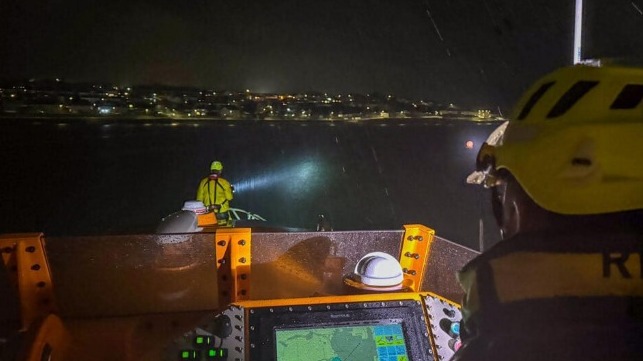
Angle RNLI Lifeboat led a massive multi-agency search Sunday night and again Monday (Angle RNLI)
British authorities now believe that a man overboard search commenced on Sunday evening along the coast of Wales was instead a case of illegal immigration. The report prompted a massive multi-agency search on Sunday and again on Monday, only for the authorities to now report they arrested the individual onshore in the villages in Pembrokeshire on the coast of Wales.
The call-out began Sunday, December 3 when the crew aboard an unidentified crude oil tanker requested assistance saying it had reason to believe a crewmember had gone overboard. The tanker was at Valero’s Pembroke Oil Terminal located on the Milford Haven Waterway. The crew reported that they had found indications that someone was overboard and had searched the vessel. They reported an unidentified crewmember was missing.
HM Coastguard confirmed that it received the call that someone was missing from the tanker and likely in the water. They dispatched the RNLI lifeboat from Angle to start the search. A police boat also joined in the search and the lifeboat reports after making “best speed” to the scene they also launched their inflatable Y boat. A Coastguard rescue helicopter also was sent to assist with the search but later turned back due to heavy rain which made it unsafe for it to continue to participate in the search.
The lifeboat reports carrying out multiple legs searching the area around the vessel as well as along the coastline and waterways. The crew utilized its searchlights, image intensifiers, and thermal imaging equipment to aid in the search, all to no avail. After being in the area from around 10:00 p.m. local time and despite the heavy rains the search continued until 2:00 a.m., when the lifeboat was prepared for its next call.
Angle RNLI search over 32 miles of shoreline and around the vessel in two searches despite heavy rain (Angle RNLI)
On Monday, with the weather having improved, the lifeboat was again dispatched to conduct an additional search of the area. They report completing a search covering 32 miles of shoreline before the crew and lifeboat were stood down.
Later that night the police report arresting the crewmember on shore. He is said to be in good condition and without further details the police report the crewmember is being held on suspicion of being an illegal immigrant. The case has been handed over to the Border Force.
Western Australian Government Unveils Plan for Relocation of Fremantle Port
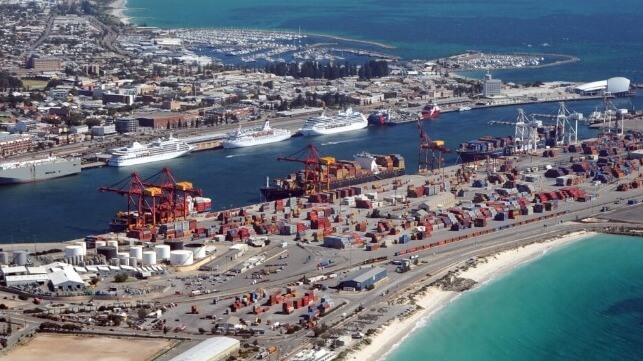
The plan calls for the relocation of container operations from the Inner Harbour 15 miles tothe south to join the bulk port (Fremantle Ports file photo)
Following years of intensive studies and consultations, the Western Australian (WA) government has unveiled its preferred design and location for the relocation of the container operations currently in Fremantle. The port, which handles nearly all the container traffic for all of Western Australia is quickly running out of capacity and also occupies prime real estate which official highlight could be better used for the city.
The preferred design and location unveiled by the WA government on November 29 calls for the relocation of the container operations from its current location to Kwinana, approximately 15 miles to the south, and uniting the container operations with the existing bulk cargo operations. Known as the Westport Project the container operations would be adjacent to the existing Outer Harbour, which is one of Australia’s major bulk cargo ports handling grain, petroleum, liquid petroleum gas, alumina, mineral sands, fertilizers, coal, sulfur, iron ore, and other bulk commodities.
The planning for the new container terminal has been ongoing for years with officials highlighting the concept of placing containers in Kwinana was first suggested in 2006. Between 2018 and 2020, they report the Westport Taskforce explored 25 different locations ranging from Fremantle to Cockburn Sound and Bunbury for the new container terminal before selecting the preferred location. They started with 30 different design options, narrowing it first to seven and then three before selecting the design that they believe provides the best opportunities as well as environmental outcomes.
Currently, the port which is located in the Fremantle Inner Harbour in Perth, handles imports and exports of around 800,000 containers with terminals operated by DP World and Patrick. However, this port infrastructure and its surrounding roads are expected to reach capacity within the next two decades, hence the necessity for a new terminal. Long-term planning calls for the port to grow to more than three million containers over the next 50 years.
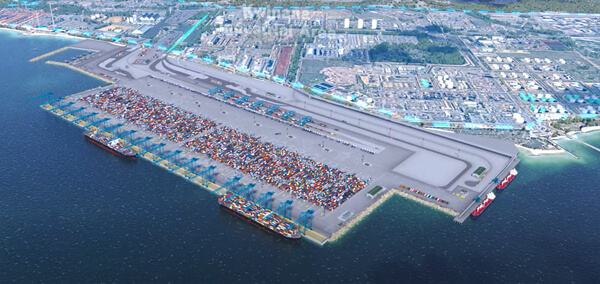
Government officials released the preferred design for the new container port (Fremantle Ports)
The new design includes a container terminal adjacent to the shoreline of the current Kwinana Bulk Terminal. Another aspect is a new breakwater to provide enhanced protection to the port and docked ships. The design will allow the new container terminal to handle larger ships than the existing Fremantle terminal and also incorporates redevelopment of the aging Kwinana Bulk Terminal jetty. The new facility would also be supported by an enhanced multi-modal infrastructure with road and rail links.
“A world-class port in Kwinana is critical for our state to remain a global economic and industrial powerhouse for decades to come,” said WA Premier Roger Cook. “Through this design, we can ensure WA can continue to meet trade demand long into the future while strengthening our supply lines.”
The move to relocate Fremantle Port is also expected to unlock around 260 hectares of prime inner urban land in Fremantle. The state government has indicated it wants to transform the space into a “vibrant precinct” to cater to WA’s growing population. One proposal is to establish a public space and residential facilities. Fremantle Port would continue to be a working port for cruise ships, visiting naval vessels, and recreational craft.
The next step is the development of a project business case report, scheduled to be finalized by mid-2024. Previously the budget for the project was set at A$4 billion (US$2.7 billion) but government officials said that was pre-pandemic and they expect to determine the timeline and cost for the new terminal based in the next phase of the project.
Report: Green Shipping Corridor Initiatives Doubled in 2023
Green Corridor projects continue to grow in popularity
Green shipping corridors are emerging as one of the promising approaches to accelerate climate action in shipping. At the ongoing COP28 Climate Summit in Dubai, this initiative has received yet another major backing, with the U.S., Denmark, and the Maersk Mc-Kinney Moller Center pledging to join forces to establish Global South Green Corridors.
The announcement of the plans for the latest green corridor initiative coincided with the release of the 2023 Annual Progress Report on Green Shipping Corridor, prepared by the Global Maritime Forum on behalf of Getting to Zero Coalition. The report reveals that the number of green corridor initiatives around the world doubled in the last year from 21 to 44. It goes on to project that 2024 will prove pivotal for green corridors, buoyed by increased governmental efforts to establish these routes as well as sustained industry and port efforts.
“It is, of course, encouraging to see the emergence of so many new green corridor initiatives and the increased maturity of existing green corridors, but the other side of this maturation has seen the unearthing of a new set of challenges as the corridors move closer to implementation,” said Jesse Fahnestock, the Global Maritime Forum’s project director for decarbonization.
Currently, the majority of the plans for green corridors are focused on ports in the global north. However, the new project aims to incorporate for the first time developing countries. As part of the plan that was announced, the project will conduct pre-feasibility studies in Namibia, Panama, and Fiji, and two more countries to be announced soon.
“We are facing a global transition that needs to be inclusive, just, and equitable to be truly sustainable: from East to West and from South to North. This is why we are excited to partner with U.S. and Danish governments to establish the Global South Green Corridors with countries in Latin America, Africa, and the Pacific,” said Bo Cerup-Simonsen, CEO of Maersk McKinney-Moller Center for Zero Carbon Shipping.
Denmark’s Minister of Industry, Business and Financial Affairs, Morten Bødskov, commented, “We need to transition containerships to new fuels, and this can only happen through collaboration between countries worldwide and maritime companies. This partnership is a prime example of how we should drive the green transition at sea."
Similarly, Anne Steffensen, CEO of the trade group Danish Shipping said, “The Global South Green Corridors project is a brilliant idea that will assist countries in the Global South in making sustainable use of their resources and in making a vital contribution to achieving the goal of climate neutral shipping. That’s a win-win for everybody.”
The Annual Progress Report on Green Shipping Corridor however highlights some of the challenges facing the implementation of green corridors. The report identifies the need to make key fuel decisions. Determining the priority fuel they conclude is a key consideration in the execution of green corridors. However, the maritime industry they note is yet to settle on the next future green shipping fuel, something which is impacting the planning of green corridors.
Additionally, mobilizing customer demand for the green corridors remains low. Currently, only five initiatives are incorporating cargo owners. The underlying assumption for most cargo owners is that there will be additional costs associated with green shipping, and without a level playing field established through global or regional policies, first-movers the report says are poised to bear most of the risks.
Despite the challenges, the report concludes that encouragingly, government support for green corridors is rising. They note two years after the concept was adopted at the COP26 conference 18 governments are now directly involved in the initiatives.
Several of the projects have also announced completing key planning steps toward the launch of the first corridors. The initiatives have focused on key ports such as Singapore, Rotterdam, Shanghai, and Los Angeles, or regional such as the Pacific Northwest/Alaska, or the Baltic, but with the latest announcement confidence is growing that support will be provided for developing countries which might otherwise be left behind in the efforts.
Low Water on the Amazon Strands Tanker Near Manaus
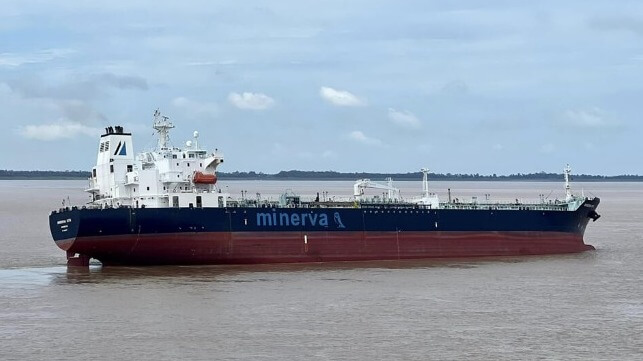
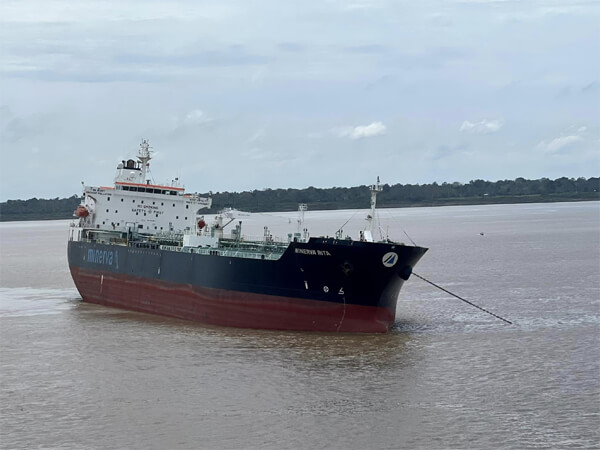
Cruise passenger caught these pictures of the tanker grounded along the Amazon below Manaus (Jo Johnston/Facebook)
Authority in the Amazon region and Brazil are waiting for a determination about what to do with a tanker that is stuck in the mud due to the low water levels along the Amazon River. The reports are that while the outer hull sustained some damage the vessel is not leaking and there have been no environmental issues.
The 50,000 dwt Minerva Rita, a product tanker registered in Libera, was outbound from Manaus, Brazil on December 4 when the vessel grounded in the river just below Manaus in the Guajara Channel. The tanker which is 183 meters (600 feet) in length was transporting 8,500 cubic meters of gasoline and 18,000 cubic meters of naphtha after loading at the Amazon Refinery (REAM).
Initially, reports were that the vessel struck a rock in the river and anchored. Officials from the Brazilian Navy however are blaming the vessel saying it took a “wrong turn” and passed through a shallow area created by the drought.
The Amazon has for months been experiencing low water levels. Cruise ship passenger Jo Johnston who was also on a ship moving along the river this week wrote on social media that a pilot boat was ahead of their cruise ship, taking soundings as they proceeded toward Manaus. There are reportedly temporary channel markers set as well as indications on the electronic charting systems of the new dangers due to low water.
Brazilian media reports are that some larger vessels have elected to remain further down river at Itacoatiara due to the low water levels. They said that there are currently at least 20 vessels holding either down river or near the mouth of the river while others continue to proceed cautiously with the assistance of the local authorities toward Manaus.
(Jo Johnston/Facebook)
A spokesperson from the refinery said that they had offered assistance to the tanker but that they only owned the cargo and had no responsibility for the operation or navigation of the vessel. As of midweek, the refinery had gained permission from the Amazon authorities to offload the cargo.
Officers from the Navy command overflew the area and the local authorities launched an inspection of the vessel. Divers went down at the beginning of the week and a second inspection was conducted midweek. The tanker is a double-hull vessel and they are reporting that the outer hull is damaged or possibly holed below the waterline on the port side. The inner skin remains intact and the vessel is in no immediate danger.
The owners of the tanker are reported to be developing a plan but the Navy said there was no immediate plan to attempt to move the vessel. It is unclear if it could be safely moved and in its current position it is not blocking navigation on the river. An investigation is underway to determine why the Minerva Rita grounded.
Report Zero-Emission Fuels Could Add 50% to Container Shipping Costs
Early adopters face the highest costs and hard decisions highlights new report on cost of zero-emission fuels
The early moves both among the container carriers and the shippers face substantially higher costs for transporting containers using the new generation of zero-emission vessels and fuels. A new report from independent UK consultancy UMAs seeks both to quantify some of the potential costs and contribute to the discussions by highlighting the challenges that lay ahead for the industry, echoing similar concerns raised by industry CEOs attending the current COP 28 conference and other reports that highlight the potential near-term shortages in the supply of alternative fuels.
“The role of the early movers including cargo owners, and their willingness to pay is therefore vital in setting up a zero-emissions shipping market,” writes UMAS. “This report contributes to that dialogue by providing examples of baseline additional cost per container required to bridge the cost gap considering only technological savings. It shows the room that cargo owners, governments, and other stakeholders have to contribute.”
UMAS used a variety of models to estimate the costs that will be incurred concluding that they could add as much as half to the current price of moving boxes on some routes. Initially, the report predicts there will be a significant cost gap between conventional fossil fuels and scalable zero-emission fuels. For example, in 2030 on the transpacific route, under the best-case fuel price scenario, the cost difference can be $150 per TEU for green ammonia, $210 per TEU for green methanol, and as high as $350 per TEU for green ammonia and $450 per TEU for green methanol in a high fuel price scenario. The lowest cost they find would be $90 per TEU transpacific and even on a Chinese coastal route could range between $30 and $70 per TEU.
The fuel cost gap is now acknowledged as the main blocker for shipping’s transition and tackling it requires a frank conversation about the dimension of the challenge,” said Camilo Perico, Consultant at UMAS, and author of the report. “We need “numbers on the table” and more visibility on how stakeholders can help to cover it.
The report details significant financial burdens, especially for the early adopters which will be needed to move the market forward. The industry has cited these same concerns. The CEOs of five leading carriers last week called for regulatory efforts and a move to level the cost difference between traditional and alternative fuels spreading the premium across all fuels.
UMAS calculates that a vessel operating transpacific would require an additional $20 to $30 million annually by 2030 when you consider both the capex investment in the vessels and operational expenditure. Fuel they highlight would be $18 to $27 million of the added annual cost.
Early adopters will have some choices according to UMAS which will also have an impact on the market. They could go with cheaper but non-scalable fuels such as the much-touted bio-methane, which they conclude will however become more expensive as demand outstrips supply. The alternative will be to invest in fuels with a higher capital expense but it would stimulate the market and become less expensive as production ramps up. UMAS expects that the cost gap will not narrow until 2050.
“The analysis shows fuel costs are a major component of the overall cost and therefore the primary driver of the total cost of operation. With the right demand signals and corporate action during the emergence phase, production and supply of zero-emission fuels and freight services can make a head start in lowering the cost gap that this work has shown,” said Dr. Nishatabbas Rehmatulla, Principal Research Fellow at UCL and co-author of the report.
They are calling for increased dialog and using the data to help plan the long-term approach for the shipping industry. The report notes that there are already emerging subsidies that could close the gap between conventional fuels and the new scalable alternatives. They highlight the regulatory efforts in the EU and U.S. that have the potential to help cover the cost difference on specific routes as well as future initiatives such as programs in the UK and Norway that would specifically support hydrogen fuels.
UMAS concludes that the window of opportunity for corporate action before regulation increasingly closes the gap is only available for a few years. The full report and the analysis are available online to help guide the discussion and the decision that the shipping industry needs to undertake.
Why Clean Shipping Fuels Need Solar-Industry Style Support
Shipping receives nowhere near the media coverage given to aviation, yet the sector also accounts for around three percent of global energy-related carbon dioxide emissions. Its footprint must be tackled rapidly if international climate targets are to be met. Solutions to decarbonize shipping exist, most notably in the form of green methanol, and some shipping firms are investing heavily in a greener future. However, the regulations and financial support needed to scale up the sector and push down costs are still found wanting.
The wind and solar industries are today mainstream players in the power sector. Costs, in particular for solar, have fallen massively everywhere. However, this positive trend would not have happened without significant government backing as these industries were starting out. The shipping industry has been used to accessing cheap fuels and, without similar financial and legal assistance, cleaner shipping fuels will remain an expensive pipe dream.
The shipping sector must reduce its emissions by 45 percent by 2030 compared with 2010 to come in line with the Paris Agreement commitment to keep global heating below 1.5°C above pre-industrial levels, says the Copenhagen-based Mærsk Mc-Kinney Møller Center for Zero Carbon Shipping, a not-for-profit research center. Meeting this target will be challenging, but the technology to achieve it exists and companies are engaging with the transition.
First, the technology. Methanol is a chemical compound that has long been in great demand for a variety of industrial applications. It is a relatively benign substance and, as a light liquid, it is easy to transport and store at room temperature. Almost all methanol today is, however, produced from coal and natural gas. Green methanol, on the other hand, is generated from clean energy sources either as bio-methanol or e-methanol. Bio-methanol can come from biogas or the gasification of sustainable biomass sources like agricultural and forestry residues and municipal waste, while e-methanol is produced from green hydrogen from renewable electricity and captured carbon dioxide.
Danish company Maersk has leapt ahead of global regulatory requirements through a commitment to procure only vessels compatible with green fuels and is taking steps towards retrofittings. As part of this transformation, the company has ordered 25 green methanol vessels it expects to come into service in the next three to four years. These decisions will help drive the creation of new green methanol supply chains as Maersk develops extensive off-take partnerships with energy companies.
Maersk is not the only company changing the way it does business. The global order books for low emissions vessels grew six-fold from 2019 to 2022 and changes to bunkering and fuel supply are also beginning to happen. In 2016, there were almost no shipping ports planning green fuel bunkering; by the end of 2022, ports representing around 16 percent of global shipping volume had announced plans to build out green fuel bunkering.
Green methanol supply has also been growing rapidly with total global production capacity increasing by 450 per cent from 2020 to 2023. This figure may sound impressive, but it comes from a very low base. Today, there are less than 0.2 million tonnes of green methanol on the market; we need at least 20 million tonnes by 2030. Further, production costs remain high, leaving large numbers of projects stuck in early-stage development. They will remain there unless we can secure long-term offtake at a price that makes these projects viable — but shipping companies cannot simply pass all of these higher costs to the owners of the cargo they move.
Governments can help solve this affordability gap between the cost of production and customer willingness to pay through "demand pull" initiatives, like the mandates for green hydrogen in the EU’s Fit for 55 package. Such policies create a clear demand signal and the industry can examine how to meet that at the lowest cost. We also need "supply incentives" like the EU's Hydrogen Bank and the US Inflation Reduction Act to help bridge production cost gaps.
Corporate leaders surveyed for Global Corporate Stocktake carried out by We Mean Business, with support from the UN Climate Champions team and consultancy Bain & Company, ahead of the COP28 climate summit, cited the lack of infrastructure to support fuel production and bunkering, commercial constraints and uncertainty surrounding technology pathways as important blockages to system change in the shipping industry. They also emphasized the need for governments to support collaboration between different actors in the shipping sector to push initiatives like "green corridors" where low-emissions vessels are incentivized.
Ultimately, green methanol will not be the only solution to decarbonize shipping. In the coming years, other low-emission fuels, like ammonia, are likely to come onto the market, with the end result being a complementary patchwork of solutions. For the moment, though, governments, and industry, should be focused on green methanol as a proven, easy-to-use solution that, with the right support, can be scaled up immediately.
Brian Davis is CEO of C2X, a standalone company founded by A.P. Moller Holding (APMH) and its shipping arm Maersk to "defossilize" the fuel used by shipping.
The opinions expressed herein are the author's and not necessarily those of The Maritime Executive.
Report: Financial and Regulatory Barriers Delay Zero-Emission Fuel Supply
Barriers are holding back the projects needed to produce shipping's zero-emission fuels
Zero-emission fuels such as methanol and ammonia are an important focus in the efforts to reach the shipping industry’s decarbonization targets, but a new report highlights that leaders across the industry believe financial and regulator hurdles are slowing the developments. Presented as a perspective on how to start addressing the barriers affecting zero-emission fuel projects, the report calls for unconventional partnerships and business models supported by regulatory and financial collaborations to overcome the barriers to lay the foundations for a zero-emission future in shipping.
While there has been a lot of publicity and discussion about these zero-emission fuel projects, the report concludes that “more than 95 percent of the projects centered on producing these fuels have not yet passed the final investment (FID) phase.” They highlight that this is despite the rising demand for the fuels as indirectly indicated by the more than 180 dual-fuel ships already on order and more planned.
“We are in the middle of what needs to be the decade of action if maritime shipping is to achieve net-zero emissions by 2050,” writes Mette Asmussen of the World Economic Forum and Peter Jonathan Jameson of Boston Consulting Group in the forward of their new report. “We need to eliminate these emissions through scaling of technologies that can power deep-sea vessels.”
Despite the positive momentum, the report highlights that the shippers and carriers that helped to launch the First Movers Coalition for shipping in 2021 are saying that barriers in the maritime value chain and beyond are hindering decarbonization from progressing at the speed needed.
Interviewing industry stakeholders, the report highlights that the nexus between demand and supply is an important dynamic and will help to increase the confidence to invest in the supply side. The interviews with more than 20 stakeholders shed light on the barriers that they believe are holding back the investment decisions and progress that is required.
Ten barriers were identified as limiting the projects from getting past the key FID milestone. The report categorizes the barriers into segments including customer and consumer demand, economic and financial issues and regulatory, as well as supply chain and infrastructure challenges and organizational issues within the companies. They point to issues such as the “green premium” and the lack of clear signals and willingness to cover the costs as well as the gap in offtake agreements and the lack of credible cost estimates.
Existing financial instruments and funds they also conclude are “not fit for purpose in terms of horizons and risk appetite.” At the same time, they point to a lack of near- and mid-term mandates or a global carbon price. Finally, they point to infrastructure issues for the storage and transportation of e-fuels.
The report concludes that while collaborations are underway to overcome the barriers, more needs to be done to get the first movers to take bold actions to advance the development of alternative fuels. “Although daunting, these barriers need not all be overcome simultaneously,” the report asserts.
They call for steps in addition to the support of green corridors that can consolidate shipping’s demand for methanol and ammonia with other sectors to hedge end-market risk. They also see the need to drive offtake agreements suggesting steps including reverse auctions using public-private demand aggregation.
The report also calls for using innovative contracting and financing mechanisms. They suggest that steps such as capacity payments, dynamic contract pricing, and offering equity stakes to strategic buyers could help to overcome the current financial challenges.
The report follows on from a statement last Friday, December 1, by five of the CEOs of the largest shipping companies highlighting the challenges they see in meeting the decarbonization objective. Their message called for greater collaboration and regulator efforts to support the industry during this period of transition.