Wednesday, February 21, 2024

CANADA'S SWEATSHOP

Gildan's new CEO attempts to soothe shareholders amid higher Q4 profit, dividend hike

GILDAN ACTIVEWEAR INC (GIL:CT)

47.49 1.71 (3.74%)
As of: 02/21/24 9:38:53 pm
REAL-TIME QUOTE. Prices update every five seconds for TSX-listed stocks
16. Oct11. Dec19. Feb3540455055
Chart Type - 6month
See Full Stock Page »

Gildan Activewear Inc.'s strong market share and higher fourth-quarter profit puts it in an enviable position even as there's "a lot of opportunity to grow," the company's new chief executive said as financial analysts asked about his plans for the clothing maker.

Speaking on his first earnings call since taking the helm of the Montreal-based clothing manufacturer from his ousted predecessor in January, Vince Tyra had early thoughts about changes he may make but shared few specifics. 

He said he would like to make unspecified "tweaks and enhancements" to the company's American Apparel and Comfort Colors brands and focus more on expanding the ring-spun fleece part of Gildan's business.

"But in terms of nailing down the long-term strategy, I think that'll come as 2024 develops," Tyra said Wednesday.

Analysts and shareholders have been waiting for Tyra to outline his vision for the company, which has been dogged by controversy since his arrival.

Gildan has been embroiled in a fight over who should lead the company since it announced late last year that co-founder and then-CEO Glenn Chamandy would be replaced by Tyra. Several Gildan shareholders, led by U.S. investment firm Browning West, have sought to have Chamandy reinstated in what has been an ugly battle for control.

Browning West has been trying to replace a majority of the Gildan board of directors in a move to bring Chamandy back. The U.S. investor, which has the support of Gildan's largest shareholder Jarislowsky Fraser, has said it will offer a slate of candidates for election at the company's forthcoming annual meeting.

The Gildan board has said it replaced Chamandy because he had no credible long-term strategy for the company and had lost the board's trust and confidence in his ability to grow an increasingly complex organization.

In response, Chamandy has said he presented a comprehensive long-range plan in October that showed meaningful organic growth prospects for Gildan over the next five years.

Tyra did not reference the strife on Wednesday's call and when analysts queued to ask questions, they were told to limit their queries to the company's guidance and fourth-quarter results.

Just before the call, Gildan announced that it had raised its quarterly dividend 10 per cent as it reported a fourth-quarter profit of US$153.3 million, up from US$83.9 million a year earlier.

The clothing maker said it would pay a quarterly dividend of 20.5 cents US per share, up from 18.6 cents US per share.

Gildan, which keeps its books in U.S. dollars, said its fourth-quarter profit amounted to 89 cents US per diluted share for the quarter ended Dec. 31, up from 47 cents US per diluted share a year earlier.

Net sales totalled US$782.7 million, up from US$720.0 million.

On an adjusted basis, Gildan says it earned 75 cents US per diluted share, up from an adjusted profit of 65 cents US per diluted share a year earlier.

Tyra said 2023 was "a year of strong progress" for Gildan, which he said came "despite an overall challenging macroeconomic backdrop."

Canadian companies have seen consumers cut back on purchases to cope with high inflation, curtailing the spending trends usually seen as the country closes out the year.

Executives, who joined Tyra on Gildan's call, said the company had also seen inflation change when people are buying their products. Many customers have now moved to placing orders closer to when they need merchandise, encouraging the company to manage their inventory and its replenishment "more tightly."

Their remarks pushed Gildan's share price up by almost five per cent or $2.28 to $48.06 in morning trading.

Moving forward, Gildan said it expects revenue growth for 2024 to be flat to up low-single digits.

The company's adjusted diluted earnings per share for 2024 are expected to be in a range of $2.92 to $3.07, up between 13.5 per cent and 19.5 per cent year over year.

Gildan is also anticipating the expiry of its licensing agreement with sportswear giant Under Armour in March, but said it will have a minimal impact on profitability.

Desjardins analyst Chris Li saw the outlook as "solid," but warned in a note to investors that he thinks "macro uncertainties remain the biggest risk for Gildan."

With files from Craig Wong in Ottawa

This report by The Canadian Press was first published Feb. 21, 2024.

Canada's oil boom threatens to bring back pipeline shortages

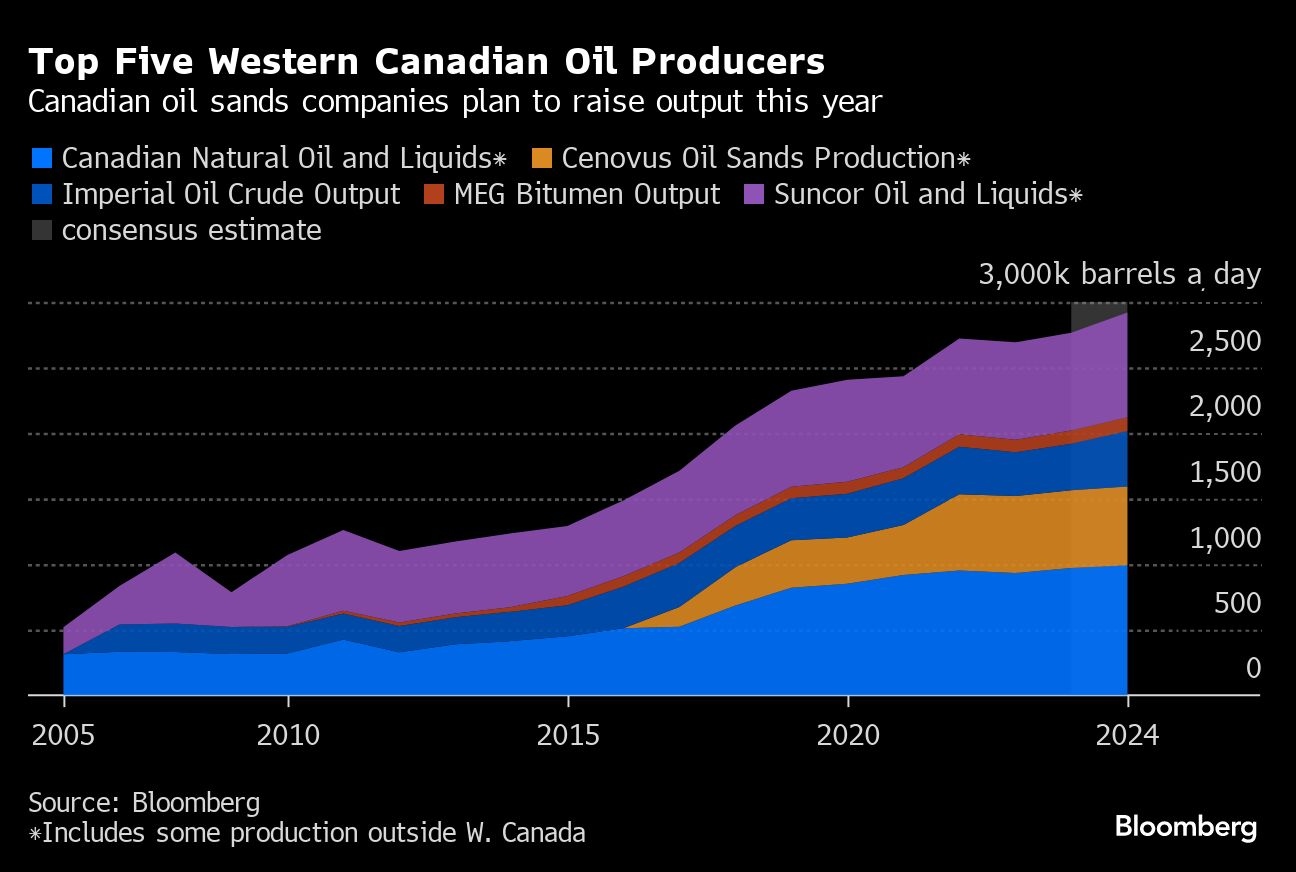
Canada’s oil producers are poised to pour about half a million barrels of new daily output — more than the total production of some OPEC members — into world markets over the next year or so. 

And while the deluge of new crude will be a boon to an industry that has struggled to grow recently, it threatens to expand a global supply surplus and revive the pipeline shortages that have bedeviled Canadian drillers for years, something that could once again severely depress the price of the country’s oil exports.

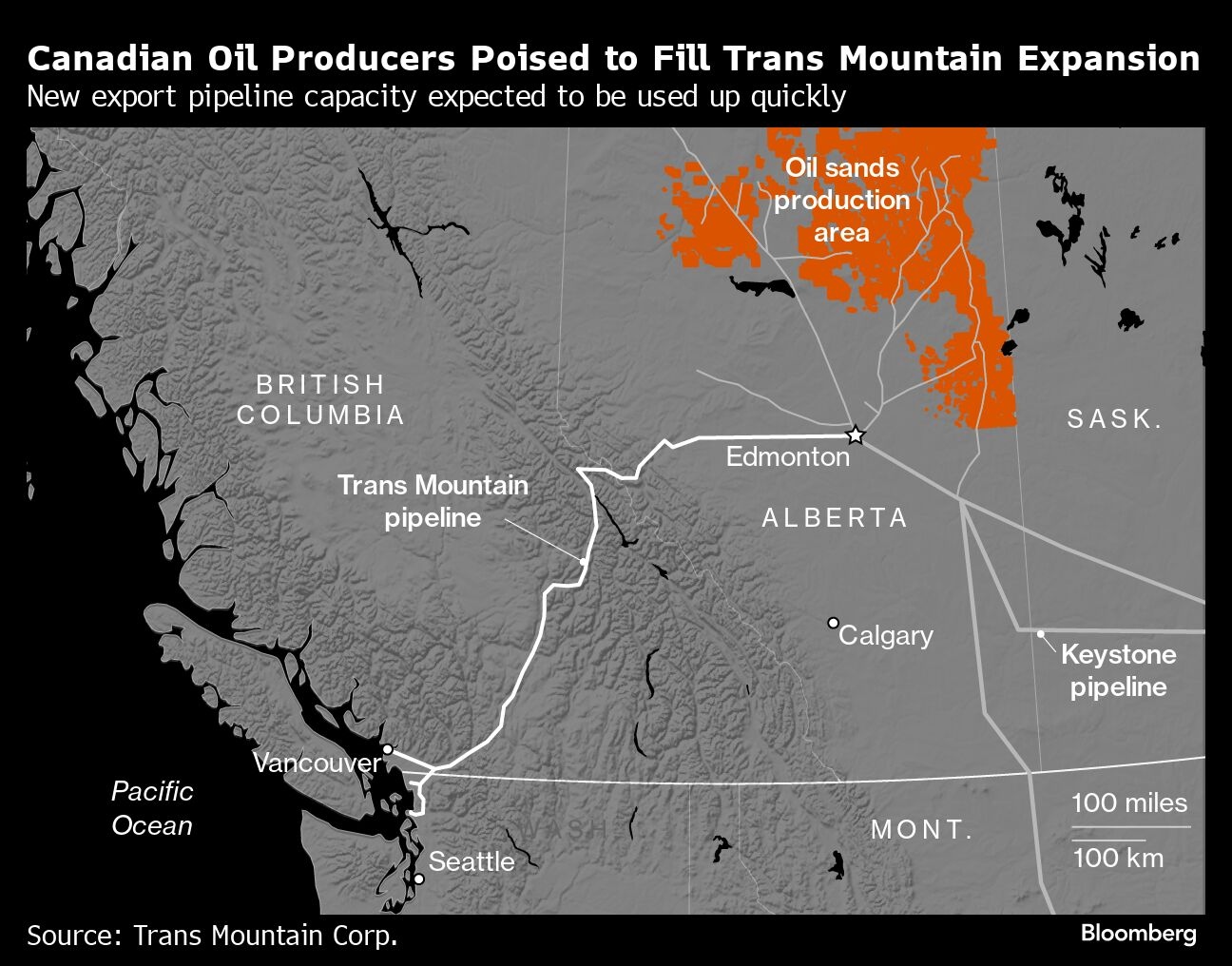
With an expansion of the Trans Mountain crude pipeline set to start operation in the months ahead, the supply of western Canadian oil available for export is set to rise by about 500,000 barrels a day by the end of next year, S&P Global estimates. The added volumes — which will include increased Canadian production and some imported condensate — will take up almost all of the 590,000 barrels a day of new capacity on Trans Mountain.  

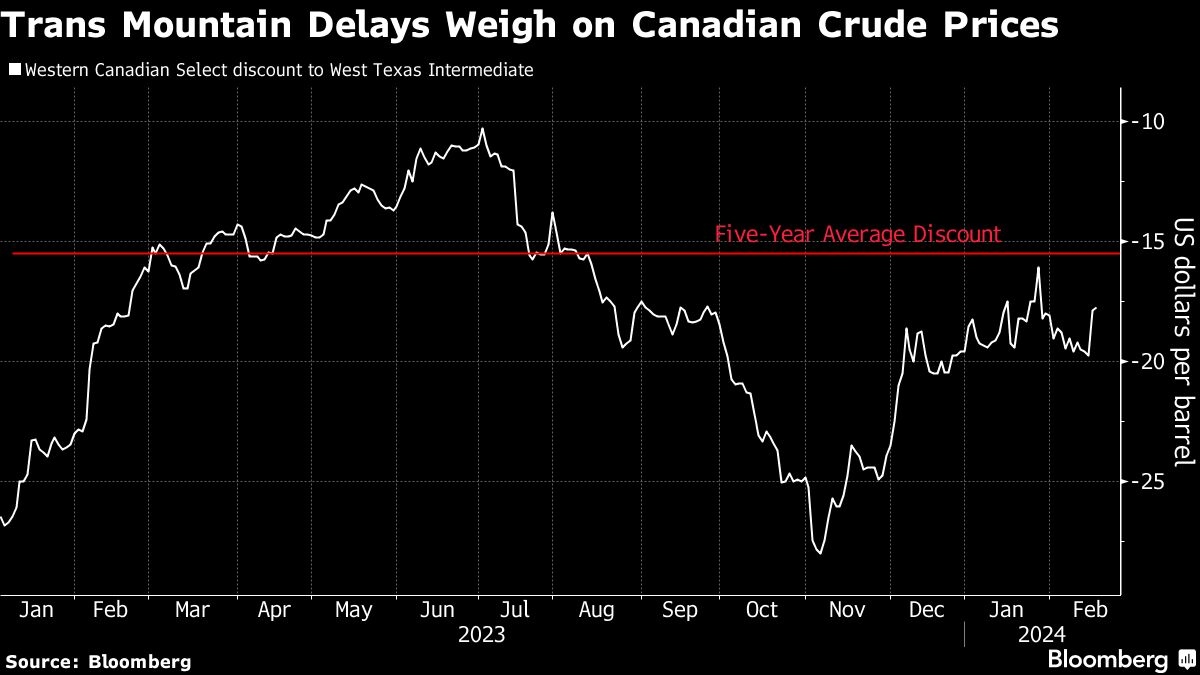
Much of that new output is already flowing out of Alberta’s oil-sands mines and wells as projects with long lead times come online, but the new space on Trans Mountain has been delayed by drilling challenges along the line’s route. The mismatched timing is straining already-full pipeline systems and weighing on heavy Canadian crude prices.

Embedded Image

Trans Mountain “has become a just-in-time delivery system,” said Kevin Birn, S&P Global Commodity Insights chief analyst of Canadian oil markets. “Had it come on time when it was supposed to, Canada would have had some excess capacity.” 

The Trans Mountain expansion already has been a decade in the making. The project — which twins an existing, 715-mile (1,150-kilometer) line running from Edmonton to the Pacific Coast city of Vancouver — was almost scrapped because of opposition from Indigenous groups and environmentalists in British Columbia. 

Prime Minister Justin Trudeau’s government bought the pipeline to save it and provide the country’s producers with a way to sell their crude to markets in Asia. While construction has moved forward under the government, it’s years late and billions over budget. 

But the government-backed company has recently held to projections that operations will begin in the second quarter. Drillers have boosted output in anticipation, sending Alberta’s oil output to records in both November and December, surpassing export pipeline space of roughly 4.2 million barrels a day.

The situation forced pipeline operator Enbridge Inc. to ration heavy-oil line space on its Mainline system by the most in more than two years in February. The volume of crude shipped out of Alberta on rail cars in November rose to the highest since June 2022. 

Enbridge had feared Trans Mountain, known as TMX, would draw volumes away from the Mainline, but the company may have to continue rationing pipeline space even after Trans Mountain starts, Colin Gruending, president of liquids pipelines, said on a recent earnings call.  

“This notion that the Mainline is going to lose a bunch of volume when TMX comes in is a bit of a stale concept,” he said. “It might have been valid a few years ago, but it has been delayed materially.”

The lack of pipeline has caused heavy Canadian crude’s discount to the U.S. benchmark to linger around US$20 a barrel for most of this year, wider than the average of about $15.50 over the past five years. The discount was $17.30 at the end of Tuesday, according to General Index prices.

Embedded Image

For global markets, the extra Canadian output adds to a flood of new production from the U.S., Guyana and Brazil that’s complicating OPEC’s efforts to balance markets with its own supply cuts. The unexpectedly strong non-OPEC growth was a major factor in oil prices’ 11 per cent decline last year, and expectations that it will continue have helped keep crude in a narrow range this year despite rising tensions in the Middle East.

Canada’s new production also puts producers in a precarious position. If one pipeline goes down, crude can suddenly back up, forcing them to slash output or ship oil via more expensive rail. 

That’s what happened in 2018, when a heavy U.S. refinery-maintenance season and scattered pipeline outages caused the discount on Canadian crude to blow out to $50 a barrel. The crisis subsided only after Alberta’s government ordered producers to cut output by 325,000 barrels a day to restore balance. 

Embedded Image

Alberta drillers plan to keep boosting output over the next two years. Imperial Oil Ltd. has plans to add more output in 2025, while Cenovus Energy Inc. is looking to boost production from its Christina Lake oil-sands site starting next year and at Foster Creek the following year.

“Everything is going to effectively be full,” S&P’s Birn said. But a return to the days of major pipeline shortages may be averted if production growth “really slows down” as S&P predicts it may. 

“If we are wrong,” Birn said, “Western Canada may not have enough pipelines.”


Millennials outnumber baby boomers in Canada as immigration slows population aging


Statistics Canada says there are now more millennials than baby boomers in the country, ending the 65-year reign of the post-Second World War generation as the largest cohort in the population.

The federal agency noted the change in its newly released population estimate for July 1, 2023, broken down by age and gender.

The baby boomer generation became the largest in Canada in 1958 — seven years before the last baby boomer was even born. They accounted for 40 per cent of the population from the mid-1960s to the early 1970s.

Many countries are grappling with the reality of an aging population as baby boomers retire. These changing demographics are expected to affect health care needs and governments' tax bases.

Here in Canada, the Liberal government has pitched higher immigration as part of the solution to problems created by aging demographics. 

Statistics Canada's report, released on Wednesday, shows federal policies are already having an impact as higher immigration through both permanent and temporary streams in 2022 and 2023 helped slow population aging.

"However, the effect of receiving a high number of immigrants in 2022 and 2023 on the decline of the average and median ages is temporary, as population aging is unavoidable," the report says. 

The average age in Canada — 41.6 — dropped slightly, by a tenth of a percentage point, between July 1, 2022 and July 1, 2023. It was the first decline since 1958. 

Meanwhile, the number and proportion of people aged 65 years and older have continued to rise.

The federal agency says the share of millennials and generation Z is increasing, while the reverse is true for baby boomers and generation X. 

Those trends have helped widen the share of the working-age population, which increased in 2023 after steadily declining over the previous 15 years.

"This change may benefit Canadian society by increasing the size of the working-age population, possibly helping to alleviate the pressures of sectoral labour shortages," the report says. 

"However, the high number of new working age Canadians may also put pressure on the delivery of services to the population, housing, transportation and infrastructure."

Statistics Canada estimates generation Z could overtake millennials in numbers sometime between 2038 and 2053. 

This report by The Canadian Press was first published Feb. 21, 2024.
 

Automotive expert says immigration can help address labour shortages in EV manufacturing

One automotive expert says that Canada’s immigration policy will help in addressing labour shortages in Canada’s EV industry. 

Bill Newman, an industry executive advisor at SAP North America, said in an interview with BNN Bloomberg Tuesday that automotive manufacturing requires a skilled workforce and workers in other industries can’t easily transition into the sector. 

“Right now, Canada has an advantage because the Canadian policies around immigration are very proactive and so I think that is a net plus,” he said. 

Newman also highlighted that building EVs requires fewer automotive parts and more software content when compared to traditional automotive manufacturing. 

“So the talent and the skills that you need in order to build a vehicle platform today are significantly different than what previous generations used to build vehicles of those of those times,” he said. 


Immigration surge fuels male population boom in Canada

An influx of new immigrants is shifting Canada’s gender ratio, as a higher share of male newcomers helps squeeze the female majority to its smallest margin in decades.

The population of adult men grew 3.4 per cent over the past year, while women rose 2.9 per cent, making the spread between the growth of the two groups the widest in nearly 50 years of records, according to an analysis by Doug Porter, chief economist at Bank of Montreal.

The gap is even larger in the 25-to-44 age group, in which men have seen a 4.8 per cent jump and women a 3.9 per cent increase. There are 141,000 more men than women in this age bracket as of January, compared with a long-run average difference of zero.

“What we’ve seen in the last 10 years is that the growth rate in the male population has steadily been rising faster than the female population in that age group. It seems to be something a little bit more permanent,” Porter said in an interview.

The figures highlight the country’s changing demographic trends due to its liberal immigration policy, which aims to rapidly expand the pool of workers to stave long-term economic decline from an aging populace.

Canada’s population growth accelerated to 3.2 per cent over a one-year period to Oct. 1, faster than any Group of Seven nation, China or India. Almost all of the increase was driven by a surge in international migration, especially among foreign students and temporary workers.

From the late 1970s to around the early 2010s, Canada’s population increasingly skewed female, but the trend has been reversing over the past decade as the male cohort grew faster. In 2022, the gap between men and women was at its narrowest in more than 30 years.

Globally, advanced economies with older populations tend to have more women because they generally live longer. Countries with a higher share of young people, on the other hand, tend to skew male, while government policies can amplify that disparity. Large migrant worker populations have also led to wide sex imbalances in Qatar and the United Arab Emirates. 

“The issue is less economic in the short term than it is social and economic in the long term,” said Armine Yalnizyan, a labour economist and a research fellow at the Atkinson Foundation, an equality-focused charitable group.

“Because it means that we are putting the premium on dealing with labour shortages and economic needs and forgetting that we are humans who need to form families, who get sick, who get old.”


Makers of COVID-19 protective equipment seek over $5 billion in damages from Ottawa

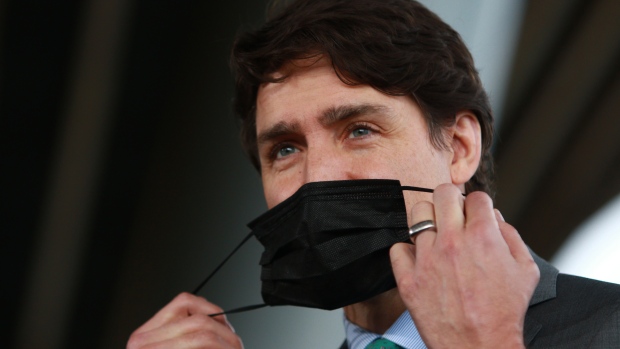
Prime Minister Justin Trudeau

Canadian manufacturers of masks and other equipment for protecting against COVID-19 are seeking more than $5 billion in damages from the federal government, saying Ottawa misled them about buying and helping sell their products.

In a statement of claim filed in Federal Court, the companies and their industry association allege the government made "negligent misrepresentations" that prompted them to invest in personal protection equipment innovations, manufacturing and production.

The companies and the Canadian Association of PPE Manufacturers say the government made misleading statements about markets, direct assistance, flexible procurement and long-term support over a three-year period that began in March 2020.

The federal government will have an opportunity to file a defence to the unproven allegations as the court case proceeds.

The emergence of COVID-19 in early 2020 spurred governments and public-health officials to implement extraordinary measures — including lockdowns, vaccine requirements and mask mandates — to prevent the spread of the disease.

The companies and their association say they formed a "special relationship" with the government that gave rise to a duty of care to the small- and medium-size businesses that swiftly retooled to make protective equipment for Canadians.

"This promise came from the very top of our Canadian government and was supported and propagated through all the departments that dealt with the plaintiffs," the statement of claim says.

The claim alleges Canada's misrepresentations resulted in about $88 million in investment losses and a further $5.4 billion in projected lost market opportunities over a 10-year period.

The government communicated to the companies through an initiative known as Canada's Plan to Mobilize Industry to fight COVID-19 that there would be new measures to directly support businesses to rapidly scale up production or revamp their manufacturing lines, the claim says.

However, even though the government identified masks and respirators as vital items in an airborne pandemic as of May 2020, invoking a national security exception for procurement, it "did not contract with" the Canadian companies, the claim says.

It further alleges the government told the companies in June 2021 it would agree to a 10-year contract with the industry association and the businesses to make up for the fact it had been buying protective equipment from foreign firms.

In a similar vein, the claim says that last September a federal official indicated the government would support the Canadian companies when procurement took place to replenish the National Emergency Strategic Stockpile of protective items.

However, another official would later tell the companies the government would "not be procuring masks and respirators" from them for the strategic stockpile, the claim says.

It contends that despite promises to support the domestic industry, the government shunned homegrown companies "and instead supported foreign competition." In turn, the government's actions denied the Canadian companies "fair and equitable access" to the Ontario and Quebec markets as well as the Canadian hospital market.

The claim also contends the government, through guidance provided by the Public Health Agency of Canada, "inappropriately misdirected" Canadians away from buying and using N95 and other manufactured masks in favour of "making, buying and wearing cloth masks for at least the first two-year period of the pandemic."

This report by The Canadian Press was first published Feb. 14, 2024.


All oil and gas permits in B.C. waters are relinquished, say feds

The federal government says the final offshore oil and gas permits for Canada's West Coast have been relinquished.

A news release from the office of Energy and Natural Resources Minister Jonathan Wilkinson says the relinquishment came from Chevron Canada, which has given up its 23 offshore permits along the coast of British Columbia as of Feb. 9.

A spokeswoman from Wilkinson's office says that represents the last of the 227 offshore oil and gas permits for British Columbia's coastal waters.

The release says giving up the oil and gas permits in Pacific waters fulfils a condition in the federal government's commitment to an Indigenous-led conservation initiative that received a pledge of $800 million in support from Ottawa two years ago. 

In April 2023, Chevron Canada said it was voluntarily relinquishing 19 offshore oil and gas permits within protected wildlife areas on B.C.'s West Coast.

The permitting area given up by Chevron at that time was estimated at 5,700 square kilometres and overlapped parts of federal marine protection areas off B.C.

This report by The Canadian Press was first published Feb. 21, 202


Group RRSP use rising as retirement savings burden 'largely on employees': experts

Experts say group registered retirement savings plans (RRSPs) have risen in popularity as employees are increasingly tasked with retirement planning amid a broader decline in pension activity. 

Gren Austin, the head of Wealthsimple Work, said in an interview with BNNBloomberg.ca last week that his organization works with employers across Canada looking to create group retirement savings plans. He said that group RRSPs have become the most popular retirement savings plan among clients.   

“We know broadly that pension involvement is down over the decades. And so the onus becomes on the individual, on the Canadian, on the employee, to pay for their own retirement,” Austin said adding that group RRSPs can make a meaningful difference in retirement savings. 

In November of last year, research from Deloitte Canada found that only 24 per cent of private sector workers participated in an employer-sponsored pension plan

According to a statement from Wealthsimple on Tuesday, less than one per cent of Wealthsimple Work clients offer a pension plan. The statement said that consumer preferences are changing and employers “are realizing the cost requirements to run a pension are high and opt to follow the demand for group RRSPs.” 

“There is this decades-long historical arc, in that the big pension groups dominated the landscape for a long time in the 60s and 70s. And then those started to fade and things like GRRSPs took over as the main account that sort of dominated the space,” Gren said. 

Julie Petrera, senior strategist with Edward Jones Canada, said in an interview with BNNBloomberg.ca last week that while there is still some level of government assistance for retirement savings, employees take on the bulk of saving responsibilities.  

“The onus is largely on employees to save for their retirement in the absence of good pension plans,” she said. 


Group RRSP matching 

Austin said that group RRSPs often come with a matching component, where some employers will match employee contributions up to a certain level. 

“There's not a lot of other investment scenarios where you can just get that return right away and that's before even the market does its thing and compound interest does its thing. So, it's a really great vehicle to start saving and building up in your RRSP,” he said.

Colin White, the president and CEO of Verecan Capital Management, said in an interview with BNNBloomberg.ca last week that matching components for group RRSPs often range between two and four per cent. He also highlighted that group RRSPs often go unutilized. 

“There's an amazing number of people that don't take advantage of that and they really should. It's free money. If your employer's going to put money into an RRSP plan, you should take that money,” White said.  


Flexibility, transparency

According to White, the rise of group RRSPs has happened for a few reasons, including the difficulties operating pension plans. 

“Pension plans are difficult and complicated to maintain, and they do come with a financial liability that firms have struggled with. And as people have moved around more often in their careers, moving a pension plan is a very difficult and cumbersome thing to do,” he said. 

White also highlighted that traditional pensions are “restrictive from a legislative perspective” and come with liability. 

“So the group RRSP is a far more transparent solution. You know exactly where you stand at any moment in time and you see yourself making progress,” he said. 

White also noted that group RRSP offerings have risen in popularity amid a “more transient workforce” with employees changing jobs more frequently.

According to Petrera, group RRSPs can help employers with recruiting. 

“Group RRSPs are part of a compensation plan. And they’re something that employees would find attractive. So I think there's been a rise in these as employers seek to attract talent to organizations,” she said. 


Dollarama proposes $2.5M settlement in class action over products with eco fees

Dollarama Inc. customers who purchased products with an "eco fee" in the last few years may be eligible to receive a gift card from the retailer under a $2.5 million proposed settlement stemming from a class-action lawsuit.

Under the class action, a plaintiff represented by Quebec law firm LPC Avocats alleged Dollarama did not properly display the price of products subject to eco fees and charged a total price or eco fee higher than displayed for these products or allowed by law.

Environmental handling fees, sometimes called eco fees, are levied on items like electronics, light bulbs, batteries and toys in order to help with the cost of recycling.

To settle the matter, LPC Avocats says Dollarama has offered Dollarama customers who purchased products with eco fees between May 29, 2021 and July 4, 2023 gift cards valued at up to $15.

Customers who bought such products in Quebec between Dec. 11, 2019 and July 4, 2023 are also eligible.

LPC Avocats says a court will hold a hearing on April 9 to decide whether to approve the settlement before any gift cards are provided to eligible consumers.

Dollarama says in a statement that, like other retailers, it charges eco fees "where appropriate" but displayed its eco fees and prices separately.

It adds the proposed settlement is not an admission of any liability or wrongdoing by Dollarama.

This report by The Canadian Press was first published Feb. 21, 2024.
Kumba Iron Ore to cut 490 jobs as rail crisis hits output, shares fall

Reuters | February 20, 2024 

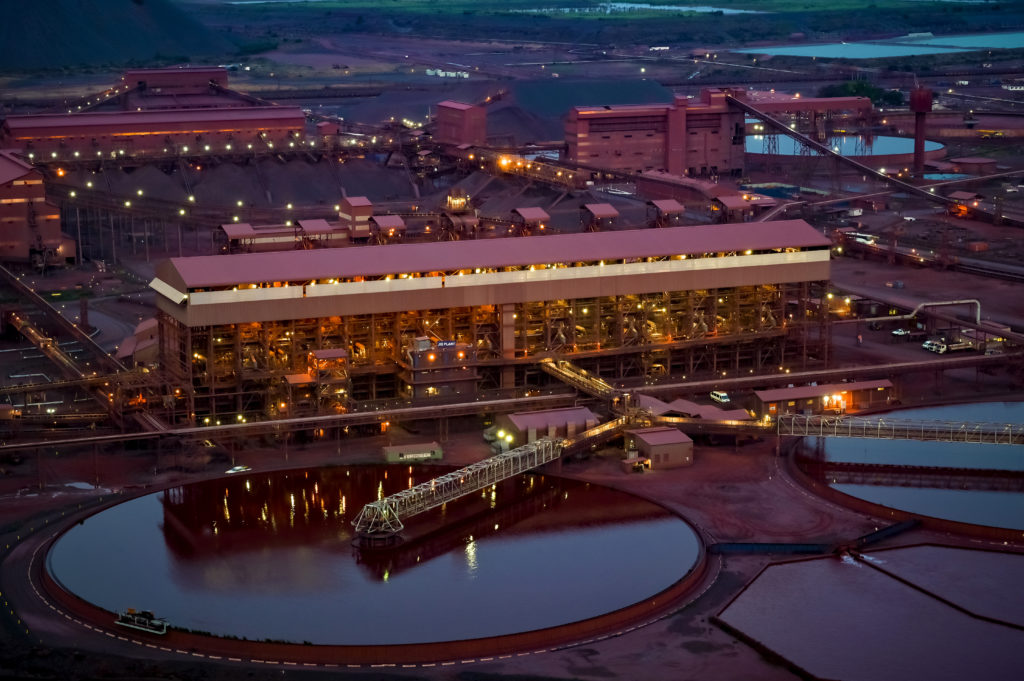
The Sishen mine is the company’s flagship operation and one of the largest open pit mines in the world. Credit: Kumba Iron Ore

Kumba Iron Ore shares fell more than 5% on Tuesday after it announced plans to cut about 490 jobs, following a reduction in production as it struggles to overcome South Africa’s persistent rail bottlenecks.


In December, the Anglo American Plc unit said it was curbing production to match the limited capacity of state-owned rail operator Transnet, hit by shortages of locomotives and spares, as well as rampant cable theft and vandalism.

Stockpiles of iron ore stood at 7.1 million tons in December and the persistent challenge in moving the commodity to ports for exports has forced Kumba to cut output to between 35 million tons to 37 million tons from this year to 2026.

Kumba CEO Mpumi Zikalala said during a conference call that the proposed job cuts, combined with the restructuring of head office roles which started last September, would affect 10% of the company’s workforce. The company employed about 7,000 full-time staff, according to its 2022 annual report.

The restructuring is “necessary” for Kumba to remain competitive, the company said.

Job losses across South Africa’s mining sector due to weaker commodity prices and infrastructure challenges add pressure for the government ahead of elections due later this year.

South Africa’s official jobless rate, measured at 31.9% in the third quarter of 2023, is among the highest in the world.

On Monday, Anglo American Platinum announced plans to cut 3,700 jobs in South Africa after a sharp decline in metal prices slashed annual profit by 71%.

Kumba’s headline earnings per share rose 26% to 70.80 rand in the year ended Dec. 31, up from 56.19 rand the previous year as its high grade iron ore continues to fetch prices 15% above the benchmark rate.

(By Nelson Banya; Editing by Muralikumar Anantharaman, Clarence Fernandez and Sharon Singleton)
CHART: China’s Belt and Road mining investment hits record

Frik Els | February 20, 2024 | 


A new report from Griffith Asia Institute, a unit of Australia’s Griffith University, shows 10 years after the launch of China’s Belt & Road Initiative (BRI) cumulative engagement tops $1 trillion with about $634 billion in construction contracts and $419 billion in non-financial investments.


The authors point out that 2023 was the first time that more than 50% of BRI engagement was through investments where Chinese investors take equity stakes as opposed to construction contracts, which are typically financed through loans provided by Chinese financial institutions or contractors, often accompanied by guarantees from the host country.


Last year Africa overtook the Middle East as the no. 1 target of BRI projects after a 114% jump in investments and a 47% jump in construction projects on the continent. Investments in Latin America and the Caribbean also doubled last year.

Source: Griffith Asia Institute

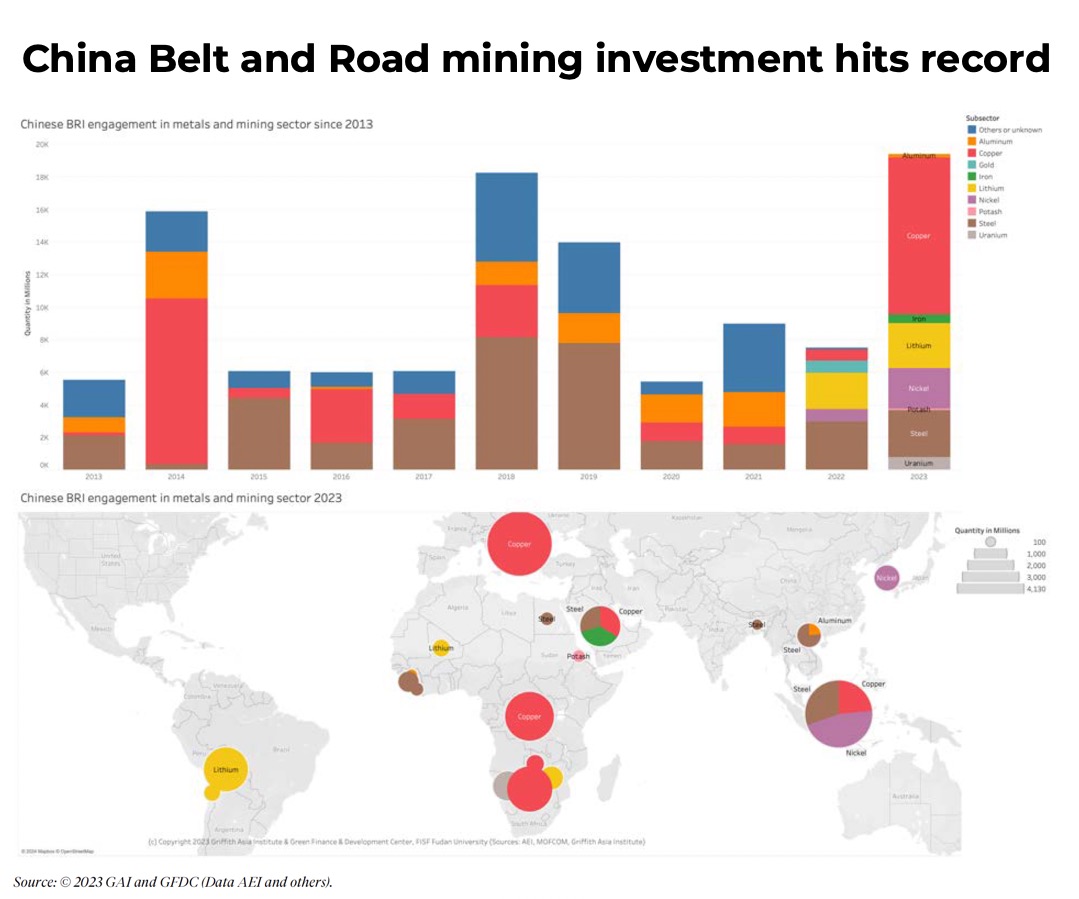
China’s BRI-related investment in metals and mining reached $19.4 billion in 2023 according to the study, a 158% jump compared to 2022 and the highest on record.

Minerals and metals investment focused on the green energy transition with copper making up the lion’s share of new project announcements last year, followed by sizable lithium, nickel and uranium spending under the BRI.

Apart from a giant new copper processing facility in Saudi Arabia, mining investments were focused in Indonesia and various countries in Africa and South America.

Examples include vertical integration investments by the world’s largest battery manufacturer CATL, which bought shares for a nickel mining concession in Indonesia from PT Aneka Tambang (Antam).


Lithium projects in Mali attracted investment from Chinese firms Jiangxi, Ganfeng and Hainan Mining (through the acquisition of Kodal Minerals) while Zhejiang Huayou Cobalt commissioned a lithium processing plant in Zimbabwe.

Downstream investment in battery and electric vehicle manufacturing also soared, reaching nearly $10 billion, according to the report. The largest investors under the BRI last year were CATL, accounting for more than 15% of overall spending, followed by Zijin Mining at 11%.

Zhejiang Huayou Cobalt contributed nearly 9% of the total while CMOC (formerly China Molybdenum) and Minmetals each had a 5%-plus share of the $92.4 billion total investments in 2023.

For 2024, the Griffith Asia Institute sees further growth of Chinese BRI engagement with a strong focus on country partnerships in renewable energy, resource-backed mining and related technologies including EV batteries.