Tuesday, March 26, 2024

Ecuador's youngest mayor, Brigitte García, killed 
MURDERED with her advisor amid state of emergency

Jonathan Limehouse
Tue, March 26, 2024

Ecuador’s youngest mayor and her press officer were found Sunday shot to death in a vehicle amid an ongoing state of emergency, police said.

Brigitte García, the 27-year-old mayor of San Vicente and member of the left-wing Citizen Revolution Party, was found alongside her advisor, Jairo Loor, in the vehicle, Ecuadorian police said in a social media post on X.

Ecuadorian police found the two that morning without vitals and with gunshot wounds, according to the social post.


Handout picture released by the Mayor's Office of San Vicente taken on February 20, 2024, of the then mayoress of San Vicente Brigitte García, speaking during the delivery of agricultural implements in San Vicente, Manabi, Ecuador. The 27-year-old mayoress of coastal San Vicente was found shot to death on March 24, 2024, police said, as the South American country approaches its third month of a state of emergency decreed by the government to crack down on soaring gang violence.

Police said they’re working to figure out a motive for the shooting.

After collecting ballistics evidence and conducting a preliminary investigation, police determined the shots were fired from inside the vehicle.

Investigators continue to analyze the car's route, which appears to be rented, Ecuadorian police said in an X post shared later that afternoon.

.oembed-frame {width:100%;height:100%;margin:0;border:0;}

More world news: WikiLeaks' Julian Assange may get a shot at freedom as UK court asks for US 'assurances'

'No one is safe in Ecuador,' Luisa Gonzalez, fellow Citizen Revolution Party member, says

Luisa Gonzalez, a member of the Citizen Revolution Party who ran to become president of Ecuador in 2023, called García’s death an assassination.

“I've just found out they've assassinated our fellow mayor of San Vicente Brigitte Garcia," Gonzalez said in a post on X. “I have no words… no one is safe in Ecuador.”

.oembed-frame {width:100%;height:100%;margin:0;border:0;}

García’s death comes after President Daniel Noboa issued a nationwide state of emergency in January and declared Ecuador was in a “state of war” against gangs after violence ensued following "internal armed conflict” and the prison escape of alleged "Los Choneros" gang leader Adolfo "Fito" Macías.

Macías' gang is accused of numerous car bombings, kidnappings and murders, NBC News reported.

President Daniel Noboa extends nationwide state of emergency


Ecuador's President Daniel Noboa wears a bulletproof vest and a helmet to verify the results of a police and military operation at the Socio Vivienda neighborhood in Guayaquil, Ecuador on March 26, 2024.

Noboa extended the emergency order by an additional 30 days on March 7.

The 36-year-old president who designated 22 gangs as terrorist groups said the extension would help "keep military patrols going in prisons and violent areas of the country, maintain order and reduce homicides," Reuters reported.

During the emergency order, intentional homicides have been halved — dropping from an average of 24 a day to 12 a day, according to the outlet.

So far, the Ecuadorian government confirmed that 1,534 people have been arrested and five “terrorists” were killed during more than 15,000 operations around the state, the Guardian reported.

US citizens advised to 'exercise increased caution' in Ecuador, US Embassy and Consulate says

The U.S. Embassy and Consulate in Ecuador advised Americans abroad to follow "all local laws, including curfew guidance and the requirement for a criminal record check for foreigners entering the country via land border crossings from Colombia or Peru."

“U.S. citizen residents and travelers should continue to exercise increased caution throughout the country, should reconsider travel to areas marked as ‘Level 3,’ and should not travel to areas marked as ‘Level 4’ in the advisory,” according to a U.S. Embassy and Consulate in Ecuador news release.

Three U.S. citizens were murdered in Ecuador in 2022, according to the U.S. Department of State's Bureau of Consular Affairs. The data for 2024 and 2023 was unavailable as of Tuesday.

"U.S. citizens should be aware that individuals not connected with criminal organizations may use the current conflict to commit crimes of opportunity," according to the release.

This article originally appeared on USA TODAY: Brigitte García, Ecuador's youngest mayor, found shot to death

Brazilian police launch investigation into Bolsonaro's 2-night sleepover at Hungarian embassy


MAURICIO SAVARESE
Mon, March 25, 2024 

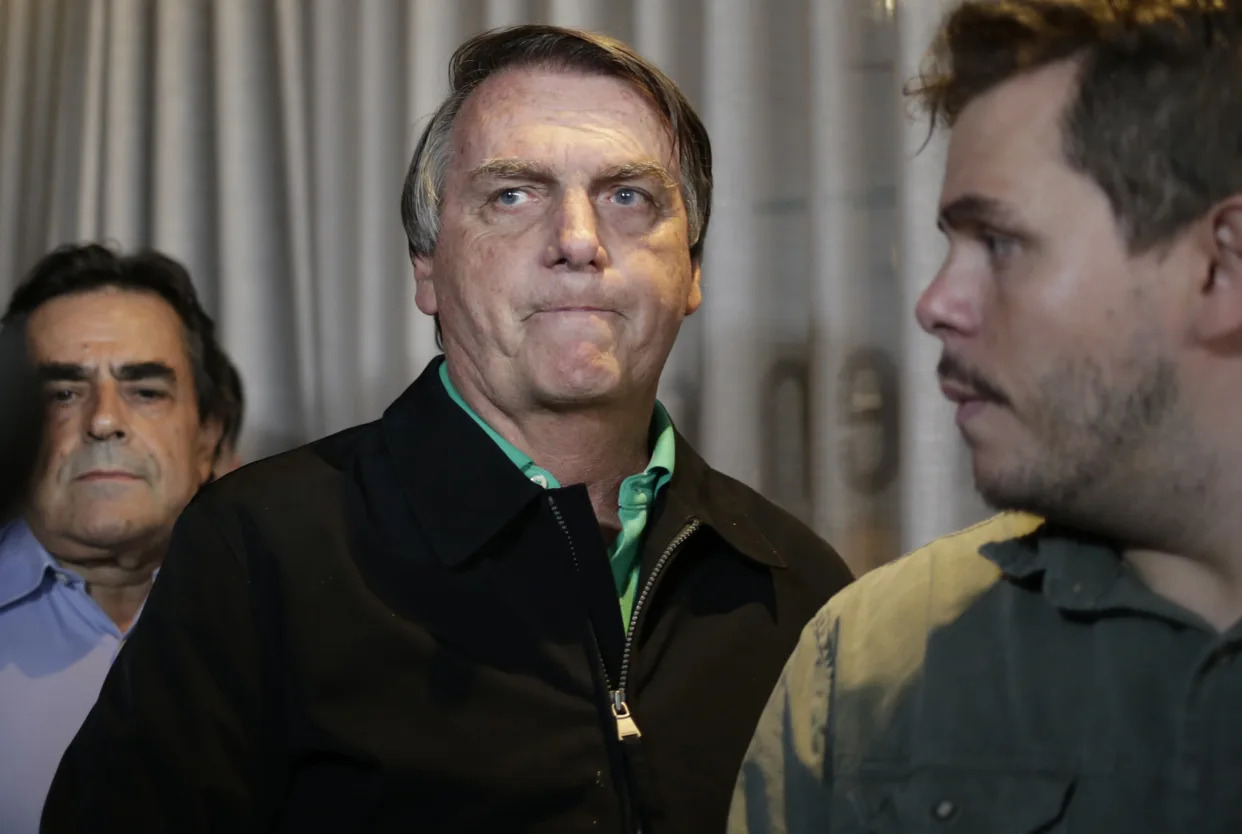
 Brazil's former President Jair Bolsonaro prepares to speak to the press in Belo Horizonte, Brazil, June 30, 2023, the day that judges ruled him ineligible to run for any political office again until 2030 after concluding that he abused his power and cast unfounded doubts on the country's electronic voting system. According to a Federal Police indictment unveiled Tuesday, March 19, 2024, Bolsonaro turned to an aide-de-camp and asked him to insert false data into the public health system to make it appear as though he and his daughter had received the COVID-19 vaccine, in order to have the necessary vaccination certificate required by U.S. authorities for their 2023 trip to Florida.
 (AP Photo/Thomas Santos)


SAO PAULO (AP) — Brazil's Federal Police on Monday launched an investigation into former President Jair Bolsonaro's two-night stay last month at the Hungarian embassy in Brasilia, amid widespread speculation from his opponents that he may have been attempting to evade arrest.

A Federal Police source with knowledge of the investigation confirmed to The Associated Press that it was undertaken in response to a report from The New York Times, which featured security camera video of the Hungarian ambassador welcoming Bolsonaro on Feb. 12 and footage of Bolsonaro from the rest of his stay. Hungary’s Prime Minister Viktor Orbán, one of the leaders of a global far-right movement, is a key international ally of his.

The visit took place just days after Federal Police seized Bolsonaro’s Brazilian and Italian passports and raided the homes of his top aides as part of a probe into whether they plotted to ignore 2022 election results and stage an uprising to keep the defeated leader in power.

Bolsonaro has denied wrongdoing regarding this investigation, and multiple others targeting him.

Were the Federal Police to obtain an arrest warrant for the former president, officers would not have jurisdiction to enter the Hungarian embassy due to diplomatic conventions restricting access.

Bolsonaro’s lawyers said in a statement on Monday that there was nothing amiss about his embassy stay.

“In the days he was at the Hungarian embassy, by invitation, the former Brazilian president spoke to countless authorities from the friendly country for updates on the political scenarios of both nations,” his lawyers said in the statement. “Any other interpretations ... constitute an evidently fictional work, with no connection to the reality of the facts.”

Speaking at his party's headquarters in Sao Paulo, Bolsonaro told supporters he gets many calls from Orbán to discuss politics.

“To this day I have a relationship with some heads of state around the world,” Bolsonaro said. “If I had my passport, I would have traveled to Israel.”

Brazil's foreign ministry said in a short statement that it had summoned Hungary's ambassador Miklos Halmai to explain why Bolsonaro was his guest at the embassy.

Bolsonaro flew to the U.S. in the final days of his term, in December 2022, just days before his supporters stormed the capital in a failed bid to oust President Luiz Inácio Lula da Silva from power. He remained in South Florida for three months.

Some of Bolsonaro's political rivals seized on the news Monday to call for his arrest, alleging that he once again is signaling plans to escape.

“These images just reinforce that Bolsonaro is a confessed fugitive,” Alexandre Padilha, Lula's minister of institutional relations, told reporters in Brasilia, citing Bolsonaro's stint in the U.S. last year. “But what the courts and the Federal Police will do with these images (published by The New York Times) isn't for me to say.”

Augusto de Arruda Botelho, a criminal lawyer who has been an outspoken critic of the former president, wrote on X, formerly Twitter, that “Bolsonaro’s act of hiding in the embassy is a classic motive for decreeing preventive detention."

"It is one of those situations used as an example in books and classrooms,” he added.

___


Brazil summons Hungarian envoy to explain why Bolsonaro hid in embassy

Tom Phillips in Rio de Janeiro
Mon, March 25, 2024 

Jair Bolsonaro hugs Hungary's prime minister, Viktor Orbán, right, in Budapest in 2022. ‘I won’t deny that I was in the embassy,’ he said on Monday.
Photograph: Attila Kisbenedek/AFP/Getty Images

Brazil’s foreign ministry has summoned the Hungarian ambassador to explain why the South American country’s embattled former president Jair Bolsonaro spent two nights “hiding” at Hungary’s embassy in Brasília last month as federal police investigators closed in on some of his closest allies.

Security footage obtained by the New York Times showed that in early February – four days after two Bolsonaro aides were arrested on suspicion of plotting to overthrow the Brazilian government – the rightwing populist took shelter in the embassy, a short drive from the presidential palace Bolsonaro once occupied.

The New York Times said Bolsonaro’s embassy stay suggested he was “seeking to leverage his friendship with a fellow far-right leader, Hungary’s Prime Minister Viktor Orbán of Hungary, into an attempt to evade the Brazilian justice system as he faces criminal investigations at home”.

On Monday Bolsonaro confirmed the report, telling the Brazilian website Metrópoles: “I won’t deny that I was in the embassy … I won’t say where else I’ve been. I have a circle of friends with some heads of state around the world. They are worried. I talk to them about matters in our country’s interest. Full stop. The rest is speculation,” he was quoted as saying.

In a statement, the former president’s lawyers said he had been in the embassy “to keep in touch with the authorities of a friendly country”. Alternative interpretations amounted to “a work of fiction, with no connection to the reality of the facts” and were “fake news”, it added.

Related: Bolsonaro laid out plan for Brazil coup after defeat by Lula, ex-commanders say

Bolsonaro, who lost power in late 2022 after being beaten in the presidential election by his leftist rival Luiz Inácio Lula da Silva, is facing a series of criminal investigations relating to claims that he faked Covid vaccination records, sought to siphon off expensive foreign gifts and, most seriously, that he plotted to topple the government of his successor.

On 8 February Bolsonaro was forced to surrender his passport as part of the federal police investigation into the alleged attempted coup on 8 January 2023 when Bolsonaro supporters ran riot in the capital. Two close aides, Marcelo Costa Câmara and Filipe Martins, were arrested and addresses linked to powerful former members of Bolsonaro’s administration searched.

That evening, Orbán tweeted a photograph in which he appeared shaking Bolsonaro’s hands and offered some words of support. “An honest patriot. Keep on fighting, Mr. President!”

Four days later, at 9.34pm on Monday 12 February, a black saloon car appeared at the gate of Hungary’s embassy in Brazil, according to the images obtained by the New York Times. Three minutes later the ambassador, Miklós Halmai, appeared to let his visitor in. Bolsonaro was taken inside.

The former president reportedly remained at the embassy until the afternoon of 14 February when the ambassador waved him off.

Bolsonaro did not make clear why he had decided to visit the embassy. However, he has publicly voiced fears of meeting the same fate as Bolivia’s former president, Jeanine Áñez. In 2022, Áñez was sentenced to 10 years in prison after being found guilty of helping orchestrate an alleged 2019 coup that brought her to power after the fall of President Evo Morales.

Before his election defeat, Bolsonaro said he saw only three possible futures for himself: prison, death or victory. The New York Times’s video suggests a fourth alternative may now be under consideration: a new life as a lodger in the Hungarian embassy, where under international law he cannot be arrested.

Reports of Bolsonaro’s two-day break at the embassy prompted calls for him to be detained to prevent him from escaping justice. “Bolsonaro’s attempt to hide himself in the embassy is a classic motive for preventive detention,” Augusto de Arruda Botelho, the former national secretary of justice, tweeted

Many social media users mocked the former president using the hashtag ‘Bolsonaro fujão’, which translates roughly as Bolsorunaway.

The Hungarian ambassador reportedly remained silent during his 20-minute meeting with Brazilian diplomats on Monday afternoon.

Thousands protest against Hungary's Orban after former insider leaks graft case tape

Reuters
Tue, March 26, 2024 


BUDAPEST (Reuters) - Thousands of people protested in Budapest near parliament on Tuesday demanding the chief prosecutor and Prime Minister Viktor Orban resign after a former government insider accused a senior aide to Orban of trying interfere in a graft case.

Protesters marched from the chief prosecutor's office towards parliament shouting "Resign, resign", with many carrying torches.

Peter Magyar earlier published a recording of a conversation with Judit Varga, then his wife and Hungary's justice minister, in which she detailed an attempt by aides to Orban's cabinet chief to remove certain parts from documents in a graft case.


The case is centred on former justice ministry state secretary Pal Volner, who was charged in 2022 with accepting bribes from the former head of the Court Bailiffs, Gyorgy Schadl. Both have pleaded not guilty. Prosecutors are seeking jail terms for the pair.

Prosecutors said in a statement they would analyse the tape, which Magyar said he recorded in January 2023, and further evidence would be collected.

"It is legally and physically impossible to eliminate and meddle into prosecution documents," the statement said.

Prosecutors were scheduled to hold a press conference on Thursday.

The allegations come at a politically sensitive time for Orban ahead of European parliamentary elections in June, and follow a sex abuse scandal that brought down two of Orban's political allies - the former president and the former justice minister Judit Varga - last month.

Magyar, 43, a lawyer formerly close to the government, plans to launch a new party to challenge Orban.

"Hungarians thank you ... for coming in the thousands tonight ... to tell those in power that we have had enough," he told protesters in a speech.

On the audio tape, recorded in the then couple's home, and published on Magyar's Facebook page, Varga says aides linked to cabinet chief minister Antal Rogan suggested to prosecutors what should be deleted from documents related to the Volner/Schadl case.

"They told the prosecutors what should be deleted but they (prosecutors) did not entirely follow up on that," Varga is heard on the tape as saying.

Former justice minister Varga, who could not be reached for comment, did not dispute the authenticity of the tape in a post on her Facebook page.

"Peter Magyar made a secret recording of his former spouse, me, in our home and now used this to achieve his political goals. He is not worthy of anybody's trust," she wrote.

Government spokesperson Zoltan Kovacs declined to reply to emailed questions from Reuters about the content of the recording, commenting: "Much ado about nothing."

(Reporting by Krisztina Than and Gergely Szakacs; Editing by Jon Boyle, Angus MacSwan and Daniel Wallis)


Former Hungarian insider releases audio he says is proof of corruption in embattled Orbán government

JUSTIN SPIKE
Updated Tue, March 26, 2024


BUDAPEST, Hungary (AP) — A former Hungarian government insider turned critic released an audio recording on Tuesday that he says proves that top officials conspired to cover up corruption, the latest development in a scandal that has shaken Prime Minister Viktor Orbán's domination of the country's politics.

The country's largest protests in years erupted in early February when it was revealed that the president had issued a pardon to a man imprisoned for covering up child sexual abuses by the director of a state-run orphanage.

Close Orbán allies, including the president and Justice Minister Judit Varga, were forced to resign in the face of public outrage.

The latest allegations come from Varga's ex-husband, Peter Magyar, a former political insider who says he has turned whistleblower to reveal the extent of impropriety within Orbán's government.

He posted a recording on Facebook and YouTube on Tuesday featuring what appeared to be Varga's voice describing how other government officials caused evidence to be removed from court records to cover up their roles in corrupt business dealings.

“They suggested to the prosecutors what should be removed," Varga says in the recording, which Magyar says he made during a conversation in the former couple’s apartment. Varga also says that one of her state secretaries was tipped off by senior officials that he was the subject of a corruption investigation.

Magyar gave the recording to the Metropolitan Public Prosecutor's Office in Budapest on Tuesday to be used as evidence.

In a Facebook post on Tuesday, Varga accused Magyar of domestic violence during their marriage and claimed she had made the statements under duress, but didn't deny that it was her in the recording.

“I said what he wanted to hear so I could get away as soon as possible. In a situation like this, any person can say things they don’t mean in a state of intimidation,” Varga wrote. Magyar later denied those claims in a separate post on Facebook.

Once a senior but little-known member of Orbán’s political circle, Magyar shot to prominence when he gave an interview in February to popular YouTube channel Partizan in which he accused Orbán's government of widespread corruption and of using smear campaigns to discredit its opponents.

On March 15, he addressed a crowd of tens of thousands in Budapest and announced plans to form a new political party to challenge the governing party's 14-year grip on power as an alternative to Hungary’s fragmented opposition.

The scandal caused an unprecedented political crisis within Orbán’s government, which has led Hungary since 2010. Magyar’s followers hope his position as a former insider can help to disrupt Hungary’s political system, which many see as a deeply entrenched autocracy.

In his recent public appearances, Magyar has particularly targeted Antal Rogan, a close Orbán ally who is responsible for the government’s communications as well as the country’s secret services. The recording released Tuesday purports to show that Rogan led the effort to alter evidence.

The government has dismissed Magyar as an opportunist seeking to forge a new career after his divorce with Varga and his loss of positions in several state companies. But his rise has compounded political headaches for Orbán that have included the resignation of members of his government and a painful economic crisis.

After spending nearly four hours inside the prosecutor's office on Tuesday, Magyar told journalists that the alleged evidence tampering was cause for Orbán's government to step down, and called for a spontaneous protest later in the day.

On Tuesday evening, thousands of demonstrators gathered at Magyar's urging at the Public Prosecutor's Office in Budapest where he demanded the resignation of the attorney general, whom he accused of acting in the interests of Orbán's governing party.

“Let us send a message from here, together, that we will not let them cover up the biggest legal and political scandal of the last 30 years! We will not allow it!” he said, adding that he demanded that the alleged misconduct “be investigated independently, objectively and free from political interference.”

One demonstrator, Katalin Varga, said that she identifies with Magyar's political message that corruption in Hungary has led to a disintegration of the country's political, cultural and social life.

“Finally, there is a force, a character who represents what for me is the problem with the current situation: the political system, the abuses, and the fact that we are slowly cooking like frogs and not realizing that we are going to be the soup,” she said.

Hungarian whistleblower releases audio suggesting corruption in embattled Orbán government

Euronews
Tue, March 26, 2024 

Hungarian whistleblower releases audio suggesting corruption in embattled Orbán government

A former Hungarian government insider turned whistleblowed has released an audio recording that he says proves that top officials conspired to cover up corruption – the latest twist in a scandal that's shaken authoritarian Prime Minister Viktor Orbán's political dominance.

The country's largest protests in years erupted in early February after it was revealed that the president had issued a pardon to a man imprisoned for covering up incidents of child sexual abuse perpetrated by the director of a state-run orphanage.

Close Orbán allies, including the president and Justice Minister Judit Varga, were forced to resign in the face of public outrage.

The latest allegations come from Varga's ex-husband, Peter Magyar, a former political insider who says he has turned whistleblower to reveal the extent of the scandal.

Hungarian Prime Minister Viktor Orbán gives a speech on the steps of the National Museum in Budapest. - Denes Erdos/Copyright 2024 The AP. All rights reserved.

On Tuesday morning, Magyar published a recording on Facebook and YouTube in which Varga can be heard describing how other government officials caused evidence to be removed from court records to cover up their roles in corrupt business dealings.

"They suggested to the prosecutors what should be removed," Varga says in the recording, which Magyar says he made during a conversation in the former couple's apartment.

He has given the tape to the Public Prosecutor's Office in Budapest to be used as evidence.

In a Facebook post on Tuesday, Varga confirmed the voice on the recording is hers, but accused Magyar of violence toward her during their marriage and claimed she had made the statements under duress.

"I said what he wanted to hear so I could get away as soon as possible," she wrote. "In a situation like this, any person can say things they don't mean in a state of intimidation."

Magyar subsequently denied her claims in a Facebook post of his own.
Switching sides

Once a senior but little-known member of Orbán's political circle, Magyar shot to prominence when he gave an interview in February to popular YouTube channel Partizan, where he accused Orbán's government of widespread corruption and using smear campaigns to discredit its opponents.

On March 15, he addressed a crowd of tens of thousands in Budapest, where he announced plans to form a new political party to challenge Fidesz's 14-year grip on power as an alternative to Hungary's fragmented opposition.


Péter Magyar, the former husband of one-time justice minister and Orbán ally Judit Varga holds a smoke-candle after his speech on Hungary's National Day in Budapest. - Denes Erdos/Copyright 2024 The AP. All rights reserved.

The scandal caused an unprecedented political crisis within Orbán's government, which has led Hungary since 2010. Magyar's followers hope his position as a former insider can help to disrupt Hungary's political system, which many see as a deeply entrenched autocracy.

The government has dismissed him as an opportunist seeking to forge a new career after his divorce from Varga and his loss of positions in several state companies. Nonetheless, Magyar's rise has seriously exacerbated what were already major political headaches.

Magyar has railed against official corruption, accusing Orbán of overseeing a nepotistic system of oligarchs that enrich themselves through unfairly awarded government contracts.

He has particularly targeted Antal Rogan, a close Orbán ally who is responsible for the government's communications as well as the country's secret services. The recording released Tuesday purports to show that Rogan led the effort to alter evidence.


Hungary Corruption
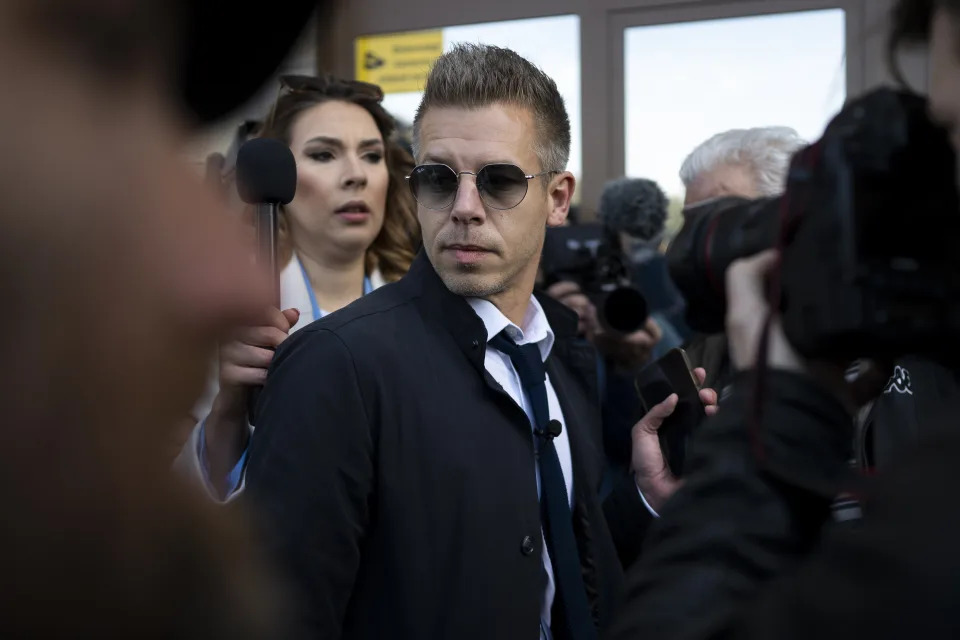
Former Hungarian government insider Peter Magyar leaves the Public Prosecutor's office in Budapest, Hungary, on Tuesday March 26, 2024. Magyar on Tuesday released a recording that he claims proves senior officials in the government of Prime Minister Viktor Orbán manipulated court documents to cover up their involvement in a corruption case.
 (AP Photo/Denes Erdos)

THE ENEMY OF MY ENEMY
Lebanese Sunni militant group head says coordination with Shiite Hezbollah is vital to fight Israel

BASSEM MROUE
Tue, March 26, 2024 


The Secretary-General of the Islamic Group Sheikh Mohammed Takkoush, speaks during an interview with The Associated Press in Beirut, Lebanon, Tuesday, March 26, 2024. Takkoush allied with Hamas and Hezbollah said Tuesday they are closely coordinating with both groups along the southern border with Israel where they have claimed responsibility for several attacks over the past months.
 (AP Photo/Bilal Hussein)


BEIRUT (AP) — The head of a Lebanese Sunni political and militant group that has joined the Shiite militant group Hezbollah in its fight against Israel on Lebanon’s border said Tuesday that the conflict has helped strengthen cooperation between the two groups.

The Secretary-General of al-Jamaa al-Islamiya, or the Islamic Group, Sheikh Mohammed Takkoush said his faction decided to join the fighting along the Lebanon-Israel border because of Israel's crushing offensive on the Gaza Strip and its strikes against Lebanese towns and villages killing civilians, including journalists, since the Israel-Hamas war started on Oct.7.

“We decided to join (the battle) as a national, religious and moral duty. We did that to defend our land and villages,” Takkoush told The Associated Press at his group’s headquarters in Beirut. “We also did so in support of our brothers in Gaza," where he said Israel was committing an “open massacre.”

Hamas led a surprise attack in southern Israel on Oct. 7 that killed around 1,200 people and took another 250 hostage. The ensuing Israeli bombardment and ground invasion of the Gaza Strip has killed more than 32,000 Palestinians there, according to local health officials. Since then, violence along the Lebanon-Israel border intensified, displacing tens of thousands of people on both sides

Takkoush said he believed Israel has ambitions to seize more territory "not only in Palestine but in Lebanon too.”

The Islamic Group is one of Lebanon’s main Sunni factions but has kept a low profile politically over the years. It has one member in Lebanon’s 128-seat legislature. Elections within the group in 2022 brought its leadership closer to Hamas.

Like Hamas, it is inspired by the ideology of the Pan-Arab Islamist political movement The Muslim Brotherhood, founded in Egypt in 1928 by a school teacher-turned-Islamic ideologue Hassan al-Banna.

It carries out attacks against Israel mainly from the southern city of Sidon where the group once enjoyed wide influence.

Takkoush said his group makes its own decisions in the field but coordinates closely with Hezbollah, and with the Lebanese branch of the Palestinian militant group Hamas.

“Part of (the attacks against Israeli forces) were in coordination with Hamas, which coordinates with Hezbollah,” he said adding that direct cooperation with Hezbollah “is on the rise and this is being reflected in the field.” He did not elaborate further.

While the Lebanese border area is seen as a Hezbollah stronghold and its population is primarily Shiite, it also has Sunni villages, where the Islamic Group primarily operates.

The tensions between Islam's two main sects — Sunni and Shiite — originated following the death of Prophet Muhammad in 632. It has reverberated across the wider Middle East till the present day thus making cooperation between Hezbollah and al-Jamaa al-Islamiya all the more rare.

The Islamic Group's armed wing, known as the Fajr Forces, has claimed responsibility for a series of attacks along the Lebanon-Israel border since the outbreak of the Israel-Hamas war.

They have lost five fighters so far, Takkoush said, with three killed in an Israeli airstrike in a border area earlier this month.

The other two were killed in a Jan. 2, Israeli strike on an apartment in Beirut that targeted top Hamas official Saleh Arouri.

The group's use of weapons against Israel is not new. It founded its Fajr Forces in 1982 at the height of the Israeli invasion of Lebanon.

Israel withdrew from southern Lebanon in 2000 ending an 18-year occupation. But the Lebanese government says Israel still occupies the disputed Chebaa Farms and Kfar Chouba hills that Israel captured from Syria during the 1967 Mideast war.

In the current conflict, “coordinating and cooperating with a movement like Hamas, the most honorable liberation movement, is an honor,” Takkoush said.

Regarding his group's relations with Hezbollah, Takkoush said it had gone through ups and downs. They had differences regarding the conflicts in Syria and Yemen but put them aside “to resist the Israeli occupation of parts of our Lebanese territories," he said.

“Our relations with Hezbollah are good and growing and it is being strengthened as we go through war,” Takkoush said.

Takkoush added that all the weapons they use, from bullets to rockets, are from their own arsenal. “We did not get even a bullet from any side,” he said.

As Hezbollah has solidified its position as the most powerful political and military entity in Lebanon, the country's Sunni community has floundered in the absence of a strong leader.

Asked whether the Islamic Group is trying to fill the gap in Lebanon’s Sunni political leadership left behind by former Prime Minister Saad Hariri who quit politics two years ago, Takkoush said that Prime Minister Saad Hariri still has a base of support and popularity, but his group was not in the habit of filling anyone's absence.

“We introduce ourselves as partners in building generations and (state) institutions but we do not replace anyone,” he said.

Kids as young as 14 were found working at a Tennessee factory that makes lawn mower parts


Laura Strickler
Tue, March 26, 2024 


Immigrant children as young as 14 were found working illegally amid dangerous heavy equipment at a Tennessee firm that makes parts for lawn mowers sold by John Deere and other companies, according to Labor Department officials.

The company, Tuff Torq, was fined nearly $300,000 for hiring 10 children. As part of a consent agreement with the federal government, the company is also required to set aside $1.5 million to help the children who were illegally employed. Ryan Pott, general counsel for Tuff Torq’s majority owner, the Japanese firm Yanmar, acknowledged the violations to NBC News.

“The department will not tolerate companies profiting on the backs of children employed unlawfully in dangerous occupations,” said Seema Nanda, the department’s chief legal officer, whose office obtained the consent judgment against Tuff Torq. “Tuff Torq has agreed to disgorge profits, which will go to the benefit of the children. This sends a clear message: putting children in harm’s way in the workplace is not only illegal, but also comes with significant financial consequences.”

Tuff Torq Corporation (Google)

The Labor Department did not specify what work the children were doing. But Labor official Juan Coria said what his investigative team found in Tuff Torq’s “very busy” Morristown manufacturing plant was “astonishing.”

Coria, southeast regional administrator for the Labor Department’s Wage and Hour Division, described an environment that he says caused anxiety among his investigators who witnessed children as young as 14 working late at night at the 24-hour manufacturing facility amid power-driven equipment that was being moved around the plant.

Pott, the general counsel for Tuff Torq’s majority owner, said the child workers were temporary and were not hired directly by Tuff Torq. He said they used fake names and false credentials to obtain jobs through a temporary staffing agency, and said Tuff Torq is “transitioning” away from doing business with the staffing company.

“Tuff Torq is dedicated to ensuring that their products and services are produced under ethical conditions, with a strong emphasis on fair labor practices, and Tuff Torq is further strengthening our relevant training and compliance programs,” said Pott. “We are also actively engaging with our suppliers to reinforce our expectations regarding ethical labor practices and collaborate with them on implementing our updated policies.”

According to the Labor Department, within 30 days Tuff Torq must also hang signs at every entrance to the plant that say, “Stop! You must be at least 18 years of age to enter and work in this building.”

Nanda said through such agreements the agency is sending a message to the company and its whole community of suppliers and contractors. “They will look at their supply chain meaning their contractors, their staffing agencies, and make sure that they are doing these things as well.”

John Deere did not respond to a request for comment.

Labor officials say their investigation into the company began almost a year ago, in spring 2023, and investigators visited the facility multiple times. Officials declined to say what sparked the investigation.

The Labor Department has prioritized child labor enforcement since last spring amid a 152% increase in children found to be illegally employed since 2018, according to department figures.

This article was originally published on NBCNews.com

Tennessee parts supplier for John Deere, Yamaha fined for illegally employing children. What to know


Keenan Thomas, Knoxville News Sentinel

Updated Tue, March 26, 2024

The U.S. Department of Labor’s Office of the Solicitor is cracking down on Morristown manufacturer Tuff Torq Corporation for illegally employing children as young as 14-years-old.

Tuff Torq will pay a $296,951 penalty after the department's Wage and Hour Division confirmed several children worked for the outdoor power equipment parts manufacturer. Additionally, Tuff Torq will set aside $1.5 million from profits made during the kids' employment, which will go to the kids illegally employed.

The department received the federal consent judgement to hold Tuff Torq Corporation accountable and make sure the company complies with federal child labor laws.

“Even one child working in a dangerous environment is too many,” Wage and Hour Division administrator Jessica Looman said in a press release. “Over the past year, we have seen an alarming increase in child labor violations, and these violations put children in harm’s way. With this agreement, we are ensuring Tuff Torq takes immediate and significant steps to stop the illegal employment of children. When employers fail to meet their obligations, we will act swiftly to hold them accountable and protect children.”

U.S. Department of Labor headquarters
How many kids did Tuff Torq Corporation employ illegally?

The department determined that 10 kids illegally worked for Tuff Torq under opressive child labor conditions.

The Wage and Hour Division began probing in 2023, but received proof of the unlawful work Jan. 23, 2024. On that day, investigators witnessed a child operating a "power-driven hoisting apparatus" like a forklift. Workers under 18 are prohibited from operating this type of machinery.

The department filed the action against Tuff Torq Corporation March 22, 2024, in the U.S. District Court for the Eastern District of Tennessee at Greeneville.
What does Tuff Torq Corporation say about the Department of Labor findings?

Yanmar Group, who owns Tuff Torq Corporation, emailed a statement to Knox News.

Yanmar states that "Tuff Torq did not directly hire and employ the individuals" and that the minors were provided through a "temporary workforce staffing agency."

Yanmar adds the employees used fake idenentification and names during the hiring process through the agency.

"Tuff Torq is dedicated to ensuring that their products and services are produced under ethical conditions, with a strong emphasis on fair labor practices, and Tuff Torq is further strengthening our relevant training and compliance programs," Yanmar spokesperson Ryan Pott said in the email. "We are also actively engaging with our suppliers to reinforce our expectations regarding ethical labor practices and collaborate with them on implementing our updated policies."
What else will Tuff Torq Corporation have to do under the judgement?

Tuff Torq Corporation will stop employing children and comply with federal child labor laws moving forward. In addition to the penalty and payments, Tuff Torq Corporation agrees to do the following:

Work with community organizations to regularly train staff, managers and contractors


Create a tip line for anonymous reporting of child labor and other Fair Labor Standards Act (FLSA) violations


Allow unplanned and warrantless searches of the Tuff Torq Corporation facility for three years


Abstain from creating new contracts with staffing agencies or contractors with FLSA violations


Require contractors to disclose violations and hiring protocols before entering into contracts
What does Tuff Torq Corporation work in?

The manufacturer supplies power equipment parts for companies like John Deere, Toro and Yamaha. Tuff Torq Corporation invests in new technology, tests products and provides electric alternatives.

Tuff Torq Corporation operates at 5943 Commerce Blvd. in Morristown.
What are Tennessee's child labor laws?

Tennessee's Child Labor Act protects minors between the ages of 14 and 17 as they enter into the workforce. Protections under this act include hours working, types of jobs and exceptions for Work Based Learning Programs.

A few off-limits jobs and hazardous environments for workers under 18 include manufacturing establishments, meat packing, demolition and operation of power-driven hoisting apparatuses.

The Child Labor Act includes rules for hours minors can work throughout the week. Kids 14 and 15 can only work three hours a day during school days after 7 a.m. but before 7 p.m. for a total of 18 hours a week. When school isn't in session, minors can work up to eight hours a day between 6 a.m.-9 p.m. for up to 40 hours a week.

For kids 16 and 17, the rules are a little more flexibile as long as minors aren't working during classes and only between 6 a.m.-10 p.m. They can get a parental slip signed to work up until midnight, but only for a three days a week between Sunday and Thursday.

Minors also get a mandatory 30 minute break for every six hours of work in a day.
How many child labor violations has the U.S. Department of Labor investigated?

The department investigated 955 cases with child labor violations in 2023. This included 5,792 children nationwide with 502 of those kids employed in either violation or hazardous conditions.

As a result, the department assessed employers for more than $8 million in civil money penalties.

This article originally appeared on Knoxville News Sentinel: Tennessee parts supplier for John Deere fined for employing children


Manufacturing company ordered to turn over $1.5M in profits for child labor violations

LAURA ROMERO
Mon, March 25, 2024 

Manufacturing company ordered to turn over $1.5M in profits for child labor violations

A Tennessee parts manufacturer for major companies including John Deere and Yamaha has been ordered to turn over $1.5 million in profits after the Department of Labor found children employed in dangerous jobs.

"The U.S. Department of Labor's Office of the Solicitor has obtained a federal consent judgment that requires a Morristown manufacturer of outdoor power equipment components for major companies including John Deere, Toro and Yamaha to stop employing children illegally and to follow federal child labor laws in the future," the Labor Department said in a statement Monday.

The $1.5 million that the company, Tuff Torq, will have to turn over will be used to compensate victims, department officials said.

MORE: Labor Department cites meatpacking cleaning company for 'oppressive child labor' practices

The company was also fined $296,951 for subjecting "10 children to oppressive child labor," according to the department.

During their probe, investigators said they obtained clear evidence when they "observed a child operating a power-driven hoisting apparatus, an occupation prohibited for workers under the age of 18."

"The DOL did identify temporary workforce employees at the Tuff Torq facility that were subject to child labor violations," an attorney for Tuff Torq said in a statement. "The temporary workforce employees were provided to and placed at Tuff Torq by a temporary workforce staffing agency. Tuff Torq did not directly hire and employ the individuals. The violations investigation revealed that the temporary employees identified as child labor violations had utilized fake names and credentials in the staffing agency hiring process."

PHOTO: Tuff Torq Corporation in Morristown, Tenn. (Google Maps Street View)

"Tuff Torq is dedicated to ensuring that their products and services are produced under ethical conditions, with a strong emphasis on fair labor practices, and Tuff Torq is further strengthening our relevant training and compliance programs," the attorney said.

"Even one child working in a dangerous environment is too many," said Jessica Looman of the Labor Department's Wage and Hour Division. "Over the past year, we have seen an alarming increase in child labor violations, and these violations put children in harm's way."

Last year, the Labor Department investigated 955 cases of child labor violations, involving 5,792 children nationwide, including 502 children employed in violation of hazardous occupation standards.

Manufacturing company ordered to turn over $1.5M in profits for child labor violations originally appeared on abcnews.go.com


EV maker Fisker loses potential Nissan deal, putting rescue funds at risk

Sean O'Kane
Updated Mon, March 25, 2024 


The negotiations between Fisker and a large automaker -- reported to be Nissan -- over a potential investment and collaboration have been terminated, a development that puts a separate near-term rescue funding effort in danger.

Fisker revealed in a Monday morning regulatory filing that the automaker terminated the negotiations March 22. It did not explain why. But the company had to keep the negotiations going as part of one of the closing conditions for a potential $150 million convertible note announced last week. Fisker said in the filing that it will ask the unnamed investor to waive the closing condition.

The startup's stock plunged 28% after the stock market opened, and trading was halted.

It's the latest in a series of ominous signs for the imperiled EV startup. Fisker has struggled to sell its Ocean SUV in the early going, underperforming its own internal sales goals, as TechCrunch reported in January, and forcing a pivot away from a direct sales model. Some of the cars that have been delivered have been affected by a number of quality problems -- ones that Fisker has, at times, struggled to solve, according to internal documents.

In February, Fisker laid off 15% of its staff (around 200 people) and last week reported having just $121 million in the bank. The company has paused production and warned investors it would not survive a year without a fresh infusion of cash. Fisker held talks with other automakers, including Mazda, but only Nissan recently remained at the table.


Fisker said Monday morning that it is evaluating other "strategic alternatives" to the potential tie-up with Nissan, including "in or out of court restructurings, capital markets transactions (subject to market conditions), repurchases, redemptions, exchanges or other refinancings of its existing debt, the potential issuance of equity securities, the potential sale of assets and businesses and/or other strategic transactions and/or other measures."
Clorox Audit Revealed Cybersecurity Flaws at Its Plants in 2020

Ryan Gallagher and Leslie Patton
Tue, March 26, 2024


(Bloomberg) -- A few years before a 2023 cyberattack disrupted manufacturing at one of the largest US producers of disinfectants ahead of flu season, an audit warned of systemic cybersecurity flaws within the company’s production systems.

Among the shortcomings highlighted by the internal audit at Clorox Co., conducted in 2019 and 2020, were outdated computers, some of them running older Windows 98 and Windows XP operating systems that left them vulnerable to intrusion, according to three former employees who described the audit’s findings. The auditors urged Clorox to create a kind of digital perimeter around manufacturing plants, about 30 in total, located in the US and overseas, isolating them to reduce the disruption of an attack, according to the former employees and two current employees.

Instead, senior leaders at Clorox delayed improvements and cut back on recommended upgrades to cybersecurity defenses at the manufacturing plants, in part because they wanted to curb costs, according to the five people, who asked not to be identified to discuss internal company information. Most of the plants hadn’t received all of the recommended security upgrades by the time of the August 2023 breach, according to the current employees.

The vulnerabilities identified by the audit didn’t play a role in how the hackers got into Clorox’s systems, according to the company. Still, the three former employees and two current employees said having the upgrades recommended by the audit in place at the time of the attack could have helped to mitigate the fallout.

Following the attack, it took about three weeks for Clorox to get back to a level at which three quarters of its plants were producing products — and until Sept. 29, seven weeks after the attack, before all of its manufacturing sites had “resumed scheduled production,” according to the company. Meanwhile, stores ran out of cleaning supplies, and Clorox itself was missing out on hundreds of millions of dollars’ worth of sales.

A Clorox spokesperson, Linda Mills, said it was “patently false” that Clorox delayed or cut back on recommended upgrades to digital defenses that made it vulnerable to breaches. She said the findings in the audit had no connection to the hack’s cause, severity or the company’s recovery. The ransomware incident didn’t infiltrate its production systems, which were disconnected as a precautionary measure, according to Clorox.

The hackers got into the company’s network via a social engineering attack that targeted a third-party IT help desk vendor. Clorox became aware of the intrusion within hours of it happening and immediately took steps to stop and remediate the damage, Mills said.


“The issues you raise did not cause or create any vulnerability to the cyberattack,” she said, in response to questions from Bloomberg. “Connecting the two is analogous to suggesting that not having a sprinkler system in one building is the reason why a completely different building experienced a fire.” She also disputed the current and former employees claim that having the recommended upgrades from the audit in place would have mitigated the fallout from the hack.

The issues raised by the audit had been “fully addressed or were already in the process of being addressed,” Mills said. Under Chief Executive Officer Linda Rendle, who took over in September 2020, the company has more than doubled its investment in cybersecurity in three years, Mills said. She declined to provide more detail about the company’s response to the audit or its investments in digital defenses.

The audit, and separately the breach itself, highlight the differences between technology used to manage data for such things as finance, human resources and email, and the software and hardware that operates industrial systems used in industries such as manufacturing, oil and gas and utilities. Those systems have become increasingly connected as businesses demand more remote access and real-time production data from manufacturing plants — or other industrial facilities — to drive decisions, according to Justin Turner, a director within the security and privacy practice at the consulting firm Protiviti. Turner wasn’t involved in responding to the Clorox hack.

But those connections — between what’s known as information technology (IT) systems and operational technology (OT) systems — also introduce security risks that must be considered, Turner said. The extent to which manufacturing facilities depend on a company’s IT network could potentially dictate how quickly production can resume following an attack, he said. Health and safety issues can also determine when factory production resumes, he said.

In 2021, for instance, hackers deployed ransomware against the IT network of Colonial Pipeline, the largest fuel pipeline in the US. The company was forced to shut down its pipeline for five days — causing fuel shortages along the US East Coast — to ensure the malware didn’t spread to the OT network, according to the company.

“It’s very hard to completely disconnect your OT and your IT,” said Luke Dembosky, partner and co-chair of data strategy and security at Debevoise & Plimpton, who advises companies on cyber risks but wasn’t involved in the Clorox breach response. He said it’s advantageous to keep connections between the two systems few and far between to make it harder for contagion to spread. “You try to keep it narrow.”

The audit of Clorox’s production systems focused on cybersecurity flaws in the OT network and recommended ways to protect and isolate it, according to the people familiar with it. However, Mills said, “The reason we took the time we did to reconnect our OT and IT environment was due to the size, scale and scope of our operations and had nothing to do with the state of security at the plant level prior to the attack.”The company was cautious when reconnecting its manufacturing plants to a newly built IT environment, she said, adding, “We were dealing with a very sophisticated adversary that we needed to make sure was not somehow hiding in one of our remote locations, including the plants, just waiting for us to reconnect so that they could re-infect our IT network.”

Oakland, California-based Clorox makes not only disinfectant wipes and toilet-bowl cleaner but also a wide range of other products including Hidden Valley Ranch dressing, Burt’s Bees lip balm and Fresh Step cat litter.

The hack cost Clorox about $350 million in sales declines, and it is expected to incur costs of as much as $60 million related to the hack itself, according to Mills. Clorox’s sales rose in the latest quarter as it rebuilt store inventories across the country. The company said in February that it had recovered 86% of the distribution that it lost due to the breach. It still hasn’t fully restocked shelves for certain categories like cat litter and Glad bags, Chief Financial Officer Kevin Jacobsen said in a February interview.

This account is based on interviews with three current employees, four former employees and two vendors, all of whom requested anonymity to discuss sensitive information, in addition to information provided by Clorox.

Sign up for the Cyber Bulletin newsletter for exclusive coverage inside the shadow world of hackers and cyber-espionage ‒ and how businesses are playing defense.

The intrusion was first detected on Aug. 11, and it was made public on Aug. 14, when the company said it had detected “unauthorized activity” in its computer networks. The incident caused widespread disruption. The company told Bloomberg News after the breach that it was diverting newly idled factory staff to cleaning and training tasks and that it had to destroy expired products that it wasn't able to ship.

Once in Clorox’s network, the intruders deployed ransomware, a type of malicious software that encrypts files held on computers and servers. Clorox cybersecurity personnel tried to eject the intruders from the network but couldn’t, so they began shutting down its computer systems in an attempt to stop the damage from spreading further, according to two people familiar with the matter. That action prevented the company’s manufacturing systems from being infiltrated, according to Mills.

Clorox declined to pay the hackers to unlock the compromised computers, according to a person close to the investigation. It’s not clear how much ransom was demanded.

The August 2023 incident wasn’t Clorox’s first security incident.

In a previously undisclosed incident in 2018, an employee in the company’s accounting department was tricked into paying about $500,000 in Clorox funds, according to three people familiar with the incident. An unidentified criminal pretended to be a contractor and duped the employee by email into making the payment to them electronically. With the help of the FBI, the company was later able to recover most of the funds, according to the people.

The FBI didn’t respond to a request for comment about the 2018 incident.

Following the scamming incident, Clorox began more extensively training its employees to guard against common hacking methods, three of the people said. Mills acknowledged the incident but denied it led to more extensive cybersecurity training, saying the company had “consistently promoted practical and real-world training of employees against cyberattacks.”

But the company’s manufacturing plants nonetheless remained vulnerable, the three people said. The audit began as a routine evaluation by a small team at Clorox of the security at one plant, according to one of the people. Clorox later brought in a third-party auditor to carry out a larger assessment at multiple plants to get a better understanding of issues — both one-off and systemic — affecting the manufacturing environment, the person said.

The audit found that some production systems weren’t sufficiently protected by firewalls and security appliances that could isolate them from external networks and monitor and shut out potentially malicious activity, according to the three people.

Company bosses were at times reluctant to shut down manufacturing plants for cybersecurity upgrades, according to the people. That coincided with the first years of the pandemic, when Clorox struggled to meet demand for disinfecting wipes and was running its own facilities 24 hours a day to meet demand.

Clorox’s cyber defenses had other issues, complicated by two decades of acquisitions that created a patchwork of old and new machines that was difficult and costly to maintain and upgrade, according to the people. Clorox didn’t respond to a request for comment about its alleged reluctance to shut down plants and the alleged patchwork of machines.

Meanwhile, a half dozen or so cybersecurity specialists ended up leaving the company, partly due to frustrations over a perceived lack of investment in cybersecurity under Rendle’s tenure as CEO, said the people. Some of the departed employees hadn’t been replaced by the time the attack occurred last summer, two current employees said. That left the company short on expertise in areas such as threat and risk management and security engineering, they said.

Mills, the Clorox spokesperson, said the company had made “significant upgrades” to its cybersecurity infrastructure, including on vulnerability management, cloud security, mobile device security, threat detection, identity and access management. Claims that Clorox hadn’t replaced cybersecurity roles is inaccurate, she said, adding that the company had “redesigned our cybersecurity team to upgrade skill sets with stronger focus in engineering, architecture and risk management, and modernized our infrastructure.” The overall size of the company’s IT security team has increased over the last four years, she said, adding that Clorox has increased its third-party staffing as well.

In mid-2021, after the internal audit was completed, Clorox recruited a new chief information security officer, or CISO. But the company’s leadership merged the security job with another role, vice president of enterprise security and infrastructure, two former employees said. Some employees said that change had posed challenges for the incoming CISO, Amy Bogac, as she had to juggle what amounted to two high-pressure jobs rather than focusing solely on cybersecurity. Bogac didn’t respond to requests for comment. Mills said it was inaccurate to suggest Bogac’s dual roles compromised the company’s security focus or posture.

At the time of the hack, Clorox had been in the process of implementing a $500 million digital transformation, initially proposed by Rendle in 2021. But that effort was focused on upgrading the company’s enterprise resource planning system — software used to manage day-to-day business activities — and didn’t encompass cybersecurity upgrades for manufacturing facilities, according to three people familiar with the situation. Clorox didn’t respond to questions about the focus of the digital transformation.

Clorox declined to identify the hackers responsible. In October, Bloomberg News reported that the suspected perpetrator was a group known as Scattered Spider, the same gang tied to last year’s cyberattacks on MGM Resorts International and Caesars Entertainment Inc. The gang is known to specialize in targeting IT help desks, impersonating employees to obtain access to accounts.

In the intrusion at Clorox, the intruders impersonated employees and duped help desk assistants into resetting credentials to gain access to accounts, according to the two current employees. Once logged in, they gained broader access to the company’s systems, eventually compromising its Active Directory, a Microsoft service used to manage permissions, devices and users within a network, they said.

Social engineering attacks can happen regardless of a company’s cyber defenses, said Katie Moussouris, founder and chief executive officer of cybersecurity firm Luta Security. But she added, “Good cyber best practices will help in later detection, containment and recovery after any breach.”

Moussouris said creating strong limits on what privileged users can do inside company networks can mitigate the extent of the damage once a hacker has infiltrated. Such controls can restrict the ability of hackers to move freely within internal systems if they obtain passwords for privileged accounts through methods such as social engineering, she said.

In calls with investors, Rendle has remained upbeat. During a conference on Feb. 22, she indicated that the company was still trying to regain both its retail shelf space and lost customers. “The job is not done until we fully recovered households, we fully recovered distribution, we have all of our merchandising back,” she said. “We have the plans in the back half to do that and the investment to support it.”

In November, Clorox’s board of directors named Rendle as its chair starting in 2024, praising her handling of the cyberattack.

Around the same time, Bogac, the CISO, left the company after two and a half years in the role. A Clorox representative said in an internal memo, reviewed by Bloomberg News, that Bogac “was a champion of cybersecurity best practices externally and across the company.” Mills said Bogac's departure didn’t occur because Clorox was hacked.

Clorox has since posted an advertisement recruiting for a chief information security and infrastructure officer. The successful candidate, the advertisement says, will need to “identify and protect against key threats.”

--With assistance from Jessica Nix.

Bloomberg Businessweek


SEC Ramps Up Massive-Hack Probe With Focus on Tech, Telecom Companies

Ava Benny-Morrison and Austin Weinstein
Tue, March 26, 2024 


(Bloomberg) -- The US Securities and Exchange Commission is asking tech and telecom companies how they handled the sprawling 2020 SolarWinds cyberattack, and drawing fire from the cybersecurity industry and big business for what they call overreach.

The SEC, which sought the information from a broader swath of victim companies in the wake of the massive hack, has been refining its inquiries, according to people familiar with it, who didn’t identify the companies. The regulator has asked for internal communications about the cyber-assault’s impact, probing for gaps in corporate security and for other cyber incidents, according to the people, who asked not to be named discussing a private matter.

QuickTake: The Facts and Mystery About Russia’s SolarWinds Hack

The probe — aimed partly at determining what the companies may have known but didn’t disclose — follows a landmark lawsuit the SEC filed in October against SolarWinds Corp., claiming it failed to maintain adequate controls and defrauded investors by downplaying security risks. SolarWinds is the Texas software firm whose flagship product was used as a Trojan horse in the attack.

The sharpened inquiry into the victim companies themselves comes amid broader pushback against the agency’s regulatory ambitions. Powerful trade and lobbying groups have criticized Gary Gensler’s SEC over its regulation of climate policy, cryptocurrencies, market structure, trade processing and more. The US Chamber of Commerce, which isn’t a party to the SolarWinds suit, nonetheless filed a brief last month asking the court to consider its view — and its view is that the SEC is going too far.

‘Power Grab’

The agency’s “constant power grab” has left companies in a state of uncertainty, and legal peril, over how to design their internal controls, the Chamber and the Business Roundtable argued in their “friend of the court” brief in federal court in Manhattan. The Business Roundtable counts among its members such heavy hitters as Apple Inc.’s Tim Cook, Citigroup Inc.’s Jane Fraser and JPMorgan Chase & Co.’s Jamie Dimon.

The SolarWinds case is “a watershed moment in the SEC enforcement program in terms of cybersecurity,” said Jennifer Lee, former assistant director in the SEC’s enforcement division, which is conducting the inquiry, and now a partner at Jenner & Block LLP.

The commission has become “very aggressive” in scrutinizing public companies’ disclosures after a data breach “and now, with SolarWinds, is turning its focus to a company’s public statements made before a cybersecurity incident,” said Lee, who predicts the lawsuit could be a sign of future cases.

A spokesperson for the SEC declined to comment.

Legal Test

In the historic cyberattack, malicious code was installed in software updates. SolarWinds’ Orion software was one of the products the hackers weaponized to spread digital havoc among nine federal agencies and about 100 companies, including such names as networking gear maker Cisco Systems Inc. and cybersecurity firm FireEye Inc., now known as Mandiant Inc. It isn’t clear whether the two are among the companies that have received information requests from the SEC.

Lawyers say the suit may be the first legal test of one of the SEC’s tools: what Congress intended when it required that public companies maintain certain “internal accounting controls” half a century ago to ward off bribery of foreign officials. The business trade groups say the agency has distorted the law by applying it to a corporate victim of cybercrime and effectively dropping “accounting” from the equation.

“The outcome of this litigation will affect every public company,” Nicole Friedlander, a lawyer for the groups, said in a statement. “For the first time, the SEC asserts the power to penalize companies for alleged failures of controls over access to anything a company owns, not limited to balance sheet assets.”

Serrin Turner, a lawyer for SolarWinds, said the case was as “unfounded as it was unprecedented.”

“The business community has called for this case to be dismissed because the SEC is trying to expand cybersecurity disclosure obligations well beyond what the law requires,” he said in a statement.

From the commission’s standpoint, cybersecurity controls are internal accounting controls, because they are meant to protect corporate assets, which the agency says SolarWinds failed to do. SEC’s Enforcement Director Gurbir Grewal said at a conference this month that there is a disconnect between what SolarWinds said publicly and what executives said internally.

‘Swiss Army Statute’

In the wake of the assault, the SEC wrote to a wide range of companies it believed were affected, to determine whether they had made appropriate disclosures to investors, if there was suspicious trading related to the cyberassault and whether private data had been compromised.

The letter came from the enforcement division, which is responsible for investigating and punishing companies, but to encourage cooperation the agency signaled it wouldn’t penalize those that shared data voluntarily.

The lawsuit, filed two years later, sparked a furor in the cybersecurity industry, as some argued it could deter future cooperation with the government. Grewal countered that view at the Securities Industry and Financial Markets Association conference.

“No one is asking you to give the blueprint of how hackers got in, where hackers got in,” he said.

The business leaders point to skepticism of the enforcement strategy within the SEC’s own ranks. In 2020 energy company Andeavor agreed to pay $20 million to resolve claims over stock buybacks. Three years later Charter Communications Inc. paid $25 million in a similar case. Each case drew dissents from two SEC commissioners, who expressed concern about the use of the legal tool.

They called it the “Swiss Army statute,” after the famous multi-purpose knife.

The SolarWinds case is Securities and Exchange Commission v. SolarWinds Corp., 23-cv-09518, US District Court, Southern District of New York (Manhattan).

--With assistance from Greg Farrell.

Most Read from Bloomberg Businessweek
Sungrow Ousts Longi as World’s Most Valuable Solar Energy Firm

Bloomberg News
Mon, March 25, 2024


(Bloomberg) -- Sungrow Power Supply Co. surpassed Longi Green Energy Technology Co. as the world’s most valuable solar sector company, as tumbling equipment prices squeeze margins for manufacturers of panel components.

Hefei, China-based Sungrow gets the largest share of revenue from sales of inverters, the technology needed to convert direct current solar electricity into the alternating current that’s used in most power grids. The firm’s product mix offers “high volume growth” and relatively sustainable margins, Citigroup Inc. said in a note this month.

Longi, among the top global players in production of solar modules, cells and wafers, has slumped more than 70% from a 2021 peak as rapid expansion by manufacturers has outpaced demand growth. The firm plans to lay off thousands of workers to survive in an increasingly competitive landscape, Longi said earlier this month.

The company’s market capitalization fell Friday to 152.2 billion yuan ($21 billion), slipping behind Sungrow. Longi had been the most valuable of 13 major solar industry companies tracked by Bloomberg since September 2018. Both remain some way off the valuation of China’s leading energy firm, oil and gas producer PetroChina Co.

Sungrow advanced as much as 1.1% in Shenzhen trading as of 1:02 p.m. local time Tuesday, as Longi rose as much as 0.9% in Shanghai.

China’s boom in battery-storage capacity, which almost quadrupled last year, is handing another boost to Sungrow, which won about a quarter of revenue in 2022 from the segment. The company said in January it forecasts annual net income in 2023 rose as much as 187%.

Bloomberg Businessweek
END LIVE SHIPPING
Suspected Disease Outbreak Kills 100 Cattle on Australian Ship

Keira Wright and Eko Listiyorini
Mon, March 25, 2024 


(Bloomberg) -- A disease outbreak has killed at least 100 cattle traveling on a live-export ship from Australia to Indonesia, highlighting welfare risks of exporting livestock.

An exporter using the Brahman Express vessel notified Australia’s government of an incident involving cattle deaths, the agriculture department said in a statement, without providing additional details. A spokesperson from Australia’s Livestock Exporters Council confirmed by phone that at least 100 animals had perished.

“Initial assumptions are that this is a case of botulism, with the affected animals coming from a single property,” the council said in a separate statement. “Efforts are underway to treat remaining animals that may be affected.” The disease can affect both humans and animals, causing muscle paralysis.

The period sheep and cattle spend at sea has led to increased concerns over livestock shipments, which Australia’s government is seeking to phase out. Earlier this year, another carrier heading to the Middle East through the Red Sea drew international criticism when about 16,000 animals were stuck at sea for weeks after the ship was turned back due to security risks. Some 81 cattle died.

The Brahman Express departed Darwin for Indonesia in mid-March, according to ship-tracking data. The animals were discharged on Sunday, the exporters’ council said.

The agriculture department wasn’t immediately able to provide further details on the incident. Indonesia’s agriculture department didn’t immediately respond to a request for further details.