Wednesday, March 27, 2024

Canadians receiving unemployment benefits up 18% from last year


Laura Dhillon Kane and Jay Zhao-Murray, Bloomberg News

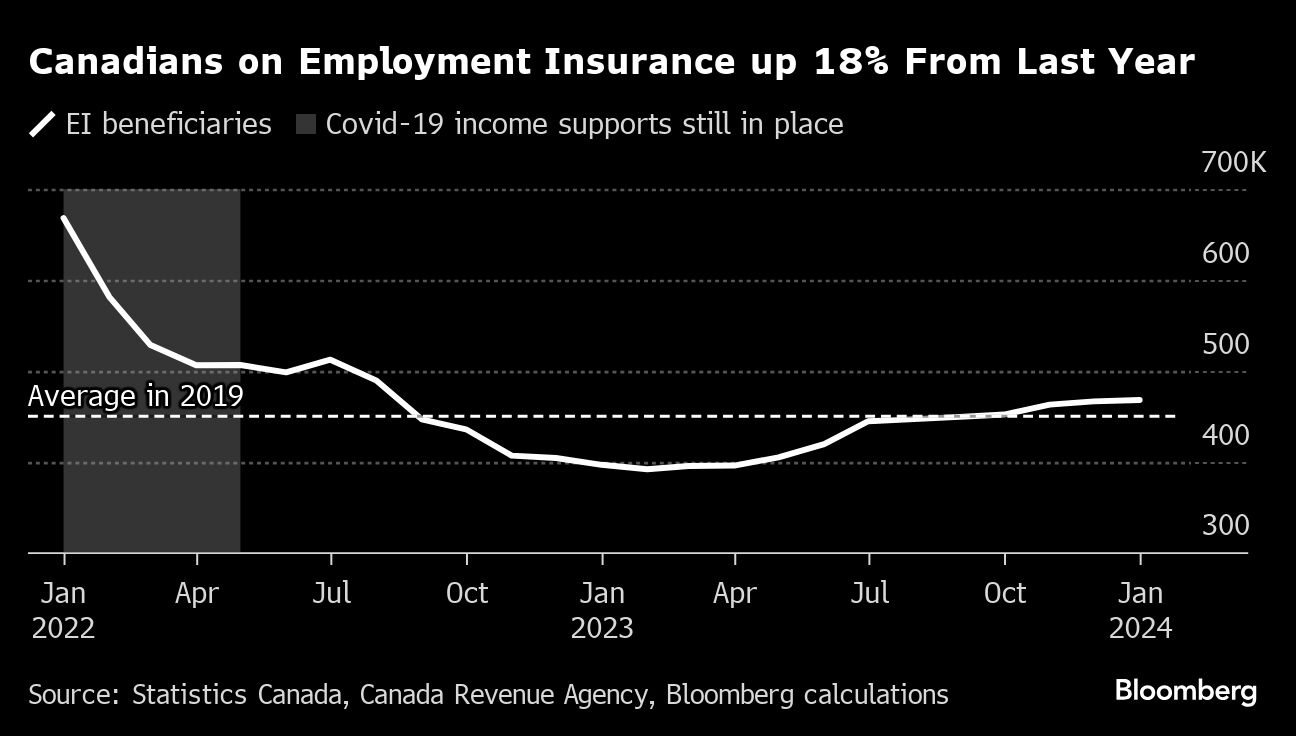
The number of Canadians receiving unemployment benefits in January rose 18 per cent compared to a year earlier, marking the fourth straight month that it was higher than the pre-pandemic level.

On a monthly basis, Canadians on employment insurance, known as EI, rose 0.3 per cent to 468,300 in January, Statistics Canada reported Thursday. Core working-age recipients, aged 25 to 54, increased by 19.6 per cent on the year.

The average number of EI recipients in 2019 was about 450,000. The number spiked between March 2020 and May 2022 while COVID-19 supports were in place, reaching a peak of nearly 1.7 million in May 2021. It fell below the pre-pandemic average between September 2022 and September 2023, but has been rising above that baseline ever since.

The data add to evidence that the Canadian labour market is softening. While job gains came in higher than expected last month, they have not been keeping up with rapid population growth, and recent gains have been concentrated in the public sector. The unemployment rate has risen to 5.8 per cent, wage growth has cooled and job vacancies have fallen for six straight quarters.

When the Bank of Canada held its key interest rate at 5 per cent earlier this month, it noted in a statement that the labour market has come into better balance and there are “some signs” that wage pressures may be easing.


Survey finds nearly half of Canadians feeling 'stuck at work'

As spring arrives, many Canadians are re-evaluating their current job satisfaction, according to a new survey by Robert Half, a human resources consulting firm.

The research found that 44 per cent of Canadian employees surveyed are dissatisfied with their jobs and looking for ways to improve their careers going into the summer.

When asked what it would take to feel “re-energized” in their workplace, 67 per cent cited hopes of a bonus or raise, and 40 per cent called for opportunities for career advancement with their current employer.

Aside from promotions and pay increases, 28 per cent of respondents said that “trainings to acquire new skills” would re-energize them at work, according to Robert Half.

Of the 609 professionals surveyed throughout Canada, 15 per cent of them reported that they are actively seeking a new job opportunity, the survey concluded.

The research also focused on career impact ambitions, with 32 per cent of respondents aiming for a promotion and 24 per cent hoping to be trusted with more significant responsibilities among their teammates.

In a blog post on the Robert Half website, the firm wrote that “taking pride in the work you do gives you drive to achieve and exceed goals, another quality desired by employers across all industries.”

The blog added that career pivots are a feasible way to find more meaning at work.

“Being happy and enthused about your work is key to physical, emotional and mental wellbeing,” the blog post explained.

Methodology:

These findings are based on an online survey of 609 Canadian professionals developed by Robert Half and conducted by an independent research firm, fielded March 4-11, 2024.


Canada to toughen foreign investment rules for AI, space technology

Canada will tighten its scrutiny of foreign investments in artificial intelligence, quantum computing and space technology as the government expands its power to stall and block deals for national security reasons.

Non-Canadian companies will have to give advance warning to the government before they invest in or acquire Canadian entities in those key technology sectors, Industry Minister Francois-Philippe Champagne said in an interview with Bloomberg. The tougher rules will also apply to investments in critical minerals and potentially other sectors, he said. 

The idea is to buy the government time to conduct a national-security review before any transaction gets too far advanced. The would-be buyer or investor may be restricted in its access to the target company’s user data or other property while the inquiry is taking place, Champagne said.

It’s the first time he has outlined some of the industries and technologies that will fall under beefed-up regulations to be attached to the Investment Canada Act, which is one of the major laws governing foreign investment in the country and was recently revamped.

Canada has traditionally had an open door to foreign companies making acquisitions, a policy that allowed large global firms to snap up large mining and metals, energy and consumer products companies in Canada in the years before the 2008 global financial meltdown.

The mood began to shift after the crisis, as the government blocked BHP Group’s push to buy a huge potash miner and placed restrictions on the flow of Chinese capital into the oil industry. In recent years, as the U.S. began to take broader measures to counter Chinese influence and money, Canada has followed suit.

Earlier this month, Prime Minister Justin Trudeau’s government announced a tightening of rules on foreign investment into the video game industry and other interactive media, citing the ability of “hostile state-sponsored or state-influenced actors” to use the games to spread disinformation. Champagne declined to go into details, citing national security concerns, but said the government had noticed a troubling pattern.

“We’ve seen a stream of acquisitions in that field which should make us pause,” Champagne said. The government had concerns not only about video-game content but access to user data, he said.

Critical minerals

Other industries might be added in the future to the list of sectors subject to the tougher takeover reviews, Champagne added. “You want to leave the ability to be more flexible and adapt to the reality of the market,” he said.

The government has also been taking steps to prevent certain foreign companies from taking control of Canadian critical-minerals producers. In 2022, Canada ordered three Chinese entities to divest from a trio of junior lithium producers.

Still, Chinese companies have continued investing in Canadian junior miners and China’s ambassador to Canada recently told Bloomberg his country intends to keep doing business in the industry.

Some miners have spoken out against Canada’s crackdown on Chinese investment, arguing the limits will make it harder to produce the metals needed to make electric vehicle batteries and support the global energy transition.

When asked about those concerns, Champagne said he sees the U.S., Germany, Japan and South Korea as important sources of investment and pointed to critical minerals co-operation agreements his government has signed with these countries.

“I often say my job is to be a bridge-builder. I’m almost like the concierge service of investors,” he said. “I think the source of capital is there. What we need to make is the strategic link.” He said he regularly fields phone calls from U.S. private equity firms.

Some mining companies are working directly with manufacturers, Champagne noted, in alliances that help provide capital for resource projects. General Motors Co. and Panasonic Holdings Corp., for example, recently announced a deal to buy electric-vehicle battery materials from Quebec’s Nouveau Monde Graphite Inc. and will invest in the Canadian miner.

Even so, Champagne acknowledged the government has more work in matching investors with opportunities. “We need to do a better job,” he said.
 

Enbridge joint venture to connect Permian Basin natural gas to U.S. Gulf Coast

ENBRIDGE INC (ENB:CT)

48.38 0.40 (0.82%)
As of: 03/27/24 5:29:52 am
REAL-TIME QUOTE. Prices update every five seconds for TSX-listed stocks
26. Mar21. Mar4848.2548.548.7549
Chart Type - 5day
See Full Stock Page »

Pipeline giant Enbridge Inc. has signed a deal to form a joint venture to help connect Permian Basin natural gas to liquefied natural gas export terminals on the U.S. Gulf Coast.

The Calgary-based company said Tuesday it will partner with global investment manager I Squared Capital and U.S. pipeline firms WhiteWater and MPLX LP.

The new joint venture will develop, construct, own, and operate natural gas pipeline and storage assets connecting the Permian (a major oil-and-gas field located in western Texas and southeast New Mexico) to growing LNG and U.S. Gulf Coast demand.

Enbridge has been bullish on both natural gas and LNG in recent years, repeatedly stating  it believes demand for natural gas is not going away any time soon and that cleaner-burning LNG can be used to replace coal in parts of the world that still depend on the dirty fuel.

The Canadian company currently supplies natural gas to five operating LNG export facilities on the U.S. Gulf Coast and has previously said it is interested in expanding its export strategy through further acquisitions in the region.

Under the deal, Enbridge will contribute to the joint venture its proposed Rio Bravo pipeline project — which would transport natural gas to an LNG export facility currently being constructed by developer NextDecade at the Port of Brownsville in South Texas — as well as US$350 million in cash. Enbridge will also fund the first US$150 million of the post-closing capital spending to complete the Rio Bravo project.

The joint venture will also hold the Whistler pipeline — which began operations in 2021 and runs from the Permian Basin to Agua Dulce, Texas — as well as a 70 per cent interest in the ADCC intra-state pipeline to Corpus Christi, Texas and a 50 per cent stake in the Waha gas storage facilities.

Under the terms of the deal, WhiteWater/I Squared will hold a 50.6 per cent interest in the joint venture, while MPLX will own 30.4 per cent.

In addition to receiving a 19.0 per cent equity interest in the joint venture, Enbridge will keep a 25 per cent economic interest in the Rio Bravo project.

In a news release, Enbridge's chief financial officer Path Murray said the deal will be immediately accretive to cash flow as well as paving the way for future growth opportunities.

"Having access to new Permian natural gas infrastructure enhances and increases the visibility of our medium-term growth outlook," Murray said.

Robert Kwan of RBC Capital Markets said in a note to clients that he likes the deal for its financial benefits as well as the strategic expansion of Enbridge's gas footprint.

"That being said, we do not expect the transaction to materially impact Enbridge's share price due to the relatively modest overall transaction size that is consistent with management's prior messaging that it is not pursuing large deals," Kwan said.

The deal is expected to close in the second quarter of 2024, subject to regulatory approvals and other customary closing conditions.

This report by The Canadian Press was first published March 26, 2024.


What's next for the Trans Mountain pipeline project?


After more than four years of construction and at least $34 billion in costs, the Trans Mountain pipeline expansion project is nearly complete.

Here's a look at what milestones to expect in the coming weeks as the massive pipeline gets ready to start shipping Canadian oil to the West Coast:

Resolution of B.C. construction challenges: Crown corporation Trans Mountain Corp. has been dealing with construction-related challenges in the Fraser Valley between Hope and Chilliwack, where it encountered an "obstruction" when trying to pull the pipe into the horizontal hole that had been drilled for it. The setback forced the company to remove the pipe temporarily to address the issue, but Trans Mountain Corp. says it is nearing a resolution and expects to be able to re-install the pipe in that section within the next couple of weeks.

Mechanical completion: This marks the final stage of physical construction of the pipeline. Once the challenging segment of pipe has been successfully pulled back into its location, Trans Mountain will be able to complete the "final weld," or what is formally known as mechanical completion. 

Leave To Open: After construction is finished but before the pipeline can be put into service, there are several regulatory steps that must be completed. In accordance with the Canada Energy Regulator Act, companies require permission from the CER before commencing operations of a pipeline. This process is called Leave to Open and requires results from a series of inspections and safety tests. Because the Trans Mountain project has been constructed in phases, the company has been applying for Leave to Open permission in stages in order to allow flexibility during the commissioning and startup process.

Line fill: This term is used to describe the final stages of work required to prepare and ultimately fill the expanded pipeline system with more than four billion barrels of oil. The process will take several weeks to complete. While line fill has not yet started on the newly constructed pipe, part of the Trans Mountain expansion project involves reactivating two older pipeline segments that had been maintained in a deactivated state. Initial line fill has already begun in B.C. on that section of the project.

In-service: This term refers to when the entire expanded pipeline system is fully operational and ready to make regular deliveries. According to a Bloomberg report, China's Sinochem Group has purchased one of the first shipments, a 550,000-barrel cargo from Suncor Energy Inc., which will load from the Trans Mountain expansion pipeline in May-June. Trans Mountain is continuing to target an in-service date sometime in the second quarter of 2024.

Cleanup and reclamation: Once the expanded pipeline is operational, required cleanup and reclamation work will continue in the project's construction zone.

This report by The Canadian Press was first published March 26, 2024.

Luxury parka maker Canada Goose laying off 17% of corporate staff

LAST ONE OUT OF THE OFFICE TURN OFF THE LIGHTS


Canada Goose Holdings Inc. says it is laying off 17 per cent of its global corporate workforce.

In a LinkedIn note from CEO Dani Reiss, the luxury parka maker said Tuesday that the job cuts are meant to put the company in a better position for scaling and will help the Toronto-based business focus on efficiency and key brand, design and operational initiatives.

"This is sad news for me to share because we have individuals leaving the organization today who were instrumental in making Canada Goose the business it is today, and I am personally grateful to each and every one of them," Reiss wrote.

"Decisions like this are heartbreaking, but at the same time I am confident this is necessary for the next phase of our business."

When asked about the extent and nature of the cuts, Canada Goose did not release the number of employees affected.

Canada Goose had 4,760 staff in April 2023, according to data from financial markets firm Refinitiv.

The layoff comes after Canada Goose faced a particularly difficult winter.

First, unseasonably warm temperatures pushed back the start of the usual parka buying season.

“The first cold snap prompts business,” chief financial officer Jonathan Sinclair said on Nov. 1 call with analysts to discuss the company's second quarter financial results.

“It sort of reminds the consumer that this is the time that they should go and buy cold weather gear, so the longer you wait for that, the later (the sales period) starts, and I think that is what we've experienced this year.”

Months later, when the company was discussing its third-quarter performance, Reiss conceded the company was facing a "challenging consumer environment” globally.

Carrie Baker, the company's president of brand and commercial, said Canada Goose was open to hiking prices as buyers rethink purchasing expensive apparel while interest rates and inflation remain high. Despite already selling some parkas for $2,000, a higher price point would increase the desirability of the luxury brand, she said.

On Tuesday, Baker's role was expanded to also include design, while Beth Clymer, president of finance, strategy and administration, took on additional operations responsibilities that used to fall under chief operating officer John Moran. Moran left the company on March 19.

Rounding out the job changes was Daniel Binder, chief transformation officer, who will now also oversee the company's global stores.

Canada Goose said the shuffle is the result of a "comprehensive review" of its organizational structure and roles" needed to achieve our strategic objectives, which we anticipate will yield immediate cost savings, simplify organizational structure, accelerate decision making and increase efficiencies across our operating platform." 

Canada Goose is set to release its fourth-quarter and full-year financial results in May, where it said it will provide further information on its transformation and its outlook for fiscal 2025.

This report by The Canadian Press was first published March 26, 2024.


CFIB says 200,000 small businesses took new loans to meet CEBA repayment deadline

Roughly 200,000 small businesses took on new debt to access the forgivable portion of their pandemic relief loans from the federal government, the Canadian Federation of Independent Business said Tuesday.

Many businesses took private bank loans with high interest rates to pay back enough of their Canada Emergency Business Account loans to qualify for partial loan forgiveness, CFIB president Dan Kelly said Tuesday.

Meeting the new payment obligations will be a challenge for some, he said.

"This has caused a real constraint on businesses," Kelly said in an interview. "They do so, in so many ways, with a gun to their head because they had no choice in order to access that forgivable portion."

The federal government provided up to $60,000 in interest-free loans to help businesses and non-profit organizations survive pandemic-related shutdowns and slowdowns.

Businesses that paid off the required portion of their loan by the repayment deadline were eligible to have the remainder forgiven. Those that missed the deadline lost out on the forgivable portion and saw their debt converted to a three-year loan with interest of five per cent annually.

The CEBA repayment deadline was extended twice, as businesses dealing with inflation and a slowing economy struggled to come up with the cash, and expired on Jan. 18.

However, a special extension to March 28 was allowed for companies to refinance their loans with a financial institution instead.

As Thursday approaches, Kelly said, some of his organization's members are growing anxious.

"We're starting to get a bunch of calls from business owners that are still facing a level of CEBA panic," Kelly said.

According to the government's CEBA database, more than 28 per cent of businesses have fully paid back their loans. Of the remainder, 65 per cent expect to fully repay the loan by the end of 2026.

Kelly speculated business owners on the verge of defaulting are likely to pay just the interest and not be able to keep up with their obligations.

"That should send an alarm bell to public policymakers," he said, as many small-scale businesses are facing bankruptcies.

The Office of the Superintendent of Bankruptcy said last month that the number of insolvencies filed by Canadian companies in 2022 was up 37.2 per cent compared with 2021.

The small business association is calling on Ottawa to establish partial forgiveness for businesses in the next three years as they start repaying their principal amount.

It is also urging banks to be compassionate toward businesses as they seek refinancing.

This report by The Canadian Press was first published March 26, 2024.


Economists defend Liberals' carbon price as political rhetoric heats up

Dozens of Canadian economists are issuing an ardent defence of Canada's price on carbon, as the government faces increased pressure from Opposition Conservatives and provincial premiers to pause a planned increase to the levy. 

A growing number of premiers have joined the federal Conservatives and come out against raising the carbon price from $65 to $80 per tonne as scheduled for April 1. 

The economists released an open letter in response to the intense political rhetoric that has garnered 80 signatures from academics across the country as of this afternoon.

The letter says signatories support heathy public debate, but it should be based on facts and sound evidence. 

The economists say several arguments against the carbon price are based on myths, and the levy is actually the least costly way to reach Canada's climate goals.

The letter says the most vocal opponents of the policy have not said how they would reduce greenhouse-gas emissions at a lower cost. 

This report by The Canadian Press was first published March 26, 202

Canadian IT workers welcome AI adoption, but hurdles remain: survey


A survey of Canadian “IT decision makers” shows most companies welcome the use of artificial intelligence in their work, but are concerned for its current uses.

The survey from CDW in collaboration with Angus Reid, released Tuesday, shows 61 per cent of respondents are open to using AI and 58 per cent believe it helps productivity, but 49 per cent are uncomfortable with its current uses.

Michael Traves, the devops and AI cloud principal architect at CDW Canada, said in a news release that much of the discomfort surrounding AI comes from a misunderstanding of the technology.

“Organizations recognize the transformative potential of AI and its ability to not only enhance operational efficiency but to drive innovation and growth,” he said in the release. “The current discomfort with AI adoption stems from a lack of understanding around important pieces of the AI puzzle, including security, education and compliance.”

The optimism surrounding AI echoes a similar report from the financial services company Square, which found 100 per cent of responding Canadian restaurants believe AI can help with staffing and food prep, among other use cases.

The report also speculated AI could one day help with pairing food and drink choices to individual tastes for an elevated experience.

Understanding of AI has also hurt the implementation of the software, however. More than half of respondents have already implemented some form of AI into their workplace, but on 21 per cent of respondents believe their company is doing it effectively.

CDW explains the disconnect “highlights a significant gap in education and governance between those responsible for overseeing AI integration, the organizations they work for and assumptions about the complexity of AI tools.”

Small businesses lag behind

The survey also found a lack of AI knowledge among small businesses, as just 28 per cent of small businesses were aware of AI data processing tools, compared to 60 per cent of larger businesses.

Small businesses are also less likely to benefit from AI adoption, the survey found. Just 18 per cent of small businesses found AI provided customer service benefits and only 20 per cent reported it helped with decision-making.

Overall, CDW recommends tailoring AI solutions to individual employees’ needs, for businesses to train employees on AI and evaluate the AI options to find the best organizational fit. 

METHODOLOGY

These are the findings of an online survey conducted by CDW from February 1 to February 8, 2024, among a sample of 309 IT decision-makers who are members of the Angus Reid Forum. The survey was conducted in English. For comparison purposes only, a probability sample of this size would carry a margin of error of +/-6 percentage points, 19 times out of 20.


Need to improve Canadian productivity has reached emergency level, BoC official says

FAILURE OF CAPITALI$TS TO INVEST VS BUYBACKS

A senior Bank of Canada official says the need to improve productivity has reached an emergency level as the economy faces a future where inflation may be more of a threat than in the past few decades.

"You know those signs that say 'In an emergency, break the glass?' Well, it's time to break the glass," Bank of Canada senior deputy governor Carolyn Rogers said in a speech Tuesday.

Rogers said Canadian labour productivity eked out a small gain at the end of last year, but that came after six straight quarters where productivity fell.

She noted the U.S. has seen productivity gains coming out of the pandemic as firms found their footing, but Canada has not seen the same.

"In fact, the level of productivity in Canada’s business sector is more or less unchanged from where it was seven years ago," Rogers said.

The need to improve productivity comes as Rogers said many of the forces that helped create a benign environment for inflation in the past are going to fade away, or even reverse. 

"We know that changing demographics and the economic impacts of climate change will tend to put upward pressure on prices. Persistent global trade tensions also raise the risk of future inflation," she said.

The Bank of Canada's next interest rate decision and monetary policy report is set for April 10.

Inflation has been cooling in recent months, coming in at an annual rate of 2.8 per cent in February. Economists will be watching to see what the central bank, which is targeting an annual inflation rate of two per cent, will have to say about cuts to its key interest rate target.

Rogers said Tuesday that productivity is a way to inoculate an economy against inflation.

"An economy with low productivity can grow only so quickly before inflation sets in. But an economy with strong productivity can have faster growth, more jobs and higher wages with less risk of inflation," she said.

Canada's lagging productivity has been a chronic problem.

Rogers said when you compare Canada’s recent productivity record with that of other countries, what sticks out is how much the country lags on investment in machinery, equipment and intellectual property.

She also said Canada needs to focus on making sure the training and education we provide teach the skills we need, while a more competitive business environment would help drive greater innovation and efficiency. 

This report by The Canadian Press was first published March 26, 2024.