It’s possible that I shall make an ass of myself. But in that case one can always get out of it with a little dialectic. I have, of course, so worded my proposition as to be right either way (K.Marx, Letter to F.Engels on the Indian Mutiny)
Monday, April 15, 2024
SNAFU
Belgian Warship Sidelined From Red Sea Mission Due to a Stuck Missile
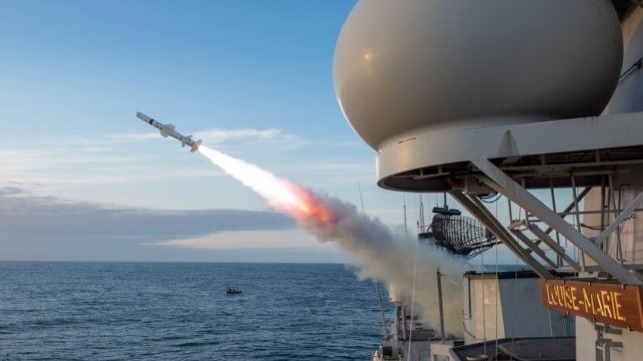
Louise-Marie launches a Harpoon anti-ship missile (file image courtesy Belgian Navy)
In the latest in a string of challenges for European air-defense mission in the Red Sea, the Belgian navy has had to suspend the deployment of the frigate Louise-Marie for an "indefinite period" because an antiaircraft missile got stuck in one of the warship's launch tubes, according to a Belgian defense news outlet. Belgium's defense department has confirmed that the warship has been sidelined, but declined to comment on the details, citing operational security.
Louise-Marie is currently operating in the Mediterranean in preparation for a mission with Operation Aspides, the EU-led component of the Red Sea policing mission. According to naval news site Marineschepen.nl, the frigate's crew were conducting air-defense drills last week (with the country's top defense official on board) when the ship had a mishap. One of its RIM-7 short range antiaircraft missiles failed to launch and got stuck in its tube. Backup air-defense systems also would have failed to take down the incoming threat, according to the outlet.
"The commander and the general staff have decided to extend the frigate's training period as a result of previous training and technical tests that are not achieving the full intended result," Belgium's defense department told Marineschepen.
Just last month, Danish frigate Iver Huitfeldt appeared to cut short her mission in the Red Sea and return to base after her commander reported a weapons-system failure in the middle of a Houthi attack, apparently because of a known software issue in the interface between its fire-control radar and its combat management system. Huitfeldt's crew used the deck cannon to shoot down incoming drones using proximity-fuzed shells - but half the shells blew up right after exiting the muzzle, an apparent failure of the fuze, the commander reported. Denmark's top military officer was relieved of command after the defense minister learned of the problem from the media.
The month before, the German frigate Hessen misidentified and attempted to shoot down an American MQ-9 surveillance drone over the Red Sea. Hessen launched two sophisticated SM-2 air defense missiles and missed twice, and the drone survived.
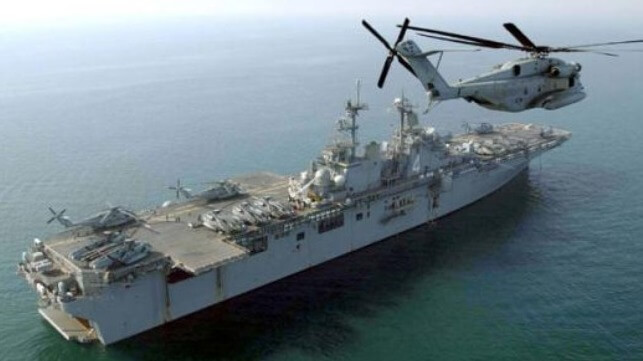
Amphib USS Boxer Cuts Short Deployment After Another Engineering Casualty
Just 10 days after deploying to the Indo-Pacific, the amphib USS Boxer has turned around to head back to port for repairs, Navy officials have confirmed to USNI and Military.com. It is the latest setback in a long string of maintenance-related delays for the Boxer, and further extends her time off-hire.
At the time of the casualty, Boxer was operating in the Pacific and conducting exercises with a Marine Corps MV-22 Osprey squadron. That squadron has disembarked and Boxer is returning to port. The nature of the casualty was not disclosed.
Boxer has been in various phases of repair and preparation since 2022, and the process has been repeatedly delayed by maintenance quality and operational problems. The previous delays all come down to human factors and contractor skill level, according to a recent command investigation.
In November 2022, two of the forced draft blowers on USS Boxer's steam plant failed, the victims of improper repairs. They were overhauled multiple times, and suffered oil and water leaks every time. An examination by the OEM found that improper parts were used, machined sealing surfaces did not line up, and reassembly techniques were substandard and noncompliant.
In May 2023, USS Boxer experienced an unspecified incident during a boiler light-off, which the strike group commander attributed to complacency and a departure from "sound shipboard operating principles." The incident could have resulted in severe injuries, but no crewmembers were harmed. In mid-July 2023, Boxer's engineering team spun the main gearbox for two hours without lubrication, and did not notify the commanding officer of this potentially damaging decision until 27 hours later.
"Every level of senior engineering leadership failed to provide a safe, professional, and procedurally compliant work environment in engineering department. These failures had direct, measurable impacts on USS Boxer's upcoming deployment and impeded the overall accomplishment of the strike group's mission," concluded the expeditionary strike group's commander last year.
The chief of naval operations, Adm. Lisa Franchetti, has ordered a "deep-dive" review of the problems aboard USS Boxer and other amphibs in the fleet. "I think there's some good lessons learned with Boxer," Franchetti told media at a defense conference last week.
First U.S. WTIV is Launched in Texas for Dominion Energy
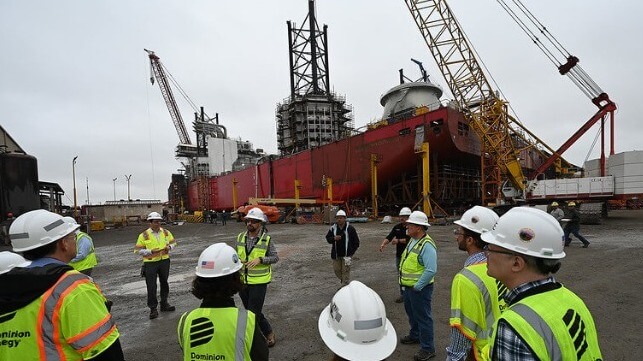
Hull of Charybis during a March 2024 site inspection by Department of the Interior officials (BOEM)
The U.S. offshore wind sector marked another milestone with the launch of the first U.S. wind turbine installation vessel, which is being built for Dominion Energy. It is the latest example of the benefits to the shipbuilding industry from the emerging offshore wind sector.
Work on the vessel which will measure 472 feet in length when completed began in December 2020. Dominion reports welding of the ship's hull and commissioning of the vessel's four legs and related jacking system have been completed before today’s launch at Seatrium AmFELS shipyard in Brownsville, Texas. The vessel’s launch according to the companies marked a historical achievement as the world's largest completed lift totaling 23,000 tons.
The vessel's hull and infrastructure were fabricated with more than 14,000 tons of domestic steel, with nearly 10,000 tons sourced from Alabama, West Virginia, and North Carolina suppliers. Outfitting is now underway with the vessel designed to handle turbine sizes of 12 megawatts or larger.
Dominion reports that there is no change to the vessel's timeline which supports the current Coastal Virginia Offshore Wind (CVOW) construction schedule. When the vessel was ordered, they said it was scheduled for delivery in late 2023 but recently the Bureau of Ocean Energy Management during a tour of the construction reported the ship is due in late 2024 or early 2025. When completed, the home port for the vessel will be in the Hampton Roads area of Virginia.
"Charybdis is vital not only to CVOW, but also to the growth of the offshore wind industry along the U.S. East Coast and is key to the continued development of a domestic supply chain by providing a homegrown solution for the installation of offshore wind turbines," said Bob Blue, Dominion Energy's chair, president and chief executive officer.
Dominion is proceeding with the construction of its first offshore wind farm, which is expected to be the largest in the U.S. when it is completed. The company reports it received its final federal approvals and permits from the Environmental Protection Agency and it expects to start offshore monopile installation in May. Dominion has been staging the components for the 176 monopoles in Virginia since late 2023 in anticipation of this phase of the project.
Coinciding with that announcement, DEME reported that its installation vessel the Orion has departed for Virginia where it will begin the monopole work for Dominion. The ship, which was also used for the installation of the Vineyard project in Massachusetts, recently completed work on 29 monopiles over approximately two months for Ocean Winds’ Moray West offshore wind farm project in Scotland.
Dominion’s installation vessel which is named Charybdis will take over during a later phase of the project which is due for completion in 2026. Ørsted had previously reported that it planned to charter the WTIV from Dominion for work on its planned Revolution Wind and Sunrise Wind projects. As the only U.S. WTIV and being Jones Act compliant, the Charybdis is expected to remain busy in the domestic market. Other installation plans call for a feeder ship model using U.S. barges and tugs to move components from the staging ports in the U.S. to foreign-registered installation vessels which will be positioned offshore at the sites.
Egypt Detains Gas Carrier After Grounding in Environmental Preserve
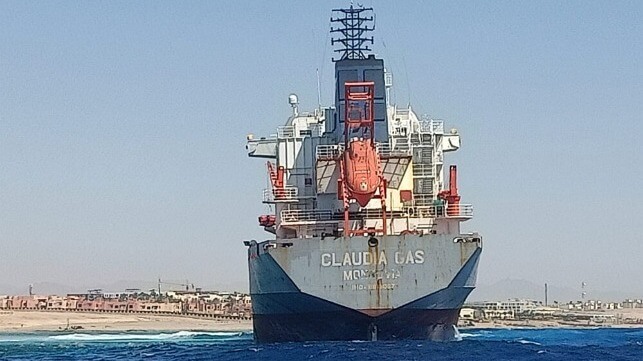
Claudia Gas grounded near a popular tourist destination and marine reserve in Egypt (Ministry of Environment)
Egyptian authorities are detaining a Liberian-registered gas carrier after the vessel grounded in an environmentally sensitive area in the Gulf of Aqaba. Salvage teams were able to refloat the vessel and move it into a secure anchorage near Safaga, Egypt in the Red Sea.
The Claudia Gas, a 16,000 dwt vessel built in 1990, had completed offloading in the Jordanian port of Aqaba and was reportedly sailing to Russia when the vessel blacked out on Friday, April 12. It grounded Friday night in the Ras Nasrani area, near the Egyptian tourist town of Sharm El Sheikh. The Environmental Ministry put resources on alert for a possible oil spill but reports the vessel was refloated with so far, no signs of a leak. The gas tanks were empty.
Egyptian authorities were already on alert in the area as it was the Eid Al-Fitr celebration that comes at the end of the Muslin holy month of Ramadan. It is a busy tourist time and they reported that they were expecting a large inflow of tourists to the popular marine reserve. They were expecting increased activity on the beaches, with divers, and yachts traveling in the area. Coastal monitoring had been underway during the holiday and was increased after the grounding.
Unconfirmed reports from the Egyptian media said the gas tanker lost propulsion causing the grounding. They are suggesting the vessel could be fined in the tens of millions of dollars depending on the level of damage in the marine reserve.
Divers were reported to be following the path of the vessel inspecting the coral reef for possible injuries. Minister of the Environment Dr. Yasmine Fouad said post-accident inspections were underway. The studies are measuring the damage to the coral reef and expected recovery rates as well as the possibility of undertaking specific restoration efforts.
The vessel, which has been managed by Zeus Lines of Greece since 2020, was inspected in February 2024 in Aqaba. At the time it was cited for inoperative gauges but no detention was imposed.
YSA Uses Sails to Meet Challenge of Creating Sustainable Cruise Ship
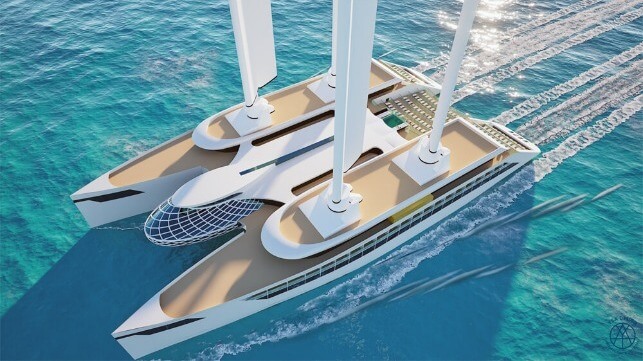
YSA's concept for a sustainable cruise ship uses Oceanbird sails and a catamaran platform (YSA)
Norwegian architecture firm YSA Design tackled the challenge of creating a sustainable cruise ship developing the concept for a luxury catamaran cruise ship with sail power. The designers looked to capture the trends in cruising creating a platform for luxury travel that provides unique experiences while also addressing the increasing attention to sustainability among travelers.
“A sustainable ship which brings environmentally conscious guests closer to the sea and reaches destinations others cannot is a clear opportunity at the premium end of the cruise market,” says Trond Sigurdsen, Senior Architect and Partner of YSA Design who also heads their Sustainability & Technology efforts. He acknowledges that there would be challenges in developing the design but that it also presents new perspectives for the market.
Sigurdsen highlights that they selected a catamaran to address the concern of maintaining a stable platform for a cruise ship. While they applied sails to the design to achieve zero emissions, he recognized that as a cruise ship, they could not develop more than a two-degree list for the comfort of the passengers. A catamaran was the natural solution for stability, but it also presents part of the uniqueness of the onboard experience.
Propulsion power is provided by 164-foot (50-meter) sails. The catamaran design provides space for a total of four of the sails. YSA selected the sail concept from Oceanbird, a joint venture launched in 2021 by Alfa Laval and Norwegian shipping company Wallenius Wilhelmsen, which has been working on the sail concept for more than a decade. Oceanbird plans land-based tests this year ahead of the installation of a prototype sail on a Wallenius Wilhelmsen vehicle carrier either in late 2024 or early 2025.
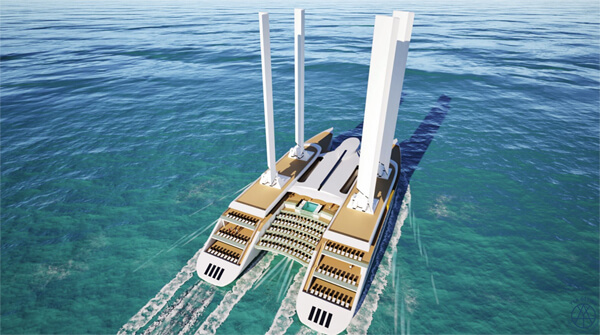
The stern decks would provide outdoor space for 70 percent of the passengers (YSA)
According to YSA, the cruise ship would be able to achieve an operating speed of 13 knots while entirely under sail power. The Oceanbird sails also fold down for the vessel to navigate in areas with restricted air clearances. The sails would each stand on a 20-foot (6-meter) base, and Sigurdsen highlights that they are computerized and easy to operate.
Further enhancing the vessel’s overall sustainability, YSA projects the engines, which would be aboard as a backup or when maneuvering, would be fueled with bio-methane. They would also assist with the power requirements of the hotel. The design would also include batteries for a hybrid drive that would permit the cruise ship to navigate and operate silently to enter environmentally sensitive areas.
The 343-foot (104.5 meter) length ship with a 13-foot (4 meter) draft would be able to access shallow waters providing unique destinations for the passengers. The two 60-foot (18.2 meter) wide hulls would be connected by an inverted U-shaped structure spanning 60 feet (18.5 meters), with a two-deck central superstructure incorporating the bridge and some public spaces. Each hull would include four decks plus a “yacht top” area that could be used for private deck areas for suite passengers. They project a total of 100 dual occupancy passenger cabins including private balconies for 200 passengers and 155 crew. It would be possible to stretch the design to accommodate 400 passengers.
Sigurdsen highlights as a catamaran, the passenger areas are suspended above the water creating the opportunity for unique viewing areas. He includes a large glass deck area, a bay (a glass bubble), and underwater hull lights for a view into the sea. The design also includes a forward-view lounge.
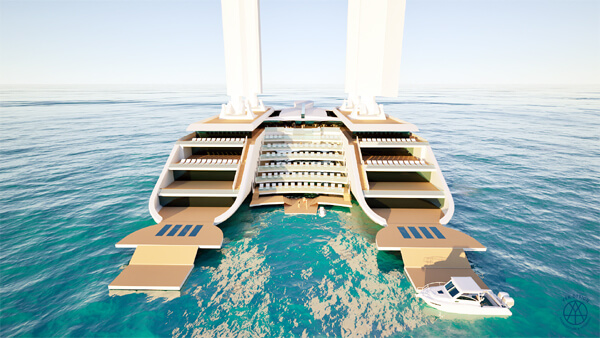
Other unique experiences would include folding down platforms on the stern stepping the aft decks to the sea. The aft decks would provide space for sea lounges that could open for sunset dining, be the location for spas, or a beach and watersports area.
In addition to being a zero-emission cruise ship, Sigurdsen highlights that the design helps get back to the sea. It provides passengers with experiences related to the ocean environment while knowing that their travel meets the goals for sustainability.
The stern decks could open and step down to the sea to provide passengers unique experiences and a link to the ocean environment (YSA)
NGOs Want More Data on Emissions From "Green" Engines
A coalition of environmental groups has called on marine engine manufacturers to disclose the full extent of emissions from LNG and ammonia-powered vessels.
Driven by market sentiment and by regulation, shipowners are looking for options to replace conventionally-powered ships with greener ones. LNG dual-fuel propulsion is one of the leading options, and the one with the largest extant fleet. LNG’s popularity is rising, accounting for 25 percent of the orderbook for containerships and 44 percent for cruise ships, according to Clarksons.
However, the environmental groups claim in the letter that the full impact of LNG-powered vessels is hard to assess, as engine manufacturers do not fully disclose methane slip.
“Shipping companies are buying LNG-powered vessels as a way to clean up their fleets. But no one actually knows the true climate impact of LNG, as the quantity of methane that leaks from engines remain unknown. Engine manufacturers must commit to greater transparency,” said Constance Dijkstra, LNG campaigner at the Brussels-based Transport& Environment. Other groups undersigned in the letter include Ocean Conservancy, Environmental Defense Fund and the Royal Belgium Institute of Natural Sciences, among others.
Methane is a highly potent greenhouse gas, which - if released in appreciable quantity – can undo the claimed CO2 savings associated with LNG. To help determine the extent of the problem, the coalition has asked marine engine manufacturers to publicly release granular data on methane emissions from LNG-powered engines, as different engine designs (four-stroke vs. two-stroke, high-pressure injection vs. low-pressure, etc.) have different methane slip profiles.
The groups also raised similar questions about ammonia-powered engines, which are just beginning to emerge from development and testing. The first commercially available ammonia-fueled engine debuted last year, and as of yet there are few installed examples from which to gather operational data. Still, the NGOs would like to have more information on these engines’ nitrous oxide (N2O) and ammonia (NH3) emissions, since both are pollutants and nitrous oxide is a potent greenhouse gas.
UK's Shipyards Look for New Ways to Plug Workforce Gaps
Steel-cutting for the Type 31 frigate at Babcock's Rosyth shipyard (Babcock)
The U.S. has a well-publicized challenge in finding and retaining enough qualified shipyard workers, but it isn't the only nation with a shortage of skilled labor. The UK's top defense shipbuilders are trying new ways to solve persistent gaps between the workforce they have and the workforce they need, like introducing top-notch automation and creating new entry-level opportunities.
At BAE Systems' yard on the Clyde, there are currently about 200 vacancies, and managers need to staff up to support a new eight-ship frigate contract for the Royal Navy. In years past, UK yards could raid the European labor market for qualified welders when needed, managing director Simon Lister told Glasgow Times - but that is no longer an option. BAE is investing in training instead, as well as a brand new highly-automated panel line.
“The availability of steelworkers has been a challenge for all shipbuilders in the UK," Lister said.
BAE has its own shipbuilding academy and a growing apprentice program, which will expand to about 1,000 personnel by next year. The yard and its competitors emphasize that they aren't just looking for welders, but also for people with all kinds of skills, like programming, finance and project management.
Babcock's Rosyth shipyard has found its own way to help resolve persistent manning shortages. It has a robust apprenticeship pipeline, but it has also realized that not every shipyard worker has to be a high-skill employee from the start. Many support tasks can be performed by personnel with a relatively basic skillset. Babcock has started hiring ordinary people who can pick up some of these less-skilled tasks and relieve pressure on the high-skill union workforce, the yard told Defence Connect. The new Production Support Operative (PSO) hiring pipeline selects for people with a good attitude, even if they do not have relevant qualifications, and provides them with enough training to support experienced workers. Down the road, they may have an opportunity to apply for an apprenticeship.
For its part, the UK government has completed a study on shipbuilding skills and is standing up a new working group to advocate for the industry's workforce needs. Public perception is one of the key challenges, the study found: in the UK, it is often viewed as an outdated industry in decline, and prospective employees may not know of recent investments and improvements.
Navy Secretary Calls for Restoring "Atrophied" U.S. Shipbuilding Sector
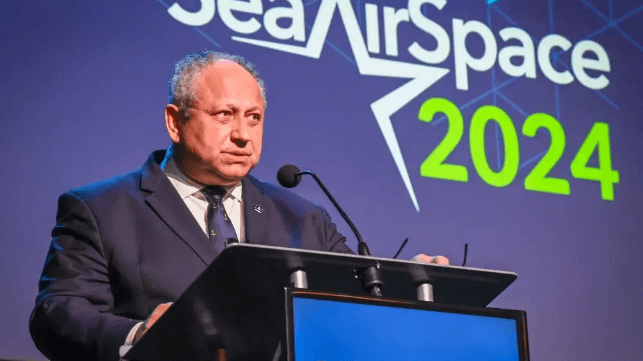
As he prepared to launch into a pointed keynote address at a conference in the capital this week, Secretary of the Navy Carlos Del Toro welcomed the audience and quoted President Harry Truman: "If you want a friend in Washington, get yourself a dog." To emphasize the point, Del Toro brought out his friend in Washington - a brown and white bulldog, Chesty, who trotted out for a quick circuit around the stage.
Del Toro was at the conference to celebrate the U.S. Navy's accomplishments, but also to remind its shipbuilders, suppliers and procurement officials of how far they have to go. A recent review of Navy shipbuilding revealed that three of the most important programs - the Columbia-class ballistic missile sub, the next Ford-class aircraft carrier and the Constellation-class frigate - are running one to three years behind schedule. There are proximate causes, like supplier delays and workforce difficulties, but Del Toro pointed to the long-term decline that began with the end of the Cold War.
"Over the past 40 years, America's shipbuilding capabilities have atrophied. The consequences for naval shipbuilding have been manifesting for years, and will grow ever more acute unless we reverse the underinvestment," he said. "Right now we build the most capable warships in the world, in shipyards that are sometimes decades behind the global technological standard."
The current level of shipyard capability, he warned, is "wholly inadequate to pace our 21st-century competitors." But Del Toro sees potential in the skills of America's allies - and the potential to make American shipbuilding great again, with outside help and investment.
"[Korea and Japan] build high quality ships, including AEGIS destroyers, for a fraction of the cost that we do. When my team and I went to South Korea, we were floored at the level digitalization and real-time monitoring of shipbuilding progress," he said. "We have the opportunity to attract the most advanced shipbuilders in the world . . . and invest in commercial shipyards here at home."
The critique was a toned-down version of the tongue-lashing Del Toro delivered at the West conference in February, when he accused top defense contractors of appearing to "prioritize stock prices that drive executive compensation" by putting off investments in the industrial base. "I need you to deliver platforms and capabilities on time and on budget without excuses," he said.
GT Green Technologies Secures £1.35 Million in Seed Equity Funding
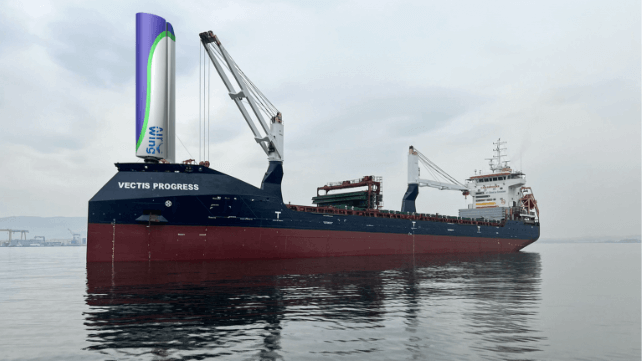
Artist’s impression of a 20-meter AirWing unit to be installed on Carisbrooke Shipping’s general cargo vessel later this year. Courtesy of GT Green Technologies
GT Green Technologies is a pioneering force in wind technology, dedicated to revolutionising commercial shipping with innovative Wind Assisted Propulsion (WAP) solutions. Their flagship product, AirWing™, represents a breakthrough in sustainable maritime technology which is set to reduce fuel costs, reduce carbon emissions, and help shipowners comply with stringent environmental regulations.
Funding Announcement
GT Green Technologies closed a £1.35 million seed equity round, led by OnePlanetCapital, an early-stage VC focused on businesses that impact climate change. Alongside OnePlanetCapital, GT Green Technologies received strategic investments from Carisbrooke Shipping and John Good Group plc, plus financial backing from several notable climate focused angels, alongside a retail tranche with over 500 investors undertaken on crowdfunding platform, Seedrs.
The broad interest in the round reflects the growing interest in WAP for commercial shipping, and the early positive results the company has been able to demonstrate through testing and simulation.
This seed funding, in combination with a recent £3.7 million CMDC4 grant from the UK Department for Transport, will fund the manufacture, installation, and testing of the first AirWing™20 unit later this year. It will also facilitate the commercial rollout of both the 20m unit, and future 30m and 40m product iterations.
Will O’Malley, CFO at GT Green Technologies expressed excitement about the funding. “Closing this seed round enables us to accelerate execution of our exciting strategy. We are thrilled to have attracted a leading climate focused VC, alongside a consortium of high quality strategic and financial investors. The appeal of the round is evidence of the strength of our proposition and reflects our potential to make significant positive environmental change.”
Anthony Chant, director of OnePlanetCapital, said of the round; “GT Green Technologies is one of the most exciting investments we have made in the greentech space. The opportunity set for the company is enormous as the shipping industry reacts to new regulations, with the company’s WAP technology a potential game-changer in the sector.”
Thordon Delivers SXL Water Lubricated Rudder Bearing to Research Ship
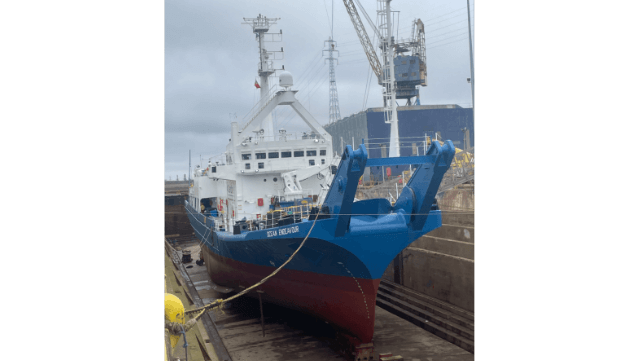
The Ocean Endeavour in drydock where Thordon’s SXL rudder bearing was installed
Thordon Bearings, the pioneer in water-lubricated bearings, secured a new order for a rudder bearing that was fitted to a 77.1m (253ft) research ship that frequently operates in ecologically sensitive marine environments. The order underscores the value of Thordon’s grease-free bearing and seal solutions in helping to keep oceans and seas clean.
The 38-year-old Ocean Endeavour, operated by the UK’s Gardline, a multi-disciplinary marine survey company which operates a fleet of 13 multi-role survey ships, was recently fitted with Thordon’s SXL rudder bearing at UK Docks Marine Services’ Teesside drydock.
Bruntons Propellers, Thordon’s new authorized distributor in the UK, secured the order from the UK-based ship repair group, which operates drydocks and berths throughout the country.
Ocean Endeavour, which runs a pair of Ruston 8RKCM main engines driving a single four-bladed CP propeller, was previously fitted with a bronze rudder bearing. This required replacement due to age-related wear and tear, and bronze bearing replacement is expensive.
This kind of system also requires lubricating grease, which increases the risk of pollution with grease leaking into the ocean. Thordon’s water-lubricated SXL bearing, the far more cost-effective option, negates completely the need for grease.
Neil McDonald, Thordon Bearings’ Regional Manager, Northern Europe & Africa, said: “The lead time and price we offer for our SXL solutions are two major benefits for ship owners and the yards carrying out refit work. A like-for-like bronze bush replacement would have taken twelve weeks for the part to be delivered and would have been very expensive. We were able to get the SXL material to the yard in a matter of days and for significantly less. It’s also a better product!
“With UK Docks Marine specifying SXL we contribute to the vessel and Gardline’s ESG commitment and continued environmental performance. I would also like to emphasize the fast service and delivery provided by our new distributor, Bruntons Propellers.”
Jonathan Shaw, Managing Director, Bruntons Propellers, said: “We have hit the ground running as the new UK and Ireland distributor for Thordon Bearings. As a major propeller supplier to owners and yards around the world we were approached by UK Docks Marine Services to find a new rudder bearing solution following the Ocean Endeavour’s return. A particular shout out goes to Celia Birnie, our UK & Ireland Sales Executive, who is working with Thordon to ensure the vessel maintains its schedule.”
The vessel returned to home port Great Yarmouth, UK, after carrying out seismic exploration surveys around the Northwest Coast of Australia.
McDonald added: “This order clearly demonstrates Thordon’s ability to ship the required repair items very quickly, to avoid any delays for the ship or inconvenience for passengers and crew,” said McDonald. “The SXL bearing is also easier to machine and fit, once on site, compared to conventional bronze bearings.”
The products and services herein described in this press release are not endorsed by The Maritime Executive.
Royal Navy to Deploy Advanced Laser Weapons by 2027
The U.S. Navy's surface warfare leaders have been frustrated with the slow pace of development of a laser air-defense system for shipboard service. The Houthi drone campaign in the Red Sea has shown the potential value of a system that could shoot down endless swarms of slow-moving targets at near-zero cost - but even after decades of R&D, such a system does not yet exist at deployable scale in the United States. In Britain, it does, and the Royal Navy will be getting laser air-defense weapons starting in 2027.
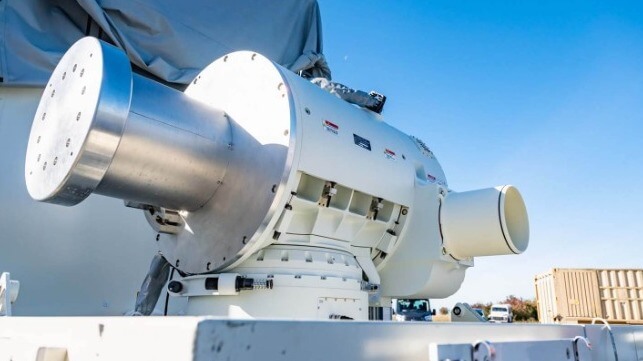
The UK's DragonFire is a combined beam fiber laser in the 50 kW class, and was designed to defeat drones and mortar shells. Britain's ministry of defense spent a few humdred million dollars to develop it, a fraction of the multi-billion-dollar budget for U.S. laser weapons programs.
"DragonFire shows the best of the UK at the forefront of military technology, and we will not delay in getting it in the hands of our military to face down the threats we’re facing," said UK defense minister Grant Shapps on Friday.
DragonFire's makers claim to have cracked one of the biggest problems with laser weapons: the extended time period that the beam must be on target in order to burn through and defeat it. Conventional weapons hit instantaneously; laser weapons hit cumulatively. DragonFire is designed to reduce this challenge with a concentrated, combined beam.
The Royal Navy was planning to deploy DragonFire from 2032, but it has moved up the timeline and will now begin installation in 2027.
“We recognize this cutting-edge UK laser weapons technology as highly relevant and the need to accelerate it into service on board our ships at the earliest opportunity," said Captain Matt Ryder, Head of Above Water Battlespace in the Royal Navy’s Develop Directorate. “In the Southern Red Sea, we see a very relevant and current example of where laser weapons could provide an additional layer of defense to protect shipping, at a potentially much lower cost per shot."