Tuesday, September 24, 2024

SPACE/COSMOLOGY

NASA Scientists Startled When Mars Rover Finds Rock With Stripes


Sharon Adarlo
FUTURISM
Tue, September 24, 2024 


Rock the Casbah

NASA's Mars Perseverance rover has encountered something unlike anything else discovered on the Red Planet: a zebra-striped rock that sticks out like a sore thumb in the midst of the planet's dusty, notoriously red landscape.

The rover found the unusual stone, measuring about 7.8 inches in width, last week, according to NASA in a statement about the disovery, while the craft was exploring the Jezero Crater, located north of the planet's equator and which is believed to have been the site of an ancient lake and river delta.

"The science team thinks that this rock has a texture unlike any seen in Jezero Crater before, and perhaps all of Mars," reads the statement from the space agency. "Our knowledge of its chemical composition is limited, but early interpretations are that igneous and/or metamorphic processes could have created its stripes."


Researchers are now calling the rock "Freya Castle" — a nod to a craggy peak in the Grand Canyon — and are surmising that it came from somewhere at a higher elevation, according to NASA. Basically, this loose stone rolled there and gathered no moss.
Stone Alone

Freya Castle isn't the only weird rock that Perseverance has found this year at the crater. Earlier this summer, the probe chanced upon an arrow-shaped slab with tiny "leopard spots" that could hold tantalizing evidence of microbes from billions of years ago, back when scientists believe there might have been water on the surface of Mars.

Perseverance took a core sample of that rock, now called "Cheyava Falls," for further analysis. The rover has also found two other boulders, nicknamed "Atoko Point" and "Bunsen Peak," both of which may have hold more clues on Mars' early history.

These are all incredible finds for Perseverance, which landed on Mars back in 2021 and whose current mission is to find any evidence of alien microbes that could have flourished on Mars when it was wetter and warmer.

NASA is hoping that the samples the rover has collected will be sent back to Earth for further analysis as part of its troubled Mars Sample Return mission, in hopes that the data will tell us more about the Martian climate billions of years ago, and what happened to make the planet cold and desolate.

Until then, Perseverance is leaving no stone unturned.

More on Mars: Mars Appears to Be Missing a Moon, Astronomer Finds

This Might Be the Most Amazing Video of a Rocket Explosion We've Ever Seen

Frank Landymore
Mon, September 23, 2024
FUTURISM


Action Spectacular

We bet you've seen a lot of videos of exploding rockets.

But we'd also wager that you haven't seen one quite as mind-blowing as this new footage of a Chinese rocket blowing up as it touches down, because the failure is filmed so dramatically that you kinda just have to tip your hat to everyone involved — even if things didn't go quite as planned.

The star of the show is a Nebula-1 launch vehicle, a reusable, two-stage, kerosene-fueled rocket manufactured by the Chinese company Deep Blue Aerospace.

As part of a high-altitude vertical flight test on Sunday — all captured on video — the rocket took off from its launchpad in Ejin Banner Spaceport in Inner Mongolia, engaged all three of its Thunder-R engines, flew to an altitude of about three miles without issue, and came back down to make a landing, according to Ars Technica.

But that's when the footage launches into a sequence of gonzo action filmmaking that could make Michael Bay weep.

As the rocket levitates down to the pad and deploys its landing gear, we cut to a drone camera spiraling down from above. It pirouettes about its subject in epic swoops until it moves in close for the money shot: the rocket holding position a few yards above the ground, before dropping and exploding in a fireball — which is right when the slow motion kicks in. Cinema, baby.

https://twitter.com/SpaceBasedFox/status/1837856903357255849


Almost There

Deep Blue Aerospace released a detailed statement about what it's learned from the test, which Ars notes is one of the things that sets it apart from its domestic competitors: its transparency.

According to the company, it completed 10 of its 11 major objectives, achieved a landing accuracy of about 1.6 feet, and expects to perform its next vertical flight test in November.

This failure will sting, though, because it's not clear what caused the crash. It could be that the rocket's instruments incorrectly calculated its height from the ground, causing the drop to be too severe. It's also possible that the single engine left on for the landing didn't throttle properly.

In any case, it will likely be a while before the rocket can level up to perform a full-blown orbital flight test: Ars guesstimates that won't be until at least 2025.

Fully-loaded, the Nebula-1, which is about 11 feet wide and 69 feet tall, is billed to be capable of carrying around 4,400 pounds to low-Earth orbit, with plans to up that figure to over 17,000 pounds, according to SpaceNews. Compared to SpaceX's Falcon 9 rocket — the gold standard of kerosene-fueled rockets — which can carry 50,000 pounds to LEO, it's not a massive payload, but the rocket is also less than half the size.

It'll be disappointing that the rocket failed at the final hurdle, but at the very least, the engineers will be walking away with heaps of data — and also an absolutely blockbuster video.

More on rockets: SpaceX Falcon 9 Rocket Crashes While Landing


Side-by-side images from the James Webb and Hubble space telescopes show why NASA spent 25 years and $10 billion on the Webb


Morgan McFall-Johnsen
Mon, September 23, 2024 

NASA's James Webb Space Telescope is by far the most powerful observatory ever launched into space.


Even Webb's very first images show why NASA spent 25 years and $10 billion.


The Hubble Space Telescope captured the same sights, but JWST revealed details that were invisible.

NASA's James Webb Space Telescope floored astronomers and spectators across the globe when it released its first full-color images.

Even the scientists who worked on the telescope were taken aback when they saw those first snapshots in the summer of 2022, telling reporters that they sobbed, fell speechless, or dropped their jaws so far that they "nearly broke."

The telescope — called Webb or JWST for short — has continued to wow the world with new discoveries and mesmerizing portraits of the universe.

It has investigated distant planets that could be habitable, spotted the oldest black hole ever, and peered into the universe's ancient dark ages, giving astronomers answers in some cases and raising new mysteries in others.

Webb has even spotted a pair of galaxies that look like a question mark.NASA, ESA, CSA. Image Processing: Joseph DePasquale (STScI)

JWST has snagged so many feats that it's easy to forget what a scientific marvel each image is. To grasp how far Webb has taken us, we can revisit its first images.

Even those preliminary snapshots revealed countless stars, galaxies, and fine details that hadn't been seen before. They painted the births and deaths of stars in sharp, new colors and peered further into the distance than any infrared telescope ever had.

Before Webb, images like these only came from the Hubble Space Telescope, which rocketed into Earth's orbit in 1990. But the JWST pictures reveal the rewards of the 25 years and $10 billion NASA spent on the observatory — all in a new, wide-ranging spectrum of infrared light.

A side-by-side collage of the same area taken by Hubble and the James Webb Space Telescope in its very first image.NASA/STScI; NASA/ESA/CSA/STScI

"We're making discoveries, and we really haven't even started trying yet," Eric Smith, the chief scientist of NASA's astrophysics division, said in a 2022 briefing where the Webb team revealed its first images.

Indeed, these pictures were only warm-ups for the years of science ahead. Here's what they revealed.
JWST clearly showed two stars at the center of this nebula, where Hubble only saw one

Hubble's image of the Southern Ring Nebula, left, has just one light at its center, while JWST, right, clearly shows two stars.The Hubble Heritage Team (STScI/AURA/NASA); NASA, ESA, CSA, STScI

The Southern Ring Nebula is a dying star that has imploded and is slowly expelling the layers of its atmosphere in successive waves, creating ever-expanding bubbles of colorful gas. Scientists knew there were two stars at its center, but couldn't see them in images.

The new JWST picture showed the dying star, which glows red because it's surrounded by dust, right next to its white companion star.
With other wavelengths of infrared light, JWST saw different details in the same nebula
The Southern Ring Nebula, captured by JWST in near-infrared light.NASA, ESA, CSA, STScI

This image, captured in near-infrared wavelengths of light, shows the structure of the nebula. The blue bubble at the center is hot, ionized gas that the leftover core of the star has superheated. In the foamy orange outer regions made of newly formed hydrogen, rays of the starlight beam through holes in the inner bubble.
A cluster of five galaxies was much sharper through JWST's lens

The galaxy cluster Stephan's Quintet, as imaged by Hubble (left) and JWST (right).Hubble SM4 ERO Team/NASA/ESA/CSA/STScI

Four of the galaxies in this image are about 300,000 light-years away, locked in a cosmic dance as each galaxy's gravity influences the others.
In the JWST image, you can see galaxies in the background that were invisible to Hubble

A few galaxies that are clearly visible in the JWST image, but not the Hubble image.Hubble SM4 ERO Team/NASA/ESA/CSA/STScI

Webb is 100 times stronger than Hubble, capturing far more galaxies than its predecessor could.
The JWST image also revealed the stellar nurseries created as galaxies merge

The JWST image shows a region of gas compressed between merging galaxies.Hubble SM4 ERO Team/NASA/ESA/CSA/STScI

"We now see gas and dust, which is being heated up in the collision between those galaxies," Mark McCaughrean, the senior advisor for science and exploration at the European Space Agency — which is collaborating with NASA on the telescope — said when the images were released in 2022.

As gas and dust get compressed and heated, they collapse into new stars. That means the cloud between galaxies in the JWST image is a nursery for the birth of new stars.

"We're actually seeing the process of creation of new stars in this region," McCaughrean said.
This is Hubble's image of a star nursery in the Carina Nebula

The star-forming region NGC 3324 in the Carina Nebula, captured by Hubble.NASA, ESA, and The Hubble Heritage Team (STScI/AURA)
And this is JWST's image of the same region

The star-forming region NGC 3324 in the Carina Nebula, captured in infrared by JWST.NASA, ESA, CSA, STScI

"When I see an image like this, I can't help but think about scale," Amber Straughn, a NASA astrophysicist on the JWST team, said in 2022. "Every dot of light we see here is an individual star, not unlike our sun, and many of these likely also have planets. And it just reminds me that our sun and our planet, and ultimately us, were formed out of the same kind of stuff that we see here."
The JWST image revealed hundreds of stars that weren't visible before

A portion of the Carina Nebula, imaged by Hubble (left) and JWST (right).NASA/ESA/The Hubble Heritage Team (STScI/AURA)/CSA

"This is going to be revolutionary," Jane Rigby, a NASA scientist overseeing JWST operations, said in the briefing. "These are incredible capabilities that we've never had before."

Indeed, Webb has been revolutionary in the two years since. There are still more discoveries to come.

This story was originally published on July 12, 2022, and most recently updated on September 23, 2024.

Scientists May Have Found A Whole New Region of Our Solar System


Darren Orf
Tue, September 24, 2024 

Is There a Second Kuiper Belt?bymuratdeniz - Getty Images

New Horizons—the famous NASA spacecraft that flew by Pluto in 2015—is now making new discoveries beyond the Kuiper Belt.

With help from the Subaru telescope in Hawaii, scientists have discovered what could be a second belt of icy bodies beyond the known Kuiper Belt.

This possible discovery only highlights how much more there is to learn about our Solar System beyond the reaches of Neptune.

With the James Webb Space Telescope in orbit at Lagrange point 2, roughly 1 million miles from Earth, humanity’s view of the universe now extends some 13.5 billion years into the past. And while astronomers and cosmologists are eager to study the early days of everything, there’s still a lot we don’t know about our own stellar neighborhood.

We know that the Earth orbits the Sun (thanks for that one, Copernicus), and that our star hosts eight full-fledged planets (sorry about that one, Pluto). But astronomers still only have a fuzzy picture of what lies beyond the reaches of Neptune. In 1951, Dutch-American astronomer Gerard Kuiper hypothesized that a belt of objects must lie beyond the most distant planet, and that prediction proved true in 1992 with the discovery of the Kuiper Belt. Now, mounting evidence suggests that a second Kuiper Belt might even lie beyond this first one. A study detailing this discovery, which will be published in the Planetary Science Journal, was recently published on the pre-print server arXiv.

“Our Solar System’s Kuiper Belt long appeared to be very small in comparison with many other planetary systems,” Wes Fraser, the lead author of the study from the National Research Council of Canada, said in a press statement, “but our results suggest that idea might just have arisen due to an observational bias. So maybe, if this result is confirmed, our Kuiper Belt isn’t all that small and unusual after all compared to those around other stars.”

These results come from a joint effort of the New Horizons probe—which famously flew by Pluto back in 2015—and the 8-meter Subaru telescope Mauna Kea, which sits atop the mountain from which it gets its name and has been searching for potential Kuiper Belt objects (KBOs) for New Horizons to visit. For years, Subaru’s search for objects was complicated by being located in front of the dense background of the galaxy’s center. But now that it’s located in a sparse region of the sky, the telescope’s Hyper Suprime-Cam has spotted 239 KBOs in just four years. Of those, about a dozen are particularly interesting.

"The most exciting part of the HSC was the discovery of 11 objects at distances beyond the known Kuiper Belt,” Fumi Yoshida, a co-author of the study from the Chiba Institute of Technology, said in a press statement. “If this is confirmed, it would be a major discovery.”

Their unique nature has to do with their relative distance from both the Sun and the “first” Kuiper Belt, which lies roughly 35 to 55 astronomical units (AU) out from the center of our Solar System (one AU is the average distance from the Earth to the Sun). However, according to Space.com, these newly discovered objects lie between 70 and 90 AU from the Sun.

So, why aren’t these farflung KBOs considered part of the (much larger than expected) original Kuiper Belt? Well, there appears to be a gap of objects located between 55 AU and 70 AU from the Sun (New Horizons is currently located at around 60 AU from the Sun). That means these 11 objects appear to be forming a defined second ring around the Solar System.

The researchers say they’ll continue to track these objects while searching for more like them, and considering that these are clustered in a small part of the sky, there are likely many more out there. Upcoming surveys—especially the Legacy Survey of Space and Time (LSST) at the Vera C. Rubin Observatory—will search for unknown KBOs that lie beyond our (current) understanding.

There’s still a lot we don’t know about our Solar System, but much like our broadening view of the universe, some new facts are certainly coming into focus.

  CRYPTOZOOLOGY

Archaeologists Uncovered a Painting That May Prove the Existence of a Mysterious Creature

Tim Newcomb
Tue, September 24, 2024


African Rock Art Depicts Ancient Horned ReptileTim Boyle - Getty Images

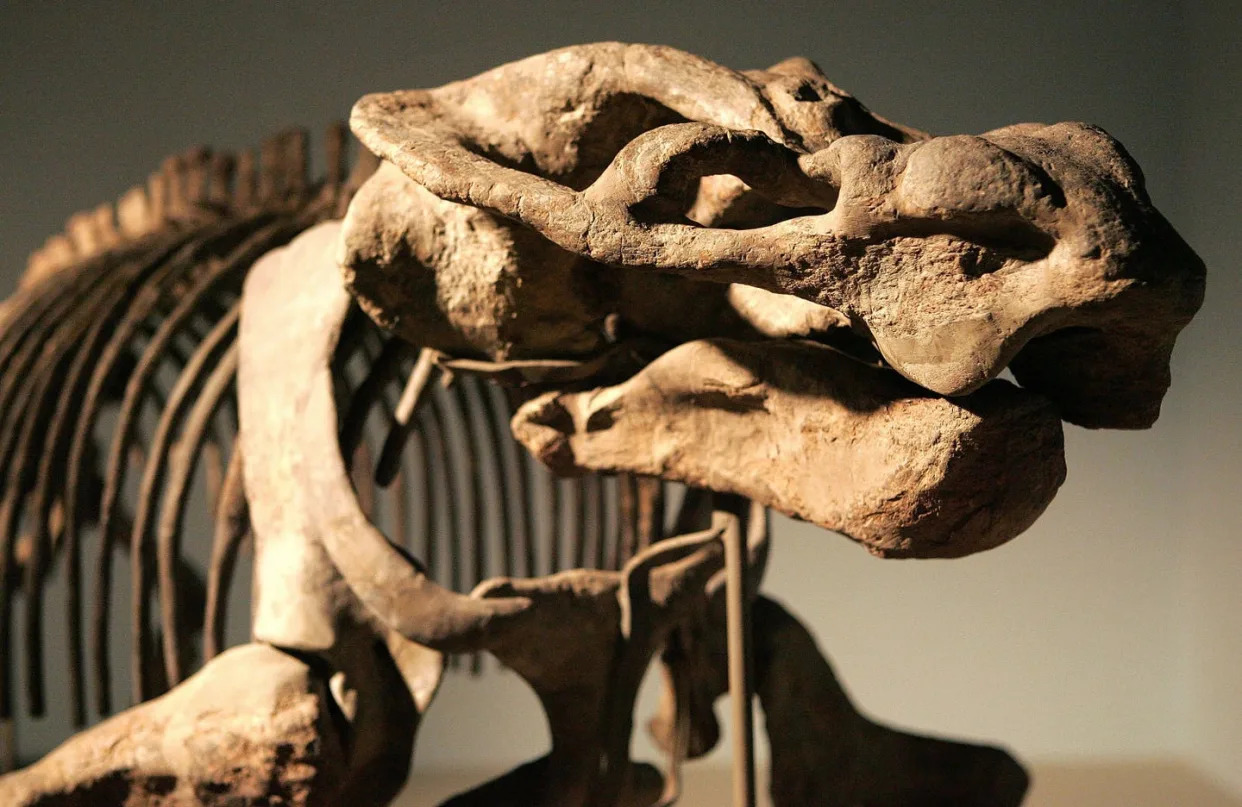
Archaeologists discovered a rock painting of an animal from at least 200 years ago in South Africa that may match with fossils found in the area.

The art depicts a horned serpent that may be a now-extinct creature called a dicynodont.

Pairing the art with fossil finds and long-standing legends from the San people has scientists eager to discern if the horned serpent’s existence was a reality instead of merely legend.

There’s something intriguing, even frightening, about the image of an ancient horned serpent roaming across the land. Thanks to some suggestive fossils and legends of old, talk of such a creature isn’t a new concept. But the recent discovery of 200-year-old rock paintings found in South Africa now has scientists hypothesizing that this ancient creature may have been far more than just a legend.

The first formal scientific descriptions of this horned serpent—a supposed member of the dicynodont group—appeared in 1845. Considering the abundance of dicynodont fossils found in the Karoo Basin in South Africa, some have pondered whether this long-thought mythical horned serpent is rooted in reality. The discovery of rock art dated to between 1821 and 1835 adds even more credence to the legend, as the painting is older than the first formal reference to the dicynodont. If we’re lucky, it could provide further clues as to just how intertwined this horned serpent was with South Africa’s indigenous San culture.

In a study published in the journal PLOS ONE, Julien Benoit from the University of the Witwatersrand confirmed that the rock art from the early 1800s depicts a tusked animal, and that it sits alongside tetrapod fossils in the immediate vicinity. “Altogether,” the Benoit wrote, “they suggest a case of indigenous paleontology.”

Still, it will need to take more than a 200-year-old painting to match a smattering of unknown fossils to a long-extinct creature unlike anything seen in the area today. “The ethnographic, archaeological, and paleontological evidence are consistent with the hypothesis that the Horned Serpent panel could possibly depict a dicynodont,” Benoit wrote in the study. He added that the downward orientation of the tusks, which doesn’t match any African animal (but does match dicynodonts), the abundance of fossils in the area, and the belief held by the San of the existence of this long-extinct large animal further support the theory.

“Of course, at this point it is speculative,” said Benoit, according to IFL Science, “but the tusked animal on the Horned Serpent panel was likely painted as a rain-animal, which means it was probably involved [in] rain-making ceremonies.” These ceremonies often evoked known extinct animals to help the people encourage the gods to send rain.

The San were known to have a robust mix of animals belonging to their ‘spirit world,’ but Benoit said that these animals were generally inspired by reality—even if extinct. Coupled with the San’s interest in fossils, Benoit believes a fossil discovery could have led the San to recreate the horned serpent, using a long-held legend in which their ancestors described the creatures as “great monstrous brutes, exceeding the elephant or hippopotamus in bulk” as the template.

There’s plenty of leaps from legend to scientific grounding that may be too large for a fabled horned serpent to make. But after further studies, the 200-year-old paintings could spin a different tale.

Scientists use DNA to identify bones, find descendants of Franklin expedition sailor


CBC
Tue, September 24, 2024

Marc-André Bernier, Parks Canada's manager of underwater archelogy, sets a marine biology sampling quadrat on the port side hull of HMS Erebus in 2014. (Parks Canada - image credit)


Human remains resting in a remote Arctic cairn, visible emblems of one of the North's most enduring mysteries, finally have a name.

Scientists have managed to identify bones belonging to a member of the Franklin expedition, a 19th-century voyage of exploration and discovery that ended in disaster, starvation and death. James Fitzjames — only the second member of the expedition's crew to be identified by DNA — captained one of the expedition's two ships and served as second-in-command after Sir John Franklin's death.

"It helps us ask new questions about what really transpired," said Doug Stenton, an archeologist at the University of Waterloo whose paper on the identification was released Tuesday.

Franklin's ships, HMS Erebus and Terror, set out from England in 1845 in search of the Northwest Passage. The commander and his 128 men never returned.

More than 30 expeditions tried to find them.

Three graves were found on Beechey Island, their occupants identified. In 2014, the wreck of the Erebus was discovered through a blend of Inuit oral history and systematic, high-tech surveys just off the northwest coast of King William Island in Nunavut. The Terror was found two years later.

Fitzjames' final resting place on King William Island was probably first found in the 1860s by Inuit and studied by archeologists in the early 1990s. With 451 bones from at least 13 Franklin sailors, it was not like the careful interments of Beechey Island.

Qiniqtiryuaq (barge) above the Erebus site, wreck and divers visible.

Qiniqtiryuaq (barge) above the Erebus site, wreck and divers visible. (Underwater archeology team/Parks Canada)

"The human skeletal remains at this site, the bones, were scattered over several hundred square metres," Stenton said.

Fitzjames' DNA was isolated and profiled from a single molar. It had been extracted from a jawbone that bore the distinctive marks of man-made cuts, making Fitzjames the first identified victim of the cannibalism for which the expedition has become notorious.

"Surely the most compassionate response to the information presented here is to use it to recognize the level of desperation that the Franklin sailors must have felt to do something they would have considered abhorrent, and acknowledge the sadness of the fact that in this case, doing so only prolonged their suffering," Stenton writes.

Descendants 'excited and really intrigued'

Stenton and his colleagues have advertised for years at venues, such as museum displays on the Franklin expedition, for DNA samples from people who believe they are descendants of those doomed sailors. Those ads paid off in 2021, when the great-great-great-grandson of Warrant Officer John Gregory was located in South Africa.

Fitzjames' descendants, the family of a paternal second cousin of Fitzjames five times removed, have been contacted but have not yet spoken out.

"They were excited and really intrigued," Stenton said.

Much is known about Fitzjames' life. He joined the Royal Navy at the age of 12 and sailed in Central and North America, Malta, Syria, Egypt and China before the Arctic. He was known for his bravery and was awarded a silver cup by the City of Liverpool after he dove fully clothed into a river to rescue a drowning man.

It was Fitzjames who, as captain of the Erebus, wrote the main text of the last known message from the expedition, discovered at Victory Point on King William Island.

The note, co-signed by Fitzjames, reads in part: "Sir John Franklin died on the 11th of June 1847 and the total loss by deaths in the Expedition has been to this date nine officers and 15 men ... (We) start on tomorrow 26th for Backs Fish River."

At the time of his death, Fitzjames had a wife and two children. Meanwhile, Stenton and his colleagues continue to look for DNA matches to identify more remains. Fitzjames has been returned to his final home, where bones share a cairn with those of his shipmates on the windy, cobbled coast where he died.

Stenton said the identification of his remains, not far from those of Gregory's, could reveal more about what happened to the expedition. Both Fitzjames and Gregory, he notes, sailed on the Erebus.

"It's going to invite a lot of speculation," Stenton said. "What events really transpired — especially after the retreat, when the ships were deserted?"

Franklin researchers have long wondered about leadership during the expedition as more officers died, Stenton said.

"What exactly was going on?" Stenton asked.

That question has been asked over and over as the Franklin expedition entered Arctic folklore, persisting through songs, novels, TV shows and undying curiosity. It remains with us.
Thousands of bones and hundreds of weapons reveal grisly insights into a 3,250-year-old battle

Ashley Strickland, CNN
Tue, September 24, 2024 

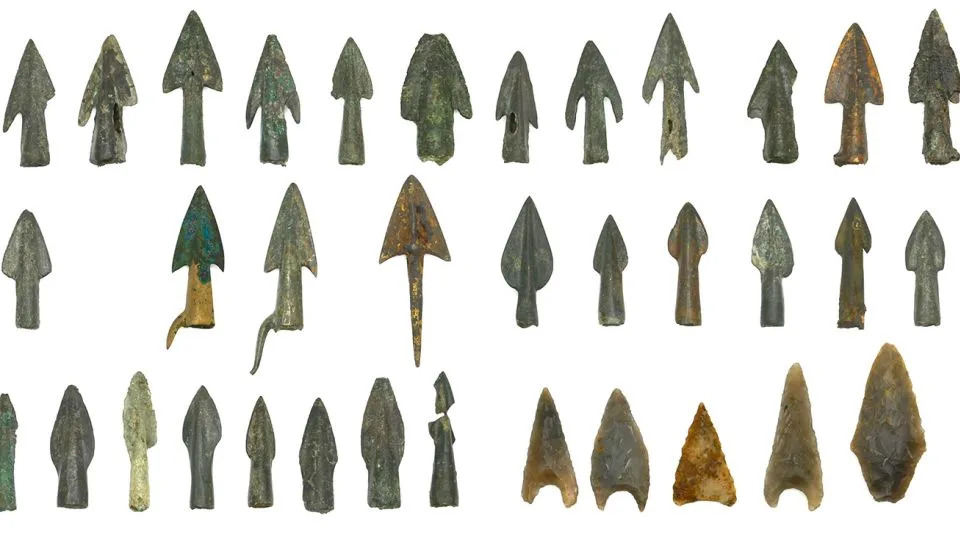
A new analysis of dozens of arrowheads is helping researchers piece together a clearer portrait of the warriors who clashed on Europe’s oldest known battlefield 3,250 years ago.

The bronze and flint arrowheads were recovered from the Tollense Valley in northeast Germany. Researchers first uncovered the site in 1996 when an amateur archaeologist spotted a bone sticking out of a bank of the Tollense River.

Since then, excavations have unearthed 300 metal finds and 12,500 bones belonging to about 150 individuals who fell in battle at the site in 1250 BC. Recovered weaponry has included swords, wooden clubs and the array of arrowheads — including some found still embedded in the bones of the fallen.

No direct evidence of an earlier battle of this scale has ever been discovered, which is why Tollense Valley is considered the site of Europe’s oldest battle, according to researchers who have studied the area since 2007.

Studies of the bones have yielded some insights into the men — all young, strong and able-bodied warriors, some with healed wounds from previous skirmishes. But details on who was involved in the violent conflict, and why they fought in such a bloody battle, has long eluded researchers.

There are no written accounts describing the battle, so as teams of archaeologists have unearthed more finds from the valley, they have used the well-preserved remains and weapons to try to piece together the story behind the ancient battle scene.

Now, a team of researchers studying arrowheads used in the battle has discovered evidence that it included local groups as well as an army from the south. These findings, published Sunday in the journal Antiquity, suggest the clash was the earliest example of interregional conflict in Europe — and raise questions about the state of organized, armed violence thousands of years ago.

“The arrowheads are a kind of ‘smoking gun,’” said lead study author Leif Inselmann, researcher at the Berlin Graduate School of Ancient Studies within the Free University of Berlin, in a statement. “Just like the murder weapon in a mystery, they give us a clue about the culprit, the fighters of the Tollense Valley battle and where they came from.”

An ancient skull recovered from the Tollense Valley site was found perforated with a bronze arrowhead. - Volker Minkus/Minkusimages
Evidence of invasion

Previous discoveries of foreign artifacts, such as a Bohemian bronze ax and a sword from southeastern Central Europe, and analyses of the remains have suggested that outsiders fought in the Tollense Valley battle. But the researchers of the new study were curious to see what clues the arrowheads would yield.

When Inselmann and his colleagues analyzed the arrowheads, they realized that no two were identical — not exactly shocking before the days of mass production. But the archaeologists could pick out key differences in the shapes and features that signified some of the arrowheads were not made within Mecklenburg-Western Pomerania, a state in northeast Germany that’s home to the Tollense Valley.

Inselmann collected literature, data and examples of more than 4,700 Bronze Age arrowheads from Central Europe and mapped out where they came from to compare them with the Tollense Valley arrowheads.

Many matched the style of arrowheads from other sites in Mecklenburg-Western Pomerania, suggesting they were locally made and carried by men who called the region home, according to the study.


Lead study author Leif Inselmann holds one of the arrowheads recovered from Mecklenburg-Western Pomerania, a state in northeast Germany that’s home to the Tollense Valley. - Leif Inselmann

But other arrowheads with straight or rhombus-shaped bases and side spurs and barbs matched those from a southern region that now includes modern Bavaria and Moravia, Inselmann said.

“This suggests that at least a part of the fighters or even a complete battle faction involved in Tollense Valley derive from a very distant region,” Inselmann wrote in an email.

Inselmann and his colleagues suspect it unlikely that the arrowheads were imported from another region to be used by local fighters. Otherwise, they would expect to find evidence of arrowheads within ceremonial burials in the region that were practiced during the Bronze Age.

Researchers uncovered a variety of bronze and flint arrowheads at the Tollense Valley site. - Leif Inselmann


The spark of war

A causeway that crossed the Tollense River, constructed about 500 years before the battle, is thought to have been the starting point of the conflict, said study coauthor Thomas Terberger.

Terberger, a professor in the department of prehistoric and historical archaeology at Germany’s University of Göttingen, has studied the site, a 1.8-mile (3-kilometer) stretch of the river, since 2007.

“The causeway was probably part of an important trade route,” he said. “Control of this bottleneck situation could well have been an important reason for the conflict.”

However, the fact that researchers haven’t found any clear evidence in the area of sources of wealth, such as mines for metal or places to extract salt, makes the trade route theory less likely, said Barry Molloy, an associate professor in the school of archaeology at University College Dublin. Molloy was not involved in the study.

“The causes of warfare were many, but it is likely in my view that this was about a group seeking to impose political control over another — an age old thing — in order to extract wealth systematically over time, not simply as plunder,” Molloy said in an email.

The exact scale and cause of the battle remain unknown, but the remains and weaponry found so far suggest more than 2,000 people were involved, according to the study. And researchers believe that more human bones are preserved in the valley, which could represent hundreds of victims.

The 13th century BC was a time of increased trade and cultural exchange, but the discovery of bronze arrowheads across Germany has suggested it was also when armed conflict arose.

“This new information has considerably changed the image of the Bronze Age, which was not as peaceful as believed before,” Terberger said. “The 13th century BC saw changes of burial rites, symbols and material culture. I consider the conflict as a sign that this major transformation process of Bronze Age society was accompanied by violent conflicts. Tollense is probably only the tip of the iceberg.”

The new study also points to the placement of arrow injuries found on remains buried at the battle site, which suggests that shields may have protected warriors from the front, while their backs were left exposed.

The research drives home the importance of archery on the battlefield, which has often been underestimated in previous studies of Bronze Age warfare, Molloy said.

“This is a really convincing study that uses routine archaeological methods to great effect to provide insight into the nature of this key prehistoric battle site, with regard to aspects of battlefield actions and the participants involved,” he said. “The authors make a robust case that there were at least two competing forces and that they were from distinct societies, with one group having travelled hundreds of kilometers. That is a crucial insight into the logistics behind the armies involved at Tollense.”


Researchers cataloged the types of injuries inflicted on remains recovered in the Tollense Valley to understand how the conflict played out. - Ute Brinker


The scale of conflict

The large scale of battle has researchers rethinking what social organization and warfare were like during the Bronze Age.

“Were the Bronze Age warriors (organized) as a tribal coalition, the retinue or mercenaries of a charismatic leader — a kind of ‘warlord’ — or even the army of an early kingdom?” Inselmann said.

For a long time, researchers argued that Bronze Age violence was a small-scale affair involving tens of individuals from local communities, but Tollense blows that theory wide open, Molloy said.

“We have many sites where we find evidence of mass killing and even slaughter of whole communities,” Molloy said, “but this is the first time that the demographics of the dead are those we can reasonably argue were warriors and not, for example, whole families migrating.”

Bronze Age societies built fortified settlements and smiths to forge weapons, but Tollense shows that both were more than just displays of power, he said.

“Tollense shows us that they were also created for very real military purposes including full scale battles that involved armies on the march, moving into hostile lands and waging war,” Molloy said.

Thousands of prehistoric artifacts found where Wake County highway opens this week

Richard Stradling
Tue, September 24, 2024 

Before the trees were cut and the bulldozers moved in to build NC. 540 across southern Wake County, archaeologists followed the route, looking for places people might have lived thousands of years ago.

They discovered a treasure trove along a creek east of Interstate 40. Sifting through the dirt, they found more than 24,000 artifacts, including shards of clay pots and other vessels; stone points used on spears, arrows and hand tools; and at least one piece of jewelry.

As the southern leg of the Triangle Expressway opens to traffic this week, those items are poised to join the state’s archaeological collection in Raleigh. Without the work of the archaeologists, they would have been churned up and paved over by the six-lane highway.

“It was going to be blitzed by the construction,” said Matt Wilkerson, who heads the N.C. Department of Transportation’s archaeology program. “This site was pretty much smack dab in the middle.”

NCDOT is required by state and federal law to determine whether road and bridge projects are likely to destroy important archaeological sites. That falls to Wilkerson and his team of six archaeologists, with help from consultants and the State Office of Archaeology.

They evaluate between 300 and 400 projects a year, focusing on those most likely to yield results: roads built on new right-of-way and bridges where flood plains can conceal well-preserved artifacts. The 18-mile extension of N.C. 540, across fields, forests and house lots from Apex to near Garner, was a good candidate.

NCDOT’s team gradually moved the length of the future highway corridor, pushing soil samples through a quarter-inch mesh to see what showed up.

“It’s like a chess board,” Wilkerson said. “We dig holes at a certain interval. If we find something, we tighten up that interval and dig some more.”

The goal is not to find and remove every artifact in the highway’s path. Instead, it’s to document what’s there and explore more deeply the most significant sites.

“We’re after sites that have integrity, where the soils are intact,” Wilkerson said. “That way we know the materials that we’re finding are not just all jumbled up. They might actually be able to tell us a little something about the site.”

The team found artifacts in more than 150 places along the path of the highway. But only one site was so rich and undisturbed that it was considered eligible for the National Register of Historic Places. And that site needed to be excavated, because it was directly in the highway’s path.

Artifacts including pottery, tools and jewelry--some made 10,000 years ago--were found during digging in 2021 for the last leg of the Triangle Expressway.
A popular spot over thousands of years

It was on a small rise just above a creek, which likely made it an attractive place to camp. It was extensive enough that NCDOT contracted with Commonwealth Heritage Group, a consulting firm based in Tarboro, to help with the work.

Using radio carbon dating and other techniques, the archaeologists determined that most of the artifacts they found were from two distinct periods: 6,000 to 5,500 BC or middle archaic and the middle woodland era, from 300 BC and 800 AD.

In neither case does it look as if the site was a permanent settlement, Wilkerson said. People may have spent a season along the creek, before moving on. The more recent occupants in particular seem to have spent little time at the site, which may have been a satellite of a larger settlement nearby, he said.

Perhaps the coolest item the archaeologists found was part of a gorget or piece of jewelry from sometime in the woodland period. The polished piece of stone was tapered on both ends and had been drilled with holes for a cord or leather strap.

“We don’t really know if it’s ceremonial or it’s just jewelry that someone would wear,” Wilkerson said. “We haven’t found many of those.”

A stone gorget or piece of jewelry found during an archaeological dig before construction of N.C. 540 in southern Wake County. N.C. Department of Transportation’s archaeologists and their consultants found more than 24,000 artifacts at one site where the highway runs now.

None of what the archaeologists found at the site is a museum piece, said Davis Cranfield, an assistant state archaeologist with the Department of Natural and Cultural Resources. But taken together, they are notable, Cranfield said.

“Usually we say, ‘It’s not what you find but what you find out,’ the collective assemblage that can help tell a story,” he said. “And this was a pretty significant site.”

In particular, the concentration of ceramic pottery, the presence of a hearth or fire pit and fragments of burned walnut shells help show how people lived at the time.

NCDOT and its consultants cataloged and documented what they found; a few of the items were on display at 540 Fest, when people were invited to run and cycle on the nearly completed highway in June.

Their permanent home will be at the State Office of Archaeology’s Research Center, where they’ll be available for future study.

Trump says women won’t be ‘thinking about abortion’ if he’s elected, casting himself as their ‘protector’


OLDE FASHIONED CHAUVINISM AND SEXISM

Kate Sullivan and Eric Bradner, CNN
Tue, September 24, 2024 


Jim Watson/AFP/Getty Images

Former President Donald Trump cast himself as a “protector” of women at a Pennslyvania rally Monday evening and claimed that American women won’t be “thinking about abortion” if he’s elected.

The plea to ignore Trump’s own role in undoing national abortion rights protections is a clear signal that the former president is keenly aware of what polls show: His Democratic rival, Vice President Kamala Harris, has a clear advantage among women voters, nationally and in key swing states. Trump has kept the race close by countering with a lead among men.

Harris’ edge with women is driven in part by the Supreme Court’s conservative majority, with three members appointed by Trump, in 2022 overturning Roe v. Wade and leading to a patchwork of state-level abortion regulations — including restrictive laws in several of the battleground states that could decide the 2024 election. Democrats have performed strongly in elections where abortion has taken center stage since that 2022 Supreme Court decision, and abortion rights supporters have won a series of statewide referendums on the issue, even in deep-red states.

“I always thought women liked me. I never thought I had a problem. But the fake news keeps saying women don’t like me,” Trump said in Indiana, Pennsylvania. “I don’t believe it.”

The former president claimed women are “less safe,” “much poorer” and are “less healthy” now compared to when he was president and vowed to end what he described as their “national nightmare.”

“Because I am your protector. I want to be your protector. As president, I have to be your protector. I hope you don’t make too much of it. I hope the fake news doesn’t go, ‘Oh he wants to be their protector.’ Well, I am. As president, I have to be your protector,” Trump said.

Women, he added, “will be happy, healthy, confident and free. You will no longer be thinking about abortion.”

Polls also show likely voters give Harris the edge on handling abortion. Polls also show likely voters give Harris the edge on handling abortion. A CNN poll conducted by SSRS released Tuesday found likely voters nationally favor Harris’ approach to abortion (52%) to Trump’s (31%). That advantage was in line with several other national surveys released this month.

Even in polls that indicate Trump has a lead — such as a New York Times/Siena College poll of Arizona likely voters released Monday, which found Trump leading with 48% support to Harris’ 43% — it’s clear Trump faces political headwinds on the issue of abortion rights. A broad majority (58%) of voters said they would vote to back a ballot measure seeking to establish a right to abortion in the state, while 35% oppose it.

Americans remain broadly opposed to the Supreme Court’s decision to overturn Roe, according to CNN polling, and it has proven to be thorny campaign issue for Republicans in down-ballot races.

Bernie Moreno, the GOP candidate for US Senate in Ohio, said at a town hall Friday that abortion is the only issue many suburban women vote on, and questioned why women over 50 would care about the issue, according to video obtained by WCMH-TV in Columbus, Ohio.

A spokesperson for Moreno later sought to call his remarks “a tongue-in-cheek joke,” though his opponent, incumbent Sen. Sherrod Brown, has already seized on the comments.

Trump appeared to be referring to Democrats later in his speech Monday when he said, “all they can talk about is abortion.”

“The country is falling apart. We’re going to end up in World War III, and all they can talk about is abortion. That’s all they talk about, and it really no longer pertains, because we’ve done something on abortion that nobody thought was possible,” he said in reference to the Supreme Court’s 2022 decision.

Trump had previewed his Monday evening appeal to female women voters with a post on his Truth Social platform last week. American women, he wrote in all-caps, “are more depressed and unhappy than they were four years ago” before vowing to “fix all of that.”

Harris, in a Wisconsin Public Radio interview on Tuesday, reiterated her support for eliminating the Senate’s 60-vote filibuster threshold to restore Roe v. Wade to codify abortion rights and protect women’s reproductive freedom.

“I think we should eliminate the filibuster for Roe,” Harris said.

Doing so, she said, would “get us to the point where 51 votes would be what we need to actually put back into law the protections for reproductive freedom and for the ability of every person, every woman to make decisions about their own body and not have their government tell them what to do.”

CNN’s Ebony Davis and Jenn Agiesta contributed to this report.

Trump ignores the First Amendment and says those who criticize the Supreme Court should be tossed in jail

TRUMP ONLY BELIEVES IN THE SECOND AMENDMENT

Ariana Baio
Tue, September 24, 2024 

Donald Trump scolded those who critique the Supreme Court at a rally on Monday, saying people should be jailed for “the way they talk about our judges and our justices” – despite the First Amendment allowing people to criticize the government.

The former president, who has invoked his First Amendment right to launch a bevy of attacks against federal and state judges, suggested it should be “illegal” to rebuke judicial decisions or try and advocate in favor of a certain decision.

“It should be illegal, what happens,” Trump told a crowd in Pennslyvania. “You know, you have these guys like playing the ref, like the great Bobby Knight. These people should be put in jail the way they talk about our judges and our justices, trying to get them to sway their vote, sway their decision.”

The former president was referring to the backlash the Supreme Court received after overturning Roe v. Wade in June 2022. He called the court “very brave” for making a decision that “everybody wanted” – an unfounded claim.

Former president Donald Trump condemned those that criticize the Supreme Court’s decision to overturn Roe v. Wade, saying it should be ‘illegal’ to make that kind of rhetoric (AP)

Under the First Amendment, people have the right to complain about government officials and decisions.

Trump himself has been safeguarded by this rule when during his New York criminal trial, Trump called Justice Juan Merchan “highly conflicted.” When a gag order was placed on him, Trump violated it at least 10 times and then utilized his allies to launch more attacks against the judge.

In his federal election interference trial, the former president claimed District Court Judge Tanya Chutkan was “highly partisan” and “VERY BIASED & UNFAIR” because she warned him not to make inflammatory statements about the case.

Trump has also criticized federal appeals courts, he once called the Ninth Circuit Court of Appeals “a complete & total disaster” with a “horrible reputation” and claimed the judges were “making our Country unsafe.”


A protestor holds a sign saying ‘abort the court’ after the Supreme Court overturned Roe v. Wade (Copyright 2022 The Associated Press. All rights reserved.)

Those statements, made in 2018, were in response to Chief Justice John Roberts rebuking Trump’s assertion that an “Obama judge” ruled against his asylum policy.

Yet, the former president stood in front of a crowd of supporters on Monday evening to insinuate it is not appropriate to criticize the Supreme Court – which is comprised of lifetime appointed, not elected, justices.

Trump also criticized Democrats’ desire to “pack the court”, or appoint more judges, to balance the conservative-to-liberal ratio. He claimed Vice President Kamala Harris wants to make the court 25 justices – it is unclear where that figure originated.

Harris supports President Joe Biden’s Supreme Court reform proposal which would authorize a president to appoint a new justice every two years to serve for 18 years. However, given Congress would need to approve the addition of justices, it is unlikely to happen.


Trump Says People Who Criticize Supreme Court Justices Should Be Jailed

Charisma Madarang
Mon, September 23, 2024 


Donald Trump, who earlier this month threatened to jail his political opponents, upped his authoritarian rhetoric during a campaign rally at Indiana University of Pennsylvania.

When speaking to supporters from the swing state, where both Trump and Vice President Kamala Harris have doubled efforts to capture the election count in November, Trump lamented the criticism aimed at the Supreme Court’s conservative supermajority and said it should be “illegal.”

“They were very brave, the Supreme Court. Very brave. And they take a lot of hits because of it,” said the former president. “It should be illegal, what happens. You know, you have these guys like playing the ref, like the great Bobby Knight. These people should be put in jail the way they talk about our judges and our justices, trying to … sway their vote, sway their decision”

Trump, who appointed three of the Supreme Court’s six conservative justices, specifically praised the Supreme Court for overturning Roe v. Wade and allowing states to ban abortion, saying it “took a lot of courage.” He said abortion will forever remain a state issue, not a federal one, and complained that Democrats are upset about it. “All they can talk about is abortion. That’s all they talk about, and it really no longer pertains,” he said.

“The issue of reproductive freedom certainly ‘pertains’ to women all across this country, especially as we learn women are losing their lives under Donald Trump’s extreme abortion bans,” Harris campaign spokesperson Sarafina Chitika said in statement after his speech.

The former president also slammed Harris’ support for Supreme Court reform and baselessly claimed her efforts were an attempt to “rig the system.” The push for reform arrived after a series of ethics scandals involving some of the justices’ failure to disclose luxury gifts — private jet flights, superyacht trips, and more — from conservative donors. Trump claimed Harris “wants to pack the Supreme Court,” and add up to 16 seats; the vice president has not endorsed such a policy.

Trump’s remarks about jailing those criticizing judges and justices align with his previous sentiments that he would be a dictator if re-elected but only on “Day One” in office. His desire to squash any hint of opposition if he were to return to the White House was again on full display in a Truth Social post made in early September, during which he threatened to jail people “involved in unscrupulous behavior” this election.

“WHEN I WIN, those people that CHEATED will be prosecuted to the fullest extent of the Law, which will include long term prison sentences so that this Depravity of Justice does not happen again,” Trump raged on his social media platform. “We cannot let our Country further devolve into a Third World Nation, AND WE WON’T!” Since losing the 2020 election to President Joe Biden, Trump has blamed his demise on false claims of widespread election fraud — dangerous rhetoric that he has ramped up as election day approaches.

In July, the high court granted Trump broad immunity from prosecution stemming from his federal criminal charges involving his efforts to overturn his 2020 election loss. In a landmark decision, the Supreme Court ruled that the former president cannot be prosecuted for official acts committed during his time as president. Although its three liberal members dissented, the six conservative justices, three of whom were appointed by Trump, were in the majority.

Along with providing Donald Trump sweeping immunity from prosecution and eliminating federal protections for abortion rights, in recent years the nation’s highest court has rolled back climate protections, limited protections for LGBTQ+ Americans, ended college affirmative action policies, and allowed companies to provide thank-you payments to corrupt politicians.


Activists protest US support for Israel as risks rise of wider Middle East war


Washington Protesters Rally Against Israel’s Attacks on Hezbollah in Lebanon


By Kanishka Singh

Tue, September 24, 2024


WASHINGTON (Reuters) - Protesters in some U.S. cities demonstrated on Tuesday against American military support for Israel as risks have risen of a full-fledged conflict in the Middle East, with anti-war activists demanding an arms embargo against the U.S. ally.

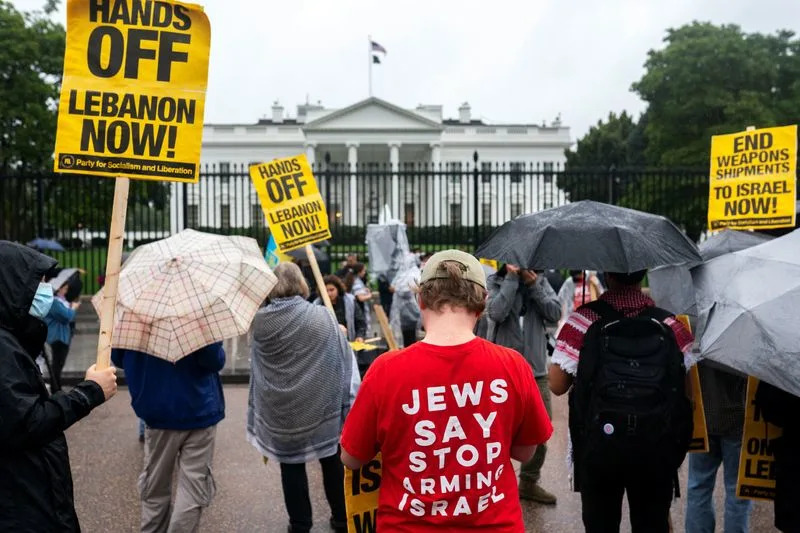
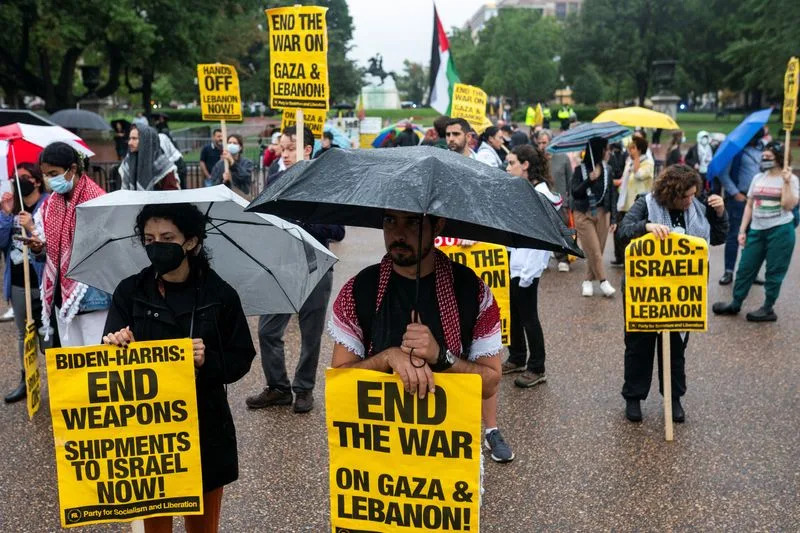
Dozens of protesters gathered in Herald Square in New York City on Tuesday evening and carried banners that read "Hands off Lebanon now" and "no U.S.-Israeli war on Lebanon," according to the ANSWER coalition group, which stands for "Act Now to Stop War and End Racism."

Protesters chanted "Hands off the Middle East," "Free Palestine" and "Biden, Harris, Trump and Bibi; none are welcome in our city," referring to U.S. President Joe Biden, Vice President Kamala Harris, former President Donald Trump and Israeli Prime Minister Benjamin Netanyahu.

A smaller protest with similar slogans and banners was also seen near the White House in Washington on a rainy Tuesday evening.

"Israel's attacks in Lebanon and the ongoing siege and genocide in Gaza are made possible by the huge amount of bombs, missiles and warplanes provided by the U.S. government," the ANSWER coalition group said in a statement. It said protests were also being organized on Tuesday in other cities like San Francisco, Seattle, San Antonio and Phoenix, among others.

Israel says its actions are an act of self-defense against militant groups like Hamas and Hezbollah that it considers hostile. The United States has maintained support for its ally during this war despite domestic and international criticism.

In May, Biden said U.S. support for Israel was "ironclad", while also calling for an immediate ceasefire. "What's happening in Gaza is not genocide. We reject that," Biden said at a Jewish American Heritage Month event at the White House.

The United States has seen months of protests over Israel's war in Gaza that has killed over 41,000, according to the local health ministry, caused a hunger crisis, displaced the entire 2.3 million population of the enclave and led to genocide allegations at the World Court that Israeli denies.

Israel's military assault on Hamas-governed Gaza followed a deadly attack by the Palestinian Islamist group on Oct. 7 that killed around 1,200 people and in which about 250 were taken as hostages, according to Israeli tallies.

Israel's offensive in Lebanon since Monday morning has killed over 560 people, including 50 children, and wounded 1,800. Israel says it has struck targets of Lebanese Hezbollah militants who are supported by Iran while Hezbollah has also said it fired rockets at Israeli military posts.

The situation has raised concerns of a widened regional war that could destabilize the Middle East. Leaders of different United Nations member states met this week in the United States with the situation in the Middle East being top of the agenda.

(Reporting by Kanishka Singh in Washington; editing by Lisa Shumaker)