Wednesday, October 02, 2024

 Japan’s New Economy Minister Seeks to Maximize Nuclear Restarts


Shoko Oda and Yoshiaki Nohara
Tue, October 1, 2024


(Bloomberg) -- Japan’s new economy minister said the country will need to maximize the use of existing nuclear power plants as artificial intelligence and data centers are expected to boost electricity demand.

It’s “natural” for Japan to pursue both atomic and renewable energy in order to meet the growing needs without increasing carbon emissions, said Yoji Muto, who was appointed to the role on Tuesday. The new administration will eye restarting as many reactors as possible so long as they are safe, he said Wednesday.

Muto’s comments point to a continuation of former Prime Minister Fumio Kishida’s work that shifted Japan back toward nuclear energy as a major power source, with many reactors still offline in the wake of the 2011 Fukushima disaster. His successor, Shigeru Ishiba, had said during his campaign that Japan should reduce its dependence on the energy source but later said that he would support the restart of existing plants.

Ishiba’s comments led to a decline in utility shares earlier this week, as investors speculated that the new government would negatively impact the push to embrace nuclear. That move is part of a global revival as countries turn to fission for stable and emissions-free electricity to meet demand.

Muto also said that Japan will need to protect its atomic industry by developing next-generation reactors. The nation is in the process of revising its strategic energy plan that will dictate the power mix, which is currently 70% fossil fuels such as natural gas and coal, beyond 2030.

Most Read from Bloomberg Businessweek

 Mississippi lawmakers, energy experts agree more nuclear power is in state's future. See why


Grant McLaughlin, Mississippi Clarion Ledger
Wed, October 2, 2024 

Energy sector experts and representatives from some of Mississippi's largest energy providers want to increase nuclear energy production in and around the state, and they aren't the only ones.

During a meeting with the Mississippi Senate Energy Committee Tuesday at the State Capitol, representatives from Entergy and the Tennessee Valley Authority spoke with lawmakers about the importance and utility of new nuclear power technology to meet demands from various industries in and out of Mississippi such as steel manufacturing and data centers.

Lawmakers also wanted to know what they can do now to entice developments of small nuclear reactor plants, which are essentially more compact reactors that can produce more power.

"Obviously, nuclear is the future," Senate Energy Committee Chairman Joel Carter, R-Gulfport, said. "I thinkMississippi has decided to say, 'Hey, y'all watch this,' and now we'll see what happens."

Experts from Nuscale Power said more modern energy production sites can have as many as 12 small reactors to a plant and produce more than 1,000 megawatts of power while only using a portion of the land a traditional nuclear power plant would need.

Brett Favre tries to expand lawsuit: Brett Favre attempts to add Mississippi Auditor's book to defamation lawsuit

Grand Gulf Nuclear Station in Port Gibson

From a cost-to-build perspective, these types of nuclear power plant would take about three years to build at a significantly reduced overall price tag, Nuscale Power Executive Vice President of Business Development Clayton Scott said.

"Mississippi is a great state to build something, and so we think we're open minded to working with you guys to figure out what (projects) make sense," Scott said.

As for what the state can do now to attract these projects, Scott and others said tax incentives, supportive state policy and investment, Nuclear Regulatory Commission approved build sites, land with access to rivers, waterways, rail and highways are essential.

Read about other committee hearings Crumbling roads and bridges in MS need more revenue now, leaders say. Costly problem looms

Scott said his company is actively looking at 12 sites throughout the United States.

Currently, there are 93 nuclear power plants in the United States and one, the Grand Gulf Nuclear Station, which is owned by Entergy, is located near Port Gibson. The plant has an operation license ending in 2044 and an option to extend it to 2066.

According to the United States Department of Energy, nuclear energy is the second largest form of clean energy production. Nuclear power also does not produce carbon emissions, uses less land as compared to other plants such as coal or gas plants and leaves little waste product.

The power itself is created traditionally by fission, a process for splitting atoms. The heat from that atomic reaction is then used to create steam, which then spins a turbine that creates electricity.

Jim Smiley, of Entergy, told lawmakers the company doesn't want to pioneer new nuclear technology in the state, but it already has a federally approved nuclear plant site in addition to Grand Gulf Nuclear Station, and would greenlight a plant project if it doesn't cost its customers more on their monthly bills and is a benefit to the region.

"We firmly believe that nuclear is our future and new nuclear specifically is in our future," Smiley said. "It's not really a matter of if, it's a matter of when and how do we get there."

TVA representative Dan Pratt also showed a chart showing that as of 2023, nuclear power accounted for 42% of its grid, which encompasses Northeast Mississippi. Pratt said the future of nuclear power should not be ignored as TVA looks to significantly decrease its carbon footprint by 2050.

"We do believe that ultimately to get to 2050 and truly be able to get to extreme decarbonization, nuclear has got to be part of that," Pratt said. "That's got to be part of the national energy strategy, and TVA is part of that, obviously, as an advocate and an operator of nuclear power."

The TVA operates three nuclear power plants already, with one in Alabama and two in Tennessee.

Grant McLaughlin covers state government for the Clarion Ledger. He can be reached at gmclaughlin@gannett.com 
Corrosion exceeds estimates at Michigan nuclear plant US wants to restart, regulator says

Timothy Gardner
Wed, October 2, 2024 


By Timothy Gardner

WASHINGTON (Reuters) -Holtec, the company wanting to reopen the Palisades nuclear reactor in Michigan, found corrosion cracking in steam generators "far exceeded" estimates, the U.S. nuclear power regulator said in a document published on Wednesday.

President Joe Biden's administration this week finalized a $1.52 billion conditional loan guarantee to the Palisades plant. It is part of an effort to support nuclear energy, which generates virtually emissions-free power, to curb climate change and to help satisfy rising electricity demand from artificial intelligence, electric vehicles and digital currency.

Palisades, which shut under a different owner in 2022, is seeking to be the first modern U.S. nuclear power plant to reopen after being fully shut.

A summary of an early September call between the U.S. Nuclear Regulatory Commission and Holtec published on Wednesday said indications of stress corrosion cracking in tubes in both of Palisade's steam generators "far exceeded estimates based on previous operating history." It found 1,163 steam generator tubes had indications of the stress cracking. There are more than 16,000 tubes in the units.

Steam generators are sensitive components that require meticulous maintenance and are among the most expensive units at a nuclear power station.

Holtec wants to return the plant to operation late next year. Patrick O'Brien, a company spokesperson, said the results of the inspections "were not entirely unpredicted" as the standard system "layup process", or procedure for maintaining the units, was not followed when the plant went into shutdown.

But he said the return of Palisades is still on schedule and that Holtec wants to fix, and not replace, the steam generators, which he said would last for 30 years after repairs.

"We expect the repair strategy will be to 'unplug' approximately 300 tubes per steam generator that were plugged at original installation, and then address the tubes found during the inspections by plugging approximately 20% of the tubes that cannot be repaired easily and repairing the remaining 80% with sleeving, which is a common and proven repair strategy," O'Brien said.

Holtec still needs permits from the NRC. "Holtec must ensure the generators will meet NRC requirements if the agency authorizes returning Palisades to operational status," an NRC spokesperson said.

The NRC said last month that preliminary results from inspections "identified a large number of steam generator tubes with indications that require further analysis and/or repair."

Steam generator issues can pose problems for nuclear power plants. Parts of the San Onofre Nuclear Generating Station in California were shut in 2012 after steam generators that had a design flaw leaked. Problems with new generators led to the closure of the plant in 2013.

(Reporting by Timothy Gardner; Editing by Andrea Ricci and David Gregorio)


First nuclear plant recommissioned in US history as part of $2.8bn funding
Power Technology · (Holtec International.)


Claire Jenns
Power Technology
Tue, October 1, 2024 

The Biden-Harris Administration, through the US Department of Energy (DOE) and Department of Agriculture (USDA), has announced more than $2.8bn in funding to support clean power in the Midwest.

As part of the plan, the DOE has closed a loan guarantee of up to $1.52bn to finance the restoration and resumption of a 800MW nuclear generating station in Michigan.


This marks the first recommissioning of a retired nuclear power plant in US history.

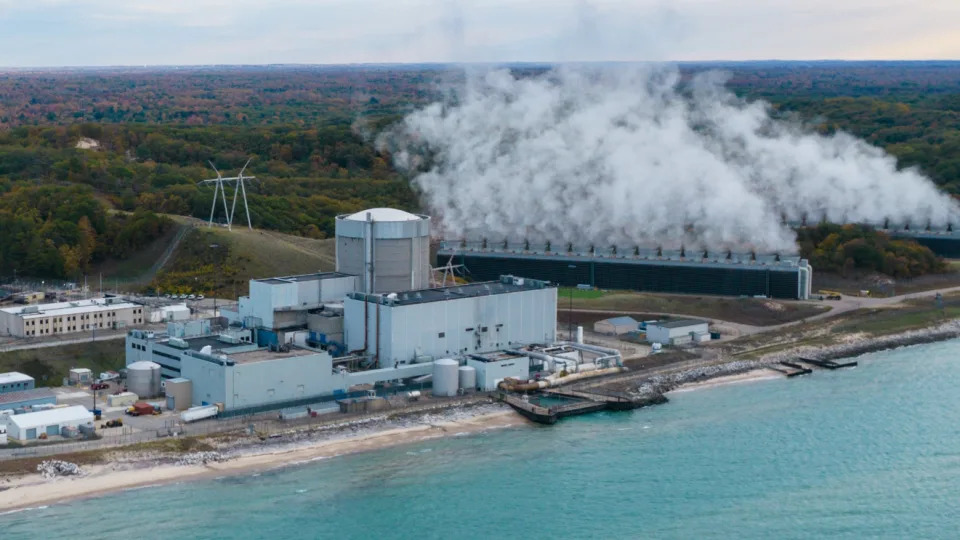
The Palisades Nuclear Plant, which ceased operations in May 2022, will be brought back online and upgraded to produce clean baseload power until at least 2051, subject to US Nuclear Regulatory Commission licensing approvals.

The plant’s restart is expected to protect 600 union jobs at the plant and 1,100 in the community and provide access to reliable power for 800,000 homes in the Midwest, covering Michigan, Wisconsin, Indiana and Illinois.

Palisades is also anticipated to reduce greenhouse gas emissions by 4.47 million tonnes (mt) per year for a total of 111mt during the projected 25 years of operations.

The project is managed by energy company Holtec International and Wolverine Power Cooperative, a not-for-profit energy provider to rural communities in Michigan. The organisations signed long-term power purchase agreements in 2023.

The USDA has also allocated more than $1.3bn for Wolverine Power Cooperative and Hoosier Energy to reduce the cost of electricity passed on to the community from the Palisades plant and other clean energy sources.

According to the White House, the Palisades plant is located in a disadvantaged community where residents face higher energy costs than 97% of communities in the country.

US Secretary of Energy Jennifer M Granholm commented: “Nuclear power is America’s largest source of carbon-free of electricity, supporting hundreds of thousands of direct and indirect jobs across the country, and will play a critical role in tackling the climate crisis and protecting public health and the environment from its impacts.”

The US aims for a carbon-free power sector by 2035. Nuclear power has been spotlighted as a solution for providing uninterrupted carbon-free power amid rising electricity demand.

"First nuclear plant recommissioned in US history as part of $2.8bn funding " was originally created and published by Power Technology, a GlobalData owned brand.

Energy Department finalizes loan for Michigan nuclear plant revival

Zack Budryk
Mon, September 30, 2024


The Energy Department on Monday announced it has finalized a $1.5 billion loan to restart a shuttered Michigan nuclear power plant.

The loan guarantee will restart the Holtec Palisades nuclear plant in Covert Township, which shut down in 2022 after five decades of operation. The reboot will mark the first for a nuclear reactor after the removal of its fuel.

The Biden administration is also awarding $1.3 billion through the Department of Agriculture’s Empowering Rural America program to two rural electric cooperatives, which will discount electricity passed on to their members through emissions-free sources, such as the Holtec plant.


The administration projected the restarted Palisades plant, which still must go through the Nuclear Regulatory Commission licensing approval process, will provide power until at least 2051 once brought back online. The administration estimated it will create or keep up to 600 local jobs, and the company has signed an agreement with 15 trade unions, according to the department.

“Nuclear power is America’s largest source of carbon-free of electricity, supporting hundreds of thousands of direct and indirect jobs across the country and will play a critical role in tackling the climate crisis and protecting public health and the environment from its impacts,” said Energy Secretary Jennifer Granholm, a former Michigan governor, in a statement. “Under President Biden and Vice President Harris’ leadership, DOE and our partners across the federal government are working around the clock to ensure this vital source of clean electricity—and the vibrant workforce it supports— continues to power our nation for generations to come.”

Nuclear power largely fell out of favor during the Cold War amid anxieties about the potential for accidents, but policymakers in recent years have revisited it as a renewable and emissions-free power source. The announcement comes shortly after the news that the Three Mile Island plant in Pennsylvania, the site of a partial meltdown in 1979, will reopen to power Microsoft data centers.

Copyright 2024 Nexstar Media, Inc. All rights reserved. This material may not be published, broadcast, rewritten, or redistributed.

DOE, USDA announce over $2.8B for Palisades nuclear plant restart

Brian Martucci
Tue, October 1, 2024 


Dive Brief:

Holtec International will receive a loan guarantee of up to $1.52 billion from the U.S. Department of Energy’s Loan Programs Office to restart operations at the 800-MW Palisades nuclear generating station in southwestern Michigan, the Biden-Harris administration said Monday.


Two regional electric cooperatives, Hoosier Energy and Wolverine Power Supply Cooperative, will receive about $1.3 billion from the U.S. Department of Agriculture to partially offset power purchases from the reopened facility, the administration said.


Holtec remains on track to restart Palisades in October 2025, company spokesperson Patrick O’Brien told Utility Dive earlier this month. It would be the first U.S. n
Dive Insight:

DOE in March announced a conditional loan guarantee of up to $1.52 billion for the Palisades restart. Monday’s announcement solidifies DOE’s commitment and, along with the USDA’s awards, represents crucial financing for Holtec’s effort.

The federal funding announcements for Palisades come less than two weeks after Constellation Energy said it would spend $1.6 billion to restart the idled 835-MW reactor at Three Mile Island unit 1 in 2028.

Constellation’s TMI-1 restart is supported by a 20-year PPA with Microsoft, which will use the electricity to run data centers in PJM Interconnection territory. Constellation declined to discuss the terms of the PPA, but the company’s investor presentation on the restart suggests it places a substantial premium on power generated by TMI-1, Studsvik Scandpower Chief Commercial Officer Keith Drudy told Utility Dive last month.

Morgan Stanley analysts estimate Constellation will sell power to Microsoft for $98/MWh compared to market power prices of around $50/MWh. Constellation also expects the unit’s output will receive a roughly $30/MWh clean energy tax credit.

The USDA awards to Hoosier Energy and Wolverine Power Supply Cooperative “will help reduce wholesale power costs, provide community benefits and keep electricity reliable and affordable” for the cooperatives’ residential and commercial members, Deputy Secretary of Agriculture Xochitl Torres Small said in a press briefing.

Under their respective PPAs, Wolverine Power Supply Cooperative will procure 435 MW and Hoosier Energy 369 MW of Palisades’ generation, USDA said earlier this month.

Hoosier Energy will also use a portion of its award to procure 250 MW of renewable energy annually, USDA said.

The USDA award to Wolverine Power Supply Cooperative will help it reach its goal of procuring 100% carbon-free power by 2030, 10 years ahead of Michigan’s 2040 target, Torres Small said. The Palisades PPA is “a key component” of that plan, along with some 400 MW of solar capacity under development across Michigan, the cooperative said in March.

The USDA awards represent about one-quarter of the value of the cooperatives’ PPAs, a senior administration official said in the press briefing.

The DOE loan will fund inspection, testing, restoration, rebuilding and replacement of existing equipment at Palisades, another senior administration official said in the briefing. LPO has received nuclear-related loan requests worth more than $65 billion, the senior administration official added.

“To dominate the industries of the future, we need to supply abundant, affordable, clean power,” National Climate Advisor Ali Zaidi said in the briefing. “Palisades represents that potential.

PITIFUL

Biden to keep target of accepting 125,000 refugees next year, memo says

Reuters
Mon, September 30, 2024

U.S. President Biden provides an update on the Hurricane Helene response and recovery efforts, at the White House


(Reuters) - President Joe Biden will keep the administration's target of accepting 125,000 refugees next year, according to a memo delivered to the U.S. State Department on Monday.

The Biden administration is on pace to bring in 100,000 people through the U.S. Refugee Admissions Program in fiscal year 2024, which ends on Sept. 30, according to an internal report to U.S. lawmakers, Reuters has reported.

If successful, that would be the highest level in three decades.


"The admission of up to 125,000 refugees to the United States during Fiscal Year (FY) 2025 is justified by humanitarian concerns or is otherwise in the national interest," Biden wrote in the memo.

Immigration is a top voter concern in the run-up to the Nov. 5 elections that will pit Kamala Harris, a Democrat and Biden's vice president, against Republican Donald Trump. Trump greatly curtailed refugee admissions during his 2017-2021 presidency and has pledged a wide-ranging immigration crackdown if re-elected.

The U.S. Refugee Admissions Program typically is available to people outside of their home countries who face persecution based on race, religion, nationality, membership in a particular social group, or political opinion. Applicants must be outside the U.S. to qualify for the status.

Biden first aimed for 125,000 refugee admissions in fiscal year 2022, an ambitious target that has remained elusive even after years of stepping up refugee processing.

(Reporting By Jarrett Renshaw; Editing by Chris Reese and Muralikumar Anantharaman)
US 'Welcome Corps' helps resettle LGBTQ+ refugees fleeing crackdowns against gay people

MICHAEL CASEY and TERRY CHEA
Updated Wed, October 2, 2024 
 

SAN FRANCISCO (AP) — Cabrel Ngounou's life in Cameroon quickly unraveled after neighbors caught the teenager with his boyfriend.

A crowd surrounded his boyfriend's house and beat him. Ngounou's family learned of the relationship and kicked him out. So Ngounou fled — alone and with little money — on a dangerous, four-year journey through at least five countries. He was sold by traffickers and held captive as a sex slave in Libya, harassed in Tunisia and tried unsuccessfully to take a boat to Europe.

"The worst thing was that they caught us. So it was not easy for my family," Ngounou said. “My sisters told me I need to get out of the house because my place is not there. So that’s what really pushed me to leave my country.”


Ngounou's troubles drew attention after he joined a protest outside the U.N. refugee agency's Tunisia office. Eventually, he arrived in the United States, landing in San Francisco in March.

Ngounou joined a growing number of LGBTQ+ people accepted into the Welcome Corps, which launched last year and pairs groups of Americans with newly arrived refugees. So far, the resettlement program has connected 3,500 sponsors with 1,800 refugees, and many more want to help: 100,000 people have applied to become sponsors.

President Joe Biden has sought to rebuild the refugee programs Donald Trump largely dismantled as president, working to streamline the process of screening and placing people in America. New refugee resettlement sites have opened across the country, and on Tuesday, the Biden Administration announced that it resettled 100,000 refugees in fiscal year 2024, the largest number in more than three decades.

In contrast, Trump has pledged to bar refugees from Gaza, reinstate his Muslim ban and impose “ideological screening” for all immigrants if he regains the presidency. He and running mate JD Vance are laying groundwork for their goal of deporting millions of illegal immigrants by amplifying false claims, such as the accusation that Haitians given temporary protected status to remain in the U.S. legally are eating pets in Ohio.

Under Biden, meanwhile, two human rights officials in the State Department were tasked last year with identifying refugees who face persecution either due to their sexual orientation or human rights advocacy.

“LGBTQ refugees are forced to flee their homes due to persecution and violence, not unlike other people,” said Jeremy Haldeman, deputy executive director of the Community Sponsorship Hub, which implements the Welcome Corps on behalf of the State Department. But they are particularly vulnerable because they're coming from places "where their identities are criminalized and they are at risk of imprisonment or even death.”

More than 60 countries have passed anti-LGBTQ laws and thousands of people have fled the Middle East and Africa seeking asylum in Europe. In April, Uganda’s constitutional court on Wednesday upheld an anti-gay law that allows the death penalty for “aggravated homosexuality.”

“There are just a lot of people who are really at risk and are not safe in their country, and they’re usually not safe in the neighboring or regional countries either,” Kathryn Hampton, senior adviser for U.S. Strategy at Rainbow Railroad, which helps LGBTQI+ people facing persecution.

The demand far outstrips capacity: Of more than 15,000 requests for help in 2023, the nonprofit helped resettle 23 refugees through the Welcome Corps program in cities as large as Houston and towns as small as Arlington, Vermont. It has a goal of resettling 50 this year.

"So, we have a lot of urgency as an organization to find and create new pathways that LGBTQI+ people can access to find safety,” Hampton said.

Another refugee in the program, Julieth Luna Garcia, is a transgender woman from El Salvador who settled in Chicago.

Speaking through a translator, the 31-year-old Garcia said she suffered abuse from her family because of her trans identity and couldn't legally access gender-affirming care until she arrived in the United States.

"I lived with constant fear, even more so at night. I didn’t like to go out. I was really scared that somebody would find me alone and do something,” Garcia said. Since arriving in February, Garcia has found a place to live and a job as a home health aide and hopes to study to become a lawyer. "Here, I’m not scared to say who I am. I’m not scared to tell anyone," she said.

Maybe the biggest change was starting hormone treatments, she said: “To see yourself in the mirror and see these changes, I can’t really explain it, but it’s really big. It’s an emotional and exciting thing and something I thought I would never experience.”

Welcome Corps sponsors are expected to help refugees adjust for at least three months after they arrive. Garcia said the five volunteers helped her “adapt to a new life with a little less difficulty,” by accessing benefits, getting a work permit and enrolling in English classes.

Ngounou recalled how his sponsors, a team of seven that included a lesbian couple, Anne Raeff and Lori Ostlund, hosted him and connected him with LGBTQ resources and a work training program. They also served as his tour guides to gay life, taking him to the historically gay Castro district, where Ngounou got his first glimpse of the huge rainbow Pride flag and stopped to read every plaque honoring famous gay people.

“Cabrel was just very, very moved by that. Just kind of started crying. We all did,” Raeff recalled.

“I know that feeling like when we were young, when you’d go into a gay bar and you’d feel like this sense of kind of freedom, like this community,” she said. “That was the only place where you could go and actually be open. And that ... this is this community of people and we all have this in common.”

Now the 19-year-old Ngounou works in a coffee shop and takes college courses, with the goal of becoming a social worker. He hopes the boyfriend he met in Tunisia can visit him in San Francisco — and he still finds it hard to believe that they can share their love openly.

“Here I’m really me ... I feel free,” he said with a laugh. "I feel free to have my boyfriend and walk with him in the street. I feel free, you know, to enjoy myself with him wherever we want to enjoy ourselves. But in Tunisia or anywhere else, in Cameroon, you have to hide such things.”


APTOPIX US LGBTQ Refugees
Julieth Luna Garcia, a transgender woman from El Salvador, looks into a compact mirror at Horner Park in Chicago, Monday, Sept. 30, 2024. (AP Photo/Nam Y. Huh)

___

This story has been corrected. Ngounou was sold by traffickers and held captive as a sex slave in Libya, not sexually assaulted in prison.

___

Casey reported from Boston.


WWIII

Vietnam protests Chinese force's attack on fishermen in contested waters

Wed, October 2, 2024


HANOI (Reuters) - Vietnam on Wednesday protested to China over what it said was an attack on a Vietnamese fishing boat three days ago in contested South China Sea waters that injured several fishermen.

The Vietnamese foreign ministry said in a statement that Chinese law enforcers beat the Vietnamese fishermen and took away their fishing equipment when their boat was operating near Hoang Sa, Vietnam's name for the Paracel Islands.

The Chinese-controlled islands, also claimed by Vietnam, are in the South China Sea, a busy global maritime waterway, almost all of which is claimed by China.

"Vietnam is extremely concerned, indignant and resolutely protests the brutal treatment by Chinese law enforcement forces of Vietnamese fishermen and fishing boats operating in the Hoang Sa archipelago of Vietnam," foreign ministry spokesperson Pham Thu Hang said in a statement.

The ministry delivered a strong protest to the Chinese embassy in Hanoi demanding that China respect Vietnam's sovereignty, investigate the incident and desist from further such actions, Hang said.

Vietnamese state media reported this week that around 40 people from two foreign vessels had beaten the fishermen with iron pipes, injuring 10.

China's foreign ministry said on Tuesday that the Vietnamese boats had been fishing illegally in Paracel waters without the permission of the Beijing government, and that Chinese authorities had taken measures to stop them.

"The on-site operations were professional and restrained, and no injuries were found," it said in response to a Reuters request for comment, without specifically referring to the attack.

(Reporting by Khanh Vu; Editing by Kevin Liffey)

Vietnamese Fishing Crew Attacked and Severely Beaten in Paracel Islands

Launches
Vietnamese fishing vessels at Da Nang

Published Sep 30, 2024 8:34 PM by The Maritime Executive


A Vietnamese fishing boat was attacked by unnamed aggressors in the Paracel Islands, according to state-owned media, and all 10 crewmembers aboard were injured. 

The Vietnamese border guard station in the village of Binh Chau reported that a fishing vessel was "obstructed and attacked" while operating in a Vietnamese-claimed area of the Paracel Islands. China has occupied the archipelago since a brief naval battle with U.S.-backed South Vietnamese forces in 1974, but Vietnam has never abandoned its sovereignty claim. 

The fishing vessel - named only with a numeral, QNg 95739 TS - departed port on September 13, bound for the Paracels (known as the Hoang Sa archipelago to the Vietnamese). 

According to state outlet TPO, the crew were approached by two foreign vessels, which destroyed their fishing gear and beat the crew severely. On returning to port in Quang Ngai province, four were taken immediately to a hospital for treatment for a range of injuries. 

Captain Nguyen Thanh Bien, 40, said that the 95739 was approached by a vessel with the pennant number 301 visible on the hull at about 0600 hours on September 29. At 1000, the vessel closed in from astern and lowered away two launches. A second ship, numbered 101, followed suit and lowered another. 

"About 40 people climbed onto the ship, each holding an iron rod, and then attacked," said Bien. "At this time, I tried to run towards the bow of the ship, however, two people held me and attacked me so hard that I lost consciousness. About one hour later I woke up."

Fisherman Huynh Tien Cong, 47, told TPO that the two foreign vessels approached from astern and boarded the 95739. They used iron pipes or bars to beat the fishermen severely. "We didn't dare to resist, we just lay there and endured the beating," said Cong, who sustained two broken legs. 

Crewmember Nguyen Thuong, 34, told the outlet that the attackers departed at about 1300 hours, and that they took the boat's cargo of fish, its equipment and its fishing gear - everything of value except for a GPS unit. The boarding party's interpreter told the injured crewmembers to go back to Vietnam.

Phung Ba Vuong, party chairman for the village of Binh Chau, told media that local agencies are working to verify the claim. According to TPO, many other boats from Quang Ngai province have encountered the same violent treatment at the hands of unnamed attackers in the Paracel Islands. 
 Xi vows ‘reunification’ with Taiwan on eve of Communist China’s 75th birthday

Nectar Gan, CNN
Tue, October 1, 2024 


Chinese leader Xi Jinping reiterated his pledge to achieve “reunification” with Taiwan on the eve of Communist China’s 75th birthday, as Beijing flexed its military might in the run-up to the national holiday.

At a state banquet celebrating the founding of the People’s Republic on Monday, Xi used his address to underscore his resolve to achieve the “complete reunification of the motherland.”

“It’s an irreversible trend, a cause of righteousness and the common aspiration of the people. No one can stop the march of history,” he told the thousands in attendance at the Great Hall of the People in Beijing, according to state-run news agency Xinhua.

China’s ruling Communist Party claims Taiwan as its own, despite having never controlled it, and has vowed to “reunify” with the self-governing democracy, by force if necessary.

But many people on the island view themselves as distinctly Taiwanese and have no desire to be part of Communist China.

The two sides have been ruled by separate governments since 1949, after the end of the Chinese civil war. The communists took power in Beijing and founded the People’s Republic of China on October 1, 1949, while the defeated nationalists fled to Taiwan, moving the seat of the Republic of China from the mainland to Taipei.

Successive Chinese leaders have vowed to one day take control of Taiwan, but Xi, China’s most assertive leader in decades, has ramped up rhetoric and aggression against the democratic island – fueling tension across the strait and raising concerns for a military confrontation.

“Taiwan is China’s sacred territory. Blood is thicker than water, and people on both sides of the strait are connected by blood,” Xi told the banquet attended by more than 3,000 people, including officials, retired party leaders and foreign dignitaries.

He also called for deeper economic and cultural exchanges across the Taiwan Strait and promotion of “spiritual harmony of compatriots on both sides.”

“(We must) resolutely oppose ‘Taiwan independence’ separatist activities,” Xi said.

Beijing has labeled Taiwan’s President Lai Ching-te a “dangerous separatist,” and tensions have ratcheted up since Lai’s inauguration in May, during which he called on China to cease its intimidation of Taiwan.

Taiwan officials say Beijing has intensified military activities around the island in recent months, including drills in May that the Chinese military said were designed to test its ability to “seize power” over the island.

On Sunday, Taiwan’s Defense Ministry said it was on alert after detecting “multiple waves” of missile firing deep in inland China.

The missiles were fired by the Chinese People’s Liberation Army’s Rocket Force in the inland regions of Inner Mongolia, Gansu, Qinghai and Xinjiang, the ministry said in a statement, adding that Taiwan’s air defense forces have “maintained a high level of vigilance and strengthened their alert.”

It comes just days after China fired an intercontinental ballistic missile into the Pacific Ocean for the first time in 44 years, in a rare public test that analysts said was meant to send a message to the United States and its allies amid heightened regional tensions.

The issue of Taiwan has become a major point of contention between China and the US, which maintains close but informal relations with Taipei and is bound by law to supply the island with weapons to defend itself.

On Sunday, US President Joe Biden approved an additional $567 million in military support for Taiwan in the largest aid package America has granted the island. The funding will cover defense articles as well as “military education and training,” the White House said in a statement.
Israel bars UN secretary-general from entering country

Reuters
Updated Wed, October 2, 2024 

FILE PHOTO: World leaders take part in the 79th annual U.N. General Assembly high-level debate


JERUSALEM (Reuters) - Israel's foreign minister said on Wednesday that he was barring U.N. Secretary-General Antonio Guterres from entering the country because he had not "unequivocally" condemned Iran's missile attack on Israel.

Iran fired more than 180 ballistic missiles at Israel on Tuesday amid an escalation in fighting between Israel and its proxy in Lebanon, Hezbollah. Many were intercepted in flight but some penetrated missile defences.

Guterres on Tuesday issued a brief statement after the missile attack condemning "the broadening of the Middle East conflict, with escalation after escalation." Earlier on Tuesday, Israel had sent troops into southern Lebanon.

Israeli foreign minister Israel Katz said Guterres' failure to call out Iran made him persona non grata in Israel.

"Anyone who cannot unequivocally condemn Iran's heinous attack on Israel, as nearly all the countries of the world have done, does not deserve to set foot on Israeli soil," Katz said.

"Israel will continue to defend its citizens and uphold its national dignity, with or without Antonio Guterres."

Asked about the move at a press briefing, U.S. State Department spokesperson Matthew Miller said: "Steps like these are not productive to (Israel) improving its standing in the world."

"The U.N. does incredibly important work in Gaza. It does incredibly important work in the region. And the U.N., when it's acting at its best, can play an important role for security and stability," Miller added.

U.N. spokesperson Stephane Dujarric described the announcement as political and "just one more attack, so to speak, on U.N. staff that we've seen from the government of Israel." He said the U.N. traditionally does not recognise the concept of persona non grata as applying to U.N. staff.

During a Security Council meeting on Wednesday Guterres said: "As I did in relation to the Iranian attack in April - and as should have been obvious yesterday in the context of the condemnation I expressed - I again strongly condemn yesterday’s massive missile attack by Iran on Israel."

(Reporting by Ari Rabinovitch and Michelle Nichols; additional reporting by Daphne Psaledakis; Editing by Peter Graff, Angus MacSwan and Jonathan Oatis)
CRIMINAL CAPITALI$M

Australian court upholds ruling against ANZ in $2.5 billion share issue case

Business in Sydney’s CBD and general views of Sydney · Reuters

Updated Wed, October 2, 2024 
By Byron Kaye

(Reuters) -An Australian court on Wednesday upheld a ruling that found ANZ violated disclosure rules in a A$2.5 billion ($1.7 billion) share placement nearly a decade earlier, dismissing the lender's appeal and wrapping up a long legal saga.

The three-judge appeals panel of the Federal Court also upheld a A$900,000 fine imposed on the bank and ordered the country's No. 3 lender to pay the costs borne by the Australian Securities and Investments Commission (ASIC) in defending the appeal.

Last year, the Federal Court found ANZ had broken rules and unfairly impacted investors' decision-making by failing to disclose that between $754 million and $791 million worth of the shares had not been sold as planned and would be placed with underwriters.

The Australian Competition and Consumer Commission (ACCC) first filed criminal charges against the bank and its underwriters in 2018 alleging cartel behaviour before withdrawing the case four years later.

ASIC's civil case against ANZ was put on hold until the ACCC case ended. It ended with the finding against the bank last September.

ANZ's appeal "overcomplicates the statutory regime and does not withstand close analysis", one of the three Federal court judges said in the ruling on Wednesday.

ASIC Chair Joe Longo said in a statement that the regulator would "always defend the integrity of Australia's markets".

"This is an important case that confirms how critical continuous disclosure is to maintain market integrity," he said.

ANZ said in a statement that it would review the judgement.

($1 = 1.4480 Australian dollars)

(Reporting by Byron Kaye; Additional reporting by Archishma Iyer in Bengaluru; Editing by Edwina Gibbs)
Amazon’s RTO charge is just layoffs in disguise, experts say

Fortune · (David Ryder/Bloomberg—Getty Images)


Sasha Rogelberg
Updated Wed, October 2, 2024 at 8:35 AM MDT 3 min read


Amazon’s return-to-office policy announced last month, mandating employees work in person five days a week starting in 2025, already has workers irritated. Some have even begun “rage-applying” to new positions, wanting to stick it to the tech company. The trouble for them is that could be exactly the response Amazon was hoping for.

The tech mammoth’s strict RTO push might just be a sneaky means of laying off workers, some future-of-work experts say. Amazon likely already knows the new policy will nudge dissatisfied workers out, meaning the company will no longer have to go through the tough process of formal layoffs. As a tradeoff, the RTO crusade could come at the expense of the company’s own talent and tech advancements.

"Amazon presumably took the view they would rather control costs by cutting head count and take the hit of technology and innovation," Stanford economist Nicholas Bloom told Business Insider.

The company may be content with making the sacrifice of some brain drain. The RTO crackdown came in tandem with CEO Andy Jassy calling for a reduction in managers and a bump in the ratio of workers to managers by 15% by the end of 2025’s first quarter. Amazon said its RTO shift is an effort to strengthen company culture and that the company has no plans to reduce its headcount.

Brian Elliott, future-of-work advisor and author of How the Future Works: Leading Flexible Teams to Do the Best Work of Their Lives, agreed with Bloom. He told Fortune Amazon will “undoubtedly” see employee attrition as a result of the mandate because it continues to be widely unpopular among most U.S. workers.

“The vast majority of people want something that is in the middle: They want a couple days a week together that are meaningful with their teams,” he said. “And, by the way, those people the flexibility is taken away from are much more likely to jump ship.”

A study from human resources consulting firm Robert Half conducted last month revealed 39% of office workers in Australia would quit if their company slashed flexible working. Amazon employees are already bolstering that statistic. Anonymous job review site Blind, which surveyed 2,585 verified Amazon workers a day after Jassy’s RTO announcement, found that 73% of employees considered quitting their jobs as a result of the mandate.
Amazon’s high risk strategy

These “backdoor layoffs,” as Bloom refers to them, have already made a splash in other workplaces. According to research by BambooHR published in May surveying over 1,500 U.S. managers, about a quarter of executives said they hoped employees would voluntarily leave the company after the implementation of an RTO mandate. When AT&T mandated its 60,000 workers across nine of its 350 offices work in person again, some employees interpreted the push as a way to eliminate workers unable or uninterested in relocating to their offices. CEO John Stankey estimated that 15% of the affected workforce, about 9,000 employees, would face the choice of relocating or leaving the company altogether.

“It’s a layoff wolf in return-to-office sheep’s clothing,” an anonymous AT&T employee told Bloomberg.

The sneaky layoff strategy hasn’t always worked out for employers. Almost half of employers that implemented RTO policies saw a greater than anticipated level of employee attrition, according to a 2023 report from Unispace. Almost 30% reported recruitment difficulties.

Amazon will face this same risk, Elliott argued. Other tech companies may keep their flexible work policies as a means to poach Amazon’s talent, and Amazon may struggle to hire new faces, he said. This talent pool shrinks even more for women, who may need flexibility for child care, and managers, who can leverage experience to find a cushier job elsewhere.

“You lose a set of people in your organization,” Elliott said. “You lose high performance.”

This story was originally featured on Fortune.com