Sunday, October 06, 2024


Australian Officials Push Authoritarian Crackdown on Pro-Hezbollah Speech

As Israel begins another invasion of Lebanon, Australian officials from both sides of the imaginary partisan divide have been falling all over themselves to get Australians punished for speech crimes about the Lebanese resistance group Hezbollah.

The Australian political-media class have been in an uproar ever since footage surfaced of people waving Hezbollah flags at a protest in Melbourne over the weekend and displaying pictures of the group’s deceased leader Hassan Nasrallah, who was assassinated by Israel in a massive airstrike on Friday.

After initially stating that no crime had been committed in these acts of political speech, Victoria police are now saying they have identified six potentially criminal incidents related to the demonstration. These incidents reportedly involve “prohibited symbols” in violation of the Counter-Terrorism Legislation Amendment which was enacted last year.

Needless to say, free nations do not have “prohibited symbols”.

This development follows numerous statements from various Australian leaders denouncing the protests as criminal.

“I expect the police agencies to pursue this,” Victorian premier Jacinta Allan said of the protests, adding, “Bringing grief and pain and division to the streets of Melbourne by displaying these prohibited symbols, is utterly unacceptable.”

Australia’s foreign minister Penny Wong took to Twitter to denounce the protesters, saying Australians must not only refrain from supporting Hezbollah but from even giving “any indication of support”.

“We condemn any indication of support for a terrorist organisation such as Hizballah,” Wong tweeted, adding, “It not only threatens national security, but fuels fear and division in our communities.”

Home Affairs Minister Tony Burke wants to deport any international visitors displaying prohibited symbols in Australia, saying “I won’t hesitate to cancel the visas of visitors to our country who are spreading hate.”

On the other side of the aisle, opposition leader Peter Dutton is on a crusade to get new laws passed to ensure the elimination of banned symbols from public view, saying “enforcement for law is required and if there are laws that need to be passed to make sure that our values are upheld then the Prime Minister should be doing that.”

“Support for a proscribed terrorist organisation has no place on the streets of Melbourne,” tweeted Labor MP Josh Burns. “Anyone breaking counter-terrorism legislation should face the full force of the law.”

“Australians cherish the right to peaceful protest,” tweeted independent MP Zoe Daniels. “However, there is no justification for supporting a proscribed terrorist organisation. Those who were seen doing so on the streets of Melbourne at protests yesterday should be investigated and prosecuted.”

In an article titled “Hezbollah flags at protests shape as test of new hate-symbol laws,” the ABC reports that these legal efforts to stomp out dissenting political speech are made possible by laws which were recently passed with the official intention of targeting Nazi symbols, but which “also cover the symbols of listed terrorist organisations such as Hezbollah.” Which is about as strong an argument on the slippery slope of government censorship as you could possibly ask for.

Hezbollah is listed as a “terrorist organisation” on the say-so of the Australian government, not because of its actions or methods but because it stands in opposition to the US power alliance of which Australia is a part. This arbitrary designation is smeared across any resistance group on earth which opposes the dictates of Washington, and can then be used to suppress the speech of anyone who disagrees with the murderous behavior of the western empire.

And it should here be noted that Australia is the only so-called democracy in the world which has no national charter or bill of rights of any kind. A tremendous amount of faith has been placed in state and federal legislators to simply do the right thing, which has proved foolish and ineffective. Professor George Williams wrote for the Melbourne University Law Review in 2006:

“Australia is now the only democratic nation in the world without a national bill of rights. Some comprehensive form of legal protection for basic rights is otherwise seen as an essential check and balance in democratic governance around the world. Indeed, I can find no example of a democratic nation that has gained a new Constitution or legal system in recent decades that has not included some form of a bill of rights, nor am I aware of any such nation that has done away with a bill of rights once it has been put in place.

“Why then is Australia the exception? The answer lies in our history. Although many think of Australia as a young country, constitutionally speaking, it is one of the oldest in the world. The Australian Constitution remains almost completely as it was when enacted in 1901, while the Constitutions of the Australian states can go back as far as the 1850s. The legal systems and Constitutions of the nation and the Australian colonies (and then states) were conceived at a time when human rights, with the prominent exception of the 1791 United States Bill of Rights, tended not to be protected through a single legal instrument. Certainly, there was then no such law in the United Kingdom, upon whose legal system ours is substantially based. This has changed, especially after World War II and the passage of the Universal Declaration of Human Rights, but by then Australia’s system of government had been operating for decades.”

If you ever wonder why Australia so often stands out as a freakish anomaly in the western world with its jarring authoritarianism and disregard for human rights, this is why.

The powerful abuse our civil rights because they can. We are pummeled with propaganda in the birthplace of Rupert Murdoch and increasingly forbidden from speaking out against the atrocities of our government and its allies overseas. We are being groomed into mindless, obedient sheep for the empire.FacebookTwitterRedditEmail

Caitlin Johnstone has a reader-supported Newsletter. All her work is free to bootleg and use in any way, shape or form; republish it, translate it, use it on merchandise; whatever you want. Her work is entirely reader-supported, so if you enjoyed this piece and want to read more you can buy her books. The best way to make sure you see the stuff she publishes is to subscribe to the mailing list on Substack, which will get you an email notification for everything she publishes. All works are co-authored with her husband Tim Foley. Read other articles by Caitlin.
UPDATED

Thousands join pro-Palestinian rallies around the globe as Oct. 7 anniversary nears


Italian Police and demonstrators clash during a march in support of the Palestinian people in Rome, Saturday, Oct. 5, 2024, two days before the anniversary of Hamas-led groups’ attack in Israeli territory outside of Gaza on Oct. 7, 2023. (AP Photo/Andrew Medichini)


BY GIADA ZAMPANO AND SYLVIA HUI
 October 5, 2024

ROME (AP) — Police used tear gas and water cannons to disperse violent demonstrators in Rome as tens of thousands of pro-Palestinian protesters took to the streets in major European cities and around the globe Saturday to call for a cease-fire as the first anniversary of the Hamas attacks on Israel approached.

Huge rallies were held in several European cities, with gatherings expected to continue over the weekend and peak on Monday, the date of the anniversary.

In Rome, several thousands demonstrated peacefully Saturday afternoon until a smaller group tried to push the rally toward the center of the city, in spite of a ban by local authorities who refused to authorize protests, citing security concerns.

Some protesters, dressed in black and with their faces covered threw stones, bottles and paper bombs at the police, who responded with tear gas and water cannons, eventually dispersing the crowd. At least 30 law enforcement officers and three demonstrators were injured in the clashes, local media reported.

The rally in Rome had been calm earlier, with people chanting “Free Palestine, Free Lebanon,” waving Palestinian flags and holding banners calling for an immediate stop to the conflict.

Italian Police and demonstrators clash during a march in support of the Palestinian people in Rome, Saturday, Oct. 5, 2024, two days before the anniversary of Hamas-led groups’ attack in Israeli territory outside of Gaza on Oct. 7, 2023. (AP Photo/Andrew Medichini)

In London, thousands marched through the capital to Downing Street amid a heavy police presence. The atmosphere was tense as pro-Palestinian protesters and counterdemonstrators, some holding Israeli flags, passed one another. Scuffles broke out as police officers pushed back activists trying to get past a cordon. At least 17 people were arrested on suspicion of public order offenses, supporting a proscribed organization and assault, London’s Metropolitan Police said.

In the northern German city of Hamburg, about 950 people staged a peaceful demonstration with many waving Palestinian and Lebanese flags or chanting “Stop the Genocide,” the DPA news agency reported, citing a count by police. Two smaller pro-Israeli counterdemonstrations took place without incident, it said.


People demonstrate in support of Palestinians in Hamburg, Germany, Saturday, Oct. 5, 2024. (Georg Wendt/dpa via AP)

Several thousands protesters gathered peacefully at Paris’ Republique Plaza in a show of solidarity with the Palestinian and Lebanese people. Many were waving Palestinian flags while holding posters reading ”stop the genocide,” “free Palestine,” and “hands off Lebanon.”

Pro-Palestinian demonstrators also gathered at New York’s Times Square to call for a cease-fire, chanting “Gaza!” to a drumbeat. Some wore keffiyeh scarfs, waved Palestinian and Lebanese flags and held a large cardboard image of Israeli Prime Minister Benjamin Netanyahu with red paint symbolizing blood across his face.

Rallies were also planned in several other cities in the United States as well as in other parts of the world, including Denmark, Switzerland, South Africa and India. In the Philippines, dozens of left-wing activists protested near the U.S. Embassy in Manila, where police prevented them from getting closer to the seaside compound.

Activists tear a U.S. flag during a rally near the U.S. Embassy in Manila Saturday, Oct. 5, 2024, as they hold a protest to observe the first-year anniversary of the war in Gaza.(AP Photo/Gerard V. Carreon)


Demonstrators participate in a pro-Palestinian protest in Bengaluru, India, Saturday, Oct. 5, 2024. (AP Photo/Aijaz Rahi) Palestinian

In Indonesia’s capital, Jakarta, thousands of pro-Palestinian protesters marched to the heavily guarded U.S. Embassy on Sunday. Authorities blocked roads leading to the embassy with razor wire and concrete barriers as more than 1,000 police were deployed around the compound.

Pro-Israeli demonstrations are expected to be held Sunday because Jews across the world are still observing Rosh Hashana, or the Jewish new year.

This year, emotions will be high for many given that the midpoint of the 10 days spanning Rosh Hashana and Yom Kippur is Oct. 7 — the one-year anniversary of the Hamas attack that killed 1,200 Israelis and triggered the ongoing war in Gaza.

High security alerts

Security forces in several countries warned of heightened levels of alert in major cities, amid concerns that the escalating conflict in the Middle East could inspire new terror attacks in Europe or that the protests could turn violent.

Pro-Palestinian protests calling for an immediate cease-fire have repeatedly taken place across Europe and around the globe in the past year and have often turned violent, with confrontations between demonstrators and law enforcement officers.

Italian authorities believed that the timing of Saturday’s rally in Rome risked the Oct. 7 attack being “glorified,” local media reported.

Interior Minister Matteo Piantedosi also stressed that, ahead of the key anniversary, Europe is on high alert for potential terror attacks.

“This is not a normal situation. … We are already in a condition of maximum prevention,” he said.

Ben Jamal, director of the Palestine Solidarity Campaign in Britain, said he and others will keep organizing marches until action against Israel is taken.

“We need to be out on the streets in even bigger numbers to stop this carnage and stop Britain being drawn into it,” Jamal said.

In Berlin, a march is scheduled from the Brandenburg Gate to Bebelplatz on Sunday. Local media reported that security forces have warned of potential overload because of the scale of protests. German authorities pointed to increasing antisemitic and violent incidents in recent days.

Earlier this week in France, Interior Minister Bruno Retailleau warned the country’s regional prefects, expressing concern about possible tensions and saying that the terrorist threat was high.

Thousands rally in DC

About 3,000 people demonstrated within sight of the White House.

Amid a heavy police presence, the protesters gathered at Lafayette Park, the same site as 2020 protests against police brutality and the killing of George Floyd. “Resistance is justified when people are occupied!” they chanted.

One speaker on stage called Oct. 7, 2023, “the day that Gazans finally broke out of their prison.”

The crowds then marched through downtown, with police closing streets ahead of them.

Protesters carried signs criticizing the Biden-Harris administration’s handling of the issue. One read: “Abandon Harris ’24.”

Law student Annette Tunstall said she considered voting Democratic after Biden stepped down and Harris became the candidate. But she lost faith after pro-Palestinian voices were muzzled at the Democratic National Convention, she said.

“I really wanted to feel like I could vote for her in good conscience,” Tunstall said. “I don’t think it would have taken a lot for thousands of pro-Palestinian people to hold their nose and vote for Harris.”

A tense and bloody year

On Oct. 7 last year, Hamas launched a surprise attack into Israel, killing 1,200 Israelis, taking 250 people hostage and setting off a war with Israel that has shattered much of the Hamas-controlled Gaza Strip.

More than 41,000 Palestinians have been killed since then in Gaza, according to the Gaza Health Ministry, which does not differentiate between fighters and civilians.

Nearly 100 Israeli hostages remain in Gaza, with fewer than 70 believed to be alive. Israelis have experienced attacks — missiles from Iran and Hezbollah, explosive drones from Yemen, fatal shootings and stabbings — as the region braces for further escalation.


In late September, Israel shifted some of its focus to Hezbollah, which it seeks to push back from its border in parts of south Lebanon where the group is entrenched.
___

Hui reported from London. AP journalists Sylvie Corbet in Paris, Jamey Keaten in Geneva, John Minchillo in New York, Ashraf Khalil in Washington and Niniek Karmini in Jakarta, Indonesia, contributed to this story.


SYLVIA HUI
Hui, based in London, reports on UK news for The Associated Press with particular interest in foreign and social affairs and human rights.

Thousands march for ceasefire ahead of Oct 7 anniversary


London (AFP) – Thousands of protesters marched in cities around the world on Saturday calling for a ceasefire in Gaza and Lebanon as the war in the Palestinian territory neared the one-year mark.


Issued on: 05/10/2024 -
Pro-ceasefire supporters from across the UK marched from Russell Square to Downing Street © JUSTIN TALLIS / AFP

Kicking off a planned wave of demonstrations worldwide, pro-Palestinian supporters gathered in cities in Europe, Africa and the Americas to demand an end to the conflict, which has killed nearly 42,000 people in Gaza.

Dozens of protests and commemorations are set to take place ahead of the anniversary Monday of Hamas's attack on Israel, which resulted in the deaths of 1,205 people, mostly civilians, according to an AFP tally based on Israeli official figures.

Israel's retaliatory military offensive has killed at least 41,825 people in Gaza, most of them civilians, according to figures provided by the territory's health ministry and described as reliable by the United Nations.

With Israel now mounting a ground operation in Lebanon and vowing to respond to a barrage of missiles fired by Iran this week, there are fears the conflict could spiral into a wider war.

Underlining international polarisation over events in the Middle East, demonstrations in support of both Israel and the Palestinians are planned worldwide -- sometimes with rival events scheduled in the same city.
'Worse and worse'

A pro-Palestinian protest in Rome that drew thousands of people turned violent, as dozens of young demonstrators threw bottles and firecrackers at police, who responded with tear gas and water cannon.
Police officers clash with protestors during a pro-Palestinian demonstration in Rome © Alberto PIZZOLI / AFP

At least one policeman was wounded and two protestors detained, AFP journalists said.

"Israel is a criminal state!" the demonstrators shouted.

In Berlin, police said they had detained 26 people who shouted insults at a pro-Israeli commemoration attended by around 650 people.

Meanwhile, a pro-Palestinian demonstration drew just over 1,000 protestors in the German capital, police said.

At the "National March for Palestine" in London, chants of "stop bombing civilians" were joined by shouts of "hands off Lebanon".

Zackerea Bakir, 28, said he has attended dozens of marches around the United Kingdom. Large numbers continue to turn up because "everyone wants a change", he told AFP.

Demonstrators in Madrid march in solidarity with Palestinian and Lebanese people © Thomas COEX / AFP

"It's continuing to just get worse and worse, and yet nothing seems to be changing," said Bakir, joined at the rally by his mother and brother.

While the rally in London was largely peaceful, at least 15 people were arrested, including three on suspicion of assaulting an emergency worker and one on suspicion of supporting a proscribed organisation.

In Dublin, several hundred people took to the streets, waving Palestinian flags and chanting: "Ceasefire now!".

In France, thousands of people marched in Paris, Lyon, Toulouse, Bordeaux and Strasbourg to express solidarity with Palestinians, AFP journalists said.

Around 5,000 people joined a pro-Palestinian protest in Madrid, brandishing signs with messages such as "Boycott Israel".

A pro-Palestinian demonstration in the Swiss city of Basel drew several thousand people, the Keystone-ATS news agency reported.

Hundreds of pro-Palestinian demonstrators also marched on the Israeli embassy in Athens, which was heavily guarded by riot police.
Soaring tension

In Cape Town in South Africa, hundreds walked to parliament, chanting: "Israel is a racist state" and "We are all Palestinian."
A woman wears a dress in the colours of the Palestinian flag as she takes part in a pro-Palestinian march in Cape Town © RODGER BOSCH / AFP

Pro-Gaza marches were also planned Saturday in Johannesburg and Durban.

In Caracas, hundreds of pro-Palestinian demonstrators protested outside the United Nations's headquarters for Venezuela, carrying a giant Palestinian flag.

They delivered a petition to the UN calling for an end to the "genocide" of the Palestinians.

"Where are the UN peacekeepers? Why haven't they intervened?" university professor Jesus Reyes, 53, told AFP.

Other pro-Palestinian protests were planned over the weekend and on Monday in cities including New York, Sydney, Buenos Aires, Madrid, Manila, and Karachi.

Pope Francis has called for a day of "prayer and fasting for peace" on the anniversary of the attack, amid soaring tension in the Middle East.

An official anniversary ceremony will be held in Jerusalem on Monday.

Israeli President Isaac Herzog will lead a memorial service at Sderot, one of the cities hardest hit during the onslaught by Palestinian militants.

burs-aks-jhb/gv

© 2024 AFP

Marches across US mark Gaza war anniversary

Washington (AFP) – Thousands marched in US cities from Washington to Los Angeles on Saturday, demanding an immediate ceasefire as the war in Gaza nears the one-year mark, with a man attempting to self-immolate in protest.

Issued on: 06/10/2024 - 
T
he pro-Palestinian protest began and ended outside the White House in Washington, with demonstrators demanding an end to US aid to Israel 
© MATTHEW HATCHER / AFP

The marches were part of a worldwide day of action against the devastating war, which has recently seen Israel intensify its military operations into Lebanon.

The war was sparked on October 7 when Palestinian armed group Hamas attacked Israel, resulting in the deaths of 1,205 people, mostly civilians, according to an AFP tally based on Israeli official figures that include hostages killed in captivity.

More than 41,825 Palestinians, a majority of them civilians, have been killed in Israel's military campaign in the Gaza Strip since the war began, according to data provided by the health ministry in Hamas-run Gaza. The UN has acknowledged the figures as reliable.

In Washington, more than a thousand angry protesters demonstrated outside the White House, with many demanding an end to US military and other aid to its strategic ally, Israel.

In New York, pro-Palestine demonstrators walked in the city's Midtown neighbourhood, waving flags and holding signs © Leonardo Munoz / AFP

"The US government has really shown what side of history it is on," Zaid Khatib, an organizer with the Palestinian Youth Movement, told AFP.

"The US government has performed and co-signed the most evil atrocities that we've seen of this century."

Protesters waved Palestinian and Lebanese flags, among others, with many holding up signs and chanting in unison to demonstrate solidarity with the Palestinian cause.

Almost two hours into the protest, a man approached the demonstration site and attempted to set himself on fire, AFP journalists saw.

He succeeded in lighting his left arm ablaze before bystanders and police rushed to his aid, dousing him with water and extinguishing the flames using their keffiyehs, traditional Palestinian scarves.

"I'm a journalist and we neglect it, we spread the misinformation," he shouted, in between screams of pain as the fire on his arm was put out.

Police said the man was being treated for "non-life threatening injuries."
'Ethnic cleansing'

In New York, thousands marched in the city's famed Times Square neighborhood, some carrying pictures of people killed by Israel's military offensive in Gaza, which has left much of the territory in rubble.

Among those marching was Cornel West, a prominent rights activist and an independent candidate running in the US presidential election.

"I'm here to forever be in solidarity with people undergoing a vicious genocide," he told AFP. "Dealing with ethnic cleansing it's getting worse, it's been a whole year now. You know, we got to keep fighting."

The United States is one of Israel's closest allies, providing billions in military assistance -- a subject that protesters in both cities focused on.
Police at the protest in Washington maintained a perimeter around the demonstration © Ting Shen / AFP
"As an American we're tired of our tax money going to Israel to bomb kids in Palestine and then Lebanon," said Daniel Perez, a New York resident.

Protesters also took to the street in Los Angeles, many holding signs calling for an end to "genocide" in Gaza.

In Washington, protesters' cries for "justice" and "peace" reverberated off office buildings in downtown, with the crowd animated by a mix of righteous anger and raucous solidarity.

Laila, an American of Palestinian and Lebanese descent, told AFP the past year had left her disillusioned with her country's leaders -- so much so that she was unlikely to vote in November.

"It all disgusts me now," she said. "It's all a lie."

© 2024 AFP

Protests in Berlin and many major cities as October 7 


People in Berlin rallied in support of both Israelis as well as Palestinians and Lebanese in rival demonstrations almost a year after Hamas' October 7 attack. Protesters mobilized in many other cities the world over.

Police kept space between participants in a number of rallies across Berlin on Saturday

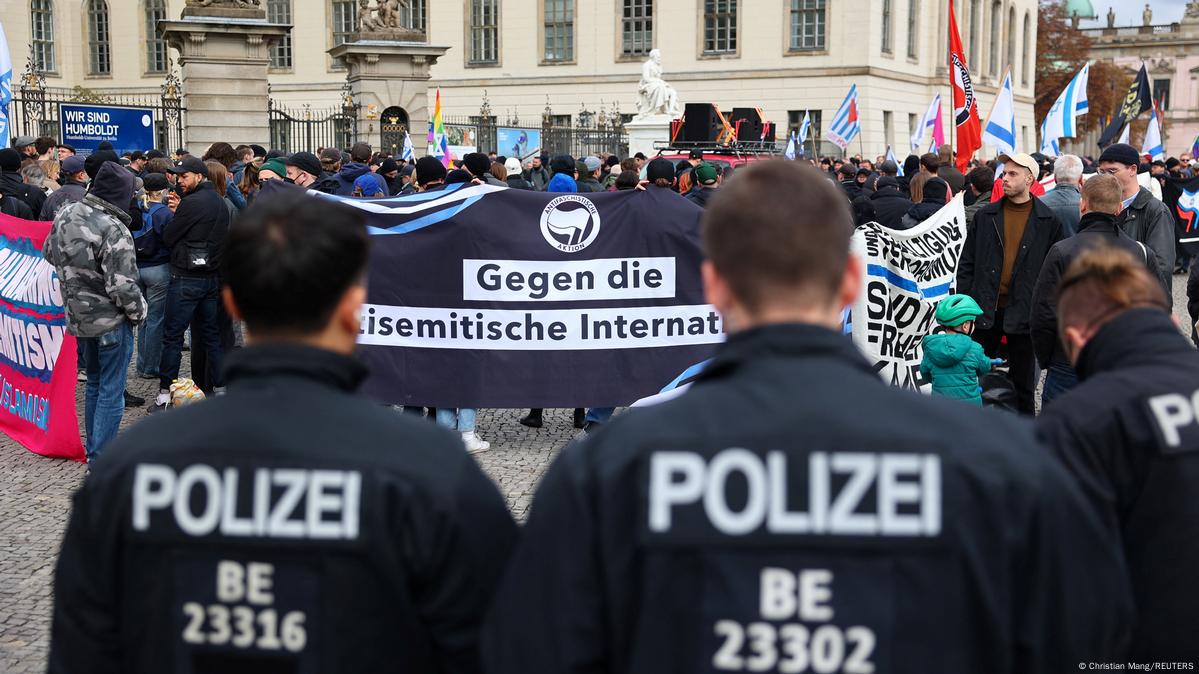
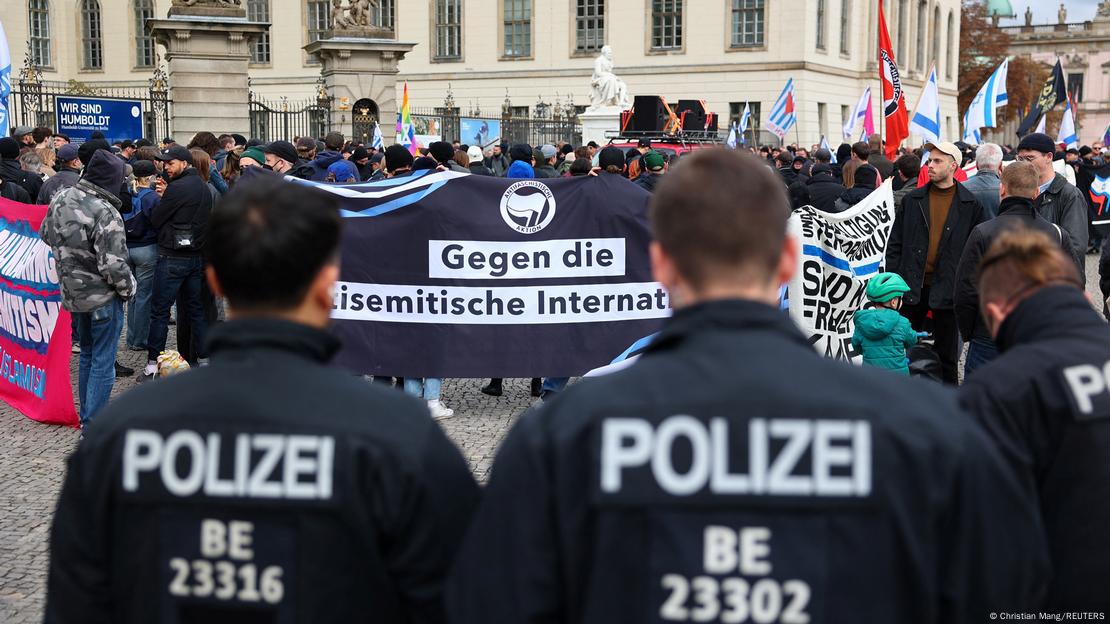
Police in Berlin said 500 officers were in action on Saturday amid a series of rival protests in the German capital, some showing support for Israel and others for Palestinians or Lebanese people.

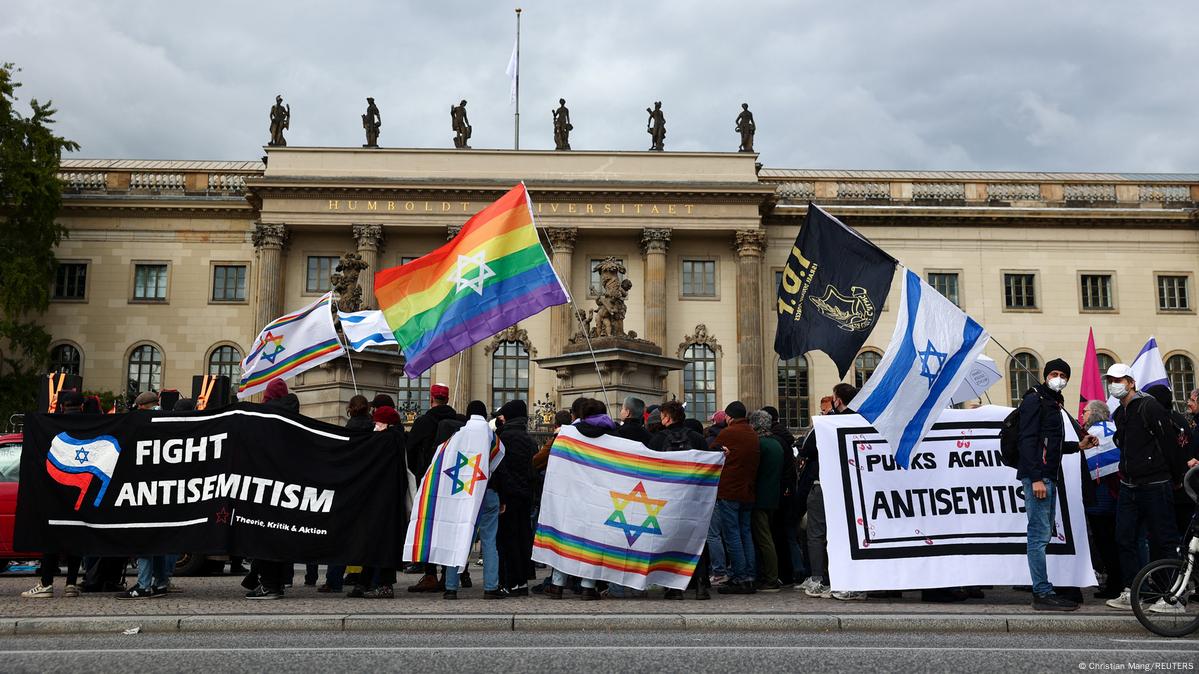
Several participants at a demonstration in front of Humboldt University in the city center carried Israeli flags and signs and placards showing their support for Israel.

Berlin police were on hand at demonstrations around the cityImage: Christian Mang/REUTERS

Nearby, a series of empty chairs bearing the photographs of people taken hostage by Hamas on October 7 and still in captivity was on display, with the caption "kidnapped" written in German above each portrait.

Rival rallies in other parts of Berlin

In other parts of the city, around a thousand protesters called for a halt to fighting in Gaza and in Lebanon, many waving Palestinian flags and carrying banners, some accusing Israel of "genocide" in Gaza.

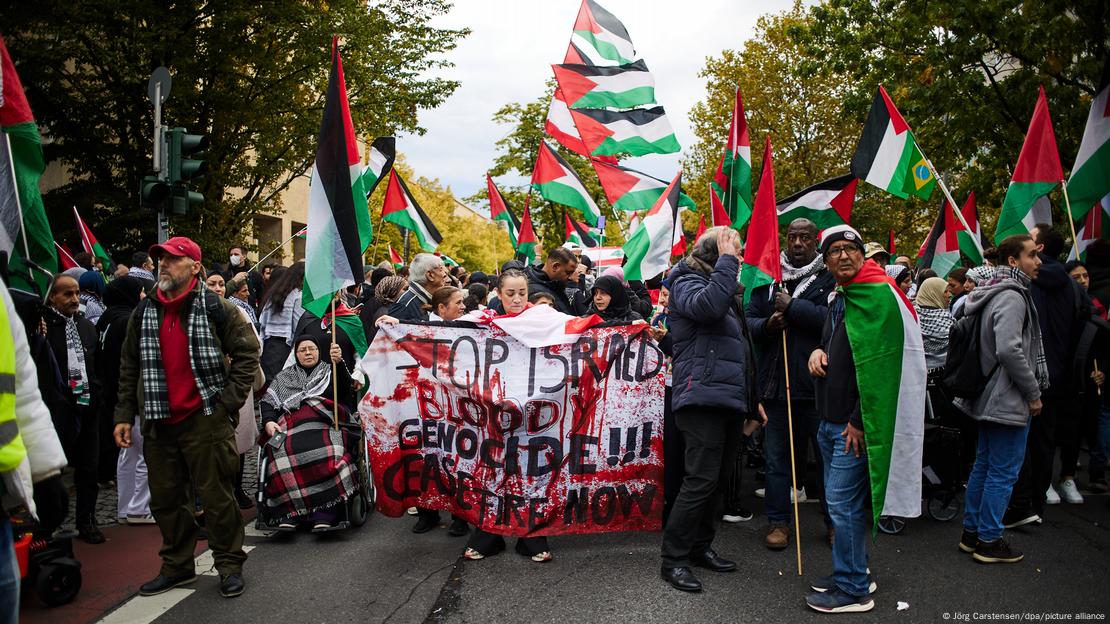
These protesters gathered near the memorial to the Cold War Berlin Airlift, near Tempelhof AirportImage: Jörg Carstensen/dpa/picture alliance

At one point, scuffles broke out between police and pro-Palestinian protesters, news agencies reported.

Berlin police reported one case of people at a pro-Palestinian demonstration in the Kreuzberg district "repeatedly chanting forbidden slogans," which it said would be prosecuted.

The politician in charge of interior affairs in the city-state of Berlin, Senator Iris Spranger, told the dpa news agency that what German authorities deem antisemitic would be prosecuted by police in the coming days. More and larger events are expected on Sunday and Monday as the October 7 anniversary approaches.

"My position is clear: Hatred, defamation and antisemitism do not belong on the streets of Berlin," Spranger told dpa while appealing to participants to "express their opinions, their personal concerns and their protests peacefully, respectfully and without violence."

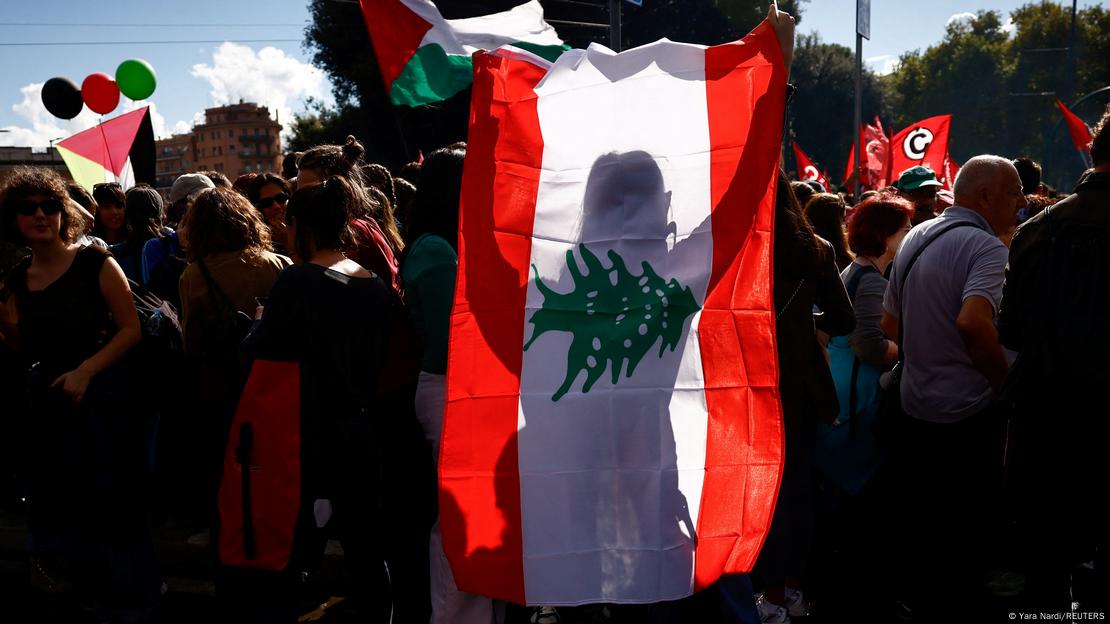
The Lebanese flag joined the Palestinian one at several of the protests around Europe on Saturday, including this one in Rome
 Yara Nardi/REUTERS

Jewish group official says October 7 an unsuitable date for pro-Palestinian protests

The president of the Central Council of Jews in Germany, Josef Schuster, said in a newspaper interview on Saturday that some recent pro-Palestinian demonstrations had been a "low point" for German society.

He cited "the scenes of celebration on German streets after Iran's rocket attack against Israel" earlier this week, and "the calls for open protests of hate towards Israel around the anniversary" of Hamas's October 7 terror attack.

Schuster told the RND network of newspapers that anyone who was unable on that anniversary "to feel at least a little empathy for Jewish people, for Israeli people, will never be able to do so — and that person has a serious problem."

Schuster said Germany's open society set up after World War II and the Holocaust in which the first article of the constitution begins, "Human dignity shall be inviolable," was at risk unless the rest of Germany recognized this problem.

The German government's commissioner tasked with combating antisemitism, Felix Klein, said he was observing with alarm not just rapidly rising cases of antisemitic crimes in Germany, but also protests "where hatred of Israel and antisemitic positions are expressed."

Meanwhile, the commissioner tasked with combating racism, Reem Alabali-Radovan, said it was not acceptable to place Palestinians or their supporters under general suspicion either.

Israel-Hamas-war: Berlin demonstrations ahead of October 7


October 7 is the anniversary of the terrorist attack on Israel, in which hundreds of Israelis were killed and kidnapped and which led to the Israel-Hamas war. Berlin already saw pro-Israeli and pro-Palestinian protests.


Pro-Israeli demonstration in Berlin

On Saturday, October 5, two days before the anniversary of the terrorist attack on Israel, there was a pro-Israel demonstration in Berlin. 

People gathered in front of Humboldt University to protest against antisemitism.
Image: Christian Mang/REUTERS


Pro-Palestinian protest at the same time
At the same time, a pro-Palestinian demonstration is taking place elsewhere in Berlin. At the Platz der Luftbrücke, many demonstrators are carrying Palestinian flags, as well as a large banner soaked in fake blood saying "Stop Israel's bloody genocide."

Hundreds of police on the streets


A lot of police are deployed to prevent violence. On the social media platform X, police said 500 officers were on site. The police estimated the number of participants in the pro-Palestinian rally at around 500 and the pro-Israeli demonstration at around 650.I

More demonstrations coming up


There were pro-Israeli and pro-Palestinian demonstrations not only in Berlin but also in other German cities and around the world. Further demonstrations have been announced for Sunday and Monday — and the number of participants will likely be larger than on Saturday.Image: Christian Mang/REUTERS

She said that while antisemitism should not be tolerated at any protests, "There must also be a space for people, where they can point to the suffering of the people in Gaza or in the region."

Germany's government has also faced criticism for what some deem an overzealous attempt to police and regulate antisemitism, likely rooted at least in part in its 20th century history.

From Cape Town to Copenhagen — other demonstrations around the world

People also took to the streets in countries including Denmark, the UK, the Republic of Ireland, France, Switzerland and Italy on Saturday, mostly calling for a halt to fighting in Gaza and Lebanon.

In Rome, police fired tear gas and water cannons after clashes broke out. Around 6,000 protesters defied a ban to march in the city center.

Some 40,000 people attended the "National March for Palestine" in central London, organizers said.

Police were on hand in numbers, after some demonstrators had said they planned to target businesses and institutions they deemed to support Israel in the city center, including the British Museum.

In London, counter-demonstrators waved Israeli flags as pro-Palestinian marchers walked by. There were 15 arrests on the sidelines of the protests, according to police, who did not specify whether those detained were from either group.

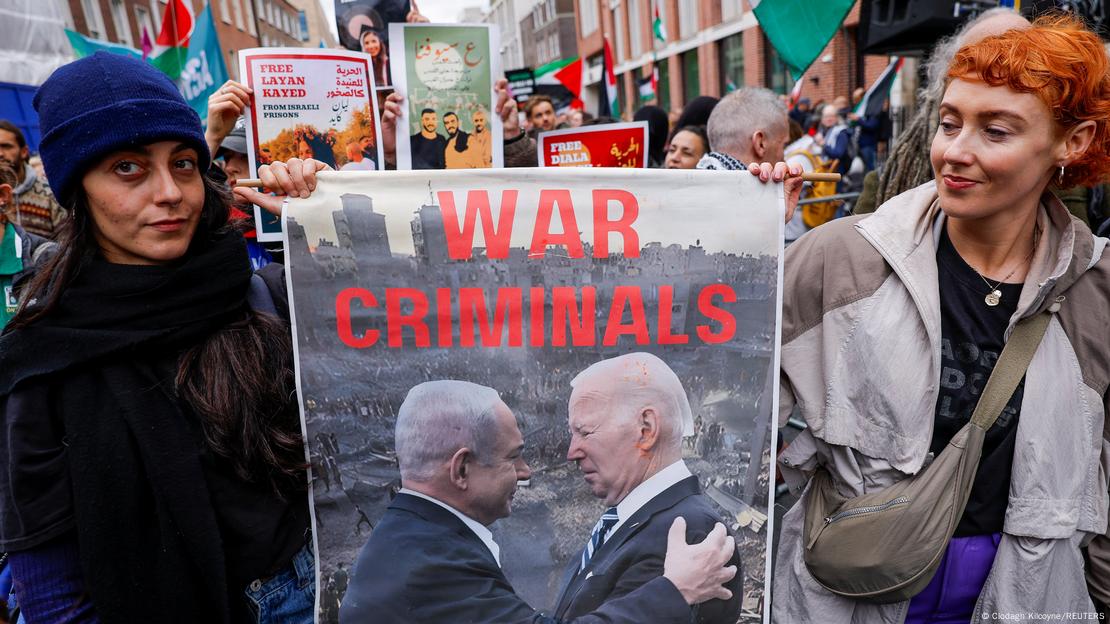
A simultaneous demo took place in the Republic of Ireland's capital, Dublin, with some calling Israeli Prime Minister Benjamin Netanyahu and US President Joe Biden "war criminals."

Some demonstrators in Dublin accused both the leaders of Israel and the US of being war criminalsImage: Clodagh Kilcoyne/REUTERS

In Cape Town, protesters marched towards South Africa's parliament in a protest organized by the Palestine Solidarity Campaign.

Similar demos took place in other major European cities including Stockholm, Copenhagen, Paris and Basel on Saturday.

mm, msh/sms (AFP, dpa, Reuters)


Condoms aren’t a fact of life for young Americans. They’re an afterthought
AS IT ALWAYS HAS BEEN


SAFE SEX- 
FORTY FOUR YEARS AFTER AIDS

Fewer young people are having sex, and the teens and young adults who are sexually active aren’t using condoms as regularly. It has some public health experts thinking about how to help young people have safe sex.


Condoms and other sexual wellness items are made available to students at the University of Mississippi campus in Oxford, Miss., Wednesday, Aug. 28, 2024. (AP Photo/Karen Pulfer Focht)


OXFORD, Miss. (AP) — It’s hard to miss the overflowing bowl of condoms at the entrance of the gym.


Some University of Mississippi students walking past after their workout snicker and point, and the few who step forward to consider grabbing a condom rethink it when their friends catch up, laughter trailing behind them. Almost no one actually reaches in to take one.


Though officials say they refill the bowl multiple times a day, and condoms are available at multiple places on campus, Ole Miss students say the disinterest is indicative of changing attitudes.


More women had their tubes tied after Roe v. Wade was overturned


Alaska governor vetoes expanded birth control access as a judge strikes down abortion limits

Fewer young people are having sex, but the teens and young adults who are sexually active aren’t using condoms as regularly, if at all. And people ages 15 to 24 made up half of new chlamydia, gonorrhea and syphilis cases in 2022.

The downward trend in condom usage is due to a few things: medical advancements like long-term birth control options and drugs that prevent sexually transmitted infections; a fading fear of contracting HIV; and widely varying degrees of sex education in high schools.

Is this the end of condoms? Not exactly. But it does have some public health experts thinking about how to help younger generations have safe sex, be aware of their options — condoms included — and get tested for STIs regularly.

“Old condom ads were meant to scare you, and all of us were scared for the longest time,” said Dr. Joseph Cherabie, medical director of the St. Louis HIV Prevention Training Center. “Now we’re trying to move away from that and focus more on what works for you.”


Drink protector “condoms” and other sexual wellness items are made available to students at the University of Mississippi campus in Oxford, Miss., Wednesday, Aug. 28, 2024. (AP Photo/Karen Pulfer Focht)

A shift in attitudes

Downtown Oxford was thrumming the day before the first football game of the season. The fall semester had just started.

Lines of college students with tequila-soda breath waited to be let in dim bars with loud music. Hands wandered, drifting into back pockets of jeans, and they leaned on one another.

It’s likely that many of those students didn’t use a condom, said Magan Perry, president of the college’s Public Health Student Association.
Advertisement

“Using a condom is just a big, ‘uh, no,’” the senior said.

Young women often have to initiate using condoms with men, she said, adding that she’s heard of men who tell a sexual partner they’ll just buy emergency contraception the next day instead.

“I’ve had friends who go home with a guy and say they’re not having sex unless they use a condom, and immediately the reaction is either a reluctant, ‘OK, fine,’ or ‘If you don’t trust me, then I shouldn’t even be here,’” Perry said. “They’re like, ‘Well, I’m not dirty, so why would I use them?’”

Women have long had the onus of preventing pregnancy or STIs, Cherabie said, and buying condoms or emergency contraceptives — which are often in a locked cabinet or behind a counter — can be an uncomfortable experience and “inserts a certain amount of shame.”

Annie Loomis, 25, a student at the University of Washington, said dating apps and casual sex are making it hard for people to know what a “healthy sexual relationship” looks like when it comes to intimacy and respect.

“If you say, ‘Hey, I want you to wear a condom’ and they say, ‘no, I don’t,’ you’re not having sex. It should be that simple,” Loomis said. “But it’s not.”

If pregnancy risk has been the driving factor for condom usage among heterosexual couples, the fear of contracting HIV was the motivation for condom use among men who have sex with men.

But as that fear has subsided, so has condom use, according to a recent study that focused on a population of HIV-negative men who have sex with men.

Grindr, a popular gay dating app, even lists condom use under “kinks” instead of “health.” Things like that make Steven Goodreau, an HIV expert at the University of Washington who led the study, worry that the change in attitudes toward condoms is trickling down to younger generations.

Goodreau believes the promotion of pre-exposure prophylaxis (PrEP), a drug that prevents HIV, is overshadowing condoms as a prevention strategy. A strategic plan for federal HIV research through 2025 doesn’t mention condoms, and neither does the national Ending the HIV Epidemic plan.


Students walk around the University of Mississippi campus in Oxford, Miss., Wednesday, Aug. 28, 2024. (AP Photo/Karen Pulfer Focht)

The Centers for Disease Control and Prevention acknowledges that condoms are still an effective tool that can be used “alongside newer prevention strategies.”

“We know that condom use has declined among some groups, but they still have an important role to play in STI prevention,” said Dr. Bradley Stoner, director of the CDC’s Division of STD Prevention. “Condoms can be accessed without navigating the health care system, can be used on-demand, are generally affordable and most importantly – they are effective at preventing HIV and STIs when used consistently and correctly.”
Medical advances allow for more options

Pleasure — for both men and women — has long been an undeniable factor for the lack of condom use, according to Dr. Cynthia Graham, a member of the Kinsey Institute team that studies condoms.


But more so, advances in medicine have expanded the options for both STI and pregnancy prevention.

Young cisgender women have been turning to contraceptive implants like intrauterine devices and birth control pills to keep from getting pregnant. And researchers say that once women are in committed relationships or have one sexual partner for a significant amount of time, they often switch to longer-term birth control methods.

Ole Miss junior Madeline Webb said she and her partner seem like outliers — they have been seeing each other for four years, but still use condoms. They also share the responsibility of buying condoms.

“People see condoms as an inconvenience … but they do serve a purpose even if you’re on birth control because there is always a chance of an STD,” Webb said.

A new drug on the market could mean even more STI prevention options for men and possibly women.

Doxycycline post-exposure prophylaxis, or doxy PEP, can be taken within 72 hours after unprotected sex and can help prevent chlamydia, gonorrhea and syphilis. It has to be prescribed by a doctor. Trials are still being conducted for women, but the drug is gaining traction among men who have sex with men and transgender women.

With widespread uptake, the drug has the potential to make a significant impact in STI prevention strategies.

“When PrEP came out, everyone was excited because it was one less thing to worry about in terms of HIV acquisition,” Cherabie said. “With another thing on board that can help decrease our likelihood of getting other STIs, on top of not having to worry about HIV, it gives our community and patients a little less anxiety about their sex lives.”


And in just a decade, PrEP has become a main preventive measure against HIV and other STIs for men who have sex with men – though it is disproportionately used by white men.

Condom use now is “pretty much a thing of the past” for men who have sex with men compared to the 1980s and early 1990s during the AIDS epidemic, said Andres Acosta Ardilla, a community outreach director at an Orlando-based nonprofit primary care clinic that
focuses on Latinos with HIV.


“Part of what we have to talk about is that there is something enticing about having condomless sex,” Acosta Ardilla said. “And we have to, as people who are working in public health, plan for the fact that people will choose to have condomless sex.”

Condoms and other sexual wellness items are stored at the University of Mississippi campus in Oxford, Miss., Wednesday, Aug. 28, 2024. (AP Photo/Karen Pulfer Focht)

The fight over sex ed


Despite the relentless Southern sun, a handful of people representing various student organizations sat at tables in the heart of Ole Miss’ campus. Students walked past and grabbed buttons, wristbands and fidget toys. One table offered gold-packaged condoms – for cups to prevent drinks from being spiked.

Actual condoms are noticeably absent. They’re also absent in the state’s public schools.


Condom demonstrations are banned in Mississippi classrooms, and school districts can provide abstinence-only or “abstinence-plus” sexual education — both of which can involve discussing condoms and contraceptives.

Focus on the Family, a Christian organization that advocates for teaching abstinence until marriage, is concerned that comprehensive sex education “exposes students to explicit materials.” Abstinence-centered education is “age-appropriate” and keeps students safe and healthy, Focus on the Family analyst Jeff Johnston said in an emailed statement.

But Josh McCawley, deputy director of Teen Health Mississippi, an organization that works with youth to increase access to health resources, said the effects are clear.

“The obvious consequence is the rise of sexually transmitted infections, which is what we’re seeing right now, which can be a burden on the health care system,” he said, “but also there could be long-term consequences for young people in terms of thinking about what it means to be healthy and how to protect themselves, and that goes beyond a person’s sexual health.”

The latest CDC data from 2022 shows Mississippi has the highest teen birth rate in the country.

Scott Clements, who oversees health information for the state education department, was hesitant to criticize Mississippi’s sex education standards because they’re “legislatively mandated.”

“If the legislature wants to make changes to this, we will certainly follow their lead,” he added — though attempts to pass more advanced sexual education standards have died repeatedly in the Mississippi statehouse over the past eight years.

Nationally, there is no set standard for sex education, according to Michelle Slaybaugh, the director of social impact and strategic communication for the Sexuality Information and Education Council for the United States, which advocates for comprehensive sex ed.

Not every state mandates sex education. Some states emphasize abstinence. Less than half of states require information on contraception.

“There is no definitive way to describe what sex ed looks like from classroom to classroom, even in the same state, even in the same district,” Slaybaugh said, “because it will really be determined by who teaches it.”


Compare Mississippi to Oregon, which has extensive state standards that require all public school districts to teach medically accurate and comprehensive sexual education. Students in Portland are shown how to put on a condom on a wooden model of a penis starting in middle school and have access to free condoms at most high schools.


Lori Kuykendall of Dallas, who helped write abstinence-focused standards, said condom demonstrations like those in Portland “normalize sexual activity in a classroom full of young people who the majority of are not sexually active.” She also points to increasingly easy access to pornography — in which people typically do not wear condoms — is a contributing factor to the decline in condom use among young people.

Jenny Withycombe, the assistant director for health and physical education at Portland Public Schools, acknowledged the standards see pushback in the more conservative and rural parts of Oregon. But the idea is to prepare students for future interactions.

“Our job is to hopefully build the skills so that even if it’s been a while since the (condom) demo ... the person has the skills to go seek out that information, whether it’s from the health center or other reliable and reputable resources,” Withycombe said.

Those standards seem to contribute to a more progressive view of condoms and sex in young adults, said Gavin Leonard, a senior at Reed College in Portland and a former peer advocate for the school’s sexual health and relationship program.

Leonard, who grew up in Memphis – not far from Oxford, Mississippi, said his peers at Reed may not consistently use condoms, but, in his experience, better understand the consequences of not doing so. They know their options, and they know how to access them.

Slaybaugh wants that level of education for Mississippi students — and the rest of the country.

“We would never send a soldier into war without training or the resources they need to keep themselves safe,” she said. “We would not send them into a battle without a helmet or a bulletproof vest. So why is it OK for us to send young people off to college without the information that they need to protect themselves?”

This story has been corrected to show that Michelle Slaybaugh’s title is director of social impact and strategic communication for the Sexuality Information and Education Council for the United States.


___


Associated Press videojournalist Manuel Valdes in Seattle contributed to this report.


___


The Associated Press Health and Science Department receives support from the Robert Wood Johnson Foundation. The AP is solely responsible for all content.


SEX ED AT OLD MIS


A couple holds hands at the University of Mississippi campus in Oxford, Miss., Wednesday, Aug. 28, 2024. (AP Photo/Karen Pulfer Focht)


Condoms and other sexual wellness items are stored at the University of Mississippi campus in Oxford, Miss., Wednesday, Aug. 28, 2024. (AP Photo/Karen Pulfer Focht)

Condoms and other sexual wellness items are made available to students at the University of Mississippi campus in Oxford, Miss., Wednesday, Aug. 28, 2024. (AP Photo/Karen Pulfer Focht)


DEVNA BOSE
Bose is a public health reporter for The Associated Press, based in Jackson, Mississippi. She covers hospitals, rural health access and disparities, public health funding and other topics that broadly intersect with the health of communities.
twitter mailto
In Philadelphia, Chinatown activists rally again to stop development. This time, it’s a 76ers arena


Activists fought against the proposal for a Phillies stadium in the early 2000s. They are now experiencing déjà vu as they try to stop a planned $1.3 billion arena at the edge of Chinatown. 


Supporters and Chinatown community leaders gathered during a “No Sixers arena rally” on Wednesday, Sept. 18, 2024, outside Philadelphia City Hall in Philadelphia. (Jose F. Moreno/The Philadelphia Inquirer via AP)

Supporters and Chinatown community leaders gather during a “No Sixers arena rally” on Wednesday, Sept. 18, 2024, outside Philadelphia City Hall in Philadelphia. (Jose F. Moreno/The Philadelphia Inquirer via AP)

Supporters and Chinatown community leaders gathered during a “no Sixers arena rally” on Wednesday, Sept. 18, 2024, outside Philadelphia City Hall in Philadelphia. 

(Jose F. Moreno/The Philadelphia Inquirer via AP)

BY MARYCLAIRE DALE
October 5, 2024

PHILADELPHIA (AP) — Vivian Chang works on a narrow Philadelphia street that would have been consumed by a Phillies stadium had Chinatown activists not rallied to defeat the plan in the early 2000s. Instead of 40,000 cheering fans, the squeals of young children now fill the playground at Folk Arts-Cultural Treasures Charter School, which opened in 2007.

“We’re standing right where the baseball stadium would have been,” Chang said in late September. “And now it’s 480 students — a lot of immigrants, a lot of students of color from across the city.”

Chang, 33, leads Asian Americans United, which flexed its political muscle during the stadium fight and is now experiencing déjà vu as it tries to stop a planned $1.3 billion basketball arena for the Philadelphia 76ers at the other edge of Chinatown.

Mayor Cherelle Parker hopes a glitzy, 18,500-seat arena can be the catalyst to revive a distressed retail corridor called Market East, which runs for eight blocks, from City Hall to the Liberty Bell. The plan now moves to city council for debate this fall. Team owners say they need the council’s approval for 76 Place by year’s end so they can move into their new home by 2031.

“I wholeheartedly believe this is the right deal for the people of Philadelphia,” Parker said in announcing her support in September, while pledging to protect what she called “the best Chinatown in the United States.”

RELATED STORIES

Philadelphia mayor strikes a deal with the 76ers to build a new arena downtown

Philadelphia mayor reveals the new 76ers deal to build an arena downtown

Few would deny that Market East needs a savior. But some are less sure it should be the Sixers. Critics fear gridlock on game days and a dark arena at other times, along with gentrification, homogenization and rising rents. Chinatown sits just above Market East and the LGBTQ+ friendly “Gayborhood” a few blocks below it.

“The arena is a uniquely bad use for that land,” said local activist Jackson Morgan, who fears the Gayborhood could lose its identity. “It would make Center City virtually unlivable for hours at a time.”

Victor Matheson, an economics professor at the College of the Holy Cross who studies stadium issues, said arenas can bring an economic bounce to downtown business districts, but only a limited one.

“They don’t have much of an effect once you get beyond a couple of blocks,” he said.

Market East, a once-bustling stretch of historic Market Street, has withered over the last half-century amid a series of cultural shifts: the growth of suburban shopping malls in the 1960s and ‘70s, the financial crises that crippled U.S. cities in the 1980s, and, more recently, the twin blows of online shopping and the pandemic.

And while much of Philadelphia is thriving as more young people settle downtown, Market East has resisted renewal efforts. All but one of its fabled department stores are long gone.

Enter the 76ers, owned by Harris Blitzer Sports & Entertainment, who want to shed their Wells Fargo Center lease with Comcast Spectacor and move from the city’s South Philadelphia sports complex to their own facility.

The partners, who also own the NHL’s New Jersey Devils and have a controlling interest in the NFL’s Washington Commanders, say the project will be privately financed and bring thousands of jobs and more than $2 billion in economic growth to downtown. They also hope to build an adjacent $250 million apartment tower.

“I think the arena is a good thing,” said Dante Sisofo, 28, who lives nearby. “I could see a lot of families gathering and getting a nice bowl of Vietnamese pho — my favorite dish — and then heading to the game.”

Parker shares his optimism, and has tried to address concerns by noting the $50 million in local benefits the team has promised, a sum that includes a $3 million loan fund for Chinatown businesses.

But others wonder if sports fans would really patronize mom and pop stores. Arenas, they say, are designed to keep fans inside, spending their money on increasingly upscale dining and entertainment.

“The Sixers’ owners, they don’t make money by people going to the quaint little sports bar across the street. They make money by having people buy those $14 beers inside the stadium,” Matheson said.

The owners have pledged not to ask the city for any construction funding, although they are free to seek state and federal funds. Instead of property taxes, they would pay about $6 million in annual Payments in Lieu of Taxes. Over the 30-year agreement, the potential savings to the team — and loss to the city and its cash-strapped schools — could be tens of millions of dollars or more, by some economists’ measure.

“Historically, city officials have been extremely poor poker players when it comes to staring down and bluffing billionaire sports owners,” Matheson said.

“And of course, that’s the exact reason why you have them playing footsie with Camden,” he said, referring to a last-minute flirtation from New Jersey to have the Sixers move across the Delaware River, where the team already has a practice facility, for $400 million in tax breaks.

Still, Parker called the deal the best ever struck with a city sports team, given that the three venues in South Philadelphia — the Wells Fargo Center, Citizens Bank Park and Lincoln Financial Field — were all built with huge public subsidies.

Back in Center City, rising rents already are a reality for Debbie Law’s family.

It ran a variety store in the heart of Chinatown for 35 years until the landlord tripled the rent in 2022, when the arena plan surfaced. The family reluctantly moved around the block to a smaller, less visible location that faces the hulking back side of the Pennsylvania Convention Center, another economic development project that hems in Chinatown.

“I grew up in that shop. It was a community center of sorts,” said Law, 42, as her aunt tended the register at the new store one recent day. Local residents, she said, rely on them for Chinese-language magazines, newspapers and cultural items they would struggle to find if the store is displaced again.

The Chinatown community, which dates to 1871, has worked to fend off sometimes dubious development since at least the 1960s: casinos, a prison, the stadium, a highway. They have won some fights and lost others. The six-lane, sunken Vine Street Expressway opened in 1991, cutting off the top of Chinatown, where the charter school sits. Only now are pedestrian overpasses being built to try to stitch the neighborhood back together.

“Every single time that Chinatown has been targeted for a project like this, people say Chinatown will survive,” Chang said. “But is that really how we should be treated as a community?”
___

AP NBA: https://apnews.com/hub/NBA

MARYCLAIRE DALE
Dale covers national legal issues for The Associated Press, often focusing on the federal judiciary, gender law, #MeToo and NFL player concussions. Her work unsealing Bill Cosby’s testimony in a decade-old deposition led to his arrest and sexual assault trials.