DAWN
Monitoring Desk
Monitoring Desk
Published February 18, 2025 Updated about 13 hours ago

US Special Envoy to the Middle East Steve Witkoff looks on, at the White House, in Washington, US on February 3, 2025. — Reuters/Elizabeth Frantz/File
WASHINGTON/BRUSSELS: When US President Donald Trump wanted someone to meet Russian President Vladimir Putin last week to open negotiations for a potential deal to end the Russia-Ukraine war, he didn’t dispatch his secretary of state.
The man he sent to the Kremlin to handle a titanic geopolitical challenge does not even have a diplomatic background, the BBC reported.
Instead, Trump picked his personal friend, golf buddy and billionaire real estate developer Steve Witkoff. The president has made Witkoff his Middle East envoy.
But last week the Bronx-born businessman found himself in discussions about ending a conflict in Eastern Europe — having been “with [Putin] for a very extended period, like about three hours”, in Trump’s words.
Witkoff was in Moscow to help facilitate a deal that saw the US and Russia swap prisoners, which was seen as signalling a possible thaw in relations between the two countries. Witkoff also played a part in brokering the current ceasefire agreement between Israel and Hamas, for which both Trump and his predecessor Joe Biden took credit.
Witkoff is now returning to the region — specifically Saudi Arabia — for the first US-Russian face-to-face talks over the war in Ukraine after Trump had his own call with Putin, according to BBC news.
So, who is Witkoff — dubbed by US media as “the man in the room”, taking centre stage as more potentially consequential international talks take place?
He was one of Trump’s first picks for his top team after his presidential election win in November. Trump wrote: “Steve will be an unrelenting voice for PEACE, and make us all proud”, the BBC reported.
“The president sees Steve as one of the world’s great dealmakers,” a White House official told Axios.
Witkoff’s preferred negotiating tactic was to use charm, according to another associate, but he could also turn up the pressure. The 67-year-old was raised in Long Island, New York and trained as a real estate developer in one of America’s most cut-throat markets.
Ukraine deal
US envoy Keith Kellogg on Monday said that he would not tell Ukraine to accept whatever deal is negotiated by President Donald Trump to end Russia’s war, ahead of a visit to Kyiv.
Kellogg is set to arrive in Ukraine on Wednesday for three days of talks that will include a meeting with President Volodymyr Zelensky.
His visit to Kyiv will come after top US officials, including Wikoff, meet Russian negotiators in Saudi Arabia on Tuesday for the first time since Trump blindsided allies by agreeing to launch peace efforts with Russian counterpart Vladimir Putin.
Kellogg said US officials were engaged in parallel efforts to bring Moscow and Kyiv to the negotiating table — with him spearheading the outreach to Ukraine. Trump’s envoy insisted that it would ultimately be up to Zelensky to decide if Ukraine accepts any deal that the US leader brokers.
“The decision by Ukrainians is a Ukrainian decision,” Kellogg told journalists after talks with US allies at Nato headquarters in Brussels.
Published in Dawn, February 18th, 2025
Opinion
WASHINGTON/BRUSSELS: When US President Donald Trump wanted someone to meet Russian President Vladimir Putin last week to open negotiations for a potential deal to end the Russia-Ukraine war, he didn’t dispatch his secretary of state.
The man he sent to the Kremlin to handle a titanic geopolitical challenge does not even have a diplomatic background, the BBC reported.
Instead, Trump picked his personal friend, golf buddy and billionaire real estate developer Steve Witkoff. The president has made Witkoff his Middle East envoy.
But last week the Bronx-born businessman found himself in discussions about ending a conflict in Eastern Europe — having been “with [Putin] for a very extended period, like about three hours”, in Trump’s words.
Witkoff was in Moscow to help facilitate a deal that saw the US and Russia swap prisoners, which was seen as signalling a possible thaw in relations between the two countries. Witkoff also played a part in brokering the current ceasefire agreement between Israel and Hamas, for which both Trump and his predecessor Joe Biden took credit.
Witkoff is now returning to the region — specifically Saudi Arabia — for the first US-Russian face-to-face talks over the war in Ukraine after Trump had his own call with Putin, according to BBC news.
So, who is Witkoff — dubbed by US media as “the man in the room”, taking centre stage as more potentially consequential international talks take place?
He was one of Trump’s first picks for his top team after his presidential election win in November. Trump wrote: “Steve will be an unrelenting voice for PEACE, and make us all proud”, the BBC reported.
“The president sees Steve as one of the world’s great dealmakers,” a White House official told Axios.
Witkoff’s preferred negotiating tactic was to use charm, according to another associate, but he could also turn up the pressure. The 67-year-old was raised in Long Island, New York and trained as a real estate developer in one of America’s most cut-throat markets.
Ukraine deal
US envoy Keith Kellogg on Monday said that he would not tell Ukraine to accept whatever deal is negotiated by President Donald Trump to end Russia’s war, ahead of a visit to Kyiv.
Kellogg is set to arrive in Ukraine on Wednesday for three days of talks that will include a meeting with President Volodymyr Zelensky.
His visit to Kyiv will come after top US officials, including Wikoff, meet Russian negotiators in Saudi Arabia on Tuesday for the first time since Trump blindsided allies by agreeing to launch peace efforts with Russian counterpart Vladimir Putin.
Kellogg said US officials were engaged in parallel efforts to bring Moscow and Kyiv to the negotiating table — with him spearheading the outreach to Ukraine. Trump’s envoy insisted that it would ultimately be up to Zelensky to decide if Ukraine accepts any deal that the US leader brokers.
“The decision by Ukrainians is a Ukrainian decision,” Kellogg told journalists after talks with US allies at Nato headquarters in Brussels.
Published in Dawn, February 18th, 2025
Opinion
Middlemen Are Trump’s ‘Alternative’ for Statesmen

Eyad Abu Shakra
Tuesday - 18 February 2025
US President Donald Trump’s engagements, as well as his statements to the media, have sparked concern in many corners of the world, including Western Europe, where most countries are NATO allies. This alliance had been established on the basis of a "military doctrine" to counter the Soviet Union, which Western nations saw as antithetical, ideologically and economically, to Western values, culture, and interests. A powerful communist rival that sought to expand its influence and export its model globally.
NATO was one of three alliances that Washington formed to "contain" the communist threat posed by the Soviet Union and Communist China: NATO in Europe, the Baghdad Pact in the Middle East (which later became the Central Treaty Organization, CENTO), and the Southeast Asia Treaty Organization (SEATO).
Over the years, and throughout most of the Cold War, the countries of these three regions, and others, were split between the "allies" of Washington and its "adversaries" who relied on Soviet and Chinese support. Even after the establishment of Israel, the collapse of the Soviet Union, and the emergence of a major nationalist state in its place, the Russian Federation, the historical alignments of the period broadly remained the same.
In the Middle East, President Trump’s recent positions, most notably his state intention to displace the people of Gaza to Jordan, Egypt, and other countries, have shocked many of Washington’s allies and friends in the region.
It is well known that the Democrats lost the last elections due to their cowardice and lack of scruple in the face of a fanatical, ideological, and religious Republican populist campaign, which was orchestrated by some of the staunchest supporters of "Greater Israel" behind the scenes: Sheldon Adelson and his family, Rupert Murdoch’s vitriolic media empire, and the oligarchs of the new media...
However, Donald Trump did not merely return to the White House; under his leadership, the Republicans also regained control of both houses of Congress, and he has built a conservative majority on the Supreme Court. As a result, Trump feels that the American people have given him an absolute mandate to do what he wants: even restructuring institutions, violating laws and norms, and dismantling the issues of broad foundations that underpin a sound democracy and ensure accountability and the peaceful transfer of power.
That is the domestic scene, where the disoriented Democratic opposition seems to still be reeling from its defeat in November. Globally, things are no less alarming following the flood of Trump’s unrestrained executive orders.
The Arab world was shocked not only by the cruelty of Trump’s proposal for Gaza, but also by his insistence on it, even after it was met with universal rejection from every actor concerned - with the exception, of course, of his Likudist partner and instigator. Several Arab countries are now taking action in the face of an increasingly worrisome situation that threatens an avalanche of regional complications.
Washington’s relations with the Arab world are part of a broader global pattern. Responsible figures from within the American institutions, particularly in defense and intelligence, have begun to sound the alarm, warning of the threats that the administration’s new course poses to Washington’s relationships and long-term strategic interests.
Some Americans were stunned by Trump’s unprovoked "antagonization" of their two neighbors, Canada to the north and Mexico to the south. This began with his stated desire to annex Canada and launch a new "economic war" against Mexico, after his presidency’s opening act had been the "border wall." As we have seen and continue to see, economic warfare through tariffs has become a weapon from the past that Washington wields in the present against any leader or state that insists on independence.
Equally shocking was Trump’s unilateral insistence on acquiring Greenland, a vast island belonging to Denmark, despite the fact Denmark, both a trade partner and a NATO ally of the US, has categorically rejected the idea. He also turned his attention to Panama, making a claim to the Panama Canal, which connects the Atlantic and Pacific Oceans.
At the same time, lawmakers in Congress, generals at the Pentagon, experts in research centers, and officials in military alliances (including NATO) have condemned several recent Trump appointments. One is Peter Hegseth, a right-wing commentator on Murdoch’s Fox News who was appointed Secretary of Defense. Another is former Congresswoman Tulsi Gabbard, a defender of Russian President Vladimir Putin and former Syrian President Bashar al-Assad, who was appointed Director of National Intelligence!
Adding to the "absurdity," US Vice President J.D. Vance made hostile remarks about the European Union last week. Meanwhile, the Trump administration, particularly through billionaire Elon Musk, has been openly supporting far-right parties in Europe, including the neo-Nazi Alternative for Germany (AfD) and the anti-immigrant Reform Party in Britain, antagonizing Washington’s two most strategic allies in Europe.
The European picture was made even more bleak as Trump and his administration reversed course on Ukraine. He stressed that he trusted Putin and that he wanted to make a deal, even if it meant forcing Ukraine to cede some of its territory to Russia.
In Asia, Trump took a coercive and domineering posture when receiving his guest, India’s hard right Prime Minister Narendra Modi, who is supposed to be among the closest allies of the US on the continent and whose role would be particularly relevant in the event of a major confrontation with China over trade or Taiwan. Modi was "forced" to agree to purchase more US oil (!), American-made cars, and advanced F-35 fighter jets (which New Delhi had not sought), along with modifications that would allow India to buy more US nuclear reactors.
In light of the above, there can be no doubt Ishaq al-Mawsili was right: "Every era has its state and its men."




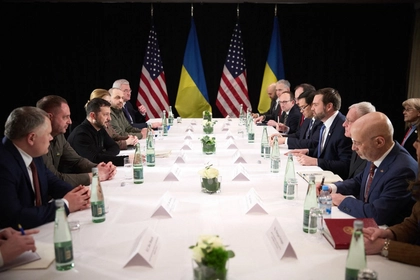







U.S. Secretary of State Marco Rubio meets with Saudi Arabia Foreign Minister Faisal bin Farhan in Riyadh, Saudi Arabia, February 17, 2025. /VCG
U.S. Secretary of State Marco Rubio arrived in Riyadh on Monday, with reports indicating that he will begin talks with Russian officials on the Ukraine crisis there on Tuesday, excluding key players in the conflict: Ukraine and Europe.
In addition to Rubio, U.S. Middle East Special Envoy Steve Witkoff and National Security Advisor Mike Waltz are expected to attend the talks. Russian Foreign Minister Sergey Lavrov and Russian Presidential Assistant Yuri Ushakov will represent Russia in the negotiations.
Ukrainian President Volodymyr Zelenskyy announced on Monday that Ukraine will not participate in the U.S.-Russia talks and will not accept any outcome that excludes Ukraine.
Currently in the United Arab Emirates (UAE), Zelenskyy is set to visit Saudi Arabia soon. He clarified that his visit to Saudi Arabia on Tuesday "has no connection" to the U.S.-Russia talks, focusing instead on discussions to lower oil prices with Saudi Arabia. However, he noted that he would use the opportunity to learn about the progress of the U.S.-Russia negotiations through Saudi officials.
Concerned about being sidelined in the negotiations, Europe leaders have taken action.
French President Emmanuel Macron convened an emergency meeting in Paris on Monday, bringing together leaders from NATO, the European Commission, and key European countries, including France, Germany, Britain, Poland, Spain, Italy, Denmark, and the Netherlands, to coordinate a unified European response ahead of the Russian-U.S. talks.
Chen Yu, deputy director of the Eurasian Institute at the China Institute of Contemporary International Relations, told CMG that Europe considers Ukraine as a core interest. He noted that Europeans are worried that the current U.S.-Russia approach, bypassing Europe, could undermine European interests and lead to a peace solution that sacrifices concerns of Ukraine and Europe. Additionally, Europe fears this could result in further expansion of Russian influence in the West.
After the meeting, Macron spoke with U.S. President Donald Trump and Ukrainian President Zelenskyy. He later tweeted that Europe seeks a "strong and lasting peace" for Ukraine, one that includes "strong and credible security guarantees" for the Ukrainian people.
German Chancellor Olaf Scholz also reiterated Germany's ongoing support for Ukraine, rejecting the notion that Ukraine should accept "everything that is presented to it under any conditions." He emphasized the importance of unity between U.S. and European allies in safeguarding European security. "There must be no division of security and responsibility between Europe and the United States," Scholz stated. "NATO is based on the principle of always acting together and sharing the risks. This must not be called into question."
UK Prime Minister Keir Starmer, speaking outside the Ukraine summit in Paris, called the future of Ukraine an "existential" issue for Europe. He suggested that Britain may consider deploying forces to Ukraine if a lasting peace agreement is reached.
However, Chancellor Scholz dismissed the idea of European countries sending ground troops to Ukraine, calling it "totally premature." He did confirm that European nations are prepared to allocate "at least two percent" of their GDP to strengthen Europe's defense.
Chen explained that Europe is pushing to play a more prominent role in resolving the Russia-Ukraine conflict amid ongoing U.S.-Russia negotiations. However, there are significant divisions within Europe regarding security guarantees for Ukraine and the potential for troop deployment after a ceasefire.
He pointed out that any realistic peace settlement would likely address Ukraine's security concerns, which are central to the country's interests. If such a solution requires Europe to take on more responsibilities, Europe may be willing to do so, including engaging in discussions about troop deployment. However, he cautioned that the situation remains complex, with substantial differences in positions, requiring ongoing observation of how events unfold.
OPINION: The Art (and Pitfalls) of a Ukraine Deal
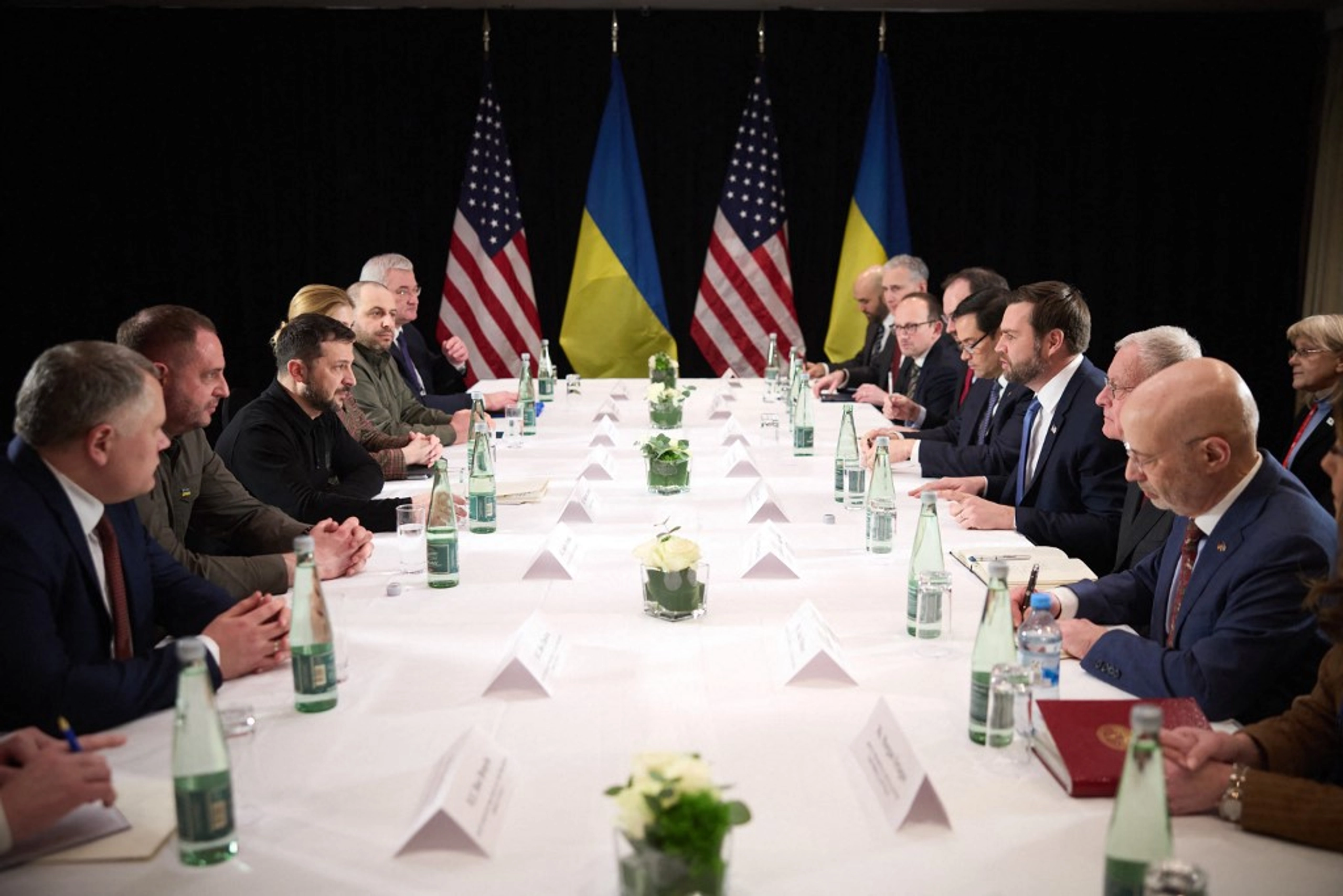
Talks between the US and Russia have begun. But excluding Ukraine at any stage does not bode well for the security guarantees necessary to prevent Russian aggression in the future.
By Lord Ashcroft
KYIV POST
February 18, 2025
As discussions on Ukraine’s future intensify, one recurring notion in diplomatic circles is that Donald Trump has set his sights on a Nobel Peace Prize by negotiating an end to the war. However, if he mishandles this delicate process, that prize will remain far beyond his reach. If his proposed deal leaves Ukraine vulnerable, fractures NATO, or emboldens further Russian aggression, his legacy will not be peace – it will be appeasement.
As my recent polling found, while most Ukrainians believe Trump’s election will mean a swifter end to the war, many also fear this will be on terms less favorable to Ukraine. The recent remarks by US Secretary of Defense Pete Hegseth do not inspire confidence. He stated unequivocally that a return to Ukraine’s pre-2014 borders is off the table. Does this mean the United States is prepared to disregard the Belovezh Accords of 1991, which affirmed Ukraine’s sovereignty within internationally recognized borders?
More troublingly, it would mark yet another broken American commitment to Ukraine – following the Budapest Memorandum of 1994, which assured Ukraine’s security in exchange for surrendering the world’s second-largest nuclear arsenal. A failure to uphold these agreements sends a disastrous signal, not just to Russia but to potential aggressors worldwide.
Ukrainian President Volodymyr Zelensky has made it clear that no deal will be accepted without Ukraine’s involvement. He has also implied that the US can no longer be fully trusted to align with European interests in the region. Gen. Keith Kellogg, Trump’s top security envoy, recently echoed the necessity of Ukraine’s presence at the negotiating table – but was noticeably vague about European involvement. Excluding Europe from a settlement on European security would be a serious and costly mistake.
First US-Russia Meetings Held in Riyadh Ahead of Official Saudi Talks
The head of the Russian Direct Investment Fund revealed that he has already met with members of US President Donald Trump’s team in the Saudi capital.
If a peace deal is to have any legitimacy, it must satisfy several key conditions.
Advertisement
The only real assurance of lasting peace for Ukraine is NATO membership.
First, it cannot leave Ukraine as an exposed buffer state, vulnerable to another Russian invasion in the coming years. A ceasefire that merely freezes the conflict without robust security guarantees would be a repeat of the failed Minsk agreements of 2014 and 2015, which Moscow systematically violated. The only real assurance of lasting peace for Ukraine is NATO membership. Anything short of that leaves the door open for further Russian aggression.
Secondly, any peace deal must consider the reality on the ground. Russia’s economy, despite Western sanctions, has been kept afloat by its ability to bypass restrictions – particularly through the sale of oil to India and other third parties. If Trump is serious about exerting pressure on Moscow, he must address these loopholes rather than force Ukraine into an unfavorable settlement. He must also understand that the very survival of Ukraine as a sovereign state depends on continued military and economic support.
Meanwhile, as these negotiations develop, Europe must step up. The continent has long relied on American military backing, but with Washington potentially shifting its stance, European nations must take responsibility for their own security. Trump has already made it clear that he expects Europe to contribute more to defense, and rightly so. Poland has led by example, committing 5% of its GDP to defense, while the Baltic states are set to reach this benchmark by next year. But others, including key Western European powers, have lagged behind. If Europe wants a real say in shaping Ukraine’s future and ensuring long-term stability on the continent, it must match its words with action.
The recent Munich Security Conference reflected these tensions. While European leaders expressed continued support for Ukraine, the reality is that decisive commitments on increased defense spending and military aid remain insufficient. In the meantime, senior figures from the Trump administration are reportedly in Saudi Arabia to engage in talks with Russian and Ukrainian negotiators. National Security Advisor Mike Waltz, Secretary of State Marco Rubio, and Middle East envoy Steve Witkoff are expected to push for an agreement in the coming days.
We must reject the notion that a rushed, ill-conceived deal is the only path forward.
Zelensky, however, remains deeply skeptical of Putin’s intentions, and for good reason. Russia has shown time and again that it does not honor ceasefires or diplomatic agreements. The OSCE monitoring missions that oversaw previous ceasefire lines were ignored and rendered powerless in the face of Russian violations. So, the critical question remains: who will enforce any new ceasefire? Will there be peacekeeping troops on the ground? If so, which nations would be willing to send them? And what happens if – when – Russia violates the terms again?
These are fundamental concerns that must be addressed before any deal is signed. A flawed agreement that fails to ensure Ukraine’s security could lead to an internal crisis, possibly even civil unrest. The thousands of battle-hardened Ukrainian soldiers who have sacrificed so much will not accept a settlement that undermines their cause. Any agreement that leaves Russia with the capacity to strike again, or forces Ukraine into concessions that betray its sovereignty, will not bring peace—it will simply set the stage for the next war.
The stakes could not be higher. We must reject the notion that a rushed, ill-conceived deal is the only path forward. A just peace must be one that guarantees Ukraine’s long-term security, holds Russia accountable, and reinforces the strength of Western alliances. Anything less would be a betrayal of everything Ukraine has fought for – and would all but guarantee that history repeats itself.
Lord Ashcroft KCMG PC is an international businessman, philanthropist, author and pollster. For more information on his work, visit lordashcroft.com. Follow him on X/Facebook @LordAshcroft.
The views expressed in this opinion article are the author’s and not necessarily those of Kyiv Post.
“If you believe there are going to be thirty-three people sitting at the same table (…) in all probability, the answer is no, not at all,” Kellogg explained.
by Euractiv | February 18, 2025,
European views will be taken into account and Ukraine will not be pressured into a deal, the US envoy for Ukraine and Russia told a group of reporters at NATO HQ.
Keith Kellogg’s two-day visit to Brussels comes amid growing unease among European allies that a future Ukraine peace deal would be struck over their and Kyiv’s heads, as neither of them is expected to participate in the US-Russia talks in Riyadh, Saudi Arabia, tomorrow.
Ukraine’s President Volodymyr Zelenskyy said over the weekend that Kyiv would not agree to a deal that would be detrimental to his country or that resulted from negotiations in which he didn’t participate.
Kellogg said “nobody” would impose decisions on Zelenskyy as the “elected leader of a sovereign nation” and the decision about striking a deal would ultimately be the Ukrainians’.
Trump’s Ukraine envoy is expected to travel to Kyiv tomorrow night for a three-day visit, where he is scheduled to meet with the Ukrainian leader. He will then return to Washington and continue a tour of NATO capitals in the next few weeks.
At the table
Asked by Euractiv about his comments made on stage in Munich that “Europeans would not be at the table,” Kellogg clarified that this would not mean European concerns would not be taken into account.
“If you believe there are going to be thirty-three people sitting at the same table – exactly the same table – during the discussion, in all probability, the answer is no, not at all,” Kellogg said.
Trump is Selling Ukraine Down the River, and Europe With It
The Trump administration has forced us to face up to harsh new realities and their challenges for Ukraine, Europe and the world generally.
“If ‘at the table’ means that your views are heard, understood, transmitted, the answer is absolutely,” he said.
Washington sent a questionnaire to European capitals earlier last week to determine what resources they would be ready to contribute to a possible future peacekeeping force.
“Before any type of discussion and security guarantees is finalized, of course, those discussions are going to take place,” Kellogg said.
“Answers to those questions will be determined as you come up with the final process,” he added, throwing the ball back to the Europeans’ court.
Status concerns
Kellogg’s absence from the US negotiating team travelling to Riyadh raised questions over his leverage on Trump’s efforts to draw up a peace proposal – and how European input will find its way into them.
Responding to concerns about his status in the process, Kellogg said, “That doesn’t mean that the team is not fully synced.”
“They are going to come out of the Middle East, I will come out of Ukraine – we will go back to being synched up,” he said, adding he had a joint conference call with the negotiating team over the phone after Munich.
The team includes Secretary of State Marco Rubio, National Security Adviser Mike Waltz and Middle East envoy Steve Witkoff.
See the original report for Euractiv by Alexandra Brzozowski here.