Monday, February 24, 2025

Op-Ed: The US and Ukraine – Useless third party vs a nation trying to survive


By Paul Wallis
February 23, 2025
DIGITAL JOURNAL 


Ukraine has huge mineral resources and some coal mines are still operating despite Russia's invasion but huge investment will be needed to reach its rare earths. — © AFP Pedro Pardo

Pick a subject, then digress to fill in the vast selective spaces created by your lack of knowledge and understanding of that subject. That’s usually the case with the US and Russian “negotiations” over Ukraine and the Ukraine war in general.

As diplomacy, it’s abysmal. Without including Ukraine, there can be no negotiations and no peace. Yet, from the shamelessly biased coverage and bot-based social media, you’d think Ukraine was just a spectator.

Let’s clarify:

Ukraine is an internationally recognized sovereign nation.

Ukraine cannot be and is not in any way bound by any agreement between third parties.

Negotiations between the US and Russia have achieved precisely nothing. Zip. Nada. Nil.

That’s all there is to it.

So far from being a neutral third party, the US is acting like a Russian employee. A pretty inept employee at that. A barely recognizable America is “helping” a dilapidated Russia to achieve nothing.

Russia hasn’t had a lot of success proving that Ukraine isn’t a sovereign nation. The 2014 “borders” created by sheepish Western acceptance of Russia’s illegal land grabs have barely moved.

Trump may or may not have noticed that.

He also may or may not have noticed that he’s not the president of any other country. He’s all yours, America.

The rest of the world, however, has noticed.

The situation on the ground is, to put it mildly, unambiguous.

Russia is not exactly in a position of strength. It’s in roughly the same position as America would be fighting a three-year war with Mexico and losing as badly as Russia has.


Ukraine: reserves of critical raw materials. — © AFP

The tales of Russian military dysfunction are turning into an encyclopedia. Even Russian arms exports have dried up due to the Ukraine debacle. A “massive Russian bombardment” last night ended up as a rather brief and unimpressive statistical analysis, not a military achievement of any kind.

From the Ukrainian perspective, the US involvement is merely insulting to Ukraine and embarrassing to the US. The strategically suicidal babble about rare earths has also failed spectacularly. Why would Ukraine give valuable assets to a third party very obviously acting for its enemy and against its best interests?

I’m a trained negotiator. I’ve conducted successful commercial negotiations.

Negotiators are specifically not trained to propose absurdly unworkable non-negotiable scenarios to resolve disputes.

They are also for some reason not trained to pretend they’ve achieved something when they very obviously haven’t.

Yet that seems to be all that’s happening on the US side. These “negotiations” may as well have never happened.

_______________________________________________________

Disclaimer
The opinions expressed in this Op-Ed are those of the author. They do not purport to reflect the opinions or views of the Digital Journal or its members.


Dumped by Trump

America’s U-turn on Ukraine has unnerved Europe.

February 24, 2025 
DAWN


The writer is a journalist.


HENRY Kissinger’s life knew how to deliver a quote. But context is king and without being aware of the context in which it was delivered, a quote can easily be misinterpreted.

Take, for example, when Kissinger said: “It may be dangerous to be America’s enemy, but to be America’s friend is fatal.”

This quote is doing the rounds in the context of Trump’s moves in Ukraine and his vilification of its increasingly embattled president, Volodymyr Zelensky. Given that Donald Trump favours the Russian position over that of Ukraine, the same country the US and its allies armed, funded, and diplomatically supported against Russia for years in an effort to grind down Moscow in an ‘unwinnable’ war before taking the ultimate U-turn, Kissinger’s seemingly blisteringly honest observation seems to ring true.

However, would Kissinger, who was known for his realpolitik and bluntness but was also dedicated to advancing US policy, actually admit to such a thing, and that too in the midst of the Cold War when the US needed all the allies it could get?

When you dig into the context of the quote it turns out that Kissinger was talking to American writer William F. Buckley, soon after the election of Richard Nixon in 1968, about the need for Nixon to support the US’s then-ally Nguyen Van Thieu, a Vietnamese general who became the president of South Vietnam after a deeply rigged election the year before and was embroiled in a conflict with the Viet Cong and the North Vietnamese army.

The full quote reportedly goes like this: “Word should be gotten to Nixon that if Thieu meets the same fate as Diem [the first president of South Vietnam who had been deposed and killed in a CIA-backed coup five years earlier], the word will go out to the nations of the world that it may be dangerous to be America’s enemy, but to be America’s friend is fatal.”

America’s U-turn on Ukraine has unnerved Europe.


So, this wasn’t an acceptance of America’s perfidy so much as it was an appeal for America to not abandon an ally and thus be seen as perfidious which, one imagines, would scare off existing and potential allies.

That’s exactly what Trump has done. Not only has he effectively reversed decades of US policy when it comes to curtailing and containing Russia, he has also sent a clear message that those who take up arms on behalf of the US can be disposed of much like a soiled tissue paper. Not just that, they can also be shaken down, gangster-style and be asked to give up half their mineral wealth as some form of payback for services rendered.

Nowhere is the impact of this being felt more deeply than in Europe, the leaders of which are scrambling to come up with some way to keep the Ukraine war going in the backdrop of a looming US withdrawal.

European leaders have already faced a humiliating dressing down at the hands of American Vice President J.D. Vance who came to Munich to lecture Europeans on free speech and migration before going off to meet Alice Weidel, the leader of Germany’s far-right AFD, while pointedly ignoring German Chancellor Olaf Scholz. I wonder what those who spent decades screaming about Russian electoral interference will have to say about that?

One should also note that prior to this, American oligarch and close Trump ally Elon Musk, also gave a speech at an AFD rally and has been actively supporting the party on X. The AFD, along with other European far-right parties, has carefully positioned itself against the Ukraine war, and has certainly exploited the economic consequences of that war on Germany, consequences that are deeply felt by the European taxpayer.

The cutting off of Russian energy and the destruction of the Nord Stream pipeline, has had serious consequences for European countries, which — according to the US Congressional Resear­­ch Service — have spe­nt up to seven per cent of their GDP “shielding consumers and firms from rising energy costs”.

With talk of raising European defence spending and pre­­paring a 20 billion euro defence package for Israel it is clear that the economic pain will increase and that this will be exp­loited by Trump’s right-wing Europ­ean all­i­­es. In contrast, the CSR notes that “the im­­plications of Russian sanctions for US trade overall have arguably been minimal”.

More damningly, Russia hasn’t been hurt as badly as the sanctions-mongers expected. The CSR reports that “the broad consensus was that the new sanctions would devastate the Russian economy [however] Russia’s economy has proved resilient”, by transitioning to a war economy and pivoting to alternative economic partners like China, Turkey, Brazil and India.

As for the rest of the world there’s a feeling that Ukraine, Canada and Europe are only now learning what we always knew: that the friendship of princes is a fickle thing, and that Empire acknowledges no allies, only vassals and subjects.

X: @zarrarkhuhro

Published in Dawn, February 24th, 2025
Daily anti-President protests in Serbia continued in several towns


Belgrade, 23 February 2025, dtt-net.com 

– Thousands of Serbia students and citizens continued Sunday with daily anti-President and anti-Government protests, with the biggest one held in northern city of Vršac, seeking accountability from authorities following tragic accident of November 1 when canopy collapse at train station in Novi Sad town killed 15 people, including a student.

Another protest of Montenegro students calling for dismissal of two ministers following mass shooting


Podgorica, 23 February 2025, dtt-net.com – 

Thousands of students and citizens took the streets last night in capital Podgorica, as they continue calling for dismissal of deputy Prime Minister for Security and Defence, Aleksa Bečić, and the Minister of Interior, Danilo Šaranović, following the mass shooting of January 1 in Cetinje town, when a gunman killed thirteen people, including two children.

CAIR slams Musk for labelling US Muslim groups as 'terrorist organisations'


CAIR says the US Muslim groups are duly registered nonprofit organisations and have partnered with the previous Trump administration.


The Council on American-Islamic Relations has denounced Billionaire Elon Musk's post labelling US Muslim groups that receive USAID as "terrorist organisations", saying it fuels Islamophobia and endangers Muslim Americans.

Musk retweeted a post on Sunday that depicted American Muslim aid groups as "terrorist organisations."

"As many people have said, why pay terrorist organisations and certain countries to hate us when they’re perfectly willing to do it for free?" Musk said in his quoted retweet.

The post mentioned over a dozen US Muslim groups, including the Arab American Institute, Islamic Relief Agency, Muslim Aid, and Palestine Children's Relief Fund.

In its response, CAIR said those groups are "duly registered nonprofit organisations that have the same right to apply for federal funding as every other eligible charity", adding that many of them partnered with Trump's first administration.

"Anyone who sees the word 'Islam' in the name of an American charity and then immediately declares that the charity must be a 'terrorist organisation' is a hateful person who must know next to nothing about American Muslims and their contributions to our society, including humanitarian work," CAIR said.


'Reckless and dangerous' labelling

CAIR National Executive Director Nihad Awad replied to Musk in his retweet thread, saying his remarks are "reckless and dangerous."

"This kind of rhetoric fuels Islamophobia, endangers innocent lives, and undermines the values of justice and equality. Do better," Awad told Musk.

CAIR also called on Musk to stop defaming Americans and start calling out taxpayer money Israel uses to "slaughter tens of thousands of innocent men, women and children in Gaza."

Musk, who heads the Department of Government Efficiency (DOGE), is tasked with shutting down USAID operations.

On Sunday, the Trump administration said it is firing 2,000 USAID workers and putting thousands of others globally on leave.
Musk seeks productivity lists amid federal crackdown as discontent emerges


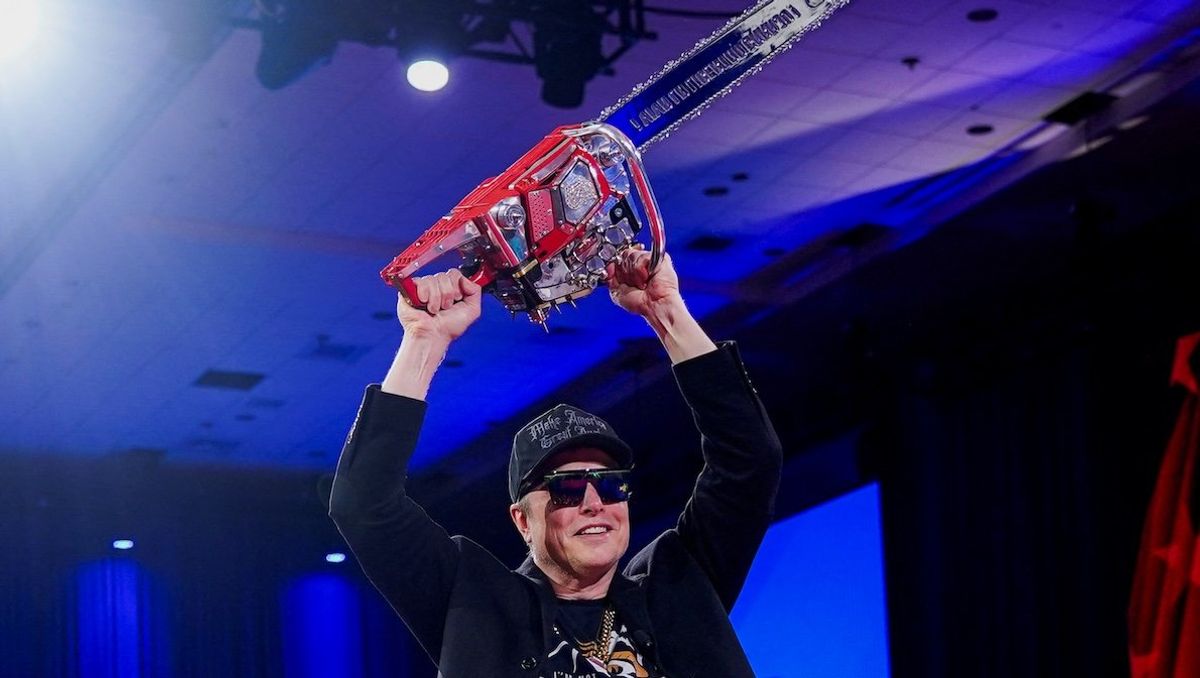
Elon Musk holds a chainsaw onstage as he attends the Conservative Political Action Conference in National Harbor, Maryland, on Feb. 20, 2025. The idea is that he's taking a chainsaw to the federal bureaucracy.
REUTERS/Nathan Howard

GZERO Media
Feb 23, 2025

Mimicking a tactic he used to slash the size of Twitter’s workforce, White House senior adviser Elon Musk on Saturday instructed all 2.3 million federal employees to list five things they “accomplished last week.” The deadline to respond is Monday by 11:59 p.m.

“Failure to respond will be taken as a resignation,” Musk wrote on social media.

This move is the latest effort from the Trump administration to remove government employees en masse. The White House offered buyouts to workers who chose to quit — roughly 65,000 reportedly accepted — and effectively mothballed the US Agency for International Development. The Pentagon started its own purge on Friday by ousting Gen. Charles Q. Brown, the chairman of the Joint Chiefs of Staff, as well as Chief of Naval Operations Adm. Lisa Franchetti, and Air Force Vice Chief James C. Slife.

Several agencies, including the Department of Defense and the Federal Bureau of Investigation, told their employees on Sunday to hold off on responding to Musk’s email, in part over concerns about sharing classified information. The US Department of State informed its workers that it would respond to Musk’s email on their behalf. Others, like the Cybersecurity and Infrastructure Security, ordered their staff to reply.

Meanwhile, a backlash appears to be brewing in conservative parts of the country against Musk and US President Donald Trump over their planned government cuts. A group of voters in Georgia jeered their Republican congressman at a town hall on Thursday for backing the administration proposals. A Wisconsin lawmaker faced similar heckling on Friday in his rural conservative district. One Ohio Republican, who also represents a right-leaning area, tacitly rebuked Musk by reiterating that it was Congress who controls the purse, not him.

“What is bothering people is the sense that Donald Trump really does believe he’s king or ought to be,” Larry Sabato, a politics professor at the University of Virginia, told GZERO. “People who don’t take seriously his discussion about running for a third term are dead wrong.”
Fact check: Eight ways Elon Musk has misled Americans about government spending

By Daniel Dale
CNN


Tesla and SpaceX chief executive Elon Musk arrives for the inauguration ceremony before Donald Trump is sworn in as the 47th US President in the US Capitol Rotunda on 20 January, 2025. Photo: AFP/ Chip Somodevilla

Elon Musk has repeatedly misled the public about federal spending while playing a leading role in President Donald Trump's effort to cut that spending.

When Musk was asked earlier this month about one of the inaccurate statements he had promoted, he conceded that "some of the things that I say will be incorrect, and should be corrected." But "some" might be an understatement. The billionaire businessman has made or amplified numerous false or misleading assertions in the past month alone, largely on the X social media platform he owns.

Here are eight examples.

This list doesn't include erroneous cost-savings claims on the website of Musk's Department of Government Efficiency. And it doesn't include the many vague Musk assertions that he hasn't corroborated but that also can't be definitively debunked at this time.

The White House didn't respond to CNN requests for comment last week.

Promoting a phony video about USAID and celebrities

As the Trump administration worked to dismantle the US Agency for International Development (USAID), Musk shared an X user's post that claimed "USAID spent your tax dollars to fund celebrity trips to Ukraine, all to boost Zelensky's popularity among Americans." The post included a video, made to look as though it was from entertainment outlet E! News, that listed large sums various celebrities were supposedly paid for visits to Ukraine.

The video was a fabrication.

E! News never ran any such video. USAID never made those payments to the celebrities.

Ben Stiller, one of the actors the phony video claimed had received millions from USAID to go to Ukraine, said he "completely self-funded" his trip and received "no funding from USAID."

Stiller attributed the "lies" to "Russian media," and experts said the video indeed had the hallmarks of a long-running Russian deception campaign.

Misrepresenting a Pentagon contract for defense against cyberattacks

Musk took aim at the Reuters news agency he has previously criticized over its coverage of his business practices. He wrote on X: "Reuters was paid millions of dollars by the US government for 'large scale social deception'. That is literally what it says on the purchase order! They're a total scam. Just wow."

Musk's comment itself deceived the public.

The contract Musk was talking about was awarded by the Department of Defense, during the first Trump administration, to bolster the military's defenses against "social engineering" cyberattacks that use "social deception" tactics to trick humans. The money went to a "data-driven solutions" company called Thomson Reuters Special Services, not the Reuters news agency with which it shares a corporate parent - and, more importantly, neither company was paid to engage in deceiving the public.

Musk's post didn't mention that the spending document he was citing prominently features the words "active social engineering defense." And he continued to post misleadingly about the contract even after his initial comment was fact-checked by news outlets such as CNN and The Washington Post.

Casting baseless suspicion upon tax credits under Trump and Biden

Musk shared an X user's chart that purported to show the value of federal tax credits each year from 1990 through 2021. The chart, dubiously describing the tax credits as "IRS Welfare," depicted a big jump in 2018, another big jump in 2020, and a peak in 2021.

Musk suggested there was something inexplicable or nefarious about these recent increases. He wrote: "Such a big jump in a short time doesn't make sense."

It makes perfect sense. The increases are easy to explain.

Trump signed an expansion of the child tax credit in his 2017 tax law, causing the increase in 2018. His 2020 pandemic relief legislation also provided various forms of relief to Americans through tax credits, causing the increase that year. President Joe Biden then approved a short-term expansion of the child tax credit in the pandemic relief law he signed in early 2021, causing the increase that year.

"There's no mystery why the child tax credit increased in 2018 and again during the pandemic. The growth is the direct result of child tax credit expansions signed into law by President Trump and then President Biden to increase the credit's maximum value, refundability and availability," Erica York, vice president of federal tax policy at the Tax Foundation think tank, told CNN.

Promoting a false claim about government spending on The New York Times

Musk, declaring that "NYT is government-funded media," shared a post from an X user who asserted the US government "gave the New York Times tens of millions of dollars over just the past 5 years," including $26.9 million from the Department of Health and Human Services and $19.15 million from the National Science Foundation.

But those figures were not even close to correct.

The X user who made the post, right-wing commentator Ian Miles Cheong, had done a flawed web search that was not actually limited to federal spending on The New York Times. As University of Central Arkansas economics professor Jeremy Horpedahl pointed out, Cheong's search also brought up federal spending on other entities with "New York" in their names, such as grants to New York University.

When you limit the search to federal spending on The New York Times in the last five years, you find no Times spending at all from the HHS or National Science Foundation. This correct search shows that total federal spending committed to The Times since the beginning of 2020 was about $1.6 million, and that the biggest chunk came from subscriptions for the Department of Defense.

Promoting an invented story about condoms for Gaza


When press secretary Karoline Leavitt announced at her first White House briefing that the Trump administration had spotted and thwarted a planned $50 million expenditure "to fund condoms in Gaza," she attributed the supposed discovery in part to Musk's DOGE team. Musk then promoted Leavitt's words in a post on X, writing that this was the "tip of iceberg" and that he guessed "a lot of that money ended up in the pockets [of] Hamas, not actually condoms."

But the claim was pure nonsense; Musk and the White House never had any evidence to substantiate it. Asked two weeks later about the inaccuracy, Musk made his concession that "some of the things that I say will be incorrect, and should be corrected."

Musk then promptly continued to say incorrect things. Seizing on an inaccurate assertion from the reporter who asked him about the tale about condoms for Gaza, he criticized the US for supposedly sending $50 million in condoms to the African country of Mozambique - though that didn't happen either.

Promoting a false claim about DOGE savings


Musk shared an X post from conservative activist Charlie Kirk that included a brief video clip of a "DOGE Clock," an animated counter that showed a fast-increasing total of more than $109 billion. Kirk wrote, "Projected DOGE savings now near $110 billion, or over $700 per American taxpayer. And we're just getting started…"

"Good progress," Musk wrote.

But the "clock" does not actually measure DOGE's progress.

At the time of Kirk's post, DOGE was making an inflated claim of having saved an estimated $55 billion. In other words, the figure on the "clock" was roughly double DOGE's own flawed number.

So what is the "clock," exactly? The website that publishes it, USDebtClock.org, makes clear it is not tracking DOGE's actual savings; it says it is tracking DOGE's "savings objective." The site, which is not affiliated with the government, didn't respond to a CNN request to explain what precisely "savings objective" means - but Horpedahl said the "clock" tracks "what DOGE would need to have saved to be on track to balance the budget. It's not a count of actual savings. It literally just adds $4 billion per day, regardless of what is happening in the real budget situation."

Misleading about Social Security data


Musk posted a chart on X he said showed how many people in different age brackets had a "death field set to FALSE" in a Social Security database - in other words, who were not listed as being dead. The chart included nearly 9 million people age 130 and older, who are obviously deceased. Musk joked, "Maybe Twilight is real and there are a lot of vampires collecting Social Security" - then added, "This might be the biggest fraud in the history of humanity."

But the chart didn't prove any fraud. It didn't even show that millions of dead people are erroneously being sent Social Security money. Public data from the Social Security Administration shows that about 89,000 people age 99 or over were receiving Social Security benefits in December 2024, not even close to the millions Musk suggested.

That's because of a critical fact Musk didn't explain: Someone not having have their death listed in this Social Security database doesn't mean they are actually getting Social Security money. Social Security already has a system in place to stop payments to people listed as being age 115 and older.

A 2023 report from the inspector general who monitors the Social Security Administration found 18.9 million people age 100 or older who were not marked as deceased on their database entry. But while the inspector general was critical of the Social Security Administration (SSA) over this issue, she also found that only 44,000 of these 18.9 million people were receiving payments.

Even those 44,000 payments were not obviously fraudulent or erroneous. The inspector general noted that a larger number of living people in the US, an estimated 86,000, were age 100 or older.

"Regarding the 44,000 figure, I'm confident that the vast majority of those are legit payments. So while there probably is some fraud, I don't think these numbers show any evidence of it," Andrew Biggs, a senior fellow at the conservative American Enterprise Institute think tank who served as principal deputy commissioner of the Social Security Administration during the George W. Bush administration, told CNN last week.

Biggs said that "while the SSA clearly should work to better ensure that Social Security numbers are deactivated when a person dies, it does not appear that this computer systems issue results in many benefits being paid out to people who should not receive them."

The acting commissioner of the Social Security Administration, Leland Dudek, who was elevated to that post by the current Trump administration, tried to set the record straight in a statement last week.

"The reported data are people in our records with a Social Security number who do not have a date of death associated with their record. These individuals are not necessarily receiving benefits," Dudek said.

Making a false claim about FEMA spending on migrant housing


Musk claimed on X earlier this month that the DOGE team had "just discovered" that the Federal Emergency Management Agency had the previous week sent $59 million to luxury New York City hotels "to house illegal migrants." Musk then added, "That money is meant for American disaster relief and instead is being spent on high end hotels for illegals!" He repeated the claim at a conservative conference on Thursday: "They took money from FEMA, meant for helping Americans in distress, and sent that money to luxury hotels for illegal immigrants in New York."

The money was never meant for American disaster relief.

The cash came from a separate federal initiative, the Shelter and Services Program, in which Congress gave money to FEMA for the specific purpose of helping state and local governments and nonprofits house migrants.

Congress appropriated $650 million for this program in the 2024 fiscal year. It appropriated a much larger sum, more than $35 billion, for FEMA disaster relief in that fiscal year. These are just two distinct pots of money - as fact-checkers repeatedly noted when Trump and others made similar claims in the fall.

And there is additional context worth noting.

The Shelter and Services Program money was sent to the government of New York City, not directly to hotels, and the city said in a statement this month that of a recent allocation of about $59 million, about $19 million covered direct hotel costs for people seeking asylum; about $26 million was for services like food and security, while about $13 million was for group shelters and related services.

In addition, the city objected to the "luxury hotels" part of the claim, saying, "we have never paid luxury-hotel rates." A report last year from the city comptroller, which studied the hotels that are part of a city contract to house people seeking asylum, found that the average daily rate paid by the city was $156 and that, of the hotels whose category class could be confirmed, none were in the highest-end "luxury" or "upper upscale" categories, while half were "economy," 13% "midscale," 25% "upper midscale" and 8% "upscale."

Critics are free to make an argument that even this accommodation is overly generous. Regardless, Musk's claim that it was paid with funds taken from disaster relief is flat wrong.

- CNN
Unveiling untold stories of indentured servitude under British rule in India


ANN | The Statesman | Devasis Chattopadhyay 
Published February 24, 2025 

OVER 30 million Indians died due to recurring famines during the 19th century under British rule. During these famines, average rural Indians found it nearly impossible to procure food grains. In their struggle for survival, like any human being at any time in any civilisation, they were willing to migrate to new locations where they could secure two square meals a day and provide for their families.

At this time, a section of officials of the English East India Company (EIC) in India, along with a segment of the British politicians in England, exploited these vulnerable, desperate and trusting individuals. They lured them into migrating to various plantation colonies across the globe with the promise of a better future. This deception was aimed to replenish their lost labour force after slavery had been outlawed within the British Empire. The phenomenon became known as ‘decoy slavery’, or indentured labour, according to the Harvard Law Review in its March 2021 issue (Vol. 134, No. 5).

Slavery was abolished throughout the British Empire by an Act of Parliament in 1833, effective from August 1, 1834, except in India. It took nearly an entire decade before the British Indian Law Commission could secure authorisation for its implementation in the Indian subcontinent in 1843. While researching for my book, Harry Hobbs of Kolkata and Other Forgotten Lives (July 2024/Niyogi Books), I discovered that one of the main reasons for this delay was the obstruction of the anti-slavery law by Henry Thoby (H.T.) Prinsep, the elder brother of the famous Indologist James Prinsep, known for his work on deciphering the Kharosthi and Ashoka Brahmi scripts.

H.T. Prinsep was a key member of the then Indian Law Commission and wielded significant influence within the EIC due to his family connections, which allowed him to delay the implementation of the anti-slavery law in India by a decade. But why is this topic relevant now?

Migration has captured global attention, but in the past millions of Indians were shipped out to work in various European colonies, primarily in the Caribbean, Southeast and East Africa, British Guiana, Fiji, Mauritius, and Suriname

The West Bengal State Archives is celebrating ‘Archives Week’ in Kolkata presently by holding a very interesting exhibition (18th till 24th February) at its Shakespeare Sarani office on the theme of ‘migration of indentured labour’. Simonti Sen, Director of the State Archives, articulated in the introductory booklet of the exhibition that, “In recent years the phenomenon of ‘migration’ has captured the attention of governments and people the world over. Although ‘indentured’ labour of the colonial times no longer exists, the governments are vexed with problems of present-day labour migration that are evidently reminiscent of the former”.

She went on further to elucidate that even at present the progenies and other descendants of these ‘indentured labourers’ visit the archives seeking and searching for information about their unfortunate forebears who had been taken away long ago.

In India, discussions about indentured migration were largely avoided until very recently. I was delighted to see that the exhibition of the West Bengal State Archives began with panels displaying the correspondence and memos written by Henry Thoby (H.T.) Prinsep. Most Indian historians have either refrained from or overlooked discussing Prinsep’s views on slavery, with the exception of D.R. Banaji, the author of ‘Slavery in British India’ (1933).

As the British Empire was about to outlaw slavery, the supply of free labour for the plantations in her colonies began to diminish. In response, a new system akin to slavery emerged in the Indian subcontinent, cleverly circumventing the new anti-slavery laws. Like its predecessor, this new system exploited the economic deprivation found in Indian villages, allowing British and French plantation owners to continue their labour exploitation in their colonies.

This system copied the model used by the South American planters and was known as ‘indentured’ or ‘bonded’ servitude. The impoverished indentured labourers from India were referred to as Girmitiyas, a term derived from the word ‘agreement.’ The Girmitiyas, or Girmits, were essentially ‘agreement holders.’ According to the agreements or bonds signed by these labourers, they would work for a fixed period—typically five years—in a foreign land, under very harsh conditions and for minimal pay.

H.T. Prinsep consistently opposed the importation of foreign slaves to India but was unwilling to legislate against the export of Indian labourers to other colonies. Testimonials from former Girmitiyas reveal the extent of their exploitation using this loophole created by Prinsep. Lured by labour brokers and companies, these workers were often enticed by false promises. Many were not compensated for their labour, and nearly all experienced inhumane conditions and severe mistreatment.

Ultimately, this practice resulted in millions of Indians being shipped out to work in various European colonies, primarily in the Caribbean, Southeast and East Africa, British Guiana, Fiji, Mauritius, and Suriname.

Dola Mitra, an editor and a political analyst, wrote in her, The Bengal Book (Rupa/ 2021), “Deonauth’s family too arrived in British Guyana as plantation workers and settled. ‘It was sometime in 1838 that they boarded a ship,’ he says. ‘Though there are not many records of those times, what we do know is from what has passed down to us through the generations by word of mouth.’ Deonauth’s ancestors were from a remote village in Bengal, who signed up or were compelled to sign up for the indentured system, possibly due to economic hardships.

The indenture system targeted the needy masses, the memories of whose displacement could and did get lost in the oblivion of time. Their numbers remained virtually unaccounted for except as cold impersonal statistics. Close to two million (by some accounts three million or even more) people had been dislocated by the Indian indenture system. The mere rattling off of these numbers doesn’t take into account the fact that each and every one of the figures which make up that total, was that of an individual who had dreams and aspirations to return home one day. To their parents, spouses, children and siblings“.

This new form of slavery in British India lasted till the end of the 1920s. The stories of Indian Girmitiyas are so widespread and well-known that even before you finish entering the relevant search terms into Internet search engines, an abundance of references pop up on your screen.

The testimonies of Zuhoorun and other indentured migrants can be found in the Letter From ‘Secretary to Government of India to Committee on Exportation of Hill Coolies: Report of Committee and Evidence’ – Parliamentary Papers (House of Commons) 1841, Vol 16, No. 45. In fact, the exhibition too spoke about Zuhoorun’s story.

In her testimony, Zuhoorun says she was persuaded by a labour recruiter to travel to Mauritius and work as a servant. After her departure from Kolkata, however, she realised she had been deceived: “I got no clothes given to me, nor blankets, nor brass pots.” Nor did she receive the quality of wages, or the six-month wage advance that the recruiter had promised.

In Mauritius, Zuhoorun spoke of the injustice meted out to fellow labourers—a story of overworked men subjected to ill-treatment and corporal punishment. Labourers were often confined within plantations and denied wages if they refused to work. Zuhoorun felt stuck in a foreign land with no means of returning to her homeland, urging “everyone would leave if there was a land journey; not one would advise any of their friends to go there”.

Published in Dawn, February 24th, 2025
NZ Defence Minister Judith Collins says Chinese warships in Tasman Sea nothing to worry about

24 February 2025
Morning Report
@NZMorningReport Morningreport@rnz.co.nz


This handout photo taken on February 13, 2025 and released by The Australian Defence Force shows the Royal Australian Navy ship HMAS Arunta (lower L) sailing near the People's Liberation Army-Navy (PLA-N) Fuchi-class replenishment vessel and Weishanhu Jiangkai-class frigate Hengyang in the Tasman Sea. Photo: HANDOUT / AFP

Defence Minister Judith Collins says the presence of Chinese warships carrying out live-fire exercises in the Tasman Sea is "unusual", but nothing Kiwis need to be worried about.

The New Zealand Defence Force - in conjunction with Australian authorities - are continuing to monitor three Chinese naval ships off the coast of Australia's Tasmania. Flights between the two countries had to be diverted, with complaints there was no prior warning given.

Prime Minister Christopher Luxon said China did not inform New Zealand before carrying out a live-fire drill on Friday,

But China says complaints from New Zealand and Australia have been "hyped up", "unreasonable " and inconsistent with the facts.

The fleet consists of the Jiangkai-class frigate Hengyang, the Renhai-class cruiser Zunyi and the Fuchi-class replenishment vessel Weishanhu.

Australian defense minister Richard Marlesm - also the deputy prime minister - said at the weekend Australia and New Zealand were simply trying to understand what was happening.

"We have in an unprecedented way, put in place assets to shadow this, to shadow the task group so that we know exactly what's happening. We're working very closely with New Zealand in relation to this. It was actually a New Zealand frigate, Te Kaha, which is in the vicinity of the task group now, and I've been in close contact with my New Zealand counterpart Defense Minister Judith Collins about this."

Morning Report asked for an interview with the Chinese ambassador to New Zealand, Wang Xiaolong, but the embassy did not respond.

Collins told Morning Report that China's claim it gave sufficient warning to New Zealand and Australia was "wrong".

"There was a warning to civil aviation flights that was basically a very short amount of notice - a couple of hours - as opposed to what we would consider best practice, which is 12 to 24 hours' notice so that aircraft are not having to be quickly diverted when they're on the wing.

"So actually it is unusual and… we are seeking assurance from the Chinese embassy around that."

Collins said China was staying quiet on what else its ships might do this week, including whether they might sail closer to New Zealand.

"They're not telling us what they're planning, but I can tell you that the ships are currently around 280 nautical miles east of Tasmania. So the ships have slightly changed their formation, but of course, we are monitoring it and Te Kaha has been out there, basically monitoring and doing what you'd expect us to be doing.

"We don't know what their intention is, but we're taking them at face value that they are undertaking normal transits when it comes to the UN Convention on the Law of the Sea, that they're not breaking the law. But as we've said, it is always better to give a lot more notice when it comes to live firing."


Judith Collins. Photo: RNZ / Angus Dreaver

She linked the activity to recent moves by China to increase its influence in the Pacific, such as its "unusual" deal with the Cook Islands to get access to its seabed minerals.

"I don't think New Zealanders should be worried. I think we should be very aware that we live in a world of increasing geopolitical,, competition, that the seabed of the Pacific Ocean is viewed by some countries as an area of enormous resource, and that you can see it with the Cook Islands and China agreements that clearly, seabed mining is a major priority for some countries."

"We have to be aware that we are in a situation - as I've said at the Munich Security Conference - in the Indo-Pacific region of sitting on an enormous treasury with a very small lock to protect it."

New Zealand did sometimes send ships through the contested Taiwan Strait, between rivals Taiwan and China - such as the Aotearoa last year - but Collins said they never carried out live-fire exercises.

"New Zealand has a duty to help to keep open shipping lanes - shipping lanes that are in some cases, very difficult for nations. And when we do our work, we do so under the UN conventions and we are very careful of what we do.

"We're certainly not having live firing range activities in the South China Sea or the Taiwan Straits. We are very careful, very responsible, very professional, and we give full notice of everything we need to do… The Aotearoa is a supply ship, it's a tanker, and the fact is that it was returning from our exercises from North Korea around the sanctions busting. So it is really important that we need to be able to get out of that area as well."

Collins said the advice she has received is that none of the Chinese vessels were nuclear-powered, but "the weapons they have are extremely capable".


Australia reacts

ABC defense correspondent Andrew Greene told Morning Report the military over there has seen the visit by Chinese warships as a "wake-up call".

"The reaction certainly inside military ranks is similar to what you're experiencing in New Zealand. This is being seen as very unusual, and I would say a bit of a wake-up call for the Australian Defence Force, which has not had to deal with a potential threat like this, or an act that requires monitoring so close to the east coast of Australia for decades.

"Politicians though have been a little bit more muted. The Australian prime minister has stressed repeatedly that China is acting within international rules, which it is, but it took two days for Anthony Albanese to essentially criticise the lack of short notice given by the Chinese. And the notice that was only given - as Judith Collins has explained there - to airlines within a couple of hours of the exercise getting underway.

"The defense minister has been a bit more forward leaning in Australia and also pointed out that the notice time was not enough, and also said that Beijing had not given a satisfactory explanation of what had been occurring in the Tasman Sea."

Greene said the timing of the exercise was significant, and likely to be "related to the new world order, the shifting strategic dynamics across the world", such as the actions of US President Donald Trump.

"The Australian government has repeatedly talked about the Trump administration being very focused on the Indo-Pacific. Well, here's a test of it right off the bat.

"The fact that Australia has been a regular observer of the South China Sea, has regularly deployed both warships and maritime surveillance air assets into those contested waters, has annoyed Beijing for a long time. A couple of weeks ago we saw yet another midair confrontation between the People's Liberation Army and the Royal Australian Air Force. Australia has protested strongly about the unsafe practice of the Chinese military, but now the Chinese military… really is able to demonstrate that it is a true-blue water navy that can deploy assets all the way south to the point where it's close to New Zealand.

"This is a significant demonstration and at this point in time when the Australian military is still working out the lay of the land under the new Trump administration. This is a reminder that Australia really needs to be able to demonstrate that it has a capable military - and that's still some way off."
'Will the Americans still be there?' The looming question for New Zealand


Phil Pennington, Reporter
@pjppenn phil.pennington@rnz.co.nz


US Vice President JD Vance (R), US Secretary of State Marco Rubio (2nd R) and Ukrainian President Volodymyr Zelensky (2nd L) meet on the sidelines of the 61st Munich Security Conference. Photo: AFP/TOBIAS SCHWARZ

Analysis: Is the United States becoming less dependable as the world's most formidable defence backstop, and is New Zealand factoring that in?

Some world leaders and ex-leaders think the US is less reliable, after 10 days of geopolitical ructions centred on NATO.

Germany's likely next chancellor Friedrich Merz warned the political order NATO had been used to was crumbling, Reuters reported. "Will the Americans still be there?" Merz said at a campaign event in Darmstadt.

"Eight weeks ago I would not have dared to ask this question, but today we have to give an answer to it."

Ministers in New Zealand, asked about US dependability by RNZ, did not answer directly.

Local Ukrainians spoke of feeling shock and betrayal, and others closer to the war in Europe are grappling with it.

Independent policy institute Chatham House in London, in analysis following the Munich Security Conference, said Trump had made clear that friends and allies "count for nothing".

"When the initial shock subsides, the significance of the change in US policy that this represents will sink in."


File photo. Ukraine's President Volodymyr Zelensky a few days ago warned: "We can't rule out the possibility that America might say 'no' to Europe. Photo: AFP / Ukrainian Presidential Press Service

Another think tank, the European Union Institute for Security Studies asked: "What could US abandonment of Europe look like?"

The concerns "about the reliability of the US as an ally" revolved around the new administration opening talks with Russia without involving Ukraine or EU allies, expecting European countries to enforce a future agreement without US backing, and attacking the EU on trade, technology and freedom of speech, it said.

Ukraine's President Volodymyr Zelensky a few days ago warned: "We can't rule out the possibility that America might say 'no' to Europe on issues that threaten it."

Former Australian Prime Minister Malcolm Turnbull asserted the United States had become less dependable.

"Trump is saying you can't always count on us. You've got to do more yourself," said Turnbull, in calling the AUKUS defence pact a very bad deal for Australia.

Turnbull, the prime minister from 2015 to 2018, told the ABC: "We have to recognize the world has changed, America has changed.

"And we cannot assume that we can rely on America in the way we have in the past."


One of three Chinese naval ships off the coast of Australia. Photo: AFP / Australian Defence Force
What about New Zealand?

Three powerful Chinese warships in the Tasman Sea in recent days have brought the stakes closer to home.

Foreign Minister Winston Peters, asked by RNZ if he considered the US was or might be a less reliable partner for security in the IndoPacific, did not address the question directly.

Instead, a spokesperson said: "The United States is a close and long-standing partner. "New Zealand works constructively with the US across a range of areas including foreign policy and security.


Foreign Minister Winston Peters. Photo: RNZ / Samuel Rillstone

"New Zealand and the US have common strategic and security challenges in the IndoPacific region and around the world. Bilateral and regional collaboration is important in managing those challenges," they said.

NATO members could say the same thing, but they and others are also very clear they see the ground shifting under them under Trump.

"The upside is that he is ready to shake up the game board," leading US commentator Thomas Friedman told the New York Times.

But "everything is purely transactional".

"He looks at the world really like it's the retail section in a Trump Tower. You know: 'Hey, Mr. France, you're not paying enough rent for your baguette shop'."
Defence spending

The shift in Europe was consistent with Trump's pre-election threats: That he would not protect European allies who did not spend enough on defence.

Yet a year ago he went even further, saying if he was elected, he would encourage Russia to "do whatever the hell they want" to any NATO country that did not pay enough.

Applied to the Indo-Pacific, New Zealand would be exposed, with its low defence spending.

The government has continued to drip feed the public over that, with Defence Minister Judith Collins most recently saying it would be a "big budget item" for the coalition.

Collins said on Friday the renewed US pivot to the Indo-Pacific was significant.

This was dubbed the "so long Europe" strategy where the Pentagon prioritised deals and weapons supply in the Indopacific, by the European Union Institute for Security Studies.

This fit with the new US Defence Secretary Pete Hegseth's view, to focus on China not Russia, it said.


But what is the nature of this giant partner and backstop that is pivoting?


Minister of Defence Judith Collins. Photo: RNZ / Marika Khabazi

Collins, asked about US dependability, in an interview about the Chinese warships, told Morning Report on Monday:

"I don't think there's any reason to expect that the US has not pivoted towards the Pacific for a reason.

"I think we can see what's happened in the Cook Islands as a very unusual move again from China ...

"It is a challenging time being a small nation and we have to make sure we do everything we can to look after ourselves and our near neighbours."

She also said China, the US and Australia were key trading partners, and the latter two were traditional defence partners.

"I'd be very aware that that is just going to continue," Collins said.

Like Peters, she did not directly address the question of whether if New Zealand's backstop has changed.

 Argument

An expert’s point of view on a current event.

American AI Is High on Its Own Supply

Why hasn’t the messianic urge for “efficiency” hit the tech industry?

By , the dean of global business at Tufts University’s Fletcher School of Law and Diplomacy.


Donald Trump, Softbank Group's Masayoshi Son, and CEO of Open AI Sam Altman listen to Larry Ellison of Oracle speak in the Roosevelt Room at the White House on Jan. 21.
Donald Trump, Softbank Group's Masayoshi Son, and CEO of Open AI Sam Altman listen to Larry Ellison of Oracle speak in the Roosevelt Room at the White House on Jan. 21. Jim Watson/AFP/Getty Images

The most powerful people in the United States are obsessed with spending more on artificial intelligence (AI). Besides Greenland and Gaza, President Donald Trump has signaled that he wants total dominance of the technology. Elon Musk wants OpenAI, a leading player, for himself. And OpenAI CEO Sam Altman is aiming for artificial general intelligence, or AGI, which mimics all human capabilities—and he’s pushing for “exponentially increasing investment” to get there.

Even as a hitherto obscure Chinese lab, DeepSeek, has demonstrated a cost- and energy-efficient approach to AI development, the U.S. tech industry has taken the present situation as its own Sputnik moment. Americans have derived all the wrong lessons: spend even more on AI; trust Chinese technology even less; and reach back to analogies from the 19th-century English coal industry to justify the seemingly unjustifiable 21st-century expenditures in AI.

Undeterred by proof that pretty good AI can be produced with a fraction of the planned spending, the major players have responded by upping the ante. Last year, CNBC estimated that AI investments added up to $230 billion; this year, Amazon alone plans to spend $100 billion on AI infrastructure, Alphabet will pitch in $75 billion, Meta’s bill could run up to $65 billion, and Microsoft will spend $80 billion on AI data centers in the fiscal year ending in June, with more to come for the balance of 2025. The so-called “Magnificent Seven” tech companies will now be spending more on capital investment than the U.S. government’s entire budget for research and development across all industries.

This showering of industry spending on AI is happening in the larger context of the U.S. public sector being stripped of people and resources in the name of efficiency. Ironically, a part of the new administration’s so-called efficiency plans involves replacing government civil servants with AI.

Why hasn’t this messianic urge for finding savings hit the private sector, where one would expect competitive market pressures to demand such discipline?

Three forces are in play; collectively, they are locking the U.S. industry into a trap.


A central argument for increased investment is a variant of the Jevons paradox, a theory that dates back to post-Industrial Revolution 1860s but is back in fashion in the proto-AI age.

The English economist William Stanley Jevons had argued that technologies that made more efficient use of coal would only make England’s coal-shortage problem worse by driving up demand for the fuel. The argument is intuitive—with greater efficiency, costs and, therefore, prices fall, triggering more demand and creating the need for more coal to meet the rising demand.

This logic is at the heart of the case that the leading AI players are making. In arguing for more investment, Alphabet CEO Sundar Pichai told the Wall Street Journal that “we know we can drive extraordinary use cases because the cost of actually using it [AI] is going to keep coming down,” while Microsoft CEO Satya Nadella posted on X in January, “Jevons paradox strikes again!” and went on to declare his own intentions to spend more.

There is no doubt that we are still early in our learning about AI’s many uses. But it’s unclear whether the technology’s uneven adoption picture will be improved simply by the availability of cheaper tools. According to a study conducted by Boston Consulting Group, only 26 percent of companies surveyed have derived tangible value from AI adoption, despite all the spectacular advances.

Worse yet, trust in AI has been declining. That trend is likely to persist; with fewer guardrails and regulations coming from the United States, the largest source of AI tools, this will act as a brake on adoption. More than 56 percent of Fortune 500 companies have listed AI as one of the risk factors in their annual reports to the U.S. Securities and Exchange Commission. Overall, business decision-makers have struggled to demonstrate an adequate return on investment in AI so far.

But will cheaper AI unlock greater demand for the technology—along with demand for more data centers and high-end chips in the proportions anticipated by these unprecedented levels of investment?

New frugal AI formulas are already in the market: DeepSeek alone has shown ways to economize on the computing power needed—through, for example, open-source models rather than proprietary ones, a “mixture of experts” technique that splits the AI’s neural networks into different categories, or even resorting to lopping off decimal places on numbers used in calculations.

Despite these new revelations, none of the major AI players have made the case for why they haven’t altered their strategies or R&D budgets. Lower prices alone may not drive up demand for more AI infrastructure, as Jevons’s theory about coal might suggest, and even if they did, there are far cheaper ways to assemble that infrastructure.

With hundreds of billions of dollars at stake, it is unwise to overlook the lessons of numerous earlier technological disruptions, where persistent heavy investments by incumbents led to massive destruction of value. What has frequently happened in these cases is that incumbents ignored the overturning of received industry wisdom by entrants armed with minimal investments but “good enough”—and, often, ultimately better—products.

Consider the examples of Kodak and the emergence of digital imaging, BlackBerry and the rise of the Apple iPhone and the apps ecosystem, Blockbuster being sidelined by Netflix, and so many more.

There is a second factor that is hard to ignore: The major AI players are locked into a mutually reinforcing and collectively binding embrace. Each of the major players has experienced near-term benefits from increasing investments in development. For Google, generative AI is an existential threat to its most lucrative business, its search engine, so the company had no choice but to invest to defend its most precious asset. Moreover, the company reports that 2 million developers are using its AI tools, and its cloud services revenue from AI has grown by billions.

Microsoft’s Azure AI has seen new revenues estimated to be about $5 billion last year, up 900 percent annually, and the company has experienced the number of daily users double every quarter for its AI-aided Copilot. Amazon, too, has earned billions from its AI-related cloud services and in driving operational efficiencies into its online retail businesses. Meta CEO Mark Zuckerberg hopes to be the “leading assistant” for a billion people (whatever that means) and to “unlock historic innovation” and “extend American technology leadership.” More pragmatically, Meta sees demand for data centers growing and wants to be at the forefront of serving that demand.

For Amazon, Google, and Microsoft in the near term, greater AI spending increases demand for their cloud services. Indeed, these companies have been giving each other business and driving up each other’s revenues, which keeps the mutually reinforcing justification for investing going for a while. As long as each player believes that all the others are going to keep investing heavily, it is not in the interests of any individual player to pull back, even if they harbor concerns privately.

In the language of game theory, this devolves into a suboptimal Nash equilibrium—a situation where every party is locked in, and it is not compatible with their incentives to unilaterally break from the industry’s norm.

A third force locking the industry into its flood of investment is the U.S. government and its geopolitical interests. The White House has sent several signals of its intention of ensuring U.S. domination in the AI industry and keeping Chinese technologies away from usurping that position. Tellingly, the ambitious $500 billion Stargate project, a new joint venture for building out AI infrastructure led by SoftBank and OpenAI with several other partners, was announced not in Silicon Valley but in the Roosevelt Room of the White House, just one day after Trump’s inauguration.

Even though DeepSeek surfaced just a few days later and seems poised to make such giant commitments look like overkill, construction of the first Stargate site is already underway in Texas. Vice President J.D. Vance took to the podium at the recent Artificial Intelligence Action Summit in Paris to advance an aggressive “AI opportunity” agenda and—with an obvious reference to China—warn against “cheap tech in the marketplace that’s been heavily subsidized and exported by authoritarian regimes.”

The Trump administration’s approach to championing the U.S. AI industry is one of the few areas where it has taken a page from the previous administration, which had systematically attempted to stymie China by limiting access to high-performance chips. But while the new administration plans via executive order to give the U.S. players free rein to build faster and bigger AI, it reserves the right to selectively make it difficult for companies that do not align with its political agenda. It does so with threats of regulations, lawsuits, or tariffs on key supply chain components.

The emerging rules of play are clear: Companies that fall in line and have strong ties to the administration will be better positioned to make plans without interference from Washington, get government contracts, benefit from federal spending on AI, and negotiate more forcefully with international regulators and other industry players.


Before the bubble bursts, it will be wise for at least one major player to signal a stop to the escalation. The first step to breaking out of a trap is to recognize that you are in one. The second step is to acknowledge that the rules of competitive advantage in your industry may have changed. The third is to have the courage to recognize technology that is “good enough” and defined not by the hardest number-crunching problem that it can solve but by the breadth of problems that it can solve for the largest number of people.

Can even one major player dare to break from the pack and aim not for the splashiest announcement on spending on AI, but for a new goal for the technology? How about aiming to make a meaningful difference to worker productivity—an aspiration that proved so elusive for AI’s predecessor, the internet?

This could offer courage to the others to follow suit and find a different—better—Nash equilibrium of mutual best responses. Now, that would be a real breakthrough.

Bhaskar Chakravorti is the dean of global business at Tufts University’s Fletcher School of Law and Diplomacy. He is the founding executive director of Fletcher’s Institute for Business in the Global Context, where he established and chairs the Digital Planet research program. His next book Defeating Disinformation (co-edited with Joel Trachtman) will be published by Cambridge University Press in January 2025.


FOREIGN POLICY