Monday, February 24, 2025


Turning Back The Clock: How White House Anti-DEI Policies Aim to ‘Resanitize History’
Edited by: Ingrid Burke Friedman | JURIST Editorial Director

The Office of the Attorney General was established some 200 years before the first woman ever served in the role (Janet Reno, 1993-2001). It would take an additional decade for the first person of color to hold the office (Alberto Gonzales, 2005-2007). Since the passage of the 1789 Judiciary Act — the law that created the office, Pam Bondi is only the third woman to serve as Attorney General.

It is in this context that I consider three consequential recent documents related to diversity, equity, and inclusion (DEI), as well as diversity, equity, inclusion, and accessibility (DEIA):

  1. Bondi’s Feb. 5, 2025 memo entitled Ending Illegal DEI and DEIA Discrimination and Preferences (AG memo);
  2. US President Donald Trump’s Jan. 31, 2025 executive order on Ending Illegal Discrimination and Restoring Merit-Based Opportunity (executive order); and
  3. The US Supreme Court’s 2023 decision in Students for Fair Admissions, Inc. v. President and Fellows of Harvard College (SFFA decision).

By its own terms, the SFFA decision concerns university admissions, does not apply to the military, recognizes students can write anything they desire in their applications and merely says race cannot be a factor in student admissions. The decision does not criminalize DEI or DEIA; nor does it endeavor to interpret them as civil violations.

However, in their effort to restore their vision of “merit-based” hiring, the executive order and the AG memo go far beyond the SFFA decision to try to return America to the over 200 straight years of white men only being considered or hired for positions such as Attorney General of the United States.

This is what I call the Plessy game. The 1896 Supreme Court case Plessy v Ferguson authorized racial segregation in passenger trains. That decision was glommed onto to enshrine segregation across America, including Woodrow Wilson’s resegregation of the federal service. In our present case, the executive branch is glomming onto the SFFA decision in a bid to take America back to what proponents see as a merit-based system. Powerful and rich forces are spreading their fetid wings across the US to force this idea into every nook and cranny of society.

The question then becomes whether American society, out of timidity, fear, or wrongheaded belief, wishes to return to those days of “white men only need apply.”

Some might argue that the executive order and AG memo do no such thing — that they merely speak to assuring equal opportunity. And yet, they advocate for a return to practices that historically led to only white men being considered and hired.

The so-called “merit-based” period they romanticize was one where consideration and appointment rested more on relationships than actual merit. The fundamental criterion for consideration and hiring was who one knew rather than what one knew. And since, due to virulent discrimination, white men primarily knew other white men as peers, those relationships led to the lily-white outcome discussed above — the very system to which the President and the Attorney General (a woman, which is an irony not lost on anyone except possibly her) wish we return. If you believe I overstate the case, consider Attorney General Griffin Bell’s own comments about judicial appointments, courtesy of a 2021 University of Toledo Law Review article by Katherine Simpson.

For certain white individuals, this vision might seem appealing as it reduces competition in professional spaces — a return to those “good old days” that lasted 200 years for women and 210 years for people of color seeking the Attorney General role. I distinctly recall a white colleague once lamenting to me about the competition he faced from women and minorities.

The fundamental problem is that during those supposedly halcyon 200+ years to which these documents wish to return us, rampant bigotry and misogyny excluded all but white men from consideration and hiring. I know this not only from historical accounts but from the lived experiences of both my parents and myself.

Eventually, I hope a legal case will emerge that draws together all evidence — both circumstantial and direct — of the current Administration’s intent to resurrect the era of “white men only” discrimination under the guise of returning to a merit-based system. Such evidence would encompass:

  • The anti-DEI Executive Actions published on whitehouse.gov
  • Various anti-DEI memoranda circulating across all Executive branch functions
  • Anti-DEI legislation adopted or proposed in multiple states
  • Even seemingly minor details, such as the reinstatement to the so-called DOGE of a 25-year-old author of racist and eugenicist writings who proudly admits he was “a racist before it was cool”

This reinstatement, following his initial dismissal, occurred at the specific direction of President Trump, Vice President JD Vance, and private citizen Elon Musk — a white South African/naturalized American billionaire who directs the DOGE, which according to publicly available information, employs no Black individuals.

Consider also last week’s disturbing incident when Secretary of Defense Pete Hegseth declared that “diversity is our strength” was “the worst thing he has heard” — a statement made during Black History Month in a room filled with Department of Defense personnel, many of them people of color. Or note the systematic removal of photos and exhibits throughout federal buildings depicting anyone who is not a white man.

This coordinated effort amounts to nothing less than the resanitizing of history into “whitestory.”

Perhaps these matters will receive proper international scrutiny during the next Universal Periodic Review of the United States regarding its compliance with treaty obligations under the Convention for the Elimination of All Forms of Racial Discrimination, scheduled for November 2025 at the United Nations in Geneva. One hopes that appropriate plaintiffs will also bring such evidence before United States federal or state courts.

For now, we must recognize that the Trump Administration is wielding Executive Power not to faithfully execute the laws, but rather to implement a policy laden with discriminatory intent while disguising it in the language of non-discrimination. This repugnant effort spreads across our separation of powers and our federalism like a malodorous plague.

They know it. I know it. And I daresay all Americans know it.

The pressing question before us is whether Americans will acquiesce to this ramping up of discriminatory policy disguised as the executive order and AG memo — documents that are inconsistent with both relevant law and the Supreme Court’s SFFA decision — or whether we will demand these centers of power conform to the law as it actually exists.

The evidence thus far is not encouraging, as rationalizations for cowardice (what I call “bending those knees with pretzel logic”) proliferate across the political spectrum.

This situation evokes what Langston Hughes decried in a powerful 1934 article for NAACP Oklahoma publication The Crisis addressing institutional cowardice on college campuses. Hughes concluded his critique of self-censorship at HBCUs with these stirring words:

Meanwhile, more power to those brave and progressive students who strike against mid-Victorian morals and the suppression of free thought and action! More power to the Ishmael Florys, and the Denmark Vesey Forum, and the Howard undergraduates who picket the Senate’s Jim-crow dining rooms — for unless we develop more and ever more such young men and women on our campuses as an antidote to the docile dignity of the meek professors and well-paid presidents who now run our institutions, American Negroes in the future had best look to the unlettered for their leaders, and expect only cowards from the colleges.

We would also do well to heed the wisdom shared by a recent recipient of the Outstanding Contribution to Diversity Award from global dispute resolution firm CPR earlier this month:

Every time the US has sought quality, it has arrived at diversity… Diversity and quality are closely connected. They travel together, and neither arrives at the expense of the other.

To clearly see what’s happening, we might ask: When has America ever experienced a period without massive resistance to equality for all? Certainly not during those first 200 or 210 years I discussed earlier. And evidently not today, as demonstrated by this executive order and AG memo.

So it goes. But the essential truth remains: one fights back.

Benjamin G. Davis is an Emeritus Professor of Law at the University of Toledo College of Law in Ohio.

Opinions expressed in JURIST Commentary are the sole responsibility of the author and do not necessarily reflect the views of JURIST's editors, staff, donors or the University of Pittsburgh.
Chained by aid: Washington's tariff on Lebanon's pursuit of justice

The United States has indirectly stifled Lebanon's path to recovery by blocking international accountability for Israel's crimes, writes Giselle Jetti.


Perspectives
Giselle Jetti
17 Feb, 2025
NEW ARAB


Should Lebanon pursue accountability through the ICC, it risks severe economic and military repercussions, which could destabilise the country and lead to renewed war with Israel, argues Giselle Jetti [photo credit: Getty Images]


The US has long used its superpower status to shield Israel from accountability, blocking efforts to prosecute its officials for international law violations. This policy is evident in diplomatic manoeuvres, legislative measures, and direct interventions against judicial mechanisms.

By reimposing sanctions on International Criminal Court (ICC) personnel, US President Donald Trump reinforced Washington’s opposition to the court — timed strategically with Israeli Prime Minister Netanyahu’s visit. This was not an isolated act but a clear signal that any attempt to hold Israeli officials accountable would face punitive measures.

Many in Lebanon would like to see Israel accountable for its violations of international law during the recent armed conflict. Paramount among efforts to achieve this has been a push to have Lebanon accede to the International Criminal Court (ICC) to allow it to investigate these crimes and try those responsible.

Lebanese leaders’ anxiety about coming under the court’s jurisdiction helped derail a previous accession attempt last year. Even if this domestic impasse is overcome, however, another massive roadblock will loom: Washington. US military and humanitarian assistance has been critical for maintaining internal stability in Lebanon since the 2019 financial collapse. At the same time, Washington has a history of leveraging aid to influence policy, particularly when it comes to shielding its key ally, Israel.

Against this backdrop, President Joseph Aoun’s inaugural promise to uphold the rule of law and protect Lebanese rights demands scrutiny. Can this commitment extend to pursuing justice for Israeli crimes on Lebanese soil, and at what cost?

Washington’s shield for Israeli crimes

The United States has for decades leveraged its position as a global superpower to clear the way for Israel to act with impunity and to avoid international accountability itself.

This includes Washington vetoing 49 United Nations Security Council (UNSC) resolutions regarding Israel since 1970. Washington has also worked to undermine international judicial mechanisms when it has seen them as working against its interests, with the ICC drawing particular ire since its creation in 2002.

While the highest UN judicial body, the International Court of Justice, hears cases between states, the ICC was created independently from the UN to try individuals for the “most serious crimes of global concern,” including genocide, crimes against humanity, and war crimes. The Rome Statute creating the ICC has today 125 signatory nations.

Neither the US nor Israel are party to the statute, and since the court’s inception, every US administration — whether Democratic or Republican — has sought to subvert it.

For instance, in response to the ICC, President George W. Bush enacted the American Service-Members’ Protection Act (ASMP) in 2002. Informally dubbed the “The Hague Invasion Act,” among other clauses it authorised military action against the ICC if it attempted to prosecute US personnel or those of an “allied” country, such as Israel.

The Obama administration openly opposed the Goldstone Report, the UN fact-finding mission on the 2008-09 Israeli assault on Gaza that accused both the Israeli army and Palestinian militant groups of war crimes. His administration then sought to block Palestine from gaining UN state recognition in 2012 – a necessary step for Palestine to join the Rome Statute three years later.

President Donald Trump further entrenched US hostility towards the ICC by imposing sanctions on it in 2020 and threatening “any means necessary” against the court to protect US interests.

President Joe Biden, while lifting some of Trump’s sanctions, offered Israel unfettered military and diplomatic support during the Gaza genocide and condemned the ICC prosecutor for issuing arrest warrants against Israel’s prime minister and defense minister last year. Indeed, the warrants spurred bipartisan outrage throughout Washington, epitomised by Republican Senator Tom Cotton, who called the ICC a “kangaroo court”, its prosecutor a “deranged fanatic”, and invoked The Hague Invasion Act to protect Israeli officials.

Trump further entrenched this stance on his first day back in office this January, revoking Biden’s ICC sanctions reversal. He formalised this position on Thursday by reimposing economic and travel sanctions on ICC personnel, coinciding with Israeli Prime Minister Benjamin Netanyahu’s visit to Washington, underscoring the US-Israel alignment in resisting international legal scrutiny.

These actions reinforce expectations that the new administration will be the most staunchly pro-Israel in recent history, signalling an even more aggressive approach to shielding Israel from accountability.

In addition to attacking the ICC directly, Washington has also coerced other governments not to cooperate with the court to protect Israel.

Last year, there was broad bipartisan support in the US Congress for an amendment that conditioned continued funding for the Palestinian Authority to it refraining from involvement in ICC investigations into Israeli actions. While this provision applies specifically to Palestine, it signals Washington’s broader red line.

If Lebanon were to try to re-engage with the ICC, it would almost certainly risk severe aid reductions, particularly to the LAF, which relies heavily on US military assistance.

Over the past 20 years, Lebanon has received nearly $6 billion in US aid more than half of this going to Lebanon’s army and security services.

Since Lebanon’s 2019 financial collapse, Washington has also provided crucial income support for LAF personnel, helping to keep the army standing as the government lost the fiscal capacity to do so. More recently, the outgoing Biden administration diverted $95 million in military aid allocated for Egypt to Lebanon.

The US approach to foreign aid under the new administration further complicates Lebanon’s position.

Under Trump, US policy explicitly ties foreign assistance to alignment with presidential foreign policy priorities.

As US Secretary of State Marco Rubio stated, foreign aid should “be a tool that we use to advance the national interest.” The blunt-force nature with which the Trump administration is willing to wield this leverage is evident in its recent 90-day pause in all foreign aid – exempting only military financing for Israel and Egypt – which has sown chaos throughout operations and programs around the globe.

Following the Israel-Hezbollah ceasefire in November, Lebanese media revealed that the Biden administration exerted “great pressure” on the Lebanese government to retract a renewed bid for accession to the Rome Statute.

Trump, surrounded by pro-Israel hawks in his administration, would no doubt seek to strongarm the Lebanese government even more forcefully away from any renewed effort at ICC participation.

How Washington, Israel, and Hezbollah align on impunity

Given Lebanon’s fragile economic and political reality, foreign aid has become increasingly critical to maintaining internal stability.

The fragile ceasefire between Hezbollah and Israel also relies heavily on the LAF securing the south following Hezbollah’s withdrawal. However, should Lebanon lose US funding, the LAF’s military capacity would be significantly threatened and likely jeopardise the ceasefire.

Ironically, one of the few points of agreement between Washington, Israel and Hezbollah is that Lebanon should not join the ICC.

Indeed, while the Biden administration applied external pressure against Lebanon’s ICC accession efforts last spring, Hezbollah also sought to undermine them from within the Lebanese government.

In an unusual convergence of priorities, these parties aligned and mutually maintained their impunity from international justice.

Yet, if President Joseph Aoun is to follow through on his commitment to a “new era” of the rule of law, and if the Prime Minister-designate, Nawaf Salam — former president of the International Court of Justice — is to lead a government that truly prioritises justice, both must take a stand for Lebanon’s right to seek accountability.

Upholding international law is not only a legal obligation but also a fundamental assertion of Lebanon’s sovereignty.

Should Lebanon pursue accountability through the ICC, it risks severe economic and military repercussions, which could destabilise the country and lead to renewed war with Israel.

Is that a risk any leader could take for the sake of sovereignty and justice? Conversely, if it refrains from legal action, it reinforces the precedent that justice has a price and that Lebanese sovereignty is for sale. It is a pivotal decision that will shape its diplomatic, economic, and security landscape for years to come.


Giselle Jetti is a Research Analyst at Badil | The Alternative Policy Institute

Opinions expressed in this article remain those of the author and do not necessarily represent those of The New Arab, its editorial board or staff.
Trump’s Gaza plan may lead to uprisings across the Middle East

Trump’s plan to ethnically cleanse Gaza wouldn't be accepted across the Middle East and could lead to uprisings or coups, argues Toufic Haddad.


Toufic Haddad
20 Feb, 2025
NEW ARAB


If Trump and Israel really do attempt to complete the ethnic cleansing of Gaza, the very cornerstones of US historic policies in the region would collapse overnight, writes Toufic Haddad. [GETTY]

It’s difficult to listen to US president Donald Trump’s recent statements on Gaza and not be left aghast.

First was his revelation that the US intends to “own” Gaza and “clean out” the Palestinians who live there so that he can turn the Strip into the ‘Riviera’ of the Middle East. Then came the edict that Jordan and Egypt need to absorb two million displaced Gazans, lest their annual aid be cut. “They will do it, okay?”, he insisted.

Finally, was the ultimatum that all remaining Israeli captives held in Gaza be released by an arbitrary date and time unilaterally determined by Trump - high noon on Saturday 15 February - or “all hell is gonna break loose.”

Scarcely a month earlier, Trump himself was bragging about his team’s role in bringing about the Israel-Hamas ceasefire to begin with. But then the deal wasn’t good enough, and the US had the right to intervene in its terms and conditions – not only regarding dates, times and numbers of captives released, but even regarding its entire endgame.

The unhinged nature of Trump’s running commentary on Gaza oozes a desperate need for recognition – as though the world isn’t speaking enough about the ‘new sheriff in town’, with his big guns and “out of the box” thinking down at the local saloon.

Trump’s attempts to combine predatory real estate practices with ‘great game’ geostrategy would be considered comic under most circumstances. But there’s nothing particularly funny about applying vulture capitalism to genocide and ethnic cleansing.

Facing Gaza

In the end it should be remembered that despite his pomp, Trump was never a successful businessman. He received a million dollar leg-up from his father when he began his career but still declared business bankruptcy six times before becoming a reality TV ‘star’. He also developed a reputation for racism and is said to have deprived hundreds of people who worked for him of their pay.

Seen in this light, ‘the statesman’ may only be a radically scaled-up version of Trump ‘the developer’, using bullying and bravado to obfuscate what’s really going on.

But what is that?

Let’s first explore what the Trump ideas aren’t.

Here, it is worth noting that the idea to transform Gaza into expensive real estate isn’t particularly original.

Singapore and Hong Kong have tended to be the tired go-to fantasies of Western projections for the Gaza Strip, with the World Bank and Thomas Friedman giving currency to these visions in earlier eras. But the truth is that no Western power has ever wanted to face the reality of Gaza and the abhorrent injustice it represents.

The territory only exits by dint of continued international complicity in the injustice of the 1948 ethnic cleansing of southern and coastal Palestine, not to mention, the festering political and humanitarian wounds this act continues to generate 77 years later.
Related


Trump's first weeks: Signs of unbridled chaos in the Middle East
Unfiltered
Khalil E. Jahshan

In this respect, Trump’s ‘Gazan Riviera’ idea only continues a shameless tradition of complicity and cowardess in the Gaza obscenity, as the West seeks new slight-of-hand tricks instead of admitting it never had anything to offer Palestinians yesterday, or today.


It’s also worth asserting that Gaza fantasization has never been anything other than a prolonged nightmare. Israel repeatedly bombs the territory back to the “stone ages” irrespective of these plans and has now created conditions of pre-history, where life itself is unsustainable.

Western declinism?

It nonetheless should be acknowledged that Trump’s plans are novel in at least two respects. First, is his unapologetic call for the mass transfer of Palestinians from Gaza as a means to overcome what he refers to as the territory’s predilection for being “unlucky.”

Second is Trump’s suggestion of actual US ownership, as Gaza is added to the list of territories he aspires to directly colonise.

How these ideas jive with his neoisolationist tendencies, or the peacemaker reputation he supposedly covets, is anyone’s guess. But that’s precisely the point.

Trump’s bluster and brinkmanship are so ideologically and politically incoherent, and so tinged with delusions of genius and grandeur, that they hardly reflect strength and vision – quite the opposite.

Indeed, they smack of late-imperial magical thinking, overly reliant on intimidation and force, and conceived in a broader context of Western declinism and approaching Israeli terminability.

Should we be surprised by this?

The very re-election of Trump speaks to deep-seated democratic and institutional crises within the US liberal political and institutional orders. Re-electing the same man who attempted to foment a coup that resulted in seven deaths in Washington speaks volumes about the failure of the US system to discipline him, or at the very least, protect the country from insider threats of such orders – rich, white charlatans with an army of aggressive lawyers.

This track record should have been a sign that Uncle Sam was in fact, far sicker than the images posted on Instagram.

As we now watch the Trump administration fill up with a wild collection of gangsters and not-so-disguised neo-Nazis, one should hardly be surprised where this dystopian zombie party bus is heading.

Of course, while it is one thing to surround oneself with sycophants and hustlers for the purpose of witch-hunting ‘woke folk’, or establishing monumental rackets of conflicts of interest, it is quite another to expect the world to join you for a two-step on what could be a last sail on the Titanic.

US policies in the Middle East

Trump’s drunken gun-toting quickly set off five-alarm warnings across the Middle East, and with good reason. In one fell swoop, the US president was abandoning a host of traditional policies that long served US imperial designs, irrespective of whether the administration was democratic or republican.

Gone is the personage of the ‘honest broker’, which the US played in its theatrical appearances across the Arab and Islamic world stage for decades. Now there is unapologetic fealty for ethnic cleansing, openly siding US policy with the most extreme right-wing line on the Zionist spectrum.

If Trump and Israel really do attempt to complete the ethnic cleansing of Gaza, the very cornerstones of US historic policies in the region would collapse overnight. The Arab and Muslim worlds would clearly see what ultimately happens when they don’t resist their elites signing peace deals with Israel. The sense of betrayal could not indefinitely be contained.

The 1979 Camp David Accords invaluably served US policy in the Middle East for generations, removing the largest Arab country from the circle of engagement with Israel. It also effectively corrupted the Egyptian officer class. Camp David also paved the way for other Arab states to cut their own bilateral deals with Israel at the expense of a unified Arab position towards supporting Palestinian rights.

If ethnic cleansing of Gaza is attempted however, this entire political trajectory, together with the political and economic classes that engaged in it regionally, would be delegitimised and find themselves targeted by their peoples or armies for replacement.

Western assets and interests would equally find it difficult to avoid getting wet from the regional flood gates opened by these acts, given how closely the Western bloc has already backed Israel in its genocide.

While this dynamic wouldn’t necessarily happen overnight, significant aspects of it actually could take place faster than expected with the right combination of coups or popular mobilisations.

This is why the sclerotic Arab regimes quickly mobilised to present a common front against the Trump plans. They know only too well that the region’s current socio-economic and political arrangement is so precarious that it wouldn’t take much to destabilise it.

Indeed, who could have predicted that a dispute between an unlicensed fruit vendor and local cop in rural Tunisia in 2010 could set off a forest fire so large that it consumed the entire Arab world, from Morocco to Bahrain, resulting in six different Arab regimes overthrown?

Make no mistake, the embers of these fires still smolder within the ashes.

Moreover, the ethnic cleansing of Gaza and the broader horrific policies Israel and the West have perpetuated in Palestine, relate directly to the Arab and Muslim worlds’ identities, histories, religions and cultures.

Trump’s endorsement of ethnic cleansing and plans for recolonising Gaza also suggest a willingness to commit crimes of monumental global and historic proportions. Trump does this in an era where global systems of accountability are weakening, while personal vulnerability and precarity is also increasing.

Trump’s plan constitutes a clear threat, and a return to earlier eras of darkness regarding Western colonial butchery across the ‘Third world’. It would be a seismic turn in Western imperial history and there would be no reason why the Palestinians should have to face this new/old world order alone, especially if it means the failure to resist would invite these forces to target your state next.


Toufic Haddad is a Palestinian-American academic and author of “Palestine Ltd: Neoliberalism and Nationalism in the Occupied Territory.” He has worked in various capacities across the OPT as a journalist, researcher, consultant, editor, and publisher, including in Gaza for several UN bodies since 1997, and was most recently the Director of the Council for British Research in the Levant's Jerusalem Branch - the Kenyon Institute. He also writes for the Palestinian policy network Al Shabaka.

Follow him on X: @thaddad

Opinions expressed in this article remain those of the author and do not necessarily represent those of The New Arab, its editorial board or staff.

Hamas says ceasefire talks with Israel contingent on release of prisoners as agreed

The release of 602 Palestinian prisoners by Israel has been postponed after Benjamin Netanyahu accused Hamas of "violations" of the ceasefire.


The New Arab Staff & Agencies
24 February, 2025 


Hamas halts Gaza ceasefire talks until Israel frees 620 Palestinian prisoners [Getty]

Talks with Israel through mediators on further steps in a ceasefire agreement are conditional on Palestinian prisoners being released as agreed, Hamas official Basem Naim said on Sunday.

Israel said on Sunday it was delaying the release of hundreds of Palestinian prisoners it had planned to free the day before until militant group Hamas met its conditions.

Prime Minister Benjamin Netanyahu's office said that Israel was waiting to deliver the 620 Palestinian prisoners and detainees "until the release of the next hostages has been assured, and without the humiliating ceremonies."

That was a reference to recent handovers by Hamas that UN officials have said went against international law because they were not respectful.

Hamas has made hostages appear on stage in front of crowds and sometimes speak before they were handed over. Coffins with hostage remains have also been carried through crowds.


"Any talks with the enemy through mediators regarding any upcoming steps are conditional on the release of the 620 Palestinian prisoners agreed upon in exchange for the four bodies and the six Israeli captives who were freed on Saturday," Naim, a member of the Hamas political bureau, told Reuters.

"The mediators must ensure that the enemy adheres to the terms of the agreement as stated in the agreed-upon text."

The Palestinian Prisoner's Society, a local group that supports Palestinian prisoners, said Israel is practicing "state-terrorism against the prisoners and their families".

Ghasan Washahi, whose brother was set to be released on Saturday, said his family was disappointed with the delay.

"Every time there was a list of prisoners set to be released, we would wait, hoping Islam's name would be among them, but it was never there," he said, referring to his brother.

"My mother even started losing hope that he would be freed in the deal. And when his name finally appeared, Israel halted the deal."

Israel and Hamas have frequently accused each other of violations since the ceasefire started on January 19 but it has so far continued to hold. Hamas at one stage said it would stop handing over hostages because of alleged Israeli breaches.

The ceasefire has brought a pause in the fighting, but prospects of a definitive end to the war remain unclear.

Both sides have said they intend to start talks on a second stage, which mediators say aims to agree the return of all remaining hostages and the full withdrawal of Israeli troops.

Israel's Prime Minister Benjamin Netanyahu and his former Defence Minister Yoav Gallant continue to face accusations of war crimes and crimes against humanity over Israel's military actions in Gaza.

The Government Media Office updated its death toll to at least 61,709, saying thousands of Palestinians missing under the rubble are presumed dead.
#METOO JAPAN

Is the downfall of a Japanese star a turning point for women's rights?

Shaimaa Khalil
BBC
Tokyo correspondent
FEB 23, 2025
AP
Masahiro Nakai announced his retirement in January


For months, Japan's entertainment industry has been rocked by a scandal that unseated one of its most popular celebrities and put one of its biggest broadcasters at risk.

But some believe it has also marked a turning point in how cases of sexual assault are perceived in Japan - where traditionally victims have been shamed into silence.

At its heart was Masahiro Nakai, a household name and leading presenter for Fuji TV, one of the country's biggest broadcasters.

Nakai, who is also a former member of J-pop boy band SMAP, was accused of sexually assaulting a woman at a dinner party in 2023.

The revelations, which first appeared last December in weekly tabloid magazine Shukan Bunshun, marked the latest of a series of scandals involving celebrities in Japan, including that of late entertainment mogul Johnny Kitagawa, who was found by investigators to have abused hundreds of boys and young men over six decades.

Nakai didn't admit guilt and denied using force against the woman. But he apologised for "causing trouble" in a statement and said that he had "resolved" the matter in a settlement, reportedly worth more than half a million dollars.

But as public anger mounted, he was forced to announce his retirement from the entertainment industry in January. Another channel, the Tokyo Broadcasting System, has also stopped airing a program that Nakai regularly appeared on as an MC.

The impact on Fuji TV has been devastating.

The broadcaster's reputation is now in ruins. Its revenue is under threat and some of its top executives have also been forced to step down.

High-profile companies like Nissan and Toyota were among those who pulled advertising from the broadcaster as outrage grew. Fuji TV has since admitted it allowed Nakai to continue presenting shows even after finding out about the allegations.

'Keep silent to keep your job'


"If this had happened 10 years ago, there would not have been this outcry," Keiko Kojima, who worked in Japan's media industry for 15 years as a TV presenter, told the BBC.

Sexual violence against women is one of Japan's worst-kept secrets. A 2020 survey claimed that more than 70% of sexual assaults in the country go unreported. And according to a 2024 study published in the International Journal of Asian Studies, for every 1,000 rapes in Japan, only 10–20 result in a criminal conviction – and fewer than half of convicted rapists are incarcerated.

"There's still a prevalent attitude of 'Shoganai ' or 'there's nothing you can do' that is being projected on women - so they're encouraged to keep silent," Machiko Osawa, professor emeritus at Japan Women's University in Tokyo, told the BBC.

She added that women were seldom believed and did not have proper mechanisms to even report such incidents, which contributed to this culture of silence.

Ms Kojima said that the media industry in particular, has long had a culture of impunity and lack of accountability where many young women felt they must keep silent to keep their jobs.

"It was common for men to make rude comments about women's bodies or appearance or age. I remember my colleagues and I being asked how many people we've had sex with," she said.

"We were expected to reply with a sense of humour without getting angry or offended. I saw sexual harassment and other forms of derogatory treatment of women on a daily basis. For a woman, adapting to these situations was the only way to become a full-fledged TV or media professional."

Keiko Kojima
Keiko Kojima who worked in Japan's media industry for 15 years, says women had to put up with sexual harassment to keep their jobs

The Fuji TV case has also raised the question of whether dinners and drinking parties involving celebrities and young women were common practice.

Although Shukan Bunshun retracted an earlier report that claimed the alleged assault took place at a party organised by Fuji TV, Ms Kojima told the BBC that it was indeed common to use women as "tools for entertaining".

"In Japanese working culture, it's an everyday practice to half-forcibly take young female employees to events to entertain clients."

"Men are happy when young women join them. The idea that women are like a gift and that taking a young woman with you is a way of offering hospitality to the other person is very common."

That is why the fallout of this scandal has encouraged women's rights activists.

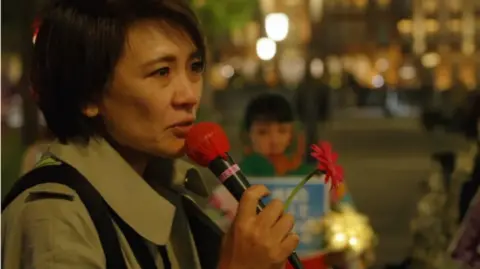
Minori Kithara, one of the founders of the Flower Demo movement - where groups of sexual violence victims and their supporters gather in public spaces on the 11th of every month - admitted she was surprised at how swiftly and severely the sponsors reacted.

"Even if it's more of self-preservation than human rights for sponsors, this is a turning point for the MeToo movement in Japan. It's up to us how big we make it," she told the BBC.
Advertisement


Deeper in disgrace

Getty Images
Masahiro Nakai was accused of sexually assaulting a woman at a party in 2023

Nearly 50 companies have walked away from the now tarnished Fuji TV.

The government has also withdrawn all its recent and planned advertisements with the network.

The Japanese government has called on the broadcaster to regain the trust of viewers and sponsors. So far it seems to have done neither.

The scandal and Fuji TV's role in hiding it, sent the company on a crisis-management frenzy that seems to have dug it deeper into disgrace and fuelled more public anger.

Then Fuji TV president Koichi Minato admitted that the company had known about the allegation shortly after the alleged incident.

But he said they chose not to disclose it at the time because they "prioritised the woman's physical and mental recovery as well as the protection of her privacy."

After a press conference which it held in the hope of defusing the outrage turned into a PR disaster, the company held a second one that lasted 10 hours - intended to show remorse.

Both Fuji TV's chairman Shuji Kano and its President Koichi Minato stepped down - bowing humbly as they announced their resignations.

It was announced that the company's executive vice president Kenji Shimizu would replace Mr Minato as president.

But these were seen as mere face and revenue saving exercises rather than substantial change, especially because the president's replacement was of the same leadership cadre.
Advertisement


Change comes slow


Professor Osawa told the BBC however, that high profile cases like Fuji TV become important precedents for these patterns to change.

The saga is the latest in a series of high-profile sexual misconduct cases that have generated conversation on women's rights in Japan.

These include the case of journalist Shiori Ito, who became a symbol of the country's #MeToo movement when in 2017 she took the rare step of going public with allegations that Noriyuki Yamaguchi, a senior television journalist, had raped her after she met him for drinks. While he denied the allegations, in 2019 she won her civil lawsuit against him.

"People have now started to realise that it was OK to speak out and say that this (sexual harassment) is a problem. We are changing what we take as the norm," Ms Kojima said.

Ms Kojima and Ms Kithara both say however, that Japan is not moving fast enough.

"I think it's time for that generation (of media leadership) to step down. The industry needs to create a new corporate culture. The change is slow." Ms Kojima said.

"The TV industry has long neglected the issue of exploitation and violence and has not dealt with the victims properly. If the root of the problem doesn't change, the same will happen again."

BBC News/Jiro Akiba
Minori Kithara says her wish is to never attend another Flower Demo again

Professor Osawa agrees that while change is happening, Japan still has a long way to go. Mainly because of the ubiquitous power imbalance in the country's male dominated society.

She adds that while women have been part of the workforce for decades they're still seen as the "caretakers" and men as the "breadwinners" by a society that is still heavily shaped by patriarchal values.

"This is an important time... But it's unclear how far attitudes will change." she said.

While Ms Kithara is hopeful, she says she's still angry: "The sexual violence never stops."

"I still meet new survivors at Flower Demo (protests) every month and learn what happened to them. We had a high school girl other day. When we started the movement (In 2019) she was probably in Junior High, " she said.

"One day I hope I will never have to go on a Flower Demo protest again."
Australia fines Telegram for delay in answering child abuse, terror questions


February 23, 2025 
By Reuters

-
 The Telegram app logo is seen on a phone against the backdrop of a keyboard in an illustration photo taken Aug. 27, 2024.

Sydney —

Australia's online safety regulator fined messaging platform Telegram about $640,000 on Monday for its delay in answering questions about measures the app took to prevent the spread of child abuse and violent extremist material.

The eSafety Commission in March 2024 sought responses from social media platforms YouTube, X and Facebook to Telegram and Reddit, and blamed them for not doing enough to stop extremists from using live-streaming features, algorithms and recommendation systems to recruit users.

Telegram and Reddit were asked about the steps they were taking to combat child sexual abuse material on their services. They had to respond by May, but Telegram submitted its response in October.

"Timely transparency is not a voluntary requirement in Australia and this action reinforces the importance of all companies complying with Australian law," eSafety Commissioner Julie Inman Grant said in a statement.

Telegram's delay in providing information obstructed eSafety from implementing its online safety measures, Grant said.

Telegram said it had fully responded to all eSafety's questions last year, with no outstanding issues.

"The unfair and disproportionate penalty concerns only the response time frame, and we intend to appeal," the company said in an email.

Australia's spy agency in December said one in five priority counterterrorism cases investigated involved youths.

The messaging platform has been under growing scrutiny around the world since its founder Pavel Durov was placed under formal investigation in France in August in connection with alleged use of the app for illegal activities.

Durov, who is out on bail, has denied the allegations.

Grant said Big Tech must be transparent and put in place measures to prevent their services from being misused as the threat posed by online extremist materials poses a growing risk.

"If we want accountability from the tech industry we need much greater transparency. These powers give us a look under the hood at just how these platforms are dealing, or not dealing, with a range of serious and egregious online harms which affect Australians," Grant said.

If Telegram chooses to ignore the penalty notice, eSafety would seek a civil penalty in court, Grant said.
Hackers reportedly stole $2.4 billion from cryptocurrency exchange platform Bybit. Here's what we know

By Hanan Dervisevic

FEB 23, 2024
ABC. AU

Analysts say the Bybit heist may be the biggest crypto hack ever. 
(Getty: Jakub Porzycki)


Major cryptocurrency exchange platform Bybit was hacked over the weekend to the tune of $1.5 billion in digital assets, in what's estimated to be the largest cryptocurrency heist in history.

Here's how the attack transpired and who might be responsible.
What happened?

The hack occurred when the Dubai-based crypto platform was making a routine transfer of Ethereum from an offline "cold" wallet to a "warm" wallet.Ethereum is one of the most popular digital currencies after bitcoin
A cold wallet is an offline storage system designed for security
A warm wallet enables daily trading via an internet connection

A hacker exploited security controls and was able to transfer the assets to an unknown address.

Here's the initial statement that was released by Bybit:


The transaction was manipulated by a sophisticated attack that altered the smart contract logic and masked the signing interface, enabling the attacker to gain control of the ETH Cold Wallet.

In other words, the hackers manipulated the front-end interface to display a legitimate transaction while signing a different, malicious transaction behind the scenes.

The price of Ethereum dropped by nearly 4 per cent following news of the hack, but has since almost returned to previous levels.
How much money was stolen?

The company estimates almost $US1.5 billion ($2.4 billion) worth of tokens were stolen.

It's said to be the biggest theft ever experienced in the industry, according to blockchain analytics firm Elliptic.


It surpassed the $US611 million stolen from Poly Network in 2021.

Immediately after the hack, the company said it had reported the case to authorities and that it was working "quickly and extensively" to identify the attacker.
Who's responsible?

Bybit or other authorities are yet to say, but security researchers Elliptic and Arkham Intelligence have reportedly linked the attack to North Korean hackers from the Lazarus Group.

Security sleuth ZachBXT also identified Lazarus as the group behind the heist.
UN accuses North Korea of stealing cryptocurrency to fund nucear weapons

Photo shows This photo provided by the North Korean government shows what it says is an intercontinental ballistic missile

.

The United Nations says it is investigating cyberattacks worth $US3 billion allegedly orchestrated by North Korea.

Arkham Intelligence posted on X that ZachBXT submitted "definitive proof" Lazarus Group was the perpetrator.

This included a detailed analysis of test transactions and connected wallets used ahead of the exploit, as well as forensic graphs and timing analyses.

Lazarus Group is no stranger to high-profile exploits — it's a state-sponsored hacking collective notorious for siphoning billions of dollars from the crypto industry.

Lazarus was also believed responsible for pilfering $US600 million from the Ronin Network in March 2022.

Despite the claims from the security analysts, Bybit is yet to confirm the perpetrators in a statement.

However, in a post on X, they thanked ZachBXT for "always keeping the space sharp" and that his work into the hack "didn't go unnoticed".
What is Bybit?

A cryptocurrency exchange platform.

It is the world's second-largest cryptocurrency exchange by trading volume. It holds over $31 billion in assets.

It has more than 60 million customers worldwide. Immediately after the hack, Bybit sought to reassure customers that their cryptocurrency holdings were safe.

But news of the hack led to a surge in withdrawal requests.

Bybit chief executive Ben Zhou said the company had received more than 350,000 requests from customers to withdraw their funds.


A price chart on the Bybit website for the cryptocurrency Ethereum. 
(AP: Patrick Sison)


Will affected customers get their money back?

Yes.

Mr Zhou said on social media that the company would refund those affected, even if the hacked currency was not returned.

"Bybit is solvent even if this hack loss is not recovered, all of clients assets are 1 to 1 backed, we can cover the loss," he posted on X.

He said the money would be covered by the firm or by a loan from partners.
Three years into Russia-Ukraine war, UN faces difficult vote

Trump's return to White House brings dramatic reshuffling of diplomatic cards.


A tersely worded US draft "implores a swift end to the conflict and further urges a lasting peace between Ukraine and Russia". / Photo: Reuters

Defying Kiev and its European allies, Washington plans on Monday to submit to the UN Security Council and General Assembly a draft text that calls for a "swift end" to the Ukraine conflict but makes no reference to its territorial integrity.

Since Russian forces attacked Ukraine three years ago, the balance of power at the United Nations has been clear: the General Assembly, representing all members, has clearly and overwhelmingly supported Ukrainian sovereignty, while the 15-member Security Council has seen regular vetoes by Russia.

But Trump's return to the White House last month has brought a dramatic reshuffling of the diplomatic cards, as he undertakes a clear rapprochement with the Kremlin while dismissing his Ukrainian counterpart Volodymyr Zelenskyy as a "dictator".


Against this tense diplomatic backdrop, Ukraine and more than 50 other states are planning on Monday — the third anniversary of the war — to introduce a text before the General Assembly saying it is "urgent" to end the war "this year" and clearly repeating the Assembly's previous demands: an immediate cessation of Russian hostilities against Ukraine and an immediate withdrawal of Russian troops.

Amid heated speculation that the United States might abstain from the General Assembly vote — expected around midday — Washington generated widespread surprise Friday by proposing a competing text.

The US resolution is "simple (and) historic", Secretary of State Marco Rubio said late Friday, as he urged member states to approve it.


'A good move'

The tersely worded US draft "implores a swift end to the conflict and further urges a lasting peace between Ukraine and Russia".

It makes no reference to Ukrainian territorial integrity, a cornerstone of the previous resolutions passed by the Assembly, with the United States under former president Joe Biden among its strongest supporters.

For Vassili Nebenzia, the Russian ambassador to the UN, the American resolution is "a good move", though he believes it should also "address the root causes" of the war.

According to diplomatic sources, the American delegation plans to submit that text to a Security Council vote set for 3 pm (2000 GMT) Monday, according to the Chinese presidency of the Council.

The vote will place European delegates in an awkward position.

To be adopted, a resolution needs the votes of at least nine of the 15 Security Council members — while not being vetoed by any of the five permanent members (the United States, Britain, France, Russia and China).

Even if the EU members (France, Slovenia, Denmark and Greece) along with Britain were to abstain, the resolution could still pass.

Would France or Britain be prepared to cast their first vetoes in more than 30 years — even as their respective leaders, Emmanuel Macron and Keir Starmer, are expected this week at the White House for key talks on Ukraine?

"I do not see how Paris and London can support a text that is so far from their stated positions on Ukraine, but I also do not see how they can veto it," Richard Gowan of the International Crisis Group said.

Predicting the outcome of the diplomatic confrontation in the General Assembly is not easy: While some Europeans are deeply unsettled by the American approach, several UN member states have grown tired of the constant attention to Ukraine, and some Arab countries have not forgotten Kiev's refusal to support their resolutions on Gaza.

For the Europeans, the competing votes will be "a test of their standing in the multilateral system". At the same time, Kiev could be left "increasingly isolated" if it draws too little support, Gowan said.

The votes also constitute "an early test of the Trump administration's strong-arm approach to UN diplomacy", he added.

With core principles of international law at stake, UN chief Antonio Guterres on Sunday called for a peace that "fully upholds Ukraine's territorial integrity" and respects the UN Charter.


Istanbul Protocol will be 'guidepost' to make Russia-Ukraine deal — US

Trump's special envoy, Steve Witkoff, also echoed a similar sentiment to the president that Ukraine provoked Russia into the war.

WITKOFF EXPERIENCE IS AS REAL ESTATE WHEELER DEALER


"The war didn't need to happen. It was provoked. It doesn't necessarily mean it was provoked by the Russians," Witkoff says.

US President Donald Trump's special envoy, Steve Witkoff, said that the United States is "very close" to reaching a peace agreement between Ukraine and Russia, similar to Istanbul Protocol Agreement, to end the war.

Speaking to CNN, Witkoff reiterated on Sunday that the war did not need to happen and that regardless of who started it, it must come to an end.

"The war didn't need to happen. It was provoked. It doesn't necessarily mean it was provoked by the Russians," he said.

"There were all kinds of conversations back then about Ukraine joining NATO. The president has spoken about this. That didn't need to happen. It basically became a threat to the Russians," he added.

"There were very, very what I'll call cogent and substantive negotiations framed in something that's called the Istanbul Protocol Agreement. We came very, very close to signing something, and I think we'll be using that framework as a guidepost to get a peace deal done between Ukraine and Russia, and I think that will be an amazing day."

Commenting on the role that US President Donald Trump has in the process, Witkoff said: "We have had close to 1.5 million deaths, and finally we have a leader determined to end the carnage."


UNGA resolutions

The US has pressured Ukraine to withdraw its European-backed UN resolution demanding an immediate withdrawal of Russian forces from Ukraine in favour of an American proposal that does not mention Moscow's invasion, a US official and a European diplomat said on Sunday.

But Ukraine refused to pull its draft resolution, and the UN General Assembly will vote on it Monday, the third anniversary of the war, two European diplomats said.

The 193-nation General Assembly then is expected to vote on the US draft resolution, according to the diplomats and the US official, who spoke on condition of anonymity because private negotiations are still ongoing.

The Trump administration is also seeking a vote on its proposal in the more powerful UN Security Council. The 15-nation council will meet on Monday afternoon on Ukraine, and late on Sunday, it scheduled the vote immediately afterwards, but the European diplomats said it could be pushed to Tuesday at Russia's request.

The duelling resolutions — the first since the invasion — highlight the tension between the US, Ukraine and European countries in the five weeks since President Donald Trump took office and has opened talks with Russia after years of isolation in a bid to end the war.


SOURCE: TRTWorld and agencies
BLACKMAILED BY A GRIFTER

Zelensky Says $500 Billion Mineral Deal Is Off the Table but Ukraine Is Open to Negotiations

President of Ukraine Volodymyr Zelensky speaks in Kyiv on Feb. 23, 2025.
Aleksandr Gusev—SOPA Images/LightRocket/Getty Images


By Justin Spike and Illia Novikov / AP
Updated: February 23, 2025 

KYIV, Ukraine — A contentious Trump Administration proposal to give the U.S. $500 billion worth of profits from Ukraine’s rare earth minerals as compensation for its wartime assistance to Kyiv has been taken off the table, President Volodymyr Zelensky said Sunday, indicating a more equitable deal is in the works.

Zelensky had earlier declined a U.S. draft agreement on exploitation of his country’s valuable minerals such as lithium used in the aerospace, defense and nuclear industries because it did not contain security guarantees and came with the $500 billion price tag.

“The question of $500 billion is no longer there,” Zelensky told a news conference at a forum of government officials in Kyiv marking the three-year anniversary of Russia’s full-scale invasion of Ukraine.

The Ukrainian leader said considering aid as a debt to be repaid would be a “Pandora’s box” that would set a precedent requiring Kyiv to reimburse all its backers.

“We do not recognize the debt,” Zelensky said. “It will not be in the final format of the agreement.”

No further details were given on the state of negotiations. Ukraine has insisted on security guarantees that it needs to deter any potential Russian aggression in the future.

Trump’s special envoy to the Middle East, Steve Witkoff, said on CNN’s State of the Union that he expects a deal this week allowing the U.S. to play a greater role in exploiting Ukraine’s mineral resources.

Treasury Secretary Scott Bessent said the administration’s minerals plan was to create a U.S.-Ukraine partnership, calling it a “win-win.”

“We make money if the Ukrainian people make money,” Bessent told Fox News Channel’s Sunday Morning Futures program.

Zelensky’s chief of staff, Andrii Yermak, left the Kyiv forum early along with Economic Minister Yuliia Svyrydenko for what Yermak said were talks with U.S. officials on a potential deal.

Later Sunday, Yermak posted on social media that he’d spoken with U.S. officials, including Bessent and Trump’s national security adviser Mike Walz, saying it had been a “constructive conversation.”

“We are making progress,” Yermak wrote. “The USA is our partner and we are grateful to the American people.”
Zelensky says he’d give up presidency for NATO membership

In response to a pointed question from a reporter on whether he would give up his presidency for peace in Ukraine, Zelensky said he would if it achieved a durable end to the fighting under the security umbrella of the NATO military alliance.

“If to achieve peace, you really need me to give up my post, I’m ready,” he said. “I can trade it for NATO.”

His comment appeared to be aimed at recent suggestions by President Donald Trump and Russian President Vladimir Putin that elections should be held despite Ukrainian legislation prohibiting them during martial law.


Ukraine fears Trump’s policy shift toward Putin


Trump’s engagement with Russian officials and his recent agreement to reopen diplomatic ties and economic cooperation with Moscow have marked a dramatic about-face in U.S. policy that has rattled leaders in Ukraine and across Europe.

Zelensky has expressed fear that Trump pushing a quick resolution would result in Ukraine losing territory and being left vulnerable to future Russian aggression. U.S. officials have asserted the Ukrainian leader would be involved if and when peace talks actually start.

Trump, however, prompted alarm and anger in Ukraine this week when he suggested Kyiv had started the war and Zelensky was acting as a “dictator” by not holding elections.

On Sunday, Russian Deputy Foreign Minister Sergei Ryabkov told the state TASS news agency that Moscow and Washington would continue bilateral talks at the end of next week.

Ryabkov said the talks would take place between department heads from both countries’ foreign ministries, adding that “quite a lot” of contact was ongoing between the Russian and American sides.

European leaders prepare for talks with Zelensky and Trump


European Union Commission President Ursula von der Leyen and other top EU officials were headed to Kyiv Monday for talks with Ukraine’s government as Europe scrambles to devise a response to the Trump Administration’s U.S. policy changes, and to maintain support for Kyiv if aid from Washington ends.

The U.K. said it would announce new sanctions against Russia on Monday, describing them as the biggest package since the early days of the war. Foreign Secretary David Lammy said the measures would be aimed at eroding Russia’s “military machine and reducing revenues fueling the fires of destruction in Ukraine.”

British Prime Minister Keir Starmer and French President Emmanuel Macron were to both visit Washington this week as Europe attempts to persuade Trump not to abandon Ukraine in pursuit of a peace deal.
Russia launches record drone strikes on eve of anniversary

Earlier on Sunday, Zelensky said Russia had launched 267 drones into Ukraine overnight, more than in any other single attack of the war.

Ukraine’s air force said 138 drones were shot down over 13 Ukrainian regions, with 119 more lost enroute to their targets.

Three ballistic missiles also were fired, the air force said. One person was killed in the city of Kryvyi Rih, according to the city military administration.

Reacting to the latest Russian attacks, Andrii Sybiha, Ukraine’s minister of foreign affairs, said on social media: “No one should trust Putin’s words. Look at his actions instead.”
More sanctions imposed on Russia

New Zealand will sanction an additional 52 people and entities involved in Russia’s military and energy sectors, North Korea’s support to Russia’s war effort, and the forced relocation and reeducation of Ukrainian children, New Zealand’s Foreign Minister Winston Peters said Monday.

Since March 2022, New Zealand has placed sanctions on more than 1,800 individuals and entities.

New Zealand will contribute a further 3 million New Zealand dollars ($1.7 million) to the World Bank-administered fund for Ukraine, Peters said in a statement.

—Associated Press writers Thomas Strong and Will Weissert in Washington and Charlotte Graham-McLay in Wellington, New Zealand, contributed to this report.