Thursday, February 27, 2025

Trump’s MAGA + Modi’s MIGA = A mega contradiction


White nationalist segments of MAGA do not see Indians, Hindutva supporters or otherwise, as partners in their project.


AFRIKANER MUSK PURGED DOGE OF RAMASWAMY

FEB 26, 2024
Scroll

Prime Minister Narendra Modi and US President Donald Trump at the White House on Thursday. | Narendra Modi, @narendramodi/X


In his visit to Washington last fortnight, Prime Minister Narendra Modi proclaimed a new equation in US-India relations: “MAGA + MIGA = MEGA Partnership”.

By aligning India’s development goals with Trump’s signature slogan, Modi aimed to appeal to American conservatives while boasting about India’s rise as a global power. However, beneath the rhetoric of economic cooperation and shared nationalist aspirations lies a fundamental contradiction – one that exposes the fragility of this supposed alliance.

At its core, Trump’s Make America Great Again or MAGA movement has been deeply intertwined with white supremacist ideologies and an exclusionary vision of America. While some Indian-American conservatives have aligned themselves with MAGA politics, often based on a shared Islamophobia and anti-left sentiment, they have failed to recognise the movement’s broader racial and cultural prejudices.

The recent spate of anti-Indian rhetoric from MAGA figures and their supporters, from Silicon Valley to the White House, is a stark reminder that the movement does not see Hindutva supporters as equals, but rather as a convenient, expendable constituency.

Prime Minister Modi’s attempt to merge MAGA with MIGA or Make India Great Again is rooted in the assumption that nationalist movements can find common ground. Both movements center around a romanticised past, economic self-sufficiency and a muscular and majoritarian approach to governance.

However, while Modi’s brand of Hindu nationalism promotes India as a civilisational state with its own historical and cultural superiority, MAGA’s racialised vision of America is fundamentally opposed to such ideas. White nationalist segments of MAGA do not see Indians, Hindutva supporters or otherwise, as partners in their project.

Instead, Indians are often cast as job stealers, cultural outsiders, or, at best, temporary allies in the fight against “woke” ideology.


Recent incidents highlight the widening gulf between Indian MAGA supporters and the movement’s hardline base. Marko Elez, a staffer for Elon Musk’s Department of Government Efficiency was found to have posted blatantly racist, anti-Indian messages, calling for a “eugenic immigration policy” and urging his social media followers to “normalize Indian hate”.

Instead of condemning such remarks outright, prominent MAGA figures, including Vice President JD Vance, who is married to a woman of Indian origin, came to Elez’s defense, arguing that social media activity should not “ruin a kid’s life”.

This dismissive attitude toward anti-Indian racism within the movement has forced many Indian MAGA supporters to confront a harsh reality: their loyalty to MAGA does not grant them immunity from its deeply ingrained xenophobia.

The fall of biotech entrepreneur and former presidential candidate Vivek Ramaswamy serves as a cautionary tale. Once embraced by MAGA circles for his critiques of “woke” culture and his nationalist rhetoric, Ramaswamy quickly found himself ostracised after making remarks about American mediocrity and the cultural discipline of immigrant families.

The moment he suggested that American-born workers were losing out to foreign talent due to cultural laziness rather than a flawed immigration system, MAGA supporters, who had initially celebrated him as proof that the movement was not racist, turned on him.

Ramaswamy’s ouster from Musk’s DOGE underscores the rigid racial hierarchy within MAGA. While the movement is willing to accept non-white figures who reinforce its broader narratives, any deviation from its core ideology leads to immediate ostracisation. The message is clear: Indian-origin figures in the MAGA movement are tolerated only as long as they do not challenge the racialised status quo.

One of the primary contradictions in the MAGA-Hindutva alliance is the question of immigration. Many Indian Americans in tech have supported Trump’s policies, believing that his administration would favor highly skilled immigrants. However, MAGA’s anti-immigrant base sees no distinction between undocumented migrants and legal visa holders, viewing both as threats to American jobs and culture.

The recent uproar over Trump’s handling of H-1B visa policies and his crackdown on birthright citizenship for children of visa holders signals a clear hostility toward Indian immigrants.

Trump’s decision to deport several hundreds of undocumented Indian immigrants in shackles, on military planes, was met with outrage in India but barely a murmur from his loyalists in the Indian-American conservative community.

This silence is telling. While some pro-MAGA Indian Americans have begun to express concern about rising anti-Indian sentiment within the movement, others continue to delude themselves into thinking that they are integral to its future.

The reality is starkly different: MAGA does not prioritise Indian interests, and its base views Indian immigrants as expendable at best, and unwelcome at worst.

Despite these warning signs, many Indian nationalists continue to court MAGA support, believing that Trump’s strongman persona aligns with Modi’s leadership style. What they fail to acknowledge is that Hindu nationalists, in the eyes of white supremacists, are not natural allies but rather useful instruments.

The Indian diaspora in the US has long sought to position itself as a model minority – hardworking, successful, and aligned with conservative values. Yet, history has shown that model minority status is conditional and can be revoked at any time. The growing wave of anti-Indian racism within MAGA is proof that no amount of loyalty can override the fundamental racial biases at play.

Modi’s proclamation of a MEGA partnership between MAGA and MIGA is, at best, a wishful slogan and, at worst, a delusion. The contradictions are too vast to ignore. MAGA thrives on exclusion and racial superiority, while Hindutva envisions a Hindu-dominated but globally respected India. These visions are not just different: they are fundamentally incompatible.

Ashok Swain is a professor of peace and conflict research at Uppsala University, Sweden.

LA REVUE GAUCHE - Left Comment: Hinduism Is Fascism

LA REVUE GAUCHE - Left Comment: Search results for ARYAN

LA REVUE GAUCHE - Left Comment: Search results for ARYAN SUPREMACY

BOOK EXCERPT

How Indian soldier
s were subjected to medical neglect while fighting for the Empire in WW I

An excerpt from ‘Indian Soldiers in World War I: Race and Representation in Britain’s Imperial War’, by Andrew T Jarboe.

Andrew T Jarboe
FEB. 26, 2025
Indian soldiers in World War I. | Getarchive.net [Public Domain]

At the turn of the 20th century, infected wounds and communicable diseases were the greatest scourge of armies, taking the lives of more soldiers than explosives or steel. In the American Civil War (1861–65) sickness claimed approximately two-thirds of the estimated 620,000 soldier deaths. Two-thirds of all British deaths in the Boer War (1899–1902) were attributed to disease. Across much of the planet during World War I, germs continued their deadly work. Seven times as many Turkish soldiers died of disease as from wounds, and in the protracted campaigns ranging across East Africa, disease was the major killer of Europeans, Indians, and Africans.

At the start of August 1915, the Indian force in East Africa numbered some 17,000 men. But disease had so ravaged the men that only 4,000 were fit for duty. One member of the British cabinet lamented at a meeting to discuss future operations in East Africa, “One Indian Regiment, the 13th Rajputs, is suffering to such an extent from malaria and debility that they will never be of any more use in the field.” The sudden onset of extreme temperatures also presented a very real danger to armies. During the Carpathian Winter Campaign, between January and April 1915, temperatures routinely hit minus 30 degrees Celsius (minus 22 degrees Fahrenheit). Entire Russian and Habsburg armies – hundreds of thousands of men – quite literally froze to death.

The Russo-Japanese War and the Western Front were the first major conflicts in world history in which soldiers had a better chance of being killed by high explosives and bullets than by disease and exposure to the elements. This is not to say that the soldiers in Belgium and France did not get sick. And this does not mean that they did not suffer from exposure to rain, wind, and snow. But owing to recent and remarkable advances in medicine, wounded and sick soldiers stood a decent chance of surviving and returning to active duty at the front where their commanders wanted them. From a medical standpoint, one of the great ironies of the war on the Western Front may very well have been the fact that the modern medicine soldiers accessed in France (when combined with the insatiable demand for manpower) contributed to innumerable cases of repeated bodily trauma.

Conditions were so bad in Mesopotamia in 1915 and early 1916 that IEFD’s operations became the topic of official inquiry and opprobrium. The secretary of state for India, Austen Chamberlain, had called some attention to conditions in the Middle East in 1915. In the wake of that year’s disastrous operations and an outcry in the British press in 1916, command of IEFD passed from the hands of the Government of India to the British government, and two commissions were appointed to investigate things – the VincentBingley Commission (created in March 1916) and the Mesopotamia Commission (created in July 1916). The publication of the findings of these investigations in 1916 and 1917 exposed the gross deficiencies Indian soldiers had long endured in the employ of the Government of India.

When World War I began in 1914, Indian soldiers still received medical care under what was called the “regimental system.” Regimental hospitals were based on the principle of bringing “the hospital to the patient rather than the patient to the hospital.” Under this system in South Asia, hospitals and equipment were transported with the regiment to which they were attached when that regiment moved. Surgical equipment and facilities were quite naturally subpar; comforts and amenities were otherwise absent. Patients generally provided their own bedding and clothing (contributing to the spread of contagion) and relied on healthy comrades to provide them with food and nursing. The shortcomings of the regimental system were too much for authorities to stomach when it came to treating British soldiers employed by the Indian Army. British soldiers in South Asia had enjoyed the perks of “station hospitals” since 1882.
But until 1914 military authorities had rejected any attempt at reforming the way Indian soldiers were treated. “The salient rationale behind the system,” historian Samiksha Sehrawat points out, “was the spirit of nonintervention in indigenous customs and the principle of managing sepoy health care as economically as possible.” We might put it this way. The Indian Army’s healthcare system was separate and unequal.

Since “economy” was the rule by which Indian Army Command made decisions affecting the health and welfare of the sepoys, cutting costs was the modus vivendi of its underlings. “Under a policy so rigorously defined,” read the Mesopotamia Commission, “it is not unnatural that military and medical officers thought that they were best discharging their duty to the Government by keeping down demands, by carrying on as best they could without incurring fresh expenditure, and by discouraging their subordinates from pressing new ideas or ideals which . . . would entail . . . additional expenditure.”

The life of an Indian soldier was cheap, in other words. Better to keep quiet and permit conditions to deteriorate for the men than stick one’s neck out and call attention to the inadequacies of a healthcare system the army had already deemed inadequate for its white soldiers. Witnesses interviewed by the Vincent-Bingley Commission testified that this “Indian system,” as they called it, did more than anything else contribute to the breakdown of the medical arrangements in the Mesopotamia campaign in 1915 and 1916. According to the Vincent-Bingley Commission’s witnesses, it was “a system which allows officers to think, whether rightly or wrongly,”

That there is more merit to be obtained by keeping quiet and not worrying the higher authorities than by asking for what is necessary;


That keeping down expenditure is more meritorious than efficiency;


That nothing new is likely to be sanctioned unless a corresponding saving in something else can be shown; and


That even in small matters anything asked for will be cut down by half . . . A system of this nature will possibly be good and economical in peacetime but is bound to break down in war.

It was no secret to the doctors and medical personnel employed by the Indian Medical Service (IMS) that they were not adequately supported by the government in the work they had to perform. “I doubt whether you gentlemen would consider that the Sepoys’ hospitals in peacetime in India are hospitals at all,” one officer with the IMS recalled. Havelock Charles called India’s peacetime medical hospitals “a disgrace to the Government of India.”

Another witness told the Mesopotamia Commission of the Indian Army’s peacetime hospitals: “They are so bad that I think it would be necessary to reform them ab initio.” Alfred Keogh, who would have a hand in overseeing the operation of Indian hospitals in France and England during the war in his role at the War Office as director-general, Army Medical Services, said in 1916 of India’s prewar military hospitals: “I have no hesitation whatever in saying that the medical arrangements connected with the Army in India have been for years and years most disgraceful. I say that with a full sense of responsibility. I have served many years in India. I have not been there for some time now, but in my opinion, things are not better than they were. Anything more disgraceful than the carelessness and want of attention with regard to the sick soldier in India it is impossible to imagine.”

This was the system to which Indian soldiers had long been subjected in the years prior to World War I.


Excerpted with permission from Indian Soldiers in World War I: Race and Representation in Britain’s Imperial War, Andrew T Jarboe, Speaking Tiger Books.
Students’ cheap labour powers Taiwan’s semiconductor factories

The country, which makes over 60% of the world’s chips, is filling worker gaps with youngsters from Southeast Asian countries in ‘study-work’ programmes.
Ruwangi Amarasinghe for Rest of World.

This article was originally published in Rest of World, which covers technology’s impact outside the West.

Before Dang Nhut Hao came to Taiwan, he knew nothing about semiconductors.

Growing up in Dong Thap – a southern Vietnamese province on the Mekong Delta famous for its rice fields, red-headed cranes and lakes dotted with lotuses – Dang loved biology, and got into one of Ho Chi Minh City’s most prestigious undergraduate science programmes in 2019. But his family couldn’t afford the tuition. At the age of 18, Dang took out a loan of 80,000 New Taiwan dollars ($2,450) and flew to Taipei to join a semiconductor and electro-optical engineering work-study programme.

“Although the cost of living and tuition here are higher than in Vietnam, I could earn money on my own, pay for everything myself, and support myself,” Dang, who has since graduated, told Rest of World.

Dang is among thousands of teenagers from Southeast Asia who have been recruited into work-study programmes since 2017, and ended up in factory jobs in Taiwan’s booming semiconductor sector. The tiny island supplies 63% of the world’s semiconductors – chips that power everything from LED bulbs to smartphones, electric cars, and artificial intelligence models. The industry is growing rapidly, with revenue expected to hit $1 trillion by 2030 from $545 billion in 2023, according to a PricewaterhouseCoopers report.

This has created a massive, often unfilled, demand in Taiwan for workers in its semiconductor fabricators, or fabs. There were 26,000 monthly job openings in the latter half of 2024, mostly in lower-level positions such as machine operators and packaging workers, according to Taiwanese recruitment firm 104 Job Bank.

One way to fill this gap has been by recruiting middle- and high-school graduates, largely from Southeast Asia, into Taiwan’s vocational high schools and colleges. Some 35,924 students were recruited into these programmes – in all fields including STEM – in the five years to 2022, according to the latest data available from the Ministry of Education and the Overseas Community Affairs Council.

Students in these programmes often become a low-paid labour force, working long hours in factories in the guise of “practical training”, according to education experts and a recent report from Control Yuan, a government agency that acts as a watchdog. Some schools intentionally leave gaps in schedules for students to work, blurring the lines between work-study and part-time labour, the report said.

After graduation, students can find it difficult to move from the shop floor to higher-skilled engineering positions without further education, Ping Chou, chairperson of the Taiwan Higher Education Union and a sociology professor at Nanhua University, told Rest of World.
“The time spent in school is very, very little – sometimes less than two days a week, or in some cases, just one day or less,” he said. “What’s the reality? Most of their time is spent working.”


The Association of Private Universities and Colleges, and the Association of National Universities of Science and Technology of Taiwan – which represent vocational institutes – did not respond to a request for comment.

Dang arrived in Taiwan under an industry-academia programme, part of a 2016 initiative by then-President Tsai Ing-wen to reduce reliance on China and boost ties with neighbors.

He enrolled at Minghsin University of Science and Technology, one of Taiwan’s largest technical colleges in the electronics hub of Hsinchu, for a four-year bachelor’s degree. In his first year, he mostly learned Mandarin, he said. In his second year, he and 31 classmates were bussed to Miaoli, a small county south of Hsinchu. At an LED factory owned by Everlight Electronics, Dang was taught to operate five machines that cut and packaged semiconductor chips used in LEDs.

Such internships fill a critical need in the semiconductor industry, where production lines run 24/7 and cannot be shut down, Weber Chung, senior vice president at 104 Job Bank, told Rest of World.

Operators work in shifts to monitor production, calibrate machines, and troubleshoot problems as they arise, he said. When a machine malfunctions, they refer to technical manuals to diagnose and repair the problem. It is precise work because modern chips operate at the nano scale, and even the smallest defect can cause failure, he said.

Dang learned this trade working six days a week and living in a factory dorm. He was paid the then-minimum monthly wage of 23,800 New Taiwan dollars ($724), equal to an entry-level salary for operators, and the money went toward his tuition and student loan, he said.

He spent his third year back on campus. In his fourth year, he returned to the factory to maintain the machines.

“In university, if we’re talking about truly learning technical or scientific skills, we didn’t really get to learn much due to time constraints,” Dang, now 23, recalled. “Since we were either in class or at work, there wasn’t really time to study properly. Most of the time, classes were brief, just enough to complete assignments, and then we had to go back to work.”

Minghsin University recruits around 2,600 international students each year. More than 60% come through industry-academia collaboration programmes, Hsin-Te Liao, vice president of the university, told Rest of World. Most are from Vietnam, the Philippines, and Indonesia, he said.

“We recruit foreign students based on the needs of the companies we work with,” he said.

Companies mostly request students from Vietnam and the Philippines, according to Liao. After the students graduate, the companies hope to retain them as employees.

Among the companies partnering with vocational schools are ASE Holdings, Powertech Technology, and Siliconware Precision Industries, according to recruitment documents. They are part of the supply chain for big tech firms including Nvidia and Apple.

Dang said some of his classmates remain at Everlight as maintenance workers or forepersons. Others have found jobs as operators in the electronics industry, he said. A few have returned to their home countries.

Dang was one of five students who decided to study further.

Everlight did not respond to a request for comment. The Taiwan Semiconductor Industry Association, and the Taiwan IC Industry & Academia Research Alliance – which represent the semiconductor industry – also did not respond.

The inflow of students into Taiwan is set to increase as the government has announced plans to invest $160 million to attract 320,000 students into STEM, finance, and semiconductor fields by 2030.

Middle-school graduates, some as young as 15, are recruited through a “3+4 Vocational Education Program”.

These include Ryan Hartono, who left Medan, Indonesia, when he was 16 as part of the programme to attend three years of vocational high school, followed by a bachelor’s degree in electronic engineering at Cheng Shiu University in Kaohsiung. Every three months, Hartono found himself in a fab in southern Taiwan, gripping a digital measuring tool no larger than an iPhone, he told Rest of World.

Hartono’s tasks revolved around the manufacturing lines of Walsin Technology Corporation. The company makes semiconductor passive components that are installed in Intel’s computer processors and AI servers for Microsoft and Google, among others.

Hartono would measure multilayer ceramic capacitors and chip resistors no bigger than a few centimeters, ensuring they met the exacting standards set by designers and engineers. He also operated the machines that made these components, he said.

“It is more of a one-sided, simple job,” Hartono, now 25, recalled.

At college, Hartono worked five days in the same factory with two days of rest – the only time he could study, he said. Most of his classmates graduated to low-skilled jobs as operators in electronics factories and fabs, he said.

Such work-study programmes place students at a disadvantage for engineering jobs, Shangmao Chen, a government-sponsored curriculum reviewer of vocational institutes and a professor at Fo Guang University, told Rest of World.

“Most of their internship work is quite low-level, to be honest. It’s basically operator-level work,” he said. “So, after graduation, I think it’s highly unlikely for these students to have any opportunity to advance to the position of an engineer.”

Both Cheng Shiu and Minghsin universities did not respond to a request for comment about whether their programmes blur the lines between internship and labor.

After graduation, Hartono was hired as a low-level engineer at Yageo Corporation, a supplier of components of chips used to train AI. He later moved to Taiwan Semiconductor Manufacturing Company, where he dons a bunny suit every morning to maintain ion implant machines that give semiconductors their electrical characteristics.

Other than his usual hours, he also works one weekend a month and a week-long night shift every two months. Shift work is common in maintenance and operation roles, which are usually filled by vocational school graduates, said Chung from 104 Job Bank. Hartono said he is happy with his job, and isn’t thinking of more advanced research and design roles.

“It hasn’t been long since I joined, and I feel that my role is to first understand my work well, and contribute to the department in some way,” he said.

Dang aspires to do higher-skilled semiconductor research and has gone back to his alma mater to get a master’s degree. He would like to work in Taiwan for at least three years before potentially returning home to Vietnam.

He does not regret choosing to do the work-study programme, he said. It has opened up new opportunities, including joining a master’s program in semiconductor engineering and a part-time research internship.

“I think I am very lucky, I was able to transition into the semiconductor field,” he said.

Hsiuwen Liu is a Labor x Tech reporter based in Taipei, Taiwan.

This article was originally published in Rest of World, which covers technology’s impact outside the West.
US to invest up to $1B to curb bird flu: Agriculture secretary

Brooke Rollins tells Wall Street Journal that agency will take 5 steps to tackle avian flu, make eggs affordable

Diyar Guldogan |26.02.2025
A view of chickens and a rooster at a farm as California declares state of emergency to prevent new public health crisis on Bird flu in Pescadero, California

WASHINGTON

The US will spend up to $1 billion to combat bird flu and make eggs affordable, Agriculture Secretary Brooke Rollins said Wednesday.

"Today I am announcing a comprehensive strategy to combat avian influenza. The Agriculture Department will invest up to $1 billion to curb this crisis and make eggs affordable again," Rollins said in a Wall Street Journal op-ed.

Rollins said families are seeing egg prices of $6, $7, $10 or more due to continuing outbreaks of the "highly pathogenic avian influenza," which has devastated American poultry farmers and slashed the egg supply in the last two years.

"There’s no silver bullet to eradicating avian flu," she said, adding the agency has developed a five-pronged strategy, including dedicating up to $500 million to helping US poultry producers implement gold-standard biosecurity measures.

The other strategies include making up to $400 million of increased financial relief available to farmers, exploring the use of vaccines and therapeutics for laying chickens, and other actions to lower the price of eggs.

"Finally, we will consider temporary import options to reduce egg costs in the short term," Rollins said.

Türkiye is set to export 15,000 tons of eggs to the US by June to ease disruptions.

"This five-point strategy won’t erase the problem overnight, but we’re confident that it will restore stability to the egg market over the next three to six months," Rollins said.

Wednesday, February 26, 2025

RFK Jr. IN CHARGE

First measles death in US since 2015 as disease affects ‘close-knit’ Mennonite community

HT News Desk
Feb 26, 2025 

The US CDC is providing “technical assistance, laboratory support and vaccines as needed” to West Texas authorities

A school aged girl died late Tuesday due to measles outbreak in West Texas, marking the first such casualty in the United States since 2015. The spread, which began last month, has affected 124 people in nine counties so far.

A vehicle drives past a sign outside of Seminole Hospital District offering measles testing Friday, Feb. 21, 2025, in Seminole, Texas.(AP)

Texas Department of State Health Services said in a statement that the death was a “school-aged child who was not vaccinated”. She was hospitalised last week due to what officials described as Texas' largest outbreak in nearly 30 years.

The death was first confirmed by Texas Tech University Health Sciences Center spokesperson Melissa Whitfield, AP reported. The state health agency is leading the disease investigation.
West Texas measles outbreak

The US Centers for Disease Control and Prevention (CDC) also confirmed that this is the first measles death in the country since 2015. The agency told AP that it is providing “technical assistance, laboratory support and vaccines as needed” to West Texas.

In West Texas, the outbreak is largely spreading in the Mennonite community. A health department data showed that a vast majority of positive cases are among people younger than 18.

Health department spokesperson Lara Anton cited the “close knit and under-vaccinated” nature of the Mennonite community as one of the probable reasons for the outbreak.

It has largely affected people from families who attend close-knit religious schools or are home-schooled. Gaines County with 80 cases, one of the highest in Texas, has the highest number of school-aged children who opt out of at least one required vaccine.

Earlier this month, US health secretary Robert F. Kennedy Jr. said that a panel would look into children's vaccine schedules to prevent measles and other dangerous diseases.

Measles, a respiratory virus, can survive suspended in the air particles for up to two hours. According to the US CDC, 9/10 people are susceptible to infection if exposed.

If infected, most people can recover from the infection, but it could lead to medical complications like pneumonia, blindness, brain swelling and death, AP reported.

Unvaccinated child dies from measles in first US death from virus since 2015

The death was a "school-aged child who was not vaccinated" and had been admitted to hospital last week, the Texas Department of State Health Services said on Wednesday in a statement


Wednesday 26 February 2025, 
SKY NEWS, UK

A child with measles. File pic: iStock

An unvaccinated child has died from measles in West Texas, the first death in an outbreak that broke out late last month.

It is also the first death from measles in the US since 2015.
Sponsored link

The death was a "school-aged child who was not vaccinated" and had been admitted to hospital last week, the Texas Department of State Health Services said on Wednesday in a statement.

Lubbock health officials also confirmed the death, but neither agency provided more details. Covenant Children's Hospital in Lubbock didn't immediately respond to a request for comment

The measles outbreak in rural West Texas has grown to 124 cases across nine counties, the state health department said Tuesday.

The vast majority of cases are among people younger than 18, according to Texas health department data.

There are also nine cases in eastern New Mexico.

More on Measles

"The loss of a child is a tragedy" and Governor Greg Abbott and his wife are praying for "the family, loved ones and the entire Lubbock community", Abbott spokesman Andrew Mahaleris said.

Gaines County, which has 80 cases, has one of the highest rates in Texas of school-aged children who opt out of at least one required vaccine, with nearly 14% of children from kindergarten to the age of 16-17 in the 2023-24 school year.

The US Centres for Disease Control and Prevention confirmed the child's death reported on Wednesday is the first measles death in the country since 2015.
Measles usually starts with cold-like symptoms, followed by a rash a few days later. Some people may also get small spots in their mouth, according to the NHS.

The measles infection can spread very rapidly and lead to serious complications, lifelong disability and even death.

It can affect the lungs and brain and cause pneumonia, meningitis, blindness and seizures.

The NHS says the best way to protect yourself against measles is vaccination.
Mother of Palestinian boy killed in US says they were targeted for being Muslim

Amid other similar attacks, there are fears of Islamophobia growing


26 February 2025 - 
By Kanishka Singh


The trial began on Tuesday for a killing that marked one of the earliest and worst alleged hate crime incidents in the US since the eruption of US ally Israel's military assault on Gaza after an October 2023 attack by Hamas.
Image: 123RF/Evgenyi Lastochkin/ File photo

The mother of a six-year-old Palestinian American boy killed in October 2023 in Illinois in a stabbing — that authorities called a hate crime — testified on Tuesday that her son's alleged attacker said they must die because they were Muslims.

WHY IT'S IMPORTANT

The trial began on Tuesday for a killing that marked one of the earliest and worst alleged hate crime incidents in the US since the eruption of US ally Israel's military assault on Gaza after an October 2023 attack by Hamas.

Rights advocates have noted rising Islamophobia and anti-Semitism.

The family's landlord, Joseph Czuba, 73, was charged with murder and hate crimes and had earlier pleaded not guilty.

Police and prosecutors say he targeted Wadee Alfayoumi and his mother Hanan Shaheen for their religion and as a response to the Israel-Gaza war. Shaheen was stabbed several times but survived.

KEY QUOTES

“He told me 'You, as a Muslim, must die,'” Shaheen testified, according to remarks reported by local media.

Michael Fitzgerald, prosecutor at Will County State's Attorney's Office, presented a 911 call's recording in the trial.

“The landlord is killing me and my baby,” the mother said in the recording played in court, according to CBS Chicago. “I am in the bathroom waiting for you.”

Czuba did not speak on Tuesday. Alfayoumi was stabbed 26 times with a military-style knife, prosecutors said.

CONTEXT


Other US incidents raising alarm over anti-Arab bias include the attempted drowning of a three-year-old Palestinian American girl in Texas, the stabbing of a Palestinian American man in Texas, the beating of a Muslim man in New York, a violent mob attack on pro-Palestinian protesters in California, a Florida shooting of two Israeli visitors whom a suspect mistook to be Palestinians and a Vermont shooting of three Palestinian American students.

Incidents raising alarm over anti-Semitism include threats of violence against Jews at Cornell University that led to a conviction and sentencing, an unsuccessful plot to attack a New York Jewish centre, vandalising of Jewish properties, and physical assaults against a Jewish man in Michigan, a rabbi in Maryland and two Jewish students in Chicago.

Reuters


Life expectancy in Gaza lowest in world following war

The study's authors said it likely understates the impact of the war on life expectancy because it only includes direct deaths in its analysis.

The New Arab Staff
26 February, 2025


Afghanistan, Sudan and Somalia have markedly higher life expectancies than Gaza, according to the analysis [Getty]


The population of Gaza has the lowest life expectancy in the world due to Israel's onslaught, according to a new study.

Research by The Lancet medical journal estimates average life expectancy in the strip plunged by almost half to 40.5 years during the first 12 months of the devastating war.

Before the war, the average Palestinian in Gaza could have expected to live for 75.5 years.

This means that Gaza has by far the lowest life expectancy in the world, 26 years less than Sudan and 18 years less than Somalia, according to the most recent UN figures.

Nigeria currently has the lowest expectancy in the world at 54.5 years.


The study is based on data collected by Gaza's Health Ministry, which estimates that Israeli forces have killed more than 48,000 Palestinians since 7 October 2023.

The figure rises to more than 61,000 when including the thousands believed to be buried under the rubble.

The life expectancy for males plunged to 35.6 years from 73.6 before the war – a decline of 52%. Female life expectancy dropped to 47.5 years from 77.5.

The authors said that study likely understates the true impact of the war on life expectancy because it only includes direct deaths in the analysis.

"Our approach to estimating life expectancy losses in this study is conservative as it ignores the indirect effect of the war on mortality," they wrote.

"Even ignoring this indirect effect, results show that the ongoing war in the Gaza Strip generated a life expectancy loss of more than 30 years during the first 12 months of the war, nearly halving pre-war levels.

"Actual losses are likely to be higher."

Lancet researchers have consistently warned that official figures coming out of Gaza are significant undercounts of the true human cost of the war.

Research published in January estimated that the number of Palestinians killed in the first nine months of the war is around 40% higher than the official death toll.

A separate analysis last year suggested that the death count during the first nine months could be as high as 186,000 when factoring in indirect deaths caused by the war.
Gary Lineker among 500 journalists slamming 'BBC Gaza censorship and racism'

Gary Lineker is among hundreds of media workers who have slammed the BBC's 'censorship' and 'racism' over a documentary on the war on Gaza.


The New Arab Staff
26 February, 2025

Thousands of children have been killed in Gaza due to Israeli bombing [Getty]


Over 500 media workers have signed a letter condemning the BBC for "racism" and "censorship" after the broadcaster pulled a video highlighting the horrific impact the war on Gaza has had on Palestinian children.

Gary Lineker, Khalid Abdalla, Anita Rani, and Miriam Margolyes were among the signatories of the open letter published by Artists for Palestine UK that condemned the British public broadcaster's decision to remove 'Gaza: How to Survive a War Zone' from its iPlayer platform following outrage among pro-Israeli activists.

The artists and journalists described the BBC's decision to censor the movie, which reveals the harrowing conditions children in Gaza are currently enduring, as “racist” and "dehumanising".

It comes as six Palestinian children in the enclave died of hypothermia due to the bitter cold and a lack of essential shelter and clothes available to them due to Israel's assault and siege on the enclave.

"Beneath this political football are children who are in the most dire circumstances of their young lives. This is what must remain at the heart of this discussion," the letter read.


"As programme-makers, we are extremely alarmed by the intervention of partisan political actors on this issue, and what this means for the future of broadcasting in this country."

The BBC removed the documentary as it went through additional “due diligence" checks regarding some of those featured in the film, after a campaign was launched by supporters of Israel regarding the content.

Among those targeted by pro-Israel activists was the 14-year-old protagonist Abdullah Al-Yazouri, whose father, Ayman Al-Yazouri, served as Gaza’s deputy agriculture minister, a completely civilian role.

An estimated 17,861 children are among the approximately 61,00 Palestinians killed since Israel launched its devastating assault on Gaza on 7 October 2023, which has had a particularly devastating impact on the young and old.

Whole swathes of Gaza have been left in complete ruins as Israel maintains its crippling siege on Gaza, including on supplies essential such as food and medicine, while UNICEF says that 17,000 children in the Gaza Strip are unaccompanied or separated.

At least of 12 BBC staff put their names to the letter, while filmmakers senior executives & filmmakers Brian Hill and Rich Peppiatt, and Sara Agha also spoke out against the broadcaster's decision.

"The UK film and TV industry will no longer be intimidated by those whose sole mission it is to censor the voices of the many who are defending the rights of children, the marginalised and those in desperate need," said Nada Issa, an award-winning producer/director and journalist who is part Palestinian and Lebanese.

"All stories have the right to be told and journalistic scrutiny should not be at the whim of those who deem certain lives unequal."

The BBC board will discuss the film on Thursday, with hopes that the letter will highlight the public outrage over the removal of the film about Gaza's suffering population.
As some Jewish philanthropists withdraw funding, others are standing up for Palestinian causes


(RNS) — A newer group of Jewish philanthropists has begun to challenge restrictions in funding to organizations critical of Israel.


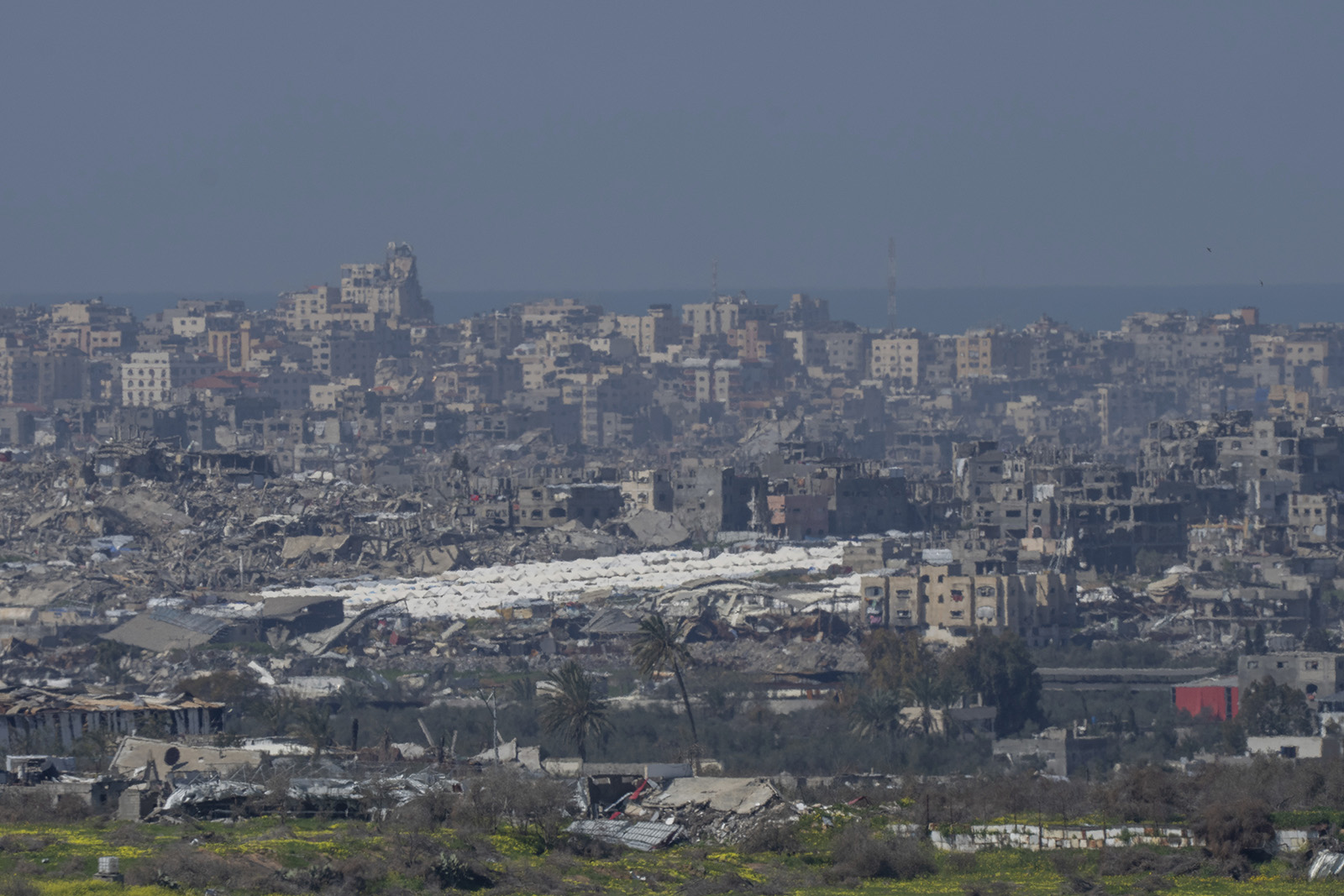
White tents are erected among destroyed buildings in the Gaza Strip, as seen from southern Israel, Tuesday, Feb. 25, 2025. (AP Photo/Ohad Zwigenberg)


Yonat Shimron
February 26, 2025
RNS


(RNS) — Jewish philanthropies in the U.S. have supported a host of liberal projects through the years, including climate change initiatives, abortion care and immigrant support and advocacy.

Palestinian solidarity — not so much.

Since the war in Gaza began, after the Oct. 7, 2023, attack by Hamas on Israel, some Jewish philanthropies have disciplined or withdrawn funding from social justice organizations that expressed support for Palestinians or criticized Israel. The war, which has killed some 46,000 Palestinians, according to the Gaza Health Ministry, and flattened most of the enclave, led many otherwise liberal philanthropies to bow out of funding for progressive nonprofit organizations.

They’ve done so with language provisions that silence a grantee’s ability to speak out about Israel’s conduct of the war or by outright pulling support from an organization over its views on the war in Gaza.

The Charles and Lynn Schusterman Family Philanthropies ended grants to the Altanta-based Access Reproductive Care-Southeast. The Harry and Jeanette Weinberg Foundation cut off funding to CASA, an immigrant rights group based in Maryland. (Weinberg then went so far as to remove its name from two CASA buildings the foundation had helped fund.) And the Nathan Cummings Foundation did not renew a grant to The Rising Majority, a coalition of multiracial activist groups that organize around economics and labor.

The philanthropies regard themselves as Zionists, meaning they support a Jewish nation-state.

“Your words and actions are in conflict with the Foundation’s mission, which includes work in Israel, a country with personal ties to the life and legacy of our founder,” wrote the board chair of The Harry and Jeanette Weinberg Foundation to CASA’s executive director in 2023, explaining the foundation’s decision to cut ties with the group.


A full-page ad in the New York Times on Thursday, Feb. 13, 2025, says “Trump has called for the removal of all Palestinians from Gaza. Jewish people say NO to ethnic cleansing!” (Photo via X/@JFREJNYC)

But now a newer group of Jewish philanthropists has begun to challenge restrictions in funding to organizations critical of Israel. A recent full-page New York Times ad that condemned President Donald Trump’s plan to clear Gaza of its Palestinian residents is one of the first public statements paid for by those efforts.

RELATED: American rabbis condemn Trump’s Gaza plan in New York Times ad

The ad, published Feb. 13 and signed by celebrities and rabbis, stated boldly, “Jewish people say NO to ethnic cleansing!” Its nearly six-figure price tag was paid by In Our Name, a Jewish-led effort to raise money for organizations that support Palestinian safety and self-determination.

“This practice of defunding is actively silencing organizations and represents a major threat to democracy overall,” said Cody Edgerly, the campaign’s director.


The In Our Name campaign began with a public letter this past summer from Jewish philanthropists that derided the “dramatic ramping up of efforts in philanthropy to marginalize, discredit, and censor voices — including Jewish voices — that dissent from certain orthodoxies.”

Its 200-plus signatories said, “We will not let our faith be used as an excuse to silence the voices of progressive activists.”

The campaign has so far raised $2.8 million. About 75% of the funds raised will support Palestinian-led social initiatives in Gaza and the West Bank. Decisions on funding will be turned over to Palestinian leaders or advisory boards that reflect the communities they support. (The other 25% will remain in the U.S. to fund actions and movements in support of Palestinians.)

American Jews broadly support Israel, and funding to help with its war in Gaza has grown exponentially. The Jewish Federations of North America, an umbrella group, has raised upward of $850 million since the war began, and private foundations have topped that with at least $1 billion in aid, according to Alliance, a British philanthropy newsletter.

But some Jewish philanthropists, especially younger ones, have begun to question that support.

David Roswell, one of multiple heirs to an oil fortune, has been engaging family members of the Jacob and Hilda Blaustein Foundation based in Baltimore to reconsider aid to Israel.

Roswell, who considers himself an anti-Zionist, said the events of Oct. 7, 2023, clarified the need to push the foundation to rethink its Israel giving. Roswell, 34, is not a member of the Blaustein board but a related family foundation, the Elizabeth B and Arthur E Roswell Foundation. This past year he has been working to steer his elder relatives on the Blaustein board to change their funding strategy.

“Every time there’s been a big news moment, I’ve sort of knocked on the door of the foundation: ‘What are you gonna do about this? This is really crazy,’” he said. “Maybe if there were more Jewish foundations being clear about not being OK with what Israel is doing, that would have given cover for more nonprofits.”

Roswell, his sister, Naomi, and several other younger members of the family privately contributed about $250,000 to the In Our Name campaign.

Liana Krupp, another Jewish philanthropist who has contributed to In Our Name, wrote in an email to RNS that she was “committed to building a world that supports Palestinian self-determination as much as it does for any other people.”


Rebecca Vilkomerson. (Photo by Jess Benjamin)

Krupp, who is president of the Krupp Family Foundation, wrote: “I don’t believe bridge-building within the American Jewish community can only happen on the conditionality of bending one’s beliefs and values. …There are more Jews who support Palestine than are publicly represented. Many of us have been actively demonstrating that we listen, learn, and show up with people we may disagree with on certain issues because there are other intersections of Jewish life that we can find common ground on. ”

Rebecca Vilkomerson, co-director of Funding Freedom, a group that builds support for Palestinian freedom in the philanthropic sector, said the Jewish philanthropic space has been riven by the war.

“Most Jews think of themselves as liberal and progressive and have concerns about the way the genocide has been waged on Gaza,” said Vilkomerson, formerly the executive director of the anti-Zionist nonprofit Jewish Voice for Peace. “That’s dividing synagogues, it’s dividing Hebrew schools, it’s dividing arts institutions, it’s dividing every kind of institution you can imagine. And it’s creating enormous fractures, including in the funding world.”

Additionally, lawfare, or the use of legal systems to delegitimize an opponent’s political views, has raised the costs of working in the solidarity space.

And last month, Jewish Voice for Peace agreed to pay $677,634 to settle allegations made by a pro-Israel lawyer that the progressive Jewish organization had fraudulently received a second Paycheck Protection Program loan.

Many progressive nonprofits also fear a bill that passed in the U.S. House would enable the secretary of the Treasury to rescind the tax-exempt status of any nonprofits the secretary concludes are “terrorist-supporting organizations.”

But Vilkomerson said she was heartened by the rise of groups such as In Our Name.

“Every organization is having to make some decisions,” she said. “And obviously, some organizations are deciding that the time is now; they have to speak out.”

RELATED: House passes anti-terror financing bill that may punish nonprofits
Serbian police raid NGOs funded by USAID

BRUSSELS SIGNAL
26 February 2025

Serbian police have raided several major non-governmental organisations in search of evidence of financial malfeasance.

The move on February 25 came as four organisations were accused of embezzling funds from the US development agency USAID.

According to the NGOs, which have supported the ongoing protests against the current President Aleksandar Vučić, the police action was an attack on their civil rights.

In a statement to the press, Nenad Stefanovic, Belgrade’s prosecutor general, accused the four NGOs searched of possible “embezzlement of American taxpayers’ funds”.

He cited the “doubts about USAID’s work” expressed by “US President Donald Trump and the US Department of Government Efficiency [DOGE], led by Elon Musk”.

Stefanovic said the Special Anti-Corruption Department had contacted the US Justice Department for information concerning USAID over the possible abuse of funds, money laundering and the improper spending of US taxpayers’ funds in Serbia.

All USAID-related documents were seized from the four NGOs by the Higher Public Prosecutor’s Office, which also questioned those in charge of spending.

Several non-governmental organisations in Croatia, Bosnia and Serbia described these raids as an attempt to intimidate these groups.

In a reaction in French newspaper Le Monde on February 26, Radovan Kupres, a representative of the Centre for Research, Transparency and Accountability (CRTA), said: “It’s the first time we’ve been subjected to something like this, we have more and more the impression of living like in Belarus.”

The CRTA described itself as an independent, non-partisan civil society organisation committed to developing democratic culture and civic activism.

Other NGOs in the crosshairs of the police were the watchdogs Gradjanske Inicijative (Civic Initiatives), Trag and the Policy Centre.

Maja Stojanovic, director of Civic Initiatives, told Reuters that 20 detectives raided its offices “without a court order”.

“Today’s intrusion by the police … represents a brutal demonstration of force and continued pressure on civil society in Serbia,” Stojanovic said.

Since 2001, USAID has donated close to $1 billion (€950 million) to Serbia. Officially, this was to “strengthen the rule of law and improve good governance” but some, including the Serbian Government, have doubted these intentions.

In recent years, Serbia has seen multiple protests against Vučić, driven by accusations of corruption, electoral fraud and growing authoritarianism.

A significant trigger was the November 2024 collapse of a train station canopy in Novi Sad, killing 15 people, which demonstrators blamed on government negligence and graft tied to a Chinese-led reconstruction project.

This sparked major student-led protests, starting in November 2024 and growing into the largest protest movement in Serbia’s history by early 2025, with tens of thousands demanding governmental accountability and Vučić’s resignation.

In late January, he resigned, stating he did not want to fuel social tensions further.
For years, the European Union had been critical of Vučić’ and his “illiberal democracy”.

Brussels scolded him for his consolidation of power, suppression of media freedom and erosion of judicial independence.

Vučić’s ties with Moscow, exemplified by his refusal to impose sanctions on Russia after the 2022 invasion of Ukraine, drew particular ire. The European Parliament explicitly condemned Serbia’s stance in resolutions that tied its EU accession to stricter compliance.

The war in Ukraine and the EU’s growing need for critical resources, especially lithium, then prompted an apparent change of attitude.

Brussels started to see Serbia’s Jadar Valley, home to one of Europe’s largest lithium deposits, as key for its “green” transition.

By mid-2024, the EU’s tone had softened as it sought to secure Serbia’s lithium through a deal it signed with Serbia in July with then-German chancellor Olaf Scholz and European Commission Vice President Maroš Šefčovič, granting European carmakers exclusive access to the reserves.

That was despite the popular protest in the valley, fuelled by environmental concerns, on top of the national protests against Vučić’s regime.