Tuesday, March 11, 2025

Chad extends detention of RFI journalist, as lawyers denounce 'crackdown'

An RFI correspondent and a national TV journalist have been detained in Chad in a move condemned by press freedom advocates as part of a broader crackdown on dissent.

Campaign posters showing Chad's presidential candidates in N'Djamena on 2 May, 2024. © ISSOUF SANOGO / AFP

By:RFI
Issued on: 10/03/2025 -


Following a further interrogation at the offices of the criminal investigation department on Saturday, journalist Olivier Monodji's custody has been extended until at least this Monday, when he will be brought before the public prosecutor of N'djamena.

Monodji, a correspondent for Radio France Internationale and publication director of the newspaper Le Pays, has been detained in the Chadian capital, since Wednesday, 5 March.

His lawyer, Allatha Amos, has slammed the arrest as baseless, stating: “The criminal investigation police were unable to tell us what offence my client is accused of. We are therefore waiting impatiently for Monday to find out. It is really absurd that journalists are still being arrested in the 21st century: it is truly from another age!”

Alongside Monodji, Mahamat Saleh Alhissein, a journalist with the national television station Tele Chad, was also arrested.


Russian translation

The exact reasons for Monodji’s detention remain unclear, but sources indicated to French news agency AFP that it may be linked to an article he wrote in September 2023 about the inauguration of the Russian House in N'Djamena.

Alhissein, on the other hand, is accused of translating documents containing information on Russia's proxy forces and the Sahel’s economic situation, according to Tele Chad.

The Union of Chadian Journalists (UJT) has denounced the detentions as arbitrary, labelling them a “serious attack on the freedom of the press” and calling for the unconditional release of both journalists as well as the return of Monodji’s work equipment.

Ruling party wins majority in Chad's legislative election as opposition boycott polls


'Broader crackdown'

Monodji was reportedly interrogated for four hours on Saturday, by three criminal investigation officers, after which his custody was extended.

His lawyer has criticised this extension, emphasising that Monodji presents sufficient guarantees of representation.

“From now on, [the public prosecutor] alone can explain why he is being held at the premises of the criminal investigation department,” Amos stated.

The recent arrests of journalists in Chad have sparked widespread condemnation from press freedom advocates, who say they fit into a broader crackdown on opposition figures in Chad, as military leader Mahamat Idriss Deby tightens his grip on power.

France launches embezzlement inquiry into Chad's President Mahamat Idriss Déby

Since August 2024, at least three journalists have been arbitrarily detained, according to the Chad Online Media Association.

In September 2024, the World Organisation Against Torture condemned the Chadian intelligence service for increasingly using arrests and detentions without due process.

Deby, who took power after his father’s death three years ago, has distanced Chad from its former colonial ruler, France, and fostered stronger ties with Russia.

Moscow has expanded its influence in Africa through mercenary groups like Wagner, which operate in neighbouring Mali and the Central African Republic.
Réunion Island company revives ancient fermentation technique to boost health

Pot en Ciel Kreol is an artisanal cannery based on France's Réunion Island. Combining local agriculture with the ancient technique of lacto-fermentation, the company aims to preserve the island's rich biodiversity and promote better health for its inhabitants.

01:20
Sylviane Boyer and Mégane Mardemoutou at the Paris International Agricultural Show on 24 February, 2025. © RFI

By: Isabelle Martinett

Issued on: 09/03/2025 -  RFI


Sylviane Boyer founded Pot en Ciel Kreol in 2023, in Cambaie in the north of Réunion, a French department in the Indian Ocean. She had taken over her family farm, which grew numerous vegetables native to the island.

"On Réunion Island, we have exotic vegetables, which have lots of antioxidants. We’re protected here on this little volcanic island, in terms of all the produce we have," Boyer told RFI. "There are vegetables that can’t be found in mainland France… papaya, chayote, watercress that grow in our mountains. And chillies."
Cirque de Mafate on the volcanic island of Réunion in the Indian Ocean. © AFP - Richard Bouhet

Over the years, Boyer began to notice a rise in cases of diabetes, Crohn's disease and high cholesterol. It was at this point that she became interested in micronutrition – the practice of optimising the diet to include vitamins and minerals the body needs – and discovered lacto-fermentation.

"We have lots of health problems because we eat too much fat and sugar. This led me to study lacto-fermentation a bit and I found that, scientifically speaking, a lot has been proven about it, which brought me back to it."

hy do France's overseas territories have a diabetes problem?

\This technique is very common in several Africa countries, where access to electricity can be limited, making food preservation a challenge.

 
Lacto-fermentation is an ancient food preservation technique. 
© Flickr/CC/Local Food Initiative

"In Africa, babies’ first meals are made using lacto-fermentation. It’s a natural process to follow," says Boyer.

This ancient food preservation technique involves immersing food in salted water to encourage the growth of lactic acid bacteria.

"We use large vats where we put local fruits and vegetables from Réunion, along with water and natural, unrefined salt from Saint Leu. This process helps us pre-digest the food and release its full bioavailability," explains Mégane Mardemoutou, sales manager at Pot en Ciel Kreol.

"This process develops probiotics and prebiotics, multiplies vitamin C, vitamin K – which is very important for the heart – and various B vitamins like B2 and B6."

Bitter melon from Réunion Island. © Flickr/CC/Sogni_Hal

One local vegetable the company works with is bitter melon. "It’s a fruit that grows on vines, somewhat like cucumbers. It's an old local vegetable with a thousand benefits because it aids detoxification, improves heart circulation and provides all the essential vitamins we need," says Mardemoutou.

Over half of all adults will be overweight or obese by 2050, study shows

The company is now working with hospitals, the Regional Health Agency and local organisations to spread awareness of the health benefits of lacto-fermentation.
France remains world's second largest arms exporter behind US

The United States maintains its position as world's number one arms exporter, followed by France, according to a report released by the Stockholm International Peace Research Institute on Monday. It also showed that Ukraine became the world's largest importer in the period 2020-2024.

French truck-mounted Ceasar howitzer at the Eurosatory 2024 show, 16 June 2024.
 © RFI/Jan van der Made


By:  Jan van der Made
Issued on: 10/03/2025 -
The findings by the Stockholm International Peace Research Institute (Sipri) coincide with an announcement by European Union states that they intend to strengthen the continent's defence capabilities.

This comes after US President Donald Trump said Europe should become less dependent on the US.

The report published on Monday found that the United States strengthened its position as the world's top weapons exporter with some 43 percent of global exports and France confirmed a distant second place with 9.6 percent.

"France has now cemented its place as the second largest exporter vis-a-vis Russia, which was at that position some time ago," Mathew George, director of Sipri's Arms Transfer Programme told RFI.

France is also "making those inroads into different areas with exports to Asia and the Middle East," he says. "So it's really growing."
Arms embargoes

According to Sipri's report which covers 2020 - 2024, Ukraine became the world's largest arms importer with a growth of "9.627 percent more than the previous period", which is "mind-boggling," George says.

Russia accounted for only 0.5 percent of global arms imports between 2020 and 2024, but mainly "because Russia has mostly relied on domestic arms production to meet its demand," George explains.

In that period, Russia did import missiles with a range of 100 kilometres or more and one-way attack drones from Iran and artillery and missiles with a range of 450 kilometres from North Korea.

But figures are hard to come by due to arms embargoes on the three countries, George explains.

"We make conservative estimates. Unfortunately we don't have that much transparency in those transfers."
RFI

A man reads informations of an Iranian domestically-built drone as he visits National Aerospace Park of the Revolutionary Guard, just outside Tehran, Iran, Friday, Nov. 15, 2024. AP - Vahid Salemi


Warring states' exports down

Exports coming from Russia and Ukraine went substantially down over the 2020-2024 period, Sipri's report shows.

Ukraine became the 20th largest exporter down from the 12th, with a a reduction of 72 percent less exports, while Russian exports declined by 64 percent.

George points out that this decline already started before the 2022 invasion, "most likely related to Russia's decision to prioritise the production of its major arms for its own armed forces over those for export".

This was aggravated by further effects caused by multilateral trade sanctions imposed on Russia and increased pressure from the US and its allies on other states not to buy Russian arms.

Russian arms exports remained at around the same levels of 2023, which was some 47 percent lower than 2022.

Missile systems manufactured by French company MBDA on display at the Eurosatory 2024 defence & security exhibition, 16 June 2024. © RFI/Jan van der Made

Arms imports by European NATO members more than doubled their arms imports in comparison to the period 2015-2020, which preceded the Russian invasion of Ukraine.

According to Sipri's database, 64 percent of Europe's arms imports come from the US, followed by France, South Korea, Germany and Israel.

Last week, EU Commission President Ursula von der Leyen announced that the union's spending on weapon procurement will be increased to €800 billion.

Windfall for European arms makers as Brussels ramps up defence spending

George isn't sure how this will impact current weapon transfers in the long term.

"We'll have to see what and where that is translated into. There has to be a lot of mobilisation in what the industry will need to do to support the requirements of Europe."

"We'll have to wait and see where that 800 billion gets invested into, whether that means that countries will again focus on their own industry to buy more European.

"Some of these decisions are not so much about what's available for us, but also to improve relationships and long-term relationships for a shared strategic objective." George says.


Ukraine has become the largest importer of arms. Percentage wise it is 9,627 percent. That's mindboggling.
REMARK Mathew George SIPRIJan van der Made

Monday, March 10, 2025

Colombia urges UN to remove coca leaf from harmful substances list

Vienna (AFP) – Colombia, whose President Gustavo Petro is a vocal critic of the US-led war on drugs, on Monday urged the UN to remove coca -- the main ingredient in cocaine -- from a list of harmful substances.


Issued on: 10/03/2025 - 

Colombia is the world's main producer of cocaine, which is extracted from the coca leaf © JOAQUIN SARMIENTO / AFP


Colombia is the world's main producer of cocaine -- much of its production in the hands of drug cartels and violent guerrilla groups.

In 2023, the South American country set a new record last year for coca leaf cultivation and cocaine production, which rose 53 percent from 1,738 tonnes (1,915 US tons) to 2,600 tonnes, according to the UN.

The United States is the biggest cocaine consumer.

Used not only for cocaine, the coca leaf is also chewed as a stimulant in countries such as Colombia, Peru, Bolivia and Ecuador, or brewed into a tea thought to combat altitude sickness.


Colombian Foreign Minister Laura Sarabia, in an address to the UN's Commission on Narcotic Drugs in Vienna, insisted Monday that the leaf "is itself not harmful to health".

Removing it from a 1961 UN list of harmful narcotics, where it sits alongside cocaine and heroin, would allow it to be used to "its full potential in industrial applications such as fertilisers and beverages," she said.

She argued that legalisation was the only way to stop drug traffickers monopolising the plant -- forcing rural communities to grow it for them, and razing forests for its cultivation.

Sarabia said billions of dollars spent on the so-called war on drugs has done nothing to stop consumption, production, and trafficking.

In fact, she said, the number of recreational users of cocaine increased by more than 50 million in a decade.

Petro, the country's first-ever leftist president, has tried to change the approach to combatting drug trafficking to focus more on prevention among potential users, and finding alternative incomes for coca farmers.

Last month, he raised some eyebrows when he said that cocaine "is no worse than whisky" and is only illegal because it comes from Latin America.

"If you want peace, you have to dismantle the business (of drug trafficking)," he said during a government meeting. "It could easily be dismantled if they legalise cocaine in the world. It would be sold like wine."

Sarabia on Monday insisted that changing the approach from a punitive one towards a more humanitarian one did not imply "normalising or coexisting with drug trafficking".

Colombian authorities have seized more than 1,900 tonnes of cocaine and destroyed 454 clandestine laboratories since Petro took office in August 2022 up to January this year, said the minister.

© 2025 AFP
The Unyielding Reality—and Cruelty—of Israeli Settler Colonialism

The only solution is that Israel's settler colonialism must be challenged, curtailed, and ultimately defeated.


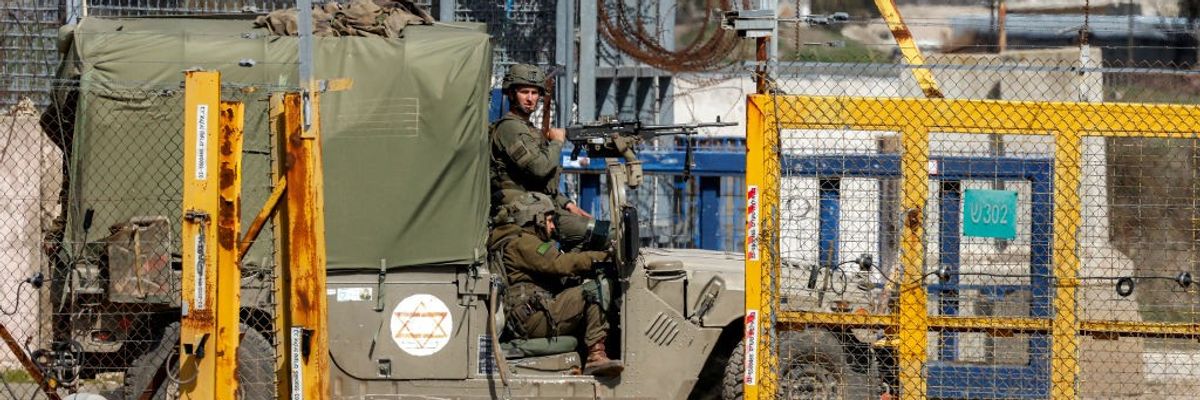
An Israeli army vehicle is pictured by the barbed-wire fence of the UN-patrolled buffer zone separating Israeli and Syrian forces in the Golan Heights near the UN Quneitra checkpoint on March 2, 2025.
(Photo by Jalaa Marey/AFP via Getty Images)


Ramzy Baroud
Mar 10, 2025 
COMMON DREAMS


The conversation on settler colonialism must not be limited to academic discussion. It is a political reality, clearly demonstrated in the everyday behavior of Israel.

Israel is not merely an expansionist regime historically; it remains actively so today. Additionally, the core of Israeli political discourse, both past and present, revolves around territorial expansion.

Frequently, we succumb to the trap of blaming such language on a specific set of right-wing and extremist politicians or on a particular US administration. The truth is vastly different: the Israeli Zionist political discourse, though it may change in style, remains fundamentally unchanged throughout time.

Zionist leaders have always associated the establishment and expansion of their state with the ethnic cleansing of the Palestinians, later referred to in Zionist literature as the "transfer."

Theodor Herzl, the founder of modern political Zionism, wrote in his diary about the ethnic cleansing of the Arab population from Palestine:

"We shall try to spirit the penniless population across the border by procuring employment for it in the transit countries, while denying it any employment in our own country... Both the process of expropriation and the removal of the poor must be carried out discreetly and circumspectly."

It is unclear what happened to Herzl's grand employment scheme aimed at "spiriting" the population of Palestine across the region. What we know is that the so-called "penniless population" resisted the Zionist project in numerous ways. Ultimately, the depopulation of Palestine occurred through force, culminating in the Nakba, the Catastrophe of 1948.

The discourse of the erasure of the Palestinian people has been the shared foundation among all Israeli officials and governments, though it has been expressed in different ways. It has always had a material component, manifesting in the slow but decisive takeover of Palestinian homes in the West Bank, the confiscation of farms, and the constant construction of "military zones."

Despite Israeli claims, this "incremental genocide" is not directly linked to the nature and degree of Palestinian resistance. Jenin and Masafer Yatta illustrate this clearly.

Take, for example, the ongoing ethnic cleansing in the northern West Bank, which, according to UNRWA, is the worst since 1967. The displacement of tens of thousands of Palestinians has been justified by Israel as a military necessity due to the fierce resistance in that region, primarily Jenin, but other areas as well.

However, many parts of the West Bank, including the area of Masafer Yatta, have not been engaged in armed resistance. Yet, they have been primary targets for Israel's colonial expansion.

In other words, Israeli colonialism is in no way linked to Palestinian resistance, action or inaction. This has remained true for decades.

Israel... rarely feels the need to explain itself to anyone. It remains a model of a ferocious, traditional colonial society that fears no accountability and has no regard for international law.

Gaza is a stark example. While one of the most horrific genocides in recent history was being carried out, Israeli real estate developers, members of the Knesset (Parliament), and leaders of the illegal settlement movement were all meeting to discuss investment opportunities in a depopulated Gaza. The callous tycoons were busy promising villas on the beach for competitive prices while Palestinians starved to death, amid an ever-growing body count. Even fiction cannot be as cruel as this reality.

It is no wonder that the Americans joined in, as evidenced by equally ruthless comments made by Jared Kushner, the son-in-law of US President Donald Trump, and eventually by the President himself.

While many at the time spoke about the strangeness of US foreign policy, few mentioned that both countries are prime examples of settler colonialism. Unlike other settler colonial societies, both Israel and the US are still committed to the same project.

Trump's desire to take over and rename the Gulf of Mexico, his ambition to occupy Greenland and claim it as American territory, and, of course, his comments about owning Gaza are all examples of settler colonial language and behavior.

The difference between Trump and previous presidents is that others used military power to expand US influence through war and hundreds of military bases worldwide without explicitly using expansionist language. Instead, they referenced the need to challenge the Soviet "red menace," "restore democracy," and launch a global "war on terror" as justifications for their actions. Trump, however, feels no need to mask his actions with false logic and outright lies. Brutal honesty is his brand, though in essence, he is no different than the rest.

Israel, on the other hand, rarely feels the need to explain itself to anyone. It remains a model of a ferocious, traditional colonial society that fears no accountability and has no regard for international law.

While the Israelis pushed to conquer and ethnically cleanse Gaza, they remained entrenched in southern Lebanon, insisting on remaining in five strategic areas, thus violating the ceasefire agreement with Lebanon, which was signed on November 27.

A perfect case in point was the immediate—and I mean immediate—expansion into southern Syria, the moment the Syrian regime collapsed on December 8.

As soon as the events in Syria opened up security margins, Israeli tanks rolled in, warplanes destroyed almost the entirety of the Syrian army, and Israeli Prime Minister Benjamin Netanyahu canceled the armistice agreement signed in 1974.

That expansion continued, though Syria represented no so-called security threat to Israel whatsoever. Israel is now in control of the Sheikh Mountain and Quneitra inside Syria.

The unquenchable appetite for land in Israel remains as strong as it was upon the formation of the Zionist movement and the takeover of the Palestinian homeland nearly eight decades ago.

This realization is crucial, and Arab countries, in particular, must understand this. Sacrificing Palestinians to the Israeli death machine with the flawed calculation that Israel's ambitions are limited to Gaza and the West Bank is a fatal mistake.

Israel will not hesitate for a minute to militarily move into any Arab geographic space the moment it feels able to do so, and it will always find US support and European silence, regardless of how destructive its actions are.

Jordan, Egypt, and other Arab countries could find themselves facing the same predicament as Syria today: watching their territories being devoured while remaining powerless and without recourse.

This realization should also matter to those busy finding "solutions" to the Palestinian-Israeli "conflict," which narrowly frame the problem to that of the Israeli occupation of the West Bank and Gaza.

Settler colonialism can never be resolved through creative solutions. A settler colonial state ceases to exist, and a settler colonial society ceases to function if territorial expansion is not a permanent state of affairs.

The only solution to this is that Israel's settler colonialism must be challenged, curtailed, and ultimately defeated. It may be a difficult task, but it is an inescapable one.
WaPo Columnist Resigns, Says Publisher Killed Column That 'Respectfully Dissented' Against Bezos Edict

"This just exposes the blatant fallacy in Bezos' new rules: civil liberty for him but not for anyone who disagrees," wrote one journalist.


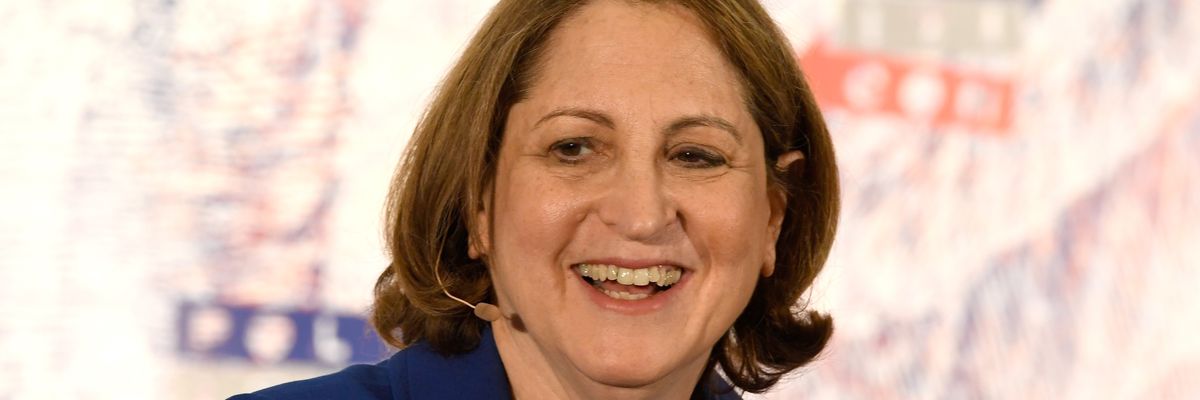
Ruth Marcus speaks onstage at Politicon 2018 at Los Angeles Convention Center on October 21, 2018 in Los Angeles, California.
(Photo: Michael S. Schwartz/Getty Images)


Ellise Goldsmith
Mar 10, 2025

Columnist and editor Ruth Marcus said Monday that she is resigning from The Washington Post after CEO and publisher Will Lewis allegedly decided not to run a column she penned critiquing billionaire owner Jeff Bezos' recent changes to the opinion section, according to a note from Marcus that was obtained by multiple media reporters.

In the note, which is addressed to both Bezos and Lewis, Marcus wrote that as an opinion writer, she was "honored to offer commentary that readers could be assured constituted my best independent judgment of the topic at hand. Unfortunately, on the opinions side of the newspaper, that appears to be no longer the case."

In late February, Bezos—who has owned the paper since 2013—announced a major change in the outlet's opinion section. From now on, the opinion section will advocate for "personal liberties and free markets" and "viewpoints opposing those pillars will be left to be published by others," according to an email from Bezos. The section's editor, David Shipley, decided to depart and the paper lost thousands of subscriptions after Bezos' intentions became public, according to NPR.

The move was denounced, including by the Post's own chief economics reporter, Jeff Stein, who called it a "massive encroachment" on The Post's opinion section and said that the move makes clear "dissenting views will not be published or tolerated there."

In her farewell note, Marcus said that the Lewis' decision "not to run the column that I wrote respectfully dissenting from [Bezos'] edict... underscores that the traditional freedom of columnists to select the topics they wish to address and say what they think has been dangerously eroded."

Marcus, who has been with the paper since 1984, separately sent a note to staff in which she emphasized that her decision does not suggest "what anyone else should do in the circumstances in which we find ourselves," according to a copy of the note obtained by Semafor's Max Tani.

Marcus' departure comes amidst greater turmoil at the Post. In the fall, Bezos decided to block the paper's endorsement of then-presidential candidate Kamala Harris and ended the Post's tradition of endorsing presidential candidates. Hundreds of thousands of readers canceled their subscriptions in response. The paper has also undergone layoffs and experienced other high profile departures.

The news that Marcus was leaving the paper was mourned online on Monday.

"The tragic self-destruction of a great newspaper continues. I had the privilege of working with Ruth Marcus for years and she is the best of the best. Whether you agree with her or not, she is the model of journalistic excellence and integrity," wrote New York Times journalist Peter Baker.

"Terrible news," wrote journalist Julia Preston. "Ruth Marcus writes a well-researched, level-headed column. She is a voice of reason and decency. This just exposes the blatant fallacy in Bezos's new rules: civil liberty for him but not for anyone who disagrees."

‘Elbows up!’ – the hockey tactic inspiring Canada’s anti-Trump fight


By  AFP
March 10, 2025


Gordie Howe's 'elbows up' tactics are one way that Canadians are getting in the spirit to fight back against Donald Trump - Copyright GETTY IMAGES NORTH AMERICA/AFP BRUCE BENNETT

A legendary Canadian ice hockey player renowned for his aggressive play has inspired the country’s emerging rallying cry of “Elbows up!” in its battle against US President Donald Trump.

Throwing an elbow — in your opponent’s face or ribs — is hardly rare in hockey, but the move is closely associated Gordie Howe, one of the sport’s greatest ever players.

Howe, known to many as “Mr Hockey,” was notorious for using his elbows to ward off opponents when battling for the puck.

“We’re a country that will be diplomatic when we can — but fight when we must: ‘Elbows up!'” outgoing Prime Minister Justin Trudeau said to a cheering crowd of Liberal Party supporters in his farewell address in Ottawa on Sunday.

Rising to their feet, the crowd chanted “elbows up” in response.

The catchphrase had been gaining traction online and was propelled to a new level this weekend when Toronto-born comedian Mike Myers mouthed it during the closing credits of US show Saturday Night Live.

Trudeau warned in his speech that Canada faced “an existential challenge” from Trump, who has repeatedly spoken about annexing the country and initiated trade tariffs that could devastate the Canadian economy.

A statue honoring Howe in his hometown of Floral, in the province of Saskatchewan, shows him on skates, holding a stick, with his left elbow pointed straight up.

“If a guy slashed me, I’d grab his stick, pull him up alongside me and elbow him in the head,” Howe, who died in 2016, once said.

Any country facing annexation from the world’s largest military power might want to be armed with more than pointed elbows, but in Canada hockey references can be unifying.

The premier of British Columbia David Eby, whose government has banned the sale of alcohol from US “red states” that support Trump, offered an explanation for the phrase.

“‘Elbows up’ means the other team is trying to take advantage, and if they come at you, they’re going to feel it,” he said.

Sunday’s Liberal Party meeting in Ottawa named former central banker Mark Carney as Trudeau’s successor. A transition is expected in the coming days.

Earlier Sunday, a crowd of about 1,000 anti-Trump protesters met on Parliament Hill in Ottawa and chanted “Elbows Up, Canada!”


Next Canadian PM Mark Carney to Trump: 'Canada Never, Ever, Will Be Part of America'

"There is someone who is trying to weaken our economy: Donald Trump," said Carney in his victory speech.


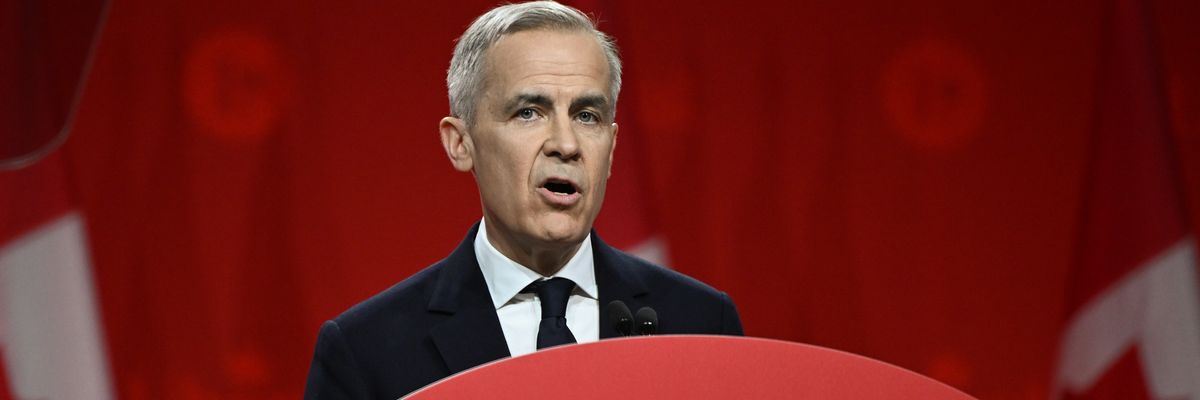
Mark Carney, newly elected as the leader of the Liberal Party of Canada, delivers his victory address following the official announcement of the 2025 Liberal Leadership race results at Rogers Centre, in Ottawa, Ontario, Canada, on March 9, 2025.
(Photo: Stringer/Anadolu via Getty Images)


Ellise Goldsmith
Mar 10, 2025  
COMMON DREAMS

Former central banker Mark Carney will replace outgoing Prime Minister Justin Trudeau and take the helm of Canada's centrist Liberal Party after winning the leadership race by more than 80%. In his victory speech in Ottawa, Carney took direct aim at U.S President Donald Trump.

"There is someone who is trying to weaken our economy: Donald Trump," said Carney. " Donald Trump, as we know, has put... unjustified tariffs on what we build, on what we sell, on how we make a living. He's attacking Canadian families, workers, and businesses."

Last week, the Trump administration imposed 25% tariffs on most goods imported from Canada and Mexico last week, prompting Canada to impose retaliatory tariffs. Trump has paused tariffs on some products from Canada, but the duties could still return in April, according to Bloomberg. But a trade war isn't the only area where Canadian and U.S. relations are feeling a chill. Trump has made threats to Canadian sovereignty by repeatedly saying Canada should be the 51st state of the U.S., which Carney also addressed in his speech.

"America is not Canada. And Canada never, ever, will be part of America in any way, shape or form," Carney told the crowd. "We didn't ask for this fight, but Canadians are always ready when someone else drops the gloves."

After nearly a decade leading the Canadian government, outgoing Prime Minister Justin Trudeau announced in January that he intended to resign as the head of the Liberal Party after it selected a new leader—acquiescing to calls that he should make way for new leadership ahead of a federal election later this year. Trudeau faced declining public polling and calls from within his own party to resign.

In recent weeks, however, the Liberal Party has sharply rebounded in public opinion polls—rising from 20% in early January to 30% as of March 5. A federal election must be held by October 20, 2025, but could be held sooner if a snap election is called. Carney will serve as prime minister for the duration of the party's ruling term.

Polling has the Conservative Party, lead by Pierre Poilievre, in the lead.

Carney will be the second Canadian prime minister "with no concrete links to parliament at the time of his appointment, including no seat in the House of Commons. While no rule bars this, convention suggests Carney will need to quickly announce plans to run for a federal seat," according to The Guardian.

Carney was the governor of the Bank of Canada from 2008 to 2013, and later was the first non-British person selected to run the Bank of England, from 2013 to 2020, according to The Associated Press. In both cases, Carney earned acclaim for helping the countries navigate economic hardship. From 2020 to early 2025 he was the United Nations’ special envoy for climate action and finance, per his LinkedIn page.

Call What's Coming the 'Donald J. Trump Recession,' Says Economist

"While a recession may not be fully baked into the cards at this point, the risk is evident and it's almost entirely coming from Donald Trump's policies."


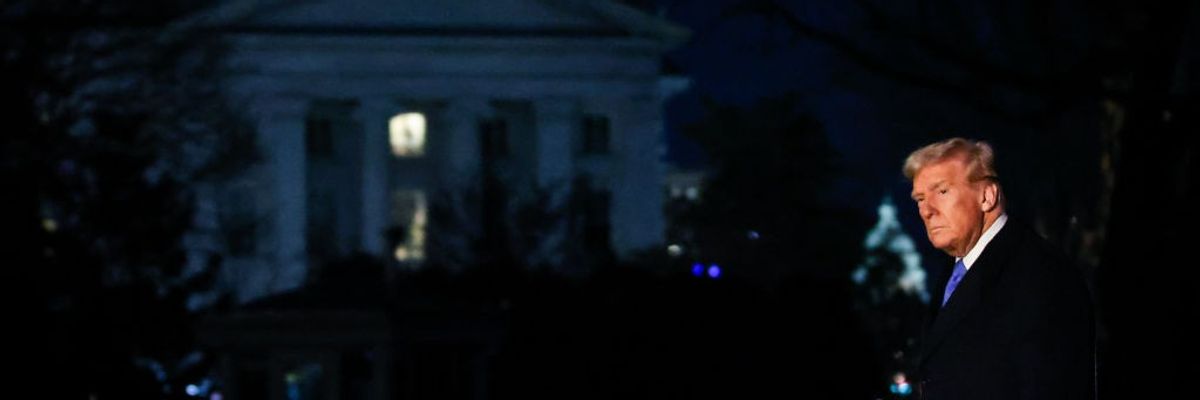
U.S. President Donald Trump walks to the White House on March 9, 2025.
(Photo: Samuel Corum/Getty Images)

Jake Johnson
Mar 10, 2025 
COMMON DREAMS

As U.S. financial markets continued their downward spiral on Monday amid rapidly mounting concerns about the impacts of President Donald Trump's erratic and destructive tariff policies, one economist argued that the president has almost single-handedly engineered economic conditions that could result in a recession in the near future.

"Past recessions have been the result of policy errors or disasters," Dean Baker, senior economist at the Center for Economic and Policy Research, wrote Monday. "The most typical policy error is when the Federal Reserve Board raises interest rates too much to counter inflation. That was clearly the story in the 1974-75 recession as well as the 1980-82 double-dip recession."

"Then we have recessions caused by collapsing financial bubbles, the 2001 recession following the collapse of the stock bubble and the 2008-09 recession following the collapse of the housing bubble. And of course, we had the 2020 recession because of the Covid pandemic," he added. "But now Donald Trump is threatening us with a recession, not because of something that is any way unavoidable, but rather because as president he has the power to bring on a recession."

Baker pointed specifically to Trump's decision to impose sweeping tariffs on imports from Canada, Mexico, and China, which the economist estimates will cost Americans roughly $2,000 per household as companies push the costs of the tariffs onto consumers in the form of higher prices.


Retaliatory measures are also likely to inflict pain on Americans: On Monday, Ontario announced it would charge 25% more for the electricity it provides to Minnesota, New York, and Michigan in response to Trump's tariffs on Canadian imports, a move that's expected to hike electricity bills significantly for ratepayers in those states.

China, meanwhile, hit back at Trump Monday with an additional 15% tariff on U.S. farm products, including chicken, pork, soybeans, and beef.

Trump's tariff policies, and the widespread confusion surrounding their implementation, have sparked a sell-off on Wall Street and broader fears about the state of the U.S. economy as the labor market shows signs of stalling and consumer confidence plunges.

"While a recession may not be fully baked into the cards at this point, the risk is evident and it's almost entirely coming from Donald Trump's policies," Baker argued, noting that while the recession threat is "first and foremost" driven by tariffs, they "are just one possible route."

"The other is Elon Musk's DOGE team attack on the government. If there was ever any doubt, it is now clear that this outfit has nothing to do with increasing government efficiency," Baker wrote. "The direct impact of Musk's job cuts on both the budget and the economy is likely to be small. The bigger impact is the uncertainty they have created in large sectors of the economy."

"In short, Donald Trump has good reasons for telling us that his MAGA policies might give us a recession," he added. "It's hard to know how bad this recession would be, but it will definitely be the 'Donald J. Trump recession.'"

"Will the Trump slump turn into a recession? How will Trump lie and cheat his way out of it? Stay tuned."

Baker's assessment came a day after Trump declined to rule out the possibility of an economic recession in the U.S. this year and downplayed the effects of his tariffs, claiming without a shred of evidence that they will make the country "so rich you're not going to know where to spend all that money."

Trump previously insisted that the U.S. stock sell-off was attributable not to his chaotic tariff announcements, but to "globalists that see how rich our country is going to be and they don't like it."

Former U.S. Labor Secretary Robert Reich wrote Monday that just seven weeks after Trump's inauguration, "the bottom is falling out" of the U.S. economy.

"Stocks are plunging. Treasury yields are falling. Consumer confidence is dropping. Inflation is picking up," Reich wrote. "The cost of living—the single biggest problem identified by consumers over the last several years—is going up, not down. Trump's tariffs on steel and aluminum, and his threatened 25% tariffs on Canada and Mexico, are playing havoc with supply chains inside and outside America."

"Even before this Trump slump, only the richest 10% of Americans had enough purchasing power to keep the economy going with their spending. The bottom 90%—including most Trump voters—were barely getting by. The next eighteen months could be rough on millions of people," he continued. "Will the Trump slump turn into a recession? How will Trump lie and cheat his way out of it? Stay tuned."


Trump EPA and Citibank Sued for 'Illegally' Freezing Green Energy Funds

"This program was designed to save money for hard-working Americans who are struggling to pay for groceries and keep the lights on," said the head of a climate group that had been awarded funds to finance green energy expansion.


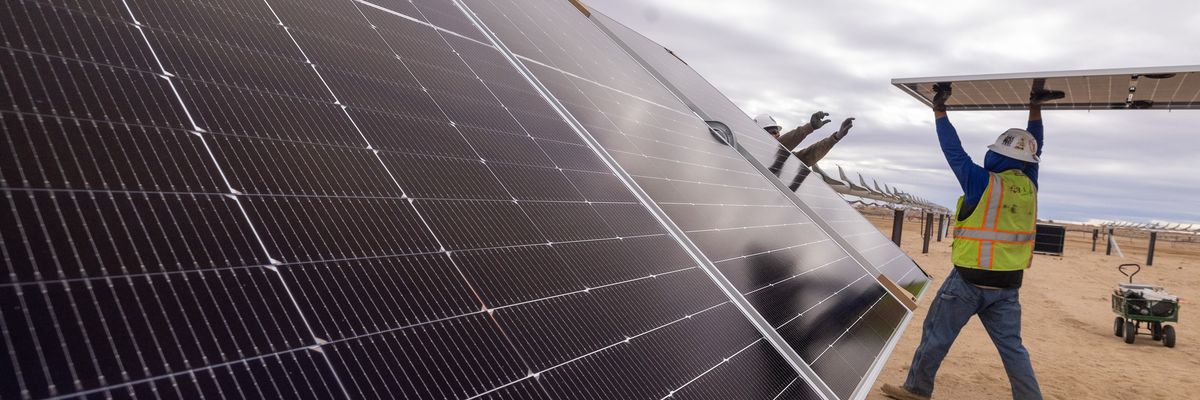
Workers install solar panels for the Los Angeles Department of Water and Power's biggest solar and battery storage plant on November 25, 2024 near California City, California.
(Photo: Brian van der Brug/Los Angeles Times via Getty Images)


Julia Conley
Mar 10, 2025
 COMMON DREAMS


The need for a federal lawsuit filed Monday presents "more evidence of a constitutional crisis," according to one campaigner, as plaintiffs pushed back against the Trump administration's unlawful freezing of funds appropriated by Congress to help fuel a green energy transition in marginalized communities nationwide.

The lawsuit was announced Saturday by Climate United Fund, a nonprofit green investment fund, and was received Monday by U.S. District Judge Tanya Chutkan, who previously presided over President Donald Trump's criminal trial regarding his alleged attempts to overturn the 2020 election.

The group is accusing the Environmental Protection Agency and Citibank of "illegally withholding" $7 billion that had been awarded to Climate United through the Inflation Reduction Act (IRA), which set up a $20 billion Greenhouse Gas Reduction Fund, also known as the Green Bank.

The Green Bank was established to fund solar power, energy-efficient housing projects, and electric vehicles. Climate United has reported that it used funds to begin pre-construction on a solar energy project across the University of Arkansas system, invest in electric trucks at the ports of Los Angeles and Long Beach with plans for nationwide expansion, and launch a grant program for low-income communities to start clean energy projects.

For the last two weeks, The New York Times reported, Climate United and seven other nonprofits that were awarded funding through the Green Bank have been unable to withdraw the money from their accounts at Citibank.

"They have essentially acted as if they control the power of the purse, but very clearly written into the Constitution is the separation of powers that grants Congress and Congress alone the power of making funding decisions."

The Times reported that the EPA appeared to have frozen the funds after EPA Administrator Lee Zeldin called for a "termination" of the agreement the Biden administration made with Citibank when the money was allocated to the nonprofits.

Zeldin made that demand last month after the right-wing group Project Veritas, released a hidden-camera video in which it had surreptitiously recorded an EPA employee saying before Trump took office that the agency was attempting to spend federal money on climate programs before the Republican president was inaugurated.

Zeldin suggested the comments signaled the Green Bank was "designed to obligate all of the money in a rush job with reduced oversight" and was "irresponsibly shoveling boat loads of cash to far-left, activist groups in the name of environmental justice and climate equity."

Climate United and the other groups impacted by the funding freeze have been struggling to pay their staff, the Times reported.

"This isn't about politics; it's about economics," said Beth Bafford, CEO of Climate United. "This program was designed to save money for hard-working Americans who are struggling to pay for groceries and keep the lights on. We're going to court for the communities we serve—not because we want to, but because we have to."

In his statement about the Green Bank funding last month, Zeldin said he was referring the matter to the Office of the Inspector General, suggesting an accusation of potential fraud.

Days after Zeldin's directive, federal prosecutor Denise Cheung resigned after declining to freeze an unidentified bank's accounts for a government contractor, saying she had not found "sufficient evidence" of criminal activity. Cheung's resignation is believed to have stemmed from Zeldin's accusations regarding the Greenhouse Gas Reduction Fund.

In an interview with "Living on Earth" on Public Radio Exchange last month, Jillian Blanchard, vice president of climate change and environmental justice at Lawyers for Good Government, said Zeldin's push to claw back $20 billion that was awarded last year through legislation passed by Congress suggests that "this executive [branch] seems to believe that they have and should have more power than both Congress and the courts."

"They have essentially acted as if they control the power of the purse, but very clearly written into the Constitution is the separation of powers that grants Congress and Congress alone the power of making funding decisions," said Blanchard.

The Trump administration has already been blocked from freezing funds that were were appropriated by Congress. In January the president moved to block federal grants and loans in an order that was swiftly blocked by federal courts, with one judge saying the funding freeze was "likely unconstitutional."
Los Angeles wildfires cost Lloyd’s of London $2.3 bn


By AFP
March 10, 2025


The LA wildfires have dealt a multi-billion-dollar hit to the insurance industry - Copyright AFP RONALDO SCHEMIDT

Insurance market Lloyd’s of London on Monday said it had taken a financial hit totalling about $2.3 billion from the Los Angeles wildfires earlier this year.

“We are still assessing the full impact” of the January fires that will affect 2025 results, chief financial officer Burkhard Keese said in a statement.

The fires around the United States’ second city burned for three weeks, forcing thousands of residents to evacuate their homes.

They destroyed thousands of structures, devastating the affluent Pacific Palisades neighbourhood of Los Angeles, Malibu and the community of Altadena in the wider county.

Private meteorological firm AccuWeather has estimated the total damage and economic loss at between $250 billion and $275 billion.

Lloyd’s of London published financial results on Monday showing pre-tax profits of $11.4 billion for 2024, slightly less than the previous year.

The loss from the fires compares with an estimated hit of some 1.2 billion euros ($1.3 billion) announced by German reinsurance giant Munich Re last month.

At the time it called them the “the most substantial wildfire losses in the history of the insurance industry”.

Munich Re said it was well-prepared to absorb the costs from such natural catastrophes and it would continue to cover wildfires as long as the compensation was appropriate.