Sunday, March 23, 2025


Transition point in romantic relationships signals the beginning of their end


Dissatisfaction in a relationship will inevitably lead to separation at some point / Recent study is based on the concept of terminal decline


Johannes Gutenberg Universitaet Mainz

relationship satisfaction 

image: 

How satisfaction with a relationship declines prior to separation. The chart presents the results of pairfam, the national representative longitudinal study undertaken in Germany.

view more 

Credit: ill./©: Janina Bühler


The end of a romantic relationship usually does not come out of the blue but is indicated one or two years before the breakup. As the results of a psychological study have demonstrated, the terminal stage of a relationship consists of two phases. First, there is a gradual decline in relationship satisfaction, reaching a transition point one to two years before the dissolution of the relationship. "From this transition point onwards, there is a rapid deterioration in relationship satisfaction. Couples in question then move towards separation," said Professor Janina Bühler from the Institute of Psychology at Johannes Gutenberg University Mainz (JGU). She conducted the corresponding investigation in collaboration with Professor Ulrich Orth of the University of Bern. Their paper was recently published in the Journal of Personality and Social Psychology.

Analysis built on national studies from Germany, Australia, the United Kingdom, and the Netherlands

It is a common fact that satisfaction in a romantic relationship declines over time. This reduction in satisfaction is particularly marked in the first years of a relationship, and a distinctive low point is often reached after a period of ten years. Instead of considering the processes that occur in the time-since-beginning of a romantic relationship, Janina Bühler and Ulrich Orth decided to look at the time-to-separation of relationships for the purposes of their research.

With this in view, they used data from four representative studies conducted in Germany, Australia, the United Kingdom, and the Netherlands. All these countries are WEIRD, i.e., Western, Educated, Industrialized, Educated, Rich, Democratic, and their individuals are free – by law – to decide about their relationship status. For each of the four data sets covering a total of 11,295 individuals there was a control group roughly the same size consisting of couples that had not separated. The surveys in the four countries were conducted over different periods of time, ranging from 12 to 21 years. In the case of Germany, the researchers employed the data of the Panel Analysis of Intimate Relationships and Family Dynamics (pairfam), a multidisciplinary longitudinal study. In all countries, the subjects were asked to specify how satisfied they were right then with their existing romantic relationship.

Using the available data, Bühler and Orth assessed the extent to which the satisfaction with the relationship developed in the light of their subsequent separation. "In order to better understand dissolving relationships, we examined them from the point of view of time-to-separation. To do this, we applied a concept that is in general use in other fields of psychology," said Janina Bühler. Based on the data of the four national representative studies, the researchers were able to determine that relationships can be subjected to what is known as terminal decline. This decline in relationship satisfaction occurs in two phases. The initial preterminal phase, which can have a duration of several years, is characterized by a minor decline in satisfaction. However, this is followed by a transition or tipping point from which there is an accelerated decline in satisfaction. The terminal phase of a relationship after this transition point lasts 7 to 28 months, one to two years on average. "Once this terminal phase is reached, the relationship is doomed to come to an end. This is apparent from the fact that only the individuals in the separation group go through this terminal phase, not the control group," explained Bühler.

Partners assess the terminal phase of a relationship differently

At the same time, the two partners do not experience the transition phase in the same way. The partner who initiates the separation has already become dissatisfied with the relationship at an earlier point in time. For the recipient of the separation, the transition point arrives relatively shortly before the actual separation. They experience a very rapid decline in relationship satisfaction.

"Partners pass through various phases. They do not normally separate from one day to the next, and the way these phases impact on the two partners differs," added Bühler. In many cases, couples seek help too late, i.e., when the transition point has already been reached. "It is thus important to be aware of these relationship patterns. Initiating measures in the preterminal phase of a relationship, i.e., before it begins to go rapidly downhill, may thus be more effective and even contribute to preserving the relationship," concluded Bühler, who also works as a couples therapist.

Recognition by the APS for innovative contributions to the subject

Janina Bühler has been Junior Professor of Personality Psychology and Diagnostics at Mainz University since January 2022. From January 2024, she has headed an Emmy Noether Research Group that investigates the interactions between relationship events and the personalities of partners in a relationship. In February 2025, she was nominated a Rising Star by the Association for Psychological Science (APS). This designation is given to early career researchers whose innovative work has already advanced their field and signals great potential for future contributions.


Related links:


Read more:


Researchers create eco-friendly detergent from wood fiber and corn protein


American Chemical Society


From laundry detergent to dishwasher tablets, cleaning products are an indispensable part of life. Yet the chemicals that make these products so effective can be difficult to break down or could even trigger ecosystem-altering algal blooms. Now, researchers reporting in ACS’ Langmuir have addressed those challenges with an environmentally compatible detergent made of tiny wood fibers and corn protein that removes stains on clothes and dishes just as well as commercial products.

Increased public concern about household products’ impact on the environment has spurred interest in replacing traditional cleaners containing ingredients such as alkylphenol polyethoxylates and phosphates with natural alternatives. Efforts to date have produced mixed results because these cleaners are difficult to make and hard to rinse off, resulting in high manufacturing and retail costs, as well as potential damage to surfaces and fabrics. Therefore, there is a desire for low-cost, easily produced, effective alternatives that are gentle on the environment and the items they are designed to clean. To address this need, Pengtao Liu and colleagues developed an eco-friendly detergent from ingredients found in abundant renewable sources.

The researchers combined cellulose nanofibers from wood with zein protein from corn to create an emulsion. Cellulose can attract and repel water, so it is effective at forming such emulsions and attracting different types of stains. The zein protein, on the other hand, helps stabilize the emulsion and trap oils. Liu and colleagues then tested the cleaning capacity of the cellulose/zein detergent on cotton fabrics and dishes stained with ink, chili oil and tomato paste. They compared the performance of their new detergent to laundry powder and commercial dish soap solutions with deionized water.

The cellulose/zein detergent was slightly less effective at cleaning the cotton cloth compared to a laundry powder solution of equal dilution (1% detergent or powder by weight). At a 5% concentration, however, the researchers’ product was more effective than the 1% laundry powder solution at cleaning each of the stains from the fabric. Microscopic examination showed that the cellulose/zein detergent left no residue on cotton fabric after washing and rinsing, which suggests it would not damage the cloth.

The researchers also tested their detergent’s capacity to remove chili oil stains from plates made of ceramic, stainless steel, glass and plastic. Again, the cellulose/zein detergent cleaned almost as well as the commercial dish soap of equal dilution, and at a 5% concentration, their product was superior. On the stainless-steel plates, for example, a 5% solution of cellulose/zein removed 92% of the stain compared to 87% with a 1% solution of commercial dish soap.

The researchers suggested that these results show that their natural detergent could be an efficient, cost-effective and sustainable alternative to synthetic cleaning agents currently on the market.

The authors acknowledge funding from the National Key Research and Development Program of China.

###

The American Chemical Society (ACS) is a nonprofit organization founded in 1876 and chartered by the U.S. Congress. ACS is committed to improving all lives through the transforming power of chemistry. Its mission is to advance scientific knowledge, empower a global community and champion scientific integrity, and its vision is a world built on science. The Society is a global leader in promoting excellence in science education and providing access to chemistry-related information and research through its multiple research solutions, peer-reviewed journals, scientific conferences, e-books and weekly news periodical Chemical & Engineering News. ACS journals are among the most cited, most trusted and most read within the scientific literature; however, ACS itself does not conduct chemical research. As a leader in scientific information solutions, its CAS division partners with global innovators to accelerate breakthroughs by curating, connecting and analyzing the world’s scientific knowledge. ACS’ main offices are in Washington, D.C., and Columbus, Ohio. 

Registered journalists can subscribe to the ACS journalist news portal on EurekAlert! to access embargoed and public science press releases. For media inquiries, contact newsroom@acs.org

Note: ACS does not conduct research but publishes and publicizes peer-reviewed scientific studies. 

Follow us: Facebook | LinkedIn | Instagram  

Carbon-negative manufacturing method creates strong building materials


A new study introduces an electrochemical process that sequesters carbon dioxide to create resilient and fire-resistant materials


University of Southern California


A new method inspired by coral reefs can capture carbon dioxide from the atmosphere and transform it into durable, fire-resistant building materials, offering a promising solution for carbon-negative construction.

The approach, developed by USC researchers and detailed in a study published in npj Advanced Manufacturing, draws inspiration from the ocean’s coral reefs’ natural ability to create robust structures by sequestering carbon dioxide. The resulting mineral-polymer composites demonstrate extraordinary mechanical strength, fracture toughness and fire- resistance capabilities.

“This is a pivotal step in the evolution of converting carbon dioxide,” said Qiming Wang, associate professor of civil and environmental engineering at the USC Viterbi School of Engineering. “Unlike traditional carbon capture technologies that focus on storing carbon dioxide or converting it into liquid substances, we found this new electrochemical manufacturing process converts the chemical compound into calcium carbonate minerals in 3D-printed polymer scaffolds.”

Inspiration of coral reefs

Existing carbon capture technologies generally focus on storing carbon dioxide or converting it into liquid substances. However, this is generally expensive and inefficient. This new method offers a less expensive solution by integrating carbon capture directly into building materials.

Wang attributed the “magic of ocean coral” as fundamental to the study’s breakthrough. “As an organism, coral can use photosynthesis to capture carbon dioxide from the atmosphere and convert it into a structure,” Wang said.

The method was directly inspired by how coral creates its aragonite skeletal structures, known as corallites. In nature, coral builds corallites through a process called biomineralization, in which coral sequesters carbon dioxide from the atmosphere by the process of photosynthesis. It then combines the chemical compound with calcium ions from seawater to precipitate calcium minerals around organic templates.

The research team replicated this process by creating 3D-printed polymer scaffolds that mimicked coral’s organic templates. They then coated them with a thin conductive layer. These coated structures were then connected to electrochemical circuits as cathodes and immersed in a calcium chloride solution.

When carbon dioxide was added to the solution, it underwent hydrolysis to be broken down into bicarbonate ions. These ions reacted with calcium in the solution to form calcium carbonate, which gradually filled the 3D-printed pores. This resulted in the final product, a dense mineral-polymer composite.

Fire resistance

The most surprising trait of the experimental composite material may be its reaction to fire. While the 3D-printed polymer scaffolds lack inherent fire-resistant properties, the mineralized composites maintained their structural integrity under the research team’s experimental flame tests.

“The manufacturing method revealed a natural fire-suppression mechanism of 30 minutes of direct flame exposure,” Wang said. “When exposed to high temperatures, the calcium carbonate minerals release small amounts of carbon dioxide that appear to have a fire-quenching effect. This built-in safety feature provides significant advantages for construction and engineering applications where fire resistance is critical.”

In addition to fire resistance, cracked fabricated structures can be repaired by connecting them to low-voltage electricity. Electrochemical reactions can rejoin the cracked interfaces and restore the mechanical strength.

Carbon-negative future

After a rigorous life cycle assessment, the researchers found that the manufactured structures featured a negative carbon footprint, revealing that the carbon capture exceeded the carbon emissions associated with manufacturing and operations.

The researchers also demonstrated how the manufactured composites could be assembled into larger structures using a modular approach, creating large-scale load-bearing structures; the composite materials could potentially be used in construction and other applications requiring high mechanical resistance.

Wang said the researchers plan to focus on commercializing the patented technology. With building materials and construction responsible for around 11% of global carbon emissions, the study’s new manufacturing method lays the groundwork for the possibility of carbon-negative buildings.

###

About the study: In addition to Wang, other study authors include Haoxiang Deng, Haixu Du, Ketian Li, Yanchu Zhang, Kyung Hoon Lee and Botong Zheng of the University of Southern California.

This research was supported by grants from the Office of Naval Research (N00014-22-1- 2019) and the National Science Foundation (CMMI-1943598, CMMI-2229228 and DBI- 2222206).


Climate warming and heatwaves accelerate global lake deoxygenation, study reveals


Chinese Academy of Sciences Headquarters


Freshwater ecosystems require adequate oxygen levels to sustain aerobic life and maintain healthy biological communities. However, both long-term climate warming and the increasing frequency and intensity of short-term heatwaves are significantly reducing surface dissolved oxygen (DO) levels in lakes worldwide, according to a new study published in Science Advances.

Led by Prof. SHI Kun and Prof. ZHANG Yunlin from the Nanjing Institute of Geography and Limnology of the Chinese Academy of Sciences, in collaboration with researchers from the Nanjing University and the UK’s Bangor University, the study quantifies the effects of continuous climate warming and intensified heatwave events on surface DO levels in lakes worldwide. The research team utilized an extensive dataset and applied a data-driven model to analyze surface DO variations across more than 15,000 lakes over the past two decades.

The study reveals a widespread decline in surface DO concentrations, with 83% of the studied lakes exhibiting significant deoxygenation. Notably, the average rate of deoxygenation in lakes exceeds that of both oceans and rivers, highlighting the severity of this issue.

The researchers further explored the roles of climate warming and eutrophication in shaping surface DO concentrations. Their findings indicate that climate warming, by reducing oxygen solubility, contributes to 55% of global surface deoxygenation. Meanwhile, increasing eutrophication accounts for approximately 10% of the total global surface oxygen loss.

Historical trends in heatwaves were also analyzed, with their impacts on surface DO levels quantitatively assessed. The study shows that heatwaves exert rapid and pronounced effects on surface DO decline, resulting in a 7.7% reduction in surface DO compared to conditions under average climatological temperatures. 

These findings underscore the profound impact of climate change on freshwater ecosystems, emphasizing the urgent need for mitigation and adaptation strategies to preserve lake ecosystems worldwide. The study provides crucial insights for policymakers and environmental managers working to combat the escalating threat of freshwater deoxygenation.

America is on the cusp of irreversible terror — sleepwalking into danger

Sabrina Haake
March 22, 2025 
RAW STORY


Elon Musk’s attacks on the federal government are so unpopular that Tesla stock and sales are tanking, and anti-Tesla demonstrations have erupted all over the world.

Trump is clearly triggered. Calling demonstrators ‘domestic terrorists’ and ‘sick terrorist thugs,’ he is threatening “20 year jail sentences for what they are doing to Elon Musk and Tesla,” while suggesting demonstrators could be sent to “prisons of El Salvador, which have become so recently famous for such lovely conditions!"

It isn’t a joke, but it is sick. Attorney General Pam Bondi issued a statement promising to pursue investigations that “impose severe consequences on those involved in these (Tesla) attacks, including those operating behind the scenes to coordinate and fund these crimes,” and added that the DOJ had already charged several people with crimes involving five-year mandatory sentences.


Most Tesla demonstrators, like most Gaza protestors, are not violent and have no violent intentions. Intimidating peaceful protest organizers who neither engage in nor encourage physical violence violates the 1st Amendment and chills the free speech of every American watching.

Clearly that is Trump’s intention.

In the past ten days, Trump has attacked protestors, declared a false ‘national invasion,’ invoked war powers in time of peace, ignored federal court orders, and sent people to an El Salvador labor prison without due process, a hearing, or review. These are the hallmarks of tyranny.


Trump’s use of wartime powers

By now, anyone outside the Fox News bubble knows that Trump has openly disregarded federal court orders. Trump recently invoked war powers during time of peace to remove Venezuelan immigrants without due process, in direct defiance of a federal court order not to.

Hearings on the removal have not yet reached the merits of the case, but the facts are alarming. Trump used the Alien Enemies Act, a rarely invoked wartime law from 1798, to send Venezuelan immigrants to a forced labor prison in El Salvador. In 230 years, the Act has only been invoked three times: during the War of 1812, during WWI, and after Pearl Harbor was bombed in WWII. The Act can only be used under “a declared war between the United States and any foreign nation or government, or any invasion or predatory incursion.” We are not at war with Venezuela, and there has been no “invasion” as that term is rationally understood


Trump called forth these rare war powers to send people to an El Salvador prison, unilaterally claiming they were members of the dangerous drug trafficking gang Tren de Aragua without evidence, hearings, or independent review. For these reasons, Judge James Boasberg issued an order to block the removal flights until he could review the ancient statute, a review that has still not occurred because Trump flouted the non-removal order, setting up a Constitutional crisis with potentially disastrous consequences.

Trump expands his authoritarian rule

Trump officials knew about the court’s order and charged ahead anyway, commanding the flights to leave the country while the hearing was still underway. After Judge Boasberg demanded answers, Justice Department attorneys tried to game him. They tried to get the hearing he scheduled canceled, then refusedto answer his questions, then tried to get him removed from the case.


At hearing, Justice Department lawyers argued outrageously that because the judge did not put his verbal command to return the planes to the U.S. in his written minute order, the government did not have to follow it.The judge was incredulous: “Your first argument is when I said those things, because I didn't say it in a minute order that the plaintiffs didn't have to turn around, you didn't have to comply? You're saying that you felt you could disregard it because it wasn't in a written order?" Yes, and yes.

When El Salvador’s self-described dictator president mocked the judge’s order on X, with, a sarcastic “Oopsie . . . too late,” Secretary of State Marco Rubio retweeted the slam.Tom Homan, Trump’s chief border official, piled on, telling Fox viewers, “We’re not stopping. I don’t care what the judges think — I don’t care what the left thinks. We’re coming.” AG Pam Bondi also attacked Judge Boasberg, accusing him, outrageously, of “supporting Tren de Aragua terrorists over the safety of Americans.”

Trump and his unqualified hacks are deliberately fomenting public hatred toward federal judges who are now, as a result, experiencing threats of violence. These actions will cause such irreparable harm to the rule of law that in any functioning democracy, where legislators honor their Constitutional oaths, they would result in Trump’s impeachment and removal from office.


Trump’s continuing tyranny

Trump openly manufactured an invasion to imprison people. His ‘invasion’ declaration was as lawless as it is dangerous. After calling Tesla protest organizers ‘domestic terrorists and thugs,’ it’s only a matter of time before anyone who criticizes Trump becomes an ‘enemy of the state’ targeted for imprisonment.

None of this is hyperbole. We are on the cusp of irreversible terror, sleepwalking into danger.


Americans who value freedom must urgently speak up now. Support the judiciary on your social media- while imperfect, there is no better legal system in the world. Take to the streets, go to as many protests as you can. Go to Telsa protests. Paint those signs, call your representatives and senators on the daily- calls are counted. Demand, and attend, town halls.

Speak up peacefully and forcefully, but speak up now. Trump can only turn America into Russia if we let him.


Sabrina Haake is a 25+ year federal trial attorney specializing in 1st and 14th A defense.Her columns are published in Alternet, Chicago Tribune, MSN, Out South Florida, Raw Story, Salon, Smart News and Windy City Times. Her Substack, The Haake Take, is free.


'It sort of doesn't matter': Trump envoy unconcerned with Putin taking over Europe

David Edwards
March 23, 2025 
RAW STORY

Fox News/screen grab

Steve Witkoff, President Donald Trump's special envoy, argued that it "doesn't matter" whether or not Russian President Vladimir Putin wants to take over Europe.

During an interview on Fox News Sunday, Witkoff told host Shannon Bream that Putin "wants peace" in Ukraine despite overnight attacks that killed at least seven people.

"You're convinced that he's not going to go further or have aspirations towards Europe," Bream noted. "Why are you convinced that he won't press further? If he's given some reward or some territory this time around?"

"This is not me taking sides," Witkoff insisted. "Now, I've been asked my my opinion about what President Putin's motives are on a larger scale. And I simply have said that I just don't see that he wants to take all of Europe. This is a much different situation than it was in World War Two."

"To me, it just — it just — I take him at his word in this sense," he continued. "So, and I think the Europeans are beginning to come to that belief, too. But it sort of doesn't matter."

"The real issue here, the agenda set forth by President Trump, he is my boss. And I adhere to that fact that the agenda is stop the killing, stop the carnage. Let's end this thing."

Watch the video below from Fox News.


Putin not a 'bad guy,' Trump envoy says

Agence France-Presse
March 23, 2025 

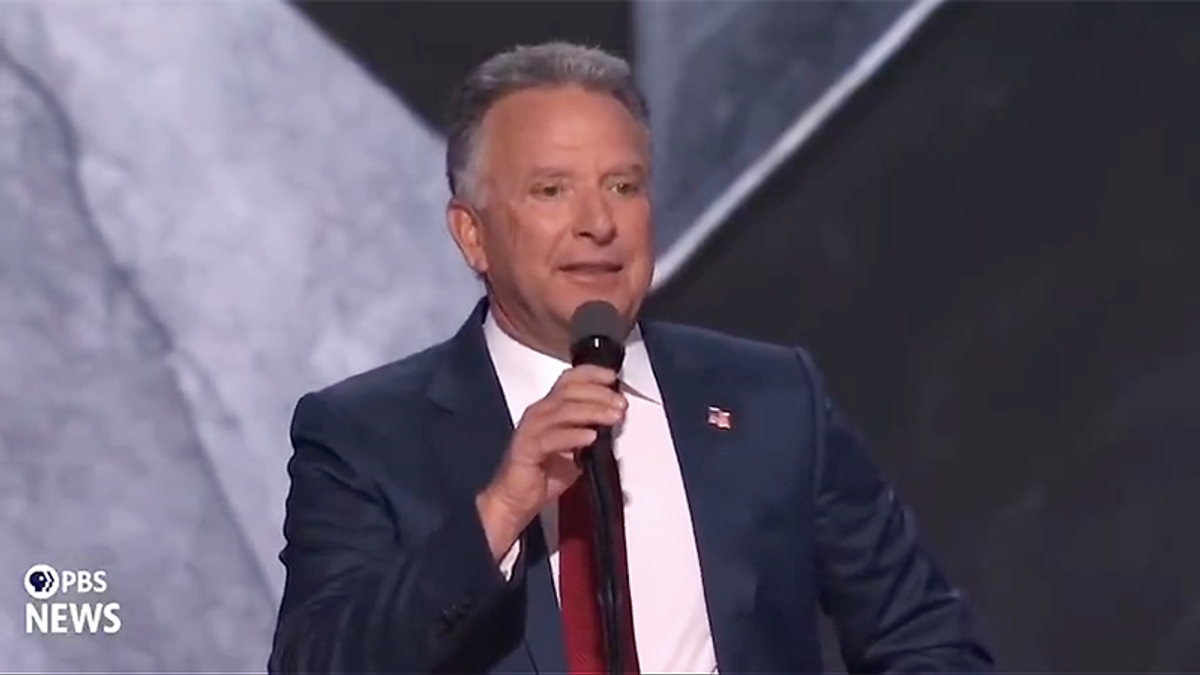
Longtime Donald Trump friend, golf buddy and investor Steven Witkoff speaks at the RNC (Photo: Screen capture via PBS video)

White House envoy Steve Witkoff has praised Vladimir Putin in glowing terms as trustworthy and said the Russian leader told him he had prayed for his "friend" US President Donald Trump when he was shot.

Witkoff met with Putin over multiple hours last week in Moscow and told US media the talks -- which involved discussions about forging a path towards ending Russia's war in Ukraine -- were constructive and "solution-based."

In an interview with right-wing podcast host Tucker Carlson, the envoy said he has come to regard Putin as not a "bad guy," and that the Russian president was a "great" leader seeking to end Moscow's deadly three-year conflict with Kyiv.

"I liked him. I thought he was straight up with me," Witkoff said in the interview aired Friday.

"I don't regard Putin as a bad guy. That is a complicated situation, that war, and all the ingredients that led up to it."

He also described a "personal" element of the discussion in which Putin recalled his reaction to the assassination attempt on Trump in July 2024 as the Republican held a campaign rally in Butler, Pennsylvania.


Putin "told me a story... about how when the president was shot, he went to his local church and met with his priest and prayed for the president," Witkoff said.

"Not because... he could become the president of the United States, but because he had a friendship with him and he was praying for his friend."

Putin had commissioned a "beautiful portrait of President Trump from a leading Russian artist," and asked the envoy to take it home to Trump, Witkoff added.

"It was such a gracious moment."

Witkoff's gushing praise of a president long seen by the United States as an autocratic adversary highlights the dramatic turn in Washington's approach to dealings with the Kremlin since Trump took office for a second presidential term.

Witkoff also said Ukraine's Volodymyr Zelensky was facing tough choices ahead and that the president should recognize it is time for him to "get a deal done" with Moscow.

Zelensky is "in a very, very difficult situation, but he's up against a nuclear nation," Witkoff said. "So he's got to know that he's going to get ground down. Now is the best time for him to get a deal done."

Witkoff's comments essentially were delivered on friendly ground. Carlson is a controversial former Fox News star who conducted what was widely considered to be a rare but soft interview with Putin last year.

Carlson has also been a leading propagator of pro-Kremlin narratives in the United States.


'You want to do nonsense!' Bernie Sanders walks off ABC News after AOC question

David Edwards
March 23, 2025 
RAW STORY


ABC/screen grab

Sen. Bernie Sanders (D-VT) tried to end an interview with ABC News after host Jonathan Karl asked an "inside the beltway" question about Rep. Alexandria Ocasio-Cortez (D-NY).

While speaking to Sanders, Karl wondered if Ocasio-Cortez had a future in the U.S. Senate.

"Would you like to see her join you in the Senate?" Karl asked.

"I said, just a whole lot of people in the Congress. OK, Jonathan, thanks," Sanders said as he got up to leave the interview.

"Wait, I got one more — I got one more. This is an important..." Karl pleaded.

"No, you want to do nonsense. Do nonsense," Sanders interrupted. "I don't want to talk about inside the beltway stuff."

"I was just asking you about AOC because she was out there with you," Karl explained.

"Well, you know, fine, but I don't want to talk about this," Sanders insisted before agreeing to answer one more question about his political future.

"Right now, I'm Vermont's senator. That's what I do. And I'm very happy to do it. I am 83 years of age. So — and I'm tired," he concluded.

Watch the video below from ABC or at the link..


Under threat from Trump, Canada set to hold snap elections


By AFP
March 22, 2025


Canada's Prime Minister Mark Carney will call for snap elections and hopes to claim a stronger mandate to fend off US threats - Copyright AFP Dave Chan


Marion THIBAUT

Canada’s new prime minister Mark Carney is expected to announce snap elections Sunday, seeking a stronger mandate as his country fights off a trade war and annexation threats from Donald Trump’s United States.

The former central banker was chosen by the centrist Liberal Party to replace Justin Trudeau as prime minister, but he has never faced the broader Canadian electorate.

That will change on April 28, if, as expected, Carney announces he is bringing parliamentary elections forward several months from October.

Government sources told AFP that he would announce the decision at 12:30 local time (1630 GMT) in a speech to Canada’s 41-million-strong nation.

In power for a decade, the Liberal government had slid into deep unpopularity, but Carney will be hoping to ride a wave of Canadian patriotism to a new majority — thanks to Trump’s threats.

Trump has riled his northern neighbor by repeatedly dismissing its sovereignty and borders as artificial, and urging it to join the United States as the 51st state.

The ominous remarks have been accompanied by Trump’s trade war, imposing tariffs on imports from Canada that could wreck its economy.

“In this time of crisis the government needs a strong and clear mandate,” Carney told supporters on Thursday in a speech in the western city of Edmonton.

– Poll favorites –

Domestic issues such as the cost of living and immigration usually dominate Canadian elections, but this year one key topic tops the list: who can best handle Trump.

The president’s open hostility toward his northern neighbor — a NATO ally and historically one of his country’s closest partners — has upended the Canadian political landscape.

Trudeau, who had been in power since 2015, was deeply unpopular when he announced he was stepping down, with Pierre Poilievre’s Conservatives seen as election favorites just weeks ago.

But the polls have narrowed spectacularly in Carney’s favor since he took over the Liberals, and now analysts are calling this Trump-overshadowed race too close to call.

“Many consider this to be an existential election, unprecedented,” Felix Mathieu, a political scientist at the University of Winnipeg told AFP.

“It is impossible at this stage to make predictions, but this will be a closely watched election with a voter turnout that should be on the rise.”

Poilievre, 45, is a career politician, first elected when he was only 25. A veteran tough-talking campaigner, he has sometimes been tagged as a libertarian and a populist.

Carney, 60, has spent his career outside of electoral politics. He spent over a decade at Goldman Sachs and went on to lead Canada’s central bank, then the Bank of England.

Smaller opposition parties could suffer if Canadians seek to give a large mandate to one of the big two, to strengthen his hand against Trump.

And as for the US leader, he professes not to care, while pushing ahead with plans to further strengthen tariffs against Canada and other major trading partners on April 2.

“I don’t care who wins up there,” Trump said this week.

“But just a little while ago, before I got involved and totally changed the election, which I don’t care about […] the Conservative was leading by 35 points.”
Canada invests in Indigenous-led clean energy projects across remote communities


By  Jennifer Kervin
DIGITAL JOURNAL
March 20, 2025


Image generated by Gemini Advanced

Indigenous and remote communities across Canada are pushing forward with clean energy solutions, reducing their reliance on diesel and investing in long-term sustainability.

To support these efforts, the federal government has announced more than $11 million in funding for 15 community-led clean energy projects.

The funding, delivered primarily through the Clean Energy for Rural and Remote Communities (CERRC) program, will support initiatives in Nunavut, the Northwest Territories, Ontario, British Columbia, Saskatchewan, and Quebec.
Community-driven projects reducing diesel reliance

Many Indigenous and remote communities continue to rely on imported diesel for heat and power, which can be both costly and environmentally damaging. The newly funded projects focus on practical alternatives, including:Forest biomass and bioenergy systems
Solar photovoltaic and battery storage
Energy efficiency retrofits
Feasibility and engineering studies to support long-term clean energy planning

These initiatives aim to increase energy security while creating economic opportunities and reducing emissions.

“Every community deserves access to reliable, sustainable energy to power their homes, schools, and businesses,” Patty Hajdu, Minister of Indigenous Services, said in a statement.

“By working with Indigenous partners through Wah-ila-toos, we’re supporting Indigenous-led clean energy solutions that create good jobs and build stronger communities. These investments put decision-making power where it belongs — in the hands of communities themselves.”
Investing in energy security and sustainability

Jonathan Wilkinson, Minister of Energy and Natural Resources, highlighted the broader impact of these projects.

“I am pleased to see community-led projects contribute to building long-term resilience and prosperity within Indigenous communities,” Wilkinson said.

“Clean energy solutions will ultimately lead to increased economic empowerment, improved health, and lower energy costs for households. Each project contributes to the broader goal of creating sustainable communities and a thriving economy.”

The federal government has emphasized that these investments align with its goals of reconciliation and Indigenous self-determination by supporting projects where communities lead decision-making.

“The path toward a sustainable future must be Indigenous-led and anchored in Indigenous perspectives and knowledge,” said Gary Anandasangaree, Minister of Crown-Indigenous Relations and Northern Affairs.

“By supporting community-led clean energy projects in northern and remote communities, we are supporting First Nations and Inuit as they drive sustainable economic growth and protect the land for future generations.”
Expanding federal support for Indigenous-led clean energy

Since its launch in 2018, the CERRC program has supported over 190 projects across Canada, with a total allocation of $220 million over eight years. Additional funding through Budget 2021 added $233 million over five years and introduced the Indigenous and Remote Communities Clean Energy Hub, later renamed Wah-ila-toos, to streamline federal clean energy funding.

Wah-ila-toos is guided by an Indigenous Council that advises on programs, policy, and engagement strategies. The council recently released the Kinship and Prosperity: Proven Solutions for a Clean Energy Landscape report, outlining recommendations to support Indigenous, rural, and remote communities in transitioning to clean energy.

In addition to these initiatives, Budget 2024 has renewed the Strategic Partnerships Initiative’s Clean Energy funding, allocating $36 million over three years to advance Indigenous economic participation in clean energy projects across Alberta, Saskatchewan, Manitoba, Quebec, and Atlantic Canada.

With continued investment, these programs are enabling Indigenous communities to take the lead in shaping Canada’s clean energy future while strengthening local economies and environmental stewardship

.
This article was created with the assistance of AI. Learn more about our AI ethics policy here.


Written ByJennifer Kervin
Jennifer Kervin is a Digital Journal staff writer and editor based in Toronto.
Algeria prosecutors seek 10 years’ jail for writer Boualem Sansal: media

By AFP
March 20, 2025


French-Algerian writer Boualem Sansal, pictured in 2015, is a prominent figure in north African modern francophone literature - Copyright AFP ROBERTO SCHMIDT

Algerian prosecutors have requested a 10-year prison sentence for French-Algerian writer Boualem Sansal, accused of undermining the country’s territorial integrity, local media reported Thursday.

Sansal, a prominent figure in North African modern francophone literature, is known for his criticism of Algerian authorities as well as of Islamists.

The 80-year-old was detained in November upon arrival at Algiers airport, at a time of growing tensions between France and its former colony.

A verdict in the case, which has received widespread attention in France, is expected on March 27.

Relations between France and Algeria have deteriorated since President Emmanuel Macron in July 2024 expressed support for Morocco’s autonomy plan for the disputed territory of Western Sahara.

The former Spanish colony is mostly controlled by Morocco but claimed by the Algeria-backed pro-independence Polisario Front, which seeks a UN-backed self-determination referendum that has never materialised since a 1991 ceasefire.

Macron said Thursday he hoped for “a swift resolution” so that Sansal could “regain his freedom”.

“We are dealing with a great writer, who is also ill,” Macron told reporters in Brussels, saying he trusted that Algerian President Abdelmadjid Tebboune would appreciate that the case had little basis.

According to the Algerian media outlet TSA, Sansal was charged with “affecting national unity, insulting a constitutional body, practices of a nature likely to harm the national economy, and possession of videos and publications threatening the security and stability of the country”.

Prosecutors accuse him of making statements undermining the country’s territorial integrity.

In an October interview with the far-right French media outlet Frontieres, Sansal said France had reduced Moroccan territory to the benefit of Algeria during its colonisation of North Africa.

According to French newspaper Le Monde, the comments infuriated authorities in Algeria.


– Health concerns –


At a court near Algiers, Sansal on Thursday denied any intention of attacking Algeria, the newspaper Echorouk reported. He said that he had only “expressed an opinion like any Algerian citizen”.

He admitted that he had not considered the fact that his comments could be considered as attacks on Algerian institutions, and said that he is an “Algerian who loves his country”, Echorouk said.

It added that Sansal had no lawyer and “preferred to act in his own defence”.

Sansal’s French lawyer, Francois Zimeray, last week said his client had neither proper access to lawyers nor to medical care, accusations the authorities denied.

In 2015, Sansal won the Grand Prix du Roman of the French Academy, the guardians of the French language, for his book “2084: The End of the World”, a dystopian novel set in an Islamist totalitarian world in the aftermath of a nuclear holocaust.