Sunday, March 23, 2025

Pentagon restores Navajo Code Talkers histories after outcry

Defense Department has yet to restore history of Iowa Jima flagraiser Ira Hayes, Pima
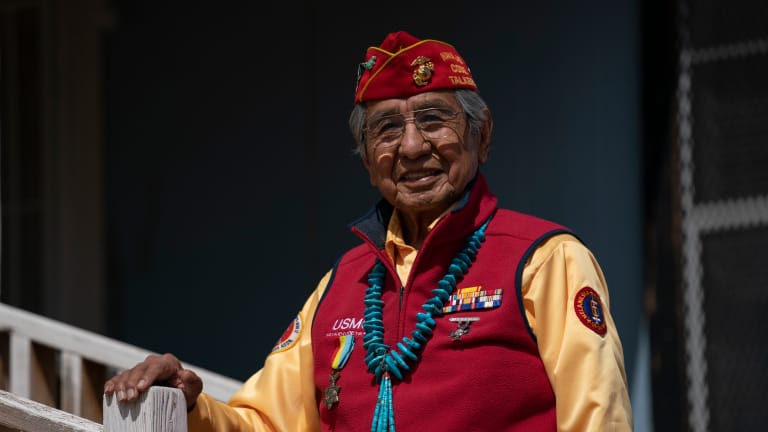


WWII veteran and Navajo Code Talker Peter MacDonald Sr. is photographed at his home on the Navajo Reservation in Tuba City, Ariz., April 28, 2020. (AP Photo/Carolyn Kaster, File)

MAR 20, 2025
Terry Tang
Associated Press

PHOENIX — The Pentagon restored some webpages highlighting the crucial wartime contributions of Navajo Code Talkers and other Native American veterans on Wednesday, days after tribes condemned the action.

The initial removal was part of a sweep of any military content that promoted diversity, equity and inclusion, or commonly referred to as DEI. Following President Donald Trump’s broader executive order ending the federal government’s DEI programs, the Defense Department deleted thousands of pages honoring contributions by women and minority groups. Department officials say the Navajo Code Talker material was erroneously erased.

“In the rare cases that content is removed — either deliberately or by mistake — that is out of the clearly outlined scope of the directive, we instruct the components and they correct the content so it recognizes our heroes for their dedicated service alongside their fellow Americans, period,” Pentagon press secretary John Ullyot said in a statement.

Several webpages on the Code Talkers landed on a “404 - Page not found” message Tuesday. Some were back up Wednesday — although any that also mention Native American Heritage Month remain down. Thousands of other pages deleted in the DEI purge are still offline.

White House officials informed the Navajo Nation that an artificial intelligence-powered automated review process looking for content with DEI initiatives led to the elimination of anything mentioning “Navajo," according to a statement from Navajo Nation President Buu Nygren.

Nygren, who sent a letter to the Defense Department requesting clarity on the issue, said he's pleased by the resolution.

“I want to assure the Navajo people that we remain in close communication with federal officials to ensure the legacy of our cherished Navajo Code Talkers is never erased from American and Navajo history,” Nygren said.

He also pointed out the 574 federally recognized tribes across the U.S. are sovereign nations and not defined by DEI classifications, a stance broadly supported by other Native American leaders who also sent letters to the Trump administration.

The U.S. Marine Corps initially recruited 29 Navajo men to develop a code based on the unwritten Navajo language in World War II. Using Navajo words for red soil, war chief, clan, braided hair, beads, ant and hummingbird, for example, they came up with a glossary of more than 200 terms, later expanded, and an alphabet. To convey the word “send,” Code Talkers would say the Navajo words for “sheep, eyes, nose and deer.”

Hundreds of Navajos followed in their footsteps, sending thousands of messages without error on Japanese troop movements, battlefield tactics and other communications crucial to the war’s ultimate outcome. The code stumped Japanese military cryptologists.

The Code Talkers participated in all assaults the Marines led in the Pacific from 1942 to 1945 and are credited with helping the U.S. win the war. Hundreds of Native Americans from more than 20 tribes also served as code talkers during World War I and World War II, according to the Smithsonian's National Museum of the American Indian. Among them were Choctaw, Cherokee, Osage, Chippewa and Hopi speakers.

Among those alarmed to hear of the missing Navajo Code Talker webpages was Peter MacDonald, 96. He and Thomas H. Begay are the only two Navajo Code Talkers still living today.

“That code became a very valuable weapon and not only saved hundreds of thousands of soldiers, but it also helped win the war in the Pacific,” MacDonald said by phone from his home in Tuba City in the Arizona portion of the Navajo Nation. "And it has absolutely nothing to do with DEI."

A Republican who voted for Trump, MacDonald said he thinks the current administration needs to better walk the line between getting rid of DEI and ignoring history.

“That’s why I’m very concerned that communication from the Pentagon down to the various military units should be taught or learn that this information is history, and you don’t want to hide history,” MacDonald said.

The Defense Department has had to issue reassurances that it is not omitting historic achievements by servicemen and women of color. Besides the Code Talkers, the agency also on Wednesday restored a webpage describing baseball and civil rights icon Jackie Robinson’s military service after it was missing earlier in the day. Last week, pages honoring a Black Medal of Honor winner and Japanese American service members were also restored.

“Everyone at the Defense Department loves Jackie Robinson, as well as the Navajo Code Talkers, the Tuskegee airmen, the Marines at Iwo Jima and so many others — we salute them for their strong and in many cases heroic service to our country, full stop,” Ullyot said. “We do not view or highlight them through the prism of immutable characteristics, such as race, ethnicity or sex.”

Michael Smith, whose father, Samuel “Jesse” Smith Sr., was a Navajo Code Talker, questioned why these pages were removed at all.

“I don’t know how taking Navajo Code Talkers off the Department of Defense website is saving the United States any money because that’s not consistent with the president’s order,” said Smith, who helps organize annual celebrations of the Code Talkers.

Gov. Stephen Roe Lewis of the Gila River Indian Community in Arizona also expressed disappointment, claiming there was missing content relating to all Native American veterans, including Ira Hayes. Hayes was an enrolled member of the tribe and one of six Marines featured in an iconic 1945 Associated Press photograph of U.S. forces raising an American flag during the Battle of Iwo Jima. As of March 20, Hayes' history page had yet to be restored.

Even with some being reposted, he remains worried web content removal is “the tip of the iceberg.”

“The way it looks in the (executive) order, this language is skewed and made to sound like the diversity programs are the ones that are unethical," Smith said.

‘My dad didn’t go to war for nothing’: Pentagon scrubs Native American heroes from website


Department of Defense deletes Code Talkers, Iwo Jima flag raiser Hayes under Trump’s DEI order
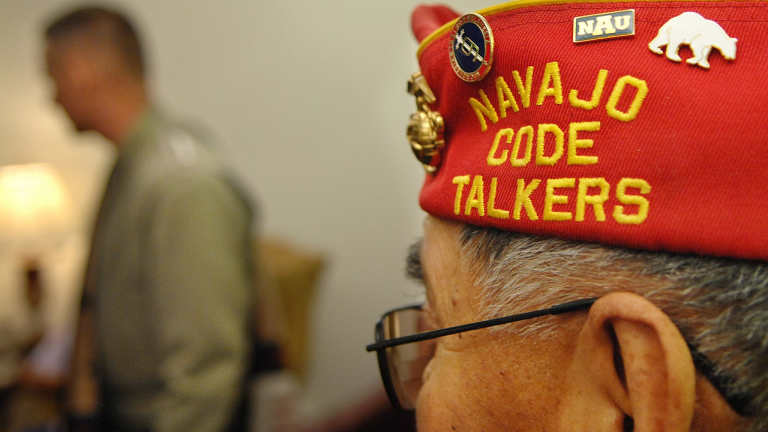


Navajo Code Talkers and their family members met with Chairman of the Joint Chiefs of Staff U.S. Marine Corps Gen. Peter Pace at the Pentagon, Aug. 10, 2007. (Photo by U.S. Air Force Staff Sgt. D. Myles Cullen | Public domain)


SHONDIIN SILVERSMITH AND ARIZONA MIRROR
MAR 19, 2025

Prominent Native American figures in U.S. military history have been erased from the U.S. Department of Defense’s website as part of the sweeping effort stemming from President Donald Trump’s executive order banning diversity, equity and inclusion.

The Department of Defense website removed articles featuring details about the Navajo Code Talkers — Navajo men who served during World War II and used their language as a secret code in battle — along with U.S. Marine Ira Hayes from the Gila River Indian Community, who helped raise the flag during the Battle of Iwo Jima in World War II.

“Navajo code has absolutely nothing to do with DEI because Navajo code was a weapon,” Navajo Code Talker Peter MacDonald said in response to the removal during an interview with the Arizona Mirror.

MacDonald, 96, is one of two living Navajo Code Talkers. He served in the South Pacific as a Code Talker and in North China with the 6th Marine Division.

MacDonald said that dismissing the Navajo Code Talkers as DEI is a “terrible misinterpretation by the United States.”

The complex Navajo language was used as a weapon in World War II against the enemy because the Japanese were breaking every military code that U.S. troops were using in the Pacific theater.

It took the Navajo people to develop a whole new code in the Navajo language, he added, and “it became the only military code in modern history never broken by an enemy.”

In a general keyword search on Tuesday of the Department of Defense’s website for the Navajo Code Talkers, only eight results appeared, but none related to information or articles detailing their role in World War II.

Zero results appeared in a search for Ira Hayes.
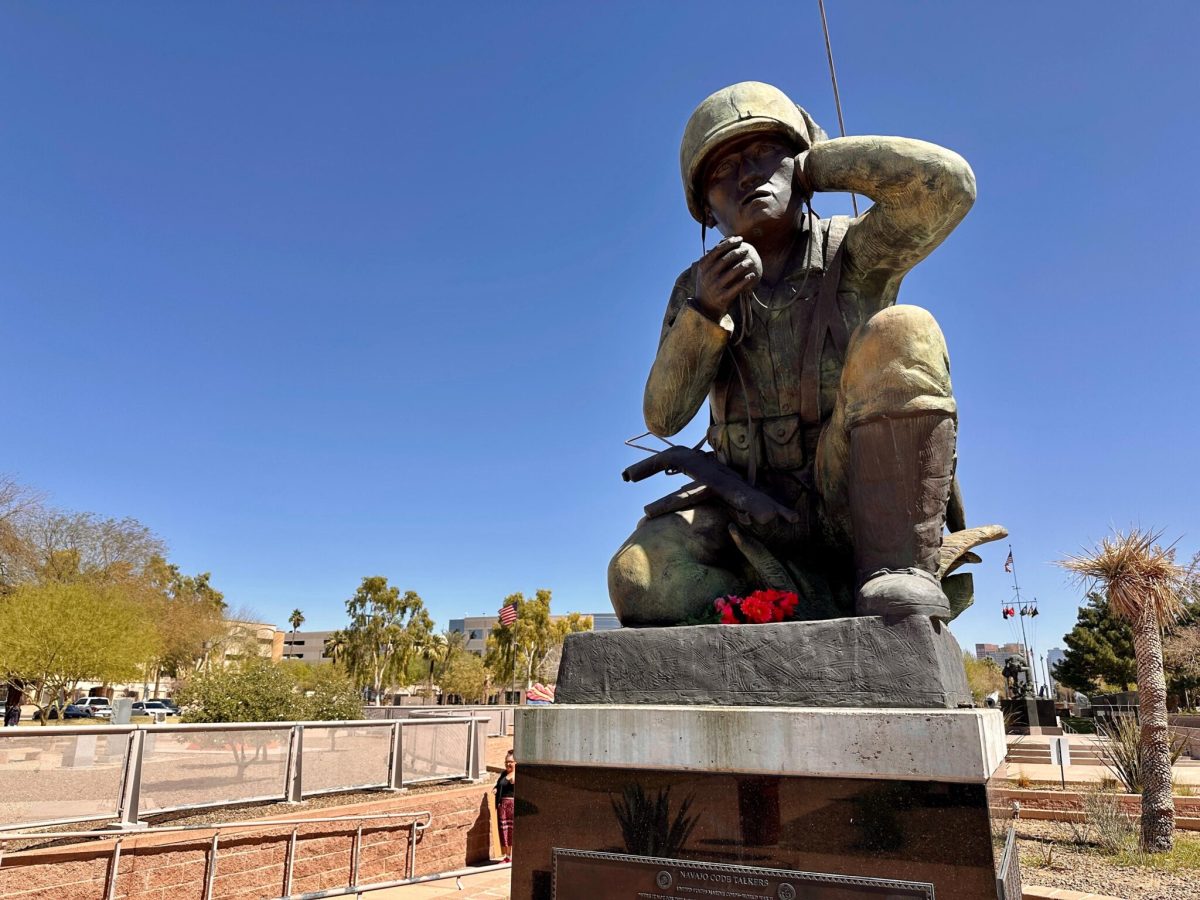


Ira Hayes is memorialized in a monument at Wesley Bolin Plaza in Phoenix. (Photo by Shondiin Silversmith, Arizona Mirror)

“The Navajo Code Talkers earned their place in history through their courage and sacrifice, giving their lives in defense of this nation,” Navajo Nation Council Speaker Crystalyne Curley said in a press release. “Erasing their extraordinary contributions from formal military history is not only disrespectful, it is dishonorable.”

Having articles and information about the Navajo Code Talkers on the department’s website is the right thing, MacDonald said, because it provides education for everyone that weapons do not just include guns but language.

He added that their weapon helped preserve America’s freedom, and “we were happy to use that weapon to help.”

“It’s important for the entire nation to know that the Navajo Code has absolutely nothing to do with DEI,” he said. He hopes the Pentagon will return all the content so they can learn.

In an email response to the Arizona Mirror, a Department of Defense spokesperson who wouldn’t provide their name said the DOD is in the process of restoring the content about the Navajo Code Talkers, which had been removed during the auto-removal process.

No time frame was provided for restoring the content, and the spokesperson did not respond to questions about the deleted content related to Ira Hayes.

Ronald Kinsel, the son of the late Navajo Code Talker John Kensel, Sr., said he was shocked to learn that all articles featuring the Navajo Code Talkers had been removed.

“My dad didn’t go to war for nothing,” he said, adding that the United States wouldn’t be the country it is now if it wasn’t for the Navajo Code Talkers.
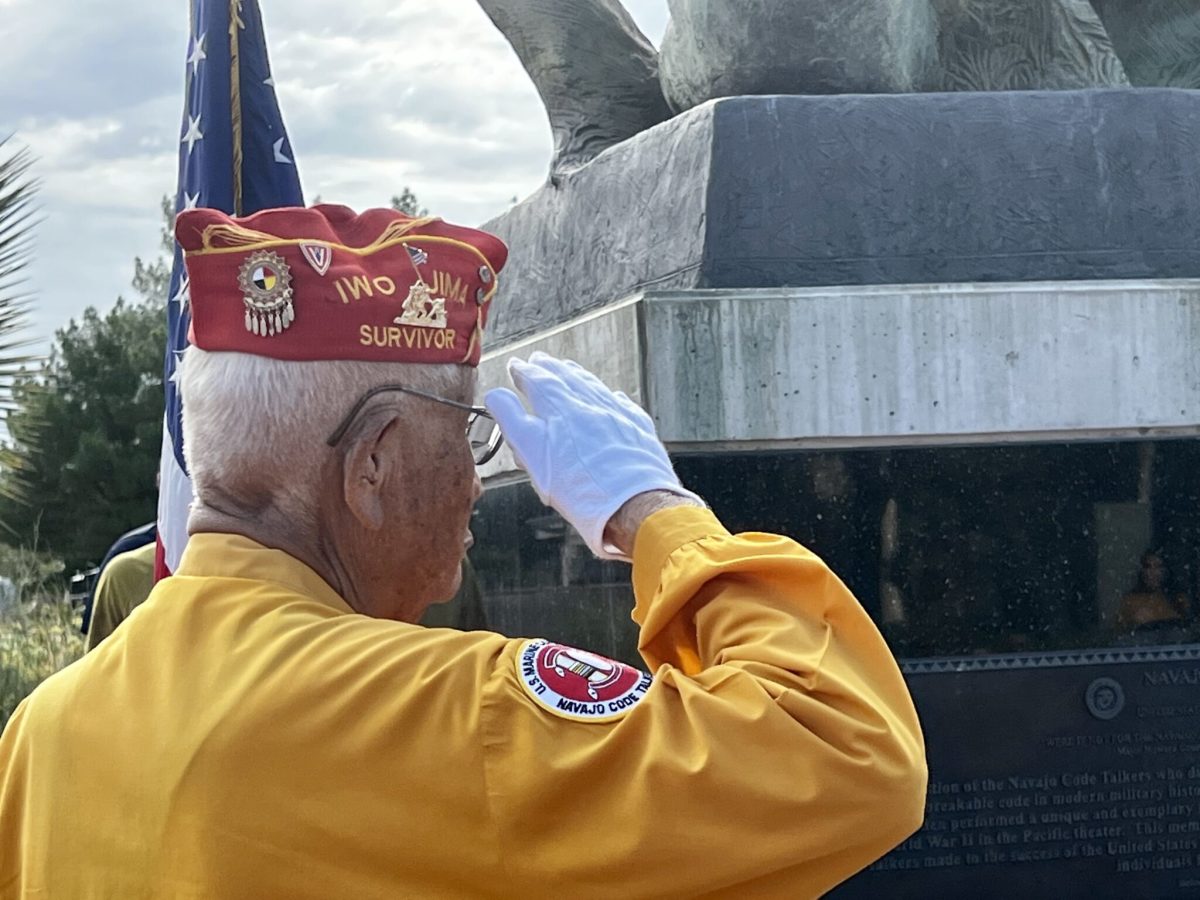


Navajo Code Talker Thomas H. Begay salutes the Navajo Code Talker Memorial Statue during the National Navajo Code Talkers Day celebration on Aug. 14, 2022.
 (Photo by Shondiin Silversmith, Arizona Mirror)

The Navajo Code Talkers participated in all assaults led by the U.S. Marines in the Pacific from 1942 to 1945, including Guadalcanal, Tarawa, Peleliu and Iwo Jima. The total number of Navajo Code Talkers who served in the U.S. Marines is unknown, but it is estimated to be between 350 and 420.

MacDonald’s daughter, Charity, said she wasn’t shocked by the removal. It is merely a new form of erasure of Indigenous people, something the United States has done throughout its history.

“You can not erase an entire history of people,” she said, especially today when information can be accessed in various ways.

“Our federal government is doing this purposely,” Charity said, adding that it’s an action they’re taking to show people that they can.

“The federal government is making a statement, saying that this is how they feel,” she added.

Charity said Indigenous people have given a lot to the federal government, and during World War II, the military came to the Navajo people and asked them for help.

“They used the Navajo language to help them win the war,” she said.

Navajo Nation, Gila River Indian Community respond

Leaders from the Navajo Nation and the Gila River Indian Community sent letters to the Department of Defense to ask why the details about the Navajo Code Talkers and Hayes were deleted.

Gila River Indian Community Gov. Stephen Roe Lewis said removing information about Hayes and the Navajo Code Talkers due to the scrubbing for DEI initiatives is “misguided” and “irresponsible.”

Lewis said his tribe sent a official letter to the Department of Defense on Tuesday but have not received a response.

“Sadly, we’re no strangers to being erased,” Lewis said, noting it has happened to Indigenous peoples throughout history.

“All the stories of Ira Hayes and all Native veterans, including the code talkers, have to be rectified ASAP,” he said.

Lewis said Hayes is a significant figure in military history, and members of the Gila River Indian Community learn about him from a very young age.

Hayes, alongside five other Marines, raised the U.S. flag on the island of Iwo Jima at the summit of Mount Suribachi on February 23, 1945. He was part of the 5th Marine Division and fought in the Battle of Iwo Jima until the island was secured on March 26, 1945.

The photograph of the flag raising during the Battle of Iwo Jima is one of the most iconic images of World War II, taken months into the battle by Associated Press photographer Joe Rosenthal.

Lewis said Hayes’ story and the image of the Marines raising the flag at Iwo Jima is historic for Native military service.

“Native Americans have always served in our country’s military, in all branches, at the highest levels of any other group,” Lewis said.

Indigenous people across the United States serve in the armed forces at five times the national average, according to the National Indian Council on Aging, and have served with distinction in every major conflict for over 200 years.

Lewis said that recognizing the patriotism and courage of Native American soldiers has nothing to do with any type of DEI initiative.

“It’s simply an offering of respect for extraordinary service and bravery in the line of duty,” he added.

Navajo Nation President Buu Nygren sent a letter to Defense Secretary Pete Hegseth on Tuesday asking him to explain the removal of the Navajo Code Talkers’ information from military websites.

“Appropriately recognizing the work of the Navajo Code Talkers is profoundly significant to the Navajo Nation,” Nygren said in his letter, requesting the rationale behind the removal.

In the letter, Nygren wrote about how Trump welcomed the Navajo Code Talkers to the White House in 2017, during his first term in office, and praised their contributions to the country.

“We sincerely appreciate this recognition and believe it highlights the importance of preserving the history and legacy of the Navajo Code Talkers,” he wrote.

“Given the profound impact and historic importance of these American heroes, it is imperative that their legacy remains visible and accessible to all Americans,” the letter stated.

The Navajo Nation Council voiced its disappointment in the removal of the Code Talkers, emphasizing that the Navajo Nation is not a racial group but a distinct political entity.

“The Navajo Nation Council is deeply concerned by being conflated into DEI initiatives that fail to recognize our unique political status,” Curley said in a press release. The Navajo Nation Council is engaging with the administration to clarify the reasoning behind removing articles.

“The United States would not be the nation it is today without the bravery and service of the Navajo Nation Code Talkers,” Curley said. “Their legacy is a cornerstone of American history, and it is essential that their contributions be honored and recognized.”


 SHONDIIN SILVERSMITH  is an award-winning Native journalist with AZ Mirror. Silversmith has covered Indigenous communities for more than 10 years, and covers Arizona's 22 federally recognized sovereign tribal nations, as well as national and international Indigenous issues.  Follow DiinSilversmith

Arizona Mirror is part of States Newsroom, the nation’s largest state-focused nonprofit news organization.


Trump's DEI Executive Order Prompts the Removal of Navajo Code Talkers from Some Military Websites


Yahoo News
Native News Online 
 March 17, 2025
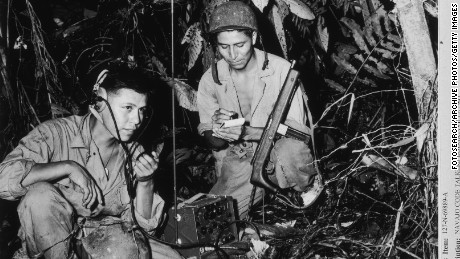
The code developed by the Navajo Marines during WWII was never broken. 
file photoBy Levi Rickert

Native American Code Talkers are highly revered across Indian Country for their patriotism and service to the United States. During World War II, Navajo Code Talkers, a group of Diné citizens serving in the U.S. Marine Corps, used the Navajo language to securely transmit classified tactical messages.

On Monday, in an exclusive article, Axios reported articles about the renowned Native American Code Talkers have disappeared from some military websites, with several broken URLs now labeled "DEI."

Axios identified at least 10 articles mentioning the Code Talkers that had disappeared from the U.S. Army and Department of Defense websites as of Monday.

During World War II in the South Pacific theater, the Navajo Code Talkers used a secret code that was never broken by the Japanese, enabling the United States military to communicate securely and ensure victory. The Navajo language secured military communication lines that allowed Marines to advance on the battlefields of the Pacific Theater.

The original group of 29 Navajo Code Talkers transmitted information about tactics, troop movements, orders, and other battlefield messages using telephones and radios. Their work was so successful that by the end of World War II, more than 400 Navajos were called upon to serve as Code Talkers. The code has never been broken. The story about the contributions to save democracy remained classified until 1968.

This rich history has been diminished due to a Trump executive order aimed at removing Diversity, Inclusion, and Equity (DEI) initiatives throughout the federal government.

Asked about the missing pages, Pentagon Press Secretary John Ullyot replied in a statement: "As Secretary [Pete] Hegseth has said, DEI is dead at the Defense Department. ...We are pleased by the rapid compliance across the Department with the directive removing DEI content from all platforms."

The irony of the erasure is one of the far right’s heroic presidents, Ronald Reagan in 1982 declared August 14th as "National Navajo Code Talkers Day" to honor the contributions of the Navajo Code Talkers.

$250M investment in lithium mine frustrates tribes

Tribes have tried and failed to stop the project in court. A new report says it violates Indigenous rights


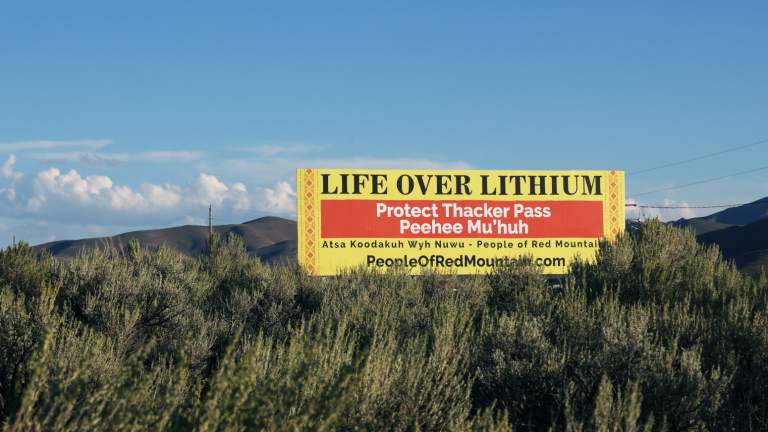
A billboard on U.S. 95 near Orovada, Nev. warns against Lithium Americas’ Thacker Pass lithium mine on Sep. 9, 2023. The group, People of Red Mountain, had opposed construction of the mining operation in Thacker Pass because of environmental concerns and damage to an area sacred to Paiute and Shoshone tribes.
 (Noel Lyn Smith / Howard Center for Investigative Journalism)

GRIST
MAR 22, 2025

Anita Hofschneider

A Canadian mining company behind a massive new lithium mine in northern Nevada has received a $250 million investment to complete construction of the new mine — a project that aims to accelerate America’s shift from fossil fuel-powered cars but that has come under fierce criticism from neighboring tribal nations and watchdog groups for its proximity to a burial site.

Lithium Americas is developing the mine in an area known as Thacker Pass where it plans to unearth lithium carbonate that can be used to make batteries for electric vehicles. The area, known as Peehee Mu’huh in the Numu language of the Northern Paiute, is home to what could be the largest supply of lithium in the United States and is also a site that tribal citizens visit every year to honor dozens of Native men, women, and children who fled American soldiers in an 1865 unprovoked attack at dawn.


The funding from Orion Resources Partners LP, a global investment firm specializing in metals and materials, will enable the first phase of construction to be completed by late 2027. The investment firm is also considering giving an additional $500 million to support later phases of the mine’s development.

The critical financial investment comes just weeks after a report from the American Civil Liberties Union and Human Rights Watch called for a halt to the construction of the mine after concluding its approval violates the rights of Indigenous peoples whose ancestors are buried there.

“Orion’s commitment to this project highlights the strategic importance of Thacker Pass to national security and developing a domestic supply chain as we work to reduce American dependence on foreign suppliers for critical minerals,” said Jonathan Evans, Lithium Americas’ president and chief executive officer, in a press release.

Lithium Americas said that research indicates the actual burial site is located several miles away from the project site, and a federal judge agreed with the company, citing a cultural inventory study that did not uncover any human remains. Gary McKinney disagrees. He is a spokesperson for the group People of Red Mountain and is a descendant of one of the survivors of the September 12, 1865, massacre.

He and many others believe the project area to be a graveyard for his ancestors, in part due to Indigenous oral histories and a 1929 autobiography describing the massacre there.

“What that mine is doing is desecrating,” McKinney said. “They’re erasing parts of the history of the Northern Paiute and Western Shoshone people.”
Scroll to Continue

He said the mine was approved during the COVID-19 pandemic when reservations were shut down, Indigenous communities were grappling with high rates of the virus, and few realized the project was moving forward.

“Our tribal chairman at that time, he died of COVID,” said McKinney, who is an enrolled member of the Duck Valley Shoshone Paiute Tribe. “What I’m saying is this whole thing wasn’t done with the best of morals or intentions of honoring and respecting those cultural sites.”

His organization, People of Red Mountain, sued to stop the mine along with four tribes — Reno-Sparks Indian Colony, Burns Paiute Tribe, Summit Lake Paiute Tribe, and Winnemucca Indian Colony — but no court challenges have been successful. The Duck Valley Shoshone-Paiute Tribe also criticized the mine in an appeal to the United Nations special rapporteur on the rights of Indigenous peoples.

The American Civil Liberties Union and Human Rights Watch report from last month concluded the mine violates Indigenous peoples’ right to free, prior and informed consent to projects that affect their territories. The report notes tribes have raised concerns about the risk of toxic waste from the mine polluting their water and about their cultural practices being curtailed by limited access to the area.

In a letter to Human Rights Watch, Tim Crowley, vice president of government and external affairs at Lithium Americas, emphasized that the U.N. Declaration on the Rights of Indigenous Peoples, which contains the right to free, prior, and informed consent, is not binding. At the same time, the U.S. government believes consulting with tribes is sufficient without achieving support from all tribes, he said.

“Further, the Treaty of Ruby Valley, which is the treaty that pertains to Western Shoshone peoples in the Thacker Pass area, does not reserve rights to access off-reservation public land,” Crowley wrote. “The Thacker Pass Project is not in a federally recognized Native American territory. If it were, mining could not happen without the express consent and approval of that tribe.”

The new investment in Lithium Americas from Orion Resources Partners LP helps fulfill the terms of a $2.26 billion loan that Lithium Americas received last fall from the U.S. Department of Energy to support the project.

Abbey Koenning-Rutherford from the American Civil Liberties Union and Human Rights Watch said the Thacker Pass mine is symbolic of the broader risks of mining to Indigenous peoples and underscores why there’s a need to reform a 1872 U.S. mining law that enables companies to claim mineral rights on federal lands, including land stolen from tribal nations.

“The United States should respect Indigenous peoples’ centuries-long connections to Peehee Mu’huh and act to prevent further harm at Thacker Pass,” Koenning-Rutherford said.

Ruling on Indigenous peoples’ rights strikes at oil industry

The Inter-American Court of Human Rights ordered the Ecuadorian government to protect uncontacted Indigenous groups from oil operations and to leave oil in the ground underneath their lands


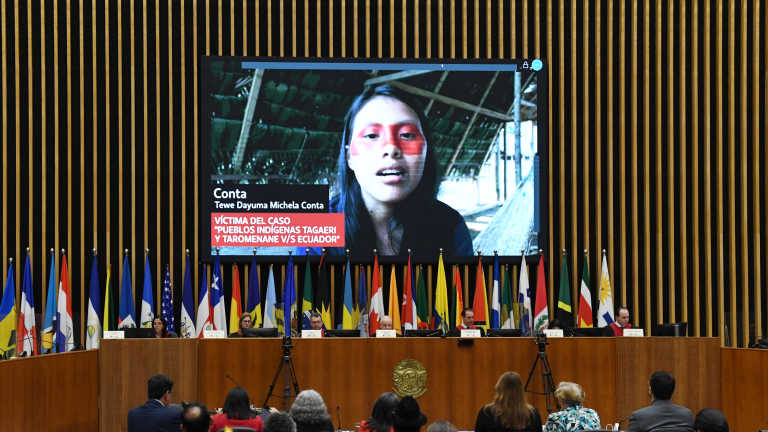
Conta, a member of the Tagaeri and Baihuaeri Waorani Indigenous groups, appears before the Inter-American Court of Human Rights via pre recorded video on Aug. 23, 2022. (Photo courtesy of the Inter American Court of Human Rights)

Katie Surma
Inside Climate News
March 23, 2025 


The Inter-American Court of Human Rights ruled on Thursday that the Ecuadorian government violated the rights of uncontacted Indigenous peoples living in the Amazon rainforest, a landmark decision that strikes at Ecuador’s powerful oil industry.

The Costa Rica-based court ordered the Ecuadorian government to ensure any future expansion or renewal of oil operations does not impact Indigenous peoples living in voluntary isolation.

There are at least three groups of Indigenous peoples living in voluntary isolation in the Ecuadorian Amazon: the Tagaeri, Taromenane and Dugakaeri. Indigenous peoples living in voluntary isolation is a term used to describe Indigenous people who refuse or have not had contact with the outside world.

The Ecuadorian government violated the rights of those groups by allowing oil drilling to go forward inside portions of Yasuni National Park where uncontacted groups are known to inhabit, the court ruled. Ecuador must honor the results of a 2023 referendum, in which Ecuadorian voters chose to stop oil operations in that region indefinitely, the court said.

The judges emphasized that Indigenous peoples living in voluntary isolation are particularly vulnerable to impacts on their environment. Thus, any activities that could affect their territories, like oil drilling, must be carefully evaluated. The court ordered the Ecuadorian government to apply the “precautionary principle” when making decisions about future oil operations.

“This principle means that, even in the absence of scientific certainty regarding oil exploration and exploitation projects’ impacts on this territory, effective measures must be adopted to prevent serious or irreversible damage, which in this case would be the contact of these isolated populations,” said the opinion, written in Spanish.

Thursday’s ruling is the first time an international court has ruled on whether a government has done enough to protect the rights of people living in voluntary isolation.

The court underscored that the rights of people living in voluntary isolation includes not just their physical territories but also their cultural identity, health, food security, housing and the overall environment necessary for their dignified life.

The court also directed the government to enact measures to prevent third parties, like illegal loggers, from invading uncontacted peoples’ lands and jeopardizing their right to remain uncontacted.

Multiple international treaties recognize the rights of people living in voluntary isolation to remain uncontacted.

The court suggested that to fully protect the rights of the Tagaeri, Taromenane and Dugakaeri, the government may need to expand a Delaware-sized area of rainforest and its 6-mile buffer zone that are supposed to be off-limits to extractive activity. The ruling noted that there have been multiple sightings of uncontacted groups traveling outside the designated off-limits area, known as the “Intangible Zone.”

In recent years, oil operations have expanded into the buffer area surrounding the Intangible Zone.

Ecuador’s Procurador General’s office, which defended the government in the case, did not respond to requests for comment.

The court said the Ecuadorian government violated the rights of two uncontacted girls who survived a violent attack on their community in 2013. The girls, the court said, were subject to multiple rights violations, including to their personal integrity, cultural identity, appropriate health care and participation in decisions affecting their lives. All of the violations stemmed from the attackers’ invasion of their territory, the contact forced on the girls and the government’s inadequate response to their situation.

The United Nations estimates that about 200 Indigenous communities live in voluntary isolation across at least nine countries: Bolivia, Brazil, Colombia, Ecuador, India, Indonesia, Papua New Guinea, Peru and Venezuela.
\

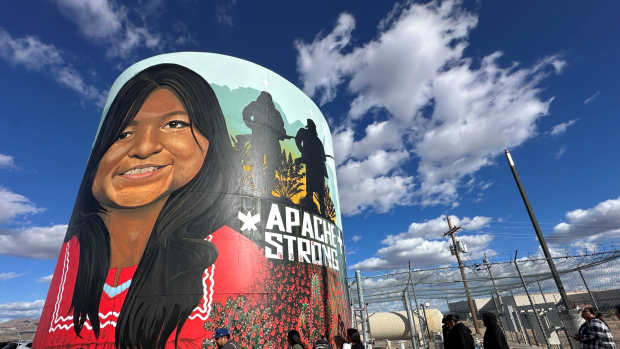
‘Apache Strong’: Mural honors slain teen Emily Pike


The ruling also impacts other Indigenous groups who either share territories with the Tagaeri, Taramonae and Dugakaeri or live nearby. That includes Waorani people in recent contact. The Tagaeri, Taramonae and Dugakaeri are a subset of Waorani peoples, and the groups share the same language and culture.

Penti Baihua, a traditional leader of the Baihuaeri Waorani of Bameno, called on the government to meet with recently contacted Waorani communities affected by the ruling, and to include those groups in discussions about protecting the forest and their uncontacted relatives. The Baihuaeri’s ancestral territory is located inside the Intangible Zone. Government policies affecting the region, Baihua said, must respect the rights and culture of the uncontacted and recently contacted Waorani.

“The government talks wonders about protection,” Baihua said in Spanish. “But what will they do to make that a reality? The government keeps sending oil companies deeper into the forest. We live here, too. This forest is here because we have protected it for generations.”

The nissionaries and the oil company

All Waorani people lived uncontacted in the Ecuadorian Amazon until the late 1950s, when American Christian missionaries began to force contact on Waorani groups to evangelize them. A few years later, the U.S. oil company Texaco worked with the missionaries to accelerate their forced contact campaign and remove Waorani people from their oil-rich lands.

Ever since, the oil industry’s operations have expanded deeper into Waorani groups’ territories, displacing some communities and driving uncontacted and recently contacted communities into a smaller and smaller area of shared rainforest.

This has put an enormous amount of pressure on Waorani communities that need large territories to survive and to have access to their culture, which is deeply reliant upon sizable and healthy rainforest lands and waterways.

The oil industry, including Texaco (now Chevron), has spilled, flared and intentionally dumped vast amounts of toxic pollution into the region’s air, water and soil, according to court documents and multiple reports. Oil industry roads have opened up previously inaccessible forest to colonization and other extraction activities like illegal logging and mining.

Beginning in 2003, a string of high-profile killings took place between illegal loggers using guns and uncontacted groups, who defended their territories with spears.

In 2006, activists Fernando Ponce VillacĂ­s, RaĂºl Moscoso, Juan Guevara and Patricio Asimbaya filed a petition with the Inter-American Commission on Human Rights, alleging that the Ecuadorian government had violated the rights of Tagaeri and Taramonae by failing to safeguard their territories.

The commission, based in Washington, D.C., is an independent arm of the Organization of American States that investigates complaints filed against OAS members. The commission helps governments comply with their human rights obligations and can also refer cases to the Inter-American Court of Human Rights, which hears cases filed against governments that have accepted its jurisdiction. Ecuador is one of 20 countries in the Americas that has done so.

In 2006, the commission asked the Ecuadorian government to implement measures to protect the lives and territories of the Tagaeri and Taramonae.

In response, the Ecuadorian government, in 2007, demarcated the “Intangible Zone,” covering about 700,000 hectares of rainforest meant to be off-limits to extractive activities for the benefit of the uncontacted groups. The government also installed a checkpoint on a river used to access remote parts of the Amazon rainforest.

Human rights experts have criticized the Ecuadorian government’s efforts, saying its policies were designed to accommodate the oil industry. Uncontacted groups are known to travel outside the Intangible Zone, for instance, but officials have not expanded the extraction-free zone to reflect that reality.

In 2013, the Ecuadorian government quietly adjusted official maps designating where uncontacted groups were known to travel. The new maps indicated, without justification, that uncontacted groups no longer traveled through an oil-rich area known as the Ishpingo, Tambococha and Tiputini oil fields.

The government then announced it would open up drilling in those fields.

That same year, two more violent attacks involving uncontacted groups took place, including a massacre of around 30 uncontacted people. Two surviving girls referred to in Thursday’s ruling, then aged about 2 and 6, now live in different parts of the Ecuadorian Amazon region.

In 2020, the Inter-American commission referred the case to the Inter-American Court of Human Rights. Thursday’s ruling was the culmination of that move, though the court ordered the Ecuadorian government to report back to the court on its compliance measures.
The remarkable life of Marion Ironquil Meadmore

Miles Morrisseau
ICT
Fri, March 7, 2025

Marion Ironquil Meadmore – one of Canada’s first Indigenous women lawyers who worked decades to empower Indigenous people – died Feb. 19 at age 89.

Meadmore died peacefully at home in Winnipeg, Manitoba, surrounded by family.

In addition to her legal career, she was a founding member in 1961 of the National Indian Council, which eventually would split into two national organizations, the Assembly of First Nations and the Native Council of Canada.

SUPPORT INDIGENOUS JOURNALISM. CONTRIBUTE TODAY.

And she co-founded the first Indian and Métis Friendship Centre in 1959 in Winnipeg to provide support and services, including a space for celebrations both cultural and familial, for Indigenous people living in the city.

The Friendship Centre Movement eventually spread across Canada to become the heartbeat of the urban Indigenous community, and the centres remain vital today from coast to coast. She also co-founded Kinew Housing, the first Indigenous housing corporation in Canada.

“Marion was a force for change, a visionary who built institutions that continue to advance First Nations sovereignty, rights, and self-determination,” said Assembly of Manitoba Grand Chief Kyra Wilson. “Her impact is immeasurable, and her legacy will continue to guide our Nations for generations. We extend our deepest condolences to her family, friends, and all who were inspired by her work.”

Delia Opekokew, Cree from Canoe Lake, Saskatchewan, was a friend and colleague who attended law school with Meadmore.

“She had an impact nationally in several ways,” Opekokew told ICT from her home in Toronto. “They laid the groundwork nationally in promoting Indigenous interests.”

Meadmore was named a Member of the Order of Canada in 1985, and in 2015, the University of Manitoba awarded her the Distinguished Alumni Award for Lifetime Achievement.

She was preceded in death by her husband of 56 years, Ron Meadmore, who died in 2013. She is survived by their three sons – Glen; Neil and his wife Kelleanne, and three children Dakota, Kayla, and Connor; and Jim (Lorraine); as well as her sister Doris Hyndford.

Years of activism

Marion Ironquil was born on July 11, 1935, on the Peepeekisis First Nation located in the Qu’Appelle Valley in southern Saskatchewan. Her mother was Cree and her father, Joe Ironquil, was Ojibway. Her father became chief of the Peepeekisis First Nation when she was a child.

Around the age of six, she attended one of Canada’s most notorious residential schools, File Hills, but she did not have to spend nights at the school because it was located on the reserve. She went on to attend boarding school in Strasbourg, Saskatchewan, then the Birtle Indian Residential School.

Marion Ironquil Meadmore, shown here in 1970, one of Canada's first Indigenous women lawyers, helped build organizations to empower Indigenous people in Canada, including the precursor to the Assemply of First Nations. She died Feb. 19, 2025, at her home in Winnipeg, Manitoba, at age 89. (Archive photo via the University of Manitoba)More

She initially enrolled as a pre-med student at the University of Manitoba, but three years later married Ron Meadmore, who at the time was a star player for the University of Manitoba football team. Meamore, described as a large farm boy, would go on to play 12 years in the Canadian Football League, winning the Grey Cup with the Winnipeg Blue Bombers in 1958, 1959 and 1961.

She became editor of The Prairie Call, a newspaper published in 1961 that shared community events, features and stories by Indigenous writers. According to Canadian Encyclopedia, “Meadmore used the paper to discuss human rights issues and the realities of urban life, to build community and address Indigenous peoples’ legal and socio-economic challenges.”

The same year, she co-founded the National Indian Council, to represent both treaty/status and non-status Indians, as well as the Métis people. The Inuits went a different way.

In 1971, the Métis and non-status Indians founded the Native Council of Canada, which later became the Congress of Aboriginal Peoples. The work to bring Indigenous people together in Canada eventually led to the formation of the Assembly of First Nations in 1982, an outgrowth of the National Indian Brotherhood.

“At some point, she and her board of directors made a decision that they should invite provincial leaders from across Canada to meet in Toronto with a view of them taking over their work,” Opekokew said. “That was the founding of the Native Council of Canada and the National Indian Brotherhood, before it became the Assembly of First Nations.”

The Assembly of First Nations has since grown into a powerful organization that represents the interests of First Nations people in Ottawa.

In 1970, Meadmore was a founding member of Kinew Housing, which continues to provide affordable housing to Indigenous people in the city of Winnipeg. Opekokew said the project followed a study of urban Indigenous housing conditions in the city.


“One of the stories she told me was that she found these two people from the north living in a cheap hotel … and they had raw moose meat,” Opekokew said. “That's all they could afford to eat in the room. And so she saw those kinds of conditions in the city.”

She returned to the University of Manitoba after her children were older, and in 1977 she graduated with her law degree.

“Long before she arrived at the University of Manitoba’s Faculty of Law, from which she graduated in 1977, she was already working to decolonize spaces for and empower Indigenous people,” Richard Jochelson, the law school dean, said in a statement. “Since the mid-1950s, she was involved with founding numerous organizations and institutions that serve as models for similar initiatives across the country, including the precursors to the Manitoba MĂ©tis Federation and the Indigenous Bar Association.”

‘Undeniable and profound’

In addition to her commitment to education and justice, Meadmore loved sports.


Opekokew says that it was their shared love of sports that bonded the two woman, and helped motivate her older friend.

”She used to use sports as an incentive to drag me to the library so we could study,” she said. “My study skills were very poor. Hers were phenomenal. And so I used to think she was crazy to be sitting in the library on a Sunday or a Saturday, hour after hour. So I acquired that habit. And I think that's how I went through law school. But her incentive was, after we finished studying, we could go and play. And we would.”

Meadmore would go on to win a gold medal at the inaugural North American Indigenous Games, which took place in Edmonton, Alberta, in 1990. She was 55 and the regular pitcher for Winnipeg’s Arrowettes baseball team.

In recent years she co-founded the National Indigenous Council of Elders, which aims to help Indigenous entrepreneurs create business without government support.


“Marion Ironquil Meadmore has spent her life championing ideas of Indigenous nationhood, while creating organizations that inspire Indigenous Peoples to regain equality and economic independence in the wake of colonialism,” the University of Manitoba said in a statement in 2024, when she received an honorary doctoral degree.

“Marion Ironquil Meadmore’s experiences and contributions are undeniable and profound.”


Our stories are worth telling. Our stories are worth sharing. Our stories are worth your support. Contribute today to help ICT carry out its critical mission. Sign up for ICT’s free newsletter.
Why Canada is jailing more Indigenous people despite Liberal's promises

Never free: How Canada keeps Indigenous people locked up

By Anna Mehler Paperny
Sat, March 8, 2025 
REUTERS

SASKATOON (Reuters) - Like a growing number of formerly incarcerated Indigenous people, Marvin Starblanket's life is still governed by Correctional Service Canada rules.

They determine where he sleeps (a halfway house instead of at home with his partner and children), when he clocks in for the night (10 p.m.), whether he drinks alcohol (he is prohibited), and the job he pursues.

The rules did not stop Starblanket, who is 42, from getting a pair of gray-scale tattoos on the backs of his hands: “Good” on the right, in curly script set against bars of heavenly light; and "Evil," against a smokily stylized skull, on the left.

"Who wins?" he muses. "Depends which one you feed."

Starblanket, a member of the Mistawasis First Nation, has led a life shaped by crime and substance use. He's nearing the halfway point of a five-year supervisory order imposed after his most recent prison stint - just under six years for the hold-up of a convenience store with a Taser.

When Canada's Prime Minister Justin Trudeau took office a decade ago, he pledged "a total renewal of the relationship between Canada and Indigenous peoples." His Liberal Party committed to implementing recommendations from a government commission, which included eliminating within 10 years the over-representation of Indigenous people in custody.

With Trudeau due to step down as Liberal leader on Sunday, that overrepresentation has worsened. Indigenous people, who comprise 5% of Canada's population, account for about one-third of federal inmates - compared to just over one-fifth in 2015.

High rates of Indigenous imprisonment are a problem in several Western nations. In the United States, Indigenous people are incarcerated at double the rate of Americans overall, according to the Prison Policy Initiative, a non-profit think tank. In Australia, incarceration rates are 15 times higher for aboriginal peoples.

In Canada, the problem has defied attempts by the Liberal government to address it.

For this story, Reuters spoke to 50 people involved in Canada's criminal justice system - lawyers, advocates, prison staff and former prisoners. They pointed to the imposition of post-release conditions on Indigenous people, a higher rate of parole denials and the use of mandatory minimum sentences, as playing an important part in their rising rates of incarceration.

The sharply higher supervision orders that Reuters is reporting for the first time were four times the rate of increase for white people.

Previously unreported Correctional Service data, obtained by Reuters through a freedom-of-information request, showed the number of Indigenous people in Canada subject to these strict conditions once they have completed prison sentences rose 53% during the decade ending in 2023-2024.

Trudeau's office and Canada's justice ministry did not respond to requests for comment. In 2022, Trudeau’s government repealed mandatory minimum sentences for some drug and weapons offenses, though they remain for other crimes.

Long-term supervision orders in Canada are meant to address rare cases of people who pose a risk to the public. Similar measures are used in the United States and United Kingdom, where they are generally used for sex offenders.


Some experts and former prisoners, including Starblanket, recognize there are benefits to such oversight.

"The longer periods of supervision bring with them more resources” such as drug treatment and psychological counselling, said Shabehram Lohrasbe, a doctor who assesses people in the criminal justice system, including those being considered for dangerous or long-term offender designations. But if they breach any of their conditions, or are seen as a risk, "he's back in the can," Lohrasbe said.

'SYSTEMIC RACISM'

Lawyers and advocates told Reuters that Indigenous people may be seen as riskier because of higher rates of poverty, instability and untreated mental illness and disabilities; they may also be more prone, because of these factors, to build up lengthy rap sheets of less-serious violent offenses.

Indigenous people account for over a third of Canadian prisoners under such supervision orders, 328 out of 959 people, the data showed - slightly above their share of the prison population.

Once released under supervision orders, Indigenous people may struggle to stick to conditions because of “socioeconomic gaps,” such as high rates of unemployment in their communities, homelessness, substance use and past trauma, according to Leonard Marchand, Chief Justice of British Columbia and a member of the Okanagan Indian Band.

The Correctional Service data showed Indigenous people are overrepresented among those breaching the conditions of long-term supervision orders, putting them at greater risk of returning to jail. The bar for reincarceration is low: a former offender under a supervision order may be sent back to prison for 90 days if their parole officer believes they pose an "unmanageable risk" to the community.

“It kind of sets up an opportunity where you served your time but you're still not free,” said lawyer Rob Dhanu, who has dealt with many such cases.

Advocates say better risk assessments that consider social circumstances could help steer Indigenous people away from supervision, and easier access to psychological treatment and Indigenous cultural programs might keep them from falling back into crime or substance use.

“We need to look at what works and what doesn't work,” said Jonathan Rudin, program director of Aboriginal Legal Services, a service provider. “And jail, generally, has not worked for Indigenous people.”

Indigenous people are more likely to be incarcerated at every stage of their encounter with the criminal justice system, the data show. Before trial, they are more likely to be denied bail; and on conviction, they are more likely to be held in maximum security units - where there is limited access to rehabilitative programs that are often a prerequisite to gaining parole.

Indigenous people are more likely than white people to be denied full parole - even when their parole officer recommends it, according to Parole Board of Canada data obtained through a freedom-of-information request and analyzed by Reuters with the help of University of Toronto criminologist Anthony Doob.

Crown-Indigenous Affairs Minister Gary Anandasangaree acknowledged Canada has an Indigenous incarceration problem.

"There's more than sufficient evidence to suggest that there is systemic racism within the correctional institutions, as well as the criminal justice system, that have often led to over-incarceration of Indigenous people," he told Reuters. He cited the government’s work to eliminate some mandatory minimum sentences and said the justice system needed to give more weight to Indigenous offenders’ health needs and social history.

The opposition Conservative party, in a tightening race with Liberals ahead of a federal election this year, has adopted a hard line on crime. It has pledged to keep "violent criminals where they belong - behind bars," Larry Brock, Shadow Minister for Justice and Attorney General, said in a statement to Reuters.

Brock did not comment on the overrepresentation of Indigenous people in prison. But he noted that Indigenous people themselves are often the victims of crime.

HISTORY OF TRAUMA

More than 30 lawyers, advocates and judges said that poverty and inter-generational trauma - when damaging events visited on one person transfer to their descendants and then snowball - stack the deck against Indigenous people.

Starblanket was five when his father died by suicide in police custody. Around the same time, according to court documents, Starblanket was abused by a male relative.

He was seven when he and his four siblings were taken into foster care after his mother, who was doing sex work at the time, was jailed for the manslaughter of a violent client, according to court transcripts. She was eventually pardoned.

Starblanket shuttled between his mother's place and 15 foster homes in the Saskatoon and Regina areas, according to testimony in the court record.

Starblanket's mother Beverley Johnston said she apologized to her children for what they went through.

"I felt bad for them that they ended up in foster," she told Reuters.

A Statistics Canada study published last month found higher rates of physical and mental illness, economic hardship and homelessness among Indigenous people who spent time in government care as children. Indigenous children comprise more than half of all children in foster care in Canada.

At 16, Starblanket was criminally charged for the first time with robbery and assault after following his victim off a bus and heading-butting him twice, according to court documents. "I committed a senseless crime," he says.

He was sentenced in 1999 to 13 months in custody.

Four days before Starblanket was sentenced, Canada's Supreme Court issued a decision declaring the mass incarceration of Indigenous people "a crisis." It urged the judicial system to take Indigenous people's circumstances into account, including substance use or family breakdown.

Starblanket's sentence was the first of 23 violent convictions, mostly for robberies and assault, many when he was drunk or using meth or cocaine, according to court records. He was convicted of punching his mother; biting and attempting to strangle a former partner; cutting a woman's chin with a broken beer bottle; punching a hotel clerk; robbing two teens of $16.50.

In 2014, he and a woman were convicted of robbing a convenience store and threatening the clerk with a Taser, according to court records.

Three years later, Starblanket, then in prison, was designated a dangerous offender - someone who could be imprisoned indefinitely. The ruling cited a pattern of violent behavior and "a likelihood of causing injury or inflicting severe psychological damage on other persons."

Marchand, the Chief Justice of British Columbia, said the standardized risk assessments used in dangerous offender decisions factor in prior convictions and substance use, but do not account for the circumstances of Indigenous people. He did not comment on Starblanket's case.

RELEASE

Starblanket's lawyer, Mike Nolin, appealed the dangerous offender designation and in 2019 the Saskatchewan Court of Appeal ruled the sentencing judge did not adequately consider the possibility of treating Starblanket for substance use and antisocial personality disorder. The dangerous offender designation was overturned.

Starblanket was released from prison in 2022 - but placed under a five-year supervision order.

After his release, Starblanket moved in with his partner under orders not to drink or do drugs, to attend treatment, and not to travel. The couple's child, Anastasia, turns two on April 1.

Fourteen months into his long-term supervision order came what Starblanket calls “the slip”: He did meth.

He told his parole officer, knowing he would fail a drug test. His parole officer ordered him to move to the halfway house - a facility providing housing, meals and some services for people on day parole or supervision orders. Starblanket is required to check in three times a day.

For Starblanket, the restrictions grate - especially not being able to live at home with his family. But he also says he sees the support they can provide. He worries about how he will adjust when his long-term supervision order is up in November 2027. Above all, he wants to rebuild his life and avoid a return to prison.

"I don't want to be asking for permission forever," Starblanket said. "And I won't be."

Once free, he wants to go to university to study psychology, he said. He says he wants to be a voice for other Indigenous people caught up in the justice system. Maybe run a halfway house himself someday.


Never free: How Canada keeps Indigenous people locked up

Never free: How Canada keeps Indigenous people locked up

Never free: How Canada keeps Indigenous people locked up

Never free: How Canada keeps Indigenous people locked up

Never free: How Canada keeps Indigenous people locked up

Never free: How Canada keeps Indigenous people locked up

Never free: How Canada keeps Indigenous people locked up

Never free: How Canada keeps Indigenous people locked up

Never free: How Canada keeps Indigenous people locked up

Never free: How Canada keeps Indigenous people locked up

Never free: How Canada keeps Indigenous people locked up

Never free: How Canada keeps Indigenous people locked up

Never free: How Canada keeps Indigenous people locked up

Federal Election 2025

Vassy Kapelos: This isn’t just another election campaign

By Vassy Kapelos
March 23, 2025 
CTV News Channel 

Vassy Kapelos is the Chief Political Correspondent for CTV News.


'We are stronger together': Carney launches election campaign


'Change and hope are both on the way': Poilievre kicks off election campaign
Nanos: Election 'a real horse race' as Liberals close the gap with Conservatives

I was seven years old the last time an election in this country centred around a single issue. Then, it was free trade; nearly four decades later – almost my entire lifetime – it’s about freedom. Freedom from Donald Trump.

Let’s just lay it all out there. I have never seen anything like this. Not politically, or otherwise. Would you have thought a year ago we’d wake up to a nightmare wherein the president of the United States wanted to take us over and planned to do it by bludgeoning an entire nation into submissive poverty? And that those threats would coincide with the resignation of a prime minister who never wanted to go but finally did? If you had that all on your bingo card, you’re way ahead of the rest of us.U.S. President Donald Trump speaks during an event in the Oval Office of the White House in Washington, Friday, March 21, 2025. (Pool via AP) (\)

The rest of us could never have predicted the degree to or cruelty with which Trump would take aim at Canada, and that it would coincide so specifically with Justin Trudeau’s decision to exit stage left. In just eight short weeks, the combination of those two events have taken this campaign from a Conservative cakewalk to the most competitive in a generation. A double-digit lead for the Tories is no more, and every single issue driving public sentiment last year--lack of housing, immigration policy, expensive groceries--has been displaced with an entire country’s anxiety over Trump coming for us.

(Nanos Research)

In short, the world we lived in last year is no more. And the politics of last year have largely disappeared with it. Now, instead of a trouncing - public opinion polls in the aggregate have the Liberals and Conservatives within the margin of error. Their polling numbers aren’t the only thing moving closer together; the two main parties’ policies are converging like at no other point in the last decade.


For the Liberals, gone are the days of talking up NDP-driven policy (pharmacare, dental care) and gender balance. Even those policies and their politics aimed at putting Tories on the spot--the consumer price on carbon, the capital gains tax changes --gone and gone. Now it’s about (loosely defined) ‘fiscal responsibility,’ getting conventional and other types of energy to markets outside of the U.S. and breaking down trade barriers between provinces.

If that all sounds familiar, it’s because it is. The Conservatives were so successful in their opposition to the carbon tax and Trudeau, they will no longer be able to fight an entire election against them. They’ve been talking about getting oil and gas out of Canada for years, and though Tories will argue the Liberals won’t actually do it, the fact the now Mark Carney-led party is talking about it – even that is not something imaginable in this way just a year ago

.
Conservative Party Leader Pierre Poilievre speaks during a rally in Ottawa, on Sunday, March 24, 2024. THE CANADIAN PRESS/Spencer Colby

What Trudeau’s resignation did

So where has it left the parties? And what does it mean for how they will court your vote?

Liberals I speak with are less surprised by what’s happening to them than media and the punditry class are. Of more than a dozen MPs I spoke with on background in writing this, all but one thought Trudeau’s resignation would give them a fighting chance. The difference? They thought they’d be fighting to be a bigger opposition – not in majority territory. The Trump factor, on the other hand, did surprise most of those MPs. They largely felt the party’s previous attempts to link Trump and Conservative Party Leader Pierre Poilievre--particularly around the issue of Ukraine--had some payoff but not enough to move a campaign.

Those MPs, and a handful of staffers I spoke with, now feel it will be the deciding factor in this campaign. That despite their differences and the recent rebuke of Poilievre by Trump himself, Canadians are so consumed with their disgust of the U.S. president, even a whiff of a Musk-laced endorsement is enough to poison the well.

As a result, you’ll see an amplified version of the online Liberal Party ads running in the weeks leading up to the campaign--Trump and Poilievre side by side--sliced into mirror images. They believe they can drive up the perception Poilievre is a risk when their candidate--in their view--is the opposite.

The proposition is entirely unique to the times. A year ago, Canadians did not feel their lives were better off - they wanted to take a risk to change that. Now, in the face of Trump, they appear to just want to keep hold of what we have – blemishes and all.
Prime Minister Mark Carney, centre, Ontario Premier Doug Ford, left, and Premier of Quebec Francois Legault, right, take part in the First Minister Meeting at the National War Museum in Ottawa on Friday, March 21, 2025. THE CANADIAN PRESS/Adrian Wyld

Watching Mark Carney become prime minister and take the helm of the Liberal Party, it’s hard not to be reminded of Stephen Harper. Serious, economically focused, and prickly at times. Listening to his press conferences this week I felt a distinct sense of dĂ©jĂ  vu to more than a decade ago, listening to the then prime minister. Liberals feel like the moment was created for Carney--that his brand of “boring” as one staffer put it--is exactly what Canadians want right now, and perhaps only right now.
Poilievre ‘is who he is’: Conservative MP

Tories, conversely, cannot believe their luck. I spoke with almost a dozen Conservative MPs in writing this and none of them think they will handily win their ridings anymore – they believe any wins will be hard fought. Their leader--once revered by them for being a ‘true’ Conservative, for refusing to moderate in the name of broader public support that never materialized for his predecessors--they are less sure of.

“Pierre is who is he is,” one MP told me, with a sigh. Six months ago, the same line would have been (and was) delivered with excitement and optimism. MPs who willingly stayed away from public comment out of deference to a leader they thought would finally bring true Conservatism to the halls of government, are now resentful they aren’t allowed to speak their minds.

Those MPs are also incredulous at the thought Canadians will believe the Liberals with a new leader are different than the Liberals of the last decade. They support messaging to the contrary and they think if Canadians are reminded, they too will remember. That’s why their ads will focus on links between Carney and Trudeau and past Liberal policies.
NDP leader Jagmeet Singh speaks to reporters as he leaves the Prime Minister's office in the West Block after taking part in a meeting with Prime Minister Justin Trudeau and fellow opposition leaders on Parliament Hill in Ottawa on Tuesday, Dec. 3, 2024. THE CANADIAN PRESS/Sean Kilpatrick


What does the NDP do?

The NDP, for its part, is harder to gauge. The half dozen members of caucus I spoke with felt deflated by their own significant losses to the Liberals in recent public opinion polls. They are worried their leader can’t get in on what seems like a two-way race. They plan to characterize the battle as two Conservative candidates versus just one progressive option. Most of those MPs admit, though, that many of their own constituents have told them in recent weeks they will vote for Carney.

The result--the ads, the mud slinging, the campaign stops--might at times feel like just another election campaign. Make no mistake: it is anything but.

This is the beginning of what will define the future for us as Canadians – and our kids. Our beautiful country, under direct threat, has a once-in-a-lifetime opportunity to face down that threat and become something better. I take great comfort (and I hope you will, too) in the fact every party’s leader is seized with that and understands the significance of the moment. This won’t be just another campaign – it will be the campaign of our lifetime.

CTVNews.ca will have in-depth coverage on Sunday and exclusive reporting throughout the campaign. A CTV News Special Report will be hosted by CTV News Chief Anchor & Senior News Editor Omar Sachedina and Chief Political Correspondent Vassy Kapelos on Sunday and will be streaming on all platforms.


Vassy Kapelos

CTV News Chief Political Correspondent


Election campaign begins, as leaders start making their pitches to Canadians

By Spencer Van Dyk and Rachel Aiello
Updated: March 23, 2025 

Prime Minister Mark Carney has called the 2025 federal election, sending the country into an early campaign, six months ahead of the fixed date.

Carney paid Gov. Gen. Mary Simon a visit Sunday to ask that she issue the writs of election.

It’s his second trip to Rideau Hall in 10 days, with his last historic visit happening March 14 for the swearing in of his new and now potentially short-lived ministry. Now, instead of returning to Parliament on March 24 as scheduled, MPs and the candidates looking to unseat them are off to the races, now with 343 seats up for grabs after the last electoral district redistribution.

“We’ve done a lot in the nine days to put in place many of the foundations,” Carney said from outside Rideau Hall Sunday. “But what’s important is that the government has a mandate from the Canadian people to finish the job, to finish the job of building that Canadian economy, to finish the job of diversifying our trading partners, and to have a strong mandate to stand up to (U.S. President) Donald Trump and the Americans and negotiate the best deal for Canadians.”

Making it a five-week campaign, Canadians will head to the polls April 28. The date means Carney has opted for the shortest possible campaign period allowed under Canadian law.

It also means advance polls would take place over Easter weekend.

Liberals look to leverage leadership momentum

The Liberals selected Carney as leader on March 9, after a two-month race to replace former prime minister Justin Trudeau.

Without a seat in the House of Commons, the former central banker would not be able to participate in the chamber. This was seen as potential motivator for him to trigger a snap vote rather than try to navigate an already unstable minority government from the sidelines.Complete federal election coverage

One day before kicking off the campaign, the Liberal party announced what many in Ottawa long speculated, that Carney would be running for a seat in the nation’s capital. Carney is seeking his first ever seat in the House of Commons in the riding of Nepean, which neighbours Poilievre’s long-held riding.

Confirming the news in a post online, Carney said he was “honoured” to seek election in that constituency, and called this election “one of the most consequential in our lifetimes.”

Meanwhile, despite nearly two years of a Conservative double-digit lead in public opinion polling, the Liberals started to gain ground and close the gap around the end of January, following Trudeau’s resignation earlier that month.

By mid-February, data showed the Liberals and the Conservatives would be neck-and-neck if Carney were chosen as the next Liberal leader.

Now, some of those same pollsters have the Liberals pulling slightly ahead, a widely unanticipated turnaround for a party that’s been in power for nearly a decade.

In his speech outside Rideau Hall Sunday, Carney pointed to his following through on Liberal leadership campaign promises in the last week to try to make the argument that he now needs a mandate from Canadians to continue making progress.


Carney cited his pledge to scrap the consumer carbon tax and the capital gains inclusion rate increase, and to work to eliminate interprovincial trade barriers, as examples .

If he wins the election, he’s vowed to eliminate the GST for some first-time homebuyers, a move Conservative Leader Pierre Poilievre promised last October.

The Liberal leader also announced Sunday that if he becomes prime minister at the end of April, he’ll implement a middle-class tax cut, which he says will save dual-income families up to $825 a year.
Poilievre blames Liberals for ‘lost’ decade

Opposition party leaders, meanwhile, are also launching their campaigns today.

The election is the first with Poilievre as leader of the Conservatives. He took over in September 2022, after his party’s three consecutive general election losses to the Liberals, and is now looking to end early ten years of Liberal rule.

In a press conference ahead of Carney’s trip to Rideau Hall, Poilievre pitched himself to Canadians, blaming the Liberals for the cost-of-living crisis, and referring to Trudeau’s tenure as “the lost Liberal decade.”

With some polling showing the Liberals and Conservatives in a statistical tie, the leaders of both parties took shots at the other in their speeches on Sunday, setting up the next five weeks as a potentially antagonistic race.

In his speech, the Conservative leader also laid out a slate of policy planks, including scrapping the industrial carbon tax, eliminating the sales tax on some new homes, and freeing up land and cutting development charges, among other promises.

“We don’t go looking for a fight, but we’re ready if one comes looking for us,” Poilievre said. “None of this will be easy, but making and defending Canada wasn’t easy either, and with change, there’s hope.”

“Change and hope are both on the way,” he also said. “A new Conservative government will restore Canada’s promise, the promise that anyone from anywhere can do anything, that hard work gets you a great life in a beautiful home on a safe street under a proud flag.”

He officially kicked off the 37-day campaign with an event in Manotick, Ont., in the riding he’s held for nearly 21 years.
NDP, Greens and Bloc look to improve their standings

NDP Leader Jagmeet Singh, who launched his campaign from Ottawa today, and Bloc Quebecois Leader Yves-François Blanchet were both at the helm of their respective parties during the last two elections. Heading into this one, they — and Green party co-leaders Elizabeth May and Jonathan Pedneault — are all hoping to improve their standings.

Singh is campaigning on policies advanced by the longstanding supply-and-confidence agreement between the Liberals and the NDP — such as dental care and pharmacare — highlighting them as progressive moves his party “forced” the government to implement.

“You deserve a prime minister you can trust to make decisions in your best interest,” Singh said, before taking aim at Carney, Poilievre, and Trump.

“People who are afraid at a Pierre Poilievre government might think they have no choice but Carney,” Singh also said. “But this is like being told you have to pick between a house with a leaky roof or a cracked foundation, one patched together with empty Conservative slogans, the other rotting from the inside after years of Liberals protecting the most wealthy.”

In a press release Sunday, the NDP says that Singh and New Democrat candidates are ready for this election: “this time around, they’ve got more money, they’re better prepared and they’ve got strong candidates.” The release also states, “This is the first time in a decade the NDP will spend the maximum allowed under Elections Canada’s limits.”

The Bloc and the Greens launched their campaigns from Montreal.

At the start of the year, polling suggested the main rival to Blanchet’s Bloc QuĂ©bĂ©cois was the Conservatives.

Trudeau’s decision, however, to step down as Liberal leader — and Carney’s rise as his replacement — coincided with a Liberal resurgence in the polls.

“What goes up goes down. If that’s good for me, that’s good for Mr. Carney. Let’s see,” Blanchet told reporters at his party’s campaign launch.

“I do not have the feeling that Quebecers trust so much Mr. Poilievre, and I do not have the feeling that Quebecers know so much about Mr. Carney,” said Blanchet.

The Bloc leaded added that while he’s not running to be prime minister, he’s running to be a strong leader to promote Quebec interests.

Also speaking to reporters in Montreal, the Green Party leaders — which held two seats in in the House Commons before dissolution — were asked directly about their electoral prospects and whether they can make any gains.

“Actually, I think (the Green Party has) done extremely well. We now have more candidates nominated than others of the main parties,” May said, adding they are aiming to win “as many (seats) as we can.”

“The role for the Green Party right now is to stand up for every single Canadian that’s having a hard time because of politicians and career politicians standing up in front of them and consistently, constantly lying to them. We’re not politicians,” Pedneault added.
Campaign kicks off amid trade tensions

This election — the first in 12 years without Trudeau at the helm of the Liberals — will get underway at a time when Canada’s relationship with the United States is being severely tested, and amid unpredictability about what the American administration might do next.

During the leadership race Carney played coy about his potential post-victory electoral intentions, noting the underlying uncertainty of U.S. President Donald Trump’s tariff threats.

After taking office, the two-time central banker made it clear that he thought it was important that at a moment like this, Canadians need to have their say about the path ahead and who should be leading the way.

This campaign is being called with cross-border tariffs in place. Trump has hit Canada with 25 per cent import tariffs on non-trade-exempt goods and followed it up with further levies on steel and aluminum. The federal government has hit back with reciprocal countermeasures, targeting $60 billion worth of U.S. products.

And still looming is the president’s threat of what he has called “the big one:” reciprocal tariffs, which he says are coming April 2.

It’s set to be the big ballot question, with Canadians being asked to vote for who they think is best placed to steer the country through these choppy and chaotic waters.

Both Carney and Poilievre took aim at the commander-in-chief in their campaign-launch speeches Sunday.

“I know a lot of people are worried, angry and anxious, and with good reason, as a result of the president’s unacceptable threats against our country,” Poilievre said. “You worry about your job and the sovereignty of our nation, and you’re angry at the feeling of betrayal that these unacceptable words and tariffs have made us all experience.”

“I share your anger and I share the worry for our future, but I also draw great resolve in knowing that we can transform the anxiety and anger into action,” he added, insisting Canada will never become the 51st state, an ongoing threat from the U.S. president amid the trade war.

The Liberal leader also framed many of his policy proposals as geared at pushing back against Trump and helping Canada become less reliant on its southern neighbour.

“We are facing the most significant crisis of our lifetimes because of President Trump’s unjustified trade actions and his threats to our sovereignty,” Carney said. “Our response must be to build a strong economy and a more secure Canada President Trump claims that Canada isn’t a real country. He wants to break us so America can own us.”

Poilievre, Carney, and Singh are set to host more campaign launch events Sunday night.

With files from Stephanie Ha and Brennan MacDonald


Spencer Van Dyk

Writer & Producer, Ottawa News Bureau, CTV News


Redrawn ridings could give Conservatives an advantage, say pollsters

By The Canadian Press
 March 23, 2025 

People arrive to cast their ballots on federal election day in Montreal on September 20, 2021. THE CANADIAN PRESS/Graham Hughes

Canadians across the country will be voting in new ridings in the coming election.

Pollsters say that the updated districts could give the Conservatives a slight advantage in the race, though the boundary changes shouldn’t affect the election’s overall results.
How many ridings are there?

The country has added five new ridings, bringing the total to 343.

Three of the new seats are in Alberta, one is in British Columbia and one is in Ontario.

Many ridings saw their boundaries changed and some, including one in Toronto, were eliminated completely. Of the 338 old ridings, only 48 remain unchanged.

Why were the ridings updated?

Federal electoral districts need to be reviewed after every 10-year census to reflect changes in Canada’s population, says Elections Canada.

As a result of the review, electoral district boundaries can be changed and new districts can be created. The last federal redistribution process began in October 2021.

Dan Arnold, chief strategy officer at Pollara and former pollster for the Trudeau Liberals, said that while the redistribution process is nonpartisan, one party can expect to benefit from the recent changes.

“The Conservatives will benefit from this new map, but the reason they’ll benefit is because they have more support in the parts of the country that are growing faster, and those changes should be made to our maps,” Arnold said.
How will the new boundaries affect the election results?

Two pollsters say that while there have been several changes to the map, the changes shouldn’t seriously benefit one party over the other.

Philippe Fournier, a polling analyst with 338Canada, said that while the changes to the map are “relatively minor,” there is a “small advantage” for the Conservatives because of the three new seats in Alberta.

“Every party can look at parts of the map that are better or worse for them. Overall, the changes were not that big,” said Fournier.

In some ridings, the changes will be noticeable.


Fournier said the Bloc Quebecois has an advantage in Quebec under the new map, which expands the old Gaspesie--Les Iles-de-la-Madeleine riding, held by former fisheries minister Diane Lebouthillier, and merges it with a Bloc-leaning area.

Lebouthillier defeated the Bloc candidate in the last election by only 2,618 votes.

“That’s a cabinet minister that is going from a favorite to an underdog just because of the way they drew the map,” Fournier said.

He pointed out that a seat was also added to the northern suburbs of Montreal, which went “wall-to-wall” Bloc in the last election.

The riding of Desnethe--Missinippi--Churchill River in northern Saskatchewan has been redrawn in a way that likely will benefit the Liberals, Fournier said, now that it has removed a portion that voted overwhelmingly in favour of the Conservatives.

“The riding is mostly First Nations,” Fournier said. “The Conservatives are still the favorite, of course, in Saskatchewan, but not in that riding because of the new boundaries.”

Arnold said it’s “simplistic” to just look at the results of the last election and attempt to make predictions by comparing them to the new map - because people change their party preferences, new voters are registered with every new election and people do move from riding to riding.

He noted that while Toronto is losing its Liberal-held Don Valley East seat and the suburbs around Toronto that lean Conservative are getting extra seats, a lot of people -- who tend to vote Liberal -- have moved from the city centre into those areas.

“Any shifts that happen because of boundaries are going to pale in comparison to shifts that happen because of the Trump factor or the new leaders for the Conservatives and Liberals, or other factors that are also going to come into play,” Arnold said.

Arnold said he believes the overall impact of the new map will be “minimal,” with some benefits for the Conservatives.

“No matter how you draw the boundaries in Alberta, at the end of the day more seats there is going to be good for the Conservatives, regardless of how boundaries shift and populations move and things like that,” Arnold said, noting the addition of a seat in the B.C. interior is also probably good for the Conservatives.

Arnold said the NDP may be in trouble in northern Ontario, a region the Conservatives have been targeting heavily over the past year.

He said that, based on a mathematical redistribution of 2021 results, the NDP would still win Timmins by about 10 points but MP Charlie Angus, who has said he won’t run again, “would have been a big part of that.”

“If the NDP are down nationally, if they don’t have that incumbent to anchor their vote, the riding becomes very difficult for them,” Arnold said. “Even though the board has been shaken up, losing a seat in Northern Ontario is generally bad news for the NDP, just like losing a seat in Toronto is generally bad news for the Liberals.”
How have politicians reacted to the boundary changes?

Several members of Parliament have expressed discontent with the boundary changes - including Liberal MP for Sydney-Victoria Jaime Battiste, who argued the changes were unconstitutional.

Both Battiste and Mike Kelloway, the Liberal MP for the federal riding of Cape Breton-Canso, announced plans to run in the newly created Sydney-Glace Bay riding.

In February Battiste said on social media that most of his riding will form part of the new riding and that he has satisfied the criteria for acclamation as the Liberal candidate for the riding.

In his own social media post around the same time, Kelloway said the new riding had no incumbent and called on the Liberal party to choose which candidate to nominate. He said the new riding is where his hometown of Glace Bay is located.

On Saturday, Kelloway said he’d been told by the Liberals he would be the candidate for Sydney-Glace Bay.

Battiste confirmed in a written statement posted on his Facebook page that he will be the candidate in Cape Breton-Canso-Antigonish.

Arnold said there’s always going to be “points of friction” when boundaries change.

Michael Coteau, who represents the disappearing riding of Don Valley East, said in 2023 that the redrawing process is “flawed” and the results are “inconsistent with Toronto’s economic, social and political role in Canada.”

The MP held a news conference at the time, where he raised concerns about the changes and said constituents were not happy with the decision.

The Liberal party website says Coteau is now running in Scarborough--Woburn, a new riding where no Liberal incumbent exists.
When will the full list of federal candidates be available?

Fournier said the full list of candidates isn’t usually shared until the very last day during the campaign. He said parties are still recruiting and still vetting, noting that they will have to prioritize the ridings “they have a chance in.”

As of mid-March, the Conservatives had nominated 275 out of 343 candidates. As of Friday, the Liberals had nominated 195 candidates and the NDP had nominated 230 candidates.

As of mid-March the Green Party had 208 nominated candidates. The Bloc, which only runs candidates in Quebec, had 11 candidates confirmed as of Friday.

This report by The Canadian Press was first published March 23, 2025.


Saving cheetahs — what 1 woman is doing to help save the big cats from extinction

Summer Poole
Fri, March 7, 2025

NAMIBIA (WKRG) — Nearly 8,000 miles away from the Port City, you will find Dr. Laurie Marker and the Cheetah Conservation Fund in Namibia — a country in Africa.

Dr. Marker has spent over 50 years studying cheetahs and trying to help keep the endangered cats from going extinct.

Mobile County Sheriff’s Office sets reward to find person responsible for Chance the dog

“To save cheetahs, we do a variety of different programs, which include research, education and conservation,” Dr. Marker said.

Dr. Marker created CCF about 35 years ago in Namibia — the cheetah capital of the world — to help save the animals for future generations.

“There are only about 7,000 cheetahs left in the world today, so they are Africa’s most endangered big cat,” Dr. Marker continued.

One issue affecting the cheetah population is the illegal wildlife pet trade, which primarily comes from the Horn of Africa.


“Although I’m based here in Namibia, we have a second base, which is up in Somaliland, which is a breakaway country from Somalia,” Dr. Marker said. “There, the cats come up from Ethiopia and Somaliland, and they’re poached as cubs and sold into the illegal pet trade.”

Dr. Marker continued by saying they have over 100 cheetahs that they have rescued from the trade at their research center in Somaliland.

“We often get cubs in, mostly, and if you get a cub in, and it’s a tiny cub that has to be on a bottle, it probably will not be able to go back out into the wild because it’s too habituated and used to people,” Dr. Marker said.

Later this month, Dr. Marker will come to Mobile for the Educational Travel Conference to discuss the importance of cheetahs and other animals in Africa living in the wild.

On March 20, she will be spending time at the Gulf Coast Zoo in Gulf Shores where two cheetahs made it their home in July 2024.

There are many ways to get involved with CCF, including donating to the cause, joining their Facebook page and volunteering at the research center.

More information can be found on the CCF website.

Copyright 2025 Nexstar Media, Inc. All rights reserved. 

US-Congo minerals, security talks in early stages, minister says


Bloomberg News | March 21, 2025 | 


Congo President President Felix Tshisekedi.
 Credit: World Economic Forum under licence CC BY-SA 3.0


Talks between the Democratic Republic of Congo and the Trump administration over a possible minerals and security deal are in the early stages, the central African country’s foreign minister said.


In a letter last month, Congo offered the US exclusive access to critical minerals and infrastructure projects in exchange for security assistance as it battles a rebellion backed by neighboring Rwanda in its mineral-rich east. The talks were partly inspired by a similar offer the US made to Ukraine, Foreign Minister Therese Kayikwamba Wagner said in an interview on Thursday.

“I think it’s something that still needs to mature, and that both parties are certainly investing the necessary time, but also the necessary effort to make sure that if there are any agreements that are going to be taken, that they meet the interests of both parties,” she said.


Congo is the world’s second-largest copper producer, the biggest source of cobalt and has large deposits of lithium, tantalum, tin and gold.

KoBold Metals Co., backed by billionaires Bill Gates and Jeff Bezos, has expressed an interest in Congo’s lithium deposits, the first major investment offer by a large US mining company.

President Felix Tshisekedi has dangled his country’s resources as a way to attract support from US President Donald Trump’s administration, which is looking to shore up its access to the minerals critical for the green-energy transition. Chinese companies currently dominate the industry in the central African nation, which is notorious for its difficult business climate.

“I know that there is a perception that some countries or some regions are more active in the DRC and some sectors of our economy,” Kayikwamba said. “For us it is a challenge of understanding what is it that makes our business environment more hospitable for some and less for others.”

The advance by the M23 rebels, who have captured eastern Congo’s biggest cities, has also spooked some miners.

Last week, Toronto-listed tin miner Alphamin Resources Corp. evacuated its mines in eastern Congo as the rebels expanded their territory. Some companies in the copper and cobalt-rich Katanga region, more than 600 miles away from the fighting, have had some staff leave the country.

Kayikwamba said she understood investors’ “completely legitimate” concerns about the risk. “It’s not something we’re downplaying.”

The US and EU have both slapped sanctions on Rwanda for its role in the fighting, though Kigali denies supporting the rebels.

(By Michael J. Kavanagh and Antony Sguazzin)