Monday, March 24, 2025

 INDIA

Odisha: Tribal Healing System, Healers in Crisis


Shubham Kumar 


The traditional system of healing in Odisha's Koraput and its neighbouring tribal-dominated districts is in crisis, with tribal healers being forced to leave the profession.

At around 11 o’clock at night, Hima is decorating the ground with vermilion, rice and some firewood. Red flowers wrapped in cow dung are scattered on the painting. Some leaves kept nearby have been folded in the shape of a bowl with some white-coloured water. A diya (oil lamp) is burning with a dim flame right in the middle. Right in front of Hima, a 35-year-old young man is sitting. He has been ill for the past two months. "While sleeping at night, he has a strange itch in his body and his veins swell up. A visit to the city doctor was of no avail," he says.

Hima starts the treatment, his language is not Odia, but a bit similar to Kui. It's a cold December midnight.  The young man is squatting without clothes. Hima constantly whispers some mantras. The patient is given a drink. After some time, a spoon-shaped red tool is brought to the fire and is quickly removed with a slight stitch in a corner of the young man's back. A slow sound of mantras resounds in which his scream in pain seems to disappear. On his back, some brittle paste is applied. Hima hands over some herbs to the young man, he stands up and starts walking toward his house slowly.

Hima, 63, belongs to the Kondh tribal community of Mahuli village in Boipariguda block of Koraput. He has been working as a tribal healer for the past four generations. In the local language, they are called Bhisari and Pujari. He is the only healer in this area. Hima says that Pujari, Bhisari, and Ojha are all different, but their work is similar: treating sick people by using herbs and praying to God. But now it is becoming difficult to do this work.

What is Tribal Healing? 


Tribal healing is a traditional medical practice among the community in which physical and mental ailments are treated by using herbs, wild fruits, flowers, seeds and other natural things, such as cow dung, breast milk, cow urine, blood of animals, accompanied by mantras and worship of God.

Tribal healers generally do not have any formal education in medicine and healing, and many of them can't even write their names. But they have healing for generations. 

Hima says he first went to the forest when he was 4 years old. His grandfather (Rajaram) knew every medicinal plant in the forest. Many times they were bitten by snakes but it had no effect. "When I was digging the root of a plant from the forest, I too have been bitten by a snake twice, but there are some mantras and herbs that help”. 

Although Hima’s words reflect an element of superstition, it is the truth here. The good number of tribal people who come to Hima for treatment make this ‘deception’ a reality. 

BRS published a research report in which 1,649 tribal healers were contacted in 43 districts of seven states of the country. Some of the report's findings were surprising. 

-A huge majority of tribal healers did not have any valid medical degree. Only 2% claimed to have a degree. 

-Faith in tribal healing was maximum among tribal communities of Odisha.

-- The average age of tribal healers is 52.6 years. 

 -- About 83% of tribal healers follow Hinduism and 13% Christianity. 

What Kinds of Diseases to Tribal Healers Tackle? 


Hima's hut is on a small hill outside the village. This is where he treats people. From a distance, it looks like a monastery. He has cultivated many types of medicinal plants on a large piece of land near the house.

"I have a house in the village, too, where the rest of my family lives. But his job requires a certain amount of privacy, so we built a house here," said Hima, adding “My wife and I live here.” 

When we reached Hima's place, he had just come from the forest carrying some freshly plucked roots in his hand, which he was cleaning along with his son. "These roots are useful in reducing swelling and pain of the throat and muscles," he said.

When asked, which diseases do they (tribal healers) treat? Hima said, “Generally, we treat diseases like snake bites, skin diseases, leprosy, chicken pox (hadphuti in Oriya), bintha (pain), arthritis, TB, and even cancer.” Cancer seemed like an exaggeration, but he stuck to his point.

Hima showed us his garden with many small and big plants. Pointing at a leaf, he said, “That it is the chabli which cures sapkatti (snake bite). In the same way, Aricha cures the pain of the forehead immediately. If you do not believe it, then try it.”

Hima had grown a plant, Kalajkandh, in a box, which he claimed helped in relieving stomach pain in small children. Earlier, he used to get it from the forest, but now it was difficult to find it. Therefore, he had grown it at home. 

Hima’s wife Parvati said they do the treatment only with herbs (medicine). “Prayer to God is a ritual. A lot of people just practice ‘black magic’. That's why people don't believe us anymore. They also say that earlier we used to make tattoos (Godana),” she said.

The couple claimed it is also possible to cure diseases, such as goiter, migraine, but now no one makes those medicines as the process is quite complicated. It needs breast milk, which is very difficult to get now, they said.

Hima takes us to a room full of medicines, a very clean, tiled room with several boxes in which medicines are stored. 

We are asked not to take photographs. After a while, the lid of a jar kept in the room opens. Two black snakes crawl on Hima's hand. The snakes are poured into a skillet filled with oil. “They swim in the cauldron for two hours, then they will be removed and locked in the box. This oil will help to relieve joint pain,” said Hima, admitting that it was “illegal” to keep snakes.

We met another tribal healer from Koraput, Shiv Bhumia, the first healer in his generation. He said he learnt healing from his Guruji. Since childhood, he used to go to the hilly forests of Deomali with his Guruji, and used to collect medicinal plants from there. But now going to the forest is full of challenges, so they started cultivating the necessary medicines around their house.

Like Hima, Shiva initially denies doing any “witchcraft”. But as we talk, they tell us that some disease cannot be cured “without worship and animal sacrifice”. "The number of patients has increased in the past few days. People go to government hospitals, but we also have herbalists. These days, some non-tribals also come to us for treatment. Most of them are patients suffering from arthritis”, said Shiva.

Tribal healer Hima treating the patient. Image credit: Shubham Kumar


Is Tribal Healing Only About Superstition? 


It is not that tribal healing is dependent only on mantras, witchcraft, or divine power. It is an ancient tradition. Wild plants are the backbone of this treatment method. While it is also true that the element of superstition is very much part of the system, but that is only one aspect.

Govardhan Kandhak, head of the Tribal Healers Group, says, "Earlier, Bhisari (healers) used to treat people with herbs. Then the government opened a hospital. Many of them gave up healing and began to smoke. From then on, everything went wrong.” 

We talked to some patients who had come for their treatment at Hima and Shiv's place. Jamuna Nayak was injured in the leg. Hima applied some ground paste on the wound. Jamuna said that he had not visited any doctor till date. “Whenever there is any disease, Hima treats me,” the elderly person said.

Padma has terrible shoulder pain after a fall from a tree while cutting wood. Hima presses his hand and gives him the medicine in two polythene bags. The bark of a tree is tied with a cloth on the pain site. After some time, Padma is asked if there is some relief. The answer is, yes. 

Modern Medicine Vs. Traditional Treatment


A large part of our society considers tribal healing as a superstition and even life threatening. The healers themselves accepted that among today's generation, no one wants to become a healer or get traditional treatment.

When asked, a doctor working in the Community Health Center (CHS) initially refused to comment on tribal healing. But on the condition of anonymity, the doctor said, "This system is based on superstition. Poor tribal people are exploited by these healers. During healing, many incidents of people losing lives have been reported. Burning the newborn baby and rubbing cow dung on burns and cuts worsens the cases of many patients. Many times they even die. The biggest thing is that death is declared as “divine wrath”." 

The doctor said, “However, such incidents have reduced a lot. Awareness has increased among the new generation. There are many reasons for the increase in awareness, such as the establishment of CHCs at the panchayat and block level, migration of people to big cities for employment and the arrival of mobile phones in the tribal society.”

Gayatri is an ASHA (accredited social health activist). Dressed in a blue sari and carrying a medicine bag on her bicycle handlebar, she travels an average of three times a day from the village to the block CHC. She has been working as ASHA for the past three years. Her main job is to bring pregnant women to the block hospital (government ambulances are also an important partner for Gayatri) and provide health care to newborn babies.

When asked about tribal healing, Gayatri says, “This is their own work, earlier when there was no facility to come from the village to the city, there was no proper road to come down from the mountain, then people used to go to Bhisari. Now what is the need to go there? Now an ambulance (pointing toward the ambulance standing nearby) goes to every village and a doctor has also started sitting once a week.”

She admitted that today the poor and the elderly, who still believe in old traditions, avoid getting treatment from doctors. She said she had to face many challenges while working as an ASHA worker. Her salary has now increased from Rs 4,500 to 7,000/month. She delivers essential medicines related to women and newborns to every house.

Is Tribal Healing on Verge of Extinction? 


When asked, both Hima and Shiva look sad. "It's a very old profession and will not end so soon. But it is definitely on its slope now,” he said.

Hima said, "The new generation does not want to get into this profession. Medicines from the market have entered our homes. My daughter-in-law (son's wife) drinks bubbly sherbet (Eno) whenever she has a stomach ache. My son also does not have any special knowledge of tribal medicines. He drives an auto in the nearby city.” 

Govardhan Kandakhi, head of the treatment group, says, "Things are not the same anymore. The truth is that diseases are no longer cured by herbs. The biggest reason for this is that we now use a lot of fertilisers and pesticides in our farms. Instead, some “magic priests” have started making money by turning God's prayer into a farce. That dented our confidence.” 

Herbs being dried to make medicines. Image credit: Shubham Kumar

Pointing at another challenge, Shiva said, "Earlier, going to the forest was very easy. But now we are not allowed to go very much in the interiors. We grow some medicines on our farm. But its quality is not the same as that of wild plants. Tree barks are also difficult to find these days.”

A worker of an NGO that trains tribal healers in the region and provides certificates to the healers, said, "Before giving the certificate, we check if the healer is doing any superstitious work," The activist, on condition of anonymity, said, “We issue the certificates to those who treat with herbal healing. They get a certificate like a degree along with training.”

But after USAID announced the closure of the fund to the NGO, “our work is coming to an end.  No concrete action is taken by the government in this regard.  The challenges for this traditional profession have now increased,” the activist added.

The writer studied at Banaras Hindu University, Uttar Pradesh. He is currently working as a fellow in Koraput, Odisha. The views are personal.

 INDIA

Rajasthan: Silent Tears of ‘Toiling’ Elephants in Amer Fort


The pachyderms are used for uphill joy rides for foreign and other tourists even during peak summer. Many of them are old and partially blind, which could lead to mishaps, warn activists.


Elephants lined up for giving joy rides to tourists at Amer Fort in Jaipur, Rajasthan, even as the temperature soars.

Jaipur: The harsh Jaipur summer has just begun. The capital city of Rajasthan, which is a tourist hot spot, is experiencing a temperature of 36 degrees Celsius in March. During peak summer, the temperature climbs up to 48 to 50 degrees Celsius.

The splendor in the city’s Amer Fort, is added by elephant rides, which are a key attraction for tourists, especially foreigners. The decorated and painted pachyderms sometimes carry over 400 kg weight on their backs and cover the uphill trek to the fort for a few kilometers. Strangely, the Animal Welfare Board of India, the nodal organisation, has allowed carriage of not more than 200 kg of weight, including the mahout and the howdah (the sitting area on an elephant’s back, that too on a plain terrain. Uphill treks by elephants are said to be banned in India as far as animal welfare rules are concerned.

Elephants Golapi or Rongmala are cash cows for their owners. They have to complete three to four round trips per day to Amer Fort, which can go up to seven if the owner is lucky, on a single day.

There are about 76 elephants at present, all of whom are in the hands of private owners, offering rides, mostly to foreigners, even during peak summer in Jaipur, said local sources.

The former Vasundhara Raje government built an elephant colony nearby (hathigaon) where about 80 elephants now live with their mahout that are used for offering uphill rides up to 12 ‘o’ clock in the afternoon.

The tusks of most of the pachyderms have been done away with. This is illegal as per AWBI rules are concerned. Roughly about 40 to 50 kg of ivory has made it to the trafficking market, said some local sources.

Deepak Singh Rathore, a tour guide in Amer Fort, gave a true picture of the elephants in Amer Fort. He said these elephants are forced to carry about 400-500 kg on an uphill ride. There are vets available round the clock to look after these elephants. Most of these animals are over 50 to 60 years old, we are told.  There are allegations they are being inferior millets instead of sugarcane, and are forced to make three-four round trips a day, to cater to foreign tourists.

Many elephants are reportedly treated “very badly” when they do not follow the mahout’s order. Many of them refuse to go uphill, and there have also been instances when these elephants have been made to enter local ponds carrying tourists to save them against Rajasthan’s sweltering heat. We are told that many of the older elephants suffer from blindness (partial), tuberculosis and seven foot and mouth disease after “working in an unhealthy atmosphere.”

NewsClick spoke with Abdul Aziz, president of Hathi Malik Vikas Samity. He said he and his brothers owned nine elephants, all of which were being used for giving rides in Amer Fort. He strongly protested against any attempt to stop or curb the number of elephant rides at Amer Fort, saying it would creater a livelihood problem.

Aziz has nine brothers and a total number of 100 people depend on these nine elephants for livelihood. He said he had reared the elephants for ride purposes. According to him, a total of 20,000 people economically depend on elephants at Amer Fort.

“These elephants are like our children. From our childhood, we know of no other no alternative way of living.  We feed them chapatis and sugarcane. All of them have robust health. We also undetake regular veterinary checkups,” he added.

Though Aziz and other elephant owners tried to paint a rosy picture of Amer’s elephants, the condition is not so rosy.

“In a nutshell, this practice (uphill rides carrying huge weight) harms the animals’ health, particularly in summers when the temperature may rise above 50 degrees Celsus. The large animal’s behaviour may turn unpredictable and could also lead to accidents harming humans,” noted environmentalist Bittu Sehgal, editor of wildlife magazine, Sanctuary Asia, told NewsClick. 

Film actor Deepti Bhatnagar, who anchors a travel show ‘Musafir hun Yaron’, while talking to NewsClick, condemned the treatment of elephants in the Amer Fort. She cited the age-old practice of treating the pachyderms as gods.

“My voice, if it reaches even one ear and ends these illegal tours, I will consider myself successful,” she said.

NewsClick also spoke with the “first female mahout of India”, Parvati Barua, who said she had given an elaborate report about the condition of elephants at Amer Fort to the Rajasthan. The report is now biting the dust, she said.

NewsClick tried to speak with Shikha Gupta, chief wildlife warden of Rajasthan, and also sent a written questionnaire, which remains unanswered.

Animesh Bose, an environmentalist and patron of Himalayan Nature and Adventure Foundation, said in the case of captive elephants in India, the Central Zoo Authority guidelines are being flouted day in and out. Everyone is turning a blind eye to the guidelines, he said, adding that it was a case of humans not showing any humane behaviour and instead showing animalistic traits.

Interestingly, the 48 ownership certificates issued by the Rajasthan Forest Department refer to the “present market value” of elephants, even though assigning a commercial value to them is prohibited by law, making these certificates invalid.  

Sources said the tusks of 47 elephants were found to have been cut, and the custodians couldn’t produce any documents to prove that the Forest Department had granted them permission to do so, leading the inspectors to conclude that these tusks likely entered the illegal wildlife trade.

The estimated weight of the ivory from these tusks is approximately 23.5 to 47 kilogrammes, amounting to a significant potential contribution toward crime. Through a recent order in the matter of Wild Life Warden vs Komarrikkal Elias, the Supreme Court had observed that elephant tusks were the property of the government citing a declaration to that effect under Section 39(1) of the Wildlife Protection Act.


An elephant rehabilitation camp run by Wildlife SOS.

During a health screening in 2018, the AWBI had found that out of 102 elephants, 19 captive ones were observed to be blind, either unilaterally (right or left eye) or bilaterally (both eyes), rendering them unfit for any work. The safety of these elephants and people around them are at high risk if they are used for any purpose, including joy rides.

Out of 91 elephants screened for tuberculosis or TB, a disease which is transferable to humans by elephants, 10 elephants were found to be positive. Blood or serum samples could not be collected from 12 elephants, as the animals were not cooperating. These remaining 11 elephants (one dead) had to be subject to TB screening before deciding whether they qualify for registering under the Performing Animals (Registration) Rules (PARR), 2001, said media reports.

The report also found that 100% elephants from Hathi Gaon suffered from various foot problems, including overgrown toenails with cracks, deformation, discoloration, overgrown cuticles around nails and in the interdigital space, dry and cracking and thin, uneven and bruised footpads, etc.

NewsClick also spoke with Suvidha Bhatnagar, Director, Communications, of Wildlife SOS, an organisation engaged in wildlife rehabilitation. She said her organisation began its work with its Dancing Bear Project, which successfully resolved the brutal practice of poaching sloth bears for entertainment.

While mitigating this issue, Wildlife SOS also turned its attention to the rising elephant crisis, Bhatnagar said, adding that to combat the cruelty faced by Asian elephants, including poaching, wherein the elephants are exploited for commercial use in begging, circuses, temples and unethical tourism, the organisation had launched numerous petitions and campaigns, achieving significant on-ground impact. “We are also willing to set up rehab camps for ‘working pachyderms’ if the government so feels,” she added.

Bhatnagar said Wildlife SOS had rescued and treated over 50 elephants so far. The Elephant Conservation and Care Centre and the Elephant Hospital Campus in Mathura, along with the Elephant Rehabilitation Centre in Haryana, provide lifelong care to rescued elephants, particularly geriatric individuals who have endured years of abuse and now receive expert veterinary treatment and compassionate care.

Among the campaigns spearheaded by Wildlife SOS are:

The Circus Elephant Campaign that led to the rescue of elephants.

The Begging Elephant Campaign, which targeted private owners forcing elephants to beg on scorching urban streets. One of the most notable rescues under this initiative was Raju, also known as "The Crying Elephant".

The Refuse to Ride Campaign, which raises awareness about the exploitation of elephants in tourism. Through petitions, media campaigns and advertisements, Wildlife SOS educates tourists, particularly foreign visitors, about the ethical implications of elephant rides, urging them to decline participation.

The Protect Elephants from Speeding Trains Campaign, launched in response to the tragic 2023 incident where a baby elephant named Bani was struck by a speeding train. 

Bhatnagar said Wildlife SOS had launched a crucial initiative to rescue and rehabilitate all of India’s begging elephants within the next five years, with the goal of eradicating this cruel practice by 2030.

“In India, approximately 300 elephants are held in captivity for begging, subjected to extreme cruelty, starvation and brutal subjugation methods such as phajaan. Many of these elephants are illegally kept, forced to endure harsh conditions and suffer from untreated injuries,” she added.

About Mahouts 

One reason for the falling health of elephants is that private owners have been struggling to provide them adequate nutrition and care. As a result, many elephants have been surrendered or rescued with the assistance of the Forest Department.

Wildlife SOS claimed that it ensured “the best possible outcome” by transitioning traditional mahouts into compassionate caregivers, offering them an opportunity to care for elephants out of love rather than financial gain.

“This shift in approach fosters a positive change, reinforcing ethical treatment. Caregivers are provided employment, enabling them to look after the elephants while also assisting veterinarians during treatment. The deep bond that develops between the elephants and their caregivers is truly heartwarming to witness.” Bhatnagar added.

(This story has been facilitated by US-based Journalism Centre on global trafficking.)


Shrinking worlds of Indian history

Rather than asking what Chhaava gets right or wrong, perhaps we should ask: Why does such distortion happen?


Rohan Basu
24 Mar, 2025
DAWN


The film Chhaava, centred on Maratha king Chhatrapati Sambhaji Maharaj, has sparked debates about its portrayal of history. Yet, rather than simply asking what the film gets right or wrong, perhaps we should ask: Why does such distortion happen?

The answer to the question lies in understanding the result of a fundamental rift –– between conceptions of history outside its academic confines, as opposed to its academic counterpart that strives toward ‘decolonisation.’ The national populace’s general mistrust towards the academic practice of many historians and archaeologists working in universities comes from the latter’s refusal to engage in the pursuit of a ‘glorious Hindu nation’ that supposedly was. Any other historical undertaking would inevitably lead to derogatory tags like ‘urban naxal’, ‘Lutyens gang’ or ‘left-liberal.’

The roots of history’s politicisation in India trace back to the late 19th century, when nationalist movements first demanded that Indians reclaim their history from British colonial accounts. Until then, Indian history was dominated by British colonial frameworks, epitomised by James Mill’s influential The History of British India. Mill explicitly divided Indian history into three adversarial stages — Hindu, Muslim, and British — portraying Muslims as aggressive outsiders who corrupted a pure and ancient Hindu civilisation.

In doing so, colonial historiography justified British rule as a supposed liberation from Mus­lim despotism, firmly embedding the Hindu-Muslim binary into historical consciousness. This simplified binary can be traced even further back to the late 18th-century Orientalist scholarship. British Orientalists, working predominantly with upper-caste Hindu literati, sought original texts (‘ur-texts’) like the Manusmriti to codify Indian traditions. Their selective focus on Hindu religious texts as the essence of authentic Indian civilisation implicitly marginalised Muslims as historical intruders.

By presenting Hindu culture as India’s timeless and original heritage, Orientalism (ironically co-opted later by nationalist history) established the groundwork for the communal divisions that began perpetuating in the following decades, reinforced through governance mechanisms such as the census. Moreover, colonial administrative practices did not allow for archival access in the colonies, thus prohibiting the growth of inquiry using the archives.

In 19th-century colonial India, British administrators treated archival records primarily as instruments for bureaucratic efficiency, tax collection, and land revenue management. Unlike in Britain, where archives became accessible symbols of government accountability, in India, archives and historical records suffered from administrative neglect.

This neglect laid the foundation for India’s contemporary archival mismanagement, where invaluable documents routinely rot, disintegrate, or vanish altogether. The economic dynamics of British imperial rule further shaped the nationalist historical project. Following economic crises like the Union Bank collapse in Calcutta (1848) and the British Crown’s takeover of India (1857), the Indian mercantile class, particularly in the Bengal province, lost significant power. Stripped of economic and political agency, the colonised middle class in India turned towards cultural domains, particularly history, as a means of resistance to colonial domination. Strangely mirroring the Volk projects shaping European literary culture, intellectuals in India’s presidency towns crafted nationalist ‘histories’ using myth, blurring the distinction between the two.

Anyone familiar with Dakshinaranjan’s Thakumar Jhuli would notice its resemblance to Grimm’s Fairy Tales — both collections of folklore preserving cultural memory against the onslaught of modernity. In European imperial metropoles, folklore remained a literary pursuit, since ‘scientific history’ naturalised modernity as the culmination of enlightened civilisation. In contrast, Indian intellectuals, grappling with colonial subjugation, turned to mythic pasts, envisioning nationalist resurgence through the excavation, recording and thus recovery of the same.

Bankim Chandra Chattopa­dhyay typified this nationalist historiography. In 1880, through his Bengali magazine Bangadarshan, Bankim called on Bengalis to reclaim their martial heritage using ancient epics like the Mahabharata as historical sources.

However, rather than rejecting orientalist categories, Bankim and other nationalist writers embraced and reinforced them. Muslims continued to be depicted explicitly as foreign aggressors, deepening communal divides and further embedding colonial historiography’s simplistic Hindu-Muslim binary within Indian nationalism. This tendency carried over into the post-colonial period, shaping how the new republic envisioned its history.

Jawaharlal Nehru’s vision of history in The Discovery of India also played a role in framing India’s identity through ancient texts such as the Vedas, Upanishads, and epics like the Mahabharata and Ramayana. In these texts, he sought a ‘romantic’ vision of India that regrettably aligns with Hindu nationalist claims of cultural continuity, which was supposedly disrupted by Muslims and the British. These Hindu nationalist claims even permeated one of the supposed ‘secular’ institutions investigating history — The Archaeo­logical Survey of India (ASI).

This institution carried on its legacy of the early orientalist scholarship: they gave ‘scientific’ veracity to the search for texts that revealed the ‘origins’ of Indian civilisation by locating it in the earth and excavating it to reveal ‘ancient truths’. In postcolonial India, this explicitly became the search for a ‘Hindu past’ in service of a ‘Hindu nation’. While academic history came to be ‘decolonised’ (albeit incomplete), through interventions of Marxists, the Subaltern Studies and a rehabilitated Cambridge School, the ASI never shed its oriental roots. The efforts to identify locations mentioned in the Mahabharata and Ramayana, along with the Saraswati Heritage Project aimed at uncovering archaeological sites along the mythical Saraswati River referenced in the Rigveda — illustrate this tendency.

Therefore, it isn’t a coincidence that the former director of ASI, B.B. Lal, a part of the archaeology of the Ramayana Sites Project (1975-1985), argued that there existed a Ram temple below the Babri Masjid. His intellectual milieu is that of the long nineteenth century which has shaped ‘our’ historical thinking since – that of the community at large, and not necessarily the academic historian. There is a reason why fake WhatsApp histories prevail in community consciousness more than academic history. It is not merely because academic historians do not engage in the public sphere. In fact, the contrary is often the case.

Therefore, to reclaim history from a community that valorises itself while excluding others — and a governmental apparatus overtaken by the same ideology — we must bridge the divide over what defines legitimate sources of knowledge about the past, and a credible approach to history. To salvage the national imagination of India, we must save the ever shrinking worlds of Indian history.

This story was originally published in The Statesman, an ANN partner of Dawn.


From darkness to light: The promise of decentralised community-driven energy in northern Pakistan

Harnessing the power of small-scale hydropower, community-driven energy projects in northern Pakistan are transforming lives — yet governance gaps, climate threats, and systemic inequalities challenge their long-term success.

Published March 21, 2025
DAWNJ

For nearly 12 million people in Pakistan, access to electricity remains a distant dream. The country faces severe challenges — its national grid struggles to reach remote regions, energy prices soar, and energy security remains fragile.

In northern Khyber Pakhtunkhwa (KP), over half the population lives below the poverty line, and in the newly merged districts, this figure jumps to 72 per cent. For these communities, access to energy isn’t just a convenience, it’s a lifeline. High electricity prices push families into energy poverty, forcing them to rely on costly, unreliable alternatives.

Yet, there is hope.

Decentralised, community-driven solutions, particularly hydropower, could offer a way out. KP alone has the potential to produce up to 64,000 MW of electricity through small hydro projects — enough to power millions of homes sustainably.

Over the past decade, the provincial government has embarked on an ambitious journey to electrify its remote regions by building over a thousand micro-hydropower (MHP) units. These projects, supported by well-regarded local organisations such as the Sarhad Rural Support Programme (SRSP), the Aga Khan Rural Support Programme (AKRSP), and Haashar Association, take a community-based approach, aiming to empower local residents through energy. The initiative promises to transform lives, and hundreds of MHPs have succeeded in bringing electricity to the region.

But as with any ambitious plan, challenges abound. Field reports indicate that over 150 units installed since the early 2000s are now non-operational. What can we learn from these successes and setbacks? To find out, we conducted a detailed assessment of MHP infrastructure, combining field visits, key stakeholder interviews and in-depth case studies of three projects in Chitral and Swat. Here, we share the key insights and lessons learned.
Building resilience — where people and technology meet

When it comes to small hydropower projects, success doesn’t just depend on the technology. It’s as much about the people and communities using the technology. In energy projects, this blend of the social and technical — the “sociotechnical” approach — shapes how well these projects deliver real benefits. And in northern Pakistan’s remote areas, this approach has made a tangible difference.

Local hotels and businesses such as general stores, tailors, welders, carpenters, and various cottage industries benefit from more reliable MHP supply

Community-based MHP projects in KP have catalysed substantial socio-economic improvements in impoverished communities, which can be seen in enhanced educational opportunities, poverty reduction, economic development, and women’s enhanced entrepreneurship and health.

Take Kalam, for example. Thanks to two SRSP-managed power plants, there has been a noticeable boost in girls’ school enrolment. The reliable electricity has also powered up healthcare, small businesses, and agriculture, creating new income opportunities and reducing food insecurity. At the same time, the Jungle Inn MHP has been a game changer for local hotels and businesses, allowing them to stay open longer, attract more tourists, and slash their energy bills.


Ayun MHP project, Chitral — an SRSP initiative


On a household level, these MHPs have helped families switch from costly wood and biomass to cleaner, cheaper electricity. The shift has led to better health outcomes, with fewer respiratory problems and lower medical expenses. According to SRSP, since 2016, these projects have cut carbon emissions by 66,000 tonnes annually and reduced community reliance on fossil fuels.

But it’s not all smooth sailing — MHPs face tough challenges, especially with the unpredictable weather patterns in northern Pakistan. Variability of water flow, increasing droughts and flash flooding cause technical problems while extreme vulnerability to climate change is making things worse. Transporting machinery to remote areas is also a logistical nightmare due to rough terrain and poor road access, impacting project cost and complexity.


Reduction in residents’ household energy expenditures from MHP installation.


The projects that thrive are those with strong community involvement and good governance. Unfortunately, many struggling MHPs are held back by poor maintenance, limited technical expertise, community conflicts and local disputes. Our research also uncovered a serious lack of record-keeping in terms of monitoring and evaluation. Many projects have no hydrological data or performance records, and there’s no public information on why some MHPs have failed. This lack of transparency and oversight limits the growth of small-scale renewables, despite their potential to significantly enhance the country’s energy landscape.


Non-operational MHP at Koghuzai, Chitral.


Decentralisation and the dream of energy democracy

Decentralising energy projects sounds like an ideal solution — more control for local communities and energy systems designed to fit their needs. But it’s no silver bullet. In northern Pakistan, where energy infrastructure is slowly expanding to reach underserved areas, decentralisation has exposed serious challenges in governance.

MHP projects are intended to be collaborative efforts, built on participatory decision-making. They bring together a wide range of players: government departments such as the Pakhtunkhwa Energy Development Organisation (Pedo), non-profit organisations (NGOs), Rural Support Programmes (RSPs), local authorities, donors, community organisations, and engineering consultants. Ideally, these stakeholders would work in harmony to plan, fund, and operate the plants under a shared “build-operate-transfer” framework. But that’s not always how it plays out.

The reality is often messy. Governance can break down due to vague roles, imbalanced responsibilities, and a lack of formal ownership agreements. These gaps lead to mismanagement and inefficiency. Communities have reported that funds generated from electricity sales were poorly managed and that promised job opportunities never materialised. Internal issues like nepotism and local power struggles further undermine the fairness of decision-making, reinforcing existing inequalities. Adding to the strain, local governments often lack the capacity to manage these technical projects effectively.


Community respondents’ perceived concerns for nepotism in community organisation membership.


The broader context doesn’t help either. Sectarian violence and political conflicts in the region create instability that can derail projects. Even with recent governance reforms in KP, the region still relies heavily on foreign aid. Donor-led initiatives, with their rigid priorities and short-term funding cycles, can hinder local capacity-building and long-term resilience. That said, there are signs of progress.

Social enterprise models are emerging as a promising alternative, though much more needs to be done. Strengthening local governance frameworks, diversifying funding sources (through options like public-private partnerships, green bonds, and carbon financing), and increasing community involvement are crucial steps forward.

Despite these hurdles, the success stories show that when governance aligns with community needs and participatory processes, decentralised projects can thrive. The dream of energy democracy — where communities control and benefit from their own energy resources — remains within reach, provided we address these governance challenges head-on.

Women in power — driving change in energy projects

When MHP plants light up a community, the benefits often ripple out to women in profound ways. Electricity access has improved education and healthcare for women and girls, boosted literacy rates, and eased daily tasks. Programmes like Pedo’s Ujaloon Ka Safar and RSP-led initiatives have supported women’s socio-economic development, helping them gain better opportunities.

But the picture isn’t all bright. While electricity has made some household chores easier, outdated cooking practices still persist. Women remain reliant on inefficient, polluting fossil fuels such as firewood for cooking — a task that is both time-consuming and harmful to their health. During our surveys, many residents expressed a desire to switch to modern electric appliances, such as washing machines and cookers, but only if costs could be kept manageable. Clearly, any future improvements to MHPs must prioritise access to clean, affordable cooking solutions to truly benefit women.


Left: Perceived impact of MHP electricity on women’s ease of work and availability at time of need. Right: Respondents’ satisfaction with cooking energy.


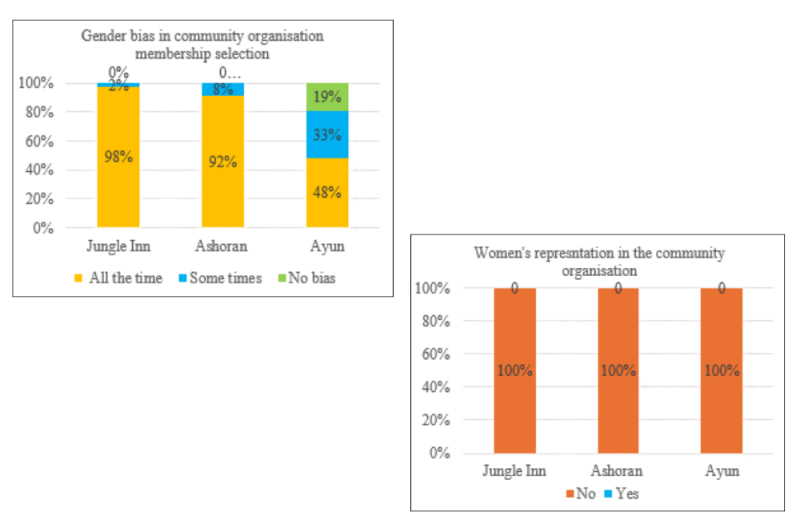
Despite progress made, gender development remains slow and at times regressive. In a region where gender roles are conservatively defined, women are rarely involved in the planning or management of energy projects. Gender bias still influences who gets a seat at the table in community energy organisations, leaving women with limited say in decision-making. While hundreds of women’s organisations have been set up under RSPs, their scope and effectiveness vary widely across different cultural contexts.

Development programmes have spent decades trying to promote gender equity, but the results have been modest at best. In KP, projects have addressed women’s immediate needs, but they’ve done little to support their broader aspirations — like becoming leaders or entrepreneurs. While a handful of women have launched small businesses thanks to electricity access, many remain confined to traditional roles within the home. Political instability, religious extremism, and entrenched patriarchy continue to block women’s participation in public life and local governance.

That’s not to say these programmes have failed. Initiatives led by organisations like SRSP have made a real difference, improving education and skills for many women. Yet after 30 to 40 years of development work, progress is painfully slow. Female literacy in KP stands at just 37pc, compared to 72pc for men, and nearly 40pc of girls are still out of school. A recent UNDP report reveals that gender inequality is actually worsening, with women’s labour force participation dropping from 16pc in 2006-2007 to just 11.3pc by 2018-2019. Parliamentary representation for women has also declined slightly over the same period.


Respondents’ perception of women’s representation and gender bias in community organisation membership.


Why do these disparities persist?

One major reason is that development projects often focus on short-term outputs — such as building schools or distributing resources — without tackling the root causes of gender injustice. Unequal access to resources, power imbalances, and rigid social norms remain largely unchallenged.

The lesson is clear: to build resilient energy systems, we must actively empower women. Studies show that when women play a leadership role, resource management improves, and projects become more adaptable to change. For MHPs and similar initiatives to be truly transformative, they need to support women’s agency, not just their participation. That means involving women at every stage of the project, from planning and execution to governance. Only then can energy access become a tool for empowerment and equality.
Towards resilient and inclusive energy futures

As KP continues to navigate the challenges and opportunities that come with decentralised energy systems, the experiences with MHP projects offer crucial lessons on how localised energy solutions can be refined to better serve communities. These projects are vital for achieving sustainable development in remote areas, but success isn’t just about installing turbines or building infrastructure. It’s about creating systems that are both resilient and equitable — where technology and community needs are deeply interconnected.

From a technical standpoint, we observed that small MHPs (under 100kW) face greater operational challenges than larger ones, highlighting the need for more careful feasibility assessments. However, technology alone won’t ensure sustainability.

Strengthening local institutions, project monitoring, and inclusive governance are critical. Communities must have a genuine role in decision-making, and projects need to address underlying power dynamics and inequalities. As climate change intensifies, adaptable and resilient energy systems will be crucial for northern Pakistan’s survival and growth.

The future of rural electrification in KP and similar regions globally depends on understanding the socio-technical nature of these projects — where technology meets human lives, and where power should mean not just electricity, but empowerment.

Disclaimer: This study has been published as an open-access peer-reviewed journal article in Environmental Research: Infrastructure and Sustainability and can be accessed here. We are grateful to the British Council Researcher Links Climate Challenge Workshops Grant: Delivering a Sustainable Energy Transition for Pakistan for funding this project. We also acknowledge the support of Pedo, SRSP and the Energy & Power Department KP in facilitating data collection and field visits.

Header image: The tourist’s hub, Kalam Valley in Swat, powered by local MHP plants. — photo by author


The author is a Research Associate with the MECS programme at Loughborough University. Her research explores the intersections of the gender-energy nexus in the Global South. She is passionate about problem-driven research, believes in interdisciplinary collaborations and dreams of doing fieldwork across the globe.


This author is a lecturer in the Energy Management and Sustainability programme at the US-Pak Center for Advanced Studies in Energy, UET Peshawar. His interests and research focus on energy policy, grassroots energy innovation, sociotechnical systems, and sustainability.