Part 1
In case you are ever tempted to feel sorry for Trumpy – now might be the time. We are referring, of course, to the current shrill crescendo of attacks from the mainstream media and UniParty pols upon Trump over his spat with Zelensky and his sensible decision to ixnay the barking idiocy of the Lindsay O. Graham Sanctioning Russia And Iran Act of 2026.
For crying out loud. On the (very) rare occasion when Trump gets something right – that is, on the urgent need for Washington to cut loose of the no-count cesspool of corruption in Kiev – the aforementioned chorus hoovers up the tired (and groundless) old canard about Putin allegedly having salacious pictures of the Donald with his pants off.
So we sincerely ask: Is it not possible that there is a damn good reason why Trump is stumbling around attempting to disengage from the Washington-made disaster in Ukraine?
Is it also not conceivable that the pathetic crooks in Kiev should be severed from the US arms and treasury pipeline forthwith? After all, these are the good folks who steal their allies in Europe and Washington blind and who are so desperately hanging on by a thread in their misbegotten war against Russia that they are gang-pressing 60-years olds right off the streets of their crumbling cities into paddy wagons in order to do what?
Why, to be rushed off to the human hamburger factories at the hellish front lines in eastern Ukraine after hardly a few weeks of pro forma “training”. And while that particular form of self-genocide may be their prerogative as the rulers of the so-called nation of Ukraine, Zelensky and his den of thugs should not be getting a single dime from US taxpayers. That’s because their pointless lost cause way over there is utterly, completely and terminally irrelevant to America’s homeland liberty and security way over here.
Likewise, is it not possible that the end of the Cold War in 1991, which likely never should have happened in the first pace, left in the old Soviet Union a vestigial mess of scrambled up borders, peoples, languages, cultures and misbegotten polities?
Moreover, these Soviet era arrangements had precious little historical legitimacy but, instead, had been confabulated by communist ruffians and tyrants over the prior 74 years of their horrid rule. Accordingly, they needed to be sorted out by the locals involved, not by the subsequently unemployed Cold Warriors in Washington, London, Brussels and lesser places in the West, as we will amplify further in Part 2.
So as they used to say in the smoke filled room of Washington, it’s now time to get down to the lick log on the matter. To wit, there is no point in a proxy war against Russia because this shrunken remnant of the fallen Soviet Empire is no military threat to the American Homeland whatsoever. And that’s as in none, nada, nichts and nugatory.
On the one hand, Russia’s limited arsenal of nuclear weapons is checkmated by the 70-year old truth of strategic nuclear deterrence. That is, the knowledge of its eminently “rational” leaders that a first strike against America would bring a second strike retaliation so ferocious as to end civilized life in Russia in a bloody nuclear fireball.
At the same time, they also have virtually zero sealift and airlift capacity to launch a conventional invasion of the New Jersey shores or to disembark troops on the banks of the Potomac. So the long and short of it is this: Russia with a GDP of $2.2 trillion is not remotely a military threat whatsoever to America’s $32 trillion GDP and its overwhelming capabilities for nuclear deterrence and conventional defense.
So why are we even in the Ukraine theater on the doorstep of a country which has no intention, capability or prospect of harming the US homeland militarily?
Alas, the answer is that during the 80 years after the end of WWII, Washington DC has become the War Capital of the World. Accordingly, it world historic scale war machine needs to be exercised in the pursuit of forever wars; its vast assemblage of arms merchants need continuous orders for weaponry and ammo; and its house-trained politicians and national security apparatchiks need scary-narratives about threats and bad people abroad in order to justify the hideously unnecessary taxes they impose on the American public to fund a Brobdingnagian Warfare State at a level of $1.5 trillion per year – when even $500 billion would be more than adequate.
We will elaborate on all these points further in Part 2, but first let us run aground the specious Russophobic threat inflation which hangs over Washington thicker than a California forest fire. To wit, the one and only possible military threat from Russia lies in its 1,796 deployed nuclear warheads, but here’s why Moscow will never use them to launch a first attack on the American homeland.
Its called the terrible logic of strategic nuclear deterrence. It is the knowledge of Russian leaders that in the event that they should ever launch a nuclear first strike against America, current U.S. strategic nuclear deterrence doctrine calls for a retaliatory second strike capable of imposing civilization-ending mayhem on their own territories, cities and peoples.
Open-source assessments from the Federation of American Scientists put the currently deployed U.S. strategic arsenal at roughly 1,770 warheads. These include 400 Minuteman III ICBMs (each typically carrying a single 300–335 kiloton warhead), approximately 970 warheads on Trident II D5 submarine-launched ballistic missiles, and roughly 300 associated with bombers (B-52s armed with air-launched cruise missiles and B-2s carrying gravity bombs).
A full-on second strike would almost certainly begin with counter-force targeting of Russian nuclear forces, command nodes, and related military infrastructure, then escalate to what lies at the heart of nuclear deterrence: Namely, counter-city strikes on economic and urban targets.
Simulations such as Princeton’s Science & Global Security “Plan A,” which models an escalatory exchange using realistic force postures, project that the city-targeting phase alone could employ five to ten warheads against each of Russia’s 30 most populated cities and economic centers. Russia’s largest urban areas – Moscow (over 13 million), St. Petersburg (roughly 5.7 million), Novosibirsk, Yekaterinburg, Kazan, and others – would rank among the highest-priority targets.
If just half of the above described US nuclear arsenal (900 warheads) were unleashed in the counter-city phase of the second strike, and if based on proportionate distribution of the triad force, the result would be 200,000 kilotons of explosive release. That compares to the Little Boy release on Hiroshima in August 1945, which carried just 15 kilotons, yet turned the this great Japanese city into the wasteland photographed below in August 1945.
That’s right. Any Russian leader launching a first nuclear strike on America would be guaranteeing the annihilation of his country in a fiery apocalypse equal to 13,000 Hiroshima’s.
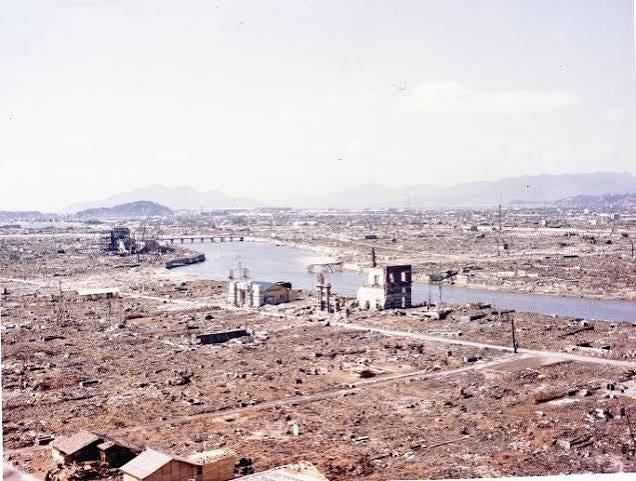
It hardly seems necessary to total the casualties, but were 900 US warheads to be dropped on the major Russian cities in retailiation for a first strike, the immediate number of dead would be in the range of 40 million, and total dead and injured would likely reach 90 million.
For crying out loud. That’s 65% of the entire Russian population—men, women and children.
Moreover, on the ground the physical and functional destruction would be near-total in targeted cities. Blast and thermal effects would flatten large portions of the built environment, rendering central districts uninhabitable for months or years due to rubble, residual radiation, and the absence of shelter.
Electrical grids would fail regionally or nationally as generation plants, high-voltage transformers, and transmission lines were destroyed or disabled. Transportation networks – rail hubs, airports, major highways, and ports – would be severed, isolating surviving populations. Internet and telecommunications infrastructure, dependent on power, fiber optic nodes, and data centers concentrated in urban areas, would go dark.
Likewise, water treatment, fuel distribution, and medical systems would collapse. The result would be the functional erasure of Russia’s largest cities as organized urban centers and the crippling of the national economy: industrial output, logistics, and administrative capacity would be reduced to a fraction of pre-attack levels.
So here’s the thing. Nuclear deterrence has worked for a reason from the very dawn of the nuclear age after 1949 when the Soviet Union first got the bomb as well. Russian leaders – even Stalin, Brezhnev and now Putin – have fully understood that nuclear war is not an option. Full stop.
That fact is, Russia is not going to start a nuclear war, and given the decrepit state of its conventional forces, as we will essay in Part 2, they very idea of an attempted Russian invasion of the USA across the great ocean moats amounts to risible joke.
So why, again, are we at war in Ukraine and why, again, are the pols and journos on the banks of the Potomac cackling at the Donald for stumbling toward a halt to the madness there?
The great dissident Randolph Bourne gave the answer in a famous 1918 essay as he looked into the jaws of the similar madness then extant along the trenches of WWI. Update his felicitous phrase to today’s reality, and he would surely be saying to the mumblers now braying at the Donald:
“War is indeed the health of the War Capital of the World”.
Part 2
Sometimes an especially stubborn mule needs to have a 2X4 administered squarely between the eyes. Repeatedly.
The same can be said about the politicians, commentators, think tanks and lobbyists for the merchants of war who practice their malefic arts amidst the fog of propaganda, lies, venality and humbug which literally suffuses the air – indoors and outdoors alike – over the War Capital of the World on the Potomac.
So here’s today’s 2X4. There is no justification whatsoever for the proxy war on Russia now being conducted with US dollars and weapons on the killing fields of Ukraine. As we saw in Part 1, a Russian nuclear attack against the US is so utterly implausible that even a semi-educated mule would understand: No Kremlin leader is ever going to light a match that would bring down 13,000 Hiroshima’s on the Russian Motherland and kill or injure 90 million citizens or nearly 65% of its population. Full stop.
As it happens, moreover, the entire US triad nuclear deterrent costs only about $75 billion a year to assure the nuclear peace via MAD, and does not require a single foreign base, alliance or sign-off from anyone outside of Washington DC. So virtually all of the rest of the nation’s $1 trillion DOD budget and $1.5 trillion Warfare State overall amounts to a self-licking ice cream cone.
That is to say, the massive $1.5 trillion annual Warfare State assault on US taxpayers essentially fuels its own perpetuation via endless inflation of foreign threats, continuous provocation of alleged foreign foes and busy-body interventionist machinations from one end of the planet to the other. The Empire, in effect spends hundreds of billions of the American taxpayers’ dollars each and every year to keep their own elected politicians in thrall to the lies and propaganda which stand at the heart of the Washington domiciled national security apparatus.
Self-perpetuation of the Warfare State, in fact, is the only possible explanation for the idiocy of Washington’s meddling on Russia’s border lands. After all, there is no Russian military threat to the security and liberty of the American Homeland that requires Washington to give a good goddamn about doings over there 5,000 miles from the Potomac River.
Indeed, once you set aside the completely checkmated threat of nuclear attack owing to the shield of MAD, the very idea of a Russian conventional attack and invasion of US territory is so implausible and literally impossible as to belong in the screwball section of the deep outfield bleachers.
For want of doubt, however, we document the implausibility of a Russian conventional attack in detail below. But the spoiler alert is this: Once the 2X4 has awakened the mule to the implausibility of a Russian military threat to the American Homeland – nuclear and conventional alike – the only reason for Empire and war in distant lands like the eastern regions of Ukraine reduces to, ironically, eleemosynary.
Of course, the Warfare State narrative gussies up this planetary gendarme and good shepherd role under the high-minded catchments of “collective security” and the “rule of law”. In the current case, the latter pertains to Moscow’s alleged violation of Ukrainian sovereignty when it invaded in February 2022.
Alas, if there are no military threats to America’s homeland in the world today—and the same stipulation noted above for Russia applies to the alleged menace of Red China, as well – then by definition there is no need for alliances, collective security or enforcement of the so-called “rule of law”. All of these are pretexts for foreign interventions and military adventures, not rudiments of true Homeland Security.
Nevertheless, upholding the rule of law and alleged sovereignty of borders is exactly the canard used to justify Washington’s decades long meddling in Ukraine. The latter, of course, culminated in the February 2014 coup de etat that Washington organized, funded, supported and instantly recognized upon the overthrow of Ukraine’s duly elected president – who happened to be a Russian-speaker and a son of the eastern Russian provinces of Ukraine that would never have provoked war with Moscow.
Even aside from the barking hypocrisy of using the “rule of law” justification for a regime change intervention that Washington foisted upon the hapless population of Ukraine in the first place, the whole narrative is too rich for words.
For crying out loud. Washington has been the regime change champion of the world since 1947, and without peer.
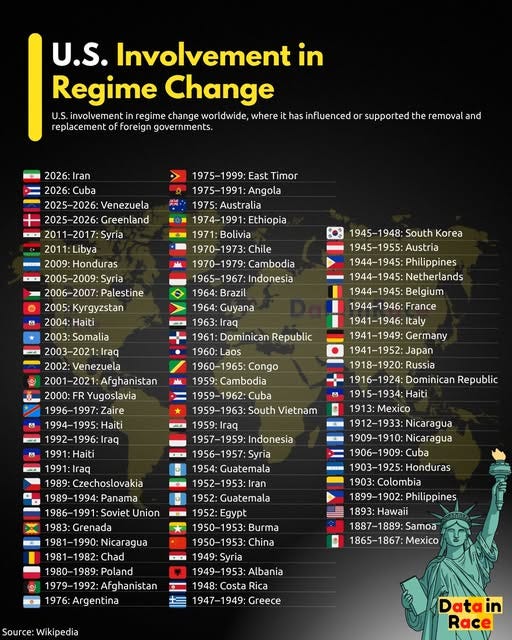
In any event, once the nuclear threat is set aside under the shield of MAD, the notion of a conventional Russian invasion of the United States collapses under the relentless facts of geography and comparative military force structure.
To begin, when it comes to conventional military attack on the homeland territory of the USA, the Atlantic and Pacific oceans are not minor obstacles. To the contrary, they are multi-thousand-mile barriers – the great nature-given moats that has been at the heart of America’s security and safety for 250 years.
Crossing them with an invasionary armada requires the ability to move and protect large numbers of troops, heavy equipment, fuel, munitions, and air cover–including a massive staging capability at home, robust logistical sinews and unfailing re-supply lines circling the earth. Russia possesses almost none of these necessary tools.
The disparity begins with scale. Open assessments place the overall Russian Navy at roughly 1.4 million tonnes of displacement. The U.S. Navy measures nearly six times larger. Its 8.0 milliontonnes of displacement is driven by large carriers, amphibious ships, destroyers, and submarines.
By contrast, Russia’s surface force is a modest collection of aging cruisers, destroyers, and frigates, many of Soviet-era design and dispersed across separated fleets. Its single aircraft carrier, the Admiral Kuznetsov, has not completed an operational deployment since 2016–2017 and remains non-operational after a failed multi-year overhaul. Russia has no other carrier in service.Accordingly, fixed-wing naval aviation is effectively dormant.
Against this stands the U.S. undersea fleet. The Navy operates approximately 50 attack submarines: roughly 20–22 remaining Los Angeles-class boats, three Seawolf-class (Seawolf, Connecticut, and Jimmy Carter), and about 25–26 Virginia-class boats, with more under construction.
These nuclear-powered attack submarines are optimized for anti-surface warfare, intelligence collection, and land attack. A Russian surface group attempting to transit the Strait of Gibraltar or the GIUK gap (Greenland–Iceland–United Kingdom) would enter waters where these submarines, supported by maritime patrol aircraft and allied forces, hold decisive advantages.
Aging Russian destroyers and cruisers, lacking modern layered air defense and continuous organic air cover, would face torpedoes and anti-ship missiles launched from positions they cannot reliably detect or engage. In practical terms, Davy Jones’ Locker waits outside Gibraltar and the GIUK gap for any such Russian formation—the seafloor ready to claim a force that cannot protect itself or sustain its passage.
Even if a Russian surface force somehow survived the transit, it would confront U.S. carrier strike groups organized precisely for control of the open ocean.
Consider the USS Gerald R. Ford (CVN-78), lead ship of its class, as a representative example. The Ford is a nuclear-powered carrier of approximately 100,000 tons with a flight deck of roughly five acres, capable of embarking an air wing of about 70–75 aircraft.
A typical loadout includes multiple squadrons of F/A-18E/F Super Hornets for strike and air superiority, EA-18G Growlers for electronic attack, E-2D Advanced Hawkeyes for airborne early warning and command, and MH-60 helicopters for anti-submarine warfare and other roles. These aircraft deliver precision-guided munitions, anti-radiation missiles, and air-to-air weapons while providing continuous surveillance and electronic warfare.
Moreover, the aircraft carrier obviously does not sail by its lonesome. A Carrier Strike Group built around the Ford typically includes several Arleigh Burke-class guided-missile destroyers (for example, ships such as Bainbridge, Mahan, and Winston S. Churchill in recent deployments). Each destroyer carries up to 96 vertical launch system cells that can be loaded with Tomahawk cruise missiles (ranges exceeding 1,000 miles), Standard Missiles (SM-2/SM-6) for air and missile defense, and other weapons.
The group’s integrated air and missile defense, Aegis combat system, and electronic warfare suite create layered protection against air and missile threats. An attack submarine often operates in company, adding undersea strike and reconnaissance. Logistics ships sustain the formation for months. Collectively, one such group brings sustained carrier aviation, long-range cruise-missile firepower, dense air defense, and extensive electronic and intelligence collection – capabilities that no Russian surface formation could event remotely match or effectively counter.
These asymmetries compound. Without operational carriers, without sufficient aerial tankers (Russia fields only about 15–20 Il-78 refueling aircraft versus the U.S. inventory of roughly 500–600 aerial tankers), and without large-scale amphibious and sealift capacity, Russia just plain cannot generate or protect an invasion force across the ocean.
No sane, or even partially sane, Russian military leaders, therefore, would send an attack armada across the ocean moats toward America. It would be a suicide mission like no other in the annals of naval warfare because Russia’s limited blue-water surface ships would be engaged and attrited long before reaching the approaches to North America.
Russia does have a formidable submarines force which can threaten individual vessels. But self-evidently, you couldn’t move a million man invasionary army accross 5,000 to 10,000 miles of blue water and then sustain and re-supply it via a handful of submarines. Yet that’s what would be needed to seize and hold territory on the North American continent. Indeed, any Russian formation that cleared European waters would still face the same fate: Davy Jones’ Locker lying in wait on the approaches to the American shore.
In short, Russia retains substantial conventional forces optimized for operations near its own borders. Those assets matter in regional contingencies. They do not remotely translate, however, into the ability to project and sustain combat power across open ocean against the United States.
The combination of the two great ocean moats; the overwhelming numbers and lethality of the U.S. attack submarine fleet; the overwhelming carrier strike group firepower (as illustrated by the Ford and its escorts); and the sheer disparity in naval tonnage renders a conventional invasionary operation not just utterly implausible.
It actually means that the very idea of it is a risible joke.
So the question recurs. If the shield of MAD secures the American homeland against nuclear attack and the great ocean moats and US naval capabilities block any route to conventional military invasion, where’s the Russian military threat?
There isn’t one, of course!
What’s left of the whole insane operation since February 2022 – which has cost Uncle Sam $130 billion which he doesn’t have – is thus the biggest Washington lie of all. Namely, that Washington philanthropically came to the aid of the innocent nation of Ukraine, which had suffered an unprovoked invasion by a wanna be world conqueror domiciled in the Kremlin.
Alas, every single bit of that predicate is untrue. As we will amplify in Part 3, it’s just another manufactured “narrative” that is the stock and trade of the insidious forces ensconced within the War Capital of the World on the Potomac.
David Stockman was a two-term Congressman from Michigan. He was also the Director of the Office of Management and Budget under President Ronald Reagan. After leaving the White House, Stockman had a 20-year career on Wall Street. He’s the author of three books, The Triumph of Politics: Why the Reagan Revolution Failed, The Great Deformation: The Corruption of Capitalism in America, TRUMPED! A Nation on the Brink of Ruin… And How to Bring It Back, and the recently released Great Money Bubble: Protect Yourself From The Coming Inflation Storm. He also is founder of David Stockman’s Contra Corner and David Stockman’s Bubble Finance Trader.