Big Tech Ramps Up Propaganda Blitz As AI Data Centers Become Toxic With Voters
One Michigan state legislator said data centers are emblematic of the divide between “tech billionaires who are seizing power and… the working and middle classes.”
One Michigan state legislator said data centers are emblematic of the divide between “tech billionaires who are seizing power and… the working and middle classes.”

A sign on a rural Michigan road opposes a planned $7 billion data center on southeast Michigan farmland in Saline, Michigan, on December 1, 2025.
(Photo by Jim West/UCG/Universal Images Group via Getty Images)
Stephen Prager
Dec 18, 2025
COMMON DREAMS
As voters across the country begin to rally against the unchecked construction of data centers, artificial intelligence companies are panicking and investing millions into propaganda to paint the energy-sucking facilities in a more positive light.
By 2030, the amount of energy demanded by US data centers is expected to more than double, according to the International Energy Agency.
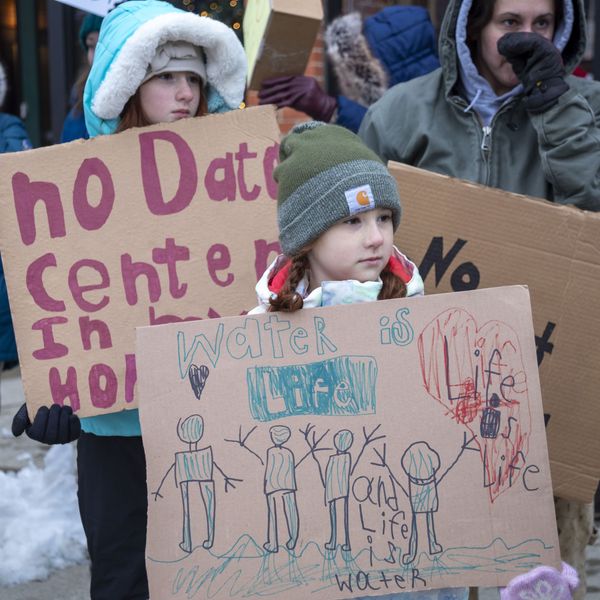
230+ Environmental Groups Call On Congress to Impose Moratorium on New AI Data Centers
Energy costs have spiked considerably in the states with the most data centers. And as the industry continues its breakneck expansion, one watchdog report found that consumers on America’s largest electric grid are expected to pay hundreds of dollars more to meet increased power demand from now until 2027.
These costs became an unexpected point of emphasis for Democrats in November, whose calls for greater transparency from tech companies seeking to build data centers propelled them to victory in elections from New Jersey to Virginia.
But tech companies want to keep building, and as AI threatens to become a central villain of the 2026 midterm elections, Politico reports that companies are putting the wheels in motion to portray themselves “as job creators and economic drivers rather than resource-hungry land hogs.”
As Gabby Miller wrote on Wednesday:
A new AI trade group is distributing talking points to members of Congress and organizing local data center field trips to better pitch voters on their value. Another trade association, the Data Center Coalition, nearly tripled its lobbying spend in the third quarter of this year from the previous quarter, according to US lobbying disclosures.
The social media giant Meta, with billions invested in its own fleet of data centers from Stanton Springs, Georgia, to Richland Parish, Louisiana, has been running a multimillion-dollar ad campaign depicting data centers as a boon to agricultural towns in Iowa and New Mexico. It has spent at least $5 million nationally in the past month on TV ads plugging Meta’s $600 billion pledged investment in tech infrastructure and jobs.“
”There’s a very bad connotation around data centers. And this is something that, frankly, the data center industry needs to figure out,“ said Caleb Max, president and CEO of the National Artificial Intelligence Association, a new trade group established in January to accelerate AI infrastructure development.
Tech giants are also putting focus on swaying policymakers. Max told Politico that his group has been making the rounds to talk with elected officials in critical battlegrounds for the AI future, like Georgia, Ohio, and Texas, to craft a “positive pro-data center campaign message for elected officials, for businesses, for current lawmakers who are going to be up for reelection in 2026.”
Meanwhile, Meta reportedly aired its 30-second TV spots “featuring small-town imagery of farming equipment and mom-and-pop diners” in Washington, DC, and nine state capitals. Miller says this suggests “that policymakers might be Meta’s real target audience, rather than the rural Americans impacted by these energy-hungry server hubs.”
AI and tech firms plan to ramp up the lobbying and ad blitzes as the next election draws nearer, and their attempt to reframe the narrative about data centers comes as no surprise, as communities across the US in recent months have increasingly come out in force to push their representatives to halt the construction of the facilities.
In Saline Township, a small community just outside Ann Arbor, Michigan, more than 800 residents descended upon a public input session earlier this month to protest against the construction of a $7 billion center—predicted to consume as much energy as the entire city of Detroit—fearing it would raise energy costs, pollute groundwater, and force the state to abandon its nation-leading climate policies.
The town initially blocked the plans, but reversed course following a lawsuit from a real-estate billionaire closely aligned with President Donald Trump, whose administration has backed the $500 billion “Stargate” initiative by OpenAI, SoftBank, and Oracle to expand data centers.
On Tuesday, Michigan Attorney General Dana Nessel joined Saline residents at a gathering outside the state Capitol, where they called for a statewide moratorium on data centers.
Data center projects have run into similar resistance nationwide. As of March, the group Data Center Watch found that more than $64 billion worth of projects had been blocked or delayed due to local opposition since May 2024. This opposition has reached a fever pitch in recent months.
Last week, after it received hundreds of angry comments from residents, the city council of Chandler, Arizona, unanimously rejected plans for a $2.5 billion data center that had been pushed by former US Sen.-turned lobbyist Kyrsten Sinema (D-Ariz.).
Even in Trump country, backlash has been fierce. Last week, the planning commission of Starke County, Indiana, voted unanimously to recommend a one-year moratorium on the construction of centers bigger than 5,000 square feet after residents flooded a meeting to raise concerns about water pollution and energy costs.
“In Memphis, Tennessee, Elon Musk’s AI company has built a data center whose energy demands have outgrown the region’s energy capabilities,” said one resident, Sophia Parker. “We’ve heard from everyone else saying that our infrastructure does not have the capacity to support a data center. And as a result, gas turbines are emitting nitrogen oxide to the point where residents cannot breathe. Their community is being used as a sacrifice for others to get rich. We cannot allow that to happen to us.”
Last month in Montour County, Pennsylvania—a state where electric prices have surged by 15% this year, double the national average—environmentalists formed an uncommon alliance with conservative farmers and the Amish to stop the county planning commission from rezoning 1,300 acres of agricultural land for a massive new center.
“Stay out. We wouldn’t even be having this conversation without federal involvement,” said Craig High, a 39-year-old Trump supporter quoted by Reuters. “Both parties are pushing data centers and giving regulatory relief—water permits, permitting, all of it.”
“This is part of an experience that America and the world is having around tech billionaires who are seizing power and widening the gap between those who have much too much… and the working and middle classes,” Yousef Rabhi, a former Democratic state legislative leader from Michigan and clean energy advocate who opposes the construction of data centers, told The Guardian. “That’s what these data centers are symbolic of, and they’re the vehicle for the furtherance of this divide.”
Sanders Pushes for Moratorium on New AI Data Center Construction Amid Growing Backlash
“Do you believe that these guys, these multibillionaires, are staying up at night, worrying about what AI and robotics will do to working families?”

WASHINGTON DC, UNITED STATES - NOVEMBER 5: Senator Bernie Sanders (I-VT) speaks at an impromptu press conference on recent election results, in Washington DC, United States on November 5, 2025.
Photo by Nathan Posner/Anadolu via Getty Images
Brad Reed
Dec 17, 2025
COMMON DREAMS
Sen. Bernie Sanders on Tuesday called for a moratorium on the construction of new artificial intelligence data centers in the US amid growing nationwide backlash.
In a video posted on social media, Sanders (I-Vt.) explained why it’s time for the government to hit the brakes AI data center projects, which have drawn protests all over the country for driving up electric bills and draining communities’ water supplies.

Sanders Champions Those Fighting Back Against Water-Sucking, Energy-Draining, Cost-Boosting Data Centers
Sanders began the video by acknowledging that AI has the potential to be a truly transformative technology, before noting that those who are pushing for its rapid development the most were the wealthiest people on the planet, including Meta CEO Mark Zuckerberg, Tesla CEO Elon Musk, and Palantir co-founder Peter Thiel.
“So here is a very simple question I’d like you to think about,” Sanders continued. “Do you believe that these guys, these multibillionaires, are staying up at night, worrying about what AI and robotics will do to working families of our country and the world? Well, I don’t think so.”
Sanders then argued that AI’s biggest backers are pushing the technology to further enrich themselves at the expense of everyone else by replacing human laborers entirely with computers.
Sanders then quoted Musk, who predicted that AI and robots would “replace all jobs” in the future, and then cited a quote from Microsoft co-founder Bill Gates, who said that “humans won’t be needed for most things.”
Sanders then questioned how people will survive if AI meets its backers’ goals and deprives people of jobs on a mass scale. This problem is being compounded, Sanders continued, because “very few members of Congress are seriously thinking about this.”
In addition to discussing AI’s potential to vastly undermine working people’s economic power, he also touched on its social implications, and said he was concerned that “millions of kids in this country are becoming more and more isolated from real human relationships, and are getting their emotional support from AI.”
“Think for a moment about a future where human beings are not interacting with each other,” he said. “Is that the kind of future you want? Well, not me.”
Sanders concluded by arguing that the push to advance and integrate AI is “moving very, very quickly,” and without proper considerations for the economic and social impacts it will have.
The Vermont senator argued for his proposed moratorium on data center construction to give “democracy a chance to catch up with the transformative changes we are witnessing.”
During a Tuesday anti-data center rally, Michigan Attorney General Dana Nessel slammed plans to build a 2.2-million-square-foot data center in Saline Township, and pointed to electric service company DTE’s efforts to rush through the construction approval process as reason enough to oppose it.
“Do you guys trust DTE?” she asked. “Do you trust OpenAI? Do you trust Oracle to look out for our best interests here in Michigan?”
Republican gubernatorial candidate Anthony Hudson told MLive that he shared Nessel’s criticism of the data center plan, and he questioned whether Michigan residents would see any economic benefit from it.
“They don’t support local job growth,” he said of the data centers. “They pull millions of gallons of water a day, and they’re going to strain the power grid that’s already crippled. And once they’ve made their money, like Dana Nessel said, they’re going to leave.”
Earlier this month, more than 230 environmental advocacy groups, led by Food and Water Watch, demanded a moratorium on building new data centers, which they said consumed unsustainable amounts of water and electricity, while also worsening the global climate emergency.
By Dr. Tim Sandle
SCIENCE EDITOR
DIGITAL JOURNAL
December 18, 2025

Image: — © AFP Kirill KUDRYAVTSEV
OpenAI just announced the new GPT-5.2 model, its most advanced artificial intelligence model to date, which is said to enhance its general intelligence, coding, and long-context understanding. At the same time the company has made the surprising choice of appointing George Osbourne, former Conservative Party Chancellor, as its managing director (then again, Osbourne is not known for his green credentials).
More advanced AI models, however, come at a higher cost, with the electricity consumption of ChatGPT, in particular, ever growing. To put this into context, ChatGPT’s power needs for answering user questions alone have reached a massive 17 TWh a year, nearly what a country such as Puerto Rico or Slovenia uses to keep the lights on (ChatGPT’s energy use for processing requests surpasses the total electricity consumption of dozens of small countries and territories, including Slovenia, Georgia, Kenya, Lithuania, Costa Rica, Mongolia, Latvia, and Luxembourg).
The annual electricity needed to answer user queries would also be enough to power New York City for 113 days, or nearly 4 months, or the whole of the U.K. for 20 days. In addition, the data centres and their in-house power-hungry data servers consume additional energy, while generating a substantial carbon footprint.
As AI systems scale at breakneck speed, their energy appetite is ballooning just as quickly, straining power grids, pushing up carbon emissions, and raising uncomfortable questions about the environmental cost of intelligence on demand. ChatGPT is a prime example: each query is estimated to consume 18.9 watt-hours, more than 50 times the energy used by a standard Google search (0.3 Wh).
To illustrate the real scale of this, researchers at BestBrokers calculated the model’s total electricity consumption over a full year of responding to user prompts and calculated what it would (using the average U.S. commercial electricity rate of $0.141 per kWh as of September).
At the latest commercial electricity prices, that translates into an estimated $2.42 billion in annual power costs, solely to keep the model answering questions.
Daily, this translates to more than 2.5 billion daily requests, consuming over half a 47.2 million kilowatt-hours of energy. With the average U.S. and Western European household consuming around 29 kWh per day, this means that the energy needed by ChatGPT every year could easily power all households in the U.S. for more than 4 and a half days.
For further context, the energy ChatGPT consumes in a year could fully charge about 238 million electric vehicles, each with an average battery capacity of 72.4 kWh. With an estimated 6.5 million EVs on U.S. roads as of mid-2025, the annual electricity for answering prompts could use all these vehicles at least 36 times.
December 18, 2025
Image: — © AFP Kirill KUDRYAVTSEV
OpenAI just announced the new GPT-5.2 model, its most advanced artificial intelligence model to date, which is said to enhance its general intelligence, coding, and long-context understanding. At the same time the company has made the surprising choice of appointing George Osbourne, former Conservative Party Chancellor, as its managing director (then again, Osbourne is not known for his green credentials).
More advanced AI models, however, come at a higher cost, with the electricity consumption of ChatGPT, in particular, ever growing. To put this into context, ChatGPT’s power needs for answering user questions alone have reached a massive 17 TWh a year, nearly what a country such as Puerto Rico or Slovenia uses to keep the lights on (ChatGPT’s energy use for processing requests surpasses the total electricity consumption of dozens of small countries and territories, including Slovenia, Georgia, Kenya, Lithuania, Costa Rica, Mongolia, Latvia, and Luxembourg).
The annual electricity needed to answer user queries would also be enough to power New York City for 113 days, or nearly 4 months, or the whole of the U.K. for 20 days. In addition, the data centres and their in-house power-hungry data servers consume additional energy, while generating a substantial carbon footprint.
As AI systems scale at breakneck speed, their energy appetite is ballooning just as quickly, straining power grids, pushing up carbon emissions, and raising uncomfortable questions about the environmental cost of intelligence on demand. ChatGPT is a prime example: each query is estimated to consume 18.9 watt-hours, more than 50 times the energy used by a standard Google search (0.3 Wh).
To illustrate the real scale of this, researchers at BestBrokers calculated the model’s total electricity consumption over a full year of responding to user prompts and calculated what it would (using the average U.S. commercial electricity rate of $0.141 per kWh as of September).
At the latest commercial electricity prices, that translates into an estimated $2.42 billion in annual power costs, solely to keep the model answering questions.
ChatGPT’s annual energy needed to answer user prompts (17.23 TWH) can supply electricity to these nations for:
- China: 15 hours
- U.S.: 1 day and 10 hours
- India: 3 days and 2 hours
- Russian Federation: 5 days and 6 hours
- Japan: 6 days and 4 hours
- Brazil: 8 days and 6 hours
- South Korea: 10 days and 1 hour
- Canada: 10 days and 2 hours
- Germany: 12 days and 9 hours
- France: 13 days and 11 hours
Daily, this translates to more than 2.5 billion daily requests, consuming over half a 47.2 million kilowatt-hours of energy. With the average U.S. and Western European household consuming around 29 kWh per day, this means that the energy needed by ChatGPT every year could easily power all households in the U.S. for more than 4 and a half days.
For further context, the energy ChatGPT consumes in a year could fully charge about 238 million electric vehicles, each with an average battery capacity of 72.4 kWh. With an estimated 6.5 million EVs on U.S. roads as of mid-2025, the annual electricity for answering prompts could use all these vehicles at least 36 times.
AI influencers earn more than the average full-time employee
By Dr. Tim Sandle
SCIENCE EDITOR

A potential AI influencer? Image by © Tim Sandle (Barbican Centre, London)
Is it easy money? Perhaps. Some AI influencers are accumulating large sums by creating digital avatars and created characters. As an example, Brazilian AI character Lu do Magalu has been crowned as the highest-earning virtual influencer in 2025, earning an average of £32,010 per Instagram post (or at least this is the sum that gravitates towards his creators).
While Lu do Magalu is an extreme example, a recent survey notes that AI influencers can now earn an average of £6,791 per social media upload. This is more than many traditional influencer earnings.
These findings come from a company called Bestever who have spent some time analysing the follower counts, engagement rates, and posting frequency of human-like AI influencers on Instagram to determine which content creators can amass the highest earnings per post.
To compare and contrast, using data from the Office for National Statistics, the survey found that the average UK worker earns around £2,521 per month (median salary £39,039). This means that the majority of AI influencers now earn more via a single social media post than most people do after an entire month’s worth of work.
Who are the most popular AI influencers?
According to the data, Lu do Magalu, who was created by the company Magazine Luiza, earns an average of £32,010per Instagram upload. With a following of over eight million, Lu is often regarded as one of the most well-known AI influencers. The Instagram account frequently shares unboxing videos, product reviews, and product promotions on behalf of Magazine Luiza.
Charli D’Amelio, who was featured in Forbes’ top 10 content creators of 2025, is estimated to earn up to £22,515 per Instagram upload, depicting the growing economic force of AI influencer accounts in 2025.
Miquela Sousa, also known by the username Lil Miquela, is identified as the second-highest earner in the study. At first glance, Lil Miquela may appear like any ordinary influencer, uploading snaps of food, fashion, and meetups with friends. However, the account is run by the Los Angeles-based tech company, Brud.
Since first appearing in 2016, Lil Miquela has gone on to release her own music and star alongside celebrities in various fashion campaigns for luxury brands like Calvin Klein and Prada. With a following of over 2.4 million, Miquela can earn up to a staggering £12,896 per Instagram post.
YouTuber and podcaster Emma Chamberlain, who featured in Forbes’ top 20 content creators this year, is projected to earn up to £9,758 per Instagram post, highlighting the growing economic opportunities associated with the high engagement rates and sponsorship deals of AI accounts like Lil Miquela.
Alara X is crowned as the third-most influential AI content creator of 2025. Created by the tech production company IAMX.Live, Alara regularly shares various lifestyle and fashion uploads. The influencer also hosts her own talk show where she interviews real-world guests in a virtual studio.
Since the account started sharing content back in 2021, Alara has amassed a following of over 760,000, which means that she can earn an average of £5,280per Instagram post.
Noonoouri, the fashion-focused content creator, is identified as the fourth-highest-earning virtual influencer. Created by artist Joerg Zuber, the account has collaborated with some huge fashion names, including Dior and Valentino. After signing a contract with Warner Music, Noonoouri has also gone on to release her own music.
Mattel also launched a collaboration between Noonoouri and Barbie, demonstrating the impressive real-world reach of the AI creation. The account now has over 501,000 followers on Instagram and can earn an average of over £3,828per social media post.
Created by the Tokyo-based CGI companies ModelingCafe and Aww Inc, Imma Gram is the fifth most-influential AI content creator in 2025. After debuting on Instagram back in 2018, Imma has since collaborated with some high-profile brands, including Adidas, The North Face, and Amazon.
As a virtual model, the account’s content heavily focuses on fashion and has a following of almost 400,000. The research calculates that Imma can earn an average of £3,155per social media upload.
The virtual influencer economy is experiencing rapid growth as part of the broader creator economy, which now accounts for 1.5 million full-time equivalent jobs, according to a recent report by the Interactive Advertising Bureau (IAB). This sector is growing five times faster than traditional media workforces, reflecting brands’ desire to capitalise on the trend of virtual influencers.
Recent reports have revealed that AI tools are becoming essential in the daily work of an influencer, especially when it comes to writing creative content and revealing audience demographics. With the rise of AI within the content creation industry, it will also become more common for companies to employ the use of an AI influencer for the purpose of brand partnerships, media coverage, and sponsorships.
As AI continues to improve in quality, it will likely become increasingly difficult to spot an AI influencer when scrolling through social media. Some virtual influencers will state in their bio that they are ‘AI-created,’ but many are gradually slipping under the radar of the average social media user.
By Dr. Tim Sandle
SCIENCE EDITOR
DIGITAL JOURNAL
December 18, 2025
December 18, 2025
A potential AI influencer? Image by © Tim Sandle (Barbican Centre, London)
Is it easy money? Perhaps. Some AI influencers are accumulating large sums by creating digital avatars and created characters. As an example, Brazilian AI character Lu do Magalu has been crowned as the highest-earning virtual influencer in 2025, earning an average of £32,010 per Instagram post (or at least this is the sum that gravitates towards his creators).
While Lu do Magalu is an extreme example, a recent survey notes that AI influencers can now earn an average of £6,791 per social media upload. This is more than many traditional influencer earnings.
These findings come from a company called Bestever who have spent some time analysing the follower counts, engagement rates, and posting frequency of human-like AI influencers on Instagram to determine which content creators can amass the highest earnings per post.
To compare and contrast, using data from the Office for National Statistics, the survey found that the average UK worker earns around £2,521 per month (median salary £39,039). This means that the majority of AI influencers now earn more via a single social media post than most people do after an entire month’s worth of work.
Who are the most popular AI influencers?
According to the data, Lu do Magalu, who was created by the company Magazine Luiza, earns an average of £32,010per Instagram upload. With a following of over eight million, Lu is often regarded as one of the most well-known AI influencers. The Instagram account frequently shares unboxing videos, product reviews, and product promotions on behalf of Magazine Luiza.
Charli D’Amelio, who was featured in Forbes’ top 10 content creators of 2025, is estimated to earn up to £22,515 per Instagram upload, depicting the growing economic force of AI influencer accounts in 2025.
Miquela Sousa, also known by the username Lil Miquela, is identified as the second-highest earner in the study. At first glance, Lil Miquela may appear like any ordinary influencer, uploading snaps of food, fashion, and meetups with friends. However, the account is run by the Los Angeles-based tech company, Brud.
Since first appearing in 2016, Lil Miquela has gone on to release her own music and star alongside celebrities in various fashion campaigns for luxury brands like Calvin Klein and Prada. With a following of over 2.4 million, Miquela can earn up to a staggering £12,896 per Instagram post.
YouTuber and podcaster Emma Chamberlain, who featured in Forbes’ top 20 content creators this year, is projected to earn up to £9,758 per Instagram post, highlighting the growing economic opportunities associated with the high engagement rates and sponsorship deals of AI accounts like Lil Miquela.
Alara X is crowned as the third-most influential AI content creator of 2025. Created by the tech production company IAMX.Live, Alara regularly shares various lifestyle and fashion uploads. The influencer also hosts her own talk show where she interviews real-world guests in a virtual studio.
Since the account started sharing content back in 2021, Alara has amassed a following of over 760,000, which means that she can earn an average of £5,280per Instagram post.
Noonoouri, the fashion-focused content creator, is identified as the fourth-highest-earning virtual influencer. Created by artist Joerg Zuber, the account has collaborated with some huge fashion names, including Dior and Valentino. After signing a contract with Warner Music, Noonoouri has also gone on to release her own music.
Mattel also launched a collaboration between Noonoouri and Barbie, demonstrating the impressive real-world reach of the AI creation. The account now has over 501,000 followers on Instagram and can earn an average of over £3,828per social media post.
Created by the Tokyo-based CGI companies ModelingCafe and Aww Inc, Imma Gram is the fifth most-influential AI content creator in 2025. After debuting on Instagram back in 2018, Imma has since collaborated with some high-profile brands, including Adidas, The North Face, and Amazon.
As a virtual model, the account’s content heavily focuses on fashion and has a following of almost 400,000. The research calculates that Imma can earn an average of £3,155per social media upload.
The top 10 highest-earning AI influencers
| Rank | Influencer Name | Average Earnings per Post |
| 1 | Lu do Magalu | £32,010 |
| 2 | Miquela Sousa | £12,896 |
| 3 | Alara X | £5,280 |
| 4 | Noonoouri | £3,828 |
| 5 | Imma Gram | £3,155 |
| 6 | Milla Sofia | £2,719 |
| 7 | Kyra on IG | £2,202 |
| 8 | Shudu | £2,162 |
| 9 | Bermuda Is Bae | £1,982 |
| 10 | Rozy Gram | £1,677 |
The virtual influencer economy is experiencing rapid growth as part of the broader creator economy, which now accounts for 1.5 million full-time equivalent jobs, according to a recent report by the Interactive Advertising Bureau (IAB). This sector is growing five times faster than traditional media workforces, reflecting brands’ desire to capitalise on the trend of virtual influencers.
Recent reports have revealed that AI tools are becoming essential in the daily work of an influencer, especially when it comes to writing creative content and revealing audience demographics. With the rise of AI within the content creation industry, it will also become more common for companies to employ the use of an AI influencer for the purpose of brand partnerships, media coverage, and sponsorships.
As AI continues to improve in quality, it will likely become increasingly difficult to spot an AI influencer when scrolling through social media. Some virtual influencers will state in their bio that they are ‘AI-created,’ but many are gradually slipping under the radar of the average social media user.

No comments:
Post a Comment