Wednesday, July 28, 2021

Simone Biles and the rise of the ‘great refusal’

Black public figures from Simone Biles to Naomi Osaka are helping us put one simple word at the top of our vocabulary: no

‘Some might wrongly view this refusal as a symptom of millennial dysfunction and entitlement.’ Photograph: Jamie Squire/Getty Images


Casey Gerald
Wed 28 Jul 2021 19.08 BST

I can hardly do a proper cartwheel, so I’m hesitant to opine on Simone Biles’s decision to withdraw from the Tokyo Olympics this week, telling the press and the world: “I have to focus on my mental health.” I can’t stay silent, though, because I know she’s not alone.

As a former college football player, I can imagine the psychological price Olympians pay to squeeze every ounce of greatness into a tiny window of life. As a Black man raised by a cadre of women, I can imagine the tax Black women pay because of our national commitment to “trust” them, which really just means “let them do all the work.” Or, in the case of Simone Biles, “let her put the whole country on her back”.

Faced with these burdens, however, Biles did not simply quit. She refused. With her bold act she stepped into a beautiful, radical, often overlooked tradition, what I call the Black Art of Escape. That tradition is how I believe we, Black people, have managed to live in a country that’s made to destroy us. We’ve been told a great deal about our people’s strategies of resistance and protest. The great Olympic example of this, of course, is Tommie Smith and John Carlos’s black-gloved Black Power salute on the medal stand at the 1968 Games in Mexico City. We’ve been told about our people’s strategies of respectability and exceptionalism, perhaps embodied best by the icon Jesse Owens, who became the first American to win four track and field gold medals at a single Olympics, a feat he accomplished while Adolf Hitler looked on.

Biles’s decision harkens to a third way Black people have survived this country: flight.

Throughout the diaspora, tales of flying Africans were shared to give hope to the enslaved, hope that no matter how their slavers treated them, no matter how their country treated them, they had a freedom on the inside that the world had not given, and the world could not take away. This folkloric tradition inspired Toni Morrison’s Song of Solomon, in which Guitar tells Milkman: “Wanna fly, you got to give up the shit that weighs you down.”

For years we have watched Simone Biles soar through the air, across the mat, on balance beams and vaults. She’s twisted her body in ways that defy gravity, defy human comprehension. Her genius has made her the most decorated American gymnast in history, even as she’s competed with broken bones, not to mention the unconscionable abuse she endured at the hands of the former USA Gymnastics doctor Larry Nassar.

Yet, despite her many other accomplishments, I believe Biles’s decision to forgo her chance at another medal in Tokyo will stand as her greatest achievement of all. That Biles, perhaps the greatest gymnast ever, on the biggest stage of all, chose herself over yet another accomplishment, gives hope to a generation of Black Americans, famous and not, that we too might refuse the terms of success our country has offered us. Now, some might say she betrayed her teammates. Betrayed her country. I say: good for her. I think back to EM Forster’s great essay What I Believe, in which he writes: “I hate the idea of causes, and if I had to choose between betraying my country and betraying my friend I hope I should have the guts to betray my country.” If it takes guts to betray one’s country and choose one’s friend, how much more courage is required to truly choose oneself, when the whole world thinks they need you – when your team, your family, thinks they need you? But as a therapist once wisely told me: you can’t give what you don’t have.

America has always asked Black people to give everything we’ve got and then give what we don’t have. And if we did not give it, it was taken wilfully – plundered, as Ta-Nehisi Coates wrote.

Biles’s courageous decision echoes the actions of other Black public figures, from Naomi Osaka to Leon Bridges, who are refusing to sacrifice their sanity, their peace, for another gold medal or another platinum record. They are helping us all build a new muscle, helping us put one simple word at the top of our vocabulary: no.

Some might wrongly view this refusal as a symptom of millennial dysfunction and entitlement. The truth is that many of us came of age against the backdrop of 9/11 and the pyrrhic “war on terror”. We entered the workforce in the midst of the Great Recession. We cast our first votes for a Black president, only to then witness a reign of terror against Black people, young and old, at the hands of the state. (Not to mention the traumatic four years under our last president, who dispatched troops to brutalize peaceful protests for Black lives.) We are tired. We are sad. As the brilliant musician and producer Terrace Martin, perhaps best known for his work with Kendrick Lamar, told me recently: “I don’t know anybody sleeping well.”

I’m reminded of that great scene in the film Network, when the unstable newscaster convinces viewers all over the country to rush to their windows and scream out into the street: “I’m as mad as hell, and I’m not gonna take this any more!” Might Biles’s act of deep and brave self-love spark the largest wave of refusal in the history of this country? I believe it’s possible.

We are, I believe, witnessing the beginning of a great refusal, when a generation of Black Americans decide to, in the words of Maxine Waters, reclaim our time. Simone Biles, famous for what she does in the air, has shown the way by standing her ground.

Casey Gerald is the author of There Will Be No Miracles Here
Bolsonaro’s 1,000km Amazon railway will cause climate chaos. It must be stopped

This project would rapidly deforest large areas of the Amazon, which would wreak havoc on the planet


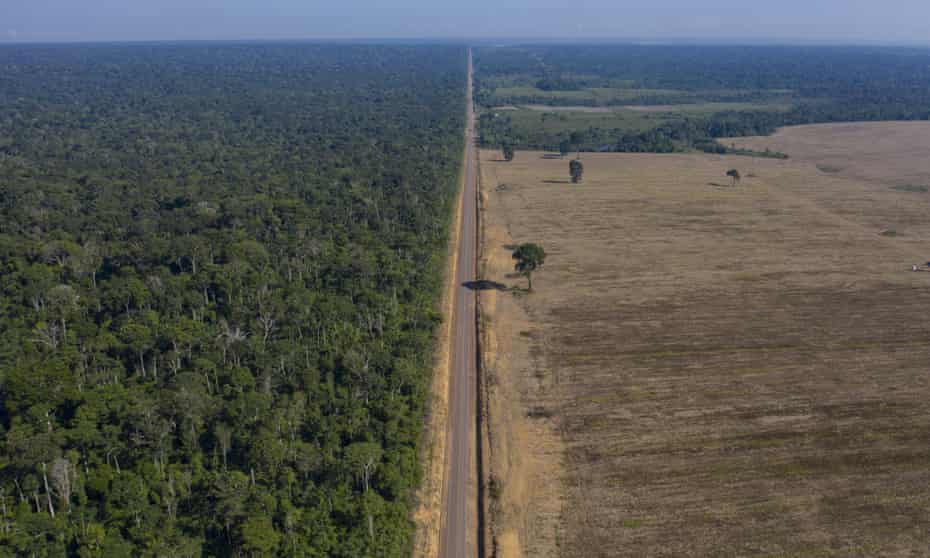
‘Today, almost 15% of the Amazon rainforest has already been deforested. When this number reaches 20%, the entire Amazonian system will collapse.’ 
Photograph: Léo Corrêa/AP


David Miranda
THE GUARDIAN
Wed 28 Jul 2021 

Despite increasing global concern, Jair Bolsonaro is determined to expand his exploitation of Brazil’s crucial natural resources. His latest project, one of the most destructive yet, would rapidly deforest large areas of the Amazon.

Bolsonaro’s plan? To construct a 1,000km railway system extending right into the heart of the Amazon rainforest – with trains passing within 500 metres of 726 official environmentally protected areas. The new railway, called Ferrogrão, would also entail construction within 10km of another 18 priority conservation areas established by the ministry of the environment.

The pretext for Bolsonaro’s environment-destroying plan is a problem that, while real, could be easily addressed through far less harmful measures. Currently, soybeans and other grains grown in the Brazilian midwest must travel a considerable distance – 2,000km – to reach seaports in the states of São Paulo and Paraná. The proposed railway would reduce transport costs and increase the competitiveness of these products in the international or national market by roughly 8%.
Advertisement

This underscores a key point of tension between Brazil and the international community. One reason the Amazon, a massive carbon bank, is so crucial to global climate policy is that countries in the global north became rich by exploiting their own natural resources, including through massive deforestation. Now that western European and North American countries are economically developed, they demand that Brazilians not do what they did: exploit our environmental resources so that we, too, can thrive economically. Many Brazilians, understandably, resent the hypocrisy.

It is true that Ferrogrão, like so many of Bolsonaro’s projects, will result in serious environmental harm to the Amazon and thus the world. Yet it is not enough for western governments and environmental NGOs to lecture Brazil; they should compensate us for the economic costs of the environmental protection we must undertake on the whole planet’s behalf.

According to research by the Climate Policy Initiative and PUC-Rio, a Brazilian university, constructing Ferrogrão won’t just consume massive amounts of land; it will also encourage development on land around the railway. Under Bolsonaro’s current plan, this construction project will result in up to 2,043 sq meters of deforestation – about 285,000 soccer fields – which will increase carbon emissions by 75m tonnes. There are economic costs, too: according to World Bank projections, each tonne of emission costs US$25 – so Brazil would lose at least $1.9bn with this project. And that forecast is conservative.

Since Bolsonaro was inaugurated in 2019, deforestation has been the centerpiece of his environmental policies. In 2019, deforestation grew 85%, a record high in the past five years. In 2020 the National Institute for Space Research (INPE), a federal agency relentlessly attacked by Bolsonaro, recorded new increases of 9.5% in devastated areas. And INPE has announced that deforestation rate in April was the worst for that month in the past six years.

Opponents of Ferrogrão may have the law on their side. By altering the territorial limits of the Jamanxim National Park, the project may violate the Brazilian constitution. My political party, the Socialism and Liberty Party (PSOL), brought a constitutional challenge before the federal supreme court, which has temporarily suspended Ferrogrão pending further proceedings. Brazilian law also requires prior approval of the project by the federal audit court. Brazilian civil society and indigenous groups have mobilized against judicial approval.

Bolsonaro’s plan has completely excluded the indigenous tribes most affected. That is not only unethical but an added opportunity to induce a court to stop the project: an agreement signed by Brazil requires indigenous tribes be consulted on public policies that affect their lives and territories. This hasn’t happened.

Brazilian law also requires that environmental impact studies be prepared for any significant new project. The environmental impact study for Ferrogrão found that it would have a disastrous impact on the lives of indigenous peoples and on the environment. Environmental harms include interference in environmental protection areas, disturbance of fauna (the affected region includes at least 14 species at risk of extinction), fragmentation of habitats, destruction of native flora and contamination of water. The railroad would also increase the flow of cargo across the Xingu Indigenous Park, disrupting the lives of the Kayaopós people.

Standard environmental mitigation projects might be able to reduce some of these harms. But that is unimaginable in the current Brazilian political context: the Bolsonaro government has proved countless times its indifference to environmental issues and contempt for indigenous peoples. Bolsonaro governs according to the agribusiness interests that played a crucial role in financing his 2018 campaign and will no doubt help determine the success of his 2022 re-election bid.

Ironically, the titans of agribusiness should want to preserve forests. The rain that falls over the midwest of the country, up to the La Plata basin, is in part a product of the Amazon. Roughly 390 billion trees constantly pump water from the Atlantic into the atmosphere, creating so-called “flying rivers”. This moisture flows to the Andes, then forms rain, which supplies Brazil’s main hydrographic basins. Fewer trees mean less rain, and therefore less productivity and profit for agriculture.

Given the international interest in protecting the Amazon, it is not enough that only Brazilians fight the construction of Ferrogrão. Following a letter we sent US senator Bernie Sanders, members of the Progressive International are arriving in Brazil on 15 August. The Amazon forest affects the whole world’s climate. Brazil has the largest tropical forest in the world, and its trees constitute one of the largest carbon banks. The more deforestation that is permitted, the more carbon dioxide goes back into the atmosphere. And we know well the consequences: climate chaos.

Like the global climate itself, the Amazon is on the brink of disaster. The immensity of the Amazon rainforest – 5.5m sq kilometers, 1m sq kilometers larger than the total area of the European Union – makes it easy to believe that it is too large to be meaningfully harmed. But the same “flying rivers” that rain across South America also sustain the forest itself.

 Today, almost 15% of the Amazon rainforest has already been deforested. When this number reaches 20%, the entire Amazonian system will collapse, with a direct impact on the entire planet. There will be no return.


David Miranda is a member of the Brazilian congress for the Socialism and Liberty party and a Guardian US columnist
‘We will return’: the battle to save an ancient Palestinian village from demolition

Activists say Lifta, abandoned during the 1948 war, must be preserved in the face of Israeli construction plans


Israel’s land authority released plans for the tender for Lifta’s redevelopment on Jerusalem Day, and many Palestinians saw the move as political. Photograph: Stefanie Glinski/The Guardian

by Stefanie Glinski in Jerusalem
THE GUARDIAN
Wed 28 Jul 2021 

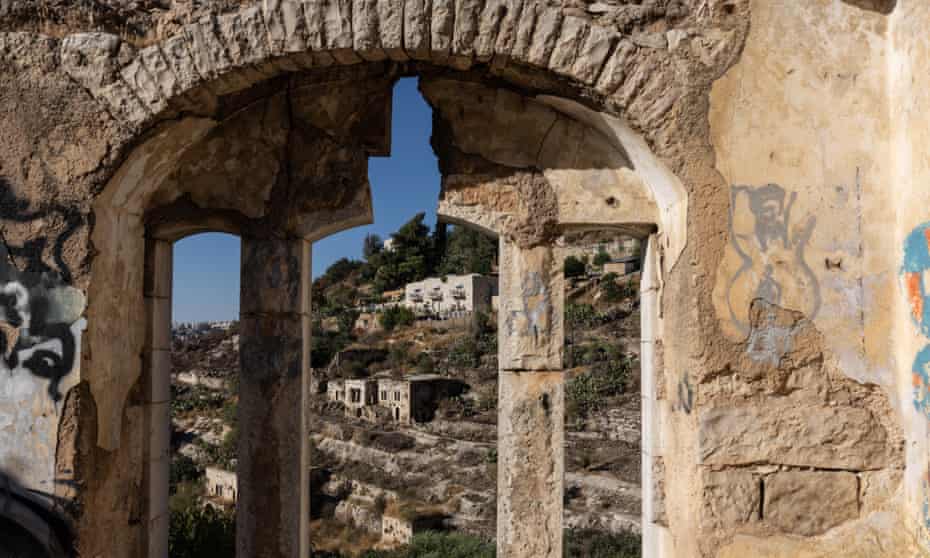
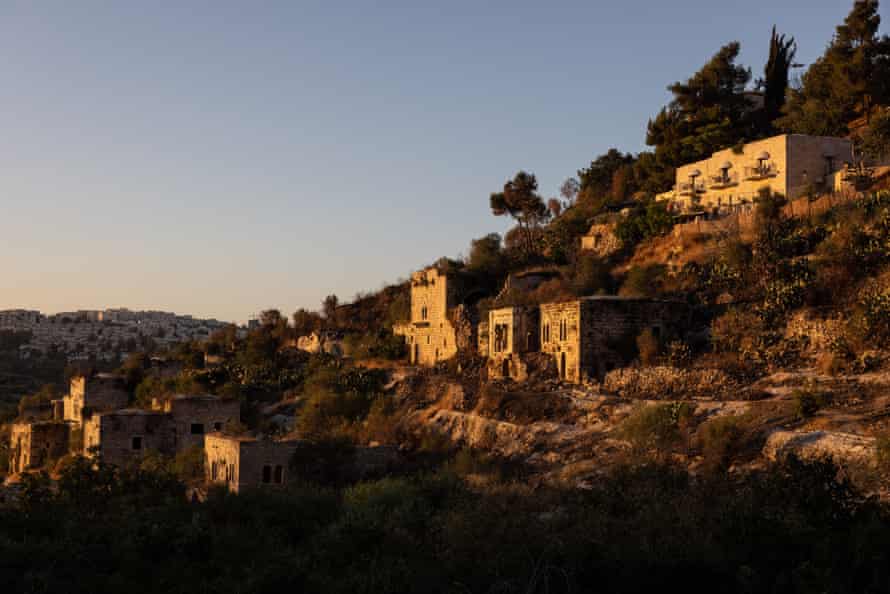
The ancient Palestinian village of Lifta sits on a quiet hillside minutes from Jerusalem’s bustling modern centre. Abandoned when its residents fled during the 1948 war, it has been left unchanged – frozen in time – ever since.

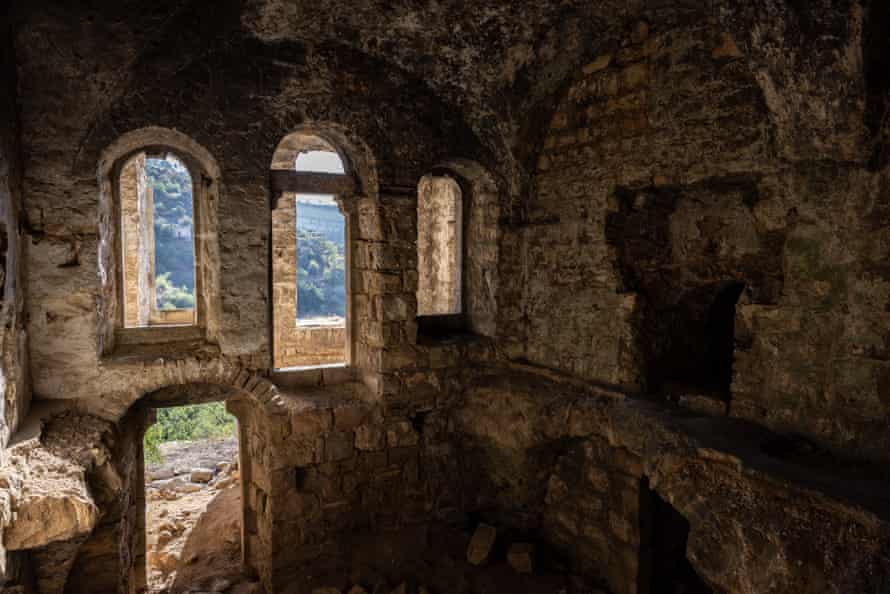
Today, however, its overgrown domed stone houses with arched windows, built during the early Ottoman Empire and resting on even older ruins dating back to the Iron Age, are at risk of being demolished to make way for a luxurious resort of villas, hotels and shops.

Lifta was abandoned when its residents fled during the 1948 war. Photograph: Stefanie Glinski/The Guardian

In a joint Israeli-Palestinian initiative, activists are bracing for a legal battle to try to save the village, which stands as a reminder of the 1948 expulsions of Palestinians from West Jerusalem.

Israel’s land authority announced in May that it planned to issue a tender for Lifta’s redevelopment and bidding is expected to open on Thursday.

A court prevented a similar initiative in 2012, when it ruled that a detailed survey of the site’s history and archaeology must take place before any potential construction work could start.

Plans for the tender were released on Jerusalem Day, a holiday commemorating the establishment of Israeli control over the Old City. Many Palestinians, who believe any new development would erase the area’s history, saw the move as political, and Lifta quickly became a flashpoint.

One of the 77 buildings still standing in Lifta after the destruction of more than 200. Photograph: Stefanie Glinski/The Guardia

Currently on Unesco’s tentative list, meaning it could become a world heritage site, the fate of the village has even divided Israeli authorities, because it has long been a place of escape for thousands of Jerusalem residents.

“We weren’t informed about the publication of this tender and didn’t approve it. The mayor of Jerusalem asked all the relevant authorities to reconsider the construction plan,” a Jerusalem municipality spokesperson said.

The land authority said it had published tenders for housing, employment and tourism “in accordance with the availability of land and the statutory approval of the plans”. Though unusual, it is legally able to proceed with the tender without the municipality’s approval.

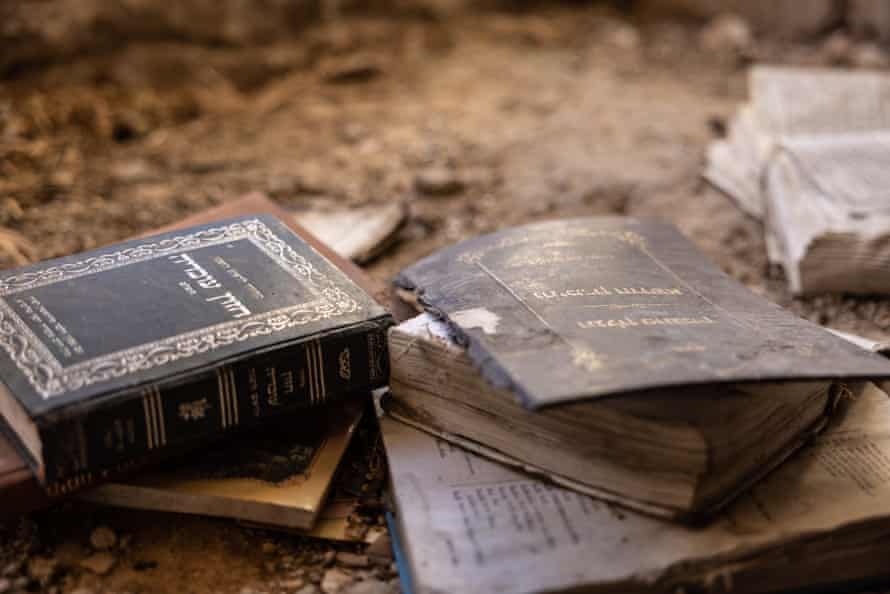
Religious books scattered on the floor in one of Lifta’s houses. Former residents say people have previously gathered there for religious studies. Photograph: Stefanie Glinski/The Guardian

As part of its push for development, the land authority commissioned the antiquities authority, an independent government body, to carry out a full survey of the area. The survey was completed in 2016 but was not publicly released until this May.

“On that survey, you can’t develop Lifta,” said the Palestinian-British architect Antoine Raffoul. “The village’s natural spring is even mentioned in the Bible and a settlement existed in the area as early as the Iron Age. It has developed over thousands of years and deserves preservation. This is a cultural war we’re fighting.”

People living in Jerusalem have described Lifta as an open-air museum, with 77 buildings still standing.
Advertisement


At its height, it was home to more than 2,500 people, had orchards, several olive presses, two coffee houses, a mosque and a winepress.

More than 200 buildings have been destroyed since 1948. Most of those who lived there fled to neighbouring Jordan or other Palestinian cities in the West Bank.
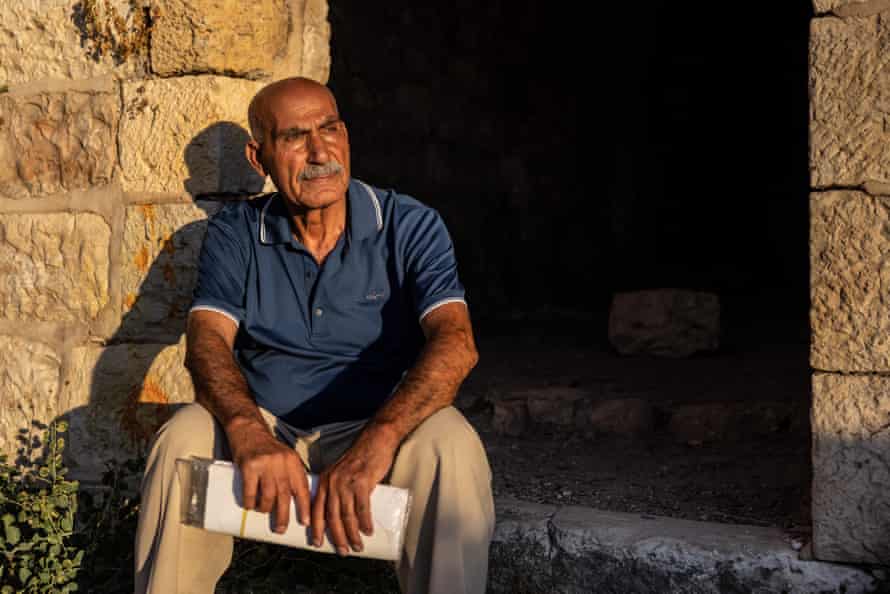
Yacoub Odeh, an 81-year-old who grew up in Lifta, sits outside what was once the village’s mosque. Photograph: Stefanie Glinski/The Guardian

“Villagers used to gather near the spring in the evenings, telling stories, drinking coffee, even dancing together. We shared happiness and, when one of the villagers died, we also shared sadness. The village was alive,” said Yacoub Odeh, an 81-year-old former resident who was born in Lifta.

“This is painful for me. When we were evicted, people scattered in all directions. We lost track of each other, of our community,” he said as he stood quietly near the ruins of what was once his family home.

Odeh, who lives in a suburb of Jerusalem, said he hoped his village might be turned into a heritage site instead. He visits several times a week, driving up the hill in his battered car.

Daphna Golan-Agnon, a Hebrew University human rights professor and Lifta activist, said the antiquities authority’s survey – which has taken archaeology, history, architecture, wildlife and ecology into account – showed clearly that Lifta can be preserved.

“It’s amazing that after more than 70 years of abandonment, the village is still standing so beautifully, even with many of the houses’ roofs destroyed. We ask for the buildings to be stabilised and are willing to help fundraise if cost is an issue.”

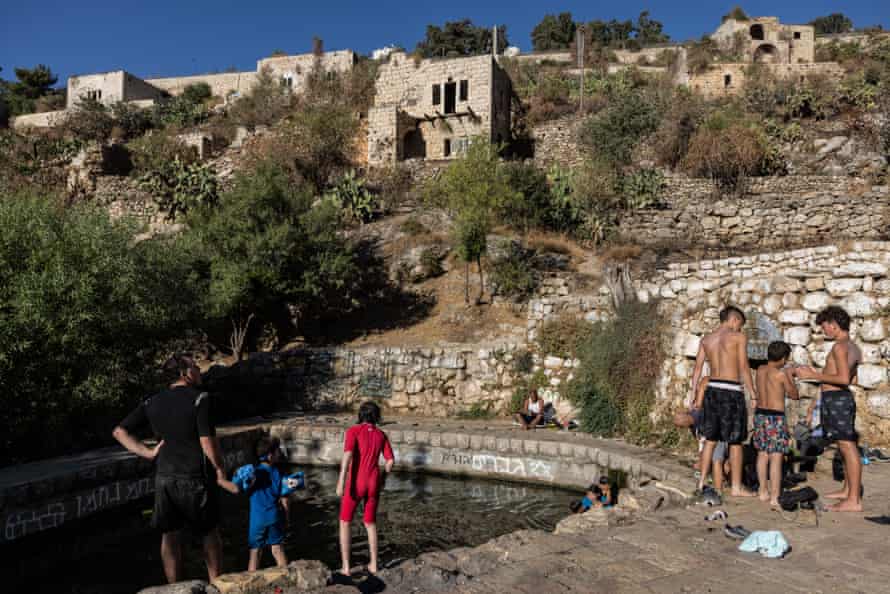
Children swim in Lifta’s spring. Photograph: Stefanie Glinski/The Guardian

Today, the ancient site is mostly used as a recreational park by Jews and Palestinians alike, with children swimming in the pool of the spring, older women picking cactus fruit and teenagers smoking cigarettes in the shade of trees.

Tamar Maor, 92, was one of the village’s few Jewish residents in 1948. She describes the relationships between “the Arab families” and her own as “excellent”.

“I remember the day we left,” she said. “Three or four men in khaki knocked on our door and told my mother we had to leave. They also knocked on our Arab neighbour’s door. We cried and hugged and cried more, but promised each other we’d return. We all left the next day.”

Maor’s family went back temporarily but found most houses damaged, their Arab friends gone and their village no longer liveable.

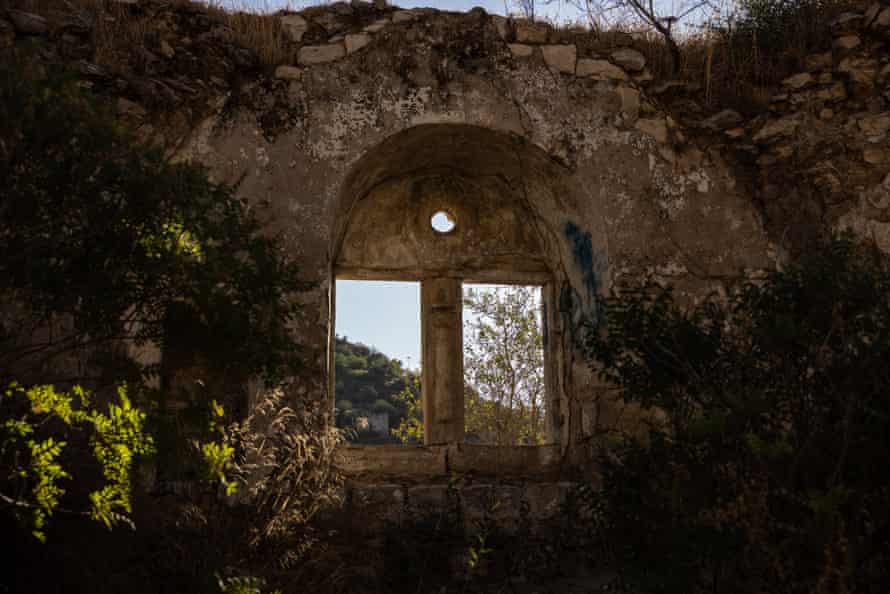
Lifta is known for its domed stone houses with arched windows, built during the early Ottoman empire. Photograph: Stefanie Glinski/The Guardian

Decades later, and shortly before the tender’s release, many of Lifta’s houses have a small Palestinian flag painted inside their doorframes and a single statement, or wish, inscribed below in Arabic: “We will return.”


Here in Jerusalem, we Palestinians are still fighting for our homes


The world has looked away, but in Sheikh Jarrah the effort to dispossess us has not slowed down
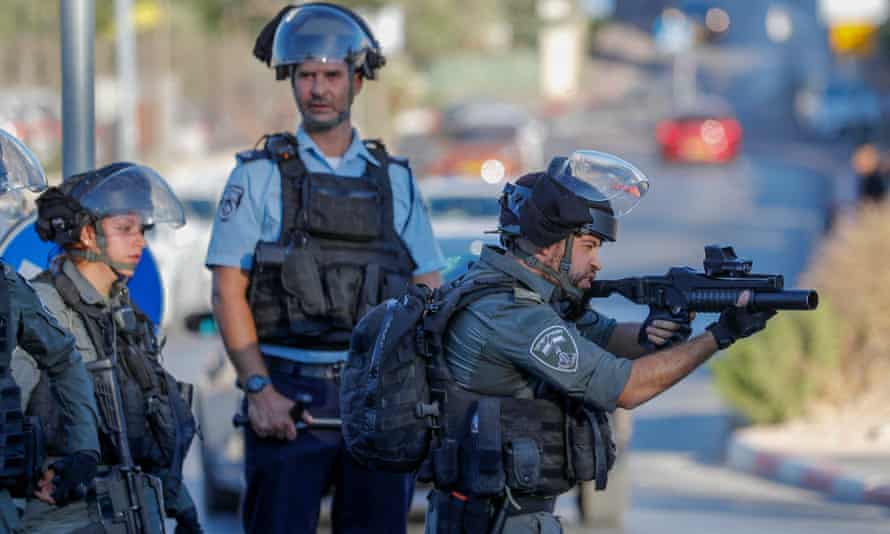
A member of Israeli security forces aims a stun grenade gun at (PEACEFUL)Palestinian protesters in the Sheikh Jarrah neighbourhood of East Jerusalem on 17 July. 
Photograph: Ahmad Gharabli/AFP/Getty Images


OPINION
THE GUARDIAN
Wed 28 Jul 2021 

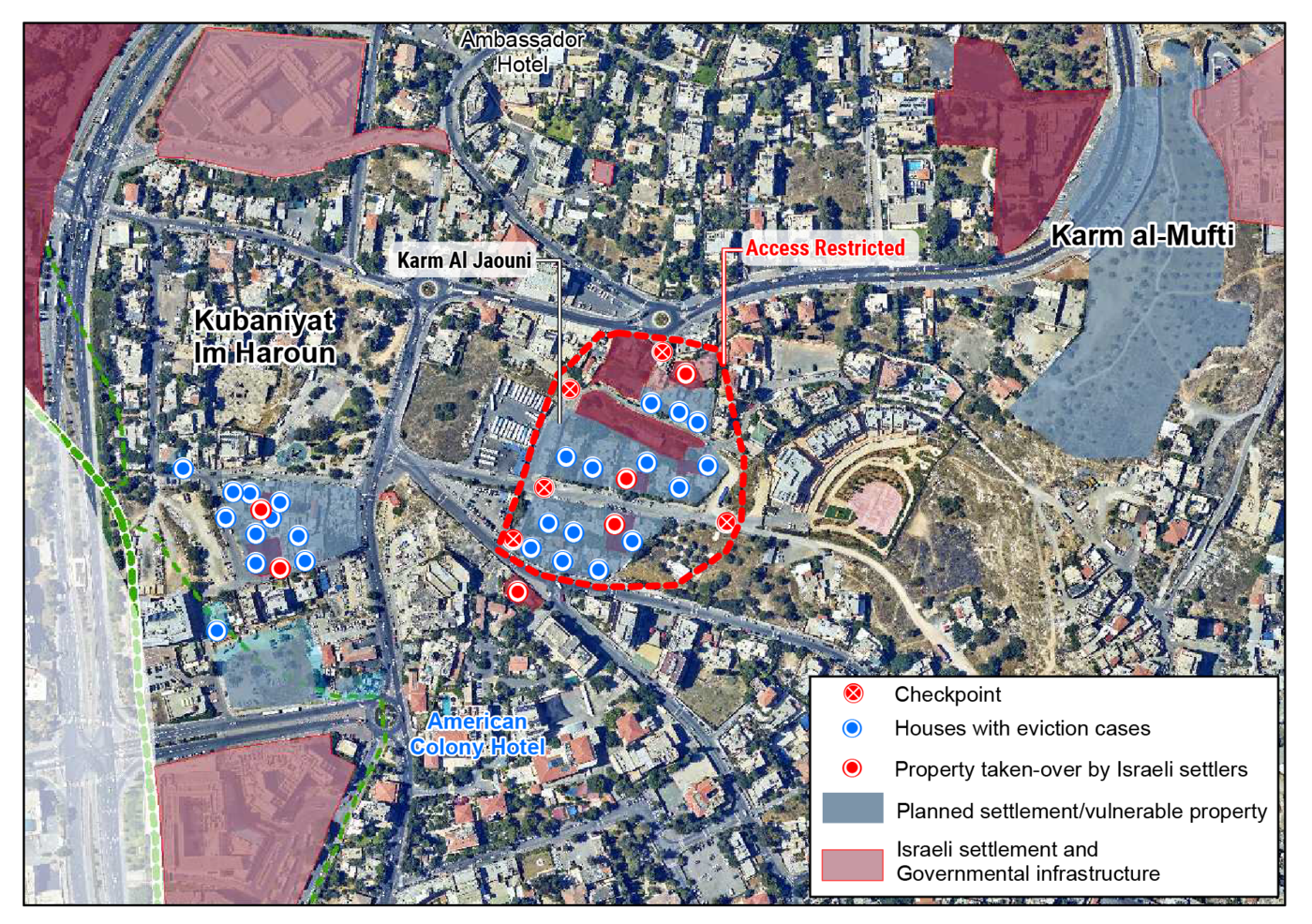
A few months ago, the world’s attention was on Sheikh Jarrah, my neighbourhood in occupied Jerusalem. For decades, Israeli settlers, backed by their state, have been trying to displace us from our homes and colonise our neighbourhood. The UN called these forcible expulsions a war crime. I call this theft – because it is.


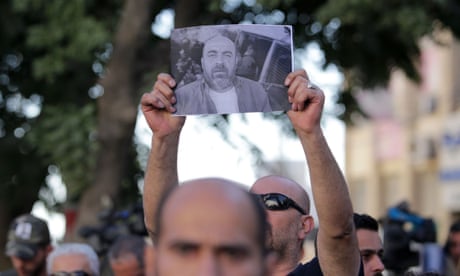
Palestinians protest for fifth day in West Bank after death of activist

In May, our efforts to resist this takeover received a surge of solidarity from Palestinians across Jerusalem and further afield, in what became known as the Unity Uprising. Palestinians were subjected to Israeli violence across the eastern part of Jerusalem – not only in Sheikh Jarrah, but outside the Damascus gate (itself a focus of protests), and in and around the al-Aqsa mosque – which escalated into attacks on besieged Gaza. Palestinians mobilised and resisted, and around the world people demonstrated in support of the Palestinian right to liberation and decolonisation. But after the ceasefire, the world’s attention has moved away. The reality for Palestinians, however, has not changed

In Sheikh Jarrah, the effort to dispossess us has not slowed down. Our neighbourhood has been under a blockade for three months, maintained by Israeli forces, with continuing restrictions intended to suffocate the lives of the hundreds of Palestinians who live here. And yet, meanwhile, armed Jewish settlers, who have already occupied some of our homes, roam freely on the streets. On any given night, a dozen gun-wielding fanatics patrol my street with arrogant impunity. They are protected – even supported – by the troops blockading our community.

For those of us living in Sheikh Jarrah, the evidence of this partnership between settlers and the state is abundant and overwhelming. Consider the events of two days last month. On 21 June, Israeli police came into the neighbourhood after a settler pepper-sprayed four schoolgirls on the street. But when they arrived, the officers ignored the girls and arrested two Palestinian boys. Of course, they did not arrest the settler – but they did threaten to arrest my brother for filming the detention of the two boys.

Later the same day, dozens of armed settlers gathered in a home that was seized in 2009 from the Ghawi family, sparking a night of violence that once again saw militarised police joining in attacks on Palestinian residents of Sheikh Jarrah. At one end of Othman Bin Affan street, Israeli occupation forces beat Palestinians with batons; at the other end, settlers threw rocks and chased protesting teenagers with pepper spray. Journalists who arrived on the scene were also targeted. Some young Palestinians attempted to disrupt this repression, launching fireworks at settlers. Before the end of the night, a number of Palestinian homes – including ours – were invaded by Israeli forces.

The next morning, as I collected about 10 stun grenade fragments from the street, my neighbour stopped me to show me dozens more spent munitions. His children had displayed them on their outdoor table, like a collection of macabre souvenirs. The same day, a member of the Israeli Knesset, Bezalel Smotrich, barged into my family’s house, along with Tzahi Mamo, the director of Nahalat Shimon International – a private company, registered in the US, that is working to seize our neighbourhood and cleanse it of Palestinians. Nahalat Shimon International files lawsuits relying on racist Israeli legislation, fabricated documents and settler judges to expel Palestinians from their homes and hand over the properties to settlers. When lawmakers show up on my doorstep to call for me to be stripped of my home, what Palestinians have been saying for decades is confirmed: the settlers and the state mirror one another.

I am tired of reporting the same brutality every day, of thinking of new ways to describe the obvious. The situation in Sheikh Jarrah is not hard to understand: it is a perfect illustration of settler colonialism, a microcosm of the reality for Palestinians across 73 years of Zionist rule. This vocabulary is not theoretical. It is evident in the attempts to throw us out of our homes so that settlers can occupy them – with the backing of the regime, whose forces and policies provide violent support for the transfer of one population to install another.

I do not care whom this terminology offends. Colonial is the correct way of referring to a state whose forces collude in the violence of settlers; whose government works with settler organisations; whose judicial system uses expansionist laws to claim our homes; whose nation-state law enshrines “Jewish settlement” as a “national value … to encourage and promote”. The appetite for Palestinian lands – without Palestinians – has not abated for over seven decades. I know because I live it.

On 2 August, the Israeli supreme court, whose jurisdiction over the eastern part of Jerusalem defies international law, is set to decide whether it will allow the appeal of my family and three others – a last legal obstacle before we can be expelled. There have been postponements before. Palestinians are accustomed to this kind of stalling; it tests our stamina. But we are as stubborn as anyone else faced with the prospect of losing their home – their life, their memories – to those using force, intimidation and biased laws.

In the face of this cruelty, and despite teargas and skunk water, we are resisting. We cannot allow them to steal our homes once more, and we refuse to continue living in refugee camps while colonisers live in our houses. We cannot let them throw more of us on to the streets. We are tired of being turned into a refugee population, neighbourhood after neighbourhood, one home at a time.

I have no faith in the Israeli judicial system; it is a part of the settler-colonial state, built by settlers for settlers. Nor do I expect any of the international governments who have been deeply complicit in Israel’s colonial enterprise to intervene on our behalf. But I do have faith in those people around the world who protest and pressure their governments to end what is essentially unconditional support for Israeli policies.

Impunity and war crimes will not be stopped by statements of condemnation and raised eyebrows. We Palestinians have repeatedly articulated what kind of transformative political measures must be taken – such as civil society boycotts and state-level sanctions. The problem is not ignorance, it is inaction.

Mohammed El-Kurd is a Palestinian writer and poet from Jerusalem
VW’s dilemma in Xinjiang shows how the west is headed for an ethical car crash

Europe and the US are economically dependent on China now – and ‘change through trade’ is no longer on the cards


‘Volkswagen has got itself stuck between the rock of Xi Jinping and the hard place of an increasingly outraged western public opinion.’ The Volkswagen production line in Urumqi, China, in 2013. Photograph: VCG/Getty Images

THE GUARDIAN
Wed 28 Jul 2021 

On YouTube, you can watch a video clip of Volkswagen’s chief executive, Herbert Diess, denying that he knows what’s going on in Xinjiang. When the BBC correspondent helpfully spells it out – so-called reeducation camps for one million Uyghurs – Diess says: “I’m not aware of that.” Either he was being culpably ignorant about a region where Volkswagen has a factory, or he was lying.

This was in the spring of 2019, and a company spokesperson soon declared that Diess was “of course aware” of the situation in Xinjiang. The case is particularly sensitive because Volkswagen was originally set up by the Nazis, and its use of forced labour during the Third Reich has been scrupulously documented by German historians.
Advertisement

It is interesting to compare Diess’s response with a statement made earlier this year, by the president of the Board of Deputies of British Jews, to coincide with Holocaust Memorial Day. “As a community, we are always extremely reluctant to consider comparisons with the Holocaust,” Marie van der Zyl wrote in a letter to the British prime minister. But, she went on, there are similarities between what is reported to be happening in China and what happened in Nazi Germany in the 1930s and 1940s. The violations of the human rights of the Uyghurs are “shaping up to be the most serious outrage of our time”, said Van der Zyl.

Volkswagen is significant in another way, too. It is an example of a western company that has become so dependent on the Chinese market that it can hardly do without it. China accounts for more than 40% of Volkswagen’s global car sales. Whatever the exact calculations that led Volkswagen to open its relatively small plant in Xinjiang in 2013, it seems clear that to close it down now would negatively impact its whole relationship with the Chinese regime, on which its business in the country depends. The company has got itself stuck between the rock of Xi Jinping and the hard place of an increasingly outraged western public opinion. The result could be a moral car crash.

Behind this leading western company that is too dependent on China is a leading western country that is at risk of becoming too dependent on China. Under Angela Merkel, China has risen to be Germany’s largest single trading partner. Her likely successor, Armin Laschet, the Christian Democratic Union candidate for chancellor, currently heads a federal state, North Rhine-Westphalia, which has a large stake in economic relations with the east Asian dictatorship. Every week, many giant container trains pull into the city of Duisburg, which is often billed as the western land terminus of Beijing’s belt and road initiative. Despite pressure on Berlin from the Biden administration in Washington, everything Laschet has said so far in the German election campaign suggests the continuation of a soft, business-first China policy. Without a change in Germany’s policy, there will be no coherent European China policy.

To be clear: this is not just about Germany. Coca-Cola also has a factory in Xinjiang. Wall Street firms are piling into Chinese markets wherever they can. British bankers, lawyers and estate agents have for years been falling over themselves to service Russian oligarchs, Chinese apparatchiks and Central Asian tyrants. France would love a larger slice of the action.

In the original cold war, the west was never economically dependent on the east (then meaning the Soviet bloc). On the contrary, in the later years of the east-west conflict, several east European states became heavily indebted to the west. That hastened their downfall. In this new cold war – or hot peace, if you would rather – the west is already economically dependent on the east (now meaning China). In the 2000s, it was still just possible to believe in the possibility of Wandel durch Handel (change through trade). But when the German economics minister, Peter Altmaier, said last year: “I still believe that change can be achieved through trade,” it sounded like the platitude of a bygone era. In the past decade, China has done more trade, become more repressive and exercised more leverage over the west. So who has changed whom?

Although it is a dangerous illusion to believe that economic interdependence necessarily prevents international conflict, we certainly do not want a world of competitive autarkies. Western democracies do, however, need to ensure that they are not strategically dependent on China. We had a taste of such dependency in the early months of the Covid pandemic, when we discovered just how much of our personal protection equipment came from China. If Huawei were to dominate our 5G networks, that would be a deep strategic vulnerability.

Western businesses must also accept the ultimate primacy of politics in a democracy. In the German Ostpolitik of the 1970s and 1980s, German trade and investment in the Soviet bloc served the country’s larger foreign policy goals. In Germany’s recent China policy, by contrast, the commercial tail has wagged the political dog.

As individual investors and consumers, we should include a broader concern about violations of human rights in ESG (environmental, social and governance) criteria for assessing companies. The German parliament recently passed an admirable supply chain act, which requires German companies to monitor human rights standards wherever they produce. It will be fascinating to see how Volkswagen responds.

Last year, the chief executive of Volkswagen Group China, Stephan Wöllenstein, said he was aware of the “allegations” in relation to Xinjiang (what a great leap forward in executive knowledge!), but that no forced labour is used in their factory or its local supply chains. Diess repeated this assertion in an interview earlier this year, claiming: “Neither we nor our suppliers employ forced labourers.”

As it happens, I drive a Volkswagen. It’s a perfectly good car, but I need to change it soon for one with a climate-friendly electric engine, and there are plenty of other good makes. I am realistic. I don’t expect the boss of Volkswagen to speak out like some fiery human rights advocate. In Europe, jobs, prosperity and the sustainability of our social model depend on those earnings from abroad.

But the next time a Volkswagen executive is asked about the Chinese camps by one of those troublesome journalists, he or she could at least say something like this: “As a citizen, I am deeply concerned whenever I hear credible reports of human rights violations in areas where we do business. I hope our government, and all democratic governments, will continue to speak up in defence of human rights everywhere. As a company, especially having in mind the early history of Volkswagen, our specific duty is to ensure that no violations of human rights are to be found in our supply chain.” And then a group of reporters experienced in Chinese affairs should be invited to visit the Volkswagen factory in Xinjiang, talk to its employees and look in detail at its supply chain. History and conscience demand nothing less.


Timothy Garton Ash is a Guardian columnist
Another roaring 20s? We need to do better than that

When the pandemic wanes, bold ideas and big investment could create a new economic miracle for the 21st century

Illustration by Sébastien Thibault
Wed 28 Jul 2021

Dan Davies

Economic history isn’t like normal history – it doesn’t repeat itself as farce and it doesn’t rhyme. Technology moves on, political and legal systems develop, debtors turn into creditors and vice versa. But some economic structures remain stubbornly the same. As Karl Marx said, we make our own history, but not in circumstances of our own choosing. Using the past to guide decisions in the present requires understanding what has endured and what has changed, and taking a sober view of our history – not simply replicating the supposed golden ages of the past.

For that reason, we shouldn’t aim to repeat the “roaring 20s” just because the decade starts with a two and we’re (hopefully) coming to the end of a pandemic similar to the Spanish flu. Despite the name, the roaring 20s were not all that great for most of the population. Growth was sluggish and the falling prices of consumer goods concealed widening inequality by making everyone feel rich, much like the decade preceding the 2008 financial crisis. In the 20th century as in the 21st, a period of growth ended in a financial crash, a lost decade, the rise of rightwing populism and leading countries turning their back on trading blocs.

But here the historical comparison quickly runs out of road; this time round, we haven’t recently survived a major European war, and we don’t appear to be headed for another. If we are to understand the present, let alone think about the future, we have to start asking not what our current position has in common with cycles of the past, but what’s completely unprecedented.

Take interest rates, which have rarely been so low. The “Treasury view” – that increasing government borrowing necessarily makes interest rates rise – is in tatters thanks to the pandemic. The old arguments of the austerity period have been discredited; the usual suspects still try to push them, but voters aren’t convinced.

The truth is that, over the course of the pandemic, we have done all the things with government spending that everyone had warned against, and the sky hasn’t fallen in. The Biden administration seems to have understood this; it’s on the verge of passing a $3.5tn (£2.5tn) spending package on infrastructure, healthcare and social security. Not that I’m so naive as to believe that our Treasury will change its thinking – finance ministries always see it as their role to rein in spending departments. But they just aren’t as influential as they used to be on policy. Now that every leading industrial country has had to run record deficits and finance them with quantitative easing, the genie is out of the bottle.

The fear of interest rate rises has hobbled our ability to think through the problems we face. One of the great intellectual tragedies of our time is that we cannot understand and confront the vast inequalities that have come to define Anglosphere politics without dissecting the role of housing wealth, and we cannot make sense of house prices without understanding how they’re affected by interest rates. Seemingly nobody in charge understands both.

What’s at stake in the inflation debate?
Mark Weisbrot


The relationship between house prices and interest rates is almost insultingly trivial when you get it. If the tenant in a house pays £20,000 a year in rent, and the house costs £1m, then from the landlord’s point of view, the house is like a savings bond paying 2%. While the interest rate on savings is 0.5%, the landlord is happy – in fact, he might buy more million-pound houses if he can. But if rates go up by even 2-3%, the house becomes a worse deal than the bond. As a consequence, landlords would probably sell their houses, driving the price down until some sort of stable relationship is established. Instead, house prices have soared to 30% above their peak before the 2008 financial crisis.

What does this mean for politics? In my view, everything. It means that the housing wealth of the boomer generation is to a very great extent leprechaun’s gold. They can’t sell it at anywhere near the current price – there aren’t enough buyers – and even a small normalisation of the economic cycle would cause it to disappear. Their interest in the profitability of houses as an asset class makes sense when set against the spiralling cost of care in later life. But this fear cannot justify the harm it causes to generation rent.

In fact, if we are determined to navigate the present with help from the past, perhaps we should return not to the 1920s, but the period known in France as the trente glorieuses and in Germany as the Wirtschaftswunder (economic miracle) – the post-1945 flourishing that rebuilt the continent. During those years, people were asking a question that remains relevant today: if we could spend all that money on a war – or in our case a pandemic – why not invest to make society flourish? The last time policy was made on that basis, Europe enjoyed an economic miracle.

The opportunity facing us shouldn’t be underestimated. If there is even a chance of opening up political space required to bring back full employment as a goal, and to regard rising wages as a sign of success rather than an ominous sign, then it should be grabbed with both hands. As the saying goes, whatever your favourite social policy might be, full employment is probably the best way to achieve it. And if, over time, that means that we get modest inflation and interest rates begin to rise, what of it?

The Canadian-American economist John Kenneth Galbraith said: “All of the great leaders have had one characteristic in common: it was the willingness to confront unequivocally the major anxiety of their people in their time.” For more than a decade now, the developed world has seen the growing wealth and security of older people set against the stagnation and increasing precarity of the younger generation. Politicians of the left have done well to the extent that they have confronted this trend, and badly to the extent that they have avoided it. As we make our start in the 2020s, delayed by two years of isolation, the challenge is still to face up to the great anxieties of our time with the optimism of the postwar economic miracle, not the outdated tools of the “roaring 20s”. Only then will we ensure prosperity for all.


Dan Davies is an investment banking analyst


Hey, that’s mine: naked man’s wild boar chase immortalised in plastic

Photographer unhappy about model railway version of viral picture she took at Berlin lakeside

The original image of the naked man in pursuit of a wild boar that had snatched his laptop, and the ‘action set’ of the scene. Composite: AFP, Busch


 in Berlin


A woman whose photograph of a naked man in pursuit of a wild boar at a Berlin lakeside went viral has said she might take legal action against a company that has immortalised the spectacle for model railway enthusiasts.

Adele Landauer, an actor and charisma coach, told German media she resented the fact that others were making money from her snapshot, which went around the world last August.

The drama she captured played out after a wild boar, nicknamed Elsa by bathers, stole the man’s laptop in a bag that she was likely to have believed contained food. It has now been adapted into a plastic figurine set costing €13.99 (£11.90) and being sold by a model railway company as an embellishment for the landscape of a model railway set.

According to the manufacturer’s description, the so-called action set of a “naked man pursuing a wild boar who has stolen his bag – after a true event at the Berlin Teufelssee – including two air mattresses” – can contribute to the “realistic revival” of a model railway world. Missing from the set are the two piglets who followed their mother as she charged into a nearby wooded area, as well as the onlookers in various states of dress who watched the chase with startled glee.

Landauer told the tabloid Bild: “I had a huge amount of work due to that picture, but financially I got nothing from it. I don’t like the fact that others are now earning money from it without asking me.”

A spokesperson for Busch, the company behind the action set, has said “sales are going well”.

At the time the picture went viral, Landauer said that the man in question had given his permission for her to post the image on social media. His identity has never been made public, so it is unclear what he makes of his latest depiction.

Authorities’ subsequent announcement they would hunt the wild boar down triggered a protest by animal rights activists.

But almost a year on, it appears that Elsa is no more. Almost 2,000 wild boar in and around Berlin have been slaughtered amid attempts to stop the spread of African swine fever, and Elsa is believed to be among them.
Arrested Biafra separatist’s family accuse Raab of ‘unlawful failure’

Exclusive: Nnamdi Kanu’s relatives threaten judicial review against UK foreign secretary, saying his life is at risk in Nigeria


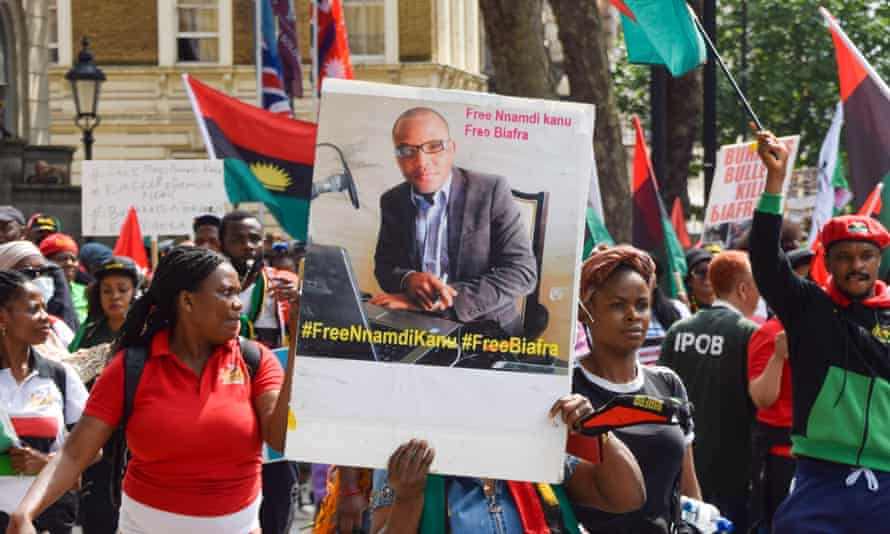
A demonstrator holds a picture of Nnamdi Kanu outside Downing Street during a recent Free Biafra protest calling for his release.
Photograph: Vuk Valcic/Sopa Images/Rex/Shutterstock


Haroon Siddique 
Legal affairs correspondent
THE GUARDIAN
Wed 28 Jul 2021

The family of a British national said to have been arrested in Kenya and taken to Nigeria in an act of extraordinary rendition has accused the UK government of abandoning him to illegal detention and risk of torture.

Nnamdi Kanu, the leader of the Indigenous People of Biafra (Ipob) – a prominent separatist movement proscribed in Nigeria – fled the country in 2017 while on bail after soldiers attacked his family home in Abia.

Last month, Nigeria’s attorney general said Kanu, a father of two, had been extradited to the country’s capital city, Abuja, with assistance from Interpol. Kanu entered Kenya this year on his British passport, on a visa expiring in June.


His wife, Uchechi Okwu-Kanu, and brother, Kingsley Kanu, are threatening judicial review against the foreign secretary, Dominic Raab, over an alleged “unlawful failure” to provide consular assistance. Although the government has requested access to Kanu, his family said it must act with urgency, claiming his life is at risk.

His wife said: “Until they have access to my husband and are able to talk to him, the FCDO [Foreign, Commonwealth and Development Office] is not doing enough. My husband was abducted in Nairobi on 18 June, he re-emerged on 29 June in Abuja – for 10 days he was disappeared. He is the victim of extraordinary rendition; he is detained in the state security services building, as far as we know, he is held incommunicado.

“His application to be transferred to a regular prison has been denied; everything about my husband’s incarceration screams torture. My husband is British, his children are British. The foreign secretary should be on the phone to his counterpart in Nigeria and refuse to get off the call until the Nigerian government grants the British high commission immediate access to my husband. If that fails, Boris Johnson needs to call President Buhari.”

She said her last contact with her husband was on 18 June, when her five-year-old son sent him a Father’s Day card, and Kanu said he would call after some meetings but never did. “He’s upset that he hasn’t heard from his dad and he does not understand,” she said of their youngest son.

In 2015, Kanu was arrested in Nigeria and charged with terrorism offences and incitement, after airing broadcasts on a digital radio station, Radio Biafra, which he founded at his home in London. He was released on bail in 2017 and fled the country after an attack on his family home, which he claimed killed 28 members of Ipob.

His wife said his only “so-called crime” is to demand a referendum on Biafran self-determination. “Only the British government can prevent him from being subjected to further harm,” she said. “My family’s future happiness rests with Dominic Raab. He can end all of this in an instant. He can stop my nightmare.”

Supporters of Kanu were arrested outside the Abuja high court on Monday. A judicial review pre-action letter, prepared by lawyers at Bindmans LLP, said the Ipob leader formerly held Nigerian citizenship but renounced it in 2015 and in response his Nigerian passport was taken away from him.

The letter said Kanu told his Nigerian lawyers that he was tortured by the Kenyan authorities prior to his transfer to Nigeria, adding: “There are ongoing concerns that he is currently being tortured in detention in Nigeria. Similar actions by the Nigerian authorities against pro-Biafra activists have been widely reported and condemned by international human rights NGOs as well as the United Nations.”
Advertisement

His family also said he is being denied treatment for a heart condition.

Buried for 50 years: Britain’s shameful role in the Biafran war
Frederick Forsyth


His brother Kingsley accused Britain of being affected by its “mistakes” during the 1967-70 Biafran war when it covertly armed the Nigerian military dictatorship and millions died after an attempted secession.

“That is the real issue,” he said. “Nnamdi Kanu is a symbol of self-determination, Nnamdi is the face of Biafra.”

Both Nigerian and Kenyan authorities have denied that Kenya was involved in the arrest. However, NGOs have implicated Kenya in extraordinary renditions and enforced disappearances in the past.

An FCDO spokesperson said: “We are in contact with the Nigerian authorities after the detention of a British national.

“We have requested consular access as soon as possible and remain in contact with the family and legal representatives.”
BECAUSE OF COURSE SHE DID
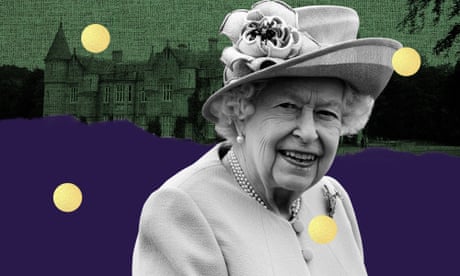
Queen secretly lobbied Scottish ministers for climate law exemption

Monarch used secretive procedure to become only person in country not bound by a green energy rule

The documents disclose how the Queen used her special access to Scottish legislation to intervene in the parliamentary process as recently as February. 
Composite: Guardian/PA/Rex/ShutterstockRob Evans, Severin Carrell and David Pegg

Wed 28 Jul 2021

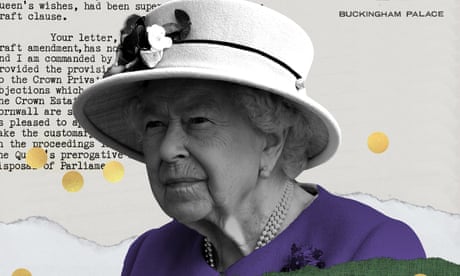
The Queen’s lawyers secretly lobbied Scottish ministers to change a draft law to exempt her private land from a major initiative to cut carbon emissions, documents reveal.

The exemption means the Queen, one of the largest landowners in Scotland, is the only person in the country not required to facilitate the construction of pipelines to heat buildings using renewable energy.

Her lawyers secured the dispensation from Scotland’s government five months ago by exploiting an obscure parliamentary procedure known as Queen’s consent, which gives the monarch advance sight of legislation.


Revealed: Queen vetted 67 laws before Scottish parliament could pass them


The arcane parliamentary mechanism has been borrowed from Westminster, where it has existed as a custom since the 1700s.

In a series of reports into Queen’s consent in recent months, the Guardian revealed how the Queen repeatedly used her privileged access to draft laws to lobby ministers to change UK legislation to benefit her private interests or reflect her opinions between the late 1960s and the 1980s.

The new documents, uncovered by Lily Humphreys, a researcher for the Scottish Liberal Democrats using freedom of information laws, disclose how the monarch used her special access to Scottish legislation to intervene in the parliamentary process as recently as February.

The documents also suggest Nicola Sturgeon’s government failed to disclose the monarch’s lobbying this year when a Scottish politician used a parliamentary debate to query why the Queen was securing an exemption from the green energy bill

The move appears at odds with the royal family’s public commitment to tackling the climate crisis, with Prince William recently joining his father, Charles, in campaigning to cut emissions and protect the planet

Sturgeon’s government heralded the bill as a key piece of legislation to combat the climate emergency. It said the law, known as the heat networks bill, would help cut emissions, reduce fuel poverty and create green jobs.

The legislation enabled the construction of pipelines to heat clusters of homes and businesses using renewable energy, rather than from separate fossil fuel boilers.

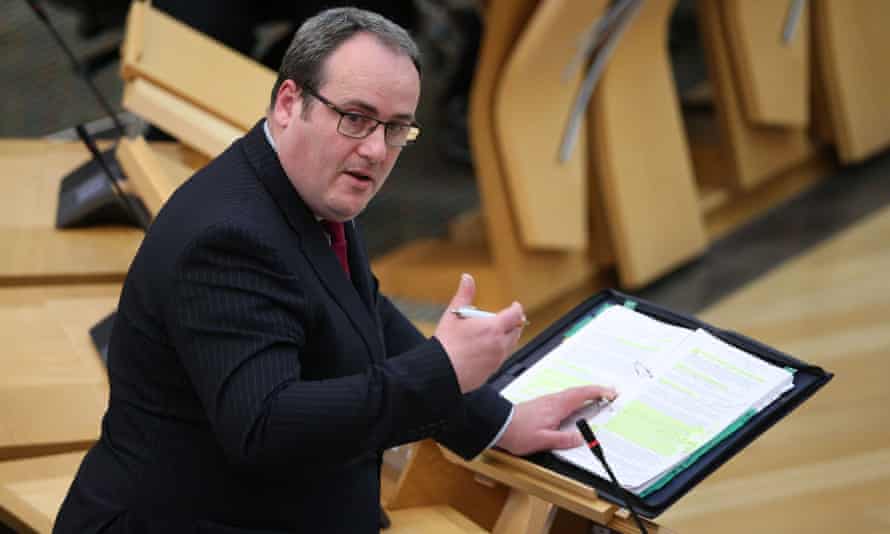
On 12 January, John Somers, Sturgeon’s principal private secretary, wrote to Sir Edward Young, the Queen’s most senior aide, asking for her consent to the heat networks bill. In his letter, Somers said it would allow companies and public authorities to compulsorily buy land from landowners.

On 3 February, officials working for Paul Wheelhouse, the then energy minister, recorded that the Queen’s lawyers raised concerns about the bill. They also recorded he had agreed to alter the bill, noting the “minister agreed to proposed amendment that would addressed [sic] concerns from Queen’s solicitors”. This had been done in relation to the Queen’s consent process.

On 17 February, a courtier told the Scottish government the Queen had given her consent to allow the bill to be passed
.
Scotland’s then energy minister, Paul Wheelhouse, put forward an amendment as part of the Queen’s consent process. Photograph: Andrew MacColl/Rex/Shutterstock


Five days later, when MSPs debated the bill, Wheelhouse put forward an amendment that applied only to land privately owned by the Queen. It specifically prevents companies and public authorities from compelling the Queen to sell pieces of her land to enable the green energy pipelines to be built.

Buckingham Palace says Queen’s consent, a process requiring ministers to notify lawyers when a proposed bill might affect her public powers or private interests, is a “purely formal” part of the parliamentary process.

However, there are increasing examples where the Queen has taken advantage of her consent privileges to require changes before she formally consents to the law proceeding through parliament. That appears to have occurred on this occasion in Scotland, where the procedure – known as crown consent – operates in the same way.

During the debate over the parliamentary bill, Andy Wightman, then an independent MSP, objected to the amendment, arguing it was wrong to single out the Queen for preferential treatment.

Wheelhouse responded that the amendment was “required to ensure the smooth passage of the bill”. However, he did not disclose that the Queen’s lawyers had lobbied for the change. The amendment was passed with Wightman and a handful of other MSPs opposing it.

After being informed about the new documents, Wightman said he was “shocked to discover that the amendment was put in place in order to secure Queen’s consent. That should have been stated in the debate.

“If changes are being requested in order to secure Queen’s consent, people should be told about that and it appears in this case we were not told.”

Unlike the better-known procedure of royal assent, a formality that brings a bill into law, Queen’s consent gives the monarch a mechanism to covertly meddle with proposed UK laws without the public knowing about her intervention.

Revelations earlier this year about how the Queen had vetted draft laws before they were approved by the UK’s elected representatives prompted more than 65,000 people to call for an inquiry into the “unfathomable” process.

Adam Tucker, a senior lecturer in constitutional law at the University of Liverpool, said disclosures made it plain the process was more than a mere formality and “should prompt grave concerns about the practice’s continued existence”.


Revealed: Queen lobbied for change in law to hide her private wealth

Willie Rennie, who stood down recently as leader of the Scottish Liberal Democrats, said the documents raised concerns about “secret doors” made available to the monarch to change laws. “Others who lobby for changes have to declare it,” he said. “That should be true for everyone.”

Rennie added: “The Queen rightly does not express her views publicly and does so privately with the prime minister and first minister. However, this is different. It’s about the interests of the head of state’s assets and direct interests. Any of these communications should be notified publicly and openly so we can judge for ourselves.”

A Buckingham Palace spokesperson said: “The royal household can be consulted on bills in order to ensure the technical accuracy and consistency of the application of the bill to the crown, a complex legal principle governed by statute and common law. This process does not change the nature of any such bill.”

Wheelhouse, who lost his seat at the last election, said: “I led several bills in my time and these sort of exemptions for the Queen’s interests are sometimes required as a necessary step.”

The Scottish government did not answer questions about the number of bills that provided special exemptions for the Queen, or whether greater transparency was needed.

In a short statement, a spokesperson said: “Scottish government policy is that the crown should be subject to regulatory requirements on the same basis as everyone else, unless there is a legitimate reason for an exemption or variation. However, crown consent is required by law if a bill impacts the private property or interests of the sovereign – and that is what happened in this case.”
Myanmar could become Covid
‘super-spreader’ state, says UN expert


Special rapporteur urges security council to call for ceasefire amid fears Covid will spread across wider region

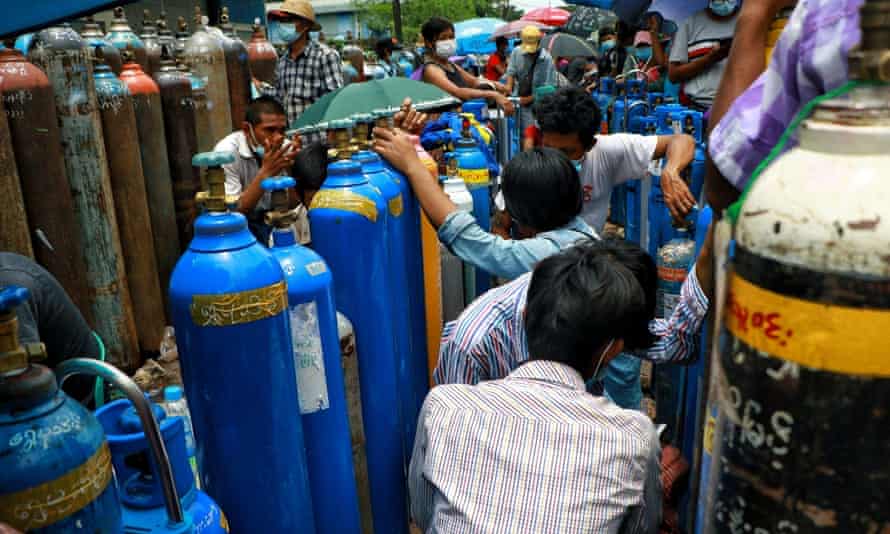
People wait in line next to oxygen tanks to be refilled outside the Naing oxygen 
factory at the South Dagon industrial zone in Yangon, Myanmar.
 Photograph: AP Rebecca Ratcliffe in Bangkok

Wed 28 Jul 2021

Myanmar is at risk of becoming a super-spreader Covid state that fuels outbreaks across the region, the UN special rapporteur for the country has warned as he urged the security council to call for a ceasefire.

The south-east Asian country is facing its most severe outbreak yet, on top of a deep political and economic crisis brought about by the military coup in February. Its vaccination programme has ground to a standstill, testing has collapsed, and government hospitals are barely functioning.

Doctors, who have been at the forefront of an anti-junta strike and are refusing to work in state hospitals, have been forced to treat patients in secret because they face the constant threat of military violence or arrest.

The exact number of cases and fatalities in Myanmar was unclear, said Tom Andrews, the UN special rapporteur on the situation of human rights in Myanmar, in an interview with the Guardian. The targeting of journalists and doctors has made it hard to obtain accurate information about the crisis.

“We know that this is a spike upward. It’s a very rapid, an alarmingly rapid rise,” said Andrews.

According to the military-controlled ministry of health and sports, 4,629 people have died of Covid since 1 June. The figures are thought to be an underestimate. Military-controlled media announced on Tuesday that 10 new crematoriums would be built at cemeteries in Yangon, Myanmar’s largest city, to cope with the fatalities, the Irrawaddy news site, an independent outlet, reported.

“In Yangon, it’s common to see three types of lines,” Andrews added. “One before ATMs, one for oxygen supplies – which is very dangerous because people are literally being shot at by the Myanmar forces for standing in line for oxygen – and the third being lines at crematoriums and morgues.”

There is a severe shortage of oxygen, medical equipment and medication in cities across the country. Outside homes, people have hung yellow and white flags to signal that they need food or medicine, while social media have been flooded with pleas for help and death notices.

The military has been accused of seizing oxygen supplies. It has ordered suppliers not to sell to the public, claiming that people are hoarding tanks.

Andrews said international governments, including Myanmar’s neighbours, needed to act swiftly, or they would see the consequences of an uncontrolled outbreak at their borders.

“Myanmar is becoming a super-spreader of Covid-19 with these very virulent variants – Delta and other forms of the disease, [which are] extremely dangerous, extremely lethal, extremely contagious … This is very, very dangerous for all kinds of reasons,” Andrews said.

“It’s just a fact that Covid does not respect nationalities or borders or ideologies or political parties. It’s an equal opportunities killer. This is a region that is susceptible to even greater suffering as a result of Myanmar becoming a super-spreader state.”

About a third of the world’s population lives in countries neighbouring Myanmar, he added. This includes China, which, along with Russia, has blocked previous attempts by the security council to pressure the Myanmar military.

In February, the security council passed a resolution demanding ceasefires in all states experiencing conflict so that health workers could safely provide Covid vaccinations. Andrews said the resolution should now be reaffirmed in relation to the Myanmar crisis. This could help pave the way for international agencies to provide greater assistance.

On Wednesday, the military-controlled Global New Light of Myanmar reported that junta chief, Min Aung Hlaing, had addressed a meeting “to beef up cooperation with the international community, including Asean [Association of South-east Asian Nations] and friendly countries in the prevention, control and treatment of the Covid-19”. The details of the cooperation are not clear.

Junta forces have engaged in at least 260 attacks against medical personnel and facilities, killing at least 18 people, according to the Office of the United Nations high commissioner for human rights. The military is holding at least 67 healthcare workers, and has issued arrest warrants for a further 600 medics.

Last week, military officials reportedly posed as Covid patients in need of treatment to entrap medical volunteers in Yangon. Three doctors who went to help were subsequently arrested, according to a report by the independent outlet Myanmar Now.

In total, at least 5,630 people are being held in detention facilities, including Insein prison in Yangon, where the virus has spread. U Nyan Win, who previously served as Aung San Suu Kyi’s lawyer, and who was a senior member in her National League for Democracy party, died of Covid after becoming infected in jail, it was confirmed last week.

At least 931 people – protesters, politicians and bystanders – have been killed by the military since February.

There is significant evidence that crimes against humanity are unfolding in Myanmar, Andrews said. “This is not an errant commander here or there doing horrible things, this is very systematic, very clear … The junta going on state television and telling people don’t go on the streets [to protest] or you’ll get shot in the head. And then suddenly all these people are shot in the head.”

Andrews said the need for international action was more urgent than ever. “The people of Myanmar are losing hope that the international community cares about what is happening in Myanmar,” he said.