Saturday, November 06, 2021

COP26: Lobbying threat to global climate action

Lobbyists are pushing the climate to dangerous extremes by blocking or diluting policies that would reduce the burning of fossil fuels.


Lobbyists for oil giant ExxonMobil told undercover reporters that the company was supporting a carbon tax in order to stall more serious carbon pollution cuts


As world leaders meet for a landmark summit to cut carbon pollution, scientists and environmental groups are sounding alarm bells that businesses and governments are lobbying to keep burning fossil fuels.

"Every time there's a climate policy being proposed — which basically entails control of fossil fuels — the industry is there mobilizing against it," said Benjamin Franta, a science historian at Stanford University who studies how the fossil fuel industry has blocked climate action. "Sometimes it defeats it entirely. Sometimes it merely weakens it."

Often overlooked as an obstacle to climate action, lobbying has come into the spotlight as world leaders gather to seek compromise on the fate of the planet at the annual UN climate conference, which is being held this year in Glasgow, Scotland. The UK organized the COP26 summit in partnership with businesses like Boston Consulting Group, which consults for oil and gas companies. Unlike at previous COPs, however, the hosts have banned fossil fuel companies from sponsoring the event itself.

An investigation by The Ferret, a cooperatively owned newsroom in Scotland, found that 35 side events at the summit are being organized by — or feature — big polluting companies and groups that represent them. They include banks like Goldman Sachs, which invests in fossil fuels, and lobby group, the International Association of Oil and Gas Producers.

Ahead of the conference, campaign group Transparency International (TI) wrote a letter to COP26 President Alok Sharma to address conflicts of interest that undermine climate action. "We have already seen the impact of this," said Delia Ferreira Rubio, chair of TI, in a statement. "Undue influence and illicit lobbying from the industry even extends to the very meetings where progress on climate crisis is meant to be discussed."
What does lobbying look like?

Lobbying can range from secretive meetings with government officials to influencing narratives through public advertising and the funding of third-party groups.

"The tricky part is that lobbying is most effective if nobody knows that you're doing it," Franta said.

This can stretch to science. Documents leaked in October to Unearthed, an investigative journalism outlet from environmental group Greenpeace, revealed that some of the world's biggest coal, oil, beef and animal feed-producing countries tried to strip a landmark UN climate report of findings that could hurt their industries.


Oil producing nations wanted to cut references to fossil fuels in IPCC reports, according to one investigation

Saudi Arabia, Australia and Japan pushed to remove a conclusion that the world needs to rapidly phase out fossil fuels from an upcoming Intergovernmental Panel on Climate Change (IPCC) report scheduled to be published next year, according to Unearthed. Brazil and Argentina tried to delete passages highlighting the climate benefits of plant-based diets. The Organization of Petroleum Exporting Countries (OPEC), meanwhile, wanted to cut several mentions of fossil fuel lobbying — including a reference to "powerful interest groups who have vested interest in maintaining the current high carbon economic structures."

Climate scientists involved in the report said they were under no obligation to accept comments and routinely rejected those that are not grounded in science. But such pressure from governments has raised fears of self-censorship. A landmark IPCC report in August, for instance, contained a 40-page summary for policymakers that did not use the words "fossil fuels." While two such mentions in the draft had been removed at Saudi Arabia's request, they were both only in figure captions, and had not been written into the body text.

How does corporate lobbying hold back climate action?

Powerful companies continue to fight policies that would make it harder for them to sell fossil fuels.

A report by UK think tank Influence Map in 2019 found the five largest publicly traded oil and gas majors — ExxonMobil, Royal Dutch Shell, Chevron, BP and Total — invested more than $1 billion (€860 million) of shareholder funds into "misleading climate branding and lobbying" in the three years following the Paris Agreement.

In many cases, oil and gas companies try to change public perception using the same messages with which they lobby politicians, said Faye Holder, a climate expert at Influence Map. This includes portraying themselves to the public as part of a solution to climate change, rather than a cause, and highlighting their investments in clean energy while funneling far more money into dirtier fuels. "Advertising becomes really important [because it] socializes these concepts before you even reach the policymakers."

In May, lobbyists for oil giant ExxonMobil told an undercover reporter from Unearthed that the company's support for a carbon tax was a move to stall serious measures to cut carbon pollution. Former senior executive Keith McCoy also admitted that Exxon funded "shadow groups" that distorted climate science to stall regulation. "We were looking out for shareholders," McCoy told the reporters, who were posing as recruitment consultants.

ExxonMobil CEO Darren Woods distanced the company from the tactics, describing the comments as "entirely inconsistent with our commitment to the environment."

Experts say it fits a broader trend, though it is hard to quantify exactly how much of an impact lobbying has had in slowing climate action. "It stands to reason that it has been impactful since the companies spend quite a bit of money on it," Franta said. "A for-profit business is not going to spend a lot of money on something unless they perceive that it has some beneficial outcome for them."


SOLAR ENERGY IN UNUSUAL PLACES
Solar catamaran on a world tour
The catamaran Race for Water is the largest solar yacht in the world and runs completely without fossil fuels. Modules on deck power the electric motors and charge the batteries for the night. Instead of masts and sails, the yacht also uses a steering kite.


Holocaust survivor Margot Friedländer turns 100

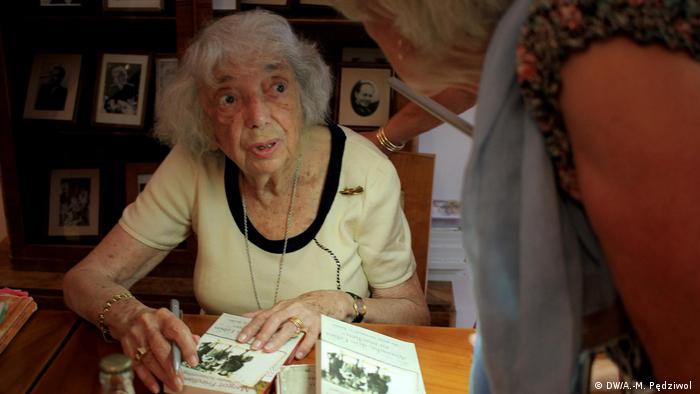
German Jewish Holocaust survivor Margot Friedländer, who moved back to Berlin at the age of 88, celebrates her 100th birthday on Friday. Her late years of education and reconciliation are being honored this week.


Margot Friedländer turned 100 on Friday

Margot Friedländer says she has lived four different lives in her 100 years, but it was the moment when her first life became her second that marked her forever. That was when her early, mainly happy years in Berlin turned into 15 months of hiding in various houses in Berlin, evading the Nazi authorities as long as she could, and then another year of surviving the Theresienstadt concentration camp.

In her 2008 memoir, Friedländer recounts an incident on January 20, 1943, in the apartment of a couple she barely knew in Berlin's Kreuzberg district. She knew that her mother had recently been there.

The acquaintance told Friedländer, who was 21 years old and had the last name Bendheim at the time, that her mother had left. She had gone to report herself to the authorities to join her son, Margot's brother Ralph, who had been arrested that afternoon by the Gestapo. The woman then handed Margot her mother's handbag containing her last connection with her family: An address book and an amber necklace. And there was a message, passed on verbally: "Try to make your life."

"These words shaped my life," Friedländer told DW this week at one of the events taking place in Berlin to mark her 100th birthday on Friday — this one the opening of an exhibition of portraits of her. "I feel that I have accomplished something, not just for my mother, not just for six million Jews, but for the many million people who were killed because they didn't want to do what they were told to do."


Friedländer with her friend Thomas Halaczinsky, who has made three films about her later life in Berlin

'Try to make your life'

Though she was not to find out until decades later, Friedländer's mother and brother were murdered in Auschwitz within weeks of that January day. Her father, who had fled to Belgium years before, had already been gassed, too.

Sixty-five years later, her mother's hastily delivered final message became the title of Friedländer's memoir, a book that began the work of remembrance and education that has taken up the last decade in Berlin, where she moved back for good in 2010.

It wasn't an easy move to make, and there were many people who tried to dissuade her. Other Holocaust survivors she knew in New York, including her cousin Jean, objected to her visits to Germany. Her husband Adolf Friedländer, another Holocaust survivor who she had met in Theresienstadt and who died in 1997, had always rejected the occasional invitations that had arrived over the years from the Berlin government.

"I often ask myself if coming back here was the right thing to do," Friedländer said in "A Long Way Home," a 2010 documentary co-produced by DW. In the same film, Margot admitted to uncomfortable feelings around some Berliners: "I'm still very guarded about the people of my generation whom I meet here. They were the ones who cheered the Nazis back then. And did nothing to put a stop to what was going on. Everybody knew about it, and they looked away. Although I came back, it's still something that affects me very deeply."

For the next generation

But those doubts were answered in the work she undertook after the age of 87, when her memoirs were published, and she began to give readings around Germany, especially in schools. "They listen to me intently," she says now of the students. "I have received — I don't know — a thousand letters. I tell them: What happened can't be changed, but this is for you. That became my mission."

Friedländer's journey in Berlin has been documented in a loose trilogy of documentaries made by Thomas Halaczinsky, a German filmmaker living in New York. The first of them, "Don't Call It Heimweh," became the occasion for her first visit to Berlin in 2003.


Friedländer speaking to the likely next mayor of Berlin, Franziska Giffey, on Tuesday


Halaczinsky said he was interested in the crisis Friedländer experienced when he first met her in the early 2000s. "I was seeing how the effects of German history, of fascism, of oppression, of the Holocaust, actually continue to exist in the lives of people like Margot, who were struggling to come to terms with their lives and their own identity," he told DW.

Friedländer's specific situation contained a peculiar conflict: She had spent 15 months in hiding in Berlin, being protected by non-Jewish Germans, while at the same time other Germans were murdering her family. "She was struggling with exactly that, and she was trying to find some way to figure out how she could balance that," he said. "How does somebody at that age actually find the center point of herself?"

In the second of Halaczinsky's films, "A Long Way Home," Friedländer answers the question herself: "How can I possibly feel homesick for Germany, after the Germans killed my parents?" she says.

"To that, I'd have to reply: This is precisely why I've come here — I've come here to meet the young people who had nothing to do with it."

A service for Germany

Those early struggles seem a long way away 18 years later. Friedländer has since been showered with state awards and honorary citizenships. Portraits have been painted, busts cast, her story told in exhibitions, films, books, and a graphic novel. The Schwarzkopf Foundation, set up to empower young people to engage in politics, founded an annual prize in her honor in 2014, the latest of which was presented by Chancellor Angela Merkel.

Politicians have lined up to laud her, among them Berlin's likely next mayor, Franziska Giffey, who was also at Tuesday's exhibition opening. "I think she's a model for all of us," she told DW. "She goes to children and young people and people of all ages and shares her life. And this act of commemoration is very, very important for our political education today. To hear this voice, in her 100th year, is very important for all of us defending a free and open society."

Friedländer has spent the last decade telling her story and presenting readings of her memoir, 'Try to Make Your Life'

"She reaches out a hand of reconciliation," said Schwarzkopf Foundation Chairman André Schmitz, who befriended Friedländer after welcoming her to Berlin as state culture secretary in 2003. "She makes it easy for us Germans: She's charming, she's joyful, she enjoys being heard — she doesn't make accusations against us, but says: Watch out, this was possible once, and is always possible. That's an invaluable service."

The last of Halaczinsky's films, which covers these last few years of her work, has recently been aired by public broadcaster ARD. It is entitled "Angekommen" ("Arrived"), and its very last scene catches Friedländer in an unusually uncertain moment.

"I don't make many presumptions that very much will remain after I have died," she says. "There are great people who have done something. But my contribution is after all, very, very small. Perhaps the generation now that hears me in schools will say something to their children. I have no idea how far that will go, because so many people keep saying we don't want to talk about it anymore."

Pessimistic as this may sound, Halaczinsky sees the ending as a call to action, because soon we won't be able to rely on Holocaust survivors for first-hand accounts of the real horrors of fascism.

"Even though her work is being acknowledged, this is not a work that can be finished. It's a process, it continues," Halaczinsky said. "Her doubts are a warning to all of us."
Gaia-X cloud: A safe haven for Europe's data?

Europe has just marked the second anniversary of Gaia-X. It's a cloud data project intended to help the continent achieve "digital sovereignty," but many companies remain skeptical or have simply never heard of it .


Europe's cloud industry is seen as crucial in regaining control over the continent's data

In the era of digitalization, companies, administrations and the public at large produce huge amounts of data. The permanent stream of bits and bytes is multiplying exponentially by the day as innovations such as artificial intelligence, autonomous driving and automation are coming online now and in the future.

At the same time, Big Data has become big business for those companies who are able to store and mine the huge data pools, and, ideally, share them with other companies for commercial gain. In this, many companies have come to rely on outside cloud service providers — a business that's been booming in recent years, with more data meanwhile being stored by firms externally rather than in-house.

Apart from saving valuable storage capacity, businesses can also cut costs by renting rather than buying software applications and processing power, while data clouds guarantee access from seemingly anywhere in the world.


Europe's independent cloud ecosystem

Gaia-X is a Franco-German project idea that was first presented to the public at a European Digital Summit in October 2019. About one year later, the Gaia-X Association (AISBL) was founded as an international nonprofit organization based in Belgium. Its aim is to foster the digital sovereignty of European cloud service users, and promote European values of transparency, openness, data protection and security.


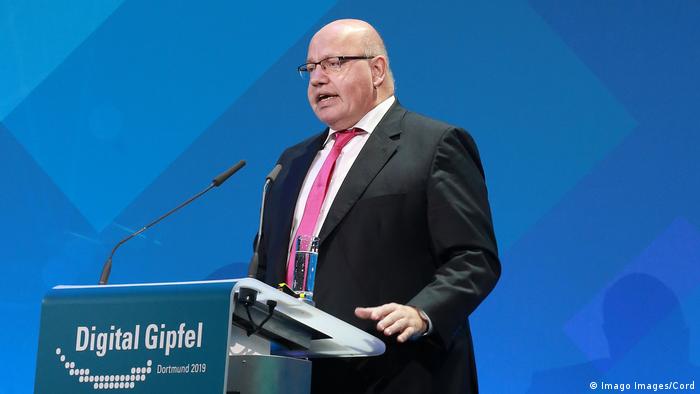
Germany's Peter Altmaier first floated the idea of Gaia-X saying it would be a key tool for allowing Europeans to "assert themselves in the world"

Senior French and German ministers have promised Europe will regain its "digital sovereignty" in the face of dominant American players like Amazon, Google and Microsoft. German Economy Minister Peter Altmaier said during the AISBL founding ceremony the data infrastructure ecosystem would "drive innovation and create new data-based services and applications."

In the opinion of its founders, Gaia-X is not intended to create a competing product to existing offers by US providers. Instead its stated aim is to link different data infrastructures via open interfaces and standards in order to connect data and make them available to a broad audience.

"Gaia-X is based on existing data infrastructure systems, but acts as a software federation system that mainly orchestrates data exchanges within the ecosystem," said Andreas Weiss from eco, the largest internet industry association in Europe.

Among the project's German founding members are such big industry names as BMW, Airbus, Bosch, Deutsche Telekom, SAP and Siemens. On the French side, Amadeus, Atos, Electricite de France (EDF), Orange and Scaleway were early members of Gaia-X.

Within less than a year after the AISBL nonprofit was founded in 2020, the alliance elected a new board, developed from about a dozen founding members into 320 member organizations, launched dozens of national hubs across Europe and started work for several committees to draw up technical and policy rules.

Common standards are key

Presently, many European companies build individual interfaces for data exchange and interoperability solutions with each of their customers seperately — a tedious and costly process.

"Some companies seeking to exchange data still use e-mail, fax or other technologies that are no longer state of the art. Sometimes they have to sort out in advance how to exchange their data," said Rainer Sträter from cloud services provider IONOS. This might still work between two companies, he told DW, but it's impossible among several hundreds of firms, which, for instance, need to organize supply chains. Here, interoperability was essential and could only be achieved through standardized data, he added.

According to market analyst IDC and cloud company Seagate, the lack of standardized data exchanges in Europe means that only about one third of the data existing in companies would effectively be used to develop new products and business innovations.

The European Commission says data services will become a major driver of economic growth in the next decade, garnering data industry revenue worth about €829 billion ($957 billion) annually by 2025 — three times as much as in 2020.

At the moment, however, it's mainly the cloud services of Amazon, Microsoft, and Google that are flourishing amid the boom, cementing their dominance over Europe, where they account for almost 70% of the market. Europe's biggest cloud player, Deutsche Telekom, accounts for only 2%.


US services dominant, Gaia-X not well-known

The German Economy Ministry says on its website that cloud services providers outside Europe are able to "rapidly scale their infrastructure and dominate the market with their huge capital reserves." In times of growing international tensions and trade conflicts, the ministry warns, Europe must be able to "act more independently" with regard to its data.

But with its cloud agenda still only evolving, Europe will likely remain reliant on big US companies for a while, and exposed to the reach of Washington through extraterritorial laws like the US Cloud Act. The law allows Washington to requisition European data held by US companies.

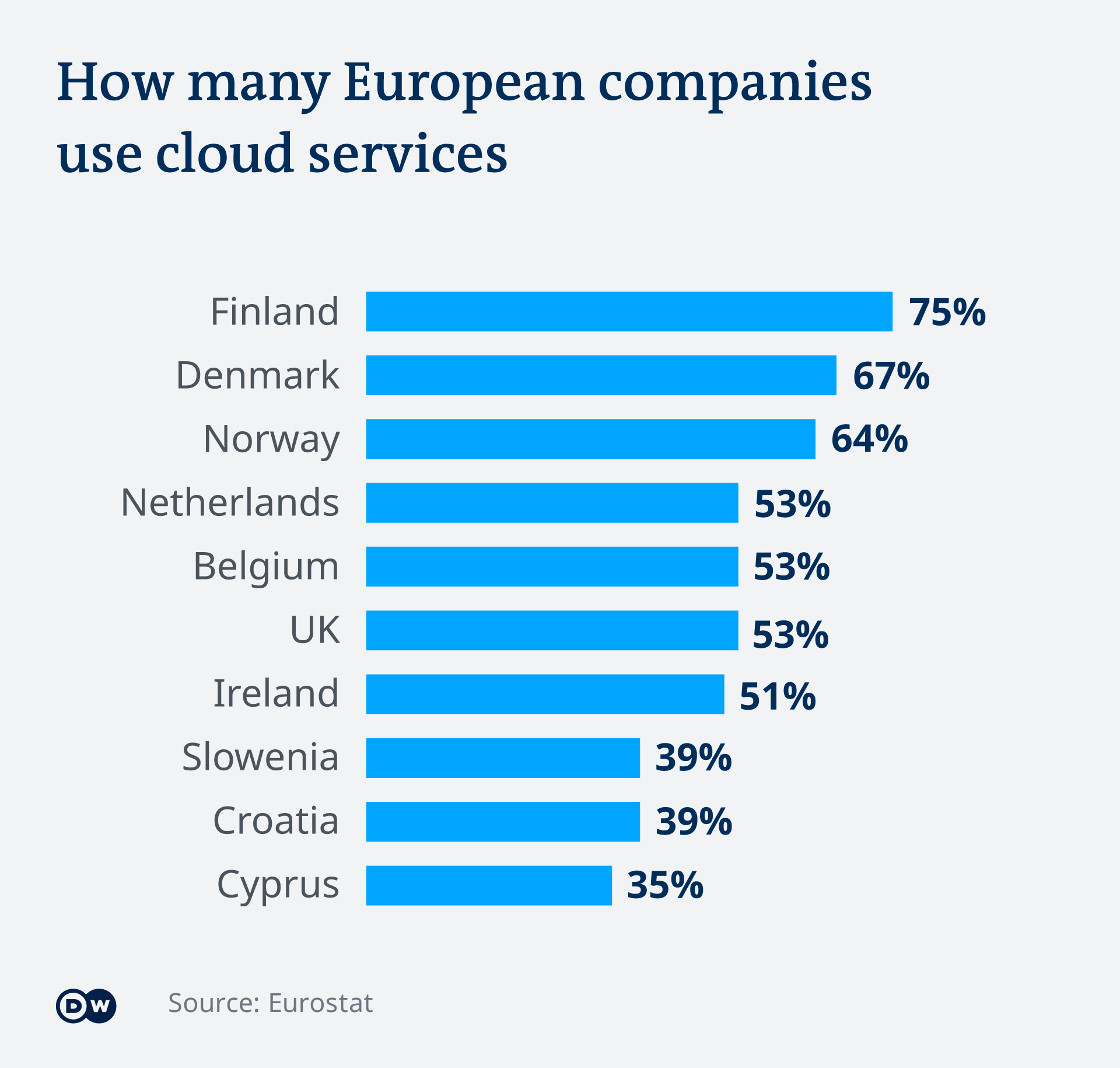
Small wonder then that the primary concern of European companies is data security when it comes to using cloud services. According to the Cloud Monitor 2021 compiled by consultancy KPMG and the Bitkom industry association, 75% of the European companies not using cloud services named security issues as the main reason for their reluctance, while 67% are worried about unclear regulatory frameworks.

Apart from legitimate security concerns, Gaia-X also seems to have a public relations problem. Only about 6% of some 500 German companies polled by the Institute of the German Economy (IW) recently said they had heard of the European cloud project — a worryingly low number two years after it started.
Dubious bedfellows

In order to move things forward, the Gaia-X alliance decided in April to accept global cloud players such as Microsoft, Huawei, Amazon, Google, Salesforce and Alibaba as full members. Palantir, a controversial California-based company with alleged links to the US military-industrial complex, was revealed to have been a Gaia-X member since day one.

Such developments have caused worries that the foreign data giants could influence the initiative to benefit them rather than Europe's own interests. But Boris Otto, the head of the Fraunhofer ISST institute and interim chief technology officer (CTO) at the Gaia-X Association, sought to play down the differences. "We don't want to isolate Europe, but seek to invite anyone who agrees to play by our rules," he said in a statement.

IONOS' Rainer Sträter shares this view, insisting that Gaia-X's vision is still alive. Once completed, he told DW, the open source project would allow Europeans to freely chose their cloud services providers in line with their own requirements. And those European companies that are already heavily relying on cloud services, would be able to switch between providers more easily because all Gaia-X participants would need to abide by the same standards of transparency and data security. This could also benefit smaller cloud services who are presently unable to compete with the heavyweights of the industry, he added.


Google runs partnerships with major European telecoms. Will deep commercial ties make data sovereignty impossible?

Whether the Gaia-X alliance can really advance the cloud project to help protect European interests will become clearer in mid-November, when members meet for a two-day summit in Milan. They are planning to launch so-called labels for cloud companies active in Europe to market their security, privacy and sovereignty practices.

This article has been adapted from German.
What are the chances for peace in Ethiopia's Tigray conflict?

As the war in Ethiopia comes to a head, opponents of Prime Minister Abiy Ahmed are forging an alliance for a "safe transition." A national dialogue to provide a way out of the crisis appears to be a distant prospect

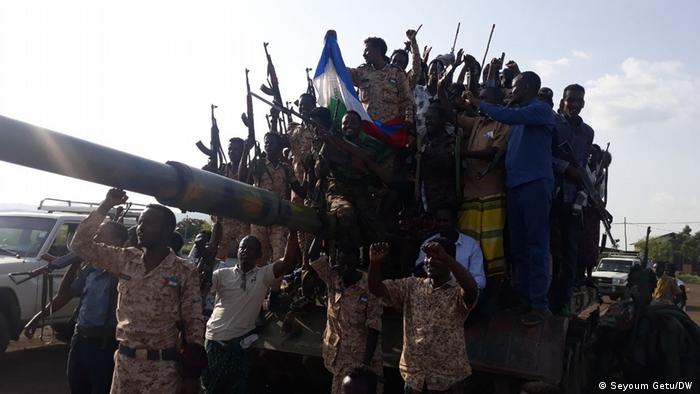
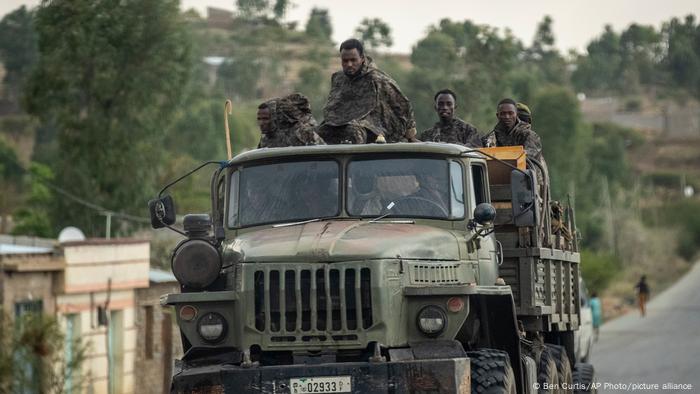
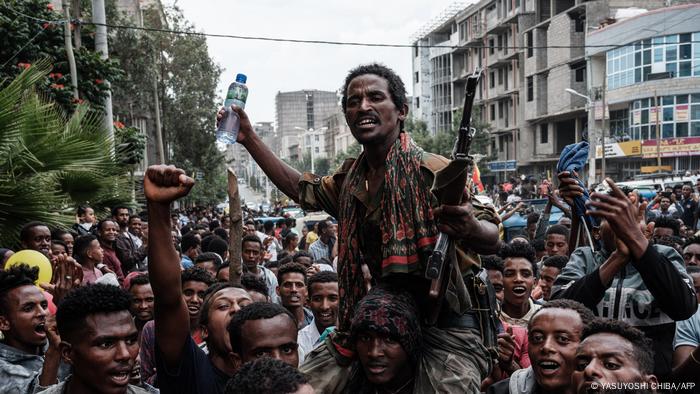
In mid-October, Ethiopian army special forces were still confident of victory


"The situation in Ethiopia is currently very perilous. This is probably the most dangerous moment in the country for decades," said Murithi Mutiga, International Crisis Group Project Director for the Horn of Africa, based in Nairobi, Kenya. "The primary issue is that all sides have decided that they can settle this conflict militarily."

According to the analyst, the Tigrayan forces have gained strength. "They seem determined and try to make a decisive move that could either lead to the end of the siege in Tigray or to the collapse of the Abiy government," Mutiga told DW.

For its part, the government of Prime Minister Abiy Ahmed has stepped up its war rhetoric. Facing a possible advance on the capital, Addis Ababa, it is calling for a general arming of the people, as well as for all civilians to join the fight. According to observers, there have been busloads of forcibly recruited teenagers and clampdowns during which Tigrayans still staying in the capital were arrested.

In the meantime, the US special envoy to the Horn of Africa, Jeffrey Feltman, has met with the prime minister in Addis Ababa. "It is essential that he, the AU and possible neighbors, at least get all parties to give talks a chance," said Mutiga.

Mekele, the capital of the Tigray region, has been repeatedly hit by airstrikes


Abiy 'can flee and go into exile'

The Ethiopian Army and troops from Tigray siding with the Tigray People's Liberation Front (TPLF) party have been battling for the region in the north of the country since last November. Voluntary fighters have joined both sides. In the meantime, the TPLF has received reinforcement from the Oromo Liberation Army (OLA) and claims to have made territorial gains in the course of its advance on the capital.

On Friday, TPLF and OLA announced the formation of an alliance along with seven other opposition groups — with the aim of reversing "the harmful effects of the Abiy Ahmed rule" and precipitating a "safe transition" for the country.

Abiy, who was awarded the 2019 Nobel Peace Prize for his political reforms in Horn of Africa, imposed a state of emergency on Tuesday. He labeled TPLF leaders as terrorists, "a cancer," or "weeds." His Facebook post that called on people to "bury" advancing fighters was deleted by the social network on Thursday.

Is there any chance for negotiations between the arch enemies? Norwegian peace researcher Kjetil Tronvoll believes there isn't: "There is no negotiated takeover of power. We can expect an ongoing conflict," he told DW.

The TPLF, he added, had no interest in assuming power in Addis Abeba through political means, "but they want to topple Abiy (and achieve) a transitional agreement." Abiy's political career, Tronvoll said, was over: "He can flee and go into exile."

Experts do not believe that a quick solution to the Ethiopian conflict is possible

The will to win

The current fight was no military challenge for the troops of the Tigray regional government — they could reach Addis Abeba within a week, Tronvoll believes.

But why is the TPLF campaign so successful? Abiy, Tronvoll explains, made a mistake when he dealt with the national army, which had long been dominated by Tigrayans. "He arrested 17,000 soldiers and officers in the chain of command (of the government army) when he came to power. He incapacitated his own army. Being from the Oromo ethnic group, he could not trust them." Today, there was a lot of infighting in the Ethiopian National Defense Force (ENDF), Tronvoll added.

The troops from Tigray, Tronvoll emphasizes, have a stronger fighting morale and the will to win. There is discipline in TPLF troops, who are "highly educated people, not peasants as in the resistance war. Now they are recruiting doctors and high school graduates, and they believe in their course."

In addition, the survival of their families is at stake. In the face of a situation like this, international efforts came too late and, worse still, most diplomats are unfamiliar with the complexity of Ethiopia, with the people, with the sentiment of the parties, according to Tronvoll.

Diplomacy has failed


Bayisa Wak-Woya, a former UN employee from Ethiopia, also mentions a setback in diplomacy: Many diplomats, he said, do not know enough about the different traditions and cultures of the country and were, therefore, failing in their mediation efforts. "It is very difficult to know what is happening at the war front in Ethiopia now. Transparency is a rare commoditiy in that country."

One thing, however,is certain, he believes: "Civil wars are different from wars of aggression." In the former, maintaining the state's sovereignty is a non-argument: "What are human rights violations for some is maintaining law and order for others. This makes it difficult to design a dignified exit (from the fighting) for the parties involved."

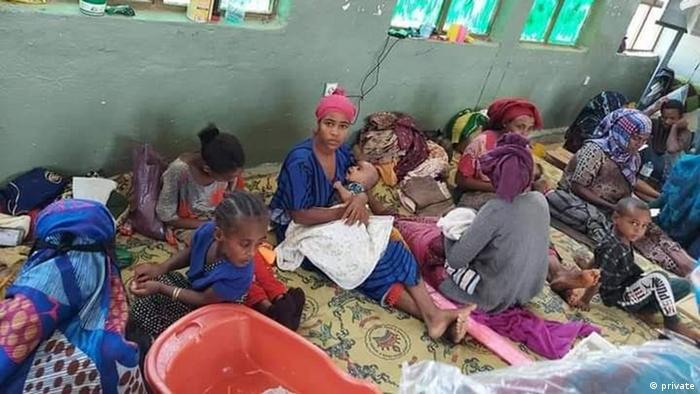
Hunger and displacement aggravate the catastrophic humanitarian situation in Tigray


What, then, is the way forward? "External powers (…) should refrain from taking sides and putting pressure on the parties in the conflict. So far the diplomatic talks failed to bear fruit, because the international community started to condemn parties. Not a good start," Wak-Woya says, who, nonetheless, is still hopeful that peace can be brought to the region.

Inner balance in disarray


Considerable efforts are being made to prepare international negotiations, according to people familiar with the situation. But discretion is of the essence here, so as not to jeopardize the prospect of successful talks. The inner balance of Ethiopia's immature political system has been in disarray for decades, ethnohistorian Wolbert Smidt, an expert on Ethiopia, tells DW.

That disarray, Smidt says, originated in the late 19th century, an era which saw Ethiopia massively expanding into neighboring regions, which were organized in completely different ways with regard to languages, ethnic groups and cultures. Today's conglomerate of regional states is lacking equality on the political level; there are extreme differences in education, wealth, access to power and recognition, accoring to Smidt.

Realistic offers to advancing troops

One symptom of those long-lasting marginalizations is the current civil war. "Talks must clarify whether there's any common ground left," Smidt says. The government is holding on to its autocratic tendencies, he believes. Now, however, clarity about the military situation is paramount, instead of forcing through reforms.

African partners believe that Ethiopia is tearing itself apart because of these internal contradictions, Smidt says. "We must now make realistic offers to the advancing troops."


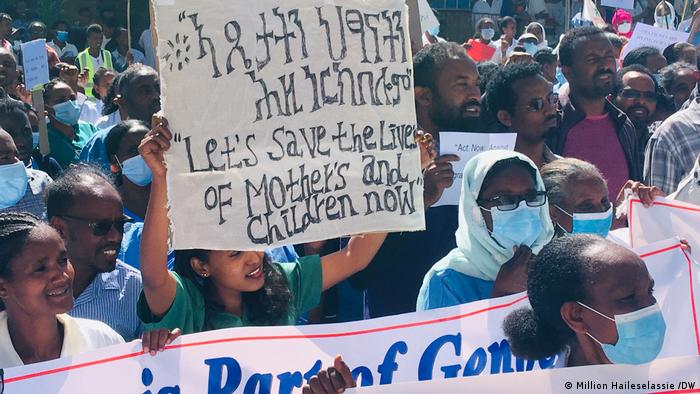
Doctors in Tigray protest against a de facto blockade of medical supplies

According to Smidt, the only formula for peace is a national dialogue involving all ethnic and regional-political groups. At first, however, the guns must remain silent. "No reform, no matter how idealistic, can work if you don't integrate stakeholders of central importance."

That political process collapsed years ago. "That means that in the short term, we only have the option of stopping the war, so that a transitional government can be established. It is only on that basis that a longer civil process can be set in motion."

This article was translated from German.

Facebook whistleblower warns company is neglecting languages other than English

Facebook is taking an English-first approach in tackling "extreme" online content, whistleblower Frances Haugen told DW. 


She warned that the current situation in Ethiopia shows how dire the consequences can be.

The role Facebook plays in fanning the flames of ethnic and political tensions shows how urgently change is needed at the social media giant, whistleblower Frances Haugen said in an interview with DW.

Haugen is a former product manager for the social media giant, which recently rebranded itself under the new name "Meta."

She is due to testify in front of a panel at the European Parliament on Monday about her disclosures on the company.
Tackling 'extreme content' in English — but less so in other languages

"One of the core things that I'm trying to draw attention to is the underinvestment in languages that aren't English," Haugen told DW.

With the company most concerned about preventing regulatory scrutiny in the United States, the English language gets the most attention in terms of adapting the company's artificial intelligence (AI) software.

"Unfortunately the most fragile places in the world are the most diverse when it comes to languages," Haugen said.

She said Facebook's current safety strategy is to use AI to catch "extreme content" and ensure it doesn't rank higher in users' feeds.

"The problem is that strategy requires us to build those AI systems over and over and over again in each language for the platform to be safe — and right now Facebook is not doing that," she explained.
Ethiopia conflict illustrates need for change

Relying on AI to help ensure public safety — and then not updating the systems in other languages — can have major, real-world consequences, the whistleblower said.

"I saw a pattern of behavior where I believed there was no chance that Facebook would be able to solve these problems in isolation," Haugen said, explaining her decision to come forward.

"I saw what I feared was going to happen continue to unfurl," she said, pointing to the deteriorating situation in Ethiopia as a more recent example.

"I knew I could never live with myself if I watched 10 million, 20 million people over the next 20 years die because of violence that was facilitated by social media," Haugen added.

Rights groups have sounded the alarm over a rise in hate speech on social media in Ethiopia amid the advance of Tigrayan forces.

Amnesty International warned that many posts "inciting violence" and using slurs against ethnic Tigrayans have "gone unchecked."

Earlier this week, Facebook removed a post by Ethiopian Prime Minister Abiy Ahmed, saying it violated the company's policies against calling for violence.

On Friday, Twitter suspended its "trends" section in Ethiopia, citing a rise in threats of physical violence.

This interview was conducted by DW political correspondent Giulia Saudelli.


Who are the Tigray fighters, and why is Ethiopia at war with them?

A year ago, Ethiopian Prime Minister Abiy Ahmed launched a military campaign against Tigray fighters, promising a quick victory. But Tigrayans managed to turn the tide. DW explains who they are and why they're fighting.


Tigray, Ethiopia's northernmost region, is home to most of the country's estimated 7 million ethnic Tigrayans

Since early November 2020, the Ethiopian government and Tigray fighters have been exchanging fire in a conflict that has claimed thousands of lives and has left more than 400,000 people facing famine, according to a recent UN estimate.

The conflict has escalated rapidly since June, when fighters began to retake most of Tigray and expand into neighboring regions. The fighters have managed to recruit allies and are approaching the capital, Addis Ababa.

So, who are the Tigray fighters?

From militiamen to rulers

In the mid-1970s, a small group of militiamen founded the Tigray People's Liberation Front (TPLF). With a left-wing nationalist ideology, they vowed to fight for the rights of Tigrayans, a relatively small ethnic group that account for just 5% of the population and had long been marginalized by the central government.

Throughout the 1980s the TPLF emerged as a formidable challenger to Ethiopia's then Marxist military dictatorship. The group eventually led an alliance of militia organizations, the Ethiopian People's Revolutionary Democratic Front (EPRDF), that overthrew the Soviet Union-backed regime in 1991.


The alliance then began to run Ethiopia under a federal system, with TPLF holding sway over the other groups and dominating politics for nearly three decades.

Tigrayan leader Meles Zenawi was Ethiopia's transitional president from 1991 until poorly contested elections in 1995, when he was elected prime minister. He would go on to rule the country until his death in 2012, and was succeeded by Hailemariam Desalegn. During this time, Ethiopia saw economic growth, but the government clamped down on dissent.

The EPRDF government led the country through periodic drought and famine, and the 1998-2000 border war with northern neighbor Eritrea. Human rights deteriorated during this time, with opposition groups complaining of persecution and corruption, which fed into growing public discontent.

In early 2018, after several years of frequent anti-government protests from different ethnic groups had seriously damaged the legitimacy of the EPRDF government, Hailemariam stepped down. The EPRDF selected Abiy Ahmed, of the Oromo ethnic group, as his successor and he was soon elected prime minister.

Abiy, a non-Tigrayan politician with little ties to the TPLF, enjoyed widespread popularity. He unseated many Tigrayan officials, charged some with corruption and introduced a set of political reforms which sidelined the TPLF. In late 2019, Abiy disbanded the EPRDF coalition government and moved to create the new Prosperity Party (PP). Refusing to join the group, the TPLF moved back to its stronghold.


Tigrayans are Ethiopia's third-largest ethnic group

After the 2020 general election was postponed by the COVID-19 pandemic, the TPLF and some other opposition leaders accused Abiy of delaying the vote to stay in power. Despite the delay, officials in the Tigray region went ahead with regional elections in September 2020. A month later, the federal government began withholding funds from the regional administration.

In early November 2020, TPLF forces were accused of having attacked and looted federal military bases in the region. Abiy kicked off a military campaign in the Tigray region, known as Operation Law enforcement, and promised to swiftly defeat the TPLF fighters.

But since June 2021, the Ethiopian army has endured continued setbacks and has been forced to withdraw from Tigray. Now the front line is getting closer and closer to Addis Ababa, with the prime minister calling on residents to be ready to defend the capital.

The Tigray fighters might have the upper hand, but capturing Addis Ababa will not be easy. They are likely to face resistance from other Ethiopians who fear the return to power of a party that ruled the country for nearly three decades.


ETHIOPIA: TIGRAY CRISIS ONE YEAR ON
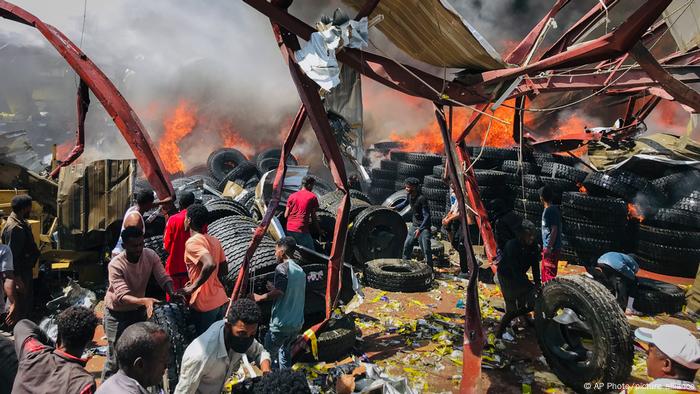
A city burns
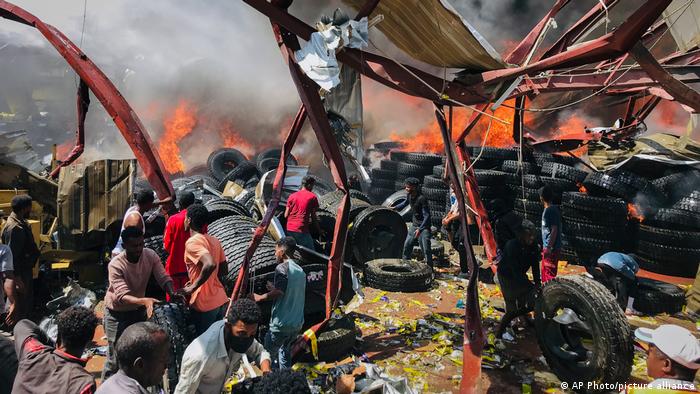
Residents of Tigray's capital Mekele sift through wreckage following an airstrike by government forces on October 20. The military said it was targeting a weapons manufacturing facility operated by the Tigrayan People's Liberation Front (TPLF), which the rebel Tigray forces have denied.     123456789
Ancient Mayan artifacts returned to Guatemala and Mexico

Germany's return of 13 Mayan cultural objects also reflects a recent trend of private collectors returning what is not theirs.


Bought at a flea market in 2003, these ancient Mayan artifacts will be returned to Guatemala and Mexico


The discovery and return of Mayan artifacts have been making headlines lately — with some private collectors both in Germany and elsewhere voluntarily surrendering the objects.

In late 2020, a man in the city of Klötze in the eastern German state of Saxony-Anhalt contacted the police to hand over WWII-era weapons that had belonged to his father.

His cellar also housed a collection of 13 objects — including figures, plates and cups dating back to 250-850 AD. Claiming not to know of their origins, he said that they had been purchased for less than €100 ($116) at a flea market in Leipzig in 2003.

An expert later confirmed the objects' authenticity and declared that 11 of the pieces were produced in what is today Guatemala and two others were from Teotihuacan, located roughly 40 kilometers (25 miles) northeast of modern-day Mexico City. The ancient Mesoamerican city of Teotihuacan was the largest city in the pre-Columbian Americas. Police suspect these items were looted by tomb raiders.

On Friday, Saxony-Anhalt State premier Reiner Haseloff handed the priceless Mayan cultural artifacts over to Guatemalan Ambassador Jorge Lemcke and Mexican Ambassador Francisco Quiroga at a ceremony in Berlin.


Saved from resale: fragment from the Piedras Negras archaeological site in Guatemala

'Private collectors' goodwill'


The handover came a week after another private collector in France returned a Mayan artifact to Guatemala after it was initially slated for auction in 2019.

Thought to have been looted from a Mayan archaeological site in the 1960s, the stone fragment depicts the head of a ruler of Piedras Negras wearing a headdress in the form of a bird of prey. Piedras Negras was the capital of a Mayan kingdom that existed between 4th century BC and 9th century AD, and was located in what is now northwestern Guatemala.

The Los Angeles Timesreported that the object changed hands several times before being ultimately acquired by private collectors Manichak and Jean Aurance in Paris. It was later included as part of a collection of pre-Columbian artifacts slated for auction in Paris in 2019. It had been estimated to fetch between €23,325 ($27,000) and €33,692 ($39,000).

Guatemala objected and produced evidence of provenance, with drawings and pictures dating back to its discovery in 1899, and the carving was then withdrawn from the auction.

Negotiations followed between Manichak Aurance, the French and Guatemalan governments, and UNESCO, which later released a statement saying Aurance opted to voluntarily return the fragment.

"The voluntary handover of this fragment of a Mayan stela to its homeland in Guatemala showcases the evolution of the international environment in favor of the return of emblematic cultural objects and artefacts to their homelands under UNESCO's guidance over the last 50 years," UNESCO Director-General Audrey Azoulay said in a statement.

"It also shows the importance of the UNESCO 1970 Convention in fighting the illicit trafficking of cultural objects," Azoulay said. "This success story has been possible thanks to international cooperation and a private collector's goodwill; it is a model for others to follow."


A clay drinking vessel estimated to be 1,500 years old is one of the 13 items returned
Market for antiquities


In May, two German collectors voluntarily returned 34 pre-Columbian artifacts to Mexico. Twenty-eight of the objects were in the city of Monheim am Rhein in western Germany and the remaining six in Recklinghausen, some 70 kilometers (43 miles) away.

Commenting on that event, Diego Prieto, director of Mexico's National Institute of Anthropology and History, highlighted the "growing sensitivity" in the global community about the need to respect cultural heritage and return artifacts.

People of Mayan descent constitute over 40% of the population in Guatemala. In the north of the country lie the ruins of the city of Tikal, one of the former centers of Mayan power.

Meanwhile, near Mexico's capital, Mexico City, lie the sprawling ruins of Teotihuacan — the center of a culture that dominated Central America in the first century AD.

InsightCrime.org reported in February that informal markets peddling Mayan artifacts still exist in Guatemala. Quoting an expert from the La Ruta Maya Foundation, the report explained how Mayan sites were looted between the 1960s and 1980s, when a trend of pre-Columbian exhibitions in the United States saw increased demand for cultural items from museums and private collectors. Guatemala's civil war had also forced some archaeologists to abandon excavation sites, leaving them exposed to impoverished rural communities seeking additional sources of income.


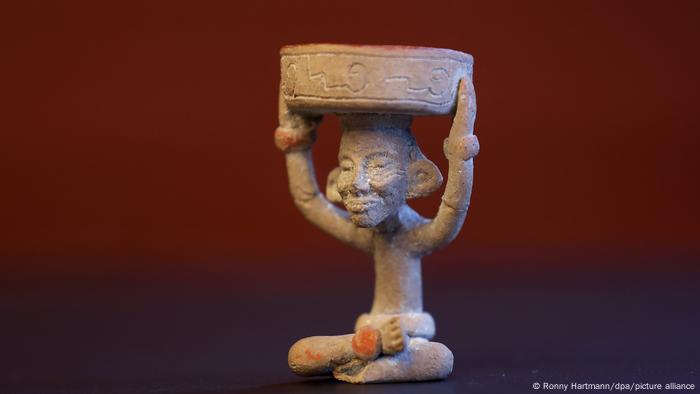
A clay figurine believed to be 1,500 years old that doubles as a candle holder, representing Huehueteotl, the fire god of Teotihuacan

Who are heirs?

Nikolai Grube, a professor of Ancient American studies at the University of Bonn, told DW in May that the Indigenous peoples of the Americas are the legitimate heirs of these artifacts.

"Their ancestors created these cultural assets. But, nowadays, they are not even allowed to speak their language; it does not appear in school, their culture is not part of national life. A real kind of apartheid reigns. Either members of the indigenous population live in poverty in the countryside, or in the favelas of the big cities," he said, adding that cultural institutions like museums often operate without their participation.

"The debate about African looted art is in full swing, and rightly so, and should have happened much sooner, especially since the debt is particularly large due to the German colonies. And that would be needed now for South America, as well," Grube said. "There is blood on all these objects as well — it's just older."
Can Africa achieve universal internet access by 2030?

Despite recent growth in internet connectivity, Africa lags behind other regions of the world. The World Bank hopes to help the continent achieve universal connectivity by 2030, but huge hurdles stand in the way.


IT experts say Africa has the largest potential for digital growth

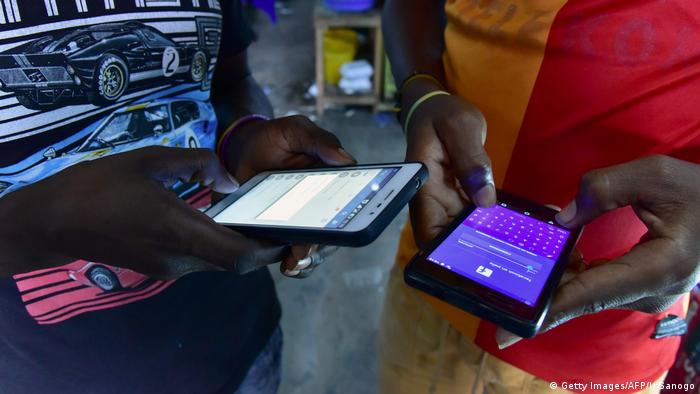
Customers surrounded Samuel Dagblo, a young teacher who doubles as a mobile phone money transfer agent in northern Ghana's Yunyoo farming community.

In this rural area which only recently gained access to cellular networks, people's lives are being rapidly transformed by internet connectivity.

Previously, people had to make do with weak network signals and, in some cases, needed to walk several kilometers just to make a phone call.

But a few weeks ago, authorities and telecom companies set up infrastructure to connect the region via a 4G broadband network.

"It's making things now easy, whoever comes, maximum, one minute, you are done with that person, and the person can go," Dagblo told DW. "Unlike those days [where] you can be [with] one person close to 10 minutes and getting to the end, the network will fail you, and you have to start all over again."

Nearby, a group of young people sat under a cashew tree using their phones. One of them, Musah Nangode, said he felt very excited about this new connectivity.

"We did not have this privilege others were enjoying in other districts," Nangode said, adding that they could not make calls, transact mobile money, or use WhatsApp and Twitter.

"We were just left out, which was a hell here," he added.


Broadening broadband

Ghana was among the first African countries to liberalize the telecommunications market in 1990. Two years later, the internet became accessible.

Today, nearly 70% of Ghana's 30 million people are mobile subscribers, according to the National Communications Authority (NCA).

In 2004, Ghana enacted an internet accelerating development program, which included laying fiber optic infrastructure. IT expert Amadu Samed Gaida said connectivity is crucial for empowering Africa's youth.

"That is where they will be able to learn beyond imagination," Gaida said.

"If you deprive them of the internet, you are definitely not empowering them. You can give them money, you can give them water, you can give them anything, but they will still lack the knowledge to make use of whatever you are giving them," Gaida told DW.

South Sudan's internet woes

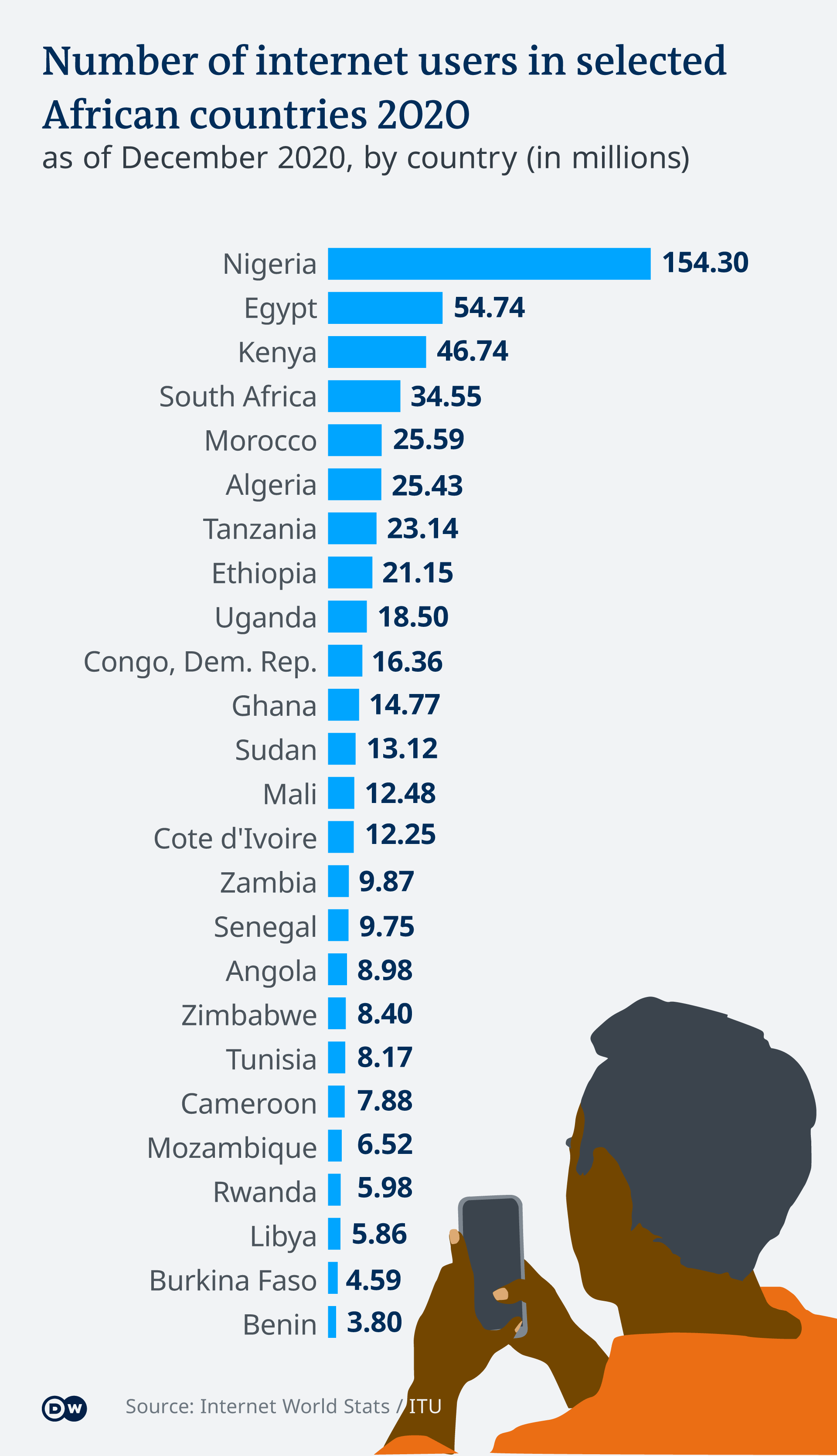
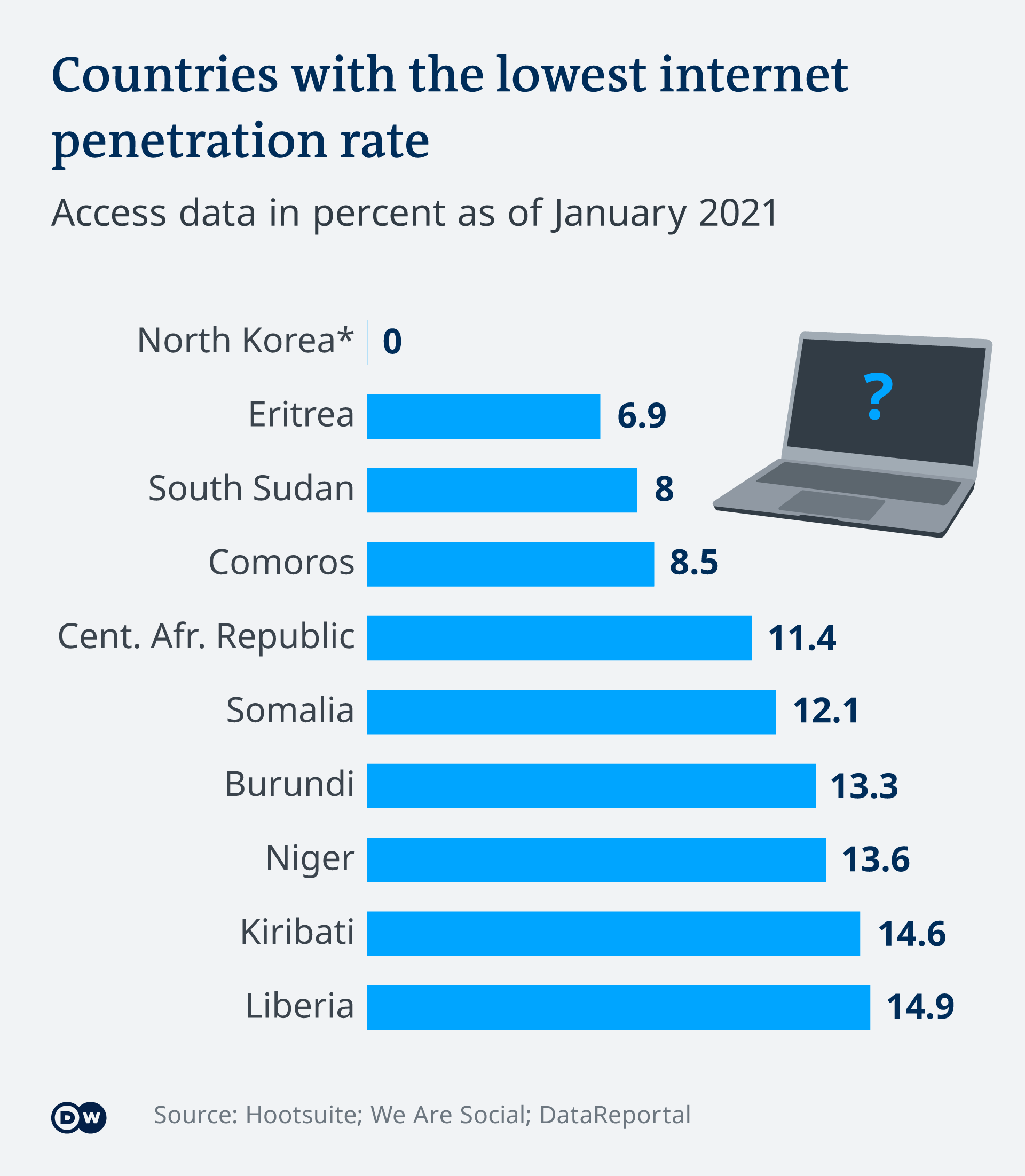
Whereas countries such as Ghana, Nigeria, South Africa and Kenya boast impressive internet penetration, South Sudan has an internet penetration rate of only 8% — one of the lowest in the continent.

Moreover, mobile network coverage is feeble in Africa's youngest nation.


Connecting to the internet in South Sudan can be frustrating

The number of mobile phone connections in South Sudan is equivalent to roughly 20% of the population, according to 2020 figures from DataReportal.

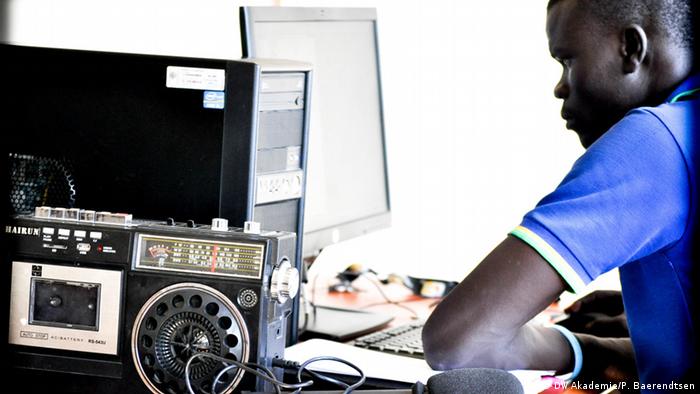
"It is very difficult in South Sudan to get in touch with our family members because we have the internet in South Sudan but it is not all that fast," Dedi Ezbon Samuel, a radio journalist in the capital, Juba, told DW. "Even in some parts of the country, we find there is no internet."

His frustrations are shared by Jimmy Alithum. The 45-year-old hardware businessman complained that the phone companies give way too little time on their data bundles.

"Sometimes when I am at home doing my research using my phone or my laptop, it is a little bit disturbing because you feel like the time given [by phone companies to browse] is not enough and you have spent a lot of money," he said.

"Most people are doing business online and maybe there is a picture of a certain item that is on display, you want to view and so you click on it, It takes so long and if you are in a hurry you cannot wait," Alithum said, adding that in the process he was using up data bundles.

"The government needs to address the issue of higher taxes," Robert Gama, an IT consultant based in Juba, told DW. "Companies tend to incur a lot of money on taxes, they also spend a lot of money on taxes on the importation of equipment and logistics."

Gama also highlighted the need to improve the country's infrastructure, such as roads and railway, as a means of accelerating internet penetration.

"Besides that, the issue of insecurity tends to make a lot of losses for internet and telecom companies in this country," he said.

South Sudan has been ravaged by internal power and ethnic strife since it gained independence from Sudan in 2011.
Billions needed to connect Africans

Over the past decade, African leaders working with various local and international partners have made great strides in making the internet accessible for the continent's 1.4 billion people.

But — with just 22% internet connectivity — the continent remains significantly behind other world regions.

IT experts have long argued that the cost of data is too high for most people. In addition, lack of digital skills and literacy remains a stumbling block for many, particularly those living in rural areas.


Africa will require an investment totaling $100 billion (€86 billion) to plug every citizen into the internet by 2030, according to a World Bank estimate.

"Let us be clear: No single actor will be able to meet Africa's 2030 target and carry the burden of a $100 billion investment funding requirement alone," Hafez Ghanem, the World Bank's vice president for Eastern and Southern Africa, said on the bank's website. He added that all stakeholders must strive to ensure that every African has affordable and reliable access to the internet.

In October, US tech giant Google announced that it intends to invest $1 billion in Africa over the next five years. The massive funds will ensure access to fast and affordable internet and support startups to aid the continent's digital transformation. Nigeria, Kenya, Ghana and Uganda will be the prime beneficiaries.

Abdul Rahaman Nayuni, from the Yunyoo community of northern Ghana, can attest to that.

"If you don't monitor the internet, you wouldn't know there is an opportunity somewhere. Now I can sit in my room every morning, go to the job opportunity platforms and see if anything is going on in Ghana," he said.


Maxwell Suuk and Waakhe Wudu Simon contributed to this article
Call for review of Thai royal insults law sparks rare debate


Pro-democracy rally in Bangkok

Panu Wongcha-um and Panarat Thepgumpanat
Fri, November 5, 2021

BANGKOK (Reuters) - Nine political parties in Thailand have taken a position on reform of a strict royal insults law in recent days, bringing into the mainstream a controversial debate that would have been unthinkable just a few years ago.

The catalyst for the discussion has been a youth-led anti-government protest movement that emerged late last year and openly called for a reform of the monarchy - a bold move in a country that traditionally upholds the king as semi-divine and above criticism.

Changing the lese majeste law, which carries punishments of up to 15 years in prison for each perceived insult of the monarchy, had been a subject off-limits for decades in Thailand, where the crown is officially above politics and constitutionally enshrined to be held in "revered worship".

But the opposition Pheu Thai party ignited discussion on the taboo topic this week, with major parties weighing in quickly after it proposed a parliamentary review of how it said the law was being used to prosecute scores of opponents of the royalist government.

Since the student protests began last year, at least 155 people, including 12 minors, have been charged with lese majeste, according to a tally compiled by the Thai Lawyers for Human Rights group.

"The lese majeste law has become a fault line in Thai politics. It was inevitable," said Thitinan Pongsudhirak, a political analyst at Chulalongkorn University.

"Moving forward, this will be the front-and-centre issue to decide Thailand's political future."

DESTRUCTIVE DEBATE?


The Pheu Thai party's call for a parliamentary review drew strong reaction among royalist conservatives.

Major parties in the ruling coalition issued their own statements objecting to amending the law, including Prime Minister Prayuth Chan-ocha, a former army chief.

"It's a security matter for our country," he said. "We do not want to destroy something that is revered by Thai people."

Prayuth's government has denied misusing the law. The palace, which has a longstanding policy of not commenting on the issue, could not be reached for comment.

Thailand's media has long self-censored on issues of the monarchy but in a rare move, Thursday's Bangkok Post newspaper carried an infographic of the major parties' positions on lese majeste, under the headline "to change or not to change".

Opposition parties Move Forward and the Seri Ruam Thai have also accused the government of abusing the royal law to go after opponents, and they called for punishments to be less severe.

In February, 44 Move Forward lawmakers sought a reduction in the maximum sentence from 15 years to one year, or a 300,000 baht ($8,982) fine, or both. Their effort was shot down by parliament, which said it was unconstitutional.

Stirring the debate too was influential tycoon and self-exiled former premier Thaksin Shinawatra, Pheu Thai's de facto founder. This week, Thaksin voiced his support for preserving a law that he himself has been accused of breaking, while calling for changes in how it was applied.

Political scientist Wanwichit Boonprong said a push for a review is unlikely to gain much traction in parliament, though it has forced other parties to take a firm position on one of the country's most sensitive issues.

But Piyabutr Saengkanokkul, secretary-general of the student-led progressive movement, a backer of the Move Forward party, said opposition efforts were not bold enough, and it was time to abolish the law altogether.

"The party needs to be avant garde," Piyabutr said on Twitter, adding Move Forward should be pressing a more progressive agenda.

(Reporting by Panu Wongcha-um and Panarat Thepgumpanat; Editing by Martin Petty and Mark Heinrich)
16 million student-loan borrowers could be facing 'millions of mistakes and problems' at the hands of new student-loan companies, Elizabeth Warren says


Ayelet Sheffey
Thu, November 4, 2021


Students toss their hats at Wesleyan University's commencement ceremony in 2018. Eduardo Munoz Alvarez/Getty Images


Three student-loan companies are shutting down federal services, impacting 16 million borrowers.


Elizabeth Warren joined six Democrats in requesting information from those companies on the transitions.


They noted that in the past, transitions have caused a number of mistakes that harmed borrowers.


Three student-loan companies announced they are shutting down their federal loan services at the end of this year, placing 16 million borrowers in the hands of new companies.

Seven Democrats, led by Massachusetts Sen. Elizabeth Warren, want to ensure those borrowers will not be harmed during the transition before student-loan payments resume in 90 days.

In letters to Navient, the Pennsylvania Higher Education Assistance Agency (PHEAA) and Granite State Management and Resources - the three companies ending their federal loan servicing - Warren and six other senators requested information on how each of the companies will ensure "a smooth transfer of tens of millions of borrowers' accounts to new student loan servicers."

"Student loan servicers have a long history of misleading borrowers about available options, mismanaging programs, and cheating borrowers out of protections developed to help them pay back their student loans," the lawmakers, including Massachusetts Sen. Ed Markey, wrote. "In previous transfers, failures to transfer complete and accurate information left hundreds of thousands of borrowers with account problems that continue to plague the federal loan portfolio today."

They added that during past servicer transitions, "millions of mistakes and problems" caused borrowers to face penalties due to servicer error in processing payments, and months of qualifying payments toward loan forgiveness programs, like Public Service Loan Forgiveness (PSLF) could be lost.

PHEAA manages the entire PSLF portfolio, holding millions of accounts for public servants such as teachers and police officers seeking loan forgiveness after ten years of qualifying payments. The lawmakers requested PHEAA provide them with information on how they plan to maintain borrowers' payment records and ensure they will be processed correctly, along with requests to all three companies on further information regarding the transition.

The Consumer Financial Protection Bureau (CFPB) has previously highlighted issues that could arise from servicer transitions, resulting in lost payments, surprise late fees, and processing problems. The lawmakers wrote that on top of the difficulties with the transition, the Education Department has the "unprecedented logistical challenge" of resuming student-loan payments for borrowers after a nearly two-year pandemic pause.

Despite the significant administrative burdens borrowers and loan companies could be facing, though, Warren has previously said that borrowers no longer having to pay their debt to Navient and PHEAA is a good thing.

She told Insider last month that the 6 million borrowers under Navient will be "far better off," citing the company's decades spent "misleading, cheating, and abusing student borrowers." Insider reported in April on the comprehensive history Warren has with Navient, most recently telling Navient's CEO, John Remondi, that he should be fired for the abuses that happened under his leadership.

She also said in June that the 8.5 million borrowers serviced by PHEAA could "breathe a sigh of relief" since they would no longer have to deal with the company that oversaw a 98% denial rate for PSLF, and Warren told Insider in a July interview that "the days are over" when student-loan companies could do "a terrible job."

But despite administrative burdens, an Education Department spokesperson told Insider after Navient announced plans to shut down that it still "expects" payments to resume on February 1, as planned.

"We will continue to work to ensure that all of our borrowers can experience a successful return to repayment," the spokesperson said. "The Department expects student loan payments to resume after Jan. 31, 2022."
Leukemia-Causing Benzene Found in Underarm Sprays

Anna Edney
Thu, November 4, 2021

(Bloomberg) -- Antiperspirant and deodorant body sprays have been found to contain elevated levels of the carcinogen benzene and should be recalled, an independent testing lab said in a petition filed with the U.S. Food and Drug Administration late Wednesday.

The sprays are the latest in a string of aerosol products found to contain the cancer-causing chemical, including sunscreens and antifungals. Earlier this year, Johnson & Johnson recalled certain aerosol sunscreen sprays under the brands Neutrogena and Aveeno. Beiersdorf AG recalled some Coppertone sunscreen sprays in September. The next month, Bayer AG pulled certain Lotrimin and Tinactin sprays used for athlete’s foot and jock itch after tests showed some samples contained benzene.

The efforts to get the contaminated products off of shelves came after Valisure, an independent testing lab in New Haven, Connecticut, alerted the FDA to its findings of benzene in sun-care products in May. Valisure followed up in recent months by testing 108 batches of antiperspirant and deodorant sprays from 30 brands and detected benzene in 59 batches at levels as much as triple the amount it found in sunscreens and detailed in the petition to the FDA.

Antiperspirant sprays from Procter & Gamble Co. brands Old Spice and Secret contained the highest levels of benzene. An antiperspirant spray from Walmart Inc.’s Equate brand and one from Unilever PLC’s Suave were also high on the list. Most of the sprays that Valisure found to contain benzene were meant only for underarms, though the lab did find some benzene in a Victoria’s Secret & Co. spray deodorant meant to be used all over the body and a Summer’s Eve spray from Prestige Consumer Healthcare Inc. meant for the vaginal area.

The companies and the FDA didn’t immediately respond to requests for comment. P&G fell 0.7% at 9:43 a.m. in New York trading, and Unilever dropped 1.1% in London.

Valisure found that products that contained butane were most likely to have elevated benzene levels. Those that used alcohol as a propellant instead were least likely to be contaminated with the carcinogen.

David Light, chief executive officer of Valisure, said he’s concerned the contamination may be coming from the raw materials companies use as propellants, such as butane and propane that are petroleum distillates produced by refining crude oil.

“Butane is lighter fluid,” Light said. “Propane is the same thing you use to light your grill. These gases come out of the ground, as benzene does as well. Benzene is a known contaminant of these products. It seems likely these propellants are the source.”

It’s difficult to track and ensure the purity of raw materials even in pharmaceutical products. Consumer goods, meanwhile, are more lightly regulated by the FDA. The pharmaceutical industry has been dealing with its own contamination problem related to probable carcinogens called nitrosamines and mutagenic impurities called azidos that have been found in drugs over the last few years stemming from side chemical reactions that are sometimes the result of raw materials that aren’t properly purified.

No Clear Threshold


The FDA doesn’t have a clear benzene threshold in products. Its guidance for drugs is that benzene levels can reach up to 2 parts per million only if its use in manufacturing is unavoidable for a product that represents a significant therapeutic advance. Valisure has asked the FDA to set clear benzene guidance.

Valisure found benzene levels up to almost 18 parts per million in the antiperspirant and deodorant sprays. Yale University’s Chemical and Biophysical Instrumentation Center confirmed the presence of benzene in a sampling of the sprays through separate tests. Valisure also found spray products that didn’t contain any detectable benzene, including a deodorant from Sanofi’s Gold Bond and antiperspirants from Unilever’s Axe and Degree.

Valisure first detected benzene in consumer products in March when it tested hand sanitizers. The benzene levels were particularly high in those that came on the market to fill a gap when supplies of the cleansers ran low at the start of the Covid-19 pandemic. It’s possible the benzene in hand sanitizers may have been introduced during the manufacturing process when germ-killing alcohol is purified. Alcohol is also sometimes used as a propellant in aerosols.

Artnaturals contained the highest levels of benzene Valisure found in hand sanitizers. The FDA said last month it tested Artnaturals hand sanitizers and also found benzene as well as other contaminants. The agency advised consumers in early October not to use any Artnaturals products. The company later announced a limited recall of hand sanitizers. The agency said it asked the company to conduct more testing to determine the scope of the contamination, adding that even after the recall, the scope is still under investigation.

(Updates share trading in fifth paragraph. An earlier version of this story corrected the spelling of P&G.)
Jeffrey Toobin: Rudy Giuliani’s Leaked Election-Fraud Deposition May Be ‘Disastrous’ for Fox News


Tony Maglio
Fri, November 5, 2021,

CNN has been having a field day with Rudy Giuliani’s deposition video cross-examining his claims of election tampering evidence, which included a purported trip in 2013/2014 by the heads of voting-systems companies Dominion and Smartmatic USA to Venezuela to participate in a “vote-fixing” meeting.

In the deposition, Giuliani said he was given that anecdotal — and since debunked — evidence about election fraud, a conspiracy theory that he reported during a press conference but never attempted to personally verify. The idea was to push the (conspiracy) theory that the 2020 U.S. presidential election was stolen from Donald Trump.

The press conference in question — and thus, Giuliani’s claims — was covered by several conservative news outlets, including Fox News.

Giuliani’s public and false accusation has led to numerous libel lawsuits: Dominion sued Giuliani for $1.3 billion dollars and Fox News for $1.6 billion. Smartmatic USA sued Fox News for $2.7 billion.

Fox News has filed to dismiss both lawsuits, at the time telling TheWrap: “Fox News Media is proud of our 2020 election coverage, which stands in the highest tradition of American journalism, and will vigorously defend against this baseless lawsuit in court.”

“Before the press conference, I was told about it,” Giuliani said of the Venezuela hearsay (and we’re being generous in using that term) in the deposition. “Sometimes I go and look myself online when stuff comes up. This time I didn’t have time to do it. It’s not my job in a fast-moving case to go out and investigate every piece of evidence that is given to me.”

“From America’s Mayor to Trump’s Stooge,” Chris Cuomo said of Giuliani on his Thursday night program, which re-aired the deposition video.

Attorney and CNN contributor Jeffrey Toobin also reveled in Giuliani’s floundering.

“In order to win a libel case like this, the plaintiffs have to show what’s called ‘reckless disregard for the truth,'” Toobin said. “That deposition to me looks like the definition of reckless disregard for the truth. The idea that you will go out in public and damage the reputation — as Giuliani clearly did — of these companies, without any sort of checking, without any sort of concern for whether what you’re saying is true, seems to me, clearly libelous.”

Toobin said he believes Giuliani is now “on the hook for millions of dollars.”

“I think these libel cases will be disastrous for him, and they may as well be disastrous for the media outlets, including Fox News, that put it on uncritically,” Toobin said.

Watch the video above. Toobin’s turn comes around the 5-minute mark.