Thursday, January 06, 2022


On Understanding Society

Fred Friendly interviews Walter Lippmann, America’s founding media critic

Context clues: In 1922, Walter Lippmann, known as the father of American journalism, wrote Public Opinion, on the subject of government, mass communication, and societal perceptions. Late in his life, during the Vietnam War, the book—and in particular Lippmann’s idea of “the manufacture of consent”—drew renewed interest. The following interview, with Fred Friendly, appeared in the Fall 1969 edition.

“For when there was panic in the air, with one crisis tripping over the heels of another, actual dangers mixed with imaginary scares, there is no chance at all for the constructive use of reasons, and any order soon seems preferable to any disorder.”

So wrote Walter Lippmann in Public Opinion in 1922.

Some weeks before his eightieth birthday, at the invitation of Prof. Fred W. Friendly of the Columbia Journalism faculty, Mr. Lippmann held a seminar with a small group of graduate students to discuss the contemporary applicability of this and other observations from his long and distinguished career. The text below is excerpted from the three-hour dialogue which resulted.


Public opinion has been the third force that really changed American policy on the Vietnam war. How did that come about?

Well, the war was very distant, nobody was interested in it, and the Johnson method of handling the war was to conceal it from the American people. In the first year of the fighting, this was the Johnson escalation, because before that it was not really a war in the sense that it is now. It was concealed by the fact that the Army which was sent to Vietnam to do the fighting was really a professional army. It was not a drafted army. What Johnson did was to cannibalize the American forces all over the world, and build up probably the best army the United States has had in the world. But that army could last only about a year, until its term expired. During the next year or two Johnson more and more couldn’t hide the fact that we were drafting men to fight that war.

Now, drafting men to fight a war 10,000 miles away is something that no sensible great power has ever attempted. The British, in all their period of imperial rule in the nineteenth century, never conscripted Englishmen to fight in Asia. They always relied on volunteers, professional soldiers, and on mercenaries. They hired the Indians, the Gurkhas; regiments of Iranians and other people from the Middle East, and so on; but there were no Englishmen conscripted to fight around the world. Johnson, who knows no history, didn’t realize what a thing he was doing when he began to conscript an army to fight a war that nobody believed in particularly anyway—nobody had ever had it explained to them, nobody could explain the reason for it—10,000 miles away. It was that that began to arouse the American people to realize what this was. And Johnson kept getting one general after another to come forward and say we were winning it when we were not winning it. Finally the Tet Offensive came, and he tried to get generals to say we would only take 35,000 men. But finally it was leaked out from Washington that Westmoreland wanted 206,000 men. And that figure broke Johnson’s back. That was when public opinion revolted. That’s why Johnson had to retire.

One of the reasons for all the turmoil in the country the last few years has been the feeling of a lot of young people that our governmental institutions are not responsive to the needs and feelings of the people. But apparently you do believe that at least in an informal way our government is responsive to public opinion?

Well, it’s responsive to the kind of thing that I was talking about, which is being for the war or against it. The fact that the country came to be against the war is very important. Whether you can get a public opinion sharpened and attuned and made accurate to more specific reforms, I’m not sure. And I think that one of the difficulties—the difficulty with television, the difficulty with this turmoil—is that you cannot refine public opinion and educate it to very detailed and complicated things. I don’t expect that any large audience, for instance, could ever really understand the problem of decentralizing the schools in New York City. I think it’s just too complicated and difficult. It just won’t catch in the net. So I don’t want to sound too optimistic about public opinion.

How many problems do you think this country can digest at one time without breaking at the seams? We have Vietnam, the cities, the race problem. Are these likely to create a permanent cleavage?

Well, that’s a problem I’ve been worried about all my life, but I have begun to realize, since I wrote Public Opinion and also while I was writing it, that the capacity of the general public—on which we’re dependent for votes—to take on many problems is very limited. I wrote a book called The Phantom Public [1925], arguing that really what public opinion in the end could do was to say yes or no. It couldn’t do anything very much more complicated than that. It couldn’t say three-quarters or five-sixths but not two-sevenths—it isn’t able to do that. That’s what a scientist has to do. That’s what an administrator has to do, what a public servant has to do. But public opinion as a mass can’t do that. And it’s one of the great unsolved problems of democracy: how are you going to make popular government—because it’s always going to be popular, in the sense of involving a great many people—how are you going to make that work in the face of the problems which have become infinitely complicated even in the last twenty years?

In that regard, how do you see the role of the mass media, if in fact public opinion is not responsive to very sophisticated and very subtle problems? Is the role of the media to oversimplify them in the hopes of mobilizing some force?

Well, undoubtedly the mass media oversimplify. The American people are very simplistic, they want to be told that things are absolute, that they’re black or white. They don’t want to be bothered very long.

So what should the mass media do?

That is the question, I admit, but first of all, I don’t know enough about the mass media. I know something about journalism, but I know very little about broadcasting. I listen to broadcast journalism, but for the news at night; I don’t get the news from it. I feel utterly dissatisfied almost always. Of course, I’m very interested to see a picture of something happening. That’s very interesting—a splashdown, that’s wonderful. But as for the problems which are very difficult, urban problems and all, you can’t find out about them. You can get a smell of them. You know a little bit about what they’re like, and then you can read about them, or somebody can lecture to you about them. But broadcast journalism has not only a terribly simplifying effect, but a distorting effect, I think, because it makes everything more dramatic than it should be, more interesting, more amusing. And the world of life isn’t that. It’s prosaic.

The current controversy over advertising of cigarettes seems to raise a central question about the relationship between public opinion and social policy. If the scientists and doctors who have no economic involvement in the industry are correct, and they seem to be, then there should be some public outcry about this; it’s not just a problem of public opinion’s not getting to the legislators.

But there’s a good deal of feeling. You see, this pressure has worked. Public opinion doesn’t always work through big mass meetings or demonstrations.

How much do you think public opinion has become synonymous with public relations?

Well, these professionals at public relations are too much for me. There is an awful manipulation of public opinion going on all the time, no doubt about it. It’s not the whole thing, though. Public relations was unable to do anything about the Vietnam war. They tried to. Johnson tried all the techniques he could to hide that war, and then to make it acceptable. And it didn’t work.

How is public opinion best measured? Is the Gallup Poll, for instance, an effective measure of public opinion?

The Gallup Poll is pretty good, if it’s very broadly taken. But 96.3 percent, that’s foolishness. The taxicab poll that most people take when they ride in a taxi and find out what the driver thinks—that has some validity. My wife comes home and tells me about the hairdressers and what they think. Very reactionary, I assure you. They’re afraid to go out at night.

If you’re a public man—say, a President or a candidate or a good journalist—you suddenly know what the public feeling is. Why did Johnson retire, do you think? He knew that he was beaten. And where did he get that? He got it from polls, a little bit, but mostly he just knew, as a public man very well trained in public affairs—he assumed it. I don’t think you can measure everything.

Public opinion isn’t instantaneous. You can’t take flashlights of public opinion and get it right every time. But a man like Johnson, who is made to hear an awful lot, and the representatives in Congress who are representative in the sense that they’re like the others—you talk to them and you know what people in his district are thinking or feeling, and what they’re prejudiced against or for.

You once wrote that the hardest thing to report is chaos, even evolving chaos. That was in 1922. Now, 1968 was a very chaotic year; how do you think journalism performed then?

Well, if I remember what I said in 1922, the world actually—and I think I used the phrase of William James—is a “blooming, buzzing confusion,” and the mind’s eye has to form a picture out of really a very chaotic thing. And that’s done by the creation of stereotypes, which are ways of looking at things; and then after a while when you have these, that’s all you see—what the stereotype says to you. That’s all that comes through.

Now, I think that today the good reporters, both electronic and newspaper, are much more sophisticated and educated men than reporters were in 1922 when I was writing. They’re much more aware of the dangers of superficiality and so on. And they strike me as extremely intelligent. I think on the whole 1968 left us rather confused. Everybody was confused, including the newspapermen, because they were dealing with a situation for which they had no preparation.

Does it seem to you that political writers of the country are swinging to the right? If so, how far to the right do you think they will go?

Well, there’s no doubt that—whether that’s age or personal ambition or what—men do that. It’s a rule any journalist would know: it’s always safer to be conservative than not. You’re much less on the defensive. You have much less to explain yourself for. The Left has recently done some very vicious things, I think. But on the whole, in the lifetime of most men who are now fifty or more, the Right is the one that’s done the vicious things. Fascism was very vicious. I don’t think anybody can predict how far it will go, because it’s action and reaction, how the Left acts and how the Right acts.

“Broadcast journalism has not only a terribly simplifying effect, but a distorting effect.”

How would you compare the social rebelliousness of the generation coming of age now with the social rebelliousness of the one that came of age immediately after World War I? And why, in the seven decades we have had in the century, have these two produced the greatest generation gaps, when they seem to be such dissimilar decades?

First, of course, there was rebellion and disillusion at the end of the First World War, and that produced the Twenties, in which a lot of the people who now are extremely Left just expatriated themselves. A whole colony formed in Paris of people who just couldn’t stand this country. It was too awful for them. Hemingway belonged to that generation, Archibald MacLeish belonged to it. But what is new that I never knew then is the violence and disruption. They were rebellious, they made speeches, they wrote books, but they didn’t come into the classroom and say, “By God, you’re not teaching what we like, you’re not going to teach.” That didn’t exist.

This man Herbert Marcuse has written a book, as you know, about the limits of toleration, and he doesn’t want to tolerate people who don’t agree with him. He says you mustn’t tolerate people who are wrong. Those are the people he doesn’t agree with. You mustn’t tolerate the Right or the middle, you must only tolerate the Left, and the Left must decide whom to tolerate. Now, that philosophy, that is new. That is a revival of a thing that started quite differently about the middle of the nineteenth century and became anarchism, with people like Bakunin, who was the great antagonist of Marx. Bakunin was a Russian nobleman who had a romantic view of the Russian serf, and if only he were in charge of things all evil would disappear from the world.

But it was an amiable and decent thing. It was impracticable, of course, and it disappeared, and now it has revived, and that is the significant and dangerous thing about the recent times. We saw it abroad. We saw it in Berkeley. We see it all around: this feeling that you must stop things from happening that you don’t agree with, and that liberalism is the great enemy.

But the power of the economic system is so vast, and yet so destructive and unaware of its destructiveness, that the people who see that power and that destructiveness are frustrated, and feel they can’t work within traditional lines to counter the power, and so the question really is: is the society capable of change?

It is changing all the time. It is changing much more rapidly than we know how to understand it. But can it be remade to your heart’s desire? I would say no, it cannot. And that isn’t because the Right is in control, it is because this is the way of life in which we are embedded. Just as primitive man was embedded in his system of tribes and so on, we’re embedded in this, and we can’t get out of it. It’s like jumping out of your skin.

It is possible that the rebellion of the young may be a product of technology’s getting out of our hands, so that we really have produced a generation that is more different from their parent generation than ever has been the case before. Could you point to a time in history, perhaps, when you believe the same thing happened?

I think you’re absolutely right, and I think it’s fundamental. The technological gap and the generation gap are the same thing. And the young people today are coming into a world for which there was no preparation in custom. There never was a world like this. Not that any revolutionist made it. It was created by technology and science. They don’t know what to do about it, and the older people don’t know what to do about it, either. They don’t understand it themselves. That is absolutely the core of our problems. How will we be able to create a capacity to govern this enormously new and enormously complicated and very rapidly changing social environment? That is the problem. And there’s no answer. We may not solve it in a generation. That’s the problem today. The revolutionary—all that business—is of no importance except as a byproduct of that.

Of course, one of the most revolutionary technological inventions of our time—much more revolutionary I think than people realize generally—is contraception: The Pill. It absolutely knocked the family to pieces. The old reasons for creating and holding families together have been knocked out by this technological interference in the relationship between procreation and sexual life. And that is felt everywhere. There’s no family, there’s no neighborhood, there are no clans.

But how do you get around the problem of being ruled by a generation brought up in a time of slower change? Really, the problem seems to be re-educating Congressmen and Senators and the like, and this is the media’s responsibility. But how do you get at them?

Well, this is an autobiography for me. I have lived through this. I feel it. I have felt it for years. And I have lived right in the midst of this change, never really understanding it very well and knowing I didn’t understand it very well, not knowing what to do about it. I don’t feel able to say what I’m going to tell a Congressman to do. I myself don’t know what to do. We might as well be honest about it with ourselves: we are not in a position yet to re-educate the masses because we don’t know what to teach them. And that is one of the critical conditions of our time.

Is it more important for us to educate the Congressmen or to educate the Middlewestern farmer?

First of all, it’s most important to educate ourselves. And that is really absolutely fundamental. We know what to do about a particular thing, but about the general situation we don’t know. And the fact that we don’t know is perhaps the beginning of wisdom. We’re going to have to create the general knowledge that we don’t know.

Has America ever needed a media watchdog more than now? Help us by joining CJR today.

Walter Lippmann was the the founding editor of The New Republic and the winner of two Pulitzer Prizes. He is considered a father of modern American journalism; his 1922 book Public Opinion was formative to the field of media studies. Lippmann died in 1974. Fred Friendly, a former president of CBS News, was a longtime professor at the Columbia Journalism School, where he helped establish the broadcast program. With Edward R. Murrow, he created See It Now, a show credited with changing the tide of public opinion on Senator Joseph McCarthy, leading to his fall from power. Friendly died in 1998.

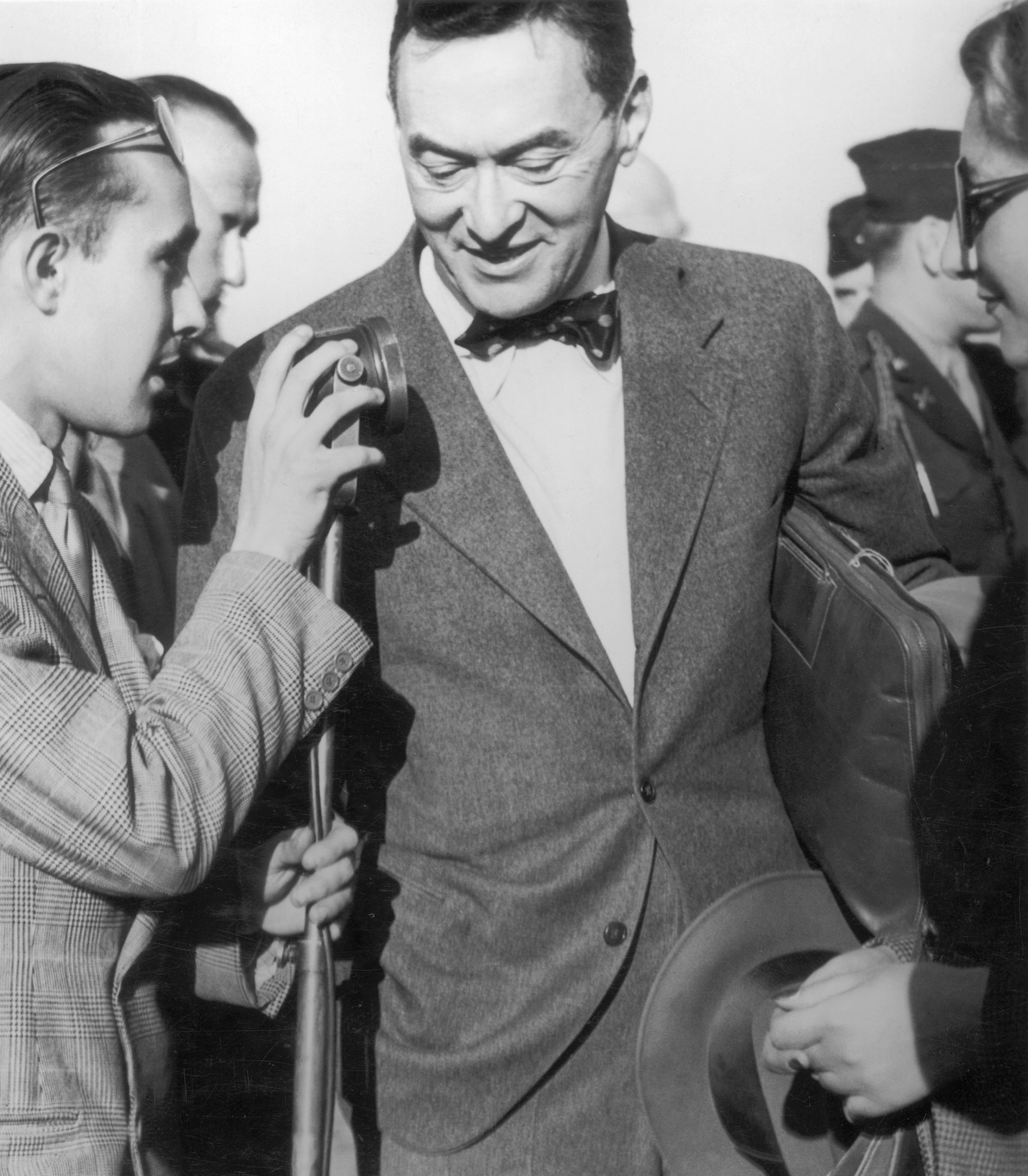
TOP IMAGE: WALTER LIPPMANN IN ITALY, APRIL 9, 1946; PHOTO BY KEYSTONE/GETTY IMAGES

Rare Wild Amur Tiger Spotted Walking in the Woods With Cubs

An Amur Tiger and her two baby cubs, estimated to be four or five months old, were caught on camera walking through the snowy woods in Russia. Amur Tigers, formerly known as Siberian Tigers, are the biggest cats in the world. They are extremely rare and considered an endangered species. Some experts estimate fewer than 500 of the animals remain in the wild, where Amur tigers can live for about 10 to 14 years.

UK
From Conrad’s Kurtz to Enoch Powell
Conservatism Takes a Dark Turn to the Past

Peter Jukes and Hardeep Matharu
23 December 2021
Enoch Powell in 1969. Photo: PA Images

Under Boris Johnson’s leadership, the Conservative Party has reversed half a century of attempts at post-imperial reform, and – regardless of whether the Prime Minister stays or goes – is now embarked on an ethno-nationalist, protectionist, statist project, with major institutional changes afoot, observe Peter Jukes and Hardeep Matharu

The 1899 novella Heart of Darkness by the Polish-born novelist Joseph Conrad laid bare the brutality of the colonial project of European powers in Africa – focusing on the fictional character of Kurtz, an ivory trader and post commander on the Congo River, driven into savagery: the coloniser devoured by the brutality racistly ascribed to the colonised.

The work inspired Francis Ford Coppola’s epic 1979 war movie, Apocalypse Now, exploring America’s own corruption by its neocolonial exploits in Vietnam and Cambodia in the 1970s. Marlon Brando brought to life the paranoia of Kurtz in his memorable portrayal, with the declaration to “exterminate the brutes!” and his dying words “the horror… the horror”, both of which appear in Conrad’s book.

In the original – based on Conrad’s own experience in colonial Africa – the disturbing story is recounted by a steamship captain who had navigated the Congo River, Charles Marlow, now moored up on a ship in the port of London. It ends on a sombre understanding that the Thames itself “seemed to lead into the heart of an immense darkness”. Both the film and book suggest that colonisers are changed by colonisation, just as much as the colonised – incorporating both the guilt and supremacy of an ‘empire state of mind’ into their psyches.

It is a dark current which still flows through British politics to this day.

Back in 1968, when the would-be Conservative leader Enoch Powell made his famous claim that racial resentment would destroy Britain and that he could see the River Tiber would be “foaming with much blood”, the Conservative Party was faced with another classic scene from Latin literature: a Rubicon.

Would post-Imperial Britain, having conquered a quarter of the world and helped during two world wars by colonial soldiers and workers to support it, instead turn on its new multi-ethnic citizenry back in the home country? Would the global colonial project turn into a domestic one – creating a racialised system of conflict, suppression and violence: from the enemies overseas to the enemies within?

Like Kurtz, Powell’s speech was full of psychological projection and the fear of retribution, as he predicts that the black man will have the “whip hand” in 50 years’ time over those who have “found themselves made strangers in their own country”. This is, of course, a reverse colonial mentality: having actually made people strangers in their own countries and exerting a very real whip hand, the coloniser feels that it will inevitably happen to him.

Powell’s doom-laden projection of racial warfare never came to fruition in 2018. But the underlying apocalypse needs no end date, and Powell’s “evil” genius (“evil” was how The Times described the watershed speech) was to make it a constant, future threat – one which is always around the corner; or on boats heading across the Channel.

From George Orwell to Priti Patel How Britain Brought its Colonial Policing Home

Hardeep Matharu and Peter Jukes


Brexit and Othering


Powell’s version of Britain was effectively suppressed within the Conservative party half a century ago. But, as Byline Times columnist Peter Oborne explained in an interview with Byline TV, “it’s very fascinating that that great historic battle which appeared to have been won by Edward Heath, has actually been won by Enoch Powell – through the medium of Boris Johnson”.

The seeds of Powell’s politics of othering were sown in Boris Johnson, Michael Gove and Dominic Cummings’ Vote Leave campaign during the 2016 Brexit referendum. Although they distanced themselves from Nigel Farage’s overtly racist ‘Breaking Point’ poster, they employed the same dog whistles by claiming significant numbers of Turks would be coming to Britain and that this, along with immigration from other countries in the Middle East, posed a terrorist threat. Many other variations from this playbook have been deployed by Johnson’s Government ever since.

Five years on, these seeds have flourished and spread. The Brexit vision – for all its claims to be about a ‘global’, outward-looking Britain – has crystallised into an ethno-nationalist project, predicated on the ‘threats’ from abroad and fifth columnists within.

Now the country has finally exited the EU, the attempts to blame ‘Brussels bureaucrats’ are harder to maintain – though various Conservative MPs and ministers attempt to blame perfidious France over fishing rights in the Channel. Though quick to summon up mythic images of Britain standing alone in World War Two, the Europeans don’t make good enemies these days. Through countless physical, economic and cultural ties, we are too close to them – and Johnson’s Britain has none of the economic power, or imperial hinterland, to genuinely go it alone. But the ethno-nationalist vision always requires barbarians at the gates – so new ones are needed.

In the first half of 2021, a major domestic front was also opened up with a ‘War on Woke’; a crusade to find enemies in culture and civil society. The campaign had limited success.

As that faltered, the Home Secretary opened up a new front, both in high profile PR campaigns and in legislation, against more easily demonised barbarians at the gates: ‘illegal migrants’ crossing the Channel in boats – even though the majority of them turn out to be genuine asylum seekers; among them the many abandoned by the UK’s peremptory evacuation of Afghanistan.

While Johnson constantly plays with the fires of division, it is the Home Secretary he has chosen – a daughter of immigrants and the granddaughter of refugees, Priti Patel – who is the figurehead feeding the flames. She presides over a hardline approach towards certain ‘bad’ and ‘undeserving’ immigrants – the same attitude that Enoch Powell and others expressed towards the Ugandan Asians welcomed to Britain by Ted Heath. For Powell, despite their British passports, Patel’s relatives weren’t really British and should have gone “back” to India. Despite this, his perpetual, future threat from ‘others’ is a key pillar of her department’s policies.

The dehumanisation of asylum seekers and the stoking of fears of being ‘swamped’ by immigrants is not unique to British politics, nor to Patel. It accelerated under the brief post-Brexit tenure of Theresa May as Prime Minister, when she made a distinction between those who ‘belonged’ and “citizens of nowhere” – be they feckless cosmopolitan elites or foreign marauders.

Almost inevitably, just as the versions of leaving the EU became more and more extreme, so has this othering of strangers – until Britain has become estranged from itself. The imagined porosity of our external borders has created new, hard internal borders – literally in the case of the Irish Sea and the transit of goods between Northern Ireland and the rest of the UK.

Resisting the threat of alien invasion has metastasized – as in the case of Shamima Begum – into a policy of removing the inalienable rights of British citizens. We are all potentially citizens of nowhere now.

Sado-Populism

The removal of historic citizenship rights is just one part of a spiral of escalation that acts out the often unconscious ethno-nationalist thinking behind the Vote Leave regime that took power in 2019. Nothing is enough for the world of Leave.

We were told we would remain close to Europe and stay in the single market or a customs union. But, at each stage, the rhetoric became more extreme until we achieved an ultra-hard Brexit, just short of a no ‘deal’.

The rupture with the EU became a rupture within the UK. Exiting the EU soon became an excuse to abandon our own traditions, with voter suppression measures to deter voting, neutering of the Electoral Commission, and two new bills on borders and policing removing ancient rights of identity and protest. Soon, Boris Johnson was not only promising to break international law over the Good Friday Agreement, but also unlawfully trying to usurp the sovereignty of Parliament by proroguing it.

A year into full withdrawal, the acceptance of – sometimes celebration of – the material economic harm of leaving the EU merely emphasises how Enoch Powell is a much more important influence on the Conservative Vote Leave Government than Adam Smith, Freidrich Hayek or the liberal or neoliberal thinkers who dominated the party for the past 40 years.

So important is the narrow ethno-nationalist project, Johnson’s Government is willing to abandon all the previous Thatcherite nostrums of small government, fiscal frugality, free trade and open markets. These days, Brexiters openly talk – in ‘sado-populist’ terms – about how leaving the EU must be costly, and only worth it because it hurts. We summon our sovereign pride by material suffering, and those sacrifices of trade, living standards and international connection, are like wafts of sacred incense around the altar of national purity.

And with that, the Vote Leave project will have achieved its hidden objective – and, like Conrad’s Kurtz – have left the norms and standards of the modern world.
UK
‘A Total Waste of Police Time’

Labour Rows Over Drugs Policy as Cannabis Offences Surge

John Lubbock
5 January 2022

London Mayor Sadiq Khan, Metropolitan Police Commissioner Cressida Dick, and Home Secretary Priti Patel. Photo: PA Images/Alamy

New data shows a mounting drugs problem in England and Wales, while Labour and the Conservatives remain committed to status quo solutions, reports John Lubbock

Total recorded drug offences increased in England and Wales by 19% from 2019/20 to 2020/21, with possession of cannabis recording a 21.5% increase, according to data from the Office for National Statistics (ONS) compiled in a new parliamentary report.

“The main drug offence recorded in 2020/21 was ‘possession of cannabis’ (63%), followed by ‘possession of controlled drugs (excluding cannabis)’ (18%), ‘trafficking in controlled drugs’ (18%),” the report states.

The statistics are increasingly relevant amid a disagreement between Labour Party Leader Keir Starmer and Labour Mayor of London Sadiq Khan, who is considering the effective decriminalisation of cannabis and other Class B drugs in a pilot scheme – employing a method known as ‘diversion’ – that will offer young people counselling or “speeding course-style” classes instead of prosecution.

As a Class B drug, the maximum prison sentence for possession of cannabis is currently five years.


14,900 penalty notices for disorder (PNDs) were issued in 2020/21, with possession of cannabis the second most common reason for a PND after a person being ‘drunk and disorderly’. 25% fewer PNDs were issued in 2020/21 than in 2019/20 and 60% fewer than five years ago.

However, while custodial sentences for most crimes have been falling for the past decade, a greater proportion of drug offences are receiving prison sentences.

According to the parliamentary report, between 2008/09 and 2019/20, the proportion of drug offenders receiving a caution fell from 46% to 30%, while the proportion receiving a custodial sentence increased from 9% to 16%. This goes against the general trend for all offences whereby the number of people sentenced immediately to prison is falling.

Average prison sentences for drug offences have also risen. The average sentence for drug trafficking in 2020 was 43.6 months, compared to 3.9 months for possession offences, according to the report. In 2012, 25% of drug offences resulted in prison time of at least three years – which increased to 40% in 2020.

The report also notes that on 30 June 2021, there were just under 14,000 people in prison for drug offences – 16% of the overall prison population. As reported by the Guardian in 2020, “people from Asian and other minority ethnic groups are 1.5 times more likely to go to prison for drugs offences than white people”.

While convictions for drug offences have been increasing, convictions for common assault have been falling since 2015, and only 1.6% of the 50,210 reported rape cases in England and Wales in 2020 led to a conviction.

Statistics also show worsening health outcomes for drug users.

“The number of deaths related to drug poisoning have increased year on year from 2,652 in 2011 to 4,561 in 2020,” the report states. “This represents a 72% increase. 2020 saw a 4% increase in deaths compared to 2019.” Drug misuse accounted for 13% of accidental deaths in 2020.


Old Thinking

These statistics suggest that current drugs policy is not working and contradict the official stance of the Labour Party.

Keir Starmer told journalists at a press conference yesterday: “I’m not in favour of us changing the law or decriminalisation, and I’m very clear about that… I’m not in favour of changing drugs laws.”

The Prime Minister’s spokesperson agreed, saying that “decriminalisation would leave organised criminals in control while risking an increase in drug use, which drives a climate of violence”.

But organised crime is already in control of the illegal drugs trade and reported use of drugs in the UK has been rising since 2013.

According to the ONS, “following a period of falls between year ending December 1995 and year ending March 2013, there was a change in the trend. Between the year ending March 2013 and March 2020, the proportion of adults reporting any drug use in the last year has increased by 15% (16- to 59-year-olds) and 28% (16- to 24-year-olds) respectively”.

Ant Lehane, of the Labour Campaign for Drug Policy Reform, told Byline Times: “As many Labour councils move towards diversionary measures which save police time and reduce reoffending, it is shameful that the Home Office has overseen an increase of over 20% for simple cannabis possession offences.

“This is a total waste of police time, and will place further strain on the criminal justice system which has been decimated by the Tories. It’s time for bold measures such as full decriminalisation. Instead, we are stuck with a Prime Minister who dresses up as a police officer to seem ‘tough on crime’.”


DAVID LAMMY ‘Young People are Dying On Our Streets– We Need to Get On with Legalising Cannabis’


But senior figures in the Conservative and Labour parties currently refuse to treat drug misuse as a health rather than a criminal problem. This is despite polling which shows that the British public has been growing increasingly open to the idea of liberalising drug laws.

According to a 2018 YouGov poll, 43% support legalisation and 41% oppose it, while the remaining 15% don’t know. Another poll in 2019 showed 48% support for legalisation for recreational drug use and 77% support for legalising medical cannabis.

The UK is actually the world’s biggest producer of medical cannabis for export to other countries, but it remains illegal in the UK. A private members’ bill has been put before Parliament which would legalise medical cannabis, proposed by MP Jeff Smith, leader of the Labour Campaign for Drug Policy Reform, but the bill has little realistic chance of passing.

A Home Office spokesperson told Byline Times that “the Government has no plans to decriminalise harmful drugs” and that Sadiq Khan “has no powers to do so and the police are always expected to uphold and enforce the law”.

“Decriminalising drugs would lead to lawlessness and hand over control of our communities to organised criminals, pushing up serious violence and its corrosive impact on mainly young black men in London,” they added.
UK
‘Refugees and Migrants Do Not Come From a Different World’
Malka Al-Haddad
5 January 2022
The cover of 'The Other Side of Hope'

Malka Al-Haddad introduces a new magazine aiming to challenge stereotypes about refugees and migrants by showcasing their writing and editing and building a ‘bridge’ of understanding

The Other Side of Hope: Journeys in Refugee and Immigrant Literature is a new literary journal edited by immigrants and refugees based in the UK. The magazine seeks to break down stereotypes about migrants and refugees by showcasing their writing and aims to support those careers that may have been cut short because of exile and migration.

It was created because there is no other similar literary magazine in the country. This type of publication should have happened years ago but because it didn’t, we made it happen. Arts Council England funded us and we are supported by Journeys Festival International.

As immigrant editors, we believe that people need to understand each other, and this magazine exists to enable people to gain insights into us – our lives, our talents and our stories. It aims to be a bridge that will bring us closer through literature, and we want it to become a home for refugee and immigrant writers of fiction, non-fiction and poetry, and for those writers who know about us and want to support us.

Our first print and online issues have now been published. The annual print issue is available to buy from our website and the online version is free to read.

So far, we have published work from 120 refugee and immigrant writers from across the world in the genres of fiction and poetry, as well as non-fiction, book reviews and author interviews on the theme of migration.

This magazine is hugely important because it provides the opportunity to hear the voices of refugees and migrants, and for them to exhibit their literary and artistic talents in describing their experiences and telling their stories. It is an opportunity to build bridges with others who do not know about the experiences of refugees and are unaware of the wealth of talent within immigrant communities.

It is important to unite people through the literary cultures of the world because we live in a world of division and distance from others. We extend a message of love and understanding to others – our world needs cultural exchange, people need to listen to each other and learn what is good in each other’s cultures.

We hope this magazine will go some way to achieving this. It is an opportunity to love each other, acknowledge each other and understand each other, so that our world can one day live in peace.

We are exhausted by wars and conflicts, and we must stop the madness of hatred and the madness of racism, because continuing the cycle of war and conflict will bring destruction to all. We must unite for peace and live in harmony, understanding and acceptance of each other.

We are refugees and immigrants, we did not come from a different world.

Malka Al-Haddad is the poetry editor of the ‘Other Side of Hope’

Hardeep Matharu speaks to Romanian-born Labour county councillor Dr Alex Bulat about damaging political narratives around migration, the insidious nature of British prejudice and why she has always felt more at home in the UK
Labour Cambridgeshire county councillor Dr Alex Bulat. Photo: Dr Alex Bulat

People with negative views towards migrants should put themselves in their shoes and ask themselves how they would feel if British people studying and working in other parts of Europe were scapegoated and stereotyped by politicians, the press and public, a Romanian-born Cambridge county councillor has told Byline Times.

Dr Alex Bulat first came to the UK aged three for seven months when her father – at that time a junior doctor – was invited to work in an NHS hospital in Leeds.

Having moved back here to study aged 18, she is now a Labour representative on Cambridgeshire County Council, as well as the co-founder of Migrants4Labour group and the co-chair of the Young Europeans Network at the 3 Million – a campaigning group to protect pre-Brexit rights for EU citizens.

Speaking to Byline Times, she said that one of the key aspects missing from politicised debates about migration – which could challenge people to reconsider their negative views in a constructive way – is people “seeing themselves in that situation”.

“Would they say similarly about British people living, working and studying in Spain?,” she asked. “What if the Spanish Government said those same horrible things about British people. Would they be happy? Of course not – therefore we’re not happy that those things are said about Romanians in the UK.”

Although Dr Bulat was very young when she first came to Britain, she said she always had a sense of wanting to return because of her early memories of the UK being “very welcoming”, diverse and “tolerant” – a view she admits has been “challenged at various points in my journey later on”.

“When I came here as a child, I didn’t really know anyone, I couldn’t really communicate for the first days,” she told Byline Times. “But all the children were really welcoming and we all made very good friends. I had this impression of the UK as being a very welcoming place, which was also a very multi-ethnic group.

“I grew up in a very white Romanian area and the only people who were migrants were the students who came for medical school from Turkey, Greece and other nearby countries. So, I didn’t grow up in a multicultural environment but that’s what I liked about the UK – a very tolerant country, which welcomes all cultures. So, I had only a completely positive image of the UK as a country.”
Why Did Asian Immigrants Vote to Leave the EU?
Hardeep Matharu

In 2012, aged 18, she moved to the UK to study a sociology and media studies degree at Sussex University. She then went on to complete a Master’s degree at Cambridge University and a PhD at University College London on political sociology and migration studies. Brexit and the weaponisation of migration – now a central pillar in the Vote Leave Government’s ‘culture war’ agenda – has served as the backdrop of her time in the UK.

Politically disengaged when she arrived, Dr Bulat said that changed when debates around the 2016 EU Referendum started. “It was the first moment when I realised that decisions in this country will affect me directly – if the vote goes to leave the EU then this will ultimately affect my rights in the country so I should pay attention to politics,” she said.

After the referendum result, she volunteered to advise Romanian migrants in the UK about their rights, at a time people were “scared”, “confused” and didn’t know what to do.

“One of the things I will always remember was that I was watching the referendum results on the TV in college with other students and one of my French colleagues said – after we found out the result – that it was the first time she felt like a migrant in the UK,” she told Byline Times. “I asked her ‘what do you mean?’ because I always felt as such or I have been made to feel as such.”

The 27-year-old said that the reaction to her presence in the UK has always been mixed and that this didn’t really change with the EU Referendum.

“In my first months in the UK, I do remember people asking me where am I from and some people would be ‘lovely, I’ve been to Romania’ or ‘I have Romanian friends’, but some people were quite negative,” she said. “They were saying the usual stereotypes about coming here to steal jobs or benefits or Romanians being criminals or negative views about the Romanian Roma community. It was not that I was always perceived as positive and then Brexit happened and, suddenly, I became this undesirable migrant.

“But I also speak from the perspective of a Romanian and Romanians have always had quite a negative image in the UK. The worst moment for me was actually 2014 because Romanians were suddenly given full rights to work in the UK and I remember all the tabloid media – especially on the right like the Daily Mail, Daily Express and so on – having the big headlines about ‘millions of Romanians invading the UK, coming to flood the job market’.”

She said that it took her time to understand the under-the-surface, insidious nature of prejudice which operates in Britain, whereby “some people have negative views towards migrants but they didn’t express them openly”, and believes that “Brexit often offered a platform for some people to express them more openly”.

“Growing up in Romania, some of my neighbours and people quite close to me, had negative views about migration and I grew up in quite a monocultural society,” she said. “So often you hear quite xenophobic or racist views but in Romania they were always, always expressed very openly without any shame. So then people could say ‘that’s wrong’ or debate it, but it was never hidden.

“And that’s what I realised [in the UK] when I was in conversations where people were like ‘it’s not about you, you’re okay, you’re studying, I’m not racist, it’s the others’ and I realised that there was something, culturally, I hadn’t understood before. The more I lived in the UK, the more I understood the nuances of this. When I arrived here, I thought if no one says anything negative to my face it means they’re okay with me, but that’s not always the case.”

Putting party politics aside, what she finds most upsetting about the leadership of the likes of Boris Johnson, Priti Patel and Michael Gove is their detachment from the impact of their decisions on real people’s lives. For her, one example of this was their promise, before the 2016 referendum, that the rights of EU citizens in the UK would be secure – before later announcing that they would need to apply for settled status. Another is Boris Johnson not knowing that most migrants have ‘no recourse to public funds’ and therefore cannot claim benefits.

“A lot of the people in power in government right now are not interested in, let alone have, that lived experience,” Dr Bulat told Byline Times. “They don’t actually listen to the people who are affected by their policies. A hostile policy gets created but then a lot of the people involved have no idea how it will impact people on a day-to-day basis. It is disappointing to see people in politics who are very far removed from the realities.”

This is why she entered politics – to get issues such as immigration, from the viewpoint of migrants, on the agenda. “If you don’t have those voices in politics, change will be very, very slow,” she added.
Hardeep Matharu explores Priti Patel’s hardline approach towards other immigrants on Byline TV

The response to her political role has been mainly positive. “I never encountered anyone questioning my right to stand for election, my accent or where I’m from,” she said. “But I represent an area in Cambridge which is a very multicultural city, it is very different politically from the rest of the country.”

Online, Dr Bulat finds it’s a different story. “I encounter a lot of racist, xenophobic comments online. The classic ‘why should you have the right to stand for office when you weren’t born in the UK?’ or ‘obviously she wants to be in politics to bring more migrants in’ to just very personal, negative comments about me as a person. When people are not in front of you, and don’t have to say those things to your face, I think that makes a difference.”

One of the main narratives on migration in Britain, according to the councillor, is that migrants will be tolerated rather than welcomed. Even during the Coronavirus crisis, she says, a political choice was made to side-line their contributions.

“A lot of the press debate is ‘well, of course we want doctors and nurses and students – we just don’t want those low-skilled migrants’,” she told Byline Times. “And we have seen how this completely shifted in COVID times, when so many of our politicians suddenly realised that, actually, our hospitals can’t function without doctors, but they also can’t function without cleaners. So, the previously low-skilled, low-paid, undesirable people became the ‘key workers’ – but we still don’t hear a lot about migrant key workers.”

Having obtained settle status, Dr Bulat is also now a British citizen. When she first told friends she was applying for it, some of them asked her: “Why would you want to be a citizen of a country that treats migrants so badly?” But she sees her identity as very much connected to Britain.

“For me, it’s not only a practicality – you feel safer with citizenship – although I’m not so sure with this Borders and Nationality Bill now, but I genuinely consider myself part of the UK and having both British and Romanian citizenship reflects my identity,” she said.

“Growing up in Romania, I never particularly felt attached to a certain nationality. I’m not the person who follows all the Romanian traditions. I do post a message for the Romanian national day and so on, but I’m not the person who eats the traditional food and participates in all the Romanian events and celebrations. I was a bit remote from that even growing up. I felt differently from how my other colleagues or friends did.

“When I moved here, I came with the intention to move permanently. I think this does shape your identity. Because if you come with the intention of ‘this is the country I chose to live in and I will do everything possible to stay here and build my life and career here’, then everything works along those lines.

“All of my life is here. I’ve never worked in Romania, ever. So, if someone said to go theI would really struggle.”

Donald Trump’s supporters couldn’t overturn the election, but they still might destroy America

WASHINGTON—A year ago on Capitol Hill, it felt like the end of something. Or of some things.

The long, unbroken tradition of the peaceful transfer of power that George Washington invented and Ronald Reagan had memorably bragged was central to America’s greatness was an obvious casualty amid the violence and chaos and screaming lunatic weirdness of Jan. 6, 2021. And with it, maybe, the smug sense of exceptionalism that has long made Americans so certain that their democracy could never be seriously threatened by wannabe strongmen and the mobs they inspire.

But as the riot ended, it felt like the end of still more than that. As the tear gas and smoke bombs dissipated, the riot put down, the insurrectionists dispersed and Congress resumed its historic business of certifying the election, a fever seemed to have broken. A kind of twisted, howling madness that had gripped American politics through the vector of Donald Trump’s takeover of the Republican Party — a stew of white resentment, cartoonish conspiracy theories and thuggishly authoritarian impulses — had shown what it was capable of becoming: not just a personality-driven political phenomenon, but an actual threat to American democracy.

It was, essentially, what Trump and his supporters had been promising, fairly plainly and for a long time. Many observers — including me — had written commentaries that wondered if something like this was coming. Like so many unprecedented episodes of Trump’s presidency, you could say it was shocking without really being surprising to anyone who had been paying attention. But a lot of Americans — including those long rumoured to be ready to act as “guard rails,” the figures of the centrist and Republican establishment leadership — had steadfastly refused to pay attention, dismissing talk of a threat to democratic traditions as fantastical products of “Trump derangement syndrome.”

The deranged scene Trump brought to the Capitol on Jan. 6 seemed to dispel such casual dismissals. Trump’s vice-president, Mike Pence, made a show of carrying on the vote certification that very night. Longtime Trump sycophants like Sen. Lindsay Graham said they were through. Sen. Mitch McConnell publicly blamed the outgoing president.

Trump was kicked off of Twitter as corporate donors abandoned Republicans. There was a wave of panicked or disgusted resignations from the White House. There was a second impeachment on the way, and the sense that McConnell and his caucus might actually vote to convict this time. A new president was on the way in, promising the nominally modest but still far-off goal of normalcy.

At the time, it felt like history’s page was turning, that a bizarre and scary chapter full of dangerous portents was ending.

With the benefit of a year’s hindsight, it’s fair to say that didn’t turn out to the be case.

The next pages may have begun a new chapter, but they largely continued the same plot lines on a similar trajectory, and the portents of danger seem more menacing than ever. I am currently reading two much-discussed books released this week — about which I’ll write more soon — with the words “civil war” in their titles, each weighing the likelihood of the U.S. descending into such a conflict. They capture the zeitgeist: in an Axios/Momentive poll released this week, a majority of Americans say the country is more divided than ever before — and 57 per cent think more events like the Capitol riot are likely to happen soon.

But here is one of the most telling results of that poll: one year after Jan. 6, 2021, only 55 per cent of Americans believe President Joe Biden legitimately won the election. That is depressingly close to the percentage of voters (51.3) who voted for Biden. Trump’s big lie, the one that inspired the insurrectionist assault on the Capitol a year ago, has prevailed against all evidence for a huge chunk of the public, including the roughly 75 per cent of Republicans who doubt the legitimacy of Biden’s presidency.

Trump himself has recast the Capitol riot as a glorious protest against the “real insurrection” that he says happened on election day, and has portrayed the rioters as martyrs and political prisoners. Most of the Republicans who seemed ready to abandon him in the aftermath of the Capitol storming have either come back to his side or fallen silent. Those like Liz Cheney and Adam Kinzinger, who serve on the House of Representatives’ Jan. 6 commission and refuse to stop speaking about the danger of Trump’s culpability for that day, have been essentially exiled from the party.

As much as — or perhaps even more than—before, it is Trump’s party.

Moreover, Republican-led state governments have been rewriting rules to further ensure majorities for themselves, to restrict voting in ways that seem likely to suppress Democratic constituencies, and to give partisan political figures power over federal election results and the authority to overturn them. Election authorities who stood up to Trump’s attempts to fraudulently overturn his election loss are being hounded out of office and replaced by Trump loyalists.

A year ago, as I stood on the Capitol steps while the rioters rampaged, one of them said, “This could be the start of something.” Another replied, “Oh, it is. Today changes everything.” I wrote then that the change might be different than what they were expecting, that it might be the end of the indulgence of Trump.

One year later, it seems like the rioters were right. Their message has been embraced by many Americans, and their larger goals are now being pursued by other means. Their attack on the Capitol wasn’t the end of their attack on American democracy. And so the insurrection continues.


Opinion: The false prophets who inspired the violence on Jan. 6


By Joe ScarboroughColumnist
Today at 5:57 p.m. EST


My grandmother’s faith in God sustained her as she struggled to raise her family through the Great Depression, said goodbye to her teenage son as he left for World War II and buried her husband a decade later.

The sounds of Billy Graham’s crusades would fill my grandmom’s Georgia home in the 1970s. A decade later, Jim and Tammy Faye Bakker’s “PTL Club” would win her loyalty, as well as her monthly tithes. My parents gently tried warning her that the “PTL” stars were scam artists less interested in her spiritual welfare than in her monthly Social Security checks. Even after being treated rudely by Tammy Faye in a chance encounter, Grandmom kept sending money the Bakkers’ way as they built their empire on the backs of working-class Christians. The dreadful pair’s get-rich schemes leveraged Americans’ love of God for cold, hard cash.

Looking back on the events of Jan. 6, perhaps we should focus more on the false prophets who inspired the violence of that day than the rioters we still highlight on video loops.

Those who beat cops with American flags should serve long jail sentences. But the most important lesson from that tragic day may come from deconstructing how plutocrats and trust-fund babies deployed propaganda campaigns to push that bloodthirsty mob up the Capitol steps.

The “big lie” bloodletting happened at the behest of a slumlord’s son, who inherited more than $400 million and used his presidency to undermine citizens’ faith in their country. His anti-American poison was spread through the arteries of one foreign family’s media empire and soon metastasized across the American heartland.

Just as the Bakkers used the Gospel of Jesus Christ to prey on gullible viewers, these right-wing billionaires and their allies are trying to brainwash millions of Americans into believing the U.S. government is deploying Afghanistan War helicopters to launch domestic attacks against them, that the FBI is purging patriots from society and that the “deep state” staged the Jan. 6 riot as a “false flag” to strip citizens of their constitutional rights.

These hate-filled hysterics spewed against the United States have been punctuated by verbal assaults targeting military heroes, the slandering of the U.S. intelligence community and a barrage of fire against the nation’s democratic voting system that would make Vladimir Putin blush with pride. These are the kind of anti-American screeds that fueled the Capitol riot, and they have been preached with increasing intensity since that tragic day.

The targets of their misinformation campaign now await trial or languish in jail while the authors of these phony crises sleep comfortably in their marbled mansions and beachside resorts. They are free to travel the world on their super yachts or private jets while Jan. 6 defendants beg for their freedom in federal court.

What a dichotomy between these plutocrats and the working-class populists they duped into doing their bidding on Jan. 6. The divide between the propaganda they preach and the policies they pursue has become just as stark over the past two decades. Republicans have spent the 21st century embracing a populist brand while tailoring their policies to help the super rich. The result has helped drive perhaps the greatest wealth redistribution in world history, at the expense of the middle class.


Maybe that explains why every Republican presidential nominee this century has come from the United States’ most powerful families and graduated from the country’s most elite universities. Their fathers ran automobile companies, Midwest industrial states, the United States Navy, New York real estate empires and the country itself. I can hear the voice of my grandmom saying, “To whom much is given, much is expected.” While we have not inherited the wealth and power of these American oligarchs, we have been given a republic. Let us spend the next year doing what we can to save it.


Opinion by Joe ScarboroughJoe Scarborough, a former Republican congressman from Florida, hosts the MSNBC show “Morning Joe." Twitter
Parents Spent More Time With Kids During Pandemic But Stress Was High, Census Survey Shows

BY AYUMI DAVIS ON 1/5/22

A new survey from the U.S. Census Bureau indicated that while parents spent more time with their children during the pandemic, stress was high.

"Families knew before the pandemic that they were overstressed. Kids had so many places to be. Parents were juggling an awful lot," said Roma Walsh, co-director of the Chicago Center for Family Health at the University of Chicago, in a phone interview, according to The Associated Press. "The pandemic made people not go to work, and our kids were home. It really helped parents to say, 'Hey, wait a minute. We are able to have real family time together that we weren't before.'"

The Survey of Income and Program Participation's findings were based on interviews with one parent from 22,000 households within the first four months of the pandemic in the U.S.

The Census Bureau released a report on the survey this week in which they noted that a large number of people did not respond to the survey. In addition, many of the parents in the survey were older, married, educated, foreign-born, and above the poverty level, compared to years past.

The survey did not measure the long-term effects of the pandemic, so it's unclear if the parents continued to spend more time with their children.

The survey discovered that the percentage of meals parents shared with their kids increased from 84 percent to 85 percent from 2018 to 2020 for "reference parents." For other parents, their proportion of meals shared with kids went up from 56 percent to 63 percent, the survey showed.

The pandemic also taxed many families. Job losses, financial worries, social isolation, the death of loved ones, virtual learning, and childcare and elder care demands hit hard, Walsh said, AP reported

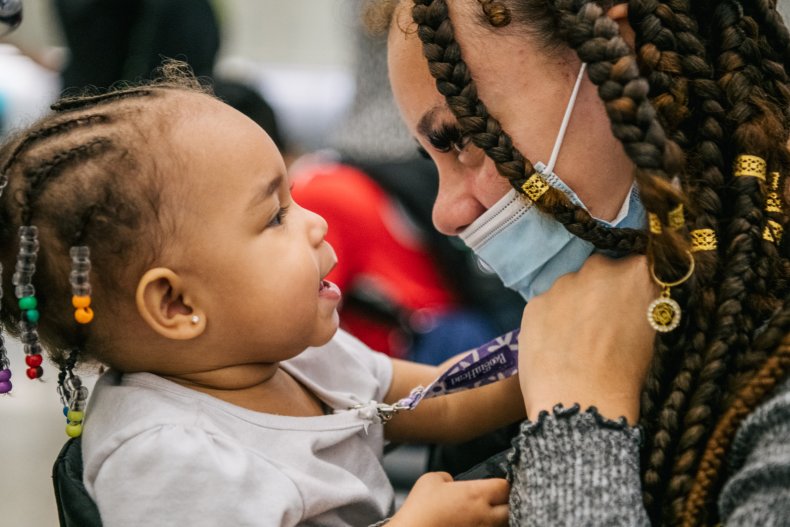
The Survey of Income and Program Participation’s findings were based on interviews with one parent from 22,000 households within the first four months of the pandemic in the U.S. Here, Karen Albicy bonds with her daughter Kaia while waiting for her PCR test to process at George Bush Intercontinental Airport on December 3, 2021, in Houston, Texas.
BRANDON BELL/GETTY IMAGES

During the first several months of the pandemic in the U.S., Dina Levy made her young daughter and son go on walks with her three times a day.

They kicked a soccer ball around at the nearby high school. The children, then 11 and 8, created an obstacle course out of chalk and the three timed each other running through it. They also ate all their meals together.

Levy is among scores of parents who indicated in a new survey from the U.S. Census Bureau that they spent more time eating, reading and playing with their children from March to June 2020, when coronavirus-lockdowns were at their most intense, than they had in previous years.

"With school and work, you split up and go your own way for the day, but during coronavirus, we were a unit," said Levy, an attorney who lives in New Jersey. "It really was, I don't want to say worthwhile since this pandemic has been so awful for so many people, but there was a lot of value to us as a family."

The report found that outings with children decreased for parents because of travel restrictions and lockdowns, dropping from 85 percent in 2018 and 87 percent in 2019 to 82 percent in 2020. The drop was starkest for solo parents, going from 86 percent in 2019 to 75 percent in 2020, according to the survey.

"The key point is families have experienced extreme stress and strain over the course of this prolonged pandemic," Walsh said. She said her research showed that families do best when they share positive values, take a creative approach to problem-solving, and have the flexibility to adapt.

"Those families that can pull together and practice resilience are doing well, and it actually strengthens their bonds," she said.

That was certainly the case for Eugene Brusilovskiy, a statistician living in suburban Philadelphia. He said the pandemic allowed him to be with his daughter, who was born during the early months of the virus's spread. Since he was working from home, he and his wife decided not to put her in day care as originally planned.

"I was involved in every routine, everything from feeding her to changing her diapers," Brusilovskiy said. "I was able to spend real quality time, to go on walks and watch all of those first milestones that I wouldn't have been able to do otherwise."

Although many people are limiting their activities now with the Omicron-driven resurgence of the coronavirus, it's possible that once schools reopened in 2021 and kids returned to their extracurricular pursuits, parents fell back into earlier habits, said Melissa Milkie, a University of Toronto sociologist.

"Still, some families might have experienced eating more dinners together and reading as something they pushed to 'keep' even beyond those early months of the pandemic," Milkie said.


For Levy, the downside of all the meals with her kids was the intense cleanup.

"It drove me crazy," she said. "It was tons and tons of dirty dishes."

Still, that wasn't enough to diminish the once-in-a-lifetime sense of togetherness she was able to forge with her children.

"It was time we had never spent together," Levy said, "and probably never will again."

The Associated Press contributed to this report.

The Heat: U.S. reports 1 million covid cases in a single day


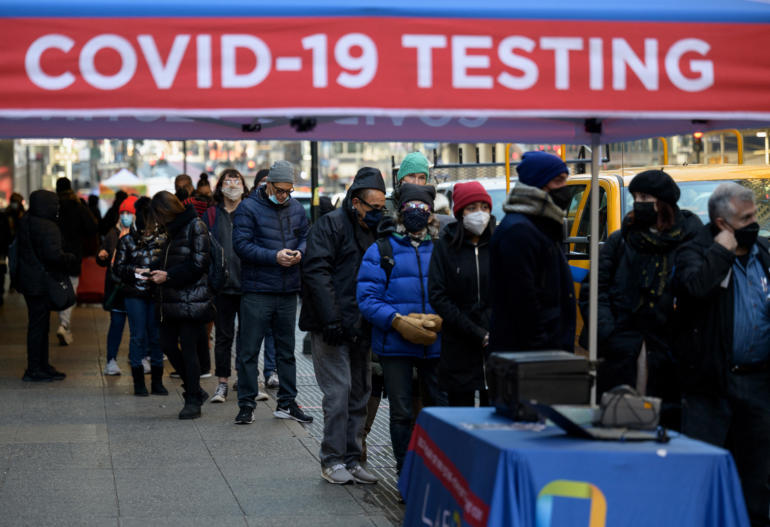
People wait in line to receive a Covid-19 test on January 4, 2022, in New York. – The US recorded more than 1 million Covid-19 cases on January 3, 2022, according to data from Johns Hopkins University, as the Omicron variant continues to spread at a blistering pace. Johns Hopkins also reported 1,688 deaths for the same period, a day after top US pandemic advisor Anthony Fauci had said the country is experiencing “almost a vertical increase” in Covid-19 cases but the peak may be only weeks away. (Photo by ANGELA WEISS / AFP)

On Monday, the United States set another grim coronavirus milestone: more than 1 million new cases reported in a single day.

The spike is stark. The Omicron variant is infecting people at alarming rates. President Joe Biden addressed the staggering numbers.

CGTN White Correspondent Nathan King has more.

To discuss:

  • Dr. Peter Chin-Hong is a professor of medicine and an infectious disease specialist at the University of California.
  • Dr. Ziyad Al-Aly is the Director of the Clinical Epidemiology Center at the Veteran Affairs Saint Louis Health Care System.
  • Dr. Georges Benjamin is the Executive Director of the American Public Health Association.
  • Joseph Williams is Senior Managing Editor for Color of Change.

Can $1 billion really fix a meat industry dominated by just four companies?


by Jessica Fu

01.05.2022

Mario Tama/Getty Images


The Biden administration’s newly announced investment in small, independent processors is intended to level the playing field. But without addressing the root causes of market concentration, critics fear it may have limited impact.


The Biden-Harris Administration announced on Monday that it would dedicate $1 billion from the $1.9 trillion American Rescue Plan to curb consolidation and boost competition in the livestock industry, which it blames for rising prices at the grocery store.

The plan was well received by farm groups and some supporters of stronger antitrust laws, including organizations like the Farm Action and the Open Markets Institute. But it also received pushback from some of the very factions the move was intended to please. For cattle ranchers and anti-monopoly advocates who’ve long been concerned that a tiny handful of global food corporations control prices on both ends of the supply chain, the news represented a missed opportunity to address the root causes of industry concentration.

To understand these divergent responses, and why “consolidation”—a decades-long trend that narrowed the market to a small group of processing giants—has become a newly urgent flashpoint amid persistent supply chain frustrations, you need to know how the meat industry became so concentrated in the first place, and how the White House plan fits into that larger picture.

Big Meat: Big problem?

Beef prices have jumped an eye-popping 21 percent over the past year, according to the Department of Agriculture’s (USDA) latest food price outlook report; prices for pork increased by almost 17 percent and poultry by more than 8 percent in the same period. White House economic advisors last month estimated that meat is the single biggest contributor to rising food costs right now, accounting for a quarter of total price increases.

At the same time as meat’s gotten more expensive, cattle prices have gone down. In theory, that shouldn’t happen—and critics say the concentrated power of a small cohort of multinational meatpackers is to blame.

The Big Four are beautifully positioned to take advantage of supply chain chaos.

Today, the so-called “Big Four” beef processing companies—which include Tyson Foods, JBS, Cargill, and Marfrig—control around 85 percent of feedlot cattle in the U.S. (Beef has seen the fastest rate of consolidation compared to poultry and pork). In recent years, producers have accused these companies of engaging in anti-competitive business practices, like depressing live cattle prices through restrictive contracts or artificially restricted supply, while simultaneously reaping record profits.

The coronavirus pandemic has highlighted how this dynamic can play out under extreme circumstances: Outbreak-related shutdowns in the early spring of 2020 caused backlogs of live animals with nowhere to go for slaughter, tanking the prices big packers pay to ranchers for their animals. Meanwhile, on the other end of the supply chain, the resulting inventory shortages at grocery stores drove up the cost of meat for consumers. These concurrent trends meant that the “meat margin”—that is, the difference between what processors pay for livestock and what they charge for meat—widened significantly, leading to soaring profits.

In other words, the Big Four are beautifully positioned to take advantage of supply chain chaos: disruptions led to historically low cattle prices, but spooked consumers have proven willing to pay more to stockpile their freezers with meat.

How did we get the “Big Four?”

Economists measure consolidation using what is called the “four-firm concentration ratio,” which refers to the market share controlled by the four biggest companies in any given industry. In 1977, the four biggest beef packers controlled just 25 percent of the market, according to the U.S. Census Bureau. Within 15 years, that number had jumped to 71 percent—a nearly threefold increase. Today, that number hovers around 85 percent.

James MacDonald, a University of Maryland agricultural economics professor who has conducted research on meat industry concentration, said that two important factors drove what he described as a “dramatic” rate of consolidation in the industry in the 1970s and 1980s: economies of scale and lower wages.

“In beef packing, an important driver was that large firms realized they could reduce processing costs by building much bigger plants,” he said. Another key factor was a series of labor fights that resulted in lower wages for the meatpacking workers employed by those companies that were rapidly expanding, further accelerating their dominance within a consolidating industry.


“In beef packing, an important driver was that large firms realized they could reduce processing costs by building much bigger plants.”


“Through the early 1980s, there was a series of labor battles, strikes, lockouts, plant closures,” MacDonald said. “In a very short period of time, the average production worker wage in meatpacking fell very sharply, [particularly] in the larger plants, because that’s really where they broke the unions.” Average hourly wages in the largest meatpacking plants fell by almost 15 percent in the decade between 1982 and 1992.

Together, MacDonald said, those factors helped the biggest packers to become very large and cost-efficient, while making it harder for smaller packers to compete—setting the stage for the concentrated industry we see today.

What would the White House plan do to curb consolidation?

A lot—at least according to the White House. Its billion-dollar aid package will include $375 million in grants for independent processing plants (which it expects to pay out through the spring and summer of this year); $375 million in loan support; $100 million to fund worker safety and training programs; $50 million in research and development, and $100 million in subsidies to help small processing plants cover inspection costs.

But critics of the plan argue that the White House largely excluded from its announcement a concrete timeline by which it would enforce the robust competition laws that already exist.

In 1921, Congress passed the Packers and Stockyards Act, a set of laws aimed at protecting producers from anti-competitive practices on the part of meatpackers, like unequal treatment and price manipulation. In 2016, the Obama administration promulgated a set of rules under the act that would have given farmers and ranchers an avenue for legal recourse against those unfair practices, and outlawed delayed payment and economic retaliation, among other things. Those reforms were later rolled back under the Trump administration. In June of last year, USDA announced that it had begun working to reinstate them and to strengthen its enforcement actions under the Packers and Stockyards Act. That hasn’t yet happened, though—and now, six months later, supporters of these protections are scratching their heads, wondering when the agency will actually take action.


“USDA is going to essentially establish a hotline so cattle producers could continue complaining about potentially anti-competitive practices to a regulatory agency that hasn’t done anything about all of the previous complaints that have been filed.”


Monday’s announcement provided little clarity. Instead, USDA committed that it would, within 30 days, set up a tip line through which farmers and ranchers could file complaints about unfair practices. The agency would then refer them to the Department of Justice for investigation “as appropriate”—a far cry from the decisive steps that anti-monopoly advocates were hoping for.

“They’re going to essentially establish a hotline so cattle producers could continue complaining about potentially anti-competitive practices to a regulatory agency that hasn’t done anything about all of the previous complaints that have been filed,” said Bill Bullard, president and CEO of Ranchers-Cattlemen Action Legal Fund United Stockgrowers of America (R-CALF USA). In 2019, R-CALF USA filed a lawsuit against the Big Four, alleging anti-competitive business practices. An amended version of the case is currently in discovery.

Who’s getting excited?

Owners of independent meat processing plants, obviously, as well as many livestock producers. In July, USDA received more than 400 comments from industry stakeholders, including farmers, ranchers, and processing companies, many of them largely enthusiastic about federal funding to expand meat processing capacity, worker training, and infrastructure investments.

Monday’s announcement was also warmly received by multiple lawmakers and organizations, including those that have advocated for greater scrutiny of meatpacking giants.


“We must get to the bottom of why farmers and ranchers continue to receive low payments while families across America endure rising meat prices.”


“For too long, our meat and poultry supply chain has been over reliant on a handful of large-scale companies that dominate the market,” wrote Representative Chellie Pingree, the Democratic congresswoman from Maine, in a press release. (Pingree has previously sponsored legislation that would provide funding for small processors.) “The Biden-Harris Administration’s action plan […] will work to create a more competitive and resilient meat and poultry sector and is a win for local farmers and small businesses, the market, consumers, and hungry Americans.”

Bigger groups like the Farm Bureau also welcomed the announcement.

“American Farm Bureau Federation appreciates the Biden administration’s continued work to ensure a fair and competitive meat processing system,” read a statement from president Zippy Duvall. “We must get to the bottom of why farmers and ranchers continue to receive low payments while families across America endure rising meat prices.”

Who’s not having it?

Those who believe that an influx of funding can’t fix a system rigged against small- and mid-scale processors. From an economic standpoint, said Darren Hudson, a professor of agricultural economics at Texas Tech University, who has researched concentration in agriculture, a $1 billion investment is unlikely to effect any significant, long-term change in the meat supply chain.

“It’s a horrible idea,” he said. “Subsidizing small processors isn’t going to solve any real problems. In a short run it might prop up or encourage some small processors to engage in meat processing [….] But unless they’re operating at a cost that’s equivalent to or very near what the major processors are, they won’t be able to compete over the long run.”

What’s an alternative?

Hudson’s sentiment was echoed by Austin Frerick, deputy director of the antitrust-oriented Thurman Arnold Project at Yale University, who called the plan “naive.” Going a step further, Frerick said that focusing resources solely on supporting small processors, instead of scrutinizing the practices of packing giants, meant USDA was missing the forest for the trees.

“They understand the issue, they want to pretend to have a solution, but they don’t want to actually do anything meaningful here or they don’t want to actually grapple with this industry, grapple with this corporate power that’s run amok,” he said.

Short of addressing the root causes of market concentration, any independent processors subsidized by federal dollars would still face the same economic challenges that pushed their predecessors out of business in the first place.

Like Bullard, Frerick said it would be far more effective to just enforce the Packers and Stockyards Act. Short of addressing the root causes of market concentration, any independent processors subsidized by federal dollars would still face the same economic challenges that pushed their predecessors out of business in the first place.

Since the 1980s, the meatpacking industry has undergone a series of mergers, in which larger packers edged out or bought up smaller competitors, usually those on the financial brink due to downward economic pressure that the bigger processors could exert. Frerick said he wouldn’t be surprised to see another wave of similar acquisitions between the Big Four and their smaller, subsidized competitors when the federal funding dries up.

“They’re throwing all this money at these plants,” Frerick said. “I just expect that in a few years they’ll go broke and then the big companies will buy them for pennies on the dollar.”


Jessica Fu is a staff writer for The Counter. She previously worked for The Stranger, Seattle's alt-weekly newspaper. Her reporting has won awards from the Association of Food Journalists and the Newswomen’s Club of New York.