
Chevron: the only foreign oil company left in Venezuela
By AFP
December 23, 2025

Chevron currently extract oil from four fields and offshore gas from another field in Venezuela - Copyright AFP Yuri CORTEZ
The US oil company Chevron is walking a tightrope amid tensions between Washington and Caracas to retain its fragile position as the only foreign company allowed to exploit Venezuela’s oil reserves —- the largest in the world.
Washington’s total blockade of oil tankers, added last week to punishing US sanctions, has put Chevron and its presence in Venezuela back in the spotlight.
– Why is Chevron in Venezuela? –
The Venezuelan Gulf Oil Company, Chevron’s predecessor in Venezuela, was founded in April 1923 and began operating its first well in August 1924.
Initially operating near Lake Maracaibo, it then moved on to new deposits such as Urumaco and Boscan. Most reserves are now in the Orinoco Belt.
Gulf Oil merged with Standard Oil of California in 1984, forming the giant now known as Chevron.
The group currently extracts oil from four fields and offshore gas from another field, covering a total area of nearly 30,000 hectares (115 square miles).
This is part of a partnership with the state-owned company PDVSA and its affiliates that employs around 3,000 people.
According to the International Energy Agency (IEA), in 2023, Venezuelan territory contained around 303 billion barrels, or about 17 percent of the world’s reserves.
The US embargo on Venezuelan crude oil, in place since 2019, was relaxed in 2023 with licenses to operate in the country.
But President Donald Trump revoked them all in the first half of 2025 before granting an exception to Chevron.
Yet, according to an industry expert, recent presidential decisions do not affect the group’s activities.
“We believe our presence continues to be a stabilizing force for the local economy, the region and US energy security,” the company told AFP, assuring that it operates in compliance with the law and “sanctions frameworks provided by the US government.”
Other foreign oil companies do not operate inside Venezuela because of the US embargo and a Venezuelan law that requires foreign firms to partner with PDVSA in majority state-owned ventures, a structure Chevron accepted when it was imposed.
– How many barrels? –
According to Stephen Schork, an analyst at the Schork Group consulting firm, Venezuela’s total production is around 800,000 to 900,000 barrels per day compared to more than 3 million at its peak.
With its license, Chevron generates around 10 percent of Venezuela’s production, although sources differ on the exact figure.
This currently represents around 150,000 to 200,000 barrels per day, 100 percent of which is exported to the United States.
But the oil is high-sulfur “sludge,” said Schork.
“It is heavy, nasty stuff. You can’t move this oil in a pipeline,” and it’s the hardest to refine, he explained.
Because of the embargo, Caracas is forced to sell its oil on the black market at heavy discounts, mainly to Asia.
But the new US blockade is expected to significantly reduce these illicit exports — by up to 50 percent according to experts.
– Does US need the oil? –
The United States has refineries around the Gulf of Mexico that were specifically designed decades ago to process this highly viscous Venezuelan oil.
Due to its lower quality, it is converted into diesel or by-products such as asphalt, rather than gasoline for cars.
“The United States does not need this oil,” noted Schork.
If they want it, he believes, it is for political reasons.
They want to “prevent the vacuum created by their departure from being filled by countries that do not share their values, such as China and Russia,” according to a source close to the matter.
By AFP
December 23, 2025
Chevron currently extract oil from four fields and offshore gas from another field in Venezuela - Copyright AFP Yuri CORTEZ
The US oil company Chevron is walking a tightrope amid tensions between Washington and Caracas to retain its fragile position as the only foreign company allowed to exploit Venezuela’s oil reserves —- the largest in the world.
Washington’s total blockade of oil tankers, added last week to punishing US sanctions, has put Chevron and its presence in Venezuela back in the spotlight.
– Why is Chevron in Venezuela? –
The Venezuelan Gulf Oil Company, Chevron’s predecessor in Venezuela, was founded in April 1923 and began operating its first well in August 1924.
Initially operating near Lake Maracaibo, it then moved on to new deposits such as Urumaco and Boscan. Most reserves are now in the Orinoco Belt.
Gulf Oil merged with Standard Oil of California in 1984, forming the giant now known as Chevron.
The group currently extracts oil from four fields and offshore gas from another field, covering a total area of nearly 30,000 hectares (115 square miles).
This is part of a partnership with the state-owned company PDVSA and its affiliates that employs around 3,000 people.
According to the International Energy Agency (IEA), in 2023, Venezuelan territory contained around 303 billion barrels, or about 17 percent of the world’s reserves.
The US embargo on Venezuelan crude oil, in place since 2019, was relaxed in 2023 with licenses to operate in the country.
But President Donald Trump revoked them all in the first half of 2025 before granting an exception to Chevron.
Yet, according to an industry expert, recent presidential decisions do not affect the group’s activities.
“We believe our presence continues to be a stabilizing force for the local economy, the region and US energy security,” the company told AFP, assuring that it operates in compliance with the law and “sanctions frameworks provided by the US government.”
Other foreign oil companies do not operate inside Venezuela because of the US embargo and a Venezuelan law that requires foreign firms to partner with PDVSA in majority state-owned ventures, a structure Chevron accepted when it was imposed.
– How many barrels? –
According to Stephen Schork, an analyst at the Schork Group consulting firm, Venezuela’s total production is around 800,000 to 900,000 barrels per day compared to more than 3 million at its peak.
With its license, Chevron generates around 10 percent of Venezuela’s production, although sources differ on the exact figure.
This currently represents around 150,000 to 200,000 barrels per day, 100 percent of which is exported to the United States.
But the oil is high-sulfur “sludge,” said Schork.
“It is heavy, nasty stuff. You can’t move this oil in a pipeline,” and it’s the hardest to refine, he explained.
Because of the embargo, Caracas is forced to sell its oil on the black market at heavy discounts, mainly to Asia.
But the new US blockade is expected to significantly reduce these illicit exports — by up to 50 percent according to experts.
– Does US need the oil? –
The United States has refineries around the Gulf of Mexico that were specifically designed decades ago to process this highly viscous Venezuelan oil.
Due to its lower quality, it is converted into diesel or by-products such as asphalt, rather than gasoline for cars.
“The United States does not need this oil,” noted Schork.
If they want it, he believes, it is for political reasons.
They want to “prevent the vacuum created by their departure from being filled by countries that do not share their values, such as China and Russia,” according to a source close to the matter.
UN experts slam US blockade on Venezuela
By AFP
December 24, 2025

US forces have launched dozens of deadly air strikes on boats that Washington alleges were transporting drugs - Copyright AFP Miguel J. Rodriguez Carrillo
Four United Nations rights experts on Wednesday condemned the US partial naval blockade of Venezuela, determining it illegal armed aggression and calling on the US Congress to intervene.
The United States has deployed a major military force in the Caribbean and has recently intercepted oil tankers as part of a naval blockade against Venezuelan vessels it considers to be under sanctions.
“There is no right to enforce unilateral sanctions through an armed blockade,” the UN experts said in a joint statement.
A blockade is a prohibited use of military force against another country under the UN Charter, they added.
“It is such a serious use of force that it is also expressly recognised as illegal armed aggression under the General Assembly’s 1974 Definition of Aggression,” they said.
“As such, it is an armed attack under article 51 of the Charter — in principle giving the victim state a right of self-defence.”
US President Donald Trump accuses Venezuela of using oil, the South American country’s main resource, to finance “narcoterrorism, human trafficking, murders, and kidnappings”.
Caracas denies any involvement in drug trafficking. It says Washington is seeking to overthrow its president, Nicolas Maduro, in order to seize Venezuelan oil reserves, the largest in the world.
Since September, US forces have launched dozens of air strikes on boats that Washington alleges, without showing evidence, were transporting drugs. More than 100 people have been killed.
– Congress should ‘intervene’ –
“These killings amount to violations of the right to life. They must be investigated and those responsible held accountable,” said the experts.
“Meanwhile, the US Congress should intervene to prevent further attacks and lift the blockade,” they added.
They called on countries to take measures to stop the blockade and illegal killings, and bring perpetrators justice.
The four who signed the joint statement are: Ben Saul, special rapporteur on protecting human rights while countering terrorism; George Katrougalos, the expert on promoting a democratic and equitable international order; development expert Surya Deva; and Gina Romero, who covers the right to freedom of peaceful assembly and association.
UN experts are independent figures mandated by the UN Human Rights Council to report their findings. They do not, therefore, speak for the United Nations itself.
On Tuesday at the UN in New York, Venezuela, having requested an emergency meeting of the Security Council, accused Washington of “the greatest extortion known in our history”.
By AFP
December 24, 2025
US forces have launched dozens of deadly air strikes on boats that Washington alleges were transporting drugs - Copyright AFP Miguel J. Rodriguez Carrillo
Four United Nations rights experts on Wednesday condemned the US partial naval blockade of Venezuela, determining it illegal armed aggression and calling on the US Congress to intervene.
The United States has deployed a major military force in the Caribbean and has recently intercepted oil tankers as part of a naval blockade against Venezuelan vessels it considers to be under sanctions.
“There is no right to enforce unilateral sanctions through an armed blockade,” the UN experts said in a joint statement.
A blockade is a prohibited use of military force against another country under the UN Charter, they added.
“It is such a serious use of force that it is also expressly recognised as illegal armed aggression under the General Assembly’s 1974 Definition of Aggression,” they said.
“As such, it is an armed attack under article 51 of the Charter — in principle giving the victim state a right of self-defence.”
US President Donald Trump accuses Venezuela of using oil, the South American country’s main resource, to finance “narcoterrorism, human trafficking, murders, and kidnappings”.
Caracas denies any involvement in drug trafficking. It says Washington is seeking to overthrow its president, Nicolas Maduro, in order to seize Venezuelan oil reserves, the largest in the world.
Since September, US forces have launched dozens of air strikes on boats that Washington alleges, without showing evidence, were transporting drugs. More than 100 people have been killed.
– Congress should ‘intervene’ –
“These killings amount to violations of the right to life. They must be investigated and those responsible held accountable,” said the experts.
“Meanwhile, the US Congress should intervene to prevent further attacks and lift the blockade,” they added.
They called on countries to take measures to stop the blockade and illegal killings, and bring perpetrators justice.
The four who signed the joint statement are: Ben Saul, special rapporteur on protecting human rights while countering terrorism; George Katrougalos, the expert on promoting a democratic and equitable international order; development expert Surya Deva; and Gina Romero, who covers the right to freedom of peaceful assembly and association.
UN experts are independent figures mandated by the UN Human Rights Council to report their findings. They do not, therefore, speak for the United Nations itself.
On Tuesday at the UN in New York, Venezuela, having requested an emergency meeting of the Security Council, accused Washington of “the greatest extortion known in our history”.
Trump ‘Choosing From the War Crimes Menu’ With ‘Quarantine’ on Venezuela Oil Exports
“Economic strangulation is warfare and civilians always pay the price,” lamented CodePink.
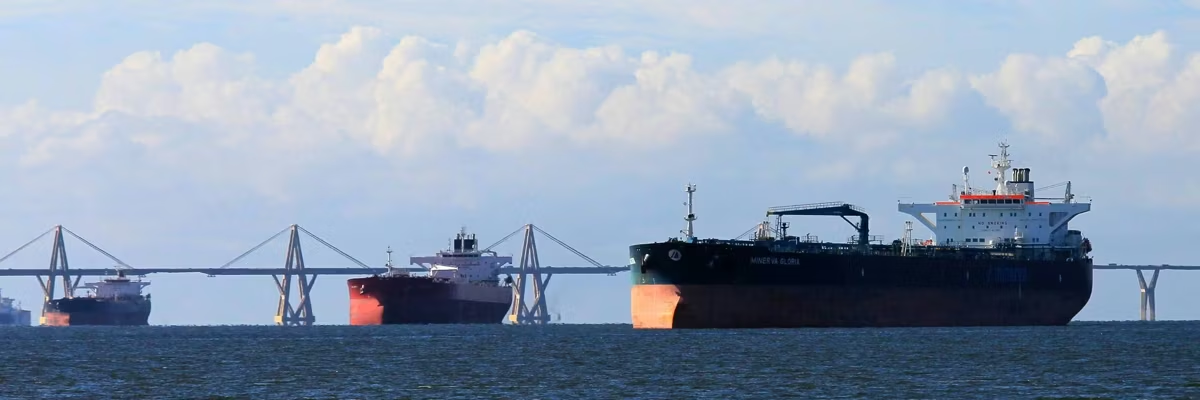
Oil tankers are seen anchored in Lake Maracaibo, Venezuela on December 4, 2025.
(Photo by José Bula Urrutia/UCG/Universal Images Group via Getty Images)
Brett Wilkins
Dec 25, 2025
COMMON DREAMS
President Donald Trump has ordered US military forces to further escalate their aggression against Venezuela by enforcing a “quarantine” on the South American nation’s oil—by far its main export—in what one peace group called an attempted act of “economic strangulation.”
“While military options still exist, the focus is to first use economic pressure by enforcing sanctions to reach the outcome the White House is looking [for],” a US official, who spoke on condition of anonymity, told Reuters.
The move follows the deployment of an armada of US warships and thousands of troops to the region, threats to invade Venezuela, oil tanker seizures off the Venezuelan coast, Trump’s authorization of covert CIA action against the socialist government of Venezuelan President Nicolás Maduro, and airstrikes against boats allegedly running drugs in the Caribbean Sea and Pacific Ocean that have killed more than 100 people in what critics say are murders and likely war crimes.
This, atop existing economic sanctions that experts say have killed tens of thousands of Venezuelans since they were first imposed during the first Trump administration in 2017.
“The efforts so far have put tremendous pressure on Maduro, and the belief is that by late January, Venezuela will be facing an economic calamity unless it agrees to make significant concessions to the US,” the official told Reuters.
The official’s use of the word “quarantine” evoked the 1962 Cuban Missile Crisis, an existential standoff that occurred after the John F. Kennedy administration imposed a naval blockade around Cuba to prevent Soviet nuclear missiles from being deployed on the island, even as the US was surrounding the Soviet Union with nuclear weapons.
“This is an illegal blockade,” the women-led peace group CodePink said in response to the Reuters report. “Calling it a ‘quarantine’ doesn’t change the reality. The US regime is using hunger as a weapon of war to force regime change in Venezuela. Economic strangulation is warfare and civilians always pay the price. The US is a regime of terror.”
Critics have also compared Trump’s aggression to the George W. Bush administration’s buildup to the invasion and occupation of Iraq, initially referred to as Operation Iraqi Liberation (OIL). But unlike Bush, Trump—who derided Bush for not seizing Iraq’s petroleum resources as spoils of war—has openly acknowledged his desire to take Venezuela’s oil.
“Maybe we will sell it, maybe we will keep it,” he Trump said on Monday. “Maybe we’ll use it in the strategic reserves. We’re keeping the ships also.”
On Wednesday, a panel of United Nations experts said that the US blockade and boat strikes constitute “illegal armed aggression” against Venezuela.
Multiple efforts by US lawmakers—mostly Democrats, but also a handful of anti-war Republicans—to pass a war powers resolution blocking the Trump administration from bombing boats or attacking Venezuela have failed.
The blockade and vessel seizures have paralyzed Venezuela’s oil exports. Ports are clogged with full tankers whose operators are fearful of entering international waters. Venezuela-bound tankers have also turned back for fear of seizure. Although Venezuelan military vessels are accompanying tankers, the escorts stop once the ships reach international waters.
According to the New York Times, Venezuela is considering putting armed troops aboard tankers bound for China, which, along with Russia, has pledged its support—but little more—for Caracas.
Trump Isn’t Planning to Invade Venezuela. He’s Planning Something Worse
Rather than launching a military invasion that would provoke public backlash and congressional scrutiny, Trump is doubling down on something more insidious.
Rather than launching a military invasion that would provoke public backlash and congressional scrutiny, Trump is doubling down on something more insidious.
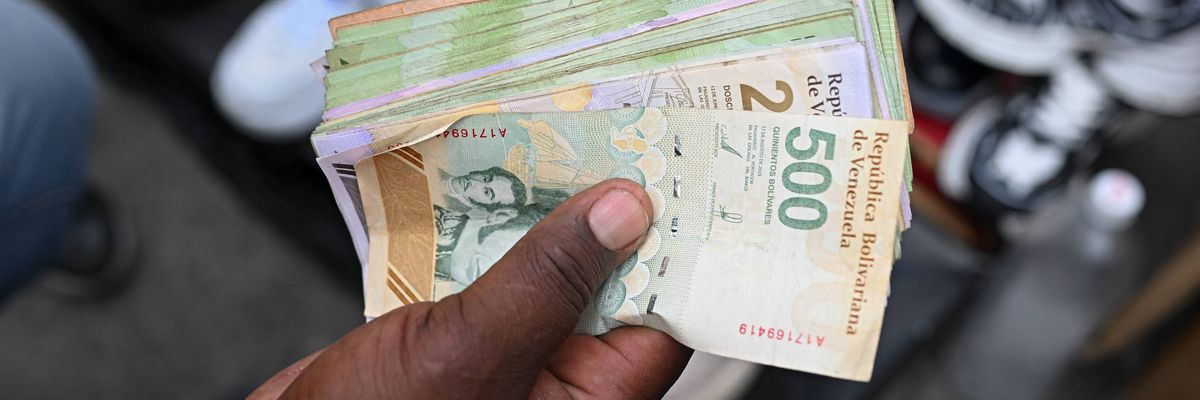
A vendor counts Venezuelan bolivar banknotes at La Hoyada market in Caracas on December 23, 2025.
(Photo by Federico Parra/AFP via Getty Images)
Michelle Ellner
Dec 25, 2025
Common Dreams
The loudest question in Washington right now is whether Donald Trump is going to invade Venezuela. The quieter, and far more dangerous, reality is this: he probably won’t. Not because he cares about Venezuelan lives, but because he has found a strategy that is cheaper, less politically risky at home, and infinitely more devastating: economic warfare.
Venezuela has already survived years of economic warfare. Despite two decades of sweeping US sanctions designed to strangle its economy, the country has found ways to adapt: oil has moved through alternative markets; communities have developed survival strategies; people have endured shortages and hardship with creativity and resilience. This endurance is precisely what the Trump administration is trying to break.
Rather than launching a military invasion that would provoke public backlash and congressional scrutiny, Trump is doubling down on something more insidious: total economic asphyxiation. By tightening restrictions on Venezuelan oil exports, its primary source of revenue, Trump’s administration is deliberately pushing the country toward a full-scale humanitarian collapse.
In recent months, US actions in the Caribbean Sea, including the harassment and interdiction of oil tankers linked to Venezuela, signal a shift from financial pressure to illegal maritime force. These operations have increasingly targeted Venezuela’s ability to move its own resources through international waters. Oil tankers have been delayed, seized, threatened with secondary sanctions, or forced to reroute under coercion. The objective is strangulation.
This is illegal under international law.
The freedom of navigation on the high seas is a cornerstone of international maritime law, enshrined in the UN Convention on the Law of the Sea. Unilateral interdiction of civilian commercial vessels, absent a UN Security Council mandate, violates the principle of sovereign equality and non-intervention. The extraterritorial enforcement of US sanctions, punishing third countries and private actors for engaging in lawful trade with Venezuela, has no legal basis. It is coercion, plain and simple. More importantly, the intent is collective punishment.
Trump’s calculation is brutally simple: make Venezuelans so miserable that they will rise up and overthrow Maduro.
By preventing Venezuela from exporting oil, which is the revenue that funds food imports, medicine, electricity, and public services, the Trump administration is knowingly engineering conditions of mass deprivation. Under international humanitarian law, collective punishment is prohibited precisely because it targets civilians as a means to achieve political ends. And if this continues, we will see horrific images: empty shelves, malnourished children, overwhelmed hospitals, people scavenging for food. Scenes that echo those coming out of Gaza, where siege and starvation have been normalized as weapons of war.
US actions will undoubtedly cause millions of Venezuelans to flee the country, likely seeking to travel to the United States, which they are told is safe for their families, full of economic opportunities, and security. . But Trump is sealing the US border, cutting off asylum pathways, and criminalizing migration. When people are starved, when economies are crushed, when daily life becomes unlivable, people move. Blocking Venezuelans from entering the United States while systematically destroying the conditions that allow them to survive at home means that neighboring countries like Colombia, Brazil, and Chile will be asked to absorb the human cost of Washington’s decisions. This is how empire outsources the damage. But these countries have their own economic woes, and mass displacement of Venezuelans will destabilize the entire region.
Venezuela is a test case. What is being refined now—economic siege without formal war, maritime coercion without declared blockade, starvation without bombs—is a blueprint. Any country that refuses compliance with Washington’s political and economic demands should be paying attention. This will be the map for 21st century regime change.
And this is how Trump can reassure the United States Congress that he is not “going to war” with Venezuela. He doesn’t need to. Economic strangulation carries none of the immediate political costs of a military intervention, even as it inflicts slow, widespread devastation. There are no body bags returning to US soil, no draft, no televised bombing campaigns. Just a steady erosion of life elsewhere.
Trump’s calculation is brutally simple: make Venezuelans so miserable that they will rise up and overthrow Maduro. That has been the same calculation behind US policy toward Cuba for six decades—and it has failed. Economic strangulation doesn’t bring democracy; it brings suffering. And even if, by some grim chance, it did succeed in toppling the government, the likely result would not be freedom but chaos—possibly a protracted civil war that could devastate the country, and the region, for decades.
Tomorrow, people in Venezuela will celebrate Christmas. Families will gather around the table to eat hallacas wrapped with care, slices of pan de jamón, and dulce de lechoza. They will share stories, dance to gaitas, and make a toast with Ponche Crema.
If we oppose war because it kills, we must also oppose sanctions that do the same, more quietly, more slowly, and with far less accountability.
But if this economic siege continues, if Venezuelan oil is fully cut off, if the country is denied the means to feed itself, if hunger is allowed to finish what bombs are no longer politically useful to accomplish, then this Christmas may be remembered as one of the last Venezuelans were able to celebrate in anything resembling normal life, at least in the near future.
Polls consistently show that nearly 70 percent of people in the United States oppose a military intervention in Venezuela. War is recognized for what it is: violent, destructive, unacceptable. But sanctions are treated differently. Many people believe they are a harmless alternative, a way to apply “pressure” without bloodshed.
That assumption is dangerously wrong. According to a comprehensive study in medical journal The Lancet, sanctions increase mortality at levels comparable to armed conflict, hitting children and the elderly first. Sanctions do not avoid civilian harm—they systematically produce it.
If we oppose war because it kills, we must also oppose sanctions that do the same, more quietly, more slowly, and with far less accountability. If we don’t act against economic warfare with the same urgency we reserve for bombs and invasions, then sanctions will remain the preferred weapon: politically convenient but equally deadly.
Our work is licensed under Creative Commons (CC BY-NC-ND 3.0). Feel free to republish and share widely.
Michelle Ellner
Michelle Ellner is a Latin America campaign coordinator of CODEPINK. She was born in Venezuela and holds a bachelor’s degree in languages and international affairs from the University La Sorbonne Paris IV, in Paris. After graduating, she worked for an international scholarship program out of offices in Caracas and Paris and was sent to Haiti, Cuba, The Gambia, and other countries for the purpose of evaluating and selecting applicants.
Full Bio >
The loudest question in Washington right now is whether Donald Trump is going to invade Venezuela. The quieter, and far more dangerous, reality is this: he probably won’t. Not because he cares about Venezuelan lives, but because he has found a strategy that is cheaper, less politically risky at home, and infinitely more devastating: economic warfare.
Venezuela has already survived years of economic warfare. Despite two decades of sweeping US sanctions designed to strangle its economy, the country has found ways to adapt: oil has moved through alternative markets; communities have developed survival strategies; people have endured shortages and hardship with creativity and resilience. This endurance is precisely what the Trump administration is trying to break.
Rather than launching a military invasion that would provoke public backlash and congressional scrutiny, Trump is doubling down on something more insidious: total economic asphyxiation. By tightening restrictions on Venezuelan oil exports, its primary source of revenue, Trump’s administration is deliberately pushing the country toward a full-scale humanitarian collapse.
In recent months, US actions in the Caribbean Sea, including the harassment and interdiction of oil tankers linked to Venezuela, signal a shift from financial pressure to illegal maritime force. These operations have increasingly targeted Venezuela’s ability to move its own resources through international waters. Oil tankers have been delayed, seized, threatened with secondary sanctions, or forced to reroute under coercion. The objective is strangulation.
This is illegal under international law.
The freedom of navigation on the high seas is a cornerstone of international maritime law, enshrined in the UN Convention on the Law of the Sea. Unilateral interdiction of civilian commercial vessels, absent a UN Security Council mandate, violates the principle of sovereign equality and non-intervention. The extraterritorial enforcement of US sanctions, punishing third countries and private actors for engaging in lawful trade with Venezuela, has no legal basis. It is coercion, plain and simple. More importantly, the intent is collective punishment.
Trump’s calculation is brutally simple: make Venezuelans so miserable that they will rise up and overthrow Maduro.
By preventing Venezuela from exporting oil, which is the revenue that funds food imports, medicine, electricity, and public services, the Trump administration is knowingly engineering conditions of mass deprivation. Under international humanitarian law, collective punishment is prohibited precisely because it targets civilians as a means to achieve political ends. And if this continues, we will see horrific images: empty shelves, malnourished children, overwhelmed hospitals, people scavenging for food. Scenes that echo those coming out of Gaza, where siege and starvation have been normalized as weapons of war.
US actions will undoubtedly cause millions of Venezuelans to flee the country, likely seeking to travel to the United States, which they are told is safe for their families, full of economic opportunities, and security. . But Trump is sealing the US border, cutting off asylum pathways, and criminalizing migration. When people are starved, when economies are crushed, when daily life becomes unlivable, people move. Blocking Venezuelans from entering the United States while systematically destroying the conditions that allow them to survive at home means that neighboring countries like Colombia, Brazil, and Chile will be asked to absorb the human cost of Washington’s decisions. This is how empire outsources the damage. But these countries have their own economic woes, and mass displacement of Venezuelans will destabilize the entire region.
Venezuela is a test case. What is being refined now—economic siege without formal war, maritime coercion without declared blockade, starvation without bombs—is a blueprint. Any country that refuses compliance with Washington’s political and economic demands should be paying attention. This will be the map for 21st century regime change.
And this is how Trump can reassure the United States Congress that he is not “going to war” with Venezuela. He doesn’t need to. Economic strangulation carries none of the immediate political costs of a military intervention, even as it inflicts slow, widespread devastation. There are no body bags returning to US soil, no draft, no televised bombing campaigns. Just a steady erosion of life elsewhere.
Trump’s calculation is brutally simple: make Venezuelans so miserable that they will rise up and overthrow Maduro. That has been the same calculation behind US policy toward Cuba for six decades—and it has failed. Economic strangulation doesn’t bring democracy; it brings suffering. And even if, by some grim chance, it did succeed in toppling the government, the likely result would not be freedom but chaos—possibly a protracted civil war that could devastate the country, and the region, for decades.
Tomorrow, people in Venezuela will celebrate Christmas. Families will gather around the table to eat hallacas wrapped with care, slices of pan de jamón, and dulce de lechoza. They will share stories, dance to gaitas, and make a toast with Ponche Crema.
If we oppose war because it kills, we must also oppose sanctions that do the same, more quietly, more slowly, and with far less accountability.
But if this economic siege continues, if Venezuelan oil is fully cut off, if the country is denied the means to feed itself, if hunger is allowed to finish what bombs are no longer politically useful to accomplish, then this Christmas may be remembered as one of the last Venezuelans were able to celebrate in anything resembling normal life, at least in the near future.
Polls consistently show that nearly 70 percent of people in the United States oppose a military intervention in Venezuela. War is recognized for what it is: violent, destructive, unacceptable. But sanctions are treated differently. Many people believe they are a harmless alternative, a way to apply “pressure” without bloodshed.
That assumption is dangerously wrong. According to a comprehensive study in medical journal The Lancet, sanctions increase mortality at levels comparable to armed conflict, hitting children and the elderly first. Sanctions do not avoid civilian harm—they systematically produce it.
If we oppose war because it kills, we must also oppose sanctions that do the same, more quietly, more slowly, and with far less accountability. If we don’t act against economic warfare with the same urgency we reserve for bombs and invasions, then sanctions will remain the preferred weapon: politically convenient but equally deadly.
Our work is licensed under Creative Commons (CC BY-NC-ND 3.0). Feel free to republish and share widely.
Michelle Ellner
Michelle Ellner is a Latin America campaign coordinator of CODEPINK. She was born in Venezuela and holds a bachelor’s degree in languages and international affairs from the University La Sorbonne Paris IV, in Paris. After graduating, she worked for an international scholarship program out of offices in Caracas and Paris and was sent to Haiti, Cuba, The Gambia, and other countries for the purpose of evaluating and selecting applicants.
Full Bio >

No comments:
Post a Comment